×
  • Cat-intel
  • MedIntelliX
  • Resources
  • About Us
  • Hero Background
    English
    Chinese
    French
    Japanese
    Korean
    German
    Spanish

    Polyalkylene Glycol Market Share

    ID: MRFR/CnM/3645-HCR
    138 Pages
    Anshula Mandaokar
    October 2025

    Polyalkylene Glycol Market Research Report Information by Product (Polyethylene Glycol, Polypropylene Glycol), by Application (Polyurethane Foam, Functional Fluids, Lubricants, Personal Care, Pharmaceuticals and Surface Active Agents) – Forecast till 2035

    Share:
    Download PDF ×

    We do not share your information with anyone. However, we may send you emails based on your report interest from time to time. You may contact us at any time to opt-out.

    Polyalkylene Glycol Market Infographic
    Purchase Options

    Market Share

    Polyalkylene Glycol Market Share Analysis

    Market share positioning strategies are crucial for companies operating in the Polyalkylene Glycol Market to establish a strong presence and gain a competitive edge. Several key strategies are employed to enhance market share:

    Product Differentiation: Companies differentiate their polyalkylene glycol products by offering unique features such as specific molecular weights, viscosities, and functionalities tailored to meet the diverse needs of end-users. By focusing on product innovation and customization, companies can attract a wider customer base and capture a larger market share.

    Market Segmentation: Effective market segmentation allows companies to target specific industries and applications where polyalkylene glycols are in high demand. By understanding the unique requirements of each segment, companies can tailor their marketing strategies and product offerings to effectively penetrate and capture market share in niche markets.

    Strategic Partnerships and Collaborations: Forming strategic partnerships and collaborations with distributors, suppliers, and industry players can help companies expand their market reach and increase their share of the polyalkylene glycol market. Collaborative efforts such as joint ventures, licensing agreements, and strategic alliances enable companies to leverage each other's strengths and resources to gain a competitive advantage.

    Investment in Research and Development: Companies that invest in research and development (R&D) to improve product quality, develop new applications, and enhance manufacturing processes are better positioned to capture a larger market share. By staying at the forefront of technological advancements and innovation, companies can offer superior products that meet the evolving needs of customers and gain a competitive edge in the market.

    Focus on Customer Service and Support: Providing excellent customer service and support is essential for building strong relationships with customers and increasing market share. Companies that offer comprehensive technical assistance, timely delivery, and responsive customer support can attract and retain loyal customers, ultimately leading to a larger market share.

    Geographical Expansion: Expanding into new geographical regions and emerging markets is another strategy for increasing market share in the polyalkylene glycol market. Companies can capitalize on growing demand in regions such as Asia-Pacific, Latin America, and the Middle East by establishing a strong presence, forming partnerships with local distributors, and adapting their products to meet regional requirements.

    Price Competitiveness: Pricing strategies play a significant role in determining market share in the polyalkylene glycol market. Companies may adopt competitive pricing strategies to gain market share by offering products at lower prices compared to competitors while maintaining profitability. However, companies must balance price competitiveness with product quality and value to avoid devaluing their brand and sacrificing long-term profitability.

    Brand Building and Marketing Initiatives: Investing in brand building and marketing initiatives helps companies increase brand awareness, visibility, and reputation in the polyalkylene glycol market. Through targeted marketing campaigns, advertising efforts, and participation in industry events and trade shows, companies can effectively communicate their value proposition and differentiate themselves from competitors, ultimately leading to an increase in market share.

    Author
    Anshula Mandaokar
    Team Lead - Research

    Anshula Mandaokar holds an academic degree in Chemical Engineering and has been contributing to the field for more than 5 years. She has expertise in Market Research and Business Consulting and serves as a Team Lead for a reputed Market Research firm under the Chemicals and Materials domain spectrum. She has worked on multiple projects, generating explicit results in a quick turnaround time. Her understanding of data interpretation justifies her role as a leader.

    Leave a Comment

    FAQs

    What is polyalkylene glycol?

    Polyalkylene glycol is a waxy, crystalline compound that is soluble in various organic solvents, including benzene and chloroform.

    Where is polyalkylene glycol used?

    Polyalkylene glycol is used in various applications, including polyurethane foam, personal care products, functional fluids, and lubricants. The polyurethane foam segment dominates the global market, followed by the functional fluids and lubricants segments.

    What is the major driver for the global market?

    The increasing use of polyalkylene glycol in the production of industrial and automotive lubricants is likely to be the major driver for the global polyalkylene glycol market over the forecast period.

    Which is the leading regional market for polyalkylene glycol?

    Asia Pacific holds the largest share in the global polyalkylene glycol market.

    What are the leading players in the polyalkylene glycol market?

    Leading players in the polyalkylene glycol market include Clariant, BASF, Dow, LyondellBasell, SABIC, INEOS, Bayer AG, Royal Dutch Shell plc, and Huntsman International.

    Market Summary

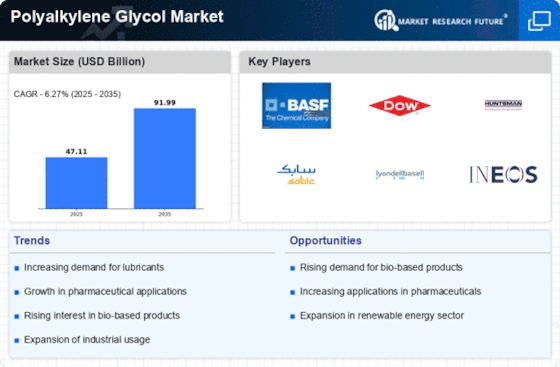
    As per MRFR analysis, the Polyalkylene Glycol Market Size was estimated at 47.11 USD Billion in 2024. The Polyalkylene Glycol industry is projected to grow from 50.06 USD Billion in 2025 to 91.99 USD Billion by 2035, exhibiting a compound annual growth rate (CAGR) of 6.27 during the forecast period 2025 - 2035.

    Key Market Trends & Highlights

    The Polyalkylene Glycol Market is experiencing robust growth driven by sustainability and technological advancements.

    • North America remains the largest market for polyalkylene glycols, driven by diverse industrial applications.
    • Asia-Pacific is emerging as the fastest-growing region, reflecting increasing demand across various sectors.
    • Polyethylene Glycol continues to dominate the market, while Polypropylene Glycol is witnessing rapid growth due to its versatile applications.
    • Key market drivers include rising demand in the automotive sector and an increased focus on sustainable practices.

    Market Size & Forecast

    2024 Market Size 47.11 (USD Billion)
    2035 Market Size 91.99 (USD Billion)
    CAGR (2025 - 2035) 6.27%
    Largest Regional Market Share in 2024 Asia Pacific

    Major Players

    <p>BASF SE (DE), Dow Inc. (US), Huntsman Corporation (US), SABIC (SA), LyondellBasell Industries N.V. (NL), Ineos Group Limited (GB), Clariant AG (CH), Eastman Chemical Company (US), Mitsubishi Chemical Corporation (JP)</p>

    Market Trends

    The Polyalkylene Glycol Market is currently experiencing a notable transformation, driven by various factors that influence its growth trajectory. The increasing demand for environmentally friendly products is prompting manufacturers to explore sustainable alternatives, thereby enhancing the appeal of polyalkylene glycols. These compounds are recognized for their versatility and effectiveness in numerous applications, including lubricants, surfactants, and personal care products. As industries seek to reduce their environmental footprint, the adoption of bio-based polyalkylene glycols appears to be gaining momentum, suggesting a shift towards greener formulations. Furthermore, advancements in production technologies are likely to improve efficiency and reduce costs, which may further stimulate market expansion. In addition to sustainability, the Polyalkylene Glycol Market is witnessing a surge in applications across diverse sectors. The automotive and aerospace industries, in particular, are increasingly utilizing these compounds for their superior performance characteristics. This trend indicates a growing recognition of the benefits offered by polyalkylene glycols, such as enhanced lubrication and reduced wear. Moreover, the pharmaceutical and cosmetic sectors are also exploring innovative uses, which could potentially broaden the market's scope. Overall, the Polyalkylene Glycol Market appears poised for growth, driven by evolving consumer preferences and technological advancements.

    Sustainability Initiatives

    The Polyalkylene Glycol Market is increasingly influenced by sustainability initiatives. Manufacturers are focusing on developing bio-based alternatives to traditional polyalkylene glycols, which aligns with the global push for environmentally friendly products. This trend not only caters to consumer preferences but also helps companies comply with stringent regulations regarding chemical safety and environmental impact.

    Technological Advancements

    Technological advancements in production processes are reshaping the Polyalkylene Glycol Market. Innovations aimed at enhancing efficiency and reducing production costs are becoming more prevalent. These improvements may lead to higher quality products and increased availability, thereby attracting a broader customer base across various industries.

    Diverse Application Growth

    The expansion of applications for polyalkylene glycols is a notable trend within the market. Industries such as automotive, aerospace, and personal care are increasingly recognizing the benefits of these compounds. This diversification suggests a robust potential for market growth as new uses are discovered and developed.

    Polyalkylene Glycol Market Market Drivers

    Rising Demand in Automotive Sector

    The Polyalkylene Glycol Market is experiencing a notable surge in demand from the automotive sector. This increase is primarily attributed to the growing need for high-performance lubricants and coolants that enhance engine efficiency and reduce emissions. Polyalkylene glycols are favored for their superior thermal stability and low volatility, making them ideal for modern automotive applications. According to recent data, the automotive lubricants segment is projected to witness a compound annual growth rate of approximately 4.5% over the next few years. This trend indicates a robust market potential for polyalkylene glycols, as manufacturers seek to meet stringent environmental regulations while improving vehicle performance. As the automotive industry continues to evolve, the reliance on advanced materials like polyalkylene glycols is likely to expand, further driving the market forward.

    Expansion in Personal Care Products

    The Polyalkylene Glycol Market is witnessing a significant expansion due to the increasing incorporation of polyalkylene glycols in personal care products. These compounds are valued for their emulsifying and moisturizing properties, making them essential in formulations for creams, lotions, and hair care products. The personal care sector is projected to grow at a compound annual growth rate of approximately 5% in the coming years, driven by rising consumer awareness regarding skincare and hygiene. As manufacturers strive to create innovative and effective products, the demand for polyalkylene glycols is likely to rise, reflecting their versatility and effectiveness. This trend indicates a robust opportunity for the Polyalkylene Glycol Market, as it aligns with the growing consumer preference for high-quality personal care solutions.

    Growth in Pharmaceutical Applications

    The Polyalkylene Glycol Market is significantly influenced by the expanding applications within the pharmaceutical sector. Polyalkylene glycols are utilized as excipients in drug formulations, enhancing solubility and bioavailability of active pharmaceutical ingredients. The increasing focus on drug delivery systems and the development of novel therapeutics are propelling the demand for these compounds. Recent statistics indicate that the pharmaceutical excipients market is expected to grow at a rate of around 6% annually, suggesting a favorable environment for polyalkylene glycols. This growth is likely to be driven by the rising prevalence of chronic diseases and the need for effective medication delivery methods. Consequently, the integration of polyalkylene glycols in pharmaceutical formulations is anticipated to bolster their market presence, reflecting a promising trajectory for the Polyalkylene Glycol Market.

    Technological Innovations in Production

    The Polyalkylene Glycol Market is poised for growth due to ongoing technological innovations in production processes. Advances in manufacturing techniques are enhancing the efficiency and cost-effectiveness of polyalkylene glycol production, thereby increasing availability and reducing prices. Innovations such as continuous processing and improved catalyst systems are streamlining operations, which could lead to a more competitive market landscape. Recent data indicates that the production capacity for polyalkylene glycols is expected to expand by approximately 10% over the next few years, driven by these technological advancements. This increase in production capacity may facilitate greater market penetration and accessibility of polyalkylene glycols across various applications. As technology continues to evolve, the Polyalkylene Glycol Market is likely to experience a transformative phase, characterized by enhanced product offerings and market dynamics.

    Increased Focus on Sustainable Practices

    The Polyalkylene Glycol Market is increasingly influenced by the global shift towards sustainable practices. As industries seek to reduce their environmental footprint, the demand for bio-based and biodegradable polyalkylene glycols is on the rise. These materials offer a more sustainable alternative to traditional petrochemical-based products, aligning with the growing emphasis on eco-friendly solutions. Recent market analyses suggest that the bio-based lubricants segment, which includes polyalkylene glycols, is expected to grow at a rate of around 7% annually. This trend indicates a significant opportunity for manufacturers to innovate and develop sustainable products that meet the evolving regulatory standards and consumer preferences. As sustainability becomes a core focus across various sectors, the Polyalkylene Glycol Market is likely to benefit from this paradigm shift.

    Market Segment Insights

    By Product: Polyethylene Glycol (Largest) vs. Polypropylene Glycol (Fastest-Growing)

    <p>In the Polyalkylene Glycol Market, Polyethylene Glycol (PEG) dominates the segment due to its wide range of applications in pharmaceuticals, cosmetics, and food industries. It accounts for a substantial share owing to its versatility, solubility, and safety profile. On the other hand, Polypropylene Glycol (PPG) is gaining traction as it finds increased utilization in industrial applications, especially in the production of plastics and coatings. The market for PPG is growing due to the rising demand in these sectors, which adds to the competitive landscape.</p>

    <p>Polyethylene Glycol (Dominant) vs. Polypropylene Glycol (Emerging)</p>

    <p>Polyethylene Glycol (PEG) is recognized as the dominant component in the Polyalkylene Glycol Market due to its extensive use across multiple industries, primarily owing to its favorable properties such as excellent moisture retention and compatibility with various formulations. PEG serves as a crucial ingredient in personal care products and pharmaceuticals, driving its market presence. In contrast, Polypropylene Glycol (PPG) is viewed as an emerging player due to its fast growth rate, spurred by increasing demand in the production of industrial solvents and surfactants. PPG's unique attributes, such as lower volatility and enhanced thermal stability, position it as a key player in sectors aiming for sustainability and innovation.</p>

    By Application: Polyurethane Foam (Largest) vs. Functional Fluids (Fastest-Growing)

    <p>In the Polyalkylene Glycol market, Polyurethane Foam retains the largest market share due to its extensive applications in insulation, cushioning, and automotive interiors. This segment dominates owing to the increasing demand for lightweight and energy-efficient materials in various sectors, significantly contributing to its robust position in the market. Meanwhile, Functional Fluids are steadily growing, benefitting from advancements in lubrication technology and a focus on sustainable options, making them an appealing choice for various industrial applications.</p>

    <p>Polyurethane Foam: Dominant vs. Functional Fluids: Emerging</p>

    <p>Polyurethane Foam is characterized by its versatility and performance, making it a preferred choice across multiple industries including construction and automotive. Its excellent thermal insulation properties and adaptability to various forms boost its demand. Conversely, Functional Fluids, emerging as a vital segment, cater to the need for high-performance lubricants and coolants in industrial applications. With increasing regulations favoring environmentally friendly products, this segment is rapidly adopting innovations to enhance efficiency and sustainability, thus establishing itself as a significant player in the Polyalkylene Glycol market.</p>

    Get more detailed insights about Polyalkylene Glycol Market Research Report- Forecast to 2035

    Regional Insights

    North America : Innovation and Demand Surge

    North America is witnessing robust growth in the polyalkylene glycol market, driven by increasing demand in various applications such as pharmaceuticals, cosmetics, and industrial lubricants. The region holds approximately 40% of the global market share, making it the largest market. Regulatory support for sustainable products and innovations in manufacturing processes are key catalysts for this growth. The United States and Canada are the leading countries in this region, with major players like Dow Inc. and BASF SE dominating the landscape. The competitive environment is characterized by significant investments in R&D and a focus on eco-friendly products. The presence of established companies ensures a steady supply chain and innovation in product offerings, further solidifying North America's market position.

    Europe : Sustainability and Innovation Focus

    Europe is emerging as a significant player in the polyalkylene glycol market, driven by stringent environmental regulations and a strong focus on sustainability. The region accounts for approximately 30% of the global market share, making it the second-largest market. Regulatory frameworks such as REACH are catalyzing the demand for eco-friendly alternatives, pushing manufacturers to innovate and adapt. Germany, France, and the Netherlands are at the forefront of this market, with key players like BASF SE and Clariant AG leading the charge. The competitive landscape is marked by collaborations and partnerships aimed at enhancing product offerings and sustainability. The presence of advanced research institutions further supports innovation, ensuring that Europe remains a hub for polyalkylene glycol development.

    Asia-Pacific : Emerging Markets and Growth Potential

    Asia-Pacific is rapidly becoming a key player in the polyalkylene glycol market, driven by increasing industrialization and urbanization. The region holds about 25% of the global market share, with countries like China and India leading the charge. The growing demand for consumer goods and automotive applications is propelling market growth, supported by favorable government policies and investments in infrastructure. China is the largest market in this region, with significant contributions from local manufacturers and multinational companies. The competitive landscape is evolving, with a mix of established players like Mitsubishi Chemical Corporation and emerging local firms. This dynamic environment fosters innovation and competitive pricing, making Asia-Pacific a vital region for future growth in the polyalkylene glycol market.

    Middle East and Africa : Resource-Rich and Growing Demand

    The Middle East and Africa region is witnessing a gradual increase in the polyalkylene glycol market, driven by rising industrial activities and demand for specialty chemicals. This region currently holds about 5% of the global market share, with potential for significant growth as local industries expand and diversify. The regulatory environment is becoming more favorable, encouraging investments in chemical manufacturing. Countries like Saudi Arabia and South Africa are leading the market, with key players such as SABIC and Ineos Group Limited establishing a strong presence. The competitive landscape is characterized by a focus on local production and supply chain optimization. As the region continues to develop its industrial base, the demand for polyalkylene glycol is expected to rise, presenting opportunities for both local and international companies.

    Key Players and Competitive Insights

    The Polyalkylene Glycol Market is currently characterized by a dynamic competitive landscape, driven by increasing demand across various applications, including pharmaceuticals, cosmetics, and industrial lubricants. Key players such as BASF SE (Germany), Dow Inc. (US), and Huntsman Corporation (US) are strategically positioned to leverage their extensive product portfolios and innovative capabilities. BASF SE (Germany) focuses on sustainability and has been investing in bio-based polyalkylene glycols, which aligns with the growing consumer preference for environmentally friendly products. Meanwhile, Dow Inc. (US) emphasizes digital transformation and operational efficiency, aiming to enhance its supply chain resilience and customer engagement through advanced technologies. Huntsman Corporation (US) is actively pursuing mergers and acquisitions to expand its market reach and diversify its offerings, thereby intensifying competition within the sector.

    The business tactics employed by these companies reflect a concerted effort to optimize operations and adapt to market demands. Localizing manufacturing has emerged as a critical strategy, allowing firms to reduce lead times and enhance responsiveness to regional market needs. The Polyalkylene Glycol Market appears moderately fragmented, with several players vying for market share. However, the collective influence of major companies shapes the competitive structure, as they engage in strategic collaborations and partnerships to bolster their market positions.

    In August 2025, BASF SE (Germany) announced the launch of a new line of bio-based polyalkylene glycols, which are derived from renewable resources. This strategic move not only enhances BASF's product offerings but also positions the company as a leader in sustainability within the market. The introduction of these eco-friendly alternatives is likely to attract environmentally conscious consumers and strengthen BASF's competitive edge.

    In September 2025, Dow Inc. (US) unveiled a digital platform aimed at streamlining its supply chain operations. This initiative is expected to improve efficiency and reduce costs, thereby enhancing Dow's ability to respond to market fluctuations. The integration of advanced analytics and AI into their operations signifies a shift towards a more data-driven approach, which could provide Dow with a substantial advantage in the increasingly competitive landscape.

    In July 2025, Huntsman Corporation (US) completed the acquisition of a specialty chemicals firm, which is anticipated to expand its product portfolio and enhance its technological capabilities. This acquisition not only diversifies Huntsman's offerings but also strengthens its position in the polyalkylene glycol segment, allowing for greater innovation and responsiveness to customer needs.

    As of October 2025, the Polyalkylene Glycol Market is witnessing trends that emphasize digitalization, sustainability, and the integration of advanced technologies. Strategic alliances among key players are becoming increasingly prevalent, as companies seek to enhance their competitive positioning through collaborative efforts. The competitive differentiation is likely to evolve from traditional price-based competition towards a focus on innovation, technological advancements, and supply chain reliability, reflecting the changing dynamics of consumer preferences and market demands.

    Key Companies in the Polyalkylene Glycol Market market include

    Industry Developments

    • In February 2021, A group of researchers from Florida State University developed a novel way of developing safer batteries by utilizing a substance found in plants. For the creation of battery electrolytes, the researchers used an organic polymer known as lignin, which is a stiffening substance present in the cell walls of numerous plants. To generate the latest type of solid electrolyte, researchers mixed the synthetic polymer polyethylene glycol with lignin. Because of its excellent electrochemical stability, polyethylene glycol (the main form of polyalkylene glycol) is one of the most commonly utilized components in solid electrolytes. However, because its efficacy decreases at ambient temperature, the batteries' ability to charge quickly is hampered.
    • Dow Chemical Company (US) is a competitor in the Polyalkylene Glycol Market, competing on pricing and product offering to suit market demands. This significant industry player's preferred approach for surviving in this highly competitive market is to expand in the Polyalkylene Glycol Market.
    • December 2022: Clariant announces new investments to enhance Chinese ethoxylation plant - Clariant is set to expand its Care Chemicals facility in Daya Bay, Huizhou, China, to boost its support for pharmaceutical, personal care, home care, and industrial application customers.The CHF 80 million investment will see capacity increases for existing products as well as the introduction of new products by the end of 2024. By successfully obtaining the drug GMP certificate, the Clariant Daya Bay manufacturing site has become the first API manufacturer in China with certified polyethylene glycol Polyglykol 3350. The site will also become a new global hub for Clariant’s healthcare business support, speeding up the supply of high-quality ingredients for life-changing medicines.“The successful production and registration of the pharmaceutical grade of PEGs are great examples of how resilient and dedicated Clariant is to growing in our strategic dedicated business segment and supporting our customers,” said Zhigang Miao, Head of Industrial Applications, Clariant Care Chemical.Clariant will also expand existing production capacity for its Ethylene Oxide Derivatives (EODs) and a broader chemical portfolio at Daya Bay. As a result, it will step up its production of more sustainable ingredients that can help customers advance their environmental targets and create differentiated, more sustainable solutions to meet sector demands. The EcoTain®-labelled, plant-based Hostapon® mild surfactant for example supports Personal Care brands and formulators in developing milder, cleaner beauty in applications such as solid beauty bars, body washes and cream-type shampoos.

    Intended Audience

    • Polyalkylene Glycol Market Manufacturers
    • Traders and Distributors of Polyalkylene Glycol Market
    • Production Process Industries
    • Potential Investors
    • Raw Material Suppliers
    • Nationalized Laboratory

    Future Outlook

    Polyalkylene Glycol Market Future Outlook

    <p>The Polyalkylene Glycol Market is projected to grow at a 6.27% CAGR from 2024 to 2035, driven by increasing demand in pharmaceuticals, cosmetics, and industrial applications.</p>

    New opportunities lie in:

    • <p>Development of bio-based polyalkylene glycols for sustainable applications.</p>
    • <p>Expansion into emerging markets with tailored product offerings.</p>
    • <p>Investment in R&D for high-performance formulations in specialty chemicals.</p>

    <p>By 2035, the Polyalkylene Glycol Market is expected to achieve robust growth and diversification.</p>

    Market Segmentation

    Polyalkylene Glycol Market Product Outlook

    • Polyethylene Glycol
    • Polypropylene Glycol

    Polyalkylene Glycol Market Application Outlook

    • Polyurethane Foam
    • Functional Fluids
    • Lubricants
    • Personal Care
    • Pharmaceuticals
    • Surface Active Agents
    • Others

    Report Scope

    MARKET SIZE 202447.11(USD Billion)
    MARKET SIZE 202550.06(USD Billion)
    MARKET SIZE 203591.99(USD Billion)
    COMPOUND ANNUAL GROWTH RATE (CAGR)6.27% (2024 - 2035)
    REPORT COVERAGERevenue Forecast, Competitive Landscape, Growth Factors, and Trends
    BASE YEAR2024
    Market Forecast Period2025 - 2035
    Historical Data2019 - 2024
    Market Forecast UnitsUSD Billion
    Key Companies ProfiledMarket analysis in progress
    Segments CoveredMarket segmentation analysis in progress
    Key Market OpportunitiesGrowing demand for bio-based Polyalkylene Glycol in sustainable applications presents significant market opportunities.
    Key Market DynamicsRising demand for eco-friendly lubricants drives innovation and competition in the Polyalkylene Glycol Market.
    Countries CoveredNorth America, Europe, APAC, South America, MEA

    FAQs

    What is polyalkylene glycol?

    Polyalkylene glycol is a waxy, crystalline compound that is soluble in various organic solvents, including benzene and chloroform.

    Where is polyalkylene glycol used?

    Polyalkylene glycol is used in various applications, including polyurethane foam, personal care products, functional fluids, and lubricants. The polyurethane foam segment dominates the global market, followed by the functional fluids and lubricants segments.

    What is the major driver for the global market?

    The increasing use of polyalkylene glycol in the production of industrial and automotive lubricants is likely to be the major driver for the global polyalkylene glycol market over the forecast period.

    Which is the leading regional market for polyalkylene glycol?

    Asia Pacific holds the largest share in the global polyalkylene glycol market.

    What are the leading players in the polyalkylene glycol market?

    Leading players in the polyalkylene glycol market include Clariant, BASF, Dow, LyondellBasell, SABIC, INEOS, Bayer AG, Royal Dutch Shell plc, and Huntsman International.

    1. SECTION I: EXECUTIVE SUMMARY AND KEY HIGHLIGHTS
      1. | 1.1 EXECUTIVE SUMMARY
      2. | | 1.1.1 Market Overview
      3. | | 1.1.2 Key Findings
      4. | | 1.1.3 Market Segmentation
      5. | | 1.1.4 Competitive Landscape
      6. | | 1.1.5 Challenges and Opportunities
      7. | | 1.1.6 Future Outlook
    2. SECTION II: SCOPING, METHODOLOGY AND MARKET STRUCTURE
      1. | 2.1 MARKET INTRODUCTION
      2. | | 2.1.1 Definition
      3. | | 2.1.2 Scope of the study
      4. | | | 2.1.2.1 Research Objective
      5. | | | 2.1.2.2 Assumption
      6. | | | 2.1.2.3 Limitations
      7. | 2.2 RESEARCH METHODOLOGY
      8. | | 2.2.1 Overview
      9. | | 2.2.2 Data Mining
      10. | | 2.2.3 Secondary Research
      11. | | 2.2.4 Primary Research
      12. | | | 2.2.4.1 Primary Interviews and Information Gathering Process
      13. | | | 2.2.4.2 Breakdown of Primary Respondents
      14. | | 2.2.5 Forecasting Model
      15. | | 2.2.6 Market Size Estimation
      16. | | | 2.2.6.1 Bottom-Up Approach
      17. | | | 2.2.6.2 Top-Down Approach
      18. | | 2.2.7 Data Triangulation
      19. | | 2.2.8 Validation
    3. SECTION III: QUALITATIVE ANALYSIS
      1. | 3.1 MARKET DYNAMICS
      2. | | 3.1.1 Overview
      3. | | 3.1.2 Drivers
      4. | | 3.1.3 Restraints
      5. | | 3.1.4 Opportunities
      6. | 3.2 MARKET FACTOR ANALYSIS
      7. | | 3.2.1 Value chain Analysis
      8. | | 3.2.2 Porter's Five Forces Analysis
      9. | | | 3.2.2.1 Bargaining Power of Suppliers
      10. | | | 3.2.2.2 Bargaining Power of Buyers
      11. | | | 3.2.2.3 Threat of New Entrants
      12. | | | 3.2.2.4 Threat of Substitutes
      13. | | | 3.2.2.5 Intensity of Rivalry
      14. | | 3.2.3 COVID-19 Impact Analysis
      15. | | | 3.2.3.1 Market Impact Analysis
      16. | | | 3.2.3.2 Regional Impact
      17. | | | 3.2.3.3 Opportunity and Threat Analysis
    4. SECTION IV: QUANTITATIVE ANALYSIS
      1. | 4.1 Chemicals and Materials, BY Product (USD Billion)
      2. | | 4.1.1 Polyethylene Glycol
      3. | | 4.1.2 Polypropylene Glycol
      4. | 4.2 Chemicals and Materials, BY Application (USD Billion)
      5. | | 4.2.1 Polyurethane Foam
      6. | | 4.2.2 Functional Fluids
      7. | | 4.2.3 Lubricants
      8. | | 4.2.4 Personal Care
      9. | | 4.2.5 Pharmaceuticals
      10. | | 4.2.6 Surface Active Agents
      11. | | 4.2.7 Others
      12. | 4.3 Chemicals and Materials, BY Region (USD Billion)
      13. | | 4.3.1 North America
      14. | | | 4.3.1.1 US
      15. | | | 4.3.1.2 Canada
      16. | | 4.3.2 Europe
      17. | | | 4.3.2.1 Germany
      18. | | | 4.3.2.2 UK
      19. | | | 4.3.2.3 France
      20. | | | 4.3.2.4 Russia
      21. | | | 4.3.2.5 Italy
      22. | | | 4.3.2.6 Spain
      23. | | | 4.3.2.7 Rest of Europe
      24. | | 4.3.3 APAC
      25. | | | 4.3.3.1 China
      26. | | | 4.3.3.2 India
      27. | | | 4.3.3.3 Japan
      28. | | | 4.3.3.4 South Korea
      29. | | | 4.3.3.5 Malaysia
      30. | | | 4.3.3.6 Thailand
      31. | | | 4.3.3.7 Indonesia
      32. | | | 4.3.3.8 Rest of APAC
      33. | | 4.3.4 South America
      34. | | | 4.3.4.1 Brazil
      35. | | | 4.3.4.2 Mexico
      36. | | | 4.3.4.3 Argentina
      37. | | | 4.3.4.4 Rest of South America
      38. | | 4.3.5 MEA
      39. | | | 4.3.5.1 GCC Countries
      40. | | | 4.3.5.2 South Africa
      41. | | | 4.3.5.3 Rest of MEA
    5. SECTION V: COMPETITIVE ANALYSIS
      1. | 5.1 Competitive Landscape
      2. | | 5.1.1 Overview
      3. | | 5.1.2 Competitive Analysis
      4. | | 5.1.3 Market share Analysis
      5. | | 5.1.4 Major Growth Strategy in the Chemicals and Materials
      6. | | 5.1.5 Competitive Benchmarking
      7. | | 5.1.6 Leading Players in Terms of Number of Developments in the Chemicals and Materials
      8. | | 5.1.7 Key developments and growth strategies
      9. | | | 5.1.7.1 New Product Launch/Service Deployment
      10. | | | 5.1.7.2 Merger & Acquisitions
      11. | | | 5.1.7.3 Joint Ventures
      12. | | 5.1.8 Major Players Financial Matrix
      13. | | | 5.1.8.1 Sales and Operating Income
      14. | | | 5.1.8.2 Major Players R&D Expenditure. 2023
      15. | 5.2 Company Profiles
      16. | | 5.2.1 BASF SE (DE)
      17. | | | 5.2.1.1 Financial Overview
      18. | | | 5.2.1.2 Products Offered
      19. | | | 5.2.1.3 Key Developments
      20. | | | 5.2.1.4 SWOT Analysis
      21. | | | 5.2.1.5 Key Strategies
      22. | | 5.2.2 Dow Inc. (US)
      23. | | | 5.2.2.1 Financial Overview
      24. | | | 5.2.2.2 Products Offered
      25. | | | 5.2.2.3 Key Developments
      26. | | | 5.2.2.4 SWOT Analysis
      27. | | | 5.2.2.5 Key Strategies
      28. | | 5.2.3 Huntsman Corporation (US)
      29. | | | 5.2.3.1 Financial Overview
      30. | | | 5.2.3.2 Products Offered
      31. | | | 5.2.3.3 Key Developments
      32. | | | 5.2.3.4 SWOT Analysis
      33. | | | 5.2.3.5 Key Strategies
      34. | | 5.2.4 SABIC (SA)
      35. | | | 5.2.4.1 Financial Overview
      36. | | | 5.2.4.2 Products Offered
      37. | | | 5.2.4.3 Key Developments
      38. | | | 5.2.4.4 SWOT Analysis
      39. | | | 5.2.4.5 Key Strategies
      40. | | 5.2.5 LyondellBasell Industries N.V. (NL)
      41. | | | 5.2.5.1 Financial Overview
      42. | | | 5.2.5.2 Products Offered
      43. | | | 5.2.5.3 Key Developments
      44. | | | 5.2.5.4 SWOT Analysis
      45. | | | 5.2.5.5 Key Strategies
      46. | | 5.2.6 Ineos Group Limited (GB)
      47. | | | 5.2.6.1 Financial Overview
      48. | | | 5.2.6.2 Products Offered
      49. | | | 5.2.6.3 Key Developments
      50. | | | 5.2.6.4 SWOT Analysis
      51. | | | 5.2.6.5 Key Strategies
      52. | | 5.2.7 Clariant AG (CH)
      53. | | | 5.2.7.1 Financial Overview
      54. | | | 5.2.7.2 Products Offered
      55. | | | 5.2.7.3 Key Developments
      56. | | | 5.2.7.4 SWOT Analysis
      57. | | | 5.2.7.5 Key Strategies
      58. | | 5.2.8 Eastman Chemical Company (US)
      59. | | | 5.2.8.1 Financial Overview
      60. | | | 5.2.8.2 Products Offered
      61. | | | 5.2.8.3 Key Developments
      62. | | | 5.2.8.4 SWOT Analysis
      63. | | | 5.2.8.5 Key Strategies
      64. | | 5.2.9 Mitsubishi Chemical Corporation (JP)
      65. | | | 5.2.9.1 Financial Overview
      66. | | | 5.2.9.2 Products Offered
      67. | | | 5.2.9.3 Key Developments
      68. | | | 5.2.9.4 SWOT Analysis
      69. | | | 5.2.9.5 Key Strategies
      70. | 5.3 Appendix
      71. | | 5.3.1 References
      72. | | 5.3.2 Related Reports
    6. LIST OF FIGURES
      1. | 6.1 MARKET SYNOPSIS
      2. | 6.2 NORTH AMERICA MARKET ANALYSIS
      3. | 6.3 US MARKET ANALYSIS BY PRODUCT
      4. | 6.4 US MARKET ANALYSIS BY APPLICATION
      5. | 6.5 CANADA MARKET ANALYSIS BY PRODUCT
      6. | 6.6 CANADA MARKET ANALYSIS BY APPLICATION
      7. | 6.7 EUROPE MARKET ANALYSIS
      8. | 6.8 GERMANY MARKET ANALYSIS BY PRODUCT
      9. | 6.9 GERMANY MARKET ANALYSIS BY APPLICATION
      10. | 6.10 UK MARKET ANALYSIS BY PRODUCT
      11. | 6.11 UK MARKET ANALYSIS BY APPLICATION
      12. | 6.12 FRANCE MARKET ANALYSIS BY PRODUCT
      13. | 6.13 FRANCE MARKET ANALYSIS BY APPLICATION
      14. | 6.14 RUSSIA MARKET ANALYSIS BY PRODUCT
      15. | 6.15 RUSSIA MARKET ANALYSIS BY APPLICATION
      16. | 6.16 ITALY MARKET ANALYSIS BY PRODUCT
      17. | 6.17 ITALY MARKET ANALYSIS BY APPLICATION
      18. | 6.18 SPAIN MARKET ANALYSIS BY PRODUCT
      19. | 6.19 SPAIN MARKET ANALYSIS BY APPLICATION
      20. | 6.20 REST OF EUROPE MARKET ANALYSIS BY PRODUCT
      21. | 6.21 REST OF EUROPE MARKET ANALYSIS BY APPLICATION
      22. | 6.22 APAC MARKET ANALYSIS
      23. | 6.23 CHINA MARKET ANALYSIS BY PRODUCT
      24. | 6.24 CHINA MARKET ANALYSIS BY APPLICATION
      25. | 6.25 INDIA MARKET ANALYSIS BY PRODUCT
      26. | 6.26 INDIA MARKET ANALYSIS BY APPLICATION
      27. | 6.27 JAPAN MARKET ANALYSIS BY PRODUCT
      28. | 6.28 JAPAN MARKET ANALYSIS BY APPLICATION
      29. | 6.29 SOUTH KOREA MARKET ANALYSIS BY PRODUCT
      30. | 6.30 SOUTH KOREA MARKET ANALYSIS BY APPLICATION
      31. | 6.31 MALAYSIA MARKET ANALYSIS BY PRODUCT
      32. | 6.32 MALAYSIA MARKET ANALYSIS BY APPLICATION
      33. | 6.33 THAILAND MARKET ANALYSIS BY PRODUCT
      34. | 6.34 THAILAND MARKET ANALYSIS BY APPLICATION
      35. | 6.35 INDONESIA MARKET ANALYSIS BY PRODUCT
      36. | 6.36 INDONESIA MARKET ANALYSIS BY APPLICATION
      37. | 6.37 REST OF APAC MARKET ANALYSIS BY PRODUCT
      38. | 6.38 REST OF APAC MARKET ANALYSIS BY APPLICATION
      39. | 6.39 SOUTH AMERICA MARKET ANALYSIS
      40. | 6.40 BRAZIL MARKET ANALYSIS BY PRODUCT
      41. | 6.41 BRAZIL MARKET ANALYSIS BY APPLICATION
      42. | 6.42 MEXICO MARKET ANALYSIS BY PRODUCT
      43. | 6.43 MEXICO MARKET ANALYSIS BY APPLICATION
      44. | 6.44 ARGENTINA MARKET ANALYSIS BY PRODUCT
      45. | 6.45 ARGENTINA MARKET ANALYSIS BY APPLICATION
      46. | 6.46 REST OF SOUTH AMERICA MARKET ANALYSIS BY PRODUCT
      47. | 6.47 REST OF SOUTH AMERICA MARKET ANALYSIS BY APPLICATION
      48. | 6.48 MEA MARKET ANALYSIS
      49. | 6.49 GCC COUNTRIES MARKET ANALYSIS BY PRODUCT
      50. | 6.50 GCC COUNTRIES MARKET ANALYSIS BY APPLICATION
      51. | 6.51 SOUTH AFRICA MARKET ANALYSIS BY PRODUCT
      52. | 6.52 SOUTH AFRICA MARKET ANALYSIS BY APPLICATION
      53. | 6.53 REST OF MEA MARKET ANALYSIS BY PRODUCT
      54. | 6.54 REST OF MEA MARKET ANALYSIS BY APPLICATION
      55. | 6.55 KEY BUYING CRITERIA OF CHEMICALS AND MATERIALS
      56. | 6.56 RESEARCH PROCESS OF MRFR
      57. | 6.57 DRO ANALYSIS OF CHEMICALS AND MATERIALS
      58. | 6.58 DRIVERS IMPACT ANALYSIS: CHEMICALS AND MATERIALS
      59. | 6.59 RESTRAINTS IMPACT ANALYSIS: CHEMICALS AND MATERIALS
      60. | 6.60 SUPPLY / VALUE CHAIN: CHEMICALS AND MATERIALS
      61. | 6.61 CHEMICALS AND MATERIALS, BY PRODUCT, 2024 (% SHARE)
      62. | 6.62 CHEMICALS AND MATERIALS, BY PRODUCT, 2024 TO 2035 (USD Billion)
      63. | 6.63 CHEMICALS AND MATERIALS, BY APPLICATION, 2024 (% SHARE)
      64. | 6.64 CHEMICALS AND MATERIALS, BY APPLICATION, 2024 TO 2035 (USD Billion)
      65. | 6.65 BENCHMARKING OF MAJOR COMPETITORS
    7. LIST OF TABLES
      1. | 7.1 LIST OF ASSUMPTIONS
      2. | | 7.1.1
      3. | 7.2 North America MARKET SIZE ESTIMATES; FORECAST
      4. | | 7.2.1 BY PRODUCT, 2025-2035 (USD Billion)
      5. | | 7.2.2 BY APPLICATION, 2025-2035 (USD Billion)
      6. | 7.3 US MARKET SIZE ESTIMATES; FORECAST
      7. | | 7.3.1 BY PRODUCT, 2025-2035 (USD Billion)
      8. | | 7.3.2 BY APPLICATION, 2025-2035 (USD Billion)
      9. | 7.4 Canada MARKET SIZE ESTIMATES; FORECAST
      10. | | 7.4.1 BY PRODUCT, 2025-2035 (USD Billion)
      11. | | 7.4.2 BY APPLICATION, 2025-2035 (USD Billion)
      12. | 7.5 Europe MARKET SIZE ESTIMATES; FORECAST
      13. | | 7.5.1 BY PRODUCT, 2025-2035 (USD Billion)
      14. | | 7.5.2 BY APPLICATION, 2025-2035 (USD Billion)
      15. | 7.6 Germany MARKET SIZE ESTIMATES; FORECAST
      16. | | 7.6.1 BY PRODUCT, 2025-2035 (USD Billion)
      17. | | 7.6.2 BY APPLICATION, 2025-2035 (USD Billion)
      18. | 7.7 UK MARKET SIZE ESTIMATES; FORECAST
      19. | | 7.7.1 BY PRODUCT, 2025-2035 (USD Billion)
      20. | | 7.7.2 BY APPLICATION, 2025-2035 (USD Billion)
      21. | 7.8 France MARKET SIZE ESTIMATES; FORECAST
      22. | | 7.8.1 BY PRODUCT, 2025-2035 (USD Billion)
      23. | | 7.8.2 BY APPLICATION, 2025-2035 (USD Billion)
      24. | 7.9 Russia MARKET SIZE ESTIMATES; FORECAST
      25. | | 7.9.1 BY PRODUCT, 2025-2035 (USD Billion)
      26. | | 7.9.2 BY APPLICATION, 2025-2035 (USD Billion)
      27. | 7.10 Italy MARKET SIZE ESTIMATES; FORECAST
      28. | | 7.10.1 BY PRODUCT, 2025-2035 (USD Billion)
      29. | | 7.10.2 BY APPLICATION, 2025-2035 (USD Billion)
      30. | 7.11 Spain MARKET SIZE ESTIMATES; FORECAST
      31. | | 7.11.1 BY PRODUCT, 2025-2035 (USD Billion)
      32. | | 7.11.2 BY APPLICATION, 2025-2035 (USD Billion)
      33. | 7.12 Rest of Europe MARKET SIZE ESTIMATES; FORECAST
      34. | | 7.12.1 BY PRODUCT, 2025-2035 (USD Billion)
      35. | | 7.12.2 BY APPLICATION, 2025-2035 (USD Billion)
      36. | 7.13 APAC MARKET SIZE ESTIMATES; FORECAST
      37. | | 7.13.1 BY PRODUCT, 2025-2035 (USD Billion)
      38. | | 7.13.2 BY APPLICATION, 2025-2035 (USD Billion)
      39. | 7.14 China MARKET SIZE ESTIMATES; FORECAST
      40. | | 7.14.1 BY PRODUCT, 2025-2035 (USD Billion)
      41. | | 7.14.2 BY APPLICATION, 2025-2035 (USD Billion)
      42. | 7.15 India MARKET SIZE ESTIMATES; FORECAST
      43. | | 7.15.1 BY PRODUCT, 2025-2035 (USD Billion)
      44. | | 7.15.2 BY APPLICATION, 2025-2035 (USD Billion)
      45. | 7.16 Japan MARKET SIZE ESTIMATES; FORECAST
      46. | | 7.16.1 BY PRODUCT, 2025-2035 (USD Billion)
      47. | | 7.16.2 BY APPLICATION, 2025-2035 (USD Billion)
      48. | 7.17 South Korea MARKET SIZE ESTIMATES; FORECAST
      49. | | 7.17.1 BY PRODUCT, 2025-2035 (USD Billion)
      50. | | 7.17.2 BY APPLICATION, 2025-2035 (USD Billion)
      51. | 7.18 Malaysia MARKET SIZE ESTIMATES; FORECAST
      52. | | 7.18.1 BY PRODUCT, 2025-2035 (USD Billion)
      53. | | 7.18.2 BY APPLICATION, 2025-2035 (USD Billion)
      54. | 7.19 Thailand MARKET SIZE ESTIMATES; FORECAST
      55. | | 7.19.1 BY PRODUCT, 2025-2035 (USD Billion)
      56. | | 7.19.2 BY APPLICATION, 2025-2035 (USD Billion)
      57. | 7.20 Indonesia MARKET SIZE ESTIMATES; FORECAST
      58. | | 7.20.1 BY PRODUCT, 2025-2035 (USD Billion)
      59. | | 7.20.2 BY APPLICATION, 2025-2035 (USD Billion)
      60. | 7.21 Rest of APAC MARKET SIZE ESTIMATES; FORECAST
      61. | | 7.21.1 BY PRODUCT, 2025-2035 (USD Billion)
      62. | | 7.21.2 BY APPLICATION, 2025-2035 (USD Billion)
      63. | 7.22 South America MARKET SIZE ESTIMATES; FORECAST
      64. | | 7.22.1 BY PRODUCT, 2025-2035 (USD Billion)
      65. | | 7.22.2 BY APPLICATION, 2025-2035 (USD Billion)
      66. | 7.23 Brazil MARKET SIZE ESTIMATES; FORECAST
      67. | | 7.23.1 BY PRODUCT, 2025-2035 (USD Billion)
      68. | | 7.23.2 BY APPLICATION, 2025-2035 (USD Billion)
      69. | 7.24 Mexico MARKET SIZE ESTIMATES; FORECAST
      70. | | 7.24.1 BY PRODUCT, 2025-2035 (USD Billion)
      71. | | 7.24.2 BY APPLICATION, 2025-2035 (USD Billion)
      72. | 7.25 Argentina MARKET SIZE ESTIMATES; FORECAST
      73. | | 7.25.1 BY PRODUCT, 2025-2035 (USD Billion)
      74. | | 7.25.2 BY APPLICATION, 2025-2035 (USD Billion)
      75. | 7.26 Rest of South America MARKET SIZE ESTIMATES; FORECAST
      76. | | 7.26.1 BY PRODUCT, 2025-2035 (USD Billion)
      77. | | 7.26.2 BY APPLICATION, 2025-2035 (USD Billion)
      78. | 7.27 MEA MARKET SIZE ESTIMATES; FORECAST
      79. | | 7.27.1 BY PRODUCT, 2025-2035 (USD Billion)
      80. | | 7.27.2 BY APPLICATION, 2025-2035 (USD Billion)
      81. | 7.28 GCC Countries MARKET SIZE ESTIMATES; FORECAST
      82. | | 7.28.1 BY PRODUCT, 2025-2035 (USD Billion)
      83. | | 7.28.2 BY APPLICATION, 2025-2035 (USD Billion)
      84. | 7.29 South Africa MARKET SIZE ESTIMATES; FORECAST
      85. | | 7.29.1 BY PRODUCT, 2025-2035 (USD Billion)
      86. | | 7.29.2 BY APPLICATION, 2025-2035 (USD Billion)
      87. | 7.30 Rest of MEA MARKET SIZE ESTIMATES; FORECAST
      88. | | 7.30.1 BY PRODUCT, 2025-2035 (USD Billion)
      89. | | 7.30.2 BY APPLICATION, 2025-2035 (USD Billion)
      90. | 7.31 PRODUCT LAUNCH/PRODUCT DEVELOPMENT/APPROVAL
      91. | | 7.31.1
      92. | 7.32 ACQUISITION/PARTNERSHIP
      93. | | 7.32.1

    Polyalkylene Glycol Market Segmentation

    Market Segmentation Overview

    • Detailed segmentation data will be available in the full report
    • Comprehensive analysis by multiple parameters
    • Regional and country-level breakdowns
    • Market size forecasts by segment
    Infographic

    Free Sample Request

    Kindly complete the form below to receive a free sample of this Report

    Get Free Sample

    Customer Strories

    “I am very pleased with how market segments have been defined in a relevant way for my purposes (such as "Portable Freezers & refrigerators" and "last-mile"). In general the report is well structured. Thanks very much for your efforts.”

    Victoria Milne

    Founder
    Case Study
    Chemicals and Materials

    Compare Licence

    ×
    Features License Type
    Single User Multiuser License Enterprise User
    Price $4,950 $5,950 $7,250
    Maximum User Access Limit 1 User Upto 10 Users Unrestricted Access Throughout the Organization
    Free Customization
    Direct Access to Analyst
    Deliverable Format
    Platform Access
    Discount on Next Purchase 10% 15% 15%
    Printable Versions