×
Hero Background
English
Chinese
French
Japanese
Korean
German
Spanish

Polished Concrete Market Share

ID: MRFR/PCM/10260-HCR
128 Pages
Snehal Singh
October 2025

Polished Concrete Market Research Report Information By Type (Densifier, Sealer & Crack Filler, and Conditioner), By Method (Dry and Wet), By Construction Type (New Construction and Renovation), By End Use (Residential and Non-Residential), and By Region (North America, Europe, Asia-Pacific, and Rest Of The World) – Market Forecast Till 2035

Share:
Download PDF ×

We do not share your information with anyone. However, we may send you emails based on your report interest from time to time. You may contact us at any time to opt-out.

Polished Concrete Market Infographic
Purchase Options

Market Share

Polished Concrete Market Share Analysis

Polished Concrete Market has achieved double-digit growth rates in recent years, and the industry participants are using smart tactics to tap into the market potential. An effective strategy that is used by market players is product differentiation through new innovation. Companies are spending in research and development to have distinctive and leading polished concrete products that have a higher edge in durability, aesthetics, and sustainability. These methods enable them to satisfy a variety of customer needs which in turn makes them a competitive advantage in the market.

Besides, the other important market share positioning strategy is branding and marketing efforts. Successful companies engaged in polished concrete industry do not only provide superior products but also the brands’ recognizability as well. By means of specific marketing activities they are raising the level of the concrete polished awareness, underlining its eco-friendliness, low maintenance costs, and competitive pricing. Through generating favorable brand perceptions, firms can draw and retain consumers which, in turn, secures their market shares.

Also, firms willingly use a customer-centric strategy to increase their influence in the industry. Knowing the changing tastes of customers, companies can meet their demands by personalizing the products and their service. Here are few key things: look for customer feedback, conduct market research, and follow the industry trends. Through a synchronization of their offers with the niche customers’ demands, brands can become viewed as reliable and customer-oriented, which will create loyalty and increase the shares of the market.

Collaboration and strategic partnerships likewise are essential when positioning yourself in the polished concrete market. Companies are collaborating with suppliers, wholesalers and indeed other businesses in the construction sphere to grow their outreach and seize additional markets. Through such partnerships, companies can avail themselves of pooled resources, scale economies, and a wider market presence which, in the end, lead to increased market penetration.

Along with low cost leadership being one of the leading strategies in the polished concrete market. With the optimization of production processes, sourcing materials efficiently, and improvement of operations, businesses can provide competitive pricing while ensuring high quality of the offered products. This cost-effective strategy not only brings the budget conscious customers on board but also allows companies to withstand market turbulences and retain a continuous market share.

Author
Snehal Singh
Assistant Manager - Research

High acumen in analyzing complex macro & micro markets with more than 6 years of work experience in the field of market research. By implementing her analytical skills in forecasting and estimation into market research reports, she has expertise in Packaging, Construction, and Equipment domains. She handles a team size of 20-25 resources and ensures smooth running of the projects, associated marketing activities, and client servicing.

Leave a Comment

FAQs

What is the current valuation of the Polished Concrete Market?

The Polished Concrete Market was valued at 2.859 USD Billion in 2024.

What is the projected market size for the Polished Concrete Market by 2035?

The market is projected to reach 5.373 USD Billion by 2035.

What is the expected CAGR for the Polished Concrete Market during the forecast period?

The expected CAGR for the Polished Concrete Market from 2025 to 2035 is 5.9%.

Which companies are considered key players in the Polished Concrete Market?

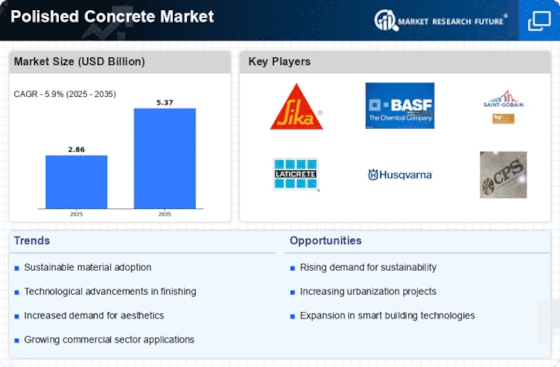
Key players include Sika AG, BASF SE, Saint-Gobain, and Laticrete International, among others.

What are the main segments of the Polished Concrete Market?

The main segments include Type, Method, Construction Type, and End User Industry.

How did the Densifier segment perform in 2024?

The Densifier segment was valued at 0.857 USD Billion in 2024 and is expected to grow significantly.

Market Summary

As per MRFR analysis, the Polished Concrete Market Size was estimated at 2.859 USD Billion in 2024. The Polished Concrete industry is projected to grow from 3.028 USD Billion in 2025 to 5.373 USD Billion by 2035, exhibiting a compound annual growth rate (CAGR) of 5.9 during the forecast period 2025 - 2035.

Key Market Trends & Highlights

The Polished Concrete Market is experiencing a robust growth trajectory driven by sustainability and technological advancements.

  • North America remains the largest market for polished concrete, driven by increasing demand in commercial and residential sectors.
  • The Asia-Pacific region is emerging as the fastest-growing market, fueled by rapid urbanization and infrastructure development.
  • The densifier segment holds the largest market share, while the sealer and crack filler segment is witnessing the fastest growth due to rising aesthetic preferences.
  • Key market drivers include sustainability initiatives and technological innovations that enhance the cost-effectiveness and versatility of polished concrete.

Market Size & Forecast

2024 Market Size 2.859 (USD Billion)
2035 Market Size 5.373 (USD Billion)
CAGR (2025 - 2035) 5.9%
Largest Regional Market Share in 2024 Asia Pacific

Major Players

<p>Sika AG (CH), BASF SE (DE), Saint-Gobain (FR), Laticrete International, Inc. (US), Husqvarna AB (SE), Concrete Polishing Solutions (US), Diamond Products Limited (US), Norton Abrasives (US), Krete Industries, Inc. (US)</p>

Market Trends

The Polished Concrete Market is currently experiencing a notable transformation, driven by a combination of aesthetic appeal and functional benefits. This flooring solution is increasingly favored in both residential and commercial sectors due to its durability, low maintenance requirements, and versatility in design. As consumers become more environmentally conscious, the demand for sustainable building materials has surged, positioning polished concrete as a favorable option. Its ability to reflect light enhances energy efficiency, which aligns with the growing trend towards eco-friendly construction practices. Furthermore, advancements in technology have facilitated the development of innovative polishing techniques, allowing for a wider range of finishes and colors, thereby expanding its application in various settings. In addition to aesthetic and environmental considerations, the Polished Concrete Market is also influenced by economic factors. The construction industry is witnessing a resurgence, with increased investments in infrastructure and commercial projects. This uptick in construction activity is likely to bolster the demand for polished concrete solutions. Moreover, the rise of urbanization and the trend towards open-concept spaces are contributing to the popularity of polished concrete as a flooring choice. As the market evolves, it appears that the integration of polished concrete into modern design will continue to grow, reflecting broader shifts in consumer preferences and industry standards.

Sustainability Focus

The emphasis on sustainable building practices is reshaping the Polished Concrete Market. As environmental concerns gain traction, consumers and builders are increasingly seeking eco-friendly materials. Polished concrete, known for its low carbon footprint and energy efficiency, aligns well with this trend, making it a preferred choice for green construction projects.

Technological Advancements

Innovations in polishing techniques are significantly impacting the Polished Concrete Market. Enhanced machinery and methods allow for a broader spectrum of finishes and textures, catering to diverse aesthetic preferences. This technological evolution not only improves the quality of the final product but also expands its applicability across various sectors.

Urbanization and Design Trends

The ongoing trend of urbanization is influencing the demand for polished concrete. As cities expand and modernize, there is a growing preference for open-concept designs that incorporate polished concrete flooring. This material's versatility and contemporary appeal make it an attractive option for urban developers and homeowners alike.

Polished Concrete Market Market Drivers

Cost-Effectiveness

Cost-effectiveness is emerging as a significant driver for the Polished Concrete Market. Compared to other flooring materials, polished concrete offers a lower total cost of ownership due to its durability and minimal maintenance requirements. The initial investment may be comparable to other flooring options, but the long-term savings associated with reduced repair and replacement costs make polished concrete an attractive choice for both residential and commercial applications. Market analysis indicates that the lifecycle cost of polished concrete can be up to 30% lower than that of traditional flooring materials. This financial advantage is particularly appealing to budget-conscious builders and property owners, thereby enhancing the market's growth potential. As economic considerations continue to influence purchasing decisions, the cost-effectiveness of polished concrete is likely to drive its adoption across various sectors.

Urbanization Trends

The ongoing trends in urbanization are likely to serve as a catalyst for the Polished Concrete Market. As urban areas expand and the demand for commercial and residential spaces increases, polished concrete is becoming a preferred choice for flooring solutions. Its versatility allows for seamless integration into various architectural designs, making it suitable for both high-rise buildings and retail spaces. Recent statistics indicate that urban populations are expected to rise by 2.5 billion by 2050, which could drive the demand for durable and aesthetically pleasing flooring options. Consequently, the polished concrete market may experience a surge in demand as urban developers seek materials that meet both functional and design requirements. This trend underscores the importance of polished concrete in modern construction practices.

Aesthetic Versatility

The aesthetic versatility of polished concrete is becoming increasingly recognized as a key driver for the Polished Concrete Market. With a wide range of colors, finishes, and textures available, polished concrete can be tailored to meet diverse design preferences. This adaptability makes it suitable for various applications, from residential homes to commercial spaces and industrial facilities. Recent trends indicate that consumers are gravitating towards unique and personalized design elements, which polished concrete can readily provide. Additionally, the ability to incorporate decorative aggregates and patterns enhances its appeal. Market data suggests that the demand for customized flooring solutions is on the rise, with polished concrete positioned to capture a significant share of this trend. As designers and architects seek innovative materials that offer both functionality and aesthetic appeal, polished concrete is likely to gain further traction in the market.

Technological Innovations

Technological advancements in the Polished Concrete Market are reshaping the landscape of flooring solutions. Innovations in grinding and polishing equipment have enhanced the efficiency and quality of polished concrete applications. For instance, the introduction of advanced diamond tooling and automated machinery has significantly reduced labor costs and time required for installation. Additionally, the development of new sealers and coatings has improved the aesthetic appeal and durability of polished concrete surfaces. Market data suggests that the adoption of these technologies could lead to a 15% increase in market share for polished concrete products over the next five years. As manufacturers continue to invest in research and development, the potential for enhanced performance and customization options in polished concrete is likely to attract a broader customer base.

Sustainability Initiatives

The increasing emphasis on sustainability within the construction sector appears to be a pivotal driver for the Polished Concrete Market. As environmental concerns gain traction, builders and architects are increasingly opting for polished concrete due to its eco-friendly attributes. Polished concrete is often made from recycled materials and has a lower carbon footprint compared to traditional flooring options. Furthermore, its durability and longevity contribute to reduced waste over time. According to recent data, the demand for sustainable building materials is projected to grow at a rate of approximately 10% annually, indicating a robust market potential for polished concrete solutions. This trend not only aligns with regulatory frameworks aimed at reducing environmental impact but also resonates with consumers who prioritize green building practices.

Market Segment Insights

By Type: Densifier (Largest) vs. Sealer & Crack Filler (Fastest-Growing)

<p>The Polished Concrete Market showcases a diverse range of product types, with Densifiers leading in market share due to their essential role in enhancing the durability and surface hardness of concrete. Following closely are Sealers and Crack Fillers, which are gaining popularity and are increasingly recognized for their protective qualities and aesthetic enhancements. Conditioners represent a smaller yet significant portion of the market, utilized primarily for surface preparation and maintaining the finish of polished concrete floors. The growth trend in this segment is significantly influenced by rising demand for sustainable and low-maintenance flooring solutions in residential, commercial, and industrial applications. The increasing awareness of the advantages of polished concrete over traditional flooring alternatives further drives interest in Densifiers, while the rapid adoption of Sealers and Crack Fillers is attributed to ongoing innovations in formulation and technology, ensuring superior performance and versatility.</p>

<p>Densifier (Dominant) vs. Sealer & Crack Filler (Emerging)</p>

<p>Densifiers are recognized as the dominant force in the Polished Concrete Market, providing essential benefits such as enhancing strength, minimizing dusting, and offering resistance to stains. Their widespread use in both new construction and renovation projects reflects their essential nature in achieving optimal polished floor performance. On the other hand, Sealers and Crack Fillers are emerging as key players, with advancements in technology providing improved formulation that elevates their functionality and appeal. These products cater to an increasing demand for aesthetically pleasing and durable surfaces, aligning with modern design trends focusing on sustainability and maintenance efficiency. The growing emphasis on protecting concrete from moisture and wear further solidifies their market presence.</p>

By Method: Wet (Largest) vs. Dry (Fastest-Growing)

<p>In the polished concrete market, the method segment is primarily divided into two main approaches: dry and wet polishing. The wet method is the largest segment, gaining significant market traction due to its ability to prevent dust and provide a smoother finish. Wet polishing also attracts contractors focused on health and safety, as the use of water minimizes dust exposure. This segment showcases its strength in larger residential and commercial projects, thus dominating the market share in the method category. On the other hand, the dry method is recognized as the fastest-growing segment, driven by the increasing preference for quicker, more efficient solutions that cater to residential renovations and smaller-scale projects. The advancements in dry polishing technologies and equipment are paving the way for wider adoption. Moreover, the growing sustainability trend encourages the use of dry methods, as they typically generate less wastewater compared to wet methods, attracting environmentally conscious consumers and contractors alike.</p>

<p>Polishing Method: Wet (Dominant) vs. Dry (Emerging)</p>

<p>The wet polishing method dominates the polished concrete market, primarily due to its ability to provide a high-gloss finish while controlling dust effectively. It is preferred in larger applications such as warehouses and retail spaces where aesthetics and health standards are paramount. Wet polishing techniques allow for better cooling of diamond pads, which extends their lifespan and enhances performance. In contrast, the dry polishing method is emerging rapidly, appealing to those requiring flexibility and efficiency. Dry polishing eliminates water usage, making it suitable for environments where moisture is a concern. It also offers quicker turnaround times, appealing to contractors looking to optimize project schedules. Both methods cater to diverse client needs, thus representing distinct yet complementary segments in the market.</p>

By Construction Type: New Construction (Largest) vs. Renovation (Fastest-Growing)

<p>In the polished concrete market, the New Construction segment holds a substantial share, driven by an increasing number of commercial and residential building projects. This segment benefits from the demand for durable and aesthetically pleasing flooring solutions, establishing itself as the dominant player in the industry. On the other hand, the Renovation segment is gaining traction, trending upwards as property owners increasingly opt for polished concrete to modernize existing spaces. This shift not only enhances property aesthetics but also improves functionality and sustainability.</p>

<p>Polished Concrete Market: New Construction (Dominant) vs. Renovation (Emerging)</p>

<p>The New Construction sector remains the dominant force in the polished concrete market, as new builds prioritize cutting-edge design and durability. This segment appeals to builders and contractors seeking long-lasting solutions with minimal maintenance. In contrast, the Renovation segment is emerging rapidly, fueled by the trend toward revitalizing older buildings with modern finishes. This segment often incorporates reclaimed materials and eco-friendly practices, resonating with environmentally conscious consumers. Renovation projects frequently leverage polished concrete for its versatility, adapt to various design aesthetics, and contribute to increased property values while creating appealing and functional spaces.</p>

By End User Industry: Residential (Largest) vs. Non-Residential (Fastest-Growing)

<p>In the Polished Concrete Market, the distribution of market share indicates that the residential segment is the largest contributor, driven by increasing home renovation and aesthetic demands. Homeowners are increasingly opting for polished concrete floors for their durability and modern aesthetic, which results in a strong share for this segment. On the other hand, the non-residential segment is rapidly gaining traction as businesses look for cost-effective and long-lasting flooring solutions that can accommodate heavy foot traffic and provide a sophisticated appearance in commercial spaces.</p>

<p>Residential (Dominant) vs. Non-Residential (Emerging)</p>

<p>The residential segment of the polished concrete market has established itself as the dominant force, catering to discerning homeowners seeking stylish and functional flooring solutions. This segment thrives on trends in interior design that favor minimalist aesthetics with practical advantages, such as easy maintenance and longevity. Conversely, the non-residential segment presents a burgeoning opportunity, characterized by increasing adoption in various commercial establishments like retail stores and office spaces. Non-residential customers are particularly drawn to polished concrete for its reflective qualities that enhance lighting and create an inviting atmosphere, coupled with its ability to withstand high traffic, making it an emerging market player.</p>

Get more detailed insights about Polished Concrete Market Research Report—Global Forecast till 2035

Regional Insights

North America : Market Leader in Polished Concrete Market

North America is the largest market for polished concrete, holding approximately 40% of the global share. The growth is driven by increasing demand for durable flooring solutions in commercial and residential sectors, alongside stringent regulations promoting sustainable construction practices. The rise in renovation projects and the popularity of polished concrete in retail spaces further fuel this demand. The United States is the leading country in this region, with significant contributions from Canada. Key players such as Laticrete International, Inc. and Concrete Polishing Solutions dominate the market, leveraging advanced technologies and innovative products. The competitive landscape is characterized by a mix of established companies and emerging players, all striving to meet the growing consumer demand for aesthetic and functional flooring solutions.

Europe : Emerging Market Dynamics

Europe is witnessing a robust growth trajectory in the polished concrete market, accounting for approximately 30% of the global share. The demand is primarily driven by the increasing focus on sustainable building practices and the rising popularity of polished concrete in both residential and commercial applications. Regulatory frameworks promoting energy efficiency and eco-friendly materials are significant catalysts for this growth. Leading countries in this region include Germany, France, and the UK, where major players like BASF SE and Saint-Gobain are actively involved. The competitive landscape is marked by innovation and collaboration among manufacturers, with a strong emphasis on product quality and sustainability. The presence of advanced technologies and skilled labor further enhances the market's potential in Europe.

Asia-Pacific : Rapidly Expanding Market

Asia-Pacific is rapidly emerging as a significant player in the polished concrete market, holding around 25% of the global share. The growth is fueled by urbanization, increasing construction activities, and a growing preference for aesthetically pleasing flooring solutions. Government initiatives aimed at infrastructure development and modernization are also key drivers of market expansion in this region. Countries like China, India, and Australia are leading the charge, with a mix of local and international players such as Sika AG and Husqvarna AB. The competitive landscape is evolving, with companies focusing on innovation and sustainability to capture market share. The increasing adoption of polished concrete in commercial spaces and residential projects is expected to further boost growth in the coming years.

Middle East and Africa : Emerging Opportunities Ahead

The Middle East and Africa region is gradually emerging in the polished concrete market, currently holding about 5% of the global share. The growth is driven by increasing construction activities, particularly in the UAE and South Africa, where there is a rising demand for durable and low-maintenance flooring solutions. Government investments in infrastructure and real estate development are significant catalysts for market growth in this region. Leading countries include the UAE and South Africa, where key players like Diamond Products Limited and Norton Abrasives are making their mark. The competitive landscape is characterized by a mix of local and international companies, all vying to meet the growing demand for polished concrete solutions. As the market matures, opportunities for innovation and expansion are expected to increase significantly.

Key Players and Competitive Insights

The polished concrete market is currently characterized by a dynamic competitive landscape, driven by increasing demand for durable and aesthetically pleasing flooring solutions across various sectors, including residential, commercial, and industrial applications. Key players such as Sika AG (CH), BASF SE (DE), and Saint-Gobain (FR) are strategically positioned to leverage their extensive product portfolios and innovative technologies. Sika AG (CH) focuses on enhancing its product offerings through continuous research and development, while BASF SE (DE) emphasizes sustainability in its operations, aiming to reduce the environmental impact of its products. Saint-Gobain (FR) is actively pursuing regional expansion, particularly in emerging markets, which collectively shapes a competitive environment that is increasingly focused on innovation and sustainability.

The business tactics employed by these companies include localizing manufacturing to reduce costs and optimize supply chains, which is particularly crucial in a moderately fragmented market. This competitive structure allows for a diverse range of products and services, enabling companies to cater to specific regional demands while maintaining a global presence. The collective influence of these key players fosters a competitive atmosphere where innovation and operational efficiency are paramount.

In August 2025, Sika AG (CH) announced the launch of a new line of eco-friendly polished concrete products designed to meet the growing demand for sustainable construction materials. This strategic move not only aligns with global sustainability trends but also positions Sika as a leader in environmentally responsible flooring solutions, potentially attracting a broader customer base concerned with ecological impacts.

In September 2025, BASF SE (DE) unveiled a partnership with a leading technology firm to integrate artificial intelligence into its production processes. This initiative aims to enhance operational efficiency and product quality, reflecting a broader trend towards digital transformation in the construction materials sector. By adopting AI, BASF is likely to improve its competitive edge through optimized manufacturing processes and reduced waste.

In July 2025, Saint-Gobain (FR) expanded its operations in Asia by acquiring a local polished concrete manufacturer. This acquisition is expected to strengthen Saint-Gobain's market presence in the region, allowing it to tap into the rapidly growing demand for polished concrete solutions in Asia. Such strategic moves indicate a clear focus on regional growth and market penetration, which is essential for maintaining competitiveness in a globalized market.

As of October 2025, the polished concrete market is witnessing significant trends such as digitalization, sustainability, and the integration of advanced technologies like AI. Strategic alliances among key players are increasingly shaping the competitive landscape, fostering innovation and collaboration. Looking ahead, it appears that competitive differentiation will evolve from traditional price-based competition to a focus on innovation, technology integration, and supply chain reliability, suggesting a transformative shift in how companies position themselves in the market.

Key Companies in the Polished Concrete Market market include

Industry Developments

November 2023

Sika AG bided the Polish concrete market with a 30% equity stake in a Finnish company, Concria Oy. The development aims to improve Sika's product range towards this market, increase its share in the global trade of polished concrete, and provide added value to the company's revenue.

June 2023

The trend of increasing polished concrete use in construction works, both residential and non-residential, was further boosted by an increase in US housing constructions. The figure increased to 21.7% percent annually in May 2023 for privately owned housing structures as the need for modern, easy-to-maintain and durable flooring requirements existed.

2022

Ameripolish recently presented the SmartFloor Refinement System, an advanced pad system that can be used to grind and polish concrete floors. This system promotes appreciation of the new form of cleanliness on concrete floors and is convenient for the market, emphasizing the modernization of polishing instruments.

2022

A new joint venture between Bartell Global and SASE Company of Blue Point Capital Partners was created for product development and geographical expansion. Such alliances illustrate a strong market trend among companies in the industry to form joint ventures for new market development.

December 2020

PPG Industries announced that it is purchasing Tikkurila (Finland), a finish paint and coatings producer. The acquisition is projected to be finalized in the second quarter of 2021. Tikkurila has strong and established decorative brands and product offerings in Northern and Eastern European countries where PPG has a minimal presence. This acquisition is expected to have substantial positive effects on PPG Industries, such as establishing new cross-selling opportunities, growth opportunities for employees, and new product solutions for new segments and customers.

November 2020

Sika will use the new production plant in UAE to boost its production capacity in Dubai. Alongside concrete admixtures, epoxy resins for the target market flooring will also be manufactured locally. Sika moved to develop their factory in Dubai to increase production flexibility, reduce the lead time for deliveries, improve the cost structures, and decrease the stock.

Future Outlook

Polished Concrete Market Future Outlook

<p>The Polished Concrete Market is projected to grow at a 5.9% CAGR from 2024 to 2035, driven by increasing demand for durable flooring solutions and sustainable construction practices.</p>

New opportunities lie in:

  • <p>Expansion into eco-friendly concrete polishing technologies</p>
  • <p>Development of mobile polishing units for on-site applications</p>
  • <p>Partnerships with construction firms for integrated flooring solutions</p>

<p>By 2035, the market is expected to solidify its position as a leader in flooring solutions.</p>

Market Segmentation

Polished Concrete Market Type Outlook

  • Densifier
  • Sealer & Crack Filler
  • Conditioner

Polished Concrete Market Method Outlook

  • Dry
  • Wet

Polished Concrete Market Construction Type Outlook

  • New Construction
  • Renovation

Polished Concrete Market End User Industry Outlook

  • Residential
  • Non-Residential

Report Scope

MARKET SIZE 20242.859(USD Billion)
MARKET SIZE 20253.028(USD Billion)
MARKET SIZE 20355.373(USD Billion)
COMPOUND ANNUAL GROWTH RATE (CAGR)5.9% (2024 - 2035)
REPORT COVERAGERevenue Forecast, Competitive Landscape, Growth Factors, and Trends
BASE YEAR2024
Market Forecast Period2025 - 2035
Historical Data2019 - 2024
Market Forecast UnitsUSD Billion
Key Companies ProfiledMarket analysis in progress
Segments CoveredMarket segmentation analysis in progress
Key Market OpportunitiesGrowing demand for sustainable flooring solutions drives innovation in the Polished Concrete Market.
Key Market DynamicsRising demand for sustainable flooring solutions drives innovation and competition in the polished concrete market.
Countries CoveredNorth America, Europe, APAC, South America, MEA

FAQs

What is the current valuation of the Polished Concrete Market?

The Polished Concrete Market was valued at 2.859 USD Billion in 2024.

What is the projected market size for the Polished Concrete Market by 2035?

The market is projected to reach 5.373 USD Billion by 2035.

What is the expected CAGR for the Polished Concrete Market during the forecast period?

The expected CAGR for the Polished Concrete Market from 2025 to 2035 is 5.9%.

Which companies are considered key players in the Polished Concrete Market?

Key players include Sika AG, BASF SE, Saint-Gobain, and Laticrete International, among others.

What are the main segments of the Polished Concrete Market?

The main segments include Type, Method, Construction Type, and End User Industry.

How did the Densifier segment perform in 2024?

The Densifier segment was valued at 0.857 USD Billion in 2024 and is expected to grow significantly.

  1. SECTION I: EXECUTIVE SUMMARY AND KEY HIGHLIGHTS
    1. EXECUTIVE SUMMARY
      1. Market Overview
      2. Key Findings
      3. Market Segmentation
      4. Competitive Landscape
      5. Challenges and Opportunities
      6. Future Outlook
  2. SECTION II: SCOPING, METHODOLOGY AND MARKET STRUCTURE
    1. MARKET INTRODUCTION
      1. Definition
      2. Scope of the study
    2. RESEARCH METHODOLOGY
      1. Overview
      2. Data Mining
      3. Secondary Research
      4. Primary Research
      5. Forecasting Model
      6. Market Size Estimation
      7. Data Triangulation
      8. Validation
  3. SECTION III: QUALITATIVE ANALYSIS
    1. MARKET DYNAMICS
      1. Overview
      2. Drivers
      3. Restraints
      4. Opportunities
    2. MARKET FACTOR ANALYSIS
      1. Value chain Analysis
      2. Porter's Five Forces Analysis
      3. COVID-19 Impact Analysis
  4. SECTION IV: QUANTITATIVE ANALYSIS
    1. Packaging & Transport, BY Type (USD Billion)
      1. Densifier
      2. Sealer & Crack Filler
      3. Conditioner
    2. Packaging & Transport, BY Method (USD Billion)
      1. Dry
      2. Wet
    3. Packaging & Transport, BY Construction Type (USD Billion)
      1. New Construction
      2. Renovation
    4. Packaging & Transport, BY End User Industry (USD Billion)
      1. Residential
      2. Non-Residential
    5. Packaging & Transport, BY Region (USD Billion)
      1. North America
      2. Europe
      3. APAC
      4. South America
      5. MEA
  5. SECTION V: COMPETITIVE ANALYSIS
    1. Competitive Landscape
      1. Overview
      2. Competitive Analysis
      3. Market share Analysis
      4. Major Growth Strategy in the Packaging & Transport
      5. Competitive Benchmarking
      6. Leading Players in Terms of Number of Developments in the Packaging & Transport
      7. Key developments and growth strategies
      8. Major Players Financial Matrix
    2. Company Profiles
      1. Sika AG (CH)
      2. BASF SE (DE)
      3. Saint-Gobain (FR)
      4. Laticrete International, Inc. (US)
      5. Husqvarna AB (SE)
      6. Concrete Polishing Solutions (US)
      7. Diamond Products Limited (US)
      8. Norton Abrasives (US)
      9. Krete Industries, Inc. (US)
    3. Appendix
      1. References
      2. Related Reports
  6. LIST OF FIGURES
    1. MARKET SYNOPSIS
    2. NORTH AMERICA MARKET ANALYSIS
    3. US MARKET ANALYSIS BY TYPE
    4. US MARKET ANALYSIS BY METHOD
    5. US MARKET ANALYSIS BY CONSTRUCTION TYPE
    6. US MARKET ANALYSIS BY END USER INDUSTRY
    7. CANADA MARKET ANALYSIS BY TYPE
    8. CANADA MARKET ANALYSIS BY METHOD
    9. CANADA MARKET ANALYSIS BY CONSTRUCTION TYPE
    10. CANADA MARKET ANALYSIS BY END USER INDUSTRY
    11. EUROPE MARKET ANALYSIS
    12. GERMANY MARKET ANALYSIS BY TYPE
    13. GERMANY MARKET ANALYSIS BY METHOD
    14. GERMANY MARKET ANALYSIS BY CONSTRUCTION TYPE
    15. GERMANY MARKET ANALYSIS BY END USER INDUSTRY
    16. UK MARKET ANALYSIS BY TYPE
    17. UK MARKET ANALYSIS BY METHOD
    18. UK MARKET ANALYSIS BY CONSTRUCTION TYPE
    19. UK MARKET ANALYSIS BY END USER INDUSTRY
    20. FRANCE MARKET ANALYSIS BY TYPE
    21. FRANCE MARKET ANALYSIS BY METHOD
    22. FRANCE MARKET ANALYSIS BY CONSTRUCTION TYPE
    23. FRANCE MARKET ANALYSIS BY END USER INDUSTRY
    24. RUSSIA MARKET ANALYSIS BY TYPE
    25. RUSSIA MARKET ANALYSIS BY METHOD
    26. RUSSIA MARKET ANALYSIS BY CONSTRUCTION TYPE
    27. RUSSIA MARKET ANALYSIS BY END USER INDUSTRY
    28. ITALY MARKET ANALYSIS BY TYPE
    29. ITALY MARKET ANALYSIS BY METHOD
    30. ITALY MARKET ANALYSIS BY CONSTRUCTION TYPE
    31. ITALY MARKET ANALYSIS BY END USER INDUSTRY
    32. SPAIN MARKET ANALYSIS BY TYPE
    33. SPAIN MARKET ANALYSIS BY METHOD
    34. SPAIN MARKET ANALYSIS BY CONSTRUCTION TYPE
    35. SPAIN MARKET ANALYSIS BY END USER INDUSTRY
    36. REST OF EUROPE MARKET ANALYSIS BY TYPE
    37. REST OF EUROPE MARKET ANALYSIS BY METHOD
    38. REST OF EUROPE MARKET ANALYSIS BY CONSTRUCTION TYPE
    39. REST OF EUROPE MARKET ANALYSIS BY END USER INDUSTRY
    40. APAC MARKET ANALYSIS
    41. CHINA MARKET ANALYSIS BY TYPE
    42. CHINA MARKET ANALYSIS BY METHOD
    43. CHINA MARKET ANALYSIS BY CONSTRUCTION TYPE
    44. CHINA MARKET ANALYSIS BY END USER INDUSTRY
    45. INDIA MARKET ANALYSIS BY TYPE
    46. INDIA MARKET ANALYSIS BY METHOD
    47. INDIA MARKET ANALYSIS BY CONSTRUCTION TYPE
    48. INDIA MARKET ANALYSIS BY END USER INDUSTRY
    49. JAPAN MARKET ANALYSIS BY TYPE
    50. JAPAN MARKET ANALYSIS BY METHOD
    51. JAPAN MARKET ANALYSIS BY CONSTRUCTION TYPE
    52. JAPAN MARKET ANALYSIS BY END USER INDUSTRY
    53. SOUTH KOREA MARKET ANALYSIS BY TYPE
    54. SOUTH KOREA MARKET ANALYSIS BY METHOD
    55. SOUTH KOREA MARKET ANALYSIS BY CONSTRUCTION TYPE
    56. SOUTH KOREA MARKET ANALYSIS BY END USER INDUSTRY
    57. MALAYSIA MARKET ANALYSIS BY TYPE
    58. MALAYSIA MARKET ANALYSIS BY METHOD
    59. MALAYSIA MARKET ANALYSIS BY CONSTRUCTION TYPE
    60. MALAYSIA MARKET ANALYSIS BY END USER INDUSTRY
    61. THAILAND MARKET ANALYSIS BY TYPE
    62. THAILAND MARKET ANALYSIS BY METHOD
    63. THAILAND MARKET ANALYSIS BY CONSTRUCTION TYPE
    64. THAILAND MARKET ANALYSIS BY END USER INDUSTRY
    65. INDONESIA MARKET ANALYSIS BY TYPE
    66. INDONESIA MARKET ANALYSIS BY METHOD
    67. INDONESIA MARKET ANALYSIS BY CONSTRUCTION TYPE
    68. INDONESIA MARKET ANALYSIS BY END USER INDUSTRY
    69. REST OF APAC MARKET ANALYSIS BY TYPE
    70. REST OF APAC MARKET ANALYSIS BY METHOD
    71. REST OF APAC MARKET ANALYSIS BY CONSTRUCTION TYPE
    72. REST OF APAC MARKET ANALYSIS BY END USER INDUSTRY
    73. SOUTH AMERICA MARKET ANALYSIS
    74. BRAZIL MARKET ANALYSIS BY TYPE
    75. BRAZIL MARKET ANALYSIS BY METHOD
    76. BRAZIL MARKET ANALYSIS BY CONSTRUCTION TYPE
    77. BRAZIL MARKET ANALYSIS BY END USER INDUSTRY
    78. MEXICO MARKET ANALYSIS BY TYPE
    79. MEXICO MARKET ANALYSIS BY METHOD
    80. MEXICO MARKET ANALYSIS BY CONSTRUCTION TYPE
    81. MEXICO MARKET ANALYSIS BY END USER INDUSTRY
    82. ARGENTINA MARKET ANALYSIS BY TYPE
    83. ARGENTINA MARKET ANALYSIS BY METHOD
    84. ARGENTINA MARKET ANALYSIS BY CONSTRUCTION TYPE
    85. ARGENTINA MARKET ANALYSIS BY END USER INDUSTRY
    86. REST OF SOUTH AMERICA MARKET ANALYSIS BY TYPE
    87. REST OF SOUTH AMERICA MARKET ANALYSIS BY METHOD
    88. REST OF SOUTH AMERICA MARKET ANALYSIS BY CONSTRUCTION TYPE
    89. REST OF SOUTH AMERICA MARKET ANALYSIS BY END USER INDUSTRY
    90. MEA MARKET ANALYSIS
    91. GCC COUNTRIES MARKET ANALYSIS BY TYPE
    92. GCC COUNTRIES MARKET ANALYSIS BY METHOD
    93. GCC COUNTRIES MARKET ANALYSIS BY CONSTRUCTION TYPE
    94. GCC COUNTRIES MARKET ANALYSIS BY END USER INDUSTRY
    95. SOUTH AFRICA MARKET ANALYSIS BY TYPE
    96. SOUTH AFRICA MARKET ANALYSIS BY METHOD
    97. SOUTH AFRICA MARKET ANALYSIS BY CONSTRUCTION TYPE
    98. SOUTH AFRICA MARKET ANALYSIS BY END USER INDUSTRY
    99. REST OF MEA MARKET ANALYSIS BY TYPE
    100. REST OF MEA MARKET ANALYSIS BY METHOD
    101. REST OF MEA MARKET ANALYSIS BY CONSTRUCTION TYPE
    102. REST OF MEA MARKET ANALYSIS BY END USER INDUSTRY
    103. KEY BUYING CRITERIA OF PACKAGING & TRANSPORT
    104. RESEARCH PROCESS OF MRFR
    105. DRO ANALYSIS OF PACKAGING & TRANSPORT
    106. DRIVERS IMPACT ANALYSIS: PACKAGING & TRANSPORT
    107. RESTRAINTS IMPACT ANALYSIS: PACKAGING & TRANSPORT
    108. SUPPLY / VALUE CHAIN: PACKAGING & TRANSPORT
    109. PACKAGING & TRANSPORT, BY TYPE, 2024 (% SHARE)
    110. PACKAGING & TRANSPORT, BY TYPE, 2024 TO 2035 (USD Billion)
    111. PACKAGING & TRANSPORT, BY METHOD, 2024 (% SHARE)
    112. PACKAGING & TRANSPORT, BY METHOD, 2024 TO 2035 (USD Billion)
    113. PACKAGING & TRANSPORT, BY CONSTRUCTION TYPE, 2024 (% SHARE)
    114. PACKAGING & TRANSPORT, BY CONSTRUCTION TYPE, 2024 TO 2035 (USD Billion)
    115. PACKAGING & TRANSPORT, BY END USER INDUSTRY, 2024 (% SHARE)
    116. PACKAGING & TRANSPORT, BY END USER INDUSTRY, 2024 TO 2035 (USD Billion)
    117. BENCHMARKING OF MAJOR COMPETITORS
  7. LIST OF TABLES
    1. LIST OF ASSUMPTIONS
    2. North America MARKET SIZE ESTIMATES; FORECAST
      1. BY TYPE, 2025-2035 (USD Billion)
      2. BY METHOD, 2025-2035 (USD Billion)
      3. BY CONSTRUCTION TYPE, 2025-2035 (USD Billion)
      4. BY END USER INDUSTRY, 2025-2035 (USD Billion)
    3. US MARKET SIZE ESTIMATES; FORECAST
      1. BY TYPE, 2025-2035 (USD Billion)
      2. BY METHOD, 2025-2035 (USD Billion)
      3. BY CONSTRUCTION TYPE, 2025-2035 (USD Billion)
      4. BY END USER INDUSTRY, 2025-2035 (USD Billion)
    4. Canada MARKET SIZE ESTIMATES; FORECAST
      1. BY TYPE, 2025-2035 (USD Billion)
      2. BY METHOD, 2025-2035 (USD Billion)
      3. BY CONSTRUCTION TYPE, 2025-2035 (USD Billion)
      4. BY END USER INDUSTRY, 2025-2035 (USD Billion)
    5. Europe MARKET SIZE ESTIMATES; FORECAST
      1. BY TYPE, 2025-2035 (USD Billion)
      2. BY METHOD, 2025-2035 (USD Billion)
      3. BY CONSTRUCTION TYPE, 2025-2035 (USD Billion)
      4. BY END USER INDUSTRY, 2025-2035 (USD Billion)
    6. Germany MARKET SIZE ESTIMATES; FORECAST
      1. BY TYPE, 2025-2035 (USD Billion)
      2. BY METHOD, 2025-2035 (USD Billion)
      3. BY CONSTRUCTION TYPE, 2025-2035 (USD Billion)
      4. BY END USER INDUSTRY, 2025-2035 (USD Billion)
    7. UK MARKET SIZE ESTIMATES; FORECAST
      1. BY TYPE, 2025-2035 (USD Billion)
      2. BY METHOD, 2025-2035 (USD Billion)
      3. BY CONSTRUCTION TYPE, 2025-2035 (USD Billion)
      4. BY END USER INDUSTRY, 2025-2035 (USD Billion)
    8. France MARKET SIZE ESTIMATES; FORECAST
      1. BY TYPE, 2025-2035 (USD Billion)
      2. BY METHOD, 2025-2035 (USD Billion)
      3. BY CONSTRUCTION TYPE, 2025-2035 (USD Billion)
      4. BY END USER INDUSTRY, 2025-2035 (USD Billion)
    9. Russia MARKET SIZE ESTIMATES; FORECAST
      1. BY TYPE, 2025-2035 (USD Billion)
      2. BY METHOD, 2025-2035 (USD Billion)
      3. BY CONSTRUCTION TYPE, 2025-2035 (USD Billion)
      4. BY END USER INDUSTRY, 2025-2035 (USD Billion)
    10. Italy MARKET SIZE ESTIMATES; FORECAST
      1. BY TYPE, 2025-2035 (USD Billion)
      2. BY METHOD, 2025-2035 (USD Billion)
      3. BY CONSTRUCTION TYPE, 2025-2035 (USD Billion)
      4. BY END USER INDUSTRY, 2025-2035 (USD Billion)
    11. Spain MARKET SIZE ESTIMATES; FORECAST
      1. BY TYPE, 2025-2035 (USD Billion)
      2. BY METHOD, 2025-2035 (USD Billion)
      3. BY CONSTRUCTION TYPE, 2025-2035 (USD Billion)
      4. BY END USER INDUSTRY, 2025-2035 (USD Billion)
    12. Rest of Europe MARKET SIZE ESTIMATES; FORECAST
      1. BY TYPE, 2025-2035 (USD Billion)
      2. BY METHOD, 2025-2035 (USD Billion)
      3. BY CONSTRUCTION TYPE, 2025-2035 (USD Billion)
      4. BY END USER INDUSTRY, 2025-2035 (USD Billion)
    13. APAC MARKET SIZE ESTIMATES; FORECAST
      1. BY TYPE, 2025-2035 (USD Billion)
      2. BY METHOD, 2025-2035 (USD Billion)
      3. BY CONSTRUCTION TYPE, 2025-2035 (USD Billion)
      4. BY END USER INDUSTRY, 2025-2035 (USD Billion)
    14. China MARKET SIZE ESTIMATES; FORECAST
      1. BY TYPE, 2025-2035 (USD Billion)
      2. BY METHOD, 2025-2035 (USD Billion)
      3. BY CONSTRUCTION TYPE, 2025-2035 (USD Billion)
      4. BY END USER INDUSTRY, 2025-2035 (USD Billion)
    15. India MARKET SIZE ESTIMATES; FORECAST
      1. BY TYPE, 2025-2035 (USD Billion)
      2. BY METHOD, 2025-2035 (USD Billion)
      3. BY CONSTRUCTION TYPE, 2025-2035 (USD Billion)
      4. BY END USER INDUSTRY, 2025-2035 (USD Billion)
    16. Japan MARKET SIZE ESTIMATES; FORECAST
      1. BY TYPE, 2025-2035 (USD Billion)
      2. BY METHOD, 2025-2035 (USD Billion)
      3. BY CONSTRUCTION TYPE, 2025-2035 (USD Billion)
      4. BY END USER INDUSTRY, 2025-2035 (USD Billion)
    17. South Korea MARKET SIZE ESTIMATES; FORECAST
      1. BY TYPE, 2025-2035 (USD Billion)
      2. BY METHOD, 2025-2035 (USD Billion)
      3. BY CONSTRUCTION TYPE, 2025-2035 (USD Billion)
      4. BY END USER INDUSTRY, 2025-2035 (USD Billion)
    18. Malaysia MARKET SIZE ESTIMATES; FORECAST
      1. BY TYPE, 2025-2035 (USD Billion)
      2. BY METHOD, 2025-2035 (USD Billion)
      3. BY CONSTRUCTION TYPE, 2025-2035 (USD Billion)
      4. BY END USER INDUSTRY, 2025-2035 (USD Billion)
    19. Thailand MARKET SIZE ESTIMATES; FORECAST
      1. BY TYPE, 2025-2035 (USD Billion)
      2. BY METHOD, 2025-2035 (USD Billion)
      3. BY CONSTRUCTION TYPE, 2025-2035 (USD Billion)
      4. BY END USER INDUSTRY, 2025-2035 (USD Billion)
    20. Indonesia MARKET SIZE ESTIMATES; FORECAST
      1. BY TYPE, 2025-2035 (USD Billion)
      2. BY METHOD, 2025-2035 (USD Billion)
      3. BY CONSTRUCTION TYPE, 2025-2035 (USD Billion)
      4. BY END USER INDUSTRY, 2025-2035 (USD Billion)
    21. Rest of APAC MARKET SIZE ESTIMATES; FORECAST
      1. BY TYPE, 2025-2035 (USD Billion)
      2. BY METHOD, 2025-2035 (USD Billion)
      3. BY CONSTRUCTION TYPE, 2025-2035 (USD Billion)
      4. BY END USER INDUSTRY, 2025-2035 (USD Billion)
    22. South America MARKET SIZE ESTIMATES; FORECAST
      1. BY TYPE, 2025-2035 (USD Billion)
      2. BY METHOD, 2025-2035 (USD Billion)
      3. BY CONSTRUCTION TYPE, 2025-2035 (USD Billion)
      4. BY END USER INDUSTRY, 2025-2035 (USD Billion)
    23. Brazil MARKET SIZE ESTIMATES; FORECAST
      1. BY TYPE, 2025-2035 (USD Billion)
      2. BY METHOD, 2025-2035 (USD Billion)
      3. BY CONSTRUCTION TYPE, 2025-2035 (USD Billion)
      4. BY END USER INDUSTRY, 2025-2035 (USD Billion)
    24. Mexico MARKET SIZE ESTIMATES; FORECAST
      1. BY TYPE, 2025-2035 (USD Billion)
      2. BY METHOD, 2025-2035 (USD Billion)
      3. BY CONSTRUCTION TYPE, 2025-2035 (USD Billion)
      4. BY END USER INDUSTRY, 2025-2035 (USD Billion)
    25. Argentina MARKET SIZE ESTIMATES; FORECAST
      1. BY TYPE, 2025-2035 (USD Billion)
      2. BY METHOD, 2025-2035 (USD Billion)
      3. BY CONSTRUCTION TYPE, 2025-2035 (USD Billion)
      4. BY END USER INDUSTRY, 2025-2035 (USD Billion)
    26. Rest of South America MARKET SIZE ESTIMATES; FORECAST
      1. BY TYPE, 2025-2035 (USD Billion)
      2. BY METHOD, 2025-2035 (USD Billion)
      3. BY CONSTRUCTION TYPE, 2025-2035 (USD Billion)
      4. BY END USER INDUSTRY, 2025-2035 (USD Billion)
    27. MEA MARKET SIZE ESTIMATES; FORECAST
      1. BY TYPE, 2025-2035 (USD Billion)
      2. BY METHOD, 2025-2035 (USD Billion)
      3. BY CONSTRUCTION TYPE, 2025-2035 (USD Billion)
      4. BY END USER INDUSTRY, 2025-2035 (USD Billion)
    28. GCC Countries MARKET SIZE ESTIMATES; FORECAST
      1. BY TYPE, 2025-2035 (USD Billion)
      2. BY METHOD, 2025-2035 (USD Billion)
      3. BY CONSTRUCTION TYPE, 2025-2035 (USD Billion)
      4. BY END USER INDUSTRY, 2025-2035 (USD Billion)
    29. South Africa MARKET SIZE ESTIMATES; FORECAST
      1. BY TYPE, 2025-2035 (USD Billion)
      2. BY METHOD, 2025-2035 (USD Billion)
      3. BY CONSTRUCTION TYPE, 2025-2035 (USD Billion)
      4. BY END USER INDUSTRY, 2025-2035 (USD Billion)
    30. Rest of MEA MARKET SIZE ESTIMATES; FORECAST
      1. BY TYPE, 2025-2035 (USD Billion)
      2. BY METHOD, 2025-2035 (USD Billion)
      3. BY CONSTRUCTION TYPE, 2025-2035 (USD Billion)
      4. BY END USER INDUSTRY, 2025-2035 (USD Billion)
    31. PRODUCT LAUNCH/PRODUCT DEVELOPMENT/APPROVAL
    32. ACQUISITION/PARTNERSHIP

Polished Concrete Market Segmentation

Polished Concrete Type Outlook (USD Billion, 2018-2032)

  • Densifiber
  • Sealer & Crack Filler
  • Conditioner

Polished Concrete Method Outlook (USD Billion, 2018-2032)

  • Dry
  • Wet

Polished Concrete Construction Type Outlook (USD Billion, 2018-2032)

  • New Construction
  • Renovation

Polished Concrete End-Use Outlook (USD Billion, 2018-2032)

  • Residential
  • Non-residential

Polished Concrete Regional Outlook (USD Billion, 2018-2032)

  • North America Outlook (USD Billion, 2018-2032)

    • Polished Concrete by Type
      • Densifiber
      • Sealer & Crack Filler
      • Conditioner
    • Polished Concrete by Method
      • Dry
      • Wet
    • Polished Concrete by Construction Type
      • New Construction
      • Renovation
    • Polished Concrete by End-Use
      • Residential
      • Non-residential
    • US Outlook (USD Billion, 2018-2032)

    • Polished Concrete by Type
      • Densifiber
      • Sealer & Crack Filler
      • Conditioner
    • Polished Concrete by Method
      • Dry
      • Wet
    • Polished Concrete by Construction Type
      • New Construction
      • Renovation
    • Polished Concrete by End-Use
      • Residential
      • Non-residential
    • Canada Outlook (USD Billion, 2018-2032)

    • Polished Concrete by Type
      • Densifiber
      • Sealer & Crack Filler
      • Conditioner
    • Polished Concrete by Method
      • Dry
      • Wet
    • Polished Concrete by Construction Type
      • New Construction
      • Renovation
    • Polished Concrete by End-Use
      • Residential
      • Non-residential
  • Europe Outlook (USD Billion, 2018-2032)

    • Polished Concrete by Type
      • Densifiber
      • Sealer & Crack Filler
      • Conditioner
    • Polished Concrete by Method
      • Dry
      • Wet
    • Polished Concrete by Construction Type
      • New Construction
      • Renovation
    • Polished Concrete by End-Use
      • Residential
      • Non-residential
    • Germany Outlook (USD Billion, 2018-2032)

    • Polished Concrete by Type
      • Densifiber
      • Sealer & Crack Filler
      • Conditioner
    • Polished Concrete by Method
      • Dry
      • Wet
    • Polished Concrete by Construction Type
      • New Construction
      • Renovation
    • Polished Concrete by End-Use
      • Residential
      • Non-residential
    • France Outlook (USD Billion, 2018-2032)

    • Polished Concrete by Type
      • Densifiber
      • Sealer & Crack Filler
      • Conditioner
    • Polished Concrete by Method
      • Dry
      • Wet
    • Polished Concrete by Construction Type
      • New Construction
      • Renovation
    • Polished Concrete by End-Use
      • Residential
      • Non-residential
    • UK Outlook (USD Billion, 2018-2032)

    • Polished Concrete by Type
      • Densifiber
      • Sealer & Crack Filler
      • Conditioner
    • Polished Concrete by Method
      • Dry
      • Wet
    • Polished Concrete by Construction Type
      • New Construction
      • Renovation
    • Polished Concrete by End-Use
      • Residential
      • Non-residential
    • Italy Outlook (USD Billion, 2018-2032)

    • Polished Concrete by Type
      • Densifiber
      • Sealer & Crack Filler
      • Conditioner
    • Polished Concrete by Method
      • Dry
      • Wet
    • Polished Concrete by Construction Type
      • New Construction
      • Renovation
    • Polished Concrete by End-Use
      • Residential
      • Non-residential
    • Spain Outlook (USD Billion, 2018-2032)

    • Polished Concrete by Type
      • Densifiber
      • Sealer & Crack Filler
      • Conditioner
    • Polished Concrete by Method
      • Dry
      • Wet
    • Polished Concrete by Construction Type
      • New Construction
      • Renovation
    • Polished Concrete by End-Use
      • Residential
      • Non-residential
    • Rest Of Europe Outlook (USD Billion, 2018-2032)

    • Polished Concrete by Type
      • Densifiber
      • Sealer & Crack Filler
      • Conditioner
    • Polished Concrete by Method
      • Dry
      • Wet
    • Polished Concrete by Construction Type
      • New Construction
      • Renovation
    • Polished Concrete by End-Use
      • Residential
      • Non-residential
  • Asia-Pacific Outlook (USD Billion, 2018-2032)

    • Polished Concrete by Type
      • Densifiber
      • Sealer & Crack Filler
      • Conditioner
    • Polished Concrete by Method
      • Dry
      • Wet
    • Polished Concrete by Construction Type
      • New Construction
      • Renovation
    • Polished Concrete by End-Use
      • Residential
      • Non-residential
    • China Outlook (USD Billion, 2018-2032)

    • Polished Concrete by Type
      • Densifiber
      • Sealer & Crack Filler
      • Conditioner
    • Polished Concrete by Method
      • Dry
      • Wet
    • Polished Concrete by Construction Type
      • New Construction
      • Renovation
    • Polished Concrete by End-Use
      • Residential
      • Non-residential
    • Japan Outlook (USD Billion, 2018-2032)

    • Polished Concrete by Type
      • Densifiber
      • Sealer & Crack Filler
      • Conditioner
    • Polished Concrete by Method
      • Dry
      • Wet
    • Polished Concrete by Construction Type
      • New Construction
      • Renovation
    • Polished Concrete by End-Use
      • Residential
      • Non-residential
    • India Outlook (USD Billion, 2018-2032)

    • Polished Concrete by Type
      • Densifiber
      • Sealer & Crack Filler
      • Conditioner
    • Polished Concrete by Method
      • Dry
      • Wet
    • Polished Concrete by Construction Type
      • New Construction
      • Renovation
    • Polished Concrete by End-Use
      • Residential
      • Non-residential
    • Australia Outlook (USD Billion, 2018-2032)

    • Polished Concrete by Type
      • Densifiber
      • Sealer & Crack Filler
      • Conditioner
    • Polished Concrete by Method
      • Dry
      • Wet
    • Polished Concrete by Construction Type
      • New Construction
      • Renovation
    • Polished Concrete by End-Use
      • Residential
      • Non-residential
    • Rest of Asia-Pacific Outlook (USD Billion, 2018-2032)

    • Polished Concrete by Type
      • Densifiber
      • Sealer & Crack Filler
      • Conditioner
    • Polished Concrete by Method
      • Dry
      • Wet
    • Polished Concrete by Construction Type
      • New Construction
      • Renovation
    • Polished Concrete by End-Use
      • Residential
      • Non-residential
  • Rest of the World Outlook (USD Billion, 2018-2032)

    • Polished Concrete by Type
      • Densifiber
      • Sealer & Crack Filler
      • Conditioner
    • Polished Concrete by Method
      • Dry
      • Wet
    • Polished Concrete by Construction Type
      • New Construction
      • Renovation
    • Polished Concrete by End-Use
      • Residential
      • Non-residential
    • Middle East Outlook (USD Billion, 2018-2032)

    • Polished Concrete by Type
      • Densifiber
      • Sealer & Crack Filler
      • Conditioner
    • Polished Concrete by Method
      • Dry
      • Wet
    • Polished Concrete by Construction Type
      • New Construction
      • Renovation
    • Polished Concrete by End-Use
      • Residential
      • Non-residential
    • Africa Outlook (USD Billion, 2018-2032)

    • Polished Concrete by Type
      • Densifiber
      • Sealer & Crack Filler
      • Conditioner
    • Polished Concrete by Method
      • Dry
      • Wet
    • Polished Concrete by Construction Type
      • New Construction
      • Renovation
    • Polished Concrete by End-Use
      • Residential
      • Non-residential
    • Latin America Outlook (USD Billion, 2018-2032)

    • Polished Concrete by Type
      • Densifiber
      • Sealer & Crack Filler
      • Conditioner
    • Polished Concrete by Method
      • Dry
      • Wet
    • Polished Concrete by Construction Type
      • New Construction
      • Renovation
    • Polished Concrete by End-Use
      • Residential
      • Non-residential


Infographic

Free Sample Request

Kindly complete the form below to receive a free sample of this Report

Get Free Sample

Customer Strories

Compare Licence

×
Features License Type
Single User Multiuser License Enterprise User
Price $4,950 $5,950 $7,250
Maximum User Access Limit 1 User Upto 10 Users Unrestricted Access Throughout the Organization
Free Customization
Direct Access to Analyst
Deliverable Format
Platform Access
Discount on Next Purchase 10% 15% 15%
Printable Versions