Request Free Sample ×

Kindly complete the form below to receive a free sample of this Report

* Please use a valid business email

Leading companies partner with us for data-driven Insights

clients tt-cursor
Hero Background
English
Chinese
French
Japanese
Korean
German
Spanish

Plastic Waste Management Market Size

ID: MRFR/Equip/2073-HCR
185 Pages
Varsha More
December 2024

Plastic Waste Management Market Research Report By Waste Collection Method (Kerbside Collection, Drop-Off Centers, Commercial Collection, Curbside Recycling, Community Recycling), By Recycling Technology (Mechanical Recycling, Chemical Recycling, Energy Recovery, Biological Recycling), By Plastic Type (Polyethylene Terephthalate, High-Density Polyethylene, Polyvinyl Chloride, Low-Density Polyethylene, Polypropylene), By End Use Application (Packaging, Textiles, Construction, Automotive, Consumer Goods) and By Regional (North America, Europe, South America, Asia Pacific, Middle East and Africa) - Growth & Industry Forecast to 2035

Share:
Download PDF ×

We do not share your information with anyone. However, we may send you emails based on your report interest from time to time. You may contact us at any time to opt-out.

Plastic Waste Management Market Infographic
Purchase Options

Plastic Waste Management Size

Plastic Waste Management Market Growth Projections and Opportunities

The plastic waste management market is shaped by various factors that influence its growth, demand, and overall dynamics. Firstly, the increasing global concern about plastic pollution and its environmental impact drives the demand for plastic waste management solutions. As plastic consumption continues to rise, so does the volume of plastic waste generated, leading to growing environmental and public health concerns. Governments, regulatory bodies, and communities worldwide are implementing measures to reduce plastic waste, promote recycling, and minimize its environmental footprint. This heightened awareness and regulatory pressure create a significant market demand for plastic waste management solutions that can efficiently collect, sort, recycle, and dispose of plastic waste in an environmentally sustainable manner.
 
Technological advancements play a pivotal role in driving innovation and efficiency in the plastic waste management market. Manufacturers are constantly developing new technologies and upgrading existing ones to improve plastic recycling rates, enhance material recovery, and reduce waste generation. Advanced sorting technologies such as optical sorting, near-infrared (NIR) sorting, and artificial intelligence (AI)-powered sorting systems enable efficient separation of different types of plastic materials, thereby facilitating higher recycling rates and the production of high-quality recycled plastics. Additionally, advancements in mechanical and chemical recycling technologies enable the conversion of plastic waste into valuable raw materials and products, further enhancing the circularity and sustainability of plastic waste management processes.
 
Market competition is another significant factor shaping the plastic waste management market. With increasing awareness and demand for sustainable waste management solutions, there is intense competition among waste management companies, recycling facilities, and technology providers to capture market share and offer innovative solutions. Established players in the market differentiate themselves through investments in research and development, strategic partnerships, and the development of comprehensive plastic waste management systems that encompass collection, sorting, recycling, and disposal services. Moreover, collaborations with governments, municipalities, and consumer goods companies enable waste management companies to develop integrated solutions that address the entire value chain of plastic waste management.
 
Economic factors such as urbanization, population growth, and industrialization also drive the demand for plastic waste management solutions. As urban populations grow and consumption patterns change, the volume of plastic waste generated in urban areas increases significantly. Governments and municipalities are under pressure to manage this growing waste stream effectively, leading to investments in waste management infrastructure and services. Additionally, industries such as packaging, consumer goods, and construction are increasingly adopting sustainable packaging materials and practices to meet consumer demands and regulatory requirements, further driving the demand for plastic waste management solutions.
 
Regulatory requirements and policies significantly influence the plastic waste management market. Governments worldwide are implementing regulations and policies aimed at reducing plastic waste, promoting recycling, and encouraging the use of recycled plastics. These regulations include bans on single-use plastics, extended producer responsibility (EPR) schemes, and targets for plastic recycling and waste reduction. Compliance with these regulations drives investments in plastic waste management infrastructure and technologies, creating opportunities for waste management companies, recycling facilities, and technology providers to expand their operations and offer innovative solutions that help industries and municipalities meet regulatory requirements.
 
Consumer preferences and market trends also play a crucial role in shaping the plastic waste management market. Increasing consumer awareness about plastic pollution and environmental sustainability is driving demand for products and packaging made from recycled plastics. This trend is encouraging industries to adopt sustainable packaging materials and design practices that minimize plastic waste and promote recyclability. Additionally, the rise of circular economy models and initiatives focused on reducing plastic waste and promoting resource efficiency further drives the demand for plastic waste management solutions that support the circularity of plastic materials and products.
 
In conclusion, the plastic waste management market is influenced by a combination of factors including technological advancements, market competition, economic conditions, regulatory requirements, and consumer preferences. As plastic pollution continues to pose environmental challenges, there is a growing need for innovative plastic waste management solutions that can efficiently collect, sort, recycle, and dispose of plastic waste in a sustainable manner. By leveraging technological advancements, collaborating with industry stakeholders, and aligning with regulatory requirements and market trends, plastic waste management companies and technology providers can capitalize on emerging opportunities and drive growth in the global plastic waste management market.
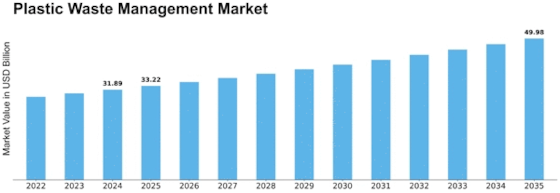

Plastic Waste Management Market Size Graph
Author
Author Profile
Varsha More
Senior Research Analyst

Experienced business professional with a demonstrated history of working in the CFnB industry. Skilled in market research, and market estimation. Strong professional with a Masters focused in marketing management.

Leave a Comment

FAQs

What is the projected market valuation of the Plastic Waste Management Market by 2035?

<p>The projected market valuation for the Plastic Waste Management Market is 49.98 USD Billion by 2035.</p>

What was the market valuation of the Plastic Waste Management Market in 2024?

<p>The overall market valuation of the Plastic Waste Management Market was 31.89 USD Billion in 2024.</p>

What is the expected CAGR for the Plastic Waste Management Market during the forecast period 2025 - 2035?

<p>The expected CAGR for the Plastic Waste Management Market during the forecast period 2025 - 2035 is 4.17%.</p>

Which companies are considered key players in the Plastic Waste Management Market?

<p>Key players in the Plastic Waste Management Market include Veolia, SUEZ, Waste Management, and Republic Services.</p>

What are the main segments of the Plastic Waste Management Market?

<p>The main segments of the Plastic Waste Management Market include Waste Collection Method, Recycling Technology, Plastic Type, and End Use Application.</p>

How much is the Kerbside Collection segment projected to grow by 2035?

<p>The Kerbside Collection segment is projected to grow from 8.0 USD Billion to 12.0 USD Billion by 2035.</p>

What is the projected valuation for the Mechanical Recycling segment by 2035?

<p>The Mechanical Recycling segment is projected to reach a valuation of 15.0 USD Billion by 2035.</p>

What is the expected growth for the Packaging end-use application by 2035?

<p>The Packaging end-use application is expected to grow from 12.0 USD Billion to 18.0 USD Billion by 2035.</p>

What is the projected valuation for the Polyethylene Terephthalate plastic type by 2035?

<p>The Polyethylene Terephthalate plastic type is projected to reach a valuation of 14.25 USD Billion by 2035.</p>

How does the growth of the Plastic Waste Management Market compare to other sectors?

<p>The growth of the Plastic Waste Management Market appears robust, with a projected CAGR of 4.17% from 2025 - 2035, indicating a strong upward trend.</p>

Market Summary

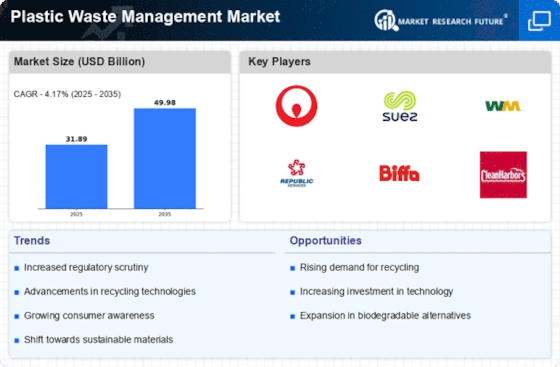
As per Market Research Future analysis, the Global Plastic Waste Management Market Size was estimated at 31.89 USD Billion in 2024. The Plastic Waste Management industry is projected to grow from 33.22 USD Billion in 2025 to 49.98 USD Billion by 2035, exhibiting a compound annual growth rate (CAGR) of 4.17% during the forecast period 2025 - 2035

Key Market Trends & Highlights

The Plastic Waste Management Market is poised for substantial growth driven by technological advancements and increasing regulatory pressures.

  • Technological advancements in recycling are reshaping the landscape of plastic waste management, particularly in North America. Consumer awareness and behavioral change are becoming pivotal in driving demand for sustainable waste management solutions in the Asia-Pacific region. Kerbside collection remains the largest segment, while curbside recycling is emerging as the fastest-growing segment in the market. Rising environmental concerns and stringent regulatory policies are key drivers propelling the growth of the plastic waste management market.

Market Size & Forecast

2024 Market Size 31.89 (USD Billion)
2035 Market Size 49.98 (USD Billion)
CAGR (2025 - 2035) 4.17%
Largest Regional Market Share in 2024 Asia Pacific

Major Players

Veolia (FR), SUEZ (FR), Waste Management (US), Republic Services (US), Biffa (GB), Clean Harbors (US), <a href="https://www.stericycle.com/en-us/resource-center/blog/recycling-plastic">Stericycle</a> (US), Remondis (DE), FCC Environment (GB), <a href="https://www.siemens.com/global/en/products/financing/siemens-financial-insight-center/covanta-and-sfs-sustainable-waste-solutions.html">Covanta </a>(US)

Market Trends

The Plastic Waste Management Market is currently experiencing a transformative phase, driven by increasing awareness of environmental issues and the pressing need for sustainable practices. Governments and organizations worldwide are implementing stricter regulations aimed at reducing plastic waste, which has led to a surge in innovative waste management solutions.

This shift appears to be fostering collaboration among various stakeholders, including manufacturers, recyclers, and consumers, to create a more circular economy. As a result, the market is witnessing a growing emphasis on recycling technologies and waste-to-energy processes, which could potentially enhance resource recovery and minimize landfill dependency. Moreover, the rising demand for eco-friendly products is influencing the Plastic Waste Management significantly. Companies are increasingly investing in research and development to create biodegradable alternatives and improve recycling methods.

This trend suggests a potential shift in consumer behavior, as individuals become more conscious of their environmental footprint. The integration of advanced technologies, such as artificial intelligence and blockchain, is also emerging as a key factor in optimizing waste management processes. As plastic garbage recycling continues to gain global momentum, these innovations are helping streamline collection, sorting, and material recovery. Overall, the Plastic Waste Management market is poised for substantial growth, driven by innovation and a collective commitment to sustainability.

Technological Advancements in Recycling

The Plastic Waste Management is witnessing a notable trend towards the adoption of advanced recycling technologies. Innovations such as chemical recycling and enhanced sorting systems are being developed to improve the efficiency and effectiveness of plastic waste processing. These technologies not only increase the volume of recyclable materials but also enhance the quality of recycled products, making them more appealing to manufacturers.

Regulatory Frameworks and Policies

There is a growing trend of governments worldwide implementing stringent regulations aimed at reducing plastic waste. These policies often include bans on single-use plastics and incentives for recycling initiatives. Such regulatory frameworks are likely to drive investment in waste management infrastructure and encourage businesses to adopt sustainable practices, thereby reshaping the Plastic Waste Management Market.

Consumer Awareness and Behavioral Change

An increasing awareness among consumers regarding the environmental impact of plastic waste is influencing market dynamics. This heightened consciousness is leading to a shift in purchasing behaviors, with more individuals opting for sustainable products and supporting brands that prioritize eco-friendly practices. As a result, companies are compelled to adapt their strategies to meet the evolving expectations of environmentally conscious consumers.

Plastic Waste Management Market Market Drivers

Rising Environmental Concerns

Growing environmental concerns are significantly influencing the Plastic Waste Management Industry. Public awareness regarding the detrimental effects of plastic pollution is prompting both consumers and businesses to seek sustainable alternatives. The Plastic Recycling Market is witnessing substantial growth as industries and governments focus on recycling technologies, reducing landfill waste, and promoting circular economy initiatives. Advances in mechanical and chemical recycling processes, coupled with supportive regulations and rising demand for recycled plastics, are driving innovation and investment across this sector. This shift in consumer behavior is leading to increased demand for eco-friendly products and effective waste management solutions. Market data indicates that approximately 70% of consumers are willing to pay a premium for products that are packaged sustainably. Consequently, companies are adapting their strategies to align with these preferences, thereby driving innovation and investment in the Market.

Stringent Regulatory Policies

Regulatory frameworks are becoming increasingly stringent, driving the Plastic Waste Management Industry towards more sustainable practices. Governments are enacting laws that mandate recycling and impose penalties for non-compliance. For instance, several countries have introduced extended producer responsibility (EPR) regulations, requiring manufacturers to take responsibility for the entire lifecycle of their products. This shift is compelling companies to invest in sustainable waste management solutions. As a result, the market is projected to grow at a compound annual growth rate (CAGR) of 5.5% over the next decade, reflecting the influence of these regulatory measures on the market.

Corporate Sustainability Initiatives

Many corporations are adopting sustainability initiatives that directly impact the Plastic Waste Management. As businesses recognize the importance of corporate social responsibility, they are increasingly committing to reducing their plastic footprint. This includes investing in recycling technologies and developing sustainable packaging solutions. Reports suggest that companies that prioritize sustainability are likely to see a 20% increase in customer loyalty. This trend is not only beneficial for the environment but also enhances brand reputation, thereby driving growth in the market.

Investment in Waste Management Infrastructure

Investment in waste management infrastructure is crucial for the advancement of the Plastic Waste Management. Governments and private entities are allocating significant funds to improve recycling facilities and waste processing technologies. Enhanced infrastructure facilitates better collection, sorting, and recycling of plastic waste, which is essential for achieving higher recycling rates. Recent estimates indicate that investments in waste management infrastructure could exceed 100 billion dollars over the next decade. This influx of capital is expected to bolster the efficiency and effectiveness of the market.

Technological Innovations in Waste Management

The Plastic Waste Management Market is experiencing a surge in technological innovations that enhance recycling processes. Advanced sorting technologies, such as AI-driven systems, are being implemented to improve the efficiency of material recovery facilities. These innovations not only streamline operations but also increase the purity of recycled materials, making them more valuable in the market. Furthermore, the development of biodegradable plastics and advanced chemical recycling methods is gaining traction. According to recent data, the adoption of these technologies could potentially increase recycling rates by up to 30% over the next five years, thereby significantly impacting the market.

Market Segment Insights

By Waste Collection Method: Kerbside Collection (Largest) vs. Curbside Recycling (Fastest-Growing)

In the Plastic Waste Management Market, Kerbside Collection emerges as the largest segment, driven by the convenience it offers to households and businesses alike. This traditional method facilitates easy collection of recyclable materials at the curbside, thus encouraging higher participation rates among the general public. Following closely, Drop-Off Centers and Commercial Collection make up significant shares, providing specialized options for businesses and eco-conscious consumers.

Kerbside Collection (Dominant) vs. Curbside Recycling (Emerging)

Kerbside Collection stands out as the dominant method in plastic waste management Market, thanks to its established infrastructure and widespread acceptance among residents. It operates efficiently in urban and suburban areas, providing timely pickups and reducing illegal dumping. On the other hand, Curbside <a href="https://www.marketresearchfuture.com/reports/recycling-equipment-market-11732">Recycling equipment</a> is an emerging segment, rapidly gaining traction as municipalities integrate advanced sorting technologies. This shift is fueled by growing environmental awareness and the increase in regulations promoting material recovery, making curbside recycling a vital player in the future of waste management.

By Recycling Technology: Mechanical Recycling (Largest) vs. Chemical Recycling (Fastest-Growing)

The Plastic Waste Management exhibits a diverse range of recycling technologies with mechanical recycling holding the largest market share. This traditional method efficiently processes plastic waste through shredding, washing, and reprocessing into usable materials. Chemical recycling, on the other hand, is emerging rapidly, leveraging advanced technologies to break down plastics into their monomers, significantly increasing the recyclability of complex plastic products. Growth trends in this segment are driven by rising environmental awareness, regulatory pressures for sustainable waste management solutions, and technological advancements that enhance efficiency. Mechanical recycling remains popular due to its established practices, yet the rapid adoption of chemical recycling technologies signifies a shift in the industry aiming to improve overall recycling rates and reduce plastic pollution. This dynamic contributes to a competitive landscape where both recycling methods are vying for market relevance.

Mechanical Recycling (Dominant) vs. Chemical Recycling (Emerging)

Mechanical recycling plays a pivotal role in the Plastic Waste Management by offering practical, cost-effective solutions to address plastic waste. This technology dominates by converting post-consumer plastics into reusable raw materials without altering their chemical structure, making it widely applicable across various plastic types. In contrast, chemical recycling is gaining traction as an emerging technology, designed to handle more complex plastics that mechanical processes struggle with. By utilizing depolymerization methods, it can turn waste back into valuable feedstocks, positioning it as a complement to mechanical recycling. The innovation in this space encourages investment and research, promising to redefine recycling standards and enhance plastic waste management efficiency.

By Plastic Type: Polyethylene Terephthalate (Largest) vs. Polypropylene (Fastest-Growing)

In the Plastic Waste Management , Polyethylene Terephthalate (PET) leads as the largest segment, capturing a significant share due to its widespread use in packaging and consumer products. High-Density Polyethylene (HDPE) and Low-Density Polyethylene (LDPE) follow closely, together forming a considerable part of the market fabric. Polyvinyl Chloride (PVC) has shown consistent demand in construction and plumbing, driving its relevance, while Polypropylene (PP) emerges as a notable player, increasing its market presence steadily overall.

Polyethylene Terephthalate (Dominant) vs. Polypropylene (Emerging)

Polyethylene Terephthalate (PET) is quintessential in the Plastic Waste Management landscape, recognized for its recyclability and extensive use in beverage containers and packaging solutions. Its dominant position stems from robust recycling technologies and consumer recycling initiatives fueling its lifecycle. On the other hand, Polypropylene (PP) is marked as an emerging force in this sector; its versatility and lightweight nature make it popular in a myriad of applications, including automotive and food packaging. As environmental regulations tighten, the increased adoption of PP reflects growing sustainability awareness, promising a future where both materials coexist with distinct strengths in addressing plastic waste issues.

By End Use Application: Packaging (Largest) vs. Textiles (Fastest-Growing)

In the Plastic Waste Management Market, the end use application segment is predominantly driven by packaging, which holds the largest share of the market. This segment encompasses a wide range of applications, including food and beverage packaging, industrial packaging, and consumer goods packaging. Following closely are sectors like textiles, construction, automotive, and consumer goods, each contributing significantly but with a smaller market share compared to packaging. Textiles are emerging quickly as a critical area, fueled by increasing awareness of environmental sustainability and innovations in recycling technologies.

Packaging (Dominant) vs. Textiles (Emerging)

The packaging segment stands out as the dominant force in the market, characterized by its extensive use in various applications such as wrappers, containers, and films. This sector is bolstered by high consumer demand and a shift towards recyclable materials in response to global sustainability goals. On the other hand, textiles are emerging as a significant player, driven by innovation in recycling methods and increasing consumer interest in sustainable fashion. The textile application of plastic waste is gaining traction as manufacturers adopt alternative materials for production, thus expanding the market and enhancing eco-conscious consumption.

Get more detailed insights about Plastic Waste Management Market Research Report - Forecast to 2035

Regional Insights

The market is poised to witness notable growth across regional segments, with varying valuations reflecting each region's specific needs and strategies. In 2024, North America leads with a market value of 9.56 USD billion, representing a significant portion of the global market due to stringent environmental regulations and advanced recycling technologies. Europe follows closely with a valuation of 8.46 USD billion in the same year, bolstered by strong governmental policies promoting sustainability.

The Asia Pacific region, valued at 9.87 USD billion, is also critical as it grapples with high plastic waste generation rates and is actively developing waste management infrastructures to combat this challenge.

South America, while smaller at 2.63 USD billion, presents opportunities for growth due to increasing awareness of plastic waste issues. The Middle East and Africa, valued at 1.37 USD billion, face unique challenges, including limited waste management frameworks, yet they are gradually improving with international collaborations. The diverse economic landscapes and regulatory environments across these regions create both challenges and opportunities, highlighting the need for tailored strategies in the Plastic Waste Management Market.

Key Players and Competitive Insights

The Plastic Waste Management Market has seen significant growth and development, driven by increasing awareness of environmental sustainability and regulatory pressures to reduce plastic waste. Key players in the market are focusing on innovative waste management solutions, advanced recycling technologies, and effective waste collection systems to enhance their market positions. The competitive landscape is characterized by a mix of established firms and emerging startups that are leveraging technology to offer more efficient and sustainable options for plastic waste management. This competitive insight highlights the strategies adopted by companies to differentiate their services, such as collaboration with municipalities, investments in recycling infrastructure, and the adoption of cutting-edge technologies to streamline operations and improve waste processing efficiencies. Waste Management has also established itself as a key player in the Plastic Waste Management Market, offering a comprehensive portfolio of services that include solid waste collection, recycling, and recovery. The company has developed innovative solutions aimed at increasing recycling rates and minimizing the amount of plastic waste sent to landfills. Waste Management’s extensive network and operational scale enable efficient service delivery and strong customer relationships globally, underpinning its market strength. With ongoing investments in technological advancements, such as waste-to-energy conversion and more sophisticated recycling technologies, Waste Management is well-positioned to address the growing challenges of plastic waste. The company has pursued strategic mergers and acquisitions, enabling it to expand its capabilities and market reach further, thereby enhancing its overall effectiveness in managing plastic waste on a global scale.

Key Companies in the Plastic Waste Management Market include

Industry Developments

The Plastic Waste Management is still changing as of mid-2025, with a growing focus on sustainability, new ideas, and circular economy practices. Waste Management and Republic Services, for example, are putting more money into advanced recycling and landfill diversion strategies. This is part of a larger trend in the industry toward eco-efficiency.

Veolia Environnement has built a notable position in the Plastic Waste Management Market through the development of extensive recycling facilities, innovative closed-loop plastic solutions, and substantial investments in mechanical and chemical recycling technologies. Through its strategic global collaborations and research-focused initiatives, the company has successfully processed thousands of tons of plastic waste each year, solidifying its position as a leader in sustainability within the industry.

As governments make environmental rules stricter, the need for scalable plastic waste solutions keeps bringing in money and new technology. 

Future Outlook

Plastic Waste Management Market Future Outlook

The Plastic Waste Management Market is projected to grow at a 4.17% CAGR from 2025 to 2035, driven by regulatory pressures, technological advancements, and increasing consumer awareness.<br>The future outlook for the Plastic Waste Management Market is increasingly defined by the transition toward a circular economy, where chemical recycling and advanced sorting technologies replace traditional landfilling. As global regulations tighten around single-use materials, the Plastic Waste Management Market will see significant growth driven by corporate sustainability mandates. Innovations in biodegradable polymers and automated recovery systems are set to fundamentally reshape the Plastic Waste Management Market over the coming years.

New opportunities lie in:

  • <p>Development of advanced recycling technologies for mixed plastics Expansion of biodegradable plastic alternatives in packaging Implementation of circular economy models in supply chains</p>

By 2035, the market is expected to be robust, driven by innovation and sustainability initiatives.

Market Segmentation

Plastic Waste Management Market Plastic Type Outlook

  • Polyethylene Terephthalate
  • High-Density Polyethylene
  • Polyvinyl Chloride
  • Low-Density Polyethylene
  • Polypropylene

Plastic Waste Management Market End Use Application Outlook

  • Packaging
  • Textiles
  • Construction
  • Automotive
  • Consumer Goods

Plastic Waste Management Market Recycling Technology Outlook

  • Mechanical Recycling
  • Chemical Recycling
  • Energy Recovery
  • Biological Recycling

Plastic Waste Management Market Waste Collection Method Outlook

  • Kerbside Collection
  • Drop-Off Centers
  • Commercial Collection
  • Curbside Recycling
  • Community Recycling

Report Scope

MARKET SIZE 2024 31.89(USD Billion)
MARKET SIZE 2025 33.22(USD Billion)
MARKET SIZE 2035 49.98(USD Billion)
COMPOUND ANNUAL GROWTH RATE (CAGR) 4.17% (2025 - 2035)
REPORT COVERAGE Revenue Forecast, Competitive Landscape, Growth Factors, and Trends
BASE YEAR 2024
Market Forecast Period 2025 - 2035
Historical Data 2019 - 2024
Market Forecast Units USD Billion
Key Companies Profiled Veolia (FR), SUEZ (FR), Waste Management (US), Republic Services (US), Biffa (GB), Clean Harbors (US), Stericycle (US), Remondis (DE), FCC Environment (GB), Covanta (US)
Segments Covered Waste Collection Method, Recycling Technology, Plastic Type, End Use Application, Regional
Key Market Opportunities Integration of advanced recycling technologies enhances efficiency in the Plastic Waste Management Market.
Key Market Dynamics Rising regulatory pressures and technological advancements drive innovation in plastic waste management solutions.
Countries Covered North America, Europe, APAC, South America, MEA

FAQs

What is the projected market valuation of the Plastic Waste Management Market by 2035?

<p>The projected market valuation for the Plastic Waste Management Market is 49.98 USD Billion by 2035.</p>

What was the market valuation of the Plastic Waste Management Market in 2024?

<p>The overall market valuation of the Plastic Waste Management Market was 31.89 USD Billion in 2024.</p>

What is the expected CAGR for the Plastic Waste Management Market during the forecast period 2025 - 2035?

<p>The expected CAGR for the Plastic Waste Management Market during the forecast period 2025 - 2035 is 4.17%.</p>

Which companies are considered key players in the Plastic Waste Management Market?

<p>Key players in the Plastic Waste Management Market include Veolia, SUEZ, Waste Management, and Republic Services.</p>

What are the main segments of the Plastic Waste Management Market?

<p>The main segments of the Plastic Waste Management Market include Waste Collection Method, Recycling Technology, Plastic Type, and End Use Application.</p>

How much is the Kerbside Collection segment projected to grow by 2035?

<p>The Kerbside Collection segment is projected to grow from 8.0 USD Billion to 12.0 USD Billion by 2035.</p>

What is the projected valuation for the Mechanical Recycling segment by 2035?

<p>The Mechanical Recycling segment is projected to reach a valuation of 15.0 USD Billion by 2035.</p>

What is the expected growth for the Packaging end-use application by 2035?

<p>The Packaging end-use application is expected to grow from 12.0 USD Billion to 18.0 USD Billion by 2035.</p>

What is the projected valuation for the Polyethylene Terephthalate plastic type by 2035?

<p>The Polyethylene Terephthalate plastic type is projected to reach a valuation of 14.25 USD Billion by 2035.</p>

How does the growth of the Plastic Waste Management Market compare to other sectors?

<p>The growth of the Plastic Waste Management Market appears robust, with a projected CAGR of 4.17% from 2025 - 2035, indicating a strong upward trend.</p>

  1. SECTION I: EXECUTIVE SUMMARY AND KEY HIGHLIGHTS
    1. | 1.1 EXECUTIVE SUMMARY
    2. | | 1.1.1 Market Overview
    3. | | 1.1.2 Key Findings
    4. | | 1.1.3 Market Segmentation
    5. | | 1.1.4 Competitive Landscape
    6. | | 1.1.5 Challenges and Opportunities
    7. | | 1.1.6 Future Outlook
  2. SECTION II: SCOPING, METHODOLOGY AND MARKET STRUCTURE
    1. | 2.1 MARKET INTRODUCTION
    2. | | 2.1.1 Definition
    3. | | 2.1.2 Scope of the study
    4. | | | 2.1.2.1 Research Objective
    5. | | | 2.1.2.2 Assumption
    6. | | | 2.1.2.3 Limitations
    7. | 2.2 RESEARCH METHODOLOGY
    8. | | 2.2.1 Overview
    9. | | 2.2.2 Data Mining
    10. | | 2.2.3 Secondary Research
    11. | | 2.2.4 Primary Research
    12. | | | 2.2.4.1 Primary Interviews and Information Gathering Process
    13. | | | 2.2.4.2 Breakdown of Primary Respondents
    14. | | 2.2.5 Forecasting Model
    15. | | 2.2.6 Market Size Estimation
    16. | | | 2.2.6.1 Bottom-Up Approach
    17. | | | 2.2.6.2 Top-Down Approach
    18. | | 2.2.7 Data Triangulation
    19. | | 2.2.8 Validation
  3. SECTION III: QUALITATIVE ANALYSIS
    1. | 3.1 MARKET DYNAMICS
    2. | | 3.1.1 Overview
    3. | | 3.1.2 Drivers
    4. | | 3.1.3 Restraints
    5. | | 3.1.4 Opportunities
    6. | 3.2 MARKET FACTOR ANALYSIS
    7. | | 3.2.1 Value chain Analysis
    8. | | 3.2.2 Porter's Five Forces Analysis
    9. | | | 3.2.2.1 Bargaining Power of Suppliers
    10. | | | 3.2.2.2 Bargaining Power of Buyers
    11. | | | 3.2.2.3 Threat of New Entrants
    12. | | | 3.2.2.4 Threat of Substitutes
    13. | | | 3.2.2.5 Intensity of Rivalry
    14. | | 3.2.3 COVID-19 Impact Analysis
    15. | | | 3.2.3.1 Market Impact Analysis
    16. | | | 3.2.3.2 Regional Impact
    17. | | | 3.2.3.3 Opportunity and Threat Analysis
  4. SECTION IV: QUANTITATIVE ANALYSIS
    1. | 4.1 Chemicals and Materials, BY Waste Collection Method (USD Billion)
    2. | | 4.1.1 Kerbside Collection
    3. | | 4.1.2 Drop-Off Centers
    4. | | 4.1.3 Commercial Collection
    5. | | 4.1.4 Curbside Recycling
    6. | | 4.1.5 Community Recycling
    7. | 4.2 Chemicals and Materials, BY Recycling Technology (USD Billion)
    8. | | 4.2.1 Mechanical Recycling
    9. | | 4.2.2 Chemical Recycling
    10. | | 4.2.3 Energy Recovery
    11. | | 4.2.4 Biological Recycling
    12. | 4.3 Chemicals and Materials, BY Plastic Type (USD Billion)
    13. | | 4.3.1 Polyethylene Terephthalate
    14. | | 4.3.2 High-Density Polyethylene
    15. | | 4.3.3 Polyvinyl Chloride
    16. | | 4.3.4 Low-Density Polyethylene
    17. | | 4.3.5 Polypropylene
    18. | 4.4 Chemicals and Materials, BY End Use Application (USD Billion)
    19. | | 4.4.1 Packaging
    20. | | 4.4.2 Textiles
    21. | | 4.4.3 Construction
    22. | | 4.4.4 Automotive
    23. | | 4.4.5 Consumer Goods
    24. | 4.5 Chemicals and Materials, BY Region (USD Billion)
    25. | | 4.5.1 North America
    26. | | | 4.5.1.1 US
    27. | | | 4.5.1.2 Canada
    28. | | 4.5.2 Europe
    29. | | | 4.5.2.1 Germany
    30. | | | 4.5.2.2 UK
    31. | | | 4.5.2.3 France
    32. | | | 4.5.2.4 Russia
    33. | | | 4.5.2.5 Italy
    34. | | | 4.5.2.6 Spain
    35. | | | 4.5.2.7 Rest of Europe
    36. | | 4.5.3 APAC
    37. | | | 4.5.3.1 China
    38. | | | 4.5.3.2 India
    39. | | | 4.5.3.3 Japan
    40. | | | 4.5.3.4 South Korea
    41. | | | 4.5.3.5 Malaysia
    42. | | | 4.5.3.6 Thailand
    43. | | | 4.5.3.7 Indonesia
    44. | | | 4.5.3.8 Rest of APAC
    45. | | 4.5.4 South America
    46. | | | 4.5.4.1 Brazil
    47. | | | 4.5.4.2 Mexico
    48. | | | 4.5.4.3 Argentina
    49. | | | 4.5.4.4 Rest of South America
    50. | | 4.5.5 MEA
    51. | | | 4.5.5.1 GCC Countries
    52. | | | 4.5.5.2 South Africa
    53. | | | 4.5.5.3 Rest of MEA
  5. SECTION V: COMPETITIVE ANALYSIS
    1. | 5.1 Competitive Landscape
    2. | | 5.1.1 Overview
    3. | | 5.1.2 Competitive Analysis
    4. | | 5.1.3 Market share Analysis
    5. | | 5.1.4 Major Growth Strategy in the Chemicals and Materials
    6. | | 5.1.5 Competitive Benchmarking
    7. | | 5.1.6 Leading Players in Terms of Number of Developments in the Chemicals and Materials
    8. | | 5.1.7 Key developments and growth strategies
    9. | | | 5.1.7.1 New Product Launch/Service Deployment
    10. | | | 5.1.7.2 Merger & Acquisitions
    11. | | | 5.1.7.3 Joint Ventures
    12. | | 5.1.8 Major Players Financial Matrix
    13. | | | 5.1.8.1 Sales and Operating Income
    14. | | | 5.1.8.2 Major Players R&D Expenditure. 2023
    15. | 5.2 Company Profiles
    16. | | 5.2.1 Veolia (FR)
    17. | | | 5.2.1.1 Financial Overview
    18. | | | 5.2.1.2 Products Offered
    19. | | | 5.2.1.3 Key Developments
    20. | | | 5.2.1.4 SWOT Analysis
    21. | | | 5.2.1.5 Key Strategies
    22. | | 5.2.2 SUEZ (FR)
    23. | | | 5.2.2.1 Financial Overview
    24. | | | 5.2.2.2 Products Offered
    25. | | | 5.2.2.3 Key Developments
    26. | | | 5.2.2.4 SWOT Analysis
    27. | | | 5.2.2.5 Key Strategies
    28. | | 5.2.3 Waste Management (US)
    29. | | | 5.2.3.1 Financial Overview
    30. | | | 5.2.3.2 Products Offered
    31. | | | 5.2.3.3 Key Developments
    32. | | | 5.2.3.4 SWOT Analysis
    33. | | | 5.2.3.5 Key Strategies
    34. | | 5.2.4 Republic Services (US)
    35. | | | 5.2.4.1 Financial Overview
    36. | | | 5.2.4.2 Products Offered
    37. | | | 5.2.4.3 Key Developments
    38. | | | 5.2.4.4 SWOT Analysis
    39. | | | 5.2.4.5 Key Strategies
    40. | | 5.2.5 Biffa (GB)
    41. | | | 5.2.5.1 Financial Overview
    42. | | | 5.2.5.2 Products Offered
    43. | | | 5.2.5.3 Key Developments
    44. | | | 5.2.5.4 SWOT Analysis
    45. | | | 5.2.5.5 Key Strategies
    46. | | 5.2.6 Clean Harbors (US)
    47. | | | 5.2.6.1 Financial Overview
    48. | | | 5.2.6.2 Products Offered
    49. | | | 5.2.6.3 Key Developments
    50. | | | 5.2.6.4 SWOT Analysis
    51. | | | 5.2.6.5 Key Strategies
    52. | | 5.2.7 Stericycle (US)
    53. | | | 5.2.7.1 Financial Overview
    54. | | | 5.2.7.2 Products Offered
    55. | | | 5.2.7.3 Key Developments
    56. | | | 5.2.7.4 SWOT Analysis
    57. | | | 5.2.7.5 Key Strategies
    58. | | 5.2.8 Remondis (DE)
    59. | | | 5.2.8.1 Financial Overview
    60. | | | 5.2.8.2 Products Offered
    61. | | | 5.2.8.3 Key Developments
    62. | | | 5.2.8.4 SWOT Analysis
    63. | | | 5.2.8.5 Key Strategies
    64. | | 5.2.9 FCC Environment (GB)
    65. | | | 5.2.9.1 Financial Overview
    66. | | | 5.2.9.2 Products Offered
    67. | | | 5.2.9.3 Key Developments
    68. | | | 5.2.9.4 SWOT Analysis
    69. | | | 5.2.9.5 Key Strategies
    70. | | 5.2.10 Covanta (US)
    71. | | | 5.2.10.1 Financial Overview
    72. | | | 5.2.10.2 Products Offered
    73. | | | 5.2.10.3 Key Developments
    74. | | | 5.2.10.4 SWOT Analysis
    75. | | | 5.2.10.5 Key Strategies
    76. | 5.3 Appendix
    77. | | 5.3.1 References
    78. | | 5.3.2 Related Reports
  6. LIST OF FIGURES
    1. | 6.1 MARKET SYNOPSIS
    2. | 6.2 NORTH AMERICA MARKET ANALYSIS
    3. | 6.3 US MARKET ANALYSIS BY WASTE COLLECTION METHOD
    4. | 6.4 US MARKET ANALYSIS BY RECYCLING TECHNOLOGY
    5. | 6.5 US MARKET ANALYSIS BY PLASTIC TYPE
    6. | 6.6 US MARKET ANALYSIS BY END USE APPLICATION
    7. | 6.7 CANADA MARKET ANALYSIS BY WASTE COLLECTION METHOD
    8. | 6.8 CANADA MARKET ANALYSIS BY RECYCLING TECHNOLOGY
    9. | 6.9 CANADA MARKET ANALYSIS BY PLASTIC TYPE
    10. | 6.10 CANADA MARKET ANALYSIS BY END USE APPLICATION
    11. | 6.11 EUROPE MARKET ANALYSIS
    12. | 6.12 GERMANY MARKET ANALYSIS BY WASTE COLLECTION METHOD
    13. | 6.13 GERMANY MARKET ANALYSIS BY RECYCLING TECHNOLOGY
    14. | 6.14 GERMANY MARKET ANALYSIS BY PLASTIC TYPE
    15. | 6.15 GERMANY MARKET ANALYSIS BY END USE APPLICATION
    16. | 6.16 UK MARKET ANALYSIS BY WASTE COLLECTION METHOD
    17. | 6.17 UK MARKET ANALYSIS BY RECYCLING TECHNOLOGY
    18. | 6.18 UK MARKET ANALYSIS BY PLASTIC TYPE
    19. | 6.19 UK MARKET ANALYSIS BY END USE APPLICATION
    20. | 6.20 FRANCE MARKET ANALYSIS BY WASTE COLLECTION METHOD
    21. | 6.21 FRANCE MARKET ANALYSIS BY RECYCLING TECHNOLOGY
    22. | 6.22 FRANCE MARKET ANALYSIS BY PLASTIC TYPE
    23. | 6.23 FRANCE MARKET ANALYSIS BY END USE APPLICATION
    24. | 6.24 RUSSIA MARKET ANALYSIS BY WASTE COLLECTION METHOD
    25. | 6.25 RUSSIA MARKET ANALYSIS BY RECYCLING TECHNOLOGY
    26. | 6.26 RUSSIA MARKET ANALYSIS BY PLASTIC TYPE
    27. | 6.27 RUSSIA MARKET ANALYSIS BY END USE APPLICATION
    28. | 6.28 ITALY MARKET ANALYSIS BY WASTE COLLECTION METHOD
    29. | 6.29 ITALY MARKET ANALYSIS BY RECYCLING TECHNOLOGY
    30. | 6.30 ITALY MARKET ANALYSIS BY PLASTIC TYPE
    31. | 6.31 ITALY MARKET ANALYSIS BY END USE APPLICATION
    32. | 6.32 SPAIN MARKET ANALYSIS BY WASTE COLLECTION METHOD
    33. | 6.33 SPAIN MARKET ANALYSIS BY RECYCLING TECHNOLOGY
    34. | 6.34 SPAIN MARKET ANALYSIS BY PLASTIC TYPE
    35. | 6.35 SPAIN MARKET ANALYSIS BY END USE APPLICATION
    36. | 6.36 REST OF EUROPE MARKET ANALYSIS BY WASTE COLLECTION METHOD
    37. | 6.37 REST OF EUROPE MARKET ANALYSIS BY RECYCLING TECHNOLOGY
    38. | 6.38 REST OF EUROPE MARKET ANALYSIS BY PLASTIC TYPE
    39. | 6.39 REST OF EUROPE MARKET ANALYSIS BY END USE APPLICATION
    40. | 6.40 APAC MARKET ANALYSIS
    41. | 6.41 CHINA MARKET ANALYSIS BY WASTE COLLECTION METHOD
    42. | 6.42 CHINA MARKET ANALYSIS BY RECYCLING TECHNOLOGY
    43. | 6.43 CHINA MARKET ANALYSIS BY PLASTIC TYPE
    44. | 6.44 CHINA MARKET ANALYSIS BY END USE APPLICATION
    45. | 6.45 INDIA MARKET ANALYSIS BY WASTE COLLECTION METHOD
    46. | 6.46 INDIA MARKET ANALYSIS BY RECYCLING TECHNOLOGY
    47. | 6.47 INDIA MARKET ANALYSIS BY PLASTIC TYPE
    48. | 6.48 INDIA MARKET ANALYSIS BY END USE APPLICATION
    49. | 6.49 JAPAN MARKET ANALYSIS BY WASTE COLLECTION METHOD
    50. | 6.50 JAPAN MARKET ANALYSIS BY RECYCLING TECHNOLOGY
    51. | 6.51 JAPAN MARKET ANALYSIS BY PLASTIC TYPE
    52. | 6.52 JAPAN MARKET ANALYSIS BY END USE APPLICATION
    53. | 6.53 SOUTH KOREA MARKET ANALYSIS BY WASTE COLLECTION METHOD
    54. | 6.54 SOUTH KOREA MARKET ANALYSIS BY RECYCLING TECHNOLOGY
    55. | 6.55 SOUTH KOREA MARKET ANALYSIS BY PLASTIC TYPE
    56. | 6.56 SOUTH KOREA MARKET ANALYSIS BY END USE APPLICATION
    57. | 6.57 MALAYSIA MARKET ANALYSIS BY WASTE COLLECTION METHOD
    58. | 6.58 MALAYSIA MARKET ANALYSIS BY RECYCLING TECHNOLOGY
    59. | 6.59 MALAYSIA MARKET ANALYSIS BY PLASTIC TYPE
    60. | 6.60 MALAYSIA MARKET ANALYSIS BY END USE APPLICATION
    61. | 6.61 THAILAND MARKET ANALYSIS BY WASTE COLLECTION METHOD
    62. | 6.62 THAILAND MARKET ANALYSIS BY RECYCLING TECHNOLOGY
    63. | 6.63 THAILAND MARKET ANALYSIS BY PLASTIC TYPE
    64. | 6.64 THAILAND MARKET ANALYSIS BY END USE APPLICATION
    65. | 6.65 INDONESIA MARKET ANALYSIS BY WASTE COLLECTION METHOD
    66. | 6.66 INDONESIA MARKET ANALYSIS BY RECYCLING TECHNOLOGY
    67. | 6.67 INDONESIA MARKET ANALYSIS BY PLASTIC TYPE
    68. | 6.68 INDONESIA MARKET ANALYSIS BY END USE APPLICATION
    69. | 6.69 REST OF APAC MARKET ANALYSIS BY WASTE COLLECTION METHOD
    70. | 6.70 REST OF APAC MARKET ANALYSIS BY RECYCLING TECHNOLOGY
    71. | 6.71 REST OF APAC MARKET ANALYSIS BY PLASTIC TYPE
    72. | 6.72 REST OF APAC MARKET ANALYSIS BY END USE APPLICATION
    73. | 6.73 SOUTH AMERICA MARKET ANALYSIS
    74. | 6.74 BRAZIL MARKET ANALYSIS BY WASTE COLLECTION METHOD
    75. | 6.75 BRAZIL MARKET ANALYSIS BY RECYCLING TECHNOLOGY
    76. | 6.76 BRAZIL MARKET ANALYSIS BY PLASTIC TYPE
    77. | 6.77 BRAZIL MARKET ANALYSIS BY END USE APPLICATION
    78. | 6.78 MEXICO MARKET ANALYSIS BY WASTE COLLECTION METHOD
    79. | 6.79 MEXICO MARKET ANALYSIS BY RECYCLING TECHNOLOGY
    80. | 6.80 MEXICO MARKET ANALYSIS BY PLASTIC TYPE
    81. | 6.81 MEXICO MARKET ANALYSIS BY END USE APPLICATION
    82. | 6.82 ARGENTINA MARKET ANALYSIS BY WASTE COLLECTION METHOD
    83. | 6.83 ARGENTINA MARKET ANALYSIS BY RECYCLING TECHNOLOGY
    84. | 6.84 ARGENTINA MARKET ANALYSIS BY PLASTIC TYPE
    85. | 6.85 ARGENTINA MARKET ANALYSIS BY END USE APPLICATION
    86. | 6.86 REST OF SOUTH AMERICA MARKET ANALYSIS BY WASTE COLLECTION METHOD
    87. | 6.87 REST OF SOUTH AMERICA MARKET ANALYSIS BY RECYCLING TECHNOLOGY
    88. | 6.88 REST OF SOUTH AMERICA MARKET ANALYSIS BY PLASTIC TYPE
    89. | 6.89 REST OF SOUTH AMERICA MARKET ANALYSIS BY END USE APPLICATION
    90. | 6.90 MEA MARKET ANALYSIS
    91. | 6.91 GCC COUNTRIES MARKET ANALYSIS BY WASTE COLLECTION METHOD
    92. | 6.92 GCC COUNTRIES MARKET ANALYSIS BY RECYCLING TECHNOLOGY
    93. | 6.93 GCC COUNTRIES MARKET ANALYSIS BY PLASTIC TYPE
    94. | 6.94 GCC COUNTRIES MARKET ANALYSIS BY END USE APPLICATION
    95. | 6.95 SOUTH AFRICA MARKET ANALYSIS BY WASTE COLLECTION METHOD
    96. | 6.96 SOUTH AFRICA MARKET ANALYSIS BY RECYCLING TECHNOLOGY
    97. | 6.97 SOUTH AFRICA MARKET ANALYSIS BY PLASTIC TYPE
    98. | 6.98 SOUTH AFRICA MARKET ANALYSIS BY END USE APPLICATION
    99. | 6.99 REST OF MEA MARKET ANALYSIS BY WASTE COLLECTION METHOD
    100. | 6.100 REST OF MEA MARKET ANALYSIS BY RECYCLING TECHNOLOGY
    101. | 6.101 REST OF MEA MARKET ANALYSIS BY PLASTIC TYPE
    102. | 6.102 REST OF MEA MARKET ANALYSIS BY END USE APPLICATION
    103. | 6.103 KEY BUYING CRITERIA OF CHEMICALS AND MATERIALS
    104. | 6.104 RESEARCH PROCESS OF MRFR
    105. | 6.105 DRO ANALYSIS OF CHEMICALS AND MATERIALS
    106. | 6.106 DRIVERS IMPACT ANALYSIS: CHEMICALS AND MATERIALS
    107. | 6.107 RESTRAINTS IMPACT ANALYSIS: CHEMICALS AND MATERIALS
    108. | 6.108 SUPPLY / VALUE CHAIN: CHEMICALS AND MATERIALS
    109. | 6.109 CHEMICALS AND MATERIALS, BY WASTE COLLECTION METHOD, 2024 (% SHARE)
    110. | 6.110 CHEMICALS AND MATERIALS, BY WASTE COLLECTION METHOD, 2024 TO 2035 (USD Billion)
    111. | 6.111 CHEMICALS AND MATERIALS, BY RECYCLING TECHNOLOGY, 2024 (% SHARE)
    112. | 6.112 CHEMICALS AND MATERIALS, BY RECYCLING TECHNOLOGY, 2024 TO 2035 (USD Billion)
    113. | 6.113 CHEMICALS AND MATERIALS, BY PLASTIC TYPE, 2024 (% SHARE)
    114. | 6.114 CHEMICALS AND MATERIALS, BY PLASTIC TYPE, 2024 TO 2035 (USD Billion)
    115. | 6.115 CHEMICALS AND MATERIALS, BY END USE APPLICATION, 2024 (% SHARE)
    116. | 6.116 CHEMICALS AND MATERIALS, BY END USE APPLICATION, 2024 TO 2035 (USD Billion)
    117. | 6.117 BENCHMARKING OF MAJOR COMPETITORS
  7. LIST OF TABLES
    1. | 7.1 LIST OF ASSUMPTIONS
    2. | | 7.1.1
    3. | 7.2 North America MARKET SIZE ESTIMATES; FORECAST
    4. | | 7.2.1 BY WASTE COLLECTION METHOD, 2025-2035 (USD Billion)
    5. | | 7.2.2 BY RECYCLING TECHNOLOGY, 2025-2035 (USD Billion)
    6. | | 7.2.3 BY PLASTIC TYPE, 2025-2035 (USD Billion)
    7. | | 7.2.4 BY END USE APPLICATION, 2025-2035 (USD Billion)
    8. | 7.3 US MARKET SIZE ESTIMATES; FORECAST
    9. | | 7.3.1 BY WASTE COLLECTION METHOD, 2025-2035 (USD Billion)
    10. | | 7.3.2 BY RECYCLING TECHNOLOGY, 2025-2035 (USD Billion)
    11. | | 7.3.3 BY PLASTIC TYPE, 2025-2035 (USD Billion)
    12. | | 7.3.4 BY END USE APPLICATION, 2025-2035 (USD Billion)
    13. | 7.4 Canada MARKET SIZE ESTIMATES; FORECAST
    14. | | 7.4.1 BY WASTE COLLECTION METHOD, 2025-2035 (USD Billion)
    15. | | 7.4.2 BY RECYCLING TECHNOLOGY, 2025-2035 (USD Billion)
    16. | | 7.4.3 BY PLASTIC TYPE, 2025-2035 (USD Billion)
    17. | | 7.4.4 BY END USE APPLICATION, 2025-2035 (USD Billion)
    18. | 7.5 Europe MARKET SIZE ESTIMATES; FORECAST
    19. | | 7.5.1 BY WASTE COLLECTION METHOD, 2025-2035 (USD Billion)
    20. | | 7.5.2 BY RECYCLING TECHNOLOGY, 2025-2035 (USD Billion)
    21. | | 7.5.3 BY PLASTIC TYPE, 2025-2035 (USD Billion)
    22. | | 7.5.4 BY END USE APPLICATION, 2025-2035 (USD Billion)
    23. | 7.6 Germany MARKET SIZE ESTIMATES; FORECAST
    24. | | 7.6.1 BY WASTE COLLECTION METHOD, 2025-2035 (USD Billion)
    25. | | 7.6.2 BY RECYCLING TECHNOLOGY, 2025-2035 (USD Billion)
    26. | | 7.6.3 BY PLASTIC TYPE, 2025-2035 (USD Billion)
    27. | | 7.6.4 BY END USE APPLICATION, 2025-2035 (USD Billion)
    28. | 7.7 UK MARKET SIZE ESTIMATES; FORECAST
    29. | | 7.7.1 BY WASTE COLLECTION METHOD, 2025-2035 (USD Billion)
    30. | | 7.7.2 BY RECYCLING TECHNOLOGY, 2025-2035 (USD Billion)
    31. | | 7.7.3 BY PLASTIC TYPE, 2025-2035 (USD Billion)
    32. | | 7.7.4 BY END USE APPLICATION, 2025-2035 (USD Billion)
    33. | 7.8 France MARKET SIZE ESTIMATES; FORECAST
    34. | | 7.8.1 BY WASTE COLLECTION METHOD, 2025-2035 (USD Billion)
    35. | | 7.8.2 BY RECYCLING TECHNOLOGY, 2025-2035 (USD Billion)
    36. | | 7.8.3 BY PLASTIC TYPE, 2025-2035 (USD Billion)
    37. | | 7.8.4 BY END USE APPLICATION, 2025-2035 (USD Billion)
    38. | 7.9 Russia MARKET SIZE ESTIMATES; FORECAST
    39. | | 7.9.1 BY WASTE COLLECTION METHOD, 2025-2035 (USD Billion)
    40. | | 7.9.2 BY RECYCLING TECHNOLOGY, 2025-2035 (USD Billion)
    41. | | 7.9.3 BY PLASTIC TYPE, 2025-2035 (USD Billion)
    42. | | 7.9.4 BY END USE APPLICATION, 2025-2035 (USD Billion)
    43. | 7.10 Italy MARKET SIZE ESTIMATES; FORECAST
    44. | | 7.10.1 BY WASTE COLLECTION METHOD, 2025-2035 (USD Billion)
    45. | | 7.10.2 BY RECYCLING TECHNOLOGY, 2025-2035 (USD Billion)
    46. | | 7.10.3 BY PLASTIC TYPE, 2025-2035 (USD Billion)
    47. | | 7.10.4 BY END USE APPLICATION, 2025-2035 (USD Billion)
    48. | 7.11 Spain MARKET SIZE ESTIMATES; FORECAST
    49. | | 7.11.1 BY WASTE COLLECTION METHOD, 2025-2035 (USD Billion)
    50. | | 7.11.2 BY RECYCLING TECHNOLOGY, 2025-2035 (USD Billion)
    51. | | 7.11.3 BY PLASTIC TYPE, 2025-2035 (USD Billion)
    52. | | 7.11.4 BY END USE APPLICATION, 2025-2035 (USD Billion)
    53. | 7.12 Rest of Europe MARKET SIZE ESTIMATES; FORECAST
    54. | | 7.12.1 BY WASTE COLLECTION METHOD, 2025-2035 (USD Billion)
    55. | | 7.12.2 BY RECYCLING TECHNOLOGY, 2025-2035 (USD Billion)
    56. | | 7.12.3 BY PLASTIC TYPE, 2025-2035 (USD Billion)
    57. | | 7.12.4 BY END USE APPLICATION, 2025-2035 (USD Billion)
    58. | 7.13 APAC MARKET SIZE ESTIMATES; FORECAST
    59. | | 7.13.1 BY WASTE COLLECTION METHOD, 2025-2035 (USD Billion)
    60. | | 7.13.2 BY RECYCLING TECHNOLOGY, 2025-2035 (USD Billion)
    61. | | 7.13.3 BY PLASTIC TYPE, 2025-2035 (USD Billion)
    62. | | 7.13.4 BY END USE APPLICATION, 2025-2035 (USD Billion)
    63. | 7.14 China MARKET SIZE ESTIMATES; FORECAST
    64. | | 7.14.1 BY WASTE COLLECTION METHOD, 2025-2035 (USD Billion)
    65. | | 7.14.2 BY RECYCLING TECHNOLOGY, 2025-2035 (USD Billion)
    66. | | 7.14.3 BY PLASTIC TYPE, 2025-2035 (USD Billion)
    67. | | 7.14.4 BY END USE APPLICATION, 2025-2035 (USD Billion)
    68. | 7.15 India MARKET SIZE ESTIMATES; FORECAST
    69. | | 7.15.1 BY WASTE COLLECTION METHOD, 2025-2035 (USD Billion)
    70. | | 7.15.2 BY RECYCLING TECHNOLOGY, 2025-2035 (USD Billion)
    71. | | 7.15.3 BY PLASTIC TYPE, 2025-2035 (USD Billion)
    72. | | 7.15.4 BY END USE APPLICATION, 2025-2035 (USD Billion)
    73. | 7.16 Japan MARKET SIZE ESTIMATES; FORECAST
    74. | | 7.16.1 BY WASTE COLLECTION METHOD, 2025-2035 (USD Billion)
    75. | | 7.16.2 BY RECYCLING TECHNOLOGY, 2025-2035 (USD Billion)
    76. | | 7.16.3 BY PLASTIC TYPE, 2025-2035 (USD Billion)
    77. | | 7.16.4 BY END USE APPLICATION, 2025-2035 (USD Billion)
    78. | 7.17 South Korea MARKET SIZE ESTIMATES; FORECAST
    79. | | 7.17.1 BY WASTE COLLECTION METHOD, 2025-2035 (USD Billion)
    80. | | 7.17.2 BY RECYCLING TECHNOLOGY, 2025-2035 (USD Billion)
    81. | | 7.17.3 BY PLASTIC TYPE, 2025-2035 (USD Billion)
    82. | | 7.17.4 BY END USE APPLICATION, 2025-2035 (USD Billion)
    83. | 7.18 Malaysia MARKET SIZE ESTIMATES; FORECAST
    84. | | 7.18.1 BY WASTE COLLECTION METHOD, 2025-2035 (USD Billion)
    85. | | 7.18.2 BY RECYCLING TECHNOLOGY, 2025-2035 (USD Billion)
    86. | | 7.18.3 BY PLASTIC TYPE, 2025-2035 (USD Billion)
    87. | | 7.18.4 BY END USE APPLICATION, 2025-2035 (USD Billion)
    88. | 7.19 Thailand MARKET SIZE ESTIMATES; FORECAST
    89. | | 7.19.1 BY WASTE COLLECTION METHOD, 2025-2035 (USD Billion)
    90. | | 7.19.2 BY RECYCLING TECHNOLOGY, 2025-2035 (USD Billion)
    91. | | 7.19.3 BY PLASTIC TYPE, 2025-2035 (USD Billion)
    92. | | 7.19.4 BY END USE APPLICATION, 2025-2035 (USD Billion)
    93. | 7.20 Indonesia MARKET SIZE ESTIMATES; FORECAST
    94. | | 7.20.1 BY WASTE COLLECTION METHOD, 2025-2035 (USD Billion)
    95. | | 7.20.2 BY RECYCLING TECHNOLOGY, 2025-2035 (USD Billion)
    96. | | 7.20.3 BY PLASTIC TYPE, 2025-2035 (USD Billion)
    97. | | 7.20.4 BY END USE APPLICATION, 2025-2035 (USD Billion)
    98. | 7.21 Rest of APAC MARKET SIZE ESTIMATES; FORECAST
    99. | | 7.21.1 BY WASTE COLLECTION METHOD, 2025-2035 (USD Billion)
    100. | | 7.21.2 BY RECYCLING TECHNOLOGY, 2025-2035 (USD Billion)
    101. | | 7.21.3 BY PLASTIC TYPE, 2025-2035 (USD Billion)
    102. | | 7.21.4 BY END USE APPLICATION, 2025-2035 (USD Billion)
    103. | 7.22 South America MARKET SIZE ESTIMATES; FORECAST
    104. | | 7.22.1 BY WASTE COLLECTION METHOD, 2025-2035 (USD Billion)
    105. | | 7.22.2 BY RECYCLING TECHNOLOGY, 2025-2035 (USD Billion)
    106. | | 7.22.3 BY PLASTIC TYPE, 2025-2035 (USD Billion)
    107. | | 7.22.4 BY END USE APPLICATION, 2025-2035 (USD Billion)
    108. | 7.23 Brazil MARKET SIZE ESTIMATES; FORECAST
    109. | | 7.23.1 BY WASTE COLLECTION METHOD, 2025-2035 (USD Billion)
    110. | | 7.23.2 BY RECYCLING TECHNOLOGY, 2025-2035 (USD Billion)
    111. | | 7.23.3 BY PLASTIC TYPE, 2025-2035 (USD Billion)
    112. | | 7.23.4 BY END USE APPLICATION, 2025-2035 (USD Billion)
    113. | 7.24 Mexico MARKET SIZE ESTIMATES; FORECAST
    114. | | 7.24.1 BY WASTE COLLECTION METHOD, 2025-2035 (USD Billion)
    115. | | 7.24.2 BY RECYCLING TECHNOLOGY, 2025-2035 (USD Billion)
    116. | | 7.24.3 BY PLASTIC TYPE, 2025-2035 (USD Billion)
    117. | | 7.24.4 BY END USE APPLICATION, 2025-2035 (USD Billion)
    118. | 7.25 Argentina MARKET SIZE ESTIMATES; FORECAST
    119. | | 7.25.1 BY WASTE COLLECTION METHOD, 2025-2035 (USD Billion)
    120. | | 7.25.2 BY RECYCLING TECHNOLOGY, 2025-2035 (USD Billion)
    121. | | 7.25.3 BY PLASTIC TYPE, 2025-2035 (USD Billion)
    122. | | 7.25.4 BY END USE APPLICATION, 2025-2035 (USD Billion)
    123. | 7.26 Rest of South America MARKET SIZE ESTIMATES; FORECAST
    124. | | 7.26.1 BY WASTE COLLECTION METHOD, 2025-2035 (USD Billion)
    125. | | 7.26.2 BY RECYCLING TECHNOLOGY, 2025-2035 (USD Billion)
    126. | | 7.26.3 BY PLASTIC TYPE, 2025-2035 (USD Billion)
    127. | | 7.26.4 BY END USE APPLICATION, 2025-2035 (USD Billion)
    128. | 7.27 MEA MARKET SIZE ESTIMATES; FORECAST
    129. | | 7.27.1 BY WASTE COLLECTION METHOD, 2025-2035 (USD Billion)
    130. | | 7.27.2 BY RECYCLING TECHNOLOGY, 2025-2035 (USD Billion)
    131. | | 7.27.3 BY PLASTIC TYPE, 2025-2035 (USD Billion)
    132. | | 7.27.4 BY END USE APPLICATION, 2025-2035 (USD Billion)
    133. | 7.28 GCC Countries MARKET SIZE ESTIMATES; FORECAST
    134. | | 7.28.1 BY WASTE COLLECTION METHOD, 2025-2035 (USD Billion)
    135. | | 7.28.2 BY RECYCLING TECHNOLOGY, 2025-2035 (USD Billion)
    136. | | 7.28.3 BY PLASTIC TYPE, 2025-2035 (USD Billion)
    137. | | 7.28.4 BY END USE APPLICATION, 2025-2035 (USD Billion)
    138. | 7.29 South Africa MARKET SIZE ESTIMATES; FORECAST
    139. | | 7.29.1 BY WASTE COLLECTION METHOD, 2025-2035 (USD Billion)
    140. | | 7.29.2 BY RECYCLING TECHNOLOGY, 2025-2035 (USD Billion)
    141. | | 7.29.3 BY PLASTIC TYPE, 2025-2035 (USD Billion)
    142. | | 7.29.4 BY END USE APPLICATION, 2025-2035 (USD Billion)
    143. | 7.30 Rest of MEA MARKET SIZE ESTIMATES; FORECAST
    144. | | 7.30.1 BY WASTE COLLECTION METHOD, 2025-2035 (USD Billion)
    145. | | 7.30.2 BY RECYCLING TECHNOLOGY, 2025-2035 (USD Billion)
    146. | | 7.30.3 BY PLASTIC TYPE, 2025-2035 (USD Billion)
    147. | | 7.30.4 BY END USE APPLICATION, 2025-2035 (USD Billion)
    148. | 7.31 PRODUCT LAUNCH/PRODUCT DEVELOPMENT/APPROVAL
    149. | | 7.31.1
    150. | 7.32 ACQUISITION/PARTNERSHIP
    151. | | 7.32.1

Chemicals and Materials Market Segmentation

Chemicals and Materials By Waste Collection Method (USD Billion, 2025-2035)

  • Kerbside Collection
  • Drop-Off Centers
  • Commercial Collection
  • Curbside Recycling
  • Community Recycling

Chemicals and Materials By Recycling Technology (USD Billion, 2025-2035)

  • Mechanical Recycling
  • Chemical Recycling
  • Energy Recovery
  • Biological Recycling

Chemicals and Materials By Plastic Type (USD Billion, 2025-2035)

  • Polyethylene Terephthalate
  • High-Density Polyethylene
  • Polyvinyl Chloride
  • Low-Density Polyethylene
  • Polypropylene

Chemicals and Materials By End Use Application (USD Billion, 2025-2035)

  • Packaging
  • Textiles
  • Construction
  • Automotive
  • Consumer Goods
Infographic

Free Sample Request

Kindly complete the form below to receive a free sample of this Report

Get Free Sample

Customer Strories

Compare Licence

×
Features License Type
Single User Multiuser License Enterprise User
Price $4,950 $5,950 $7,250
Maximum User Access Limit 1 User Upto 10 Users Unrestricted Access Throughout the Organization
Free Customization
Direct Access to Analyst
Deliverable Format
Platform Access
Discount on Next Purchase 10% 15% 15%
Printable Versions