
Request Free Sample ×

Kindly complete the form below to receive a free sample of this Report

* Please use a valid business email

Leading companies partner with us for data-driven Insights

clients tt-cursor
Hero Background
English
Chinese
French
Japanese
Korean
German
Spanish

Plastic Tableware Market Analysis

ID: MRFR/CG/8883-CR
100 Pages
Snehal Singh
February 2021

Plastic Tableware Market Size, Share, Industry Trend & Analysis Research Report Information By Type (Plates, Bowls, Cutlery, Cups & Glasses and Others), Distribution Channel (Store-Based {Supermarkets & Hypermarkets, Convenience Stores and Others} and Non-Store-Based) and Region (North America, Europe, Asia-Pacific and Rest of the World) - Forecast till 2030

Share:
Download PDF ×

We do not share your information with anyone. However, we may send you emails based on your report interest from time to time. You may contact us at any time to opt-out.

Plastic Tableware Market Infographic
Purchase Options

Market Analysis

In-depth Analysis of Plastic Tableware Market Industry Landscape

The market for plastic tableware is forecasted to grow at the rate of compound annual growth rate (CAGR) of 2.98% from 2022 to 2030 up to USD 9323.2 million value line. In the next few years, the market worth will be experiencing an impressive and significant boom in its pace of growth.

The complexity of choosing disposable tableware is dictated by various factors that together determine the market's dynamics and pace of growth. Consumers 'love for convenience and easiness has been the main factors while the demand for plastics wrapped tableware is increasing. The rise in contemporary lifestyles toward fast-paced living is also associated with a preference for the ready-to-go tableware designed to make meal preparation and the clean-up process easy. The market answers this need by providing a plastic tableware in a variety of designs, including plates, cups, cutlery and trays at a time when people may have diverse needs while eating inside or outside the home.

Those factors of economy, such as per capita income and cost of living, greatly influence the size of the plastic tableware market. When there are economic fluctuations, it is possible for consumers to spend money on cheap plastic tableware goods in order to save where possible and therefore this demand for cheap tableware products may increase. In comparison, when times are good, there may also be a readiness to acquire more expensive or eco-friendly plastic tableware products for those who want to have such products. Manufacturers should have a clear understanding of these economic differences when setting a price and targeting their marketing strategies in response to the broad range of consumer requirements.

The technological upgrading in plastic wares manufacture and design provides the key growth for the plastic tableware market. Manufacturers regularly work to produce utensils that not only satisfy the functional requirements but also strengthen the utensils making them heat resistant and socially appealing by adding aesthetically pleasing designs. The market meets the need in an endless manner by offering a wide range of plastic tableware options for different occasions, styles, and preferences, from simple disposable plates for picnics to playfully decorated, elegant plastic dinnerware for parties where plastic tableware is used.

Over the past few years, environmental considerations together with sustainability factors have gained momentum and mass media, which, in turn, has had an effect on the plastic tableware market. With the consumers becoming more aware and concerned about mother earth there is an increasing requirement that is sustainable to the normal plastic dinnerware. Eco-friendly brands which recycles materials or introduce biodegradable plastics to their operations as well as those promoting reusable option frequently have strong ties with eco-conscious consumers. This transition into sustainability coincides with a trend to decrease ones-way plastics and to limit the environmental pressure we exert.


Author
Author Profile
Snehal Singh
Manager - Research

High acumen in analyzing complex macro & micro markets with more than 6 years of work experience in the field of market research. By implementing her analytical skills in forecasting and estimation into market research reports, she has expertise in Packaging, Construction, and Equipment domains. She handles a team size of 20-25 resources and ensures smooth running of the projects, associated marketing activities, and client servicing.

Leave a Comment

FAQs

What is the current valuation of the Plastic Tableware Market as of 2024?

<p>The overall market valuation of the Plastic Tableware Market was 4240.0 USD Billion in 2024.</p>

What is the projected market size for the Plastic Tableware Market in 2035?

<p>The projected valuation for the Plastic Tableware Market in 2035 is 6580.0 USD Billion.</p>

What is the expected CAGR for the Plastic Tableware Market during the forecast period 2025 - 2035?

<p>The expected CAGR for the Plastic Tableware Market during the forecast period 2025 - 2035 is 4.0%.</p>

Which companies are considered key players in the Plastic Tableware Market?

<p>Key players in the Plastic Tableware Market include Dart Container Corporation, Solo Cup Company, and Huhtamaki Group.</p>

What are the main segments of the Plastic Tableware Market by application?

The main segments by application include Food Service, Catering, Events, Household, and Takeaway.

How does the Household segment perform in terms of market valuation?

The Household segment was valued at 1272.0 USD Billion in 2024 and is projected to reach 2000.0 USD Billion.

What materials are predominantly used in the production of plastic tableware?

The predominant materials include Polypropylene, Polystyrene, Polyethylene, Biodegradable Plastics, and PVC.

What is the market valuation for the Plates product type in 2024?

The Plates product type was valued at 800.0 USD Billion in 2024 and is expected to grow significantly.

Which distribution channels are most effective for plastic tableware sales?

Effective distribution channels include Supermarkets, Online Retail, and Convenience Stores.

What is the projected growth for the Commercial end-use segment by 2035?

The Commercial end-use segment is projected to grow from 850.0 USD Billion in 2024 to 1300.0 USD Billion by 2035.

Market Summary

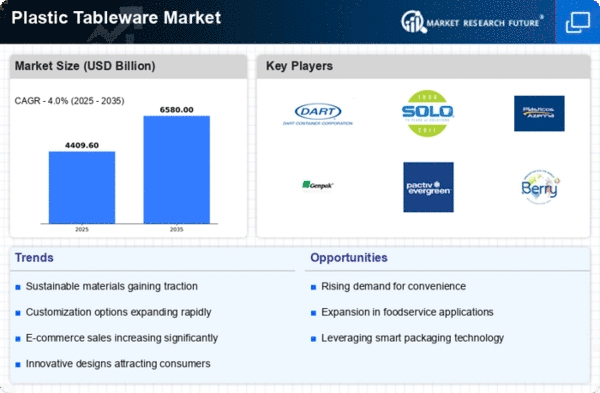
As per MRFR analysis, the Plastic Tableware Market Size was estimated at 4240.0 USD Billion in 2024. The Plastic Tableware industry is projected to grow from 4460.0 in 2025 to 6580.0 by 2035, exhibiting a compound annual growth rate (CAGR) of 4.0% during the forecast period 2025 - 2035.

Key Market Trends & Highlights

The Plastic Tableware Market is experiencing a dynamic shift towards sustainability and convenience, driven by evolving consumer preferences.

  • North America remains the largest market for plastic tableware, reflecting a strong demand in the food service sector.
  • Asia-Pacific is identified as the fastest-growing region, propelled by increasing urbanization and changing lifestyles.
  • The food service segment dominates the market, while the takeaway segment is rapidly expanding due to rising consumer convenience.
  • Sustainability initiatives and the rising demand in food service are key drivers influencing market growth.

Market Size & Forecast

2024 Market Size 4240.0 (USD Billion)
2035 Market Size 6580.0 (USD Billion)
CAGR (2025 - 2035) 4.0%
Largest Regional Market Share in 2024 Asia-Pacific

Major Players

Dart Container Corporation (US), Solo Cup Company (US), Plastico (BR), Genpak LLC (US), Pactiv Evergreen Inc. (US), Berry Global Inc. (US), Clearwater Paper Corporation (US), Huhtamaki Group (FI)

Market Trends

disposable tableware

Plastic Tableware Market Market Drivers

Rising Demand for Convenience Products

The Global Plastic Tableware Industry experiences a notable surge in demand for convenience products, driven by the fast-paced lifestyle of consumers. As people increasingly seek quick and easy meal solutions, plastic tableware offers a practical alternative to traditional dinnerware. This trend is particularly evident in urban areas where busy schedules necessitate disposable options. The market is projected to reach 25 USD Billion in 2024, reflecting the growing preference for lightweight and portable tableware. This shift towards convenience is likely to sustain the industry's growth, as consumers prioritize efficiency without compromising on aesthetics.

Market Segment Insights

By Application: Food Service (Largest) vs. Catering (Fastest-Growing)

<p>In the Plastic Tableware Market, the application segment is primarily dominated by the Food Service category, which captures a significant market share due to its widespread use in restaurants, cafes, and other dining establishments. Catering is also an important player, experiencing rapid growth as events and gatherings continue to increase in number. Both segments cater to a variety of consumer needs, leading to diverse product offerings and heightened competition among suppliers. Growth trends in the Plastic Tableware Market are strongly influenced by evolving consumer preferences and sustainability concerns. With an increased focus on convenience and disposable products, the Food Service segment remains steady, while the Catering segment is gaining traction due to the rising demand for outdoor events and corporate functions. Innovations in design and materials are also supporting growth, alongside a push for eco-friendly solutions within catering services.</p>

<p>Food Service (Dominant) vs. Catering (Emerging)</p>

<p>The Food Service segment is characterized by its extensive use of plastic tableware in restaurants and food outlets, catering to a wide range of culinary needs. This segment has solidified its position due to the high demand for practicality and cost-efficiency, making disposable options preferable for high-traffic settings. In contrast, the Catering segment is quickly emerging as event-hosting companies seek versatile and aesthetically pleasing tableware that enhances the dining experience at gatherings. Catering has embraced innovative designs and sustainable materials, making it attractive to environmentally-conscious consumers, thereby driving its growth. With these distinct characteristics, the two segments exemplify the diversity and dynamism in the Plastic Tableware Market.</p>

By Material Type: Polypropylene (Largest) vs. Biodegradable Plastics (Fastest-Growing)

In the Plastic Tableware Market, Polypropylene holds the largest share due to its excellent versatility, durability, and cost-effectiveness, which makes it a preferred choice among consumers for disposable tableware. Polystyrene and PVC also account for significant market shares, but Polypropylene's properties grant it a more substantial foothold in various applications, including restaurants, catering, and outdoor events. Furthermore, the rise in sustainability awareness is shifting consumer preferences towards alternatives like biodegradable plastics, which, while currently smaller in market size, are rapidly gaining traction. The market is witnessing a growing trend towards environmentally friendly options, causing Biodegradable Plastics to become the fastest-growing segment. Factors propelling this growth include increasing government regulations on single-use plastics and heightened consumer demand for sustainable products. As awareness of environmental issues continues to rise, manufacturers are innovating to include materials that not only meet functional requirements but also appeal to eco-conscious consumers, leading to a gradual shift in market dynamics.

Polypropylene (Dominant) vs. Biodegradable Plastics (Emerging)

Polypropylene is the dominant material in the Plastic Tableware Market, recognized for its strength, flexibility, and microwave-safe properties. It is widely used for various tableware applications, providing a balance between functionality and affordability. In contrast, Biodegradable Plastics, although currently an emerging segment, are gaining momentum among environmentally conscious consumers. These materials are designed to decompose more quickly than traditional plastics, responding to the growing consumer demand for sustainable and eco-friendly products. Brands are increasingly adopting biodegradable options to differentiate themselves in a competitive landscape, pushing innovation and consumer education as high priorities. This evolution indicates a significant shift towards sustainability while still accommodating traditional preferences.

By Product Type: Plates (Largest) vs. Cups (Fastest-Growing)

<p>In the Plastic Tableware Market, the segment values are dominated by Plates, which account for a significant share owing to their widespread use in various settings, including households and events. Cups also represent a substantial portion of the market, particularly with the growing trend towards single-use products in gatherings and fast-food environments. Other segments like Cutlery, Bowls, and Trays play crucial roles but have not achieved the same level of market penetration as Plates and Cups. The growth trends for Plastic Tableware are influenced by consumer preferences shifting towards convenience and affordability. Cups are currently the fastest-growing segment, driven by a rise in on-the-go consumption patterns and increasing demand for disposable drinkware. Additionally, sustainability concerns are pushing manufacturers to innovate in biodegradable materials for cutlery, bowls, and trays, further expanding their market opportunities.</p>

<p>Plates (Dominant) vs. Cutlery (Emerging)</p>

<p>Plates have established themselves as the dominant product type in the Plastic Tableware Market, characterized by their versatility and frequent use in diverse occasions, including parties, picnics, and restaurants. Their strong presence is backed by consumer preference for durability and design variety. In contrast, cutlery is emerging as a significant segment, buoyed by changing lifestyles that favor disposable or biodegradable options over traditional metal or ceramic alternatives. This shift is largely driven by the food delivery sector, which emphasizes ease of use and convenience. As consumers become more eco-conscious, manufacturers are focusing on developing cutlery that meets both safety standards and sustainability goals, positioning themselves to capitalize on the growing demand for eco-friendly dining solutions.</p>

By End Use: Residential (Largest) vs. Commercial (Fastest-Growing)

The Plastic Tableware Market showcases a diverse distribution across various end-use sectors, with the residential segment leading in market share. Households increasingly prefer disposable tableware for convenience, especially in outdoor and event settings. Following the residential sector, the commercial segment is gaining momentum, driven by a rising number of foodservice establishments and the growing trend of takeout and delivery services.

End Use: Residential (Dominant) vs. Commercial (Emerging)

The residential segment dominates the Plastic Tableware Market, characterized by an increase in consumer demand for convenience and sustainability. Households require tableware for a variety of occasions, from daily meals to celebrations, which boosts consumption rates. In contrast, the commercial segment is rapidly emerging, fueled by the expansion of the food service industry and an increased focus on efficiency and hygiene, especially post-pandemic. Restaurants, catering services, and event planners are incorporating plastic tableware into their operations for both practical and economic benefits, making it a vital player in market dynamics.

By Distribution Channel: Online Retail (Largest) vs. Supermarkets (Fastest-Growing)

In the Plastic Tableware Market, the distribution channel landscape is predominantly shaped by Online Retail, which commands a significant market share. Consumers increasingly prefer the convenience of shopping online, leading to a substantial portion of sales occurring through this channel. Supermarkets also play a vital role, capturing a considerable share as physical retail remains essential for immediate purchases and customer accessibility. <a href="https://www.marketresearchfuture.com/reports/convenience-stores-market-22842" target="_blank">convenience stores</a> and Wholesale account for smaller segments but still contribute to the overall distribution ecosystem.

Online Retail (Dominant) vs. Wholesale (Emerging)

Online Retail stands out as the dominant force in the Plastic Tableware Market, driven by consumer preference for convenience, a wide range of product availability, and time-saving benefits. This channel offers a platform for various brands to reach a broader audience and leverage digital marketing strategies effectively. In contrast, Wholesale is emerging as a significant player, targeting bulk purchasers such as restaurants and event organizers. wholesalers benefit from competitive pricing and the ability to meet large order requirements efficiently, making them an essential part of the distribution network as they cater to specific segments of the market.

Get more detailed insights about Plastic Tableware Market Research Report -Forecast till 2035

Regional Insights

Asia-Pacific : Dominant Market with High Growth

The Asia-Pacific region dominates the plastic tableware market with a staggering valuation of $2700.0M, driven by rapid urbanization and changing consumer lifestyles. The growing foodservice industry, particularly in countries like China and India, is a significant growth driver, as disposable tableware becomes increasingly popular for convenience. Additionally, rising disposable incomes and a shift towards online food delivery services are further propelling market demand in this region. China, Japan, and India are the leading countries in this market, with a competitive landscape featuring major players such as Genpak LLC and Pactiv Evergreen Inc. The presence of numerous local manufacturers also intensifies competition, leading to price wars and innovation in product offerings. As the market continues to expand, companies are focusing on enhancing their distribution networks and product variety to capture a larger share of the growing consumer base.

Middle East and Africa : Emerging Market with Diverse Needs

The Middle East and Africa plastic tableware market, valued at $990.0M, is experiencing growth fueled by urbanization and changing consumer habits. The increasing demand for convenience in foodservice and catering sectors is driving the adoption of plastic tableware. Additionally, government initiatives aimed at promoting local manufacturing are enhancing market dynamics, encouraging investment in the production of disposable tableware to meet rising consumer needs. Countries like South Africa and the UAE are at the forefront of this market, with a competitive landscape that includes both local and international players. Companies are focusing on product innovation and sustainability to cater to the diverse needs of consumers in this region. As the market evolves, the emphasis on quality and affordability will play a crucial role in shaping the competitive environment.

Key Players and Competitive Insights

The Plastic Tableware Market is currently characterized by a dynamic competitive landscape, driven by increasing consumer demand for convenience and sustainability. Major players are actively engaging in strategic initiatives to enhance their market positioning. For instance, Dart Container Corporation (US) has focused on innovation in biodegradable materials, aiming to capture the growing segment of environmentally conscious consumers. Similarly, Berry Global Inc. (US) has been investing in advanced manufacturing technologies to improve efficiency and reduce waste, thereby reinforcing its competitive edge. These strategies collectively contribute to a market that is moderately fragmented, with key players vying for dominance through differentiation and operational excellence.In terms of business tactics, companies are increasingly localizing manufacturing to mitigate supply chain disruptions and enhance responsiveness to regional market demands. This approach not only optimizes logistics but also aligns with sustainability goals by reducing transportation emissions. The competitive structure of the market remains moderately fragmented, with several key players influencing overall dynamics through their strategic initiatives and operational capabilities.

In November Huhtamaki Group (FI) announced a partnership with a leading food service provider to develop a new line of compostable tableware. This collaboration is significant as it underscores Huhtamaki's commitment to sustainability and positions the company to meet the rising demand for eco-friendly products. The partnership is expected to enhance Huhtamaki's market share while reinforcing its reputation as a leader in sustainable packaging solutions.

In October Pactiv Evergreen Inc. (US) launched a new product line featuring enhanced durability and design aesthetics aimed at the premium segment of the market. This strategic move is indicative of Pactiv's focus on innovation and quality, which may attract a broader customer base seeking high-end disposable tableware. By diversifying its product offerings, Pactiv Evergreen is likely to strengthen its competitive position in a market that increasingly values both functionality and style.

In September Genpak LLC (US) expanded its production capabilities by investing in a state-of-the-art facility in the Midwest. This expansion is crucial as it not only increases Genpak's production capacity but also enhances its ability to serve regional markets more effectively. The investment reflects a strategic focus on operational efficiency and responsiveness, which are vital in a competitive landscape where speed to market can be a differentiator.

As of December the Plastic Tableware Market is witnessing trends that emphasize digitalization, sustainability, and the integration of AI technologies. Companies are increasingly forming strategic alliances to leverage shared resources and expertise, thereby enhancing their competitive positioning. The shift from price-based competition to a focus on innovation, technology, and supply chain reliability is becoming more pronounced. This evolution suggests that future competitive differentiation will hinge on the ability to adapt to changing consumer preferences and technological advancements.

Key Companies in the Plastic Tableware Market include

Industry Developments

  • According to the news, Hong Kong’s Environmental Protection Department has launched a public consultation of two months on the ongoing Scheme on Regulation of Disposable Plastic Tableware Market.
  • Australia’s supermarket Coles has removed the single-use plastic tableware and replaced it with sustainable alternatives.
  • According to the recent updates, the US region is boosting the imports of kitchenware and plastic tableware.

Report Overview

The report's overview shows the development of the Plastic tableware market across the world. The effective role of key market drivers and the widespread marketing opportunities is propelling the market's growth rate. The key players check the other growth hampering factors to run the business smoothly. The awareness of plastic pollution and a plastic-free environment affected the Plastic tableware market. But the replacement of biodegradable plastics further lifted the market to regain its growth rate. The COVID-19 challenging situation was a tough period for the Plastic tableware market, but the strategies implemented by the key players helped the market restore its growth rate.

The various segments of the market reach the highest CAGR because of the largest share value in the market. The regional report shows the development of the Plastic tableware market Forecast in various regions with the key growth drivers of the regions. If its growth consistency continues, the market is estimated to witness a good CAGR during the review period.

Future Outlook

Plastic Tableware Market Future Outlook

The Plastic Tableware Market is projected to grow at a 4.0% CAGR from 2025 to 2035, driven by increasing consumer demand for convenience and sustainability.

New opportunities lie in:

  • Expansion into biodegradable plastic alternatives for eco-conscious consumers.
  • Development of customizable tableware solutions for events and catering services.
  • Implementation of subscription models for regular supply to restaurants and cafes.

By 2035, the market is expected to solidify its position as a leader in convenience-oriented dining solutions.

Market Segmentation

Plastic Tableware Market End Use Outlook

  • Residential
  • Commercial
  • Institutional
  • Industrial

Plastic Tableware Market Application Outlook

  • Food Service
  • Catering
  • Event Planning
  • Household
  • Takeaway

Plastic Tableware Market Product Type Outlook

  • Plates
  • Cups
  • Cutlery
  • Bowls
  • Trays

Plastic Tableware Market Material Type Outlook

  • Polypropylene
  • Polystyrene
  • Polyethylene
  • Biodegradable Plastics
  • PVC

Plastic Tableware Market Distribution Channel Outlook

  • Online Retail
  • Supermarkets
  • Convenience Stores
  • Wholesale

Report Scope

MARKET SIZE 2024 4240.0(USD Billion)
MARKET SIZE 2025 4460.0(USD Billion)
MARKET SIZE 2035 6580.0(USD Billion)
COMPOUND ANNUAL GROWTH RATE (CAGR) 4.0% (2025 - 2035)
REPORT COVERAGE Revenue Forecast, Competitive Landscape, Growth Factors, and Trends
BASE YEAR 2024
Market Forecast Period 2025 - 2035
Historical Data 2019 - 2024
Market Forecast Units USD Billion
Key Companies Profiled Dart Container Corporation (US), Solo Cup Company (US), Plastico (BR), Genpak LLC (US), Pactiv Evergreen Inc. (US), Berry Global Inc. (US), Clearwater Paper Corporation (US), Huhtamaki Group (FI)
Segments Covered Application, Material Type, Product Type, End Use, Distribution Channel
Key Market Opportunities Growing demand for sustainable and biodegradable options in the Plastic Tableware Market presents significant opportunities.
Key Market Dynamics Rising consumer preference for sustainable materials drives innovation and competition in the plastic tableware market.
Countries Covered North America, Europe, APAC, South America, MEA

FAQs

What is the current valuation of the Plastic Tableware Market as of 2024?

<p>The overall market valuation of the Plastic Tableware Market was 4240.0 USD Billion in 2024.</p>

What is the projected market size for the Plastic Tableware Market in 2035?

<p>The projected valuation for the Plastic Tableware Market in 2035 is 6580.0 USD Billion.</p>

What is the expected CAGR for the Plastic Tableware Market during the forecast period 2025 - 2035?

<p>The expected CAGR for the Plastic Tableware Market during the forecast period 2025 - 2035 is 4.0%.</p>

Which companies are considered key players in the Plastic Tableware Market?

<p>Key players in the Plastic Tableware Market include Dart Container Corporation, Solo Cup Company, and Huhtamaki Group.</p>

What are the main segments of the Plastic Tableware Market by application?

The main segments by application include Food Service, Catering, Events, Household, and Takeaway.

How does the Household segment perform in terms of market valuation?

The Household segment was valued at 1272.0 USD Billion in 2024 and is projected to reach 2000.0 USD Billion.

What materials are predominantly used in the production of plastic tableware?

The predominant materials include Polypropylene, Polystyrene, Polyethylene, Biodegradable Plastics, and PVC.

What is the market valuation for the Plates product type in 2024?

The Plates product type was valued at 800.0 USD Billion in 2024 and is expected to grow significantly.

Which distribution channels are most effective for plastic tableware sales?

Effective distribution channels include Supermarkets, Online Retail, and Convenience Stores.

What is the projected growth for the Commercial end-use segment by 2035?

The Commercial end-use segment is projected to grow from 850.0 USD Billion in 2024 to 1300.0 USD Billion by 2035.

  1. SECTION I: EXECUTIVE SUMMARY AND KEY HIGHLIGHTS
    1. | 1.1 EXECUTIVE SUMMARY
    2. | | 1.1.1 Market Overview
    3. | | 1.1.2 Key Findings
    4. | | 1.1.3 Market Segmentation
    5. | | 1.1.4 Competitive Landscape
    6. | | 1.1.5 Challenges and Opportunities
    7. | | 1.1.6 Future Outlook
  2. SECTION II: SCOPING, METHODOLOGY AND MARKET STRUCTURE
    1. | 2.1 MARKET INTRODUCTION
    2. | | 2.1.1 Definition
    3. | | 2.1.2 Scope of the study
    4. | | | 2.1.2.1 Research Objective
    5. | | | 2.1.2.2 Assumption
    6. | | | 2.1.2.3 Limitations
    7. | 2.2 RESEARCH METHODOLOGY
    8. | | 2.2.1 Overview
    9. | | 2.2.2 Data Mining
    10. | | 2.2.3 Secondary Research
    11. | | 2.2.4 Primary Research
    12. | | | 2.2.4.1 Primary Interviews and Information Gathering Process
    13. | | | 2.2.4.2 Breakdown of Primary Respondents
    14. | | 2.2.5 Forecasting Model
    15. | | 2.2.6 Market Size Estimation
    16. | | | 2.2.6.1 Bottom-Up Approach
    17. | | | 2.2.6.2 Top-Down Approach
    18. | | 2.2.7 Data Triangulation
    19. | | 2.2.8 Validation
  3. SECTION III: QUALITATIVE ANALYSIS
    1. | 3.1 MARKET DYNAMICS
    2. | | 3.1.1 Overview
    3. | | 3.1.2 Drivers
    4. | | 3.1.3 Restraints
    5. | | 3.1.4 Opportunities
    6. | 3.2 MARKET FACTOR ANALYSIS
    7. | | 3.2.1 Value chain Analysis
    8. | | 3.2.2 Porter's Five Forces Analysis
    9. | | | 3.2.2.1 Bargaining Power of Suppliers
    10. | | | 3.2.2.2 Bargaining Power of Buyers
    11. | | | 3.2.2.3 Threat of New Entrants
    12. | | | 3.2.2.4 Threat of Substitutes
    13. | | | 3.2.2.5 Intensity of Rivalry
    14. | | 3.2.3 COVID-19 Impact Analysis
    15. | | | 3.2.3.1 Market Impact Analysis
    16. | | | 3.2.3.2 Regional Impact
    17. | | | 3.2.3.3 Opportunity and Threat Analysis
  4. SECTION IV: QUANTITATIVE ANALYSIS
    1. | 4.1 Consumer and Retail, BY Application (USD Billion)
    2. | | 4.1.1 Food Service
    3. | | 4.1.2 Catering
    4. | | 4.1.3 Events
    5. | | 4.1.4 Household
    6. | | 4.1.5 Takeaway
    7. | 4.2 Consumer and Retail, BY Material Type (USD Billion)
    8. | | 4.2.1 Polypropylene
    9. | | 4.2.2 Polystyrene
    10. | | 4.2.3 Polyethylene
    11. | | 4.2.4 Biodegradable Plastics
    12. | | 4.2.5 PVC
    13. | 4.3 Consumer and Retail, BY Product Type (USD Billion)
    14. | | 4.3.1 Plates
    15. | | 4.3.2 Cups
    16. | | 4.3.3 Cutlery
    17. | | 4.3.4 Bowls
    18. | | 4.3.5 Trays
    19. | 4.4 Consumer and Retail, BY End Use (USD Billion)
    20. | | 4.4.1 Residential
    21. | | 4.4.2 Commercial
    22. | | 4.4.3 Institutional
    23. | | 4.4.4 Industrial
    24. | 4.5 Consumer and Retail, BY Distribution Channel (USD Billion)
    25. | | 4.5.1 Online Retail
    26. | | 4.5.2 Supermarkets
    27. | | 4.5.3 Convenience Stores
    28. | | 4.5.4 Wholesale
    29. | | 4.5.5 Direct Sales
    30. | 4.6 Consumer and Retail, BY Region (USD Billion)
    31. | | 4.6.1 North America
    32. | | | 4.6.1.1 US
    33. | | | 4.6.1.2 Canada
    34. | | 4.6.2 Europe
    35. | | | 4.6.2.1 Germany
    36. | | | 4.6.2.2 UK
    37. | | | 4.6.2.3 France
    38. | | | 4.6.2.4 Russia
    39. | | | 4.6.2.5 Italy
    40. | | | 4.6.2.6 Spain
    41. | | | 4.6.2.7 Rest of Europe
    42. | | 4.6.3 APAC
    43. | | | 4.6.3.1 China
    44. | | | 4.6.3.2 India
    45. | | | 4.6.3.3 Japan
    46. | | | 4.6.3.4 South Korea
    47. | | | 4.6.3.5 Malaysia
    48. | | | 4.6.3.6 Thailand
    49. | | | 4.6.3.7 Indonesia
    50. | | | 4.6.3.8 Rest of APAC
    51. | | 4.6.4 South America
    52. | | | 4.6.4.1 Brazil
    53. | | | 4.6.4.2 Mexico
    54. | | | 4.6.4.3 Argentina
    55. | | | 4.6.4.4 Rest of South America
    56. | | 4.6.5 MEA
    57. | | | 4.6.5.1 GCC Countries
    58. | | | 4.6.5.2 South Africa
    59. | | | 4.6.5.3 Rest of MEA
  5. SECTION V: COMPETITIVE ANALYSIS
    1. | 5.1 Competitive Landscape
    2. | | 5.1.1 Overview
    3. | | 5.1.2 Competitive Analysis
    4. | | 5.1.3 Market share Analysis
    5. | | 5.1.4 Major Growth Strategy in the Consumer and Retail
    6. | | 5.1.5 Competitive Benchmarking
    7. | | 5.1.6 Leading Players in Terms of Number of Developments in the Consumer and Retail
    8. | | 5.1.7 Key developments and growth strategies
    9. | | | 5.1.7.1 New Product Launch/Service Deployment
    10. | | | 5.1.7.2 Merger & Acquisitions
    11. | | | 5.1.7.3 Joint Ventures
    12. | | 5.1.8 Major Players Financial Matrix
    13. | | | 5.1.8.1 Sales and Operating Income
    14. | | | 5.1.8.2 Major Players R&D Expenditure. 2023
    15. | 5.2 Company Profiles
    16. | | 5.2.1 Dart Container Corporation (US)
    17. | | | 5.2.1.1 Financial Overview
    18. | | | 5.2.1.2 Products Offered
    19. | | | 5.2.1.3 Key Developments
    20. | | | 5.2.1.4 SWOT Analysis
    21. | | | 5.2.1.5 Key Strategies
    22. | | 5.2.2 Solo Cup Company (US)
    23. | | | 5.2.2.1 Financial Overview
    24. | | | 5.2.2.2 Products Offered
    25. | | | 5.2.2.3 Key Developments
    26. | | | 5.2.2.4 SWOT Analysis
    27. | | | 5.2.2.5 Key Strategies
    28. | | 5.2.3 Plastico (BR)
    29. | | | 5.2.3.1 Financial Overview
    30. | | | 5.2.3.2 Products Offered
    31. | | | 5.2.3.3 Key Developments
    32. | | | 5.2.3.4 SWOT Analysis
    33. | | | 5.2.3.5 Key Strategies
    34. | | 5.2.4 Genpak LLC (US)
    35. | | | 5.2.4.1 Financial Overview
    36. | | | 5.2.4.2 Products Offered
    37. | | | 5.2.4.3 Key Developments
    38. | | | 5.2.4.4 SWOT Analysis
    39. | | | 5.2.4.5 Key Strategies
    40. | | 5.2.5 Pactiv Evergreen Inc. (US)
    41. | | | 5.2.5.1 Financial Overview
    42. | | | 5.2.5.2 Products Offered
    43. | | | 5.2.5.3 Key Developments
    44. | | | 5.2.5.4 SWOT Analysis
    45. | | | 5.2.5.5 Key Strategies
    46. | | 5.2.6 Berry Global Inc. (US)
    47. | | | 5.2.6.1 Financial Overview
    48. | | | 5.2.6.2 Products Offered
    49. | | | 5.2.6.3 Key Developments
    50. | | | 5.2.6.4 SWOT Analysis
    51. | | | 5.2.6.5 Key Strategies
    52. | | 5.2.7 Clearwater Paper Corporation (US)
    53. | | | 5.2.7.1 Financial Overview
    54. | | | 5.2.7.2 Products Offered
    55. | | | 5.2.7.3 Key Developments
    56. | | | 5.2.7.4 SWOT Analysis
    57. | | | 5.2.7.5 Key Strategies
    58. | | 5.2.8 Huhtamaki Group (FI)
    59. | | | 5.2.8.1 Financial Overview
    60. | | | 5.2.8.2 Products Offered
    61. | | | 5.2.8.3 Key Developments
    62. | | | 5.2.8.4 SWOT Analysis
    63. | | | 5.2.8.5 Key Strategies
    64. | 5.3 Appendix
    65. | | 5.3.1 References
    66. | | 5.3.2 Related Reports
  6. LIST OF FIGURES
    1. | 6.1 MARKET SYNOPSIS
    2. | 6.2 NORTH AMERICA MARKET ANALYSIS
    3. | 6.3 US MARKET ANALYSIS BY APPLICATION
    4. | 6.4 US MARKET ANALYSIS BY MATERIAL TYPE
    5. | 6.5 US MARKET ANALYSIS BY PRODUCT TYPE
    6. | 6.6 US MARKET ANALYSIS BY END USE
    7. | 6.7 US MARKET ANALYSIS BY DISTRIBUTION CHANNEL
    8. | 6.8 CANADA MARKET ANALYSIS BY APPLICATION
    9. | 6.9 CANADA MARKET ANALYSIS BY MATERIAL TYPE
    10. | 6.10 CANADA MARKET ANALYSIS BY PRODUCT TYPE
    11. | 6.11 CANADA MARKET ANALYSIS BY END USE
    12. | 6.12 CANADA MARKET ANALYSIS BY DISTRIBUTION CHANNEL
    13. | 6.13 EUROPE MARKET ANALYSIS
    14. | 6.14 GERMANY MARKET ANALYSIS BY APPLICATION
    15. | 6.15 GERMANY MARKET ANALYSIS BY MATERIAL TYPE
    16. | 6.16 GERMANY MARKET ANALYSIS BY PRODUCT TYPE
    17. | 6.17 GERMANY MARKET ANALYSIS BY END USE
    18. | 6.18 GERMANY MARKET ANALYSIS BY DISTRIBUTION CHANNEL
    19. | 6.19 UK MARKET ANALYSIS BY APPLICATION
    20. | 6.20 UK MARKET ANALYSIS BY MATERIAL TYPE
    21. | 6.21 UK MARKET ANALYSIS BY PRODUCT TYPE
    22. | 6.22 UK MARKET ANALYSIS BY END USE
    23. | 6.23 UK MARKET ANALYSIS BY DISTRIBUTION CHANNEL
    24. | 6.24 FRANCE MARKET ANALYSIS BY APPLICATION
    25. | 6.25 FRANCE MARKET ANALYSIS BY MATERIAL TYPE
    26. | 6.26 FRANCE MARKET ANALYSIS BY PRODUCT TYPE
    27. | 6.27 FRANCE MARKET ANALYSIS BY END USE
    28. | 6.28 FRANCE MARKET ANALYSIS BY DISTRIBUTION CHANNEL
    29. | 6.29 RUSSIA MARKET ANALYSIS BY APPLICATION
    30. | 6.30 RUSSIA MARKET ANALYSIS BY MATERIAL TYPE
    31. | 6.31 RUSSIA MARKET ANALYSIS BY PRODUCT TYPE
    32. | 6.32 RUSSIA MARKET ANALYSIS BY END USE
    33. | 6.33 RUSSIA MARKET ANALYSIS BY DISTRIBUTION CHANNEL
    34. | 6.34 ITALY MARKET ANALYSIS BY APPLICATION
    35. | 6.35 ITALY MARKET ANALYSIS BY MATERIAL TYPE
    36. | 6.36 ITALY MARKET ANALYSIS BY PRODUCT TYPE
    37. | 6.37 ITALY MARKET ANALYSIS BY END USE
    38. | 6.38 ITALY MARKET ANALYSIS BY DISTRIBUTION CHANNEL
    39. | 6.39 SPAIN MARKET ANALYSIS BY APPLICATION
    40. | 6.40 SPAIN MARKET ANALYSIS BY MATERIAL TYPE
    41. | 6.41 SPAIN MARKET ANALYSIS BY PRODUCT TYPE
    42. | 6.42 SPAIN MARKET ANALYSIS BY END USE
    43. | 6.43 SPAIN MARKET ANALYSIS BY DISTRIBUTION CHANNEL
    44. | 6.44 REST OF EUROPE MARKET ANALYSIS BY APPLICATION
    45. | 6.45 REST OF EUROPE MARKET ANALYSIS BY MATERIAL TYPE
    46. | 6.46 REST OF EUROPE MARKET ANALYSIS BY PRODUCT TYPE
    47. | 6.47 REST OF EUROPE MARKET ANALYSIS BY END USE
    48. | 6.48 REST OF EUROPE MARKET ANALYSIS BY DISTRIBUTION CHANNEL
    49. | 6.49 APAC MARKET ANALYSIS
    50. | 6.50 CHINA MARKET ANALYSIS BY APPLICATION
    51. | 6.51 CHINA MARKET ANALYSIS BY MATERIAL TYPE
    52. | 6.52 CHINA MARKET ANALYSIS BY PRODUCT TYPE
    53. | 6.53 CHINA MARKET ANALYSIS BY END USE
    54. | 6.54 CHINA MARKET ANALYSIS BY DISTRIBUTION CHANNEL
    55. | 6.55 INDIA MARKET ANALYSIS BY APPLICATION
    56. | 6.56 INDIA MARKET ANALYSIS BY MATERIAL TYPE
    57. | 6.57 INDIA MARKET ANALYSIS BY PRODUCT TYPE
    58. | 6.58 INDIA MARKET ANALYSIS BY END USE
    59. | 6.59 INDIA MARKET ANALYSIS BY DISTRIBUTION CHANNEL
    60. | 6.60 JAPAN MARKET ANALYSIS BY APPLICATION
    61. | 6.61 JAPAN MARKET ANALYSIS BY MATERIAL TYPE
    62. | 6.62 JAPAN MARKET ANALYSIS BY PRODUCT TYPE
    63. | 6.63 JAPAN MARKET ANALYSIS BY END USE
    64. | 6.64 JAPAN MARKET ANALYSIS BY DISTRIBUTION CHANNEL
    65. | 6.65 SOUTH KOREA MARKET ANALYSIS BY APPLICATION
    66. | 6.66 SOUTH KOREA MARKET ANALYSIS BY MATERIAL TYPE
    67. | 6.67 SOUTH KOREA MARKET ANALYSIS BY PRODUCT TYPE
    68. | 6.68 SOUTH KOREA MARKET ANALYSIS BY END USE
    69. | 6.69 SOUTH KOREA MARKET ANALYSIS BY DISTRIBUTION CHANNEL
    70. | 6.70 MALAYSIA MARKET ANALYSIS BY APPLICATION
    71. | 6.71 MALAYSIA MARKET ANALYSIS BY MATERIAL TYPE
    72. | 6.72 MALAYSIA MARKET ANALYSIS BY PRODUCT TYPE
    73. | 6.73 MALAYSIA MARKET ANALYSIS BY END USE
    74. | 6.74 MALAYSIA MARKET ANALYSIS BY DISTRIBUTION CHANNEL
    75. | 6.75 THAILAND MARKET ANALYSIS BY APPLICATION
    76. | 6.76 THAILAND MARKET ANALYSIS BY MATERIAL TYPE
    77. | 6.77 THAILAND MARKET ANALYSIS BY PRODUCT TYPE
    78. | 6.78 THAILAND MARKET ANALYSIS BY END USE
    79. | 6.79 THAILAND MARKET ANALYSIS BY DISTRIBUTION CHANNEL
    80. | 6.80 INDONESIA MARKET ANALYSIS BY APPLICATION
    81. | 6.81 INDONESIA MARKET ANALYSIS BY MATERIAL TYPE
    82. | 6.82 INDONESIA MARKET ANALYSIS BY PRODUCT TYPE
    83. | 6.83 INDONESIA MARKET ANALYSIS BY END USE
    84. | 6.84 INDONESIA MARKET ANALYSIS BY DISTRIBUTION CHANNEL
    85. | 6.85 REST OF APAC MARKET ANALYSIS BY APPLICATION
    86. | 6.86 REST OF APAC MARKET ANALYSIS BY MATERIAL TYPE
    87. | 6.87 REST OF APAC MARKET ANALYSIS BY PRODUCT TYPE
    88. | 6.88 REST OF APAC MARKET ANALYSIS BY END USE
    89. | 6.89 REST OF APAC MARKET ANALYSIS BY DISTRIBUTION CHANNEL
    90. | 6.90 SOUTH AMERICA MARKET ANALYSIS
    91. | 6.91 BRAZIL MARKET ANALYSIS BY APPLICATION
    92. | 6.92 BRAZIL MARKET ANALYSIS BY MATERIAL TYPE
    93. | 6.93 BRAZIL MARKET ANALYSIS BY PRODUCT TYPE
    94. | 6.94 BRAZIL MARKET ANALYSIS BY END USE
    95. | 6.95 BRAZIL MARKET ANALYSIS BY DISTRIBUTION CHANNEL
    96. | 6.96 MEXICO MARKET ANALYSIS BY APPLICATION
    97. | 6.97 MEXICO MARKET ANALYSIS BY MATERIAL TYPE
    98. | 6.98 MEXICO MARKET ANALYSIS BY PRODUCT TYPE
    99. | 6.99 MEXICO MARKET ANALYSIS BY END USE
    100. | 6.100 MEXICO MARKET ANALYSIS BY DISTRIBUTION CHANNEL
    101. | 6.101 ARGENTINA MARKET ANALYSIS BY APPLICATION
    102. | 6.102 ARGENTINA MARKET ANALYSIS BY MATERIAL TYPE
    103. | 6.103 ARGENTINA MARKET ANALYSIS BY PRODUCT TYPE
    104. | 6.104 ARGENTINA MARKET ANALYSIS BY END USE
    105. | 6.105 ARGENTINA MARKET ANALYSIS BY DISTRIBUTION CHANNEL
    106. | 6.106 REST OF SOUTH AMERICA MARKET ANALYSIS BY APPLICATION
    107. | 6.107 REST OF SOUTH AMERICA MARKET ANALYSIS BY MATERIAL TYPE
    108. | 6.108 REST OF SOUTH AMERICA MARKET ANALYSIS BY PRODUCT TYPE
    109. | 6.109 REST OF SOUTH AMERICA MARKET ANALYSIS BY END USE
    110. | 6.110 REST OF SOUTH AMERICA MARKET ANALYSIS BY DISTRIBUTION CHANNEL
    111. | 6.111 MEA MARKET ANALYSIS
    112. | 6.112 GCC COUNTRIES MARKET ANALYSIS BY APPLICATION
    113. | 6.113 GCC COUNTRIES MARKET ANALYSIS BY MATERIAL TYPE
    114. | 6.114 GCC COUNTRIES MARKET ANALYSIS BY PRODUCT TYPE
    115. | 6.115 GCC COUNTRIES MARKET ANALYSIS BY END USE
    116. | 6.116 GCC COUNTRIES MARKET ANALYSIS BY DISTRIBUTION CHANNEL
    117. | 6.117 SOUTH AFRICA MARKET ANALYSIS BY APPLICATION
    118. | 6.118 SOUTH AFRICA MARKET ANALYSIS BY MATERIAL TYPE
    119. | 6.119 SOUTH AFRICA MARKET ANALYSIS BY PRODUCT TYPE
    120. | 6.120 SOUTH AFRICA MARKET ANALYSIS BY END USE
    121. | 6.121 SOUTH AFRICA MARKET ANALYSIS BY DISTRIBUTION CHANNEL
    122. | 6.122 REST OF MEA MARKET ANALYSIS BY APPLICATION
    123. | 6.123 REST OF MEA MARKET ANALYSIS BY MATERIAL TYPE
    124. | 6.124 REST OF MEA MARKET ANALYSIS BY PRODUCT TYPE
    125. | 6.125 REST OF MEA MARKET ANALYSIS BY END USE
    126. | 6.126 REST OF MEA MARKET ANALYSIS BY DISTRIBUTION CHANNEL
    127. | 6.127 KEY BUYING CRITERIA OF CONSUMER AND RETAIL
    128. | 6.128 RESEARCH PROCESS OF MRFR
    129. | 6.129 DRO ANALYSIS OF CONSUMER AND RETAIL
    130. | 6.130 DRIVERS IMPACT ANALYSIS: CONSUMER AND RETAIL
    131. | 6.131 RESTRAINTS IMPACT ANALYSIS: CONSUMER AND RETAIL
    132. | 6.132 SUPPLY / VALUE CHAIN: CONSUMER AND RETAIL
    133. | 6.133 CONSUMER AND RETAIL, BY APPLICATION, 2024 (% SHARE)
    134. | 6.134 CONSUMER AND RETAIL, BY APPLICATION, 2024 TO 2035 (USD Billion)
    135. | 6.135 CONSUMER AND RETAIL, BY MATERIAL TYPE, 2024 (% SHARE)
    136. | 6.136 CONSUMER AND RETAIL, BY MATERIAL TYPE, 2024 TO 2035 (USD Billion)
    137. | 6.137 CONSUMER AND RETAIL, BY PRODUCT TYPE, 2024 (% SHARE)
    138. | 6.138 CONSUMER AND RETAIL, BY PRODUCT TYPE, 2024 TO 2035 (USD Billion)
    139. | 6.139 CONSUMER AND RETAIL, BY END USE, 2024 (% SHARE)
    140. | 6.140 CONSUMER AND RETAIL, BY END USE, 2024 TO 2035 (USD Billion)
    141. | 6.141 CONSUMER AND RETAIL, BY DISTRIBUTION CHANNEL, 2024 (% SHARE)
    142. | 6.142 CONSUMER AND RETAIL, BY DISTRIBUTION CHANNEL, 2024 TO 2035 (USD Billion)
    143. | 6.143 BENCHMARKING OF MAJOR COMPETITORS
  7. LIST OF TABLES
    1. | 7.1 LIST OF ASSUMPTIONS
    2. | | 7.1.1
    3. | 7.2 North America MARKET SIZE ESTIMATES; FORECAST
    4. | | 7.2.1 BY APPLICATION, 2025-2035 (USD Billion)
    5. | | 7.2.2 BY MATERIAL TYPE, 2025-2035 (USD Billion)
    6. | | 7.2.3 BY PRODUCT TYPE, 2025-2035 (USD Billion)
    7. | | 7.2.4 BY END USE, 2025-2035 (USD Billion)
    8. | | 7.2.5 BY DISTRIBUTION CHANNEL, 2025-2035 (USD Billion)
    9. | 7.3 US MARKET SIZE ESTIMATES; FORECAST
    10. | | 7.3.1 BY APPLICATION, 2025-2035 (USD Billion)
    11. | | 7.3.2 BY MATERIAL TYPE, 2025-2035 (USD Billion)
    12. | | 7.3.3 BY PRODUCT TYPE, 2025-2035 (USD Billion)
    13. | | 7.3.4 BY END USE, 2025-2035 (USD Billion)
    14. | | 7.3.5 BY DISTRIBUTION CHANNEL, 2025-2035 (USD Billion)
    15. | 7.4 Canada MARKET SIZE ESTIMATES; FORECAST
    16. | | 7.4.1 BY APPLICATION, 2025-2035 (USD Billion)
    17. | | 7.4.2 BY MATERIAL TYPE, 2025-2035 (USD Billion)
    18. | | 7.4.3 BY PRODUCT TYPE, 2025-2035 (USD Billion)
    19. | | 7.4.4 BY END USE, 2025-2035 (USD Billion)
    20. | | 7.4.5 BY DISTRIBUTION CHANNEL, 2025-2035 (USD Billion)
    21. | 7.5 Europe MARKET SIZE ESTIMATES; FORECAST
    22. | | 7.5.1 BY APPLICATION, 2025-2035 (USD Billion)
    23. | | 7.5.2 BY MATERIAL TYPE, 2025-2035 (USD Billion)
    24. | | 7.5.3 BY PRODUCT TYPE, 2025-2035 (USD Billion)
    25. | | 7.5.4 BY END USE, 2025-2035 (USD Billion)
    26. | | 7.5.5 BY DISTRIBUTION CHANNEL, 2025-2035 (USD Billion)
    27. | 7.6 Germany MARKET SIZE ESTIMATES; FORECAST
    28. | | 7.6.1 BY APPLICATION, 2025-2035 (USD Billion)
    29. | | 7.6.2 BY MATERIAL TYPE, 2025-2035 (USD Billion)
    30. | | 7.6.3 BY PRODUCT TYPE, 2025-2035 (USD Billion)
    31. | | 7.6.4 BY END USE, 2025-2035 (USD Billion)
    32. | | 7.6.5 BY DISTRIBUTION CHANNEL, 2025-2035 (USD Billion)
    33. | 7.7 UK MARKET SIZE ESTIMATES; FORECAST
    34. | | 7.7.1 BY APPLICATION, 2025-2035 (USD Billion)
    35. | | 7.7.2 BY MATERIAL TYPE, 2025-2035 (USD Billion)
    36. | | 7.7.3 BY PRODUCT TYPE, 2025-2035 (USD Billion)
    37. | | 7.7.4 BY END USE, 2025-2035 (USD Billion)
    38. | | 7.7.5 BY DISTRIBUTION CHANNEL, 2025-2035 (USD Billion)
    39. | 7.8 France MARKET SIZE ESTIMATES; FORECAST
    40. | | 7.8.1 BY APPLICATION, 2025-2035 (USD Billion)
    41. | | 7.8.2 BY MATERIAL TYPE, 2025-2035 (USD Billion)
    42. | | 7.8.3 BY PRODUCT TYPE, 2025-2035 (USD Billion)
    43. | | 7.8.4 BY END USE, 2025-2035 (USD Billion)
    44. | | 7.8.5 BY DISTRIBUTION CHANNEL, 2025-2035 (USD Billion)
    45. | 7.9 Russia MARKET SIZE ESTIMATES; FORECAST
    46. | | 7.9.1 BY APPLICATION, 2025-2035 (USD Billion)
    47. | | 7.9.2 BY MATERIAL TYPE, 2025-2035 (USD Billion)
    48. | | 7.9.3 BY PRODUCT TYPE, 2025-2035 (USD Billion)
    49. | | 7.9.4 BY END USE, 2025-2035 (USD Billion)
    50. | | 7.9.5 BY DISTRIBUTION CHANNEL, 2025-2035 (USD Billion)
    51. | 7.10 Italy MARKET SIZE ESTIMATES; FORECAST
    52. | | 7.10.1 BY APPLICATION, 2025-2035 (USD Billion)
    53. | | 7.10.2 BY MATERIAL TYPE, 2025-2035 (USD Billion)
    54. | | 7.10.3 BY PRODUCT TYPE, 2025-2035 (USD Billion)
    55. | | 7.10.4 BY END USE, 2025-2035 (USD Billion)
    56. | | 7.10.5 BY DISTRIBUTION CHANNEL, 2025-2035 (USD Billion)
    57. | 7.11 Spain MARKET SIZE ESTIMATES; FORECAST
    58. | | 7.11.1 BY APPLICATION, 2025-2035 (USD Billion)
    59. | | 7.11.2 BY MATERIAL TYPE, 2025-2035 (USD Billion)
    60. | | 7.11.3 BY PRODUCT TYPE, 2025-2035 (USD Billion)
    61. | | 7.11.4 BY END USE, 2025-2035 (USD Billion)
    62. | | 7.11.5 BY DISTRIBUTION CHANNEL, 2025-2035 (USD Billion)
    63. | 7.12 Rest of Europe MARKET SIZE ESTIMATES; FORECAST
    64. | | 7.12.1 BY APPLICATION, 2025-2035 (USD Billion)
    65. | | 7.12.2 BY MATERIAL TYPE, 2025-2035 (USD Billion)
    66. | | 7.12.3 BY PRODUCT TYPE, 2025-2035 (USD Billion)
    67. | | 7.12.4 BY END USE, 2025-2035 (USD Billion)
    68. | | 7.12.5 BY DISTRIBUTION CHANNEL, 2025-2035 (USD Billion)
    69. | 7.13 APAC MARKET SIZE ESTIMATES; FORECAST
    70. | | 7.13.1 BY APPLICATION, 2025-2035 (USD Billion)
    71. | | 7.13.2 BY MATERIAL TYPE, 2025-2035 (USD Billion)
    72. | | 7.13.3 BY PRODUCT TYPE, 2025-2035 (USD Billion)
    73. | | 7.13.4 BY END USE, 2025-2035 (USD Billion)
    74. | | 7.13.5 BY DISTRIBUTION CHANNEL, 2025-2035 (USD Billion)
    75. | 7.14 China MARKET SIZE ESTIMATES; FORECAST
    76. | | 7.14.1 BY APPLICATION, 2025-2035 (USD Billion)
    77. | | 7.14.2 BY MATERIAL TYPE, 2025-2035 (USD Billion)
    78. | | 7.14.3 BY PRODUCT TYPE, 2025-2035 (USD Billion)
    79. | | 7.14.4 BY END USE, 2025-2035 (USD Billion)
    80. | | 7.14.5 BY DISTRIBUTION CHANNEL, 2025-2035 (USD Billion)
    81. | 7.15 India MARKET SIZE ESTIMATES; FORECAST
    82. | | 7.15.1 BY APPLICATION, 2025-2035 (USD Billion)
    83. | | 7.15.2 BY MATERIAL TYPE, 2025-2035 (USD Billion)
    84. | | 7.15.3 BY PRODUCT TYPE, 2025-2035 (USD Billion)
    85. | | 7.15.4 BY END USE, 2025-2035 (USD Billion)
    86. | | 7.15.5 BY DISTRIBUTION CHANNEL, 2025-2035 (USD Billion)
    87. | 7.16 Japan MARKET SIZE ESTIMATES; FORECAST
    88. | | 7.16.1 BY APPLICATION, 2025-2035 (USD Billion)
    89. | | 7.16.2 BY MATERIAL TYPE, 2025-2035 (USD Billion)
    90. | | 7.16.3 BY PRODUCT TYPE, 2025-2035 (USD Billion)
    91. | | 7.16.4 BY END USE, 2025-2035 (USD Billion)
    92. | | 7.16.5 BY DISTRIBUTION CHANNEL, 2025-2035 (USD Billion)
    93. | 7.17 South Korea MARKET SIZE ESTIMATES; FORECAST
    94. | | 7.17.1 BY APPLICATION, 2025-2035 (USD Billion)
    95. | | 7.17.2 BY MATERIAL TYPE, 2025-2035 (USD Billion)
    96. | | 7.17.3 BY PRODUCT TYPE, 2025-2035 (USD Billion)
    97. | | 7.17.4 BY END USE, 2025-2035 (USD Billion)
    98. | | 7.17.5 BY DISTRIBUTION CHANNEL, 2025-2035 (USD Billion)
    99. | 7.18 Malaysia MARKET SIZE ESTIMATES; FORECAST
    100. | | 7.18.1 BY APPLICATION, 2025-2035 (USD Billion)
    101. | | 7.18.2 BY MATERIAL TYPE, 2025-2035 (USD Billion)
    102. | | 7.18.3 BY PRODUCT TYPE, 2025-2035 (USD Billion)
    103. | | 7.18.4 BY END USE, 2025-2035 (USD Billion)
    104. | | 7.18.5 BY DISTRIBUTION CHANNEL, 2025-2035 (USD Billion)
    105. | 7.19 Thailand MARKET SIZE ESTIMATES; FORECAST
    106. | | 7.19.1 BY APPLICATION, 2025-2035 (USD Billion)
    107. | | 7.19.2 BY MATERIAL TYPE, 2025-2035 (USD Billion)
    108. | | 7.19.3 BY PRODUCT TYPE, 2025-2035 (USD Billion)
    109. | | 7.19.4 BY END USE, 2025-2035 (USD Billion)
    110. | | 7.19.5 BY DISTRIBUTION CHANNEL, 2025-2035 (USD Billion)
    111. | 7.20 Indonesia MARKET SIZE ESTIMATES; FORECAST
    112. | | 7.20.1 BY APPLICATION, 2025-2035 (USD Billion)
    113. | | 7.20.2 BY MATERIAL TYPE, 2025-2035 (USD Billion)
    114. | | 7.20.3 BY PRODUCT TYPE, 2025-2035 (USD Billion)
    115. | | 7.20.4 BY END USE, 2025-2035 (USD Billion)
    116. | | 7.20.5 BY DISTRIBUTION CHANNEL, 2025-2035 (USD Billion)
    117. | 7.21 Rest of APAC MARKET SIZE ESTIMATES; FORECAST
    118. | | 7.21.1 BY APPLICATION, 2025-2035 (USD Billion)
    119. | | 7.21.2 BY MATERIAL TYPE, 2025-2035 (USD Billion)
    120. | | 7.21.3 BY PRODUCT TYPE, 2025-2035 (USD Billion)
    121. | | 7.21.4 BY END USE, 2025-2035 (USD Billion)
    122. | | 7.21.5 BY DISTRIBUTION CHANNEL, 2025-2035 (USD Billion)
    123. | 7.22 South America MARKET SIZE ESTIMATES; FORECAST
    124. | | 7.22.1 BY APPLICATION, 2025-2035 (USD Billion)
    125. | | 7.22.2 BY MATERIAL TYPE, 2025-2035 (USD Billion)
    126. | | 7.22.3 BY PRODUCT TYPE, 2025-2035 (USD Billion)
    127. | | 7.22.4 BY END USE, 2025-2035 (USD Billion)
    128. | | 7.22.5 BY DISTRIBUTION CHANNEL, 2025-2035 (USD Billion)
    129. | 7.23 Brazil MARKET SIZE ESTIMATES; FORECAST
    130. | | 7.23.1 BY APPLICATION, 2025-2035 (USD Billion)
    131. | | 7.23.2 BY MATERIAL TYPE, 2025-2035 (USD Billion)
    132. | | 7.23.3 BY PRODUCT TYPE, 2025-2035 (USD Billion)
    133. | | 7.23.4 BY END USE, 2025-2035 (USD Billion)
    134. | | 7.23.5 BY DISTRIBUTION CHANNEL, 2025-2035 (USD Billion)
    135. | 7.24 Mexico MARKET SIZE ESTIMATES; FORECAST
    136. | | 7.24.1 BY APPLICATION, 2025-2035 (USD Billion)
    137. | | 7.24.2 BY MATERIAL TYPE, 2025-2035 (USD Billion)
    138. | | 7.24.3 BY PRODUCT TYPE, 2025-2035 (USD Billion)
    139. | | 7.24.4 BY END USE, 2025-2035 (USD Billion)
    140. | | 7.24.5 BY DISTRIBUTION CHANNEL, 2025-2035 (USD Billion)
    141. | 7.25 Argentina MARKET SIZE ESTIMATES; FORECAST
    142. | | 7.25.1 BY APPLICATION, 2025-2035 (USD Billion)
    143. | | 7.25.2 BY MATERIAL TYPE, 2025-2035 (USD Billion)
    144. | | 7.25.3 BY PRODUCT TYPE, 2025-2035 (USD Billion)
    145. | | 7.25.4 BY END USE, 2025-2035 (USD Billion)
    146. | | 7.25.5 BY DISTRIBUTION CHANNEL, 2025-2035 (USD Billion)
    147. | 7.26 Rest of South America MARKET SIZE ESTIMATES; FORECAST
    148. | | 7.26.1 BY APPLICATION, 2025-2035 (USD Billion)
    149. | | 7.26.2 BY MATERIAL TYPE, 2025-2035 (USD Billion)
    150. | | 7.26.3 BY PRODUCT TYPE, 2025-2035 (USD Billion)
    151. | | 7.26.4 BY END USE, 2025-2035 (USD Billion)
    152. | | 7.26.5 BY DISTRIBUTION CHANNEL, 2025-2035 (USD Billion)
    153. | 7.27 MEA MARKET SIZE ESTIMATES; FORECAST
    154. | | 7.27.1 BY APPLICATION, 2025-2035 (USD Billion)
    155. | | 7.27.2 BY MATERIAL TYPE, 2025-2035 (USD Billion)
    156. | | 7.27.3 BY PRODUCT TYPE, 2025-2035 (USD Billion)
    157. | | 7.27.4 BY END USE, 2025-2035 (USD Billion)
    158. | | 7.27.5 BY DISTRIBUTION CHANNEL, 2025-2035 (USD Billion)
    159. | 7.28 GCC Countries MARKET SIZE ESTIMATES; FORECAST
    160. | | 7.28.1 BY APPLICATION, 2025-2035 (USD Billion)
    161. | | 7.28.2 BY MATERIAL TYPE, 2025-2035 (USD Billion)
    162. | | 7.28.3 BY PRODUCT TYPE, 2025-2035 (USD Billion)
    163. | | 7.28.4 BY END USE, 2025-2035 (USD Billion)
    164. | | 7.28.5 BY DISTRIBUTION CHANNEL, 2025-2035 (USD Billion)
    165. | 7.29 South Africa MARKET SIZE ESTIMATES; FORECAST
    166. | | 7.29.1 BY APPLICATION, 2025-2035 (USD Billion)
    167. | | 7.29.2 BY MATERIAL TYPE, 2025-2035 (USD Billion)
    168. | | 7.29.3 BY PRODUCT TYPE, 2025-2035 (USD Billion)
    169. | | 7.29.4 BY END USE, 2025-2035 (USD Billion)
    170. | | 7.29.5 BY DISTRIBUTION CHANNEL, 2025-2035 (USD Billion)
    171. | 7.30 Rest of MEA MARKET SIZE ESTIMATES; FORECAST
    172. | | 7.30.1 BY APPLICATION, 2025-2035 (USD Billion)
    173. | | 7.30.2 BY MATERIAL TYPE, 2025-2035 (USD Billion)
    174. | | 7.30.3 BY PRODUCT TYPE, 2025-2035 (USD Billion)
    175. | | 7.30.4 BY END USE, 2025-2035 (USD Billion)
    176. | | 7.30.5 BY DISTRIBUTION CHANNEL, 2025-2035 (USD Billion)
    177. | 7.31 PRODUCT LAUNCH/PRODUCT DEVELOPMENT/APPROVAL
    178. | | 7.31.1
    179. | 7.32 ACQUISITION/PARTNERSHIP
    180. | | 7.32.1

Consumer and Retail Market Segmentation

Consumer and Retail By Application (USD Billion, 2025-2035)

  • Food Service
  • Catering
  • Events
  • Household
  • Takeaway

Consumer and Retail By Material Type (USD Billion, 2025-2035)

  • Polypropylene
  • Polystyrene
  • Polyethylene
  • Biodegradable Plastics
  • PVC

Consumer and Retail By Product Type (USD Billion, 2025-2035)

  • Plates
  • Cups
  • Cutlery
  • Bowls
  • Trays

Consumer and Retail By End Use (USD Billion, 2025-2035)

  • Residential
  • Commercial
  • Institutional
  • Industrial

Consumer and Retail By Distribution Channel (USD Billion, 2025-2035)

  • Online Retail
  • Supermarkets
  • Convenience Stores
  • Wholesale
  • Direct Sales
Infographic

Free Sample Request

Kindly complete the form below to receive a free sample of this Report

Get Free Sample

Customer Strories

Compare Licence

×
Features License Type
Single User Multiuser License Enterprise User
Price $4,950 $5,950 $7,250
Maximum User Access Limit 1 User Upto 10 Users Unrestricted Access Throughout the Organization
Free Customization
Direct Access to Analyst
Deliverable Format
Platform Access
Discount on Next Purchase 10% 15% 15%
Printable Versions