
Request Free Sample ×

Kindly complete the form below to receive a free sample of this Report

* Please use a valid business email

Leading companies partner with us for data-driven Insights

clients tt-cursor
Hero Background
English
Chinese
French
Japanese
Korean
German
Spanish

Plastic Extrusion Machine Market Share

ID: MRFR/Equip/10590-HCR
128 Pages
Harshita Gorde
March 2026

Plastic Extrusion Machine Market Research Report Information By Machine Type (Single-screw and Twin-screw), By Process Type (Blown Film Extrusion, Sheet/Film Extrusion, Tubing Extrusion and Others), By Solution (New Sales and Aftermarket), By Application (Building & Construction, Medical, Transportation, Consumer Goods and Others) And By Region (North America, Europe, Asia-Pacific, And Rest Of The World) – Growth & Industry Forecast to 2035

Share:
Download PDF ×

We do not share your information with anyone. However, we may send you emails based on your report interest from time to time. You may contact us at any time to opt-out.

Plastic Extrusion Machine Market Infographic
Purchase Options

Market Share

Plastic Extrusion Machine Market Share Analysis

The plastic extrusion machine market has gained considerable investments in the global market via either rapid or medium-paced growth due to their increasing utility across industries. Innovation has led to the growing use of computers and advanced machinery in plastics extrusion processes resulting in higher production rates and product consistency. The industry is witnessing a rise of plastic extruder manufacturers who offer improved options like automation, control system and real time monitoring for enhancing throughput as well as maintaining proper quality of the product. This move in line with the industries target to produce more productivity with controlled waste and higher in terms of quality in the process of making plastic components

Additionally, the rising preferrence of those extrusion solutions which are sustainable and eco-friendly is another key trend. As the environmental concerns intensify, it is expected that the machines which create the plastic extruded products that use recycled materials and low-energy operations will be developed. Companies who are considered leaders are engineers who invest in the research and development of machines used in extrusion so that they promote green living and sustainability efforts and meet the necessary strict environmental rules and regulations.

Beyond the change in trend, another factor has also been marked, that is the market tendency of customization and flexibility in the plastic extruding processes. Due a large variety of extrusion equipment is applicable across industry sector such as packaging, construction, and automotive market, there is a high demand for equipment which can process materials of any size and shape. Adjustable features, speedy-changeover properties, and open built design provides manufacturers with numerable ways to process different specs requirements and market trends as well as improving production efficiency.

On the one hand, the circular economy is gaining traction in the plastics extrusion machines market, because of greater emphasis on energy efficiency and cost effectiveness. Manufacturers innocuous of the high energy use of extrusion process develops machines with shall energies consumption profiles, exploiting the most recent technologies of heating and cooling for better energy utilisation of the extrusion process. The trend not only provides an environmental concern's answer but also makes a profit contribution to manufacturers aiming at mitigating rising energy cost and consequently energy efficient extrusion machines offers what is desirable in the competitive market.

Automation and computerization have, at the present time, offer an irresistible pull on developments of extruder machines market. The integration of sensors, data analytics, and control systems makes possible online tracking the extrusion parameters which give the chance for their real-time adjustment. This degree of automation not only allows the extra high precision and consistency in the extrusion operation but also the predictive maintenance so that no downtime will appear and good efficiency of the equipment will be achieved. Application of fourth generation manufacturing industrial principles towards plastic extrusion indicates that the company is strongly drifting towards the use of digital technologies for productivity and competitiveness.


Author
Author Profile
Harshita Gorde
Research Analyst

Harshita Post graduate MBA in Business Administration from Welingkar Institute, Mumbai and 5 years of experience in the field of product market research. As a Research Analyst, I have cross-domain experience in packaging, and industrial Automation & Equipment. I am currently looking after the research process of packaging, logistics & transportation, and industrial automation & equipment at Market Research Future Reports. My responsibilities at the organization involve handling syndicate and custom reports as well as responding to client inquiries, and organize, co-ordinate with a group of 5 to 6 persons to manage all workflows.

Leave a Comment

FAQs

What is the projected market valuation of the Plastic Extrusion Machine Market by 2035?

<p>The Plastic Extrusion Machine Market is projected to reach a valuation of 12.87 USD Billion by 2035.</p>

What was the market valuation of the Plastic Extrusion Machine Market in 2024?

<p>In 2024, the market valuation of the Plastic Extrusion Machine Market was 7.525 USD Billion.</p>

What is the expected CAGR for the Plastic Extrusion Machine Market during the forecast period 2025 - 2035?

<p>The expected CAGR for the Plastic Extrusion Machine Market during the forecast period 2025 - 2035 is 5.0%.</p>

Which machine types dominate the Plastic Extrusion Machine Market?

<p>The market features significant segments for Single-screw and Twin-screw machines, with valuations of 5.9 USD Billion and 6.97 USD Billion, respectively, projected for 2035.</p>

What are the key applications driving the Plastic Extrusion Machine Market?

<p>Key applications include Building & Construction, Medical, Transportation, and Consumer Goods, with projected valuations ranging from 1.0 to 2.5 USD Billion by 2035.</p>

Who are the leading players in the Plastic Extrusion Machine Market?

<p>Key players in the market include KraussMaffei, Battenfeld-Cincinnati, Milacron, and Davis-Standard, among others.</p>

What are the projected values for the Blown Film Extrusion process type by 2035?

The Blown Film Extrusion process type is projected to reach a valuation of 4.5 USD Billion by 2035.

How does the aftermarket segment compare to new sales in the Plastic Extrusion Machine Market?

By 2035, the aftermarket segment is expected to reach 5.75 USD Billion, while new sales are projected at 7.12 USD Billion.

What is the expected growth trend for the Tubing Extrusion process type?

The Tubing Extrusion process type is anticipated to grow to a valuation of 2.5 USD Billion by 2035.

What is the projected market size for the Others application segment by 2035?

The Others application segment is projected to reach a valuation of 3.07 USD Billion by 2035.

Market Summary

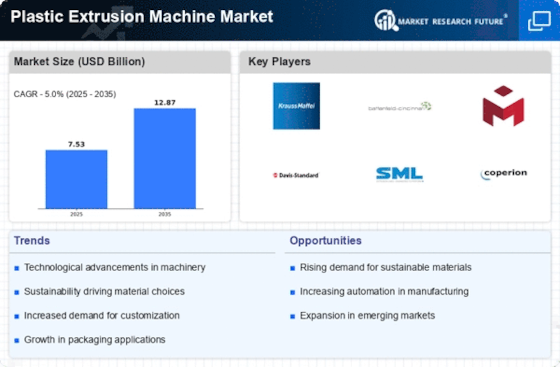
As per Market Research Future analysis, the Global Plastic Extrusion Machine Market Size was estimated at 7.525 USD Billion in 2024. The Plastic Extrusion Machine industry is projected to grow from 7.901 USD Billion in 2025 to 12.87 USD Billion by 2035, exhibiting a compound annual growth rate (CAGR) of 5.0% during the forecast period 2025 - 2035

Key Market Trends & Highlights

The Plastic Extrusion Machine Market is poised for growth driven by sustainability and technological advancements.

  • North America remains the largest market for plastic extrusion machines, reflecting robust demand across various industries. Asia-Pacific is emerging as the fastest-growing region, fueled by rapid industrialization and increasing manufacturing capabilities. The single-screw extrusion segment holds the largest market share, while twin-screw extrusion is witnessing the fastest growth due to its versatility. Key market drivers include the rising demand for packaging solutions and an increased focus on recycling and sustainability initiatives.

Market Size & Forecast

2024 Market Size 7.525 (USD Billion)
2035 Market Size 12.87 (USD Billion)
CAGR (2025 - 2035) 5.0%
Largest Regional Market Share in 2024 Asia Pacific

Major Players

KraussMaffei (DE), Battenfeld-Cincinnati (AT), <a href="https://www.milacron.com/extrusion/">Milacron </a>(US), Davis-Standard (US), SML Maschinengesellschaft mbH (AT), <a href="https://coperion.com/en/products-services/extruders-compounding-machines">Coperion </a>(DE), Bausano (IT), Feddem (DE), Wexler (DE), Kiefel (DE)

Market Trends

The Plastic Extrusion Machine Market is currently experiencing a dynamic evolution, driven by various factors that influence production processes across multiple industries. The demand for lightweight and durable materials is prompting manufacturers to adopt advanced extrusion technologies. This shift not only enhances efficiency but also aligns with sustainability goals, as companies seek to minimize waste and energy consumption. Furthermore, the growing emphasis on recycling equipement and the use of biodegradable materials is reshaping the landscape of plastic extrusion, encouraging innovation in machine design and functionality. In addition, the Plastic Extrusion Machine Market is witnessing a surge in automation and smart technologies. Manufacturers are increasingly integrating IoT and AI capabilities into their machinery, which allows for real-time monitoring and optimization of production lines. This trend appears to enhance operational efficiency and reduce downtime, ultimately leading to cost savings. As industries continue to evolve, the Plastic Extrusion Machine Market is likely to adapt, reflecting the changing needs and preferences of consumers and businesses alike.

Sustainability Initiatives

The focus on sustainability is reshaping the Plastic Extrusion Machine Market. Manufacturers are increasingly adopting eco-friendly practices, such as utilizing recycled materials and developing machines that consume less energy. This trend reflects a broader commitment to environmental responsibility and aligns with global efforts to reduce plastic waste.

Technological Advancements

Technological innovation plays a crucial role in the evolution of the Plastic Extrusion Machine Market. The integration of automation and smart technologies enhances production efficiency. These advancements enable manufacturers to optimize processes, reduce waste, and improve product quality, thereby meeting the demands of a competitive market.

Customization and Versatility

Customization is becoming a key trend within the Plastic Extrusion Machine Market. As industries require specific solutions tailored to their needs, manufacturers are focusing on creating versatile machines that can accommodate various materials and production methods, including advanced PVC extrusion machine designed for enhanced precision and efficiency. This adaptability is essential for meeting diverse customer requirements.

Plastic Extrusion Machine Market Market Drivers

Rising Demand for Packaging Solutions

The increasing demand for packaging solutions across various industries is a primary driver for the Plastic Extrusion Machine Industry. As consumer preferences shift towards convenience and sustainability, manufacturers are compelled to innovate packaging materials. The market for flexible packaging is projected to grow significantly, with estimates suggesting a compound annual growth rate of over 4% in the coming years. This trend necessitates advanced plastic extrusion technologies that can produce lightweight, durable, and recyclable materials. Consequently, companies are investing in state-of-the-art extrusion machines to meet these evolving requirements, thereby propelling the growth of the Plastic Extrusion Machine Market.

Increased Focus on Recycling and Sustainability

The heightened focus on recycling and sustainability is a crucial driver for the Plastic Extrusion Machine Industry. As environmental concerns gain prominence, industries are increasingly adopting sustainable practices, including the use of recycled plastics. The market for recycled plastic products is expected to expand, with projections indicating a growth rate of around 6% annually. This shift necessitates the development of extrusion machines capable of processing recycled materials efficiently. Manufacturers are responding by investing in technologies that facilitate the recycling of plastics, thereby aligning with sustainability goals and driving the evolution of the Plastic Extrusion Machine, especially as demand for advanced plastic extruder machine continues to rise.


Technological Innovations in Extrusion Processes

Technological innovations in extrusion processes are significantly shaping the Plastic Extrusion Machine. The advent of Industry 4.0 and automation technologies has led to the development of smarter, more efficient extrusion machines. These innovations enhance production capabilities, reduce waste management, and improve product quality. For instance, the integration of IoT and AI in extrusion processes allows for real-time monitoring and predictive maintenance, which can reduce downtime by up to 20%. As manufacturers strive for operational excellence, the demand for technologically advanced extrusion machines is likely to surge, further driving the growth of the Plastic Extrusion Machine.

Expanding Automotive Sector and Lightweight Materials

The expanding automotive sector is a significant driver for the Plastic Extrusion Machine, particularly with the growing emphasis on lightweight materials. As automotive manufacturers seek to enhance fuel efficiency and reduce emissions, the demand for lightweight plastic components is on the rise. The automotive plastics market is projected to grow at a rate of approximately 7% annually, which directly influences the need for advanced extrusion technologies. This trend compels manufacturers to invest in high-performance extrusion machines that can produce complex shapes and designs, thereby supporting the evolving requirements of the automotive industry and propelling the Plastic Extrusion Machine.

Growth in Construction and Infrastructure Development

The ongoing expansion in construction and infrastructure development is a notable driver for the Plastic Extrusion Machine Market. With urbanization trends accelerating, there is a heightened demand for plastic components in construction applications, such as pipes, profiles, and sheets. The construction sector is expected to witness a growth rate of approximately 5% annually, which directly influences the need for efficient plastic extrusion processes. As builders and contractors seek to utilize lightweight and cost-effective materials, the adoption of advanced extrusion machines becomes essential. This trend underscores the pivotal role of the Plastic Extrusion Machine in supporting the construction landscape.

Market Segment Insights

By Machine Type: Single-screw (Largest) vs. Twin-screw (Fastest-Growing)

In the Plastic Extrusion Machine Market, the single-screw extruders hold a significant market share due to their established reliability and efficiency in processing a wide variety of thermoplastics. This machine type is preferred by many manufacturers as it allows for cost-effective production while maintaining quality. On the other hand, twin-screw extruders are gaining popularity for their versatility and ability to handle complex formulations, leading to a competitive shift in market dynamics.

Machine Type: Single-screw (Dominant) vs. Twin-screw (Emerging)

Single-screw extruders have long been the dominant choice in the Plastic Extrusion Machine Market, recognized for their simplicity, lower cost, and ability to process a range of materials effectively. Their design facilitates easy maintenance and operation, making them a staple in various industries such as packaging and automotive. Conversely, twin-screw extruders, <a href="https://www.marketresearchfuture.com/reports/screw-jacks-market-23536">screw jacks</a> known for their enhanced mixing capabilities and better homogeneity, are emerging rapidly due to increased demand for specialized materials. They are particularly advantageous in applications requiring higher precision and efficiency, contributing to their fastest-growing status in the market.

By Process Type: Blown Film Extrusion (Largest) vs. Sheet/FIm Extrusion (Fastest-Growing)

In the Plastic Extrusion Machine Market, the market share is heavily dominated by the blown film extrusion segment, renowned for its versatility and wide application in packaging. The sheet/film extrusion segment follows closely, showing significant potential for growth due to increasing demand for flexible packaging solutions. Tubing extrusion and other methods hold a smaller fraction of the market, focusing on specialized applications in various industries, but they are expected to generate incremental growth as technology advances.

Blown Film Extrusion (Dominant) vs. Sheet/Film Extrusion (Emerging)

Blown film extrusion is the dominant process type within the market, leveraged for its ability to create lightweight and durable packaging solutions. This technique excels in producing films used for bags, wraps, and other packaging, benefiting from established manufacturing techniques and economies of scale. In contrast, sheet/film extrusion is an emerging category that is gaining traction, primarily due to the rising consumer preference for sustainable packaging alternatives. This segment is also driven by innovations in material technologies, appealing to environmentally conscious consumers, suggesting an upward trajectory in adoption as manufacturers pivot towards more eco-friendly options.

By Solution: New Sales (Largest) vs. Aftermarket (Fastest-Growing)

In the Plastic Extrusion Machine, new sales represent the largest segment, capturing a significant portion of market share. This segment comprises companies providing innovative machinery solutions designed for efficiency and productivity. As manufacturers continually seek to modernize their production lines, new sales remain strong and are supported by advancements in technologies that enhance performance, reduce energy consumption, and comply with regulatory standards. Conversely, the aftermarket segment is witnessing rapid growth as companies focus on maintaining and optimizing existing machines. This growth is driven by the increasing need for spare parts, upgrades, and essential maintenance services. The aftermarket is becoming increasingly important, with manufacturers recognizing that maintaining performance over time is crucial for competitive advantage and operational efficiency.

New Sales (Dominant) vs. Aftermarket (Emerging)

New sales of plastic extrusion machines dominate the market due to their technological advancements and appeal to manufacturers aiming for increased production efficiency. These machines often incorporate the latest features that enhance throughput and reduce waste. On the other hand, the aftermarket segment is emerging as a vital player, driven by the demand for spare parts and service capabilities to prolong machine life and performance. While new sales focus on innovative solutions for new installations, the aftermarket caters to a more sustained revenue stream through maintenance contracts and service agreements, ensuring the operational reliability of older models.

By Application: Building & Construction (Largest) vs. Medical (Fastest-Growing)

The plastic extrusion machine demonstrates a diverse application landscape, with Building &amp; Construction holding the majority share. This sector heavily relies on plastic extrusion processes for producing essential components such as pipes, fittings, and panels, thus showcasing a robust demand. Conversely, the Medical segment, while smaller in market share, is rapidly expanding due to advancements in healthcare technology and increasing demand for medical devices. As a result, there is a notable shift toward more innovative extrusion processes tailored for sterile and biocompatible materials.

Building &amp; Construction (Dominant) vs. Medical (Emerging)

In the plastic extrusion machine, the Building &amp; Construction segment is recognized as the dominant force due to its extensive use of extruded plastic products across various applications. Its established demand is driven by ongoing infrastructure projects and the replacement of traditional materials with more versatile and durable plastic options. On the other hand, the Medical segment is emerging as a pivotal player, propelled by innovations in medical device manufacturing and an increasing focus on patient care. This segment's growth is influenced by the need for precision, sterilization, and compliance with stringent regulations, prompting manufacturers to invest in advanced extrusion technologies that cater specifically to these requirements.

Get more detailed insights about Plastic Extrusion Machine Market Research Report – Forecast till 2035

Regional Insights

North America : Innovation and Demand Surge

The North American plastic extrusion machine market is driven by technological advancements and increasing demand for lightweight materials across various industries. The region holds the largest market share at approximately 40%, with the U.S. leading the charge due to its robust manufacturing sector and investment in automation technologies. Regulatory support for sustainable practices further fuels market growth, encouraging manufacturers to adopt advanced extrusion technologies. Key players such as Milacron and Davis-Standard dominate the landscape, supported by a network of suppliers and distributors. The competitive environment is characterized by continuous innovation and strategic partnerships aimed at enhancing product offerings. The presence of established companies ensures a steady supply of advanced machinery, catering to diverse applications in automotive, packaging, and construction sectors.

Europe : Sustainability and Innovation Focus

Europe is witnessing a significant transformation in the plastic extrusion machine market, driven by stringent environmental regulations and a strong emphasis on sustainability. The region accounts for approximately 30% of the global market share, with Germany and Italy being the largest contributors. The European Union's commitment to reducing plastic waste and promoting recycling technologies acts as a catalyst for market growth, pushing manufacturers to innovate and adapt. Leading countries like Germany and Austria host key players such as KraussMaffei and Battenfeld-Cincinnati, who are at the forefront of developing eco-friendly extrusion solutions. The competitive landscape is marked by collaborations and investments in R&D, focusing on energy-efficient machines and sustainable materials. This shift not only enhances production efficiency but also aligns with the region's environmental goals.

Asia-Pacific : Rapid Industrialization and Growth

The Asia-Pacific region is emerging as a powerhouse in the plastic extrusion machine market, driven by rapid industrialization and increasing demand for consumer goods. This region holds the second-largest market share at around 25%, with China and India leading the way. The growing population and urbanization are significant factors contributing to the rising demand for plastic products, prompting manufacturers to invest in advanced extrusion technologies. China's dominance in manufacturing, coupled with India's expanding industrial base, creates a competitive landscape rich with opportunities. Key players like Coperion and SML Maschinengesellschaft mbH are actively enhancing their presence in the region. The market is characterized by a mix of local and international companies, fostering innovation and competitive pricing strategies to meet the diverse needs of various industries.

Middle East and Africa : Emerging Markets and Opportunities

The Middle East and Africa region is witnessing gradual growth in the plastic extrusion machine market, driven by increasing investments in infrastructure and manufacturing capabilities. The market share is relatively smaller, accounting for about 5%, but shows potential for expansion as countries like South Africa and the UAE focus on diversifying their economies. Government initiatives aimed at boosting local manufacturing are key drivers for market development in this region. Leading players are beginning to establish a foothold in the region, with companies exploring partnerships and joint ventures to enhance their market presence. The competitive landscape is evolving, with a mix of local and international firms vying for market share. As the region continues to develop, the demand for advanced plastic extrusion technologies is expected to rise, creating new opportunities for growth.

Key Players and Competitive Insights

The Plastic Extrusion Machine Market is currently characterized by a dynamic competitive landscape, driven by technological advancements and increasing demand for customized solutions across various industries. Key players such as KraussMaffei (DE), Milacron (US), and Coperion (DE) are strategically positioning themselves through innovation and regional expansion. KraussMaffei (DE) focuses on enhancing its product portfolio with advanced automation technologies, while Milacron (US) emphasizes sustainability in its manufacturing processes. Coperion (DE) is actively pursuing partnerships to bolster its market presence, indicating a collective shift towards collaborative strategies that enhance competitive advantage. In terms of business tactics, companies are increasingly localizing manufacturing to reduce lead times and optimize supply chains. The market appears moderately fragmented, with several players vying for market share. However, the influence of major companies is significant, as they set industry standards and drive technological advancements. This competitive structure suggests that while smaller firms may struggle to keep pace, they can still find niche markets by focusing on specialized applications or regional demands. In August 2025, KraussMaffei (DE) announced the launch of a new line of extrusion machines designed specifically for the production of sustainable materials. This strategic move not only aligns with global sustainability trends but also positions the company as a leader in eco-friendly manufacturing solutions. By investing in sustainable technology, KraussMaffei (DE) is likely to attract environmentally conscious clients, thereby enhancing its market share. In September 2025, Milacron (US) unveiled a partnership with a leading recycling technology firm to develop machines that integrate recycling capabilities into the extrusion process. This collaboration is significant as it reflects a growing trend towards circular economy practices within the industry. By incorporating recycling into their machinery, Milacron (US) is poised to meet the increasing demand for sustainable production methods, potentially setting a new standard in the market. In July 2025, Coperion (DE) expanded its operations in Asia by establishing a new manufacturing facility in Vietnam. This strategic expansion is indicative of the company's commitment to tapping into emerging markets and enhancing its global footprint. By localizing production in Asia, Coperion (DE) can better serve its clients in the region, reduce shipping costs, and respond more swiftly to market demands. As of October 2025, the competitive trends in the Plastic Extrusion Machine Market are increasingly defined by digitalization, sustainability, and the integration of artificial intelligence. Strategic alliances are becoming more prevalent, as companies recognize the value of collaboration in driving innovation. The competitive landscape is shifting from traditional price-based competition to a focus on technological advancements and supply chain reliability. This evolution suggests that future differentiation will hinge on the ability to innovate and adapt to changing market demands, rather than merely competing on cost.

Key Companies in the Plastic Extrusion Machine Market include

Industry Developments

Future Outlook

Plastic Extrusion Machine Market Future Outlook

The Plastic Extrusion Machine Market is projected to grow at a 5.0% CAGR from 2025 to 2035, driven by increasing demand for sustainable packaging and advancements in manufacturing technologies.

New opportunities lie in:

  • <p>Integration of IoT for real-time monitoring and predictive maintenance solutions. Development of energy-efficient extrusion systems to reduce operational costs. Expansion into emerging markets with tailored product offerings for local industries.</p>

By 2035, the market is expected to achieve robust growth, positioning itself as a leader in manufacturing innovation.

Market Segmentation

Plastic Extrusion Machine Market Solution Outlook

  • New sales
  • Aftermarket

Plastic Extrusion Machine Market Application Outlook

  • Building & construction
  • Medical
  • Transportation
  • Consumer Goods
  • Others

Plastic Extrusion Machine Market Machine Type Outlook

  • Single-screw
  • Twin-screw

Plastic Extrusion Machine Market Process Type Outlook

  • Blown film extrusion
  • Sheet/film extrusion
  • Tubing extrusion
  • Others

Report Scope

MARKET SIZE 2024 7.525(USD Billion)
MARKET SIZE 2025 7.901(USD Billion)
MARKET SIZE 2035 12.87(USD Billion)
COMPOUND ANNUAL GROWTH RATE (CAGR) 5.0% (2025 - 2035)
REPORT COVERAGE Revenue Forecast, Competitive Landscape, Growth Factors, and Trends
BASE YEAR 2024
Market Forecast Period 2025 - 2035
Historical Data 2019 - 2024
Market Forecast Units USD Billion
Key Companies Profiled KraussMaffei (DE), Battenfeld-Cincinnati (AT), Milacron (US), Davis-Standard (US), SML Maschinengesellschaft mbH (AT), Coperion (DE), Bausano (IT), Feddem (DE), Wexler (DE), Kiefel (DE)
Segments Covered Machine Type, Process Type, Solution, Application, Region
Key Market Opportunities Integration of advanced automation technologies enhances efficiency in the Plastic Extrusion Machine Market.
Key Market Dynamics Technological advancements and sustainability concerns drive innovation in the Plastic Extrusion Machine market.
Countries Covered North America, Europe, APAC, South America, MEA

FAQs

What is the projected market valuation of the Plastic Extrusion Machine Market by 2035?

<p>The Plastic Extrusion Machine Market is projected to reach a valuation of 12.87 USD Billion by 2035.</p>

What was the market valuation of the Plastic Extrusion Machine Market in 2024?

<p>In 2024, the market valuation of the Plastic Extrusion Machine Market was 7.525 USD Billion.</p>

What is the expected CAGR for the Plastic Extrusion Machine Market during the forecast period 2025 - 2035?

<p>The expected CAGR for the Plastic Extrusion Machine Market during the forecast period 2025 - 2035 is 5.0%.</p>

Which machine types dominate the Plastic Extrusion Machine Market?

<p>The market features significant segments for Single-screw and Twin-screw machines, with valuations of 5.9 USD Billion and 6.97 USD Billion, respectively, projected for 2035.</p>

What are the key applications driving the Plastic Extrusion Machine Market?

<p>Key applications include Building & Construction, Medical, Transportation, and Consumer Goods, with projected valuations ranging from 1.0 to 2.5 USD Billion by 2035.</p>

Who are the leading players in the Plastic Extrusion Machine Market?

<p>Key players in the market include KraussMaffei, Battenfeld-Cincinnati, Milacron, and Davis-Standard, among others.</p>

What are the projected values for the Blown Film Extrusion process type by 2035?

The Blown Film Extrusion process type is projected to reach a valuation of 4.5 USD Billion by 2035.

How does the aftermarket segment compare to new sales in the Plastic Extrusion Machine Market?

By 2035, the aftermarket segment is expected to reach 5.75 USD Billion, while new sales are projected at 7.12 USD Billion.

What is the expected growth trend for the Tubing Extrusion process type?

The Tubing Extrusion process type is anticipated to grow to a valuation of 2.5 USD Billion by 2035.

What is the projected market size for the Others application segment by 2035?

The Others application segment is projected to reach a valuation of 3.07 USD Billion by 2035.

  1. SECTION I: EXECUTIVE SUMMARY AND KEY HIGHLIGHTS
    1. | 1.1 EXECUTIVE SUMMARY
    2. | | 1.1.1 Market Overview
    3. | | 1.1.2 Key Findings
    4. | | 1.1.3 Market Segmentation
    5. | | 1.1.4 Competitive Landscape
    6. | | 1.1.5 Challenges and Opportunities
    7. | | 1.1.6 Future Outlook
  2. SECTION II: SCOPING, METHODOLOGY AND MARKET STRUCTURE
    1. | 2.1 MARKET INTRODUCTION
    2. | | 2.1.1 Definition
    3. | | 2.1.2 Scope of the study
    4. | | | 2.1.2.1 Research Objective
    5. | | | 2.1.2.2 Assumption
    6. | | | 2.1.2.3 Limitations
    7. | 2.2 RESEARCH METHODOLOGY
    8. | | 2.2.1 Overview
    9. | | 2.2.2 Data Mining
    10. | | 2.2.3 Secondary Research
    11. | | 2.2.4 Primary Research
    12. | | | 2.2.4.1 Primary Interviews and Information Gathering Process
    13. | | | 2.2.4.2 Breakdown of Primary Respondents
    14. | | 2.2.5 Forecasting Model
    15. | | 2.2.6 Market Size Estimation
    16. | | | 2.2.6.1 Bottom-Up Approach
    17. | | | 2.2.6.2 Top-Down Approach
    18. | | 2.2.7 Data Triangulation
    19. | | 2.2.8 Validation
  3. SECTION III: QUALITATIVE ANALYSIS
    1. | 3.1 MARKET DYNAMICS
    2. | | 3.1.1 Overview
    3. | | 3.1.2 Drivers
    4. | | 3.1.3 Restraints
    5. | | 3.1.4 Opportunities
    6. | 3.2 MARKET FACTOR ANALYSIS
    7. | | 3.2.1 Value chain Analysis
    8. | | 3.2.2 Porter's Five Forces Analysis
    9. | | | 3.2.2.1 Bargaining Power of Suppliers
    10. | | | 3.2.2.2 Bargaining Power of Buyers
    11. | | | 3.2.2.3 Threat of New Entrants
    12. | | | 3.2.2.4 Threat of Substitutes
    13. | | | 3.2.2.5 Intensity of Rivalry
    14. | | 3.2.3 COVID-19 Impact Analysis
    15. | | | 3.2.3.1 Market Impact Analysis
    16. | | | 3.2.3.2 Regional Impact
    17. | | | 3.2.3.3 Opportunity and Threat Analysis
  4. SECTION IV: QUANTITATIVE ANALYSIS
    1. | 4.1 Life Sciences, BY Machine Type (USD Billion)
    2. | | 4.1.1 Single-screw
    3. | | 4.1.2 Twin-screw
    4. | 4.2 Life Sciences, BY Process Type (USD Billion)
    5. | | 4.2.1 Blown film extrusion
    6. | | 4.2.2 Sheet/film extrusion
    7. | | 4.2.3 Tubing extrusion
    8. | | 4.2.4 Others
    9. | 4.3 Life Sciences, BY Solution (USD Billion)
    10. | | 4.3.1 New sales
    11. | | 4.3.2 Aftermarket
    12. | 4.4 Life Sciences, BY Application (USD Billion)
    13. | | 4.4.1 Building & construction
    14. | | 4.4.2 Medical
    15. | | 4.4.3 Transportation
    16. | | 4.4.4 Consumer Goods
    17. | | 4.4.5 Others
    18. | 4.5 Life Sciences, BY Region (USD Billion)
    19. | | 4.5.1 North America
    20. | | | 4.5.1.1 US
    21. | | | 4.5.1.2 Canada
    22. | | 4.5.2 Europe
    23. | | | 4.5.2.1 Germany
    24. | | | 4.5.2.2 UK
    25. | | | 4.5.2.3 France
    26. | | | 4.5.2.4 Russia
    27. | | | 4.5.2.5 Italy
    28. | | | 4.5.2.6 Spain
    29. | | | 4.5.2.7 Rest of Europe
    30. | | 4.5.3 APAC
    31. | | | 4.5.3.1 China
    32. | | | 4.5.3.2 India
    33. | | | 4.5.3.3 Japan
    34. | | | 4.5.3.4 South Korea
    35. | | | 4.5.3.5 Malaysia
    36. | | | 4.5.3.6 Thailand
    37. | | | 4.5.3.7 Indonesia
    38. | | | 4.5.3.8 Rest of APAC
    39. | | 4.5.4 South America
    40. | | | 4.5.4.1 Brazil
    41. | | | 4.5.4.2 Mexico
    42. | | | 4.5.4.3 Argentina
    43. | | | 4.5.4.4 Rest of South America
    44. | | 4.5.5 MEA
    45. | | | 4.5.5.1 GCC Countries
    46. | | | 4.5.5.2 South Africa
    47. | | | 4.5.5.3 Rest of MEA
  5. SECTION V: COMPETITIVE ANALYSIS
    1. | 5.1 Competitive Landscape
    2. | | 5.1.1 Overview
    3. | | 5.1.2 Competitive Analysis
    4. | | 5.1.3 Market share Analysis
    5. | | 5.1.4 Major Growth Strategy in the Life Sciences
    6. | | 5.1.5 Competitive Benchmarking
    7. | | 5.1.6 Leading Players in Terms of Number of Developments in the Life Sciences
    8. | | 5.1.7 Key developments and growth strategies
    9. | | | 5.1.7.1 New Product Launch/Service Deployment
    10. | | | 5.1.7.2 Merger & Acquisitions
    11. | | | 5.1.7.3 Joint Ventures
    12. | | 5.1.8 Major Players Financial Matrix
    13. | | | 5.1.8.1 Sales and Operating Income
    14. | | | 5.1.8.2 Major Players R&D Expenditure. 2023
    15. | 5.2 Company Profiles
    16. | | 5.2.1 KraussMaffei (DE)
    17. | | | 5.2.1.1 Financial Overview
    18. | | | 5.2.1.2 Products Offered
    19. | | | 5.2.1.3 Key Developments
    20. | | | 5.2.1.4 SWOT Analysis
    21. | | | 5.2.1.5 Key Strategies
    22. | | 5.2.2 Battenfeld-Cincinnati (AT)
    23. | | | 5.2.2.1 Financial Overview
    24. | | | 5.2.2.2 Products Offered
    25. | | | 5.2.2.3 Key Developments
    26. | | | 5.2.2.4 SWOT Analysis
    27. | | | 5.2.2.5 Key Strategies
    28. | | 5.2.3 Milacron (US)
    29. | | | 5.2.3.1 Financial Overview
    30. | | | 5.2.3.2 Products Offered
    31. | | | 5.2.3.3 Key Developments
    32. | | | 5.2.3.4 SWOT Analysis
    33. | | | 5.2.3.5 Key Strategies
    34. | | 5.2.4 Davis-Standard (US)
    35. | | | 5.2.4.1 Financial Overview
    36. | | | 5.2.4.2 Products Offered
    37. | | | 5.2.4.3 Key Developments
    38. | | | 5.2.4.4 SWOT Analysis
    39. | | | 5.2.4.5 Key Strategies
    40. | | 5.2.5 SML Maschinengesellschaft mbH (AT)
    41. | | | 5.2.5.1 Financial Overview
    42. | | | 5.2.5.2 Products Offered
    43. | | | 5.2.5.3 Key Developments
    44. | | | 5.2.5.4 SWOT Analysis
    45. | | | 5.2.5.5 Key Strategies
    46. | | 5.2.6 Coperion (DE)
    47. | | | 5.2.6.1 Financial Overview
    48. | | | 5.2.6.2 Products Offered
    49. | | | 5.2.6.3 Key Developments
    50. | | | 5.2.6.4 SWOT Analysis
    51. | | | 5.2.6.5 Key Strategies
    52. | | 5.2.7 Bausano (IT)
    53. | | | 5.2.7.1 Financial Overview
    54. | | | 5.2.7.2 Products Offered
    55. | | | 5.2.7.3 Key Developments
    56. | | | 5.2.7.4 SWOT Analysis
    57. | | | 5.2.7.5 Key Strategies
    58. | | 5.2.8 Feddem (DE)
    59. | | | 5.2.8.1 Financial Overview
    60. | | | 5.2.8.2 Products Offered
    61. | | | 5.2.8.3 Key Developments
    62. | | | 5.2.8.4 SWOT Analysis
    63. | | | 5.2.8.5 Key Strategies
    64. | | 5.2.9 Wexler (DE)
    65. | | | 5.2.9.1 Financial Overview
    66. | | | 5.2.9.2 Products Offered
    67. | | | 5.2.9.3 Key Developments
    68. | | | 5.2.9.4 SWOT Analysis
    69. | | | 5.2.9.5 Key Strategies
    70. | | 5.2.10 Kiefel (DE)
    71. | | | 5.2.10.1 Financial Overview
    72. | | | 5.2.10.2 Products Offered
    73. | | | 5.2.10.3 Key Developments
    74. | | | 5.2.10.4 SWOT Analysis
    75. | | | 5.2.10.5 Key Strategies
    76. | 5.3 Appendix
    77. | | 5.3.1 References
    78. | | 5.3.2 Related Reports
  6. LIST OF FIGURES
    1. | 6.1 MARKET SYNOPSIS
    2. | 6.2 NORTH AMERICA MARKET ANALYSIS
    3. | 6.3 US MARKET ANALYSIS BY MACHINE TYPE
    4. | 6.4 US MARKET ANALYSIS BY PROCESS TYPE
    5. | 6.5 US MARKET ANALYSIS BY SOLUTION
    6. | 6.6 US MARKET ANALYSIS BY APPLICATION
    7. | 6.7 CANADA MARKET ANALYSIS BY MACHINE TYPE
    8. | 6.8 CANADA MARKET ANALYSIS BY PROCESS TYPE
    9. | 6.9 CANADA MARKET ANALYSIS BY SOLUTION
    10. | 6.10 CANADA MARKET ANALYSIS BY APPLICATION
    11. | 6.11 EUROPE MARKET ANALYSIS
    12. | 6.12 GERMANY MARKET ANALYSIS BY MACHINE TYPE
    13. | 6.13 GERMANY MARKET ANALYSIS BY PROCESS TYPE
    14. | 6.14 GERMANY MARKET ANALYSIS BY SOLUTION
    15. | 6.15 GERMANY MARKET ANALYSIS BY APPLICATION
    16. | 6.16 UK MARKET ANALYSIS BY MACHINE TYPE
    17. | 6.17 UK MARKET ANALYSIS BY PROCESS TYPE
    18. | 6.18 UK MARKET ANALYSIS BY SOLUTION
    19. | 6.19 UK MARKET ANALYSIS BY APPLICATION
    20. | 6.20 FRANCE MARKET ANALYSIS BY MACHINE TYPE
    21. | 6.21 FRANCE MARKET ANALYSIS BY PROCESS TYPE
    22. | 6.22 FRANCE MARKET ANALYSIS BY SOLUTION
    23. | 6.23 FRANCE MARKET ANALYSIS BY APPLICATION
    24. | 6.24 RUSSIA MARKET ANALYSIS BY MACHINE TYPE
    25. | 6.25 RUSSIA MARKET ANALYSIS BY PROCESS TYPE
    26. | 6.26 RUSSIA MARKET ANALYSIS BY SOLUTION
    27. | 6.27 RUSSIA MARKET ANALYSIS BY APPLICATION
    28. | 6.28 ITALY MARKET ANALYSIS BY MACHINE TYPE
    29. | 6.29 ITALY MARKET ANALYSIS BY PROCESS TYPE
    30. | 6.30 ITALY MARKET ANALYSIS BY SOLUTION
    31. | 6.31 ITALY MARKET ANALYSIS BY APPLICATION
    32. | 6.32 SPAIN MARKET ANALYSIS BY MACHINE TYPE
    33. | 6.33 SPAIN MARKET ANALYSIS BY PROCESS TYPE
    34. | 6.34 SPAIN MARKET ANALYSIS BY SOLUTION
    35. | 6.35 SPAIN MARKET ANALYSIS BY APPLICATION
    36. | 6.36 REST OF EUROPE MARKET ANALYSIS BY MACHINE TYPE
    37. | 6.37 REST OF EUROPE MARKET ANALYSIS BY PROCESS TYPE
    38. | 6.38 REST OF EUROPE MARKET ANALYSIS BY SOLUTION
    39. | 6.39 REST OF EUROPE MARKET ANALYSIS BY APPLICATION
    40. | 6.40 APAC MARKET ANALYSIS
    41. | 6.41 CHINA MARKET ANALYSIS BY MACHINE TYPE
    42. | 6.42 CHINA MARKET ANALYSIS BY PROCESS TYPE
    43. | 6.43 CHINA MARKET ANALYSIS BY SOLUTION
    44. | 6.44 CHINA MARKET ANALYSIS BY APPLICATION
    45. | 6.45 INDIA MARKET ANALYSIS BY MACHINE TYPE
    46. | 6.46 INDIA MARKET ANALYSIS BY PROCESS TYPE
    47. | 6.47 INDIA MARKET ANALYSIS BY SOLUTION
    48. | 6.48 INDIA MARKET ANALYSIS BY APPLICATION
    49. | 6.49 JAPAN MARKET ANALYSIS BY MACHINE TYPE
    50. | 6.50 JAPAN MARKET ANALYSIS BY PROCESS TYPE
    51. | 6.51 JAPAN MARKET ANALYSIS BY SOLUTION
    52. | 6.52 JAPAN MARKET ANALYSIS BY APPLICATION
    53. | 6.53 SOUTH KOREA MARKET ANALYSIS BY MACHINE TYPE
    54. | 6.54 SOUTH KOREA MARKET ANALYSIS BY PROCESS TYPE
    55. | 6.55 SOUTH KOREA MARKET ANALYSIS BY SOLUTION
    56. | 6.56 SOUTH KOREA MARKET ANALYSIS BY APPLICATION
    57. | 6.57 MALAYSIA MARKET ANALYSIS BY MACHINE TYPE
    58. | 6.58 MALAYSIA MARKET ANALYSIS BY PROCESS TYPE
    59. | 6.59 MALAYSIA MARKET ANALYSIS BY SOLUTION
    60. | 6.60 MALAYSIA MARKET ANALYSIS BY APPLICATION
    61. | 6.61 THAILAND MARKET ANALYSIS BY MACHINE TYPE
    62. | 6.62 THAILAND MARKET ANALYSIS BY PROCESS TYPE
    63. | 6.63 THAILAND MARKET ANALYSIS BY SOLUTION
    64. | 6.64 THAILAND MARKET ANALYSIS BY APPLICATION
    65. | 6.65 INDONESIA MARKET ANALYSIS BY MACHINE TYPE
    66. | 6.66 INDONESIA MARKET ANALYSIS BY PROCESS TYPE
    67. | 6.67 INDONESIA MARKET ANALYSIS BY SOLUTION
    68. | 6.68 INDONESIA MARKET ANALYSIS BY APPLICATION
    69. | 6.69 REST OF APAC MARKET ANALYSIS BY MACHINE TYPE
    70. | 6.70 REST OF APAC MARKET ANALYSIS BY PROCESS TYPE
    71. | 6.71 REST OF APAC MARKET ANALYSIS BY SOLUTION
    72. | 6.72 REST OF APAC MARKET ANALYSIS BY APPLICATION
    73. | 6.73 SOUTH AMERICA MARKET ANALYSIS
    74. | 6.74 BRAZIL MARKET ANALYSIS BY MACHINE TYPE
    75. | 6.75 BRAZIL MARKET ANALYSIS BY PROCESS TYPE
    76. | 6.76 BRAZIL MARKET ANALYSIS BY SOLUTION
    77. | 6.77 BRAZIL MARKET ANALYSIS BY APPLICATION
    78. | 6.78 MEXICO MARKET ANALYSIS BY MACHINE TYPE
    79. | 6.79 MEXICO MARKET ANALYSIS BY PROCESS TYPE
    80. | 6.80 MEXICO MARKET ANALYSIS BY SOLUTION
    81. | 6.81 MEXICO MARKET ANALYSIS BY APPLICATION
    82. | 6.82 ARGENTINA MARKET ANALYSIS BY MACHINE TYPE
    83. | 6.83 ARGENTINA MARKET ANALYSIS BY PROCESS TYPE
    84. | 6.84 ARGENTINA MARKET ANALYSIS BY SOLUTION
    85. | 6.85 ARGENTINA MARKET ANALYSIS BY APPLICATION
    86. | 6.86 REST OF SOUTH AMERICA MARKET ANALYSIS BY MACHINE TYPE
    87. | 6.87 REST OF SOUTH AMERICA MARKET ANALYSIS BY PROCESS TYPE
    88. | 6.88 REST OF SOUTH AMERICA MARKET ANALYSIS BY SOLUTION
    89. | 6.89 REST OF SOUTH AMERICA MARKET ANALYSIS BY APPLICATION
    90. | 6.90 MEA MARKET ANALYSIS
    91. | 6.91 GCC COUNTRIES MARKET ANALYSIS BY MACHINE TYPE
    92. | 6.92 GCC COUNTRIES MARKET ANALYSIS BY PROCESS TYPE
    93. | 6.93 GCC COUNTRIES MARKET ANALYSIS BY SOLUTION
    94. | 6.94 GCC COUNTRIES MARKET ANALYSIS BY APPLICATION
    95. | 6.95 SOUTH AFRICA MARKET ANALYSIS BY MACHINE TYPE
    96. | 6.96 SOUTH AFRICA MARKET ANALYSIS BY PROCESS TYPE
    97. | 6.97 SOUTH AFRICA MARKET ANALYSIS BY SOLUTION
    98. | 6.98 SOUTH AFRICA MARKET ANALYSIS BY APPLICATION
    99. | 6.99 REST OF MEA MARKET ANALYSIS BY MACHINE TYPE
    100. | 6.100 REST OF MEA MARKET ANALYSIS BY PROCESS TYPE
    101. | 6.101 REST OF MEA MARKET ANALYSIS BY SOLUTION
    102. | 6.102 REST OF MEA MARKET ANALYSIS BY APPLICATION
    103. | 6.103 KEY BUYING CRITERIA OF LIFE SCIENCES
    104. | 6.104 RESEARCH PROCESS OF MRFR
    105. | 6.105 DRO ANALYSIS OF LIFE SCIENCES
    106. | 6.106 DRIVERS IMPACT ANALYSIS: LIFE SCIENCES
    107. | 6.107 RESTRAINTS IMPACT ANALYSIS: LIFE SCIENCES
    108. | 6.108 SUPPLY / VALUE CHAIN: LIFE SCIENCES
    109. | 6.109 LIFE SCIENCES, BY MACHINE TYPE, 2024 (% SHARE)
    110. | 6.110 LIFE SCIENCES, BY MACHINE TYPE, 2024 TO 2035 (USD Billion)
    111. | 6.111 LIFE SCIENCES, BY PROCESS TYPE, 2024 (% SHARE)
    112. | 6.112 LIFE SCIENCES, BY PROCESS TYPE, 2024 TO 2035 (USD Billion)
    113. | 6.113 LIFE SCIENCES, BY SOLUTION, 2024 (% SHARE)
    114. | 6.114 LIFE SCIENCES, BY SOLUTION, 2024 TO 2035 (USD Billion)
    115. | 6.115 LIFE SCIENCES, BY APPLICATION, 2024 (% SHARE)
    116. | 6.116 LIFE SCIENCES, BY APPLICATION, 2024 TO 2035 (USD Billion)
    117. | 6.117 BENCHMARKING OF MAJOR COMPETITORS
  7. LIST OF TABLES
    1. | 7.1 LIST OF ASSUMPTIONS
    2. | | 7.1.1
    3. | 7.2 North America MARKET SIZE ESTIMATES; FORECAST
    4. | | 7.2.1 BY MACHINE TYPE, 2025-2035 (USD Billion)
    5. | | 7.2.2 BY PROCESS TYPE, 2025-2035 (USD Billion)
    6. | | 7.2.3 BY SOLUTION, 2025-2035 (USD Billion)
    7. | | 7.2.4 BY APPLICATION, 2025-2035 (USD Billion)
    8. | 7.3 US MARKET SIZE ESTIMATES; FORECAST
    9. | | 7.3.1 BY MACHINE TYPE, 2025-2035 (USD Billion)
    10. | | 7.3.2 BY PROCESS TYPE, 2025-2035 (USD Billion)
    11. | | 7.3.3 BY SOLUTION, 2025-2035 (USD Billion)
    12. | | 7.3.4 BY APPLICATION, 2025-2035 (USD Billion)
    13. | 7.4 Canada MARKET SIZE ESTIMATES; FORECAST
    14. | | 7.4.1 BY MACHINE TYPE, 2025-2035 (USD Billion)
    15. | | 7.4.2 BY PROCESS TYPE, 2025-2035 (USD Billion)
    16. | | 7.4.3 BY SOLUTION, 2025-2035 (USD Billion)
    17. | | 7.4.4 BY APPLICATION, 2025-2035 (USD Billion)
    18. | 7.5 Europe MARKET SIZE ESTIMATES; FORECAST
    19. | | 7.5.1 BY MACHINE TYPE, 2025-2035 (USD Billion)
    20. | | 7.5.2 BY PROCESS TYPE, 2025-2035 (USD Billion)
    21. | | 7.5.3 BY SOLUTION, 2025-2035 (USD Billion)
    22. | | 7.5.4 BY APPLICATION, 2025-2035 (USD Billion)
    23. | 7.6 Germany MARKET SIZE ESTIMATES; FORECAST
    24. | | 7.6.1 BY MACHINE TYPE, 2025-2035 (USD Billion)
    25. | | 7.6.2 BY PROCESS TYPE, 2025-2035 (USD Billion)
    26. | | 7.6.3 BY SOLUTION, 2025-2035 (USD Billion)
    27. | | 7.6.4 BY APPLICATION, 2025-2035 (USD Billion)
    28. | 7.7 UK MARKET SIZE ESTIMATES; FORECAST
    29. | | 7.7.1 BY MACHINE TYPE, 2025-2035 (USD Billion)
    30. | | 7.7.2 BY PROCESS TYPE, 2025-2035 (USD Billion)
    31. | | 7.7.3 BY SOLUTION, 2025-2035 (USD Billion)
    32. | | 7.7.4 BY APPLICATION, 2025-2035 (USD Billion)
    33. | 7.8 France MARKET SIZE ESTIMATES; FORECAST
    34. | | 7.8.1 BY MACHINE TYPE, 2025-2035 (USD Billion)
    35. | | 7.8.2 BY PROCESS TYPE, 2025-2035 (USD Billion)
    36. | | 7.8.3 BY SOLUTION, 2025-2035 (USD Billion)
    37. | | 7.8.4 BY APPLICATION, 2025-2035 (USD Billion)
    38. | 7.9 Russia MARKET SIZE ESTIMATES; FORECAST
    39. | | 7.9.1 BY MACHINE TYPE, 2025-2035 (USD Billion)
    40. | | 7.9.2 BY PROCESS TYPE, 2025-2035 (USD Billion)
    41. | | 7.9.3 BY SOLUTION, 2025-2035 (USD Billion)
    42. | | 7.9.4 BY APPLICATION, 2025-2035 (USD Billion)
    43. | 7.10 Italy MARKET SIZE ESTIMATES; FORECAST
    44. | | 7.10.1 BY MACHINE TYPE, 2025-2035 (USD Billion)
    45. | | 7.10.2 BY PROCESS TYPE, 2025-2035 (USD Billion)
    46. | | 7.10.3 BY SOLUTION, 2025-2035 (USD Billion)
    47. | | 7.10.4 BY APPLICATION, 2025-2035 (USD Billion)
    48. | 7.11 Spain MARKET SIZE ESTIMATES; FORECAST
    49. | | 7.11.1 BY MACHINE TYPE, 2025-2035 (USD Billion)
    50. | | 7.11.2 BY PROCESS TYPE, 2025-2035 (USD Billion)
    51. | | 7.11.3 BY SOLUTION, 2025-2035 (USD Billion)
    52. | | 7.11.4 BY APPLICATION, 2025-2035 (USD Billion)
    53. | 7.12 Rest of Europe MARKET SIZE ESTIMATES; FORECAST
    54. | | 7.12.1 BY MACHINE TYPE, 2025-2035 (USD Billion)
    55. | | 7.12.2 BY PROCESS TYPE, 2025-2035 (USD Billion)
    56. | | 7.12.3 BY SOLUTION, 2025-2035 (USD Billion)
    57. | | 7.12.4 BY APPLICATION, 2025-2035 (USD Billion)
    58. | 7.13 APAC MARKET SIZE ESTIMATES; FORECAST
    59. | | 7.13.1 BY MACHINE TYPE, 2025-2035 (USD Billion)
    60. | | 7.13.2 BY PROCESS TYPE, 2025-2035 (USD Billion)
    61. | | 7.13.3 BY SOLUTION, 2025-2035 (USD Billion)
    62. | | 7.13.4 BY APPLICATION, 2025-2035 (USD Billion)
    63. | 7.14 China MARKET SIZE ESTIMATES; FORECAST
    64. | | 7.14.1 BY MACHINE TYPE, 2025-2035 (USD Billion)
    65. | | 7.14.2 BY PROCESS TYPE, 2025-2035 (USD Billion)
    66. | | 7.14.3 BY SOLUTION, 2025-2035 (USD Billion)
    67. | | 7.14.4 BY APPLICATION, 2025-2035 (USD Billion)
    68. | 7.15 India MARKET SIZE ESTIMATES; FORECAST
    69. | | 7.15.1 BY MACHINE TYPE, 2025-2035 (USD Billion)
    70. | | 7.15.2 BY PROCESS TYPE, 2025-2035 (USD Billion)
    71. | | 7.15.3 BY SOLUTION, 2025-2035 (USD Billion)
    72. | | 7.15.4 BY APPLICATION, 2025-2035 (USD Billion)
    73. | 7.16 Japan MARKET SIZE ESTIMATES; FORECAST
    74. | | 7.16.1 BY MACHINE TYPE, 2025-2035 (USD Billion)
    75. | | 7.16.2 BY PROCESS TYPE, 2025-2035 (USD Billion)
    76. | | 7.16.3 BY SOLUTION, 2025-2035 (USD Billion)
    77. | | 7.16.4 BY APPLICATION, 2025-2035 (USD Billion)
    78. | 7.17 South Korea MARKET SIZE ESTIMATES; FORECAST
    79. | | 7.17.1 BY MACHINE TYPE, 2025-2035 (USD Billion)
    80. | | 7.17.2 BY PROCESS TYPE, 2025-2035 (USD Billion)
    81. | | 7.17.3 BY SOLUTION, 2025-2035 (USD Billion)
    82. | | 7.17.4 BY APPLICATION, 2025-2035 (USD Billion)
    83. | 7.18 Malaysia MARKET SIZE ESTIMATES; FORECAST
    84. | | 7.18.1 BY MACHINE TYPE, 2025-2035 (USD Billion)
    85. | | 7.18.2 BY PROCESS TYPE, 2025-2035 (USD Billion)
    86. | | 7.18.3 BY SOLUTION, 2025-2035 (USD Billion)
    87. | | 7.18.4 BY APPLICATION, 2025-2035 (USD Billion)
    88. | 7.19 Thailand MARKET SIZE ESTIMATES; FORECAST
    89. | | 7.19.1 BY MACHINE TYPE, 2025-2035 (USD Billion)
    90. | | 7.19.2 BY PROCESS TYPE, 2025-2035 (USD Billion)
    91. | | 7.19.3 BY SOLUTION, 2025-2035 (USD Billion)
    92. | | 7.19.4 BY APPLICATION, 2025-2035 (USD Billion)
    93. | 7.20 Indonesia MARKET SIZE ESTIMATES; FORECAST
    94. | | 7.20.1 BY MACHINE TYPE, 2025-2035 (USD Billion)
    95. | | 7.20.2 BY PROCESS TYPE, 2025-2035 (USD Billion)
    96. | | 7.20.3 BY SOLUTION, 2025-2035 (USD Billion)
    97. | | 7.20.4 BY APPLICATION, 2025-2035 (USD Billion)
    98. | 7.21 Rest of APAC MARKET SIZE ESTIMATES; FORECAST
    99. | | 7.21.1 BY MACHINE TYPE, 2025-2035 (USD Billion)
    100. | | 7.21.2 BY PROCESS TYPE, 2025-2035 (USD Billion)
    101. | | 7.21.3 BY SOLUTION, 2025-2035 (USD Billion)
    102. | | 7.21.4 BY APPLICATION, 2025-2035 (USD Billion)
    103. | 7.22 South America MARKET SIZE ESTIMATES; FORECAST
    104. | | 7.22.1 BY MACHINE TYPE, 2025-2035 (USD Billion)
    105. | | 7.22.2 BY PROCESS TYPE, 2025-2035 (USD Billion)
    106. | | 7.22.3 BY SOLUTION, 2025-2035 (USD Billion)
    107. | | 7.22.4 BY APPLICATION, 2025-2035 (USD Billion)
    108. | 7.23 Brazil MARKET SIZE ESTIMATES; FORECAST
    109. | | 7.23.1 BY MACHINE TYPE, 2025-2035 (USD Billion)
    110. | | 7.23.2 BY PROCESS TYPE, 2025-2035 (USD Billion)
    111. | | 7.23.3 BY SOLUTION, 2025-2035 (USD Billion)
    112. | | 7.23.4 BY APPLICATION, 2025-2035 (USD Billion)
    113. | 7.24 Mexico MARKET SIZE ESTIMATES; FORECAST
    114. | | 7.24.1 BY MACHINE TYPE, 2025-2035 (USD Billion)
    115. | | 7.24.2 BY PROCESS TYPE, 2025-2035 (USD Billion)
    116. | | 7.24.3 BY SOLUTION, 2025-2035 (USD Billion)
    117. | | 7.24.4 BY APPLICATION, 2025-2035 (USD Billion)
    118. | 7.25 Argentina MARKET SIZE ESTIMATES; FORECAST
    119. | | 7.25.1 BY MACHINE TYPE, 2025-2035 (USD Billion)
    120. | | 7.25.2 BY PROCESS TYPE, 2025-2035 (USD Billion)
    121. | | 7.25.3 BY SOLUTION, 2025-2035 (USD Billion)
    122. | | 7.25.4 BY APPLICATION, 2025-2035 (USD Billion)
    123. | 7.26 Rest of South America MARKET SIZE ESTIMATES; FORECAST
    124. | | 7.26.1 BY MACHINE TYPE, 2025-2035 (USD Billion)
    125. | | 7.26.2 BY PROCESS TYPE, 2025-2035 (USD Billion)
    126. | | 7.26.3 BY SOLUTION, 2025-2035 (USD Billion)
    127. | | 7.26.4 BY APPLICATION, 2025-2035 (USD Billion)
    128. | 7.27 MEA MARKET SIZE ESTIMATES; FORECAST
    129. | | 7.27.1 BY MACHINE TYPE, 2025-2035 (USD Billion)
    130. | | 7.27.2 BY PROCESS TYPE, 2025-2035 (USD Billion)
    131. | | 7.27.3 BY SOLUTION, 2025-2035 (USD Billion)
    132. | | 7.27.4 BY APPLICATION, 2025-2035 (USD Billion)
    133. | 7.28 GCC Countries MARKET SIZE ESTIMATES; FORECAST
    134. | | 7.28.1 BY MACHINE TYPE, 2025-2035 (USD Billion)
    135. | | 7.28.2 BY PROCESS TYPE, 2025-2035 (USD Billion)
    136. | | 7.28.3 BY SOLUTION, 2025-2035 (USD Billion)
    137. | | 7.28.4 BY APPLICATION, 2025-2035 (USD Billion)
    138. | 7.29 South Africa MARKET SIZE ESTIMATES; FORECAST
    139. | | 7.29.1 BY MACHINE TYPE, 2025-2035 (USD Billion)
    140. | | 7.29.2 BY PROCESS TYPE, 2025-2035 (USD Billion)
    141. | | 7.29.3 BY SOLUTION, 2025-2035 (USD Billion)
    142. | | 7.29.4 BY APPLICATION, 2025-2035 (USD Billion)
    143. | 7.30 Rest of MEA MARKET SIZE ESTIMATES; FORECAST
    144. | | 7.30.1 BY MACHINE TYPE, 2025-2035 (USD Billion)
    145. | | 7.30.2 BY PROCESS TYPE, 2025-2035 (USD Billion)
    146. | | 7.30.3 BY SOLUTION, 2025-2035 (USD Billion)
    147. | | 7.30.4 BY APPLICATION, 2025-2035 (USD Billion)
    148. | 7.31 PRODUCT LAUNCH/PRODUCT DEVELOPMENT/APPROVAL
    149. | | 7.31.1
    150. | 7.32 ACQUISITION/PARTNERSHIP
    151. | | 7.32.1

Life Sciences Market Segmentation

Life Sciences By Machine Type (USD Billion, 2025-2035)

  • Single-screw
  • Twin-screw

Life Sciences By Process Type (USD Billion, 2025-2035)

  • Blown film extrusion
  • Sheet/film extrusion
  • Tubing extrusion
  • Others

Life Sciences By Solution (USD Billion, 2025-2035)

  • New sales
  • Aftermarket

Life Sciences By Application (USD Billion, 2025-2035)

  • Building & construction
  • Medical
  • Transportation
  • Consumer Goods
  • Others
Infographic

Free Sample Request

Kindly complete the form below to receive a free sample of this Report

Get Free Sample

Customer Strories

Compare Licence

×
Features License Type
Single User Multiuser License Enterprise User
Price $4,950 $5,950 $7,250
Maximum User Access Limit 1 User Upto 10 Users Unrestricted Access Throughout the Organization
Free Customization
Direct Access to Analyst
Deliverable Format
Platform Access
Discount on Next Purchase 10% 15% 15%
Printable Versions