
×
Hero Background
English
Chinese
French
Japanese
Korean
German
Spanish

Plastic Compounding Market Trends

ID: MRFR/CnM/3276-CR
128 Pages
Anshula Mandaokar
March 2024

Plastic Compounding Market Research Report Information By Raw Material (Polyvinyl Chloride (PVC), Polyethylene (PE), Polypropylene (PP) [GFRP, CFRP, Other PP Mix], Polystyrene (PS) and Other Materials. By End Use Product (White Goods [Washing Machine, Refrigerators and Other White Goods], Electrical and Electronics, Furniture [Indoor and Outdoor], Automotive [Exterior Parts, Interior Parts, Panels, Airducts and Filters and Other Parts], Small Appliances. and By Region (North America, Europe, Asia-Pacific, Middle East and Africa, Latin Americ... read more

Share:
Download PDF ×

We do not share your information with anyone. However, we may send you emails based on your report interest from time to time. You may contact us at any time to opt-out.

Plastic Compounding Market Infographic
Purchase Options

Market Trends

Key Emerging Trends in the Plastic Compounding Market

The Plastic Compounding Market is experiencing dynamic trends emanating from such factors as technological advancements, increased demand for high-performance materials, environmental concerns, and changing regulatory landscapes. One of the major developments is the increasing market for engineered plastics and polymer compounds that has improved properties like strength against impact, flame retardancy and durability.

Besides, the circular economy has a significant influence on Plastic Compounding Market trends. Producers are putting more emphasis on sustainable sourcing of raw materials, recycling solutions and development of biodegradable and bio-based plastics. This reveals how the sector is responding to environmental issues and emphasizing lessening plastic’s effect on climate change by production or use. Closed-loop systems coupled with circular design principles are being embraced in trying to produce more sustainable as well as eco-friendly plastic compounds.

Technological innovations in compounding processes are shaping market trends in the Plastic Compounding Market. More advanced compounding technologies such as twin screw extrusion and reactive extrusion have enhanced the blending of polymer resins and additives hence resulting in better performing customizable compounds. This trend is critical for meeting changing requirements of plastic compound users since it offers tailored solutions with enhanced properties.

The growing regulation regarding plastic waste disposal and its negative effects on environment has also affected how Plastic Compounding Market operates. The industry is transitioning towards more sustainable and compliant alternatives due to measures that restrict the use of certain additives, enhance recyclability as well as reduce plastic waste Governments have made investments into R&D aimed at ensuring that their respective regulations concerning plastics are met by stakeholders involved in manufacturing these items through ensuring this companies provide a level playing field for industries seeking environment responsible material options.

E-commerce plays a role in reconfiguring distribution channels for plastic compounds within an online market place. Plastics buyers’ behavior today influenced by convenience offered by online platforms when sourcing materials, comparing products or placing orders.The manufacturers and distributors therefore respond to this trend by improving their online presence with detailed product information plus efficient deliveries. This makes the plastic compounds more accessible through e-commerce contributing to broader market coverage and streamlined procurement.

The COVID-19 pandemic has made the Plastic Compounding Market’s trends to become more resilient and adaptable. Reliable and diversified supply chains have been highlighted by the pandemic as logistics disruptions at a global scale as well as unavailability of raw materials within the industry posed a challenge. The focus for companies is now on risk management, flexible supply chain, regional sourcing so that there is continuity even when there are unexpected market shocks.


Author
Anshula Mandaokar
Team Lead - Research

Anshula Mandaokar holds an academic degree in Chemical Engineering and has been contributing to the field for more than 5 years. She has expertise in Market Research and Business Consulting and serves as a Team Lead for a reputed Market Research firm under the Chemicals and Materials domain spectrum. She has worked on multiple projects, generating explicit results in a quick turnaround time. Her understanding of data interpretation justifies her role as a leader.

Leave a Comment

FAQs

How much is the Plastic Compounding Market?

US$ 70272.6 Mn

What is the growth rate of the Plastic Compounding Market?

7.38%

Which region held the largest market share in the Plastic Compounding Market?

Asia Pacific

Who are the key players in the Plastic Compounding Market?

Asahi Kasei Corporation (Japan), BASF SE (Germany), Celanese Corporation (US), Clariant International Ltd (Switzerland), Exxon Mobil Corporation (US), LyondellBasell (US), RTP Company(US), SABIC(Saudi Arabia), Teknor Apex (US)

Which Raw Material had the largest market share in the Plastic Compounding Market?

Polypropylene

Which End Use Product had the largest market share in the Plastic Compounding Market?

Automotive

Market Summary

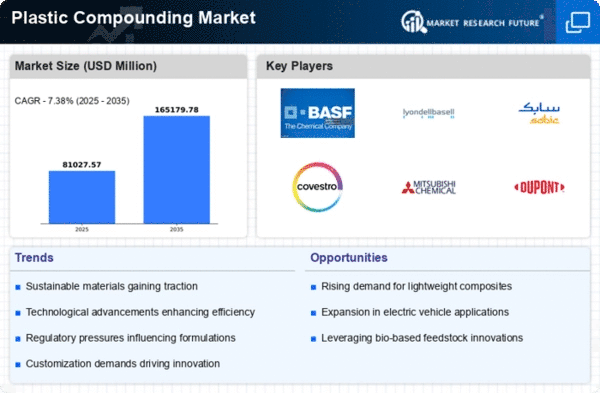
As per Market Research Future analysis, the Plastic Compounding Market Size was estimated at 75458.72 USD Million in 2024. The Plastic Compounding industry is projected to grow from USD 81029.1 Million in 2025 to USD 165179.78 Million by 2035, exhibiting a compound annual growth rate (CAGR) of 7.38% during the forecast period 2025 - 2035

Key Market Trends & Highlights

The Plastic Compounding Market is experiencing robust growth driven by sustainability and technological advancements.

  • North America remains the largest market for plastic compounding, driven by its established automotive and packaging industries.
  • Asia-Pacific is emerging as the fastest-growing region, fueled by increasing demand for customized plastic solutions in electronics and automotive components.
  • The automotive segment continues to dominate the market, while the electronics segment is witnessing rapid growth due to technological innovations.
  • Key market drivers include the rising demand for lightweight materials and regulatory support for sustainable materials, particularly in packaging applications.

Market Size & Forecast

2024 Market Size 75458.72 (USD Million)
2035 Market Size 165179.78 (USD Million)
CAGR (2025 - 2035) 7.38%
Largest Regional Market Share in 2024 North America

Major Players

<p>BASF SE (DE), Covestro AG (DE), SABIC (SA), LyondellBasell Industries N.V. (NL), Mitsubishi Chemical Corporation (JP), DuPont de Nemours, Inc. (US), ExxonMobil Chemical Company (US), Solvay S.A. (BE), Eastman Chemical Company (US)</p>

Market Trends

The Plastic Compounding Market is currently experiencing a dynamic evolution, driven by various factors that influence demand and supply. The increasing emphasis on sustainability and environmental responsibility is prompting manufacturers to explore bio-based and recycled materials. This shift not only aligns with global environmental goals but also caters to the growing consumer preference for eco-friendly products. Furthermore, advancements in technology are enhancing the efficiency of compounding processes, leading to improved product quality and performance. As industries such as automotive, packaging, and construction continue to expand, the need for specialized plastic compounds is likely to rise, fostering innovation and competition within the market. In addition, the Plastic Compounding Market is witnessing a trend towards customization, where companies are tailoring their offerings to meet specific client requirements. This trend is indicative of a broader movement towards personalized solutions across various sectors. Moreover, the integration of smart technologies into manufacturing processes is expected to streamline operations and reduce costs. Overall, the Plastic Compounding Market appears poised for growth, with a focus on sustainability, customization, and technological advancement shaping its future landscape.

Sustainability Initiatives

The Plastic Compounding Market is increasingly influenced by sustainability initiatives. Manufacturers are adopting eco-friendly practices, including the use of recycled materials and bio-based polymers. This trend reflects a broader commitment to reducing environmental impact and meeting consumer demand for greener products.

Customization of Products

Customization is becoming a prominent trend within the Plastic Compounding Market. Companies are focusing on developing tailored solutions to meet the specific needs of various industries. This approach enhances customer satisfaction and fosters long-term relationships between manufacturers and clients.

Technological Advancements

Technological advancements are reshaping the Plastic Compounding Market. Innovations in compounding processes and equipment are leading to improved efficiency and product quality. As technology continues to evolve, it is likely to drive further growth and competitiveness in the market.

Plastic Compounding Market Market Drivers

Market Growth Projections

The Global Plastic Compounding Market Industry is projected to experience substantial growth over the coming years. With a market value expected to reach 75.5 USD Billion in 2024 and further expand to 165.1 USD Billion by 2035, the industry is poised for a robust trajectory. This growth is underpinned by a compound annual growth rate (CAGR) of 7.38% from 2025 to 2035, reflecting increasing demand across various sectors. The expansion is driven by factors such as technological advancements, sustainability initiatives, and the rising need for lightweight materials. These projections indicate a vibrant future for the Global Plastic Compounding Market Industry.

Regulatory Support and Standards

Regulatory frameworks and standards play a crucial role in shaping the Global Plastic Compounding Market Industry. Governments worldwide are implementing regulations that promote the use of high-quality, safe plastic compounds in various applications. Compliance with these regulations not only enhances product safety but also fosters consumer confidence. For example, the introduction of stringent safety standards in the food packaging sector is driving demand for specialized plastic compounds. As regulatory support continues to evolve, it is likely to create a conducive environment for market growth, contributing to the anticipated CAGR of 7.38% from 2025 to 2035.

Rising Demand for Lightweight Materials

The Global Plastic Compounding Market Industry experiences a notable surge in demand for lightweight materials across various sectors, particularly in automotive and aerospace. Manufacturers are increasingly adopting plastic compounds to reduce vehicle weight, thereby enhancing fuel efficiency and lowering emissions. For instance, the automotive sector is projected to utilize plastic compounds extensively, contributing to the market's growth. The industry's value is expected to reach 75.5 USD Billion in 2024, driven by this trend. As companies strive to meet stringent environmental regulations, the shift towards lightweight materials is likely to bolster the Global Plastic Compounding Market Industry significantly.

Sustainability and Recycling Initiatives

Sustainability concerns are becoming increasingly prominent within the Global Plastic Compounding Market Industry, prompting manufacturers to adopt eco-friendly practices. The push for recycling and the use of biodegradable materials are reshaping product development strategies. Companies are investing in research to create sustainable plastic compounds that minimize environmental impact while maintaining performance. For instance, the development of bio-based plastics is gaining traction, appealing to environmentally conscious consumers. This shift towards sustainability is expected to drive market growth, with projections indicating a market value of 165.1 USD Billion by 2035, as the industry aligns with global sustainability goals.

Growing Applications in the Electronics Sector

The Global Plastic Compounding Market Industry is witnessing increased applications in the electronics sector, where plastic compounds are essential for producing lightweight, durable, and heat-resistant components. With the rise of consumer electronics and smart devices, manufacturers are increasingly relying on plastic compounds for housings, connectors, and circuit boards. This trend is expected to drive substantial growth in the market, as the electronics industry continues to expand. The demand for high-performance plastic compounds is likely to contribute to the market's projected value of 75.5 USD Billion in 2024, as companies seek innovative solutions to enhance product performance and longevity.

Technological Advancements in Compounding Processes

Technological innovations in compounding processes are transforming the Global Plastic Compounding Market Industry. Advanced techniques such as twin-screw extrusion and reactive compounding are enhancing the efficiency and quality of plastic compounds. These innovations allow for better dispersion of additives and fillers, resulting in superior material properties. For example, the introduction of smart compounding technologies enables real-time monitoring and adjustments during production, ensuring consistent quality. As these technologies become more prevalent, they are expected to drive market growth, with projections indicating a market value of 165.1 USD Billion by 2035, reflecting a robust CAGR of 7.38% from 2025 to 2035.

Market Segment Insights

By Application: Automotive (Largest) vs. Electronics (Fastest-Growing)

<p>In the Plastic Compounding Market, the application of plastics extends across various sectors, with automotive leading in market share. The automotive sector employs plastic compounds for various components, enhancing vehicle performance and reducing weight. Electronics follows closely as a significant contributor, particularly with the increasing demand for lightweight materials in electronic devices as well as consumer electronics. Both sectors are critical in driving growth and innovation in plastic compounding.</p>

<p>Automotive: Dominant vs. Electronics: Emerging</p>

<p>The automotive application of plastic compounding is crucial, characterized by its use in lightweight parts, interiors, and exteriors, aimed at improving fuel efficiency and vehicle performance. This segment is well-established, reflecting a strong demand for advanced materials that meet safety and regulatory standards. In contrast, the electronics segment, which is gaining momentum, focuses on providing innovative, lightweight materials suited for compact electronic products. With rapid technological advancements and consumer electronics growth, the electronics application is expected to witness significant growth, driven by trends in miniaturization and efficiency.</p>

By End Use: Packaging (Largest) vs. Automotive Components (Fastest-Growing)

<p>The Plastic Compounding Market exhibits a diverse segmentation based on end use, with Packaging standing out as the largest segment. This dominance is attributed to an increasing demand for flexible and durable packaging solutions across various industries, including food and beverages. Following closely is the Automotive Components segment, which is experiencing rapid growth due to the automotive industry's shift towards lightweight materials for improved fuel efficiency and performance. As the marketplace evolves, factors such as sustainability in packaging materials and advancements in compounding technologies are driving growth across these segments. Automotive Components, in particular, are expected to witness significant gains as manufacturers increasingly adopt plastics for manufacturing parts, enhancing comfort and performance while reducing overall vehicle weight. Trends such as electric vehicle production are further propelling this segment's expansion in the coming years.</p>

<p>Packaging (Dominant) vs. Automotive Components (Emerging)</p>

<p>Packaging serves as the dominant end-use segment within the Plastic Compounding Market, characterized by its ability to cater to a wide range of products, from consumer goods to industrial items. The shift towards sustainable packaging solutions has led to innovation in materials and compounding techniques, ensuring that packaging remains versatile and compliant with environmental standards. On the other hand, Automotive Components represent an emerging segment, focusing on lightweight and high-performance materials that enhance vehicle efficiency. This segment is characterized by rapid technological advancements, with manufacturers keen on integrating plastic compounds that ensure safety and reduce emissions. As cars become more sophisticated, the demand for advanced plastic materials in automotive parts will continue to grow, positioning this segment as a crucial player in the market.</p>

By Material Type: Polypropylene (Largest) vs. Polyvinyl Chloride (Fastest-Growing)

<p>In the Plastic Compounding Market, Polypropylene (PP) holds the largest market share among material types, thanks to its versatility and widespread applications across various industries, including automotive, packaging, and consumer goods. Meanwhile, Polyvinyl Chloride (PVC) is gaining momentum as the fastest-growing segment due to its increasing utilization in construction, medical devices, and consumer products. Both materials significantly contribute to the overall market dynamics, influenced by the rising demand for sustainable and engineered plastic solutions. The growth trends in the material type segment are primarily driven by changing customer preferences towards lightweight and durable materials. Polypropylene is favored for its excellent thermal resistance and chemical stability, making it ideal for high-performance applications. In contrast, PVC is witnessing growth due to innovations in formulation technologies that enhance its properties, positioning it as a crucial player in high-demand sectors such as building and healthcare, thereby promising potential market expansion in the coming years.</p>

<p>Polypropylene (Dominant) vs. Engineering Plastics (Emerging)</p>

<p>Polypropylene, as the dominant material type in the Plastic Compounding Market, is renowned for its lightweight, flexible, and robust properties, making it ideal for various applications across multiple industries, including packaging and automotive. Its high resistance to moisture and chemicals plays a significant role in its widespread adoption. On the contrary, Engineering Plastics represent an emerging segment, offering superior performance characteristics, including strength, heat resistance, and dimensional stability. Used primarily in applications requiring high durability and performance, such as aerospace and automotive components, Engineering Plastics are increasingly recognized for their ability to replace traditional materials, leading to a growing interest from manufacturers aiming to enhance product performance and sustainability.</p>

By Process Type: Extrusion (Largest) vs. Injection Molding (Fastest-Growing)

<p>The Plastic Compounding Market exhibits a diverse distribution among various process types, with extrusion holding the largest market share. This method is preferred due to its efficiency in producing continuous shapes and profiles, which caters to a wide range of applications in sectors such as automotive and consumer goods. On the other hand, injection molding is rapidly gaining traction, leveraging its precision and flexibility in manufacturing intricate designs. This shift is indicative of evolving market demands for customized products and complex geometries.</p>

<p>Extrusion (Dominant) vs. Injection Molding (Emerging)</p>

<p>Extrusion is currently the dominant process in the Plastic Compounding Market due to its ability to efficiently produce materials in bulk and its applicability across various industries, such as packaging and construction. The method enables consistent product quality and minimal waste, making it a cost-effective option. In contrast, injection molding is emerging as a favored alternative, particularly in sectors requiring high precision and versatility. It allows the production of complex parts with excellent surface finish and detail, thus catering to the growing demand for customized solutions in a competitive market.</p>

By Additive Type: Colorants (Largest) vs. Fillers (Fastest-Growing)

<p>In the Plastic Compounding Market, the market share distribution is increasingly leaning towards Colorants, which dominate the additive segment due to their essential role in enhancing product aesthetics and consumer appeal. Fillers, on the other hand, are emerging as a significant value additive, marking a notable presence driven by their functionality and cost-effectiveness, allowing manufacturers to optimize material properties while reducing costs. As these segments evolve, their dynamics shape the competitive landscape.</p>

<p>Fillers (Dominant) vs. Flame Retardants (Emerging)</p>

<p>Fillers are currently considered a dominant additive type in the plastic compounding market, utilized extensively to enhance physical properties and reduce production costs. Their diverse range includes talc, calcium carbonate, and other polymers that improve mechanical strength and durability, making them vital for various applications. In contrast, Flame Retardants are viewed as an emerging segment, driven by stringent safety regulations and growing consumer demand for higher safety standards in plastic products. As manufacturers focus on compliance and innovation, the performance characteristics of flame retardants are evolving, offering increased effectiveness against fire hazards.</p>

Get more detailed insights about Plastic Compounding Market Research Report- Forecast to 2035

Regional Insights

North America : Market Leader in Compounding

North America is poised to maintain its leadership in the plastic compounding market, holding a significant share of approximately $37,775.22 million in 2025. The region's growth is driven by robust demand from automotive, consumer goods, and packaging sectors, alongside stringent regulations promoting sustainable practices. The increasing adoption of advanced materials and technologies further fuels market expansion, making it a key player in the global landscape. The United States stands out as the leading country in this region, hosting major players like DuPont, ExxonMobil, and BASF. The competitive landscape is characterized by innovation and strategic partnerships, with companies focusing on enhancing product offerings and sustainability. The presence of established firms and a strong manufacturing base contribute to North America's dominance, ensuring continued growth in the plastic compounding sector.

Europe : Innovation and Sustainability Focus

Europe's plastic compounding market is projected to reach approximately €22,683.12 million by 2025, driven by increasing demand for high-performance materials in automotive and construction industries. Regulatory frameworks emphasizing sustainability and recycling are pivotal in shaping market dynamics, encouraging companies to innovate and develop eco-friendly solutions. The region's commitment to reducing plastic waste further propels growth, aligning with global sustainability goals. Germany, France, and the UK are the leading countries in this market, with key players like Covestro and SABIC driving innovation. The competitive landscape is marked by a focus on R&D and collaboration among industry stakeholders. European companies are increasingly investing in sustainable practices, ensuring compliance with stringent regulations while meeting consumer demands for environmentally friendly products. This positions Europe as a hub for innovation in the plastic compounding market.

Asia-Pacific : Emerging Market Potential

The Asia-Pacific region is witnessing rapid growth in the plastic compounding market, projected to reach around $11,683.36 million by 2025. This growth is fueled by rising industrialization, urbanization, and increasing demand for consumer goods. Countries like China and India are at the forefront, with government initiatives promoting manufacturing and infrastructure development. The region's focus on technological advancements and sustainable practices is also a significant driver of market expansion. China is the dominant player in this market, supported by a robust manufacturing base and a growing number of local companies entering the sector. The competitive landscape is evolving, with both multinational corporations and regional players vying for market share. Key players such as Mitsubishi Chemical and LyondellBasell are investing in capacity expansion and innovation, ensuring that Asia-Pacific remains a vital region for plastic compounding growth.

Middle East and Africa : Untapped Market Opportunities

The Middle East and Africa (MEA) region, while currently smaller in the plastic compounding market with a size of approximately $1,316.02 million, presents significant growth potential. The market is driven by increasing industrial activities and a growing demand for plastics in various sectors, including construction and automotive. Government initiatives aimed at diversifying economies and promoting manufacturing are also contributing to market growth, creating opportunities for investment and development. Countries like South Africa and the UAE are emerging as key players in the MEA market, with local companies and international firms exploring opportunities. The competitive landscape is characterized by a mix of established players and new entrants, focusing on innovation and sustainability. As the region continues to develop its industrial base, the plastic compounding market is expected to expand, attracting more investments and fostering growth.

Key Players and Competitive Insights

The Plastic Compounding Market is characterized by a dynamic competitive landscape, driven by innovation, sustainability, and strategic partnerships. Key players such as BASF SE (DE), Covestro AG (DE), and DuPont de Nemours, Inc. (US) are actively shaping the market through their operational focuses. BASF SE (DE) emphasizes innovation in sustainable materials, while Covestro AG (DE) is enhancing its portfolio with advanced polymer solutions. DuPont de Nemours, Inc. (US) is leveraging its expertise in specialty materials to cater to diverse applications, thereby influencing the competitive environment through a blend of technological advancements and market responsiveness.

In terms of business tactics, companies are increasingly localizing manufacturing to enhance supply chain efficiency and reduce lead times. The market structure appears moderately fragmented, with a mix of large multinational corporations and smaller specialized firms. This fragmentation allows for a variety of competitive strategies, as key players leverage their strengths to capture market share and respond to evolving customer demands.

In November 2025, BASF SE (DE) announced the launch of a new line of bio-based compounds aimed at reducing carbon footprints in automotive applications. This strategic move not only aligns with global sustainability goals but also positions BASF as a leader in eco-friendly solutions, potentially attracting environmentally conscious clients and enhancing its market share.

In October 2025, Covestro AG (DE) expanded its production capacity for high-performance polycarbonate materials in response to increasing demand from the electronics sector. This expansion is significant as it allows Covestro to meet the growing needs of its customers while reinforcing its position in a competitive market that values innovation and quality.

In September 2025, DuPont de Nemours, Inc. (US) entered a strategic partnership with a leading automotive manufacturer to develop advanced lightweight materials for electric vehicles. This collaboration is crucial as it not only enhances DuPont's product offerings but also aligns with the automotive industry's shift towards sustainability and efficiency, thereby potentially increasing its market penetration.

As of December 2025, the competitive trends in the Plastic Compounding Market are increasingly defined by digitalization, sustainability, and the integration of AI technologies. Strategic alliances are becoming more prevalent, allowing companies to pool resources and expertise to innovate more effectively. The competitive differentiation is likely to evolve from traditional price-based competition to a focus on innovation, technological advancements, and supply chain reliability, reflecting a broader industry shift towards sustainable practices and customer-centric solutions.

Key Companies in the Plastic Compounding Market market include

Industry Developments

April 2023 – Polymateris leans to expand its reach in Asia.

Polymateria, an Indian firm that does business within the biodegradable plastic sphere, has contacted Toppan Specialty Films in India and a business unit of Lotte Chemical in Malaysia to create biodegradable plastic goods.

May 2023 – Fishy Filaments launch their initiative on recycling fishing nets

A startup in Cornwall, Fishy Filaments, has patented a 2013 developed method for recycling fishing nets into engineering-grade nylon for 3D printing applications. Strategically recycled nylon has already caught the attention of global companies like Ford and Mercedes Benz for manufacturing automotive components, which adds to the sustainable development of the care industry.

March 2023 - Polyplastics Introduced Re-compounding Service

Polyplastics, an engineered plastics conglomerate based in Japan, has recently announced that it will launch a re-compounding service for plastics. The service would aim to improve the sustainability of plastic products by recycling and reusing plastic waste to plastic in line with the world's environmental goals.

August 2023 - LEGO Shows Commitment To Discard Fossil Fuels

In response to the world's call to address environmental circumstances, LEGO pledged to use brand-new, partially recyclable, or plastic bricks before 2032. However, this goes against their cost-based operational strategy and may result in higher costs.

January 2024 - Forecast for Compand Expanison in the Plastic Market

In the latest economic report, the market for plastic compound machines is expected to balloon from USD 73.27 billion in 2030 to approximately USD 139.65 billion in just three years. It is worth noting that this is a compound annual growth rate of 7.43%.

November 2024 - Amcor Acquires Berry Global Group

In what looks to be a final call for robust penetration into the US packaging market, Australian-based company Amcor acquired the global peer Berry Global Group in a strategic merger worth $8.4 billion.

Future Outlook

Plastic Compounding Market Future Outlook

<p>The Plastic Compounding Market is projected to grow at 7.38% CAGR from 2024 to 2035, driven by increasing demand for lightweight materials and sustainable solutions.</p>

New opportunities lie in:

  • <p>Expansion into bio-based plastic compounds for eco-conscious consumers.</p>
  • <p>Development of advanced compounding technologies to enhance product performance.</p>
  • <p>Strategic partnerships with automotive manufacturers for tailored compounding solutions.</p>

<p>By 2035, the market is expected to solidify its position as a leader in innovative plastic solutions.</p>

Market Segmentation

Plastic Compounding Market End Use Outlook

  • Packaging
  • Automotive Components
  • Electrical Insulation
  • Household Products
  • Industrial Applications

Plastic Compounding Market Application Outlook

  • Automotive
  • Electronics
  • Construction
  • Consumer Goods
  • Medical

Plastic Compounding Market Process Type Outlook

  • Extrusion
  • Injection Molding
  • Blow Molding
  • Thermoforming
  • Compounding

Plastic Compounding Market Additive Type Outlook

  • Colorants
  • Stabilizers
  • Fillers
  • Flame Retardants
  • Plasticizers

Plastic Compounding Market Material Type Outlook

  • Polypropylene
  • Polyethylene
  • Polyvinyl Chloride
  • Polystyrene
  • Engineering Plastics

Report Scope

MARKET SIZE 202475458.72(USD Million)
MARKET SIZE 202581029.1(USD Million)
MARKET SIZE 2035165179.78(USD Million)
COMPOUND ANNUAL GROWTH RATE (CAGR)7.38% (2024 - 2035)
REPORT COVERAGERevenue Forecast, Competitive Landscape, Growth Factors, and Trends
BASE YEAR2024
Market Forecast Period2025 - 2035
Historical Data2019 - 2024
Market Forecast UnitsUSD Million
Key Companies ProfiledBASF SE (DE), Covestro AG (DE), SABIC (SA), LyondellBasell Industries N.V. (NL), Mitsubishi Chemical Corporation (JP), DuPont de Nemours, Inc. (US), ExxonMobil Chemical Company (US), Solvay S.A. (BE), Eastman Chemical Company (US)
Segments CoveredApplication, End Use, Material Type, Process Type, Additive Type
Key Market OpportunitiesGrowing demand for sustainable materials drives innovation in the Plastic Compounding Market.
Key Market DynamicsRising demand for sustainable materials drives innovation and competition in the plastic compounding market.
Countries CoveredNorth America, Europe, APAC, South America, MEA

FAQs

How much is the Plastic Compounding Market?

US$ 70272.6 Mn

What is the growth rate of the Plastic Compounding Market?

7.38%

Which region held the largest market share in the Plastic Compounding Market?

Asia Pacific

Who are the key players in the Plastic Compounding Market?

Asahi Kasei Corporation (Japan), BASF SE (Germany), Celanese Corporation (US), Clariant International Ltd (Switzerland), Exxon Mobil Corporation (US), LyondellBasell (US), RTP Company(US), SABIC(Saudi Arabia), Teknor Apex (US)

Which Raw Material had the largest market share in the Plastic Compounding Market?

Polypropylene

Which End Use Product had the largest market share in the Plastic Compounding Market?

Automotive

  1. EXECUTIVE SUMMARY
  2. MARKET INTRODUCTION
    1. DEFINITION
    2. SCOPE OF THE STUDY
    3. RESEARCH OBJECTIVE
    4. MARKET STRUCTURE
  3. RESEARCH METHODOLOGY
    1. OVERVIEW
    2. DATA FLOW
      1. DATA MINING PROCESS
    3. PURCHASED DATABASE:
    4. SECONDARY SOURCES:
      1. SECONDARY RESEARCH DATA FLOW:
    5. PRIMARY RESEARCH:
      1. PRIMARY RESEARCH DATA FLOW:
      2. PRIMARY RESEARCH: NUMBER OF INTERVIEWS CONDUCTED
      3. PRIMARY RESEARCH: REGIONAL COVERAGE
    6. APPROACHES FOR MARKET SIZE ESTIMATION:
      1. REVENUE ANALYSIS APPROACH
    7. DATA FORECASTING
      1. DATA FORECASTING TECHNIQUE
    8. DATA MODELING
      1. MICROECONOMIC FACTOR ANALYSIS:
      2. DATA MODELING:
    9. TEAMS AND ANALYST CONTRIBUTION
  4. MARKET DYNAMICS
    1. INTRODUCTION
    2. DRIVERS
      1. RISING DEMAND FOR PLASTIC COMPOUNDED MATERIALS IN VARIOUS INDUSTRIES TO BOOST MARKET GROWTH
      2. DEVELOPMENT OF NEW SUSTAINABLE PLASTIC COMPOUNDED MATERIALS TO DRIVE THE MARKET DEMAND
    3. RESTRAINTS
      1. STRINGENT ENVIRONMENTAL REGULATIONS TO LIMIT MARKET GROWTH
    4. OPPORTUNITIES
      1. EXPANDING INDUSTRIALIZATION IN EMERGING MARKETS TO SURGE MARKET GROWTH
      2. GROWING DEMAND FOR SPECIALTY PLASTIC COMPOUNDED MATERIALS BOOSTING THE DEMAND IN THE MARKET
    5. IMPACT ANALYSIS OF COVID-19 ON FIRE PROTECTION MATERIALS
  5. MARKET FACTOR ANALYSIS
    1. SUPPLY CHAIN ANALYSIS
      1. RAW MATERIAL SUPPLIERS:
      2. ADDITIVE SUPPLIERS:
      3. PLASTIC COMPOUNDING COMPANIES:
      4. CONVERTERS:
      5. END USERS:
    2. PORTER''S FIVE FORCES MODEL
      1. BARGAINING POWER OF SUPPLIERS
      2. BARGAINING POWER OF BUYERS
      3. THREAT OF NEW ENTRANTS
      4. THREAT OF SUBSTITUTES
      5. INTENSITY OF RIVALRY
    3. IMPACT OF CORONAVIRUS OUTBREAK ON GLOBAL PLASTIC COMPOUNDING MARKET
    4. PRICING OVERVIEW, (USD/TON), 2019-2030
  6. PLASTIC COMPOUNDING MARKET, BY RAW MATERIAL
    1. INTRODUCTION
    2. POLYVINYL CHLORIDE (PVC)
    3. POLYETHYLENE (PE)
    4. POLYPROPYLENE (PP)
    5. POLYSTYRENE (PS)
    6. OTHER MATERIALS (PVC, ABS, PC AND NYLON)
  7. PLASTIC COMPOUNDING MARKET, BY END-USE PRODUCT
    1. WHITE GOODS
    2. ELECTRICAL AND ELECTRONICS
    3. FURNITURE
    4. AUTOMOTIVE
    5. SMALL APPLIANCES
  8. PLASTIC COMPOUNDING MARKET, BY REGION
    1. OVERVIEW
    2. NORTH AMERICA
      1. U.S.
      2. CANADA
    3. EUROPE
      1. GERMANY
      2. U.K.
      3. FRANCE
      4. ITALY
      5. SPAIN
      6. RUSSIA
      7. ROE
    4. ASIA-PACIFIC
      1. CHINA
      2. INDIA
      3. JAPAN
      4. SOUTH KOREA
      5. ROAPAC
    5. MIDDLE EAST AND AFRICA
      1. GCC
      2. SOUTH AFRICA
      3. ROMEA
    6. LATIN AMERICA
      1. BRAZIL
      2. MEXICO
      3. ARGENTINA
      4. ROLA
  9. COMPETITIVE LANDSCAPE
    1. INTRODUCTION
    2. KEY DEVELOPMENTS & GROWTH STRATEGIES
      1. LAUNCH& INVESTMENT
      2. PARTNERSHIP, COLLABORATION, EXPANSION, AND ACQUISITION
    3. MARKET STRATEGY ANALYSIS
    4. COMPETITOR DASHBOARD
  10. COMPANY PROFILES
    1. ASAHI KASEI CORPORATION.
      1. COMPANY OVERVIEW
      2. FINANCIAL OVERVIEW
      3. END-USE PRODUCTS OFFERED
      4. KEY DEVELOPMENTS
      5. SWOT ANALYSIS
      6. KEY STRATEGIES
    2. BASF
      1. COMPANY OVERVIEW
      2. FINANCIAL OVERVIEW
      3. END-USE PRODUCTS OFFERED
      4. KEY DEVELOPMENTS
      5. SWOT ANALYSIS
      6. KEY STRATEGIES
    3. CLEANSE CORPORATION.
      1. COMPANY OVERVIEW
      2. FINANCIAL OVERVIEW
      3. END-USE PRODUCTS OFFERED
      4. KEY DEVELOPMENTS
      5. SWOT ANALYSIS
      6. KEY STRATEGIES
    4. CLARIANT INTERNATIONAL LTD.
      1. COMPANY OVERVIEW
      2. FINANCIAL OVERVIEW
      3. END-USE PRODUCTS OFFERED
      4. KEY DEVELOPMENTS
      5. SWOT ANALYSIS
      6. KEY STRATEGIES
    5. DOW INC.
      1. COMPANY OVERVIEW
      2. FINANCIAL OVERVIEW
      3. END-USE PRODUCTS OFFERED
      4. SWOT ANALYSIS
      5. KEY STRATEGIES
    6. EXXON MOBIL CORPORATION
      1. COMPANY OVERVIEW
      2. FINANCIAL OVERVIEW
      3. END-USE PRODUCTS OFFERED
      4. KEY DEVELOPMENTS
      5. SWOT ANALYSIS
      6. KEY STRATEGIES
    7. LYONDELLBASELL INDUSTRIES
      1. COMPANY OVERVIEW
      2. FINANCIAL OVERVIEW
      3. END-USE PRODUCTS OFFERED
      4. KEY DEVELOPMENTS
      5. SWOT ANALYSIS
      6. KEY STRATEGIES
    8. RTP COMPANY.
      1. COMPANY OVERVIEW
      2. END-USE PRODUCTS OFFERED
      3. KEY DEVELOPMENTS
      4. SWOT ANALYSIS
      5. KEY STRATEGIES
    9. SABIC
      1. COMPANY OVERVIEW
      2. FINANCIAL OVERVIEW
      3. END-USE PRODUCTS OFFERED
      4. KEY DEVELOPMENTS
      5. SWOT ANALYSIS
      6. KEY STRATEGIES
    10. TEKNOR APEX
      1. COMPANY OVERVIEW
      2. END-USE PRODUCTS OFFERED
      3. SWOT ANALYSIS
      4. KEY STRATEGIES
  11. LIST OF TABLES
  12. QFD MODELING FOR MARKET SHARE ASSESSMENT
  13. AVERAGE GLOBAL PLASTIC COMPOUNDING PRICE, (USD/TON)
  14. AVERAGE PLASTIC COMPOUNDING PRICE, BY REGION, (USD/TON)
  15. PLASTIC COMPOUNDING MARKET VALUE, BY RAW MATERIALS, 2018-2032 (USD MILLION)
  16. PLASTIC COMPOUNDING MARKET VOLUME, BY RAW MATERIALS, 2018-2032 (KILO TONS)
  17. PLASTIC COMPOUNDING MARKET VALUE, FOR PVC, 2018-2032 (USD MILLION)
  18. PLASTIC COMPOUNDING MARKET VOLUME, FOR PVC, 2018-2032 (KILO TONS)
  19. PLASTIC COMPOUNDING MARKET VALUE, FOR PE, 2018-2032 (USD MILLION)
  20. PLASTIC COMPOUNDING MARKET VOLUME, FOR PE, 2018-2032 (KILO TONS)
  21. PLASTIC COMPOUNDING MARKET VALUE, FOR PP, 2018-2032 (USD MILLION)
  22. PLASTIC COMPOUNDING MARKET VOLUME, FOR PP, 2018-2032 (KILO TONS)
  23. PLASTIC COMPOUNDING MARKET VALUE, FOR PP IN GFRP, 2018-2032 (USD MILLION)
  24. PLASTIC COMPOUNDING MARKET VOLUME, FOR PP IN GFRP, 2018-2032 (KILO TONS)
  25. PLASTIC COMPOUNDING MARKET VALUE, FOR PP IN CFRP, 2018-2032 (USD MILLION)
  26. PLASTIC COMPOUNDING MARKET VOLUME, FOR PP IN CFRP, 2018-2032 (KILO TONS)
  27. PLASTIC COMPOUNDING MARKET VALUE, FOR PP IN OTHER MIX, 2018-2032 (USD MILLION)
  28. PLASTIC COMPOUNDING MARKET VOLUME, FOR PP IN OTHER MIX, 2018-2032 (KILO TONS)
  29. PLASTIC COMPOUNDING MARKET VALUE, FOR PS, 2018-2032 (USD MILLION)
  30. PLASTIC COMPOUNDING MARKET VOLUME, FOR PS, 2018-2032 (KILO TONS)
  31. PLASTIC COMPOUNDING MARKET VALUE, FOR OTHER MATERIALS, 2018-2032 (USD MILLION)
  32. PLASTIC COMPOUNDING MARKET VOLUME, FOR OTHER MATERIALS, 2018-2032 (KILO TONS)
  33. PLASTIC COMPOUNDING MARKET, VALUE, BY END-USE PRODUCT, 2018-2032 (USD MILLION)
  34. PLASTIC COMPOUNDING MARKET, VOLUME, BY END-USE PRODUCT, 2018-2032 (USD MILLION)
  35. PLASTIC COMPOUNDING MARKET VALUE, FOR WHITE GOODS, 2018-2032 (USD MILLION)
  36. PLASTIC COMPOUNDING MARKET VOLUME, FOR WHITE GOODS, 2018-2032 (KILO TONS)
  37. PLASTIC COMPOUNDING MARKET VALUE, FOR REFRIGERATOR, 2018-2032 (USD MILLION)
  38. PLASTIC COMPOUNDING MARKET VOLUME, FOR REFRIGERATOR, 2018-2032 (KILO TONS)
  39. PLASTIC COMPOUNDING MARKET VALUE, FOR WASHING MACHINE, 2018-2032 (USD MILLION)
  40. PLASTIC COMPOUNDING MARKET VOLUME, FOR WASHING MACHINE, 2018-2032 (KILO TONS)
  41. PLASTIC COMPOUNDING MARKET VALUE, FOR OTHER WHITE GOODS, 2018-2032 (USD MILLION)
  42. PLASTIC COMPOUNDING MARKET VOLUME, FOR OTHER WHITE GOODS, 2018-2032 (KILO TONS)
  43. PLASTIC COMPOUNDING MARKET VALUE, FOR ELECTRICAL AND ELECTRONICS, 2018-2032 (USD MILLION)
  44. PLASTIC COMPOUNDING MARKET VOLUME, FOR ELECTRICAL AND ELECTRONICS, 2018-2032 (KILO TONS)
  45. PLASTIC COMPOUNDING MARKET VALUE, FOR FURNITURE, 2018-2032 (USD MILLION)
  46. PLASTIC COMPOUNDING MARKET VOLUME, FOR FURNITURE, 2018-2032 (KILO TONS)
  47. PLASTIC COMPOUNDING MARKET VALUE, FOR INDOOR FURNITURE, 2018-2032 (USD MILLION)
  48. PLASTIC COMPOUNDING MARKET VOLUME, FOR INDOOR FURNITURE, 2018-2032 (KILO TONS)
  49. PLASTIC COMPOUNDING MARKET VALUE, FOR OUTDOOR FURNITURE, 2018-2032 (USD MILLION)
  50. PLASTIC COMPOUNDING MARKET VOLUME, FOR OUTDOOR FURNITURE, 2018-2032 (KILO TONS)
  51. PLASTIC COMPOUNDING MARKET VALUE, FOR AUTOMOTIVE, 2018-2032 (USD MILLION)
  52. PLASTIC COMPOUNDING MARKET VOLUME, FOR AUTOMOTIVE, 2018-2032 (KILO TONS)
  53. PLASTIC COMPOUNDING MARKET VALUE, FOR EXTERIOR, 2018-2032 (USD MILLION)
  54. PLASTIC COMPOUNDING MARKET VOLUME, FOR EXTERIOR, 2018-2032 (KILO TONS)
  55. PLASTIC COMPOUNDING MARKET VALUE, FOR INTERIOR PARTS, 2018-2032 (USD MILLION)
  56. PLASTIC COMPOUNDING MARKET VOLUME, FOR INTERIOR PARTS, 2018-2032 (KILO TONS)
  57. PLASTIC COMPOUNDING MARKET VALUE, FOR PANELS, 2018-2032 (USD MILLION)
  58. PLASTIC COMPOUNDING MARKET VOLUME, FOR PANELS, 2018-2032 (KILO TONS)
  59. PLASTIC COMPOUNDING MARKET VALUE, FOR AIRDUCTS AND FILTERS, 2018-2032 (USD MILLION)
  60. PLASTIC COMPOUNDING MARKET VOLUME, FOR AIRDUCTS AND FILTERS, 2018-2032 (KILO TONS)
  61. PLASTIC COMPOUNDING MARKET VALUE, FOR OTHER PARTS, 2018-2032 (USD MILLION)
  62. PLASTIC COMPOUNDING MARKET VOLUME, FOR OTHER PARTS, 2018-2032 (KILO TONS)
  63. PLASTIC COMPOUNDING MARKET VALUE, FOR SMALL APPLIANCES, 2018-2032 (USD MILLION)
  64. PLASTIC COMPOUNDING MARKET VOLUME, FOR SMALL APPLIANCES, 2018-2032 (KILO TONS)
  65. PLASTIC COMPOUNDING MARKET VALUE, BY REGION, 2018-2032 (USD MILLION)
  66. PLASTIC COMPOUNDING MARKET VOLUME, BY REGION, 2018-2032 (KILO TONS)
  67. NORTH AMERICA: PLASTIC COMPOUNDING MARKET VALUE, BY COUNTRY, 2018-2032 (USD MILLION)
  68. NORTH AMERICA: PLASTIC COMPOUNDING MARKET VOLUME, BY COUNTRY, 2018-2032 (KILO TONS)
  69. NORTH AMERICA: PLASTIC COMPOUNDING MARKET VALUE, BY RAW MATERIAL, 2018-2032 (USD MILLION)
  70. NORTH AMERICA: PLASTIC COMPOUNDING MARKET VOLUME, BY RAW MATERIAL, 2018-2032 (KILO TONS)
  71. NORTH AMERICA: PLASTIC COMPOUNDING MARKET VALUE, BY END-USE PRODUCT, 2018-2032 (USD MILLION)
  72. NORTH AMERICA: PLASTIC COMPOUNDING MARKET VOLUME, BY END-USE PRODUCT, 2018-2032 (KILO TONS)
  73. U.S.: PLASTIC COMPOUNDING MARKET VALUE, BY RAW MATERIAL, 2018-2032 (USD MILLION)
  74. U.S.: PLASTIC COMPOUNDING MARKET VOLUME, BY RAW MATERIAL, 2018-2032 (KILO TONS)
  75. U.S.: PLASTIC COMPOUNDING MARKET VALUE, BY END-USE PRODUCT, 2018-2032 (USD MILLION)
  76. U.S.: PLASTIC COMPOUNDING MARKET VOLUME, BY END-USE PRODUCT, 2018-2032 (KILO TONS)
  77. CANADA: PLASTIC COMPOUNDING MARKET VALUE, BY RAW MATERIAL, 2018-2032 (USD MILLION)
  78. CANADA: PLASTIC COMPOUNDING MARKET VOLUME, BY RAW MATERIAL, 2018-2032 (KILO TONS)
  79. CANADA: PLASTIC COMPOUNDING MARKET VALUE, BY END-USE PRODUCT, 2018-2032 (USD MILLION)
  80. CANADA: PLASTIC COMPOUNDING MARKET VOLUME, BY END-USE PRODUCT, 2018-2032 (KILO TONS)
  81. EUROPE: PLASTIC COMPOUNDING MARKET VALUE, BY COUNTRY, 2018-2032 (USD MILLION)
  82. EUROPE: PLASTIC COMPOUNDING MARKET VOLUME, BY COUNTRY, 2018-2032 (KILO TONS)
  83. EUROPE: PLASTIC COMPOUNDING MARKET VALUE, BY RAW MATERIAL, 2018-2032 (USD MILLION)
  84. EUROPE: PLASTIC COMPOUNDING MARKET VOLUME, BY RAW MATERIAL, 2018-2032 (KILO TONS)
  85. EUROPE: PLASTIC COMPOUNDING MARKET VALUE, BY END-USE PRODUCT, 2018-2032 (USD MILLION)
  86. EUROPE: PLASTIC COMPOUNDING MARKET VOLUME, BY END-USE PRODUCT, 2018-2032 (KILO TONS)
  87. GERMANY: PLASTIC COMPOUNDING MARKET VALUE, BY RAW MATERIAL, 2018-2032 (USD MILLION)
  88. GERMANY: PLASTIC COMPOUNDING MARKET VOLUME, BY RAW MATERIAL, 2018-2032 (KILO TONS)
  89. GERMANY: PLASTIC COMPOUNDING MARKET VALUE, BY END-USE PRODUCT, 2018-2032 (USD MILLION)
  90. GERMANY: PLASTIC COMPOUNDING MARKET VOLUME, BY END-USE PRODUCT, 2018-2032 (KILO TONS)
  91. U.K.: PLASTIC COMPOUNDING MARKET VALUE, BY RAW MATERIAL, 2018-2032 (USD MILLION)
  92. U.K.: PLASTIC COMPOUNDING MARKET VOLUME, BY RAW MATERIAL, 2018-2032 (KILO TONS)
  93. U.K.: PLASTIC COMPOUNDING MARKET VALUE, BY END-USE PRODUCT, 2018-2032 (USD MILLION)
  94. U.K.: PLASTIC COMPOUNDING MARKET VOLUME, BY END-USE PRODUCT, 2018-2032 (KILO TONS)
  95. FRANCE: PLASTIC COMPOUNDING MARKET VALUE, BY RAW MATERIAL, 2018-2032 (USD MILLION)
  96. FRANCE: PLASTIC COMPOUNDING MARKET VOLUME, BY RAW MATERIAL, 2018-2032 (KILO TONS)
  97. FRANCE: PLASTIC COMPOUNDING MARKET VALUE, BY END-USE PRODUCT, 2018-2032 (USD MILLION)
  98. FRANCE: PLASTIC COMPOUNDING MARKET VOLUME, BY END-USE PRODUCT, 2018-2032 (KILO TONS)
  99. ITALY: PLASTIC COMPOUNDING MARKET VALUE, BY RAW MATERIAL, 2018-2032 (USD MILLION)
  100. ITALY: PLASTIC COMPOUNDING MARKET VOLUME, BY RAW MATERIAL, 2018-2032 (KILO TONS)
  101. ITALY: PLASTIC COMPOUNDING MARKET VALUE, BY END-USE PRODUCT, 2018-2032 (USD MILLION)
  102. ITALY: PLASTIC COMPOUNDING MARKET VOLUME, BY END-USE PRODUCT, 2018-2032 (KILO TONS)
  103. SPAIN: PLASTIC COMPOUNDING MARKET VALUE, BY RAW MATERIAL, 2018-2032 (USD MILLION)
  104. SPAIN: PLASTIC COMPOUNDING MARKET VOLUME, BY RAW MATERIAL, 2018-2032 (KILO TONS)
  105. SPAIN: PLASTIC COMPOUNDING MARKET VALUE, BY END-USE PRODUCT, 2018-2032 (USD MILLION)
  106. SPAIN: PLASTIC COMPOUNDING MARKET VOLUME, BY END-USE PRODUCT, 2018-2032 (KILO TONS)
  107. RUSSIA: PLASTIC COMPOUNDING MARKET VALUE, BY RAW MATERIAL, 2018-2032 (USD MILLION)
  108. RUSSIA: PLASTIC COMPOUNDING MARKET VOLUME, BY RAW MATERIAL, 2018-2032 (KILO TONS)
  109. RUSSIA: PLASTIC COMPOUNDING MARKET VALUE, BY END-USE PRODUCT, 2018-2032 (USD MILLION)
  110. RUSSIA: PLASTIC COMPOUNDING MARKET VOLUME, BY END-USE PRODUCT, 2018-2032 (KILO TONS)
  111. ROE: PLASTIC COMPOUNDING MARKET VALUE, BY RAW MATERIAL, 2018-2032 (USD MILLION)
  112. ROE: PLASTIC COMPOUNDING MARKET VOLUME, BY RAW MATERIAL, 2018-2032 (KILO TONS)
  113. ROE: PLASTIC COMPOUNDING MARKET VALUE, BY END-USE PRODUCT, 2018-2032 (USD MILLION)
  114. ROE: PLASTIC COMPOUNDING MARKET VOLUME, BY END-USE PRODUCT, 2018-2032 (KILO TONS)
  115. ASIA-PACIFIC: PLASTIC COMPOUNDING MARKET VALUE, BY COUNTRY, 2018-2032 (USD MILLION)
  116. ASIA-PACIFIC: PLASTIC COMPOUNDING MARKET VOLUME, BY COUNTRY, 2018-2032 (KILO TONS)
  117. ASIA-PACIFIC: PLASTIC COMPOUNDING MARKET VALUE, BY RAW MATERIAL, 2018-2032 (USD MILLION)
  118. ASIA-PACIFIC: PLASTIC COMPOUNDING

Plastic Compounding Market Segmentation

Plastic Compounding Raw Material Outlook (USD Million, 2018-2032)

  • Polyvinyl Chloride (PVC)
  • Polyethylene (PE)
  • Polypropylene (PP)
    • GFRP
    • CFRP
    • Other PP Mix
  • Polystyrene (PS)
  • Other Materials

Plastic Compounding End Use Product Outlook (USD Million, 2018-2032)

  • White Goods
    • Washing Machine
    •  Refrigerators
    • Other White Goods
  •  Electrical and Electronics
  •  Furniture
    • Indoor
    • Outdoor
  •  Automotive
    • Exterior Parts
    •  Interior Parts
    •  Panels
    • Airducts and Filters
    • Other Parts
  • Small Appliances

Plastic Compounding Regional Outlook (USD Million, 2018-2032)

  • North America Outlook (USD Million, 2018-2032)
    • North America Plastic Compounding by Raw Material
      • Polyvinyl Chloride (PVC)
      • Polyethylene (PE)
      • Polypropylene (PP)
        • GFRP
        • CFRP
        • Other PP Mix
      • Polystyrene (PS)
      • Other Materials
    • North America Plastic Compounding by End Use Product
      • White Goods
        • Washing Machine
        • Refrigerators
        • Other White Goods
      • Electrical and Electronics
      • Furniture
        • Indoor
        • Outdoor
      • Automotive
        • Exterior Parts
        • Interior Parts
        • Panels
        • Airducts and Filters
        • Other Parts
      • Small Appliances
    • US Outlook (USD Million, 2018-2032)
    • US Plastic Compounding by Raw Material
      • Polyvinyl Chloride (PVC)
      • Polyethylene (PE)
      • Polypropylene (PP)
        • GFRP
        • CFRP
        • Other PP Mix
      • Polystyrene (PS)
      • Other Materials
    • US Plastic Compounding by End Use Product
      • White Goods
        • Washing Machine
        • Refrigerators
        • Other White Goods
      • Electrical and Electronics
      • Furniture
        • Indoor
        • Outdoor
      • Automotive
        • Exterior Parts
        • Interior Parts
        • Panels
        • Airducts and Filters
        • Other Parts
      • Small Appliances
    • Canada Outlook (USD Million, 2018-2032)
    • Canada Plastic Compounding by Raw Material
      • Polyvinyl Chloride (PVC)
      • Polyethylene (PE)
      • Polypropylene (PP)
        • GFRP
        • CFRP
        • Other PP Mix
      • Polystyrene (PS)
      • Other Materials
    • Canada Plastic Compounding by End Use Product
      • White Goods
        • Washing Machine
        • Refrigerators
        • Other White Goods
      • Electrical and Electronics
      • Furniture
        • Indoor
        • Outdoor
      • Automotive
        • Exterior Parts
        • Interior Parts
        • Panels
        • Airducts and Filters
        • Other Parts
      • Small Appliances
    • Europe Outlook (USD Million, 2018-2032)
      • Europe Plastic Compounding by Raw Material
        • Polyvinyl Chloride (PVC)
        • Polyethylene (PE)
        • Polypropylene (PP)
          • GFRP
          • CFRP
          • Other PP Mix
        • Polystyrene (PS)
        • Other Materials
      • Europe Plastic Compounding by End Use Product
        • White Goods
          • Washing Machine
          • Refrigerators
          • Other White Goods
        • Electrical and Electronics
        • Furniture
          • Indoor
          • Outdoor
        • Automotive
          • Exterior Parts
          • Interior Parts
          • Panels
          • Airducts and Filters
          • Other Parts
        • Small Appliances
      • Germany Outlook (USD Million, 2018-2032)
      • Germany Plastic Compounding by Raw Material
        • Polyvinyl Chloride (PVC)
        • Polyethylene (PE)
        • Polypropylene (PP)
          • GFRP
          • CFRP
          • Other PP Mix
        • Polystyrene (PS)
        • Other Materials
      • Germany Plastic Compounding by End Use Product
        • White Goods
          • Washing Machine
          • Refrigerators
          • Other White Goods
        • Electrical and Electronics
        • Furniture
          • Indoor
          • Outdoor
        • Automotive
          • Exterior Parts
          • Interior Parts
          • Panels
          • Airducts and Filters
          • Other Parts
        • Small Appliances
      • UK Outlook (USD Million, 2018-2032)
      • UK Plastic Compounding by Raw Material
        • Polyvinyl Chloride (PVC)
        • Polyethylene (PE)
        • Polypropylene (PP)
          • GFRP
          • CFRP
          • Other PP Mix
        • Polystyrene (PS)
        • Other Materials
      • UK Plastic Compounding by End Use Product
        • White Goods
          • Washing Machine
          • Refrigerators
          • Other White Goods
        • Electrical and Electronics
        • Furniture
          • Indoor
          • Outdoor
        • Automotive
          • Exterior Parts
          • Interior Parts
          • Panels
          • Airducts and Filters
          • Other Parts
        • Small Appliances
      • France Outlook (USD Million, 2018-2032)
      • France Plastic Compounding by Raw Material
        • Polyvinyl Chloride (PVC)
        • Polyethylene (PE)
        • Polypropylene (PP)
          • GFRP
          • CFRP
          • Other PP Mix
        • Polystyrene (PS)
        • Other Materials
      • France Plastic Compounding by End Use Product
        • White Goods
          • Washing Machine
          • Refrigerators
          • Other White Goods
        • Electrical and Electronics
        • Furniture
          • Indoor
          • Outdoor
        • Automotive
          • Exterior Parts
          • Interior Parts
          • Panels
          • Airducts and Filters
          • Other Parts
        • Small Appliances
      • Italy Outlook (USD Million, 2018-2032)
      • Italy Plastic Compounding by Raw Material
        • Polyvinyl Chloride (PVC)
        • Polyethylene (PE)
        • Polypropylene (PP)
          • GFRP
          • CFRP
          • Other PP Mix
        • Polystyrene (PS)
        • Other Materials
      • Italy Plastic Compounding by End Use Product
        • White Goods
          • Washing Machine
          • Refrigerators
          • Other White Goods
        • Electrical and Electronics
        • Furniture
          • Indoor
          • Outdoor
        • Automotive
          • Exterior Parts
          • Interior Parts
          • Panels
          • Airducts and Filters
          • Other Parts
        • Small Appliances
      • Spain Outlook (USD Million, 2018-2032)
      • Spain Plastic Compounding by Raw Material
        • Polyvinyl Chloride (PVC)
        • Polyethylene (PE)
        • Polypropylene (PP)
          • GFRP
          • CFRP
          • Other PP Mix
        • Polystyrene (PS)
        • Other Materials
      • Spain Plastic Compounding by End Use Product
        • White Goods
          • Washing Machine
          • Refrigerators
          • Other White Goods
        • Electrical and Electronics
        • Furniture
          • Indoor
          • Outdoor
        • Automotive
          • Exterior Parts
          • Interior Parts
          • Panels
          • Airducts and Filters
          • Other Parts
        • Small Appliances
      • Russia Outlook (USD Million, 2018-2032)
      • Russia Plastic Compounding by Raw Material
        • Polyvinyl Chloride (PVC)
        • Polyethylene (PE)
        • Polypropylene (PP)
          • GFRP
          • CFRP
          • Other PP Mix
        • Polystyrene (PS)
        • Other Materials
      • Russia Plastic Compounding by End Use Product
        • White Goods
          • Washing Machine
          • Refrigerators
          • Other White Goods
        • Electrical and Electronics
        • Furniture
          • Indoor
          • Outdoor
        • Automotive
          • Exterior Parts
          • Interior Parts
          • Panels
          • Airducts and Filters
          • Other Parts
        • Small Appliances
      • Rest Of Europe Outlook (USD Million, 2018-2032)
      • Rest of Europe Plastic Compounding by Raw Material
        • Polyvinyl Chloride (PVC)
        • Polyethylene (PE)
        • Polypropylene (PP)
          • GFRP
          • CFRP
          • Other PP Mix
        • Polystyrene (PS)
        • Other Materials
      • Rest of Europe Plastic Compounding by End Use Product
        • White Goods
          • Washing Machine
          • Refrigerators
          • Other White Goods
        • Electrical and Electronics
        • Furniture
          • Indoor
          • Outdoor
        • Automotive
          • Exterior Parts
          • Interior Parts
          • Panels
          • Airducts and Filters
          • Other Parts
        • Small Appliances
      • Asia-Pacific Outlook (USD Million, 2018-2032)
        • Asia-Pacific Plastic Compounding by Raw Material
          • Polyvinyl Chloride (PVC)
          • Polyethylene (PE)
          • Polypropylene (PP)
            • GFRP
            • CFRP
            • Other PP Mix
          • Polystyrene (PS)
          • Other Materials
        • Asia-Pacific Plastic Compounding by End Use Product
          • White Goods
            • Washing Machine
            • Refrigerators
            • Other White Goods
          • Electrical and Electronics
          • Furniture
            • Indoor
            • Outdoor
          • Automotive
            • Exterior Parts
            • Interior Parts
            • Panels
            • Airducts and Filters
            • Other Parts
          • Small Appliances
        • China Outlook (USD Million, 2018-2032)
        • China Plastic Compounding by Raw Material
          • Polyvinyl Chloride (PVC)
          • Polyethylene (PE)
          • Polypropylene (PP)
            • GFRP
            • CFRP
            • Other PP Mix
          • Polystyrene (PS)
          • Other Materials
        • China Plastic Compounding by End Use Product
          • White Goods
            • Washing Machine
            • Refrigerators
            • Other White Goods
          • Electrical and Electronics
          • Furniture
            • Indoor
            • Outdoor
          • Automotive
            • Exterior Parts
            • Interior Parts
            • Panels
            • Airducts and Filters
            • Other Parts
          • Small Appliances
        • India Outlook (USD Million, 2018-2032)
        • India Plastic Compounding by Raw Material
          • Polyvinyl Chloride (PVC)
          • Polyethylene (PE)
          • Polypropylene (PP)
            • GFRP
            • CFRP
            • Other PP Mix
          • Polystyrene (PS)
          • Other Materials
        • India Plastic Compounding by End Use Product
          • White Goods
            • Washing Machine
            • Refrigerators
            • Other White Goods
          • Electrical and Electronics
          • Furniture
            • Indoor
            • Outdoor
          • Automotive
            • Exterior Parts
            • Interior Parts
            • Panels
            • Airducts and Filters
            • Other Parts
          • Small Appliances
        • Japan Outlook (USD Million, 2018-2032)
        • Japan Plastic Compounding by Raw Material
          • Polyvinyl Chloride (PVC)
          • Polyethylene (PE)
          • Polypropylene (PP)
            • GFRP
            • CFRP
            • Other PP Mix
          • Polystyrene (PS)
          • Other Materials
        • Japan Plastic Compounding by End Use Product
          • White Goods
            • Washing Machine
            • Refrigerators
            • Other White Goods
          • Electrical and Electronics
          • Furniture
            • Indoor
            • Outdoor
          • Automotive
            • Exterior Parts
            • Interior Parts
            • Panels
            • Airducts and Filters
            • Other Parts
          • Small Appliances
        • South Korea Outlook (USD Million, 2018-2032)
        • South Korea Plastic Compounding by Raw Material
          • Polyvinyl Chloride (PVC)
          • Polyethylene (PE)
          • Polypropylene (PP)
            • GFRP
            • CFRP
            • Other PP Mix
          • Polystyrene (PS)
          • Other Materials
        • South Korea Plastic Compounding by End Use Product
          • White Goods
            • Washing Machine
            • Refrigerators
            • Other White Goods
          • Electrical and Electronics
          • Furniture
            • Indoor
            • Outdoor
          • Automotive
            • Exterior Parts
            • Interior Parts
            • Panels
            • Airducts and Filters
            • Other Parts
          • Small Appliances
        • Rest of Asia-Pacific Outlook (USD Million, 2018-2032)
        • Rest of Asia-Pacific Plastic Compounding by Raw Material
          • Polyvinyl Chloride (PVC)
          • Polyethylene (PE)
          • Polypropylene (PP)
            • GFRP
            • CFRP
            • Other PP Mix
          • Polystyrene (PS)
          • Other Materials
        • Rest of Asia-Pacific Plastic Compounding by End Use Product
          • White Goods
            • Washing Machine
            • Refrigerators
            • Other White Goods
          • Electrical and Electronics
          • Furniture
            • Indoor
            • Outdoor
          • Automotive
            • Exterior Parts
            • Interior Parts
            • Panels
            • Airducts and Filters
            • Other Parts
          • Small Appliances
        • Latin America Outlook (USD Million, 2018-2032)
          • Latin America Plastic Compounding by Raw Material
            • Polyvinyl Chloride (PVC)
            • Polyethylene (PE)
            • Polypropylene (PP)
              • GFRP
              • CFRP
              • Other PP Mix
            • Polystyrene (PS)
            • Other Materials
          • Latin America Plastic Compounding by End Use Product
            • White Goods
              • Washing Machine
              • Refrigerators
              • Other White Goods
            • Electrical and Electronics
            • Furniture
              • Indoor
              • Outdoor
            • Automotive
              • Exterior Parts
              • Interior Parts
              • Panels
              • Airducts and Filters
              • Other Parts
            • Small Appliances
          • Brazil Outlook (USD Million, 2018-2032)
          • Brazil Plastic Compounding by Raw Material
            • Polyvinyl Chloride (PVC)
            • Polyethylene (PE)
            • Polypropylene (PP)
              • GFRP
              • CFRP
              • Other PP Mix
            • Polystyrene (PS)
            • Other Materials
          • Brazil Plastic Compounding by End Use Product
            • White Goods
              • Washing Machine
              • Refrigerators
              • Other White Goods
            • Electrical and Electronics
            • Furniture
              • Indoor
              • Outdoor
            • Automotive
              • Exterior Parts
              • Interior Parts
              • Panels
              • Airducts and Filters
              • Other Parts
            • Small Appliances
          • Mexico Outlook (USD Million, 2018-2032)
          • Mexico Plastic Compounding by Raw Material
            • Polyvinyl Chloride (PVC)
            • Polyethylene (PE)
            • Polypropylene (PP)
              • GFRP
              • CFRP
              • Other PP Mix
            • Polystyrene (PS)
            • Other Materials
          • Mexico Plastic Compounding by End Use Product
            • White Goods
              • Washing Machine
              • Refrigerators
              • Other White Goods
            • Electrical and Electronics
            • Furniture
              • Indoor
              • Outdoor
            • Automotive
              • Exterior Parts
              • Interior Parts
              • Panels
              • Airducts and Filters
              • Other Parts
            • Small Appliances
          • Argentina Outlook (USD Million, 2018-2032)
          • Argentina Plastic Compounding by Raw Material
            • Polyvinyl Chloride (PVC)
            • Polyethylene (PE)
            • Polypropylene (PP)
              • GFRP
              • CFRP
              • Other PP Mix
            • Polystyrene (PS)
            • Other Materials
          • Argentina Plastic Compounding by End Use Product
            • White Goods
              • Washing Machine
              • Refrigerators
              • Other White Goods
            • Electrical and Electronics
            • Furniture
              • Indoor
              • Outdoor
            • Automotive
              • Exterior Parts
              • Interior Parts
              • Panels
              • Airducts and Filters
              • Other Parts
            • Small Appliances
          • Rest of Latin America Outlook (USD Million, 2018-2032)
          • Rest of Latin America Plastic Compounding by Raw Material
            • Polyvinyl Chloride (PVC)
            • Polyethylene (PE)
            • Polypropylene (PP)
              • GFRP
              • CFRP
              • Other PP Mix
            • Polystyrene (PS)
            • Other Materials
          • Rest of Latin America Plastic Compounding by End Use Product
            • White Goods
              • Washing Machine
              • Refrigerators
              • Other White Goods
            • Electrical and Electronics
            • Furniture
              • Indoor
              • Outdoor
            • Automotive
              • Exterior Parts
              • Interior Parts
              • Panels
              • Airducts and Filters
              • Other Parts
            • Small Appliances
          • Middle East & Africa Outlook (USD Million, 2018-2032)
            • Middle East & Africa Plastic Compounding by Raw Material
              • Polyvinyl Chloride (PVC)
              • Polyethylene (PE)
              • Polypropylene (PP)
                • GFRP
                • CFRP
                • Other PP Mix
              • Polystyrene (PS)
              • Other Materials
            • Middle East & Africa Plastic Compounding by End Use Product
              • White Goods
                • Washing Machine
                • Refrigerators
                • Other White Goods
              • Electrical and Electronics
              • Furniture
                • Indoor
                • Outdoor
              • Automotive
                • Exterior Parts
                • Interior Parts
                • Panels
                • Airducts and Filters
                • Other Parts
              • Small Appliances
            • GCC Outlook (USD Million, 2018-2032)
            • GCC Plastic Compounding by Raw Material
              • Polyvinyl Chloride (PVC)
              • Polyethylene (PE)
              • Polypropylene (PP)
                • GFRP
                • CFRP
                • Other PP Mix
              • Polystyrene (PS)
              • Other Materials
            • GCC Plastic Compounding by End Use Product
              • White Goods
                • Washing Machine
                • Refrigerators
                • Other White Goods
              • Electrical and Electronics
              • Furniture
                • Indoor
                • Outdoor
              • Automotive
                • Exterior Parts
                • Interior Parts
                • Panels
                • Airducts and Filters
                • Other Parts
              • Small Appliances
            • South Africa Outlook (USD Million, 2018-2032)
            • South Africa Plastic Compounding by Raw Material
              • Polyvinyl Chloride (PVC)
              • Polyethylene (PE)
              • Polypropylene (PP)
                • GFRP
                • CFRP
                • Other PP Mix
              • Polystyrene (PS)
              • Other Materials
            • South Africa Plastic Compounding by End Use Product
              • White Goods
                • Washing Machine
                • Refrigerators
                • Other White Goods
              • Electrical and Electronics
              • Furniture
                • Indoor
                • Outdoor
              • Automotive
                • Exterior Parts
                • Interior Parts
                • Panels
                • Airducts and Filters
                • Other Parts
              • Small Appliances
            • Rest of Middle East & Africa Outlook (USD Million, 2018-2032)
            • Rest of Middle East & Africa Plastic Compounding by Raw Material
              • Polyvinyl Chloride (PVC)
              • Polyethylene (PE)
              • Polypropylene (PP)
                • GFRP
                • CFRP
                • Other PP Mix
              • Polystyrene (PS)
              • Other Materials
            • Rest of Middle East & Africa Plastic Compounding by End Use Product
              • White Goods
                • Washing Machine
                • Refrigerators
                • Other White Goods
              • Electrical and Electronics
              • Furniture
                • Indoor
                • Outdoor
              • Automotive
                • Exterior Parts
                • Interior Parts
                • Panels
                • Airducts and Filters
                • Other Parts
              • Small Appliances
Infographic

Free Sample Request

Kindly complete the form below to receive a free sample of this Report

Get Free Sample

Customer Strories

Compare Licence

×
Features License Type
Single User Multiuser License Enterprise User
Price $4,950 $5,950 $7,250
Maximum User Access Limit 1 User Upto 10 Users Unrestricted Access Throughout the Organization
Free Customization
Direct Access to Analyst
Deliverable Format
Platform Access
Discount on Next Purchase 10% 15% 15%
Printable Versions