Request Free Sample ×

Kindly complete the form below to receive a free sample of this Report

* Please use a valid business email

Leading companies partner with us for data-driven Insights

clients tt-cursor
Hero Background
English
Chinese
French
Japanese
Korean
German
Spanish

Plasma Lighting Market Analysis

ID: MRFR/SEM/6996-HCR
200 Pages
Ankit Gupta
March 2026

Plasma Lighting Market Size, Share and Research Report By Wattage (300W, 700W, 1,000W), By Distribution Channel (Retail, Commercial), By Application (Sports and Entertainment, Roadways, Streets and Tunnels, Industrial Horticulture, Others), and By Region (North America, Europe, Asia-Pacific, and Rest Of The World) – Industry Forecast Till 2035

Share:
Download PDF ×

We do not share your information with anyone. However, we may send you emails based on your report interest from time to time. You may contact us at any time to opt-out.

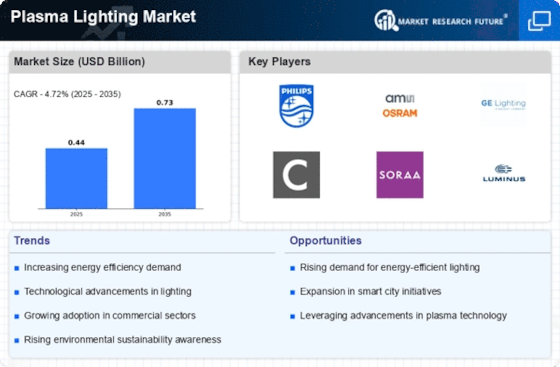
Plasma Lighting Market Infographic
Purchase Options

Market Analysis

In-depth Analysis of Plasma Lighting Market Industry Landscape

The plasma lighting market has witnessed dynamic shifts in recent years, reflecting the evolving landscape of lighting technology. Plasma lighting, known for its efficiency and versatility, has become a key player in the market dynamics. One of the primary drivers of this market is the increasing demand for energy-efficient lighting solutions. As traditional lighting sources, such as incandescent and fluorescent bulbs, face scrutiny due to their high energy consumption, plasma lighting emerges as a more sustainable alternative. The market dynamics are also influenced by the growing awareness of environmental concerns and the need for eco-friendly lighting options. In addition to energy efficiency, the plasma lighting market is characterized by its superior performance and longevity. Plasma lights boast longer lifespans compared to traditional bulbs, reducing the frequency of replacements, and contributing to lower maintenance costs. This aspect has attracted both commercial and residential users, creating a significant demand for plasma lighting solutions. Furthermore, the market dynamics are shaped by advancements in technology, leading to the development of compact and more cost-effective plasma lighting systems. These innovations have made plasma lighting more accessible to a broader consumer base, fostering market growth. Government initiatives and regulations also play a pivotal role in the market dynamics of plasma lighting. Many countries are implementing policies that encourage the adoption of energy-efficient lighting technologies to address energy conservation goals. Subsidies and incentives provided by governments to promote the use of plasma lighting further contribute to the market's expansion. These regulatory measures create a conducive environment for manufacturers to invest in research and development, leading to continuous improvements in plasma lighting technology. The competitive landscape within the plasma lighting market is marked by the presence of established players and emerging entrants. Established companies often focus on expanding their product portfolios and enhancing product features to maintain a competitive edge. Meanwhile, new entrants leverage technological innovations to introduce disruptive solutions, challenging traditional market leaders. This competitive dynamic fosters an environment of innovation and drives the evolution of plasma lighting technology. Global trends, such as smart lighting and the Internet of Things (IoT), have also influenced the market dynamics of plasma lighting. Integration with smart lighting systems allows users to control and customize their lighting preferences, contributing to increased adoption. The ability of plasma lights to seamlessly integrate with IoT platforms for enhanced connectivity and automation aligns with the growing demand for smart and connected solutions, further propelling market growth.


Author
Author Profile
Ankit Gupta
Team Lead - Research

Ankit Gupta is a seasoned market intelligence and strategic research professional with over six plus years of experience in the ICT and Semiconductor industries. With academic roots in Telecom, Marketing, and Electronics, he blends technical insight with business strategy. Ankit has led 200+ projects, including work for Fortune 500 clients like Microsoft and Rio Tinto, covering market sizing, tech forecasting, and go-to-market strategies. Known for bridging engineering and enterprise decision-making, his insights support growth, innovation, and investment planning across diverse technology markets.

Leave a Comment

FAQs

What is the projected market valuation of the Plasma Lighting Market by 2035?

<p>The Plasma Lighting Market is projected to reach approximately 0.7309 USD Billion by 2035.</p>

What was the market valuation of the Plasma Lighting Market in 2024?

<p>In 2024, the Plasma Lighting Market was valued at 0.44 USD Billion.</p>

What is the expected CAGR for the Plasma Lighting Market from 2025 to 2035?

<p>The expected CAGR for the Plasma Lighting Market during the forecast period 2025 - 2035 is 4.72%.</p>

Which companies are considered key players in the Plasma Lighting Market?

<p>Key players in the Plasma Lighting Market include Philips, Osram, GE Lighting, Cree, Soraa, Luminus Devices, Seoul Semiconductor, Nichia, and Everlight Electronics.</p>

How does the Plasma Lighting Market segment by wattage?

<p>The Plasma Lighting Market segments by wattage include 300W, 700W, and 1,000W, with valuations ranging from 0.14 to 0.25 USD Billion.</p>

What are the primary distribution channels for Plasma Lighting products?

<p>The primary distribution channels for Plasma Lighting products are Retail and Commercial, with valuations of 0.176 to 0.4236 USD Billion.</p>

What applications are driving the demand for Plasma Lighting?

Applications driving demand for Plasma Lighting include Sports and Entertainment, Roadways, Streets and Tunnels, and Industrial Horticulture, with valuations ranging from 0.06 to 0.2 USD Billion.

What is the market performance of Plasma Lighting in the Sports and Entertainment sector?

The Sports and Entertainment sector of the Plasma Lighting Market has a valuation ranging from 0.1 to 0.15 USD Billion.

How does the Plasma Lighting Market's growth compare to other lighting technologies?

The Plasma Lighting Market's growth appears to be steady, with a projected increase in valuation, potentially indicating a competitive position against other lighting technologies.

What factors may influence the growth of the Plasma Lighting Market in the coming years?

Factors influencing the growth of the Plasma Lighting Market may include technological advancements, increasing demand for energy-efficient lighting solutions, and expanding applications across various sectors.

Market Summary

As per Market Research Future analysis, the Plasma Lighting Market Size was estimated at 0.44 USD Billion in 2024. The Plasma Lighting industry is projected to grow from USD 0.4608 Billion in 2025 to USD 0.7309 Billion by 2035, exhibiting a compound annual growth rate (CAGR) of 4.72% during the forecast period 2025 - 2035

Key Market Trends & Highlights

The Plasma Lighting Market is experiencing robust growth driven by technological advancements and a focus on sustainability.

  • North America remains the largest market for plasma lighting, driven by increasing demand for high-quality lighting solutions. The Asia-Pacific region is the fastest-growing market, reflecting a rising interest in energy-efficient lighting technologies. The 700W segment dominates the market, while the 300W segment is emerging rapidly due to its versatility and efficiency. Technological advancements and sustainability initiatives are key drivers, as governments promote energy-efficient lighting solutions.

Market Size & Forecast

2024 Market Size 0.44 (USD Billion)
2035 Market Size 0.7309 (USD Billion)
CAGR (2025 - 2035) 4.72%
Largest Regional Market Share in 2024 North America

Major Players

Philips (NL), Osram (DE), GE Lighting (US), Cree (US), Soraa (US), Luminus Devices (US), Seoul Semiconductor (KR), Nichia (JP), Everlight Electronics (TW)

Market Trends

The plasma lighting market is currently experiencing a notable evolution, driven by advancements in technology and increasing awareness of energy efficiency. This sector appears to be gaining traction due to its potential to provide superior illumination through light emitting plasma while consuming less energy compared to traditional lighting solutions. As industries and consumers alike seek sustainable alternatives, the demand for plasma lighting is likely to rise, reflecting a broader trend towards eco-friendly practices. Furthermore, the versatility of plasma lighting applications, ranging from commercial to residential use, suggests a growing acceptance and integration into various settings. In addition, the Plasma Lighting Market seems to be influenced by ongoing research and development efforts aimed at enhancing the performance and lifespan of plasma lamps. Innovations in materials and design may lead to improved efficiency and reduced costs, making plasma lighting market solutions more accessible to a wider audience. As the market continues to mature, it is expected that regulatory frameworks will also evolve, potentially fostering a more conducive environment for the adoption of plasma lighting technologies. Overall, the future of this market appears promising, with numerous opportunities for growth and expansion across different sectors.

Technological Advancements

Recent innovations in plasma lighting technology are enhancing efficiency and performance. These advancements may lead to longer-lasting products and improved energy consumption, appealing to both consumers and businesses utilizing light emitting plasma systems.

Sustainability Focus

There is a growing emphasis on sustainable lighting solutions within the plasma lighting market. As environmental concerns rise, consumers are increasingly seeking energy-efficient options that reduce carbon footprints, particularly in industrial and commercial environments.

Diverse Applications

The versatility of plasma lighting is becoming more apparent, with applications spanning various sectors. From industrial settings to residential use, the adaptability of plasma lighting market systems is likely to drive market growth. In industrial horticulture, solutions such as plasma grow lighting, plasma light grow systems, and 1000w plasma grow light installations are gaining attention for their ability to deliver full-spectrum lighting.

Plasma Lighting Market Market Drivers

Sustainability and Energy Efficiency

The Plasma Lighting Market is increasingly influenced by the global emphasis on sustainability and energy efficiency. Plasma lighting systems are known for their low energy consumption and reduced carbon footprint compared to traditional lighting technologies. With energy-efficient plasma lights consuming up to 50% less energy than conventional incandescent or fluorescent lights, they are becoming a preferred choice for environmentally conscious consumers and businesses. This shift towards sustainable lighting solutions is further supported by government regulations and incentives aimed at reducing energy consumption and greenhouse gas emissions. As a result, the market is likely to see a significant increase in demand for plasma lighting products, particularly in regions where energy efficiency standards are becoming more stringent.

Government Initiatives and Regulations

The Plasma Lighting Market is significantly impacted by government initiatives and regulations aimed at promoting energy-efficient lighting solutions. Many governments are implementing policies that encourage the adoption of advanced lighting technologies, including plasma lighting, as part of broader sustainability goals. These initiatives often include financial incentives, tax rebates, and grants for businesses and consumers who choose energy-efficient lighting options. Furthermore, regulations that phase out less efficient lighting technologies are creating a favorable environment for the growth of the plasma lighting market. As these policies continue to evolve, they are likely to stimulate demand for plasma lighting products, thereby contributing to the overall expansion of the market.

Diverse Applications of Plasma Lighting

The Plasma Lighting Market is characterized by its diverse range of applications across various sectors. From street lighting to industrial facilities, plasma lighting is being utilized for its superior light quality and efficiency. The automotive sector is also witnessing a growing trend towards plasma lighting for headlights and interior illumination, enhancing both safety and aesthetics. Additionally, the agricultural sector is increasingly adopting plasma lighting for indoor farming and greenhouse applications, where optimal light conditions are crucial for plant growth. This versatility in applications is expected to drive market growth, with estimates suggesting that the plasma lighting market could reach a valuation of over 1 billion dollars by 2026. The ability to cater to multiple industries positions plasma lighting as a key player in the future of lighting solutions.

Technological Advancements in Plasma Lighting

The Plasma Lighting Market is experiencing a surge in technological advancements that enhance the efficiency and performance of plasma lighting systems. Innovations in plasma technology, such as improved gas mixtures and better electrode designs, are leading to higher luminous efficacy and longer lifespans for plasma lamps. These advancements are not only making plasma lighting more appealing for commercial and industrial applications but are also driving down costs. As a result, the market is projected to grow at a compound annual growth rate of approximately 8% over the next five years. This growth is indicative of the increasing adoption of plasma lighting solutions in various sectors, including automotive, street lighting, and indoor horticulture, where high-quality illumination is essential.

Rising Demand for High-Quality Lighting Solutions

The Plasma Lighting Market is witnessing a rising demand for high-quality lighting solutions across various sectors. As consumers and businesses become more discerning about lighting quality, plasma lighting is emerging as a preferred option due to its superior color rendering and brightness. This demand is particularly evident in sectors such as retail, hospitality, and entertainment, where lighting plays a crucial role in creating ambiance and enhancing customer experience. The ability of plasma lighting to provide consistent and high-quality illumination is likely to drive its adoption in these sectors. Market analysts project that this trend will contribute to a steady increase in the plasma lighting market, with expectations of reaching new heights in the coming years.

Market Segment Insights

By Wattage: 700W (Largest) vs. 300W (Fastest-Growing)

<p>In the Plasma Lighting Market, the wattage segment is diverse, with 700W holding the largest market share due to its widespread application in industrial settings and large-scale outdoor lighting. This segment is favored for its powerful output, making it ideal for areas requiring high-intensity light. Conversely, the 300W segment is gaining traction, particularly among smaller retail and residential applications, thanks to its energy efficiency and reduced operational costs, contributing to its rapid growth.</p>

<p>Wattage: 700W (Dominant) vs. 300W (Emerging)</p>

<p>The 700W plasma lighting fixture stands as the dominant player in the market, known for its exceptional brightness and effectiveness in large-area coverage. It is highly regarded in sectors that require robust lighting solutions, such as warehousing and stadiums. In contrast, the 300W segment is emerging rapidly, appealing to environmentally conscious consumers looking for energy-efficient alternatives. While it offers lower luminosity, the 300W model compensates with lower energy costs and minimal heat output, making it suitable for indoor and outdoor spaces while aligning with sustainability goals.</p>

By Distribution Channel: Retail (Largest) vs. Commercial (Fastest-Growing)

<p>In the Plasma Lighting Market, the retail distribution channel has emerged as the largest contributor, benefiting from strong consumer preferences for energy-efficient lighting solutions. Retail outlets provide the advantage of visibility and accessibility to end-users, leading to a substantial market share. This channel is characterized by a diverse array of products catering to different consumer needs, further enhancing its dominance in the market.</p>

<p>Distribution Channel: Retail (Dominant) vs. Commercial (Emerging)</p>

<p>The retail segment in the Plasma Lighting Market is characterized by a wide range of products available to consumers through various channels such as hardware stores, home improvement centers, and online platforms. This dominance is driven by consumer awareness and the increasing adoption of energy-efficient lighting solutions. In contrast, the commercial segment, though currently smaller, is rapidly emerging as a crucial player due to the rising need for sustainable lighting in businesses. This segment is driven by energy efficiency concerns and regulatory support, with businesses increasingly seeking innovative lighting solutions for cost savings and improved sustainability.</p>

By Application: Sports and Entertainment (Largest) vs. Industrial Horticulture (Fastest-Growing)

<p>In the Plasma Lighting Market, the application segments are diverse, with Sports and Entertainment holding the largest share. This segment benefits from the growing demand for high-performance lighting solutions in stadiums and arenas, enhancing visibility and ambiance during events. Roadways, Streets and Tunnels, and Industrial Horticulture also contribute to market dynamics, but are relatively smaller in comparison. Each segment benefits from unique requirements, with Roadways focusing on safety and visibility, while Streets and Tunnels prioritize energy efficiency. Growth trends across the application segments show an increasing inclination towards advanced lighting solutions that offer sustainability and efficiency. The Industrial Horticulture segment is emerging rapidly, driven by the need for optimized plant growth in controlled environments. Technological advancements, coupled with environmental concerns and agricultural sustainability, are propelling this sector forward. The demand for lighting solutions that cater to specific applications will continue to shape the landscape of the Plasma Lighting Market for years to come.</p>

<p>Sports and Entertainment (Dominant) vs. Industrial Horticulture (Emerging)</p>

<p>The Sports and Entertainment segment in the Plasma Lighting Market is characterized by its significant demand for immersive lighting experiences in venues. This segment often requires high-intensity and color-enhanced lighting solutions that create vibrant atmospheres during various events, including concerts and sports. Conversely, the Industrial Horticulture segment is an emerging player, focusing on specialized lighting systems designed to maximize crop yield in controlled agricultural settings. The growing interest in indoor farming and the need for efficient light sources tailored to different plant species are key drivers for this segment. While Sports and Entertainment prioritize public experience, Industrial Horticulture emphasizes technological innovation and sustainability, indicating a shift in market attention towards eco-friendly solutions.</p>

Get more detailed insights about Plasma Lighting Market Research Report - Forecast till 2035

Regional Insights

North America : Innovation and Sustainability Focus

North America is the largest market for plasma lighting, holding approximately 40% of the global share. The United States and Canada are the leading countries in this plasma lighting market, with major players like GE Lighting and Cree dominating the landscape. The adoption of plasma lighting in commercial and industrial sectors is further fueled by technological advancements and government incentives aimed at reducing carbon footprints. The United States and Canada are the leading countries in this market, with major players like GE Lighting and Cree dominating the landscape. The competitive environment is characterized by continuous innovation and partnerships among key players, enhancing product offerings and market reach. The presence of established companies ensures a robust supply chain and distribution network, facilitating market growth.

Europe : Regulatory-Driven Market Growth

Europe is the second-largest market for plasma lighting, accounting for around 30% of the global market share. Companies such as Philips, Osram, and ceravision lighting limited play pivotal roles in advancing plasma-based illumination technologies.

The increasing focus on sustainability and energy efficiency in urban planning and infrastructure development is driving demand for plasma lighting technologies. Germany, France, and the UK are the leading countries in this market, with companies like Osram and Philips playing pivotal roles. The competitive landscape is marked by innovation and collaboration among manufacturers, which enhances product quality and market penetration. The presence of regulatory bodies ensures compliance and fosters a favorable environment for market expansion.

Asia-Pacific : Rapid Growth and Adoption

Asia-Pacific is witnessing rapid growth in the plasma lighting market, driven by increasing urbanization and industrialization. The region holds approximately 25% of the global market share, with countries like China and Japan leading the demand. Government initiatives promoting energy-efficient technologies and investments in smart city projects are key growth drivers, enhancing the adoption of plasma lighting solutions. China is the largest market in the region, followed by Japan and South Korea. The competitive landscape is characterized by the presence of both local and international players, including Seoul Semiconductor and Nichia. The market is evolving with advancements in technology and a growing emphasis on sustainable lighting solutions, positioning Asia-Pacific as a significant player in the global market.

Middle East and Africa : Emerging Market with Potential

The Middle East and Africa region is gradually emerging in the plasma lighting market, holding about 5% of the global share. The growth is primarily driven by increasing investments in infrastructure and urban development projects. Governments are focusing on sustainable energy solutions, which is creating opportunities for plasma lighting technologies in various sectors, including commercial and residential applications. Countries like the UAE and South Africa are leading the market, with a growing number of projects aimed at enhancing energy efficiency. The competitive landscape is still developing, with several international players exploring opportunities in the region. The presence of key players is expected to increase as demand for innovative lighting solutions rises, paving the way for future growth.

Key Players and Competitive Insights

Leading market players are investing heavily in research and development in order to expand their product lines, which will help the Plasma Lighting Market, grow even more. Market participants are also undertaking a variety of strategic activities to expand their global footprint, with important market developments including new product launches, contractual agreements, mergers and acquisitions, higher investments, and collaboration with other organizations. To expand and survive in a more competitive and rising market climate, Plasma Lighting industry must offer cost-effective items. Manufacturing locally to minimize operational costs is one of the key business tactics used by manufacturers in the global Plasma Lighting industry to benefit clients and increase the market sector. In recent years, the Plasma Lighting industry has offered some of the most significant advantages to medicine. Major players in the Plasma Lighting Market, including Ceravision (UK), Hive Lighting (US), Ka Shui International Holdings (Hong Kong), Gavita (Netherlands), Green De Corp (Hong Kong), Griffin & Ray (UAE), Fusionlux (Luxembourg), Guangzhou Kaiming Industries (China), Birns (US), Solaronix (Switzerland), RFHIC Corporation (South Korea), Pure Plasma Lighting Market (US), Topanga Asia Limited (Topanga) (China), and others, are attempting to increase market demand by investing in research and development operations. Investment holding company Ka Shui International Holdings Ltd. (Ka Shui International). It produces and sells die castings made of magnesium, zinc, and aluminum alloys, as well as components and products for plastic injection molding and lighting. The company offers solutions for the home, communications, consumer electronics, computers, automotive, and lighting sectors. Additionally, it provides a range of services, such as supply chain management, surface treatment, CNC machining, plastic injection molding, die casting, design conceptualization, and tool design and building. The business has operations in China, the US, and Hong Kong. Kowloon is where Ka Shui International is based in Hong Kong. Advanced plasma lighting solutions are the focus of the California-based business Pure Plasma Lighting Market. The lighting system and light engine developed by the business are effective, electrode-free light sources that produce a continuous, full spectrum of nearly ideal natural light: white light of unmatched purity that is comparable to the Sun. A group of engineers and scientists with a desire for creating novel lighting technologies formed Pure Plasma Lighting Market in 2004. Circularly polarized microwaves are used to generate a stationary plasma discharge in the company's technique. With the use of this technology, ordinary plasma lights no longer require the revolving bulb that can be a point of failure.

Key Companies in the Plasma Lighting Market include

Industry Developments

In January 2024, Excelitas Technologies Corp., which specializes in industrial and medical technology focused on advanced photonics manufacturing solutions, announced that they have bought the Noblelight business from Heraeus Group, which has enormous potential in enhancing their joint potentials where they serve their customers best and keep up the pace of their profitable growth move.

In December 2023 Lumartix developed a solar simulator that allows performing aging, characterization as well as stabilization tests. The simulator was dubbed as Solixon, which has features for solar simulation and light soaking. The Solixon devices use Lumartix plasma light engine as alternative Xenon arc lamp technology which is said to be low maintenance.

In December 2023, Ushio Inc. and TNO, a Dutch research and technology organization, further consolidated their relationship with a new agreement aimed at maintenance and partnership over a five-year period. Ushio provided TNO with a high-intensity EUV light source for use in TNO’s EBL2 facility.

In October 2023, Tokamak Energy has recorded milestones on its ST40 fusion machine following a variety of modification done to the energy fusion machine which has led to an improved plasma temperature of about 100 million degrees Celsius, this temperature is ideal in achieving commercialised fusion energy and is reported to be the highest that has been attained in spherical tokamak technology that has been funded.

In August 2023, the Hamamatsu Photonics Toyooka factory in Iwata City, Japan, opened a factory extension (Building No 11). This expansion sought to satisfy the ever-increasing requirements in the market for microfocus X-ray sources (MFX) and other electron tube merchandise.

In January 2022, the excelitas technologies corp. launched the latest version of the µPAX-3 Pulsed Xenon Light Source, which is capable of emitting short bursts of ultra-wide band light of microsecond length. It makes use of advanced components and circuitry, and an advanced lamp design incorporated within a light source which provides exceptional arc stability.

Future Outlook

Plasma Lighting Market Future Outlook

The Plasma Lighting Market is projected to grow at a 4.72% CAGR from 2025 to 2035, driven by advancements in energy efficiency and increasing demand for sustainable lighting solutions.

New opportunities lie in:

  • <p>Development of smart plasma lighting systems for urban infrastructure Expansion into emerging markets with tailored plasma lighting solutions Partnerships with renewable energy firms for integrated lighting solutions</p>

By 2035, the Plasma Lighting Market is expected to achieve substantial growth, driven by innovation and strategic partnerships.

Market Segmentation

Plasma Lighting Market Wattage Outlook

  • 300W
  • 700W
  • 1
  • 000W

Plasma Lighting Market Application Outlook

  • Sports and Entertainment
  • Roadways
  • Streets and Tunnels
  • Industrial Horticulture
  • Others

Plasma Lighting Market Distribution Channel Outlook

  • Retail
  • Commercial

Report Scope

MARKET SIZE 2024 0.44(USD Billion)
MARKET SIZE 2025 0.4608(USD Billion)
MARKET SIZE 2035 0.7309(USD Billion)
COMPOUND ANNUAL GROWTH RATE (CAGR) 4.72% (2025 - 2035)
REPORT COVERAGE Revenue Forecast, Competitive Landscape, Growth Factors, and Trends
BASE YEAR 2024
Market Forecast Period 2025 - 2035
Historical Data 2019 - 2024
Market Forecast Units USD Billion
Key Companies Profiled Philips (NL), Osram (DE), GE Lighting (US), Cree (US), Soraa (US), Luminus Devices (US), Seoul Semiconductor (KR), Nichia (JP), Everlight Electronics (TW)
Segments Covered Wattage, Distribution Channel, Application, Region
Key Market Opportunities Growing demand for energy-efficient lighting solutions drives innovation in the Plasma Lighting Market.
Key Market Dynamics Technological advancements and regulatory shifts drive the adoption of energy-efficient plasma lighting solutions across various sectors.
Countries Covered North America, Europe, APAC, South America, MEA

FAQs

What is the projected market valuation of the Plasma Lighting Market by 2035?

<p>The Plasma Lighting Market is projected to reach approximately 0.7309 USD Billion by 2035.</p>

What was the market valuation of the Plasma Lighting Market in 2024?

<p>In 2024, the Plasma Lighting Market was valued at 0.44 USD Billion.</p>

What is the expected CAGR for the Plasma Lighting Market from 2025 to 2035?

<p>The expected CAGR for the Plasma Lighting Market during the forecast period 2025 - 2035 is 4.72%.</p>

Which companies are considered key players in the Plasma Lighting Market?

<p>Key players in the Plasma Lighting Market include Philips, Osram, GE Lighting, Cree, Soraa, Luminus Devices, Seoul Semiconductor, Nichia, and Everlight Electronics.</p>

How does the Plasma Lighting Market segment by wattage?

<p>The Plasma Lighting Market segments by wattage include 300W, 700W, and 1,000W, with valuations ranging from 0.14 to 0.25 USD Billion.</p>

What are the primary distribution channels for Plasma Lighting products?

<p>The primary distribution channels for Plasma Lighting products are Retail and Commercial, with valuations of 0.176 to 0.4236 USD Billion.</p>

What applications are driving the demand for Plasma Lighting?

Applications driving demand for Plasma Lighting include Sports and Entertainment, Roadways, Streets and Tunnels, and Industrial Horticulture, with valuations ranging from 0.06 to 0.2 USD Billion.

What is the market performance of Plasma Lighting in the Sports and Entertainment sector?

The Sports and Entertainment sector of the Plasma Lighting Market has a valuation ranging from 0.1 to 0.15 USD Billion.

How does the Plasma Lighting Market's growth compare to other lighting technologies?

The Plasma Lighting Market's growth appears to be steady, with a projected increase in valuation, potentially indicating a competitive position against other lighting technologies.

What factors may influence the growth of the Plasma Lighting Market in the coming years?

Factors influencing the growth of the Plasma Lighting Market may include technological advancements, increasing demand for energy-efficient lighting solutions, and expanding applications across various sectors.

  1. SECTION I: EXECUTIVE SUMMARY AND KEY HIGHLIGHTS
    1. | 1.1 EXECUTIVE SUMMARY
    2. | | 1.1.1 Market Overview
    3. | | 1.1.2 Key Findings
    4. | | 1.1.3 Market Segmentation
    5. | | 1.1.4 Competitive Landscape
    6. | | 1.1.5 Challenges and Opportunities
    7. | | 1.1.6 Future Outlook
  2. SECTION II: SCOPING, METHODOLOGY AND MARKET STRUCTURE
    1. | 2.1 MARKET INTRODUCTION
    2. | | 2.1.1 Definition
    3. | | 2.1.2 Scope of the study
    4. | | | 2.1.2.1 Research Objective
    5. | | | 2.1.2.2 Assumption
    6. | | | 2.1.2.3 Limitations
    7. | 2.2 RESEARCH METHODOLOGY
    8. | | 2.2.1 Overview
    9. | | 2.2.2 Data Mining
    10. | | 2.2.3 Secondary Research
    11. | | 2.2.4 Primary Research
    12. | | | 2.2.4.1 Primary Interviews and Information Gathering Process
    13. | | | 2.2.4.2 Breakdown of Primary Respondents
    14. | | 2.2.5 Forecasting Model
    15. | | 2.2.6 Market Size Estimation
    16. | | | 2.2.6.1 Bottom-Up Approach
    17. | | | 2.2.6.2 Top-Down Approach
    18. | | 2.2.7 Data Triangulation
    19. | | 2.2.8 Validation
  3. SECTION III: QUALITATIVE ANALYSIS
    1. | 3.1 MARKET DYNAMICS
    2. | | 3.1.1 Overview
    3. | | 3.1.2 Drivers
    4. | | 3.1.3 Restraints
    5. | | 3.1.4 Opportunities
    6. | 3.2 MARKET FACTOR ANALYSIS
    7. | | 3.2.1 Value chain Analysis
    8. | | 3.2.2 Porter's Five Forces Analysis
    9. | | | 3.2.2.1 Bargaining Power of Suppliers
    10. | | | 3.2.2.2 Bargaining Power of Buyers
    11. | | | 3.2.2.3 Threat of New Entrants
    12. | | | 3.2.2.4 Threat of Substitutes
    13. | | | 3.2.2.5 Intensity of Rivalry
    14. | | 3.2.3 COVID-19 Impact Analysis
    15. | | | 3.2.3.1 Market Impact Analysis
    16. | | | 3.2.3.2 Regional Impact
    17. | | | 3.2.3.3 Opportunity and Threat Analysis
  4. SECTION IV: QUANTITATIVE ANALYSIS
    1. | 4.1 Semiconductor & Electronics, BY Wattage (USD Billion)
    2. | | 4.1.1 300W
    3. | | 4.1.2 700W
    4. | | 4.1.3 1,000W
    5. | 4.2 Semiconductor & Electronics, BY Distribution Channel (USD Billion)
    6. | | 4.2.1 Retail
    7. | | 4.2.2 Commercial
    8. | 4.3 Semiconductor & Electronics, BY Application (USD Billion)
    9. | | 4.3.1 Sports and Entertainment
    10. | | 4.3.2 Roadways
    11. | | 4.3.3 Streets and Tunnels
    12. | | 4.3.4 Industrial Horticulture
    13. | | 4.3.5 Others
    14. | 4.4 Semiconductor & Electronics, BY Region (USD Billion)
    15. | | 4.4.1 North America
    16. | | | 4.4.1.1 US
    17. | | | 4.4.1.2 Canada
    18. | | 4.4.2 Europe
    19. | | | 4.4.2.1 Germany
    20. | | | 4.4.2.2 UK
    21. | | | 4.4.2.3 France
    22. | | | 4.4.2.4 Russia
    23. | | | 4.4.2.5 Italy
    24. | | | 4.4.2.6 Spain
    25. | | | 4.4.2.7 Rest of Europe
    26. | | 4.4.3 APAC
    27. | | | 4.4.3.1 China
    28. | | | 4.4.3.2 India
    29. | | | 4.4.3.3 Japan
    30. | | | 4.4.3.4 South Korea
    31. | | | 4.4.3.5 Malaysia
    32. | | | 4.4.3.6 Thailand
    33. | | | 4.4.3.7 Indonesia
    34. | | | 4.4.3.8 Rest of APAC
    35. | | 4.4.4 South America
    36. | | | 4.4.4.1 Brazil
    37. | | | 4.4.4.2 Mexico
    38. | | | 4.4.4.3 Argentina
    39. | | | 4.4.4.4 Rest of South America
    40. | | 4.4.5 MEA
    41. | | | 4.4.5.1 GCC Countries
    42. | | | 4.4.5.2 South Africa
    43. | | | 4.4.5.3 Rest of MEA
  5. SECTION V: COMPETITIVE ANALYSIS
    1. | 5.1 Competitive Landscape
    2. | | 5.1.1 Overview
    3. | | 5.1.2 Competitive Analysis
    4. | | 5.1.3 Market share Analysis
    5. | | 5.1.4 Major Growth Strategy in the Semiconductor & Electronics
    6. | | 5.1.5 Competitive Benchmarking
    7. | | 5.1.6 Leading Players in Terms of Number of Developments in the Semiconductor & Electronics
    8. | | 5.1.7 Key developments and growth strategies
    9. | | | 5.1.7.1 New Product Launch/Service Deployment
    10. | | | 5.1.7.2 Merger & Acquisitions
    11. | | | 5.1.7.3 Joint Ventures
    12. | | 5.1.8 Major Players Financial Matrix
    13. | | | 5.1.8.1 Sales and Operating Income
    14. | | | 5.1.8.2 Major Players R&D Expenditure. 2023
    15. | 5.2 Company Profiles
    16. | | 5.2.1 Philips (NL)
    17. | | | 5.2.1.1 Financial Overview
    18. | | | 5.2.1.2 Products Offered
    19. | | | 5.2.1.3 Key Developments
    20. | | | 5.2.1.4 SWOT Analysis
    21. | | | 5.2.1.5 Key Strategies
    22. | | 5.2.2 Osram (DE)
    23. | | | 5.2.2.1 Financial Overview
    24. | | | 5.2.2.2 Products Offered
    25. | | | 5.2.2.3 Key Developments
    26. | | | 5.2.2.4 SWOT Analysis
    27. | | | 5.2.2.5 Key Strategies
    28. | | 5.2.3 GE Lighting (US)
    29. | | | 5.2.3.1 Financial Overview
    30. | | | 5.2.3.2 Products Offered
    31. | | | 5.2.3.3 Key Developments
    32. | | | 5.2.3.4 SWOT Analysis
    33. | | | 5.2.3.5 Key Strategies
    34. | | 5.2.4 Cree (US)
    35. | | | 5.2.4.1 Financial Overview
    36. | | | 5.2.4.2 Products Offered
    37. | | | 5.2.4.3 Key Developments
    38. | | | 5.2.4.4 SWOT Analysis
    39. | | | 5.2.4.5 Key Strategies
    40. | | 5.2.5 Soraa (US)
    41. | | | 5.2.5.1 Financial Overview
    42. | | | 5.2.5.2 Products Offered
    43. | | | 5.2.5.3 Key Developments
    44. | | | 5.2.5.4 SWOT Analysis
    45. | | | 5.2.5.5 Key Strategies
    46. | | 5.2.6 Luminus Devices (US)
    47. | | | 5.2.6.1 Financial Overview
    48. | | | 5.2.6.2 Products Offered
    49. | | | 5.2.6.3 Key Developments
    50. | | | 5.2.6.4 SWOT Analysis
    51. | | | 5.2.6.5 Key Strategies
    52. | | 5.2.7 Seoul Semiconductor (KR)
    53. | | | 5.2.7.1 Financial Overview
    54. | | | 5.2.7.2 Products Offered
    55. | | | 5.2.7.3 Key Developments
    56. | | | 5.2.7.4 SWOT Analysis
    57. | | | 5.2.7.5 Key Strategies
    58. | | 5.2.8 Nichia (JP)
    59. | | | 5.2.8.1 Financial Overview
    60. | | | 5.2.8.2 Products Offered
    61. | | | 5.2.8.3 Key Developments
    62. | | | 5.2.8.4 SWOT Analysis
    63. | | | 5.2.8.5 Key Strategies
    64. | | 5.2.9 Everlight Electronics (TW)
    65. | | | 5.2.9.1 Financial Overview
    66. | | | 5.2.9.2 Products Offered
    67. | | | 5.2.9.3 Key Developments
    68. | | | 5.2.9.4 SWOT Analysis
    69. | | | 5.2.9.5 Key Strategies
    70. | 5.3 Appendix
    71. | | 5.3.1 References
    72. | | 5.3.2 Related Reports
  6. LIST OF FIGURES
    1. | 6.1 MARKET SYNOPSIS
    2. | 6.2 NORTH AMERICA MARKET ANALYSIS
    3. | 6.3 US MARKET ANALYSIS BY WATTAGE
    4. | 6.4 US MARKET ANALYSIS BY DISTRIBUTION CHANNEL
    5. | 6.5 US MARKET ANALYSIS BY APPLICATION
    6. | 6.6 CANADA MARKET ANALYSIS BY WATTAGE
    7. | 6.7 CANADA MARKET ANALYSIS BY DISTRIBUTION CHANNEL
    8. | 6.8 CANADA MARKET ANALYSIS BY APPLICATION
    9. | 6.9 EUROPE MARKET ANALYSIS
    10. | 6.10 GERMANY MARKET ANALYSIS BY WATTAGE
    11. | 6.11 GERMANY MARKET ANALYSIS BY DISTRIBUTION CHANNEL
    12. | 6.12 GERMANY MARKET ANALYSIS BY APPLICATION
    13. | 6.13 UK MARKET ANALYSIS BY WATTAGE
    14. | 6.14 UK MARKET ANALYSIS BY DISTRIBUTION CHANNEL
    15. | 6.15 UK MARKET ANALYSIS BY APPLICATION
    16. | 6.16 FRANCE MARKET ANALYSIS BY WATTAGE
    17. | 6.17 FRANCE MARKET ANALYSIS BY DISTRIBUTION CHANNEL
    18. | 6.18 FRANCE MARKET ANALYSIS BY APPLICATION
    19. | 6.19 RUSSIA MARKET ANALYSIS BY WATTAGE
    20. | 6.20 RUSSIA MARKET ANALYSIS BY DISTRIBUTION CHANNEL
    21. | 6.21 RUSSIA MARKET ANALYSIS BY APPLICATION
    22. | 6.22 ITALY MARKET ANALYSIS BY WATTAGE
    23. | 6.23 ITALY MARKET ANALYSIS BY DISTRIBUTION CHANNEL
    24. | 6.24 ITALY MARKET ANALYSIS BY APPLICATION
    25. | 6.25 SPAIN MARKET ANALYSIS BY WATTAGE
    26. | 6.26 SPAIN MARKET ANALYSIS BY DISTRIBUTION CHANNEL
    27. | 6.27 SPAIN MARKET ANALYSIS BY APPLICATION
    28. | 6.28 REST OF EUROPE MARKET ANALYSIS BY WATTAGE
    29. | 6.29 REST OF EUROPE MARKET ANALYSIS BY DISTRIBUTION CHANNEL
    30. | 6.30 REST OF EUROPE MARKET ANALYSIS BY APPLICATION
    31. | 6.31 APAC MARKET ANALYSIS
    32. | 6.32 CHINA MARKET ANALYSIS BY WATTAGE
    33. | 6.33 CHINA MARKET ANALYSIS BY DISTRIBUTION CHANNEL
    34. | 6.34 CHINA MARKET ANALYSIS BY APPLICATION
    35. | 6.35 INDIA MARKET ANALYSIS BY WATTAGE
    36. | 6.36 INDIA MARKET ANALYSIS BY DISTRIBUTION CHANNEL
    37. | 6.37 INDIA MARKET ANALYSIS BY APPLICATION
    38. | 6.38 JAPAN MARKET ANALYSIS BY WATTAGE
    39. | 6.39 JAPAN MARKET ANALYSIS BY DISTRIBUTION CHANNEL
    40. | 6.40 JAPAN MARKET ANALYSIS BY APPLICATION
    41. | 6.41 SOUTH KOREA MARKET ANALYSIS BY WATTAGE
    42. | 6.42 SOUTH KOREA MARKET ANALYSIS BY DISTRIBUTION CHANNEL
    43. | 6.43 SOUTH KOREA MARKET ANALYSIS BY APPLICATION
    44. | 6.44 MALAYSIA MARKET ANALYSIS BY WATTAGE
    45. | 6.45 MALAYSIA MARKET ANALYSIS BY DISTRIBUTION CHANNEL
    46. | 6.46 MALAYSIA MARKET ANALYSIS BY APPLICATION
    47. | 6.47 THAILAND MARKET ANALYSIS BY WATTAGE
    48. | 6.48 THAILAND MARKET ANALYSIS BY DISTRIBUTION CHANNEL
    49. | 6.49 THAILAND MARKET ANALYSIS BY APPLICATION
    50. | 6.50 INDONESIA MARKET ANALYSIS BY WATTAGE
    51. | 6.51 INDONESIA MARKET ANALYSIS BY DISTRIBUTION CHANNEL
    52. | 6.52 INDONESIA MARKET ANALYSIS BY APPLICATION
    53. | 6.53 REST OF APAC MARKET ANALYSIS BY WATTAGE
    54. | 6.54 REST OF APAC MARKET ANALYSIS BY DISTRIBUTION CHANNEL
    55. | 6.55 REST OF APAC MARKET ANALYSIS BY APPLICATION
    56. | 6.56 SOUTH AMERICA MARKET ANALYSIS
    57. | 6.57 BRAZIL MARKET ANALYSIS BY WATTAGE
    58. | 6.58 BRAZIL MARKET ANALYSIS BY DISTRIBUTION CHANNEL
    59. | 6.59 BRAZIL MARKET ANALYSIS BY APPLICATION
    60. | 6.60 MEXICO MARKET ANALYSIS BY WATTAGE
    61. | 6.61 MEXICO MARKET ANALYSIS BY DISTRIBUTION CHANNEL
    62. | 6.62 MEXICO MARKET ANALYSIS BY APPLICATION
    63. | 6.63 ARGENTINA MARKET ANALYSIS BY WATTAGE
    64. | 6.64 ARGENTINA MARKET ANALYSIS BY DISTRIBUTION CHANNEL
    65. | 6.65 ARGENTINA MARKET ANALYSIS BY APPLICATION
    66. | 6.66 REST OF SOUTH AMERICA MARKET ANALYSIS BY WATTAGE
    67. | 6.67 REST OF SOUTH AMERICA MARKET ANALYSIS BY DISTRIBUTION CHANNEL
    68. | 6.68 REST OF SOUTH AMERICA MARKET ANALYSIS BY APPLICATION
    69. | 6.69 MEA MARKET ANALYSIS
    70. | 6.70 GCC COUNTRIES MARKET ANALYSIS BY WATTAGE
    71. | 6.71 GCC COUNTRIES MARKET ANALYSIS BY DISTRIBUTION CHANNEL
    72. | 6.72 GCC COUNTRIES MARKET ANALYSIS BY APPLICATION
    73. | 6.73 SOUTH AFRICA MARKET ANALYSIS BY WATTAGE
    74. | 6.74 SOUTH AFRICA MARKET ANALYSIS BY DISTRIBUTION CHANNEL
    75. | 6.75 SOUTH AFRICA MARKET ANALYSIS BY APPLICATION
    76. | 6.76 REST OF MEA MARKET ANALYSIS BY WATTAGE
    77. | 6.77 REST OF MEA MARKET ANALYSIS BY DISTRIBUTION CHANNEL
    78. | 6.78 REST OF MEA MARKET ANALYSIS BY APPLICATION
    79. | 6.79 KEY BUYING CRITERIA OF SEMICONDUCTOR & ELECTRONICS
    80. | 6.80 RESEARCH PROCESS OF MRFR
    81. | 6.81 DRO ANALYSIS OF SEMICONDUCTOR & ELECTRONICS
    82. | 6.82 DRIVERS IMPACT ANALYSIS: SEMICONDUCTOR & ELECTRONICS
    83. | 6.83 RESTRAINTS IMPACT ANALYSIS: SEMICONDUCTOR & ELECTRONICS
    84. | 6.84 SUPPLY / VALUE CHAIN: SEMICONDUCTOR & ELECTRONICS
    85. | 6.85 SEMICONDUCTOR & ELECTRONICS, BY WATTAGE, 2024 (% SHARE)
    86. | 6.86 SEMICONDUCTOR & ELECTRONICS, BY WATTAGE, 2024 TO 2035 (USD Billion)
    87. | 6.87 SEMICONDUCTOR & ELECTRONICS, BY DISTRIBUTION CHANNEL, 2024 (% SHARE)
    88. | 6.88 SEMICONDUCTOR & ELECTRONICS, BY DISTRIBUTION CHANNEL, 2024 TO 2035 (USD Billion)
    89. | 6.89 SEMICONDUCTOR & ELECTRONICS, BY APPLICATION, 2024 (% SHARE)
    90. | 6.90 SEMICONDUCTOR & ELECTRONICS, BY APPLICATION, 2024 TO 2035 (USD Billion)
    91. | 6.91 BENCHMARKING OF MAJOR COMPETITORS
  7. LIST OF TABLES
    1. | 7.1 LIST OF ASSUMPTIONS
    2. | | 7.1.1
    3. | 7.2 North America MARKET SIZE ESTIMATES; FORECAST
    4. | | 7.2.1 BY WATTAGE, 2025-2035 (USD Billion)
    5. | | 7.2.2 BY DISTRIBUTION CHANNEL, 2025-2035 (USD Billion)
    6. | | 7.2.3 BY APPLICATION, 2025-2035 (USD Billion)
    7. | 7.3 US MARKET SIZE ESTIMATES; FORECAST
    8. | | 7.3.1 BY WATTAGE, 2025-2035 (USD Billion)
    9. | | 7.3.2 BY DISTRIBUTION CHANNEL, 2025-2035 (USD Billion)
    10. | | 7.3.3 BY APPLICATION, 2025-2035 (USD Billion)
    11. | 7.4 Canada MARKET SIZE ESTIMATES; FORECAST
    12. | | 7.4.1 BY WATTAGE, 2025-2035 (USD Billion)
    13. | | 7.4.2 BY DISTRIBUTION CHANNEL, 2025-2035 (USD Billion)
    14. | | 7.4.3 BY APPLICATION, 2025-2035 (USD Billion)
    15. | 7.5 Europe MARKET SIZE ESTIMATES; FORECAST
    16. | | 7.5.1 BY WATTAGE, 2025-2035 (USD Billion)
    17. | | 7.5.2 BY DISTRIBUTION CHANNEL, 2025-2035 (USD Billion)
    18. | | 7.5.3 BY APPLICATION, 2025-2035 (USD Billion)
    19. | 7.6 Germany MARKET SIZE ESTIMATES; FORECAST
    20. | | 7.6.1 BY WATTAGE, 2025-2035 (USD Billion)
    21. | | 7.6.2 BY DISTRIBUTION CHANNEL, 2025-2035 (USD Billion)
    22. | | 7.6.3 BY APPLICATION, 2025-2035 (USD Billion)
    23. | 7.7 UK MARKET SIZE ESTIMATES; FORECAST
    24. | | 7.7.1 BY WATTAGE, 2025-2035 (USD Billion)
    25. | | 7.7.2 BY DISTRIBUTION CHANNEL, 2025-2035 (USD Billion)
    26. | | 7.7.3 BY APPLICATION, 2025-2035 (USD Billion)
    27. | 7.8 France MARKET SIZE ESTIMATES; FORECAST
    28. | | 7.8.1 BY WATTAGE, 2025-2035 (USD Billion)
    29. | | 7.8.2 BY DISTRIBUTION CHANNEL, 2025-2035 (USD Billion)
    30. | | 7.8.3 BY APPLICATION, 2025-2035 (USD Billion)
    31. | 7.9 Russia MARKET SIZE ESTIMATES; FORECAST
    32. | | 7.9.1 BY WATTAGE, 2025-2035 (USD Billion)
    33. | | 7.9.2 BY DISTRIBUTION CHANNEL, 2025-2035 (USD Billion)
    34. | | 7.9.3 BY APPLICATION, 2025-2035 (USD Billion)
    35. | 7.10 Italy MARKET SIZE ESTIMATES; FORECAST
    36. | | 7.10.1 BY WATTAGE, 2025-2035 (USD Billion)
    37. | | 7.10.2 BY DISTRIBUTION CHANNEL, 2025-2035 (USD Billion)
    38. | | 7.10.3 BY APPLICATION, 2025-2035 (USD Billion)
    39. | 7.11 Spain MARKET SIZE ESTIMATES; FORECAST
    40. | | 7.11.1 BY WATTAGE, 2025-2035 (USD Billion)
    41. | | 7.11.2 BY DISTRIBUTION CHANNEL, 2025-2035 (USD Billion)
    42. | | 7.11.3 BY APPLICATION, 2025-2035 (USD Billion)
    43. | 7.12 Rest of Europe MARKET SIZE ESTIMATES; FORECAST
    44. | | 7.12.1 BY WATTAGE, 2025-2035 (USD Billion)
    45. | | 7.12.2 BY DISTRIBUTION CHANNEL, 2025-2035 (USD Billion)
    46. | | 7.12.3 BY APPLICATION, 2025-2035 (USD Billion)
    47. | 7.13 APAC MARKET SIZE ESTIMATES; FORECAST
    48. | | 7.13.1 BY WATTAGE, 2025-2035 (USD Billion)
    49. | | 7.13.2 BY DISTRIBUTION CHANNEL, 2025-2035 (USD Billion)
    50. | | 7.13.3 BY APPLICATION, 2025-2035 (USD Billion)
    51. | 7.14 China MARKET SIZE ESTIMATES; FORECAST
    52. | | 7.14.1 BY WATTAGE, 2025-2035 (USD Billion)
    53. | | 7.14.2 BY DISTRIBUTION CHANNEL, 2025-2035 (USD Billion)
    54. | | 7.14.3 BY APPLICATION, 2025-2035 (USD Billion)
    55. | 7.15 India MARKET SIZE ESTIMATES; FORECAST
    56. | | 7.15.1 BY WATTAGE, 2025-2035 (USD Billion)
    57. | | 7.15.2 BY DISTRIBUTION CHANNEL, 2025-2035 (USD Billion)
    58. | | 7.15.3 BY APPLICATION, 2025-2035 (USD Billion)
    59. | 7.16 Japan MARKET SIZE ESTIMATES; FORECAST
    60. | | 7.16.1 BY WATTAGE, 2025-2035 (USD Billion)
    61. | | 7.16.2 BY DISTRIBUTION CHANNEL, 2025-2035 (USD Billion)
    62. | | 7.16.3 BY APPLICATION, 2025-2035 (USD Billion)
    63. | 7.17 South Korea MARKET SIZE ESTIMATES; FORECAST
    64. | | 7.17.1 BY WATTAGE, 2025-2035 (USD Billion)
    65. | | 7.17.2 BY DISTRIBUTION CHANNEL, 2025-2035 (USD Billion)
    66. | | 7.17.3 BY APPLICATION, 2025-2035 (USD Billion)
    67. | 7.18 Malaysia MARKET SIZE ESTIMATES; FORECAST
    68. | | 7.18.1 BY WATTAGE, 2025-2035 (USD Billion)
    69. | | 7.18.2 BY DISTRIBUTION CHANNEL, 2025-2035 (USD Billion)
    70. | | 7.18.3 BY APPLICATION, 2025-2035 (USD Billion)
    71. | 7.19 Thailand MARKET SIZE ESTIMATES; FORECAST
    72. | | 7.19.1 BY WATTAGE, 2025-2035 (USD Billion)
    73. | | 7.19.2 BY DISTRIBUTION CHANNEL, 2025-2035 (USD Billion)
    74. | | 7.19.3 BY APPLICATION, 2025-2035 (USD Billion)
    75. | 7.20 Indonesia MARKET SIZE ESTIMATES; FORECAST
    76. | | 7.20.1 BY WATTAGE, 2025-2035 (USD Billion)
    77. | | 7.20.2 BY DISTRIBUTION CHANNEL, 2025-2035 (USD Billion)
    78. | | 7.20.3 BY APPLICATION, 2025-2035 (USD Billion)
    79. | 7.21 Rest of APAC MARKET SIZE ESTIMATES; FORECAST
    80. | | 7.21.1 BY WATTAGE, 2025-2035 (USD Billion)
    81. | | 7.21.2 BY DISTRIBUTION CHANNEL, 2025-2035 (USD Billion)
    82. | | 7.21.3 BY APPLICATION, 2025-2035 (USD Billion)
    83. | 7.22 South America MARKET SIZE ESTIMATES; FORECAST
    84. | | 7.22.1 BY WATTAGE, 2025-2035 (USD Billion)
    85. | | 7.22.2 BY DISTRIBUTION CHANNEL, 2025-2035 (USD Billion)
    86. | | 7.22.3 BY APPLICATION, 2025-2035 (USD Billion)
    87. | 7.23 Brazil MARKET SIZE ESTIMATES; FORECAST
    88. | | 7.23.1 BY WATTAGE, 2025-2035 (USD Billion)
    89. | | 7.23.2 BY DISTRIBUTION CHANNEL, 2025-2035 (USD Billion)
    90. | | 7.23.3 BY APPLICATION, 2025-2035 (USD Billion)
    91. | 7.24 Mexico MARKET SIZE ESTIMATES; FORECAST
    92. | | 7.24.1 BY WATTAGE, 2025-2035 (USD Billion)
    93. | | 7.24.2 BY DISTRIBUTION CHANNEL, 2025-2035 (USD Billion)
    94. | | 7.24.3 BY APPLICATION, 2025-2035 (USD Billion)
    95. | 7.25 Argentina MARKET SIZE ESTIMATES; FORECAST
    96. | | 7.25.1 BY WATTAGE, 2025-2035 (USD Billion)
    97. | | 7.25.2 BY DISTRIBUTION CHANNEL, 2025-2035 (USD Billion)
    98. | | 7.25.3 BY APPLICATION, 2025-2035 (USD Billion)
    99. | 7.26 Rest of South America MARKET SIZE ESTIMATES; FORECAST
    100. | | 7.26.1 BY WATTAGE, 2025-2035 (USD Billion)
    101. | | 7.26.2 BY DISTRIBUTION CHANNEL, 2025-2035 (USD Billion)
    102. | | 7.26.3 BY APPLICATION, 2025-2035 (USD Billion)
    103. | 7.27 MEA MARKET SIZE ESTIMATES; FORECAST
    104. | | 7.27.1 BY WATTAGE, 2025-2035 (USD Billion)
    105. | | 7.27.2 BY DISTRIBUTION CHANNEL, 2025-2035 (USD Billion)
    106. | | 7.27.3 BY APPLICATION, 2025-2035 (USD Billion)
    107. | 7.28 GCC Countries MARKET SIZE ESTIMATES; FORECAST
    108. | | 7.28.1 BY WATTAGE, 2025-2035 (USD Billion)
    109. | | 7.28.2 BY DISTRIBUTION CHANNEL, 2025-2035 (USD Billion)
    110. | | 7.28.3 BY APPLICATION, 2025-2035 (USD Billion)
    111. | 7.29 South Africa MARKET SIZE ESTIMATES; FORECAST
    112. | | 7.29.1 BY WATTAGE, 2025-2035 (USD Billion)
    113. | | 7.29.2 BY DISTRIBUTION CHANNEL, 2025-2035 (USD Billion)
    114. | | 7.29.3 BY APPLICATION, 2025-2035 (USD Billion)
    115. | 7.30 Rest of MEA MARKET SIZE ESTIMATES; FORECAST
    116. | | 7.30.1 BY WATTAGE, 2025-2035 (USD Billion)
    117. | | 7.30.2 BY DISTRIBUTION CHANNEL, 2025-2035 (USD Billion)
    118. | | 7.30.3 BY APPLICATION, 2025-2035 (USD Billion)
    119. | 7.31 PRODUCT LAUNCH/PRODUCT DEVELOPMENT/APPROVAL
    120. | | 7.31.1
    121. | 7.32 ACQUISITION/PARTNERSHIP
    122. | | 7.32.1

Semiconductor & Electronics Market Segmentation

Semiconductor & Electronics By Wattage (USD Billion, 2025-2035)

  • 300W
  • 700W
  • 1,000W

Semiconductor & Electronics By Distribution Channel (USD Billion, 2025-2035)

  • Retail
  • Commercial

Semiconductor & Electronics By Application (USD Billion, 2025-2035)

  • Sports and Entertainment
  • Roadways
  • Streets and Tunnels
  • Industrial Horticulture
  • Others
Infographic

Free Sample Request

Kindly complete the form below to receive a free sample of this Report

Get Free Sample

Customer Strories

Compare Licence

×
Features License Type
Single User Multiuser License Enterprise User
Price $4,950 $5,950 $7,250
Maximum User Access Limit 1 User Upto 10 Users Unrestricted Access Throughout the Organization
Free Customization
Direct Access to Analyst
Deliverable Format
Platform Access
Discount on Next Purchase 10% 15% 15%
Printable Versions