×
Request Free Sample ×

Kindly complete the form below to receive a free sample of this Report

* Please use a valid business email

Leading companies partner with us for data-driven Insights

clients tt-cursor
Hero Background
English
Chinese
French
Japanese
Korean
German
Spanish

Plant Based Protein Market Share

ID: MRFR/FnB/10433-HCR
200 Pages
Snehal Singh
February 2026

Plant-Based Protein Market Size, Share, Industry Trend & Analysis Research Report By Source (Soy Protein, Pea Protein, Rice Protein, Hemp Protein, Wheat Protein), By Form (Isolates, Concentrates, Textured Protein, Hydrolysates), By Application (Food Beverages, Nutritional Supplements, Animal Feed), By End Use (Residential, Commercial, Institutional) and By Regional (North America, Europe, South America, Asia Pacific, Middle East and Africa) - Forecast to 2035

Share:
Download PDF ×

We do not share your information with anyone. However, we may send you emails based on your report interest from time to time. You may contact us at any time to opt-out.

Plant Based Protein Market Infographic
Purchase Options

Market Share

Plant Based Protein Market Share Analysis

In the rapidly expanding landscape of the plant-based protein market, companies are implementing diverse market share positioning strategies to establish themselves as leaders and meet the surging demand for sustainable and plant-centric protein alternatives. These strategies are essential for businesses aiming to resonate with health-conscious consumers seeking ethical and environmentally friendly protein options in the dynamic plant-based protein industry.

Product innovation and differentiation play a pivotal role in market share positioning within the plant-based protein sector. Companies strive to create unique and appealing products by developing novel plant protein sources, refining taste and texture profiles, and offering a diverse range of plant-based alternatives. Whether derived from soy, peas, lentils, or other sources, these innovations cater to consumers looking for sustainable and tasty protein options, allowing companies to capture a significant share of the growing plant-based protein market.

Pricing strategies are critical considerations for companies seeking market share in the plant-based protein industry. While some opt for a premium pricing strategy, positioning their products as high-quality and nutritionally superior, others focus on competitive pricing to make plant-based options accessible to a broader consumer base. Striking the right balance between quality and affordability is essential to influence purchasing decisions and gain market share in this evolving market where consumers are increasingly prioritizing both health and value.

Distribution channels are key factors influencing market share positioning strategies in the plant-based protein market. Companies may choose exclusive partnerships with health food stores, specialty retailers, or plant-based eateries to position their products as niche and premium. Alternatively, widespread distribution through mainstream supermarkets, online platforms, and fast-food chains enhances accessibility and exposure, contributing to a broader market presence and increased market share.

Innovative marketing campaigns are integral to building market share in the competitive plant-based protein industry. Companies leverage various marketing channels, including social media, influencer collaborations, and educational campaigns, to communicate the health benefits, environmental impact, and ethical considerations associated with their plant-based products. Highlighting the sustainability and positive contributions to animal welfare and the environment resonates with consumers, fostering brand loyalty and influencing purchasing decisions.

Strategic partnerships and collaborations are increasingly common strategies in the plant-based protein market. Companies may collaborate with renowned chefs, athletes, or environmental organizations to strengthen their brand image and appeal to a wider audience. These partnerships not only elevate the credibility of plant-based products but also provide opportunities for unique product offerings, exclusive promotions, and expanded market reach, ultimately contributing to increased market share.

Adaptability to changing consumer preferences is crucial in the dynamic plant-based protein market. As dietary trends shift and consumers become more health-conscious and environmentally aware, companies that introduce innovative plant-based protein products, such as meat alternatives, dairy substitutes, or protein-rich snacks, can capture the attention of a diverse consumer base. Staying attuned to emerging trends and consumer demands allows companies to position themselves as leaders in addressing the evolving needs of the plant-based protein market.


Author
Snehal Singh
Assistant Manager - Research

High acumen in analyzing complex macro & micro markets with more than 6 years of work experience in the field of market research. By implementing her analytical skills in forecasting and estimation into market research reports, she has expertise in Packaging, Construction, and Equipment domains. She handles a team size of 20-25 resources and ensures smooth running of the projects, associated marketing activities, and client servicing.

Leave a Comment

FAQs

What is the current valuation of the Plant-Based Protein Market in 2025?

The Plant-Based Protein Market is valued at approximately 13.4 USD Billion in 2024.

Market Summary

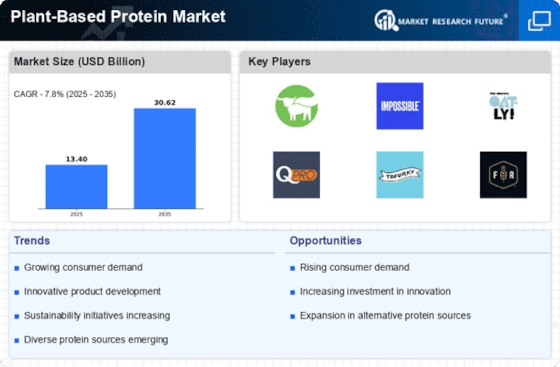
As per Market Research Future analysis, the Plant-Based Protein Market Size was estimated at 13.4 USD Billion in 2024. The Plant-Based Protein industry is projected to grow from 14.45 USD Billion in 2025 to 30.62 USD Billion by 2035, exhibiting a compound annual growth rate (CAGR) of 7.8% during the forecast period 2025 - 2035

Key Market Trends & Highlights

The Plant-Based Protein Market is experiencing robust growth driven by health consciousness and sustainability.

  • North America remains the largest market for plant-based proteins, reflecting a strong consumer shift towards healthier diets. The Asia-Pacific region is emerging as the fastest-growing market, driven by increasing urbanization and changing dietary preferences. Soy protein continues to dominate as the largest segment, while pea protein is rapidly gaining traction as the fastest-growing alternative. Rising demand for plant-based proteins and environmental sustainability initiatives are key drivers propelling market expansion.

Market Size & Forecast

2024 Market Size 13.4 (USD Billion)
2035 Market Size 30.62 (USD Billion)
CAGR (2025 - 2035) 7.8%
Largest Regional Market Share in 2024 North America

Major Players

Beyond Meat (US), Impossible Foods (US), Oatly (SE), Quorn Foods (GB), Tofurky (US), Field Roast (US), Daiya Foods (CA), Lightlife (US), MorningStar Farms (US), Eat Just (US)

Market Trends

The Plant-Based Protein Market is currently experiencing a notable transformation, driven by shifting consumer preferences towards healthier and more sustainable food options. This market encompasses a diverse range of products derived from various plant sources, including legumes, grains, nuts, and seeds. As awareness of the environmental impact of animal agriculture grows, consumers increasingly seek alternatives that align with their values. This trend is further supported by advancements in food technology, which enhance the taste and texture of plant-based offerings, making them more appealing to a broader audience. Additionally, the rise of flexitarian diets contributes significantly to overall plant based protein market growth, strengthening demand across the plant based protein products market.

Moreover, the Plant-Based Protein Market is witnessing a surge in innovation, with companies continuously developing new products to cater to diverse dietary needs. This includes protein-rich snacks, meat substitutes, dairy alternatives, and specialized segments like the plant based protein supplements market, appealing to both vegans and non-vegans alike. The increasing availability of these products in mainstream retail channels further facilitates consumer access, thereby driving market growth. As the demand for plant-based proteins continues to rise, it appears that the market will evolve to meet the expectations of health-conscious consumers, while also addressing environmental concerns. The future of this market seems promising, with potential for further expansion and diversification in the coming years.

Rising Health Consciousness

Consumers are increasingly prioritizing health and wellness, leading to a growing demand for nutritious food options. This trend is evident in the Plant-Based Protein Market, where individuals seek products that offer health benefits, such as lower cholesterol and higher fiber content. As a result, manufacturers are focusing on creating protein-rich alternatives that cater to these health-conscious consumers, contributing to overall plant based protein market share expansion.

Sustainability Focus

The environmental impact of food production is becoming a significant concern for many consumers. The Plant-Based Protein Market is responding to this by promoting sustainable sourcing and production methods. This focus on sustainability not only appeals to eco-conscious consumers but also aligns with global efforts to reduce carbon footprints and promote responsible consumption. Growth in alternative nutrition applications is also expanding the feed plant-based protein market as animal feed formulations increasingly incorporate plant-derived proteins.

Innovation in Product Development

The Plant-Based Protein Market is characterized by continuous innovation, with companies investing in research and development to create new and improved products. This includes advancements in flavor, texture, and nutritional profiles, making plant-based options more appealing to a wider audience. Such innovation is crucial for attracting consumers who may be hesitant to switch from traditional animal-based proteins.

Plant Based Protein Market Market Drivers

Changing Consumer Preferences

The Plant-Based Protein Market is witnessing a transformation in consumer preferences, with a growing inclination towards plant-based diets. This shift is influenced by various factors, including health benefits, ethical considerations, and environmental concerns. Surveys indicate that nearly 40% of consumers are actively seeking plant-based protein options, reflecting a significant change in dietary habits. Additionally, the rise of social media and influencer marketing has amplified awareness and acceptance of plant-based diets, further driving demand. As more consumers prioritize plant-based options, the market is likely to see an influx of new products and brands, enhancing competition and variety within the Plant-Based Protein Market.

Rising Demand for Plant-Based Proteins

The Plant-Based Protein Market experiences a notable surge in demand as consumers increasingly prioritize health and wellness. This trend is reflected in the growing number of individuals adopting vegetarian and vegan diets, which has been reported to increase by approximately 20% in recent years. The shift towards plant-based diets is driven by a desire for healthier lifestyles, as plant-based proteins are often perceived as lower in saturated fats and higher in essential nutrients. Furthermore, the market is projected to reach a valuation of over 20 billion dollars by 2027, indicating a robust growth trajectory. This rising demand is likely to encourage manufacturers to innovate and diversify their product offerings, thereby enhancing the overall competitiveness of the Plant-Based Protein Market.

Environmental Sustainability Initiatives

The Plant-Based Protein Market is significantly influenced by the increasing awareness of environmental sustainability. As climate change concerns escalate, consumers are gravitating towards plant-based proteins, which are generally associated with lower carbon footprints compared to animal-based proteins. Research indicates that producing plant-based proteins can require up to 90% less water and generate fewer greenhouse gas emissions. This shift is not only a response to consumer preferences but also aligns with corporate sustainability goals, as many companies are committing to reducing their environmental impact. The market is expected to benefit from this trend, with projections suggesting that plant-based protein sales could grow by 25% annually as more consumers seek eco-friendly alternatives.

Regulatory Support for Plant-Based Products

Regulatory support is emerging as a key driver for the Plant-Based Protein Market. Governments and regulatory bodies are increasingly recognizing the importance of plant-based proteins in promoting public health and sustainability. Initiatives aimed at encouraging plant-based diets are being implemented, including subsidies for plant-based food producers and educational campaigns about the benefits of plant-based nutrition. This supportive regulatory environment is likely to foster innovation and investment in the sector, as companies seek to align with government objectives. As a result, the market is expected to grow, with estimates suggesting that plant-based protein consumption could double within the next decade, further solidifying its position in the Plant-Based Protein Market.

Technological Advancements in Food Production

Technological advancements play a crucial role in shaping the Plant-Based Protein Market. Innovations in food processing and production techniques have led to the development of high-quality plant-based protein products that closely mimic the taste and texture of meat. For instance, advancements in extrusion technology and fermentation processes have enabled manufacturers to create more appealing and nutritious plant-based options. This has resulted in a broader acceptance of plant-based proteins among consumers, including those who are not strictly vegetarian or vegan. The market is projected to expand as these technologies continue to evolve, potentially increasing the market share of plant-based proteins to 30% of the total protein market by 2030.

Market Segment Insights

By Source: Soy Protein (Largest) vs. Pea Protein (Fastest-Growing)

The Plant-Based Protein Market showcases a diverse array of sources, each contributing uniquely to the overall landscape. Soy protein remains the largest segment due to its established presence and popularity among consumers. It has a strong market share, widely used across various applications, from food products to <a href="https://www.marketresearchfuture.com/reports/dietary-supplements-market-1134" target="_blank" rel="noopener">dietary supplements</a>. Following closely is pea protein, which is rapidly gaining traction due to its favorable nutritional profile and versatility. The consumer shift toward plant-based diets positively influences these market dynamics, driving interest in diverse protein sources.

Soy Protein: Dominant vs. Pea Protein: Emerging

Soy protein is recognized as the dominant player in the Plant-Based Protein Market, celebrated for its complete amino acid profile and various applications, including meat alternatives and protein bars. Its long-standing presence ensures brand recognition and consumer trust. In contrast, pea protein is considered an emerging force, appealing to health-conscious consumers for its hypoallergenic properties and sustainability. Pea protein is often found in powdered supplements and protein-enriched foods, and its growing popularity reflects the dietary shift toward plant-based options. As consumers increasingly favor clean-label products, both soy and pea protein are poised for continued growth, albeit with different market dynamics.

By Form: Isolates (Largest) vs. Textured Protein (Fastest-Growing)

In the Plant-Based Protein Market, the form segment is primarily dominated by protein isolates, which make up a significant share of the market. Isolates are favored for their high protein content and purity, making them a key ingredient in various food products. Textured protein, on the other hand, is showing impressive growth, appealing to consumers looking for meat alternatives that provide texture similar to traditional meat. This growing interest in plant-based diets and novel food formulations contributes to the robust market dynamics within this segment. As awareness of health benefits and environmental sustainability increases, the demand for plant-based protein forms has surged. Isolates maintain a stronghold due to their versatility in applications across industries, including nutrition bars and meat substitutes. Meanwhile, textured proteins are gaining traction because they offer a more realistic mouthfeel in meatless products, drawing in consumers who seek alternatives to conventional meat sources. The innovation in product development and increased availability of plant-based options are potentially driving the growth in these categories, highlighting the shifting consumer preferences towards plant-derived products.

Isolates (Dominant) vs. Hydrolysates (Emerging)

Isolates represent the dominant form in the Plant-Based Protein Market, known for their ability to deliver high protein content with minimal carbohydrates and fats. They are widely utilized in protein supplements, sports nutrition, and food formulations, making them the go-to choice for health-conscious consumers and athletes. The distinct advantage of isolates lies in their clean taste and texture, allowing for versatile applications across various food and beverage sectors. In contrast, hydrolysates, while currently in an emerging stage, are gaining attention for their rapid absorption rates and consumer-friendly properties, particularly in dietary supplements and baby food formulations. They consist of pre-digested proteins that boast enhanced bioavailability, thus appealing to niche markets seeking efficient protein sources. As the market evolves, hydrolysates may capture a larger share due to their functional benefits and the rising trend of personalized nutrition.

By Application: Food and Beverages (Largest) vs. Nutritional Supplements (Fastest-Growing)

The Plant-Based Protein Market is significantly influenced by its application segments, with Food and Beverages accounting for the largest share. This segment encompasses a wide range of products, including plant-based meat alternatives, dairy substitutes, and protein-rich snacks, which have seen increasing consumer adoption due to dietary shifts towards healthier options. In comparison, Nutritional Supplements, while smaller in market size, are recognized as the fastest-growing segment, driven by an increasing awareness of health and wellness among consumers prioritizing fitness and dietary supplementation.

Food and Beverages: (Dominant) vs. Nutritional Supplements (Emerging)

The Food and Beverages segment stands as the dominant force in the Plant-Based Protein Market, attributed to its extensive product offerings that cater to diverse dietary preferences, such as vegan and vegetarian lifestyles. This segment benefits from innovative product development and marketing strategies that highlight health benefits and environmental sustainability. Conversely, the Nutritional Supplements segment is emerging with rapid growth, particularly in protein powders and bars that appeal to fitness enthusiasts and health-conscious individuals. This segment is increasingly gaining traction due to its alignment with current trends in sports nutrition and the rising demand for clean-label products, marking its potential for significant market expansion in the coming years.

By End Use: Residential (Largest) vs. Commercial (Fastest-Growing)

The Plant-Based Protein Market exhibits a diversified distribution among its end-use segments, with the residential segment holding the largest market share. This sector has seen significant growth as consumers increasingly embrace plant-based diets for health, ethical, and environmental reasons. Residential sales are driven by a combination of health consciousness and sustainability awareness, making it a pivotal part of the market landscape. Conversely, the commercial segment is emerging as the fastest-growing sector within this market, fueled by the rise in plant-based menu offerings across restaurants and foodservice establishments. As more establishments cater to vegan and vegetarian preferences, the demand for plant-based proteins in the commercial space is rapidly increasing. This trend highlights the shifting consumer behavior in food choices towards more sustainable options, further enhancing the commercial growth trajectory.

Residential (Dominant) vs. Commercial (Emerging)

The residential segment in the Plant-Based Protein Market is characterized by its dominance, fueled by an increased consumer focus on health, sustainability, and ethical eating habits. This segment encompasses a wide range of products tailored for home cooking, including meat alternatives and protein-rich snacks that appeal to health-conscious consumers. The shift towards plant-based diets is reinforced by growing awareness of their benefits, making this segment a priority for both manufacturers and retailers. In contrast, the commercial segment, while still emerging, is gaining traction as more restaurants and foodservice outlets integrate plant-based options into their offerings. This segment is characterized by innovative menu development and partnerships with plant-based brands, reflecting a broader trend in the food industry towards sustainability and inclusivity in dining options.

Get more detailed insights about Plant Based Protein Market Research Report-Forecast to 2035

Regional Insights

The Plant-Based Protein Market demonstrates substantial revenue growth across various regions, with North America emerging as a leader, demonstrating a market valuation of 6.0 USD Billion in 2024 and projected to reach 14.0 USD Billion by 2035, primarily driven by a growing consumer inclination towards health and sustainability.

Europe follows closely, with market values of 5.0 USD Billion in 2024, anticipated to grow to 11.0 USD Billion by 2035. This region's emphasis on stringent food regulations and environmentally friendly alternatives significantly contributes to its expanding market.

South America, currently valued at 2.0 USD Billion in 2024, is expected to reach 4.5 USD Billion in 2035, driven by rising demand for vegetarian and vegan products.

The Asia Pacific market stands at 3.5 USD Billion in 2024, projected to grow to 8.0 USD Billion by 2035, as increasing health consciousness and lifestyle changes drive demand in large populations.

The Middle East and Africa, while having the lowest valuation of 1.99 USD Billion in 2024, is set to grow to 2.5 USD Billion by 2035, hinting at emerging opportunities amidst evolving dietary habits.

Each region showcases unique drivers and trends, contributing to the overall growth dynamics observed in the Plant-Based Protein Market revenue.

Key Players and Competitive Insights

The Plant-Based Protein Market has been experiencing significant growth due to the increasing demand for sustainable and health-conscious food sources. As consumers shift towards plant-based diets, the competitive landscape is becoming more dynamic with a variety of players entering the market. This has led to innovations in product development, distribution channels, and marketing strategies as companies strive to differentiate themselves. The competitive insights reveal a trend where organizations are focusing on enhancing their product portfolios, reliability in sourcing raw materials, and positioning themselves effectively in regions with high market potential. As the market evolves, it's essential to analyze the strengths and capabilities of leading entities to understand their influence on the overall landscape.

The Pea Protein Association has established itself as a key player in the Plant-Based Protein Market, emphasizing the benefits of pea protein as a versatile and nutritious ingredient. With its rich amino acid profile and allergen-friendly nature, pea protein has seen a surge in popularity among health-conscious consumers and food manufacturers. The association works diligently to promote the adoption and innovation of pea protein within food products, highlighting its environmental advantages, such as lower water usage and carbon footprint compared to animal-based proteins. The Pea Protein Association's strength lies in its commitment to education and collaboration among stakeholders, encouraging growth and development in the market while fostering a positive image of pea protein across various demographics.

Unilever is another influential entity in the Plant-Based Protein Market, known for its diverse portfolio of food products that spans a variety of segments from plant-based meats to dairy alternatives. With strong brand recognition and a commitment to sustainability, Unilever leverages its extensive distribution network to bring innovative plant-based solutions to consumers worldwide. The company focuses on developing high-quality products that appeal to a health-conscious audience, offering items such as plant-based ice creams and alternative protein sources. Unilever’s strength is further amplified by strategic mergers and acquisitions that expand its product offerings and market presence, allowing it to respond effectively to changing consumer preferences. Through continuous investment in research and development, Unilever seeks to create plant-based options that not only meet consumer demands but also align with its sustainability goals, positioning itself as a leader in the global movement towards plant-based living.

Key Companies in the Plant Based Protein Market include

Industry Developments

The Plant-Based Protein Market has seen significant activity recently, with companies such as Impossible Foods and Beyond Meat expanding their product lines to meet growing consumer demand for sustainable and healthy alternatives.

In August 2023, Unilever announced a partnership with MGP Ingredients to enhance its plant-based protein offerings, strengthening its foothold in the sector. Meanwhile, in September 2023, Kraft Heinz implemented a strategic acquisition of a local vegan brand to diversify its product range.

The market is also witnessing robust growth, indicated by the increasing valuation of major players like ADM and Nestle, which have reported substantial year-on-year revenue increases attributed to their investment in plant-based product innovations.

Recent developments in legislative policies globally have also favored plant-based initiatives, promoting environmental sustainability.

In previous years, notable advancements occurred, such as Quorn Foods launching new product lines in March 2022 and Oatly expanding to new markets in January 2021, reflecting the shifting consumer preferences toward plant-based diets.

Overall, these trends illustrate a dynamic shift in consumer behavior and market strategies within the Plant-Based Protein Market.

Future Outlook

Plant Based Protein Market Future Outlook

The Plant-Based Protein Market is projected to grow at a 7.8% CAGR from 2025 to 2035, driven by rising consumer demand for sustainable and health-conscious food options.

New opportunities lie in:

  • <p>Expansion of plant-based protein product lines in retail channels. Development of innovative plant-based protein formulations for food service. Strategic partnerships with health and wellness brands for co-marketing initiatives.</p>

By 2035, the Plant-Based Protein Market is expected to achieve substantial growth and diversification.

Market Segmentation

Plant Based Protein Market Form Outlook

  • Isolates
  • Concentrates
  • Textured Protein
  • Hydrolysates

Plant Based Protein Market Source Outlook

  • Soy Protein
  • Pea Protein
  • Rice Protein
  • Hemp Protein
  • Wheat Protein

Plant Based Protein Market End Use Outlook

  • Residential
  • Commercial
  • Institutional

Plant Based Protein Market Application Outlook

  • Food and Beverages
  • Nutritional Supplements
  • Animal Feed

Report Scope

MARKET SIZE 2024 13.4(USD Billion)
MARKET SIZE 2025 14.45(USD Billion)
MARKET SIZE 2035 30.62(USD Billion)
COMPOUND ANNUAL GROWTH RATE (CAGR) 7.8% (2025 - 2035)
REPORT COVERAGE Revenue Forecast, Competitive Landscape, Growth Factors, and Trends
BASE YEAR 2024
Market Forecast Period 2025 - 2035
Historical Data 2019 - 2024
Market Forecast Units USD Billion
Key Companies Profiled Beyond Meat (US), Impossible Foods (US), Oatly (SE), Quorn Foods (GB), Tofurky (US), Field Roast (US), Daiya Foods (CA), Lightlife (US), MorningStar Farms (US), Eat Just (US)
Segments Covered Source, Form, Application, End Use, Regional
Key Market Opportunities Growing consumer demand for sustainable and nutritious alternatives drives innovation in the Plant-Based Protein Market.
Key Market Dynamics Rising consumer demand for sustainable protein sources drives innovation and competition in the Plant-Based Protein Market.
Countries Covered North America, Europe, APAC, South America, MEA

FAQs

What is the current valuation of the Plant-Based Protein Market in 2025?

The Plant-Based Protein Market is valued at approximately 13.4 USD Billion in 2024.

  1. EXECUTIVE SUMMARY
    1. Market Overview
    2. Key Findings
    3. Market Segmentation
    4. Competitive Landscape
    5. Challenges and Opportunities
    6. Future Outlook
  2. MARKET INTRODUCTION
    1. Definition
    2. Scope of the study
    3. Research Objective
    4. Assumption
    5. Limitations
  3. RESEARCH METHODOLOGY
    1. Overview
    2. Data Mining
    3. Secondary Research
    4. Primary Research
    5. Primary Interviews and Information Gathering Process
    6. Breakdown of Primary Respondents
    7. Forecasting Model
    8. Market Size Estimation
    9. Bottom-Up Approach
    10. Top-Down Approach
    11. Data Triangulation
    12. Validation
  4. MARKET DYNAMICS
    1. Overview
    2. Drivers
    3. Restraints
    4. Opportunities
  5. MARKET FACTOR ANALYSIS
    1. Value chain Analysis
    2. Porter's Five Forces Analysis
    3. Bargaining Power of Suppliers
    4. Bargaining Power of Buyers
    5. Threat of New Entrants
    6. Threat of Substitutes
    7. Intensity of Rivalry
    8. COVID-19 Impact Analysis
    9. Market Impact Analysis
    10. Regional Impact
    11. Opportunity and Threat Analysis
  6. Plant-Based Plant Based Protein Market, BY Source (USD Billion)
    1. Soy Protein
    2. Pea Protein
    3. Rice Protein
    4. Hemp Protein
    5. Wheat Protein
  7. Plant-Based Plant Based Protein Market, BY Form (USD Billion)
    1. Isolates
    2. Concentrates
    3. Textured Protein
    4. Hydrolysates
  8. Plant-Based Plant Based Protein Market, BY Application (USD Billion)
    1. Food Beverages
    2. Nutritional Supplements
    3. Animal Feed
  9. Plant Based Protein Market, BY End Use (USD Billion)
    1. Residential
    2. Commercial
    3. Institutional
  10. Plant-Based Plant Based Protein Market, BY Regional (USD Billion)
    1. North America
    2. US
    3. Canada
    4. Europe
    5. Germany
    6. UK
    7. France
    8. Russia
    9. Italy
    10. Spain
    11. Rest of Europe
    12. APAC
    13. China
    14. India
    15. Japan
    16. South Korea
    17. Malaysia
    18. Thailand
    19. Indonesia
    20. Rest of APAC
    21. South America
    22. Brazil
    23. Mexico
    24. Argentina
    25. Rest of South America
    26. MEA
    27. GCC Countries
    28. South Africa
    29. Rest of MEA
    30. Competitive Landscape
    31. Overview
    32. Competitive Analysis
    33. Market share Analysis
    34. Major Growth Strategy in the Plant-Based Protein Market
    35. Competitive Benchmarking
    36. Leading Players in Terms of Number of Developments in the Plant-Based Protein Market
    37. Key developments and growth strategies
    38. New Product Launch/Service Deployment
    39. Merger Acquisitions
    40. Joint Ventures
    41. Major Players Financial Matrix
    42. Sales and Operating Income
    43. Major Players RD Expenditure. 2023
    44. Company Profiles
    45. DuPont
    46. Financial Overview
    47. Products Offered
    48. Key Developments
    49. SWOT Analysis
    50. Key Strategies
    51. MorningStar Farms
    52. Financial Overview
    53. Products Offered
    54. Key Developments
    55. SWOT Analysis
    56. Key Strategies
    57. Eat Just
    58. Financial Overview
    59. Products Offered
    60. Key Developments
    61. SWOT Analysis
    62. Key Strategies
    63. Greenleaf Foods
    64. Financial Overview
    65. Products Offered
    66. Key Developments
    67. SWOT Analysis
    68. Key Strategies
    69. Buffalo Wild Wings
    70. Financial Overview
    71. Products Offered
    72. Key Developments
    73. SWOT Analysis
    74. Key Strategies
    75. Impossible Foods
    76. Financial Overview
    77. Products Offered
    78. Key Developments
    79. SWOT Analysis
    80. Key Strategies
    81. Nestle
    82. Financial Overview
    83. Products Offered
    84. Key Developments
    85. SWOT Analysis
    86. Key Strategies
    87. PepsiCo
    88. Financial Overview
    89. Products Offered
    90. Key Developments
    91. SWOT Analysis
    92. Key Strategies
    93. Lightlife Foods
    94. Financial Overview
    95. Products Offered
    96. Key Developments
    97. SWOT Analysis
    98. Key Strategies
    99. Quorn Foods
    100. Financial Overview
    101. Products Offered
    102. Key Developments
    103. SWOT Analysis
    104. Key Strategies
    105. Field Roast
    106. Financial Overview
    107. Products Offered
    108. Key Developments
    109. SWOT Analysis
    110. Key Strategies
    111. Oatly
    112. Financial Overview
    113. Products Offered
    114. Key Developments
    115. SWOT Analysis
    116. Key Strategies
    117. protein2o
    118. Financial Overview
    119. Products Offered
    120. Key Developments
    121. SWOT Analysis
    122. Key Strategies
    123. Beyond Meat
    124. Financial Overview
    125. Products Offered
    126. Key Developments
    127. SWOT Analysis
    128. Key Strategies
    129. Tofurky
    130. Financial Overview
    131. Products Offered
    132. Key Developments
    133. SWOT Analysis
    134. Key Strategies
    135. Appendix
    136. References
    137. Related Reports
    138. LIST Of tables
  11. LIST OF ASSUMPTIONS
  12. North America Plant-Based Protein Market SIZE ESTIMATES & Plant Based Protein Market, BY SOURCE, 2019-2035 (USD Billions)
  13. North America Plant-Based Protein Market SIZE ESTIMATES & Plant Based Protein Market, BY FORM, 2019-2035 (USD Billions)
  14. North America Plant-Based Protein Market SIZE ESTIMATES & Plant Based Protein Market, BY APPLICATION, 2019-2035 (USD Billions)
  15. North America Plant-Based Protein Market SIZE ESTIMATES & Plant Based Protein Market, BY END USE, 2019-2035 (USD Billions)
  16. North America Plant-Based Protein Market SIZE ESTIMATES & Plant Based Protein Market, BY REGIONAL, 2019-2035 (USD Billions)
  17. US Plant-Based Protein Market SIZE ESTIMATES & Plant Based Protein Market, BY SOURCE, 2019-2035 (USD Billions)
  18. US Plant-Based Protein Market SIZE ESTIMATES & Plant Based Protein Market, BY FORM, 2019-2035 (USD Billions)
  19. US Plant-Based Protein Market SIZE ESTIMATES & Plant Based Protein Market, BY APPLICATION, 2019-2035 (USD Billions)
  20. US Plant-Based Protein Market SIZE ESTIMATES & Plant Based Protein Market, BY END USE, 2019-2035 (USD Billions)
  21. US Plant-Based Protein Market SIZE ESTIMATES & Plant Based Protein Market, BY REGIONAL, 2019-2035 (USD Billions)
  22. Canada Plant-Based Protein Market SIZE ESTIMATES & Plant Based Protein Market, BY SOURCE, 2019-2035 (USD Billions)
  23. Canada Plant-Based Protein Market SIZE ESTIMATES & Plant Based Protein Market, BY FORM, 2019-2035 (USD Billions)
  24. Canada Plant-Based Protein Market SIZE ESTIMATES & Plant Based Protein Market, BY APPLICATION, 2019-2035 (USD Billions)
  25. Canada Plant-Based Protein Market SIZE ESTIMATES & Plant Based Protein Market, BY END USE, 2019-2035 (USD Billions)
  26. Canada Plant-Based Protein Market SIZE ESTIMATES & Plant Based Protein Market, BY REGIONAL, 2019-2035 (USD Billions)
  27. Europe Plant-Based Protein Market SIZE ESTIMATES & Plant Based Protein Market, BY SOURCE, 2019-2035 (USD Billions)
  28. Europe Plant-Based Protein Market SIZE ESTIMATES & Plant Based Protein Market, BY FORM, 2019-2035 (USD Billions)
  29. Europe Plant-Based Protein Market SIZE ESTIMATES & Plant Based Protein Market, BY APPLICATION, 2019-2035 (USD Billions)
  30. Europe Plant-Based Protein Market SIZE ESTIMATES & Plant Based Protein Market, BY END USE, 2019-2035 (USD Billions)
  31. Europe Plant-Based Protein Market SIZE ESTIMATES & Plant Based Protein Market, BY REGIONAL, 2019-2035 (USD Billions)
  32. Germany Plant-Based Protein Market SIZE ESTIMATES & Plant Based Protein Market, BY SOURCE, 2019-2035 (USD Billions)
  33. Germany Plant-Based Protein Market SIZE ESTIMATES & Plant Based Protein Market, BY FORM, 2019-2035 (USD Billions)
  34. Germany Plant-Based Protein Market SIZE ESTIMATES & Plant Based Protein Market, BY APPLICATION, 2019-2035 (USD Billions)
  35. Germany Plant-Based Protein Market SIZE ESTIMATES & Plant Based Protein Market, BY END USE, 2019-2035 (USD Billions)
  36. Germany Plant-Based Protein Market SIZE ESTIMATES & Plant Based Protein Market, BY REGIONAL, 2019-2035 (USD Billions)
  37. UK Plant-Based Protein Market SIZE ESTIMATES & Plant Based Protein Market, BY SOURCE, 2019-2035 (USD Billions)
  38. UK Plant-Based Protein Market SIZE ESTIMATES & Plant Based Protein Market, BY FORM, 2019-2035 (USD Billions)
  39. UK Plant-Based Protein Market SIZE ESTIMATES & Plant Based Protein Market, BY APPLICATION, 2019-2035 (USD Billions)
  40. UK Plant-Based Protein Market SIZE ESTIMATES & Plant Based Protein Market, BY END USE, 2019-2035 (USD Billions)
  41. UK Plant-Based Protein Market SIZE ESTIMATES & Plant Based Protein Market, BY REGIONAL, 2019-2035 (USD Billions)
  42. France Plant-Based Protein Market SIZE ESTIMATES & Plant Based Protein Market, BY SOURCE, 2019-2035 (USD Billions)
  43. France Plant-Based Protein Market SIZE ESTIMATES & Plant Based Protein Market, BY FORM, 2019-2035 (USD Billions)
  44. France Plant-Based Protein Market SIZE ESTIMATES & Plant Based Protein Market, BY APPLICATION, 2019-2035 (USD Billions)
  45. France Plant-Based Protein Market SIZE ESTIMATES & Plant Based Protein Market, BY END USE, 2019-2035 (USD Billions)
  46. France Plant-Based Protein Market SIZE ESTIMATES & Plant Based Protein Market, BY REGIONAL, 2019-2035 (USD Billions)
  47. Russia Plant-Based Protein Market SIZE ESTIMATES & Plant Based Protein Market, BY SOURCE, 2019-2035 (USD Billions)
  48. Russia Plant-Based Protein Market SIZE ESTIMATES & Plant Based Protein Market, BY FORM, 2019-2035 (USD Billions)
  49. Russia Plant-Based Protein Market SIZE ESTIMATES & Plant Based Protein Market, BY APPLICATION, 2019-2035 (USD Billions)
  50. Russia Plant-Based Protein Market SIZE ESTIMATES & Plant Based Protein Market, BY END USE, 2019-2035 (USD Billions)
  51. Russia Plant-Based Protein Market SIZE ESTIMATES & Plant Based Protein Market, BY REGIONAL, 2019-2035 (USD Billions)
  52. Italy Plant-Based Protein Market SIZE ESTIMATES & Plant Based Protein Market, BY SOURCE, 2019-2035 (USD Billions)
  53. Italy Plant-Based Protein Market SIZE ESTIMATES & Plant Based Protein Market, BY FORM, 2019-2035 (USD Billions)
  54. Italy Plant-Based Protein Market SIZE ESTIMATES & Plant Based Protein Market, BY APPLICATION, 2019-2035 (USD Billions)
  55. Italy Plant-Based Protein Market SIZE ESTIMATES & Plant Based Protein Market, BY END USE, 2019-2035 (USD Billions)
  56. Italy Plant-Based Protein Market SIZE ESTIMATES & Plant Based Protein Market, BY REGIONAL, 2019-2035 (USD Billions)
  57. Spain Plant-Based Protein Market SIZE ESTIMATES & Plant Based Protein Market, BY SOURCE, 2019-2035 (USD Billions)
  58. Spain Plant-Based Protein Market SIZE ESTIMATES & Plant Based Protein Market, BY FORM, 2019-2035 (USD Billions)
  59. Spain Plant-Based Protein Market SIZE ESTIMATES & Plant Based Protein Market, BY APPLICATION, 2019-2035 (USD Billions)
  60. Spain Plant-Based Protein Market SIZE ESTIMATES & Plant Based Protein Market, BY END USE, 2019-2035 (USD Billions)
  61. Spain Plant-Based Protein Market SIZE ESTIMATES & Plant Based Protein Market, BY REGIONAL, 2019-2035 (USD Billions)
  62. Rest of Europe Plant-Based Protein Market SIZE ESTIMATES & Plant Based Protein Market, BY SOURCE, 2019-2035 (USD Billions)
  63. Rest of Europe Plant-Based Protein Market SIZE ESTIMATES & Plant Based Protein Market, BY FORM, 2019-2035 (USD Billions)
  64. Rest of Europe Plant-Based Protein Market SIZE ESTIMATES & Plant Based Protein Market, BY APPLICATION, 2019-2035 (USD Billions)
  65. Rest of Europe Plant-Based Protein Market SIZE ESTIMATES & Plant Based Protein Market, BY END USE, 2019-2035 (USD Billions)
  66. Rest of Europe Plant-Based Protein Market SIZE ESTIMATES & Plant Based Protein Market, BY REGIONAL, 2019-2035 (USD Billions)
  67. APAC Plant-Based Protein Market SIZE ESTIMATES & Plant Based Protein Market, BY SOURCE, 2019-2035 (USD Billions)
  68. APAC Plant-Based Protein Market SIZE ESTIMATES & Plant Based Protein Market, BY FORM, 2019-2035 (USD Billions)
  69. APAC Plant-Based Protein Market SIZE ESTIMATES & Plant Based Protein Market, BY APPLICATION, 2019-2035 (USD Billions)
  70. APAC Plant-Based Protein Market SIZE ESTIMATES & Plant Based Protein Market, BY END USE, 2019-2035 (USD Billions)
  71. APAC Plant-Based Protein Market SIZE ESTIMATES & Plant Based Protein Market, BY REGIONAL, 2019-2035 (USD Billions)
  72. China Plant-Based Protein Market SIZE ESTIMATES & Plant Based Protein Market, BY SOURCE, 2019-2035 (USD Billions)
  73. China Plant-Based Protein Market SIZE ESTIMATES & Plant Based Protein Market, BY FORM, 2019-2035 (USD Billions)
  74. China Plant-Based Protein Market SIZE ESTIMATES & Plant Based Protein Market, BY APPLICATION, 2019-2035 (USD Billions)
  75. China Plant-Based Protein Market SIZE ESTIMATES & Plant Based Protein Market, BY END USE, 2019-2035 (USD Billions)
  76. China Plant-Based Protein Market SIZE ESTIMATES & Plant Based Protein Market, BY REGIONAL, 2019-2035 (USD Billions)
  77. India Plant-Based Protein Market SIZE ESTIMATES & Plant Based Protein Market, BY SOURCE, 2019-2035 (USD Billions)
  78. India Plant-Based Protein Market SIZE ESTIMATES & Plant Based Protein Market, BY FORM, 2019-2035 (USD Billions)
  79. India Plant-Based Protein Market SIZE ESTIMATES & Plant Based Protein Market, BY APPLICATION, 2019-2035 (USD Billions)
  80. India Plant-Based Protein Market SIZE ESTIMATES & Plant Based Protein Market, BY END USE, 2019-2035 (USD Billions)
  81. India Plant-Based Protein Market SIZE ESTIMATES & Plant Based Protein Market, BY REGIONAL, 2019-2035 (USD Billions)
  82. Japan Plant-Based Protein Market SIZE ESTIMATES & Plant Based Protein Market, BY SOURCE, 2019-2035 (USD Billions)
  83. Japan Plant-Based Protein Market SIZE ESTIMATES & Plant Based Protein Market, BY FORM, 2019-2035 (USD Billions)
  84. Japan Plant-Based Protein Market SIZE ESTIMATES & Plant Based Protein Market, BY APPLICATION, 2019-2035 (USD Billions)
  85. Japan Plant-Based Protein Market SIZE ESTIMATES & Plant Based Protein Market, BY END USE, 2019-2035 (USD Billions)
  86. Japan Plant-Based Protein Market SIZE ESTIMATES & Plant Based Protein Market, BY REGIONAL, 2019-2035 (USD Billions)
  87. South Korea Plant-Based Protein Market SIZE ESTIMATES & Plant Based Protein Market, BY SOURCE, 2019-2035 (USD Billions)
  88. South Korea Plant-Based Protein Market SIZE ESTIMATES & Plant Based Protein Market, BY FORM, 2019-2035 (USD Billions)
  89. South Korea Plant-Based Protein Market SIZE ESTIMATES & Plant Based Protein Market, BY APPLICATION, 2019-2035 (USD Billions)
  90. South Korea Plant-Based Protein Market SIZE ESTIMATES & Plant Based Protein Market, BY END USE, 2019-2035 (USD Billions)
  91. South Korea Plant-Based Protein Market SIZE ESTIMATES & Plant Based Protein Market, BY REGIONAL, 2019-2035 (USD Billions)
  92. Malaysia Plant-Based Protein Market SIZE ESTIMATES & Plant Based Protein Market, BY SOURCE, 2019-2035 (USD Billions)
  93. Malaysia Plant-Based Protein Market SIZE ESTIMATES & Plant Based Protein Market, BY FORM, 2019-2035 (USD Billions)
  94. Malaysia Plant-Based Protein Market SIZE ESTIMATES & Plant Based Protein Market, BY APPLICATION, 2019-2035 (USD Billions)
  95. Malaysia Plant-Based Protein Market SIZE ESTIMATES & Plant Based Protein Market, BY END USE, 2019-2035 (USD Billions)
  96. Malaysia Plant-Based Protein Market SIZE ESTIMATES & Plant Based Protein Market, BY REGIONAL, 2019-2035 (USD Billions)
  97. Thailand Plant-Based Protein Market SIZE ESTIMATES & Plant Based Protein Market, BY SOURCE, 2019-2035 (USD Billions)
  98. Thailand Plant-Based Protein Market SIZE ESTIMATES & Plant Based Protein Market, BY FORM, 2019-2035 (USD Billions)
  99. Thailand Plant-Based Protein Market SIZE ESTIMATES & Plant Based Protein Market, BY APPLICATION, 2019-2035 (USD Billions)
  100. Thailand Plant-Based Protein Market SIZE ESTIMATES & Plant Based Protein Market, BY END USE, 2019-2035 (USD Billions)
  101. Thailand Plant-Based Protein Market SIZE ESTIMATES & Plant Based Protein Market, BY REGIONAL, 2019-2035 (USD Billions)
  102. Indonesia Plant-Based Protein Market SIZE ESTIMATES & Plant Based Protein Market, BY SOURCE, 2019-2035 (USD Billions)
  103. Indonesia Plant-Based Protein Market SIZE ESTIMATES & Plant Based Protein Market, BY FORM, 2019-2035 (USD Billions)
  104. Indonesia Plant-Based Protein Market SIZE ESTIMATES & Plant Based Protein Market, BY APPLICATION, 2019-2035 (USD Billions)
  105. Indonesia Plant-Based Protein Market SIZE ESTIMATES & Plant Based Protein Market, BY END USE, 2019-2035 (USD Billions)
  106. Indonesia Plant-Based Protein Market SIZE ESTIMATES & Plant Based Protein Market, BY REGIONAL, 2019-2035 (USD Billions)
  107. Rest of APAC Plant-Based Protein Market SIZE ESTIMATES & Plant Based Protein Market, BY SOURCE, 2019-2035 (USD Billions)
  108. Rest of APAC Plant-Based Protein Market SIZE ESTIMATES & Plant Based Protein Market, BY FORM, 2019-2035 (USD Billions)
  109. Rest of APAC Plant-Based Protein Market SIZE ESTIMATES & Plant Based Protein Market, BY APPLICATION, 2019-2035 (USD Billions)
  110. Rest of APAC Plant-Based Protein Market SIZE ESTIMATES & Plant Based Protein Market, BY END USE, 2019-2035 (USD Billions)
  111. Rest of APAC Plant-Based Protein Market SIZE ESTIMATES & Plant Based Protein Market, BY REGIONAL, 2019-2035 (USD Billions)
  112. South America Plant-Based Protein Market SIZE ESTIMATES & Plant Based Protein Market, BY SOURCE, 2019-2035 (USD Billions)
  113. South America Plant-Based Protein Market SIZE ESTIMATES & Plant Based Protein Market, BY FORM, 2019-2035 (USD Billions)
  114. South America Plant-Based Protein Market SIZE ESTIMATES & Plant Based Protein Market, BY APPLICATION, 2019-2035 (USD Billions)
  115. South America Plant-Based Protein Market SIZE ESTIMATES & Plant Based Protein Market, BY END USE, 2019-2035 (USD Billions)
  116. South America Plant-Based Protein Market SIZE ESTIMATES & Plant Based Protein Market, BY REGIONAL, 2019-2035 (USD Billions)
  117. Brazil Plant-Based Protein Market SIZE ESTIMATES & Plant Based Protein Market, BY SOURCE, 2019-2035 (USD Billions)
  118. Brazil Plant-Based Protein Market SIZE ESTIMATES & Plant Based Protein Market, BY FORM, 2019-2035 (USD Billions)
  119. Brazil Plant-Based Protein Market SIZE ESTIMATES & Plant Based Protein Market, BY APPLICATION, 2019-2035 (USD Billions)
  120. Brazil Plant-Based Protein Market SIZE ESTIMATES & Plant Based Protein Market, BY END USE, 2019-2035 (USD Billions)
  121. Brazil Plant-Based Protein Market SIZE ESTIMATES & Plant Based Protein Market, BY REGIONAL, 2019-2035 (USD Billions)
  122. Mexico Plant-Based Protein Market SIZE ESTIMATES & Plant Based Protein Market, BY SOURCE, 2019-2035 (USD Billions)
  123. Mexico Plant-Based Protein Market SIZE ESTIMATES & Plant Based Protein Market, BY FORM, 2019-2035 (USD Billions)
  124. Mexico Plant-Based Protein Market SIZE ESTIMATES & Plant Based Protein Market, BY APPLICATION, 2019-2035 (USD Billions)
  125. Mexico Plant-Based Protein Market SIZE ESTIMATES & Plant Based Protein Market, BY END USE, 2019-2035 (USD Billions)
  126. Mexico Plant-Based Protein Market SIZE ESTIMATES & Plant Based Protein Market, BY REGIONAL, 2019-2035 (USD Billions)
  127. Argentina Plant-Based Protein Market SIZE ESTIMATES & Plant Based Protein Market, BY SOURCE, 2019-2035 (USD Billions)
  128. Argentina Plant-Based Protein Market SIZE ESTIMATES & Plant Based Protein Market, BY FORM, 2019-2035 (USD Billions)
  129. Argentina Plant-Based Protein Market SIZE ESTIMATES & Plant Based Protein Market, BY APPLICATION, 2019-2035 (USD Billions)
  130. Argentina Plant-Based Protein Market SIZE ESTIMATES & Plant Based Protein Market, BY END USE, 2019-2035 (USD Billions)
  131. Argentina Plant-Based Protein Market SIZE ESTIMATES & Plant Based Protein Market, BY REGIONAL, 2019-2035 (USD Billions)
  132. Rest of South America Plant-Based Protein Market SIZE ESTIMATES & Plant Based Protein Market, BY SOURCE, 2019-2035 (USD Billions)
  133. Rest of South America Plant-Based Protein Market SIZE ESTIMATES & Plant Based Protein Market, BY FORM, 2019-2035 (USD Billions)
  134. Rest of South America Plant-Based Protein Market SIZE ESTIMATES & Plant Based Protein Market, BY APPLICATION, 2019-2035 (USD Billions)
  135. Rest of South America Plant-Based Protein Market SIZE ESTIMATES & Plant Based Protein Market, BY END USE, 2019-2035 (USD Billions)
  136. Rest of South America Plant-Based Protein Market SIZE ESTIMATES & Plant Based Protein Market, BY REGIONAL, 2019-2035 (USD Billions)
  137. MEA Plant-Based Protein Market SIZE ESTIMATES & Plant Based Protein Market, BY SOURCE, 2019-2035 (USD Billions)
  138. MEA Plant-Based Protein Market SIZE ESTIMATES & Plant Based Protein Market, BY FORM, 2019-2035 (USD Billions)
  139. MEA Plant-Based Protein Market SIZE ESTIMATES & Plant Based Protein Market, BY APPLICATION, 2019-2035 (USD Billions)
  140. MEA Plant-Based Protein Market SIZE ESTIMATES & Plant Based Protein Market, BY END USE, 2019-2035 (USD Billions)
  141. MEA Plant-Based Protein Market SIZE ESTIMATES & Plant Based Protein Market, BY REGIONAL, 2019-2035 (USD Billions)
  142. GCC Countries Plant-Based Protein Market SIZE ESTIMATES & Plant Based Protein Market, BY SOURCE, 2019-2035 (USD Billions)
  143. GCC Countries Plant-Based Protein Market SIZE ESTIMATES & Plant Based Protein Market, BY FORM, 2019-2035 (USD Billions)
  144. GCC Countries Plant-Based Protein Market SIZE ESTIMATES & Plant Based Protein Market, BY APPLICATION, 2019-2035 (USD Billions)
  145. GCC Countries Plant-Based Protein Market SIZE ESTIMATES & Plant Based Protein Market, BY END USE, 2019-2035 (USD Billions)
  146. GCC Countries Plant-Based Protein Market SIZE ESTIMATES & Plant Based Protein Market, BY REGIONAL, 2019-2035 (USD Billions)
  147. South Africa Plant-Based Protein Market SIZE ESTIMATES & Plant Based Protein Market, BY SOURCE, 2019-2035 (USD Billions)
  148. South Africa Plant-Based Protein Market SIZE ESTIMATES & Plant Based Protein Market, BY FORM, 2019-2035 (USD Billions)
  149. South Africa Plant-Based Protein Market SIZE ESTIMATES & Plant Based Protein Market, BY APPLICATION, 2019-2035 (USD Billions)
  150. South Africa Plant-Based Protein Market SIZE ESTIMATES & Plant Based Protein Market, BY END USE, 2019-2035 (USD Billions)
  151. South Africa Plant-Based Protein Market SIZE ESTIMATES & Plant Based Protein Market, BY REGIONAL, 2019-2035 (USD Billions)
  152. Rest of MEA Plant-Based Protein Market SIZE ESTIMATES & Plant Based Protein Market, BY SOURCE, 2019-2035 (USD Billions)
  153. Rest of MEA Plant-Based Protein Market SIZE ESTIMATES & Plant Based Protein Market, BY FORM, 2019-2035 (USD Billions)
  154. Rest of MEA Plant-Based Protein Market SIZE ESTIMATES & Plant Based Protein Market, BY APPLICATION, 2019-2035 (USD Billions)
  155. Rest of MEA Plant-Based Protein Market SIZE ESTIMATES & Plant Based Protein Market, BY END USE, 2019-2035 (USD Billions)
  156. Rest of MEA Plant-Based Protein Market SIZE ESTIMATES & Plant Based Protein Market, BY REGIONAL, 2019-2035 (USD Billions)
    1. PRODUCT LAUNCH/PRODUCT DEVELOPMENT/APPROVAL
    2. ACQUISITION/PARTNERSHIP
    3. LIST Of figures
  157. MARKET SYNOPSIS
  158. NORTH AMERICA PLANT-BASED PROTEIN MARKET ANALYSIS
    1. US PLANT-BASED PROTEIN MARKET ANALYSIS BY SOURCE
    2. US PLANT-BASED PROTEIN MARKET ANALYSIS BY FORM
    3. US PLANT-BASED PROTEIN MARKET ANALYSIS BY APPLICATION
    4. US PLANT-BASED PROTEIN MARKET ANALYSIS BY END USE
    5. US PLANT-BASED PROTEIN MARKET ANALYSIS BY REGIONAL
    6. CANADA PLANT-BASED PROTEIN MARKET ANALYSIS BY SOURCE
    7. CANADA PLANT-BASED PROTEIN MARKET ANALYSIS BY FORM
    8. CANADA PLANT-BASED PROTEIN MARKET ANALYSIS BY APPLICATION
    9. CANADA PLANT-BASED PROTEIN MARKET ANALYSIS BY END USE
    10. CANADA PLANT-BASED PROTEIN MARKET ANALYSIS BY REGIONAL
  159. EUROPE PLANT-BASED PROTEIN MARKET ANALYSIS
    1. GERMANY PLANT-BASED PROTEIN MARKET ANALYSIS BY SOURCE
    2. GERMANY PLANT-BASED PROTEIN MARKET ANALYSIS BY FORM
    3. GERMANY PLANT-BASED PROTEIN MARKET ANALYSIS BY APPLICATION
    4. GERMANY PLANT-BASED PROTEIN MARKET ANALYSIS BY END USE
    5. GERMANY PLANT-BASED PROTEIN MARKET ANALYSIS BY REGIONAL
    6. UK PLANT-BASED PROTEIN MARKET ANALYSIS BY SOURCE
    7. UK PLANT-BASED PROTEIN MARKET ANALYSIS BY FORM
    8. UK PLANT-BASED PROTEIN MARKET ANALYSIS BY APPLICATION
    9. UK PLANT-BASED PROTEIN MARKET ANALYSIS BY END USE
    10. UK PLANT-BASED PROTEIN MARKET ANALYSIS BY REGIONAL
    11. FRANCE PLANT-BASED PROTEIN MARKET ANALYSIS BY SOURCE
    12. FRANCE PLANT-BASED PROTEIN MARKET ANALYSIS BY FORM
    13. FRANCE PLANT-BASED PROTEIN MARKET ANALYSIS BY APPLICATION
    14. FRANCE PLANT-BASED PROTEIN MARKET ANALYSIS BY END USE
    15. FRANCE PLANT-BASED PROTEIN MARKET ANALYSIS BY REGIONAL
    16. RUSSIA PLANT-BASED PROTEIN MARKET ANALYSIS BY SOURCE
    17. RUSSIA PLANT-BASED PROTEIN MARKET ANALYSIS BY FORM
    18. RUSSIA PLANT-BASED PROTEIN MARKET ANALYSIS BY APPLICATION
    19. RUSSIA PLANT-BASED PROTEIN MARKET ANALYSIS BY END USE
    20. RUSSIA PLANT-BASED PROTEIN MARKET ANALYSIS BY REGIONAL
    21. ITALY PLANT-BASED PROTEIN MARKET ANALYSIS BY SOURCE
    22. ITALY PLANT-BASED PROTEIN MARKET ANALYSIS BY FORM
    23. ITALY PLANT-BASED PROTEIN MARKET ANALYSIS BY APPLICATION
    24. ITALY PLANT-BASED PROTEIN MARKET ANALYSIS BY END USE
    25. ITALY PLANT-BASED PROTEIN MARKET ANALYSIS BY REGIONAL
    26. SPAIN PLANT-BASED PROTEIN MARKET ANALYSIS BY SOURCE
    27. SPAIN PLANT-BASED PROTEIN MARKET ANALYSIS BY FORM
    28. SPAIN PLANT-BASED PROTEIN MARKET ANALYSIS BY APPLICATION
    29. SPAIN PLANT-BASED PROTEIN MARKET ANALYSIS BY END USE
    30. SPAIN PLANT-BASED PROTEIN MARKET ANALYSIS BY REGIONAL
    31. REST OF EUROPE PLANT-BASED PROTEIN MARKET ANALYSIS BY SOURCE
    32. REST OF EUROPE PLANT-BASED PROTEIN MARKET ANALYSIS BY FORM
    33. REST OF EUROPE PLANT-BASED PROTEIN MARKET ANALYSIS BY APPLICATION
    34. REST OF EUROPE PLANT-BASED PROTEIN MARKET ANALYSIS BY END USE
    35. REST OF EUROPE PLANT-BASED PROTEIN MARKET ANALYSIS BY REGIONAL
  160. APAC PLANT-BASED PROTEIN MARKET ANALYSIS
    1. CHINA PLANT-BASED PROTEIN MARKET ANALYSIS BY SOURCE
    2. CHINA PLANT-BASED PROTEIN MARKET ANALYSIS BY FORM
    3. CHINA PLANT-BASED PROTEIN MARKET ANALYSIS BY APPLICATION
    4. CHINA PLANT-BASED PROTEIN MARKET ANALYSIS BY END USE
    5. CHINA PLANT-BASED PROTEIN MARKET ANALYSIS BY REGIONAL
    6. INDIA PLANT-BASED PROTEIN MARKET ANALYSIS BY SOURCE
    7. INDIA PLANT-BASED PROTEIN MARKET ANALYSIS BY FORM
    8. INDIA PLANT-BASED PROTEIN MARKET ANALYSIS BY APPLICATION
    9. INDIA PLANT-BASED PROTEIN MARKET ANALYSIS BY END USE
    10. INDIA PLANT-BASED PROTEIN MARKET ANALYSIS BY REGIONAL
    11. JAPAN PLANT-BASED PROTEIN MARKET ANALYSIS BY SOURCE
    12. JAPAN PLANT-BASED PROTEIN MARKET ANALYSIS BY FORM
    13. JAPAN PLANT-BASED PROTEIN MARKET ANALYSIS BY APPLICATION
    14. JAPAN PLANT-BASED PROTEIN MARKET ANALYSIS BY END USE
    15. JAPAN PLANT-BASED PROTEIN MARKET ANALYSIS BY REGIONAL
    16. SOUTH KOREA PLANT-BASED PROTEIN MARKET ANALYSIS BY SOURCE
    17. SOUTH KOREA PLANT-BASED PROTEIN MARKET ANALYSIS BY FORM
    18. SOUTH KOREA PLANT-BASED PROTEIN MARKET ANALYSIS BY APPLICATION
    19. SOUTH KOREA PLANT-BASED PROTEIN MARKET ANALYSIS BY END USE
    20. SOUTH KOREA PLANT-BASED PROTEIN MARKET ANALYSIS BY REGIONAL
    21. MALAYSIA PLANT-BASED PROTEIN MARKET ANALYSIS BY SOURCE
    22. MALAYSIA PLANT-BASED PROTEIN MARKET ANALYSIS BY FORM
    23. MALAYSIA PLANT-BASED PROTEIN MARKET ANALYSIS BY APPLICATION
    24. MALAYSIA PLANT-BASED PROTEIN MARKET ANALYSIS BY END USE
    25. MALAYSIA PLANT-BASED PROTEIN MARKET ANALYSIS BY REGIONAL
    26. THAILAND PLANT-BASED PROTEIN MARKET ANALYSIS BY SOURCE
    27. THAILAND PLANT-BASED PROTEIN MARKET ANALYSIS BY FORM
    28. THAILAND PLANT-BASED PROTEIN MARKET ANALYSIS BY APPLICATION
    29. THAILAND PLANT-BASED PROTEIN MARKET ANALYSIS BY END USE
    30. THAILAND PLANT-BASED PROTEIN MARKET ANALYSIS BY REGIONAL
    31. INDONESIA PLANT-BASED PROTEIN MARKET ANALYSIS BY SOURCE
    32. INDONESIA PLANT-BASED PROTEIN MARKET ANALYSIS BY FORM
    33. INDONESIA PLANT-BASED PROTEIN MARKET ANALYSIS BY APPLICATION
    34. INDONESIA PLANT-BASED PROTEIN MARKET ANALYSIS BY END USE
    35. INDONESIA PLANT-BASED PROTEIN MARKET ANALYSIS BY REGIONAL
    36. REST OF APAC PLANT-BASED PROTEIN MARKET ANALYSIS BY SOURCE
    37. REST OF APAC PLANT-BASED PROTEIN MARKET ANALYSIS BY FORM
    38. REST OF APAC PLANT-BASED PROTEIN MARKET ANALYSIS BY APPLICATION
    39. REST OF APAC PLANT-BASED PROTEIN MARKET ANALYSIS BY END USE
    40. REST OF APAC PLANT-BASED PROTEIN MARKET ANALYSIS BY REGIONAL
  161. SOUTH AMERICA PLANT-BASED PROTEIN MARKET ANALYSIS
    1. BRAZIL PLANT-BASED PROTEIN MARKET ANALYSIS BY SOURCE
    2. BRAZIL PLANT-BASED PROTEIN MARKET ANALYSIS BY FORM
    3. BRAZIL PLANT-BASED PROTEIN MARKET ANALYSIS BY APPLICATION
    4. BRAZIL PLANT-BASED PROTEIN MARKET ANALYSIS BY END USE
    5. BRAZIL PLANT-BASED PROTEIN MARKET ANALYSIS BY REGIONAL
    6. MEXICO PLANT-BASED PROTEIN MARKET ANALYSIS BY SOURCE
    7. MEXICO PLANT-BASED PROTEIN MARKET ANALYSIS BY FORM
    8. MEXICO PLANT-BASED PROTEIN MARKET ANALYSIS BY APPLICATION
    9. MEXICO PLANT-BASED PROTEIN MARKET ANALYSIS BY END USE
    10. MEXICO PLANT-BASED PROTEIN MARKET ANALYSIS BY REGIONAL
    11. ARGENTINA PLANT-BASED PROTEIN MARKET ANALYSIS BY SOURCE
    12. ARGENTINA PLANT-BASED PROTEIN MARKET ANALYSIS BY FORM
    13. ARGENTINA PLANT-BASED PROTEIN MARKET ANALYSIS BY APPLICATION
    14. ARGENTINA PLANT-BASED PROTEIN MARKET ANALYSIS BY END USE
    15. ARGENTINA PLANT-BASED PROTEIN MARKET ANALYSIS BY REGIONAL
    16. REST OF SOUTH AMERICA PLANT-BASED PROTEIN MARKET ANALYSIS BY SOURCE
    17. REST OF SOUTH AMERICA PLANT-BASED PROTEIN MARKET ANALYSIS BY FORM
    18. REST OF SOUTH AMERICA PLANT-BASED PROTEIN MARKET ANALYSIS BY APPLICATION
    19. REST OF SOUTH AMERICA PLANT-BASED PROTEIN MARKET ANALYSIS BY END USE
    20. REST OF SOUTH AMERICA PLANT-BASED PROTEIN MARKET ANALYSIS BY REGIONAL
  162. MEA PLANT-BASED PROTEIN MARKET ANALYSIS
    1. GCC COUNTRIES PLANT-BASED PROTEIN MARKET ANALYSIS BY SOURCE
    2. GCC COUNTRIES PLANT-BASED PROTEIN MARKET ANALYSIS BY FORM
    3. GCC COUNTRIES PLANT-BASED PROTEIN MARKET ANALYSIS BY APPLICATION
    4. GCC COUNTRIES PLANT-BASED PROTEIN MARKET ANALYSIS BY END USE
    5. GCC COUNTRIES PLANT-BASED PROTEIN MARKET ANALYSIS BY REGIONAL
    6. SOUTH AFRICA PLANT-BASED PROTEIN MARKET ANALYSIS BY SOURCE
    7. SOUTH AFRICA PLANT-BASED PROTEIN MARKET ANALYSIS BY FORM
    8. SOUTH AFRICA PLANT-BASED PROTEIN MARKET ANALYSIS BY APPLICATION
    9. SOUTH AFRICA PLANT-BASED PROTEIN MARKET ANALYSIS BY END USE
    10. SOUTH AFRICA PLANT-BASED PROTEIN MARKET ANALYSIS BY REGIONAL
    11. REST OF MEA PLANT-BASED PROTEIN MARKET ANALYSIS BY SOURCE
    12. REST OF MEA PLANT-BASED PROTEIN MARKET ANALYSIS BY FORM
    13. REST OF MEA PLANT-BASED PROTEIN MARKET ANALYSIS BY APPLICATION
    14. REST OF MEA PLANT-BASED PROTEIN MARKET ANALYSIS BY END USE
    15. REST OF MEA PLANT-BASED PROTEIN MARKET ANALYSIS BY REGIONAL
  163. KEY BUYING CRITERIA OF PLANT-BASED PROTEIN MARKET
    1. RESEARCH PROCESS OF MRFR
  164. DRO ANALYSIS OF PLANT-BASED PROTEIN MARKET
    1. DRIVERS IMPACT ANALYSIS: PLANT-BASED PROTEIN MARKET
    2. RESTRAINTS IMPACT ANALYSIS: PLANT-BASED PROTEIN MARKET
    3. SUPPLY / VALUE CHAIN: PLANT-BASED PROTEIN MARKET
  165. PLANT-BASED PROTEIN Plant Based Protein Market, BY SOURCE, 2025 (% SHARE)
  166. PLANT-BASED PROTEIN Plant Based Protein Market, BY SOURCE, 2019 TO 2035 (USD Billions)
  167. PLANT-BASED Plant Based Protein Market, BY FORM, 2025 (% SHARE)
  168. PLANT-BASED PROTEIN Plant Based Protein Market, BY FORM, 2019 TO 2035 (USD Billions)
  169. PLANT-BASED Plant Based Protein Market, BY APPLICATION, 2025 (% SHARE)
  170. PLANT-BASED Plant Based Protein Market, BY APPLICATION, 2019 TO 2035 (USD Billions)
  171. PLANT-BASED Plant Based Protein Market, BY END USE, 2025 (% SHARE)
  172. PLANT-BASED Plant Based Protein Market, BY END USE, 2019 TO 2035 (USD Billions)
  173. PLANT-BASED Plant Based Protein Market, BY REGIONAL, 2025 (% SHARE)
  174. PLANT-BASED Plant Based Protein Market, BY REGIONAL, 2019 TO 2035 (USD Billions)
    1. BENCHMARKING OF MAJOR COMPETITORS

Plant Based Protein Market Segmentation

  • Plant Based Protein Market By Source (USD Billion, 2019-2035)

    • Soy Protein
    • Pea Protein
    • Rice Protein
    • Hemp Protein
    • Wheat Protein
  • Plant Based Protein Market By Form (USD Billion, 2019-2035)

    • Isolates
    • Concentrates
    • Textured Protein
    • Hydrolysates
  • Plant Based Protein Market By Application (USD Billion, 2019-2035)

    • Food Beverages
    • Nutritional Supplements
    • Animal Feed
  • Plant Based Protein Market By End Use (USD Billion, 2019-2035)

    • Residential
    • Commercial
    • Institutional
  • Plant Based Protein Market By Regional (USD Billion, 2019-2035)

    • North America
    • Europe
    • South America
    • Asia Pacific
    • Middle East and Africa

Plant-Based Protein Market Regional Outlook (USD Billion, 2019-2035)

  • North America Outlook (USD Billion, 2019-2035)

    • Plant Based Protein Market by Source Type

      • Soy Protein
      • Pea Protein
      • Rice Protein
      • Hemp Protein
      • Wheat Protein
    • Plant Based Protein Market by Form Type

      • Isolates
      • Concentrates
      • Textured Protein
      • Hydrolysates
    • Plant Based Protein Market by Application Type

      • Food Beverages
      • Nutritional Supplements
      • Animal Feed
    • Plant Based Protein Market by End Use Type

      • Residential
      • Commercial
      • Institutional
    • Plant Based Protein Market by Regional Type

      • US
      • Canada
    • US Outlook (USD Billion, 2019-2035)
    • Plant Based Protein Market by Source Type

      • Soy Protein
      • Pea Protein
      • Rice Protein
      • Hemp Protein
      • Wheat Protein
    • Plant Based Protein Market by Form Type

      • Isolates
      • Concentrates
      • Textured Protein
      • Hydrolysates
    • Plant Based Protein Market by Application Type

      • Food Beverages
      • Nutritional Supplements
      • Animal Feed
    • Plant Based Protein Market by End Use Type

      • Residential
      • Commercial
      • Institutional
    • CANADA Outlook (USD Billion, 2019-2035)
    • Plant Based Protein Market by Source Type

      • Soy Protein
      • Pea Protein
      • Rice Protein
      • Hemp Protein
      • Wheat Protein
    • Plant Based Protein Market by Form Type

      • Isolates
      • Concentrates
      • Textured Protein
      • Hydrolysates
    • Plant Based Protein Market by Application Type

      • Food Beverages
      • Nutritional Supplements
      • Animal Feed
    • Plant Based Protein Market by End Use Type

      • Residential
      • Commercial
      • Institutional
  • Europe Outlook (USD Billion, 2019-2035)

    • Plant Based Protein Market by Source Type

      • Soy Protein
      • Pea Protein
      • Rice Protein
      • Hemp Protein
      • Wheat Protein
    • Plant Based Protein Market by Form Type

      • Isolates
      • Concentrates
      • Textured Protein
      • Hydrolysates
    • Plant Based Protein Market by Application Type

      • Food Beverages
      • Nutritional Supplements
      • Animal Feed
    • Plant Based Protein Market by End Use Type

      • Residential
      • Commercial
      • Institutional
    • Plant Based Protein Market by Regional Type

      • Germany
      • UK
      • France
      • Russia
      • Italy
      • Spain
      • Rest of Europe
    • GERMANY Outlook (USD Billion, 2019-2035)
    • Plant Based Protein Market by Source Type

      • Soy Protein
      • Pea Protein
      • Rice Protein
      • Hemp Protein
      • Wheat Protein
    • Plant Based Protein Market by Form Type

      • Isolates
      • Concentrates
      • Textured Protein
      • Hydrolysates
    • Plant Based Protein Market by Application Type

      • Food Beverages
      • Nutritional Supplements
      • Animal Feed
    • Plant Based Protein Market by End Use Type

      • Residential
      • Commercial
      • Institutional
    • UK Outlook (USD Billion, 2019-2035)
    • Plant Based Protein Market by Source Type

      • Soy Protein
      • Pea Protein
      • Rice Protein
      • Hemp Protein
      • Wheat Protein
    • Plant Based Protein Market by Form Type

      • Isolates
      • Concentrates
      • Textured Protein
      • Hydrolysates
    • Plant Based Protein Market by Application Type

      • Food Beverages
      • Nutritional Supplements
      • Animal Feed
    • Plant Based Protein Market by End Use Type

      • Residential
      • Commercial
      • Institutional
    • FRANCE Outlook (USD Billion, 2019-2035)
    • Plant Based Protein Market by Source Type

      • Soy Protein
      • Pea Protein
      • Rice Protein
      • Hemp Protein
      • Wheat Protein
    • Plant Based Protein Market by Form Type

      • Isolates
      • Concentrates
      • Textured Protein
      • Hydrolysates
    • Plant Based Protein Market by Application Type

      • Food Beverages
      • Nutritional Supplements
      • Animal Feed
    • Plant Based Protein Market by End Use Type

      • Residential
      • Commercial
      • Institutional
    • RUSSIA Outlook (USD Billion, 2019-2035)
    • Plant Based Protein Market by Source Type

      • Soy Protein
      • Pea Protein
      • Rice Protein
      • Hemp Protein
      • Wheat Protein
    • Plant Based Protein Market by Form Type

      • Isolates
      • Concentrates
      • Textured Protein
      • Hydrolysates
    • Plant Based Protein Market by Application Type

      • Food Beverages
      • Nutritional Supplements
      • Animal Feed
    • Plant Based Protein Market by End Use Type

      • Residential
      • Commercial
      • Institutional
    • ITALY Outlook (USD Billion, 2019-2035)
    • Plant Based Protein Market by Source Type

      • Soy Protein
      • Pea Protein
      • Rice Protein
      • Hemp Protein
      • Wheat Protein
    • Plant Based Protein Market by Form Type

      • Isolates
      • Concentrates
      • Textured Protein
      • Hydrolysates
    • Plant Based Protein Market by Application Type

      • Food Beverages
      • Nutritional Supplements
      • Animal Feed
    • Plant Based Protein Market by End Use Type

      • Residential
      • Commercial
      • Institutional
    • SPAIN Outlook (USD Billion, 2019-2035)
    • Plant Based Protein Market by Source Type

      • Soy Protein
      • Pea Protein
      • Rice Protein
      • Hemp Protein
      • Wheat Protein
    • Plant Based Protein Market by Form Type

      • Isolates
      • Concentrates
      • Textured Protein
      • Hydrolysates
    • Plant Based Protein Market by Application Type

      • Food Beverages
      • Nutritional Supplements
      • Animal Feed
    • Plant Based Protein Market by End Use Type

      • Residential
      • Commercial
      • Institutional
    • REST OF EUROPE Outlook (USD Billion, 2019-2035)
    • Plant Based Protein Market by Source Type

      • Soy Protein
      • Pea Protein
      • Rice Protein
      • Hemp Protein
      • Wheat Protein
    • Plant Based Protein Market by Form Type

      • Isolates
      • Concentrates
      • Textured Protein
      • Hydrolysates
    • Plant Based Protein Market by Application Type

      • Food Beverages
      • Nutritional Supplements
      • Animal Feed
    • Plant Based Protein Market by End Use Type

      • Residential
      • Commercial
      • Institutional
  • APAC Outlook (USD Billion, 2019-2035)

    • Plant Based Protein Market by Source Type

      • Soy Protein
      • Pea Protein
      • Rice Protein
      • Hemp Protein
      • Wheat Protein
    • Plant Based Protein Market by Form Type

      • Isolates
      • Concentrates
      • Textured Protein
      • Hydrolysates
    • Plant Based Protein Market by Application Type

      • Food Beverages
      • Nutritional Supplements
      • Animal Feed
    • Plant Based Protein Market by End Use Type

      • Residential
      • Commercial
      • Institutional
    • Plant Based Protein Market by Regional Type

      • China
      • India
      • Japan
      • South Korea
      • Malaysia
      • Thailand
      • Indonesia
      • Rest of APAC
    • CHINA Outlook (USD Billion, 2019-2035)
    • Plant Based Protein Market by Source Type

      • Soy Protein
      • Pea Protein
      • Rice Protein
      • Hemp Protein
      • Wheat Protein
    • Plant Based Protein Market by Form Type

      • Isolates
      • Concentrates
      • Textured Protein
      • Hydrolysates
    • Plant Based Protein Market by Application Type

      • Food Beverages
      • Nutritional Supplements
      • Animal Feed
    • Plant Based Protein Market by End Use Type

      • Residential
      • Commercial
      • Institutional
    • INDIA Outlook (USD Billion, 2019-2035)
    • Plant Based Protein Market by Source Type

      • Soy Protein
      • Pea Protein
      • Rice Protein
      • Hemp Protein
      • Wheat Protein
    • Plant Based Protein Market by Form Type

      • Isolates
      • Concentrates
      • Textured Protein
      • Hydrolysates
    • Plant Based Protein Market by Application Type

      • Food Beverages
      • Nutritional Supplements
      • Animal Feed
    • Plant Based Protein Market by End Use Type

      • Residential
      • Commercial
      • Institutional
    • JAPAN Outlook (USD Billion, 2019-2035)
    • Plant Based Protein Market by Source Type

      • Soy Protein
      • Pea Protein
      • Rice Protein
      • Hemp Protein
      • Wheat Protein
    • Plant Based Protein Market by Form Type

      • Isolates
      • Concentrates
      • Textured Protein
      • Hydrolysates
    • Plant Based Protein Market by Application Type

      • Food Beverages
      • Nutritional Supplements
      • Animal Feed
    • Plant Based Protein Market by End Use Type

      • Residential
      • Commercial
      • Institutional
    • SOUTH KOREA Outlook (USD Billion, 2019-2035)
    • Plant Based Protein Market by Source Type

      • Soy Protein
      • Pea Protein
      • Rice Protein
      • Hemp Protein
      • Wheat Protein
    • Plant Based Protein Market by Form Type

      • Isolates
      • Concentrates
      • Textured Protein
      • Hydrolysates
    • Plant Based Protein Market by Application Type

      • Food Beverages
      • Nutritional Supplements
      • Animal Feed
    • Plant Based Protein Market by End Use Type

      • Residential
      • Commercial
      • Institutional
    • MALAYSIA Outlook (USD Billion, 2019-2035)
    • Plant Based Protein Market by Source Type

      • Soy Protein
      • Pea Protein
      • Rice Protein
      • Hemp Protein
      • Wheat Protein
    • Plant Based Protein Market by Form Type

      • Isolates
      • Concentrates
      • Textured Protein
      • Hydrolysates
    • Plant Based Protein Market by Application Type

      • Food Beverages
      • Nutritional Supplements
      • Animal Feed
    • Plant Based Protein Market by End Use Type

      • Residential
      • Commercial
      • Institutional
    • THAILAND Outlook (USD Billion, 2019-2035)
    • Plant Based Protein Market by Source Type

      • Soy Protein
      • Pea Protein
      • Rice Protein
      • Hemp Protein
      • Wheat Protein
    • Plant Based Protein Market by Form Type

      • Isolates
      • Concentrates
      • Textured Protein
      • Hydrolysates
    • Plant Based Protein Market by Application Type

      • Food Beverages
      • Nutritional Supplements
      • Animal Feed
    • Plant Based Protein Market by End Use Type

      • Residential
      • Commercial
      • Institutional
    • INDONESIA Outlook (USD Billion, 2019-2035)
    • Plant Based Protein Market by Source Type

      • Soy Protein
      • Pea Protein
      • Rice Protein
      • Hemp Protein
      • Wheat Protein
    • Plant Based Protein Market by Form Type

      • Isolates
      • Concentrates
      • Textured Protein
      • Hydrolysates
    • Plant Based Protein Market by Application Type

      • Food Beverages
      • Nutritional Supplements
      • Animal Feed
    • Plant Based Protein Market by End Use Type

      • Residential
      • Commercial
      • Institutional
    • REST OF APAC Outlook (USD Billion, 2019-2035)
    • Plant Based Protein Market by Source Type

      • Soy Protein
      • Pea Protein
      • Rice Protein
      • Hemp Protein
      • Wheat Protein
    • Plant Based Protein Market by Form Type

      • Isolates
      • Concentrates
      • Textured Protein
      • Hydrolysates
    • Plant Based Protein Market by Application Type

      • Food Beverages
      • Nutritional Supplements
      • Animal Feed
    • Plant Based Protein Market by End Use Type

      • Residential
      • Commercial
      • Institutional
  • South America Outlook (USD Billion, 2019-2035)

    • Plant Based Protein Market by Source Type

      • Soy Protein
      • Pea Protein
      • Rice Protein
      • Hemp Protein
      • Wheat Protein
    • Plant Based Protein Market by Form Type

      • Isolates
      • Concentrates
      • Textured Protein
      • Hydrolysates
    • Plant Based Protein Market by Application Type

      • Food Beverages
      • Nutritional Supplements
      • Animal Feed
    • Plant Based Protein Market by End Use Type

      • Residential
      • Commercial
      • Institutional
    • Plant Based Protein Market by Regional Type

      • Brazil
      • Mexico
      • Argentina
      • Rest of South America
    • BRAZIL Outlook (USD Billion, 2019-2035)
    • Plant Based Protein Market by Source Type

      • Soy Protein
      • Pea Protein
      • Rice Protein
      • Hemp Protein
      • Wheat Protein
    • Plant Based Protein Market by Form Type

      • Isolates
      • Concentrates
      • Textured Protein
      • Hydrolysates
    • Plant Based Protein Market by Application Type

      • Food Beverages
      • Nutritional Supplements
      • Animal Feed
    • Plant Based Protein Market by End Use Type

      • Residential
      • Commercial
      • Institutional
    • MEXICO Outlook (USD Billion, 2019-2035)
    • Plant Based Protein Market by Source Type

      • Soy Protein
      • Pea Protein
      • Rice Protein
      • Hemp Protein
      • Wheat Protein
    • Plant Based Protein Market by Form Type

      • Isolates
      • Concentrates
      • Textured Protein
      • Hydrolysates
    • Plant Based Protein Market by Application Type

      • Food Beverages
      • Nutritional Supplements
      • Animal Feed
    • Plant Based Protein Market by End Use Type

      • Residential
      • Commercial
      • Institutional
    • ARGENTINA Outlook (USD Billion, 2019-2035)
    • Plant Based Protein Market by Source Type

      • Soy Protein
      • Pea Protein
      • Rice Protein
      • Hemp Protein
      • Wheat Protein
    • Plant Based Protein Market by Form Type

      • Isolates
      • Concentrates
      • Textured Protein
      • Hydrolysates
    • Plant Based Protein Market by Application Type

      • Food Beverages
      • Nutritional Supplements
      • Animal Feed
    • Plant Based Protein Market by End Use Type

      • Residential
      • Commercial
      • Institutional
    • REST OF SOUTH AMERICA Outlook (USD Billion, 2019-2035)
    • Plant Based Protein Market by Source Type

      • Soy Protein
      • Pea Protein
      • Rice Protein
      • Hemp Protein
      • Wheat Protein
    • Plant Based Protein Market by Form Type

      • Isolates
      • Concentrates
      • Textured Protein
      • Hydrolysates
    • Plant Based Protein Market by Application Type

      • Food Beverages
      • Nutritional Supplements
      • Animal Feed
    • Plant Based Protein Market by End Use Type

      • Residential
      • Commercial
      • Institutional
  • MEA Outlook (USD Billion, 2019-2035)

    • Plant Based Protein Market by Source Type

      • Soy Protein
      • Pea Protein
      • Rice Protein
      • Hemp Protein
      • Wheat Protein
    • Plant Based Protein Market by Form Type

      • Isolates
      • Concentrates
      • Textured Protein
      • Hydrolysates
    • Plant Based Protein Market by Application Type

      • Food Beverages
      • Nutritional Supplements
      • Animal Feed
    • Plant Based Protein Market by End Use Type

      • Residential
      • Commercial
      • Institutional
    • Plant Based Protein Market by Regional Type

      • GCC Countries
      • South Africa
      • Rest of MEA
    • GCC COUNTRIES Outlook (USD Billion, 2019-2035)
    • Plant Based Protein Market by Source Type

      • Soy Protein
      • Pea Protein
      • Rice Protein
      • Hemp Protein
      • Wheat Protein
    • Plant Based Protein Market by Form Type

      • Isolates
      • Concentrates
      • Textured Protein
      • Hydrolysates
    • Plant Based Protein Market by Application Type

      • Food Beverages
      • Nutritional Supplements
      • Animal Feed
    • Plant Based Protein Market by End Use Type

      • Residential
      • Commercial
      • Institutional
    • SOUTH AFRICA Outlook (USD Billion, 2019-2035)
    • Plant Based Protein Market by Source Type

      • Soy Protein
      • Pea Protein
      • Rice Protein
      • Hemp Protein
      • Wheat Protein
    • Plant Based Protein Market by Form Type

      • Isolates
      • Concentrates
      • Textured Protein
      • Hydrolysates
    • Plant Based Protein Market by Application Type

      • Food Beverages
      • Nutritional Supplements
      • Animal Feed
    • Plant Based Protein Market by End Use Type

      • Residential
      • Commercial
      • Institutional
    • REST OF MEA Outlook (USD Billion, 2019-2035)
    • Plant Based Protein Market by Source Type

      • Soy Protein
      • Pea Protein
      • Rice Protein
      • Hemp Protein
      • Wheat Protein
    • Plant Based Protein Market by Form Type

      • Isolates
      • Concentrates
      • Textured Protein
      • Hydrolysates
    • Plant Based Protein Market by Application Type

      • Food Beverages
      • Nutritional Supplements
      • Animal Feed
    • Plant Based Protein Market by End Use Type

      • Residential
      • Commercial
      • Institutional
Infographic

Free Sample Request

Kindly complete the form below to receive a free sample of this Report

Get Free Sample

Customer Strories

Compare Licence

×
Features License Type
Single User Multiuser License Enterprise User
Price $4,950 $5,950 $7,250
Maximum User Access Limit 1 User Upto 10 Users Unrestricted Access Throughout the Organization
Free Customization
Direct Access to Analyst
Deliverable Format
Platform Access
Discount on Next Purchase 10% 15% 15%
Printable Versions