Request Free Sample ×

Kindly complete the form below to receive a free sample of this Report

* Please use a valid business email

Leading companies partner with us for data-driven Insights

clients tt-cursor
Hero Background
English
Chinese
French
Japanese
Korean
German
Spanish

Piriformis Syndrome Market Trends

ID: MRFR/Pharma/4788-HCR
100 Pages
Rahul Gotadki
Last Updated: April 06, 2026

Piriformis Syndrome Market Research Report Information By Cause (Trauma, Spasms, Others), Diagnostic Test (MRI, Others), Treatment (Medication, Physical Therapy, Others), Distribution Channel (Retail Pharmacies, Others), End-User – Forecast Till 2035

Share:
Download PDF ×

We do not share your information with anyone. However, we may send you emails based on your report interest from time to time. You may contact us at any time to opt-out.

Piriformis Syndrome Market Infographic
Purchase Options

Market Trends

Key Emerging Trends in the Piriformis Syndrome Market

One critical pattern is the raising occurrence of Piriformis Syndrome. The condition, described by the pressure of the sciatic nerve by the piriformis muscle, has seen an observable increase in revealed cases. This ascent is ascribed to increased awareness among medical care experts and worked on indicative capacities. The market is seeing a surge in demonstrative progressions for Piriformis Syndrome. Developments like high level imaging methods, including attractive reverberation imaging (X-ray) and ultrasound, have worked on the precision of conclusion, empowering medical care suppliers to really distinguish and treat the condition more. The syndrome's frequency is strikingly high among participants, attributable to the tedious pressure put on the piriformis muscle during specific exercises. Furthermore, a stationary way of life has added to an expansion in revealed cases, as delayed sitting can prompt muscle stiffness and pressure of the sciatic nerve. There is a developing pattern towards harmless treatment choices for Piriformis Syndrome. Physical therapy, extending activities, and lifestyle alterations are acquiring noticeable quality as essential mediations. This shift mirrors a longing to limit the requirement for surgeries and diminish the in general financial weight on patients and medical care frameworks. The market is encountering expanded innovative work exercises pointed toward investigating novel treatment modalities for Piriformis Syndrome. Drug organizations and clinical gadget producers are putting resources into the advancement of designated medications and remedial gadgets to address the necessities of people impacted by the condition. Innovation is assuming a critical part in molding the market patterns. Portable applications and wearable gadgets intended to help with locally situated activities and observing of side effects are acquiring fame. This reconciliation of innovation improves patient commitment as well as gives important information to medical care experts to follow and recreate therapy plans.


Author
Author Profile
Rahul Gotadki
Research Manager

He holds an experience of about 9+ years in Market Research and Business Consulting, working under the spectrum of Life Sciences and Healthcare domains. Rahul conceptualizes and implements a scalable business strategy and provides strategic leadership to the clients. His expertise lies in market estimation, competitive intelligence, pipeline analysis, customer assessment, etc.

Leave a Comment

FAQs

What is the projected market valuation for the Piriformis Syndrome Market in 2035?

<p>The projected market valuation for the Piriformis Syndrome Market in 2035 is expected to reach 0.544 USD Million.</p>

What was the overall market valuation for the Piriformis Syndrome Market in 2024?

<p>The overall market valuation for the Piriformis Syndrome Market in 2024 was 0.268 USD Million.</p>

What is the expected CAGR for the Piriformis Syndrome Market during the forecast period 2025 - 2035?

<p>The expected CAGR for the Piriformis Syndrome Market during the forecast period 2025 - 2035 is 6.59%.</p>

Which companies are considered key players in the Piriformis Syndrome Market?

<p>Key players in the Piriformis Syndrome Market include Medtronic, Johnson & Johnson, Stryker, and Boston Scientific.</p>

What treatment type segment had the highest valuation in 2024?

<p>In 2024, the Physical Therapy segment had the highest valuation at 0.1648 USD Million.</p>

How does the market perform in terms of diagnosis methods for Piriformis Syndrome?

The MRI Scan segment shows a valuation of 0.174 USD Million, indicating strong performance in diagnosis methods.

What demographic factors are influencing the Piriformis Syndrome Market?

Factors such as Age Group and Gender are influencing the market, with valuations of 0.1 USD Million and 0.12 USD Million, respectively.

What is the market outlook for outpatient clinics in the Piriformis Syndrome Market?

The outpatient clinic segment is projected to maintain a valuation of 0.136 USD Million, reflecting its importance in healthcare settings.

Which severity level segment is expected to show growth in the coming years?

The Moderate severity level segment, valued at 0.162 USD Million, is expected to show growth in the coming years.

How does the Piriformis Syndrome Market compare across different healthcare settings?

In 2024, the Hospital segment led with a valuation of 0.164 USD Million, suggesting a preference for treatment in hospital settings.

Market Summary

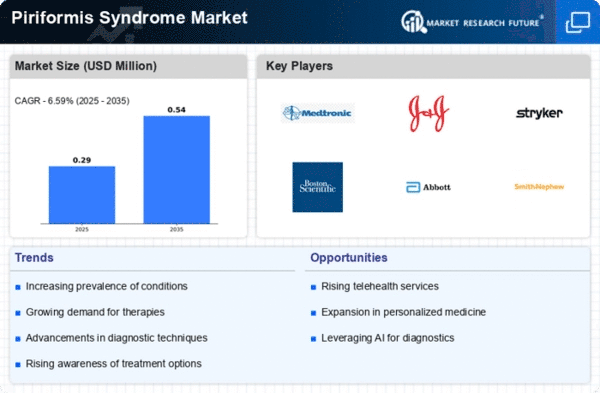
As per MRFR analysis, the Piriformis Syndrome Market Size was estimated at 0.268 USD Million in 2024. The Piriformis Syndrome industry is projected to grow from 0.289 in 2025 to 0.544 by 2035, exhibiting a compound annual growth rate (CAGR) of 6.59% during the forecast period 2025 - 2035.

Key Market Trends & Highlights

The Piriformis Syndrome Market is experiencing notable growth driven by increased awareness and advancements in treatment.

  • North America remains the largest market for Piriformis Syndrome, driven by heightened awareness and improved diagnostic capabilities.
  • The Asia-Pacific region is emerging as the fastest-growing market, reflecting a rising demand for effective treatment options.
  • Physical therapy continues to dominate the market segment, while medication is rapidly gaining traction as the fastest-growing segment.
  • Key market drivers include the rising incidence of Piriformis Syndrome and the growing demand for non-invasive treatments.

Market Size & Forecast

2024 Market Size 0.268 (USD Million)
2035 Market Size 0.544 (USD Million)
CAGR (2025 - 2035) 6.59%
Largest Regional Market Share in 2024 North America

Major Players

Medtronic (US), Johnson & Johnson (US), Stryker (US), Boston Scientific (US), Abbott Laboratories (US), Smith & Nephew (GB), Zimmer Biomet (US), DePuy Synthes (US)

Market Trends

The Piriformis Syndrome Market is currently experiencing a notable evolution, driven by a growing awareness of the condition and its impact on individuals' quality of life. This syndrome, characterized by pain in the buttocks and potential radiating discomfort down the leg, has garnered increased attention from healthcare professionals and patients alike. As a result, there is a rising demand for effective treatment options, including physical therapy, medications, and innovative surgical interventions. The market appears to be expanding as more individuals seek relief from symptoms, leading to a broader range of therapeutic solutions being developed and offered. Moreover, advancements in diagnostic techniques and a better understanding of the syndrome's underlying mechanisms are likely to enhance treatment efficacy. The integration of technology in healthcare, such as telemedicine and mobile health applications, may also play a role in improving patient access to care. As the Piriformis Syndrome Market continues to grow, stakeholders, including pharmaceutical companies and healthcare providers, are expected to adapt their strategies to meet the evolving needs of patients. This dynamic landscape suggests a promising future for the market, with potential for further innovation and improved patient outcomes.

Increased Awareness and Diagnosis

There is a growing recognition of Piriformis Syndrome among both healthcare providers and patients. This heightened awareness is leading to more accurate diagnoses and a subsequent rise in demand for treatment options. As individuals become more informed about their symptoms, they are more likely to seek medical advice, thereby driving market growth.

Advancements in Treatment Modalities

The Piriformis Syndrome Market is witnessing a shift towards more advanced treatment modalities. Innovations in physical therapy techniques, minimally invasive surgical options, and the development of targeted medications are becoming increasingly prevalent. These advancements are likely to enhance patient outcomes and satisfaction.

Integration of Technology in Care Delivery

The incorporation of technology into healthcare practices is transforming the way Piriformis Syndrome is managed. Telehealth services and mobile applications are facilitating better patient engagement and access to care. This trend may lead to improved monitoring of symptoms and treatment adherence, ultimately benefiting patients.

Piriformis Syndrome Market Market Drivers

Market Growth Projections

The Global Piriformis Syndrome Market Industry is projected to experience substantial growth over the next decade. With an estimated market value of 171.9 USD Million in 2024, the industry is expected to reach 330.0 USD Million by 2035. This growth trajectory suggests a compound annual growth rate of 6.11% from 2025 to 2035. Such projections indicate a robust demand for effective treatment options and highlight the increasing recognition of Piriformis Syndrome Market as a significant health concern. The market's expansion reflects the ongoing efforts to improve patient care and enhance treatment modalities.

Increased Awareness and Diagnosis

The growing awareness of Piriformis Syndrome Market among healthcare professionals and the general public is a significant driver for the Global Piriformis Syndrome Market Industry. Enhanced education and training for clinicians lead to more accurate diagnoses, which in turn encourages patients to seek treatment. Public health campaigns and resources available online contribute to this awareness, helping individuals recognize symptoms earlier. As a result, the market is likely to see an increase in demand for diagnostic tools and therapeutic interventions. This heightened awareness is expected to support the market's growth trajectory, with projections indicating a rise to 330.0 USD Million by 2035.

Integration of Telehealth Services

The integration of telehealth services into the management of Piriformis Syndrome Market is transforming the Global Piriformis Syndrome Market Industry. Telehealth offers patients convenient access to healthcare professionals, particularly for those in remote areas or with mobility challenges. This shift not only enhances patient engagement but also facilitates timely diagnosis and treatment. As telehealth continues to gain traction, it is likely to expand the reach of healthcare providers and improve patient outcomes. The ongoing evolution of telehealth services may further stimulate market growth, as more patients utilize these platforms for managing their conditions.

Advancements in Treatment Modalities

Innovations in treatment options for Piriformis Syndrome Market are propelling the Global Piriformis Syndrome Market Industry forward. Recent advancements include minimally invasive surgical techniques, physical therapy, and the use of targeted injections. These developments enhance patient outcomes and reduce recovery times, making treatment more appealing. Furthermore, the introduction of new therapeutic devices and medications is likely to improve the management of this condition. As the market evolves, it is anticipated that the Global Piriformis Syndrome Market will experience a compound annual growth rate of 6.11% from 2025 to 2035, driven by these advancements.

Rising Prevalence of Piriformis Syndrome

The increasing incidence of Piriformis Syndrome Market is a notable driver for the Global Piriformis Syndrome Market Industry. Factors such as sedentary lifestyles and the growing aging population contribute to this trend. Reports indicate that the prevalence of this condition is rising, particularly among individuals engaged in repetitive activities or prolonged sitting. As awareness of this syndrome grows, more patients seek medical intervention, thereby expanding the market. The Global Piriformis Syndrome Market is projected to reach 171.9 USD Million by 2024, reflecting the urgent need for effective treatment options and management strategies.

Growing Demand for Rehabilitation Services

The increasing demand for rehabilitation services for individuals suffering from Piriformis Syndrome Market is a crucial driver for the Global Piriformis Syndrome Market Industry. Rehabilitation programs focusing on physical therapy, exercise regimens, and pain management are becoming more prevalent. This trend is largely influenced by the rising number of patients seeking non-invasive treatment options. As healthcare systems prioritize rehabilitation to improve quality of life, the market is expected to expand significantly. The emphasis on holistic approaches to treatment aligns with the growing preference for personalized care, further supporting the market's development.

Market Segment Insights

By Treatment Type: Physical Therapy (Largest) vs. Medication (Fastest-Growing)

In the Piriformis Syndrome Market, the treatment type segment showcases a diverse array of options, with Physical Therapy holding the largest market share. This is primarily due to the rising acceptance of non-invasive treatment methods, which emphasize rehabilitation and recovery through carefully structured exercises. Medication, on the other hand, has shown significant growth potential as more patients seek immediate relief from pain through pharmaceuticals, particularly anti-inflammatory drugs and muscle relaxants. Growth trends in this market segment are being driven by increased awareness of Piriformis Syndrome and its effects on quality of life. As research continues to validate the efficacy of conservative treatments, Physical Therapy remains the stronghold while Medication is rapidly gaining ground. The emergence of novel drugs and the integration of telehealth for personalized <a href="https://www.marketresearchfuture.com/reports/medication-management-market-7187" target="_blank" title="medication management">medication management</a> further fuel the expansion of this segment.

Physical Therapy (Dominant) vs. Medication (Emerging)

Physical Therapy is the dominant treatment for Piriformis Syndrome due to its foundational approach of addressing the root causes of pain through physical rehabilitation. It is often tailored to individual patient needs, focusing on exercises that enhance strength, flexibility, and overall function, which can lead to long-term relief. On the other hand, Medication presents an emerging option that complements physical treatment, providing patients with necessary pain relief and inflammation reduction. With advancements in pharmacological treatments and a shift towards more holistic management of pain, this segment is witnessing rapid innovation. These two modalities signify a comprehensive approach to managing Piriformis Syndrome, balancing immediate relief with long-term recovery strategies.

By Diagnosis Method: Physical Examination (Largest) vs. MRI Scan (Fastest-Growing)

<p>In the Piriformis Syndrome Market, diagnosis methods such as Physical Examination have established a substantial presence, representing the largest share within this segment. While Physical Examination remains a critical component in assessing the condition's severity, MRI Scans are emerging as the method with the fastest growth rate. Their ability to provide detailed imaging of soft tissues has increased their utilization among healthcare professionals, leading to a notable shift toward advanced diagnostic techniques. The growth trends for diagnosis methods in the Piriformis Syndrome Market are driven by advances in imaging technology and the need for accurate diagnoses. MRI Scans, in particular, are benefiting from technological enhancements, enabling clearer and more precise visualizations. Simultaneously, awareness about the syndrome among practitioners and patients is boosting the adoption of various diagnostic methods, enhancing overall market dynamics and providing diverse options for clinical assessments.</p>

<p>Physical Examination (Dominant) vs. Nerve Conduction Study (Emerging)</p>

<p>The Physical Examination remains the dominant diagnosis method in the Piriformis Syndrome Market due to its accessibility, effectiveness, and cost-efficiency. This traditional method allows healthcare providers to assess the patient's physical condition and identify piriformis syndrome symptoms through basic tests and evaluations. On the other hand, the Nerve Conduction Study is an emerging technique gaining traction in diagnosing nerve-related issues associated with the syndrome. It involves testing the electrical conduction of nerves, helping in identifying nerve entrapment and related conditions. The growing emphasis on comprehensive diagnostic approaches is likely to position the Nerve Conduction Study as a valuable tool in the assessment arsenal for Piriformis Syndrome.</p>

By Patient Demographics: Age Group (Largest) vs. Gender (Fastest-Growing)

<p>In the Piriformis Syndrome Market, the distribution of patient demographics reveals that age group holds the largest share of patients suffering from this condition, primarily affecting individuals aged between 30-50 years. This demographic represents a significant portion of the total market due to their active lifestyles, which can contribute to the onset of piriformis syndrome. Gender also plays a crucial role, with a growing number of women being diagnosed, indicating an increasing recognition of the syndrome's prevalence among female patients.</p>

<p>Age Group (Dominant) vs. Gender (Emerging)</p>

<p>The age group segment, particularly individuals aged 30-50 years, proves to be the dominant force in the Piriformis Syndrome Market due to their higher likelihood of engaging in activities that can lead to irritation of the sciatic nerve. This age bracket is often characterized by physical jobs or hobbies that exacerbate the condition. Meanwhile, the gender segment is emerging, reflecting a noteworthy trend where women, historically underrepresented, are increasingly diagnosed with piriformis syndrome. Awareness and outreach programs are pivotal in identifying and treating this condition in women, leading to expected growth in female patient numbers in the near future.</p>

By Severity Level: Mild (Largest) vs. Severe (Fastest-Growing)

<p>The Piriformis Syndrome market is characterized by varying severity levels, with 'Mild' symptoms commanding the largest market share. This segment appeals to a broad demographic, as individuals often seek early intervention for manageable pain. The distribution among 'Moderate', 'Severe', 'Chronic', and 'Acute' levels reflects the nuanced understanding of patient needs, with 'Moderate' and 'Severe' also capturing significant attention due to their relative prevalence among affected individuals. 'Chronic' and 'Acute' categories, while vital, contribute to a smaller fraction of the market, indicating varied treatment complexities. Growth trends highlight an increasing focus on acute and severe Piriformis Syndrome cases, driven by heightened awareness and advancements in therapeutic options. Factors such as innovative treatment modalities, the rise of specialty clinics, and increased patient education have contributed to the swift growth of the severe category. Furthermore, the chronic nature of some cases continues to necessitate improvements in management strategies, promoting ongoing research and development in targeted therapies.</p>

<p>Mild (Dominant) vs. Severe (Emerging)</p>

<p>The 'Mild' severity level represents a dominant segment in the Piriformis Syndrome market, characterized by lower intensity symptoms that often lead patients to pursue conservative treatment options. Individuals in this category tend to experience occasional discomfort, resulting in a proactive approach to management through physiotherapy and lifestyle adjustments. In contrast, the 'Severe' segment is emerging as a critical focus for healthcare providers, driven by increasing awareness and more comprehensive treatment protocols. Patients experiencing severe symptoms often require more aggressive intervention, potentially including surgical options. This differentiation in severity shapes treatment pathways and patient engagement, influencing the overall market dynamics as stakeholders adapt to the evolving landscape.</p>

By Healthcare Setting: Outpatient Clinic (Largest) vs. Hospital (Fastest-Growing)

<p>The healthcare setting for the Piriformis Syndrome market is diverse, with outpatient clinics holding the largest share of the market. These clinics are pivotal in providing accessible treatments and quick interventions for patients suffering from piriformis syndrome. Hospitals also occupy a significant place in this landscape, but their market share is growing rapidly due to increasing recognition of more complex cases that require comprehensive care and advanced treatment options.</p>

<p>Outpatient Clinic (Dominant) vs. Hospital (Emerging)</p>

<p>Outpatient clinics serve as the dominant setting in the Piriformis Syndrome market, offering targeted interventions and a convenient environment for patients. Their personalized approach and emphasis on non-invasive treatments appeal to many individuals seeking relief. In contrast, hospitals, labeled as an emerging setting, are stepping up their game to cater to the more complex cases of piriformis syndrome. The increase in surgical interventions and integrated care protocols in hospitals is aimed at accommodating patients with multifaceted issues, driving their growth in this market.</p>

Get more detailed insights about Piriformis Syndrome Market Research Report – Forecast to 2035

Regional Insights

North America : Market Leader in Innovation

North America is poised to maintain its leadership in the Piriformis Syndrome market, holding a significant market share of 13.4% in 2024. The region's growth is driven by increasing awareness of the condition, advancements in medical technology, and a robust healthcare infrastructure. Regulatory support for innovative treatments and therapies further fuels demand, making it a key player in the global market. The United States stands out as the leading country, with major players like Medtronic, Johnson & Johnson, and Stryker driving competition. The presence of advanced healthcare facilities and a high prevalence of musculoskeletal disorders contribute to the market's expansion. As the region continues to innovate, it attracts investments aimed at enhancing treatment options for Piriformis Syndrome.

Europe : Emerging Market with Growth Potential

Europe is witnessing a growing interest in the Piriformis Syndrome market, with a market share of 8.6% in 2024. Factors such as an aging population, increased healthcare spending, and a focus on pain management are driving demand. Regulatory frameworks in countries like Germany and France are evolving to support innovative treatment options, enhancing market growth prospects across the region. Leading countries include Germany, France, and the UK, where key players like Smith & Nephew and Zimmer Biomet are actively involved. The competitive landscape is characterized by collaborations and partnerships aimed at developing advanced therapeutic solutions. As healthcare systems adapt to meet patient needs, the market is expected to expand significantly in the coming years.

Asia-Pacific : Emerging Powerhouse in Healthcare

The Asia-Pacific region is emerging as a significant player in the Piriformis Syndrome market, with a market share of 3.8% in 2024. The growth is driven by rising healthcare expenditures, increasing awareness of musculoskeletal disorders, and a growing population. Countries like China and India are investing heavily in healthcare infrastructure, which is expected to boost demand for effective treatment options in the coming years. China and Japan are leading the market, with a competitive landscape featuring both local and international players. Companies are focusing on expanding their product offerings and enhancing distribution channels to capture a larger market share. As the region continues to develop, it presents lucrative opportunities for growth in the Piriformis Syndrome market.

Middle East and Africa : Resource-Rich Frontier for Healthcare

The Middle East and Africa region is gradually emerging in the Piriformis Syndrome market, holding a market share of 1.0% in 2024. The growth is primarily driven by increasing healthcare investments, a rising prevalence of lifestyle-related disorders, and a focus on improving healthcare access. Governments are implementing policies to enhance healthcare infrastructure, which is expected to support market growth in the coming years. Leading countries in this region include South Africa and the UAE, where healthcare systems are evolving to meet patient needs. The competitive landscape is characterized by a mix of local and international players, with companies focusing on establishing a presence in the region. As healthcare continues to improve, the market for Piriformis Syndrome treatments is anticipated to grow steadily.

Key Players and Competitive Insights

The Piriformis Syndrome Market is characterized by a competitive landscape that is increasingly shaped by innovation, strategic partnerships, and a focus on patient-centric solutions. Key players such as Medtronic (US), Johnson & Johnson (US), and Stryker (US) are actively engaged in enhancing their product offerings and expanding their market presence. Medtronic (US) has positioned itself as a leader in neuromodulation therapies, which are crucial for managing pain associated with Piriformis Syndrome. Meanwhile, Johnson & Johnson (US) emphasizes a diversified portfolio that includes surgical instruments and advanced imaging technologies, aiming to streamline treatment processes. Stryker (US) focuses on integrating digital health solutions into its surgical products, thereby enhancing operational efficiency and patient outcomes. Collectively, these strategies contribute to a dynamic competitive environment, where innovation and operational excellence are paramount.In terms of business tactics, companies are increasingly localizing manufacturing to reduce costs and improve supply chain resilience. This approach is particularly relevant in the context of the Piriformis Syndrome Market, which is moderately fragmented, with several players vying for market share. The collective influence of these key players is significant, as they not only drive technological advancements but also set industry standards that smaller companies must adhere to.

In November Medtronic (US) announced the launch of a new neuromodulation device specifically designed for chronic pain management, including Piriformis Syndrome. This strategic move is expected to enhance Medtronic's market share by addressing unmet needs in pain management, thereby reinforcing its leadership position. The introduction of this device aligns with the growing trend towards personalized medicine, which is becoming increasingly important in the treatment of musculoskeletal disorders.

In October Johnson & Johnson (US) entered into a partnership with a leading telehealth provider to enhance remote patient monitoring capabilities for individuals suffering from Piriformis Syndrome. This collaboration is strategically significant as it not only expands Johnson & Johnson's digital health footprint but also facilitates better patient engagement and adherence to treatment protocols. The integration of telehealth solutions is likely to improve patient outcomes and streamline care delivery.

In September Stryker (US) acquired a small but innovative company specializing in AI-driven surgical planning tools. This acquisition is indicative of Stryker's commitment to integrating advanced technologies into its product offerings, which could potentially revolutionize surgical approaches for Piriformis Syndrome. By leveraging AI, Stryker aims to enhance precision in surgical procedures, thereby improving recovery times and overall patient satisfaction.

As of December the Piriformis Syndrome Market is witnessing trends that emphasize digitalization, sustainability, and the integration of AI technologies. Strategic alliances are increasingly shaping the competitive landscape, allowing companies to pool resources and expertise to drive innovation. The shift from price-based competition to a focus on technological advancement and supply chain reliability is evident. Moving forward, competitive differentiation will likely hinge on the ability to innovate and deliver superior patient outcomes, as companies navigate an evolving market landscape.

Key Companies in the Piriformis Syndrome Market include

Industry Developments

Future Outlook

Piriformis Syndrome Market Future Outlook

The Piriformis Syndrome Market is projected to grow at a 6.59% CAGR from 2025 to 2035, driven by increasing awareness, innovative treatment options, and rising healthcare expenditures.

New opportunities lie in:

  • Development of telehealth platforms for remote consultations and treatment plans.
  • Investment in targeted physical therapy programs tailored for Piriformis Syndrome patients.
  • Creation of specialized ergonomic products to alleviate symptoms in workplaces.

By 2035, the Piriformis Syndrome Market is expected to achieve substantial growth and innovation.

Market Segmentation

Piriformis Syndrome Market Treatment Type Outlook

  • Physical Therapy
  • Medication
  • Surgery
  • Chiropractic Care
  • Massage Therapy

Piriformis Syndrome Market Diagnosis Method Outlook

  • Physical Examination
  • Imaging Techniques
  • Electromyography
  • Nerve Conduction Studies
  • Patient History

Piriformis Syndrome Market Symptom Severity Outlook

  • Mild
  • Moderate
  • Severe
  • Chronic
  • Acute

Piriformis Syndrome Market Patient Demographics Outlook

  • Age Group
  • Gender
  • Activity Level
  • Occupation
  • Health Status

Report Scope

MARKET SIZE 2024 0.268(USD Million)
MARKET SIZE 2025 0.289(USD Million)
MARKET SIZE 2035 0.544(USD Million)
COMPOUND ANNUAL GROWTH RATE (CAGR) 6.59% (2025 - 2035)
REPORT COVERAGE Revenue Forecast, Competitive Landscape, Growth Factors, and Trends
BASE YEAR 2024
Market Forecast Period 2025 - 2035
Historical Data 2019 - 2024
Market Forecast Units USD Million
Key Companies Profiled Medtronic (US), Johnson & Johnson (US), Stryker (US), Boston Scientific (US), Abbott Laboratories (US), Smith & Nephew (GB), Zimmer Biomet (US), DePuy Synthes (US)
Segments Covered Treatment Type, Patient Demographics, Symptom Severity, Diagnosis Method
Key Market Opportunities Advancements in non-invasive treatment options for Piriformis Syndrome enhance patient outcomes and market potential.
Key Market Dynamics Rising demand for non-invasive treatment options drives innovation in the Piriformis Syndrome market.
Countries Covered North America, Europe, APAC, South America, MEA

FAQs

What is the projected market valuation for the Piriformis Syndrome Market in 2035?

<p>The projected market valuation for the Piriformis Syndrome Market in 2035 is expected to reach 0.544 USD Million.</p>

What was the overall market valuation for the Piriformis Syndrome Market in 2024?

<p>The overall market valuation for the Piriformis Syndrome Market in 2024 was 0.268 USD Million.</p>

What is the expected CAGR for the Piriformis Syndrome Market during the forecast period 2025 - 2035?

<p>The expected CAGR for the Piriformis Syndrome Market during the forecast period 2025 - 2035 is 6.59%.</p>

Which companies are considered key players in the Piriformis Syndrome Market?

<p>Key players in the Piriformis Syndrome Market include Medtronic, Johnson & Johnson, Stryker, and Boston Scientific.</p>

What treatment type segment had the highest valuation in 2024?

<p>In 2024, the Physical Therapy segment had the highest valuation at 0.1648 USD Million.</p>

How does the market perform in terms of diagnosis methods for Piriformis Syndrome?

The MRI Scan segment shows a valuation of 0.174 USD Million, indicating strong performance in diagnosis methods.

What demographic factors are influencing the Piriformis Syndrome Market?

Factors such as Age Group and Gender are influencing the market, with valuations of 0.1 USD Million and 0.12 USD Million, respectively.

What is the market outlook for outpatient clinics in the Piriformis Syndrome Market?

The outpatient clinic segment is projected to maintain a valuation of 0.136 USD Million, reflecting its importance in healthcare settings.

Which severity level segment is expected to show growth in the coming years?

The Moderate severity level segment, valued at 0.162 USD Million, is expected to show growth in the coming years.

How does the Piriformis Syndrome Market compare across different healthcare settings?

In 2024, the Hospital segment led with a valuation of 0.164 USD Million, suggesting a preference for treatment in hospital settings.

  1. SECTION I: EXECUTIVE SUMMARY AND KEY HIGHLIGHTS
    1. | 1.1 EXECUTIVE SUMMARY
    2. | | 1.1.1 Market Overview
    3. | | 1.1.2 Key Findings
    4. | | 1.1.3 Market Segmentation
    5. | | 1.1.4 Competitive Landscape
    6. | | 1.1.5 Challenges and Opportunities
    7. | | 1.1.6 Future Outlook
  2. SECTION II: SCOPING, METHODOLOGY AND MARKET STRUCTURE
    1. | 2.1 MARKET INTRODUCTION
    2. | | 2.1.1 Definition
    3. | | 2.1.2 Scope of the study
    4. | | | 2.1.2.1 Research Objective
    5. | | | 2.1.2.2 Assumption
    6. | | | 2.1.2.3 Limitations
    7. | 2.2 RESEARCH METHODOLOGY
    8. | | 2.2.1 Overview
    9. | | 2.2.2 Data Mining
    10. | | 2.2.3 Secondary Research
    11. | | 2.2.4 Primary Research
    12. | | | 2.2.4.1 Primary Interviews and Information Gathering Process
    13. | | | 2.2.4.2 Breakdown of Primary Respondents
    14. | | 2.2.5 Forecasting Model
    15. | | 2.2.6 Market Size Estimation
    16. | | | 2.2.6.1 Bottom-Up Approach
    17. | | | 2.2.6.2 Top-Down Approach
    18. | | 2.2.7 Data Triangulation
    19. | | 2.2.8 Validation
  3. SECTION III: QUALITATIVE ANALYSIS
    1. | 3.1 MARKET DYNAMICS
    2. | | 3.1.1 Overview
    3. | | 3.1.2 Drivers
    4. | | 3.1.3 Restraints
    5. | | 3.1.4 Opportunities
    6. | 3.2 MARKET FACTOR ANALYSIS
    7. | | 3.2.1 Value chain Analysis
    8. | | 3.2.2 Porter's Five Forces Analysis
    9. | | | 3.2.2.1 Bargaining Power of Suppliers
    10. | | | 3.2.2.2 Bargaining Power of Buyers
    11. | | | 3.2.2.3 Threat of New Entrants
    12. | | | 3.2.2.4 Threat of Substitutes
    13. | | | 3.2.2.5 Intensity of Rivalry
    14. | | 3.2.3 COVID-19 Impact Analysis
    15. | | | 3.2.3.1 Market Impact Analysis
    16. | | | 3.2.3.2 Regional Impact
    17. | | | 3.2.3.3 Opportunity and Threat Analysis
  4. SECTION IV: QUANTITATIVE ANALYSIS
    1. | 4.1 Healthcare, BY Treatment Type (USD Million)
    2. | | 4.1.1 Physical Therapy
    3. | | 4.1.2 Medication
    4. | | 4.1.3 Surgery
    5. | | 4.1.4 Chiropractic Care
    6. | | 4.1.5 Massage Therapy
    7. | 4.2 Healthcare, BY Diagnosis Method (USD Million)
    8. | | 4.2.1 Physical Examination
    9. | | 4.2.2 MRI Scan
    10. | | 4.2.3 Ultrasound
    11. | | 4.2.4 X-ray
    12. | | 4.2.5 Nerve Conduction Study
    13. | 4.3 Healthcare, BY Patient Demographics (USD Million)
    14. | | 4.3.1 Age Group
    15. | | 4.3.2 Gender
    16. | | 4.3.3 Activity Level
    17. | | 4.3.4 Occupation
    18. | | 4.3.5 Health Status
    19. | 4.4 Healthcare, BY Severity Level (USD Million)
    20. | | 4.4.1 Mild
    21. | | 4.4.2 Moderate
    22. | | 4.4.3 Severe
    23. | | 4.4.4 Chronic
    24. | | 4.4.5 Acute
    25. | 4.5 Healthcare, BY Healthcare Setting (USD Million)
    26. | | 4.5.1 Outpatient Clinic
    27. | | 4.5.2 Hospital
    28. | | 4.5.3 Rehabilitation Center
    29. | | 4.5.4 Home Care
    30. | | 4.5.5 Sports Facility
    31. | 4.6 Healthcare, BY Region (USD Million)
    32. | | 4.6.1 North America
    33. | | | 4.6.1.1 US
    34. | | | 4.6.1.2 Canada
    35. | | 4.6.2 Europe
    36. | | | 4.6.2.1 Germany
    37. | | | 4.6.2.2 UK
    38. | | | 4.6.2.3 France
    39. | | | 4.6.2.4 Russia
    40. | | | 4.6.2.5 Italy
    41. | | | 4.6.2.6 Spain
    42. | | | 4.6.2.7 Rest of Europe
    43. | | 4.6.3 APAC
    44. | | | 4.6.3.1 China
    45. | | | 4.6.3.2 India
    46. | | | 4.6.3.3 Japan
    47. | | | 4.6.3.4 South Korea
    48. | | | 4.6.3.5 Malaysia
    49. | | | 4.6.3.6 Thailand
    50. | | | 4.6.3.7 Indonesia
    51. | | | 4.6.3.8 Rest of APAC
    52. | | 4.6.4 South America
    53. | | | 4.6.4.1 Brazil
    54. | | | 4.6.4.2 Mexico
    55. | | | 4.6.4.3 Argentina
    56. | | | 4.6.4.4 Rest of South America
    57. | | 4.6.5 MEA
    58. | | | 4.6.5.1 GCC Countries
    59. | | | 4.6.5.2 South Africa
    60. | | | 4.6.5.3 Rest of MEA
  5. SECTION V: COMPETITIVE ANALYSIS
    1. | 5.1 Competitive Landscape
    2. | | 5.1.1 Overview
    3. | | 5.1.2 Competitive Analysis
    4. | | 5.1.3 Market share Analysis
    5. | | 5.1.4 Major Growth Strategy in the Healthcare
    6. | | 5.1.5 Competitive Benchmarking
    7. | | 5.1.6 Leading Players in Terms of Number of Developments in the Healthcare
    8. | | 5.1.7 Key developments and growth strategies
    9. | | | 5.1.7.1 New Product Launch/Service Deployment
    10. | | | 5.1.7.2 Merger & Acquisitions
    11. | | | 5.1.7.3 Joint Ventures
    12. | | 5.1.8 Major Players Financial Matrix
    13. | | | 5.1.8.1 Sales and Operating Income
    14. | | | 5.1.8.2 Major Players R&D Expenditure. 2023
    15. | 5.2 Company Profiles
    16. | | 5.2.1 Medtronic (US)
    17. | | | 5.2.1.1 Financial Overview
    18. | | | 5.2.1.2 Products Offered
    19. | | | 5.2.1.3 Key Developments
    20. | | | 5.2.1.4 SWOT Analysis
    21. | | | 5.2.1.5 Key Strategies
    22. | | 5.2.2 Johnson & Johnson (US)
    23. | | | 5.2.2.1 Financial Overview
    24. | | | 5.2.2.2 Products Offered
    25. | | | 5.2.2.3 Key Developments
    26. | | | 5.2.2.4 SWOT Analysis
    27. | | | 5.2.2.5 Key Strategies
    28. | | 5.2.3 Stryker (US)
    29. | | | 5.2.3.1 Financial Overview
    30. | | | 5.2.3.2 Products Offered
    31. | | | 5.2.3.3 Key Developments
    32. | | | 5.2.3.4 SWOT Analysis
    33. | | | 5.2.3.5 Key Strategies
    34. | | 5.2.4 Boston Scientific (US)
    35. | | | 5.2.4.1 Financial Overview
    36. | | | 5.2.4.2 Products Offered
    37. | | | 5.2.4.3 Key Developments
    38. | | | 5.2.4.4 SWOT Analysis
    39. | | | 5.2.4.5 Key Strategies
    40. | | 5.2.5 Abbott Laboratories (US)
    41. | | | 5.2.5.1 Financial Overview
    42. | | | 5.2.5.2 Products Offered
    43. | | | 5.2.5.3 Key Developments
    44. | | | 5.2.5.4 SWOT Analysis
    45. | | | 5.2.5.5 Key Strategies
    46. | | 5.2.6 Baxter International (US)
    47. | | | 5.2.6.1 Financial Overview
    48. | | | 5.2.6.2 Products Offered
    49. | | | 5.2.6.3 Key Developments
    50. | | | 5.2.6.4 SWOT Analysis
    51. | | | 5.2.6.5 Key Strategies
    52. | | 5.2.7 Smith & Nephew (GB)
    53. | | | 5.2.7.1 Financial Overview
    54. | | | 5.2.7.2 Products Offered
    55. | | | 5.2.7.3 Key Developments
    56. | | | 5.2.7.4 SWOT Analysis
    57. | | | 5.2.7.5 Key Strategies
    58. | | 5.2.8 Zimmer Biomet (US)
    59. | | | 5.2.8.1 Financial Overview
    60. | | | 5.2.8.2 Products Offered
    61. | | | 5.2.8.3 Key Developments
    62. | | | 5.2.8.4 SWOT Analysis
    63. | | | 5.2.8.5 Key Strategies
    64. | | 5.2.9 NuVasive (US)
    65. | | | 5.2.9.1 Financial Overview
    66. | | | 5.2.9.2 Products Offered
    67. | | | 5.2.9.3 Key Developments
    68. | | | 5.2.9.4 SWOT Analysis
    69. | | | 5.2.9.5 Key Strategies
    70. | 5.3 Appendix
    71. | | 5.3.1 References
    72. | | 5.3.2 Related Reports
  6. LIST OF FIGURES
    1. | 6.1 MARKET SYNOPSIS
    2. | 6.2 NORTH AMERICA MARKET ANALYSIS
    3. | 6.3 US MARKET ANALYSIS BY TREATMENT TYPE
    4. | 6.4 US MARKET ANALYSIS BY DIAGNOSIS METHOD
    5. | 6.5 US MARKET ANALYSIS BY PATIENT DEMOGRAPHICS
    6. | 6.6 US MARKET ANALYSIS BY SEVERITY LEVEL
    7. | 6.7 US MARKET ANALYSIS BY HEALTHCARE SETTING
    8. | 6.8 CANADA MARKET ANALYSIS BY TREATMENT TYPE
    9. | 6.9 CANADA MARKET ANALYSIS BY DIAGNOSIS METHOD
    10. | 6.10 CANADA MARKET ANALYSIS BY PATIENT DEMOGRAPHICS
    11. | 6.11 CANADA MARKET ANALYSIS BY SEVERITY LEVEL
    12. | 6.12 CANADA MARKET ANALYSIS BY HEALTHCARE SETTING
    13. | 6.13 EUROPE MARKET ANALYSIS
    14. | 6.14 GERMANY MARKET ANALYSIS BY TREATMENT TYPE
    15. | 6.15 GERMANY MARKET ANALYSIS BY DIAGNOSIS METHOD
    16. | 6.16 GERMANY MARKET ANALYSIS BY PATIENT DEMOGRAPHICS
    17. | 6.17 GERMANY MARKET ANALYSIS BY SEVERITY LEVEL
    18. | 6.18 GERMANY MARKET ANALYSIS BY HEALTHCARE SETTING
    19. | 6.19 UK MARKET ANALYSIS BY TREATMENT TYPE
    20. | 6.20 UK MARKET ANALYSIS BY DIAGNOSIS METHOD
    21. | 6.21 UK MARKET ANALYSIS BY PATIENT DEMOGRAPHICS
    22. | 6.22 UK MARKET ANALYSIS BY SEVERITY LEVEL
    23. | 6.23 UK MARKET ANALYSIS BY HEALTHCARE SETTING
    24. | 6.24 FRANCE MARKET ANALYSIS BY TREATMENT TYPE
    25. | 6.25 FRANCE MARKET ANALYSIS BY DIAGNOSIS METHOD
    26. | 6.26 FRANCE MARKET ANALYSIS BY PATIENT DEMOGRAPHICS
    27. | 6.27 FRANCE MARKET ANALYSIS BY SEVERITY LEVEL
    28. | 6.28 FRANCE MARKET ANALYSIS BY HEALTHCARE SETTING
    29. | 6.29 RUSSIA MARKET ANALYSIS BY TREATMENT TYPE
    30. | 6.30 RUSSIA MARKET ANALYSIS BY DIAGNOSIS METHOD
    31. | 6.31 RUSSIA MARKET ANALYSIS BY PATIENT DEMOGRAPHICS
    32. | 6.32 RUSSIA MARKET ANALYSIS BY SEVERITY LEVEL
    33. | 6.33 RUSSIA MARKET ANALYSIS BY HEALTHCARE SETTING
    34. | 6.34 ITALY MARKET ANALYSIS BY TREATMENT TYPE
    35. | 6.35 ITALY MARKET ANALYSIS BY DIAGNOSIS METHOD
    36. | 6.36 ITALY MARKET ANALYSIS BY PATIENT DEMOGRAPHICS
    37. | 6.37 ITALY MARKET ANALYSIS BY SEVERITY LEVEL
    38. | 6.38 ITALY MARKET ANALYSIS BY HEALTHCARE SETTING
    39. | 6.39 SPAIN MARKET ANALYSIS BY TREATMENT TYPE
    40. | 6.40 SPAIN MARKET ANALYSIS BY DIAGNOSIS METHOD
    41. | 6.41 SPAIN MARKET ANALYSIS BY PATIENT DEMOGRAPHICS
    42. | 6.42 SPAIN MARKET ANALYSIS BY SEVERITY LEVEL
    43. | 6.43 SPAIN MARKET ANALYSIS BY HEALTHCARE SETTING
    44. | 6.44 REST OF EUROPE MARKET ANALYSIS BY TREATMENT TYPE
    45. | 6.45 REST OF EUROPE MARKET ANALYSIS BY DIAGNOSIS METHOD
    46. | 6.46 REST OF EUROPE MARKET ANALYSIS BY PATIENT DEMOGRAPHICS
    47. | 6.47 REST OF EUROPE MARKET ANALYSIS BY SEVERITY LEVEL
    48. | 6.48 REST OF EUROPE MARKET ANALYSIS BY HEALTHCARE SETTING
    49. | 6.49 APAC MARKET ANALYSIS
    50. | 6.50 CHINA MARKET ANALYSIS BY TREATMENT TYPE
    51. | 6.51 CHINA MARKET ANALYSIS BY DIAGNOSIS METHOD
    52. | 6.52 CHINA MARKET ANALYSIS BY PATIENT DEMOGRAPHICS
    53. | 6.53 CHINA MARKET ANALYSIS BY SEVERITY LEVEL
    54. | 6.54 CHINA MARKET ANALYSIS BY HEALTHCARE SETTING
    55. | 6.55 INDIA MARKET ANALYSIS BY TREATMENT TYPE
    56. | 6.56 INDIA MARKET ANALYSIS BY DIAGNOSIS METHOD
    57. | 6.57 INDIA MARKET ANALYSIS BY PATIENT DEMOGRAPHICS
    58. | 6.58 INDIA MARKET ANALYSIS BY SEVERITY LEVEL
    59. | 6.59 INDIA MARKET ANALYSIS BY HEALTHCARE SETTING
    60. | 6.60 JAPAN MARKET ANALYSIS BY TREATMENT TYPE
    61. | 6.61 JAPAN MARKET ANALYSIS BY DIAGNOSIS METHOD
    62. | 6.62 JAPAN MARKET ANALYSIS BY PATIENT DEMOGRAPHICS
    63. | 6.63 JAPAN MARKET ANALYSIS BY SEVERITY LEVEL
    64. | 6.64 JAPAN MARKET ANALYSIS BY HEALTHCARE SETTING
    65. | 6.65 SOUTH KOREA MARKET ANALYSIS BY TREATMENT TYPE
    66. | 6.66 SOUTH KOREA MARKET ANALYSIS BY DIAGNOSIS METHOD
    67. | 6.67 SOUTH KOREA MARKET ANALYSIS BY PATIENT DEMOGRAPHICS
    68. | 6.68 SOUTH KOREA MARKET ANALYSIS BY SEVERITY LEVEL
    69. | 6.69 SOUTH KOREA MARKET ANALYSIS BY HEALTHCARE SETTING
    70. | 6.70 MALAYSIA MARKET ANALYSIS BY TREATMENT TYPE
    71. | 6.71 MALAYSIA MARKET ANALYSIS BY DIAGNOSIS METHOD
    72. | 6.72 MALAYSIA MARKET ANALYSIS BY PATIENT DEMOGRAPHICS
    73. | 6.73 MALAYSIA MARKET ANALYSIS BY SEVERITY LEVEL
    74. | 6.74 MALAYSIA MARKET ANALYSIS BY HEALTHCARE SETTING
    75. | 6.75 THAILAND MARKET ANALYSIS BY TREATMENT TYPE
    76. | 6.76 THAILAND MARKET ANALYSIS BY DIAGNOSIS METHOD
    77. | 6.77 THAILAND MARKET ANALYSIS BY PATIENT DEMOGRAPHICS
    78. | 6.78 THAILAND MARKET ANALYSIS BY SEVERITY LEVEL
    79. | 6.79 THAILAND MARKET ANALYSIS BY HEALTHCARE SETTING
    80. | 6.80 INDONESIA MARKET ANALYSIS BY TREATMENT TYPE
    81. | 6.81 INDONESIA MARKET ANALYSIS BY DIAGNOSIS METHOD
    82. | 6.82 INDONESIA MARKET ANALYSIS BY PATIENT DEMOGRAPHICS
    83. | 6.83 INDONESIA MARKET ANALYSIS BY SEVERITY LEVEL
    84. | 6.84 INDONESIA MARKET ANALYSIS BY HEALTHCARE SETTING
    85. | 6.85 REST OF APAC MARKET ANALYSIS BY TREATMENT TYPE
    86. | 6.86 REST OF APAC MARKET ANALYSIS BY DIAGNOSIS METHOD
    87. | 6.87 REST OF APAC MARKET ANALYSIS BY PATIENT DEMOGRAPHICS
    88. | 6.88 REST OF APAC MARKET ANALYSIS BY SEVERITY LEVEL
    89. | 6.89 REST OF APAC MARKET ANALYSIS BY HEALTHCARE SETTING
    90. | 6.90 SOUTH AMERICA MARKET ANALYSIS
    91. | 6.91 BRAZIL MARKET ANALYSIS BY TREATMENT TYPE
    92. | 6.92 BRAZIL MARKET ANALYSIS BY DIAGNOSIS METHOD
    93. | 6.93 BRAZIL MARKET ANALYSIS BY PATIENT DEMOGRAPHICS
    94. | 6.94 BRAZIL MARKET ANALYSIS BY SEVERITY LEVEL
    95. | 6.95 BRAZIL MARKET ANALYSIS BY HEALTHCARE SETTING
    96. | 6.96 MEXICO MARKET ANALYSIS BY TREATMENT TYPE
    97. | 6.97 MEXICO MARKET ANALYSIS BY DIAGNOSIS METHOD
    98. | 6.98 MEXICO MARKET ANALYSIS BY PATIENT DEMOGRAPHICS
    99. | 6.99 MEXICO MARKET ANALYSIS BY SEVERITY LEVEL
    100. | 6.100 MEXICO MARKET ANALYSIS BY HEALTHCARE SETTING
    101. | 6.101 ARGENTINA MARKET ANALYSIS BY TREATMENT TYPE
    102. | 6.102 ARGENTINA MARKET ANALYSIS BY DIAGNOSIS METHOD
    103. | 6.103 ARGENTINA MARKET ANALYSIS BY PATIENT DEMOGRAPHICS
    104. | 6.104 ARGENTINA MARKET ANALYSIS BY SEVERITY LEVEL
    105. | 6.105 ARGENTINA MARKET ANALYSIS BY HEALTHCARE SETTING
    106. | 6.106 REST OF SOUTH AMERICA MARKET ANALYSIS BY TREATMENT TYPE
    107. | 6.107 REST OF SOUTH AMERICA MARKET ANALYSIS BY DIAGNOSIS METHOD
    108. | 6.108 REST OF SOUTH AMERICA MARKET ANALYSIS BY PATIENT DEMOGRAPHICS
    109. | 6.109 REST OF SOUTH AMERICA MARKET ANALYSIS BY SEVERITY LEVEL
    110. | 6.110 REST OF SOUTH AMERICA MARKET ANALYSIS BY HEALTHCARE SETTING
    111. | 6.111 MEA MARKET ANALYSIS
    112. | 6.112 GCC COUNTRIES MARKET ANALYSIS BY TREATMENT TYPE
    113. | 6.113 GCC COUNTRIES MARKET ANALYSIS BY DIAGNOSIS METHOD
    114. | 6.114 GCC COUNTRIES MARKET ANALYSIS BY PATIENT DEMOGRAPHICS
    115. | 6.115 GCC COUNTRIES MARKET ANALYSIS BY SEVERITY LEVEL
    116. | 6.116 GCC COUNTRIES MARKET ANALYSIS BY HEALTHCARE SETTING
    117. | 6.117 SOUTH AFRICA MARKET ANALYSIS BY TREATMENT TYPE
    118. | 6.118 SOUTH AFRICA MARKET ANALYSIS BY DIAGNOSIS METHOD
    119. | 6.119 SOUTH AFRICA MARKET ANALYSIS BY PATIENT DEMOGRAPHICS
    120. | 6.120 SOUTH AFRICA MARKET ANALYSIS BY SEVERITY LEVEL
    121. | 6.121 SOUTH AFRICA MARKET ANALYSIS BY HEALTHCARE SETTING
    122. | 6.122 REST OF MEA MARKET ANALYSIS BY TREATMENT TYPE
    123. | 6.123 REST OF MEA MARKET ANALYSIS BY DIAGNOSIS METHOD
    124. | 6.124 REST OF MEA MARKET ANALYSIS BY PATIENT DEMOGRAPHICS
    125. | 6.125 REST OF MEA MARKET ANALYSIS BY SEVERITY LEVEL
    126. | 6.126 REST OF MEA MARKET ANALYSIS BY HEALTHCARE SETTING
    127. | 6.127 KEY BUYING CRITERIA OF HEALTHCARE
    128. | 6.128 RESEARCH PROCESS OF MRFR
    129. | 6.129 DRO ANALYSIS OF HEALTHCARE
    130. | 6.130 DRIVERS IMPACT ANALYSIS: HEALTHCARE
    131. | 6.131 RESTRAINTS IMPACT ANALYSIS: HEALTHCARE
    132. | 6.132 SUPPLY / VALUE CHAIN: HEALTHCARE
    133. | 6.133 HEALTHCARE, BY TREATMENT TYPE, 2024 (% SHARE)
    134. | 6.134 HEALTHCARE, BY TREATMENT TYPE, 2024 TO 2035 (USD Million)
    135. | 6.135 HEALTHCARE, BY DIAGNOSIS METHOD, 2024 (% SHARE)
    136. | 6.136 HEALTHCARE, BY DIAGNOSIS METHOD, 2024 TO 2035 (USD Million)
    137. | 6.137 HEALTHCARE, BY PATIENT DEMOGRAPHICS, 2024 (% SHARE)
    138. | 6.138 HEALTHCARE, BY PATIENT DEMOGRAPHICS, 2024 TO 2035 (USD Million)
    139. | 6.139 HEALTHCARE, BY SEVERITY LEVEL, 2024 (% SHARE)
    140. | 6.140 HEALTHCARE, BY SEVERITY LEVEL, 2024 TO 2035 (USD Million)
    141. | 6.141 HEALTHCARE, BY HEALTHCARE SETTING, 2024 (% SHARE)
    142. | 6.142 HEALTHCARE, BY HEALTHCARE SETTING, 2024 TO 2035 (USD Million)
    143. | 6.143 BENCHMARKING OF MAJOR COMPETITORS
  7. LIST OF TABLES
    1. | 7.1 LIST OF ASSUMPTIONS
    2. | | 7.1.1
    3. | 7.2 North America MARKET SIZE ESTIMATES; FORECAST
    4. | | 7.2.1 BY TREATMENT TYPE, 2025-2035 (USD Million)
    5. | | 7.2.2 BY DIAGNOSIS METHOD, 2025-2035 (USD Million)
    6. | | 7.2.3 BY PATIENT DEMOGRAPHICS, 2025-2035 (USD Million)
    7. | | 7.2.4 BY SEVERITY LEVEL, 2025-2035 (USD Million)
    8. | | 7.2.5 BY HEALTHCARE SETTING, 2025-2035 (USD Million)
    9. | 7.3 US MARKET SIZE ESTIMATES; FORECAST
    10. | | 7.3.1 BY TREATMENT TYPE, 2025-2035 (USD Million)
    11. | | 7.3.2 BY DIAGNOSIS METHOD, 2025-2035 (USD Million)
    12. | | 7.3.3 BY PATIENT DEMOGRAPHICS, 2025-2035 (USD Million)
    13. | | 7.3.4 BY SEVERITY LEVEL, 2025-2035 (USD Million)
    14. | | 7.3.5 BY HEALTHCARE SETTING, 2025-2035 (USD Million)
    15. | 7.4 Canada MARKET SIZE ESTIMATES; FORECAST
    16. | | 7.4.1 BY TREATMENT TYPE, 2025-2035 (USD Million)
    17. | | 7.4.2 BY DIAGNOSIS METHOD, 2025-2035 (USD Million)
    18. | | 7.4.3 BY PATIENT DEMOGRAPHICS, 2025-2035 (USD Million)
    19. | | 7.4.4 BY SEVERITY LEVEL, 2025-2035 (USD Million)
    20. | | 7.4.5 BY HEALTHCARE SETTING, 2025-2035 (USD Million)
    21. | 7.5 Europe MARKET SIZE ESTIMATES; FORECAST
    22. | | 7.5.1 BY TREATMENT TYPE, 2025-2035 (USD Million)
    23. | | 7.5.2 BY DIAGNOSIS METHOD, 2025-2035 (USD Million)
    24. | | 7.5.3 BY PATIENT DEMOGRAPHICS, 2025-2035 (USD Million)
    25. | | 7.5.4 BY SEVERITY LEVEL, 2025-2035 (USD Million)
    26. | | 7.5.5 BY HEALTHCARE SETTING, 2025-2035 (USD Million)
    27. | 7.6 Germany MARKET SIZE ESTIMATES; FORECAST
    28. | | 7.6.1 BY TREATMENT TYPE, 2025-2035 (USD Million)
    29. | | 7.6.2 BY DIAGNOSIS METHOD, 2025-2035 (USD Million)
    30. | | 7.6.3 BY PATIENT DEMOGRAPHICS, 2025-2035 (USD Million)
    31. | | 7.6.4 BY SEVERITY LEVEL, 2025-2035 (USD Million)
    32. | | 7.6.5 BY HEALTHCARE SETTING, 2025-2035 (USD Million)
    33. | 7.7 UK MARKET SIZE ESTIMATES; FORECAST
    34. | | 7.7.1 BY TREATMENT TYPE, 2025-2035 (USD Million)
    35. | | 7.7.2 BY DIAGNOSIS METHOD, 2025-2035 (USD Million)
    36. | | 7.7.3 BY PATIENT DEMOGRAPHICS, 2025-2035 (USD Million)
    37. | | 7.7.4 BY SEVERITY LEVEL, 2025-2035 (USD Million)
    38. | | 7.7.5 BY HEALTHCARE SETTING, 2025-2035 (USD Million)
    39. | 7.8 France MARKET SIZE ESTIMATES; FORECAST
    40. | | 7.8.1 BY TREATMENT TYPE, 2025-2035 (USD Million)
    41. | | 7.8.2 BY DIAGNOSIS METHOD, 2025-2035 (USD Million)
    42. | | 7.8.3 BY PATIENT DEMOGRAPHICS, 2025-2035 (USD Million)
    43. | | 7.8.4 BY SEVERITY LEVEL, 2025-2035 (USD Million)
    44. | | 7.8.5 BY HEALTHCARE SETTING, 2025-2035 (USD Million)
    45. | 7.9 Russia MARKET SIZE ESTIMATES; FORECAST
    46. | | 7.9.1 BY TREATMENT TYPE, 2025-2035 (USD Million)
    47. | | 7.9.2 BY DIAGNOSIS METHOD, 2025-2035 (USD Million)
    48. | | 7.9.3 BY PATIENT DEMOGRAPHICS, 2025-2035 (USD Million)
    49. | | 7.9.4 BY SEVERITY LEVEL, 2025-2035 (USD Million)
    50. | | 7.9.5 BY HEALTHCARE SETTING, 2025-2035 (USD Million)
    51. | 7.10 Italy MARKET SIZE ESTIMATES; FORECAST
    52. | | 7.10.1 BY TREATMENT TYPE, 2025-2035 (USD Million)
    53. | | 7.10.2 BY DIAGNOSIS METHOD, 2025-2035 (USD Million)
    54. | | 7.10.3 BY PATIENT DEMOGRAPHICS, 2025-2035 (USD Million)
    55. | | 7.10.4 BY SEVERITY LEVEL, 2025-2035 (USD Million)
    56. | | 7.10.5 BY HEALTHCARE SETTING, 2025-2035 (USD Million)
    57. | 7.11 Spain MARKET SIZE ESTIMATES; FORECAST
    58. | | 7.11.1 BY TREATMENT TYPE, 2025-2035 (USD Million)
    59. | | 7.11.2 BY DIAGNOSIS METHOD, 2025-2035 (USD Million)
    60. | | 7.11.3 BY PATIENT DEMOGRAPHICS, 2025-2035 (USD Million)
    61. | | 7.11.4 BY SEVERITY LEVEL, 2025-2035 (USD Million)
    62. | | 7.11.5 BY HEALTHCARE SETTING, 2025-2035 (USD Million)
    63. | 7.12 Rest of Europe MARKET SIZE ESTIMATES; FORECAST
    64. | | 7.12.1 BY TREATMENT TYPE, 2025-2035 (USD Million)
    65. | | 7.12.2 BY DIAGNOSIS METHOD, 2025-2035 (USD Million)
    66. | | 7.12.3 BY PATIENT DEMOGRAPHICS, 2025-2035 (USD Million)
    67. | | 7.12.4 BY SEVERITY LEVEL, 2025-2035 (USD Million)
    68. | | 7.12.5 BY HEALTHCARE SETTING, 2025-2035 (USD Million)
    69. | 7.13 APAC MARKET SIZE ESTIMATES; FORECAST
    70. | | 7.13.1 BY TREATMENT TYPE, 2025-2035 (USD Million)
    71. | | 7.13.2 BY DIAGNOSIS METHOD, 2025-2035 (USD Million)
    72. | | 7.13.3 BY PATIENT DEMOGRAPHICS, 2025-2035 (USD Million)
    73. | | 7.13.4 BY SEVERITY LEVEL, 2025-2035 (USD Million)
    74. | | 7.13.5 BY HEALTHCARE SETTING, 2025-2035 (USD Million)
    75. | 7.14 China MARKET SIZE ESTIMATES; FORECAST
    76. | | 7.14.1 BY TREATMENT TYPE, 2025-2035 (USD Million)
    77. | | 7.14.2 BY DIAGNOSIS METHOD, 2025-2035 (USD Million)
    78. | | 7.14.3 BY PATIENT DEMOGRAPHICS, 2025-2035 (USD Million)
    79. | | 7.14.4 BY SEVERITY LEVEL, 2025-2035 (USD Million)
    80. | | 7.14.5 BY HEALTHCARE SETTING, 2025-2035 (USD Million)
    81. | 7.15 India MARKET SIZE ESTIMATES; FORECAST
    82. | | 7.15.1 BY TREATMENT TYPE, 2025-2035 (USD Million)
    83. | | 7.15.2 BY DIAGNOSIS METHOD, 2025-2035 (USD Million)
    84. | | 7.15.3 BY PATIENT DEMOGRAPHICS, 2025-2035 (USD Million)
    85. | | 7.15.4 BY SEVERITY LEVEL, 2025-2035 (USD Million)
    86. | | 7.15.5 BY HEALTHCARE SETTING, 2025-2035 (USD Million)
    87. | 7.16 Japan MARKET SIZE ESTIMATES; FORECAST
    88. | | 7.16.1 BY TREATMENT TYPE, 2025-2035 (USD Million)
    89. | | 7.16.2 BY DIAGNOSIS METHOD, 2025-2035 (USD Million)
    90. | | 7.16.3 BY PATIENT DEMOGRAPHICS, 2025-2035 (USD Million)
    91. | | 7.16.4 BY SEVERITY LEVEL, 2025-2035 (USD Million)
    92. | | 7.16.5 BY HEALTHCARE SETTING, 2025-2035 (USD Million)
    93. | 7.17 South Korea MARKET SIZE ESTIMATES; FORECAST
    94. | | 7.17.1 BY TREATMENT TYPE, 2025-2035 (USD Million)
    95. | | 7.17.2 BY DIAGNOSIS METHOD, 2025-2035 (USD Million)
    96. | | 7.17.3 BY PATIENT DEMOGRAPHICS, 2025-2035 (USD Million)
    97. | | 7.17.4 BY SEVERITY LEVEL, 2025-2035 (USD Million)
    98. | | 7.17.5 BY HEALTHCARE SETTING, 2025-2035 (USD Million)
    99. | 7.18 Malaysia MARKET SIZE ESTIMATES; FORECAST
    100. | | 7.18.1 BY TREATMENT TYPE, 2025-2035 (USD Million)
    101. | | 7.18.2 BY DIAGNOSIS METHOD, 2025-2035 (USD Million)
    102. | | 7.18.3 BY PATIENT DEMOGRAPHICS, 2025-2035 (USD Million)
    103. | | 7.18.4 BY SEVERITY LEVEL, 2025-2035 (USD Million)
    104. | | 7.18.5 BY HEALTHCARE SETTING, 2025-2035 (USD Million)
    105. | 7.19 Thailand MARKET SIZE ESTIMATES; FORECAST
    106. | | 7.19.1 BY TREATMENT TYPE, 2025-2035 (USD Million)
    107. | | 7.19.2 BY DIAGNOSIS METHOD, 2025-2035 (USD Million)
    108. | | 7.19.3 BY PATIENT DEMOGRAPHICS, 2025-2035 (USD Million)
    109. | | 7.19.4 BY SEVERITY LEVEL, 2025-2035 (USD Million)
    110. | | 7.19.5 BY HEALTHCARE SETTING, 2025-2035 (USD Million)
    111. | 7.20 Indonesia MARKET SIZE ESTIMATES; FORECAST
    112. | | 7.20.1 BY TREATMENT TYPE, 2025-2035 (USD Million)
    113. | | 7.20.2 BY DIAGNOSIS METHOD, 2025-2035 (USD Million)
    114. | | 7.20.3 BY PATIENT DEMOGRAPHICS, 2025-2035 (USD Million)
    115. | | 7.20.4 BY SEVERITY LEVEL, 2025-2035 (USD Million)
    116. | | 7.20.5 BY HEALTHCARE SETTING, 2025-2035 (USD Million)
    117. | 7.21 Rest of APAC MARKET SIZE ESTIMATES; FORECAST
    118. | | 7.21.1 BY TREATMENT TYPE, 2025-2035 (USD Million)
    119. | | 7.21.2 BY DIAGNOSIS METHOD, 2025-2035 (USD Million)
    120. | | 7.21.3 BY PATIENT DEMOGRAPHICS, 2025-2035 (USD Million)
    121. | | 7.21.4 BY SEVERITY LEVEL, 2025-2035 (USD Million)
    122. | | 7.21.5 BY HEALTHCARE SETTING, 2025-2035 (USD Million)
    123. | 7.22 South America MARKET SIZE ESTIMATES; FORECAST
    124. | | 7.22.1 BY TREATMENT TYPE, 2025-2035 (USD Million)
    125. | | 7.22.2 BY DIAGNOSIS METHOD, 2025-2035 (USD Million)
    126. | | 7.22.3 BY PATIENT DEMOGRAPHICS, 2025-2035 (USD Million)
    127. | | 7.22.4 BY SEVERITY LEVEL, 2025-2035 (USD Million)
    128. | | 7.22.5 BY HEALTHCARE SETTING, 2025-2035 (USD Million)
    129. | 7.23 Brazil MARKET SIZE ESTIMATES; FORECAST
    130. | | 7.23.1 BY TREATMENT TYPE, 2025-2035 (USD Million)
    131. | | 7.23.2 BY DIAGNOSIS METHOD, 2025-2035 (USD Million)
    132. | | 7.23.3 BY PATIENT DEMOGRAPHICS, 2025-2035 (USD Million)
    133. | | 7.23.4 BY SEVERITY LEVEL, 2025-2035 (USD Million)
    134. | | 7.23.5 BY HEALTHCARE SETTING, 2025-2035 (USD Million)
    135. | 7.24 Mexico MARKET SIZE ESTIMATES; FORECAST
    136. | | 7.24.1 BY TREATMENT TYPE, 2025-2035 (USD Million)
    137. | | 7.24.2 BY DIAGNOSIS METHOD, 2025-2035 (USD Million)
    138. | | 7.24.3 BY PATIENT DEMOGRAPHICS, 2025-2035 (USD Million)
    139. | | 7.24.4 BY SEVERITY LEVEL, 2025-2035 (USD Million)
    140. | | 7.24.5 BY HEALTHCARE SETTING, 2025-2035 (USD Million)
    141. | 7.25 Argentina MARKET SIZE ESTIMATES; FORECAST
    142. | | 7.25.1 BY TREATMENT TYPE, 2025-2035 (USD Million)
    143. | | 7.25.2 BY DIAGNOSIS METHOD, 2025-2035 (USD Million)
    144. | | 7.25.3 BY PATIENT DEMOGRAPHICS, 2025-2035 (USD Million)
    145. | | 7.25.4 BY SEVERITY LEVEL, 2025-2035 (USD Million)
    146. | | 7.25.5 BY HEALTHCARE SETTING, 2025-2035 (USD Million)
    147. | 7.26 Rest of South America MARKET SIZE ESTIMATES; FORECAST
    148. | | 7.26.1 BY TREATMENT TYPE, 2025-2035 (USD Million)
    149. | | 7.26.2 BY DIAGNOSIS METHOD, 2025-2035 (USD Million)
    150. | | 7.26.3 BY PATIENT DEMOGRAPHICS, 2025-2035 (USD Million)
    151. | | 7.26.4 BY SEVERITY LEVEL, 2025-2035 (USD Million)
    152. | | 7.26.5 BY HEALTHCARE SETTING, 2025-2035 (USD Million)
    153. | 7.27 MEA MARKET SIZE ESTIMATES; FORECAST
    154. | | 7.27.1 BY TREATMENT TYPE, 2025-2035 (USD Million)
    155. | | 7.27.2 BY DIAGNOSIS METHOD, 2025-2035 (USD Million)
    156. | | 7.27.3 BY PATIENT DEMOGRAPHICS, 2025-2035 (USD Million)
    157. | | 7.27.4 BY SEVERITY LEVEL, 2025-2035 (USD Million)
    158. | | 7.27.5 BY HEALTHCARE SETTING, 2025-2035 (USD Million)
    159. | 7.28 GCC Countries MARKET SIZE ESTIMATES; FORECAST
    160. | | 7.28.1 BY TREATMENT TYPE, 2025-2035 (USD Million)
    161. | | 7.28.2 BY DIAGNOSIS METHOD, 2025-2035 (USD Million)
    162. | | 7.28.3 BY PATIENT DEMOGRAPHICS, 2025-2035 (USD Million)
    163. | | 7.28.4 BY SEVERITY LEVEL, 2025-2035 (USD Million)
    164. | | 7.28.5 BY HEALTHCARE SETTING, 2025-2035 (USD Million)
    165. | 7.29 South Africa MARKET SIZE ESTIMATES; FORECAST
    166. | | 7.29.1 BY TREATMENT TYPE, 2025-2035 (USD Million)
    167. | | 7.29.2 BY DIAGNOSIS METHOD, 2025-2035 (USD Million)
    168. | | 7.29.3 BY PATIENT DEMOGRAPHICS, 2025-2035 (USD Million)
    169. | | 7.29.4 BY SEVERITY LEVEL, 2025-2035 (USD Million)
    170. | | 7.29.5 BY HEALTHCARE SETTING, 2025-2035 (USD Million)
    171. | 7.30 Rest of MEA MARKET SIZE ESTIMATES; FORECAST
    172. | | 7.30.1 BY TREATMENT TYPE, 2025-2035 (USD Million)
    173. | | 7.30.2 BY DIAGNOSIS METHOD, 2025-2035 (USD Million)
    174. | | 7.30.3 BY PATIENT DEMOGRAPHICS, 2025-2035 (USD Million)
    175. | | 7.30.4 BY SEVERITY LEVEL, 2025-2035 (USD Million)
    176. | | 7.30.5 BY HEALTHCARE SETTING, 2025-2035 (USD Million)
    177. | 7.31 PRODUCT LAUNCH/PRODUCT DEVELOPMENT/APPROVAL
    178. | | 7.31.1
    179. | 7.32 ACQUISITION/PARTNERSHIP
    180. | | 7.32.1

Healthcare Market Segmentation

Healthcare By Treatment Type (USD Million, 2025-2035)

  • Physical Therapy
  • Medication
  • Surgery
  • Chiropractic Care
  • Massage Therapy

Healthcare By Diagnosis Method (USD Million, 2025-2035)

  • Physical Examination
  • MRI Scan
  • Ultrasound
  • X-ray
  • Nerve Conduction Study

Healthcare By Patient Demographics (USD Million, 2025-2035)

  • Age Group
  • Gender
  • Activity Level
  • Occupation
  • Health Status

Healthcare By Severity Level (USD Million, 2025-2035)

  • Mild
  • Moderate
  • Severe
  • Chronic
  • Acute

Healthcare By Healthcare Setting (USD Million, 2025-2035)

  • Outpatient Clinic
  • Hospital
  • Rehabilitation Center
  • Home Care
  • Sports Facility
Infographic

Free Sample Request

Kindly complete the form below to receive a free sample of this Report

Get Free Sample

Customer Strories

Compare Licence

×
Features License Type
Single User Multiuser License Enterprise User
Price $4,950 $5,950 $7,250
Maximum User Access Limit 1 User Upto 10 Users Unrestricted Access Throughout the Organization
Free Customization
Direct Access to Analyst
Deliverable Format
Platform Access
Discount on Next Purchase 10% 15% 15%
Printable Versions