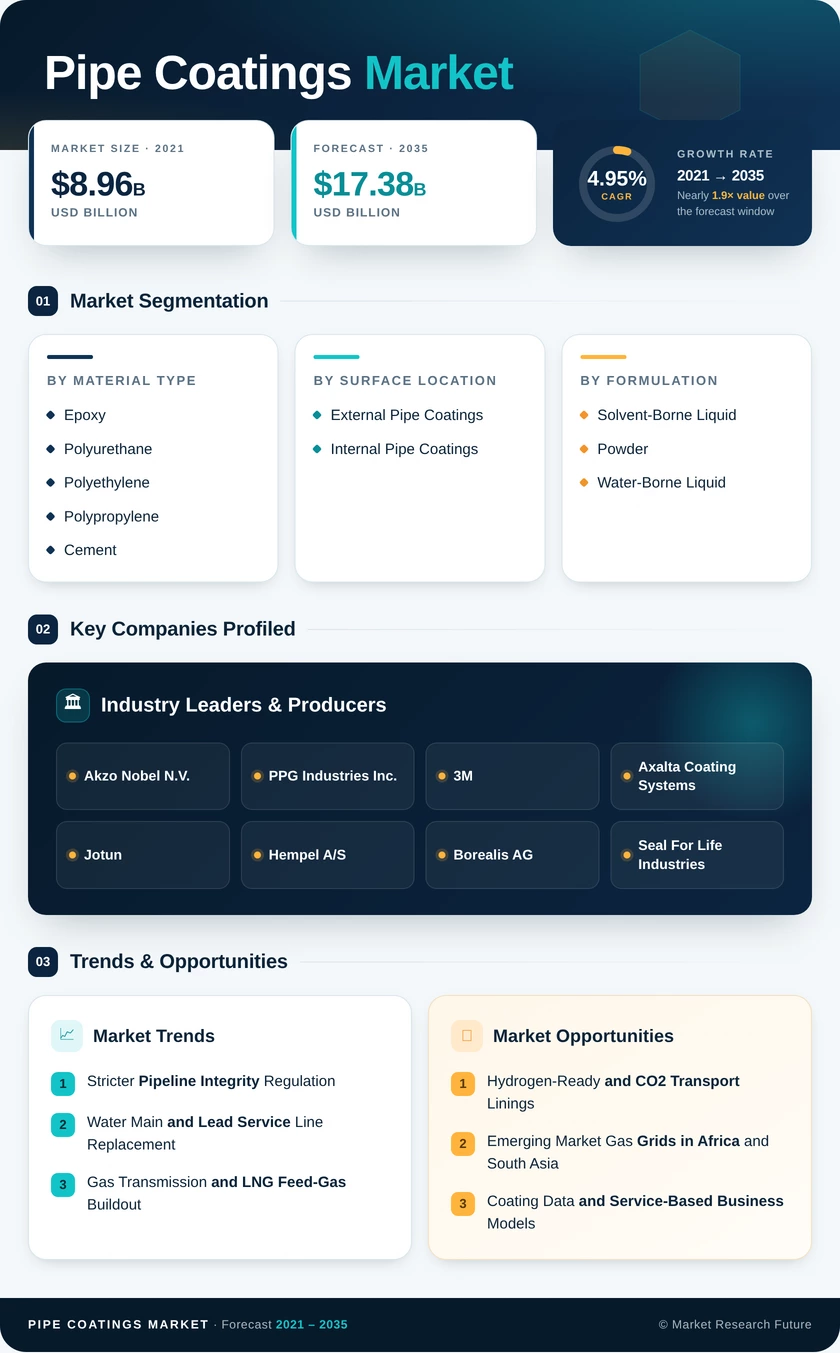
Segmentation Quick Reference
| Dimension | Sub-Segments | Dominant Segment | Fastest Growing Segment |
|---|
| By Material Type | Epoxy and Polyurethane, Polyethylene and Polypropylene, Cement and Concrete, Coal Tar Enamel, Asphalt Enamel | Epoxy and Polyurethane (43.6% share) | Polyethylene and Polypropylene (5.7% CAGR) |
| By Surface Location | External Pipe Coatings, Internal Pipe Coatings | External Pipe Coatings (84.0% share) | External Pipe Coatings (84.0% share) |
| By Formulation | Solvent-Borne Liquid, Powder, Water-Borne Liquid | Solvent-Borne Liquid (67.4% share) | Water-Borne Liquid (5.5% CAGR) |
| By End-user Industry | Oil and Gas, Water and Wastewater Treatment, Mining, Agriculture, Chemical Processing and Transport, Infrastructure, Other End-user Industries | Oil and Gas (64.2% share) | Water and Wastewater Treatment (6.2% CAGR) |
| By Region | North America, Europe, Asia-Pacific, South America, Middle East & Africa | North America (37.5% share) | Asia-Pacific (5.6% CAGR) |
Market Segmentation Overview
| Sub-Segment | Key Trend |
|---|
| Epoxy and Polyurethane | Graphene-modified epoxies and dual-layer FBE systems |
| Polyethylene and Polypropylene | Three-layer systems for deepwater and Arctic service |
| Cement and Concrete | Weight coating and large-diameter water linings |
| Coal Tar Enamel | Phase-out from new specifications |
| Asphalt Enamel | Residual use in low-cost repair |
Epoxy and Polyurethane lead because FBE offers proven long-term adhesion on high-pressure gas lines, with polyurethane topcoats adding abrasion resistance. Polyethylene and Polypropylene are growing fastest as deepwater and permafrost projects demand low-temperature flexibility and thermal insulation. Coal Tar Enamel keeps shrinking as standards and buyers move away from it.
| Sub-Segment | Key Trend |
|---|
| External Pipe Coatings | Post-construction surveys and UV-curable joint wraps |
| Internal Pipe Coatings | Potable water linings and high-temperature phenolics |
External Pipe Coatings both lead and grow fastest, since federal survey rules convert detected soil-side damage into recoating orders. Internal Pipe Coatings expand with lead line replacement and chemical service, though HDPE substitution limits municipal upside.
| Sub-Segment | Key Trend |
|---|
| Solvent-Borne Liquid | Persistent field-joint and repair use |
| Powder | Zero-VOC shop application |
| Water-Borne Liquid | Reformulation driven by emission caps |
Solvent-Borne Liquid leads because it tolerates humid, power-limited field sites. Water-Borne Liquid grows fastest as the revised Industrial Emissions Directive raises abatement costs for solvent users. Powder stays strong in mills, where oven curing is practical.
| Sub-Segment | Key Trend |
|---|
| Oil and Gas | Unconventional gas and subsea tie-backs |
| Water and Wastewater Treatment | Mandated lead line and main replacement |
| Mining | Abrasion-resistant tailings linings |
| Agriculture | Hybrid epoxy-polyurethane irrigation coatings |
| Chemical Processing and Transport | High-purity, high-temperature linings |
| Infrastructure | District heating and urban utility lines |
| Other End-user Industries | Geothermal and power plant piping |
Oil and Gas leads on Jafurah, Permian takeaway and pre-salt projects that consume large volumes of FBE and polypropylene. Water and Wastewater Treatment grows fastest because U.S. and EU lead mandates impose fixed replacement deadlines. Mining and Chemical Processing and Transport add specialised, higher-margin demand.


 Noah Malgeri
Co-Founder

 Peter Groot koerkamp
Account and Business Manager

 Younghwan Choi
Senior Retail Manager

 Mark Irwin
Management Consultant

 Akif Moroglu
Strategy & Business Development Director

 Guilherme Gomes Martins
Product Management Director

 Joseph Aguayo
Sales Operations & Pricing Manager

 La Terria Dodd
Program Support Specialist

 Rob Kooiker
Group Product Manager HVAC & Fire Protection GMA