×
Hero Background
English
Chinese
French
Japanese
Korean
German
Spanish

Pigment Intermediates Market Size

ID: MRFR/CnM/5740-HCR
140 Pages
Anshula Mandaokar
October 2025

Pigment Intermediates Market Research Report Information by Type (Organic Intermediates and Inorganic Intermediates), End-use Industry (Paints & Coatings, Textiles, Construction, Paper, Plastics, and Others), and Region —Forecast till 2035

Share:
Download PDF ×

We do not share your information with anyone. However, we may send you emails based on your report interest from time to time. You may contact us at any time to opt-out.

Pigment Intermediates Market Infographic
Purchase Options

Pigment Intermediates Size

Pigment Intermediates Market Growth Projections and Opportunities

The Pigment Intermediates Market is influenced by a myriad of market factors, which collectively shape its dynamics and growth trajectory. Among them is the global demand for pigments across different sectors such as paints and coatings, plastics, textiles and printing inks. Construction boom alongside increased expenditures on home renovations hugely drives the need for pigments thus affecting pigment intermediates market.

In addition, progressions in automotive industry are overriding influences that determine how pigment intermediates markets develop. In the manufacture of external as well as internal car components; auto industry uses pigments. With growing car making sector and innovative smarts’ there comes an increase in demand for high quality specialized pigments hence impacting the pigment intermediates market.

Raw material availability and pricing are critical market factors that directly impact the pigment intermediates industry. Geopolitical events or natural calamities among others can affect the cost and availability of these chemicals compounds which form the bulk of raw materials for pigment intermediates. Disruption in the chain supplying raw materials could therefore lead to negative effects on production and pricing of pigment intermediates.

Similarly, environmental regulations including concerns related to sustainability significantly contribute to shaping up pigment intermediates market. There is increasing environmental awareness leading to more eco friendly sustainable forms of colorant demands across all industries based on their various applications. Hence, manufacturers have been necessitated into research & development investment aimed at producing environmentally regulatory compliant intermediate pigments which has brought about extensive use within an industry towards more sustainable practices.

Market competition also plays a major role in explaining changes in the world’s paint sector however little attention is paid to it. High levels of rivalry between other players results into constant innovation taking place within this business area while competitive prices are offered together with new or improved formulations for colorants. Some firms attempt to distinguish themselves through unique offerings or by focusing on specific segments; Consequently, the competition in the pigments intermediates market has increased.

Global economic conditions and trade policies also contribute to the market dynamics of pigment intermediates. Global demand for these colorants is dictated by world economy or international politics that may influence industrial output as well as consumer spending directly deciding the consumption of pigments thus leading to changes in pigment intermediates market. Additionally, trade policies and tariffs affect raw material cost as well as finished product pricing thereby complicating further these global markets.
Pigment Intermediates Market Size Graph
Author
Anshula Mandaokar
Team Lead - Research

Anshula Mandaokar holds an academic degree in Chemical Engineering and has been contributing to the field for more than 5 years. She has expertise in Market Research and Business Consulting and serves as a Team Lead for a reputed Market Research firm under the Chemicals and Materials domain spectrum. She has worked on multiple projects, generating explicit results in a quick turnaround time. Her understanding of data interpretation justifies her role as a leader.

Leave a Comment

FAQs

How does the outlook of the global pigment intermediates market look like?

The outlook of the global pigment intermediates market looks very promising.

What are major end-use industry of pigment intermediates?

Paints & coatings, construction, textiles, paper, and plastics are major end-use industries of pigment intermediates.

Which are the leading segments in the global pigment intermediates market?

By type, the inorganic pigment intermediates segment and by end-use industry the paints & coatings segment account for leading segments in the global pigment intermediates market.

Which region holds the largest share in the global Pigment intermediates market?

Asia Pacific holds the largest share in the global Pigment intermediates market, followed by North America and Europe, respectively.

Who are the top players in the global pigment intermediates market?

CALSAK Corporation (US), Camex Limited (India), Ambuja Intermediates Pvt. Ltd. (India), Sugai Chemical Co., Ltd. (Japan), Nova International (India), Wellton Chemical Co., Ltd. (China), Seya Industries Ltd. (India), Minal Intermediates (India), Sarna Chemicals (India), Nantong Acetic Acid Chemical Co., Ltd. (China), and Kawaguchi Chemical Industry Co., LTD (Japan), are some of the major players operating in the pigment intermediates market.

Market Summary

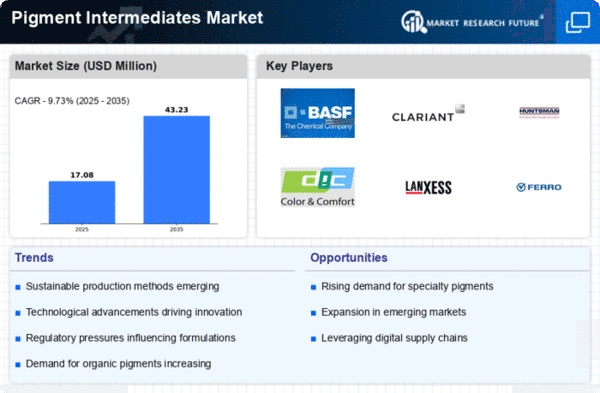
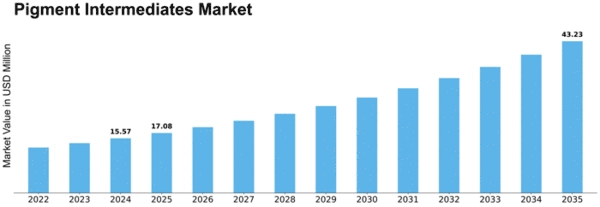
As per MRFR analysis, the Pigment Intermediates Market Size was estimated at 15.57 USD Million in 2024. The Pigment Intermediates industry is projected to grow from 17.08 in 2025 to 43.23 by 2035, exhibiting a compound annual growth rate (CAGR) of 9.73 during the forecast period 2025 - 2035.

Key Market Trends & Highlights

The Pigment Intermediates Market is poised for growth driven by sustainability and technological advancements.

  • The market is witnessing a pronounced shift towards sustainability, with increasing demand for eco-friendly products.
  • North America remains the largest market, while Asia-Pacific is emerging as the fastest-growing region in pigment intermediates.
  • The coatings segment continues to dominate, whereas the textiles segment is experiencing rapid growth.
  • Key drivers include the rising demand for eco-friendly products and the expansion of end-use industries.

Market Size & Forecast

2024 Market Size 15.57 (USD Million)
2035 Market Size 43.23 (USD Million)
CAGR (2025 - 2035) 9.73%
Largest Regional Market Share in 2024 Asia-Pacific

Major Players

<p>BASF (DE), Clariant (CH), Huntsman (US), DIC Corporation (JP), Lanxess (DE), Ferro Corporation (US), Kremer Pigments (DE), Toyo Ink (JP), SABIC (SA)</p>

Market Trends

The Pigment Intermediates Market is currently experiencing a dynamic evolution, driven by various factors that influence demand and supply. The increasing application of pigments in diverse industries, such as textiles, coatings, and plastics, appears to be a primary catalyst for growth. Furthermore, the rising emphasis on sustainable practices and eco-friendly products is prompting manufacturers to innovate and develop new formulations that align with environmental standards. This shift towards sustainability may lead to the introduction of bio-based intermediates, which could reshape the competitive landscape of the market. In addition, the Pigment Intermediates Market is likely to witness advancements in technology that enhance production efficiency and reduce costs. Automation and digitalization are becoming more prevalent, enabling companies to optimize their operations and respond swiftly to market changes. Moreover, the globalization of trade is facilitating the exchange of raw materials and finished products, which may further stimulate market expansion. As the industry adapts to these trends, stakeholders must remain vigilant and responsive to emerging challenges and opportunities that could impact their strategic positioning.

Sustainability Focus

The Pigment Intermediates Market is increasingly influenced by a growing commitment to sustainability. Manufacturers are exploring eco-friendly alternatives and bio-based products to meet consumer demand for environmentally responsible solutions. This trend may lead to the development of innovative formulations that minimize environmental impact while maintaining performance.

Technological Advancements

Technological progress is playing a crucial role in shaping the Pigment Intermediates Market. Automation and digital tools are enhancing production processes, allowing for greater efficiency and cost-effectiveness. These advancements could enable companies to adapt more readily to changing market conditions and consumer preferences.

Global Trade Dynamics

The dynamics of The Pigment Intermediates. Increased international collaboration and the exchange of materials are fostering market growth. This interconnectedness may provide opportunities for companies to expand their reach and diversify their product offerings.

Pigment Intermediates Market Market Drivers

Market Growth Projections

The Global Pigment Intermediates Market Industry is projected to experience substantial growth over the next decade. With an estimated market value of 25.75 USD Billion in 2024, the industry is anticipated to reach 38.12 USD Billion by 2035. This growth trajectory suggests a compound annual growth rate of 3.63% from 2025 to 2035. Such projections indicate a robust demand for pigment intermediates driven by various sectors, including construction, automotive, and consumer goods. The increasing emphasis on sustainability and technological advancements further supports this positive outlook, positioning the industry for continued expansion.

Growth in Automotive Industry

The automotive industry significantly influences the Global Pigment Intermediates Market Industry, as manufacturers increasingly seek vibrant and durable coatings for vehicles. The shift towards electric vehicles and advanced materials necessitates high-performance pigments that can withstand various environmental conditions. This trend is likely to drive the demand for specialized pigments, enhancing the aesthetic and protective qualities of automotive coatings. As the automotive sector continues to evolve, the Global Pigment Intermediates Market Industry is poised for growth, with projections indicating a compound annual growth rate of 3.63% from 2025 to 2035.

Increasing Environmental Regulations

The Global Pigment Intermediates Market Industry faces a growing influence from stringent environmental regulations aimed at reducing harmful emissions and promoting sustainable practices. Governments worldwide are implementing policies that encourage the use of eco-friendly pigments, which has led to a shift in production methods. Manufacturers are adapting by developing low-VOC and non-toxic alternatives to traditional pigments, aligning with global sustainability goals. This regulatory landscape not only drives innovation but also opens new market opportunities for companies that prioritize environmental responsibility. As a result, the industry is likely to witness a transformation in product offerings.

Rising Demand in Construction Sector

The Global Pigment Intermediates Market Industry experiences a notable surge in demand due to the expanding construction sector. As urbanization accelerates, the need for high-quality pigments in paints and coatings becomes increasingly critical. In 2024, the market is projected to reach 25.75 USD Billion, reflecting the industry's response to the growing infrastructure projects worldwide. The construction sector's emphasis on aesthetic appeal and durability drives the demand for innovative pigment solutions, which are essential for enhancing the longevity and visual appeal of structures. This trend suggests a robust growth trajectory for the Global Pigment Intermediates Market Industry.

Expanding Applications in Consumer Goods

The Global Pigment Intermediates Market Industry is witnessing an expansion in applications across various consumer goods, including textiles, plastics, and personal care products. The demand for vibrant colors and innovative designs in these sectors drives the need for high-quality pigments. As consumer preferences evolve towards unique and customized products, manufacturers are compelled to explore new pigment formulations that cater to these trends. This diversification of applications is expected to bolster market growth, as companies strive to meet the increasing demand for specialized pigments that enhance the visual appeal and functionality of consumer goods.

Technological Advancements in Pigment Production

Technological innovations play a pivotal role in shaping the Global Pigment Intermediates Market Industry. Advances in production techniques, such as the development of eco-friendly pigments and improved synthesis methods, enhance the efficiency and sustainability of pigment manufacturing. These innovations not only reduce environmental impact but also cater to the increasing consumer preference for sustainable products. As a result, manufacturers are likely to invest in research and development to create high-performance pigments that meet stringent regulatory standards. This focus on technology-driven solutions is expected to contribute to the market's growth, potentially reaching 38.12 USD Billion by 2035.

Market Segment Insights

By Application: Coatings (Largest) vs. Textiles (Fastest-Growing)

<p>In the Pigment Intermediates Market, the application segment is primarily dominated by Coatings, which hold the largest share due to their widespread use in various industries including automotive, architectural, and industrial applications. Following Coatings, Plastics and Inks also command significant shares, with each catering to specific markets that value pigmentation for aesthetic and functional purposes. Textiles, while smaller in market share, contribute noticeably to the overall demand driven by fashion and interior design trends which favor colored materials. The growth trends within the application segment reveal that the Coatings market will likely continue its leadership due to increasing investments in infrastructure and automotive sectors. However, Textiles are emerging rapidly, driven by the rising demand for sustainable and eco-friendly products, alongside innovative dye technologies. Furthermore, Plastics are anticipated to see growth fueled by the ongoing expansion of packaging solutions and consumer goods, reflecting a shift toward versatile and lightweight materials.</p>

<p>Coatings (Dominant) vs. Textiles (Emerging)</p>

<p>Coatings hold a dominant position in the Pigment Intermediates Market, driven by their extensive application across various industries such as furniture, automotive, and construction. These products are crucial for enhancing durability and aesthetics, offering a range of finishes that meet diverse customer requirements. The demand for high-performance coatings has surged due to stringent regulations and a focus on sustainability, motivating manufacturers to innovate and meet market needs. Conversely, Textiles are emerging as a significant segment propelled by trends in fast fashion and home furnishings, where vibrant colors and patterns are essential. The textile industry is leveraging advancements in dye technology, particularly organic options, to meet consumer demand for sustainable choices. This transformation positions Textiles as a crucial component of the pigment intermediates landscape, appealing to environmentally conscious consumers.</p>

By End Use: Automotive (Largest) vs. Consumer Goods (Fastest-Growing)

<p>In the Pigment Intermediates Market, the end-use segment is primarily dominated by the automotive industry, which holds the largest share due to its extensive use of pigments in coatings, plastics, and upholstery. Following closely are the construction and industrial sectors, which utilize pigmented materials for durability and aesthetic appeal. Consumer goods, while currently smaller in market share, are gaining traction due to increasing demand for visually appealing packaging and products that enhance consumer experience.</p>

<p>Automotive: Coatings (Dominant) vs. Consumer Goods: Packaging (Emerging)</p>

<p>In the automotive sector, coatings represent a dominant application of pigment intermediates, driven by stringent regulations for vehicle aesthetics and durability. This usage not only enhances the vehicle's appearance but also protects against environmental factors, making it essential for manufacturers. On the other hand, the consumer goods sector is emerging with a focus on innovative packaging solutions. The trend towards sustainable and visually appealing packaging is boosting demand for high-quality pigments that are both functional and attractive. As brand differentiation and customer engagement become priorities, the packaging segment is poised for accelerated growth.</p>

By Type: Organic Pigments (Largest) vs. Specialty Pigments (Fastest-Growing)

<p>The Pigment Intermediates Market showcases a diverse distribution among its type segments, with Organic Pigments holding a significant market share due to their extensive applications across various industries, including paints, coatings, and plastics. Inorganic Pigments, while also relevant, are overshadowed by the rising demand for Organic alternatives, particularly in sustainable applications. Specialty Pigments, on the other hand, are gaining traction due to their unique properties and applications, leading to a rapidly expanding market presence. Growth trends within the Pigment Intermediates Market are driven by the increasing preference for environmentally friendly and non-toxic pigments, particularly seen in the Organic segment. As industries pivot towards sustainability, the demand for Specialty Pigments is also surging, fueled by their ability to enhance product performance and aesthetics. Overall, innovation and evolving consumer preferences are key factors driving growth in this segment.</p>

<p>Organic Pigments (Dominant) vs. Dyes (Emerging)</p>

<p>Organic Pigments are currently positioned as the dominant force in the Pigment Intermediates Market, benefiting from their versatility and high-performance characteristics across multiple applications. They are often preferred for their vibrant colors and eco-friendliness. In contrast, Dyes, classified as an emerging segment, have been witnessing increased interest, particularly in textiles, packaging, and specialty applications. While they offer unique properties suitable for specific uses, Dyes are often less favored than Organic Pigments due to concerns related to environmental impact and regulatory pressures. Nevertheless, innovations in dye technologies and applications are expected to bolster their market presence, indicating potential growth in this segment.</p>

By Form: Powder (Largest) vs. Liquid (Fastest-Growing)

<p>In the Pigment Intermediates Market, the segment distribution reflects clear preferences, with Powder forms holding the largest market share. This preference is largely attributed to their versatility and stability, which makes them suitable for a variety of applications across industries. Conversely, Liquid forms are experiencing rapid growth, appealing particularly in sectors where ease of use and application are paramount. As industries continue to seek more efficient solutions, the market dynamics are shifting towards the enhanced capabilities of liquid intermediates.</p>

<p>Pigment Form: Powder (Dominant) vs. Liquid (Emerging)</p>

<p>Powder pigments are the dominant form in the pigment intermediates market, known for their broad usage in coatings, plastics, and inks due to their stability and ease of handling. They typically offer a longer shelf life and are preferred for applications that require durability. On the other hand, liquid pigments are emerging rapidly, driven by the trend towards automation and user-friendliness in industries such as paint manufacturing. Their ability to disperse easily and provide vivid colorations make them an attractive choice for manufacturers aiming to enhance production efficiencies and product appeal.</p>

By Color: Red (Largest) vs. Blue (Fastest-Growing)

<p>In the Pigment Intermediates Market, the color segment is dominated by Red pigments, which hold the largest market share owing to their extensive application in various industries, including coating and plastics. Meanwhile, Blue pigments have emerged as a significant player, capturing a noteworthy share of the market as demand for vibrant and durable colors continues to rise. Other colors such as Yellow, Green, and Black also play crucial roles but are comparatively smaller in market share.</p>

<p>Red (Dominant) vs. Blue (Emerging)</p>

<p>Red pigments are established as the dominant force in the Pigment Intermediates Market due to their versatility and broad application range. They are preferred for their high stability and performance in products such as paints, coatings, and textiles. Conversely, Blue pigments are emerging, driven by trends towards sustainability and eco-friendliness. Their fast growth is fueled by innovations in production techniques, allowing for enhanced color fastness and application versatility, which appeals to both manufacturers and consumers seeking quality and durability.</p>

Get more detailed insights about Pigment Intermediates Market Research Report – Forecast till 2035

Regional Insights

North America : Stable Market with Growth Potential

The North American pigment intermediates market, valued at $3.12 billion, is driven by robust demand in the automotive and construction sectors. Regulatory support for sustainable practices is fostering innovation, while increasing investments in infrastructure are expected to boost market growth. The region's focus on eco-friendly products aligns with global trends, enhancing its competitive edge. Leading countries like the US and Canada dominate the market, with key players such as Huntsman and Ferro Corporation driving advancements. The competitive landscape is characterized by a mix of established firms and emerging players, all vying for market share. The presence of major companies ensures a steady supply chain, while ongoing R&D efforts are likely to introduce new products, further stimulating market dynamics.

Europe : Innovation and Sustainability Focus

Europe's pigment intermediates market, valued at €4.68 billion, is characterized by a strong emphasis on sustainability and innovation. Regulatory frameworks, such as the European Green Deal, are catalyzing the shift towards eco-friendly pigments, driving demand across various industries. The region's commitment to reducing carbon footprints is expected to enhance market growth, with a projected increase in sustainable product offerings. Germany, France, and the UK are leading players in this market, with companies like BASF and Clariant at the forefront of innovation. The competitive landscape is marked by strategic partnerships and collaborations aimed at developing advanced pigment technologies. This focus on sustainability not only meets regulatory requirements but also aligns with consumer preferences, positioning Europe as a leader in The Pigment Intermediates.

Asia-Pacific : Dominant Market with High Demand

The Asia-Pacific region, holding a market share of $7.8 billion, is the largest player in the pigment intermediates market. Rapid industrialization, urbanization, and a growing middle class are driving demand for pigments in various applications, including automotive, construction, and consumer goods. Regulatory initiatives aimed at environmental protection are also influencing market dynamics, pushing for more sustainable production methods. Countries like China, Japan, and India are leading the charge, with significant contributions from major companies such as DIC Corporation and Toyo Ink. The competitive landscape is vibrant, with numerous local and international players competing for market share. The region's focus on innovation and quality is expected to sustain its growth trajectory, making it a key area for investment and development in the pigment intermediates sector.

Middle East and Africa : Emerging Market with Growth Potential

The Middle East and Africa (MEA) region, valued at $0.97 billion, is witnessing a gradual increase in demand for pigment intermediates, driven by expanding construction and manufacturing sectors. The region's focus on infrastructure development and urbanization is expected to propel market growth. Additionally, regulatory frameworks are beginning to emphasize sustainability, which may further enhance market dynamics in the coming years. Countries like South Africa and the UAE are at the forefront of this emerging market, with local and international players vying for a share. The competitive landscape is evolving, with companies exploring new opportunities in the pigment sector. As the region continues to develop, the demand for high-quality pigments is anticipated to rise, presenting significant opportunities for growth and investment.

Key Players and Competitive Insights

The Pigment Intermediates Market is characterized by a dynamic competitive landscape, driven by innovation, sustainability, and strategic partnerships. Key players such as BASF (DE), Clariant (CH), and DIC Corporation (JP) are actively shaping the market through their distinct operational focuses. BASF (DE) emphasizes innovation in sustainable pigment solutions, while Clariant (CH) is enhancing its portfolio through strategic acquisitions and partnerships aimed at expanding its market reach. DIC Corporation (JP) is focusing on regional expansion, particularly in Asia, to capitalize on the growing demand for high-performance pigments. Collectively, these strategies contribute to a competitive environment that is increasingly focused on sustainability and technological advancement.

In terms of business tactics, companies are localizing manufacturing and optimizing supply chains to enhance efficiency and responsiveness to market demands. The market structure appears moderately fragmented, with several key players exerting influence while also allowing for niche players to thrive. This fragmentation encourages innovation and competition, as companies strive to differentiate themselves through unique product offerings and customer service.

In November 2025, Clariant (CH) announced a strategic partnership with a leading technology firm to develop advanced digital solutions for pigment production. This collaboration aims to enhance operational efficiency and reduce environmental impact, aligning with the growing trend towards sustainability in manufacturing processes. The strategic importance of this partnership lies in its potential to position Clariant (CH) as a leader in the digital transformation of the pigment industry, thereby attracting environmentally conscious customers.

In October 2025, DIC Corporation (JP) launched a new line of eco-friendly pigment intermediates designed to meet stringent regulatory standards in Europe. This initiative not only reflects DIC's commitment to sustainability but also addresses the increasing demand for compliant products in the European market. The launch is strategically significant as it allows DIC to strengthen its market position in a region that is becoming increasingly important for environmentally friendly products.

In December 2025, BASF (DE) unveiled a new research facility dedicated to the development of sustainable pigment technologies. This facility is expected to accelerate innovation and enhance BASF's ability to respond to market trends. The establishment of this facility underscores BASF's commitment to leading the industry in sustainable practices and positions the company to leverage emerging opportunities in the pigment intermediates sector.

As of December 2025, current competitive trends indicate a strong shift towards digitalization, sustainability, and the integration of AI technologies within the Pigment Intermediates Market. Strategic alliances are increasingly shaping the landscape, enabling companies to pool resources and expertise to drive innovation. Looking ahead, competitive differentiation is likely to evolve from traditional price-based competition to a focus on innovation, technology, and supply chain reliability. This shift suggests that companies that prioritize sustainable practices and technological advancements will be better positioned to thrive in the future.

Key Companies in the Pigment Intermediates Market market include

Industry Developments

Future Outlook

Pigment Intermediates Market Future Outlook

<p>The Pigment Intermediates Market is projected to grow at a 9.73% CAGR from 2024 to 2035, driven by increasing demand in coatings, plastics, and textiles.</p>

New opportunities lie in:

  • <p>Expansion into bio-based pigment intermediates for sustainable products.</p>
  • <p>Development of advanced color matching technologies for industrial applications.</p>
  • <p>Strategic partnerships with end-user industries to enhance market penetration.</p>

<p>By 2035, the Pigment Intermediates Market is expected to achieve robust growth and diversification.</p>

Market Segmentation

Pigment Intermediates Market Form Outlook

  • Powder
  • Liquid
  • Granular

Pigment Intermediates Market Type Outlook

  • Organic Pigments
  • Inorganic Pigments
  • Specialty Pigments
  • Dyes

Pigment Intermediates Market Color Outlook

  • Red
  • Blue
  • Yellow
  • Green
  • Black

Pigment Intermediates Market End Use Outlook

  • Automotive
  • Construction
  • Consumer Goods
  • Electronics
  • Industrial

Pigment Intermediates Market Application Outlook

  • Coatings
  • Plastics
  • Inks
  • Textiles
  • Construction

Report Scope

MARKET SIZE 202415.57(USD Million)
MARKET SIZE 202517.08(USD Million)
MARKET SIZE 203543.23(USD Million)
COMPOUND ANNUAL GROWTH RATE (CAGR)9.73% (2024 - 2035)
REPORT COVERAGERevenue Forecast, Competitive Landscape, Growth Factors, and Trends
BASE YEAR2024
Market Forecast Period2025 - 2035
Historical Data2019 - 2024
Market Forecast UnitsUSD Million
Key Companies ProfiledBASF (DE), Clariant (CH), Huntsman (US), DIC Corporation (JP), Lanxess (DE), Ferro Corporation (US), Kremer Pigments (DE), Toyo Ink (JP), SABIC (SA)
Segments CoveredApplication, End Use, Type, Form, Color
Key Market OpportunitiesGrowing demand for sustainable pigments drives innovation in the Pigment Intermediates Market.
Key Market DynamicsRising demand for sustainable pigments drives innovation and regulatory compliance in the pigment intermediates market.
Countries CoveredNorth America, Europe, APAC, South America, MEA

FAQs

How does the outlook of the global pigment intermediates market look like?

The outlook of the global pigment intermediates market looks very promising.

What are major end-use industry of pigment intermediates?

Paints &amp; coatings, construction, textiles, paper, and plastics are major end-use industries of pigment intermediates.

Which are the leading segments in the global pigment intermediates market?

By type, the inorganic pigment intermediates segment and by end-use industry the paints &amp; coatings segment account for leading segments in the global pigment intermediates market.

Which region holds the largest share in the global Pigment intermediates market?

Asia Pacific holds the largest share in the global Pigment intermediates market, followed by North America and Europe, respectively.

Who are the top players in the global pigment intermediates market?

CALSAK Corporation (US), Camex Limited (India), Ambuja Intermediates Pvt. Ltd. (India), Sugai Chemical Co., Ltd. (Japan), Nova International (India), Wellton Chemical Co., Ltd. (China), Seya Industries Ltd. (India), Minal Intermediates (India), Sarna Chemicals (India), Nantong Acetic Acid Chemical Co., Ltd. (China), and Kawaguchi Chemical Industry Co., LTD (Japan), are some of the major players operating in the pigment intermediates market.

  1. Executive Summary
  2. Scope of the Report
    1. Market Definition
    2. Scope of the Study
      1. Research Objectives
      2. Assumptions & Limitations
    3. Markets Structure
  3. Market
    1. Research Methodology
    2. Research Process
    3. Secondary Research
    4. Primary Research
    5. Forecast Model
  4. Market Landscape
    1. Supply Chain Analysis
    2. Market Dynamics of Global Pigment Intermediates Market
  5. Raw Material Suppliers
  6. Manufacturers/Producers
  7. Distributors/Retailers/Wholesalers/E-Commerce
  8. End User
    1. Porter’s Five Forces Analysis
      1. Threat of New Entrants
      2. Bargaining Power of Buyers
      3. Bargaining Power of Suppliers
      4. Threat of Substitutes
      5. Intensity of Competitive Rivalry
    2. Introduction
    3. Drivers
    4. Restraints
    5. Opportunities
    6. Challenges
    7. Trends/Technology
  9. Global Pigment Intermediates Market, by Type
    1. Introduction
    2. Organic
      1. Market Estimates & Forecast,
      2. Market Estimates & Forecast, by Region, 2020−2027
    3. Inorganic
      1. Market Estimates & Forecast, 2020−2027
  10. Market Estimates & Forecast, by Region, 2020−2027
  11. Global
  12. Pigment Intermediates Market, by End-Use Industry
    1. Introduction
      1. Market Estimates & Forecast, 2020−2027
      2. Market Estimates & Forecast, by Region, 2020−2027
    2. Paints & Coatings
    3. Textiles
      1. Market Estimates & Forecast, 2020−2027
      2. Market Estimates
    4. & Forecast, by Region, 2020−2027
    5. Construction
      1. Market
      2. Market Estimates & Forecast,
    6. Estimates & Forecast, 2020−2027
    7. by Region, 2020−2027
    8. Plastics
      1. Market Estimates & Forecast,
      2. Market Estimates & Forecast, by Region, 2020−2027
    9. Paper
      1. Market Estimates & Forecast, 2020−2027
  13. Market Estimates & Forecast, by Region, 2020−2027
    1. Others
      1. Market Estimates &
    2. Market Estimates & Forecast, 2020−2027
    3. Forecast, by Region, 2020−2027
  14. Global Pigment Intermediates
  15. Market, by Region
    1. Introduction
    2. North America
      1. Market
      2. Market Estimates & Forecast,
      3. Market Estimates & Forecast, by End-Use
      4. US
      5. Canada
    3. Estimates & Forecast, 2020−2027
    4. by Type, 2020−2027
    5. Industry, 2020−2027
  16. Market Estimates & Forecast, by End-Use Industry, 2020−2027
    1. Europe
      1. Market Estimates & Forecast, 2020−2027
      2. Market Estimates
      3. Market Estimates & Forecast,
      4. Germany
      5. France
      6. Italy
    2. & Forecast, by Type, 2020−2027
    3. by End-Use Industry, 2020−2027
    4. & Forecast, 2020−2027
    5. Type, 2020−2027
  17. Market Estimates & Forecast, by Type, 2020−2027
    1. & Forecast, by End-Use Industry, 2020−2027
    2. Market Estimates & Forecast, 2020−2027
    3. Forecast, by Type,2020−2027
    4. by End-Use Industry, 2020−2027
    5. & Forecast, 2020−2027
    6. Type,2020−2027
  18. Market Estimates
  19. Spain
  20. Market Estimates &
  21. Market Estimates & Forecast,
  22. UK
  23. Market Estimates
  24. Market Estimates & Forecast, by
  25. Market Estimates & Forecast, by End-Use Industry,
  26. Russia
  27. Market Estimates & Forecast,
  28. Market Estimates & Forecast, by Type,2020−2027
  29. Market Estimates & Forecast, by End-Use Industry, 2020−2027
  30. Poland
  31. Market Estimates & Forecast, 2020−2027
  32. Market Estimates & Forecast, by Type, 2020−2027
  33. Market Estimates & Forecast, by End-Use Industry, 2020−2027
    1. Rest of Europe
  34. Market Estimates & Forecast, 2020−2027
  35. Market Estimates & Forecast, by Type, 2020−2027
  36. Market Estimates & Forecast, by End-Use Industry, 2020−2027
    1. Asia-Pacific
      1. Market Estimates & Forecast, 2020−2027
      2. Market Estimates
      3. Market Estimates & Forecast,
      4. China
      5. India
    2. & Forecast, by Type, 2020−2027
    3. by End-Use Industry, 2020−2027
    4. & Forecast, 2020−2027
    5. Type, 2020−2027
  37. Market Estimates & Forecast, by End-Use Industry, 2020−2027
    1. Japan
  38. Market Estimates & Forecast, 2020−2027
  39. Market Estimates & Forecast, by Type, 2020−2027
    1. & Forecast, by End-Use Industry, 2020−2027
    2. New Zealand
  40. Market Estimates
  41. Australia &
  42. Market Estimates & Forecast, 2020−2027
  43. Market Estimates & Forecast, by Type, 2020−2027
    1. & Forecast, by End-Use Industry, 2020−2027
    2. & Forecast, by Type, 2020−2027
    3. by End-Use Industry, 2020−2027
    4. Market Estimates & Forecast, 2020−2027
    5. Forecast, by Type, 2020−2027
    6. End-Use Industry, 2020−2027
    7. Forecast, 2020−2027
  44. Market Estimates
  45. Rest of Asia-Pacific
  46. Market Estimates & Forecast, 2020−2027
  47. Market Estimates
  48. Market Estimates & Forecast,
    1. Middle East & Africa
      1. Market Estimates &
      2. Market Estimates & Forecast, by
      3. GCC
      4. Israel
      5. North Africa
  49. Market Estimates & Forecast, by End-Use Industry, 2020−2027
    1. Turkey
  50. Market Estimates & Forecast, 2020−2027
  51. Market Estimates & Forecast, by Type, 2020−2027
    1. & Forecast, by End-Use Industry, 2020−2027
    2. & Africa
  52. Market Estimates
  53. Rest of Middle East
  54. Market Estimates & Forecast, 2020−2027
  55. Market Estimates & Forecast, by Type, 2020−2027
    1. & Forecast, by End-Use Industry, 2020−2027
    2. Market Estimates & Forecast, 2020−2027
    3. Forecast, by Type, 2020−2027
    4. End-Use Industry, 2020−2027
    5. & Forecast, 2020−2027
    6. Type, 2020−2027
  56. Market Estimates
    1. Latin America
      1. Market Estimates &
      2. Market Estimates & Forecast, by
      3. Brazil
      4. Argentina
      5. Mexico
  57. Market Estimates & Forecast, by End-Use Industry, 2020−2027
    1. Rest of Latin America
  58. Market Estimates & Forecast, 2020−2027
  59. Market Estimates & Forecast, by Type, 2020−2027
  60. Market Estimates & Forecast, by End-Use Industry, 2020−2027
  61. Company
    1. Landscape
    2. Introduction
    3. Market Strategy
    4. Key Development
    5. Analysis (Expansion/Merger & Acquisitions/Joint Venture/New Product Development/Agreement/Investment)
  62. Company Profiles
    1. Camex Limited
      1. Company Overview
      2. Financial Updates
      3. Product/Business Segment Overview
      4. Key Developments
      5. SWOT Analysis
    2. Strategy
    3. CALSAK
      1. Company Overview
      2. Financial Updates
      3. Strategy
      4. Key Developments
      5. SWOT Analysis
    4. CORPORATION
    5. Product/Business Segment Overview
    6. Ambuja Intermediates Pvt Ltd
      1. Company
      2. Financial Updates
      3. Product/Business Segment Overview
      4. Strategy
      5. Key Developments
      6. SWOT Analysis
    7. Overview
    8. Nova International
      1. Company Overview
      2. Financial Updates
      3. Product/Business Segment Overview
      4. Strategy
      5. SWOT Analysis
    9. Key Developments
    10. Sugai Chemical IND.CO.,LTD.
      1. Company Overview
      2. Financial Updates
      3. Product/Business
      4. Strategy
      5. Key Developments
    11. Segment Overview
    12. SWOT Analysis
    13. Wellton Chemical Co.,Ltd.
      1. Company Overview
      2. Financial Updates
      3. Product/Business Segment Overview
      4. Key Developments
      5. SWOT Analysis
    14. Strategy
    15. Minal
      1. Company Overview
      2. Financial Updates
      3. Strategy
      4. Key Developments
      5. SWOT Analysis
    16. Intermediates
    17. Product/Business Segment Overview
    18. Seya Industries Ltd.
      1. Company Overview
      2. Financial Updates
      3. Product/Business Segment Overview
      4. Key Developments
      5. SWOT Analysis
    19. Strategy
    20. Sarna
      1. Company Overview
      2. Financial Updates
      3. Strategy
      4. Key Developments
      5. SWOT Analysis
    21. Chemicals
    22. Product/Business Segment Overview
    23. Kawaguchi Chemical Industry Co., LTD
      1. Financial Updates
      2. Product/Business Segment
      3. Strategy
      4. Key Developments
      5. SWOT
    24. Company Overview
    25. Overview
    26. Analysis
    27. Nantong Acetic Acid Chemical Co., Ltd.
      1. Company
      2. Financial Updates
      3. Product/Business Segment Overview
      4. Strategy
      5. Key Developments
      6. SWOT Analysis
    28. Overview
  63. Conclusion
  64. LIST OF TABLES
  65. Global
    1. Pigment Intermediates Market: by Region, 2020−2027
  66. North America:
  67. Pigment Intermediates Market, by Country, 2020−2027
  68. Europe: Pigment
  69. Intermediates Market, by Country, 2020−2027
  70. Asia-Pacific: Pigment
    1. Intermediates Market. by Country, 2020−2027
  71. Middle East &
  72. Africa: Pigment Intermediates Market, by Country, 2020−2027
  73. Latin
  74. America: Pigment Intermediates Market, by Country, 2020−2027
    1. Table 7
  75. Global Pigment Intermediates Type Market, by Regions, 2020−2027
    1. Table
  76. North America: Pigment Intermediates Type Market, by Country, 2020−2027
  77. Europe: Pigment Intermediates Type Market, by Country, 2020−2027
  78. Table10 Asia-Pacific: Pigment Intermediates Type Market, by Country, 2020−2027
  79. Table11 Middle East & Africa: Pigment Intermediates Type Market, by Country,
    1. Table12 Latin America: Pigment Intermediates Type Market, by
    2. Country, 2020−2027
  80. Global Pigment Intermediates End-Use Industry
  81. Market, by Regions, 2020−2027
    1. Table14 North America: Pigment Intermediates
  82. End-Use Industry Market, by Country, 2020−2027
    1. Table15 Europe: Pigment
  83. Intermediates End-Use Industry Market, by Country, 2020−2027
    1. Table16
  84. Asia-Pacific: Pigment Intermediates End-Use Industry Market, by Country, 2020−2027
    1. Table17 Middle East & Africa: Pigment Intermediates End-Use Industry Market,
    2. by Country, 2020−2027
    3. Table18 Latin America: Pigment Intermediates by
  85. End-Use Industry Market, by Country, 2020-2027
    1. Table19 Global Type Market,
    2. by Region, 2020−2027
  86. Table20 Global End-Use Industry Market, by Region,
  87. Table21 North America: Pigment Intermediates Market, by Country,
  88. Table22 North America: Pigment Intermediates Market, by Type,
  89. Table23 North America: Pigment Intermediates Market, by End-Use
    1. Industry, 2020−2027
    2. Table24 Europe: Pigment Intermediates Market, by
    3. Country, 2020−2027
  90. Table25 Europe: Pigment Intermediates Market, by Type,
  91. Table26 Europe: Pigment Intermediates Market, by End-Use Industry,
  92. Table27 Asia-Pacific: Pigment Intermediates Market, by Country,
  93. Table28 Asia-Pacific: Pigment Intermediates Market, by Type,
  94. Table29 Asia-Pacific: Pigment Intermediates Market, by End-Use
    1. Industry, 2020−2027
    2. Table30 Middle East & Africa: Pigment Intermediates
  95. Market, by Country, 2020−2027
    1. Table31 Middle East & Africa: Pigment
  96. Intermediates Market, by Type, 2020−2027
    1. Table32 Middle East & Africa:
  97. Pigment Intermediates Market, by End-Use Industry, 2020−2027
    1. Table33
  98. Latin America: Pigment Intermediates Market, by Country, 2020−2027
    1. Table34
  99. Latin America: Pigment Intermediates Market, by Type, 2020−2027
    1. Table35
  100. Latin America: Pigment Intermediates Market, by End-Use Industry, 2020−2027
  101. LIST OF FIGURES
  102. Global Pigment Intermediates Market
    1. Segmentation
  103. Forecast Research Methodology
  104. Porter’s
    1. Five Forces Analysis of Global Pigment Intermediates Market
  105. Value
    1. Chain of Global Pigment Intermediates Market
  106. Share of Global Pigment
  107. Intermediates Market in 2020, by Country
  108. Global Pigment Intermediates
    1. Market, 2020−2027,
  109. Global Pigment Intermediates Market Size,
    1. by Type, 2020
  110. Share of Global Pigment Intermediates Market, by Type,
  111. Global Pigment Intermediates Market Size, by End-Use
    1. Industry, 2020
  112. FIGURE10 Share of Global Pigment Intermediates Market, by End-Use
    1. Industry, 2020−2027

Pigment Intermediates Market Segmentation

Market Segmentation Overview

  • Detailed segmentation data will be available in the full report
  • Comprehensive analysis by multiple parameters
  • Regional and country-level breakdowns
  • Market size forecasts by segment
Infographic

Free Sample Request

Kindly complete the form below to receive a free sample of this Report

Get Free Sample

Customer Strories

Compare Licence

×
Features License Type
Single User Multiuser License Enterprise User
Price $4,950 $5,950 $7,250
Maximum User Access Limit 1 User Upto 10 Users Unrestricted Access Throughout the Organization
Free Customization
Direct Access to Analyst
Deliverable Format
Platform Access
Discount on Next Purchase 10% 15% 15%
Printable Versions