Request Free Sample ×

Kindly complete the form below to receive a free sample of this Report

* Please use a valid business email

Leading companies partner with us for data-driven Insights

clients tt-cursor
Hero Background
English
Chinese
French
Japanese
Korean
German
Spanish

Phytoestrogen Supplements Market Size

ID: MRFR/Pharma/4678-HCR
100 Pages
Rahul Gotadki
March 2026

Phytoestrogen Supplements Market Research Report, by Type (Flavonoids, Non-Flavonoids), Source (Nuts and Oilseeds), Application (Food & Beverages, Nutraceuticals, Cosmetics), by End-User (Hospitals, Research Organizations) - Forecast Till 2035

Share:
Download PDF ×

We do not share your information with anyone. However, we may send you emails based on your report interest from time to time. You may contact us at any time to opt-out.

Phytoestrogen Supplements Market Infographic
Purchase Options

Phytoestrogen Supplements Size

Phytoestrogen Supplements Market Growth Projections and Opportunities

Increasing recognition of the health advantages of phytoestrogens, compounds located in plant life that mimic the demand of estrogen in the frame, drives market demand for Phytoestrogen Supplements among fitness-aware people searching for natural options for hormone balance and menopausal symptom relief. The growing old populace, especially ladies coming into menopause, contributes to market growth as they seek relief from menopausal signs and symptoms, which include warm flashes, night time sweats, and mood swings via using Phytoestrogen Supplements, riding demand for menopause control merchandise. Concerns about the risks associated with hormone replacement therapy (HRT) for menopause signs, such as the expanded danger of breast cancer and cardiovascular events, drive the market demand for natural options like Phytoestrogen Supplements, attractive individuals looking for safer treatment alternatives. Increasing consumer choice for natural and plant-based total products drives market increase for Phytoestrogen Supplements, aligning with broader developments towards health, sustainability, and easy-label products within the nutritional complement industry. The proliferation of e-commerce systems and direct-to-consumer (DTC) income channels permits less complicated access to Phytoestrogen Supplements for consumers, using market boom through improved comfort and product availability. Women's fitness cognizance campaigns and initiatives specializing in menopause management and hormone stability boost focus on the blessings of Phytoestrogen Supplements, riding market growth through instructing customers and healthcare specialists about their capacity position in ladies' fitness. Ongoing product innovation and system efforts by complementary producers cause the development of the latest phytoestrogen supplement formulations, including aggregate products with other menopause-helping ingredients, using market growth via product differentiation and customer enchantment. Cultural ideals and societal attitudes towards menopause, girls's fitness, and herbal remedies influence market demand for Phytoestrogen Supplements, shaping consumer choices and product recognition in special cultural contexts. Investments in research and development via complementary manufacturers and educational establishments pressure innovation in phytoestrogen supplement formulations, expanding the product offerings and therapeutic capacity of phytoestrogen supplements inside the market. Recommendations from healthcare experts, consisting of physicians, nutritionists, and holistic practitioners, play a big role in driving market growth by influencing purchasers to agree with and self-belief in Phytoestrogen Supplements as part of a comprehensive approach to women's fitness and menopause control. Increasing competition amongst complement manufacturers and retailers in the Phytoestrogen Supplements market drives innovation, affordability, and accessibility of merchandise, shaping the competitive panorama and consumer choices in the market.
Phytoestrogen Supplements Market Size Graph
Author
Author Profile
Rahul Gotadki
Research Manager

He holds an experience of about 9+ years in Market Research and Business Consulting, working under the spectrum of Life Sciences and Healthcare domains. Rahul conceptualizes and implements a scalable business strategy and provides strategic leadership to the clients. His expertise lies in market estimation, competitive intelligence, pipeline analysis, customer assessment, etc.

Leave a Comment

FAQs

What is the current valuation of the Phytoestrogen Supplements Market?

<p>The market valuation was 1.38 USD Billion in 2024.</p>

What is the projected market size for Phytoestrogen Supplements by 2035?

<p>The market is projected to reach 4.311 USD Billion by 2035.</p>

What is the expected CAGR for the Phytoestrogen Supplements Market during the forecast period?

<p>The expected CAGR for the market from 2025 to 2035 is 10.91%.</p>

Which companies are considered key players in the Phytoestrogen Supplements Market?

<p>Key players include Nature's Way, NOW Foods, Solgar, and Herbalife.</p>

What are the primary types of phytoestrogens in the market?

<p>The primary types include Flavonoids, Isoflavones, and Lignans.</p>

How do the segment valuations for Isoflavones compare to Flavonoids?

Isoflavones had a valuation of 0.414 USD Billion in 2024, while Flavonoids were valued at 0.276 USD Billion.

What applications are driving the demand for phytoestrogen supplements?

The main applications include Food &amp; Beverages and Nutraceuticals, with valuations of 0.414 and 0.552 USD Billion respectively.

What sources contribute to the Phytoestrogen Supplements Market?

Sources include Soy products and Nuts and oilseeds, valued at 0.414 and 0.276 USD Billion respectively.

Which end-users are most prominent in the Phytoestrogen Supplements Market?

Hospitals &amp; Clinics and Research Organizations are significant end-users, valued at 0.55 and 0.45 USD Billion respectively.

What trends are expected to shape the Phytoestrogen Supplements Market in the coming years?

The market is likely to experience growth driven by increasing health awareness and demand for natural supplements.

Market Summary

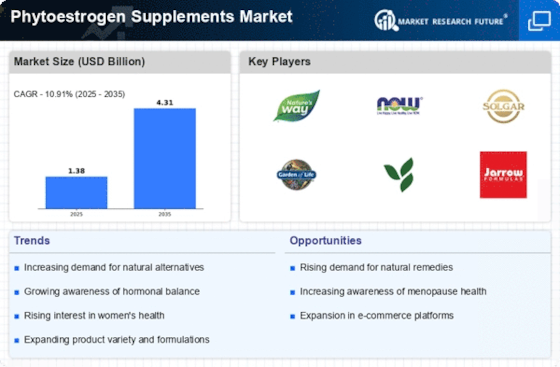
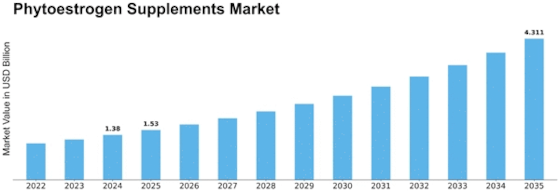
As per Market Research Future analysis, the Phytoestrogen Supplements Market was estimated at 1.38 USD Billion in 2024. The Phytoestrogen Supplements industry is projected to grow from 1.531 USD Billion in 2025 to 4.311 USD Billion by 2035, exhibiting a compound annual growth rate (CAGR) of 10.91% during the forecast period 2025 - 2035

Key Market Trends & Highlights

The Phytoestrogen Supplements Market is experiencing a robust growth trajectory driven by increasing consumer awareness and demand for natural health solutions.

  • The market is witnessing a rising demand for natural alternatives, particularly in North America, which remains the largest market. Increased research and awareness regarding the health benefits of phytoestrogens is propelling market growth across various demographics. Product innovation and diversification are evident, especially in the isoflavones segment, which holds the largest market share. Key market drivers include a growing interest in women's health and a shift towards preventive healthcare, particularly in the Asia-Pacific region.

Market Size & Forecast

2024 Market Size 1.38 (USD Billion)
2035 Market Size 4.311 (USD Billion)
CAGR (2025 - 2035) 10.91%
Largest Regional Market Share in 2024 Americas

Major Players

Nature's Way (US), NOW Foods (US), Solgar (US), Garden of Life (US), Herbalife (US), <a title="Jarrow Formulas" href="https://jarrow.com/?srsltid=AfmBOordhOjp_peXFcH9G69hOxn9jvxaAd0KCSSBmPgN-kWbEV7_0ZNl" target="_blank" rel="noopener">Jarrow Formulas</a> (US), Swanson Health Products (US), Life Extension (US)

Market Trends

The Phytoestrogen Supplements Market is currently experiencing a notable evolution, driven by increasing consumer awareness regarding health and wellness. This market appears to be influenced by a growing interest in natural alternatives to hormone replacement therapies, particularly among women seeking relief from menopausal symptoms. The rise in demand for plant-based products, coupled with a shift towards holistic health approaches, suggests that consumers are increasingly inclined to explore phytoestrogens as a viable option for managing hormonal balance. Furthermore, the market seems to be benefiting from the expanding body of research that highlights the potential health benefits associated with phytoestrogens, including their role in supporting cardiovascular health and bone density. In addition, the Phytoestrogen Supplements Market is likely to witness a surge in product innovation, as manufacturers strive to meet the evolving preferences of health-conscious consumers. This trend may lead to the introduction of new formulations that combine phytoestrogens with other beneficial ingredients, enhancing their appeal. Moreover, the increasing availability of these supplements through various distribution channels, including online platforms, indicates a shift in purchasing behavior, as consumers seek convenience and accessibility. Overall, the Phytoestrogen Supplements Market appears poised for growth, driven by a combination of consumer demand, scientific validation, and innovative product offerings.

Rising Demand for Natural Alternatives

There is a growing trend towards natural health solutions, with consumers increasingly seeking alternatives to synthetic hormone therapies. This shift is particularly evident among women experiencing menopausal symptoms, who are turning to phytoestrogen supplements as a more natural option.

Increased Research and Awareness

The expanding body of research surrounding phytoestrogens is contributing to heightened consumer awareness. As studies continue to explore the potential health benefits of these compounds, more individuals are likely to consider incorporating phytoestrogen supplements into their wellness routines.

Product Innovation and Diversification

Manufacturers in the Phytoestrogen Supplements Market are focusing on innovation, developing new formulations that combine phytoestrogens with other health-promoting ingredients. This trend towards diversification is aimed at meeting the varied preferences of health-conscious consumers.

Phytoestrogen Supplements Market Market Drivers

Growing Interest in Women's Health

The Phytoestrogen Supplements Market is experiencing a notable surge in interest surrounding women's health issues, particularly during menopause. As women seek natural alternatives to hormone replacement therapy, phytoestrogen supplements are increasingly viewed as viable options. Research indicates that phytoestrogens may alleviate symptoms such as hot flashes and mood swings, leading to a projected market growth rate of approximately 8% annually. This growing awareness and demand for natural solutions are likely to drive the market further, as consumers become more educated about the benefits of these supplements.

Increased Availability of Products

The Phytoestrogen Supplements Market is witnessing an increase in product availability, driven by the expansion of e-commerce platforms and retail outlets. Consumers now have easier access to a variety of phytoestrogen supplements, including capsules, powders, and fortified foods. This accessibility is crucial, as it caters to the growing consumer base seeking natural health solutions. Market data suggests that online sales of dietary supplements have surged, accounting for over 30% of total sales in recent years. This trend is expected to continue, further propelling the phytoestrogen supplements market.

Shift Towards Preventive Healthcare

The Phytoestrogen Supplements Market is benefiting from a broader shift towards preventive healthcare. Consumers are increasingly prioritizing wellness and preventive measures over reactive treatments. This trend is reflected in the rising sales of dietary supplements, including phytoestrogens, which are perceived as beneficial for long-term health. According to recent data, the dietary supplement market is expected to reach USD 300 billion by 2025, with phytoestrogens playing a crucial role in this growth. This shift towards preventive healthcare is likely to sustain the demand for phytoestrogen supplements.

Rising Popularity of Plant-Based Diets

The Phytoestrogen Supplements Market is closely linked to the rising popularity of plant-based diets. As more individuals adopt vegetarian and vegan lifestyles, the demand for plant-derived supplements, including phytoestrogens, is likely to increase. Phytoestrogens, found in foods such as soy and flaxseed, are recognized for their potential health benefits, including hormonal balance and cardiovascular health. This dietary shift is expected to contribute to a growing market, as consumers seek to enhance their diets with natural supplements that align with their health goals.

Regulatory Support for Dietary Supplements

The Phytoestrogen Supplements Market is benefiting from increasing regulatory support for dietary supplements. Governments are recognizing the importance of dietary supplements in promoting public health and are implementing favorable regulations to ensure product safety and efficacy. This regulatory environment encourages manufacturers to innovate and expand their product lines, thereby enhancing consumer trust. As a result, the phytoestrogen supplements market is likely to see sustained growth, with an increasing number of products entering the market, catering to diverse consumer needs.

Market Segment Insights

By Type: Isoflavones (Largest) vs. Flavonoids (Fastest-Growing)

In the Phytoestrogen Supplements Market, the 'Type' segment showcases a diverse range of constituents. Isoflavones have secured the largest market share, largely attributed to their extensive research-backed health benefits, particularly in menopausal symptom relief and hormone balance. Following closely, Flavonoids are emerging rapidly due to their <a title="antioxidant" href="https://www.marketresearchfuture.com/reports/antioxidants-market-10309" target="_blank" rel="noopener">antioxidant</a> properties and growing consumer awareness about plant-based supplements, which has seen an uptick in demand.

Isoflavones (Dominant) vs. Flavonoids (Emerging)

Isoflavones, particularly derived from soy, have established themselves as a dominant force in the phytoestrogen market, driven by their efficacy in promoting hormonal health and alleviating menopause-related symptoms. Their recognized benefits have resulted in consistent consumer interest and a robust presence in supplement formulations. Meanwhile, Flavonoids are emerging as a significant player, particularly due to their widespread appeal among health-conscious consumers seeking natural alternatives. The synergy of health benefits and growing popularity of plant-based diets positions Flavonoids for further growth, aligning with consumer trends towards holistic wellness solutions, making them a compelling option in the evolving supplement landscape.

By Source: Soy Products (Largest) vs. Nuts and Oilseeds (Fastest-Growing)

In the Phytoestrogen Supplements Market, soy products dominate the source segment, taking the largest share due to their widespread usage and consumer awareness regarding their health benefits. Nuts and oilseeds are emerging as a significant player, displaying robust growth trends as more consumers seek plant-based supplements rich in phytoestrogens. Other segments, including cereals, breads, and legumes, contribute to the market but lag behind soy products and nuts and oilseeds in overall market share.

Soy Products (Dominant) vs. Nuts and Oilseeds (Emerging)

Soy products are the primary source of phytoestrogens, often highlighted for their potential health benefits such as hormone balance and menopausal symptom relief. This dominance is supported by a growing body of research and consumer education efforts. In contrast, nuts and oilseeds are gaining traction among health-conscious consumers, thanks to their high nutritional value and versatility. Their rapid growth in popularity is driven by a shift towards plant-based diets and an increase in awareness of the health benefits associated with phytoestrogens found in these sources. Both segments are vital, with soy products leading in prevalence and nuts and oilseeds on the rise as an alternative for consumers.

By Application: Nutraceutical (Largest) vs. Food & Beverages (Fastest-Growing)

The phytoestrogen supplements market exhibits a diverse distribution across various application segments, with nutraceuticals leading the way. This segment dominates due to the growing consumer interest in natural health products, driven by increased awareness of the benefits of phytoestrogens in hormone balancing and overall wellness. Food and beverages are experiencing rapid growth, adding to the dynamic nature of the market and catering to health-conscious consumers looking for fortified products. As health trends evolve, the nutraceutical segment is supported by a rising demand for plant-based supplements that align with holistic health practices. Simultaneously, the food and beverages segment is capitalizing on this growth by integrating phytoestrogens into everyday consumables, appealing to those seeking functional foods. This trend is propelled by innovation in food formulation and a shift toward preventive healthcare among consumers.

Nutraceutical (Dominant) vs. Food &amp; Beverages (Emerging)

In the phytoestrogen supplements market, the nutraceutical segment stands as a dominant force characterized by its extensive range of dietary supplements designed to promote health benefits associated with hormone regulation. The popularity of these products is bolstered by extensive research highlighting the efficacy of phytoestrogens in alleviating symptoms related to hormonal imbalances, especially during menopause. The increasing shift toward preventive health measures has positioned nutraceuticals as essential components for health-conscious individuals. Conversely, the food and beverages segment is emerging as a dynamic player by infusing phytoestrogens into daily consumables, appealing to a broader audience. This includes products like snacks, beverages, and dairy, which are designed to tap into consumer preferences for healthy, functional foods, indicating a significant opportunity for innovation and market expansion.

By End-User: Hospitals & Clinics (Largest) vs. Research Organizations (Fastest-Growing)

Within the Phytoestrogen Supplements Market, the distribution of market share is significantly skewed towards Hospitals &amp; Clinics, which play a critical role in supplying key consumer segments with health-focused products. These facilities leverage phytoestrogen supplements for treating hormone-related disorders, thereby ensuring a steady demand. Research Organizations also contribute robustly to the market, driven by a focus on clinical trials and studies aimed at validating the efficacy of these supplements, although their market share remains comparatively smaller. The growth trends in the end-user segment reveal that while Hospitals &amp; Clinics maintain dominance, Research Organizations are emerging vigorously, propelled by increasing investments in health research and an emphasis on natural health solutions. The rising awareness about the benefits of phytoestrogens is enhancing the research activities, leading to innovation and new product formulations that will further stimulate demand. As healthcare systems evolve, these segments are likely to experience a significant upsurge in adoption rates.

Hospitals &amp; Clinics (Dominant) vs. Research Organizations (Emerging)

Hospitals &amp; Clinics serve as the dominant force in the Phytoestrogen Supplements Market, primarily due to their structured healthcare delivery systems that integrate these supplements into routine treatment plans. Their established relationships with consumers allow for better trust and accessibility to phytoestrogen products. Conversely, Research Organizations play an emerging role, primarily focused on advancing knowledge and validation of phytoestrogens. These organizations are pivotal for conducting studies that offer insights into the benefits and applications of phytoestrogens. While Hospitals &amp; Clinics stand firm in their market position, Research Organizations drive innovation and can shift market dynamics with groundbreaking findings that may attract more users towards phytoestrogen supplements.

Get more detailed insights about Phytoestrogen Supplements Market Research Report – Forecast to 2035

Regional Insights

North America : Health-Conscious Consumer Base

North America is the largest market for phytoestrogen supplements, accounting for approximately 45% of the global market share. The growth is driven by increasing awareness of health benefits associated with phytoestrogens, particularly among aging populations. Regulatory support from agencies like the FDA, which recognizes the potential health benefits of these supplements, further fuels demand. The trend towards natural and plant-based products is also a significant catalyst for market expansion. The United States dominates this market, with key players such as Nature's Way, NOW Foods, and Solgar leading the competitive landscape. The presence of a well-established distribution network and a growing trend towards preventive healthcare contribute to the market's robust growth. Additionally, consumer preferences are shifting towards organic and non-GMO products, enhancing the appeal of phytoestrogen supplements in this region.

Europe : Emerging Market with Regulations

Europe is witnessing significant growth in the phytoestrogen supplements market, holding approximately 30% of the global share. The increasing prevalence of menopausal symptoms among women and a growing inclination towards natural remedies are key drivers. Regulatory frameworks, such as the European Food Safety Authority (EFSA) guidelines, support the safe use of phytoestrogens, enhancing consumer confidence and market demand. The trend towards holistic health solutions is also contributing to this growth. Leading countries in this region include Germany, the UK, and France, where consumer awareness and acceptance of dietary supplements are high. The competitive landscape features both local and international players, with brands like Solgar and Herbalife making significant inroads. The market is characterized by a diverse range of products, catering to various consumer needs, from hormonal balance to overall wellness.

Asia-Pacific : Rapidly Growing Health Market

Asia-Pacific is rapidly emerging as a significant market for phytoestrogen supplements, accounting for about 20% of the global market share. The growth is driven by increasing health awareness, rising disposable incomes, and a growing aging population. Countries like China and India are witnessing a surge in demand for natural health products, supported by government initiatives promoting herbal and plant-based supplements. The region's diverse dietary habits also favor the incorporation of phytoestrogens into daily nutrition. China and Japan are leading the market, with a growing number of local brands entering the phytoestrogen supplement space. The competitive landscape is becoming increasingly dynamic, with both established players and new entrants vying for market share. The presence of key players like Jarrow Formulas and Swanson Health Products is notable, as they adapt their offerings to meet local consumer preferences and regulatory requirements.

Middle East and Africa : Untapped Market Potential

The Middle East and Africa region is an emerging market for phytoestrogen supplements, currently holding about 5% of the global market share. The growth is primarily driven by increasing health awareness and a shift towards preventive healthcare among consumers. The region's diverse cultural practices and dietary habits are beginning to embrace natural supplements, creating new opportunities for market expansion. Regulatory bodies are gradually recognizing the importance of dietary supplements, which is expected to further boost demand. Countries like South Africa and the UAE are leading the market, with a growing interest in health and wellness products. The competitive landscape is still developing, with local and international brands starting to establish their presence. Key players are focusing on educating consumers about the benefits of phytoestrogens, which is crucial for market growth in this region. As awareness increases, the market is poised for significant growth in the coming years.

Key Players and Competitive Insights

The Phytoestrogen Supplements Market is currently characterized by a dynamic competitive landscape, driven by increasing consumer awareness regarding health and wellness, particularly among women experiencing menopause. Key players such as Nature's Way (US), NOW Foods (US), and Solgar (US) are strategically positioned to leverage this growing demand. Nature's Way (US) emphasizes innovation in product formulations, focusing on high-quality, plant-based ingredients that appeal to health-conscious consumers. NOW Foods (US) has adopted a strategy of regional expansion, enhancing its distribution channels to reach a broader audience. Meanwhile, Solgar (US) is concentrating on digital transformation, utilizing e-commerce platforms to enhance customer engagement and streamline purchasing processes. Collectively, these strategies contribute to a competitive environment that is increasingly focused on quality, accessibility, and consumer education.

In terms of business tactics, companies are localizing manufacturing to reduce costs and improve supply chain efficiency. This approach is particularly relevant in the Phytoestrogen Supplements Market, which is moderately fragmented, with several players vying for market share. The collective influence of these key players shapes the market structure, as they compete not only on product offerings but also on brand reputation and consumer trust.

In August 2025, Nature's Way (US) launched a new line of phytoestrogen supplements specifically targeting menopausal symptoms, which reflects its commitment to innovation and consumer needs. This strategic move is significant as it positions the company to capture a larger share of the growing demographic of women seeking natural solutions for menopause-related challenges. The introduction of this product line is likely to enhance brand loyalty and attract new customers.

In September 2025, NOW Foods (US) announced a partnership with a leading health technology firm to develop a mobile application aimed at educating consumers about phytoestrogens and their benefits. This initiative underscores NOW Foods' focus on digital engagement and consumer education, potentially increasing brand visibility and fostering a community around health and wellness. Such partnerships may also facilitate data collection on consumer preferences, further informing product development.

In July 2025, Solgar (US) expanded its product range by incorporating organic ingredients into its phytoestrogen supplements, aligning with the growing trend towards sustainability and organic products. This strategic decision not only enhances the brand's appeal to environmentally conscious consumers but also positions Solgar as a leader in the organic supplement segment. The move is indicative of a broader trend within the industry, where sustainability is becoming a key differentiator.

As of October 2025, the competitive trends in the Phytoestrogen Supplements Market are increasingly defined by digitalization, sustainability, and the integration of advanced technologies such as AI for personalized health solutions. Strategic alliances are becoming more prevalent, as companies recognize the value of collaboration in enhancing product offerings and market reach. Looking ahead, competitive differentiation is likely to evolve from traditional price-based competition to a focus on innovation, technological advancements, and supply chain reliability, reflecting a shift in consumer expectations towards quality and sustainability.

Key Companies in the Phytoestrogen Supplements Market include

Industry Developments

Acne is becoming more common in Europe, so phytoestrogen pills may be used to cure the condition. As a result, the acne industry in the area is growing at a rapid pace. Acne affects 28 percent of the population in the area, as per the British Skin Foundation in the year 2016.

Phytoestrogen Supplements Market, by Type

    • Flavonoids
    • Isoflavones
    • Daidzein
    • Genistein
    • Glycitein
    • Biochanin A
    • Others
    • Coumestans
    • Prenyl Flavonoids
    • Non-flavonoids
    • Lignans
    • Stilbenes

Phytoestrogen Supplements Market, by Source

    • Nuts and oilseeds
    • Soy products
    • Cereals and breads
    • Legumes
    • Meat products
    • Others

Phytoestrogen Supplements Market, by Application

    • Food & Beverages
    • Nutraceutical
    • Cosmetics
    • Others

Phytoestrogen Supplements Market, by End-User

    • Hospitals & Clinics
    • Research Organizations
    • Others

Phytoestrogen Supplements Market, by Region

    • The Americas
    • Europe
    • Asia-pacific
    • The middle east and Africa

Future Outlook

Phytoestrogen Supplements Market Future Outlook

The Phytoestrogen Supplements Market is projected to grow at a 10.91% CAGR from 2025 to 2035, driven by increasing consumer awareness and demand for natural health products.

New opportunities lie in:

  • Development of targeted phytoestrogen blends for menopause relief
  • Expansion into emerging markets with localized marketing strategies
  • Partnerships with health professionals for product endorsements

By 2035, the market is expected to solidify its position as a leader in natural health solutions.

Market Segmentation

Phytoestrogen Supplements Market Type Outlook

  • Flavonoids
  • Isoflavones
  • Daidzein
  • Genistein
  • Glycitein
  • Biochanin A
  • Others
  • Coumestans
  • Prenyl Flavonoids
  • Non-flavonoids
  • Lignans
  • Stilbenes

Phytoestrogen Supplements Market Source Outlook

  • Nuts and oilseeds
  • Soy products
  • Cereals and breads
  • Legumes
  • Meat products
  • Others

Phytoestrogen Supplements Market End-User Outlook

  • Hospitals & Clinics
  • Research Organizations
  • Others

Phytoestrogen Supplements Market Application Outlook

  • Food & Beverages
  • Nutraceutical
  • Cosmetics
  • Others

Report Scope

MARKET SIZE 2024 1.38(USD Billion)
MARKET SIZE 2025 1.531(USD Billion)
MARKET SIZE 2035 4.311(USD Billion)
COMPOUND ANNUAL GROWTH RATE (CAGR) 10.91% (2025 - 2035)
REPORT COVERAGE Revenue Forecast, Competitive Landscape, Growth Factors, and Trends
BASE YEAR 2024
Market Forecast Period 2025 - 2035
Historical Data 2019 - 2024
Market Forecast Units USD Billion
Key Companies Profiled Nature's Way (US), NOW Foods (US), Solgar (US), Garden of Life (US), Herbalife (US), Jarrow Formulas (US), Swanson Health Products (US), Life Extension (US)
Segments Covered Type, End-User
Key Market Opportunities Growing consumer interest in natural health solutions drives demand in the Phytoestrogen Supplements Market.
Key Market Dynamics Rising consumer awareness drives demand for phytoestrogen supplements, influencing market dynamics and competitive strategies.
Countries Covered North America, Europe, APAC, South America, MEA

FAQs

What is the current valuation of the Phytoestrogen Supplements Market?

<p>The market valuation was 1.38 USD Billion in 2024.</p>

What is the projected market size for Phytoestrogen Supplements by 2035?

<p>The market is projected to reach 4.311 USD Billion by 2035.</p>

What is the expected CAGR for the Phytoestrogen Supplements Market during the forecast period?

<p>The expected CAGR for the market from 2025 to 2035 is 10.91%.</p>

Which companies are considered key players in the Phytoestrogen Supplements Market?

<p>Key players include Nature's Way, NOW Foods, Solgar, and Herbalife.</p>

What are the primary types of phytoestrogens in the market?

<p>The primary types include Flavonoids, Isoflavones, and Lignans.</p>

How do the segment valuations for Isoflavones compare to Flavonoids?

Isoflavones had a valuation of 0.414 USD Billion in 2024, while Flavonoids were valued at 0.276 USD Billion.

What applications are driving the demand for phytoestrogen supplements?

The main applications include Food &amp; Beverages and Nutraceuticals, with valuations of 0.414 and 0.552 USD Billion respectively.

What sources contribute to the Phytoestrogen Supplements Market?

Sources include Soy products and Nuts and oilseeds, valued at 0.414 and 0.276 USD Billion respectively.

Which end-users are most prominent in the Phytoestrogen Supplements Market?

Hospitals &amp; Clinics and Research Organizations are significant end-users, valued at 0.55 and 0.45 USD Billion respectively.

What trends are expected to shape the Phytoestrogen Supplements Market in the coming years?

The market is likely to experience growth driven by increasing health awareness and demand for natural supplements.

  1. SECTION I: EXECUTIVE SUMMARY AND KEY HIGHLIGHTS
    1. | 1.1 EXECUTIVE SUMMARY
    2. | | 1.1.1 Market Overview
    3. | | 1.1.2 Key Findings
    4. | | 1.1.3 Market Segmentation
    5. | | 1.1.4 Competitive Landscape
    6. | | 1.1.5 Challenges and Opportunities
    7. | | 1.1.6 Future Outlook
  2. SECTION II: SCOPING, METHODOLOGY AND MARKET STRUCTURE
    1. | 2.1 MARKET INTRODUCTION
    2. | | 2.1.1 Definition
    3. | | 2.1.2 Scope of the study
    4. | | | 2.1.2.1 Research Objective
    5. | | | 2.1.2.2 Assumption
    6. | | | 2.1.2.3 Limitations
    7. | 2.2 RESEARCH METHODOLOGY
    8. | | 2.2.1 Overview
    9. | | 2.2.2 Data Mining
    10. | | 2.2.3 Secondary Research
    11. | | 2.2.4 Primary Research
    12. | | | 2.2.4.1 Primary Interviews and Information Gathering Process
    13. | | | 2.2.4.2 Breakdown of Primary Respondents
    14. | | 2.2.5 Forecasting Model
    15. | | 2.2.6 Market Size Estimation
    16. | | | 2.2.6.1 Bottom-Up Approach
    17. | | | 2.2.6.2 Top-Down Approach
    18. | | 2.2.7 Data Triangulation
    19. | | 2.2.8 Validation
  3. SECTION III: QUALITATIVE ANALYSIS
    1. | 3.1 MARKET DYNAMICS
    2. | | 3.1.1 Overview
    3. | | 3.1.2 Drivers
    4. | | 3.1.3 Restraints
    5. | | 3.1.4 Opportunities
    6. | 3.2 MARKET FACTOR ANALYSIS
    7. | | 3.2.1 Value chain Analysis
    8. | | 3.2.2 Porter's Five Forces Analysis
    9. | | | 3.2.2.1 Bargaining Power of Suppliers
    10. | | | 3.2.2.2 Bargaining Power of Buyers
    11. | | | 3.2.2.3 Threat of New Entrants
    12. | | | 3.2.2.4 Threat of Substitutes
    13. | | | 3.2.2.5 Intensity of Rivalry
    14. | | 3.2.3 COVID-19 Impact Analysis
    15. | | | 3.2.3.1 Market Impact Analysis
    16. | | | 3.2.3.2 Regional Impact
    17. | | | 3.2.3.3 Opportunity and Threat Analysis
  4. SECTION IV: QUANTITATIVE ANALYSIS
    1. | 4.1 Healthcare, BY Type (USD Billion)
    2. | | 4.1.1 Flavonoids
    3. | | 4.1.2 Isoflavones
    4. | | 4.1.3 Daidzein
    5. | | 4.1.4 Genistein
    6. | | 4.1.5 Glycitein
    7. | | 4.1.6 Biochanin A
    8. | | 4.1.7 Others
    9. | | 4.1.8 Coumestans
    10. | | 4.1.9 Prenyl Flavonoids
    11. | | 4.1.10 Non-flavonoids
    12. | | 4.1.11 Lignans
    13. | | 4.1.12 Stilbenes
    14. | 4.2 Healthcare, BY Source (USD Billion)
    15. | | 4.2.1 Nuts and oilseeds
    16. | | 4.2.2 Soy products
    17. | | 4.2.3 Cereals and breads
    18. | | 4.2.4 Legumes
    19. | | 4.2.5 Meat products
    20. | | 4.2.6 Others
    21. | 4.3 Healthcare, BY Application (USD Billion)
    22. | | 4.3.1 Food & Beverages
    23. | | 4.3.2 Nutraceutical
    24. | | 4.3.3 Cosmetics
    25. | | 4.3.4 Others
    26. | 4.4 Healthcare, BY End-User (USD Billion)
    27. | | 4.4.1 Hospitals & Clinics
    28. | | 4.4.2 Research Organizations
    29. | | 4.4.3 Others
    30. | 4.5 Healthcare, BY Region (USD Billion)
    31. | | 4.5.1 North America
    32. | | | 4.5.1.1 US
    33. | | | 4.5.1.2 Canada
    34. | | 4.5.2 Europe
    35. | | | 4.5.2.1 Germany
    36. | | | 4.5.2.2 UK
    37. | | | 4.5.2.3 France
    38. | | | 4.5.2.4 Russia
    39. | | | 4.5.2.5 Italy
    40. | | | 4.5.2.6 Spain
    41. | | | 4.5.2.7 Rest of Europe
    42. | | 4.5.3 APAC
    43. | | | 4.5.3.1 China
    44. | | | 4.5.3.2 India
    45. | | | 4.5.3.3 Japan
    46. | | | 4.5.3.4 South Korea
    47. | | | 4.5.3.5 Malaysia
    48. | | | 4.5.3.6 Thailand
    49. | | | 4.5.3.7 Indonesia
    50. | | | 4.5.3.8 Rest of APAC
    51. | | 4.5.4 South America
    52. | | | 4.5.4.1 Brazil
    53. | | | 4.5.4.2 Mexico
    54. | | | 4.5.4.3 Argentina
    55. | | | 4.5.4.4 Rest of South America
    56. | | 4.5.5 MEA
    57. | | | 4.5.5.1 GCC Countries
    58. | | | 4.5.5.2 South Africa
    59. | | | 4.5.5.3 Rest of MEA
  5. SECTION V: COMPETITIVE ANALYSIS
    1. | 5.1 Competitive Landscape
    2. | | 5.1.1 Overview
    3. | | 5.1.2 Competitive Analysis
    4. | | 5.1.3 Market share Analysis
    5. | | 5.1.4 Major Growth Strategy in the Healthcare
    6. | | 5.1.5 Competitive Benchmarking
    7. | | 5.1.6 Leading Players in Terms of Number of Developments in the Healthcare
    8. | | 5.1.7 Key developments and growth strategies
    9. | | | 5.1.7.1 New Product Launch/Service Deployment
    10. | | | 5.1.7.2 Merger & Acquisitions
    11. | | | 5.1.7.3 Joint Ventures
    12. | | 5.1.8 Major Players Financial Matrix
    13. | | | 5.1.8.1 Sales and Operating Income
    14. | | | 5.1.8.2 Major Players R&D Expenditure. 2023
    15. | 5.2 Company Profiles
    16. | | 5.2.1 Nature's Way (US)
    17. | | | 5.2.1.1 Financial Overview
    18. | | | 5.2.1.2 Products Offered
    19. | | | 5.2.1.3 Key Developments
    20. | | | 5.2.1.4 SWOT Analysis
    21. | | | 5.2.1.5 Key Strategies
    22. | | 5.2.2 NOW Foods (US)
    23. | | | 5.2.2.1 Financial Overview
    24. | | | 5.2.2.2 Products Offered
    25. | | | 5.2.2.3 Key Developments
    26. | | | 5.2.2.4 SWOT Analysis
    27. | | | 5.2.2.5 Key Strategies
    28. | | 5.2.3 Solgar (US)
    29. | | | 5.2.3.1 Financial Overview
    30. | | | 5.2.3.2 Products Offered
    31. | | | 5.2.3.3 Key Developments
    32. | | | 5.2.3.4 SWOT Analysis
    33. | | | 5.2.3.5 Key Strategies
    34. | | 5.2.4 Garden of Life (US)
    35. | | | 5.2.4.1 Financial Overview
    36. | | | 5.2.4.2 Products Offered
    37. | | | 5.2.4.3 Key Developments
    38. | | | 5.2.4.4 SWOT Analysis
    39. | | | 5.2.4.5 Key Strategies
    40. | | 5.2.5 Herbalife (US)
    41. | | | 5.2.5.1 Financial Overview
    42. | | | 5.2.5.2 Products Offered
    43. | | | 5.2.5.3 Key Developments
    44. | | | 5.2.5.4 SWOT Analysis
    45. | | | 5.2.5.5 Key Strategies
    46. | | 5.2.6 Jarrow Formulas (US)
    47. | | | 5.2.6.1 Financial Overview
    48. | | | 5.2.6.2 Products Offered
    49. | | | 5.2.6.3 Key Developments
    50. | | | 5.2.6.4 SWOT Analysis
    51. | | | 5.2.6.5 Key Strategies
    52. | | 5.2.7 Swanson Health Products (US)
    53. | | | 5.2.7.1 Financial Overview
    54. | | | 5.2.7.2 Products Offered
    55. | | | 5.2.7.3 Key Developments
    56. | | | 5.2.7.4 SWOT Analysis
    57. | | | 5.2.7.5 Key Strategies
    58. | | 5.2.8 Life Extension (US)
    59. | | | 5.2.8.1 Financial Overview
    60. | | | 5.2.8.2 Products Offered
    61. | | | 5.2.8.3 Key Developments
    62. | | | 5.2.8.4 SWOT Analysis
    63. | | | 5.2.8.5 Key Strategies
    64. | 5.3 Appendix
    65. | | 5.3.1 References
    66. | | 5.3.2 Related Reports
  6. LIST OF FIGURES
    1. | 6.1 MARKET SYNOPSIS
    2. | 6.2 NORTH AMERICA MARKET ANALYSIS
    3. | 6.3 US MARKET ANALYSIS BY TYPE
    4. | 6.4 US MARKET ANALYSIS BY SOURCE
    5. | 6.5 US MARKET ANALYSIS BY APPLICATION
    6. | 6.6 US MARKET ANALYSIS BY END-USER
    7. | 6.7 CANADA MARKET ANALYSIS BY TYPE
    8. | 6.8 CANADA MARKET ANALYSIS BY SOURCE
    9. | 6.9 CANADA MARKET ANALYSIS BY APPLICATION
    10. | 6.10 CANADA MARKET ANALYSIS BY END-USER
    11. | 6.11 EUROPE MARKET ANALYSIS
    12. | 6.12 GERMANY MARKET ANALYSIS BY TYPE
    13. | 6.13 GERMANY MARKET ANALYSIS BY SOURCE
    14. | 6.14 GERMANY MARKET ANALYSIS BY APPLICATION
    15. | 6.15 GERMANY MARKET ANALYSIS BY END-USER
    16. | 6.16 UK MARKET ANALYSIS BY TYPE
    17. | 6.17 UK MARKET ANALYSIS BY SOURCE
    18. | 6.18 UK MARKET ANALYSIS BY APPLICATION
    19. | 6.19 UK MARKET ANALYSIS BY END-USER
    20. | 6.20 FRANCE MARKET ANALYSIS BY TYPE
    21. | 6.21 FRANCE MARKET ANALYSIS BY SOURCE
    22. | 6.22 FRANCE MARKET ANALYSIS BY APPLICATION
    23. | 6.23 FRANCE MARKET ANALYSIS BY END-USER
    24. | 6.24 RUSSIA MARKET ANALYSIS BY TYPE
    25. | 6.25 RUSSIA MARKET ANALYSIS BY SOURCE
    26. | 6.26 RUSSIA MARKET ANALYSIS BY APPLICATION
    27. | 6.27 RUSSIA MARKET ANALYSIS BY END-USER
    28. | 6.28 ITALY MARKET ANALYSIS BY TYPE
    29. | 6.29 ITALY MARKET ANALYSIS BY SOURCE
    30. | 6.30 ITALY MARKET ANALYSIS BY APPLICATION
    31. | 6.31 ITALY MARKET ANALYSIS BY END-USER
    32. | 6.32 SPAIN MARKET ANALYSIS BY TYPE
    33. | 6.33 SPAIN MARKET ANALYSIS BY SOURCE
    34. | 6.34 SPAIN MARKET ANALYSIS BY APPLICATION
    35. | 6.35 SPAIN MARKET ANALYSIS BY END-USER
    36. | 6.36 REST OF EUROPE MARKET ANALYSIS BY TYPE
    37. | 6.37 REST OF EUROPE MARKET ANALYSIS BY SOURCE
    38. | 6.38 REST OF EUROPE MARKET ANALYSIS BY APPLICATION
    39. | 6.39 REST OF EUROPE MARKET ANALYSIS BY END-USER
    40. | 6.40 APAC MARKET ANALYSIS
    41. | 6.41 CHINA MARKET ANALYSIS BY TYPE
    42. | 6.42 CHINA MARKET ANALYSIS BY SOURCE
    43. | 6.43 CHINA MARKET ANALYSIS BY APPLICATION
    44. | 6.44 CHINA MARKET ANALYSIS BY END-USER
    45. | 6.45 INDIA MARKET ANALYSIS BY TYPE
    46. | 6.46 INDIA MARKET ANALYSIS BY SOURCE
    47. | 6.47 INDIA MARKET ANALYSIS BY APPLICATION
    48. | 6.48 INDIA MARKET ANALYSIS BY END-USER
    49. | 6.49 JAPAN MARKET ANALYSIS BY TYPE
    50. | 6.50 JAPAN MARKET ANALYSIS BY SOURCE
    51. | 6.51 JAPAN MARKET ANALYSIS BY APPLICATION
    52. | 6.52 JAPAN MARKET ANALYSIS BY END-USER
    53. | 6.53 SOUTH KOREA MARKET ANALYSIS BY TYPE
    54. | 6.54 SOUTH KOREA MARKET ANALYSIS BY SOURCE
    55. | 6.55 SOUTH KOREA MARKET ANALYSIS BY APPLICATION
    56. | 6.56 SOUTH KOREA MARKET ANALYSIS BY END-USER
    57. | 6.57 MALAYSIA MARKET ANALYSIS BY TYPE
    58. | 6.58 MALAYSIA MARKET ANALYSIS BY SOURCE
    59. | 6.59 MALAYSIA MARKET ANALYSIS BY APPLICATION
    60. | 6.60 MALAYSIA MARKET ANALYSIS BY END-USER
    61. | 6.61 THAILAND MARKET ANALYSIS BY TYPE
    62. | 6.62 THAILAND MARKET ANALYSIS BY SOURCE
    63. | 6.63 THAILAND MARKET ANALYSIS BY APPLICATION
    64. | 6.64 THAILAND MARKET ANALYSIS BY END-USER
    65. | 6.65 INDONESIA MARKET ANALYSIS BY TYPE
    66. | 6.66 INDONESIA MARKET ANALYSIS BY SOURCE
    67. | 6.67 INDONESIA MARKET ANALYSIS BY APPLICATION
    68. | 6.68 INDONESIA MARKET ANALYSIS BY END-USER
    69. | 6.69 REST OF APAC MARKET ANALYSIS BY TYPE
    70. | 6.70 REST OF APAC MARKET ANALYSIS BY SOURCE
    71. | 6.71 REST OF APAC MARKET ANALYSIS BY APPLICATION
    72. | 6.72 REST OF APAC MARKET ANALYSIS BY END-USER
    73. | 6.73 SOUTH AMERICA MARKET ANALYSIS
    74. | 6.74 BRAZIL MARKET ANALYSIS BY TYPE
    75. | 6.75 BRAZIL MARKET ANALYSIS BY SOURCE
    76. | 6.76 BRAZIL MARKET ANALYSIS BY APPLICATION
    77. | 6.77 BRAZIL MARKET ANALYSIS BY END-USER
    78. | 6.78 MEXICO MARKET ANALYSIS BY TYPE
    79. | 6.79 MEXICO MARKET ANALYSIS BY SOURCE
    80. | 6.80 MEXICO MARKET ANALYSIS BY APPLICATION
    81. | 6.81 MEXICO MARKET ANALYSIS BY END-USER
    82. | 6.82 ARGENTINA MARKET ANALYSIS BY TYPE
    83. | 6.83 ARGENTINA MARKET ANALYSIS BY SOURCE
    84. | 6.84 ARGENTINA MARKET ANALYSIS BY APPLICATION
    85. | 6.85 ARGENTINA MARKET ANALYSIS BY END-USER
    86. | 6.86 REST OF SOUTH AMERICA MARKET ANALYSIS BY TYPE
    87. | 6.87 REST OF SOUTH AMERICA MARKET ANALYSIS BY SOURCE
    88. | 6.88 REST OF SOUTH AMERICA MARKET ANALYSIS BY APPLICATION
    89. | 6.89 REST OF SOUTH AMERICA MARKET ANALYSIS BY END-USER
    90. | 6.90 MEA MARKET ANALYSIS
    91. | 6.91 GCC COUNTRIES MARKET ANALYSIS BY TYPE
    92. | 6.92 GCC COUNTRIES MARKET ANALYSIS BY SOURCE
    93. | 6.93 GCC COUNTRIES MARKET ANALYSIS BY APPLICATION
    94. | 6.94 GCC COUNTRIES MARKET ANALYSIS BY END-USER
    95. | 6.95 SOUTH AFRICA MARKET ANALYSIS BY TYPE
    96. | 6.96 SOUTH AFRICA MARKET ANALYSIS BY SOURCE
    97. | 6.97 SOUTH AFRICA MARKET ANALYSIS BY APPLICATION
    98. | 6.98 SOUTH AFRICA MARKET ANALYSIS BY END-USER
    99. | 6.99 REST OF MEA MARKET ANALYSIS BY TYPE
    100. | 6.100 REST OF MEA MARKET ANALYSIS BY SOURCE
    101. | 6.101 REST OF MEA MARKET ANALYSIS BY APPLICATION
    102. | 6.102 REST OF MEA MARKET ANALYSIS BY END-USER
    103. | 6.103 KEY BUYING CRITERIA OF HEALTHCARE
    104. | 6.104 RESEARCH PROCESS OF MRFR
    105. | 6.105 DRO ANALYSIS OF HEALTHCARE
    106. | 6.106 DRIVERS IMPACT ANALYSIS: HEALTHCARE
    107. | 6.107 RESTRAINTS IMPACT ANALYSIS: HEALTHCARE
    108. | 6.108 SUPPLY / VALUE CHAIN: HEALTHCARE
    109. | 6.109 HEALTHCARE, BY TYPE, 2024 (% SHARE)
    110. | 6.110 HEALTHCARE, BY TYPE, 2024 TO 2035 (USD Billion)
    111. | 6.111 HEALTHCARE, BY SOURCE, 2024 (% SHARE)
    112. | 6.112 HEALTHCARE, BY SOURCE, 2024 TO 2035 (USD Billion)
    113. | 6.113 HEALTHCARE, BY APPLICATION, 2024 (% SHARE)
    114. | 6.114 HEALTHCARE, BY APPLICATION, 2024 TO 2035 (USD Billion)
    115. | 6.115 HEALTHCARE, BY END-USER, 2024 (% SHARE)
    116. | 6.116 HEALTHCARE, BY END-USER, 2024 TO 2035 (USD Billion)
    117. | 6.117 BENCHMARKING OF MAJOR COMPETITORS
  7. LIST OF TABLES
    1. | 7.1 LIST OF ASSUMPTIONS
    2. | | 7.1.1
    3. | 7.2 North America MARKET SIZE ESTIMATES; FORECAST
    4. | | 7.2.1 BY TYPE, 2025-2035 (USD Billion)
    5. | | 7.2.2 BY SOURCE, 2025-2035 (USD Billion)
    6. | | 7.2.3 BY APPLICATION, 2025-2035 (USD Billion)
    7. | | 7.2.4 BY END-USER, 2025-2035 (USD Billion)
    8. | 7.3 US MARKET SIZE ESTIMATES; FORECAST
    9. | | 7.3.1 BY TYPE, 2025-2035 (USD Billion)
    10. | | 7.3.2 BY SOURCE, 2025-2035 (USD Billion)
    11. | | 7.3.3 BY APPLICATION, 2025-2035 (USD Billion)
    12. | | 7.3.4 BY END-USER, 2025-2035 (USD Billion)
    13. | 7.4 Canada MARKET SIZE ESTIMATES; FORECAST
    14. | | 7.4.1 BY TYPE, 2025-2035 (USD Billion)
    15. | | 7.4.2 BY SOURCE, 2025-2035 (USD Billion)
    16. | | 7.4.3 BY APPLICATION, 2025-2035 (USD Billion)
    17. | | 7.4.4 BY END-USER, 2025-2035 (USD Billion)
    18. | 7.5 Europe MARKET SIZE ESTIMATES; FORECAST
    19. | | 7.5.1 BY TYPE, 2025-2035 (USD Billion)
    20. | | 7.5.2 BY SOURCE, 2025-2035 (USD Billion)
    21. | | 7.5.3 BY APPLICATION, 2025-2035 (USD Billion)
    22. | | 7.5.4 BY END-USER, 2025-2035 (USD Billion)
    23. | 7.6 Germany MARKET SIZE ESTIMATES; FORECAST
    24. | | 7.6.1 BY TYPE, 2025-2035 (USD Billion)
    25. | | 7.6.2 BY SOURCE, 2025-2035 (USD Billion)
    26. | | 7.6.3 BY APPLICATION, 2025-2035 (USD Billion)
    27. | | 7.6.4 BY END-USER, 2025-2035 (USD Billion)
    28. | 7.7 UK MARKET SIZE ESTIMATES; FORECAST
    29. | | 7.7.1 BY TYPE, 2025-2035 (USD Billion)
    30. | | 7.7.2 BY SOURCE, 2025-2035 (USD Billion)
    31. | | 7.7.3 BY APPLICATION, 2025-2035 (USD Billion)
    32. | | 7.7.4 BY END-USER, 2025-2035 (USD Billion)
    33. | 7.8 France MARKET SIZE ESTIMATES; FORECAST
    34. | | 7.8.1 BY TYPE, 2025-2035 (USD Billion)
    35. | | 7.8.2 BY SOURCE, 2025-2035 (USD Billion)
    36. | | 7.8.3 BY APPLICATION, 2025-2035 (USD Billion)
    37. | | 7.8.4 BY END-USER, 2025-2035 (USD Billion)
    38. | 7.9 Russia MARKET SIZE ESTIMATES; FORECAST
    39. | | 7.9.1 BY TYPE, 2025-2035 (USD Billion)
    40. | | 7.9.2 BY SOURCE, 2025-2035 (USD Billion)
    41. | | 7.9.3 BY APPLICATION, 2025-2035 (USD Billion)
    42. | | 7.9.4 BY END-USER, 2025-2035 (USD Billion)
    43. | 7.10 Italy MARKET SIZE ESTIMATES; FORECAST
    44. | | 7.10.1 BY TYPE, 2025-2035 (USD Billion)
    45. | | 7.10.2 BY SOURCE, 2025-2035 (USD Billion)
    46. | | 7.10.3 BY APPLICATION, 2025-2035 (USD Billion)
    47. | | 7.10.4 BY END-USER, 2025-2035 (USD Billion)
    48. | 7.11 Spain MARKET SIZE ESTIMATES; FORECAST
    49. | | 7.11.1 BY TYPE, 2025-2035 (USD Billion)
    50. | | 7.11.2 BY SOURCE, 2025-2035 (USD Billion)
    51. | | 7.11.3 BY APPLICATION, 2025-2035 (USD Billion)
    52. | | 7.11.4 BY END-USER, 2025-2035 (USD Billion)
    53. | 7.12 Rest of Europe MARKET SIZE ESTIMATES; FORECAST
    54. | | 7.12.1 BY TYPE, 2025-2035 (USD Billion)
    55. | | 7.12.2 BY SOURCE, 2025-2035 (USD Billion)
    56. | | 7.12.3 BY APPLICATION, 2025-2035 (USD Billion)
    57. | | 7.12.4 BY END-USER, 2025-2035 (USD Billion)
    58. | 7.13 APAC MARKET SIZE ESTIMATES; FORECAST
    59. | | 7.13.1 BY TYPE, 2025-2035 (USD Billion)
    60. | | 7.13.2 BY SOURCE, 2025-2035 (USD Billion)
    61. | | 7.13.3 BY APPLICATION, 2025-2035 (USD Billion)
    62. | | 7.13.4 BY END-USER, 2025-2035 (USD Billion)
    63. | 7.14 China MARKET SIZE ESTIMATES; FORECAST
    64. | | 7.14.1 BY TYPE, 2025-2035 (USD Billion)
    65. | | 7.14.2 BY SOURCE, 2025-2035 (USD Billion)
    66. | | 7.14.3 BY APPLICATION, 2025-2035 (USD Billion)
    67. | | 7.14.4 BY END-USER, 2025-2035 (USD Billion)
    68. | 7.15 India MARKET SIZE ESTIMATES; FORECAST
    69. | | 7.15.1 BY TYPE, 2025-2035 (USD Billion)
    70. | | 7.15.2 BY SOURCE, 2025-2035 (USD Billion)
    71. | | 7.15.3 BY APPLICATION, 2025-2035 (USD Billion)
    72. | | 7.15.4 BY END-USER, 2025-2035 (USD Billion)
    73. | 7.16 Japan MARKET SIZE ESTIMATES; FORECAST
    74. | | 7.16.1 BY TYPE, 2025-2035 (USD Billion)
    75. | | 7.16.2 BY SOURCE, 2025-2035 (USD Billion)
    76. | | 7.16.3 BY APPLICATION, 2025-2035 (USD Billion)
    77. | | 7.16.4 BY END-USER, 2025-2035 (USD Billion)
    78. | 7.17 South Korea MARKET SIZE ESTIMATES; FORECAST
    79. | | 7.17.1 BY TYPE, 2025-2035 (USD Billion)
    80. | | 7.17.2 BY SOURCE, 2025-2035 (USD Billion)
    81. | | 7.17.3 BY APPLICATION, 2025-2035 (USD Billion)
    82. | | 7.17.4 BY END-USER, 2025-2035 (USD Billion)
    83. | 7.18 Malaysia MARKET SIZE ESTIMATES; FORECAST
    84. | | 7.18.1 BY TYPE, 2025-2035 (USD Billion)
    85. | | 7.18.2 BY SOURCE, 2025-2035 (USD Billion)
    86. | | 7.18.3 BY APPLICATION, 2025-2035 (USD Billion)
    87. | | 7.18.4 BY END-USER, 2025-2035 (USD Billion)
    88. | 7.19 Thailand MARKET SIZE ESTIMATES; FORECAST
    89. | | 7.19.1 BY TYPE, 2025-2035 (USD Billion)
    90. | | 7.19.2 BY SOURCE, 2025-2035 (USD Billion)
    91. | | 7.19.3 BY APPLICATION, 2025-2035 (USD Billion)
    92. | | 7.19.4 BY END-USER, 2025-2035 (USD Billion)
    93. | 7.20 Indonesia MARKET SIZE ESTIMATES; FORECAST
    94. | | 7.20.1 BY TYPE, 2025-2035 (USD Billion)
    95. | | 7.20.2 BY SOURCE, 2025-2035 (USD Billion)
    96. | | 7.20.3 BY APPLICATION, 2025-2035 (USD Billion)
    97. | | 7.20.4 BY END-USER, 2025-2035 (USD Billion)
    98. | 7.21 Rest of APAC MARKET SIZE ESTIMATES; FORECAST
    99. | | 7.21.1 BY TYPE, 2025-2035 (USD Billion)
    100. | | 7.21.2 BY SOURCE, 2025-2035 (USD Billion)
    101. | | 7.21.3 BY APPLICATION, 2025-2035 (USD Billion)
    102. | | 7.21.4 BY END-USER, 2025-2035 (USD Billion)
    103. | 7.22 South America MARKET SIZE ESTIMATES; FORECAST
    104. | | 7.22.1 BY TYPE, 2025-2035 (USD Billion)
    105. | | 7.22.2 BY SOURCE, 2025-2035 (USD Billion)
    106. | | 7.22.3 BY APPLICATION, 2025-2035 (USD Billion)
    107. | | 7.22.4 BY END-USER, 2025-2035 (USD Billion)
    108. | 7.23 Brazil MARKET SIZE ESTIMATES; FORECAST
    109. | | 7.23.1 BY TYPE, 2025-2035 (USD Billion)
    110. | | 7.23.2 BY SOURCE, 2025-2035 (USD Billion)
    111. | | 7.23.3 BY APPLICATION, 2025-2035 (USD Billion)
    112. | | 7.23.4 BY END-USER, 2025-2035 (USD Billion)
    113. | 7.24 Mexico MARKET SIZE ESTIMATES; FORECAST
    114. | | 7.24.1 BY TYPE, 2025-2035 (USD Billion)
    115. | | 7.24.2 BY SOURCE, 2025-2035 (USD Billion)
    116. | | 7.24.3 BY APPLICATION, 2025-2035 (USD Billion)
    117. | | 7.24.4 BY END-USER, 2025-2035 (USD Billion)
    118. | 7.25 Argentina MARKET SIZE ESTIMATES; FORECAST
    119. | | 7.25.1 BY TYPE, 2025-2035 (USD Billion)
    120. | | 7.25.2 BY SOURCE, 2025-2035 (USD Billion)
    121. | | 7.25.3 BY APPLICATION, 2025-2035 (USD Billion)
    122. | | 7.25.4 BY END-USER, 2025-2035 (USD Billion)
    123. | 7.26 Rest of South America MARKET SIZE ESTIMATES; FORECAST
    124. | | 7.26.1 BY TYPE, 2025-2035 (USD Billion)
    125. | | 7.26.2 BY SOURCE, 2025-2035 (USD Billion)
    126. | | 7.26.3 BY APPLICATION, 2025-2035 (USD Billion)
    127. | | 7.26.4 BY END-USER, 2025-2035 (USD Billion)
    128. | 7.27 MEA MARKET SIZE ESTIMATES; FORECAST
    129. | | 7.27.1 BY TYPE, 2025-2035 (USD Billion)
    130. | | 7.27.2 BY SOURCE, 2025-2035 (USD Billion)
    131. | | 7.27.3 BY APPLICATION, 2025-2035 (USD Billion)
    132. | | 7.27.4 BY END-USER, 2025-2035 (USD Billion)
    133. | 7.28 GCC Countries MARKET SIZE ESTIMATES; FORECAST
    134. | | 7.28.1 BY TYPE, 2025-2035 (USD Billion)
    135. | | 7.28.2 BY SOURCE, 2025-2035 (USD Billion)
    136. | | 7.28.3 BY APPLICATION, 2025-2035 (USD Billion)
    137. | | 7.28.4 BY END-USER, 2025-2035 (USD Billion)
    138. | 7.29 South Africa MARKET SIZE ESTIMATES; FORECAST
    139. | | 7.29.1 BY TYPE, 2025-2035 (USD Billion)
    140. | | 7.29.2 BY SOURCE, 2025-2035 (USD Billion)
    141. | | 7.29.3 BY APPLICATION, 2025-2035 (USD Billion)
    142. | | 7.29.4 BY END-USER, 2025-2035 (USD Billion)
    143. | 7.30 Rest of MEA MARKET SIZE ESTIMATES; FORECAST
    144. | | 7.30.1 BY TYPE, 2025-2035 (USD Billion)
    145. | | 7.30.2 BY SOURCE, 2025-2035 (USD Billion)
    146. | | 7.30.3 BY APPLICATION, 2025-2035 (USD Billion)
    147. | | 7.30.4 BY END-USER, 2025-2035 (USD Billion)
    148. | 7.31 PRODUCT LAUNCH/PRODUCT DEVELOPMENT/APPROVAL
    149. | | 7.31.1
    150. | 7.32 ACQUISITION/PARTNERSHIP
    151. | | 7.32.1

Healthcare Market Segmentation

Healthcare By Type (USD Billion, 2025-2035)

  • Flavonoids
  • Isoflavones
  • Daidzein
  • Genistein
  • Glycitein
  • Biochanin A
  • Others
  • Coumestans
  • Prenyl Flavonoids
  • Non-flavonoids
  • Lignans
  • Stilbenes

Healthcare By Source (USD Billion, 2025-2035)

  • Nuts and oilseeds
  • Soy products
  • Cereals and breads
  • Legumes
  • Meat products
  • Others

Healthcare By Application (USD Billion, 2025-2035)

  • Food & Beverages
  • Nutraceutical
  • Cosmetics
  • Others

Healthcare By End-User (USD Billion, 2025-2035)

  • Hospitals & Clinics
  • Research Organizations
  • Others
Infographic

Free Sample Request

Kindly complete the form below to receive a free sample of this Report

Get Free Sample

Customer Strories

Compare Licence

×
Features License Type
Single User Multiuser License Enterprise User
Price $4,950 $5,950 $7,250
Maximum User Access Limit 1 User Upto 10 Users Unrestricted Access Throughout the Organization
Free Customization
Direct Access to Analyst
Deliverable Format
Platform Access
Discount on Next Purchase 10% 15% 15%
Printable Versions