Request Free Sample ×

Kindly complete the form below to receive a free sample of this Report

* Please use a valid business email

Leading companies partner with us for data-driven Insights

clients tt-cursor
Hero Background
English
Chinese
French
Japanese
Korean
German
Spanish

Phosphoric Acid Fuel Cell Market Share

ID: MRFR/EnP/10164-HCR
128 Pages
Priya Nagrale
April 2026

Phosphoric Acid Fuel Cell Market Research Report Information By Application (Vehicles, Cogeneration, and Others), and By Region (North America, Europe, Asia-Pacific, and Rest of The World) – Global Industry Size, Share, Growth, Trends and Forecast To 2035

Share:
Download PDF ×

We do not share your information with anyone. However, we may send you emails based on your report interest from time to time. You may contact us at any time to opt-out.

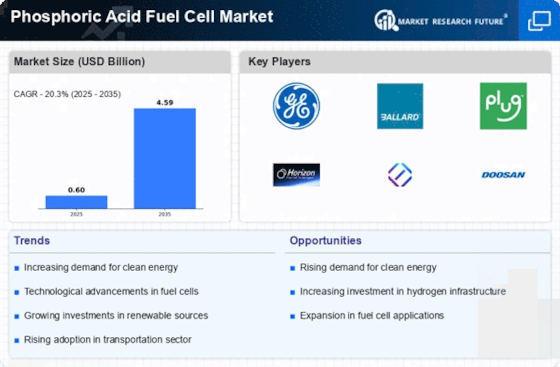
Phosphoric Acid Fuel Cell Market Infographic
Purchase Options

Market Share

Phosphoric Acid Fuel Cell Market Share Analysis

The change of market share positioning strategies has a significant effect in the field where phosphoric acid fuel cells (PAFC) operate. PAFCs have attracted interest as a potential clean energy source, and this has prompted companies to position themselves in such way so that they can take up the majority portion of market. A common approach to do so is through differentiation based on technological innovation. Firms spend tremendous amounts on research and development to improve the efficiency and output of PAFCs. Companies try to stay ahead of the technological curve to provide leading products that distinguish themselves on the competitive market. This not only gives the company an early market share but also ensures sustainable success by moving in front of emerging trends and customer needs. Lastly, market share positioning in the PAFC sector also involves collaboration and strategic partnerships. Companies are forming partnerships with research institutes, government agencies and other industrial firms so as to share ideas and funds. These agreements not only enable knowledge sharing but also allow companies to benefit from the strengths of each other, thus resulting in strong and marketable PAFC solutions. With the help of strategic alliances, companies increase their market visibility and strengthen their position towards competitors. Market segmentation is another strategy that the companies are using to successfully position themselves within PAFC market. Knowing the varying requirements of multiple customer segments helps organizations to customize their products and techniques in communication. Whether aiming at residential, commercial, or industrial applications, the companies can focus their offerings to certain market segments that have special specifications and this way they get a foothold in it. This specific strategy allows companies to acquire market share in areas where their products are necessary and desirable. Additionally, pricing approach is an important tool in market share placement. However, along with product quality and innovation companies must take into consideration pricing strategies that are attractive among a broad mass of customers. Price competition, in combination with value-added services implementation, can lead to a bigger consumer audience and high market share. Striking a balance between affordable pricing and value propositions is critical for companies to create powerful footprints in the PAFC market. Many firms are using global expansion as a strategy to boost their market share in the PAFC industry. Amid the growing global demand for clean energy solutions, businesses are scouting opportunities in other parts of the world. Creating a global presence ensures that companies can access different markets, as well as reduce vulnerability to regional economic shifts. Companies that manage to deal with the challenges posed by global markets can acquire a significant market share and become leaders in PAFC technology worldwide.


Author
Author Profile
Priya Nagrale
Senior Research Analyst

With an experience of over five years in market research industry (Chemicals & Materials domain), I gather and analyze market data from diverse sources to produce results, which are then presented back to a client. Also, provide recommendations based on the findings. As a Senior Research Analyst, I perform quality checks (QC) for market estimations, QC for reports, and handle queries and work extensively on client customizations. Also, handle the responsibilities of client proposals, report planning, report finalization, and execution

Leave a Comment

FAQs

What is the current valuation of the Phosphoric Acid Fuel Cell Market?

<p>As of 2024, the Phosphoric Acid Fuel Cell Market was valued at 0.6015 USD Billion.</p>

What is the projected market valuation for the Phosphoric Acid Fuel Cell Market in 2035?

<p>The market is projected to reach a valuation of 4.595 USD Billion by 2035.</p>

What is the expected CAGR for the Phosphoric Acid Fuel Cell Market during the forecast period?

<p>The expected CAGR for the market from 2025 to 2035 is 20.3%.</p>

Which companies are considered key players in the Phosphoric Acid Fuel Cell Market?

<p>Key players include General Electric, Ballard Power Systems, Plug Power, and FuelCell Energy, among others.</p>

What are the main application segments of the Phosphoric Acid Fuel Cell Market?

<p>The main application segments include Vehicles, Cogeneration, and Others.</p>

How did the Vehicles segment perform in terms of valuation in 2024?

In 2024, the Vehicles segment was valued at approximately 0.18045 USD Billion.

What is the projected valuation for the Cogeneration segment by 2035?

The Cogeneration segment is expected to reach a valuation of approximately 2.3875 USD Billion by 2035.

What is the expected growth trend for the Others segment in the Phosphoric Acid Fuel Cell Market?

The Others segment is projected to grow to approximately 1.81975 USD Billion by 2035.

How does the Phosphoric Acid Fuel Cell Market compare to other fuel cell technologies?

While specific comparisons are not provided, the Phosphoric Acid Fuel Cell Market is experiencing robust growth, indicating a competitive landscape.

What factors are driving the growth of the Phosphoric Acid Fuel Cell Market?

The growth appears to be driven by increasing demand for clean energy solutions and advancements in fuel cell technology.

Market Summary

As per Market Research Future analysis, the Phosphoric Acid Fuel Cell Market Size was estimated at 0.6015 USD Billion in 2024. The Phosphoric Acid Fuel Cell industry is projected to grow from USD 0.7236 Billion in 2025 to USD 4.595 Billion by 2035, exhibiting a compound annual growth rate (CAGR) of 20.3% during the forecast period 2025 - 2035

Key Market Trends & Highlights

The Phosphoric Acid Fuel Cell Market is poised for substantial growth driven by technological advancements and increasing demand for clean energy solutions.

  • The market experiences a rising demand for clean energy solutions, particularly in North America, which remains the largest market. Technological advancements in fuel cell design are enhancing efficiency and performance, contributing to market expansion. The Asia-Pacific region is recognized as the fastest-growing area, driven by increasing investments in clean energy technologies. Key market drivers include the increasing adoption of fuel cell technology and government incentives aimed at promoting sustainable energy solutions.

Market Size & Forecast

2024 Market Size 0.6015 (USD Billion)
2035 Market Size 4.595 (USD Billion)
CAGR (2025 - 2035) 20.3%
Largest Regional Market Share in 2024 Asia Pacific

Major Players

General Electric (US), <a href="https://www.ballard.com/stationary-power-generation/">Ballard Power Systems</a> (CA), Plug Power (US), Horizon Fuel Cell Technologies (SG), FuelCell Energy (US), Doosan Fuel Cell (KR), AFC Energy (GB), <a href="https://www.sfc.com/investors/sfc-energy-secured-eur-4-million-follow-up-order-its-strategic-partner-fc-tecnrgy-pvt-ltd-fuel-cell-solutions-be-used-indian-ministry-defence-newsid2935809/">SFC Energy</a> (DE)

Market Trends

The Phosphoric Acid Fuel Cell Market is currently experiencing a notable evolution, driven by the increasing demand for clean energy solutions and the growing emphasis on reducing carbon emissions. This market segment appears to be gaining traction due to its efficiency and reliability in various applications, including stationary power generation and transportation. As industries seek sustainable alternatives to traditional fossil fuels, phosphoric acid fuel cells are emerging as a viable option, offering a balance between performance and environmental responsibility. Furthermore, advancements in technology and materials are likely to enhance the performance and longevity of these fuel cells, potentially expanding their adoption across diverse sectors. In addition, the Phosphoric Acid Fuel Cell Market seems to be influenced by government policies and incentives aimed at promoting renewable energy sources. Regulatory frameworks that support the development and deployment of fuel cell technologies may further stimulate market growth. As stakeholders recognize the potential of phosphoric acid fuel cells in achieving energy efficiency and sustainability goals, investment in research and development is expected to increase. This trend could lead to innovative solutions that address current limitations, thereby solidifying the market's position in the broader energy landscape.

Rising Demand for Clean Energy Solutions

The Phosphoric Acid Fuel Cell Market is witnessing an upsurge in interest due to the global shift towards cleaner energy sources. As environmental concerns escalate, industries are increasingly exploring alternatives to conventional energy systems, positioning phosphoric acid fuel cells as a promising solution.

Technological Advancements

Ongoing innovations in fuel cell technology are likely to enhance the efficiency and durability of phosphoric acid fuel cells. These advancements may lead to improved performance metrics, making them more attractive for various applications, including transportation and stationary power.

Supportive Regulatory Environment

Government initiatives and policies aimed at promoting renewable energy are expected to bolster the Phosphoric Acid Fuel Cell Market. Incentives for clean energy technologies could encourage investment and development, facilitating broader adoption of fuel cell systems.

Phosphoric Acid Fuel Cell Market Market Drivers

Rising Environmental Concerns

The Phosphoric Acid Fuel Cell Market is significantly influenced by rising environmental concerns among consumers and businesses alike. As awareness of climate change and pollution intensifies, there is a growing demand for cleaner energy solutions. Phosphoric acid fuel cells, known for their low emissions and high efficiency, are becoming increasingly attractive to environmentally conscious consumers. This shift in consumer preference is likely to drive market growth, as more organizations seek to reduce their carbon footprint. Furthermore, the increasing pressure on industries to adopt sustainable practices may lead to a surge in the adoption of phosphoric acid fuel cells, thereby enhancing their market presence.

Government Incentives and Support

The Phosphoric Acid Fuel Cell Market benefits from a favorable regulatory landscape, characterized by government incentives and support for clean energy technologies. Various governments are implementing policies aimed at reducing carbon emissions and promoting renewable energy sources. These initiatives often include financial incentives, tax breaks, and grants for companies investing in fuel cell technology. As a result, the phosphoric acid fuel cell market is likely to experience accelerated growth, as businesses are encouraged to adopt these technologies. The increasing alignment of government policies with sustainability goals suggests a promising future for the phosphoric acid fuel cell market, potentially leading to enhanced market penetration and innovation.

Growing Demand for Backup Power Solutions

The Phosphoric Acid Fuel Cell Market is poised for growth due to the increasing demand for reliable backup power solutions. As power outages become more frequent and disruptive, businesses and consumers are seeking dependable energy sources to ensure continuity. Phosphoric acid fuel cells offer a robust solution, providing uninterrupted power supply with minimal emissions. This demand is particularly evident in critical sectors such as healthcare, data centers, and telecommunications, where reliable power is essential. The market for backup power solutions is projected to grow, and phosphoric acid fuel cells are likely to play a pivotal role in meeting this demand, thereby enhancing their market share.

Increasing Adoption of Fuel Cell Technology

The Phosphoric Acid Fuel Cell Market is witnessing a notable increase in the adoption of fuel cell technology across various sectors. This trend is primarily driven by the growing need for efficient and sustainable energy solutions. Industries such as transportation, stationary power generation, and backup power systems are increasingly integrating phosphoric acid fuel cells due to their reliability and efficiency. According to recent data, the market for fuel cells is projected to expand significantly, with phosphoric acid fuel cells expected to capture a substantial share. This shift towards cleaner energy sources is likely to bolster the demand for phosphoric acid fuel cells, as they offer a viable alternative to traditional fossil fuels.

Technological Innovations in Fuel Cell Design

The Phosphoric Acid Fuel Cell Market is experiencing a wave of technological innovations that are enhancing the performance and efficiency of fuel cells. Advances in materials science and engineering are leading to the development of more efficient phosphoric acid fuel cells, which can operate at higher temperatures and deliver improved power output. These innovations are likely to attract investment and interest from various sectors, including automotive and energy. As manufacturers continue to refine fuel cell technology, the market is expected to expand, with phosphoric acid fuel cells playing a crucial role in the transition to cleaner energy systems. The ongoing research and development efforts indicate a promising trajectory for the industry.

Market Segment Insights

By Application: Vehicles (Largest) vs. Cogeneration (Fastest-Growing)

The Phosphoric Acid Fuel Cell Market displays a diverse application landscape, with the vehicles segment holding the largest market share. This segment benefits from the increasing demand for clean transportation solutions, driven by regulatory incentives and a global push for sustainability. Alternatively, the cogeneration segment is emerging as the fastest-growing area, attributed to the rising need for efficient energy generation that can utilize waste heat and reduce overall emissions. Other applications, while contributing to the market, trail behind these two major segments in terms of share and growth potential.

Vehicles: Clean Transportation (Dominant) vs. Cogeneration: Efficient Energy (Emerging)

In the Phosphoric Acid Fuel Cell Market, the vehicles segment represents the dominant force, characterized by its alignment with global environmental goals and consumer demand for sustainable transportation solutions. These fuel cells offer significant benefits in terms of efficiency and reduced emissions, positioning them as a viable alternative to conventional vehicle powertrains. On the other hand, the cogeneration segment is recognized as an emerging application, capitalizing on the dual generation of electricity and usable thermal energy. This segment is increasingly adopted by industries seeking sustainability while improving energy efficiency, and its rapid growth reflects a shift toward integrated energy solutions that leverage both power and heat, making it a crucial focus for future investments.

Get more detailed insights about Phosphoric Acid Fuel Cell Market Research Report— Global Forecast till 2035

Regional Insights

North America : Innovation and Investment Hub

North America is the largest market for phosphoric acid fuel cells, holding approximately 45% of the global market share. The region benefits from strong government support, technological advancements, and increasing demand for clean energy solutions. Regulatory frameworks, such as the Clean Air Act, are driving investments in fuel cell technologies, fostering innovation and adoption across various sectors. The United States and Canada are the leading countries in this market, with major players like General Electric and Plug Power spearheading advancements. The competitive landscape is characterized by significant R&D investments and collaborations among key stakeholders. The presence of established companies and a growing number of startups is enhancing the region's position as a leader in fuel cell technology.

Europe : Sustainable Energy Transition

Europe is the second-largest market for phosphoric acid fuel cells, accounting for around 30% of the global market share. The region is experiencing a surge in demand due to stringent environmental regulations and a strong commitment to reducing carbon emissions. Initiatives like the European Green Deal are catalyzing investments in clean energy technologies, including fuel cells, to meet sustainability goals. Germany, the UK, and France are at the forefront of this market, with key players such as SFC Energy and AFC Energy leading the charge. The competitive landscape is marked by a focus on innovation and collaboration among industry stakeholders. European countries are increasingly investing in research and development to enhance fuel cell efficiency and reduce costs, positioning themselves as leaders in the global market.

Asia-Pacific : Emerging Market Potential

Asia-Pacific is witnessing rapid growth in the phosphoric acid fuel cell market, holding approximately 20% of the global market share. The region's growth is driven by increasing energy demands, government initiatives promoting clean energy, and advancements in fuel cell technology. Countries like South Korea and Japan are leading the charge, supported by favorable policies and investments in renewable energy sources. South Korea and Japan are the primary markets in this region, with companies like Doosan Fuel Cell and Horizon Fuel Cell Technologies playing significant roles. The competitive landscape is evolving, with both established firms and new entrants focusing on innovation and cost reduction. The region's commitment to sustainable energy solutions is expected to further boost the adoption of fuel cells in various applications.

Middle East and Africa : Resource-Rich Opportunities

The Middle East and Africa region is gradually emerging in the phosphoric acid fuel cell market, currently holding about 5% of the global market share. The growth is primarily driven by increasing energy needs and a shift towards sustainable energy solutions. Governments in the region are beginning to recognize the potential of fuel cells in diversifying energy sources and reducing reliance on fossil fuels. Countries like South Africa and the UAE are leading the way in adopting fuel cell technologies, supported by investments in renewable energy projects. The competitive landscape is still developing, with a mix of local and international players entering the market. As awareness of clean energy solutions grows, the region is expected to see significant advancements in fuel cell technology and infrastructure.

Key Players and Competitive Insights

The Phosphoric Acid Fuel Cell Market is currently characterized by a dynamic competitive landscape, driven by increasing demand for clean energy solutions and advancements in fuel cell technology. Key players such as General Electric (US), Ballard Power Systems (CA), and Plug Power (US) are strategically positioned to leverage their technological expertise and market presence. General Electric (US) focuses on innovation in fuel cell efficiency, while Ballard Power Systems (CA) emphasizes partnerships to enhance its product offerings. Plug Power (US) is actively pursuing regional expansion, particularly in North America, to capitalize on the growing demand for hydrogen fuel cells. Collectively, these strategies contribute to a competitive environment that is increasingly focused on technological advancement and market penetration.
In terms of business tactics, companies are localizing manufacturing and optimizing supply chains to enhance operational efficiency. The market structure appears moderately fragmented, with several players vying for market share. However, the influence of key players is substantial, as they set industry standards and drive innovation. This competitive structure fosters an environment where collaboration and strategic partnerships are essential for growth and sustainability.
In August 2025, General Electric (US) announced a partnership with a leading renewable energy firm to develop integrated fuel cell systems aimed at commercial applications. This strategic move is likely to enhance GE's market position by combining its technological capabilities with renewable energy solutions, thereby addressing the increasing demand for sustainable energy sources. The collaboration may also facilitate entry into new markets, further solidifying GE's competitive edge.
In September 2025, Ballard Power Systems (CA) unveiled a new line of phosphoric acid fuel cells designed for heavy-duty vehicles. This launch is significant as it aligns with the global push towards decarbonization in the transportation sector. By targeting this niche market, Ballard Power Systems (CA) positions itself as a leader in providing clean energy solutions for commercial fleets, potentially increasing its market share and reinforcing its commitment to sustainability.
In October 2025, Plug Power (US) expanded its manufacturing capabilities by opening a new facility in the Midwest, aimed at increasing production capacity for its fuel cell systems. This expansion is indicative of Plug Power's strategy to meet the rising demand for hydrogen fuel cells in various applications, including logistics and transportation. The facility is expected to enhance supply chain reliability and reduce lead times, which are critical factors in maintaining competitive differentiation in the market.
As of October 2025, current competitive trends in the Phosphoric Acid Fuel Cell Market are heavily influenced by digitalization, sustainability initiatives, and the integration of artificial intelligence in operational processes. Strategic alliances are increasingly shaping the landscape, as companies recognize the value of collaboration in driving innovation and market growth. Looking ahead, competitive differentiation is likely to evolve from traditional price-based competition to a focus on technological innovation, supply chain reliability, and sustainable practices, reflecting the industry's shift towards a more environmentally conscious future.

Key Companies in the Phosphoric Acid Fuel Cell Market include

Industry Developments

August 2019 An R&D project called D2Service was started by the German Aerospace Center (DLR) in collaboration with six additional parties working in five different countries. The initiative aims to simplify the installation and maintenance of fuel cell-powered CHP systems. Additionally, the venture aims to efficiently combine the components and interfaces of various products so that maintenance can be done with less effort.

Future Outlook

Phosphoric Acid Fuel Cell Market Future Outlook

The Phosphoric Acid Fuel Cell Market is projected to grow at a 20.3% CAGR from 2025 to 2035, driven by increasing demand for clean energy and advancements in fuel cell technology.

New opportunities lie in:

  • Development of modular fuel cell systems for commercial vehicles.
  • Integration of fuel cells in renewable energy storage solutions.
  • Expansion into emerging markets with tailored fuel cell applications.

By 2035, the market is expected to solidify its position as a leader in sustainable energy solutions.

Market Segmentation

Phosphoric Acid Fuel Cell Market Application Outlook

  • Vehicles
  • Cogeneration
  • Others

Report Scope

MARKET SIZE 2024 0.6015(USD Billion)
MARKET SIZE 2025 0.7236(USD Billion)
MARKET SIZE 2035 4.595(USD Billion)
COMPOUND ANNUAL GROWTH RATE (CAGR) 20.3% (2025 - 2035)
REPORT COVERAGE Revenue Forecast, Competitive Landscape, Growth Factors, and Trends
BASE YEAR 2024
Market Forecast Period 2025 - 2035
Historical Data 2019 - 2024
Market Forecast Units USD Billion
Key Companies Profiled General Electric (US), Ballard Power Systems (CA), Plug Power (US), Horizon Fuel Cell Technologies (SG), FuelCell Energy (US), Doosan Fuel Cell (KR), AFC Energy (GB), SFC Energy (DE)
Segments Covered Application, Region
Key Market Opportunities Growing demand for clean energy solutions drives innovation in the Phosphoric Acid Fuel Cell Market.
Key Market Dynamics Rising demand for clean energy solutions drives innovation and competition in the phosphoric acid fuel cell market.
Countries Covered North America, Europe, APAC, South America, MEA

FAQs

What is the current valuation of the Phosphoric Acid Fuel Cell Market?

<p>As of 2024, the Phosphoric Acid Fuel Cell Market was valued at 0.6015 USD Billion.</p>

What is the projected market valuation for the Phosphoric Acid Fuel Cell Market in 2035?

<p>The market is projected to reach a valuation of 4.595 USD Billion by 2035.</p>

What is the expected CAGR for the Phosphoric Acid Fuel Cell Market during the forecast period?

<p>The expected CAGR for the market from 2025 to 2035 is 20.3%.</p>

Which companies are considered key players in the Phosphoric Acid Fuel Cell Market?

<p>Key players include General Electric, Ballard Power Systems, Plug Power, and FuelCell Energy, among others.</p>

What are the main application segments of the Phosphoric Acid Fuel Cell Market?

<p>The main application segments include Vehicles, Cogeneration, and Others.</p>

How did the Vehicles segment perform in terms of valuation in 2024?

In 2024, the Vehicles segment was valued at approximately 0.18045 USD Billion.

What is the projected valuation for the Cogeneration segment by 2035?

The Cogeneration segment is expected to reach a valuation of approximately 2.3875 USD Billion by 2035.

What is the expected growth trend for the Others segment in the Phosphoric Acid Fuel Cell Market?

The Others segment is projected to grow to approximately 1.81975 USD Billion by 2035.

How does the Phosphoric Acid Fuel Cell Market compare to other fuel cell technologies?

While specific comparisons are not provided, the Phosphoric Acid Fuel Cell Market is experiencing robust growth, indicating a competitive landscape.

What factors are driving the growth of the Phosphoric Acid Fuel Cell Market?

The growth appears to be driven by increasing demand for clean energy solutions and advancements in fuel cell technology.

  1. SECTION I: EXECUTIVE SUMMARY AND KEY HIGHLIGHTS
    1. | 1.1 EXECUTIVE SUMMARY
    2. | | 1.1.1 Market Overview
    3. | | 1.1.2 Key Findings
    4. | | 1.1.3 Market Segmentation
    5. | | 1.1.4 Competitive Landscape
    6. | | 1.1.5 Challenges and Opportunities
    7. | | 1.1.6 Future Outlook
  2. SECTION II: SCOPING, METHODOLOGY AND MARKET STRUCTURE
    1. | 2.1 MARKET INTRODUCTION
    2. | | 2.1.1 Definition
    3. | | 2.1.2 Scope of the study
    4. | | | 2.1.2.1 Research Objective
    5. | | | 2.1.2.2 Assumption
    6. | | | 2.1.2.3 Limitations
    7. | 2.2 RESEARCH METHODOLOGY
    8. | | 2.2.1 Overview
    9. | | 2.2.2 Data Mining
    10. | | 2.2.3 Secondary Research
    11. | | 2.2.4 Primary Research
    12. | | | 2.2.4.1 Primary Interviews and Information Gathering Process
    13. | | | 2.2.4.2 Breakdown of Primary Respondents
    14. | | 2.2.5 Forecasting Model
    15. | | 2.2.6 Market Size Estimation
    16. | | | 2.2.6.1 Bottom-Up Approach
    17. | | | 2.2.6.2 Top-Down Approach
    18. | | 2.2.7 Data Triangulation
    19. | | 2.2.8 Validation
  3. SECTION III: QUALITATIVE ANALYSIS
    1. | 3.1 MARKET DYNAMICS
    2. | | 3.1.1 Overview
    3. | | 3.1.2 Drivers
    4. | | 3.1.3 Restraints
    5. | | 3.1.4 Opportunities
    6. | 3.2 MARKET FACTOR ANALYSIS
    7. | | 3.2.1 Value chain Analysis
    8. | | 3.2.2 Porter's Five Forces Analysis
    9. | | | 3.2.2.1 Bargaining Power of Suppliers
    10. | | | 3.2.2.2 Bargaining Power of Buyers
    11. | | | 3.2.2.3 Threat of New Entrants
    12. | | | 3.2.2.4 Threat of Substitutes
    13. | | | 3.2.2.5 Intensity of Rivalry
    14. | | 3.2.3 COVID-19 Impact Analysis
    15. | | | 3.2.3.1 Market Impact Analysis
    16. | | | 3.2.3.2 Regional Impact
    17. | | | 3.2.3.3 Opportunity and Threat Analysis
  4. SECTION IV: QUANTITATIVE ANALYSIS
    1. | 4.1 Energy & Power, BY Application (USD Billion)
    2. | | 4.1.1 Vehicles
    3. | | 4.1.2 Cogeneration
    4. | | 4.1.3 Others
    5. | 4.2 Energy & Power, BY Region (USD Billion)
    6. | | 4.2.1 North America
    7. | | | 4.2.1.1 US
    8. | | | 4.2.1.2 Canada
    9. | | 4.2.2 Europe
    10. | | | 4.2.2.1 Germany
    11. | | | 4.2.2.2 UK
    12. | | | 4.2.2.3 France
    13. | | | 4.2.2.4 Russia
    14. | | | 4.2.2.5 Italy
    15. | | | 4.2.2.6 Spain
    16. | | | 4.2.2.7 Rest of Europe
    17. | | 4.2.3 APAC
    18. | | | 4.2.3.1 China
    19. | | | 4.2.3.2 India
    20. | | | 4.2.3.3 Japan
    21. | | | 4.2.3.4 South Korea
    22. | | | 4.2.3.5 Malaysia
    23. | | | 4.2.3.6 Thailand
    24. | | | 4.2.3.7 Indonesia
    25. | | | 4.2.3.8 Rest of APAC
    26. | | 4.2.4 South America
    27. | | | 4.2.4.1 Brazil
    28. | | | 4.2.4.2 Mexico
    29. | | | 4.2.4.3 Argentina
    30. | | | 4.2.4.4 Rest of South America
    31. | | 4.2.5 MEA
    32. | | | 4.2.5.1 GCC Countries
    33. | | | 4.2.5.2 South Africa
    34. | | | 4.2.5.3 Rest of MEA
  5. SECTION V: COMPETITIVE ANALYSIS
    1. | 5.1 Competitive Landscape
    2. | | 5.1.1 Overview
    3. | | 5.1.2 Competitive Analysis
    4. | | 5.1.3 Market share Analysis
    5. | | 5.1.4 Major Growth Strategy in the Energy & Power
    6. | | 5.1.5 Competitive Benchmarking
    7. | | 5.1.6 Leading Players in Terms of Number of Developments in the Energy & Power
    8. | | 5.1.7 Key developments and growth strategies
    9. | | | 5.1.7.1 New Product Launch/Service Deployment
    10. | | | 5.1.7.2 Merger & Acquisitions
    11. | | | 5.1.7.3 Joint Ventures
    12. | | 5.1.8 Major Players Financial Matrix
    13. | | | 5.1.8.1 Sales and Operating Income
    14. | | | 5.1.8.2 Major Players R&D Expenditure. 2023
    15. | 5.2 Company Profiles
    16. | | 5.2.1 General Electric (US)
    17. | | | 5.2.1.1 Financial Overview
    18. | | | 5.2.1.2 Products Offered
    19. | | | 5.2.1.3 Key Developments
    20. | | | 5.2.1.4 SWOT Analysis
    21. | | | 5.2.1.5 Key Strategies
    22. | | 5.2.2 Ballard Power Systems (CA)
    23. | | | 5.2.2.1 Financial Overview
    24. | | | 5.2.2.2 Products Offered
    25. | | | 5.2.2.3 Key Developments
    26. | | | 5.2.2.4 SWOT Analysis
    27. | | | 5.2.2.5 Key Strategies
    28. | | 5.2.3 Plug Power (US)
    29. | | | 5.2.3.1 Financial Overview
    30. | | | 5.2.3.2 Products Offered
    31. | | | 5.2.3.3 Key Developments
    32. | | | 5.2.3.4 SWOT Analysis
    33. | | | 5.2.3.5 Key Strategies
    34. | | 5.2.4 Horizon Fuel Cell Technologies (SG)
    35. | | | 5.2.4.1 Financial Overview
    36. | | | 5.2.4.2 Products Offered
    37. | | | 5.2.4.3 Key Developments
    38. | | | 5.2.4.4 SWOT Analysis
    39. | | | 5.2.4.5 Key Strategies
    40. | | 5.2.5 FuelCell Energy (US)
    41. | | | 5.2.5.1 Financial Overview
    42. | | | 5.2.5.2 Products Offered
    43. | | | 5.2.5.3 Key Developments
    44. | | | 5.2.5.4 SWOT Analysis
    45. | | | 5.2.5.5 Key Strategies
    46. | | 5.2.6 Doosan Fuel Cell (KR)
    47. | | | 5.2.6.1 Financial Overview
    48. | | | 5.2.6.2 Products Offered
    49. | | | 5.2.6.3 Key Developments
    50. | | | 5.2.6.4 SWOT Analysis
    51. | | | 5.2.6.5 Key Strategies
    52. | | 5.2.7 AFC Energy (GB)
    53. | | | 5.2.7.1 Financial Overview
    54. | | | 5.2.7.2 Products Offered
    55. | | | 5.2.7.3 Key Developments
    56. | | | 5.2.7.4 SWOT Analysis
    57. | | | 5.2.7.5 Key Strategies
    58. | | 5.2.8 SFC Energy (DE)
    59. | | | 5.2.8.1 Financial Overview
    60. | | | 5.2.8.2 Products Offered
    61. | | | 5.2.8.3 Key Developments
    62. | | | 5.2.8.4 SWOT Analysis
    63. | | | 5.2.8.5 Key Strategies
    64. | 5.3 Appendix
    65. | | 5.3.1 References
    66. | | 5.3.2 Related Reports
  6. LIST OF FIGURES
    1. | 6.1 MARKET SYNOPSIS
    2. | 6.2 NORTH AMERICA MARKET ANALYSIS
    3. | 6.3 US MARKET ANALYSIS BY APPLICATION
    4. | 6.4 CANADA MARKET ANALYSIS BY APPLICATION
    5. | 6.5 EUROPE MARKET ANALYSIS
    6. | 6.6 GERMANY MARKET ANALYSIS BY APPLICATION
    7. | 6.7 UK MARKET ANALYSIS BY APPLICATION
    8. | 6.8 FRANCE MARKET ANALYSIS BY APPLICATION
    9. | 6.9 RUSSIA MARKET ANALYSIS BY APPLICATION
    10. | 6.10 ITALY MARKET ANALYSIS BY APPLICATION
    11. | 6.11 SPAIN MARKET ANALYSIS BY APPLICATION
    12. | 6.12 REST OF EUROPE MARKET ANALYSIS BY APPLICATION
    13. | 6.13 APAC MARKET ANALYSIS
    14. | 6.14 CHINA MARKET ANALYSIS BY APPLICATION
    15. | 6.15 INDIA MARKET ANALYSIS BY APPLICATION
    16. | 6.16 JAPAN MARKET ANALYSIS BY APPLICATION
    17. | 6.17 SOUTH KOREA MARKET ANALYSIS BY APPLICATION
    18. | 6.18 MALAYSIA MARKET ANALYSIS BY APPLICATION
    19. | 6.19 THAILAND MARKET ANALYSIS BY APPLICATION
    20. | 6.20 INDONESIA MARKET ANALYSIS BY APPLICATION
    21. | 6.21 REST OF APAC MARKET ANALYSIS BY APPLICATION
    22. | 6.22 SOUTH AMERICA MARKET ANALYSIS
    23. | 6.23 BRAZIL MARKET ANALYSIS BY APPLICATION
    24. | 6.24 MEXICO MARKET ANALYSIS BY APPLICATION
    25. | 6.25 ARGENTINA MARKET ANALYSIS BY APPLICATION
    26. | 6.26 REST OF SOUTH AMERICA MARKET ANALYSIS BY APPLICATION
    27. | 6.27 MEA MARKET ANALYSIS
    28. | 6.28 GCC COUNTRIES MARKET ANALYSIS BY APPLICATION
    29. | 6.29 SOUTH AFRICA MARKET ANALYSIS BY APPLICATION
    30. | 6.30 REST OF MEA MARKET ANALYSIS BY APPLICATION
    31. | 6.31 KEY BUYING CRITERIA OF ENERGY & POWER
    32. | 6.32 RESEARCH PROCESS OF MRFR
    33. | 6.33 DRO ANALYSIS OF ENERGY & POWER
    34. | 6.34 DRIVERS IMPACT ANALYSIS: ENERGY & POWER
    35. | 6.35 RESTRAINTS IMPACT ANALYSIS: ENERGY & POWER
    36. | 6.36 SUPPLY / VALUE CHAIN: ENERGY & POWER
    37. | 6.37 ENERGY & POWER, BY APPLICATION, 2024 (% SHARE)
    38. | 6.38 ENERGY & POWER, BY APPLICATION, 2024 TO 2035 (USD Billion)
    39. | 6.39 BENCHMARKING OF MAJOR COMPETITORS
  7. LIST OF TABLES
    1. | 7.1 LIST OF ASSUMPTIONS
    2. | | 7.1.1
    3. | 7.2 North America MARKET SIZE ESTIMATES; FORECAST
    4. | | 7.2.1 BY APPLICATION, 2025-2035 (USD Billion)
    5. | 7.3 US MARKET SIZE ESTIMATES; FORECAST
    6. | | 7.3.1 BY APPLICATION, 2025-2035 (USD Billion)
    7. | 7.4 Canada MARKET SIZE ESTIMATES; FORECAST
    8. | | 7.4.1 BY APPLICATION, 2025-2035 (USD Billion)
    9. | 7.5 Europe MARKET SIZE ESTIMATES; FORECAST
    10. | | 7.5.1 BY APPLICATION, 2025-2035 (USD Billion)
    11. | 7.6 Germany MARKET SIZE ESTIMATES; FORECAST
    12. | | 7.6.1 BY APPLICATION, 2025-2035 (USD Billion)
    13. | 7.7 UK MARKET SIZE ESTIMATES; FORECAST
    14. | | 7.7.1 BY APPLICATION, 2025-2035 (USD Billion)
    15. | 7.8 France MARKET SIZE ESTIMATES; FORECAST
    16. | | 7.8.1 BY APPLICATION, 2025-2035 (USD Billion)
    17. | 7.9 Russia MARKET SIZE ESTIMATES; FORECAST
    18. | | 7.9.1 BY APPLICATION, 2025-2035 (USD Billion)
    19. | 7.10 Italy MARKET SIZE ESTIMATES; FORECAST
    20. | | 7.10.1 BY APPLICATION, 2025-2035 (USD Billion)
    21. | 7.11 Spain MARKET SIZE ESTIMATES; FORECAST
    22. | | 7.11.1 BY APPLICATION, 2025-2035 (USD Billion)
    23. | 7.12 Rest of Europe MARKET SIZE ESTIMATES; FORECAST
    24. | | 7.12.1 BY APPLICATION, 2025-2035 (USD Billion)
    25. | 7.13 APAC MARKET SIZE ESTIMATES; FORECAST
    26. | | 7.13.1 BY APPLICATION, 2025-2035 (USD Billion)
    27. | 7.14 China MARKET SIZE ESTIMATES; FORECAST
    28. | | 7.14.1 BY APPLICATION, 2025-2035 (USD Billion)
    29. | 7.15 India MARKET SIZE ESTIMATES; FORECAST
    30. | | 7.15.1 BY APPLICATION, 2025-2035 (USD Billion)
    31. | 7.16 Japan MARKET SIZE ESTIMATES; FORECAST
    32. | | 7.16.1 BY APPLICATION, 2025-2035 (USD Billion)
    33. | 7.17 South Korea MARKET SIZE ESTIMATES; FORECAST
    34. | | 7.17.1 BY APPLICATION, 2025-2035 (USD Billion)
    35. | 7.18 Malaysia MARKET SIZE ESTIMATES; FORECAST
    36. | | 7.18.1 BY APPLICATION, 2025-2035 (USD Billion)
    37. | 7.19 Thailand MARKET SIZE ESTIMATES; FORECAST
    38. | | 7.19.1 BY APPLICATION, 2025-2035 (USD Billion)
    39. | 7.20 Indonesia MARKET SIZE ESTIMATES; FORECAST
    40. | | 7.20.1 BY APPLICATION, 2025-2035 (USD Billion)
    41. | 7.21 Rest of APAC MARKET SIZE ESTIMATES; FORECAST
    42. | | 7.21.1 BY APPLICATION, 2025-2035 (USD Billion)
    43. | 7.22 South America MARKET SIZE ESTIMATES; FORECAST
    44. | | 7.22.1 BY APPLICATION, 2025-2035 (USD Billion)
    45. | 7.23 Brazil MARKET SIZE ESTIMATES; FORECAST
    46. | | 7.23.1 BY APPLICATION, 2025-2035 (USD Billion)
    47. | 7.24 Mexico MARKET SIZE ESTIMATES; FORECAST
    48. | | 7.24.1 BY APPLICATION, 2025-2035 (USD Billion)
    49. | 7.25 Argentina MARKET SIZE ESTIMATES; FORECAST
    50. | | 7.25.1 BY APPLICATION, 2025-2035 (USD Billion)
    51. | 7.26 Rest of South America MARKET SIZE ESTIMATES; FORECAST
    52. | | 7.26.1 BY APPLICATION, 2025-2035 (USD Billion)
    53. | 7.27 MEA MARKET SIZE ESTIMATES; FORECAST
    54. | | 7.27.1 BY APPLICATION, 2025-2035 (USD Billion)
    55. | 7.28 GCC Countries MARKET SIZE ESTIMATES; FORECAST
    56. | | 7.28.1 BY APPLICATION, 2025-2035 (USD Billion)
    57. | 7.29 South Africa MARKET SIZE ESTIMATES; FORECAST
    58. | | 7.29.1 BY APPLICATION, 2025-2035 (USD Billion)
    59. | 7.30 Rest of MEA MARKET SIZE ESTIMATES; FORECAST
    60. | | 7.30.1 BY APPLICATION, 2025-2035 (USD Billion)
    61. | 7.31 PRODUCT LAUNCH/PRODUCT DEVELOPMENT/APPROVAL
    62. | | 7.31.1
    63. | 7.32 ACQUISITION/PARTNERSHIP
    64. | | 7.32.1

Energy & Power Market Segmentation

Energy & Power By Application (USD Billion, 2025-2035)

  • Vehicles
  • Cogeneration
  • Others
Infographic

Free Sample Request

Kindly complete the form below to receive a free sample of this Report

Get Free Sample

Customer Strories

Compare Licence

×
Features License Type
Single User Multiuser License Enterprise User
Price $4,950 $5,950 $7,250
Maximum User Access Limit 1 User Upto 10 Users Unrestricted Access Throughout the Organization
Free Customization
Direct Access to Analyst
Deliverable Format
Platform Access
Discount on Next Purchase 10% 15% 15%
Printable Versions
%>