Request Free Sample ×

Kindly complete the form below to receive a free sample of this Report

* Please use a valid business email

Leading companies partner with us for data-driven Insights

clients tt-cursor
Hero Background
English
Chinese
French
Japanese
Korean
German
Spanish

Pharmaceutical HDPE Bottles Market Trends

ID: MRFR/PCM/12497-HCR
128 Pages
Varsha More
December 2024

Pharmaceutical HDPE Bottles Market Research Report: Information By Capacity (Less than 30 ml, 31 ml – 100 ml, 101 ml – 500 ml, 501 ml – 1Lt, Above 1Lt), By Neck Type (Narrow Mouth Bottles and Wide Mouth Bottles), By End User (Domestic Use, Chemical Industries, Cosmetic Industries and Pharmaceutical Industries) And By Region (North America, Europe, Asia-Pacific, And the Rest Of The World) –Market Forecast Till 2035

Share:
Download PDF ×

We do not share your information with anyone. However, we may send you emails based on your report interest from time to time. You may contact us at any time to opt-out.

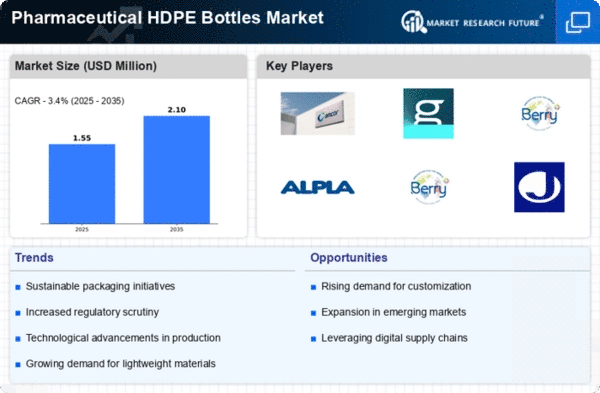
Pharmaceutical HDPE Bottles Market Infographic
Purchase Options

Market Trends

Key Emerging Trends in the Pharmaceutical HDPE Bottles Market

The market trends of pharmaceutical High-Density Polyethylene (HDPE) bottles are experiencing notable shifts influenced by factors such as regulatory requirements, technological advancements, and growing concerns about patient safety. One prominent trend in this market is the increasing emphasis on child-resistant packaging. As pharmaceutical products become more diverse and accessible, there is a heightened focus on packaging designs that prevent accidental ingestion by children. Child-resistant closures and tamper-evident features incorporated into HDPE bottles are becoming standard requirements, aligning with stringent regulations aimed at enhancing medication safety.

Moreover, there is a noticeable move towards sustainable packaging solutions in the pharmaceutical HDPE bottle market. With the broader industry push for environmentally friendly practices, pharmaceutical companies are seeking packaging materials that minimize their ecological footprint. HDPE, being recyclable, lightweight, and versatile, is gaining traction as a sustainable choice for pharmaceutical packaging. This trend reflects the growing awareness of the environmental impact of plastic usage and a commitment to more responsible packaging practices within the pharmaceutical sector.

Technological advancements are playing a crucial role in reshaping the pharmaceutical HDPE bottle market. Manufacturers are exploring innovations such as barrier coatings to enhance the performance of HDPE bottles. These coatings help protect pharmaceutical products from external factors like light, moisture, and oxygen, ensuring the stability and efficacy of the medications. Additionally, advancements in manufacturing processes are allowing for the production of HDPE bottles with precise dosing features, improving the accuracy and convenience of medication administration.

Furthermore, serialization and track-and-trace technologies are gaining prominence in the pharmaceutical packaging sector, including HDPE bottles. With an increasing focus on combating counterfeit drugs and ensuring supply chain transparency, pharmaceutical companies are implementing serialization to uniquely identify and trace individual drug packages. This trend enhances patient safety and regulatory compliance by allowing for the monitoring of the entire journey of pharmaceutical products from production to distribution.

The market is also witnessing a shift towards personalized medicine, influencing the design and functionality of pharmaceutical HDPE bottles. As pharmaceutical companies develop targeted therapies and individualized treatment plans, there is a need for packaging that accommodates varying dosage requirements. HDPE bottles with customizable dosing mechanisms, such as calibrated droppers or dispensing caps, are gaining traction to facilitate the precise administration of medications tailored to specific patient needs.

Additionally, the pharmaceutical HDPE bottle market is responding to the global health crisis by adapting to the increased demand for vaccines and other critical pharmaceutical products. HDPE bottles are well-suited for the storage and transportation of vaccines, offering durability, chemical resistance, and compatibility with a wide range of pharmaceutical formulations. The urgency of vaccine distribution and the need for reliable packaging solutions have further emphasized the importance of pharmaceutical HDPE bottles in the current healthcare landscape.

In terms of market dynamics, competition among pharmaceutical HDPE bottle manufacturers is intensifying. Companies are investing in research and development to enhance the barrier properties, sustainability, and technological features of their HDPE bottles. Meeting regulatory standards and addressing the specific needs of pharmaceutical clients are critical factors for success in this market. As the pharmaceutical industry continues to evolve, the demand for advanced and reliable HDPE packaging solutions is expected to grow.

Author
Author Profile
Varsha More
Senior Research Analyst

Experienced business professional with a demonstrated history of working in the CFnB industry. Skilled in market research, and market estimation. Strong professional with a Masters focused in marketing management.

Leave a Comment

FAQs

What is the current market valuation of the Pharmaceutical HDPE Bottles Market?

<p>The market valuation of the Pharmaceutical HDPE Bottles Market was 1.5 USD Million in 2024.</p>

What is the projected market valuation for the Pharmaceutical HDPE Bottles Market by 2035?

<p>The projected market valuation for 2035 is 2.1 USD Million.</p>

What is the expected CAGR for the Pharmaceutical HDPE Bottles Market during the forecast period?

<p>The expected CAGR for the Pharmaceutical HDPE Bottles Market from 2025 to 2035 is 3.4%.</p>

Which companies are considered key players in the Pharmaceutical HDPE Bottles Market?

Key players in the market include Amcor, Gerresheimer, Berry Global, Alpla, RPC Group, MJS Packaging, Cospak, Sidel, and Nampak.

How does the Pharmaceutical Packaging segment perform in terms of valuation?

The Pharmaceutical Packaging segment was valued at 0.6 USD Million in 2024 and is expected to reach 0.9 USD Million by 2035.

What is the valuation trend for the Nutraceutical Packaging segment?

The Nutraceutical Packaging segment was valued at 0.4 USD Million in 2024 and is projected to grow to 0.6 USD Million by 2035.

What are the expected valuations for different closure types in the market?

The Screw Cap segment was valued at 0.5 USD Million in 2024 and is anticipated to reach 0.7 USD Million by 2035.

What is the market performance of High-Density Polyethylene as a material type?

High-Density Polyethylene was valued at 0.75 USD Million in 2024 and is expected to grow to 1.05 USD Million by 2035.

How does the capacity segment of less than 100 ml perform in the market?

The capacity segment of less than 100 ml was valued at 0.3 USD Million in 2024 and is projected to reach 0.4 USD Million by 2035.

What is the expected growth for the Cosmetic Industry segment in the Pharmaceutical HDPE Bottles Market?

The Cosmetic Industry segment was valued at 0.2 USD Million in 2024 and is likely to grow to 0.3 USD Million by 2035.

Market Summary

As per MRFR analysis, the Pharmaceutical HDPE Bottles Market Size was estimated at 1.5 USD Million in 2024. The Pharmaceutical HDPE Bottles industry is projected to grow from 1.55 in 2025 to 2.1 by 2035, exhibiting a compound annual growth rate (CAGR) of 3.4% during the forecast period 2025 - 2035.

Key Market Trends & Highlights

The Pharmaceutical HDPE Bottles Market is poised for growth driven by sustainability and technological advancements.

  • North America remains the largest market for Pharmaceutical HDPE bottles, reflecting a robust demand for packaging solutions. Asia-Pacific is identified as the fastest-growing region, driven by increasing pharmaceutical production and consumption. The Pharmaceuticals segment dominates the market, while the Nutraceuticals segment is experiencing rapid growth due to rising health awareness. Key market drivers include the rising demand for pharmaceuticals and a strong focus on patient safety, which are shaping industry trends.

Market Size & Forecast

2024 Market Size 1.5 (USD Million)
2035 Market Size 2.1 (USD Million)
CAGR (2025 - 2035) 3.4%
Largest Regional Market Share in 2024 North America

Major Players

Amcor (AU), Gerresheimer (DE), Berry Global (US), Alpla (AT), RPC Group (GB), MJS Packaging (US), Cospak (AU), Paharpur 3P (IN), Sidel (FR)

Market Trends

The Pharmaceutical HDPE Bottles Market is currently experiencing a notable transformation driven by various factors. The increasing demand for safe and effective packaging solutions in the pharmaceutical sector is a primary catalyst for this evolution. As healthcare providers and manufacturers prioritize patient safety, the focus on high-density polyethylene (HDPE) bottles has intensified. These containers are recognized for their durability, chemical resistance, and lightweight properties, making them suitable for a wide range of pharmaceutical products. Furthermore, the growing trend towards sustainable packaging solutions is influencing the market, as stakeholders seek environmentally friendly options that do not compromise product integrity. In addition to sustainability, technological advancements in manufacturing processes are reshaping the Pharmaceutical HDPE Bottles Market. Innovations in production techniques are enhancing the efficiency and quality of bottle production, thereby meeting the rising expectations of the pharmaceutical industry. Moreover, the increasing prevalence of chronic diseases necessitates a steady supply of medications, further propelling the demand for reliable packaging solutions. As the market continues to evolve, it appears poised for growth, driven by the dual forces of innovation and sustainability, which are likely to define its trajectory in the coming years.

Sustainability Initiatives

The emphasis on eco-friendly practices is becoming increasingly prominent within the Pharmaceutical HDPE Bottles Market. Manufacturers are exploring biodegradable materials and recycling programs to reduce environmental impact. This trend reflects a broader commitment to sustainability, aligning with global efforts to minimize waste and promote responsible consumption.

Technological Advancements

Innovations in production technology are significantly influencing the Pharmaceutical HDPE Bottles Market. Enhanced manufacturing processes are improving efficiency and product quality. Automation and smart manufacturing techniques are being adopted, which may lead to reduced costs and increased output, thereby meeting the growing demand for pharmaceutical packaging.

Regulatory Compliance

The Pharmaceutical HDPE Bottles Market is also shaped by stringent regulatory requirements. Compliance with safety and quality standards is paramount for manufacturers. This trend indicates a heightened focus on ensuring that packaging solutions meet the necessary guidelines, which may enhance consumer trust and product reliability.

Pharmaceutical HDPE Bottles Market Market Drivers

Increasing Pharmaceutical Expenditure

The Global Pharmaceutical HDPE Bottles Market Industry is benefiting from the rising expenditure on pharmaceuticals worldwide. Governments and private sectors are investing heavily in healthcare, leading to an increase in the production and consumption of pharmaceutical products. This surge in demand for medications directly correlates with the need for effective packaging solutions, such as HDPE bottles. As pharmaceutical companies strive to meet the growing demand, the market for HDPE bottles is expected to expand. The anticipated compound annual growth rate of 4.16% from 2025 to 2035 underscores the industry's potential for sustained growth.

Rising Demand for Sustainable Packaging

The Global Pharmaceutical HDPE Bottles Market Industry is experiencing a notable shift towards sustainable packaging solutions. As environmental concerns gain traction, pharmaceutical companies are increasingly opting for HDPE bottles due to their recyclability and lower carbon footprint. This trend is further supported by regulatory frameworks promoting eco-friendly practices. For instance, the European Union's directives on plastic waste management are likely to influence global manufacturers to adopt HDPE bottles, which are perceived as more sustainable compared to alternatives. This shift could contribute to the market's projected growth, with the industry expected to reach 17.0 USD Billion in 2024.

Growing Preference for Liquid Medications

The Global Pharmaceutical HDPE Bottles Market Industry is witnessing a growing preference for liquid medications, which are often packaged in HDPE bottles. This trend is influenced by the increasing incidence of chronic diseases that require liquid formulations for better patient compliance. As healthcare providers and patients favor liquid medications for their ease of administration, the demand for HDPE bottles is expected to rise correspondingly. This shift in medication preference is likely to contribute to the overall expansion of the market, as manufacturers adapt their packaging strategies to meet evolving consumer needs.

Regulatory Compliance and Safety Standards

Regulatory compliance plays a crucial role in shaping the Global Pharmaceutical HDPE Bottles Market Industry. Stringent safety standards imposed by health authorities necessitate the use of high-quality packaging materials that ensure the integrity and safety of pharmaceutical products. HDPE bottles are favored for their chemical resistance and ability to maintain product stability. Compliance with regulations, such as those set forth by the FDA and EMA, drives pharmaceutical manufacturers to select HDPE bottles as their preferred packaging solution. This adherence to safety standards is likely to bolster market growth as companies prioritize consumer safety and product efficacy.

Technological Advancements in Manufacturing

Technological innovations in the production of HDPE bottles are significantly impacting the Global Pharmaceutical HDPE Bottles Market Industry. Advanced manufacturing techniques, such as blow molding and injection molding, enhance the efficiency and quality of bottle production. These technologies not only reduce production costs but also improve the precision of bottle designs, catering to specific pharmaceutical needs. Moreover, the integration of automation and smart manufacturing processes is likely to streamline operations, thereby increasing output. As a result, the market is poised for growth, with projections indicating an increase to 26.6 USD Billion by 2035.

Market Segment Insights

By Application: Pharmaceutical Packaging (Largest) vs. Nutraceutical Packaging (Fastest-Growing)

<p>In the Pharmaceutical HDPE Bottles market, the application segment is composed of various categories, with Pharmaceutical Packaging commanding the largest market share. This reflects the essential role that HDPE bottles play in the safe storage and transport of medications. Currently, Nutraceutical Packaging is emerging as a significant contributor, driven by increasing health consciousness and the rise of dietary supplements, which is reshaping the competitive landscape of the market. Overall, these applications are crucial in catering to specific consumer needs while adhering to regulatory compliance.</p>

<p>Pharmaceutical Packaging (Dominant) vs. Nutraceutical Packaging (Emerging)</p>

<p>Pharmaceutical Packaging remains the dominant force in the Pharmaceutical HDPE Bottles market due to its vital importance in ensuring the integrity and safety of medications. This segment is characterized by rigorous standards that govern packaging materials and designs, ensuring that they meet safety and efficacy requirements. In contrast, Nutraceutical Packaging is gaining momentum, recognized as an emerging segment fueled by the rising trend of preventative health and wellness. This segment is characterized by innovation in packaging designs that enhance convenience and nutrition preservation, catering to a growing consumer base interested in health supplements. Together, these segments reflect the evolving landscape of the market as they align with changing consumer preferences and regulatory frameworks.</p>

By End Use: Pharmaceutical Industry (Largest) vs. Nutraceutical Industry (Fastest-Growing)

<p>The Pharmaceutical HDPE Bottles Market is significantly influenced by the pharmaceutical industry, which holds the largest market share. This sector showcases a high demand for HDPE bottles due to their reliability in safeguarding medicinal products. The pharmaceutical industry's rigorous packaging standards and focus on safety further solidify HDPE bottles as a preferred choice. Conversely, the nutraceutical industry is emerging as a fast-growing segment, driven by increasing consumer interest in health supplements and natural remedies. This rise is encouraging producers to innovate and adapt packaging solutions to enhance product shelf life and consumer appeal. As the pharmaceutical industry continues to lead in share, the nutraceutical segment is witnessing remarkable growth, emphasizing the demand for diverse packaging capabilities. The expansion of online retail and increasing consumer health awareness are key factors driving market growth in the nutraceutical segment. Moreover, the overall trend towards sustainable packaging options in pharmaceuticals is influencing the adoption of HDPE materials, further intertwining the two segments' market dynamics.</p>

<p>Pharmaceutical Industry (Dominant) vs. Nutraceutical Industry (Emerging)</p>

<p>The pharmaceutical industry remains the dominant force within the Pharmaceutical HDPE Bottles Market, characterized by stringent regulatory requirements and a focus on safety and stability of pharmaceutical products. HDPE bottles are chosen for their excellent barrier properties, resistance to chemical interactions, and lightweight nature. These qualities not only ensure product integrity but also enhance logistical efficiency. On the other hand, the nutraceutical industry has emerged as a rapidly evolving segment within the market. This industry is marked by an increasing inclination towards wellness-oriented products including dietary supplements, functional foods, and herbal medicines. As health trends continue to gain traction, the nutraceutical segment is pushing for innovative and attractive packaging solutions, ultimately driving growth for HDPE bottles designed to cater to this clientele.</p>

By Material Type: High-Density Polyethylene (Largest) vs. Polypropylene (Fastest-Growing)

In the Pharmaceutical HDPE Bottles Market, High-Density Polyethylene (HDPE) leads the segment, holding the largest market share due to its superior durability, chemical resistance, and versatility in packaging pharmaceuticals. This material is highly favored for its ability to protect medications from moisture and contamination, making it the preferred choice among manufacturers. Low-Density Polyethylene (LDPE) and Polyethylene Terephthalate (PET) also hold their respective shares, although they trail behind HDPE. Polypropylene (PP) is gaining traction as an emerging alternative, particularly for specific pharmaceutical applications requiring high clarity and low moisture permeability.

High-Density Polyethylene: Dominant vs. Polypropylene: Emerging

High-Density Polyethylene (HDPE) remains the dominant player in the Pharmaceutical HDPE Bottles Market, attributed to its robust performance and reliability in safeguarding drug integrity. It is known for being lightweight, unbreakable, and recyclable, which aligns with modern sustainability initiatives. On the other hand, Polypropylene (PP) is recognized as an emerging player, driven by its advantageous properties such as higher temperature resistance and an excellent moisture barrier. These characteristics position PP favorably for certain pharmaceutical applications, contributing to its rapid growth momentum. As industries increasingly prioritize quality and customization, the shift towards innovative materials like PP reflects the changing dynamics of the sector.

By Closure Type: Screw Cap (Largest) vs. Dropper Cap (Fastest-Growing)

<p>In the Pharmaceutical HDPE Bottles Market, the closure type segment is primarily dominated by Screw Caps, known for their reliability and ease of use. This closure type enjoys a larger share due to its longstanding application in various pharmaceutical products, providing a secure seal and facilitating straightforward dispensing. On the other hand, Dropper Caps have emerged as a significant player, catering to the growing demand for precise dosages in liquid medications, particularly in pediatric applications and formulations requiring accurate measurement.</p>

<p>Screw Cap (Dominant) vs. Dropper Cap (Emerging)</p>

<p>Screw Caps remain the dominant closure type in the Pharmaceutical HDPE Bottles Market, characterized by their robust design and user-friendly operation. They are preferred for a wide range of pharmaceutical applications due to their effectiveness in preventing contamination and maintaining product integrity. Conversely, Dropper Caps are becoming an emerging choice, particularly in the growing segment of liquid medications, where dosing accuracy is paramount. These caps enhance patient compliance by enabling precise dispensation while appealing to manufacturers focused on innovative, user-centric designs. As the trends in personalized medicine and pediatric formulations continue to influence the market, the adoption rate of Dropper Caps is expected to rise significantly.</p>

By Capacity: 100 ml to 500 ml (Largest) vs. More than 1 liter (Fastest-Growing)

In the Pharmaceutical HDPE Bottles Market, the capacity segmentation reveals that bottles sized between 100 ml to 500 ml hold the largest share. This segment primarily caters to liquid formulations and is favored by pharmaceutical companies for their ease of transport and dosage accuracy. Bottles in this range are pivotal for both over-the-counter medications and prescription drugs, making them highly sought after. Emerging trends indicate a rapid growth in bottles with capacities exceeding 1 liter. This increase is driven by the rising demand for larger volume medications for chronic conditions and the industry's shift towards bulk manufacturing. The growing popularity of home healthcare solutions is also contributing to the expansion of this segment, as patients prefer larger volumes that meet their treatment needs.

100 ml to 500 ml (Dominant) vs. More than 1 liter (Emerging)

The 100 ml to 500 ml capacity segment is regarded as the dominant force within the Pharmaceutical HDPE Bottles Market due to its widespread application across various pharmaceutical products. This range is ideal for administering liquid medicines, thus appealing to both manufacturers and consumers who value accurate dosing and convenience. Additionally, this segment benefits from robust regulatory compliance, making it a preferred choice for pharmaceutical companies. In contrast, the More than 1 liter segment is emerging rapidly, reflecting a shift towards larger packaging solutions driven by the increasing prevalence of chronic diseases that require long-term medication. This category is also gaining traction from manufacturers aiming to reduce packaging waste and costs associated with smaller containers. As a result, this segment is positioned to capture market attention as it aligns with the evolving healthcare landscape.

Get more detailed insights about Pharmaceutical HDPE Bottles Market Research Report — Global Forecast till 2035

Regional Insights

Asia-Pacific : Rapidly Growing Pharmaceutical Sector

Asia-Pacific holds a 25% share of the Pharmaceutical HDPE Bottles Market, driven by rapid industrialization and increasing healthcare access. The region is witnessing a surge in pharmaceutical production, supported by favorable government policies and investments in healthcare infrastructure. Rising disposable incomes and changing lifestyles are also contributing to the growing demand for pharmaceutical products, thereby boosting the HDPE bottles market. Countries like India and China are at the forefront of this growth, with a significant presence of local and international players such as Paharpur 3P and Alpla. The competitive landscape is evolving, with companies focusing on innovation and cost-effective solutions to capture market share. The increasing trend towards outsourcing pharmaceutical manufacturing is also expected to enhance the demand for HDPE bottles in the region, making it a key player in the global market.

Middle East and Africa : Emerging Market with Challenges

The Middle East and Africa represent a nascent market, accounting for 10% of the Pharmaceutical HDPE Bottles Market. The region is experiencing growth driven by increasing healthcare investments and a rising prevalence of chronic diseases. However, challenges such as regulatory hurdles and limited infrastructure can impede market expansion. Governments are increasingly focusing on improving healthcare systems, which is expected to enhance the demand for pharmaceutical packaging solutions. Countries like South Africa and the UAE are leading the market, with a growing number of local manufacturers entering the space. The competitive landscape is characterized by a mix of established players and new entrants, all vying for market share. The presence of key players like Cospak and MJS Packaging is crucial for meeting the rising demand for HDPE bottles, as they adapt to the unique needs of the region's pharmaceutical sector.

Key Players and Competitive Insights

The Pharmaceutical HDPE Bottles Market is currently characterized by a dynamic competitive landscape, driven by increasing demand for lightweight, durable, and chemically resistant packaging solutions. Key players such as Amcor (AU), Gerresheimer (DE), and Berry Global (US) are strategically positioned to leverage innovation and sustainability in their operations. Amcor (AU) has focused on enhancing its product portfolio through the development of eco-friendly HDPE bottles, which aligns with the growing consumer preference for sustainable packaging. Meanwhile, Gerresheimer (DE) emphasizes technological advancements in manufacturing processes, aiming to improve efficiency and reduce costs, thereby strengthening its market position. Berry Global (US) has adopted a strategy of regional expansion, targeting emerging markets to capitalize on the rising demand for pharmaceutical packaging, which collectively shapes a competitive environment that is increasingly focused on sustainability and innovation.In terms of business tactics, companies are localizing manufacturing to reduce lead times and optimize supply chains. The market structure appears moderately fragmented, with several key players exerting influence over various segments. This fragmentation allows for niche players to thrive, while larger companies consolidate their market share through strategic partnerships and acquisitions.
In November Amcor (AU) announced a partnership with a leading pharmaceutical company to develop a new line of biodegradable HDPE bottles. This collaboration is significant as it not only enhances Amcor's sustainability credentials but also positions the company as a pioneer in eco-friendly packaging solutions within the pharmaceutical sector. The move is likely to attract environmentally conscious clients and strengthen its competitive edge.
In October Gerresheimer (DE) unveiled a state-of-the-art manufacturing facility in Eastern Europe, aimed at increasing production capacity for HDPE bottles. This strategic investment is crucial as it allows Gerresheimer to meet the growing demand in the region while optimizing operational efficiencies. The facility is expected to enhance the company's responsiveness to market needs and solidify its presence in a competitive landscape.
In September Berry Global (US) expanded its operations in Asia by acquiring a local packaging firm specializing in pharmaceutical HDPE bottles. This acquisition is indicative of Berry's strategy to penetrate emerging markets and diversify its product offerings. By integrating local expertise, Berry Global is likely to enhance its supply chain capabilities and better serve regional clients, thereby reinforcing its market position.
As of December current competitive trends in the Pharmaceutical HDPE Bottles Market are increasingly defined by digitalization, sustainability, and the integration of AI technologies. Strategic alliances are becoming more prevalent, as companies seek to enhance their innovation capabilities and market reach. The competitive differentiation is expected to evolve, shifting from traditional price-based competition to a focus on technological advancements, sustainable practices, and reliable supply chains. This transition suggests that companies that prioritize innovation and sustainability will likely emerge as leaders in the market.

Key Companies in the Pharmaceutical HDPE Bottles Market include

Industry Developments

In August 2023, ALPLA increased its presence in the global pharmaceutical packaging market by entering into a joint venture with Inden Pharma. The firms intend to produce approximately 800 million pharmaceutical packaging goods in 2023, which they expect to boost three-fold over the next five years.

In December 2022, Sabic, a global leader in the diversified chemical sector, launched the new high-density polyethylene (HDPE) with recycled content under TRUCIRCLE, the company's program to enhance the circular economy use of plastics. The material was designed to produce blow molding motor oil and lubricant containers. About 30% of the input material is reported as post-consumer mechanically recycled plastic granules. The initiative aims to move the Saudi Arabian automobile aftermarket toward a closed loop from bottle to bottle.

Colgate launched its novel recyclable tube in the United States in February 2022. The company focused on emphasizing a strong message on packaging to advertise the development. The tube produced by ColGate-Palmolive, the first to be recognized for recyclability by recycling outside authorities, is made from a mixture of High-Density Polyethylene (HDPE). This material No. 2 plastic is used in milk and detergent bottles.

In December 2021, Comar confirmed the goals of its acquisition of Omega Packaging, a firm engaged in the manufacture of injection and blow-molded products. Adding Omega Packaging's CR closures systems and mold building expertise enhances Comar’s commitment to providing dedicated patients with complete custom services and a wider range of goods.

In September 2021, US-based Alpha Packaging was purchased by Clearlake Capital Group portfolio company Pretium Packaging, which Irving Place Capital formerly owned. The combination of Alpha Packaging and Pretium Packaging will enable the new company to provide a wide variety of innovative packaging solutions to the current customers of both companies, plus new ones.

Future Outlook

Pharmaceutical HDPE Bottles Market Future Outlook

The Pharmaceutical HDPE Bottles Market is projected to grow at a 3.4% CAGR from 2025 to 2035, driven by increasing demand for sustainable packaging and regulatory compliance.

New opportunities lie in:

  • <p>Expansion into biodegradable HDPE alternatives Development of smart packaging solutions with QR codes Partnerships with pharmaceutical companies for customized bottle designs</p>

By 2035, the market is expected to solidify its position as a leader in sustainable pharmaceutical packaging.

Market Segmentation

Pharmaceutical HDPE Bottles Market End Use Outlook

  • Liquid Formulations
  • Solid Formulations
  • Semi-Solid Formulations
  • Injectables

Pharmaceutical HDPE Bottles Market Capacity Outlook

  • Less than 100 ml
  • 100 ml to 500 ml
  • 500 ml to 1 liter
  • More than 1 liter

Pharmaceutical HDPE Bottles Market Application Outlook

  • Pharmaceuticals
  • Nutraceuticals
  • Cosmetics
  • Veterinary
  • Research

Pharmaceutical HDPE Bottles Market Closure Type Outlook

  • Screw Cap
  • Dropper Cap
  • Pump Dispenser
  • Child-Resistant Cap

Pharmaceutical HDPE Bottles Market Material Type Outlook

  • High-Density Polyethylene
  • Low-Density Polyethylene
  • Polypropylene
  • Polyethylene Terephthalate

Report Scope

MARKET SIZE 2024 1.5(USD Million)
MARKET SIZE 2025 1.55(USD Million)
MARKET SIZE 2035 2.1(USD Million)
COMPOUND ANNUAL GROWTH RATE (CAGR) 3.4% (2025 - 2035)
REPORT COVERAGE Revenue Forecast, Competitive Landscape, Growth Factors, and Trends
BASE YEAR 2024
Market Forecast Period 2025 - 2035
Historical Data 2019 - 2024
Market Forecast Units USD Million
Key Companies Profiled Amcor (AU), Gerresheimer (DE), Berry Global (US), Alpla (AT), RPC Group (GB), MJS Packaging (US), Cospak (AU), Paharpur 3P (IN), Sidel (FR)
Segments Covered Application, End Use, Material Type, Closure Type, Capacity
Key Market Opportunities Growing demand for sustainable packaging solutions in the Pharmaceutical HDPE Bottles Market presents significant opportunities.
Key Market Dynamics Rising demand for sustainable packaging drives innovation in Pharmaceutical High-Density Polyethylene Bottles manufacturing and design.
Countries Covered North America, Europe, APAC, South America, MEA

FAQs

What is the current market valuation of the Pharmaceutical HDPE Bottles Market?

<p>The market valuation of the Pharmaceutical HDPE Bottles Market was 1.5 USD Million in 2024.</p>

What is the projected market valuation for the Pharmaceutical HDPE Bottles Market by 2035?

<p>The projected market valuation for 2035 is 2.1 USD Million.</p>

What is the expected CAGR for the Pharmaceutical HDPE Bottles Market during the forecast period?

<p>The expected CAGR for the Pharmaceutical HDPE Bottles Market from 2025 to 2035 is 3.4%.</p>

Which companies are considered key players in the Pharmaceutical HDPE Bottles Market?

Key players in the market include Amcor, Gerresheimer, Berry Global, Alpla, RPC Group, MJS Packaging, Cospak, Sidel, and Nampak.

How does the Pharmaceutical Packaging segment perform in terms of valuation?

The Pharmaceutical Packaging segment was valued at 0.6 USD Million in 2024 and is expected to reach 0.9 USD Million by 2035.

What is the valuation trend for the Nutraceutical Packaging segment?

The Nutraceutical Packaging segment was valued at 0.4 USD Million in 2024 and is projected to grow to 0.6 USD Million by 2035.

What are the expected valuations for different closure types in the market?

The Screw Cap segment was valued at 0.5 USD Million in 2024 and is anticipated to reach 0.7 USD Million by 2035.

What is the market performance of High-Density Polyethylene as a material type?

High-Density Polyethylene was valued at 0.75 USD Million in 2024 and is expected to grow to 1.05 USD Million by 2035.

How does the capacity segment of less than 100 ml perform in the market?

The capacity segment of less than 100 ml was valued at 0.3 USD Million in 2024 and is projected to reach 0.4 USD Million by 2035.

What is the expected growth for the Cosmetic Industry segment in the Pharmaceutical HDPE Bottles Market?

The Cosmetic Industry segment was valued at 0.2 USD Million in 2024 and is likely to grow to 0.3 USD Million by 2035.

  1. SECTION I: EXECUTIVE SUMMARY AND KEY HIGHLIGHTS
    1. | 1.1 EXECUTIVE SUMMARY
    2. | | 1.1.1 Market Overview
    3. | | 1.1.2 Key Findings
    4. | | 1.1.3 Market Segmentation
    5. | | 1.1.4 Competitive Landscape
    6. | | 1.1.5 Challenges and Opportunities
    7. | | 1.1.6 Future Outlook
  2. SECTION II: SCOPING, METHODOLOGY AND MARKET STRUCTURE
    1. | 2.1 MARKET INTRODUCTION
    2. | | 2.1.1 Definition
    3. | | 2.1.2 Scope of the study
    4. | | | 2.1.2.1 Research Objective
    5. | | | 2.1.2.2 Assumption
    6. | | | 2.1.2.3 Limitations
    7. | 2.2 RESEARCH METHODOLOGY
    8. | | 2.2.1 Overview
    9. | | 2.2.2 Data Mining
    10. | | 2.2.3 Secondary Research
    11. | | 2.2.4 Primary Research
    12. | | | 2.2.4.1 Primary Interviews and Information Gathering Process
    13. | | | 2.2.4.2 Breakdown of Primary Respondents
    14. | | 2.2.5 Forecasting Model
    15. | | 2.2.6 Market Size Estimation
    16. | | | 2.2.6.1 Bottom-Up Approach
    17. | | | 2.2.6.2 Top-Down Approach
    18. | | 2.2.7 Data Triangulation
    19. | | 2.2.8 Validation
  3. SECTION III: QUALITATIVE ANALYSIS
    1. | 3.1 MARKET DYNAMICS
    2. | | 3.1.1 Overview
    3. | | 3.1.2 Drivers
    4. | | 3.1.3 Restraints
    5. | | 3.1.4 Opportunities
    6. | 3.2 MARKET FACTOR ANALYSIS
    7. | | 3.2.1 Value chain Analysis
    8. | | 3.2.2 Porter's Five Forces Analysis
    9. | | | 3.2.2.1 Bargaining Power of Suppliers
    10. | | | 3.2.2.2 Bargaining Power of Buyers
    11. | | | 3.2.2.3 Threat of New Entrants
    12. | | | 3.2.2.4 Threat of Substitutes
    13. | | | 3.2.2.5 Intensity of Rivalry
    14. | | 3.2.3 COVID-19 Impact Analysis
    15. | | | 3.2.3.1 Market Impact Analysis
    16. | | | 3.2.3.2 Regional Impact
    17. | | | 3.2.3.3 Opportunity and Threat Analysis
  4. SECTION IV: QUANTITATIVE ANALYSIS
    1. | 4.1 Packaging & Transport, BY Application (USD Million)
    2. | | 4.1.1 Pharmaceutical Packaging
    3. | | 4.1.2 Nutraceutical Packaging
    4. | | 4.1.3 Cosmetic Packaging
    5. | | 4.1.4 Food Packaging
    6. | 4.2 Packaging & Transport, BY End Use (USD Million)
    7. | | 4.2.1 Pharmaceutical Industry
    8. | | 4.2.2 Nutraceutical Industry
    9. | | 4.2.3 Cosmetic Industry
    10. | | 4.2.4 Food Industry
    11. | 4.3 Packaging & Transport, BY Material Type (USD Million)
    12. | | 4.3.1 High-Density Polyethylene
    13. | | 4.3.2 Low-Density Polyethylene
    14. | | 4.3.3 Polypropylene
    15. | | 4.3.4 Polyethylene Terephthalate
    16. | 4.4 Packaging & Transport, BY Closure Type (USD Million)
    17. | | 4.4.1 Screw Cap
    18. | | 4.4.2 Dropper Cap
    19. | | 4.4.3 Pump Cap
    20. | | 4.4.4 Child-Resistant Cap
    21. | 4.5 Packaging & Transport, BY Capacity (USD Million)
    22. | | 4.5.1 Less than 100 ml
    23. | | 4.5.2 100 ml to 500 ml
    24. | | 4.5.3 500 ml to 1 liter
    25. | | 4.5.4 More than 1 liter
    26. | 4.6 Packaging & Transport, BY Region (USD Million)
    27. | | 4.6.1 North America
    28. | | | 4.6.1.1 US
    29. | | | 4.6.1.2 Canada
    30. | | 4.6.2 Europe
    31. | | | 4.6.2.1 Germany
    32. | | | 4.6.2.2 UK
    33. | | | 4.6.2.3 France
    34. | | | 4.6.2.4 Russia
    35. | | | 4.6.2.5 Italy
    36. | | | 4.6.2.6 Spain
    37. | | | 4.6.2.7 Rest of Europe
    38. | | 4.6.3 APAC
    39. | | | 4.6.3.1 China
    40. | | | 4.6.3.2 India
    41. | | | 4.6.3.3 Japan
    42. | | | 4.6.3.4 South Korea
    43. | | | 4.6.3.5 Malaysia
    44. | | | 4.6.3.6 Thailand
    45. | | | 4.6.3.7 Indonesia
    46. | | | 4.6.3.8 Rest of APAC
    47. | | 4.6.4 South America
    48. | | | 4.6.4.1 Brazil
    49. | | | 4.6.4.2 Mexico
    50. | | | 4.6.4.3 Argentina
    51. | | | 4.6.4.4 Rest of South America
    52. | | 4.6.5 MEA
    53. | | | 4.6.5.1 GCC Countries
    54. | | | 4.6.5.2 South Africa
    55. | | | 4.6.5.3 Rest of MEA
  5. SECTION V: COMPETITIVE ANALYSIS
    1. | 5.1 Competitive Landscape
    2. | | 5.1.1 Overview
    3. | | 5.1.2 Competitive Analysis
    4. | | 5.1.3 Market share Analysis
    5. | | 5.1.4 Major Growth Strategy in the Packaging & Transport
    6. | | 5.1.5 Competitive Benchmarking
    7. | | 5.1.6 Leading Players in Terms of Number of Developments in the Packaging & Transport
    8. | | 5.1.7 Key developments and growth strategies
    9. | | | 5.1.7.1 New Product Launch/Service Deployment
    10. | | | 5.1.7.2 Merger & Acquisitions
    11. | | | 5.1.7.3 Joint Ventures
    12. | | 5.1.8 Major Players Financial Matrix
    13. | | | 5.1.8.1 Sales and Operating Income
    14. | | | 5.1.8.2 Major Players R&D Expenditure. 2023
    15. | 5.2 Company Profiles
    16. | | 5.2.1 Amcor (AU)
    17. | | | 5.2.1.1 Financial Overview
    18. | | | 5.2.1.2 Products Offered
    19. | | | 5.2.1.3 Key Developments
    20. | | | 5.2.1.4 SWOT Analysis
    21. | | | 5.2.1.5 Key Strategies
    22. | | 5.2.2 Gerresheimer (DE)
    23. | | | 5.2.2.1 Financial Overview
    24. | | | 5.2.2.2 Products Offered
    25. | | | 5.2.2.3 Key Developments
    26. | | | 5.2.2.4 SWOT Analysis
    27. | | | 5.2.2.5 Key Strategies
    28. | | 5.2.3 Berry Global (US)
    29. | | | 5.2.3.1 Financial Overview
    30. | | | 5.2.3.2 Products Offered
    31. | | | 5.2.3.3 Key Developments
    32. | | | 5.2.3.4 SWOT Analysis
    33. | | | 5.2.3.5 Key Strategies
    34. | | 5.2.4 Alpla (AT)
    35. | | | 5.2.4.1 Financial Overview
    36. | | | 5.2.4.2 Products Offered
    37. | | | 5.2.4.3 Key Developments
    38. | | | 5.2.4.4 SWOT Analysis
    39. | | | 5.2.4.5 Key Strategies
    40. | | 5.2.5 RPC Group (GB)
    41. | | | 5.2.5.1 Financial Overview
    42. | | | 5.2.5.2 Products Offered
    43. | | | 5.2.5.3 Key Developments
    44. | | | 5.2.5.4 SWOT Analysis
    45. | | | 5.2.5.5 Key Strategies
    46. | | 5.2.6 MJS Packaging (US)
    47. | | | 5.2.6.1 Financial Overview
    48. | | | 5.2.6.2 Products Offered
    49. | | | 5.2.6.3 Key Developments
    50. | | | 5.2.6.4 SWOT Analysis
    51. | | | 5.2.6.5 Key Strategies
    52. | | 5.2.7 Cospak (AU)
    53. | | | 5.2.7.1 Financial Overview
    54. | | | 5.2.7.2 Products Offered
    55. | | | 5.2.7.3 Key Developments
    56. | | | 5.2.7.4 SWOT Analysis
    57. | | | 5.2.7.5 Key Strategies
    58. | | 5.2.8 Sidel (FR)
    59. | | | 5.2.8.1 Financial Overview
    60. | | | 5.2.8.2 Products Offered
    61. | | | 5.2.8.3 Key Developments
    62. | | | 5.2.8.4 SWOT Analysis
    63. | | | 5.2.8.5 Key Strategies
    64. | | 5.2.9 Nampak (ZA)
    65. | | | 5.2.9.1 Financial Overview
    66. | | | 5.2.9.2 Products Offered
    67. | | | 5.2.9.3 Key Developments
    68. | | | 5.2.9.4 SWOT Analysis
    69. | | | 5.2.9.5 Key Strategies
    70. | 5.3 Appendix
    71. | | 5.3.1 References
    72. | | 5.3.2 Related Reports
  6. LIST OF FIGURES
    1. | 6.1 MARKET SYNOPSIS
    2. | 6.2 NORTH AMERICA MARKET ANALYSIS
    3. | 6.3 US MARKET ANALYSIS BY APPLICATION
    4. | 6.4 US MARKET ANALYSIS BY END USE
    5. | 6.5 US MARKET ANALYSIS BY MATERIAL TYPE
    6. | 6.6 US MARKET ANALYSIS BY CLOSURE TYPE
    7. | 6.7 US MARKET ANALYSIS BY CAPACITY
    8. | 6.8 CANADA MARKET ANALYSIS BY APPLICATION
    9. | 6.9 CANADA MARKET ANALYSIS BY END USE
    10. | 6.10 CANADA MARKET ANALYSIS BY MATERIAL TYPE
    11. | 6.11 CANADA MARKET ANALYSIS BY CLOSURE TYPE
    12. | 6.12 CANADA MARKET ANALYSIS BY CAPACITY
    13. | 6.13 EUROPE MARKET ANALYSIS
    14. | 6.14 GERMANY MARKET ANALYSIS BY APPLICATION
    15. | 6.15 GERMANY MARKET ANALYSIS BY END USE
    16. | 6.16 GERMANY MARKET ANALYSIS BY MATERIAL TYPE
    17. | 6.17 GERMANY MARKET ANALYSIS BY CLOSURE TYPE
    18. | 6.18 GERMANY MARKET ANALYSIS BY CAPACITY
    19. | 6.19 UK MARKET ANALYSIS BY APPLICATION
    20. | 6.20 UK MARKET ANALYSIS BY END USE
    21. | 6.21 UK MARKET ANALYSIS BY MATERIAL TYPE
    22. | 6.22 UK MARKET ANALYSIS BY CLOSURE TYPE
    23. | 6.23 UK MARKET ANALYSIS BY CAPACITY
    24. | 6.24 FRANCE MARKET ANALYSIS BY APPLICATION
    25. | 6.25 FRANCE MARKET ANALYSIS BY END USE
    26. | 6.26 FRANCE MARKET ANALYSIS BY MATERIAL TYPE
    27. | 6.27 FRANCE MARKET ANALYSIS BY CLOSURE TYPE
    28. | 6.28 FRANCE MARKET ANALYSIS BY CAPACITY
    29. | 6.29 RUSSIA MARKET ANALYSIS BY APPLICATION
    30. | 6.30 RUSSIA MARKET ANALYSIS BY END USE
    31. | 6.31 RUSSIA MARKET ANALYSIS BY MATERIAL TYPE
    32. | 6.32 RUSSIA MARKET ANALYSIS BY CLOSURE TYPE
    33. | 6.33 RUSSIA MARKET ANALYSIS BY CAPACITY
    34. | 6.34 ITALY MARKET ANALYSIS BY APPLICATION
    35. | 6.35 ITALY MARKET ANALYSIS BY END USE
    36. | 6.36 ITALY MARKET ANALYSIS BY MATERIAL TYPE
    37. | 6.37 ITALY MARKET ANALYSIS BY CLOSURE TYPE
    38. | 6.38 ITALY MARKET ANALYSIS BY CAPACITY
    39. | 6.39 SPAIN MARKET ANALYSIS BY APPLICATION
    40. | 6.40 SPAIN MARKET ANALYSIS BY END USE
    41. | 6.41 SPAIN MARKET ANALYSIS BY MATERIAL TYPE
    42. | 6.42 SPAIN MARKET ANALYSIS BY CLOSURE TYPE
    43. | 6.43 SPAIN MARKET ANALYSIS BY CAPACITY
    44. | 6.44 REST OF EUROPE MARKET ANALYSIS BY APPLICATION
    45. | 6.45 REST OF EUROPE MARKET ANALYSIS BY END USE
    46. | 6.46 REST OF EUROPE MARKET ANALYSIS BY MATERIAL TYPE
    47. | 6.47 REST OF EUROPE MARKET ANALYSIS BY CLOSURE TYPE
    48. | 6.48 REST OF EUROPE MARKET ANALYSIS BY CAPACITY
    49. | 6.49 APAC MARKET ANALYSIS
    50. | 6.50 CHINA MARKET ANALYSIS BY APPLICATION
    51. | 6.51 CHINA MARKET ANALYSIS BY END USE
    52. | 6.52 CHINA MARKET ANALYSIS BY MATERIAL TYPE
    53. | 6.53 CHINA MARKET ANALYSIS BY CLOSURE TYPE
    54. | 6.54 CHINA MARKET ANALYSIS BY CAPACITY
    55. | 6.55 INDIA MARKET ANALYSIS BY APPLICATION
    56. | 6.56 INDIA MARKET ANALYSIS BY END USE
    57. | 6.57 INDIA MARKET ANALYSIS BY MATERIAL TYPE
    58. | 6.58 INDIA MARKET ANALYSIS BY CLOSURE TYPE
    59. | 6.59 INDIA MARKET ANALYSIS BY CAPACITY
    60. | 6.60 JAPAN MARKET ANALYSIS BY APPLICATION
    61. | 6.61 JAPAN MARKET ANALYSIS BY END USE
    62. | 6.62 JAPAN MARKET ANALYSIS BY MATERIAL TYPE
    63. | 6.63 JAPAN MARKET ANALYSIS BY CLOSURE TYPE
    64. | 6.64 JAPAN MARKET ANALYSIS BY CAPACITY
    65. | 6.65 SOUTH KOREA MARKET ANALYSIS BY APPLICATION
    66. | 6.66 SOUTH KOREA MARKET ANALYSIS BY END USE
    67. | 6.67 SOUTH KOREA MARKET ANALYSIS BY MATERIAL TYPE
    68. | 6.68 SOUTH KOREA MARKET ANALYSIS BY CLOSURE TYPE
    69. | 6.69 SOUTH KOREA MARKET ANALYSIS BY CAPACITY
    70. | 6.70 MALAYSIA MARKET ANALYSIS BY APPLICATION
    71. | 6.71 MALAYSIA MARKET ANALYSIS BY END USE
    72. | 6.72 MALAYSIA MARKET ANALYSIS BY MATERIAL TYPE
    73. | 6.73 MALAYSIA MARKET ANALYSIS BY CLOSURE TYPE
    74. | 6.74 MALAYSIA MARKET ANALYSIS BY CAPACITY
    75. | 6.75 THAILAND MARKET ANALYSIS BY APPLICATION
    76. | 6.76 THAILAND MARKET ANALYSIS BY END USE
    77. | 6.77 THAILAND MARKET ANALYSIS BY MATERIAL TYPE
    78. | 6.78 THAILAND MARKET ANALYSIS BY CLOSURE TYPE
    79. | 6.79 THAILAND MARKET ANALYSIS BY CAPACITY
    80. | 6.80 INDONESIA MARKET ANALYSIS BY APPLICATION
    81. | 6.81 INDONESIA MARKET ANALYSIS BY END USE
    82. | 6.82 INDONESIA MARKET ANALYSIS BY MATERIAL TYPE
    83. | 6.83 INDONESIA MARKET ANALYSIS BY CLOSURE TYPE
    84. | 6.84 INDONESIA MARKET ANALYSIS BY CAPACITY
    85. | 6.85 REST OF APAC MARKET ANALYSIS BY APPLICATION
    86. | 6.86 REST OF APAC MARKET ANALYSIS BY END USE
    87. | 6.87 REST OF APAC MARKET ANALYSIS BY MATERIAL TYPE
    88. | 6.88 REST OF APAC MARKET ANALYSIS BY CLOSURE TYPE
    89. | 6.89 REST OF APAC MARKET ANALYSIS BY CAPACITY
    90. | 6.90 SOUTH AMERICA MARKET ANALYSIS
    91. | 6.91 BRAZIL MARKET ANALYSIS BY APPLICATION
    92. | 6.92 BRAZIL MARKET ANALYSIS BY END USE
    93. | 6.93 BRAZIL MARKET ANALYSIS BY MATERIAL TYPE
    94. | 6.94 BRAZIL MARKET ANALYSIS BY CLOSURE TYPE
    95. | 6.95 BRAZIL MARKET ANALYSIS BY CAPACITY
    96. | 6.96 MEXICO MARKET ANALYSIS BY APPLICATION
    97. | 6.97 MEXICO MARKET ANALYSIS BY END USE
    98. | 6.98 MEXICO MARKET ANALYSIS BY MATERIAL TYPE
    99. | 6.99 MEXICO MARKET ANALYSIS BY CLOSURE TYPE
    100. | 6.100 MEXICO MARKET ANALYSIS BY CAPACITY
    101. | 6.101 ARGENTINA MARKET ANALYSIS BY APPLICATION
    102. | 6.102 ARGENTINA MARKET ANALYSIS BY END USE
    103. | 6.103 ARGENTINA MARKET ANALYSIS BY MATERIAL TYPE
    104. | 6.104 ARGENTINA MARKET ANALYSIS BY CLOSURE TYPE
    105. | 6.105 ARGENTINA MARKET ANALYSIS BY CAPACITY
    106. | 6.106 REST OF SOUTH AMERICA MARKET ANALYSIS BY APPLICATION
    107. | 6.107 REST OF SOUTH AMERICA MARKET ANALYSIS BY END USE
    108. | 6.108 REST OF SOUTH AMERICA MARKET ANALYSIS BY MATERIAL TYPE
    109. | 6.109 REST OF SOUTH AMERICA MARKET ANALYSIS BY CLOSURE TYPE
    110. | 6.110 REST OF SOUTH AMERICA MARKET ANALYSIS BY CAPACITY
    111. | 6.111 MEA MARKET ANALYSIS
    112. | 6.112 GCC COUNTRIES MARKET ANALYSIS BY APPLICATION
    113. | 6.113 GCC COUNTRIES MARKET ANALYSIS BY END USE
    114. | 6.114 GCC COUNTRIES MARKET ANALYSIS BY MATERIAL TYPE
    115. | 6.115 GCC COUNTRIES MARKET ANALYSIS BY CLOSURE TYPE
    116. | 6.116 GCC COUNTRIES MARKET ANALYSIS BY CAPACITY
    117. | 6.117 SOUTH AFRICA MARKET ANALYSIS BY APPLICATION
    118. | 6.118 SOUTH AFRICA MARKET ANALYSIS BY END USE
    119. | 6.119 SOUTH AFRICA MARKET ANALYSIS BY MATERIAL TYPE
    120. | 6.120 SOUTH AFRICA MARKET ANALYSIS BY CLOSURE TYPE
    121. | 6.121 SOUTH AFRICA MARKET ANALYSIS BY CAPACITY
    122. | 6.122 REST OF MEA MARKET ANALYSIS BY APPLICATION
    123. | 6.123 REST OF MEA MARKET ANALYSIS BY END USE
    124. | 6.124 REST OF MEA MARKET ANALYSIS BY MATERIAL TYPE
    125. | 6.125 REST OF MEA MARKET ANALYSIS BY CLOSURE TYPE
    126. | 6.126 REST OF MEA MARKET ANALYSIS BY CAPACITY
    127. | 6.127 KEY BUYING CRITERIA OF PACKAGING & TRANSPORT
    128. | 6.128 RESEARCH PROCESS OF MRFR
    129. | 6.129 DRO ANALYSIS OF PACKAGING & TRANSPORT
    130. | 6.130 DRIVERS IMPACT ANALYSIS: PACKAGING & TRANSPORT
    131. | 6.131 RESTRAINTS IMPACT ANALYSIS: PACKAGING & TRANSPORT
    132. | 6.132 SUPPLY / VALUE CHAIN: PACKAGING & TRANSPORT
    133. | 6.133 PACKAGING & TRANSPORT, BY APPLICATION, 2024 (% SHARE)
    134. | 6.134 PACKAGING & TRANSPORT, BY APPLICATION, 2024 TO 2035 (USD Million)
    135. | 6.135 PACKAGING & TRANSPORT, BY END USE, 2024 (% SHARE)
    136. | 6.136 PACKAGING & TRANSPORT, BY END USE, 2024 TO 2035 (USD Million)
    137. | 6.137 PACKAGING & TRANSPORT, BY MATERIAL TYPE, 2024 (% SHARE)
    138. | 6.138 PACKAGING & TRANSPORT, BY MATERIAL TYPE, 2024 TO 2035 (USD Million)
    139. | 6.139 PACKAGING & TRANSPORT, BY CLOSURE TYPE, 2024 (% SHARE)
    140. | 6.140 PACKAGING & TRANSPORT, BY CLOSURE TYPE, 2024 TO 2035 (USD Million)
    141. | 6.141 PACKAGING & TRANSPORT, BY CAPACITY, 2024 (% SHARE)
    142. | 6.142 PACKAGING & TRANSPORT, BY CAPACITY, 2024 TO 2035 (USD Million)
    143. | 6.143 BENCHMARKING OF MAJOR COMPETITORS
  7. LIST OF TABLES
    1. | 7.1 LIST OF ASSUMPTIONS
    2. | | 7.1.1
    3. | 7.2 North America MARKET SIZE ESTIMATES; FORECAST
    4. | | 7.2.1 BY APPLICATION, 2025-2035 (USD Million)
    5. | | 7.2.2 BY END USE, 2025-2035 (USD Million)
    6. | | 7.2.3 BY MATERIAL TYPE, 2025-2035 (USD Million)
    7. | | 7.2.4 BY CLOSURE TYPE, 2025-2035 (USD Million)
    8. | | 7.2.5 BY CAPACITY, 2025-2035 (USD Million)
    9. | 7.3 US MARKET SIZE ESTIMATES; FORECAST
    10. | | 7.3.1 BY APPLICATION, 2025-2035 (USD Million)
    11. | | 7.3.2 BY END USE, 2025-2035 (USD Million)
    12. | | 7.3.3 BY MATERIAL TYPE, 2025-2035 (USD Million)
    13. | | 7.3.4 BY CLOSURE TYPE, 2025-2035 (USD Million)
    14. | | 7.3.5 BY CAPACITY, 2025-2035 (USD Million)
    15. | 7.4 Canada MARKET SIZE ESTIMATES; FORECAST
    16. | | 7.4.1 BY APPLICATION, 2025-2035 (USD Million)
    17. | | 7.4.2 BY END USE, 2025-2035 (USD Million)
    18. | | 7.4.3 BY MATERIAL TYPE, 2025-2035 (USD Million)
    19. | | 7.4.4 BY CLOSURE TYPE, 2025-2035 (USD Million)
    20. | | 7.4.5 BY CAPACITY, 2025-2035 (USD Million)
    21. | 7.5 Europe MARKET SIZE ESTIMATES; FORECAST
    22. | | 7.5.1 BY APPLICATION, 2025-2035 (USD Million)
    23. | | 7.5.2 BY END USE, 2025-2035 (USD Million)
    24. | | 7.5.3 BY MATERIAL TYPE, 2025-2035 (USD Million)
    25. | | 7.5.4 BY CLOSURE TYPE, 2025-2035 (USD Million)
    26. | | 7.5.5 BY CAPACITY, 2025-2035 (USD Million)
    27. | 7.6 Germany MARKET SIZE ESTIMATES; FORECAST
    28. | | 7.6.1 BY APPLICATION, 2025-2035 (USD Million)
    29. | | 7.6.2 BY END USE, 2025-2035 (USD Million)
    30. | | 7.6.3 BY MATERIAL TYPE, 2025-2035 (USD Million)
    31. | | 7.6.4 BY CLOSURE TYPE, 2025-2035 (USD Million)
    32. | | 7.6.5 BY CAPACITY, 2025-2035 (USD Million)
    33. | 7.7 UK MARKET SIZE ESTIMATES; FORECAST
    34. | | 7.7.1 BY APPLICATION, 2025-2035 (USD Million)
    35. | | 7.7.2 BY END USE, 2025-2035 (USD Million)
    36. | | 7.7.3 BY MATERIAL TYPE, 2025-2035 (USD Million)
    37. | | 7.7.4 BY CLOSURE TYPE, 2025-2035 (USD Million)
    38. | | 7.7.5 BY CAPACITY, 2025-2035 (USD Million)
    39. | 7.8 France MARKET SIZE ESTIMATES; FORECAST
    40. | | 7.8.1 BY APPLICATION, 2025-2035 (USD Million)
    41. | | 7.8.2 BY END USE, 2025-2035 (USD Million)
    42. | | 7.8.3 BY MATERIAL TYPE, 2025-2035 (USD Million)
    43. | | 7.8.4 BY CLOSURE TYPE, 2025-2035 (USD Million)
    44. | | 7.8.5 BY CAPACITY, 2025-2035 (USD Million)
    45. | 7.9 Russia MARKET SIZE ESTIMATES; FORECAST
    46. | | 7.9.1 BY APPLICATION, 2025-2035 (USD Million)
    47. | | 7.9.2 BY END USE, 2025-2035 (USD Million)
    48. | | 7.9.3 BY MATERIAL TYPE, 2025-2035 (USD Million)
    49. | | 7.9.4 BY CLOSURE TYPE, 2025-2035 (USD Million)
    50. | | 7.9.5 BY CAPACITY, 2025-2035 (USD Million)
    51. | 7.10 Italy MARKET SIZE ESTIMATES; FORECAST
    52. | | 7.10.1 BY APPLICATION, 2025-2035 (USD Million)
    53. | | 7.10.2 BY END USE, 2025-2035 (USD Million)
    54. | | 7.10.3 BY MATERIAL TYPE, 2025-2035 (USD Million)
    55. | | 7.10.4 BY CLOSURE TYPE, 2025-2035 (USD Million)
    56. | | 7.10.5 BY CAPACITY, 2025-2035 (USD Million)
    57. | 7.11 Spain MARKET SIZE ESTIMATES; FORECAST
    58. | | 7.11.1 BY APPLICATION, 2025-2035 (USD Million)
    59. | | 7.11.2 BY END USE, 2025-2035 (USD Million)
    60. | | 7.11.3 BY MATERIAL TYPE, 2025-2035 (USD Million)
    61. | | 7.11.4 BY CLOSURE TYPE, 2025-2035 (USD Million)
    62. | | 7.11.5 BY CAPACITY, 2025-2035 (USD Million)
    63. | 7.12 Rest of Europe MARKET SIZE ESTIMATES; FORECAST
    64. | | 7.12.1 BY APPLICATION, 2025-2035 (USD Million)
    65. | | 7.12.2 BY END USE, 2025-2035 (USD Million)
    66. | | 7.12.3 BY MATERIAL TYPE, 2025-2035 (USD Million)
    67. | | 7.12.4 BY CLOSURE TYPE, 2025-2035 (USD Million)
    68. | | 7.12.5 BY CAPACITY, 2025-2035 (USD Million)
    69. | 7.13 APAC MARKET SIZE ESTIMATES; FORECAST
    70. | | 7.13.1 BY APPLICATION, 2025-2035 (USD Million)
    71. | | 7.13.2 BY END USE, 2025-2035 (USD Million)
    72. | | 7.13.3 BY MATERIAL TYPE, 2025-2035 (USD Million)
    73. | | 7.13.4 BY CLOSURE TYPE, 2025-2035 (USD Million)
    74. | | 7.13.5 BY CAPACITY, 2025-2035 (USD Million)
    75. | 7.14 China MARKET SIZE ESTIMATES; FORECAST
    76. | | 7.14.1 BY APPLICATION, 2025-2035 (USD Million)
    77. | | 7.14.2 BY END USE, 2025-2035 (USD Million)
    78. | | 7.14.3 BY MATERIAL TYPE, 2025-2035 (USD Million)
    79. | | 7.14.4 BY CLOSURE TYPE, 2025-2035 (USD Million)
    80. | | 7.14.5 BY CAPACITY, 2025-2035 (USD Million)
    81. | 7.15 India MARKET SIZE ESTIMATES; FORECAST
    82. | | 7.15.1 BY APPLICATION, 2025-2035 (USD Million)
    83. | | 7.15.2 BY END USE, 2025-2035 (USD Million)
    84. | | 7.15.3 BY MATERIAL TYPE, 2025-2035 (USD Million)
    85. | | 7.15.4 BY CLOSURE TYPE, 2025-2035 (USD Million)
    86. | | 7.15.5 BY CAPACITY, 2025-2035 (USD Million)
    87. | 7.16 Japan MARKET SIZE ESTIMATES; FORECAST
    88. | | 7.16.1 BY APPLICATION, 2025-2035 (USD Million)
    89. | | 7.16.2 BY END USE, 2025-2035 (USD Million)
    90. | | 7.16.3 BY MATERIAL TYPE, 2025-2035 (USD Million)
    91. | | 7.16.4 BY CLOSURE TYPE, 2025-2035 (USD Million)
    92. | | 7.16.5 BY CAPACITY, 2025-2035 (USD Million)
    93. | 7.17 South Korea MARKET SIZE ESTIMATES; FORECAST
    94. | | 7.17.1 BY APPLICATION, 2025-2035 (USD Million)
    95. | | 7.17.2 BY END USE, 2025-2035 (USD Million)
    96. | | 7.17.3 BY MATERIAL TYPE, 2025-2035 (USD Million)
    97. | | 7.17.4 BY CLOSURE TYPE, 2025-2035 (USD Million)
    98. | | 7.17.5 BY CAPACITY, 2025-2035 (USD Million)
    99. | 7.18 Malaysia MARKET SIZE ESTIMATES; FORECAST
    100. | | 7.18.1 BY APPLICATION, 2025-2035 (USD Million)
    101. | | 7.18.2 BY END USE, 2025-2035 (USD Million)
    102. | | 7.18.3 BY MATERIAL TYPE, 2025-2035 (USD Million)
    103. | | 7.18.4 BY CLOSURE TYPE, 2025-2035 (USD Million)
    104. | | 7.18.5 BY CAPACITY, 2025-2035 (USD Million)
    105. | 7.19 Thailand MARKET SIZE ESTIMATES; FORECAST
    106. | | 7.19.1 BY APPLICATION, 2025-2035 (USD Million)
    107. | | 7.19.2 BY END USE, 2025-2035 (USD Million)
    108. | | 7.19.3 BY MATERIAL TYPE, 2025-2035 (USD Million)
    109. | | 7.19.4 BY CLOSURE TYPE, 2025-2035 (USD Million)
    110. | | 7.19.5 BY CAPACITY, 2025-2035 (USD Million)
    111. | 7.20 Indonesia MARKET SIZE ESTIMATES; FORECAST
    112. | | 7.20.1 BY APPLICATION, 2025-2035 (USD Million)
    113. | | 7.20.2 BY END USE, 2025-2035 (USD Million)
    114. | | 7.20.3 BY MATERIAL TYPE, 2025-2035 (USD Million)
    115. | | 7.20.4 BY CLOSURE TYPE, 2025-2035 (USD Million)
    116. | | 7.20.5 BY CAPACITY, 2025-2035 (USD Million)
    117. | 7.21 Rest of APAC MARKET SIZE ESTIMATES; FORECAST
    118. | | 7.21.1 BY APPLICATION, 2025-2035 (USD Million)
    119. | | 7.21.2 BY END USE, 2025-2035 (USD Million)
    120. | | 7.21.3 BY MATERIAL TYPE, 2025-2035 (USD Million)
    121. | | 7.21.4 BY CLOSURE TYPE, 2025-2035 (USD Million)
    122. | | 7.21.5 BY CAPACITY, 2025-2035 (USD Million)
    123. | 7.22 South America MARKET SIZE ESTIMATES; FORECAST
    124. | | 7.22.1 BY APPLICATION, 2025-2035 (USD Million)
    125. | | 7.22.2 BY END USE, 2025-2035 (USD Million)
    126. | | 7.22.3 BY MATERIAL TYPE, 2025-2035 (USD Million)
    127. | | 7.22.4 BY CLOSURE TYPE, 2025-2035 (USD Million)
    128. | | 7.22.5 BY CAPACITY, 2025-2035 (USD Million)
    129. | 7.23 Brazil MARKET SIZE ESTIMATES; FORECAST
    130. | | 7.23.1 BY APPLICATION, 2025-2035 (USD Million)
    131. | | 7.23.2 BY END USE, 2025-2035 (USD Million)
    132. | | 7.23.3 BY MATERIAL TYPE, 2025-2035 (USD Million)
    133. | | 7.23.4 BY CLOSURE TYPE, 2025-2035 (USD Million)
    134. | | 7.23.5 BY CAPACITY, 2025-2035 (USD Million)
    135. | 7.24 Mexico MARKET SIZE ESTIMATES; FORECAST
    136. | | 7.24.1 BY APPLICATION, 2025-2035 (USD Million)
    137. | | 7.24.2 BY END USE, 2025-2035 (USD Million)
    138. | | 7.24.3 BY MATERIAL TYPE, 2025-2035 (USD Million)
    139. | | 7.24.4 BY CLOSURE TYPE, 2025-2035 (USD Million)
    140. | | 7.24.5 BY CAPACITY, 2025-2035 (USD Million)
    141. | 7.25 Argentina MARKET SIZE ESTIMATES; FORECAST
    142. | | 7.25.1 BY APPLICATION, 2025-2035 (USD Million)
    143. | | 7.25.2 BY END USE, 2025-2035 (USD Million)
    144. | | 7.25.3 BY MATERIAL TYPE, 2025-2035 (USD Million)
    145. | | 7.25.4 BY CLOSURE TYPE, 2025-2035 (USD Million)
    146. | | 7.25.5 BY CAPACITY, 2025-2035 (USD Million)
    147. | 7.26 Rest of South America MARKET SIZE ESTIMATES; FORECAST
    148. | | 7.26.1 BY APPLICATION, 2025-2035 (USD Million)
    149. | | 7.26.2 BY END USE, 2025-2035 (USD Million)
    150. | | 7.26.3 BY MATERIAL TYPE, 2025-2035 (USD Million)
    151. | | 7.26.4 BY CLOSURE TYPE, 2025-2035 (USD Million)
    152. | | 7.26.5 BY CAPACITY, 2025-2035 (USD Million)
    153. | 7.27 MEA MARKET SIZE ESTIMATES; FORECAST
    154. | | 7.27.1 BY APPLICATION, 2025-2035 (USD Million)
    155. | | 7.27.2 BY END USE, 2025-2035 (USD Million)
    156. | | 7.27.3 BY MATERIAL TYPE, 2025-2035 (USD Million)
    157. | | 7.27.4 BY CLOSURE TYPE, 2025-2035 (USD Million)
    158. | | 7.27.5 BY CAPACITY, 2025-2035 (USD Million)
    159. | 7.28 GCC Countries MARKET SIZE ESTIMATES; FORECAST
    160. | | 7.28.1 BY APPLICATION, 2025-2035 (USD Million)
    161. | | 7.28.2 BY END USE, 2025-2035 (USD Million)
    162. | | 7.28.3 BY MATERIAL TYPE, 2025-2035 (USD Million)
    163. | | 7.28.4 BY CLOSURE TYPE, 2025-2035 (USD Million)
    164. | | 7.28.5 BY CAPACITY, 2025-2035 (USD Million)
    165. | 7.29 South Africa MARKET SIZE ESTIMATES; FORECAST
    166. | | 7.29.1 BY APPLICATION, 2025-2035 (USD Million)
    167. | | 7.29.2 BY END USE, 2025-2035 (USD Million)
    168. | | 7.29.3 BY MATERIAL TYPE, 2025-2035 (USD Million)
    169. | | 7.29.4 BY CLOSURE TYPE, 2025-2035 (USD Million)
    170. | | 7.29.5 BY CAPACITY, 2025-2035 (USD Million)
    171. | 7.30 Rest of MEA MARKET SIZE ESTIMATES; FORECAST
    172. | | 7.30.1 BY APPLICATION, 2025-2035 (USD Million)
    173. | | 7.30.2 BY END USE, 2025-2035 (USD Million)
    174. | | 7.30.3 BY MATERIAL TYPE, 2025-2035 (USD Million)
    175. | | 7.30.4 BY CLOSURE TYPE, 2025-2035 (USD Million)
    176. | | 7.30.5 BY CAPACITY, 2025-2035 (USD Million)
    177. | 7.31 PRODUCT LAUNCH/PRODUCT DEVELOPMENT/APPROVAL
    178. | | 7.31.1
    179. | 7.32 ACQUISITION/PARTNERSHIP
    180. | | 7.32.1

Packaging & Transport Market Segmentation

Packaging & Transport By Application (USD Million, 2025-2035)

  • Pharmaceutical Packaging
  • Nutraceutical Packaging
  • Cosmetic Packaging
  • Food Packaging

Packaging & Transport By End Use (USD Million, 2025-2035)

  • Pharmaceutical Industry
  • Nutraceutical Industry
  • Cosmetic Industry
  • Food Industry

Packaging & Transport By Material Type (USD Million, 2025-2035)

  • High-Density Polyethylene
  • Low-Density Polyethylene
  • Polypropylene
  • Polyethylene Terephthalate

Packaging & Transport By Closure Type (USD Million, 2025-2035)

  • Screw Cap
  • Dropper Cap
  • Pump Cap
  • Child-Resistant Cap

Packaging & Transport By Capacity (USD Million, 2025-2035)

  • Less than 100 ml
  • 100 ml to 500 ml
  • 500 ml to 1 liter
  • More than 1 liter
Infographic

Free Sample Request

Kindly complete the form below to receive a free sample of this Report

Get Free Sample

Customer Strories

Compare Licence

×
Features License Type
Single User Multiuser License Enterprise User
Price $4,950 $5,950 $7,250
Maximum User Access Limit 1 User Upto 10 Users Unrestricted Access Throughout the Organization
Free Customization
Direct Access to Analyst
Deliverable Format
Platform Access
Discount on Next Purchase 10% 15% 15%
Printable Versions