×
Request Free Sample ×

Kindly complete the form below to receive a free sample of this Report

* Please use a valid business email

Leading companies partner with us for data-driven Insights

clients tt-cursor
Hero Background
English
Chinese
French
Japanese
Korean
German
Spanish

Petroleum Resins Market Share

ID: MRFR/CnM/3371-CR
111 Pages
Chitranshi Jaiswal
October 2019

Petroleum Resin Market Research Report Information by Type (C5 Resins, C9 Resins, Dicyclopentadiene (DCPD), Hydrogenated Petroleum Resins and C5/C9 Resins), Form (True and Masterbatch),  Application (Adhesives, Paints & Coatings, Printing Inks, Rubbers, Plastic Films and others), End-Use Industry (Construction, Automotive, Packaging, Personal Hygiene and others), Region (Asia-Pacific, Europe, North America, Latin America and the Middle East & Africa) - Forecast till 2035

Share:
Download PDF ×

We do not share your information with anyone. However, we may send you emails based on your report interest from time to time. You may contact us at any time to opt-out.

Petroleum Resins Market Infographic
Purchase Options

Market Share

Petroleum Resins Market Share Analysis

Petroleum resins play a significant role in the construction industry, particularly in applications such as industrial roofing, membranes, and various adhesive formulations. These resins offer valuable properties like color retention, resistance to dirt pickup, water repellency, and efflorescence resistance, making them suitable for a range of construction materials and coatings. In the construction sector, petroleum-based adhesives act as tackifiers, providing high adhesion and strength. They are instrumental in binding tiles, moldings, fixtures, and are commonly used in the installation of ceilings, walls, and floors. One prominent application of petroleum resins in construction is in industrial roofing and membranes. These resins contribute to color retention and resistance to external elements like dirt, water, and efflorescence. They are integral components in coatings for mortar-modified elastic waterproofing membranes, horizontal masonry, and waterproofing membranes used in pool decks. Additionally, petroleum resins find utility in window seals and serve as a topcoat for commercial roof applications, enhancing the durability and weather resistance of these structures. Moreover, in road construction and marking, C5 petroleum resin is utilized in road-marking paints. This resin exhibits a strong affinity with pigments and acts as an auxiliary agent, enhancing the rigidity, tenacity, and tackiness of the paint material. It not only contributes to the formation of a smooth paint surface but also adds waterproofing and UV resistance characteristics to the road markings. The demand for petroleum resin in the construction industry is witnessing significant growth, especially in developing regions like Asia-Pacific and the Middle East & Africa. The expansion of residential and commercial construction, coupled with urbanization and rising per capita disposable income, is driving this demand. Government investments in commercial construction projects for infrastructure development further contribute to the increasing application of petroleum resin in adhesives and sealants within the construction sector. Infrastructure plays a pivotal role in the economic and social development of both advanced and emerging economies. Good road infrastructure, in particular, provides economic benefits by improving market accessibility, productivity, and fostering balanced regional economic development. The road infrastructure investment, covering new construction and improvements to existing networks, is expected to boost the demand for petroleum resin, especially in road marking applications. China, for instance, is increasing spending on road infrastructure to support its growing economy. According to Invest India, the construction market in India is poised to become the third-largest globally, with a projected Compound Annual Growth Rate (CAGR) of 7.1% by 2025. Government initiatives such as the Atal Mission for Rejuvenation and Urban Transformation (AMRUT), Jawaharlal Nehru National Urban Renewal Mission (JNNURM), and the Pradhan Mantri Aawas Yojana are anticipated to spur infrastructure development activities in India. the Middle East & Africa region is experiencing rapid growth in the construction industry due to a shift from oil-based economies to industrial development. Increasing investments in infrastructure projects, particularly in transport, are expected to drive the demand for petroleum resin. Mega-events like Expo 2020 and FIFA World Cup 2022 in the UAE and Qatar are also contributing to increased construction and renovation activities, further fueling the demand for petroleum resin in these regions. Dubai, for example, has allocated USD 7 billion for infrastructure development and construction for the World Expo 2020, while Qatar is investing significantly in its National Vision 2030 program, focusing on infrastructure and real estate projects over the next few years.

Author
Chitranshi Jaiswal
Research Analyst Level I

In her 3 years of experience in the market research field, she has handled critical cross-domain projects. She has an in-depth knowledge of market estimation & analysis, problem-solving, primary as well as secondary research, and team management.She holds an engineering degree and is an MBA professional from a well-known university, capable of evaluating the market and competitive conditions. An exceptional strategist with excellent communication skills and a passion for delivering cutting-edge & practical insights for the market. Proficient in multi-tasking, and can successfully deal with competing demands, while maintaining complete confidentiality. Generated business through active client and project development, networking, and high-quality responses. Her knowledge and skills have helped in making solid business decisions, securing funding from investors, and avoiding business failures.

Leave a Comment

FAQs

What will be the possible market valuation of the petroleum resin market?

The global petroleum resin market is predicted to touch USD 10.57 Billion by 2035.

At what CAGR is the petroleum resin market expected to grow over the forecast period?

Petroleum Resins Market is projected to grow at a CAGR of 6.65% during the forecast period, 2025-2035

Which region is predicted to have lions share in the petroleum resin market?

Asia Pacific is predicted to have lions share in the petroleum resin market during the forecast period.

What are the key factors driving the petroleum resin market?

Low processing cost, favorable regulatory scenario, and increasing use in the paints & coatings industry is boosting market growth

Which factors may act as deterrents in the petroleum resin market?

Easy availability of substitutes and fluctuating raw material prices may deter market growth.

Market Summary

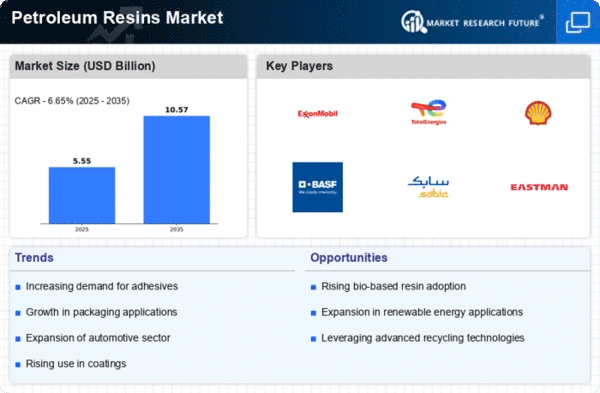
As per MRFR analysis, the Petroleum Resins Market Size was estimated at 5.2 USD Billion in 2024. The Petroleum Resins industry is projected to grow from 5.55 in 2025 to 10.57 by 2035, exhibiting a compound annual growth rate (CAGR) of 6.65 during the forecast period 2025 - 2035.

Key Market Trends & Highlights

The Petroleum Resins Market is poised for robust growth driven by sustainability and technological advancements.

  • North America remains the largest market for petroleum resins, driven by strong demand in the adhesives and sealants sector.
  • Asia-Pacific is emerging as the fastest-growing region, with significant expansion in the automotive and packaging segments.
  • The adhesives segment continues to dominate the market, while the inks segment is experiencing rapid growth due to innovative applications.
  • Key market drivers include rising demand from the adhesives and sealants sector and the growth in the coatings and paints industry.

Market Size & Forecast

2024 Market Size 5.2 (USD Billion)
2035 Market Size 10.57 (USD Billion)
CAGR (2025 - 2035) 6.65%
Largest Regional Market Share in 2024 North America

Major Players

ExxonMobil (US), TotalEnergies (FR), Shell (GB), BASF (DE), SABIC (SA), Eastman Chemical Company (US), Hexion Inc. (US), Kraton Corporation (US), Mitsui Chemicals (JP)

Market Trends

The Petroleum Resins Market is currently experiencing a dynamic evolution, driven by various factors that influence demand and supply. The increasing utilization of petroleum resins in adhesives, coatings, and inks is notable, as these materials offer enhanced performance characteristics. Furthermore, the growing emphasis on sustainable and eco-friendly products appears to be shaping the market landscape, prompting manufacturers to innovate and develop bio-based alternatives. This shift towards sustainability may lead to a re-evaluation of traditional petroleum resin applications, potentially expanding their usage in diverse sectors. In addition, the global push for infrastructure development and construction activities is likely to bolster the demand for petroleum resins. As industries seek materials that provide durability and efficiency, petroleum resins are positioned to meet these requirements effectively. Moreover, the ongoing advancements in technology and production processes may enhance the quality and functionality of these resins, further solidifying their role in various applications. Overall, the Petroleum Resins Market seems poised for growth, with evolving consumer preferences and industrial needs driving its trajectory.

Sustainability Initiatives

The trend towards sustainability is becoming increasingly prominent within the Petroleum Resins Market. Manufacturers are exploring bio-based alternatives and eco-friendly formulations to meet consumer demand for greener products. This shift not only addresses environmental concerns but also opens new avenues for innovation in resin applications.

Technological Advancements

Ongoing technological advancements are significantly impacting the Petroleum Resins Market. Innovations in production techniques and material formulations are enhancing the performance characteristics of resins. These improvements may lead to broader applications across various industries, including automotive, construction, and packaging.

Infrastructure Development

The global focus on infrastructure development is likely to drive demand for petroleum resins. As construction projects increase, the need for durable and efficient materials becomes paramount. Petroleum resins are well-suited for applications in adhesives and coatings, making them essential in supporting this growth.

Petroleum Resins Market Market Drivers

Market Growth Projections

The Global Petroleum Resin Market Industry is poised for substantial growth, with projections indicating a market value of 5.2 USD Billion in 2024 and an anticipated rise to 12.0 USD Billion by 2035. This growth trajectory reflects a compound annual growth rate (CAGR) of 7.93% from 2025 to 2035, suggesting a robust expansion driven by diverse applications across various sectors. The increasing demand for high-performance materials in adhesives, coatings, and printing inks is likely to propel this growth. As industries continue to innovate and seek advanced solutions, the Global Petroleum Resin Market Industry appears well-positioned to capitalize on emerging opportunities.

Expansion in the Coatings Sector

The coatings sector plays a pivotal role in the Global Petroleum Resin Market Industry, as petroleum resins are integral to formulating high-quality paints and coatings. The increasing demand for durable and weather-resistant coatings across various industries, including automotive, marine, and industrial applications, propels market growth. The shift towards eco-friendly and sustainable coatings further enhances the appeal of petroleum resins, as they can improve the performance of low-VOC formulations. This sector's expansion is expected to contribute substantially to the market's growth trajectory, with projections indicating a rise to 12.0 USD Billion by 2035, underscoring the importance of petroleum resins in modern coatings.

Rising Applications in Printing Inks

The Global Petroleum Resin Market Industry is witnessing a notable increase in the use of petroleum resins in printing inks. These resins enhance the adhesion, gloss, and drying properties of inks, making them indispensable in the printing industry. As digital printing technologies advance and demand for high-quality printed materials rises, the need for effective resin formulations becomes apparent. The market's growth in this segment is indicative of the broader trend towards innovation in printing technologies. This increasing application of petroleum resins in printing inks not only supports the market's expansion but also highlights the versatility of these materials across various industries.

Growing Demand from Adhesives and Sealants

The Global Petroleum Resin Market Industry experiences a robust demand surge from the adhesives and sealants sector. This growth is primarily driven by the increasing utilization of petroleum resins in formulating high-performance adhesives that are essential in various applications, including construction, automotive, and packaging. As industries seek to enhance product performance and durability, the incorporation of petroleum resins becomes vital. The market is projected to reach 5.2 USD Billion in 2024, reflecting the escalating need for advanced adhesive solutions. This trend indicates a significant opportunity for manufacturers to innovate and expand their product offerings in the Global Petroleum Resin Market Industry.

Increasing Demand for Sustainable Products

The Global Petroleum Resin Market Industry is increasingly shaped by the demand for sustainable products. As consumers and industries prioritize eco-friendly materials, petroleum resins are being reformulated to meet these expectations. Manufacturers are exploring bio-based alternatives and recycling processes to reduce environmental impact while maintaining performance standards. This shift towards sustainability not only aligns with global environmental initiatives but also opens new market opportunities. The growing emphasis on sustainable practices is likely to influence product development and marketing strategies within the Global Petroleum Resin Market Industry, fostering innovation and potentially leading to increased market share.

Technological Advancements in Resin Production

Technological advancements in the production of petroleum resins are significantly influencing the Global Petroleum Resin Market Industry. Innovations in manufacturing processes, such as the development of more efficient polymerization techniques, lead to enhanced resin quality and performance. These advancements enable manufacturers to produce resins that meet the evolving demands of various applications, from adhesives to coatings. Furthermore, the integration of sustainable practices in resin production aligns with global environmental goals, potentially attracting a broader customer base. As these technologies continue to evolve, they are likely to drive market growth and enhance the competitive landscape within the Global Petroleum Resin Market Industry.

Market Segment Insights

By Application: Adhesives (Largest) vs. Inks (Fastest-Growing)

In the Petroleum Resins Market, adhesives currently hold the largest market share, dominating the application segment due to their extensive use in various industries such as construction, automotive, and packaging. They provide essential bonding properties that enhance product performance, making them indispensable across numerous applications. Following adhesives, coatings, inks, plastics, and sealants each contribute to the market, reflecting a diverse range of applications influenced by technological advancements and evolving consumer preferences.

Adhesives (Dominant) vs. Inks (Emerging)

Adhesives are recognized as the dominant application within the Petroleum Resins Market, driven by their versatile bonding capabilities and vital role in industrial and consumer goods. They are widely used for their strong adhesion properties, durability, and resistance to environmental factors. In contrast, inks represent an emerging segment that is rapidly gaining traction, fueled by innovative printing technologies and a shift towards eco-friendly formulations. As digital printing becomes more prevalent, the demand for high-performance inks derived from petroleum resins is expected to rise, positioning them as key players in the market dynamics.

By End Use: Packaging (Largest) vs. Automotive (Fastest-Growing)

In the Petroleum Resins Market, the distribution of market share among key end-use segments is diverse. The packaging sector holds the largest share due to its extensive application in creating flexible and sturdy materials that enhance the performance of various products. Following closely, the automotive sector is also gaining traction, driven by innovations in adhesive formulations and lightweight materials that are essential for modern vehicle design.

Packaging (Dominant) vs. Automotive (Emerging)

The packaging segment stands out as the dominant force in the Petroleum Resins Market, utilizing resins for adhesives, coatings, and sealants that provide exceptional durability and performance. This segment benefits from shifting consumer preferences towards lightweight and sustainable packaging solutions. Conversely, the automotive sector is emerging as a significant growth area, with rising demands for advanced adhesives and materials that improve vehicle efficiency and safety. Automotive manufacturers are increasingly utilizing petroleum resins to meet stringent regulations and enhance vehicle aesthetics, presenting a compelling growth narrative in this evolving market.

By Type: C5 Resins (Largest) vs. Hydrocarbon Resins (Fastest-Growing)

The Petroleum Resins Market is notably segmented into various types, including C5 Resins, C9 Resins, Hydrocarbon Resins, Modified Rosin Resins, and Aliphatic Resins. Among these, C5 Resins hold the largest market share, largely due to their extensive applicability across adhesives and coatings. Hydrocarbon Resins, while not in the lead, are recognized as the fastest-growing segment driven by their versatility and increasing demand in various industrial applications. Together, these segments depict a dynamic landscape that caters to a variety of end-user industries.

C5 Resins (Dominant) vs. Hydrocarbon Resins (Emerging)

C5 Resins are primarily derived from the cracking of hydrocarbon feedstocks and are known for their excellent adhesive properties, making them a dominant player in the Petroleum Resins Market. Their robust performance across various applications like adhesives, sealants, and coatings solidifies their position at the forefront. In contrast, Hydrocarbon Resins, which are gaining traction due to their compatibility with a variety of polymers and resins, represent an emerging segment. Companies are increasingly adopting Hydrocarbon Resins for their cost-effectiveness and superior thermal stability, making them a favorable choice for applications in coatings and inks. This growth trajectory reflects a shift towards innovative materials that meet evolving market demands.

By Form: Solid (Largest) vs. Liquid (Fastest-Growing)

In the Petroleum Resins Market, the 'Form' segment is characterized by distinct categories including Solid, Liquid, Powder, and Granular. Solid forms dominate the market share, primarily due to their extensive applications in various industries such as adhesives and coatings. Liquid forms, while representing a smaller share currently, are rapidly growing as they become more favored in formulations due to their versatility and ease of use in processes such as blending and application.

Solid (Dominant) vs. Liquid (Emerging)

Solid petroleum resins are highly regarded for their stability and performance in adhesives, coatings, and sealants, making them the dominant form in the market. Their robust physical properties ensure that they provide lasting adhesion and durability in various applications. On the other hand, liquid petroleum resins are emerging rapidly in the market, driven by advancements in processing technologies and a shift towards formulations that require lower viscosity. With their ability to enhance flexibility and ease of application, liquid forms are gaining traction among manufacturers looking for versatile solutions to meet the demands of modern industry.

By Source: Natural (Largest) vs. Synthetic (Fastest-Growing)

In the Petroleum Resins Market, the distribution of market share among the source segments reveals that natural resins hold the largest share. This is due to their established application in various industries and consumer preference for materials that offer sustainable and eco-friendly benefits. Meanwhile, synthetic resins are witnessing significant market penetration, driven by their versatility and compatibility with modern industrial processes, making them increasingly popular across multiple applications. The growth trends in this segment are primarily influenced by the rising demand for environmentally friendly materials, prompting industries to seek out bio-based alternatives. Innovations in the synthetic segment further enhance its appeal, as manufacturers develop products that combine the desirable properties of traditional resins with the performance advantages of synthetic materials. This tug-of-war between natural and synthetic sources shapes the future of the petroleum resins market, as both adapt to evolving consumer preferences and regulatory frameworks.

Natural (Dominant) vs. Synthetic (Emerging)

Natural resins are characterized by their renewable origins and eco-friendly profiles, providing a sustainable solution for various applications in industries such as adhesives, coatings, and ink formulations. Their dominance in the market is attributed to a strong historical presence, coupled with a growing consumer trend toward sustainability and natural products. On the other hand, synthetic resins are emerging rapidly, favored for their enhanced performance properties, such as greater durability and customization options. As industries increasingly lean towards technological advancements, synthetic resins present themselves as a valuable alternative by offering superior formulations that meet specific application needs. This dynamic is shaping a competitive landscape where both segments vie for attention based on their unique advantages.

Get more detailed insights about Petroleum Resin Market Research Report - Forecast till 2035

Regional Insights

North America : Market Leader in Resins

North America is poised to maintain its leadership in the petroleum resins market, holding a significant share of 2.6 in 2025. The region's growth is driven by robust demand from the automotive and construction sectors, alongside increasing investments in infrastructure. Regulatory support for sustainable practices is also a catalyst, encouraging innovation in resin applications. The competitive landscape is characterized by major players such as ExxonMobil, Eastman Chemical Company, and Hexion Inc., which are leveraging advanced technologies to enhance product offerings. The U.S. remains the largest market, supported by a strong manufacturing base and a focus on R&D. This dynamic environment positions North America as a key player in The Petroleum Resins.

Europe : Emerging Market Dynamics

Europe's petroleum resins market is projected to grow, with a market size of 1.3 in 2025. The region benefits from increasing demand in the packaging and adhesive sectors, driven by sustainability trends and regulatory frameworks promoting eco-friendly materials. The European Union's commitment to reducing carbon emissions is a significant driver for innovation in resin formulations. Leading countries like Germany, France, and the UK are at the forefront of this growth, with key players such as BASF and TotalEnergies investing in sustainable technologies. The competitive landscape is evolving, with a focus on high-performance resins that meet stringent regulatory standards. This positions Europe as a vital hub for petroleum resin development.

Asia-Pacific : Rapid Growth and Demand

The Asia-Pacific region is witnessing rapid growth in the petroleum resins market, with a projected size of 1.5 in 2025. This growth is fueled by rising industrialization and urbanization, particularly in countries like China and India. The demand for petroleum resins in adhesives and coatings is increasing, driven by the booming construction and automotive sectors. Regulatory initiatives aimed at promoting sustainable practices are also influencing market dynamics. China stands out as a leading market, with significant contributions from local manufacturers and multinational companies like Mitsui Chemicals. The competitive landscape is marked by a mix of established players and emerging companies, all striving to innovate and capture market share. This dynamic environment positions Asia-Pacific as a key player in The Petroleum Resins.

Middle East and Africa : Emerging Opportunities Ahead

The Middle East and Africa (MEA) region is gradually emerging in the petroleum resins market, with a market size of 0.8 in 2025. The growth is driven by increasing investments in infrastructure and construction projects, particularly in the Gulf Cooperation Council (GCC) countries. Additionally, the region's rich natural resources provide a strong foundation for resin production. Regulatory frameworks are evolving to support sustainable practices, further enhancing market potential. Countries like Saudi Arabia and the UAE are leading the charge, with key players such as SABIC focusing on innovation and product development. The competitive landscape is characterized by a mix of local and international companies, all vying for a share in this growing market. This positions MEA as a region with significant growth opportunities in the petroleum resins sector.

Key Players and Competitive Insights

The Petroleum Resins Market is currently characterized by a dynamic competitive landscape, driven by increasing demand across various applications such as adhesives, coatings, and inks. Key players are actively engaging in strategies that emphasize innovation, sustainability, and regional expansion. For instance, ExxonMobil (US) has been focusing on enhancing its product portfolio through technological advancements, while TotalEnergies (FR) is prioritizing sustainable practices to align with global environmental standards. These strategic orientations not only bolster their market positions but also contribute to a more competitive environment, as companies strive to differentiate themselves through unique value propositions.In terms of business tactics, companies are increasingly localizing manufacturing to reduce lead times and optimize supply chains. The market structure appears moderately fragmented, with several players vying for market share. This fragmentation allows for a diverse range of products and innovations, yet it also intensifies competition among key players. The collective influence of these companies shapes market dynamics, as they adapt to changing consumer preferences and regulatory landscapes.

In November BASF (DE) announced a strategic partnership with a leading technology firm to develop bio-based petroleum resins. This collaboration is significant as it underscores BASF's commitment to sustainability and innovation, potentially positioning the company as a leader in eco-friendly resin solutions. Such initiatives may not only enhance their product offerings but also appeal to environmentally conscious consumers, thereby expanding their market reach.

In October Kraton Corporation (US) launched a new line of petroleum resins designed specifically for high-performance applications in the automotive sector. This move is indicative of Kraton's strategy to penetrate niche markets, leveraging its expertise in polymer chemistry. By targeting high-growth sectors, the company aims to capture additional market share and reinforce its competitive stance in the industry.

In September Eastman Chemical Company (US) expanded its production capacity for petroleum resins in response to rising global demand. This expansion reflects Eastman's proactive approach to scaling operations and meeting customer needs. By increasing capacity, the company not only enhances its supply chain reliability but also positions itself to capitalize on emerging market opportunities.

As of December current competitive trends in the Petroleum Resins Market are increasingly defined by digitalization, sustainability, and the integration of advanced technologies such as AI. Strategic alliances are becoming more prevalent, as companies recognize the value of collaboration in driving innovation and efficiency. Looking ahead, competitive differentiation is likely to evolve, shifting from traditional price-based competition to a focus on technological advancements, sustainable practices, and robust supply chain management. This transition may redefine market dynamics, compelling companies to innovate continuously to maintain their competitive edge.

Key Companies in the Petroleum Resins Market include

Industry Developments

To develop sustainable packaging in October 2021- TBM Co., Ltd. announced the signing of a sales contract with PT. KEMAS Indah Maju deals with environmental problems by launching LIMEX Pellet as a plastic substitute to inject molding for the beauty industry. KEMAS is the leading beauty and health plastic molding firm across Indonesia, serving beauty brands across the globe.LIMEX Pellet comprises 50% or more inorganic material such as calcium carbonate, lowers the volume of petroleum-derived plastics by up to 37%, and CO2 emissions by up to 28% as that of petroleum-derived plastics, as per the TBM survey.

It can substitute acrylonitrile butadiene styrene (ABS), polypropylene (PP) resin, which is used in several cosmetic containers and can be offered at a steady price because of less price volatility the main raw material of LIMEX, limestone, matched with petroleum resin.December 2021- Ford has disclosed that the company is now using 100-percent recycled ocean plastics to develop a Bronco Sport compact SUV component. Ford alleges to be the first automaker to use 100-percent recycled ocean plastics to manufacture auto parts.

The firm also claimed that recycled plastic generated from ocean debris is qualitatively equivalent to petroleum-based resin but saves up to 10% and requires less energy to produce.In September 2019, for manufacturing the tire product throughout the Asia-Pacific region, a new tire additive division had been set up in Shanghai, China, by the Eastman for optimizing the manufacturing process for enhancing the tire products performance at the headquarters of Eastman’s that is in China.

The increasing use of petroleum resin in road-making paints increases the scope of the petroleum resin market in the global market during the forecasted period from 2017 to 2025.

It has also been observed that there has been a substantial increase in the investment of the petroleum resin market in the global market by various stakeholders for manufacturing paints and adhesives for gathering swing.

Cracking of petroleum fractions is done for lowering the molecular weight in the hydrocarbons, which will further add essence to the petroleum resin market in the global market.

Various chemical and physical properties are used in the petroleum resin market that helps in popularising it; also, the sticking ability is used in various industries like paper, concrete curing compounds, rubber, printing inks, and adhesives industries in the global market.

Future Outlook

Petroleum Resins Market Future Outlook

The Petroleum Resins Market is projected to grow at a 6.65% CAGR from 2025 to 2035, driven by increasing demand in adhesives, coatings, and automotive applications.

New opportunities lie in:

  • Expansion into bio-based petroleum resins for sustainable product lines.
  • Development of high-performance resins for automotive and aerospace sectors.
  • Investment in advanced manufacturing technologies to enhance production efficiency.

By 2035, the Petroleum Resins Market is expected to achieve robust growth and diversification.

Market Segmentation

Petroleum Resins Market Form Outlook

  • Solid
  • Liquid
  • Powder
  • Granular

Petroleum Resins Market Type Outlook

  • C5 Resins
  • C9 Resins
  • Hydrocarbon Resins
  • Modified Rosin Resins
  • Aliphatic Resins

Petroleum Resins Market Source Outlook

  • Natural
  • Synthetic
  • Bio-based

Petroleum Resins Market End Use Outlook

  • Automotive
  • Construction
  • Packaging
  • Consumer Goods
  • Electronics

Petroleum Resins Market Application Outlook

  • Adhesives
  • Coatings
  • Inks
  • Sealants
  • Plastics

Report Scope

MARKET SIZE 20245.2(USD Billion)
MARKET SIZE 20255.55(USD Billion)
MARKET SIZE 203510.57(USD Billion)
COMPOUND ANNUAL GROWTH RATE (CAGR)6.65% (2025 - 2035)
REPORT COVERAGERevenue Forecast, Competitive Landscape, Growth Factors, and Trends
BASE YEAR2024
Market Forecast Period2025 - 2035
Historical Data2019 - 2024
Market Forecast UnitsUSD Billion
Key Companies ProfiledExxonMobil (US), TotalEnergies (FR), Shell (GB), BASF (DE), SABIC (SA), Eastman Chemical Company (US), Hexion Inc. (US), Kraton Corporation (US), Mitsui Chemicals (JP)
Segments CoveredApplication, End Use, Type, Form, Source
Key Market OpportunitiesGrowing demand for eco-friendly adhesives drives innovation in the Petroleum Resins Market.
Key Market DynamicsRising demand for eco-friendly adhesives drives innovation and competition in the petroleum resins market.
Countries CoveredNorth America, Europe, APAC, South America, MEA

FAQs

What will be the possible market valuation of the petroleum resin market?

The global petroleum resin market is predicted to touch USD 10.57 Billion by 2035.

At what CAGR is the petroleum resin market expected to grow over the forecast period?

Petroleum Resins Market is projected to grow at a CAGR of 6.65% during the forecast period, 2025-2035

Which region is predicted to have lions share in the petroleum resin market?

Asia Pacific is predicted to have lions share in the petroleum resin market during the forecast period.

What are the key factors driving the petroleum resin market?

Low processing cost, favorable regulatory scenario, and increasing use in the paints & coatings industry is boosting market growth

Which factors may act as deterrents in the petroleum resin market?

Easy availability of substitutes and fluctuating raw material prices may deter market growth.

  1. SECTION I: EXECUTIVE SUMMARY AND KEY HIGHLIGHTS
    1. | 1.1 EXECUTIVE SUMMARY
    2. | 1.1.1 Market Overview
    3. | 1.1.2 Key Findings
    4. | 1.1.3 Market Segmentation
    5. | 1.1.4 Competitive Landscape
    6. | 1.1.5 Challenges and Opportunities
    7. | 1.1.6 Future Outlook
  2. SECTION II: SCOPING, METHODOLOGY AND MARKET STRUCTURE
    1. | 2.1 MARKET INTRODUCTION
    2. | 2.1.1 Definition
    3. | 2.1.2 Scope of the study
    4. |-- 2.1.2.1 Research Objective
    5. |-- 2.1.2.2 Assumption
    6. |-- 2.1.2.3 Limitations
    7. | 2.2 RESEARCH METHODOLOGY
    8. | 2.2.1 Overview
    9. | 2.2.2 Data Mining
    10. | 2.2.3 Secondary Research
    11. | 2.2.4 Primary Research
    12. |-- 2.2.4.1 Primary Interviews and Information Gathering Process
    13. |-- 2.2.4.2 Breakdown of Primary Respondents
    14. | 2.2.5 Forecasting Model
    15. | 2.2.6 Market Size Estimation
    16. |-- 2.2.6.1 Bottom-Up Approach
    17. |-- 2.2.6.2 Top-Down Approach
    18. | 2.2.7 Data Triangulation
    19. | 2.2.8 Validation
  3. SECTION III: QUALITATIVE ANALYSIS
    1. | 3.1 MARKET DYNAMICS
    2. | 3.1.1 Overview
    3. | 3.1.2 Drivers
    4. | 3.1.3 Restraints
    5. | 3.1.4 Opportunities
    6. | 3.2 MARKET FACTOR ANALYSIS
    7. | 3.2.1 Value chain Analysis
    8. | 3.2.2 Porter's Five Forces Analysis
    9. |-- 3.2.2.1 Bargaining Power of Suppliers
    10. |-- 3.2.2.2 Bargaining Power of Buyers
    11. |-- 3.2.2.3 Threat of New Entrants
    12. |-- 3.2.2.4 Threat of Substitutes
    13. |-- 3.2.2.5 Intensity of Rivalry
    14. | 3.2.3 COVID-19 Impact Analysis
    15. |-- 3.2.3.1 Market Impact Analysis
    16. |-- 3.2.3.2 Regional Impact
    17. |-- 3.2.3.3 Opportunity and Threat Analysis
  4. SECTION IV: QUANTITATIVE ANALYSIS
    1. | 4.1 Chemicals and Materials, BY Application (USD Billion)
    2. | 4.1.1 Adhesives
    3. | 4.1.2 Coatings
    4. | 4.1.3 Inks
    5. | 4.1.4 Sealants
    6. | 4.1.5 Plastics
    7. | 4.2 Chemicals and Materials, BY End Use (USD Billion)
    8. | 4.2.1 Automotive
    9. | 4.2.2 Construction
    10. | 4.2.3 Packaging
    11. | 4.2.4 Consumer Goods
    12. | 4.2.5 Electronics
    13. | 4.3 Chemicals and Materials, BY Type (USD Billion)
    14. | 4.3.1 C5 Resins
    15. | 4.3.2 C9 Resins
    16. | 4.3.3 Hydrocarbon Resins
    17. | 4.3.4 Modified Rosin Resins
    18. | 4.3.5 Aliphatic Resins
    19. | 4.4 Chemicals and Materials, BY Form (USD Billion)
    20. | 4.4.1 Solid
    21. | 4.4.2 Liquid
    22. | 4.4.3 Powder
    23. | 4.4.4 Granular
    24. | 4.5 Chemicals and Materials, BY Source (USD Billion)
    25. | 4.5.1 Natural
    26. | 4.5.2 Synthetic
    27. | 4.5.3 Bio-based
    28. | 4.6 Chemicals and Materials, BY Region (USD Billion)
    29. | 4.6.1 North America
    30. |-- 4.6.1.1 US
    31. |-- 4.6.1.2 Canada
    32. | 4.6.2 Europe
    33. |-- 4.6.2.1 Germany
    34. |-- 4.6.2.2 UK
    35. |-- 4.6.2.3 France
    36. |-- 4.6.2.4 Russia
    37. |-- 4.6.2.5 Italy
    38. |-- 4.6.2.6 Spain
    39. |-- 4.6.2.7 Rest of Europe
    40. | 4.6.3 APAC
    41. |-- 4.6.3.1 China
    42. |-- 4.6.3.2 India
    43. |-- 4.6.3.3 Japan
    44. |-- 4.6.3.4 South Korea
    45. |-- 4.6.3.5 Malaysia
    46. |-- 4.6.3.6 Thailand
    47. |-- 4.6.3.7 Indonesia
    48. |-- 4.6.3.8 Rest of APAC
    49. | 4.6.4 South America
    50. |-- 4.6.4.1 Brazil
    51. |-- 4.6.4.2 Mexico
    52. |-- 4.6.4.3 Argentina
    53. |-- 4.6.4.4 Rest of South America
    54. | 4.6.5 MEA
    55. |-- 4.6.5.1 GCC Countries
    56. |-- 4.6.5.2 South Africa
    57. |-- 4.6.5.3 Rest of MEA
  5. SECTION V: COMPETITIVE ANALYSIS
    1. | 5.1 Competitive Landscape
    2. | 5.1.1 Overview
    3. | 5.1.2 Competitive Analysis
    4. | 5.1.3 Market share Analysis
    5. | 5.1.4 Major Growth Strategy in the Chemicals and Materials
    6. | 5.1.5 Competitive Benchmarking
    7. | 5.1.6 Leading Players in Terms of Number of Developments in the Chemicals and Materials
    8. | 5.1.7 Key developments and growth strategies
    9. |-- 5.1.7.1 New Product Launch/Service Deployment
    10. |-- 5.1.7.2 Merger & Acquisitions
    11. |-- 5.1.7.3 Joint Ventures
    12. | 5.1.8 Major Players Financial Matrix
    13. |-- 5.1.8.1 Sales and Operating Income
    14. |-- 5.1.8.2 Major Players R&D Expenditure. 2023
    15. | 5.2 Company Profiles
    16. | 5.2.1 ExxonMobil (US)
    17. |-- 5.2.1.1 Financial Overview
    18. |-- 5.2.1.2 Products Offered
    19. |-- 5.2.1.3 Key Developments
    20. |-- 5.2.1.4 SWOT Analysis
    21. |-- 5.2.1.5 Key Strategies
    22. | 5.2.2 TotalEnergies (FR)
    23. |-- 5.2.2.1 Financial Overview
    24. |-- 5.2.2.2 Products Offered
    25. |-- 5.2.2.3 Key Developments
    26. |-- 5.2.2.4 SWOT Analysis
    27. |-- 5.2.2.5 Key Strategies
    28. | 5.2.3 Shell (GB)
    29. |-- 5.2.3.1 Financial Overview
    30. |-- 5.2.3.2 Products Offered
    31. |-- 5.2.3.3 Key Developments
    32. |-- 5.2.3.4 SWOT Analysis
    33. |-- 5.2.3.5 Key Strategies
    34. | 5.2.4 BASF (DE)
    35. |-- 5.2.4.1 Financial Overview
    36. |-- 5.2.4.2 Products Offered
    37. |-- 5.2.4.3 Key Developments
    38. |-- 5.2.4.4 SWOT Analysis
    39. |-- 5.2.4.5 Key Strategies
    40. | 5.2.5 SABIC (SA)
    41. |-- 5.2.5.1 Financial Overview
    42. |-- 5.2.5.2 Products Offered
    43. |-- 5.2.5.3 Key Developments
    44. |-- 5.2.5.4 SWOT Analysis
    45. |-- 5.2.5.5 Key Strategies
    46. | 5.2.6 Eastman Chemical Company (US)
    47. |-- 5.2.6.1 Financial Overview
    48. |-- 5.2.6.2 Products Offered
    49. |-- 5.2.6.3 Key Developments
    50. |-- 5.2.6.4 SWOT Analysis
    51. |-- 5.2.6.5 Key Strategies
    52. | 5.2.7 Hexion Inc. (US)
    53. |-- 5.2.7.1 Financial Overview
    54. |-- 5.2.7.2 Products Offered
    55. |-- 5.2.7.3 Key Developments
    56. |-- 5.2.7.4 SWOT Analysis
    57. |-- 5.2.7.5 Key Strategies
    58. | 5.2.8 Kraton Corporation (US)
    59. |-- 5.2.8.1 Financial Overview
    60. |-- 5.2.8.2 Products Offered
    61. |-- 5.2.8.3 Key Developments
    62. |-- 5.2.8.4 SWOT Analysis
    63. |-- 5.2.8.5 Key Strategies
    64. | 5.2.9 Mitsui Chemicals (JP)
    65. |-- 5.2.9.1 Financial Overview
    66. |-- 5.2.9.2 Products Offered
    67. |-- 5.2.9.3 Key Developments
    68. |-- 5.2.9.4 SWOT Analysis
    69. |-- 5.2.9.5 Key Strategies
    70. | 5.3 Appendix
    71. | 5.3.1 References
    72. | 5.3.2 Related Reports

Chemicals and Materials Market Segmentation

Chemicals and Materials By Application (USD Billion, 2025-2035)

  • Adhesives
  • Coatings
  • Inks
  • Sealants
  • Plastics

Chemicals and Materials By End Use (USD Billion, 2025-2035)

  • Automotive
  • Construction
  • Packaging
  • Consumer Goods
  • Electronics

Chemicals and Materials By Type (USD Billion, 2025-2035)

  • C5 Resins
  • C9 Resins
  • Hydrocarbon Resins
  • Modified Rosin Resins
  • Aliphatic Resins

Chemicals and Materials By Form (USD Billion, 2025-2035)

  • Solid
  • Liquid
  • Powder
  • Granular

Chemicals and Materials By Source (USD Billion, 2025-2035)

  • Natural
  • Synthetic
  • Bio-based
Infographic

Free Sample Request

Kindly complete the form below to receive a free sample of this Report

Get Free Sample

Customer Strories

Compare Licence

×
Features License Type
Single User Multiuser License Enterprise User
Price $4,950 $5,950 $7,250
Maximum User Access Limit 1 User Upto 10 Users Unrestricted Access Throughout the Organization
Free Customization
Direct Access to Analyst
Deliverable Format
Platform Access
Discount on Next Purchase 10% 15% 15%
Printable Versions