
Request Free Sample ×

Kindly complete the form below to receive a free sample of this Report

* Please use a valid business email

Leading companies partner with us for data-driven Insights

clients tt-cursor
Hero Background
English
Chinese
French
Japanese
Korean
German
Spanish

Petroleum Resins Market Analysis

ID: MRFR/CnM/3371-CR
111 Pages
Chitranshi Jaiswal
October 2019

Petroleum Resin Market Research Report Information by Type (C5 Resins, C9 Resins, Dicyclopentadiene (DCPD), Hydrogenated Petroleum Resins and C5/C9 Resins), Form (True and Masterbatch),  Application (Adhesives, Paints & Coatings, Printing Inks, Rubbers, Plastic Films and others), End-Use Industry (Construction, Automotive, Packaging, Personal Hygiene and others), Region (Asia-Pacific, Europe, North America, Latin America and the Middle East & Africa) - Forecast till 2035

Share:
Download PDF ×

We do not share your information with anyone. However, we may send you emails based on your report interest from time to time. You may contact us at any time to opt-out.

Petroleum Resins Market Infographic
Purchase Options

Market Analysis

In-depth Analysis of Petroleum Resins Market Industry Landscape

C5 petroleum resins play a crucial role as tackifying agents in the adhesives and sealant industry, especially in the formulation of hot-melt and pressure-sensitive adhesives. The significance of C5 resins stems from their favorable characteristics, such as good fluidity, which enhances the wetting properties of the primary material. Additionally, these resins exhibit superior initial adhesion performance, transparency, remarkable resistance to aging, and are devoid of any unpleasant odor and volatile organic compounds (VOCs). Due to their aliphatic nature, C5 resins are predominantly employed as tackifiers for aliphatic polymers. These polymers include natural rubber, styrene-ethylene butylene-styrene block copolymers, amorphous polyolefins, styrene-isoprene-styrene block copolymers, polyethylene, EPDM rubber, butyl rubber, and petroleum waxes. C5 resins find applications in the manufacturing of pressure-sensitive tapes, labels, and nonwoven products, where their unique properties contribute to the effectiveness of the adhesive products. In the realm of paints and coatings, which are integral for safeguarding and preserving various objects, petroleum resins, including C9 and DCPD resin, have widespread applications. The color of the petroleum resin is a critical factor in its use in paint production. Additionally, the stability of the resin under UV radiation and heat, along with its storage stability, plays a pivotal role. C9 and DCPD resins, known for their high softening points, contribute to uniform color spreading, providing a brightening effect with rapid drying. C9 petroleum resins, in particular, are favored in paints due to their adhesion characteristics, resistance to acidic and alkaline substances, and the hardness and adhesiveness they impart to paint films. The higher softening point of the resin leads to faster drying times for paints. Moreover, C9 petroleum resins are utilized in printing inks to achieve uniform color spread and rapid drying effects. Beyond paints, C9 petroleum resins find application in external coatings, anti-corrosive paints, and varnishes. Their inclusion enhances the gloss and hardness of the paint while rendering it resistant to water, thereby accelerating the film's drying rate. These resins are also employed in newspaper ink, offset ink, and rubber compounding sets, augmenting coating properties such as dryness, hardness, and resistance to water, acids, and bases. In marine and alkyd coatings, C9 petroleum resins contribute to increased adhesion, hardness, glossiness, and resistance to acid and saltwater, effectively preventing corrosion. Furthermore, these resins play a role in road-marking paints, where they form binders for thermoplastic road marking materials. The combination of low molecular weight petroleum-based resin and a plasticizer enhances toughness, bond strength, gloss, and flexibility while providing excellent resistance to abrasion, water, UV radiation, and weathering. The escalating demand for these petroleum-based resins is observed in the construction and automotive sectors, particularly in architectural and protective coatings. C5 and C9 petroleum resins serve as versatile components in the adhesives, paints, and coatings industries, playing pivotal roles in enhancing performance and meeting specific requirements across a range of applications.

Author
Author Profile
Chitranshi Jaiswal
Team Lead - Research

Chitranshi is a Team Leader in the Chemicals & Materials (CnM) and Energy & Power (EnP) domains, with 6+ years of experience in market research. She leads and mentors teams to deliver cross-domain projects that equip clients with actionable insights and growth strategies. She is skilled in market estimation, forecasting, competitive benchmarking, and both primary & secondary research, enabling her to turn complex data into decision-ready insights. An engineer and MBA professional, she combines technical expertise with strategic acumen to solve dynamic market challenges. Chitranshi has successfully managed projects that support market entry, investment planning, and competitive positioning, while building strong client relationships. Certified in Advanced Excel & Power BI she leverages data-driven approaches to ensure accuracy, clarity, and impactful outcomes.

Leave a Comment

FAQs

What is the projected market valuation of the Petroleum Resins Market by 2035?

<p>The Petroleum Resins Market is projected to reach a valuation of 10.57 USD Billion by 2035.</p>

What was the market valuation of the Petroleum Resins Market in 2024?

<p>In 2024, the overall market valuation of the Petroleum Resins Market was 5.2 USD Billion.</p>

What is the expected CAGR for the Petroleum Resins Market during the forecast period 2025 - 2035?

<p>The expected CAGR for the Petroleum Resins Market during the forecast period 2025 - 2035 is 6.65%.</p>

Which companies are considered key players in the Petroleum Resins Market?

<p>Key players in the Petroleum Resins Market include ExxonMobil, TotalEnergies, Shell, BASF, SABIC, Eastman Chemical Company, Hexion Inc., Kraton Corporation, and Mitsui Chemicals.</p>

What are the main applications of petroleum resins and their market values?

<p>The main applications include Adhesives (1.8 USD Billion), Coatings (3.0 USD Billion), Inks (1.6 USD Billion), Sealants (1.4 USD Billion), and Plastics (2.6 USD Billion).</p>

How does the market for petroleum resins in the automotive sector compare to other end-use sectors?

The automotive sector is valued at 2.08 USD Billion, which is comparable to the construction and consumer goods sectors, each also at 2.08 USD Billion.

What types of petroleum resins are available and their respective market values?

Types of petroleum resins include C5 Hydrocarbon Resins (1.8 USD Billion), C9 Hydrocarbon Resins (2.4 USD Billion), Dicyclopentadiene Resins (1.6 USD Billion), Aliphatic Resins (2.0 USD Billion), and Aromatic Resins (2.5 USD Billion).

What forms of petroleum resins are present in the market and their valuations?

The forms of petroleum resins include Solid (3.12 USD Billion), Liquid (2.08 USD Billion), Powder (2.08 USD Billion), and Granular (3.29 USD Billion).

What trends are influencing the growth of the Petroleum Resins Market?

Trends influencing growth include increasing demand in adhesives and coatings, alongside advancements in resin technology.

How does the projected growth of the Petroleum Resins Market reflect on its future potential?

The projected growth indicates a robust future potential, with a market size expected to nearly double from 2024 to 2035.

What is the largest application for petroleum resins?

Adhesives represent the largest application

Market Summary

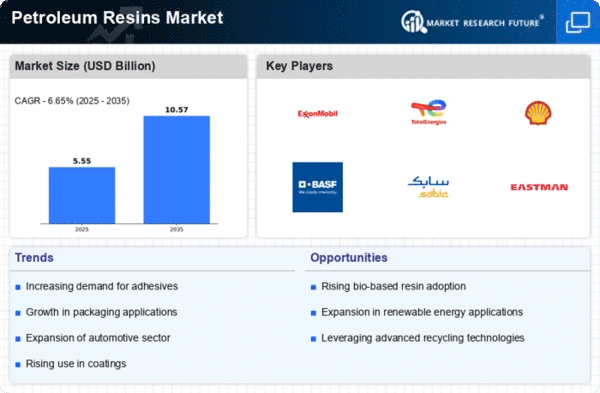
As per MRFR analysis, the Petroleum Resins Market Size was estimated at 5.2 USD Billion in 2024. The Petroleum Resins industry is projected to grow from 5.55 in 2025 to 10.57 by 2035, exhibiting a compound annual growth rate (CAGR) of 6.65% during the forecast period 2025 - 2035.
Petroleum resins are low molecular weight thermoplastic hydrocarbons derived from the C5 and C9 unsaturated hydrocarbon fractions produced during the steam cracking of naphtha, gas oil, or natural gas liquids for ethylene production.

Key Market Trends & Highlights

The Petroleum Resins Market is poised for robust growth driven by sustainability and technological advancements.

  • Asia-Pacific is the dominant region in the market, accounting for over 40% share by volume, driven by strong demand across packaging, automotive, and construction sectors, with China leading globally in production and consumption. Asia-Pacific is also the fastest-growing region, projected to expand at a CAGR of approximately 5.4%–7.7%, supported by rapid industrialization, urbanization, and increasing investments across end-use industries. The adhesives segment continues to dominate the market, while the inks segment is experiencing rapid growth due to innovative applications. Key market drivers include rising demand from the adhesives and sealants sector and the growth in the coatings and paints industry.

Market Size & Forecast

2024 Market Size 5.2 (USD Billion)
2035 Market Size 10.57 (USD Billion)
CAGR (2025 - 2035) 6.65%
Largest Regional Market Share in 2024 North America

Major Players

ExxonMobil (US), TotalEnergies (FR), Shell (GB), BASF (DE), SABIC (SA), Eastman Chemical Company (US), Hexion Inc. (US), Kraton Corporation (US), Mitsui Chemicals (JP)

Market Trends

The Petroleum Resins Market is currently experiencing a dynamic evolution, driven by various factors that influence demand and supply. The increasing utilization of petroleum resins in adhesives, coatings, and inks is notable, as these materials offer enhanced performance characteristics. Furthermore, the growing emphasis on sustainable and eco-friendly products appears to be shaping the market landscape, prompting manufacturers to innovate and develop bio-based alternatives. This shift towards sustainability may lead to a re-evaluation of traditional petroleum resin applications, potentially expanding their usage in diverse sectors. In addition, the global push for infrastructure development and construction activities is likely to bolster the demand for petroleum resins. As industries seek materials that provide durability and efficiency, petroleum resins are positioned to meet these requirements effectively. Moreover, the ongoing advancements in technology and production processes may enhance the quality and functionality of these resins, further solidifying their role in various applications. Overall, the Petroleum Resins Market seems poised for growth, with evolving consumer preferences and industrial needs driving its trajectory.

Sustainability Initiatives

The trend towards sustainability is becoming increasingly prominent within the Petroleum Resins Market. Manufacturers are exploring bio-based alternatives and eco-friendly formulations to meet consumer demand for greener products. This shift not only addresses environmental concerns but also opens new avenues for innovation in resin applications.

Technological Advancements

Ongoing technological advancements are significantly impacting the Petroleum Resins Market. Innovations in production techniques and material formulations are enhancing the performance characteristics of resins. These improvements may lead to broader applications across various industries, including automotive, construction, and packaging.

Infrastructure Development

The global focus on infrastructure development is likely to drive demand for petroleum resins. As construction projects increase, the need for durable and efficient materials becomes paramount. Petroleum resins are well-suited for applications in adhesives and coatings, making them essential in supporting this growth.

China Overcapacity Creating Global Price Pressure

China accounts for approximately 40–50% of global petroleum resin production capacity; the global petrochemical industry's oversupply crisis (particularly in C9 aromatic resins from new coal-to-chemical and naphtha cracker expansions) is forcing Chinese producers to export at discounted prices, compressing margins for Western producers. ~150–200 kt of new resin capacity is planned across

Petroleum Resins Market Market Drivers

Market Growth Projections

The Global Petroleum Resin Market Industry is poised for substantial growth, with projections indicating a market value of 5.2 USD Billion in 2024 and an anticipated rise to 12.0 USD Billion by 2035. This growth trajectory reflects a compound annual growth rate (CAGR) of 7.93% from 2025 to 2035, suggesting a robust expansion driven by diverse applications across various sectors. The increasing demand for high-performance materials in adhesives, coatings, and printing inks is likely to propel this growth. As industries continue to innovate and seek advanced solutions, the Global Petroleum Resin Market Industry appears well-positioned to capitalize on emerging opportunities.

Expansion in the Coatings Sector

The coatings sector plays a pivotal role in the Global Petroleum Resin Market Industry, as petroleum resins are integral to formulating high-quality paints and coatings. The increasing demand for durable and weather-resistant coatings across various industries, including automotive, marine, and industrial applications, propels market growth. The shift towards eco-friendly and sustainable coatings further enhances the appeal of petroleum resins, as they can improve the performance of low-VOC formulations. This sector's expansion is expected to contribute substantially to the market's growth trajectory, with projections indicating a rise to 12.0 USD Billion by 2035, underscoring the importance of petroleum resins in modern coatings.

Rising Applications in Printing Inks

The Global Petroleum Resin Market Industry is witnessing a notable increase in the use of petroleum resins in printing inks. These resins enhance the adhesion, gloss, and drying properties of inks, making them indispensable in the printing industry. As digital printing technologies advance and demand for high-quality printed materials rises, the need for effective resin formulations becomes apparent. The market's growth in this segment is indicative of the broader trend towards innovation in printing technologies. This increasing application of petroleum resins in printing inks not only supports the market's expansion but also highlights the versatility of these materials across various industries.

Growing Demand from Adhesives and Sealants

The Global Petroleum Resin Market Industry experiences a robust demand surge from the adhesives and sealants sector. This growth is primarily driven by the increasing utilization of petroleum resins in formulating high-performance adhesives that are essential in various applications, including construction, automotive, and packaging. As industries seek to enhance product performance and durability, the incorporation of petroleum resins becomes vital. The market is projected to reach 5.2 USD Billion in 2024, reflecting the escalating need for advanced adhesive solutions. This trend indicates a significant opportunity for manufacturers to innovate and expand their product offerings in the Global Petroleum Resin Market Industry.

Increasing Demand for Sustainable Products

The Global Petroleum Resin Market Industry is increasingly shaped by the demand for sustainable products. As consumers and industries prioritize eco-friendly materials, petroleum resins are being reformulated to meet these expectations. Manufacturers are exploring bio-based alternatives and recycling processes to reduce environmental impact while maintaining performance standards. This shift towards sustainability not only aligns with global environmental initiatives but also opens new market opportunities. The growing emphasis on sustainable practices is likely to influence product development and marketing strategies within the Global Petroleum Resin Market Industry, fostering innovation and potentially leading to increased market share.

Technological Advancements in Resin Production

Technological advancements in the production of petroleum resins are significantly influencing the Global Petroleum Resin Market Industry. Innovations in manufacturing processes, such as the development of more efficient polymerization techniques, lead to enhanced resin quality and performance. These advancements enable manufacturers to produce resins that meet the evolving demands of various applications, from adhesives to coatings. Furthermore, the integration of sustainable practices in resin production aligns with global environmental goals, potentially attracting a broader customer base. As these technologies continue to evolve, they are likely to drive market growth and enhance the competitive landscape within the Global Petroleum Resin Market Industry.

Market Segment Insights

By Application: Adhesives (Largest) vs. Coatings (Fastest-Growing)

In the Petroleum Resins Market, Adhesives and sealants lead the application segment with approximately 33% revenue share. These resins are favored for their exceptional bonding properties and versatility across various industries, including construction and automotive. Following adhesives, coatings represent a significant segment due to rising demand for protective finishes in manufacturing and consumer goods. Together, these segments dominate the application field, underscoring their critical role in industrial processes. Coatings are projected to be the fastest-growing segment, driven by increasing consumer awareness regarding product durability and aesthetic appeal. The growth of the construction and automotive sectors, coupled with innovations in resin formulations, has further propelled this segment's expansion. Additionally, environmental regulations favoring low-VOC coatings are fostering innovations in petroleum resins, creating opportunities for new applications and sustainable products.

Adhesives (Dominant) vs. Inks (Emerging)

Adhesives are the dominant application in the Petroleum Resins Market due to their unparalleled bonding capabilities and adaptability across various industries, including packaging, automotive, and construction. Their strong performance can be attributed to advancements in resin technology that enhance their properties, leading to greater efficiency in manufacturing processes. Conversely, inks represent an emerging application, benefiting from innovations in printing technologies and the growing need for high-quality, durable printed materials in packaging and labeling. While inks have not achieved the same market presence as adhesives, their unique formulations for improved print quality are attracting attention and investment, promising potential growth in coming years as demand for specialized ink applications rises.

By End Use: Packaging (Largest) vs. Automotive (Fastest-Growing)

In the Petroleum Resins Market, the distribution of market share among key end-use segments is diverse. The packaging sector holds the largest share due to its extensive application in creating flexible and sturdy materials that enhance the performance of various products. Following closely, the automotive sector is also gaining traction, driven by innovations in adhesive formulations and lightweight materials that are essential for modern vehicle design.

Packaging (Dominant) vs. Automotive (Emerging)

Packaging is the largest end-use segment, holding around 38–40% share, utilizing resins for adhesives, coatings, and sealants that provide exceptional durability and performance. This segment benefits from shifting consumer preferences towards lightweight and sustainable packaging solutions. Conversely, the automotive sector is emerging as a significant growth area, with rising demands for advanced adhesives and materials that improve vehicle efficiency and safety. Automotive manufacturers are increasingly utilizing petroleum resins to meet stringent regulations and enhance vehicle aesthetics, presenting a compelling growth narrative in this evolving market.

By Type: C5 Hydrocarbon Resins (Largest) vs. Dicyclopentadiene Resins (Fastest-Growing)

Within the Petroleum Resins Market, C5 <a href="https://www.marketresearchfuture.com/reports/hydrocarbon-resin-market-36302" target="_blank" title="hydrocarbon resin">Hydrocarbon Resins</a> hold the largest market share, significantly influencing various applications, particularly in adhesive and coating industries. This resin type benefits from its versatility and cost-effectiveness, making it a preferred choice among manufacturers. In comparison, <a href="https://www.marketresearchfuture.com/reports/dicyclopentadiene-market-9864" target="_blank" title="dicyclopentadiene">Dicyclopentadiene</a> Resins, while smaller in market share, represent the fastest-growing segment, driven by increasing demand for high-performance materials that offer superior thermal and mechanical properties.

C5 Hydrocarbon Resins (Dominant) vs. Dicyclopentadiene Resins (Emerging)

C5 Hydrocarbon Resins are established as a dominant player in the Petroleum Resins Market due to their favorable properties, including low viscosity and strong adhesive performance, making them ideal for various applications such as paints, adhesives, and coatings. These resins are prized for their ability to enhance formulations significantly. On the flip side, Dicyclopentadiene Resins are emerging as a competitive alternative, noted for their excellent heat resistance and elasticity. They are increasingly being adopted in sectors where high-performance materials are critical, positioning them as valuable assets for future growth amidst evolving industrial demands.

By Form: Solid (Largest) vs. Liquid (Fastest-Growing)

In the Petroleum Resins Market, the 'Form' segment is characterized by distinct categories including Solid, Liquid, Powder, and Granular. Solid forms dominate the market share, primarily due to their extensive applications in various industries such as adhesives and coatings. Liquid forms, while representing a smaller share currently, are rapidly growing as they become more favored in formulations due to their versatility and ease of use in processes such as blending and application.

Solid (Dominant) vs. Liquid (Emerging)

Solid petroleum resins are highly regarded for their stability and performance in adhesives, coatings, and sealants, making them the dominant form in the market. Their robust physical properties ensure that they provide lasting adhesion and durability in various applications. On the other hand, liquid petroleum resins are emerging rapidly in the market, driven by advancements in processing technologies and a shift towards formulations that require lower viscosity. With their ability to enhance flexibility and ease of application, liquid forms are gaining traction among manufacturers looking for versatile solutions to meet the demands of modern industry.

By Source: Natural (Largest) vs. Synthetic (Fastest-Growing)

In the Petroleum Resins Market, the distribution of market share among the source segments reveals that natural resins hold the largest share. This is due to their established application in various industries and consumer preference for materials that offer sustainable and eco-friendly benefits. Meanwhile, synthetic resins are witnessing significant market penetration, driven by their versatility and compatibility with modern industrial processes, making them increasingly popular across multiple applications. The growth trends in this segment are primarily influenced by the rising demand for environmentally friendly materials, prompting industries to seek out bio-based alternatives. Innovations in the synthetic segment further enhance its appeal, as manufacturers develop products that combine the desirable properties of traditional resins with the performance advantages of synthetic materials. This tug-of-war between natural and synthetic sources shapes the future of the petroleum resins market, as both adapt to evolving consumer preferences and regulatory frameworks.

Natural (Dominant) vs. Synthetic (Emerging)

Natural resins are characterized by their renewable origins and eco-friendly profiles, providing a sustainable solution for various applications in industries such as adhesives, coatings, and ink formulations. Their dominance in the market is attributed to a strong historical presence, coupled with a growing consumer trend toward sustainability and natural products. On the other hand, synthetic resins are emerging rapidly, favored for their enhanced performance properties, such as greater durability and customization options. As industries increasingly lean towards technological advancements, synthetic resins present themselves as a valuable alternative by offering superior formulations that meet specific application needs. This dynamic is shaping a competitive landscape where both segments vie for attention based on their unique advantages.

Get more detailed insights about Petroleum Resin Market Research Report - Forecast till 2035

Regional Insights

North America : Market Leader in Resins

North America accounts for a 26% share, with the market growing from USD 1.44 billion in 2025 to USD 1.54 billion in 2026. The region's growth is driven by robust demand from the automotive and construction sectors, alongside increasing investments in infrastructure. Regulatory support for sustainable practices is also a catalyst, encouraging innovation in resin applications. The competitive landscape is characterized by major players such as ExxonMobil, Eastman Chemical Company, and Hexion Inc., which are leveraging advanced technologies to enhance product offerings. The U.S. remains the largest market, supported by a strong manufacturing base and a focus on R&D. This dynamic environment positions North America as a key player in The Petroleum Resins.

Europe : Emerging Market Dynamics

Europe holds an 18% share, increasing from USD 1.00 billion in 2025 to USD 1.07 billion in 2026, driven by demand for high-performance and sustainable resin solutions.. The region benefits from increasing demand in the packaging and adhesive sectors, driven by sustainability trends and regulatory frameworks promoting eco-friendly materials. The European Union's commitment to reducing carbon emissions is a significant driver for innovation in resin formulations. Leading countries like Germany, France, and the UK are at the forefront of this growth, with key players such as BASF and TotalEnergies investing in sustainable technologies. The competitive landscape is evolving, with a focus on high-performance resins that meet stringent regulatory standards. This positions Europe as a vital hub for petroleum resin development.

Asia-Pacific : Rapid Growth and Demand

Asia-Pacific is the largest regional market, valued at USD 2.50 billion in 2025 and projected to reach USD 2.68 billion in 2026, holding a 45% share. This growth is fueled by rising industrialization and urbanization, particularly in countries like China and India. The demand for petroleum resins in adhesives and coatings is increasing, driven by the booming construction and automotive sectors. Regulatory initiatives aimed at promoting sustainable practices are also influencing market dynamics. China stands out as a leading market, with significant contributions from local manufacturers and multinational companies like Mitsui Chemicals. The competitive landscape is marked by a mix of established players and emerging companies, all striving to innovate and capture market share. This dynamic environment positions Asia-Pacific as a key player in The Petroleum Resins.

Middle East and Africa : Emerging Opportunities Ahead

The Middle East & Africa region represents around a 7% share, expanding from USD 0.39 billion in 2025 to USD 0.42 billion in 2026, supported by infrastructure development and industrial growth.. The growth is driven by increasing investments in infrastructure and construction projects, particularly in the Gulf Cooperation Council (GCC) countries. Additionally, the region's rich natural resources provide a strong foundation for resin production. Regulatory frameworks are evolving to support sustainable practices, further enhancing market potential. Countries like Saudi Arabia and the UAE are leading the charge, with key players such as SABIC focusing on innovation and product development. The competitive landscape is characterized by a mix of local and international companies, all vying for a share in this growing market. This positions MEA as a region with significant growth opportunities in the petroleum resins sector.

Key Players and Competitive Insights

The Petroleum Resins Market is currently characterized by a dynamic competitive landscape, driven by increasing demand across various applications such as adhesives, coatings, and inks. Key players are actively engaging in strategies that emphasize innovation, sustainability, and regional expansion. For instance, ExxonMobil (US) has been focusing on enhancing its product portfolio through technological advancements, while TotalEnergies (FR) is prioritizing sustainable practices to align with global environmental standards. These strategic orientations not only bolster their market positions but also contribute to a more competitive environment, as companies strive to differentiate themselves through unique value propositions.In terms of business tactics, companies are increasingly localizing manufacturing to reduce lead times and optimize supply chains. The market structure appears moderately fragmented, with several players vying for market share. This fragmentation allows for a diverse range of products and innovations, yet it also intensifies competition among key players. The collective influence of these companies shapes market dynamics, as they adapt to changing consumer preferences and regulatory landscapes.
In November BASF (DE) announced a strategic partnership with a leading technology firm to develop bio-based petroleum resins. This collaboration is significant as it underscores BASF's commitment to sustainability and innovation, potentially positioning the company as a leader in eco-friendly resin solutions. Such initiatives may not only enhance their product offerings but also appeal to environmentally conscious consumers, thereby expanding their market reach.
In October Kraton Corporation (US) launched a new line of petroleum resins designed specifically for high-performance applications in the automotive sector. This move is indicative of Kraton's strategy to penetrate niche markets, leveraging its expertise in polymer chemistry. By targeting high-growth sectors, the company aims to capture additional market share and reinforce its competitive stance in the industry.
In September Eastman Chemical Company (US) expanded its production capacity for petroleum resins in response to rising global demand. This expansion reflects Eastman's proactive approach to scaling operations and meeting customer needs. By increasing capacity, the company not only enhances its supply chain reliability but also positions itself to capitalize on emerging market opportunities.
As of December current competitive trends in the Petroleum Resins Market are increasingly defined by digitalization, sustainability, and the integration of advanced technologies such as AI. Strategic alliances are becoming more prevalent, as companies recognize the value of collaboration in driving innovation and efficiency. Looking ahead, competitive differentiation is likely to evolve, shifting from traditional price-based competition to a focus on technological advancements, sustainable practices, and robust supply chain management. This transition may redefine market dynamics, compelling companies to innovate continuously to maintain their competitive edge.

Key Companies in the Petroleum Resins Market include

Industry Developments

To develop sustainable packaging in October 2021- TBM Co., Ltd. announced the signing of a sales contract with PT. KEMAS Indah Maju deals with environmental problems by launching LIMEX Pellet as a plastic substitute to inject molding for the beauty industry. KEMAS is the leading beauty and health plastic molding firm across Indonesia, serving beauty brands across the globe.LIMEX Pellet comprises 50% or more inorganic material such as calcium carbonate, lowers the volume of petroleum-derived plastics by up to 37%, and CO2 emissions by up to 28% as that of petroleum-derived plastics, as per the TBM survey.

It can substitute acrylonitrile butadiene styrene (ABS), polypropylene (PP) resin, which is used in several cosmetic containers and can be offered at a steady price because of less price volatility the main raw material of LIMEX, limestone, matched with petroleum resin.December 2021- Ford has disclosed that the company is now using 100-percent recycled ocean plastics to develop a Bronco Sport compact SUV component. Ford alleges to be the first automaker to use 100-percent recycled ocean plastics to manufacture auto parts.

The firm also claimed that recycled plastic generated from ocean debris is qualitatively equivalent to petroleum-based resin but saves up to 10% and requires less energy to produce.In September 2019, for manufacturing the tire product throughout the Asia-Pacific region, a new tire additive division had been set up in Shanghai, China, by the Eastman for optimizing the manufacturing process for enhancing the tire products performance at the headquarters of Eastman’s that is in China.

The increasing use of petroleum resin in road-making paints increases the scope of the petroleum resin market in the global market during the forecasted period from 2017 to 2025.

It has also been observed that there has been a substantial increase in the investment of the petroleum resin market in the global market by various stakeholders for manufacturing paints and adhesives for gathering swing.

Cracking of petroleum fractions is done for lowering the molecular weight in the hydrocarbons, which will further add essence to the petroleum resin market in the global market.

Various chemical and physical properties are used in the petroleum resin market that helps in popularising it; also, the sticking ability is used in various industries like paper, concrete curing compounds, rubber, printing inks, and adhesives industries in the global market.

Eastman Chemical debuted its EcoResin Series — a line of bio-based hydrogenated petroleum resins incorporating 5–10% renewable bio-naphtha content — targeting sustainability-driven CPG customers seeking to reduce Scope 3 emissions in adhesive formulations while maintaining HPHR performance standards.
  

Future Outlook

Petroleum Resins Market Future Outlook

The Petroleum Resins Market is projected to grow at a 6.65% CAGR from 2025 to 2035, driven by increasing demand in adhesives, coatings, and automotive applications.

New opportunities lie in:

  • <p>Expansion into bio-based petroleum resins for sustainable product lines. Development of high-performance resins for automotive and aerospace sectors. Investment in advanced manufacturing technologies to enhance production efficiency.</p>

By 2035, the Petroleum Resins Market is expected to achieve robust growth and diversification.

Market Segmentation

Petroleum Resins Market Form Outlook

  • Solid
  • Liquid
  • Powder
  • Granular

Petroleum Resins Market Type Outlook

  • C5 Resins
  • C9 Resins
  • Hydrocarbon Resins
  • Modified Rosin Resins
  • Aliphatic Resins

Petroleum Resins Market Source Outlook

  • Natural
  • Synthetic
  • Bio-based

Petroleum Resins Market End Use Outlook

  • Automotive
  • Construction
  • Packaging
  • Consumer Goods
  • Electronics

Petroleum Resins Market Application Outlook

  • Adhesives
  • Coatings
  • Inks
  • Sealants
  • Plastics

Report Scope

MARKET SIZE 2024 5.2(USD Billion)
MARKET SIZE 2025 5.55(USD Billion)
MARKET SIZE 2035 10.57(USD Billion)
COMPOUND ANNUAL GROWTH RATE (CAGR) 6.65% (2025 - 2035)
REPORT COVERAGE Revenue Forecast, Competitive Landscape, Growth Factors, and Trends
BASE YEAR 2024
Market Forecast Period 2025 - 2035
Historical Data 2019 - 2024
Market Forecast Units USD Billion
Key Companies Profiled ExxonMobil (US), TotalEnergies (FR), Shell (GB), BASF (DE), SABIC (SA), Eastman Chemical Company (US), Hexion Inc. (US), Kraton Corporation (US), Mitsui Chemicals (JP)
Segments Covered Application, End Use, Type, Form, Source
Key Market Opportunities Growing demand for eco-friendly adhesives drives innovation in the Petroleum Resins Market.
Key Market Dynamics Rising demand for eco-friendly adhesives drives innovation and competition in the petroleum resins market.
Countries Covered North America, Europe, APAC, South America, MEA

FAQs

What is the projected market valuation of the Petroleum Resins Market by 2035?

<p>The Petroleum Resins Market is projected to reach a valuation of 10.57 USD Billion by 2035.</p>

What was the market valuation of the Petroleum Resins Market in 2024?

<p>In 2024, the overall market valuation of the Petroleum Resins Market was 5.2 USD Billion.</p>

What is the expected CAGR for the Petroleum Resins Market during the forecast period 2025 - 2035?

<p>The expected CAGR for the Petroleum Resins Market during the forecast period 2025 - 2035 is 6.65%.</p>

Which companies are considered key players in the Petroleum Resins Market?

<p>Key players in the Petroleum Resins Market include ExxonMobil, TotalEnergies, Shell, BASF, SABIC, Eastman Chemical Company, Hexion Inc., Kraton Corporation, and Mitsui Chemicals.</p>

What are the main applications of petroleum resins and their market values?

<p>The main applications include Adhesives (1.8 USD Billion), Coatings (3.0 USD Billion), Inks (1.6 USD Billion), Sealants (1.4 USD Billion), and Plastics (2.6 USD Billion).</p>

How does the market for petroleum resins in the automotive sector compare to other end-use sectors?

The automotive sector is valued at 2.08 USD Billion, which is comparable to the construction and consumer goods sectors, each also at 2.08 USD Billion.

What types of petroleum resins are available and their respective market values?

Types of petroleum resins include C5 Hydrocarbon Resins (1.8 USD Billion), C9 Hydrocarbon Resins (2.4 USD Billion), Dicyclopentadiene Resins (1.6 USD Billion), Aliphatic Resins (2.0 USD Billion), and Aromatic Resins (2.5 USD Billion).

What forms of petroleum resins are present in the market and their valuations?

The forms of petroleum resins include Solid (3.12 USD Billion), Liquid (2.08 USD Billion), Powder (2.08 USD Billion), and Granular (3.29 USD Billion).

What trends are influencing the growth of the Petroleum Resins Market?

Trends influencing growth include increasing demand in adhesives and coatings, alongside advancements in resin technology.

How does the projected growth of the Petroleum Resins Market reflect on its future potential?

The projected growth indicates a robust future potential, with a market size expected to nearly double from 2024 to 2035.

What is the largest application for petroleum resins?

Adhesives represent the largest application

  1. SECTION I: EXECUTIVE SUMMARY AND KEY HIGHLIGHTS |
    1. EXECUTIVE SUMMARY | |
      1. Market Overview | |
      2. Key Findings | |
      3. Market Segmentation | |
      4. Competitive Landscape | |
      5. Challenges and Opportunities | |
      6. Future Outlook 2
  2. SECTION II: SCOPING, METHODOLOGY AND MARKET STRUCTURE |
    1. MARKET INTRODUCTION | |
      1. Definition | |
      2. Scope of the study | | |
    2. RESEARCH METHODOLOGY | |
      1. Overview | |
      2. Data Mining | |
      3. Secondary Research | |
      4. Primary Research | | |
      5. Forecasting Model | |
      6. Market Size Estimation | | |
      7. Data Triangulation | |
      8. Validation 3
  3. SECTION III: QUALITATIVE ANALYSIS |
    1. MARKET DYNAMICS | |
      1. Overview | |
      2. Drivers | |
      3. Restraints | |
      4. Opportunities |
    2. MARKET FACTOR ANALYSIS | |
      1. Value chain Analysis | |
      2. Porter's Five Forces Analysis | | |
      3. COVID-19 Impact Analysis | | |
  4. SECTION IV: QUANTITATIVE ANALYSIS |
    1. Chemicals and Materials, BY Application (USD Billion) | |
      1. Adhesives | |
      2. Coatings | |
      3. Inks | |
      4. Sealants | |
      5. Plastics |
    2. Chemicals and Materials, BY End Use (USD Billion) | |
      1. Automotive | |
      2. Construction | |
      3. Packaging | |
      4. Consumer Goods | |
      5. Electronics |
    3. Chemicals and Materials, BY Type (USD Billion) | |
      1. C5 Hydrocarbon Resins | |
      2. C9 Hydrocarbon Resins | |
      3. Dicyclopentadiene Resins | |
      4. Aliphatic Resins | |
      5. Aromatic Resins |
    4. Chemicals and Materials, BY Form (USD Billion) | |
      1. Solid | |
      2. Liquid | |
      3. Powder | |
      4. Granular |
    5. Chemicals and Materials, BY Region (USD Billion) | |
      1. North America | | |
      2. Europe | | |
      3. APAC | | |
      4. South America | | |
      5. MEA | | |
  5. SECTION V: COMPETITIVE ANALYSIS |
    1. Competitive Landscape | |
      1. Overview | |
      2. Competitive Analysis | |
      3. Market share Analysis | |
      4. Major Growth Strategy in the Chemicals and Materials | |
      5. Competitive Benchmarking | |
      6. Leading Players in Terms of Number of Developments in the Chemicals and Materials | |
      7. Key developments and growth strategies | | |
      8. Major Players Financial Matrix | | |
    2. Company Profiles | |
      1. ExxonMobil (US) | | |
      2. TotalEnergies (FR) | | |
      3. Shell (GB) | | |
      4. BASF (DE) | | |
      5. SABIC (SA) | | |
      6. Eastman Chemical Company (US) | | |
      7. Hexion Inc. (US) | | |
      8. Kraton Corporation (US) | | |
      9. Mitsui Chemicals (JP) | | |
    3. Appendix | |
      1. References | |
      2. Related Reports 6 LIST OF FIGURES |
    4. MARKET SYNOPSIS |
    5. NORTH AMERICA MARKET ANALYSIS |
    6. US MARKET ANALYSIS BY APPLICATION |
    7. US MARKET ANALYSIS BY END USE |
    8. US MARKET ANALYSIS BY TYPE |
    9. US MARKET ANALYSIS BY FORM |
    10. CANADA MARKET ANALYSIS BY APPLICATION |
    11. CANADA MARKET ANALYSIS BY END USE |
    12. CANADA MARKET ANALYSIS BY TYPE |
    13. CANADA MARKET ANALYSIS BY FORM |
    14. EUROPE MARKET ANALYSIS |
    15. GERMANY MARKET ANALYSIS BY APPLICATION |
    16. GERMANY MARKET ANALYSIS BY END USE |
    17. GERMANY MARKET ANALYSIS BY TYPE |
    18. GERMANY MARKET ANALYSIS BY FORM |
    19. UK MARKET ANALYSIS BY APPLICATION |
    20. UK MARKET ANALYSIS BY END USE |
    21. UK MARKET ANALYSIS BY TYPE |
    22. UK MARKET ANALYSIS BY FORM |
    23. FRANCE MARKET ANALYSIS BY APPLICATION |
    24. FRANCE MARKET ANALYSIS BY END USE |
    25. FRANCE MARKET ANALYSIS BY TYPE |
    26. FRANCE MARKET ANALYSIS BY FORM |
    27. RUSSIA MARKET ANALYSIS BY APPLICATION |
    28. RUSSIA MARKET ANALYSIS BY END USE |
    29. RUSSIA MARKET ANALYSIS BY TYPE |
    30. RUSSIA MARKET ANALYSIS BY FORM |
    31. ITALY MARKET ANALYSIS BY APPLICATION |
    32. ITALY MARKET ANALYSIS BY END USE |
    33. ITALY MARKET ANALYSIS BY TYPE |
    34. ITALY MARKET ANALYSIS BY FORM |
    35. SPAIN MARKET ANALYSIS BY APPLICATION |
    36. SPAIN MARKET ANALYSIS BY END USE |
    37. SPAIN MARKET ANALYSIS BY TYPE |
    38. SPAIN MARKET ANALYSIS BY FORM |
    39. REST OF EUROPE MARKET ANALYSIS BY APPLICATION |
    40. REST OF EUROPE MARKET ANALYSIS BY END USE |
    41. REST OF EUROPE MARKET ANALYSIS BY TYPE |
    42. REST OF EUROPE MARKET ANALYSIS BY FORM |
    43. APAC MARKET ANALYSIS |
    44. CHINA MARKET ANALYSIS BY APPLICATION |
    45. CHINA MARKET ANALYSIS BY END USE |
    46. CHINA MARKET ANALYSIS BY TYPE |
    47. CHINA MARKET ANALYSIS BY FORM |
    48. INDIA MARKET ANALYSIS BY APPLICATION |
    49. INDIA MARKET ANALYSIS BY END USE |
    50. INDIA MARKET ANALYSIS BY TYPE |
    51. INDIA MARKET ANALYSIS BY FORM |
    52. JAPAN MARKET ANALYSIS BY APPLICATION |
    53. JAPAN MARKET ANALYSIS BY END USE |
    54. JAPAN MARKET ANALYSIS BY TYPE |
    55. JAPAN MARKET ANALYSIS BY FORM |
    56. SOUTH KOREA MARKET ANALYSIS BY APPLICATION |
    57. SOUTH KOREA MARKET ANALYSIS BY END USE |
    58. SOUTH KOREA MARKET ANALYSIS BY TYPE |
    59. SOUTH KOREA MARKET ANALYSIS BY FORM |
    60. MALAYSIA MARKET ANALYSIS BY APPLICATION |
    61. MALAYSIA MARKET ANALYSIS BY END USE |
    62. MALAYSIA MARKET ANALYSIS BY TYPE |
    63. MALAYSIA MARKET ANALYSIS BY FORM |
    64. THAILAND MARKET ANALYSIS BY APPLICATION |
    65. THAILAND MARKET ANALYSIS BY END USE |
    66. THAILAND MARKET ANALYSIS BY TYPE |
    67. THAILAND MARKET ANALYSIS BY FORM |
    68. INDONESIA MARKET ANALYSIS BY APPLICATION |
    69. INDONESIA MARKET ANALYSIS BY END USE |
    70. INDONESIA MARKET ANALYSIS BY TYPE |
    71. INDONESIA MARKET ANALYSIS BY FORM |
    72. REST OF APAC MARKET ANALYSIS BY APPLICATION |
    73. REST OF APAC MARKET ANALYSIS BY END USE |
    74. REST OF APAC MARKET ANALYSIS BY TYPE |
    75. REST OF APAC MARKET ANALYSIS BY FORM |
    76. SOUTH AMERICA MARKET ANALYSIS |
    77. BRAZIL MARKET ANALYSIS BY APPLICATION |
    78. BRAZIL MARKET ANALYSIS BY END USE |
    79. BRAZIL MARKET ANALYSIS BY TYPE |
    80. BRAZIL MARKET ANALYSIS BY FORM |
    81. MEXICO MARKET ANALYSIS BY APPLICATION |
    82. MEXICO MARKET ANALYSIS BY END USE |
    83. MEXICO MARKET ANALYSIS BY TYPE |
    84. MEXICO MARKET ANALYSIS BY FORM |
    85. ARGENTINA MARKET ANALYSIS BY APPLICATION |
    86. ARGENTINA MARKET ANALYSIS BY END USE |
    87. ARGENTINA MARKET ANALYSIS BY TYPE |
    88. ARGENTINA MARKET ANALYSIS BY FORM |
    89. REST OF SOUTH AMERICA MARKET ANALYSIS BY APPLICATION |
    90. REST OF SOUTH AMERICA MARKET ANALYSIS BY END USE |
    91. REST OF SOUTH AMERICA MARKET ANALYSIS BY TYPE |
    92. REST OF SOUTH AMERICA MARKET ANALYSIS BY FORM |
    93. MEA MARKET ANALYSIS |
    94. GCC COUNTRIES MARKET ANALYSIS BY APPLICATION |
    95. GCC COUNTRIES MARKET ANALYSIS BY END USE |
    96. GCC COUNTRIES MARKET ANALYSIS BY TYPE |
    97. GCC COUNTRIES MARKET ANALYSIS BY FORM |
    98. SOUTH AFRICA MARKET ANALYSIS BY APPLICATION |
    99. SOUTH AFRICA MARKET ANALYSIS BY END USE |
    100. SOUTH AFRICA MARKET ANALYSIS BY TYPE |
    101. SOUTH AFRICA MARKET ANALYSIS BY FORM |
    102. REST OF MEA MARKET ANALYSIS BY APPLICATION |
    103. REST OF MEA MARKET ANALYSIS BY END USE |
    104. REST OF MEA MARKET ANALYSIS BY TYPE |
    105. REST OF MEA MARKET ANALYSIS BY FORM |
    106. KEY BUYING CRITERIA OF CHEMICALS AND MATERIALS |
    107. RESEARCH PROCESS OF MRFR |
    108. DRO ANALYSIS OF CHEMICALS AND MATERIALS |
    109. DRIVERS IMPACT ANALYSIS: CHEMICALS AND MATERIALS |
    110. RESTRAINTS IMPACT ANALYSIS: CHEMICALS AND MATERIALS |
    111. SUPPLY / VALUE CHAIN: CHEMICALS AND MATERIALS |
    112. CHEMICALS AND MATERIALS, BY APPLICATION, 2024 (% SHARE) |
    113. CHEMICALS AND MATERIALS, BY APPLICATION, 2024 TO 2035 (USD Billion) |
    114. CHEMICALS AND MATERIALS, BY END USE, 2024 (% SHARE) |
    115. CHEMICALS AND MATERIALS, BY END USE, 2024 TO 2035 (USD Billion) |
    116. CHEMICALS AND MATERIALS, BY TYPE, 2024 (% SHARE) |
    117. CHEMICALS AND MATERIALS, BY TYPE, 2024 TO 2035 (USD Billion) |
    118. CHEMICALS AND MATERIALS, BY FORM, 2024 (% SHARE) |
    119. CHEMICALS AND MATERIALS, BY FORM, 2024 TO 2035 (USD Billion) |
    120. BENCHMARKING OF MAJOR COMPETITORS 7 LIST OF TABLES |
    121. LIST OF ASSUMPTIONS | |
      1. |
    122. North America MARKET SIZE ESTIMATES; FORECAST | |
      1. BY APPLICATION, 2025-2035 (USD Billion) | |
      2. BY END USE, 2025-2035 (USD Billion) | |
      3. BY TYPE, 2025-2035 (USD Billion) | |
      4. BY FORM, 2025-2035 (USD Billion) |
    123. US MARKET SIZE ESTIMATES; FORECAST | |
      1. BY APPLICATION, 2025-2035 (USD Billion) | |
      2. BY END USE, 2025-2035 (USD Billion) | |
      3. BY TYPE, 2025-2035 (USD Billion) | |
      4. BY FORM, 2025-2035 (USD Billion) |
    124. Canada MARKET SIZE ESTIMATES; FORECAST | |
      1. BY APPLICATION, 2025-2035 (USD Billion) | |
      2. BY END USE, 2025-2035 (USD Billion) | |
      3. BY TYPE, 2025-2035 (USD Billion) | |
      4. BY FORM, 2025-2035 (USD Billion) |
    125. Europe MARKET SIZE ESTIMATES; FORECAST | |
      1. BY APPLICATION, 2025-2035 (USD Billion) | |
      2. BY END USE, 2025-2035 (USD Billion) | |
      3. BY TYPE, 2025-2035 (USD Billion) | |
      4. BY FORM, 2025-2035 (USD Billion) |
    126. Germany MARKET SIZE ESTIMATES; FORECAST | |
      1. BY APPLICATION, 2025-2035 (USD Billion) | |
      2. BY END USE, 2025-2035 (USD Billion) | |
      3. BY TYPE, 2025-2035 (USD Billion) | |
      4. BY FORM, 2025-2035 (USD Billion) |
    127. UK MARKET SIZE ESTIMATES; FORECAST | |
      1. BY APPLICATION, 2025-2035 (USD Billion) | |
      2. BY END USE, 2025-2035 (USD Billion) | |
      3. BY TYPE, 2025-2035 (USD Billion) | |
      4. BY FORM, 2025-2035 (USD Billion) |
    128. France MARKET SIZE ESTIMATES; FORECAST | |
      1. BY APPLICATION, 2025-2035 (USD Billion) | |
      2. BY END USE, 2025-2035 (USD Billion) | |
      3. BY TYPE, 2025-2035 (USD Billion) | |
      4. BY FORM, 2025-2035 (USD Billion) |
    129. Russia MARKET SIZE ESTIMATES; FORECAST | |
      1. BY APPLICATION, 2025-2035 (USD Billion) | |
      2. BY END USE, 2025-2035 (USD Billion) | |
      3. BY TYPE, 2025-2035 (USD Billion) | |
      4. BY FORM, 2025-2035 (USD Billion) |
    130. Italy MARKET SIZE ESTIMATES; FORECAST | |
      1. BY APPLICATION, 2025-2035 (USD Billion) | |
      2. BY END USE, 2025-2035 (USD Billion) | |
      3. BY TYPE, 2025-2035 (USD Billion) | |
      4. BY FORM, 2025-2035 (USD Billion) |
    131. Spain MARKET SIZE ESTIMATES; FORECAST | |
      1. BY APPLICATION, 2025-2035 (USD Billion) | |
      2. BY END USE, 2025-2035 (USD Billion) | |
      3. BY TYPE, 2025-2035 (USD Billion) | |
      4. BY FORM, 2025-2035 (USD Billion) |
    132. Rest of Europe MARKET SIZE ESTIMATES; FORECAST | |
      1. BY APPLICATION, 2025-2035 (USD Billion) | |
      2. BY END USE, 2025-2035 (USD Billion) | |
      3. BY TYPE, 2025-2035 (USD Billion) | |
      4. BY FORM, 2025-2035 (USD Billion) |
    133. APAC MARKET SIZE ESTIMATES; FORECAST | |
      1. BY APPLICATION, 2025-2035 (USD Billion) | |
      2. BY END USE, 2025-2035 (USD Billion) | |
      3. BY TYPE, 2025-2035 (USD Billion) | |
      4. BY FORM, 2025-2035 (USD Billion) |
    134. China MARKET SIZE ESTIMATES; FORECAST | |
      1. BY APPLICATION, 2025-2035 (USD Billion) | |
      2. BY END USE, 2025-2035 (USD Billion) | |
      3. BY TYPE, 2025-2035 (USD Billion) | |
      4. BY FORM, 2025-2035 (USD Billion) |
    135. India MARKET SIZE ESTIMATES; FORECAST | |
      1. BY APPLICATION, 2025-2035 (USD Billion) | |
      2. BY END USE, 2025-2035 (USD Billion) | |
      3. BY TYPE, 2025-2035 (USD Billion) | |
      4. BY FORM, 2025-2035 (USD Billion) |
    136. Japan MARKET SIZE ESTIMATES; FORECAST | |
      1. BY APPLICATION, 2025-2035 (USD Billion) | |
      2. BY END USE, 2025-2035 (USD Billion) | |
      3. BY TYPE, 2025-2035 (USD Billion) | |
      4. BY FORM, 2025-2035 (USD Billion) |
    137. South Korea MARKET SIZE ESTIMATES; FORECAST | |
      1. BY APPLICATION, 2025-2035 (USD Billion) | |
      2. BY END USE, 2025-2035 (USD Billion) | |
      3. BY TYPE, 2025-2035 (USD Billion) | |
      4. BY FORM, 2025-2035 (USD Billion) |
    138. Malaysia MARKET SIZE ESTIMATES; FORECAST | |
      1. BY APPLICATION, 2025-2035 (USD Billion) | |
      2. BY END USE, 2025-2035 (USD Billion) | |
      3. BY TYPE, 2025-2035 (USD Billion) | |
      4. BY FORM, 2025-2035 (USD Billion) |
    139. Thailand MARKET SIZE ESTIMATES; FORECAST | |
      1. BY APPLICATION, 2025-2035 (USD Billion) | |
      2. BY END USE, 2025-2035 (USD Billion) | |
      3. BY TYPE, 2025-2035 (USD Billion) | |
      4. BY FORM, 2025-2035 (USD Billion) |
    140. Indonesia MARKET SIZE ESTIMATES; FORECAST | |
      1. BY APPLICATION, 2025-2035 (USD Billion) | |
      2. BY END USE, 2025-2035 (USD Billion) | |
      3. BY TYPE, 2025-2035 (USD Billion) | |
      4. BY FORM, 2025-2035 (USD Billion) |
    141. Rest of APAC MARKET SIZE ESTIMATES; FORECAST | |
      1. BY APPLICATION, 2025-2035 (USD Billion) | |
      2. BY END USE, 2025-2035 (USD Billion) | |
      3. BY TYPE, 2025-2035 (USD Billion) | |
      4. BY FORM, 2025-2035 (USD Billion) |
    142. South America MARKET SIZE ESTIMATES; FORECAST | |
      1. BY APPLICATION, 2025-2035 (USD Billion) | |
      2. BY END USE, 2025-2035 (USD Billion) | |
      3. BY TYPE, 2025-2035 (USD Billion) | |
      4. BY FORM, 2025-2035 (USD Billion) |
    143. Brazil MARKET SIZE ESTIMATES; FORECAST | |
      1. BY APPLICATION, 2025-2035 (USD Billion) | |
      2. BY END USE, 2025-2035 (USD Billion) | |
      3. BY TYPE, 2025-2035 (USD Billion) | |
      4. BY FORM, 2025-2035 (USD Billion) |
    144. Mexico MARKET SIZE ESTIMATES; FORECAST | |
      1. BY APPLICATION, 2025-2035 (USD Billion) | |
      2. BY END USE, 2025-2035 (USD Billion) | |
      3. BY TYPE, 2025-2035 (USD Billion) | |
      4. BY FORM, 2025-2035 (USD Billion) |
    145. Argentina MARKET SIZE ESTIMATES; FORECAST | |
      1. BY APPLICATION, 2025-2035 (USD Billion) | |
      2. BY END USE, 2025-2035 (USD Billion) | |
      3. BY TYPE, 2025-2035 (USD Billion) | |
      4. BY FORM, 2025-2035 (USD Billion) |
    146. Rest of South America MARKET SIZE ESTIMATES; FORECAST | |
      1. BY APPLICATION, 2025-2035 (USD Billion) | |
      2. BY END USE, 2025-2035 (USD Billion) | |
      3. BY TYPE, 2025-2035 (USD Billion) | |
      4. BY FORM, 2025-2035 (USD Billion) |
    147. MEA MARKET SIZE ESTIMATES; FORECAST | |
      1. BY APPLICATION, 2025-2035 (USD Billion) | |
      2. BY END USE, 2025-2035 (USD Billion) | |
      3. BY TYPE, 2025-2035 (USD Billion) | |
      4. BY FORM, 2025-2035 (USD Billion) |
    148. GCC Countries MARKET SIZE ESTIMATES; FORECAST | |
      1. BY APPLICATION, 2025-2035 (USD Billion) | |
      2. BY END USE, 2025-2035 (USD Billion) | |
      3. BY TYPE, 2025-2035 (USD Billion) | |
      4. BY FORM, 2025-2035 (USD Billion) |
    149. South Africa MARKET SIZE ESTIMATES; FORECAST | |
      1. BY APPLICATION, 2025-2035 (USD Billion) | |
      2. BY END USE, 2025-2035 (USD Billion) | |
      3. BY TYPE, 2025-2035 (USD Billion) | |
      4. BY FORM, 2025-2035 (USD Billion) |
    150. Rest of MEA MARKET SIZE ESTIMATES; FORECAST | |
      1. BY APPLICATION, 2025-2035 (USD Billion) | |
      2. BY END USE, 2025-2035 (USD Billion) | |
      3. BY TYPE, 2025-2035 (USD Billion) | |
      4. BY FORM, 2025-2035 (USD Billion) |
    151. PRODUCT LAUNCH/PRODUCT DEVELOPMENT/APPROVAL | |
      1. |
    152. ACQUISITION/PARTNERSHIP | |

Chemicals and Materials Market Segmentation

Chemicals and Materials By Application (USD Billion, 2025-2035)

  • Adhesives
  • Coatings
  • Inks
  • Sealants
  • Plastics

Chemicals and Materials By End Use (USD Billion, 2025-2035)

  • Automotive
  • Construction
  • Packaging
  • Consumer Goods
  • Electronics

Chemicals and Materials By Type (USD Billion, 2025-2035)

  • C5 Hydrocarbon Resins
  • C9 Hydrocarbon Resins
  • Dicyclopentadiene Resins
  • Aliphatic Resins
  • Aromatic Resins

Chemicals and Materials By Form (USD Billion, 2025-2035)

  • Solid
  • Liquid
  • Powder
  • Granular
Infographic

Free Sample Request

Kindly complete the form below to receive a free sample of this Report

Get Free Sample

Customer Strories

Compare Licence

×
Features License Type
Single User Multiuser License Enterprise User
Price $4,950 $5,950 $7,250
Maximum User Access Limit 1 User Upto 10 Users Unrestricted Access Throughout the Organization
Free Customization
Direct Access to Analyst
Deliverable Format
Platform Access
Discount on Next Purchase 10% 15% 15%
Printable Versions
%>