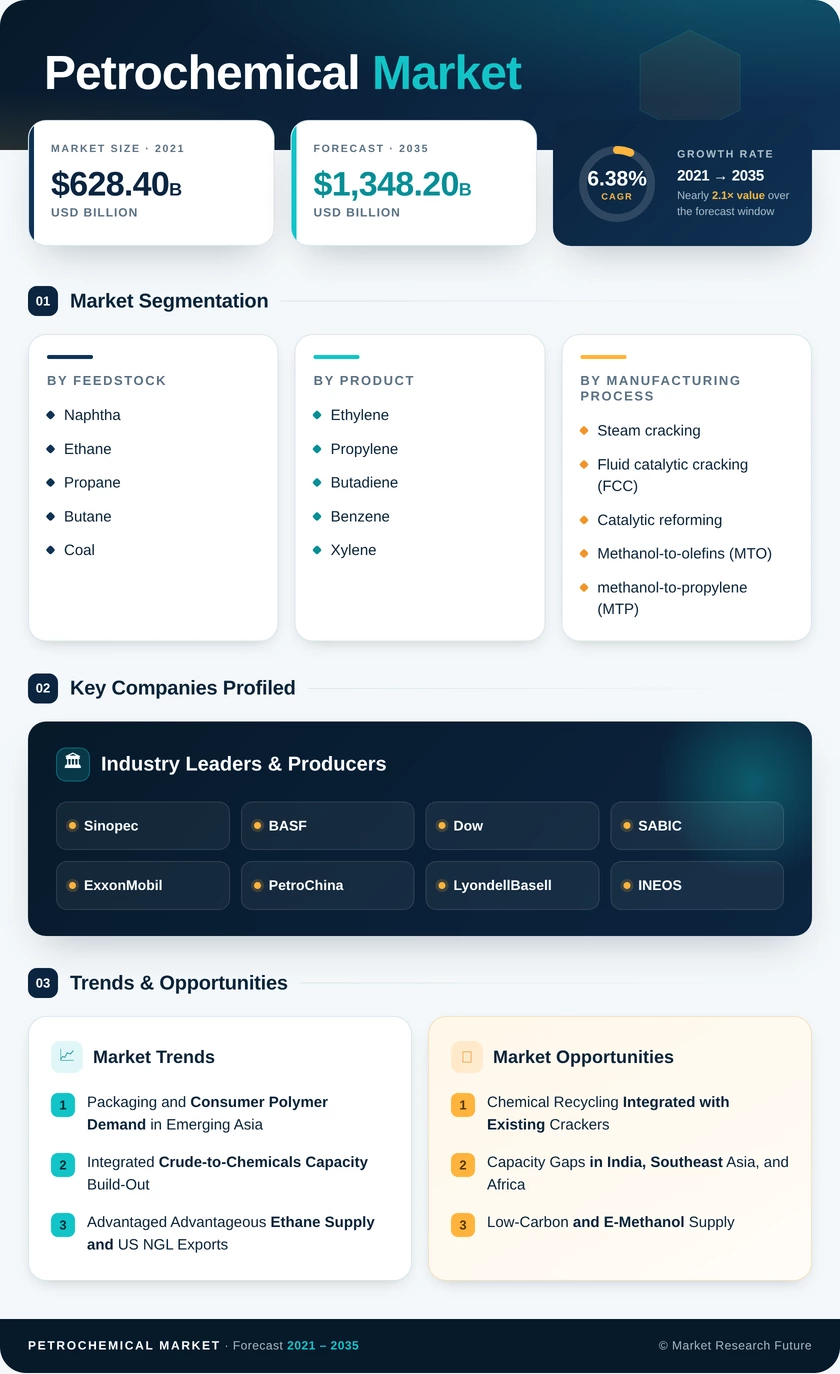
Segmentation Quick Reference
| Dimension | Sub-Segments | Dominant Segment | Fastest Growing Segment |
|---|---|---|---|
| By Feedstock | Naphtha; Ethane; Propane; Butane; Coal; Natural gas; Recycled and renewable feedstocks | Naphtha (39.8% share) | Recycled and renewable feedstocks (12.6% CAGR) |
| By Product | Ethylene; Propylene; Butadiene; Benzene; Xylene; Toluene; Methanol; Other petrochemical products | Ethylene (30.8% share) | Methanol (8.4% CAGR) |
| By Manufacturing Process | Steam cracking; Fluid catalytic cracking (FCC); Catalytic reforming; Methanol-to-olefins (MTO) and methanol-to-propylene (MTP); Propane dehydrogenation (PDH); Coal-to-methanol (CTM); Renewable and circular feedstock routes | Steam cracking (50.8% share) | Renewable and circular feedstock routes (13.0% CAGR) |
| By End-user Industry | Packaging; Building and construction; Automotive and transportation; Electrical and electronics; Consumer goods; Agriculture; Healthcare and pharmaceuticals; Textile and apparel; Industrial manufacturing; Other end-user industries | Packaging (29.3% share) | Healthcare and pharmaceuticals (7.9% CAGR) |
| By Region | North America; Europe; Asia-Pacific; South America; Middle East & Africa | Asia-Pacific (48.6% share) | Middle East & Africa (7.9% CAGR) |
Market Segmentation Overview
By Feedstock
| Sub-Segment | Key Trend |
|---|---|
| Naphtha | Mature cracker base under margin pressure |
| Ethane | Export contracts extend reach beyond source basins. |
| Propane | Growing PDH and flexible-cracker use |
| Butane | Seasonal swing feedstock |
| Coal | Anchors Chinese CTM and MTO output |
| Natural gas | Methanol and gas-based chemical routes |
| Recycled and renewable feedstocks | Pyrolysis oil and bio-naphtha under mass balance |
Naphtha leads with a 39.8% share because Europe, Japan, and South Korea operate decades-old crackers built around crude-linked supply. Ethane is the cost challenger, spreading through US export contracts. Recycled and renewable feedstocks grow fastest at a 12.6% CAGR, as pyrolysis oil can enter existing furnaces and help producers meet EU recycled-content targets.
By Product
| Sub-Segment | Key Trend |
|---|---|
| Ethylene | Large integrated additions in China and the Gulf |
| Propylene | Shift toward PDH and FCC supply. |
| Butadiene | Tied to tire and rubber demand |
| Benzene | Styrene and nylon chains under surplus |
| Xylene | Paraxylene for polyester and PET |
| Toluene | Solvent and TDI demand |
| Methanol | Dual role in olefins and marine fuel |
| Other petrochemical products | Specialty intermediates |
Ethylene holds the leading 30.8% share as the feedstock for polyethylene, ethylene oxide, and vinyl chloride. Propylene is decoupling from crackers as PDH units add dedicated supply. Methanol grows fastest at an 8.4% CAGR because Chinese MTO plants and methanol-fueled vessels give it two independent demand outlets.
By Manufacturing Process
| Sub-Segment | Key Trend |
|---|---|
| Steam cracking | Backbone process; electrification pilots underway |
| Fluid catalytic cracking (FCC) | Refinery-linked propylene recovery |
| Catalytic reforming | Supplies benzene, toluene, and xylene |
| Methanol-to-olefins (MTO) and methanol-to-propylene (MTP) | Chinese capacity growth with carbon scrutiny |
| Propane dehydrogenation (PDH) | On-purpose propylene in China and North America |
| Coal-to-methanol (CTM) | Coal-region economics, rising carbon pressure |
| Renewable and circular feedstock routes | Retrofits and modular recycling plants |
Steam cracking dominates with a 50.8% share, continuously producing ethylene and propylene for integrated downstream plants. PDH and MTO add flexible propylene and olefins supply where propane or coal is cheap. Renewable and circular feedstock routes grow fastest at a 13.0% CAGR because furnace retrofits avoid the cost of building new conversion sites.
By End-user Industry
| Sub-Segment | Key Trend |
|---|---|
| Packaging | Recycled-content mandates reshape grades |
| Building and construction | Infrastructure-led PVC and insulation demand |
| Automotive and transportation | Lightweighting for electric vehicles |
| Electrical and electronics | Cable and component polymers |
| Consumer goods | Durable plastics and personal care |
| Agriculture | Films and irrigation systems |
| Healthcare and pharmaceuticals | Medical-grade polymers and drug intermediates |
| Textile and apparel | Polyester and nylon fiber demand |
| Industrial manufacturing | Coatings and engineering resins |
| Other end-user industries | Niche specialty applications |
Packaging leads with a 29.3% share, consuming films, containers, and laminates for food and e-commerce. Building and construction follows on infrastructure-driven PVC and insulation use. Healthcare and pharmaceuticals grow fastest at a 7.9% CAGR, as medical devices and drug manufacturing require high-purity, qualified polymer grades.


 Noah Malgeri
Co-Founder

 Peter Groot koerkamp
Account and Business Manager

 Younghwan Choi
Senior Retail Manager

 Mark Irwin
Management Consultant

 Akif Moroglu
Strategy & Business Development Director

 Guilherme Gomes Martins
Product Management Director

 Joseph Aguayo
Sales Operations & Pricing Manager

 La Terria Dodd
Program Support Specialist

 Rob Kooiker
Group Product Manager HVAC & Fire Protection GMA