Request Free Sample ×

Kindly complete the form below to receive a free sample of this Report

* Please use a valid business email

Leading companies partner with us for data-driven Insights

clients tt-cursor
Hero Background
English
Chinese
French
Japanese
Korean
German
Spanish

Pet Insurance Market Trends

ID: MRFR/BS/10877-HCR
200 Pages
Nirmit Biswas
March 2026

Pet Insurance Market Size, Share and Research Report By Coverage Type (Accident Only, Accident and Illness, Wellness), By Animal Type (Dogs, Cats, Birds, Exotic Pets), By Distribution Channel (Direct Insurance, Brokers, Online), By Policy Type (Comprehensive Coverage, Limited Coverage, Time-Limited Coverage) and By Regional (North America, Europe, South America, Asia Pacific, Middle East and Africa) - Industry Forecast Till 2035

Share:
Download PDF ×

We do not share your information with anyone. However, we may send you emails based on your report interest from time to time. You may contact us at any time to opt-out.

Pet Insurance Market Infographic
Purchase Options

Market Trends

Key Emerging Trends in the Pet Insurance Market

The growth of awareness of the importance of pets in homes is reflected by some important trends being observed in the Pet Insurance market. Similarly, there is a rapidly increasing demand for coverage provided by Pet Insurance. On one hand, pet owners perceive valuable financial advantages from having insurance on many costs related to their health care. In contrast, veterinary care becomes cheaper through timely medical attention from vet doctors. Technology integration into the insurance buying process has reshaped pet insurance markets with platforms such as digital and mobile apps, letting pet masters engage in information search as well as claims processing policy updates, among others, when necessary. At the same time, technology has made personalization possible, meaning that plans for animal protection could be designed specifically for unique feature requirements, thus transitioning Pet Insurance into a more personalized approach. Aspects such as preventive care and wellness coverage are emerging trends within the Pet Insurance market. More pet owners have started realizing that regular checkups offered by veterinarians help save money that would have been spent on treating sicknesses caused by a lack of vaccines during the early stages of pets' lives. This includes extended provision of coverage types that address complementary & alternative medicine (CAM). Therefore, today, pet insurances include treatments like acupuncture or physiotherapy just because people want them as part of a complete healthcare package for their animals. At the same time, they still appreciate other therapies outside traditional veterinary procedures. The flexibility provided by customizing policies is a major highlight of the Pet Insurance market. This calls for policies that fit pets' needs and circumstances. Competition among insurers is currently on the rise, leading to changes in their coverage and pricing approaches. Moreover, we notice that there are increasing partnerships with other key stakeholders in the pet care industry, such as veterinary clinics, technology companies, and retailers, by the Pet Insurance providers themselves. Demand for Pet Insurance has gone global now since it has expanded beyond traditional markets. Awareness and education about Pet Insurance continue to be challenges affecting current trends within this market.


Author
Author Profile
Nirmit Biswas
Senior Research Analyst

With 5+ years of expertise in Market Intelligence and Strategic Research, Nirmit Biswas specializes in ICT, Semiconductors, and BFSI. Backed by an MBA in Financial Services and a Computer Science foundation, Nirmit blends technical depth with business acumen. He has successfully led 100+ projects for global enterprises and startups, including Amazon, Cisco, L&T and Huawei, delivering market estimations, competitive benchmarking, and GTM strategies. His focus lies in transforming complex data into clear, actionable insights that drive growth, innovation, and investment decisions. Recognized for bridging engineering innovation with executive strategy, Nirmit helps businesses navigate dynamic markets with confidence.

Leave a Comment

FAQs

What is the current valuation of the Pet Insurance Market as of 2024?

<p>The Pet Insurance Market was valued at 11.21 USD Billion in 2024.</p>

What is the projected market size for the Pet Insurance Market by 2035?

<p>The market is projected to reach 39.46 USD Billion by 2035.</p>

What is the expected CAGR for the Pet Insurance Market during the forecast period 2025 - 2035?

<p>The expected CAGR for the Pet Insurance Market during 2025 - 2035 is 12.12%.</p>

Which coverage type has the highest valuation in the Pet Insurance Market?

<p>Accident and Illness coverage had a valuation of 7.56 USD Billion in 2024 and is expected to grow significantly.</p>

How do dogs and cats compare in terms of market valuation within the Pet Insurance sector?

<p>In 2024, dogs accounted for 5.0 USD Billion while cats represented 4.0 USD Billion, indicating a strong preference for dog insurance.</p>

What distribution channel is projected to have the highest growth in the Pet Insurance Market?

<p>Direct Insurance, valued at 4.48 USD Billion in 2024, is likely to see substantial growth in the coming years.</p>

Which key players dominate the Pet Insurance Market?

<p>Key players include Trupanion, Nationwide, Petplan, Healthy Paws, and Embrace, among others.</p>

What is the valuation of wellness coverage in the Pet Insurance Market as of 2024?

<p>Wellness coverage was valued at 2.97 USD Billion in 2024, indicating a growing interest in preventive care.</p>

How does the market for exotic pets compare to that of birds in the Pet Insurance sector?

Exotic pets had a valuation of 1.21 USD Billion in 2024, slightly higher than the 1.0 USD Billion for birds.

What types of policy coverage are available in the Pet Insurance Market?

The market offers Comprehensive, Limited, and Time-Limited coverage types, with Comprehensive coverage valued at 4.49 USD Billion in 2024.

Market Summary

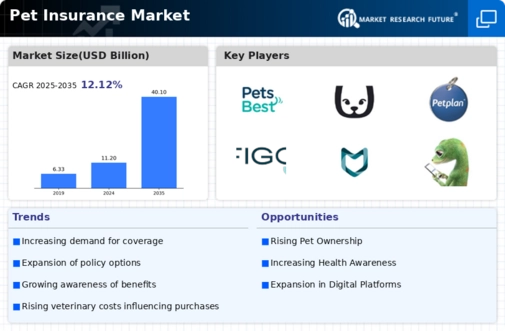
As per Market Research Future analysis, the Pet Insurance Market Size was estimated at 11.21 USD Billion in 2024. The Pet Insurance industry is projected to grow from 12.57 USD Billion in 2025 to 39.46 USD Billion by 2035, exhibiting a compound annual growth rate (CAGR) of 12.12% during the forecast period 2025 - 2035

Key Market Trends & Highlights

The Pet Insurance Market is experiencing robust growth driven by increasing awareness and technological advancements.

  • North America remains the largest market for pet insurance, reflecting a strong consumer base and established infrastructure. The Asia-Pacific region is emerging as the fastest-growing market, driven by rising pet ownership and changing consumer attitudes towards pet care. The Accident and Illness segment continues to dominate the market, while the Accident Only segment is witnessing rapid growth due to its affordability. Key market drivers include increasing pet ownership rates and rising veterinary costs, which are fostering greater awareness of pet health insurance.

Market Size & Forecast

2024 Market Size 11.21 (USD Billion)
2035 Market Size 39.46 (USD Billion)
CAGR (2025 - 2035) 12.12%
Largest Regional Market Share in 2024 North America

Major Players

Trupanion (US), Nationwide (US), Petplan (GB), Healthy Paws (US), Embrace (US), Figo (US), Pets Best (US), ASPCA Pet Health Insurance (US), PetFirst (US)

Market Trends

The Pet Insurance Market is currently experiencing a notable transformation, driven by a combination of evolving consumer preferences and advancements in veterinary care. As pet ownership continues to rise, there is an increasing recognition of the financial implications associated with pet healthcare. This awareness appears to be fostering a greater demand for insurance products tailored specifically for pets. Moreover, the integration of technology in the insurance sector, such as mobile applications and telemedicine, seems to enhance accessibility and convenience for pet owners, thereby potentially expanding the market further. In addition, the Pet Insurance Market is witnessing a shift towards more comprehensive coverage options. Pet owners are increasingly seeking policies that not only cover accidents and illnesses but also preventive care and wellness services. This trend indicates a growing understanding of the importance of proactive health management for pets. Furthermore, as more insurers enter the market, competition is likely to drive innovation and improve service offerings, ultimately benefiting consumers. Overall, the Pet Insurance Market appears poised for continued growth, reflecting changing attitudes towards pet care and the increasing value placed on the health and well-being of pets.

Rising Awareness of Pet Health Costs

There is a growing recognition among pet owners regarding the financial burden associated with veterinary care. This awareness is likely to drive demand for insurance products that can alleviate unexpected expenses.

Technological Integration in Insurance

The incorporation of technology, such as mobile apps and telehealth services, is enhancing the accessibility of pet insurance. This trend may lead to increased consumer engagement and satisfaction.

Shift Towards Comprehensive Coverage

Pet owners are increasingly interested in policies that encompass a wider range of services, including preventive care. This shift suggests a proactive approach to pet health management.

Pet Insurance Market Market Drivers

Rising Veterinary Costs

The Pet Insurance Market is significantly influenced by the rising costs associated with veterinary care. As veterinary services become more advanced and specialized, the expenses incurred by pet owners are escalating. Reports indicate that the average cost of veterinary care has increased by over 20% in recent years. This trend compels pet owners to consider insurance as a viable option to mitigate financial burdens. The Pet Insurance Market is likely to benefit from this shift, as more individuals seek coverage to offset the high costs of treatments, surgeries, and preventive care. Insurers may respond by offering more comprehensive plans that cater to the evolving needs of pet owners, thereby enhancing the overall market landscape.

Increasing Pet Ownership Rates

The Pet Insurance Market appears to be experiencing a notable surge in pet ownership rates. As more households welcome pets into their lives, the demand for pet insurance is likely to rise. Recent statistics indicate that approximately 67% of households own a pet, a figure that has steadily increased over the years. This growing trend suggests that more pet owners are recognizing the importance of safeguarding their pets' health through insurance. Consequently, the Pet Insurance Market is poised for expansion as new pet owners seek financial protection against unexpected veterinary expenses. This increase in pet ownership not only drives demand for insurance products but also encourages insurers to innovate and tailor their offerings to meet the diverse needs of pet owners.

Increased Focus on Preventive Care

The Pet Insurance Market is increasingly aligning with a broader trend towards preventive care in pet health. Pet owners are becoming more proactive in managing their pets' health, seeking regular check-ups and vaccinations to prevent serious illnesses. This shift is likely to drive demand for insurance products that cover preventive services, such as wellness plans and routine examinations. As pet owners recognize the long-term benefits of preventive care, the Pet Insurance Market may see a rise in policies that cater to these needs. Insurers could respond by developing tailored plans that emphasize preventive measures, thereby enhancing customer satisfaction and loyalty.

Growing Awareness of Pet Health Insurance

The Pet Insurance Market is witnessing a growing awareness among pet owners regarding the benefits of health insurance for their pets. Educational campaigns and increased visibility of insurance options have contributed to this trend. Surveys indicate that a significant percentage of pet owners are now aware of the existence and advantages of pet insurance, with many expressing interest in obtaining coverage. This heightened awareness is likely to drive demand for insurance products, as pet owners seek to protect their furry companions from unforeseen medical expenses. The Pet Insurance Market may see a shift in consumer behavior, with more individuals prioritizing insurance as an essential aspect of responsible pet ownership.

Technological Advancements in Insurance Services

The Pet Insurance Market is being transformed by technological advancements that enhance the accessibility and efficiency of insurance services. Innovations such as mobile applications and online platforms allow pet owners to easily compare policies, file claims, and manage their insurance needs. This technological integration not only streamlines the customer experience but also attracts a tech-savvy demographic of pet owners. As more individuals embrace digital solutions, the Pet Insurance Market is likely to expand, with insurers adapting their offerings to meet the demands of a modern consumer base. The potential for telemedicine and virtual consultations further indicates a shift towards more convenient and comprehensive insurance solutions.

Market Segment Insights

By Coverage Type: Accident and Illness (Largest) vs. Accident Only (Fastest-Growing)

In the Pet Insurance Market, the coverage type segment shows a clear distribution among three key values: Accident Only, Accident and Illness, and Wellness. Accident and Illness coverage remains the largest segment, capturing a significant portion of the market, as pet owners seek comprehensive solutions to safeguard against unexpected health issues. In comparison, Accident Only coverage is experiencing faster adoption as it appeals to budget-conscious pet owners looking for essential protection without the added cost of illness coverage, leading to its rapid growth in recent years.

Accident and Illness (Dominant) vs. Accident Only (Emerging)

The Accident and Illness coverage is the dominant force in the pet insurance market, offering a holistic approach to pet health that encompasses both accidental injuries and illnesses. This comprehensive coverage attracts many pet owners due to its assurance that a range of health issues will be covered. Meanwhile, the Accident Only segment is emerging as a popular choice for cost-sensitive consumers who prioritize basic coverage for unexpected accidents over comprehensive illness protection. This trend indicates a growing segment of pet owners who are looking for affordable options while still ensuring their pets have some level of protection against sudden accidents.

By Animal Type: Dogs (Largest) vs. Cats (Fastest-Growing)

In the Pet Insurance Market, the animal type segment is largely dominated by dogs, capturing a significant share. Dogs have long been considered members of the family, leading to higher insurance uptake among dog owners. Cats come closely behind, but they are increasingly gaining traction, demonstrating the most rapid growth in recent years as more cat owners recognize the importance of insurance for their feline companions. The rest of the segment includes birds and exotic pets, which represent a smaller but notable portion of the market.

Dogs (Dominant) vs. Cats (Emerging)

When considering the dominant segment, dogs account for the bulk of pet insurance policies, reflecting a strong cultural inclination towards responsible pet ownership. Insurance for dogs often covers a wide range of health issues and preventive measures, appealing to a broad audience. In contrast, cats are emerging as a key focus area for growth, with a rising awareness of the reimbursements available for veterinary care. More innovative insurance products are tailored specifically for cats, offering unique coverage nuances that appeal to cat owners. As awareness continues to spread, this segment shows promising potential for increased market share.

By Distribution Channel: Direct Insurance (Largest) vs. Brokers (Fastest-Growing)

In the Pet Insurance Market, the distribution among channels reveals a robust predominance of Direct Insurance. This segment, which allows consumers to purchase policies directly, has established itself as the leading method of distribution, appealing to pet owners looking for convenience and simplicity in securing coverage. Brokers, while currently capturing a smaller share, are quickly gaining traction as intermediaries provide, tailored advice and policy comparisons for clients.

Brokers: Fastest-Growing vs. Direct Insurance: Dominant

Direct Insurance represents a significant portion of the pet insurance market owing to its customer-centric approach, enabling pet owners to engage directly with insurance providers. This segment benefits from reduced costs and streamlined processes, making it appealing for budget-conscious consumers. Conversely, Brokers, as a rapidly emerging force, offer personalized services, enhancing customer experience through expert guidance. They are gaining ground as consumers increasingly value informed decision-making when it comes to choosing pet insurance. The combined growth of digital platforms and shifting consumer preferences towards flexible insurance solutions positions Brokers as a critical contributor to the evolving landscape of pet insurance distribution.

By Policy Type: Comprehensive Coverage (Largest) vs. Limited Coverage (Fastest-Growing)

The Pet Insurance Market showcases a diverse landscape in its Policy Type segment, with Comprehensive Coverage leading significantly in market share. This type of coverage offers extensive protection, including a wide range of veterinary services, which resonates well with pet owners seeking thorough care options for their pets. In contrast, Limited Coverage, while smaller in overall share, has been catching up rapidly as pet owners look for more affordable insurance solutions that still provide essential protections without extensive costs.

Comprehensive Coverage (Dominant) vs. Time-Limited Coverage (Emerging)

Comprehensive Coverage stands as the dominant force in the Pet Insurance Market, appealing to pet owners who prioritize overall health security for their animals. This type of policy typically includes various services such as preventive care, hospitalization, and surgeries, ensuring that pet owners can address both unexpected illnesses and routine health maintenance. On the other hand, Time-Limited Coverage, classified as an emerging policy option, is gaining traction due to its flexible pricing and defined limits on coverage duration. This option attracts budget-conscious shoppers who want to ensure their pets are covered for a specific timeframe or until a defined monetary limit is reached, contributing to the increasing diversification of the market.

Get more detailed insights about Pet Insurance Market Research Report - Forecast to 2035

Regional Insights

North America : Leading Market for Pet Insurance Market

North America is the largest market for pet insurance, accounting for approximately 65% of the global market share. The growth is driven by increasing pet ownership, rising veterinary costs, and a growing awareness of pet health insurance benefits. Regulatory support and favorable policies further enhance market dynamics, making it a robust environment for pet insurance providers. The U.S. is the primary contributor, followed by Canada, which holds about 15% of the market share. In North America, key players like Trupanion, Nationwide, and Healthy Paws dominate the landscape, offering a variety of plans tailored to pet owners' needs. The competitive environment is characterized by innovation in policy offerings and customer service enhancements. The presence of established companies ensures a high level of trust among consumers, contributing to the market's sustained growth. The trend towards digital platforms for policy management is also gaining traction, further enhancing customer engagement.

Europe : Emerging Market with Growth Potential

Europe is witnessing significant growth in the pet insurance market, currently holding about 20% of the global share. The increasing trend of pet ownership, coupled with rising awareness of pet health, is driving demand. Regulatory frameworks in countries like the UK and Germany are evolving to support the industry, fostering a conducive environment for growth. The market is expected to expand as more pet owners recognize the financial benefits of insurance. Leading countries in Europe include the UK, Germany, and France, where major players like Petplan and other local insurers are making strides. The competitive landscape is marked by a mix of established companies and new entrants, all vying for market share. The focus on customer-centric services and innovative policy options is shaping the market, with a notable increase in digital solutions for policy management. The European market is poised for further expansion as consumer awareness continues to grow.

Asia-Pacific : Rapidly Growing Pet Insurance Market Sector

The Asia-Pacific region is emerging as a significant player in the pet insurance market, currently holding about 10% of the global share. The growth is fueled by increasing disposable incomes, urbanization, and a rising trend of pet ownership. Countries like Japan and Australia are leading the market, with regulatory frameworks gradually adapting to support the insurance sector. The demand for pet insurance is expected to rise as awareness of pet health issues increases among consumers. In this region, key players include local insurers and international companies expanding their footprint. The competitive landscape is evolving, with a focus on tailored insurance products that cater to the unique needs of pet owners. The presence of digital platforms for policy management is also gaining traction, enhancing customer experience and engagement. As the market matures, innovative solutions and customer-centric approaches will be crucial for sustained growth.

Middle East and Africa : Emerging Market with Untapped Potential

The Middle East and Africa region is an emerging market for pet insurance, currently holding about 5% of the global share. The growth is driven by increasing pet ownership, urbanization, and a growing awareness of the importance of pet health. Regulatory frameworks are still developing, but there is a noticeable shift towards supporting the pet insurance sector. As more consumers recognize the benefits of insurance, the market is expected to expand significantly in the coming years. Leading countries in this region include South Africa and the UAE, where the presence of key players is gradually increasing. The competitive landscape is characterized by a mix of local and international insurers, all aiming to capture the growing demand. The focus on customer education and tailored insurance products is essential for market penetration. As the region continues to develop, innovative solutions and strategic partnerships will play a vital role in shaping the future of pet insurance.

Key Players and Competitive Insights

The Pet Insurance Market is currently characterized by a dynamic competitive landscape, driven by increasing pet ownership and rising awareness of pet health. Major players such as Trupanion (US), Nationwide (US), and Healthy Paws (US) are strategically positioning themselves through innovation and digital transformation. Trupanion (US) focuses on providing comprehensive coverage with a unique subscription model, which appears to resonate well with pet owners seeking predictable costs. Nationwide (US), on the other hand, emphasizes its extensive experience in the insurance sector, leveraging its brand trust to attract customers. Healthy Paws (US) is notable for its commitment to customer service and rapid claims processing, which enhances customer loyalty and satisfaction. Collectively, these strategies contribute to a competitive environment that is increasingly focused on customer-centric solutions and technological advancements.In terms of business tactics, companies are increasingly localizing their services and optimizing their supply chains to enhance efficiency and responsiveness. The Pet Insurance Market is moderately fragmented, with a mix of established players and emerging startups. This fragmentation allows for diverse offerings, yet the collective influence of key players like Trupanion (US) and Nationwide (US) shapes market trends and consumer expectations.

In August Trupanion (US) announced a partnership with a leading veterinary telehealth provider, aiming to integrate telemedicine services into its insurance offerings. This strategic move is significant as it not only enhances the value proposition for customers but also positions Trupanion (US) at the forefront of the digital transformation trend within the industry. By facilitating easier access to veterinary care, Trupanion (US) is likely to improve customer satisfaction and retention.

In September Healthy Paws (US) launched a new mobile app designed to streamline the claims process for pet owners. This initiative reflects a growing trend towards digitalization in the Pet Insurance Market, as it allows for quicker claims submissions and real-time updates. The app's introduction may enhance user experience and set a new standard for customer engagement in the sector.

In October Nationwide (US) expanded its coverage options to include alternative therapies, such as acupuncture and chiropractic care for pets. This strategic expansion indicates a shift towards more holistic pet care solutions, appealing to a growing segment of pet owners who prioritize comprehensive health management for their animals. By diversifying its offerings, Nationwide (US) is likely to attract a broader customer base and strengthen its market position.

As of October the Pet Insurance Market is witnessing trends such as digitalization, sustainability, and the integration of artificial intelligence in claims processing. Strategic alliances are increasingly shaping the competitive landscape, enabling companies to enhance their service offerings and operational efficiencies. Looking ahead, competitive differentiation is expected to evolve, with a notable shift from price-based competition to a focus on innovation, technology, and supply chain reliability. Companies that can effectively leverage these trends are likely to secure a competitive edge in the market.

Key Companies in the Pet Insurance Market include

Industry Developments

The Pet Insurance Market has recently seen significant developments. In October 2023, Trupanion announced an expansion of its services in Europe, aiming to tap into the growing demand for pet health coverage. Meanwhile, Healthy Paws was recognized for its innovative claims processing technology, further enhancing customer experience in the sector.

Growth in the market valuation for pet insurance companies like Pets Best and Petplan reflects a robust increase in pet ownership and the rising awareness of pet health care.

In recent years, Figo Pet Insurance Market launched a new customizable policy in September 2022, catering to the needs of pet owners. Moreover, in March 2022, Embrace Pet Insurance Market underwent a merger with a leading health technology firm, enhancing its service offerings.

Currently, there have been discussions of other strategic partnerships among companies like Nationwide and ASPCA Pet Health Insurance, reflecting a trend toward consolidation in the market. The overall outlook for the Pet Insurance Market remains positive as it continues to adapt to changing consumer demands and advancements in technology.

Future Outlook

Pet Insurance Market Future Outlook

The Pet Insurance Market is projected to grow at a 12.12% CAGR from 2025 to 2035, driven by increasing pet ownership, rising veterinary costs, and enhanced consumer awareness.

New opportunities lie in:

  • Development of telehealth services for pet consultations</p><p>Integration of AI-driven claims processing systems</p><p>Expansion of customizable insurance plans for niche pet breeds

By 2035, the Pet Insurance Market is expected to be robust, reflecting substantial growth and innovation.

Market Segmentation

Pet Insurance Market Animal Type Outlook

  • Dogs
  • Cats
  • Birds
  • Exotic Pets

Pet Insurance Market Policy Type Outlook

  • Comprehensive Coverage
  • Limited Coverage
  • Time-Limited Coverage

Pet Insurance Market Coverage Type Outlook

  • Accident Only
  • Accident and Illness
  • Wellness

Pet Insurance Market Distribution Channel Outlook

  • Direct Insurance
  • Brokers
  • Online

Report Scope

MARKET SIZE 2024 11.21(USD Billion)
MARKET SIZE 2025 12.57(USD Billion)
MARKET SIZE 2035 39.46(USD Billion)
COMPOUND ANNUAL GROWTH RATE (CAGR) 12.12% (2025 - 2035)
REPORT COVERAGE Revenue Forecast, Competitive Landscape, Growth Factors, and Trends
BASE YEAR 2024
Market Forecast Period 2025 - 2035
Historical Data 2019 - 2024
Market Forecast Units USD Billion
Key Companies Profiled Trupanion (US), Nationwide (US), Petplan (GB), Healthy Paws (US), Embrace (US), Figo (US), Pets Best (US), ASPCA Pet Health Insurance (US), PetFirst (US)
Segments Covered Coverage Type, Animal Type, Distribution Channel, Policy Type, Regional
Key Market Opportunities Integration of telemedicine and digital platforms enhances accessibility in the Pet Insurance Market.
Key Market Dynamics Rising consumer awareness and demand for comprehensive pet health coverage drive competitive dynamics in the pet insurance market.
Countries Covered North America, Europe, APAC, South America, MEA

FAQs

What is the current valuation of the Pet Insurance Market as of 2024?

<p>The Pet Insurance Market was valued at 11.21 USD Billion in 2024.</p>

What is the projected market size for the Pet Insurance Market by 2035?

<p>The market is projected to reach 39.46 USD Billion by 2035.</p>

What is the expected CAGR for the Pet Insurance Market during the forecast period 2025 - 2035?

<p>The expected CAGR for the Pet Insurance Market during 2025 - 2035 is 12.12%.</p>

Which coverage type has the highest valuation in the Pet Insurance Market?

<p>Accident and Illness coverage had a valuation of 7.56 USD Billion in 2024 and is expected to grow significantly.</p>

How do dogs and cats compare in terms of market valuation within the Pet Insurance sector?

<p>In 2024, dogs accounted for 5.0 USD Billion while cats represented 4.0 USD Billion, indicating a strong preference for dog insurance.</p>

What distribution channel is projected to have the highest growth in the Pet Insurance Market?

<p>Direct Insurance, valued at 4.48 USD Billion in 2024, is likely to see substantial growth in the coming years.</p>

Which key players dominate the Pet Insurance Market?

<p>Key players include Trupanion, Nationwide, Petplan, Healthy Paws, and Embrace, among others.</p>

What is the valuation of wellness coverage in the Pet Insurance Market as of 2024?

<p>Wellness coverage was valued at 2.97 USD Billion in 2024, indicating a growing interest in preventive care.</p>

How does the market for exotic pets compare to that of birds in the Pet Insurance sector?

Exotic pets had a valuation of 1.21 USD Billion in 2024, slightly higher than the 1.0 USD Billion for birds.

What types of policy coverage are available in the Pet Insurance Market?

The market offers Comprehensive, Limited, and Time-Limited coverage types, with Comprehensive coverage valued at 4.49 USD Billion in 2024.

  1. SECTION I: EXECUTIVE SUMMARY AND KEY HIGHLIGHTS
    1. | 1.1 EXECUTIVE SUMMARY
    2. | | 1.1.1 Market Overview
    3. | | 1.1.2 Key Findings
    4. | | 1.1.3 Market Segmentation
    5. | | 1.1.4 Competitive Landscape
    6. | | 1.1.5 Challenges and Opportunities
    7. | | 1.1.6 Future Outlook
  2. SECTION II: SCOPING, METHODOLOGY AND MARKET STRUCTURE
    1. | 2.1 MARKET INTRODUCTION
    2. | | 2.1.1 Definition
    3. | | 2.1.2 Scope of the study
    4. | | | 2.1.2.1 Research Objective
    5. | | | 2.1.2.2 Assumption
    6. | | | 2.1.2.3 Limitations
    7. | 2.2 RESEARCH METHODOLOGY
    8. | | 2.2.1 Overview
    9. | | 2.2.2 Data Mining
    10. | | 2.2.3 Secondary Research
    11. | | 2.2.4 Primary Research
    12. | | | 2.2.4.1 Primary Interviews and Information Gathering Process
    13. | | | 2.2.4.2 Breakdown of Primary Respondents
    14. | | 2.2.5 Forecasting Model
    15. | | 2.2.6 Market Size Estimation
    16. | | | 2.2.6.1 Bottom-Up Approach
    17. | | | 2.2.6.2 Top-Down Approach
    18. | | 2.2.7 Data Triangulation
    19. | | 2.2.8 Validation
  3. SECTION III: QUALITATIVE ANALYSIS
    1. | 3.1 MARKET DYNAMICS
    2. | | 3.1.1 Overview
    3. | | 3.1.2 Drivers
    4. | | 3.1.3 Restraints
    5. | | 3.1.4 Opportunities
    6. | 3.2 MARKET FACTOR ANALYSIS
    7. | | 3.2.1 Value chain Analysis
    8. | | 3.2.2 Porter's Five Forces Analysis
    9. | | | 3.2.2.1 Bargaining Power of Suppliers
    10. | | | 3.2.2.2 Bargaining Power of Buyers
    11. | | | 3.2.2.3 Threat of New Entrants
    12. | | | 3.2.2.4 Threat of Substitutes
    13. | | | 3.2.2.5 Intensity of Rivalry
    14. | | 3.2.3 COVID-19 Impact Analysis
    15. | | | 3.2.3.1 Market Impact Analysis
    16. | | | 3.2.3.2 Regional Impact
    17. | | | 3.2.3.3 Opportunity and Threat Analysis
  4. SECTION IV: QUANTITATIVE ANALYSIS
    1. | 4.1 BFSI, BY Coverage Type (USD Billion)
    2. | | 4.1.1 Accident Only
    3. | | 4.1.2 Accident and Illness
    4. | | 4.1.3 Wellness
    5. | 4.2 BFSI, BY Animal Type (USD Billion)
    6. | | 4.2.1 Dogs
    7. | | 4.2.2 Cats
    8. | | 4.2.3 Birds
    9. | | 4.2.4 Exotic Pets
    10. | 4.3 BFSI, BY Distribution Channel (USD Billion)
    11. | | 4.3.1 Direct Insurance
    12. | | 4.3.2 Brokers
    13. | | 4.3.3 Online
    14. | 4.4 BFSI, BY Policy Type (USD Billion)
    15. | | 4.4.1 Comprehensive Coverage
    16. | | 4.4.2 Limited Coverage
    17. | | 4.4.3 Time-Limited Coverage
    18. | 4.5 BFSI, BY Region (USD Billion)
    19. | | 4.5.1 North America
    20. | | | 4.5.1.1 US
    21. | | | 4.5.1.2 Canada
    22. | | 4.5.2 Europe
    23. | | | 4.5.2.1 Germany
    24. | | | 4.5.2.2 UK
    25. | | | 4.5.2.3 France
    26. | | | 4.5.2.4 Russia
    27. | | | 4.5.2.5 Italy
    28. | | | 4.5.2.6 Spain
    29. | | | 4.5.2.7 Rest of Europe
    30. | | 4.5.3 APAC
    31. | | | 4.5.3.1 China
    32. | | | 4.5.3.2 India
    33. | | | 4.5.3.3 Japan
    34. | | | 4.5.3.4 South Korea
    35. | | | 4.5.3.5 Malaysia
    36. | | | 4.5.3.6 Thailand
    37. | | | 4.5.3.7 Indonesia
    38. | | | 4.5.3.8 Rest of APAC
    39. | | 4.5.4 South America
    40. | | | 4.5.4.1 Brazil
    41. | | | 4.5.4.2 Mexico
    42. | | | 4.5.4.3 Argentina
    43. | | | 4.5.4.4 Rest of South America
    44. | | 4.5.5 MEA
    45. | | | 4.5.5.1 GCC Countries
    46. | | | 4.5.5.2 South Africa
    47. | | | 4.5.5.3 Rest of MEA
  5. SECTION V: COMPETITIVE ANALYSIS
    1. | 5.1 Competitive Landscape
    2. | | 5.1.1 Overview
    3. | | 5.1.2 Competitive Analysis
    4. | | 5.1.3 Market share Analysis
    5. | | 5.1.4 Major Growth Strategy in the BFSI
    6. | | 5.1.5 Competitive Benchmarking
    7. | | 5.1.6 Leading Players in Terms of Number of Developments in the BFSI
    8. | | 5.1.7 Key developments and growth strategies
    9. | | | 5.1.7.1 New Product Launch/Service Deployment
    10. | | | 5.1.7.2 Merger & Acquisitions
    11. | | | 5.1.7.3 Joint Ventures
    12. | | 5.1.8 Major Players Financial Matrix
    13. | | | 5.1.8.1 Sales and Operating Income
    14. | | | 5.1.8.2 Major Players R&D Expenditure. 2023
    15. | 5.2 Company Profiles
    16. | | 5.2.1 Trupanion (US)
    17. | | | 5.2.1.1 Financial Overview
    18. | | | 5.2.1.2 Products Offered
    19. | | | 5.2.1.3 Key Developments
    20. | | | 5.2.1.4 SWOT Analysis
    21. | | | 5.2.1.5 Key Strategies
    22. | | 5.2.2 Nationwide (US)
    23. | | | 5.2.2.1 Financial Overview
    24. | | | 5.2.2.2 Products Offered
    25. | | | 5.2.2.3 Key Developments
    26. | | | 5.2.2.4 SWOT Analysis
    27. | | | 5.2.2.5 Key Strategies
    28. | | 5.2.3 Petplan (GB)
    29. | | | 5.2.3.1 Financial Overview
    30. | | | 5.2.3.2 Products Offered
    31. | | | 5.2.3.3 Key Developments
    32. | | | 5.2.3.4 SWOT Analysis
    33. | | | 5.2.3.5 Key Strategies
    34. | | 5.2.4 Healthy Paws (US)
    35. | | | 5.2.4.1 Financial Overview
    36. | | | 5.2.4.2 Products Offered
    37. | | | 5.2.4.3 Key Developments
    38. | | | 5.2.4.4 SWOT Analysis
    39. | | | 5.2.4.5 Key Strategies
    40. | | 5.2.5 Embrace (US)
    41. | | | 5.2.5.1 Financial Overview
    42. | | | 5.2.5.2 Products Offered
    43. | | | 5.2.5.3 Key Developments
    44. | | | 5.2.5.4 SWOT Analysis
    45. | | | 5.2.5.5 Key Strategies
    46. | | 5.2.6 Figo (US)
    47. | | | 5.2.6.1 Financial Overview
    48. | | | 5.2.6.2 Products Offered
    49. | | | 5.2.6.3 Key Developments
    50. | | | 5.2.6.4 SWOT Analysis
    51. | | | 5.2.6.5 Key Strategies
    52. | | 5.2.7 Pets Best (US)
    53. | | | 5.2.7.1 Financial Overview
    54. | | | 5.2.7.2 Products Offered
    55. | | | 5.2.7.3 Key Developments
    56. | | | 5.2.7.4 SWOT Analysis
    57. | | | 5.2.7.5 Key Strategies
    58. | | 5.2.8 ASPCA Pet Health Insurance (US)
    59. | | | 5.2.8.1 Financial Overview
    60. | | | 5.2.8.2 Products Offered
    61. | | | 5.2.8.3 Key Developments
    62. | | | 5.2.8.4 SWOT Analysis
    63. | | | 5.2.8.5 Key Strategies
    64. | | 5.2.9 PetFirst (US)
    65. | | | 5.2.9.1 Financial Overview
    66. | | | 5.2.9.2 Products Offered
    67. | | | 5.2.9.3 Key Developments
    68. | | | 5.2.9.4 SWOT Analysis
    69. | | | 5.2.9.5 Key Strategies
    70. | 5.3 Appendix
    71. | | 5.3.1 References
    72. | | 5.3.2 Related Reports
  6. LIST OF FIGURES
    1. | 6.1 MARKET SYNOPSIS
    2. | 6.2 NORTH AMERICA MARKET ANALYSIS
    3. | 6.3 US MARKET ANALYSIS BY COVERAGE TYPE
    4. | 6.4 US MARKET ANALYSIS BY ANIMAL TYPE
    5. | 6.5 US MARKET ANALYSIS BY DISTRIBUTION CHANNEL
    6. | 6.6 US MARKET ANALYSIS BY POLICY TYPE
    7. | 6.7 CANADA MARKET ANALYSIS BY COVERAGE TYPE
    8. | 6.8 CANADA MARKET ANALYSIS BY ANIMAL TYPE
    9. | 6.9 CANADA MARKET ANALYSIS BY DISTRIBUTION CHANNEL
    10. | 6.10 CANADA MARKET ANALYSIS BY POLICY TYPE
    11. | 6.11 EUROPE MARKET ANALYSIS
    12. | 6.12 GERMANY MARKET ANALYSIS BY COVERAGE TYPE
    13. | 6.13 GERMANY MARKET ANALYSIS BY ANIMAL TYPE
    14. | 6.14 GERMANY MARKET ANALYSIS BY DISTRIBUTION CHANNEL
    15. | 6.15 GERMANY MARKET ANALYSIS BY POLICY TYPE
    16. | 6.16 UK MARKET ANALYSIS BY COVERAGE TYPE
    17. | 6.17 UK MARKET ANALYSIS BY ANIMAL TYPE
    18. | 6.18 UK MARKET ANALYSIS BY DISTRIBUTION CHANNEL
    19. | 6.19 UK MARKET ANALYSIS BY POLICY TYPE
    20. | 6.20 FRANCE MARKET ANALYSIS BY COVERAGE TYPE
    21. | 6.21 FRANCE MARKET ANALYSIS BY ANIMAL TYPE
    22. | 6.22 FRANCE MARKET ANALYSIS BY DISTRIBUTION CHANNEL
    23. | 6.23 FRANCE MARKET ANALYSIS BY POLICY TYPE
    24. | 6.24 RUSSIA MARKET ANALYSIS BY COVERAGE TYPE
    25. | 6.25 RUSSIA MARKET ANALYSIS BY ANIMAL TYPE
    26. | 6.26 RUSSIA MARKET ANALYSIS BY DISTRIBUTION CHANNEL
    27. | 6.27 RUSSIA MARKET ANALYSIS BY POLICY TYPE
    28. | 6.28 ITALY MARKET ANALYSIS BY COVERAGE TYPE
    29. | 6.29 ITALY MARKET ANALYSIS BY ANIMAL TYPE
    30. | 6.30 ITALY MARKET ANALYSIS BY DISTRIBUTION CHANNEL
    31. | 6.31 ITALY MARKET ANALYSIS BY POLICY TYPE
    32. | 6.32 SPAIN MARKET ANALYSIS BY COVERAGE TYPE
    33. | 6.33 SPAIN MARKET ANALYSIS BY ANIMAL TYPE
    34. | 6.34 SPAIN MARKET ANALYSIS BY DISTRIBUTION CHANNEL
    35. | 6.35 SPAIN MARKET ANALYSIS BY POLICY TYPE
    36. | 6.36 REST OF EUROPE MARKET ANALYSIS BY COVERAGE TYPE
    37. | 6.37 REST OF EUROPE MARKET ANALYSIS BY ANIMAL TYPE
    38. | 6.38 REST OF EUROPE MARKET ANALYSIS BY DISTRIBUTION CHANNEL
    39. | 6.39 REST OF EUROPE MARKET ANALYSIS BY POLICY TYPE
    40. | 6.40 APAC MARKET ANALYSIS
    41. | 6.41 CHINA MARKET ANALYSIS BY COVERAGE TYPE
    42. | 6.42 CHINA MARKET ANALYSIS BY ANIMAL TYPE
    43. | 6.43 CHINA MARKET ANALYSIS BY DISTRIBUTION CHANNEL
    44. | 6.44 CHINA MARKET ANALYSIS BY POLICY TYPE
    45. | 6.45 INDIA MARKET ANALYSIS BY COVERAGE TYPE
    46. | 6.46 INDIA MARKET ANALYSIS BY ANIMAL TYPE
    47. | 6.47 INDIA MARKET ANALYSIS BY DISTRIBUTION CHANNEL
    48. | 6.48 INDIA MARKET ANALYSIS BY POLICY TYPE
    49. | 6.49 JAPAN MARKET ANALYSIS BY COVERAGE TYPE
    50. | 6.50 JAPAN MARKET ANALYSIS BY ANIMAL TYPE
    51. | 6.51 JAPAN MARKET ANALYSIS BY DISTRIBUTION CHANNEL
    52. | 6.52 JAPAN MARKET ANALYSIS BY POLICY TYPE
    53. | 6.53 SOUTH KOREA MARKET ANALYSIS BY COVERAGE TYPE
    54. | 6.54 SOUTH KOREA MARKET ANALYSIS BY ANIMAL TYPE
    55. | 6.55 SOUTH KOREA MARKET ANALYSIS BY DISTRIBUTION CHANNEL
    56. | 6.56 SOUTH KOREA MARKET ANALYSIS BY POLICY TYPE
    57. | 6.57 MALAYSIA MARKET ANALYSIS BY COVERAGE TYPE
    58. | 6.58 MALAYSIA MARKET ANALYSIS BY ANIMAL TYPE
    59. | 6.59 MALAYSIA MARKET ANALYSIS BY DISTRIBUTION CHANNEL
    60. | 6.60 MALAYSIA MARKET ANALYSIS BY POLICY TYPE
    61. | 6.61 THAILAND MARKET ANALYSIS BY COVERAGE TYPE
    62. | 6.62 THAILAND MARKET ANALYSIS BY ANIMAL TYPE
    63. | 6.63 THAILAND MARKET ANALYSIS BY DISTRIBUTION CHANNEL
    64. | 6.64 THAILAND MARKET ANALYSIS BY POLICY TYPE
    65. | 6.65 INDONESIA MARKET ANALYSIS BY COVERAGE TYPE
    66. | 6.66 INDONESIA MARKET ANALYSIS BY ANIMAL TYPE
    67. | 6.67 INDONESIA MARKET ANALYSIS BY DISTRIBUTION CHANNEL
    68. | 6.68 INDONESIA MARKET ANALYSIS BY POLICY TYPE
    69. | 6.69 REST OF APAC MARKET ANALYSIS BY COVERAGE TYPE
    70. | 6.70 REST OF APAC MARKET ANALYSIS BY ANIMAL TYPE
    71. | 6.71 REST OF APAC MARKET ANALYSIS BY DISTRIBUTION CHANNEL
    72. | 6.72 REST OF APAC MARKET ANALYSIS BY POLICY TYPE
    73. | 6.73 SOUTH AMERICA MARKET ANALYSIS
    74. | 6.74 BRAZIL MARKET ANALYSIS BY COVERAGE TYPE
    75. | 6.75 BRAZIL MARKET ANALYSIS BY ANIMAL TYPE
    76. | 6.76 BRAZIL MARKET ANALYSIS BY DISTRIBUTION CHANNEL
    77. | 6.77 BRAZIL MARKET ANALYSIS BY POLICY TYPE
    78. | 6.78 MEXICO MARKET ANALYSIS BY COVERAGE TYPE
    79. | 6.79 MEXICO MARKET ANALYSIS BY ANIMAL TYPE
    80. | 6.80 MEXICO MARKET ANALYSIS BY DISTRIBUTION CHANNEL
    81. | 6.81 MEXICO MARKET ANALYSIS BY POLICY TYPE
    82. | 6.82 ARGENTINA MARKET ANALYSIS BY COVERAGE TYPE
    83. | 6.83 ARGENTINA MARKET ANALYSIS BY ANIMAL TYPE
    84. | 6.84 ARGENTINA MARKET ANALYSIS BY DISTRIBUTION CHANNEL
    85. | 6.85 ARGENTINA MARKET ANALYSIS BY POLICY TYPE
    86. | 6.86 REST OF SOUTH AMERICA MARKET ANALYSIS BY COVERAGE TYPE
    87. | 6.87 REST OF SOUTH AMERICA MARKET ANALYSIS BY ANIMAL TYPE
    88. | 6.88 REST OF SOUTH AMERICA MARKET ANALYSIS BY DISTRIBUTION CHANNEL
    89. | 6.89 REST OF SOUTH AMERICA MARKET ANALYSIS BY POLICY TYPE
    90. | 6.90 MEA MARKET ANALYSIS
    91. | 6.91 GCC COUNTRIES MARKET ANALYSIS BY COVERAGE TYPE
    92. | 6.92 GCC COUNTRIES MARKET ANALYSIS BY ANIMAL TYPE
    93. | 6.93 GCC COUNTRIES MARKET ANALYSIS BY DISTRIBUTION CHANNEL
    94. | 6.94 GCC COUNTRIES MARKET ANALYSIS BY POLICY TYPE
    95. | 6.95 SOUTH AFRICA MARKET ANALYSIS BY COVERAGE TYPE
    96. | 6.96 SOUTH AFRICA MARKET ANALYSIS BY ANIMAL TYPE
    97. | 6.97 SOUTH AFRICA MARKET ANALYSIS BY DISTRIBUTION CHANNEL
    98. | 6.98 SOUTH AFRICA MARKET ANALYSIS BY POLICY TYPE
    99. | 6.99 REST OF MEA MARKET ANALYSIS BY COVERAGE TYPE
    100. | 6.100 REST OF MEA MARKET ANALYSIS BY ANIMAL TYPE
    101. | 6.101 REST OF MEA MARKET ANALYSIS BY DISTRIBUTION CHANNEL
    102. | 6.102 REST OF MEA MARKET ANALYSIS BY POLICY TYPE
    103. | 6.103 KEY BUYING CRITERIA OF BFSI
    104. | 6.104 RESEARCH PROCESS OF MRFR
    105. | 6.105 DRO ANALYSIS OF BFSI
    106. | 6.106 DRIVERS IMPACT ANALYSIS: BFSI
    107. | 6.107 RESTRAINTS IMPACT ANALYSIS: BFSI
    108. | 6.108 SUPPLY / VALUE CHAIN: BFSI
    109. | 6.109 BFSI, BY COVERAGE TYPE, 2024 (% SHARE)
    110. | 6.110 BFSI, BY COVERAGE TYPE, 2024 TO 2035 (USD Billion)
    111. | 6.111 BFSI, BY ANIMAL TYPE, 2024 (% SHARE)
    112. | 6.112 BFSI, BY ANIMAL TYPE, 2024 TO 2035 (USD Billion)
    113. | 6.113 BFSI, BY DISTRIBUTION CHANNEL, 2024 (% SHARE)
    114. | 6.114 BFSI, BY DISTRIBUTION CHANNEL, 2024 TO 2035 (USD Billion)
    115. | 6.115 BFSI, BY POLICY TYPE, 2024 (% SHARE)
    116. | 6.116 BFSI, BY POLICY TYPE, 2024 TO 2035 (USD Billion)
    117. | 6.117 BENCHMARKING OF MAJOR COMPETITORS
  7. LIST OF TABLES
    1. | 7.1 LIST OF ASSUMPTIONS
    2. | | 7.1.1
    3. | 7.2 North America MARKET SIZE ESTIMATES; FORECAST
    4. | | 7.2.1 BY COVERAGE TYPE, 2025-2035 (USD Billion)
    5. | | 7.2.2 BY ANIMAL TYPE, 2025-2035 (USD Billion)
    6. | | 7.2.3 BY DISTRIBUTION CHANNEL, 2025-2035 (USD Billion)
    7. | | 7.2.4 BY POLICY TYPE, 2025-2035 (USD Billion)
    8. | 7.3 US MARKET SIZE ESTIMATES; FORECAST
    9. | | 7.3.1 BY COVERAGE TYPE, 2025-2035 (USD Billion)
    10. | | 7.3.2 BY ANIMAL TYPE, 2025-2035 (USD Billion)
    11. | | 7.3.3 BY DISTRIBUTION CHANNEL, 2025-2035 (USD Billion)
    12. | | 7.3.4 BY POLICY TYPE, 2025-2035 (USD Billion)
    13. | 7.4 Canada MARKET SIZE ESTIMATES; FORECAST
    14. | | 7.4.1 BY COVERAGE TYPE, 2025-2035 (USD Billion)
    15. | | 7.4.2 BY ANIMAL TYPE, 2025-2035 (USD Billion)
    16. | | 7.4.3 BY DISTRIBUTION CHANNEL, 2025-2035 (USD Billion)
    17. | | 7.4.4 BY POLICY TYPE, 2025-2035 (USD Billion)
    18. | 7.5 Europe MARKET SIZE ESTIMATES; FORECAST
    19. | | 7.5.1 BY COVERAGE TYPE, 2025-2035 (USD Billion)
    20. | | 7.5.2 BY ANIMAL TYPE, 2025-2035 (USD Billion)
    21. | | 7.5.3 BY DISTRIBUTION CHANNEL, 2025-2035 (USD Billion)
    22. | | 7.5.4 BY POLICY TYPE, 2025-2035 (USD Billion)
    23. | 7.6 Germany MARKET SIZE ESTIMATES; FORECAST
    24. | | 7.6.1 BY COVERAGE TYPE, 2025-2035 (USD Billion)
    25. | | 7.6.2 BY ANIMAL TYPE, 2025-2035 (USD Billion)
    26. | | 7.6.3 BY DISTRIBUTION CHANNEL, 2025-2035 (USD Billion)
    27. | | 7.6.4 BY POLICY TYPE, 2025-2035 (USD Billion)
    28. | 7.7 UK MARKET SIZE ESTIMATES; FORECAST
    29. | | 7.7.1 BY COVERAGE TYPE, 2025-2035 (USD Billion)
    30. | | 7.7.2 BY ANIMAL TYPE, 2025-2035 (USD Billion)
    31. | | 7.7.3 BY DISTRIBUTION CHANNEL, 2025-2035 (USD Billion)
    32. | | 7.7.4 BY POLICY TYPE, 2025-2035 (USD Billion)
    33. | 7.8 France MARKET SIZE ESTIMATES; FORECAST
    34. | | 7.8.1 BY COVERAGE TYPE, 2025-2035 (USD Billion)
    35. | | 7.8.2 BY ANIMAL TYPE, 2025-2035 (USD Billion)
    36. | | 7.8.3 BY DISTRIBUTION CHANNEL, 2025-2035 (USD Billion)
    37. | | 7.8.4 BY POLICY TYPE, 2025-2035 (USD Billion)
    38. | 7.9 Russia MARKET SIZE ESTIMATES; FORECAST
    39. | | 7.9.1 BY COVERAGE TYPE, 2025-2035 (USD Billion)
    40. | | 7.9.2 BY ANIMAL TYPE, 2025-2035 (USD Billion)
    41. | | 7.9.3 BY DISTRIBUTION CHANNEL, 2025-2035 (USD Billion)
    42. | | 7.9.4 BY POLICY TYPE, 2025-2035 (USD Billion)
    43. | 7.10 Italy MARKET SIZE ESTIMATES; FORECAST
    44. | | 7.10.1 BY COVERAGE TYPE, 2025-2035 (USD Billion)
    45. | | 7.10.2 BY ANIMAL TYPE, 2025-2035 (USD Billion)
    46. | | 7.10.3 BY DISTRIBUTION CHANNEL, 2025-2035 (USD Billion)
    47. | | 7.10.4 BY POLICY TYPE, 2025-2035 (USD Billion)
    48. | 7.11 Spain MARKET SIZE ESTIMATES; FORECAST
    49. | | 7.11.1 BY COVERAGE TYPE, 2025-2035 (USD Billion)
    50. | | 7.11.2 BY ANIMAL TYPE, 2025-2035 (USD Billion)
    51. | | 7.11.3 BY DISTRIBUTION CHANNEL, 2025-2035 (USD Billion)
    52. | | 7.11.4 BY POLICY TYPE, 2025-2035 (USD Billion)
    53. | 7.12 Rest of Europe MARKET SIZE ESTIMATES; FORECAST
    54. | | 7.12.1 BY COVERAGE TYPE, 2025-2035 (USD Billion)
    55. | | 7.12.2 BY ANIMAL TYPE, 2025-2035 (USD Billion)
    56. | | 7.12.3 BY DISTRIBUTION CHANNEL, 2025-2035 (USD Billion)
    57. | | 7.12.4 BY POLICY TYPE, 2025-2035 (USD Billion)
    58. | 7.13 APAC MARKET SIZE ESTIMATES; FORECAST
    59. | | 7.13.1 BY COVERAGE TYPE, 2025-2035 (USD Billion)
    60. | | 7.13.2 BY ANIMAL TYPE, 2025-2035 (USD Billion)
    61. | | 7.13.3 BY DISTRIBUTION CHANNEL, 2025-2035 (USD Billion)
    62. | | 7.13.4 BY POLICY TYPE, 2025-2035 (USD Billion)
    63. | 7.14 China MARKET SIZE ESTIMATES; FORECAST
    64. | | 7.14.1 BY COVERAGE TYPE, 2025-2035 (USD Billion)
    65. | | 7.14.2 BY ANIMAL TYPE, 2025-2035 (USD Billion)
    66. | | 7.14.3 BY DISTRIBUTION CHANNEL, 2025-2035 (USD Billion)
    67. | | 7.14.4 BY POLICY TYPE, 2025-2035 (USD Billion)
    68. | 7.15 India MARKET SIZE ESTIMATES; FORECAST
    69. | | 7.15.1 BY COVERAGE TYPE, 2025-2035 (USD Billion)
    70. | | 7.15.2 BY ANIMAL TYPE, 2025-2035 (USD Billion)
    71. | | 7.15.3 BY DISTRIBUTION CHANNEL, 2025-2035 (USD Billion)
    72. | | 7.15.4 BY POLICY TYPE, 2025-2035 (USD Billion)
    73. | 7.16 Japan MARKET SIZE ESTIMATES; FORECAST
    74. | | 7.16.1 BY COVERAGE TYPE, 2025-2035 (USD Billion)
    75. | | 7.16.2 BY ANIMAL TYPE, 2025-2035 (USD Billion)
    76. | | 7.16.3 BY DISTRIBUTION CHANNEL, 2025-2035 (USD Billion)
    77. | | 7.16.4 BY POLICY TYPE, 2025-2035 (USD Billion)
    78. | 7.17 South Korea MARKET SIZE ESTIMATES; FORECAST
    79. | | 7.17.1 BY COVERAGE TYPE, 2025-2035 (USD Billion)
    80. | | 7.17.2 BY ANIMAL TYPE, 2025-2035 (USD Billion)
    81. | | 7.17.3 BY DISTRIBUTION CHANNEL, 2025-2035 (USD Billion)
    82. | | 7.17.4 BY POLICY TYPE, 2025-2035 (USD Billion)
    83. | 7.18 Malaysia MARKET SIZE ESTIMATES; FORECAST
    84. | | 7.18.1 BY COVERAGE TYPE, 2025-2035 (USD Billion)
    85. | | 7.18.2 BY ANIMAL TYPE, 2025-2035 (USD Billion)
    86. | | 7.18.3 BY DISTRIBUTION CHANNEL, 2025-2035 (USD Billion)
    87. | | 7.18.4 BY POLICY TYPE, 2025-2035 (USD Billion)
    88. | 7.19 Thailand MARKET SIZE ESTIMATES; FORECAST
    89. | | 7.19.1 BY COVERAGE TYPE, 2025-2035 (USD Billion)
    90. | | 7.19.2 BY ANIMAL TYPE, 2025-2035 (USD Billion)
    91. | | 7.19.3 BY DISTRIBUTION CHANNEL, 2025-2035 (USD Billion)
    92. | | 7.19.4 BY POLICY TYPE, 2025-2035 (USD Billion)
    93. | 7.20 Indonesia MARKET SIZE ESTIMATES; FORECAST
    94. | | 7.20.1 BY COVERAGE TYPE, 2025-2035 (USD Billion)
    95. | | 7.20.2 BY ANIMAL TYPE, 2025-2035 (USD Billion)
    96. | | 7.20.3 BY DISTRIBUTION CHANNEL, 2025-2035 (USD Billion)
    97. | | 7.20.4 BY POLICY TYPE, 2025-2035 (USD Billion)
    98. | 7.21 Rest of APAC MARKET SIZE ESTIMATES; FORECAST
    99. | | 7.21.1 BY COVERAGE TYPE, 2025-2035 (USD Billion)
    100. | | 7.21.2 BY ANIMAL TYPE, 2025-2035 (USD Billion)
    101. | | 7.21.3 BY DISTRIBUTION CHANNEL, 2025-2035 (USD Billion)
    102. | | 7.21.4 BY POLICY TYPE, 2025-2035 (USD Billion)
    103. | 7.22 South America MARKET SIZE ESTIMATES; FORECAST
    104. | | 7.22.1 BY COVERAGE TYPE, 2025-2035 (USD Billion)
    105. | | 7.22.2 BY ANIMAL TYPE, 2025-2035 (USD Billion)
    106. | | 7.22.3 BY DISTRIBUTION CHANNEL, 2025-2035 (USD Billion)
    107. | | 7.22.4 BY POLICY TYPE, 2025-2035 (USD Billion)
    108. | 7.23 Brazil MARKET SIZE ESTIMATES; FORECAST
    109. | | 7.23.1 BY COVERAGE TYPE, 2025-2035 (USD Billion)
    110. | | 7.23.2 BY ANIMAL TYPE, 2025-2035 (USD Billion)
    111. | | 7.23.3 BY DISTRIBUTION CHANNEL, 2025-2035 (USD Billion)
    112. | | 7.23.4 BY POLICY TYPE, 2025-2035 (USD Billion)
    113. | 7.24 Mexico MARKET SIZE ESTIMATES; FORECAST
    114. | | 7.24.1 BY COVERAGE TYPE, 2025-2035 (USD Billion)
    115. | | 7.24.2 BY ANIMAL TYPE, 2025-2035 (USD Billion)
    116. | | 7.24.3 BY DISTRIBUTION CHANNEL, 2025-2035 (USD Billion)
    117. | | 7.24.4 BY POLICY TYPE, 2025-2035 (USD Billion)
    118. | 7.25 Argentina MARKET SIZE ESTIMATES; FORECAST
    119. | | 7.25.1 BY COVERAGE TYPE, 2025-2035 (USD Billion)
    120. | | 7.25.2 BY ANIMAL TYPE, 2025-2035 (USD Billion)
    121. | | 7.25.3 BY DISTRIBUTION CHANNEL, 2025-2035 (USD Billion)
    122. | | 7.25.4 BY POLICY TYPE, 2025-2035 (USD Billion)
    123. | 7.26 Rest of South America MARKET SIZE ESTIMATES; FORECAST
    124. | | 7.26.1 BY COVERAGE TYPE, 2025-2035 (USD Billion)
    125. | | 7.26.2 BY ANIMAL TYPE, 2025-2035 (USD Billion)
    126. | | 7.26.3 BY DISTRIBUTION CHANNEL, 2025-2035 (USD Billion)
    127. | | 7.26.4 BY POLICY TYPE, 2025-2035 (USD Billion)
    128. | 7.27 MEA MARKET SIZE ESTIMATES; FORECAST
    129. | | 7.27.1 BY COVERAGE TYPE, 2025-2035 (USD Billion)
    130. | | 7.27.2 BY ANIMAL TYPE, 2025-2035 (USD Billion)
    131. | | 7.27.3 BY DISTRIBUTION CHANNEL, 2025-2035 (USD Billion)
    132. | | 7.27.4 BY POLICY TYPE, 2025-2035 (USD Billion)
    133. | 7.28 GCC Countries MARKET SIZE ESTIMATES; FORECAST
    134. | | 7.28.1 BY COVERAGE TYPE, 2025-2035 (USD Billion)
    135. | | 7.28.2 BY ANIMAL TYPE, 2025-2035 (USD Billion)
    136. | | 7.28.3 BY DISTRIBUTION CHANNEL, 2025-2035 (USD Billion)
    137. | | 7.28.4 BY POLICY TYPE, 2025-2035 (USD Billion)
    138. | 7.29 South Africa MARKET SIZE ESTIMATES; FORECAST
    139. | | 7.29.1 BY COVERAGE TYPE, 2025-2035 (USD Billion)
    140. | | 7.29.2 BY ANIMAL TYPE, 2025-2035 (USD Billion)
    141. | | 7.29.3 BY DISTRIBUTION CHANNEL, 2025-2035 (USD Billion)
    142. | | 7.29.4 BY POLICY TYPE, 2025-2035 (USD Billion)
    143. | 7.30 Rest of MEA MARKET SIZE ESTIMATES; FORECAST
    144. | | 7.30.1 BY COVERAGE TYPE, 2025-2035 (USD Billion)
    145. | | 7.30.2 BY ANIMAL TYPE, 2025-2035 (USD Billion)
    146. | | 7.30.3 BY DISTRIBUTION CHANNEL, 2025-2035 (USD Billion)
    147. | | 7.30.4 BY POLICY TYPE, 2025-2035 (USD Billion)
    148. | 7.31 PRODUCT LAUNCH/PRODUCT DEVELOPMENT/APPROVAL
    149. | | 7.31.1
    150. | 7.32 ACQUISITION/PARTNERSHIP
    151. | | 7.32.1

BFSI Market Segmentation

BFSI By Coverage Type (USD Billion, 2025-2035)

  • Accident Only
  • Accident and Illness
  • Wellness

BFSI By Animal Type (USD Billion, 2025-2035)

  • Dogs
  • Cats
  • Birds
  • Exotic Pets

BFSI By Distribution Channel (USD Billion, 2025-2035)

  • Direct Insurance
  • Brokers
  • Online

BFSI By Policy Type (USD Billion, 2025-2035)

  • Comprehensive Coverage
  • Limited Coverage
  • Time-Limited Coverage
Infographic

Free Sample Request

Kindly complete the form below to receive a free sample of this Report

Get Free Sample

Customer Strories

Compare Licence

×
Features License Type
Single User Multiuser License Enterprise User
Price $4,950 $5,950 $7,250
Maximum User Access Limit 1 User Upto 10 Users Unrestricted Access Throughout the Organization
Free Customization
Direct Access to Analyst
Deliverable Format
Platform Access
Discount on Next Purchase 10% 15% 15%
Printable Versions