Request Free Sample ×

Kindly complete the form below to receive a free sample of this Report

* Please use a valid business email

Leading companies partner with us for data-driven Insights

clients tt-cursor
Hero Background
English
Chinese
French
Japanese
Korean
German
Spanish

Pet Food Ingredients Market Trends

ID: MRFR/Agri/4993-CR
128 Pages
Snehal Singh
Last Updated: April 14, 2026

Pet Food Ingredients Market Size, Share, Industry Trend & Analysis Research Report By Category (Conventional, Rendered), By Ingredient (ADX, Antimicrobials), By Use-Case (Dog Food, Cat Food, Fish Food, Others), By Distribution Channel (Direct, Indirect) and By Regional (North America, Europe, South America, Asia Pacific, Middle East and Africa) - Forecast to 2035

Share:
Download PDF ×

We do not share your information with anyone. However, we may send you emails based on your report interest from time to time. You may contact us at any time to opt-out.

Pet Food Ingredients Market Infographic
Purchase Options

Market Trends

Key Emerging Trends in the Pet Food Ingredients Market

Many businesses use premium and functional ingredients to differentiate their products from those supplied by rivals. Companies employ specialized ingredients like joint care or digestive wellness compounds or even coatings on fur which cater for some health issues common to animals. This allows competing producers satisfy particular tastes since people attached importance to dietary content of feeds.

Equally strategic partnerships and collaborations are crucial factors in determining market shares in Pet Food Ingredients Market. It means that product development requires collaboration between input manufacturers and dog food makers who will come up with innovative diets superior in nutrient composition than existing ones. Presence enhancement within major distribution channels occurs when suppliers get associated with well known brands producing animal feeds. Mutual growth and development between such companies is achieved as their areas of specialization complement each other.

One of the strategies being used by industry players is a geographical expansion and entry into new markets. Pet food ingredient suppliers want to exploit emerging regions where demand for premium products is increasing rapidly in terms of pet foods industry players serving global markets . A proper understanding of international preferences, cultural issues, regulation frameworks etc can assist corporates to built up right propositions matching with diversity of consumer needs coming from different parts of world . Such approach demands profound knowledge about worldwide trends, consumer behaviors, as well as ability to adopt formulations based on local tastes and regulatory norms.

Pet Food Ingredients Market Share Placement Requires Constant Innovation. Consequently, this has led to introduction of new proteins, superfoods, functional additives. These are some of the superfoods that pets tend to be fed today. Market leaders stay ahead of the industry by introducing innovative animal feed components that give them a competitive advantage as well as protecting their market shares.


Author
Author Profile
Snehal Singh
Manager - Research

High acumen in analyzing complex macro & micro markets with more than 6 years of work experience in the field of market research. By implementing her analytical skills in forecasting and estimation into market research reports, she has expertise in Packaging, Construction, and Equipment domains. She handles a team size of 20-25 resources and ensures smooth running of the projects, associated marketing activities, and client servicing.

Leave a Comment

FAQs

What is the current valuation of the Pet Food Ingredients Market?

<p>As of 2024, the Pet Food Ingredients Market was valued at 51.65 USD Billion.</p>

What is the projected market valuation for the Pet Food Ingredients Market in 2035?

The market is projected to reach a valuation of 118.26 USD Billion by 2035.

What is the expected CAGR for the Pet Food Ingredients Market from 2025 to 2035?

The expected CAGR for the Pet Food Ingredients Market during the forecast period 2025 - 2035 is 7.82%.

Which companies are considered key players in the Pet Food Ingredients Market?

Key players include Nestle Purina PetCare, Mars Petcare, Hill's Pet Nutrition, and others.

What are the main segments of the Pet Food Ingredients Market?

The main segments include Category, Ingredient, Use-Case, and Distribution Channel.

How much is the Conventional category valued in the Pet Food Ingredients Market?

The Conventional category was valued between 30.0 and 70.0 USD Billion.

What is the valuation range for Dog Food in the Pet Food Ingredients Market?

Dog Food is valued between 20.0 and 45.0 USD Billion.

What is the projected valuation for Antimicrobials in the Pet Food Ingredients Market?

Antimicrobials are projected to be valued between 31.65 and 73.26 USD Billion.

What are the expected valuations for Direct and Indirect distribution channels?

Direct distribution channels are expected to be valued between 25.83 and 58.63 USD Billion, while Indirect channels are projected between 25.82 and 59.63 USD Billion.

What is the valuation range for Rendered ingredients in the Pet Food Ingredients Market?

Rendered ingredients were valued between 21.65 and 48.26 USD Billion.

Market Summary

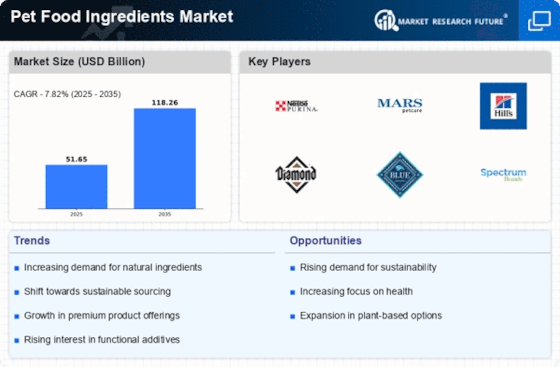
As per Market Research Future analysis, the Pet Food Ingredients Market Size was estimated at 51.65 USD Billion in 2024. The Pet Food Ingredients industry is projected to grow from 55.69 USD Billion in 2025 to 118.26 USD Billion by 2035, exhibiting a compound annual growth rate (CAGR) of 7.82% during the forecast period 2025 - 2035

Key Market Trends & Highlights

The Pet Food Ingredients Market is experiencing a transformative shift towards natural and functional ingredients driven by evolving consumer preferences.

  • The market is witnessing a notable shift towards natural ingredients, reflecting a growing consumer demand for transparency and health. Alternative proteins are gaining traction, particularly in the Asia-Pacific region, as pet owners seek innovative dietary options for their pets. Functional ingredients are increasingly prioritized, with a focus on enhancing pet health and wellness, especially in North America. Key market drivers include rising pet ownership and health trends, which are propelling the demand for rendered and antimicrobial ingredients.

Market Size & Forecast

2024 Market Size 51.65 (USD Billion)
2035 Market Size 118.26 (USD Billion)
CAGR (2025 - 2035) 7.82%
Largest Regional Market Share in 2024 North America

Major Players

Nestle Purina PetCare (US), Mars Petcare (US), Hill's Pet Nutrition (US), <a href="https://www.diamondpet.com/">Diamond Pet Foods</a> (US), Blue Buffalo (US), Spectrum Brands (US), WellPet (US), <a href="https://www.merrickpetcare.com/">Merrick Pet Care</a> (US), Royal Canin (FR), Champion Petfoods (CA)

Market Trends

The Pet Food Ingredients Market is currently experiencing a dynamic evolution, driven by shifting consumer preferences and an increasing focus on pet health and wellness. As pet owners become more discerning about the nutritional quality of their pets' diets, there is a noticeable shift towards natural and organic ingredients. This trend reflects a broader societal movement towards clean eating, which has permeated the pet food sector. Additionally, the rise of premium pet food products suggests that consumers are willing to invest more in high-quality ingredients that promise better health outcomes for their pets. Moreover, the Pet Food Ingredients Market is witnessing a growing interest in alternative protein sources, such as insect protein and plant-based ingredients. This shift may be attributed to environmental concerns and the desire for sustainable sourcing practices. As the market adapts to these changes, manufacturers are likely to innovate and diversify their ingredient offerings to meet the evolving demands of pet owners. The interplay between health consciousness and sustainability appears to be shaping the future landscape of the Pet Food Ingredients Market, indicating a potential for continued growth and transformation in the coming years.

Shift Towards Natural Ingredients

Pet food ingredients are evolving to meet growing consumer demand for health-focused and transparent formulations. Emphasis on natural pet nutrition has increased the use of clean-label components that support digestion, immunity, and overall wellbeing. The rise of functional pet food incorporates added benefits such as probiotics, omega fatty acids, and joint-support nutrients to enhance pet health. Manufacturers are increasingly differentiating products through premium pet ingredients that deliver superior quality and palatability, while the expanding market for organic pet food reflects strong demand for certified, chemical-free ingredients aligned with holistic pet care trends.

There is a marked trend towards the incorporation of natural and organic ingredients in pet food formulations. This shift is largely driven by pet owners' increasing awareness of the health benefits associated with clean, wholesome nutrition for their pets.

Rise of Alternative Proteins

The Pet Food Ingredients Market is seeing a growing interest in alternative protein sources, such as insect protein and plant-based options. This trend may reflect a response to environmental sustainability concerns and the quest for innovative, nutritious ingredients.

Focus on Functional Ingredients

An emerging trend within the Pet Food Ingredients Market is the emphasis on functional ingredients that offer specific health benefits. Ingredients that support digestion, joint health, and overall wellness are becoming more prevalent as consumers seek to enhance their pets' quality of life.

Pet Food Ingredients Market Market Drivers

Sustainability Concerns

Sustainability concerns are increasingly shaping consumer preferences within the Pet Food Ingredients Market. As environmental awareness rises, pet owners are more inclined to choose products that align with sustainable practices. This shift is prompting manufacturers to explore eco-friendly sourcing and production methods, including the use of plant-based ingredients and responsibly sourced animal proteins. Market analysis indicates that the demand for sustainable pet food ingredients is likely to grow, as consumers seek to minimize their ecological footprint. This trend not only influences ingredient selection but also encourages brands to communicate their sustainability efforts effectively. The integration of sustainability into product offerings may become a key differentiator in the competitive landscape of the Pet Food Ingredients Market.

Increasing Pet Ownership

The rise in pet ownership appears to be a pivotal driver for the Pet Food Ingredients Market. As more households adopt pets, the demand for high-quality pet food ingredients intensifies. Recent statistics indicate that pet ownership rates have surged, with approximately 70% of households owning at least one pet. This trend suggests a growing consumer base that prioritizes the health and well-being of their pets, leading to increased spending on premium pet food products. Consequently, manufacturers are compelled to innovate and diversify their ingredient offerings to cater to this expanding market. The emphasis on quality ingredients is likely to shape the future landscape of the Pet Food Ingredients Market, as consumers become more discerning about the nutritional value of the products they purchase for their pets.

Health and Wellness Trends

The ongoing health and wellness trends among pet owners significantly influence the Pet Food Ingredients Market. As consumers become increasingly aware of the nutritional needs of their pets, there is a marked shift towards ingredients that promote health benefits. This trend is reflected in the growing demand for functional ingredients, such as probiotics and omega fatty acids, which are believed to enhance pet health. Market data suggests that the segment for functional pet food ingredients is expected to witness substantial growth, potentially reaching a valuation of several billion dollars in the coming years. This focus on health and wellness not only drives innovation in ingredient sourcing but also compels manufacturers to provide transparency regarding ingredient origins and benefits, thereby fostering consumer trust in the Pet Food Ingredients Market.

Regulatory Compliance and Safety Standards

Regulatory compliance and safety standards are critical drivers in the Pet Food Ingredients Market. As consumer awareness regarding food safety increases, manufacturers are compelled to adhere to stringent regulations governing ingredient sourcing and processing. Compliance with these regulations not only ensures the safety of pet food products but also enhances consumer confidence in the brands they choose. Recent regulatory updates have emphasized the need for transparency in ingredient labeling, prompting manufacturers to invest in quality assurance measures. This focus on compliance is likely to influence ingredient selection and sourcing practices, as companies strive to meet both regulatory requirements and consumer expectations. The emphasis on safety and compliance is expected to remain a key factor in the competitive dynamics of the Pet Food Ingredients Market.

Technological Advancements in Ingredient Processing

Technological advancements in ingredient processing are revolutionizing the Pet Food Ingredients Market. Innovations in food technology, such as extrusion and freeze-drying, enhance the nutritional profile and shelf life of pet food products. These advancements allow manufacturers to create more palatable and digestible ingredients, catering to the evolving preferences of pet owners. Furthermore, the application of data analytics in ingredient sourcing and formulation is likely to optimize production efficiency and reduce waste. As these technologies continue to evolve, they may lead to the development of novel ingredients that meet the specific dietary needs of pets. The integration of technology into ingredient processing is expected to play a crucial role in shaping the future of the Pet Food Ingredients Market.

Market Segment Insights

By Category: Rendered (Largest) vs. Conventional (Fastest-Growing)

The Pet Food Ingredients Market is witnessing a significant divide between the Conventional and Rendered segments. The Rendered category holds the largest market share, owing to its established position and widespread acceptance among pet food manufacturers. Meanwhile, the Conventional segment is rapidly gaining traction, driven by increasing consumer awareness and demand for natural and high-quality ingredients. This trend is reflected in the changing dynamics of the market, with conventional options being favored for their perceived health benefits.

Rendered (Dominant) vs. Conventional (Emerging)

Rendered ingredients are considered the dominant force in the Pet Food Ingredients Market, mainly due to their efficiency in protein extraction and cost-effectiveness. They are sourced from animal by-products and provide a rich source of protein and essential nutrients for pets. Conversely, the Conventional segment is emerging as a favorable alternative, appealing to health-conscious pet owners seeking transparency and quality in their pet food. This segment's rise is characterized by innovations in ingredient sourcing and production, focusing on sustainability and natural formulations, which resonates with the growing market demand.

By Ingredient: ADX (Largest) vs. Antimicrobials (Fastest-Growing)

In the Pet Food Ingredients Market, the distribution of market share among the ingredient segments reflects a diverse preference among manufacturers and consumers. ADX stands out as the largest contributor, benefiting from its well-established usage in formulating nutritious pet food that meets regulatory standards and consumer demands. Meanwhile, Antimicrobials, although smaller in overall share, are gaining traction as they address the increasingly important issue of pet health and food safety. This evolving landscape indicates a shift towards more specialized ingredients that enhance pet well-being.

Ingredient: ADX (Dominant) vs. Antimicrobials (Emerging)

ADX has established itself as a dominant ingredient within the Pet Food Ingredients Market due to its versatility and efficacy in enhancing the nutritional profile of pet food. Its stable demand stems from a combination of regulatory compliance and consumer preferences for health-focused diets. On the other hand, Antimicrobials represent an emerging segment driven by the growing awareness of food safety and health complications in pets. They are increasingly utilized to prevent spoilage and enhance product shelf life, making them appealing to manufacturers aiming to deliver safer pet food products. As the market evolves, both ADX and Antimicrobials are crucial to meeting varied consumer demands.

By Use-Case: Dog Food (Largest) vs. Cat Food (Fastest-Growing)

In the Pet Food Ingredients Market, the use-case segmentation reveals that <a href="https://www.marketresearchfuture.com/reports/dog-food-market-11339">Dog Food</a> holds the largest share, significantly dominating preferences among pet owners. This preference is driven by the increasing awareness of pet nutrition and the growing population of dogs as pets across various regions. Cat Food follows closely, reflecting a rising trend in feline diets as cat ownership grows, with a notable number of products catering specifically to health-conscious cat owners.

Dog Food (Dominant) vs. Cat Food (Emerging)

Dog Food is the cornerstone of the Pet Food Ingredients Market, characterized by a strong demand for high-quality ingredients aimed at enhancing pet health and well-being. This segment's dominance is attributed to the deep emotional bond pet owners have with dogs, resulting in higher spending on premium products. Conversely, the <a href="https://www.marketresearchfuture.com/reports/cat-food-market-29399">Cat Food</a> segment is emerging as a potential powerhouse driven by an increase in cat ownership and innovative product launches that focus on nutritional benefits. The rise of specialty diets for cats showcases the segment's growth as a strong contender, with manufacturers increasingly targeting this market with unique formulations.

By Distribution Channel: Direct (Largest) vs. Indirect (Fastest-Growing)

In the Pet Food Ingredients Market, the distribution channel is critical for ensuring that products reach the end consumer efficiently. Direct distribution channels are currently the largest segment, dominating the market mix as manufacturers prioritize establishing strong relationships with retailers. In contrast, indirect channels are witnessing rapid growth, reflecting a shift in consumer purchasing habits and the increasing reliance on third-party distributors and wholesalers for wider market reach.

Distribution Channels: Direct (Dominant) vs. Indirect (Emerging)

The direct distribution channel plays a dominant role in the Pet Food Ingredients Market, allowing manufacturers to maintain control over their supply chain while building direct relationships with retailers. This direct engagement enables personalized marketing strategies and fosters loyalty among partners. Meanwhile, the indirect channel is emerging swiftly, characterized by its ability to penetrate diverse markets without significant initial investment from manufacturers. This channel promotes accessibility and convenience, appealing to a broader range of consumers as it encompasses various online platforms and local distributors, thus driving sales growth.

Get more detailed insights about Pet Food Ingredients Market Research Report – Forecast to 2035

Regional Insights

North America : Market Leader in Pet Food

North America is the largest region for Pet Food Ingredients Market, accounting for approximately 40% of the global market share. The region's growth is driven by increasing pet ownership, a rising trend towards premium pet food, and stringent regulations ensuring food safety and quality. The demand for natural and organic ingredients is also on the rise, supported by consumer awareness and health trends. The United States is the leading country in this region, with major players like Nestle Purina PetCare, Mars Petcare, and Hill's Pet Nutrition dominating the market. The competitive landscape is characterized by innovation in product offerings and a focus on sustainability. Canada also plays a significant role, contributing to the overall growth with its own set of key players like Champion Petfoods.

Europe : Emerging Trends in Pet Nutrition

Europe is witnessing a significant shift towards premium and specialized pet food ingredients, holding approximately 30% of the global Pet Food Ingredients Market share. The growth is fueled by increasing pet ownership, a focus on pet health, and regulatory frameworks that promote high-quality standards. Countries like Germany and the UK are leading this trend, with a growing demand for organic and natural ingredients, supported by EU regulations on food safety and labeling. Germany stands out as the largest market in Europe, followed closely by the UK. The competitive landscape is marked by the presence of established brands like Royal Canin and emerging local players. The region is also seeing innovations in ingredient sourcing and formulations, catering to the evolving preferences of pet owners. The European market is adapting to consumer demands for transparency and sustainability in pet food production.

Asia-Pacific : Rapid Growth in Pet Ownership

Asia-Pacific is rapidly emerging as a significant player in the Pet Food Ingredients Market, accounting for about 20% of the global share. The region's growth is driven by increasing disposable incomes, urbanization, and a growing trend of pet humanization. Countries like China and Japan are leading this growth, with rising demand for premium and specialized pet food products, supported by evolving consumer preferences and regulatory improvements in food safety standards. China is the largest market in the region, with Japan following closely. The competitive landscape features both international brands and local manufacturers, creating a dynamic market environment. Key players are focusing on innovation and product differentiation to capture the growing consumer base. The region is also witnessing a surge in e-commerce platforms, making pet food more accessible to consumers.

Middle East and Africa : Untapped Market Potential

The Middle East and Africa represent an emerging  Pet Food Ingredients Market , holding approximately 10% of the global market share. The growth is driven by increasing pet ownership, particularly in urban areas, and a rising awareness of pet nutrition. Regulatory frameworks are gradually evolving to support the industry, although challenges remain in terms of supply chain and distribution. Countries like South Africa and the UAE are at the forefront of this growth, with a focus on premium products. South Africa is the largest market in the region, with the UAE showing significant potential for growth. The competitive landscape is characterized by a mix of local and international players, with increasing investments in product development and marketing strategies. The region is also seeing a rise in demand for natural and organic ingredients, reflecting global trends in pet food consumption.

South America Market: Steady Market

The Brazil pet food ingredients market is a crucial part of South America market and is undergoing a rapid evolution toward premiumization and wellness, driven by a deep-rooted cultural shift where pets are increasingly integrated as core family members.

Key Players and Competitive Insights

The Pet Food Ingredients Market is currently characterized by a dynamic competitive landscape, driven by increasing consumer demand for high-quality, nutritious pet food. Key players are actively engaging in strategies that emphasize innovation, sustainability, and regional expansion. Notably, companies such as Nestle Purina PetCare (US) and Mars Petcare (US) are focusing on product diversification and premium offerings to capture a larger market share. Their operational focus on enhancing ingredient quality and transparency appears to resonate well with health-conscious pet owners, thereby shaping a competitive environment that prioritizes quality over cost.In terms of business tactics, many companies are localizing manufacturing to reduce supply chain vulnerabilities and enhance responsiveness to regional market demands. The market structure is moderately fragmented, with several key players exerting considerable influence. This fragmentation allows for niche players to thrive, while larger corporations leverage economies of scale to optimize their supply chains and distribution networks, thus enhancing their competitive positioning.
In August Hill's Pet Nutrition (US) announced a partnership with a leading agricultural technology firm to develop sustainable sourcing practices for its ingredients. This strategic move underscores Hill's commitment to sustainability and aligns with growing consumer preferences for environmentally responsible products. By integrating advanced agricultural practices, Hill's aims to enhance the quality of its pet food while reducing its environmental footprint, which could potentially strengthen its market position.
In September Royal Canin (FR) launched a new line of breed-specific pet food that incorporates innovative ingredients tailored to the unique nutritional needs of different breeds. This initiative not only reflects Royal Canin's dedication to research and development but also highlights the increasing trend towards personalized pet nutrition. Such targeted offerings may enhance customer loyalty and differentiate Royal Canin in a competitive market.Moreover, in July 2025, Champion Petfoods (CA) expanded its distribution network in Asia, focusing on the growing demand for premium pet food in that region. This strategic expansion is indicative of Champion's intent to capitalize on emerging markets, which could provide substantial growth opportunities. By establishing a stronger presence in Asia, Champion Petfoods may enhance its competitive edge and drive revenue growth in the coming years.
As of October the competitive trends in the Pet Food Ingredients Market are increasingly defined by digitalization, sustainability, and the integration of artificial intelligence in product development and supply chain management. Strategic alliances are becoming more prevalent, as companies seek to leverage complementary strengths to enhance their market offerings. Looking ahead, it appears that competitive differentiation will increasingly pivot from price-based strategies to innovation, technological advancements, and reliable supply chains, reflecting a broader shift in consumer expectations and market dynamics.

Key Companies in the Pet Food Ingredients Market include

Industry Developments

  • Q2 2024: U.S. Pet Food Growth Continues Amid Potential 2025 Challenges In 2024, U.S. pet food exports rebounded, growing 3.7% to $2.49 billion, with China posting a 15% increase in imports to $296 million and Southeast Asia up 7.5%, signaling renewed momentum in key global regions.
  • Q2 2024: 2025 Pet Food Production and Ingredient Analysis report released The Pet Food Institute published its 2025 report, revealing that U.S. pet food manufacturers purchased $13.2 billion in farm products for ingredients in 2024, supporting thousands of jobs in agriculture, manufacturing, and logistics.
  • Q2 2024: 2025 pet food ingredient report reveals $51.7B market, rising demand for premium nutrition A collaborative report from industry associations in late 2024 highlighted a surge in demand for premium pet food ingredients, with marine ingredients increasing by 95% and meat and poultry ingredients by 34% since 2019.

Future Outlook

Pet Food Ingredients Market Future Outlook

The Pet Food Ingredients Market is projected to grow at a 7.82% CAGR from 2025 to 2035, driven by increasing pet ownership, premiumization, and health-conscious consumer trends. The future outlook for the Pet Food Ingredients Market is exceptionally positive, driven by the intensifying humanization of pets and the global demand for clean-label nutrition. Growth is fueled by the transition toward alternative proteins like insect and lab-grown meat, the integration of AI-driven personalized diets, and the surging popularity of functional, medical-grade additives.

New opportunities lie in:

  • <p>Development of plant-based protein sources for pet food</p>
  • <p> </p>
  • <p>Expansion of personalized nutrition solutions for pets</p>
  • <p>Implementation of sustainable sourcing practices for ingredients</p>

By 2035, the Pet Food Ingredients Market  is expected to be robust, reflecting evolving consumer preferences and innovative product offerings.

Market Segmentation

Pet Food Ingredients Market Category Outlook

  • Conventional
  • Rendered

Pet Food Ingredients Market Use-Case Outlook

  • Dog Food
  • Cat Food
  • Fish Food
  • Others

Pet Food Ingredients Market Ingredient Outlook

  • ADX
  • Antimicrobials

Pet Food Ingredients Market Distribution Channel Outlook

  • Direct
  • Indirect

Report Scope

MARKET SIZE 2024 51.65(USD Billion)
MARKET SIZE 2025 55.69(USD Billion)
MARKET SIZE 2035 118.26(USD Billion)
COMPOUND ANNUAL GROWTH RATE (CAGR) 7.82% (2025 - 2035)
REPORT COVERAGE Revenue Forecast, Competitive Landscape, Growth Factors, and Trends
BASE YEAR 2024
Market Forecast Period 2025 - 2035
Historical Data 2019 - 2024
Market Forecast Units USD Billion
Key Companies Profiled Nestle Purina PetCare (US), Mars Petcare (US), Hill's Pet Nutrition (US), Diamond Pet Foods (US), Blue Buffalo (US), Spectrum Brands (US), WellPet (US), Merrick Pet Care (US), Royal Canin (FR), Champion Petfoods (CA)
Segments Covered Category, Ingredient, Use-Case, Distribution Channel, Regional
Key Market Opportunities Growing demand for sustainable and functional ingredients in the Pet Food Ingredients Market presents significant opportunities.
Key Market Dynamics Rising demand for natural ingredients drives innovation and competition in the pet food ingredients sector.
Countries Covered North America, Europe, APAC, South America, MEA

FAQs

What is the current valuation of the Pet Food Ingredients Market?

<p>As of 2024, the Pet Food Ingredients Market was valued at 51.65 USD Billion.</p>

What is the projected market valuation for the Pet Food Ingredients Market in 2035?

The market is projected to reach a valuation of 118.26 USD Billion by 2035.

What is the expected CAGR for the Pet Food Ingredients Market from 2025 to 2035?

The expected CAGR for the Pet Food Ingredients Market during the forecast period 2025 - 2035 is 7.82%.

Which companies are considered key players in the Pet Food Ingredients Market?

Key players include Nestle Purina PetCare, Mars Petcare, Hill's Pet Nutrition, and others.

What are the main segments of the Pet Food Ingredients Market?

The main segments include Category, Ingredient, Use-Case, and Distribution Channel.

How much is the Conventional category valued in the Pet Food Ingredients Market?

The Conventional category was valued between 30.0 and 70.0 USD Billion.

What is the valuation range for Dog Food in the Pet Food Ingredients Market?

Dog Food is valued between 20.0 and 45.0 USD Billion.

What is the projected valuation for Antimicrobials in the Pet Food Ingredients Market?

Antimicrobials are projected to be valued between 31.65 and 73.26 USD Billion.

What are the expected valuations for Direct and Indirect distribution channels?

Direct distribution channels are expected to be valued between 25.83 and 58.63 USD Billion, while Indirect channels are projected between 25.82 and 59.63 USD Billion.

What is the valuation range for Rendered ingredients in the Pet Food Ingredients Market?

Rendered ingredients were valued between 21.65 and 48.26 USD Billion.

  1. SECTION I: EXECUTIVE SUMMARY AND KEY HIGHLIGHTS
    1. | 1.1 EXECUTIVE SUMMARY
    2. | | 1.1.1 Market Overview
    3. | | 1.1.2 Key Findings
    4. | | 1.1.3 Market Segmentation
    5. | | 1.1.4 Competitive Landscape
    6. | | 1.1.5 Challenges and Opportunities
    7. | | 1.1.6 Future Outlook
  2. SECTION II: SCOPING, METHODOLOGY AND MARKET STRUCTURE
    1. | 2.1 MARKET INTRODUCTION
    2. | | 2.1.1 Definition
    3. | | 2.1.2 Scope of the study
    4. | | | 2.1.2.1 Research Objective
    5. | | | 2.1.2.2 Assumption
    6. | | | 2.1.2.3 Limitations
    7. | 2.2 RESEARCH METHODOLOGY
    8. | | 2.2.1 Overview
    9. | | 2.2.2 Data Mining
    10. | | 2.2.3 Secondary Research
    11. | | 2.2.4 Primary Research
    12. | | | 2.2.4.1 Primary Interviews and Information Gathering Process
    13. | | | 2.2.4.2 Breakdown of Primary Respondents
    14. | | 2.2.5 Forecasting Model
    15. | | 2.2.6 Market Size Estimation
    16. | | | 2.2.6.1 Bottom-Up Approach
    17. | | | 2.2.6.2 Top-Down Approach
    18. | | 2.2.7 Data Triangulation
    19. | | 2.2.8 Validation
  3. SECTION III: QUALITATIVE ANALYSIS
    1. | 3.1 MARKET DYNAMICS
    2. | | 3.1.1 Overview
    3. | | 3.1.2 Drivers
    4. | | 3.1.3 Restraints
    5. | | 3.1.4 Opportunities
    6. | 3.2 MARKET FACTOR ANALYSIS
    7. | | 3.2.1 Value chain Analysis
    8. | | 3.2.2 Porter's Five Forces Analysis
    9. | | | 3.2.2.1 Bargaining Power of Suppliers
    10. | | | 3.2.2.2 Bargaining Power of Buyers
    11. | | | 3.2.2.3 Threat of New Entrants
    12. | | | 3.2.2.4 Threat of Substitutes
    13. | | | 3.2.2.5 Intensity of Rivalry
    14. | | 3.2.3 COVID-19 Impact Analysis
    15. | | | 3.2.3.1 Market Impact Analysis
    16. | | | 3.2.3.2 Regional Impact
    17. | | | 3.2.3.3 Opportunity and Threat Analysis
  4. SECTION IV: QUANTITATIVE ANALYSIS
    1. | 4.1 Medical Device, BY Category (USD Billion)
    2. | | 4.1.1 Conventional
    3. | | 4.1.2 Rendered
    4. | 4.2 Medical Device, BY Ingredient (USD Billion)
    5. | | 4.2.1 ADX
    6. | | 4.2.2 Antimicrobials
    7. | 4.3 Medical Device, BY Use-Case (USD Billion)
    8. | | 4.3.1 Dog Food
    9. | | 4.3.2 Cat Food
    10. | | 4.3.3 Fish Food
    11. | | 4.3.4 Others
    12. | 4.4 Medical Device, BY Distribution Channel (USD Billion)
    13. | | 4.4.1 Direct
    14. | | 4.4.2 Indirect
    15. | 4.5 Medical Device, BY Region (USD Billion)
    16. | | 4.5.1 North America
    17. | | | 4.5.1.1 US
    18. | | | 4.5.1.2 Canada
    19. | | 4.5.2 Europe
    20. | | | 4.5.2.1 Germany
    21. | | | 4.5.2.2 UK
    22. | | | 4.5.2.3 France
    23. | | | 4.5.2.4 Russia
    24. | | | 4.5.2.5 Italy
    25. | | | 4.5.2.6 Spain
    26. | | | 4.5.2.7 Rest of Europe
    27. | | 4.5.3 APAC
    28. | | | 4.5.3.1 China
    29. | | | 4.5.3.2 India
    30. | | | 4.5.3.3 Japan
    31. | | | 4.5.3.4 South Korea
    32. | | | 4.5.3.5 Malaysia
    33. | | | 4.5.3.6 Thailand
    34. | | | 4.5.3.7 Indonesia
    35. | | | 4.5.3.8 Rest of APAC
    36. | | 4.5.4 South America
    37. | | | 4.5.4.1 Brazil
    38. | | | 4.5.4.2 Mexico
    39. | | | 4.5.4.3 Argentina
    40. | | | 4.5.4.4 Rest of South America
    41. | | 4.5.5 MEA
    42. | | | 4.5.5.1 GCC Countries
    43. | | | 4.5.5.2 South Africa
    44. | | | 4.5.5.3 Rest of MEA
  5. SECTION V: COMPETITIVE ANALYSIS
    1. | 5.1 Competitive Landscape
    2. | | 5.1.1 Overview
    3. | | 5.1.2 Competitive Analysis
    4. | | 5.1.3 Market share Analysis
    5. | | 5.1.4 Major Growth Strategy in the Medical Device
    6. | | 5.1.5 Competitive Benchmarking
    7. | | 5.1.6 Leading Players in Terms of Number of Developments in the Medical Device
    8. | | 5.1.7 Key developments and growth strategies
    9. | | | 5.1.7.1 New Product Launch/Service Deployment
    10. | | | 5.1.7.2 Merger & Acquisitions
    11. | | | 5.1.7.3 Joint Ventures
    12. | | 5.1.8 Major Players Financial Matrix
    13. | | | 5.1.8.1 Sales and Operating Income
    14. | | | 5.1.8.2 Major Players R&D Expenditure. 2023
    15. | 5.2 Company Profiles
    16. | | 5.2.1 Nestle Purina PetCare (US)
    17. | | | 5.2.1.1 Financial Overview
    18. | | | 5.2.1.2 Products Offered
    19. | | | 5.2.1.3 Key Developments
    20. | | | 5.2.1.4 SWOT Analysis
    21. | | | 5.2.1.5 Key Strategies
    22. | | 5.2.2 Mars Petcare (US)
    23. | | | 5.2.2.1 Financial Overview
    24. | | | 5.2.2.2 Products Offered
    25. | | | 5.2.2.3 Key Developments
    26. | | | 5.2.2.4 SWOT Analysis
    27. | | | 5.2.2.5 Key Strategies
    28. | | 5.2.3 Hill's Pet Nutrition (US)
    29. | | | 5.2.3.1 Financial Overview
    30. | | | 5.2.3.2 Products Offered
    31. | | | 5.2.3.3 Key Developments
    32. | | | 5.2.3.4 SWOT Analysis
    33. | | | 5.2.3.5 Key Strategies
    34. | | 5.2.4 Diamond Pet Foods (US)
    35. | | | 5.2.4.1 Financial Overview
    36. | | | 5.2.4.2 Products Offered
    37. | | | 5.2.4.3 Key Developments
    38. | | | 5.2.4.4 SWOT Analysis
    39. | | | 5.2.4.5 Key Strategies
    40. | | 5.2.5 Blue Buffalo (US)
    41. | | | 5.2.5.1 Financial Overview
    42. | | | 5.2.5.2 Products Offered
    43. | | | 5.2.5.3 Key Developments
    44. | | | 5.2.5.4 SWOT Analysis
    45. | | | 5.2.5.5 Key Strategies
    46. | | 5.2.6 Spectrum Brands (US)
    47. | | | 5.2.6.1 Financial Overview
    48. | | | 5.2.6.2 Products Offered
    49. | | | 5.2.6.3 Key Developments
    50. | | | 5.2.6.4 SWOT Analysis
    51. | | | 5.2.6.5 Key Strategies
    52. | | 5.2.7 WellPet (US)
    53. | | | 5.2.7.1 Financial Overview
    54. | | | 5.2.7.2 Products Offered
    55. | | | 5.2.7.3 Key Developments
    56. | | | 5.2.7.4 SWOT Analysis
    57. | | | 5.2.7.5 Key Strategies
    58. | | 5.2.8 Merrick Pet Care (US)
    59. | | | 5.2.8.1 Financial Overview
    60. | | | 5.2.8.2 Products Offered
    61. | | | 5.2.8.3 Key Developments
    62. | | | 5.2.8.4 SWOT Analysis
    63. | | | 5.2.8.5 Key Strategies
    64. | | 5.2.9 Royal Canin (FR)
    65. | | | 5.2.9.1 Financial Overview
    66. | | | 5.2.9.2 Products Offered
    67. | | | 5.2.9.3 Key Developments
    68. | | | 5.2.9.4 SWOT Analysis
    69. | | | 5.2.9.5 Key Strategies
    70. | | 5.2.10 Champion Petfoods (CA)
    71. | | | 5.2.10.1 Financial Overview
    72. | | | 5.2.10.2 Products Offered
    73. | | | 5.2.10.3 Key Developments
    74. | | | 5.2.10.4 SWOT Analysis
    75. | | | 5.2.10.5 Key Strategies
    76. | 5.3 Appendix
    77. | | 5.3.1 References
    78. | | 5.3.2 Related Reports
  6. LIST OF FIGURES
    1. | 6.1 MARKET SYNOPSIS
    2. | 6.2 NORTH AMERICA MARKET ANALYSIS
    3. | 6.3 US MARKET ANALYSIS BY CATEGORY
    4. | 6.4 US MARKET ANALYSIS BY INGREDIENT
    5. | 6.5 US MARKET ANALYSIS BY USE-CASE
    6. | 6.6 US MARKET ANALYSIS BY DISTRIBUTION CHANNEL
    7. | 6.7 CANADA MARKET ANALYSIS BY CATEGORY
    8. | 6.8 CANADA MARKET ANALYSIS BY INGREDIENT
    9. | 6.9 CANADA MARKET ANALYSIS BY USE-CASE
    10. | 6.10 CANADA MARKET ANALYSIS BY DISTRIBUTION CHANNEL
    11. | 6.11 EUROPE MARKET ANALYSIS
    12. | 6.12 GERMANY MARKET ANALYSIS BY CATEGORY
    13. | 6.13 GERMANY MARKET ANALYSIS BY INGREDIENT
    14. | 6.14 GERMANY MARKET ANALYSIS BY USE-CASE
    15. | 6.15 GERMANY MARKET ANALYSIS BY DISTRIBUTION CHANNEL
    16. | 6.16 UK MARKET ANALYSIS BY CATEGORY
    17. | 6.17 UK MARKET ANALYSIS BY INGREDIENT
    18. | 6.18 UK MARKET ANALYSIS BY USE-CASE
    19. | 6.19 UK MARKET ANALYSIS BY DISTRIBUTION CHANNEL
    20. | 6.20 FRANCE MARKET ANALYSIS BY CATEGORY
    21. | 6.21 FRANCE MARKET ANALYSIS BY INGREDIENT
    22. | 6.22 FRANCE MARKET ANALYSIS BY USE-CASE
    23. | 6.23 FRANCE MARKET ANALYSIS BY DISTRIBUTION CHANNEL
    24. | 6.24 RUSSIA MARKET ANALYSIS BY CATEGORY
    25. | 6.25 RUSSIA MARKET ANALYSIS BY INGREDIENT
    26. | 6.26 RUSSIA MARKET ANALYSIS BY USE-CASE
    27. | 6.27 RUSSIA MARKET ANALYSIS BY DISTRIBUTION CHANNEL
    28. | 6.28 ITALY MARKET ANALYSIS BY CATEGORY
    29. | 6.29 ITALY MARKET ANALYSIS BY INGREDIENT
    30. | 6.30 ITALY MARKET ANALYSIS BY USE-CASE
    31. | 6.31 ITALY MARKET ANALYSIS BY DISTRIBUTION CHANNEL
    32. | 6.32 SPAIN MARKET ANALYSIS BY CATEGORY
    33. | 6.33 SPAIN MARKET ANALYSIS BY INGREDIENT
    34. | 6.34 SPAIN MARKET ANALYSIS BY USE-CASE
    35. | 6.35 SPAIN MARKET ANALYSIS BY DISTRIBUTION CHANNEL
    36. | 6.36 REST OF EUROPE MARKET ANALYSIS BY CATEGORY
    37. | 6.37 REST OF EUROPE MARKET ANALYSIS BY INGREDIENT
    38. | 6.38 REST OF EUROPE MARKET ANALYSIS BY USE-CASE
    39. | 6.39 REST OF EUROPE MARKET ANALYSIS BY DISTRIBUTION CHANNEL
    40. | 6.40 APAC MARKET ANALYSIS
    41. | 6.41 CHINA MARKET ANALYSIS BY CATEGORY
    42. | 6.42 CHINA MARKET ANALYSIS BY INGREDIENT
    43. | 6.43 CHINA MARKET ANALYSIS BY USE-CASE
    44. | 6.44 CHINA MARKET ANALYSIS BY DISTRIBUTION CHANNEL
    45. | 6.45 INDIA MARKET ANALYSIS BY CATEGORY
    46. | 6.46 INDIA MARKET ANALYSIS BY INGREDIENT
    47. | 6.47 INDIA MARKET ANALYSIS BY USE-CASE
    48. | 6.48 INDIA MARKET ANALYSIS BY DISTRIBUTION CHANNEL
    49. | 6.49 JAPAN MARKET ANALYSIS BY CATEGORY
    50. | 6.50 JAPAN MARKET ANALYSIS BY INGREDIENT
    51. | 6.51 JAPAN MARKET ANALYSIS BY USE-CASE
    52. | 6.52 JAPAN MARKET ANALYSIS BY DISTRIBUTION CHANNEL
    53. | 6.53 SOUTH KOREA MARKET ANALYSIS BY CATEGORY
    54. | 6.54 SOUTH KOREA MARKET ANALYSIS BY INGREDIENT
    55. | 6.55 SOUTH KOREA MARKET ANALYSIS BY USE-CASE
    56. | 6.56 SOUTH KOREA MARKET ANALYSIS BY DISTRIBUTION CHANNEL
    57. | 6.57 MALAYSIA MARKET ANALYSIS BY CATEGORY
    58. | 6.58 MALAYSIA MARKET ANALYSIS BY INGREDIENT
    59. | 6.59 MALAYSIA MARKET ANALYSIS BY USE-CASE
    60. | 6.60 MALAYSIA MARKET ANALYSIS BY DISTRIBUTION CHANNEL
    61. | 6.61 THAILAND MARKET ANALYSIS BY CATEGORY
    62. | 6.62 THAILAND MARKET ANALYSIS BY INGREDIENT
    63. | 6.63 THAILAND MARKET ANALYSIS BY USE-CASE
    64. | 6.64 THAILAND MARKET ANALYSIS BY DISTRIBUTION CHANNEL
    65. | 6.65 INDONESIA MARKET ANALYSIS BY CATEGORY
    66. | 6.66 INDONESIA MARKET ANALYSIS BY INGREDIENT
    67. | 6.67 INDONESIA MARKET ANALYSIS BY USE-CASE
    68. | 6.68 INDONESIA MARKET ANALYSIS BY DISTRIBUTION CHANNEL
    69. | 6.69 REST OF APAC MARKET ANALYSIS BY CATEGORY
    70. | 6.70 REST OF APAC MARKET ANALYSIS BY INGREDIENT
    71. | 6.71 REST OF APAC MARKET ANALYSIS BY USE-CASE
    72. | 6.72 REST OF APAC MARKET ANALYSIS BY DISTRIBUTION CHANNEL
    73. | 6.73 SOUTH AMERICA MARKET ANALYSIS
    74. | 6.74 BRAZIL MARKET ANALYSIS BY CATEGORY
    75. | 6.75 BRAZIL MARKET ANALYSIS BY INGREDIENT
    76. | 6.76 BRAZIL MARKET ANALYSIS BY USE-CASE
    77. | 6.77 BRAZIL MARKET ANALYSIS BY DISTRIBUTION CHANNEL
    78. | 6.78 MEXICO MARKET ANALYSIS BY CATEGORY
    79. | 6.79 MEXICO MARKET ANALYSIS BY INGREDIENT
    80. | 6.80 MEXICO MARKET ANALYSIS BY USE-CASE
    81. | 6.81 MEXICO MARKET ANALYSIS BY DISTRIBUTION CHANNEL
    82. | 6.82 ARGENTINA MARKET ANALYSIS BY CATEGORY
    83. | 6.83 ARGENTINA MARKET ANALYSIS BY INGREDIENT
    84. | 6.84 ARGENTINA MARKET ANALYSIS BY USE-CASE
    85. | 6.85 ARGENTINA MARKET ANALYSIS BY DISTRIBUTION CHANNEL
    86. | 6.86 REST OF SOUTH AMERICA MARKET ANALYSIS BY CATEGORY
    87. | 6.87 REST OF SOUTH AMERICA MARKET ANALYSIS BY INGREDIENT
    88. | 6.88 REST OF SOUTH AMERICA MARKET ANALYSIS BY USE-CASE
    89. | 6.89 REST OF SOUTH AMERICA MARKET ANALYSIS BY DISTRIBUTION CHANNEL
    90. | 6.90 MEA MARKET ANALYSIS
    91. | 6.91 GCC COUNTRIES MARKET ANALYSIS BY CATEGORY
    92. | 6.92 GCC COUNTRIES MARKET ANALYSIS BY INGREDIENT
    93. | 6.93 GCC COUNTRIES MARKET ANALYSIS BY USE-CASE
    94. | 6.94 GCC COUNTRIES MARKET ANALYSIS BY DISTRIBUTION CHANNEL
    95. | 6.95 SOUTH AFRICA MARKET ANALYSIS BY CATEGORY
    96. | 6.96 SOUTH AFRICA MARKET ANALYSIS BY INGREDIENT
    97. | 6.97 SOUTH AFRICA MARKET ANALYSIS BY USE-CASE
    98. | 6.98 SOUTH AFRICA MARKET ANALYSIS BY DISTRIBUTION CHANNEL
    99. | 6.99 REST OF MEA MARKET ANALYSIS BY CATEGORY
    100. | 6.100 REST OF MEA MARKET ANALYSIS BY INGREDIENT
    101. | 6.101 REST OF MEA MARKET ANALYSIS BY USE-CASE
    102. | 6.102 REST OF MEA MARKET ANALYSIS BY DISTRIBUTION CHANNEL
    103. | 6.103 KEY BUYING CRITERIA OF MEDICAL DEVICE
    104. | 6.104 RESEARCH PROCESS OF MRFR
    105. | 6.105 DRO ANALYSIS OF MEDICAL DEVICE
    106. | 6.106 DRIVERS IMPACT ANALYSIS: MEDICAL DEVICE
    107. | 6.107 RESTRAINTS IMPACT ANALYSIS: MEDICAL DEVICE
    108. | 6.108 SUPPLY / VALUE CHAIN: MEDICAL DEVICE
    109. | 6.109 MEDICAL DEVICE, BY CATEGORY, 2024 (% SHARE)
    110. | 6.110 MEDICAL DEVICE, BY CATEGORY, 2024 TO 2035 (USD Billion)
    111. | 6.111 MEDICAL DEVICE, BY INGREDIENT, 2024 (% SHARE)
    112. | 6.112 MEDICAL DEVICE, BY INGREDIENT, 2024 TO 2035 (USD Billion)
    113. | 6.113 MEDICAL DEVICE, BY USE-CASE, 2024 (% SHARE)
    114. | 6.114 MEDICAL DEVICE, BY USE-CASE, 2024 TO 2035 (USD Billion)
    115. | 6.115 MEDICAL DEVICE, BY DISTRIBUTION CHANNEL, 2024 (% SHARE)
    116. | 6.116 MEDICAL DEVICE, BY DISTRIBUTION CHANNEL, 2024 TO 2035 (USD Billion)
    117. | 6.117 BENCHMARKING OF MAJOR COMPETITORS
  7. LIST OF TABLES
    1. | 7.1 LIST OF ASSUMPTIONS
    2. | | 7.1.1
    3. | 7.2 North America MARKET SIZE ESTIMATES; FORECAST
    4. | | 7.2.1 BY CATEGORY, 2025-2035 (USD Billion)
    5. | | 7.2.2 BY INGREDIENT, 2025-2035 (USD Billion)
    6. | | 7.2.3 BY USE-CASE, 2025-2035 (USD Billion)
    7. | | 7.2.4 BY DISTRIBUTION CHANNEL, 2025-2035 (USD Billion)
    8. | 7.3 US MARKET SIZE ESTIMATES; FORECAST
    9. | | 7.3.1 BY CATEGORY, 2025-2035 (USD Billion)
    10. | | 7.3.2 BY INGREDIENT, 2025-2035 (USD Billion)
    11. | | 7.3.3 BY USE-CASE, 2025-2035 (USD Billion)
    12. | | 7.3.4 BY DISTRIBUTION CHANNEL, 2025-2035 (USD Billion)
    13. | 7.4 Canada MARKET SIZE ESTIMATES; FORECAST
    14. | | 7.4.1 BY CATEGORY, 2025-2035 (USD Billion)
    15. | | 7.4.2 BY INGREDIENT, 2025-2035 (USD Billion)
    16. | | 7.4.3 BY USE-CASE, 2025-2035 (USD Billion)
    17. | | 7.4.4 BY DISTRIBUTION CHANNEL, 2025-2035 (USD Billion)
    18. | 7.5 Europe MARKET SIZE ESTIMATES; FORECAST
    19. | | 7.5.1 BY CATEGORY, 2025-2035 (USD Billion)
    20. | | 7.5.2 BY INGREDIENT, 2025-2035 (USD Billion)
    21. | | 7.5.3 BY USE-CASE, 2025-2035 (USD Billion)
    22. | | 7.5.4 BY DISTRIBUTION CHANNEL, 2025-2035 (USD Billion)
    23. | 7.6 Germany MARKET SIZE ESTIMATES; FORECAST
    24. | | 7.6.1 BY CATEGORY, 2025-2035 (USD Billion)
    25. | | 7.6.2 BY INGREDIENT, 2025-2035 (USD Billion)
    26. | | 7.6.3 BY USE-CASE, 2025-2035 (USD Billion)
    27. | | 7.6.4 BY DISTRIBUTION CHANNEL, 2025-2035 (USD Billion)
    28. | 7.7 UK MARKET SIZE ESTIMATES; FORECAST
    29. | | 7.7.1 BY CATEGORY, 2025-2035 (USD Billion)
    30. | | 7.7.2 BY INGREDIENT, 2025-2035 (USD Billion)
    31. | | 7.7.3 BY USE-CASE, 2025-2035 (USD Billion)
    32. | | 7.7.4 BY DISTRIBUTION CHANNEL, 2025-2035 (USD Billion)
    33. | 7.8 France MARKET SIZE ESTIMATES; FORECAST
    34. | | 7.8.1 BY CATEGORY, 2025-2035 (USD Billion)
    35. | | 7.8.2 BY INGREDIENT, 2025-2035 (USD Billion)
    36. | | 7.8.3 BY USE-CASE, 2025-2035 (USD Billion)
    37. | | 7.8.4 BY DISTRIBUTION CHANNEL, 2025-2035 (USD Billion)
    38. | 7.9 Russia MARKET SIZE ESTIMATES; FORECAST
    39. | | 7.9.1 BY CATEGORY, 2025-2035 (USD Billion)
    40. | | 7.9.2 BY INGREDIENT, 2025-2035 (USD Billion)
    41. | | 7.9.3 BY USE-CASE, 2025-2035 (USD Billion)
    42. | | 7.9.4 BY DISTRIBUTION CHANNEL, 2025-2035 (USD Billion)
    43. | 7.10 Italy MARKET SIZE ESTIMATES; FORECAST
    44. | | 7.10.1 BY CATEGORY, 2025-2035 (USD Billion)
    45. | | 7.10.2 BY INGREDIENT, 2025-2035 (USD Billion)
    46. | | 7.10.3 BY USE-CASE, 2025-2035 (USD Billion)
    47. | | 7.10.4 BY DISTRIBUTION CHANNEL, 2025-2035 (USD Billion)
    48. | 7.11 Spain MARKET SIZE ESTIMATES; FORECAST
    49. | | 7.11.1 BY CATEGORY, 2025-2035 (USD Billion)
    50. | | 7.11.2 BY INGREDIENT, 2025-2035 (USD Billion)
    51. | | 7.11.3 BY USE-CASE, 2025-2035 (USD Billion)
    52. | | 7.11.4 BY DISTRIBUTION CHANNEL, 2025-2035 (USD Billion)
    53. | 7.12 Rest of Europe MARKET SIZE ESTIMATES; FORECAST
    54. | | 7.12.1 BY CATEGORY, 2025-2035 (USD Billion)
    55. | | 7.12.2 BY INGREDIENT, 2025-2035 (USD Billion)
    56. | | 7.12.3 BY USE-CASE, 2025-2035 (USD Billion)
    57. | | 7.12.4 BY DISTRIBUTION CHANNEL, 2025-2035 (USD Billion)
    58. | 7.13 APAC MARKET SIZE ESTIMATES; FORECAST
    59. | | 7.13.1 BY CATEGORY, 2025-2035 (USD Billion)
    60. | | 7.13.2 BY INGREDIENT, 2025-2035 (USD Billion)
    61. | | 7.13.3 BY USE-CASE, 2025-2035 (USD Billion)
    62. | | 7.13.4 BY DISTRIBUTION CHANNEL, 2025-2035 (USD Billion)
    63. | 7.14 China MARKET SIZE ESTIMATES; FORECAST
    64. | | 7.14.1 BY CATEGORY, 2025-2035 (USD Billion)
    65. | | 7.14.2 BY INGREDIENT, 2025-2035 (USD Billion)
    66. | | 7.14.3 BY USE-CASE, 2025-2035 (USD Billion)
    67. | | 7.14.4 BY DISTRIBUTION CHANNEL, 2025-2035 (USD Billion)
    68. | 7.15 India MARKET SIZE ESTIMATES; FORECAST
    69. | | 7.15.1 BY CATEGORY, 2025-2035 (USD Billion)
    70. | | 7.15.2 BY INGREDIENT, 2025-2035 (USD Billion)
    71. | | 7.15.3 BY USE-CASE, 2025-2035 (USD Billion)
    72. | | 7.15.4 BY DISTRIBUTION CHANNEL, 2025-2035 (USD Billion)
    73. | 7.16 Japan MARKET SIZE ESTIMATES; FORECAST
    74. | | 7.16.1 BY CATEGORY, 2025-2035 (USD Billion)
    75. | | 7.16.2 BY INGREDIENT, 2025-2035 (USD Billion)
    76. | | 7.16.3 BY USE-CASE, 2025-2035 (USD Billion)
    77. | | 7.16.4 BY DISTRIBUTION CHANNEL, 2025-2035 (USD Billion)
    78. | 7.17 South Korea MARKET SIZE ESTIMATES; FORECAST
    79. | | 7.17.1 BY CATEGORY, 2025-2035 (USD Billion)
    80. | | 7.17.2 BY INGREDIENT, 2025-2035 (USD Billion)
    81. | | 7.17.3 BY USE-CASE, 2025-2035 (USD Billion)
    82. | | 7.17.4 BY DISTRIBUTION CHANNEL, 2025-2035 (USD Billion)
    83. | 7.18 Malaysia MARKET SIZE ESTIMATES; FORECAST
    84. | | 7.18.1 BY CATEGORY, 2025-2035 (USD Billion)
    85. | | 7.18.2 BY INGREDIENT, 2025-2035 (USD Billion)
    86. | | 7.18.3 BY USE-CASE, 2025-2035 (USD Billion)
    87. | | 7.18.4 BY DISTRIBUTION CHANNEL, 2025-2035 (USD Billion)
    88. | 7.19 Thailand MARKET SIZE ESTIMATES; FORECAST
    89. | | 7.19.1 BY CATEGORY, 2025-2035 (USD Billion)
    90. | | 7.19.2 BY INGREDIENT, 2025-2035 (USD Billion)
    91. | | 7.19.3 BY USE-CASE, 2025-2035 (USD Billion)
    92. | | 7.19.4 BY DISTRIBUTION CHANNEL, 2025-2035 (USD Billion)
    93. | 7.20 Indonesia MARKET SIZE ESTIMATES; FORECAST
    94. | | 7.20.1 BY CATEGORY, 2025-2035 (USD Billion)
    95. | | 7.20.2 BY INGREDIENT, 2025-2035 (USD Billion)
    96. | | 7.20.3 BY USE-CASE, 2025-2035 (USD Billion)
    97. | | 7.20.4 BY DISTRIBUTION CHANNEL, 2025-2035 (USD Billion)
    98. | 7.21 Rest of APAC MARKET SIZE ESTIMATES; FORECAST
    99. | | 7.21.1 BY CATEGORY, 2025-2035 (USD Billion)
    100. | | 7.21.2 BY INGREDIENT, 2025-2035 (USD Billion)
    101. | | 7.21.3 BY USE-CASE, 2025-2035 (USD Billion)
    102. | | 7.21.4 BY DISTRIBUTION CHANNEL, 2025-2035 (USD Billion)
    103. | 7.22 South America MARKET SIZE ESTIMATES; FORECAST
    104. | | 7.22.1 BY CATEGORY, 2025-2035 (USD Billion)
    105. | | 7.22.2 BY INGREDIENT, 2025-2035 (USD Billion)
    106. | | 7.22.3 BY USE-CASE, 2025-2035 (USD Billion)
    107. | | 7.22.4 BY DISTRIBUTION CHANNEL, 2025-2035 (USD Billion)
    108. | 7.23 Brazil MARKET SIZE ESTIMATES; FORECAST
    109. | | 7.23.1 BY CATEGORY, 2025-2035 (USD Billion)
    110. | | 7.23.2 BY INGREDIENT, 2025-2035 (USD Billion)
    111. | | 7.23.3 BY USE-CASE, 2025-2035 (USD Billion)
    112. | | 7.23.4 BY DISTRIBUTION CHANNEL, 2025-2035 (USD Billion)
    113. | 7.24 Mexico MARKET SIZE ESTIMATES; FORECAST
    114. | | 7.24.1 BY CATEGORY, 2025-2035 (USD Billion)
    115. | | 7.24.2 BY INGREDIENT, 2025-2035 (USD Billion)
    116. | | 7.24.3 BY USE-CASE, 2025-2035 (USD Billion)
    117. | | 7.24.4 BY DISTRIBUTION CHANNEL, 2025-2035 (USD Billion)
    118. | 7.25 Argentina MARKET SIZE ESTIMATES; FORECAST
    119. | | 7.25.1 BY CATEGORY, 2025-2035 (USD Billion)
    120. | | 7.25.2 BY INGREDIENT, 2025-2035 (USD Billion)
    121. | | 7.25.3 BY USE-CASE, 2025-2035 (USD Billion)
    122. | | 7.25.4 BY DISTRIBUTION CHANNEL, 2025-2035 (USD Billion)
    123. | 7.26 Rest of South America MARKET SIZE ESTIMATES; FORECAST
    124. | | 7.26.1 BY CATEGORY, 2025-2035 (USD Billion)
    125. | | 7.26.2 BY INGREDIENT, 2025-2035 (USD Billion)
    126. | | 7.26.3 BY USE-CASE, 2025-2035 (USD Billion)
    127. | | 7.26.4 BY DISTRIBUTION CHANNEL, 2025-2035 (USD Billion)
    128. | 7.27 MEA MARKET SIZE ESTIMATES; FORECAST
    129. | | 7.27.1 BY CATEGORY, 2025-2035 (USD Billion)
    130. | | 7.27.2 BY INGREDIENT, 2025-2035 (USD Billion)
    131. | | 7.27.3 BY USE-CASE, 2025-2035 (USD Billion)
    132. | | 7.27.4 BY DISTRIBUTION CHANNEL, 2025-2035 (USD Billion)
    133. | 7.28 GCC Countries MARKET SIZE ESTIMATES; FORECAST
    134. | | 7.28.1 BY CATEGORY, 2025-2035 (USD Billion)
    135. | | 7.28.2 BY INGREDIENT, 2025-2035 (USD Billion)
    136. | | 7.28.3 BY USE-CASE, 2025-2035 (USD Billion)
    137. | | 7.28.4 BY DISTRIBUTION CHANNEL, 2025-2035 (USD Billion)
    138. | 7.29 South Africa MARKET SIZE ESTIMATES; FORECAST
    139. | | 7.29.1 BY CATEGORY, 2025-2035 (USD Billion)
    140. | | 7.29.2 BY INGREDIENT, 2025-2035 (USD Billion)
    141. | | 7.29.3 BY USE-CASE, 2025-2035 (USD Billion)
    142. | | 7.29.4 BY DISTRIBUTION CHANNEL, 2025-2035 (USD Billion)
    143. | 7.30 Rest of MEA MARKET SIZE ESTIMATES; FORECAST
    144. | | 7.30.1 BY CATEGORY, 2025-2035 (USD Billion)
    145. | | 7.30.2 BY INGREDIENT, 2025-2035 (USD Billion)
    146. | | 7.30.3 BY USE-CASE, 2025-2035 (USD Billion)
    147. | | 7.30.4 BY DISTRIBUTION CHANNEL, 2025-2035 (USD Billion)
    148. | 7.31 PRODUCT LAUNCH/PRODUCT DEVELOPMENT/APPROVAL
    149. | | 7.31.1
    150. | 7.32 ACQUISITION/PARTNERSHIP
    151. | | 7.32.1

Medical Device Market Segmentation

Medical Device By Category (USD Billion, 2025-2035)

  • Conventional
  • Rendered

Medical Device By Ingredient (USD Billion, 2025-2035)

  • ADX
  • Antimicrobials

Medical Device By Use-Case (USD Billion, 2025-2035)

  • Dog Food
  • Cat Food
  • Fish Food
  • Others

Medical Device By Distribution Channel (USD Billion, 2025-2035)

  • Direct
  • Indirect
Infographic

Free Sample Request

Kindly complete the form below to receive a free sample of this Report

Get Free Sample

Customer Strories

Compare Licence

×
Features License Type
Single User Multiuser License Enterprise User
Price $4,950 $5,950 $7,250
Maximum User Access Limit 1 User Upto 10 Users Unrestricted Access Throughout the Organization
Free Customization
Direct Access to Analyst
Deliverable Format
Platform Access
Discount on Next Purchase 10% 15% 15%
Printable Versions