×
Request Free Sample ×

Kindly complete the form below to receive a free sample of this Report

* Please use a valid business email

Leading companies partner with us for data-driven Insights

clients tt-cursor
Hero Background
English
Chinese
French
Japanese
Korean
German
Spanish

Personal Entry Level Storage Market Analysis

ID: MRFR/ICT/6222-HCR
100 Pages
Ankit Gupta
February 2026

Personal and Entry Level Storage (PELS) Market Research Report: Information By Product (Cloud, Non-Cloud), By Storage System (Direct-Attached, Cloud, Network-Attached Storage, Unified, Software-Defined), By Technology (Magnetic, Solid-state) And By Region (North America, Europe, Asia-Pacific, And Rest Of The World) –Market Forecast Till 2035.

Share:
Download PDF ×

We do not share your information with anyone. However, we may send you emails based on your report interest from time to time. You may contact us at any time to opt-out.

Personal Entry Level Storage Market Infographic
Purchase Options

Market Analysis

In-depth Analysis of Personal Entry Level Storage Market Industry Landscape

The Global Personal and Entry Level Storage (PELS) Market has been gaining traction, this evolvement is pinned on a number of market drivers that demonstrate the significant need of a simple and scalable storage option for individuals and small enterprises. The most significant motive behind the market’s surge is the digital age when there is continuous content generation and consumption. People tend to produce enormous amounts of data using a wide range of devices and tools, for example, phones that uses cameras, networks and other digital technologies. Examples include photos and videos along with a vast amount of audio, video and multimedia files. This flood of digital content has therefore provided the impetus for portable, affordable, and handy personal electronic storage devices as consumers seek to keep their memories close, contributing to a healthy PELS market expansion.

Furthermore, the growth of remote working and the acceptance of cloud apps have an impact on the demand for unsophisticated and personal storage available for the end user. As time goes on individual workforce and SMEs start to appreciate the diversity of work arrangements and their ability to work wherever and whenever they want, a need for a secure and easily accessible data storage arises. PELS based, which most commonly include the devices with the local storage, cloud integration feature, provide users with the smooth and convenient way of managing the data across all the places. This mechanism behaviors with the changing work system and places the PELS as one of the critical additions onto the current digital system.

Despite the fact that it remains the most important, the extremely important role of the decreasing cost of storage components cannot be overlooked. This is yet another factor that is driving the PELS market ahead. Increased adoption of tool-based storage technologies such as hard disk drives (HDDs) and solid-state drives (SSDs) because of their growing affordability have resulted in great price reductions in mass storage units for personal and entry-level consumers. From the viewpoint of storage units, this decline in their cost elements makes cheaper and more available PVEL to consumers. This further increases the public appeal and acceptance of it as a reliable and cheaper option by indiviscuals and small businesses.

On the other hand, the increasing consciousness over data privacy as well as the emerging demand for more control over personal data pushes digitally enhancing services as these local and private storage solutions. A PES, through its function like password protection and encryption, helps a person feel safer about the confidentiality of their data better than without one, hence it creates a feeling of security and ownership of one's data. Agrès, là où les préoccupations sur les incroyables cyberattaques et les problèmes de confidentialité crocent, les particuliers et les petites entreprises optent pour des solutions de sécurité PELS qui font la priorité du traitement d'information confidentielle, ce qui accélère la croissance du marché encore plus.


Author
Ankit Gupta
Team Lead - Research

Ankit Gupta is a seasoned market intelligence and strategic research professional with over six plus years of experience in the ICT and Semiconductor industries. With academic roots in Telecom, Marketing, and Electronics, he blends technical insight with business strategy. Ankit has led 200+ projects, including work for Fortune 500 clients like Microsoft and Rio Tinto, covering market sizing, tech forecasting, and go-to-market strategies. Known for bridging engineering and enterprise decision-making, his insights support growth, innovation, and investment planning across diverse technology markets.

Leave a Comment

FAQs

What is the current valuation of the Personal and Entry Level Storage (PELS) Market?

<p>The overall market valuation was 57.21 USD Billion in 2024.</p>

What is the projected market size for the PELS Market by 2035?

<p>The projected valuation for the PELS Market is 1289.93 USD Billion by 2035.</p>

What is the expected CAGR for the PELS Market during the forecast period?

<p>The expected CAGR for the PELS Market from 2025 to 2035 is 32.74%.</p>

Which companies are considered key players in the PELS Market?

<p>Key players in the PELS Market include Seagate Technology, Western Digital, Samsung Electronics, and Toshiba Corporation.</p>

What are the main product segments in the PELS Market?

<p>The main product segments in the PELS Market are Cloud and Non-Cloud storage, valued at 20.0 and 37.21 USD Billion respectively.</p>

How does the valuation of Cloud storage compare to Non-Cloud storage?

<p>Cloud storage was valued at 20.0 USD Billion, while Non-Cloud storage reached 37.21 USD Billion.</p>

What types of storage systems are included in the PELS Market?

The PELS Market includes Direct-Attached, Cloud, Network-Attached Storage, Unified, and Software-Defined systems.

What is the valuation of Solid-state technology in the PELS Market?

Solid-state technology was valued at 37.21 USD Billion in the PELS Market.

How does the market size of Magnetic technology compare to Solid-state technology?

Magnetic technology was valued at 20.0 USD Billion, significantly lower than Solid-state technology's 37.21 USD Billion.

What is the projected growth trend for the PELS Market in the coming years?

The PELS Market is expected to experience substantial growth, reaching 1289.93 USD Billion by 2035.

Market Summary

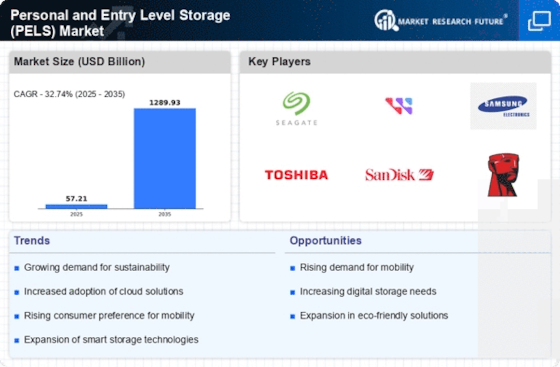
As per Market Research Future analysis, the Personal and Entry Level Storage (PELS) Market Size was estimated at 57.21 USD Billion in 2024. The PELS industry is projected to grow from 75.94 USD Billion in 2025 to 1289.93 USD Billion by 2035, exhibiting a compound annual growth rate (CAGR) of 32.74% during the forecast period 2025 - 2035

Key Market Trends & Highlights

The Personal and Entry Level Storage (PELS) Market is experiencing a transformative shift towards innovative and sustainable solutions.

  • The rise of smart storage solutions is reshaping consumer expectations in North America, the largest market. Sustainability in storage products is becoming increasingly vital, particularly in the fast-growing Asia-Pacific region. Customization and personalization are gaining traction, especially within the cloud segment, which remains the largest. Increased urbanization and e-commerce growth are driving demand for efficient storage solutions across various market segments.

Market Size & Forecast

2024 Market Size 57.21 (USD Billion)
2035 Market Size 1289.93 (USD Billion)
CAGR (2025 - 2035) 32.74%
Largest Regional Market Share in 2024 North America

Major Players

Seagate Technology (US), Western Digital (US), Samsung Electronics (KR), Toshiba Corporation (JP), SanDisk Corporation (US), Kingston Technology (US), Transcend Information (TW), ADATA Technology (TW), Crucial (US)

Market Trends

The Personal and Entry Level Storage (PELS) Market is currently experiencing a notable evolution, driven by various factors that influence consumer behavior and technological advancements. As individuals increasingly seek efficient and flexible storage solutions, the demand for personal and entry-level storage options appears to be on the rise. This trend is likely fueled by urbanization, where living spaces are becoming more compact, necessitating innovative storage solutions that maximize available space. Furthermore, the growing awareness of organization and decluttering is prompting consumers to invest in storage products that enhance their living environments. In addition, the PELS Market seems to be adapting to the digital age, with a noticeable shift towards smart storage solutions. These products, which integrate technology to provide enhanced functionality, are becoming more appealing to tech-savvy consumers. The emphasis on sustainability is also influencing purchasing decisions, as environmentally conscious individuals prefer storage options made from eco-friendly materials. Overall, the Personal and Entry Level Storage (PELS) Market is poised for continued growth, reflecting changing lifestyles and consumer preferences.

Rise of Smart Storage Solutions

The Personal and Entry Level Storage (PELS) Market is witnessing a surge in smart storage options. These innovative products incorporate technology, allowing users to manage their belongings more efficiently. Features such as app connectivity and automated organization systems are becoming increasingly popular, appealing to a tech-oriented consumer base.

Sustainability in Storage Products

There is a growing trend towards sustainability within the Personal and Entry Level Storage (PELS) Market. Consumers are increasingly favoring storage solutions made from eco-friendly materials. This shift reflects a broader societal movement towards environmental responsibility, influencing purchasing behaviors.

Customization and Personalization

The demand for customized storage solutions is on the rise in the Personal and Entry Level Storage (PELS) Market. Consumers are seeking products that cater to their specific needs and preferences. This trend indicates a shift towards more personalized shopping experiences, where individual tastes and requirements are prioritized.

Personal Entry Level Storage Market Market Drivers

E-commerce Growth

The expansion of e-commerce is driving the Personal and Entry Level Storage (PELS) Market in various ways. As online shopping continues to gain traction, consumers are increasingly seeking efficient storage solutions for their purchases. Data suggests that e-commerce sales have surged, leading to a heightened demand for storage options that accommodate the influx of goods. This trend is particularly evident in urban areas where space is at a premium. Retailers and logistics companies are also exploring storage solutions to manage inventory more effectively. The PELS market is likely to benefit from this trend, as consumers look for ways to organize their homes and manage their belongings in an increasingly digital shopping environment.

Sustainability Trends

Sustainability trends are emerging as a crucial driver for the Personal and Entry Level Storage (PELS) Market. Consumers are becoming more environmentally conscious, leading to a demand for storage solutions that are eco-friendly and sustainable. This shift is prompting manufacturers to explore materials that are recyclable and production processes that minimize environmental impact. Data suggests that a significant portion of consumers is willing to pay a premium for sustainable products. As a result, companies in the PELS market are likely to focus on developing storage solutions that align with these sustainability goals, appealing to a growing demographic that prioritizes eco-conscious choices in their purchasing decisions.

Increased Urbanization

The trend of urbanization appears to be a significant driver for the Personal and Entry Level Storage (PELS) Market. As more individuals migrate to urban areas, the demand for compact living spaces rises. This shift necessitates innovative storage solutions that maximize limited space. According to recent data, urban populations are projected to grow, leading to a potential increase in the need for personal storage options. Consequently, companies in the PELS market are likely to develop products that cater to the needs of urban dwellers, such as modular storage units and space-saving designs. This trend not only reflects changing living conditions but also indicates a growing market for storage solutions that align with urban lifestyles.

Rising Consumer Awareness

Rising consumer awareness regarding organization and decluttering is influencing the Personal and Entry Level Storage (PELS) Market. As individuals become more conscious of their living environments, there is a growing emphasis on maintaining organized spaces. This trend is reflected in the popularity of minimalism and the desire for functional storage solutions. Market data indicates that consumers are increasingly investing in storage products that not only serve a practical purpose but also enhance the aesthetic appeal of their homes. This shift in consumer behavior is prompting companies in the PELS market to innovate and offer a diverse range of products that cater to the needs of those seeking to create organized and visually pleasing living spaces.

Technological Advancements

Technological advancements are reshaping the Personal and Entry Level Storage (PELS) Market. Innovations in materials and design are leading to the development of more efficient and user-friendly storage solutions. For instance, the introduction of smart storage systems that integrate with home automation technologies is becoming more prevalent. These systems allow users to monitor and manage their storage remotely, enhancing convenience. Furthermore, advancements in manufacturing processes are enabling companies to produce storage solutions that are both durable and aesthetically pleasing. As technology continues to evolve, the PELS market is likely to see a surge in demand for products that incorporate these innovations, appealing to tech-savvy consumers.

Market Segment Insights

By Product: Cloud (Largest) vs. Non-Cloud (Fastest-Growing)

<p>In the Personal and Entry Level Storage (PELS) Market, the Cloud segment dominates the landscape, capturing a larger share of the market. Users are increasingly gravitating towards Cloud solutions due to their convenience, reliability, and ability to provide remote access to stored data. Non-Cloud offerings, while also significant, cater to specific niches that prefer local or physical storage options, resulting in varied market dynamics.</p>

<p>Cloud (Dominant) vs. Non-Cloud (Emerging)</p>

<p>The Cloud segment represents the dominant force in the Personal and Entry Level Storage (PELS) Market, favored for its scalability and ease of use. It allows users to store data without the constraints of physical hardware, thereby accommodating the growing needs of consumer and small business users alike. Conversely, the Non-Cloud segment continues to emerge as a viable alternative, appealing to users who prioritize data control and prefer on-premises solutions. This segment is characterized by diverse storage devices such as external hard drives and USBs, but it is facing challenges from increasing Cloud adoption.</p>

By Storage System: Cloud (Largest) vs. Direct-Attached (Fastest-Growing)

<p>In the Personal and Entry Level Storage (PELS) Market, the distribution of market share has significantly shifted towards Cloud storage solutions in recent years, establishing it as the clear leader. The convenience, scalability, and ease of access offered by Cloud storage have made it the preferred choice for many users, particularly for personal and entry-level applications. Direct-Attached storage solutions, while previously more popular, are increasingly being outpaced by the growing adoption of Cloud options, which cater to the need for mobility and remote access to data.</p>

<p>Cloud Storage (Dominant) vs. Direct-Attached Storage (Emerging)</p>

<p>Cloud storage stands out as the dominant force in the PELS market due to its scalability, accessibility, and flexibility, allowing users to store and retrieve data anytime and anywhere. This feature is particularly appealing in a landscape where mobile and remote work is becoming the norm. On the other hand, Direct-Attached storage, which is seen as the fastest-growing segment, appeals to users who prefer localized data solutions with low latency. Direct-Attached storage systems are often cost-effective and user-friendly, making them a popular choice for new users who prioritize simplicity and direct connection without the complexities of network setup.</p>

By Technology: Magnetic (Largest) vs. Solid-state (Fastest-Growing)

<p>In the Personal and Entry Level Storage (PELS) Market, the magnetic storage segment remains the largest, holding a significant portion of the market share due to its long history and reliability. This traditional technology provides cost-effective solutions for storing large amounts of data, making it the preferred choice for budget-conscious consumers and businesses alike. While magnetic drives continue to dominate, the solid-state segment is rapidly gaining traction, especially among performance-oriented users who prioritize speed and durability. The solid-state storage segment is the fastest-growing within the PELS market, driven by advancements in technology and decreasing prices. With increasing demand for quicker access to data and improved energy efficiency, solid-state drives are becoming more appealing for various applications, from personal devices to entry-level servers. As consumers and businesses gravitate towards faster, more reliable solutions, the preference for solid-state technology is set to significantly impact market dynamics in the coming years.</p>

<p>Technology: Magnetic (Dominant) vs. Solid-state (Emerging)</p>

<p>Magnetic storage technology has long been the backbone of the Personal and Entry Level Storage (PELS) Market, offering substantial capacity at relatively low costs. It excels in applications requiring significant data storage without critical speed demands, making it suitable for traditional hard drives. In contrast, solid-state drives (SSDs) represent an emerging technology segment gaining popularity due to their high speed and durability. SSDs have no moving parts and thus are less prone to physical shock, which enhances their appeal in portable devices. As technology continues to develop, the gap between magnetic and solid-state is narrowing, with SSDs becoming more affordable and increasingly being adopted in entry-level markets, showcasing a shift in consumer preference towards faster and more reliable data access.</p>

Get more detailed insights about Personal and Entry Level Storage (PELS) Market Research Report - Global Forecast till 2035

Regional Insights

North America : Tech-Driven Market Growth

North America is the largest market for Personal and Entry Level Storage (PELS), holding approximately 40% of the global market share. The region's growth is driven by increasing data generation, the rise of remote work, and a growing demand for personal cloud storage solutions. Regulatory support for data privacy and security further catalyzes market expansion, encouraging innovation among key players. The United States dominates the PELS market, with significant contributions from Canada. Major companies like Seagate Technology, Western Digital, and SanDisk Corporation are headquartered here, fostering a competitive landscape. The presence of advanced technology infrastructure and consumer awareness about data storage options enhances market dynamics, making North America a pivotal region for PELS.

Europe : Emerging Regulatory Frameworks

Europe is the second-largest market for Personal and Entry Level Storage (PELS), accounting for around 30% of the global market share. The region's growth is propelled by stringent data protection regulations, such as the GDPR, which drive demand for secure storage solutions. Additionally, the increasing adoption of digital technologies and e-commerce is fueling the need for personal storage devices, creating a robust market environment. Leading countries in Europe include Germany, the UK, and France, where consumer electronics demand is high. The competitive landscape features key players like Samsung Electronics and Toshiba Corporation, which are investing in innovative storage solutions. The presence of a well-established retail network and growing consumer awareness about data management further enhances the market's potential, positioning Europe as a significant player in the PELS sector.

Asia-Pacific : Rapid Growth and Adoption

Asia-Pacific is witnessing rapid growth in the Personal and Entry Level Storage (PELS) market, holding approximately 25% of the global market share. The region's expansion is driven by increasing smartphone penetration, rising disposable incomes, and a growing trend towards digitalization. Countries like China and India are leading this growth, supported by favorable government initiatives promoting technology adoption and innovation in storage solutions. China is the largest market in the region, followed by India and Japan. The competitive landscape is characterized by the presence of local and international players, including Kingston Technology and ADATA Technology. The increasing demand for high-capacity storage devices and advancements in technology are shaping the market dynamics, making Asia-Pacific a key region for PELS growth.

Middle East and Africa : Untapped Market Potential

The Middle East and Africa (MEA) region is emerging as a significant market for Personal and Entry Level Storage (PELS), currently holding about 5% of the global market share. The growth is driven by increasing internet penetration, a rise in mobile device usage, and a growing awareness of data storage solutions. Government initiatives aimed at enhancing digital infrastructure are also contributing to market expansion, creating opportunities for growth in this region. Leading countries in the MEA include South Africa and the UAE, where the demand for personal storage devices is on the rise. The competitive landscape features both local and international players, with companies like Transcend Information gaining traction. As the region continues to develop its digital economy, the demand for innovative storage solutions is expected to grow, positioning MEA as a future hotspot for PELS.

Key Players and Competitive Insights

Leading market players are investing heavily in research and development in order to expand their product lines, which will help the Personal and Entry Level Storage (PELS) Market, grow even more. Market participants are also undertaking a variety of strategic activities to expand their footprint, with important market developments including new product launches, contractual agreements, mergers and acquisitions, higher investments, and collaboration with other organizations. To expand and survive in a more competitive and rising market climate, Personal and Entry Level Storage (PELS)industry must offer cost-effective items. Manufacturing locally to minimize operational costs is one of the key business tactics used by manufacturers in the Personal and Entry Level Storage (PELS) industry to benefit clients and increase the market sector. In recent years, the Personal and Entry Level Storage (PELS) industry has offered some of the most significant advantages to medicine. Major players in the Personal and Entry Level Storage (PELS) Market, including Tintri, Inc. (US), Simplivity Corp. (US), Scality, Inc. (US), Cisco Systems, Inc. (US), Western Digital Corporation (US), Seagate Technology (US) and Symantec Corporation (US) and others, are attempting to increase market demand by investing in research and development operations. Toshiba Corporation is a Japanese multinational enterprise based in Minato, Tokyo. Its diverse products and services include power, industrial and social infrastructure systems, elevators and escalators, electronic components, semiconductors, hard disc drives (HDD), printers, batteries, lighting, and IT solutions such as quantum cryptography, which was developed at Toshiba Europe's Cambridge Research Laboratory and is now commercialized. In 2020, Toshiba announced a 16TB hard disc drive, the biggest capacity hard drive available at the time. This drive is intended for usage in data centres and other business applications. It features Toshiba's helium-sealed technology with a spindle speed of 7200RPM. SanDisk is a Western Digital brand for flash memory goods such as memory cards and readers, USB flash drives, solid-state drives, and digital audio players. Western Digital purchased the original company, SanDisk Corporation. SanDisk was founded in 1988 by Eli Harari, Sanjay Mehrotra, and Jack Yuan, and was incorporated as SunDisk at the time. Eli Harari, a co-founder of SanDisk, created the Floating Gate EEPROM, which demonstrated the practicality, dependability, and endurance of semiconductor-based data storage. In 2020, SanDisk introduced the world's highest capacity microSD card, a 400GB microSD card. This card is intended for usage in smartphones and other mobile devices requiring large amounts of storage. The card supports read and write rates of up to 100MB/s and 90MB/s, respectively.

Key Companies in the Personal Entry Level Storage Market include

Industry Developments

In April 2020, Western Digital will release the WD Black SN850 NVMe SSD. This SSD provides gamers and content developers with outstanding performance and speed. It has a PCIe Gen4 interface and storage sizes ranging from 500GB to 2TB. The drive can read at up to 7,000MB/s and write at up to 5,300MB/s, making it one of the fastest SSDs on the market.

In June 2019, Seagate released the IronWolf 510 NVMe SSD. This SSD is optimized for usage in NAS systems, with rapid data transfer speeds and long endurance. It features a PCIe Gen3 x4 interface and capacities ranging from 240GB to 1.92TB. The drive supports read and write speeds of up to 3,150MB/s and 1,000MB/s, respectively.

In September 2019, Samsung revealed the PM1643, the world's largest SSD with a storage capacity of 30.72TB. This drive is intended for use in enterprise applications that demand large amounts of storage. It employs Samsung's V-NAND technology and provides read and write speeds of up to 2,100MB/s and 1,700MB/s, respectively.

Future Outlook

Personal Entry Level Storage Market Future Outlook

The Personal and Entry Level Storage (PELS) Market is projected to grow at a 32.74% CAGR from 2025 to 2035, driven by increasing consumer demand for flexible storage solutions and technological advancements.

New opportunities lie in:

  • <p>Expansion of mobile storage applications for urban consumers. Development of eco-friendly storage solutions to attract sustainability-focused customers. Integration of smart technology in storage units for enhanced user experience.</p>

By 2035, the PELS market is expected to be robust, reflecting substantial growth and innovation.

Market Segmentation

Personal Entry Level Storage Market Product Outlook

  • Cloud
  • Non-Cloud

Personal Entry Level Storage Market Technology Outlook

  • Magnetic
  • Solid-state

Personal Entry Level Storage Market Storage System Outlook

  • Direct-Attached
  • Cloud
  • Network-Attached Storage
  • Unified
  • Software-Defined

Report Scope

MARKET SIZE 2024 57.21(USD Billion)
MARKET SIZE 2025 75.94(USD Billion)
MARKET SIZE 2035 1289.93(USD Billion)
COMPOUND ANNUAL GROWTH RATE (CAGR) 32.74% (2025 - 2035)
REPORT COVERAGE Revenue Forecast, Competitive Landscape, Growth Factors, and Trends
BASE YEAR 2024
Market Forecast Period 2025 - 2035
Historical Data 2019 - 2024
Market Forecast Units USD Billion
Key Companies Profiled Seagate Technology (US), Western Digital (US), Samsung Electronics (KR), Toshiba Corporation (JP), SanDisk Corporation (US), Kingston Technology (US), Transcend Information (TW), ADATA Technology (TW), Crucial (US)
Segments Covered Product, Storage System, Technology, Region
Key Market Opportunities Integration of smart technology enhances user experience in the Personal and Entry Level Storage (PELS) Market.
Key Market Dynamics Rising consumer demand for compact storage solutions drives innovation and competition in the Personal and Entry Level Storage market.
Countries Covered North America, Europe, APAC, South America, MEA

FAQs

What is the current valuation of the Personal and Entry Level Storage (PELS) Market?

<p>The overall market valuation was 57.21 USD Billion in 2024.</p>

What is the projected market size for the PELS Market by 2035?

<p>The projected valuation for the PELS Market is 1289.93 USD Billion by 2035.</p>

What is the expected CAGR for the PELS Market during the forecast period?

<p>The expected CAGR for the PELS Market from 2025 to 2035 is 32.74%.</p>

Which companies are considered key players in the PELS Market?

<p>Key players in the PELS Market include Seagate Technology, Western Digital, Samsung Electronics, and Toshiba Corporation.</p>

What are the main product segments in the PELS Market?

<p>The main product segments in the PELS Market are Cloud and Non-Cloud storage, valued at 20.0 and 37.21 USD Billion respectively.</p>

How does the valuation of Cloud storage compare to Non-Cloud storage?

<p>Cloud storage was valued at 20.0 USD Billion, while Non-Cloud storage reached 37.21 USD Billion.</p>

What types of storage systems are included in the PELS Market?

The PELS Market includes Direct-Attached, Cloud, Network-Attached Storage, Unified, and Software-Defined systems.

What is the valuation of Solid-state technology in the PELS Market?

Solid-state technology was valued at 37.21 USD Billion in the PELS Market.

How does the market size of Magnetic technology compare to Solid-state technology?

Magnetic technology was valued at 20.0 USD Billion, significantly lower than Solid-state technology's 37.21 USD Billion.

What is the projected growth trend for the PELS Market in the coming years?

The PELS Market is expected to experience substantial growth, reaching 1289.93 USD Billion by 2035.

  1. SECTION I: EXECUTIVE SUMMARY AND KEY HIGHLIGHTS
    1. | 1.1 EXECUTIVE SUMMARY
    2. | | 1.1.1 Market Overview
    3. | | 1.1.2 Key Findings
    4. | | 1.1.3 Market Segmentation
    5. | | 1.1.4 Competitive Landscape
    6. | | 1.1.5 Challenges and Opportunities
    7. | | 1.1.6 Future Outlook
  2. SECTION II: SCOPING, METHODOLOGY AND MARKET STRUCTURE
    1. | 2.1 MARKET INTRODUCTION
    2. | | 2.1.1 Definition
    3. | | 2.1.2 Scope of the study
    4. | | | 2.1.2.1 Research Objective
    5. | | | 2.1.2.2 Assumption
    6. | | | 2.1.2.3 Limitations
    7. | 2.2 RESEARCH METHODOLOGY
    8. | | 2.2.1 Overview
    9. | | 2.2.2 Data Mining
    10. | | 2.2.3 Secondary Research
    11. | | 2.2.4 Primary Research
    12. | | | 2.2.4.1 Primary Interviews and Information Gathering Process
    13. | | | 2.2.4.2 Breakdown of Primary Respondents
    14. | | 2.2.5 Forecasting Model
    15. | | 2.2.6 Market Size Estimation
    16. | | | 2.2.6.1 Bottom-Up Approach
    17. | | | 2.2.6.2 Top-Down Approach
    18. | | 2.2.7 Data Triangulation
    19. | | 2.2.8 Validation
  3. SECTION III: QUALITATIVE ANALYSIS
    1. | 3.1 MARKET DYNAMICS
    2. | | 3.1.1 Overview
    3. | | 3.1.2 Drivers
    4. | | 3.1.3 Restraints
    5. | | 3.1.4 Opportunities
    6. | 3.2 MARKET FACTOR ANALYSIS
    7. | | 3.2.1 Value chain Analysis
    8. | | 3.2.2 Porter's Five Forces Analysis
    9. | | | 3.2.2.1 Bargaining Power of Suppliers
    10. | | | 3.2.2.2 Bargaining Power of Buyers
    11. | | | 3.2.2.3 Threat of New Entrants
    12. | | | 3.2.2.4 Threat of Substitutes
    13. | | | 3.2.2.5 Intensity of Rivalry
    14. | | 3.2.3 COVID-19 Impact Analysis
    15. | | | 3.2.3.1 Market Impact Analysis
    16. | | | 3.2.3.2 Regional Impact
    17. | | | 3.2.3.3 Opportunity and Threat Analysis
  4. SECTION IV: QUANTITATIVE ANALYSIS
    1. | 4.1 Information and Communications Technology, BY Product (USD Billion)
    2. | | 4.1.1 Cloud
    3. | | 4.1.2 Non-Cloud
    4. | 4.2 Information and Communications Technology, BY Storage System (USD Billion)
    5. | | 4.2.1 Direct-Attached
    6. | | 4.2.2 Cloud
    7. | | 4.2.3 Network-Attached Storage
    8. | | 4.2.4 Unified
    9. | | 4.2.5 Software-Defined
    10. | 4.3 Information and Communications Technology, BY Technology (USD Billion)
    11. | | 4.3.1 Magnetic
    12. | | 4.3.2 Solid-state
    13. | 4.4 Information and Communications Technology, BY Region (USD Billion)
    14. | | 4.4.1 North America
    15. | | | 4.4.1.1 US
    16. | | | 4.4.1.2 Canada
    17. | | 4.4.2 Europe
    18. | | | 4.4.2.1 Germany
    19. | | | 4.4.2.2 UK
    20. | | | 4.4.2.3 France
    21. | | | 4.4.2.4 Russia
    22. | | | 4.4.2.5 Italy
    23. | | | 4.4.2.6 Spain
    24. | | | 4.4.2.7 Rest of Europe
    25. | | 4.4.3 APAC
    26. | | | 4.4.3.1 China
    27. | | | 4.4.3.2 India
    28. | | | 4.4.3.3 Japan
    29. | | | 4.4.3.4 South Korea
    30. | | | 4.4.3.5 Malaysia
    31. | | | 4.4.3.6 Thailand
    32. | | | 4.4.3.7 Indonesia
    33. | | | 4.4.3.8 Rest of APAC
    34. | | 4.4.4 South America
    35. | | | 4.4.4.1 Brazil
    36. | | | 4.4.4.2 Mexico
    37. | | | 4.4.4.3 Argentina
    38. | | | 4.4.4.4 Rest of South America
    39. | | 4.4.5 MEA
    40. | | | 4.4.5.1 GCC Countries
    41. | | | 4.4.5.2 South Africa
    42. | | | 4.4.5.3 Rest of MEA
  5. SECTION V: COMPETITIVE ANALYSIS
    1. | 5.1 Competitive Landscape
    2. | | 5.1.1 Overview
    3. | | 5.1.2 Competitive Analysis
    4. | | 5.1.3 Market share Analysis
    5. | | 5.1.4 Major Growth Strategy in the Information and Communications Technology
    6. | | 5.1.5 Competitive Benchmarking
    7. | | 5.1.6 Leading Players in Terms of Number of Developments in the Information and Communications Technology
    8. | | 5.1.7 Key developments and growth strategies
    9. | | | 5.1.7.1 New Product Launch/Service Deployment
    10. | | | 5.1.7.2 Merger & Acquisitions
    11. | | | 5.1.7.3 Joint Ventures
    12. | | 5.1.8 Major Players Financial Matrix
    13. | | | 5.1.8.1 Sales and Operating Income
    14. | | | 5.1.8.2 Major Players R&D Expenditure. 2023
    15. | 5.2 Company Profiles
    16. | | 5.2.1 Seagate Technology (US)
    17. | | | 5.2.1.1 Financial Overview
    18. | | | 5.2.1.2 Products Offered
    19. | | | 5.2.1.3 Key Developments
    20. | | | 5.2.1.4 SWOT Analysis
    21. | | | 5.2.1.5 Key Strategies
    22. | | 5.2.2 Western Digital (US)
    23. | | | 5.2.2.1 Financial Overview
    24. | | | 5.2.2.2 Products Offered
    25. | | | 5.2.2.3 Key Developments
    26. | | | 5.2.2.4 SWOT Analysis
    27. | | | 5.2.2.5 Key Strategies
    28. | | 5.2.3 Samsung Electronics (KR)
    29. | | | 5.2.3.1 Financial Overview
    30. | | | 5.2.3.2 Products Offered
    31. | | | 5.2.3.3 Key Developments
    32. | | | 5.2.3.4 SWOT Analysis
    33. | | | 5.2.3.5 Key Strategies
    34. | | 5.2.4 Toshiba Corporation (JP)
    35. | | | 5.2.4.1 Financial Overview
    36. | | | 5.2.4.2 Products Offered
    37. | | | 5.2.4.3 Key Developments
    38. | | | 5.2.4.4 SWOT Analysis
    39. | | | 5.2.4.5 Key Strategies
    40. | | 5.2.5 SanDisk Corporation (US)
    41. | | | 5.2.5.1 Financial Overview
    42. | | | 5.2.5.2 Products Offered
    43. | | | 5.2.5.3 Key Developments
    44. | | | 5.2.5.4 SWOT Analysis
    45. | | | 5.2.5.5 Key Strategies
    46. | | 5.2.6 Kingston Technology (US)
    47. | | | 5.2.6.1 Financial Overview
    48. | | | 5.2.6.2 Products Offered
    49. | | | 5.2.6.3 Key Developments
    50. | | | 5.2.6.4 SWOT Analysis
    51. | | | 5.2.6.5 Key Strategies
    52. | | 5.2.7 Transcend Information (TW)
    53. | | | 5.2.7.1 Financial Overview
    54. | | | 5.2.7.2 Products Offered
    55. | | | 5.2.7.3 Key Developments
    56. | | | 5.2.7.4 SWOT Analysis
    57. | | | 5.2.7.5 Key Strategies
    58. | | 5.2.8 ADATA Technology (TW)
    59. | | | 5.2.8.1 Financial Overview
    60. | | | 5.2.8.2 Products Offered
    61. | | | 5.2.8.3 Key Developments
    62. | | | 5.2.8.4 SWOT Analysis
    63. | | | 5.2.8.5 Key Strategies
    64. | | 5.2.9 Crucial (US)
    65. | | | 5.2.9.1 Financial Overview
    66. | | | 5.2.9.2 Products Offered
    67. | | | 5.2.9.3 Key Developments
    68. | | | 5.2.9.4 SWOT Analysis
    69. | | | 5.2.9.5 Key Strategies
    70. | 5.3 Appendix
    71. | | 5.3.1 References
    72. | | 5.3.2 Related Reports
  6. LIST OF FIGURES
    1. | 6.1 MARKET SYNOPSIS
    2. | 6.2 NORTH AMERICA MARKET ANALYSIS
    3. | 6.3 US MARKET ANALYSIS BY PRODUCT
    4. | 6.4 US MARKET ANALYSIS BY STORAGE SYSTEM
    5. | 6.5 US MARKET ANALYSIS BY TECHNOLOGY
    6. | 6.6 CANADA MARKET ANALYSIS BY PRODUCT
    7. | 6.7 CANADA MARKET ANALYSIS BY STORAGE SYSTEM
    8. | 6.8 CANADA MARKET ANALYSIS BY TECHNOLOGY
    9. | 6.9 EUROPE MARKET ANALYSIS
    10. | 6.10 GERMANY MARKET ANALYSIS BY PRODUCT
    11. | 6.11 GERMANY MARKET ANALYSIS BY STORAGE SYSTEM
    12. | 6.12 GERMANY MARKET ANALYSIS BY TECHNOLOGY
    13. | 6.13 UK MARKET ANALYSIS BY PRODUCT
    14. | 6.14 UK MARKET ANALYSIS BY STORAGE SYSTEM
    15. | 6.15 UK MARKET ANALYSIS BY TECHNOLOGY
    16. | 6.16 FRANCE MARKET ANALYSIS BY PRODUCT
    17. | 6.17 FRANCE MARKET ANALYSIS BY STORAGE SYSTEM
    18. | 6.18 FRANCE MARKET ANALYSIS BY TECHNOLOGY
    19. | 6.19 RUSSIA MARKET ANALYSIS BY PRODUCT
    20. | 6.20 RUSSIA MARKET ANALYSIS BY STORAGE SYSTEM
    21. | 6.21 RUSSIA MARKET ANALYSIS BY TECHNOLOGY
    22. | 6.22 ITALY MARKET ANALYSIS BY PRODUCT
    23. | 6.23 ITALY MARKET ANALYSIS BY STORAGE SYSTEM
    24. | 6.24 ITALY MARKET ANALYSIS BY TECHNOLOGY
    25. | 6.25 SPAIN MARKET ANALYSIS BY PRODUCT
    26. | 6.26 SPAIN MARKET ANALYSIS BY STORAGE SYSTEM
    27. | 6.27 SPAIN MARKET ANALYSIS BY TECHNOLOGY
    28. | 6.28 REST OF EUROPE MARKET ANALYSIS BY PRODUCT
    29. | 6.29 REST OF EUROPE MARKET ANALYSIS BY STORAGE SYSTEM
    30. | 6.30 REST OF EUROPE MARKET ANALYSIS BY TECHNOLOGY
    31. | 6.31 APAC MARKET ANALYSIS
    32. | 6.32 CHINA MARKET ANALYSIS BY PRODUCT
    33. | 6.33 CHINA MARKET ANALYSIS BY STORAGE SYSTEM
    34. | 6.34 CHINA MARKET ANALYSIS BY TECHNOLOGY
    35. | 6.35 INDIA MARKET ANALYSIS BY PRODUCT
    36. | 6.36 INDIA MARKET ANALYSIS BY STORAGE SYSTEM
    37. | 6.37 INDIA MARKET ANALYSIS BY TECHNOLOGY
    38. | 6.38 JAPAN MARKET ANALYSIS BY PRODUCT
    39. | 6.39 JAPAN MARKET ANALYSIS BY STORAGE SYSTEM
    40. | 6.40 JAPAN MARKET ANALYSIS BY TECHNOLOGY
    41. | 6.41 SOUTH KOREA MARKET ANALYSIS BY PRODUCT
    42. | 6.42 SOUTH KOREA MARKET ANALYSIS BY STORAGE SYSTEM
    43. | 6.43 SOUTH KOREA MARKET ANALYSIS BY TECHNOLOGY
    44. | 6.44 MALAYSIA MARKET ANALYSIS BY PRODUCT
    45. | 6.45 MALAYSIA MARKET ANALYSIS BY STORAGE SYSTEM
    46. | 6.46 MALAYSIA MARKET ANALYSIS BY TECHNOLOGY
    47. | 6.47 THAILAND MARKET ANALYSIS BY PRODUCT
    48. | 6.48 THAILAND MARKET ANALYSIS BY STORAGE SYSTEM
    49. | 6.49 THAILAND MARKET ANALYSIS BY TECHNOLOGY
    50. | 6.50 INDONESIA MARKET ANALYSIS BY PRODUCT
    51. | 6.51 INDONESIA MARKET ANALYSIS BY STORAGE SYSTEM
    52. | 6.52 INDONESIA MARKET ANALYSIS BY TECHNOLOGY
    53. | 6.53 REST OF APAC MARKET ANALYSIS BY PRODUCT
    54. | 6.54 REST OF APAC MARKET ANALYSIS BY STORAGE SYSTEM
    55. | 6.55 REST OF APAC MARKET ANALYSIS BY TECHNOLOGY
    56. | 6.56 SOUTH AMERICA MARKET ANALYSIS
    57. | 6.57 BRAZIL MARKET ANALYSIS BY PRODUCT
    58. | 6.58 BRAZIL MARKET ANALYSIS BY STORAGE SYSTEM
    59. | 6.59 BRAZIL MARKET ANALYSIS BY TECHNOLOGY
    60. | 6.60 MEXICO MARKET ANALYSIS BY PRODUCT
    61. | 6.61 MEXICO MARKET ANALYSIS BY STORAGE SYSTEM
    62. | 6.62 MEXICO MARKET ANALYSIS BY TECHNOLOGY
    63. | 6.63 ARGENTINA MARKET ANALYSIS BY PRODUCT
    64. | 6.64 ARGENTINA MARKET ANALYSIS BY STORAGE SYSTEM
    65. | 6.65 ARGENTINA MARKET ANALYSIS BY TECHNOLOGY
    66. | 6.66 REST OF SOUTH AMERICA MARKET ANALYSIS BY PRODUCT
    67. | 6.67 REST OF SOUTH AMERICA MARKET ANALYSIS BY STORAGE SYSTEM
    68. | 6.68 REST OF SOUTH AMERICA MARKET ANALYSIS BY TECHNOLOGY
    69. | 6.69 MEA MARKET ANALYSIS
    70. | 6.70 GCC COUNTRIES MARKET ANALYSIS BY PRODUCT
    71. | 6.71 GCC COUNTRIES MARKET ANALYSIS BY STORAGE SYSTEM
    72. | 6.72 GCC COUNTRIES MARKET ANALYSIS BY TECHNOLOGY
    73. | 6.73 SOUTH AFRICA MARKET ANALYSIS BY PRODUCT
    74. | 6.74 SOUTH AFRICA MARKET ANALYSIS BY STORAGE SYSTEM
    75. | 6.75 SOUTH AFRICA MARKET ANALYSIS BY TECHNOLOGY
    76. | 6.76 REST OF MEA MARKET ANALYSIS BY PRODUCT
    77. | 6.77 REST OF MEA MARKET ANALYSIS BY STORAGE SYSTEM
    78. | 6.78 REST OF MEA MARKET ANALYSIS BY TECHNOLOGY
    79. | 6.79 KEY BUYING CRITERIA OF INFORMATION AND COMMUNICATIONS TECHNOLOGY
    80. | 6.80 RESEARCH PROCESS OF MRFR
    81. | 6.81 DRO ANALYSIS OF INFORMATION AND COMMUNICATIONS TECHNOLOGY
    82. | 6.82 DRIVERS IMPACT ANALYSIS: INFORMATION AND COMMUNICATIONS TECHNOLOGY
    83. | 6.83 RESTRAINTS IMPACT ANALYSIS: INFORMATION AND COMMUNICATIONS TECHNOLOGY
    84. | 6.84 SUPPLY / VALUE CHAIN: INFORMATION AND COMMUNICATIONS TECHNOLOGY
    85. | 6.85 INFORMATION AND COMMUNICATIONS TECHNOLOGY, BY PRODUCT, 2024 (% SHARE)
    86. | 6.86 INFORMATION AND COMMUNICATIONS TECHNOLOGY, BY PRODUCT, 2024 TO 2035 (USD Billion)
    87. | 6.87 INFORMATION AND COMMUNICATIONS TECHNOLOGY, BY STORAGE SYSTEM, 2024 (% SHARE)
    88. | 6.88 INFORMATION AND COMMUNICATIONS TECHNOLOGY, BY STORAGE SYSTEM, 2024 TO 2035 (USD Billion)
    89. | 6.89 INFORMATION AND COMMUNICATIONS TECHNOLOGY, BY TECHNOLOGY, 2024 (% SHARE)
    90. | 6.90 INFORMATION AND COMMUNICATIONS TECHNOLOGY, BY TECHNOLOGY, 2024 TO 2035 (USD Billion)
    91. | 6.91 BENCHMARKING OF MAJOR COMPETITORS
  7. LIST OF TABLES
    1. | 7.1 LIST OF ASSUMPTIONS
    2. | | 7.1.1
    3. | 7.2 North America MARKET SIZE ESTIMATES; FORECAST
    4. | | 7.2.1 BY PRODUCT, 2025-2035 (USD Billion)
    5. | | 7.2.2 BY STORAGE SYSTEM, 2025-2035 (USD Billion)
    6. | | 7.2.3 BY TECHNOLOGY, 2025-2035 (USD Billion)
    7. | 7.3 US MARKET SIZE ESTIMATES; FORECAST
    8. | | 7.3.1 BY PRODUCT, 2025-2035 (USD Billion)
    9. | | 7.3.2 BY STORAGE SYSTEM, 2025-2035 (USD Billion)
    10. | | 7.3.3 BY TECHNOLOGY, 2025-2035 (USD Billion)
    11. | 7.4 Canada MARKET SIZE ESTIMATES; FORECAST
    12. | | 7.4.1 BY PRODUCT, 2025-2035 (USD Billion)
    13. | | 7.4.2 BY STORAGE SYSTEM, 2025-2035 (USD Billion)
    14. | | 7.4.3 BY TECHNOLOGY, 2025-2035 (USD Billion)
    15. | 7.5 Europe MARKET SIZE ESTIMATES; FORECAST
    16. | | 7.5.1 BY PRODUCT, 2025-2035 (USD Billion)
    17. | | 7.5.2 BY STORAGE SYSTEM, 2025-2035 (USD Billion)
    18. | | 7.5.3 BY TECHNOLOGY, 2025-2035 (USD Billion)
    19. | 7.6 Germany MARKET SIZE ESTIMATES; FORECAST
    20. | | 7.6.1 BY PRODUCT, 2025-2035 (USD Billion)
    21. | | 7.6.2 BY STORAGE SYSTEM, 2025-2035 (USD Billion)
    22. | | 7.6.3 BY TECHNOLOGY, 2025-2035 (USD Billion)
    23. | 7.7 UK MARKET SIZE ESTIMATES; FORECAST
    24. | | 7.7.1 BY PRODUCT, 2025-2035 (USD Billion)
    25. | | 7.7.2 BY STORAGE SYSTEM, 2025-2035 (USD Billion)
    26. | | 7.7.3 BY TECHNOLOGY, 2025-2035 (USD Billion)
    27. | 7.8 France MARKET SIZE ESTIMATES; FORECAST
    28. | | 7.8.1 BY PRODUCT, 2025-2035 (USD Billion)
    29. | | 7.8.2 BY STORAGE SYSTEM, 2025-2035 (USD Billion)
    30. | | 7.8.3 BY TECHNOLOGY, 2025-2035 (USD Billion)
    31. | 7.9 Russia MARKET SIZE ESTIMATES; FORECAST
    32. | | 7.9.1 BY PRODUCT, 2025-2035 (USD Billion)
    33. | | 7.9.2 BY STORAGE SYSTEM, 2025-2035 (USD Billion)
    34. | | 7.9.3 BY TECHNOLOGY, 2025-2035 (USD Billion)
    35. | 7.10 Italy MARKET SIZE ESTIMATES; FORECAST
    36. | | 7.10.1 BY PRODUCT, 2025-2035 (USD Billion)
    37. | | 7.10.2 BY STORAGE SYSTEM, 2025-2035 (USD Billion)
    38. | | 7.10.3 BY TECHNOLOGY, 2025-2035 (USD Billion)
    39. | 7.11 Spain MARKET SIZE ESTIMATES; FORECAST
    40. | | 7.11.1 BY PRODUCT, 2025-2035 (USD Billion)
    41. | | 7.11.2 BY STORAGE SYSTEM, 2025-2035 (USD Billion)
    42. | | 7.11.3 BY TECHNOLOGY, 2025-2035 (USD Billion)
    43. | 7.12 Rest of Europe MARKET SIZE ESTIMATES; FORECAST
    44. | | 7.12.1 BY PRODUCT, 2025-2035 (USD Billion)
    45. | | 7.12.2 BY STORAGE SYSTEM, 2025-2035 (USD Billion)
    46. | | 7.12.3 BY TECHNOLOGY, 2025-2035 (USD Billion)
    47. | 7.13 APAC MARKET SIZE ESTIMATES; FORECAST
    48. | | 7.13.1 BY PRODUCT, 2025-2035 (USD Billion)
    49. | | 7.13.2 BY STORAGE SYSTEM, 2025-2035 (USD Billion)
    50. | | 7.13.3 BY TECHNOLOGY, 2025-2035 (USD Billion)
    51. | 7.14 China MARKET SIZE ESTIMATES; FORECAST
    52. | | 7.14.1 BY PRODUCT, 2025-2035 (USD Billion)
    53. | | 7.14.2 BY STORAGE SYSTEM, 2025-2035 (USD Billion)
    54. | | 7.14.3 BY TECHNOLOGY, 2025-2035 (USD Billion)
    55. | 7.15 India MARKET SIZE ESTIMATES; FORECAST
    56. | | 7.15.1 BY PRODUCT, 2025-2035 (USD Billion)
    57. | | 7.15.2 BY STORAGE SYSTEM, 2025-2035 (USD Billion)
    58. | | 7.15.3 BY TECHNOLOGY, 2025-2035 (USD Billion)
    59. | 7.16 Japan MARKET SIZE ESTIMATES; FORECAST
    60. | | 7.16.1 BY PRODUCT, 2025-2035 (USD Billion)
    61. | | 7.16.2 BY STORAGE SYSTEM, 2025-2035 (USD Billion)
    62. | | 7.16.3 BY TECHNOLOGY, 2025-2035 (USD Billion)
    63. | 7.17 South Korea MARKET SIZE ESTIMATES; FORECAST
    64. | | 7.17.1 BY PRODUCT, 2025-2035 (USD Billion)
    65. | | 7.17.2 BY STORAGE SYSTEM, 2025-2035 (USD Billion)
    66. | | 7.17.3 BY TECHNOLOGY, 2025-2035 (USD Billion)
    67. | 7.18 Malaysia MARKET SIZE ESTIMATES; FORECAST
    68. | | 7.18.1 BY PRODUCT, 2025-2035 (USD Billion)
    69. | | 7.18.2 BY STORAGE SYSTEM, 2025-2035 (USD Billion)
    70. | | 7.18.3 BY TECHNOLOGY, 2025-2035 (USD Billion)
    71. | 7.19 Thailand MARKET SIZE ESTIMATES; FORECAST
    72. | | 7.19.1 BY PRODUCT, 2025-2035 (USD Billion)
    73. | | 7.19.2 BY STORAGE SYSTEM, 2025-2035 (USD Billion)
    74. | | 7.19.3 BY TECHNOLOGY, 2025-2035 (USD Billion)
    75. | 7.20 Indonesia MARKET SIZE ESTIMATES; FORECAST
    76. | | 7.20.1 BY PRODUCT, 2025-2035 (USD Billion)
    77. | | 7.20.2 BY STORAGE SYSTEM, 2025-2035 (USD Billion)
    78. | | 7.20.3 BY TECHNOLOGY, 2025-2035 (USD Billion)
    79. | 7.21 Rest of APAC MARKET SIZE ESTIMATES; FORECAST
    80. | | 7.21.1 BY PRODUCT, 2025-2035 (USD Billion)
    81. | | 7.21.2 BY STORAGE SYSTEM, 2025-2035 (USD Billion)
    82. | | 7.21.3 BY TECHNOLOGY, 2025-2035 (USD Billion)
    83. | 7.22 South America MARKET SIZE ESTIMATES; FORECAST
    84. | | 7.22.1 BY PRODUCT, 2025-2035 (USD Billion)
    85. | | 7.22.2 BY STORAGE SYSTEM, 2025-2035 (USD Billion)
    86. | | 7.22.3 BY TECHNOLOGY, 2025-2035 (USD Billion)
    87. | 7.23 Brazil MARKET SIZE ESTIMATES; FORECAST
    88. | | 7.23.1 BY PRODUCT, 2025-2035 (USD Billion)
    89. | | 7.23.2 BY STORAGE SYSTEM, 2025-2035 (USD Billion)
    90. | | 7.23.3 BY TECHNOLOGY, 2025-2035 (USD Billion)
    91. | 7.24 Mexico MARKET SIZE ESTIMATES; FORECAST
    92. | | 7.24.1 BY PRODUCT, 2025-2035 (USD Billion)
    93. | | 7.24.2 BY STORAGE SYSTEM, 2025-2035 (USD Billion)
    94. | | 7.24.3 BY TECHNOLOGY, 2025-2035 (USD Billion)
    95. | 7.25 Argentina MARKET SIZE ESTIMATES; FORECAST
    96. | | 7.25.1 BY PRODUCT, 2025-2035 (USD Billion)
    97. | | 7.25.2 BY STORAGE SYSTEM, 2025-2035 (USD Billion)
    98. | | 7.25.3 BY TECHNOLOGY, 2025-2035 (USD Billion)
    99. | 7.26 Rest of South America MARKET SIZE ESTIMATES; FORECAST
    100. | | 7.26.1 BY PRODUCT, 2025-2035 (USD Billion)
    101. | | 7.26.2 BY STORAGE SYSTEM, 2025-2035 (USD Billion)
    102. | | 7.26.3 BY TECHNOLOGY, 2025-2035 (USD Billion)
    103. | 7.27 MEA MARKET SIZE ESTIMATES; FORECAST
    104. | | 7.27.1 BY PRODUCT, 2025-2035 (USD Billion)
    105. | | 7.27.2 BY STORAGE SYSTEM, 2025-2035 (USD Billion)
    106. | | 7.27.3 BY TECHNOLOGY, 2025-2035 (USD Billion)
    107. | 7.28 GCC Countries MARKET SIZE ESTIMATES; FORECAST
    108. | | 7.28.1 BY PRODUCT, 2025-2035 (USD Billion)
    109. | | 7.28.2 BY STORAGE SYSTEM, 2025-2035 (USD Billion)
    110. | | 7.28.3 BY TECHNOLOGY, 2025-2035 (USD Billion)
    111. | 7.29 South Africa MARKET SIZE ESTIMATES; FORECAST
    112. | | 7.29.1 BY PRODUCT, 2025-2035 (USD Billion)
    113. | | 7.29.2 BY STORAGE SYSTEM, 2025-2035 (USD Billion)
    114. | | 7.29.3 BY TECHNOLOGY, 2025-2035 (USD Billion)
    115. | 7.30 Rest of MEA MARKET SIZE ESTIMATES; FORECAST
    116. | | 7.30.1 BY PRODUCT, 2025-2035 (USD Billion)
    117. | | 7.30.2 BY STORAGE SYSTEM, 2025-2035 (USD Billion)
    118. | | 7.30.3 BY TECHNOLOGY, 2025-2035 (USD Billion)
    119. | 7.31 PRODUCT LAUNCH/PRODUCT DEVELOPMENT/APPROVAL
    120. | | 7.31.1
    121. | 7.32 ACQUISITION/PARTNERSHIP
    122. | | 7.32.1

Information and Communications Technology Market Segmentation

Information and Communications Technology By Product (USD Billion, 2025-2035)

  • Cloud
  • Non-Cloud

Information and Communications Technology By Storage System (USD Billion, 2025-2035)

  • Direct-Attached
  • Cloud
  • Network-Attached Storage
  • Unified
  • Software-Defined

Information and Communications Technology By Technology (USD Billion, 2025-2035)

  • Magnetic
  • Solid-state
Infographic

Free Sample Request

Kindly complete the form below to receive a free sample of this Report

Get Free Sample

Customer Strories

Compare Licence

×
Features License Type
Single User Multiuser License Enterprise User
Price $4,950 $5,950 $7,250
Maximum User Access Limit 1 User Upto 10 Users Unrestricted Access Throughout the Organization
Free Customization
Direct Access to Analyst
Deliverable Format
Platform Access
Discount on Next Purchase 10% 15% 15%
Printable Versions