
Request Free Sample ×

Kindly complete the form below to receive a free sample of this Report

* Please use a valid business email

Leading companies partner with us for data-driven Insights

clients tt-cursor
Hero Background
English
Chinese
French
Japanese
Korean
German
Spanish

Personal Data Recovery Software Market Trends

ID: MRFR/ICT/9563-CR
110 Pages
Ankit Gupta
December 2022

Personal Data Recovery Software Market Research Report Information By Organization Size (SME and Large Enterprises), By Deployment Type (On-Premises and Cloud), And By Region (North America, Europe, Asia-Pacific, And Rest Of The World) –Market Forecast Till 2035.

Share:
Download PDF ×

We do not share your information with anyone. However, we may send you emails based on your report interest from time to time. You may contact us at any time to opt-out.

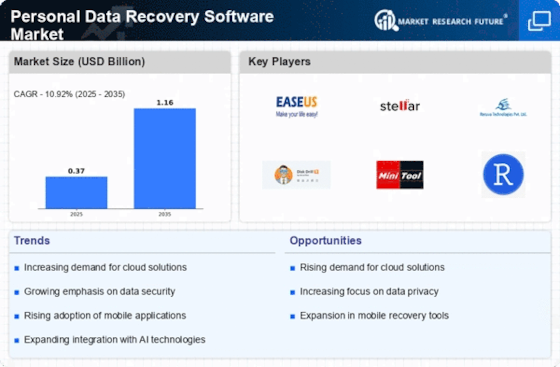
Personal Data Recovery Software Market Infographic
Purchase Options

Market Trends

Key Emerging Trends in the Personal Data Recovery Software Market

One of the noticeable market patterns in the personal data recovery software market is the emphasis on complete data recovery abilities. As the volume and complexity of computerized data keep on developing, personal data recovery software suppliers are enhancing to offer high level recovery calculations, record framework support, and checking procedures to guarantee the recovery of an extensive variety of document types and capacity media. This pattern is driving the advancement of additional flexible and productive data recovery arrangements fit for tending to assorted data failure situations and capacity gadgets, including hard drives, SSDs, memory cards, and cell phones.

Additionally, the mix of cloud-based data recovery administrations is reshaping the market elements. Cloud-based data recovery arrangements offer the accommodation of remote data recovery, secure data storing, and programmed reinforcements, empowering clients to recuperate and get to their data from any area with a web association. This pattern is driving the reception of cloud-based personal data recovery software that gives consistent data synchronization, ongoing reinforcements, and distant recovery choices, guaranteeing data transparency and insurance across different devices and stages.

One more key pattern in the personal data recovery software market is the emphasis on data security and protection. With the rising worries about data breaks, wholesale fraud, and digital dangers, personal data recovery software suppliers are improving the security elements of their answers for safeguard recuperated data from unapproved access and malignant exercises. This pattern is driving the improvement of data recovery software with encryption, secure termination, and security assurance elements to defend sensitive and recuperated data from potential security risks.

Also, the pattern towards data recovery on cell phones and IoT stages is affecting the personal data recovery software market. As the utilization of cell phones, tablets, and IoT gadgets keeps on developing, there is a rising interest for data recovery arrangements that can address data disaster incidences on these gadgets. Personal data recovery software suppliers are creating dynamic and IoT-viable recovery instruments to recover lost data from Android, iOS, and IoT gadgets, guaranteeing thorough data recovery capacities across many computerized stages.


Author
Author Profile
Ankit Gupta
Team Lead - Research

Ankit Gupta is a seasoned market intelligence and strategic research professional with over six plus years of experience in the ICT and Semiconductor industries. With academic roots in Telecom, Marketing, and Electronics, he blends technical insight with business strategy. Ankit has led 200+ projects, including work for Fortune 500 clients like Microsoft and Rio Tinto, covering market sizing, tech forecasting, and go-to-market strategies. Known for bridging engineering and enterprise decision-making, his insights support growth, innovation, and investment planning across diverse technology markets.

Leave a Comment

FAQs

What is the projected market valuation for the Personal Data Recovery Software Market in 2035?

<p>The projected market valuation for the Personal Data Recovery Software Market in 2035 is 1.157 USD Billion.</p>

What was the market valuation for the Personal Data Recovery Software Market in 2024?

<p>The overall market valuation for the Personal Data Recovery Software Market was 0.37 USD Billion in 2024.</p>

What is the expected CAGR for the Personal Data Recovery Software Market during the forecast period 2025 - 2035?

<p>The expected CAGR for the Personal Data Recovery Software Market during the forecast period 2025 - 2035 is 10.92%.</p>

Which companies are considered key players in the Personal Data Recovery Software Market?

<p>Key players in the Personal Data Recovery Software Market include EaseUS, Stellar Data Recovery, Recuva, Disk Drill, MiniTool, R-Studio, Ontrack, Data Rescue, and Wondershare.</p>

How does the market valuation for SMEs compare to that of large enterprises in 2025?

<p>In 2025, the market valuation for SMEs is projected to be between 0.15 and 0.45 USD Billion, while for large enterprises, it is expected to range from 0.22 to 0.71 USD Billion.</p>

What are the projected valuations for on-premises and cloud deployment types in 2025?

<p>In 2025, the projected valuation for on-premises deployment is between 0.15 and 0.46 USD Billion, whereas for cloud deployment, it is expected to be between 0.22 and 0.69 USD Billion.</p>

What trends are influencing the growth of the Personal Data Recovery Software Market?

The growth of the Personal Data Recovery Software Market appears to be influenced by increasing data loss incidents and the rising need for data recovery solutions across various sectors.

How does the Personal Data Recovery Software Market's growth compare to other software markets?

The Personal Data Recovery Software Market's growth, with a projected CAGR of 10.92%, suggests a robust expansion compared to many other software markets.

What factors could impact the market dynamics of Personal Data Recovery Software in the coming years?

Factors such as technological advancements, regulatory changes, and evolving consumer needs may impact the market dynamics of Personal Data Recovery Software.

What role do cloud solutions play in the Personal Data Recovery Software Market?

Cloud solutions are likely to play a significant role in the Personal Data Recovery Software Market, with projected valuations indicating a strong preference for cloud deployment.

Market Summary

As per Market Research Future analysis, the Personal Data Recovery Software Market Size was estimated at 0.37 USD Billion in 2024. The Personal Data Recovery Software industry is projected to grow from USD 0.4104 Billion in 2025 to USD 1.157 Billion by 2035, exhibiting a compound annual growth rate (CAGR) of 10.92% during the forecast period 2025 - 2035

Key Market Trends & Highlights

The Personal Data Recovery Software Market is experiencing robust growth driven by technological advancements and increasing data loss incidents.

  • The market is witnessing a rising demand for user-friendly solutions, particularly among small and medium enterprises in North America. Integration of advanced technologies is becoming prevalent, especially in the cloud segment, which is the fastest-growing area in the market. There is a heightened focus on data security and privacy, reflecting the growing awareness of data privacy regulations across the Asia-Pacific region. Increasing data loss incidents and the rising adoption of cloud storage solutions are major drivers propelling market expansion.

Market Size & Forecast

2024 Market Size 0.37 (USD Billion)
2035 Market Size 1.157 (USD Billion)
CAGR (2025 - 2035) 10.92%
Largest Regional Market Share in 2024 North America

Major Players

EaseUS (CN), Stellar Data Recovery (IN), Recuva (GB), Disk Drill (US), MiniTool (CA), R-Studio (RU), Ontrack (US), Data Rescue (US), Wondershare (CN)

Market Trends

The Personal Data Recovery Software Market is currently experiencing a notable evolution, driven by the increasing reliance on digital devices and the growing awareness of data loss risks. As individuals and organizations alike become more dependent on technology, the demand for effective recovery solutions appears to be on the rise. This trend is further fueled by the proliferation of data storage options, including cloud services and external drives, which, while convenient, also introduce complexities in data management. Consequently, users are seeking reliable software that can efficiently restore lost or corrupted files, thereby enhancing the overall user experience and trust in digital platforms. Moreover, the market landscape is characterized by rapid technological advancements, with software developers continuously innovating to meet the diverse needs of consumers. Features such as user-friendly interfaces, multi-platform compatibility, and advanced recovery algorithms are becoming increasingly prevalent. Additionally, the emphasis on data security and privacy is prompting software providers to incorporate robust encryption and protection measures within their offerings. As the Personal Data Recovery Software Market continues to evolve, it is likely that these trends will shape the future of data recovery solutions, making them more accessible and effective for a broader audience.

Rising Demand for User-Friendly Solutions

The Personal Data Recovery Software Market is witnessing a shift towards user-centric designs. Consumers increasingly prefer software that is intuitive and easy to navigate, allowing even those with limited technical expertise to recover lost data without extensive guidance.

Integration of Advanced Technologies

There is a growing trend towards the incorporation of advanced technologies such as artificial intelligence and machine learning within recovery software. These innovations enhance the efficiency and accuracy of data recovery processes, potentially reducing recovery times and improving outcomes.

Focus on Data Security and Privacy

As concerns regarding data breaches and privacy violations intensify, the Personal Data Recovery Software Market is placing greater emphasis on security features. Software solutions are increasingly incorporating encryption and secure recovery protocols to protect sensitive information during the recovery process.

Personal Data Recovery Software Market Market Drivers

Increasing Data Loss Incidents

The rise in data loss incidents, whether due to accidental deletion, hardware failure, or malware attacks, appears to be a primary driver for the Personal Data Recovery Software Market. As individuals and organizations increasingly rely on digital data, the potential for loss has escalated. Reports indicate that nearly 60% of small businesses experience data loss, which underscores the necessity for effective recovery solutions. This trend suggests a growing awareness of the importance of data recovery software, as users seek reliable tools to safeguard their information. Consequently, the demand for personal data recovery solutions is likely to surge, propelling the market forward. The increasing frequency of data loss incidents may also lead to innovations in recovery technologies, further enhancing the offerings within the Personal Data Recovery Software Market.

Increased Use of Personal Devices

The surge in the use of personal devices, such as smartphones, tablets, and laptops, is a notable driver for the Personal Data Recovery Software Market. As individuals store vast amounts of personal and sensitive data on these devices, the risk of data loss becomes more pronounced. Statistics indicate that over 80% of individuals have experienced data loss on their personal devices at some point. This trend highlights the necessity for effective recovery solutions tailored to individual users. Furthermore, as the number of personal devices continues to rise, the demand for user-friendly and accessible data recovery software is likely to increase. This growing reliance on personal devices for data storage and management may significantly influence the trajectory of the Personal Data Recovery Software Market.

Rising Adoption of Cloud Storage Solutions

The proliferation of cloud storage solutions has significantly influenced the Personal Data Recovery Software Market. As more users migrate their data to cloud platforms, the need for effective recovery solutions tailored to these environments becomes apparent. Data from various sources indicates that the cloud storage market is projected to grow at a compound annual growth rate of over 20% in the coming years. This growth suggests that users will increasingly require personal data recovery software that can seamlessly integrate with cloud services. Moreover, the potential for data loss in cloud environments, whether due to service outages or user errors, emphasizes the necessity for robust recovery solutions. Thus, the rising adoption of cloud storage is likely to drive demand for specialized recovery software, shaping the landscape of the Personal Data Recovery Software Market.

Growing Awareness of Data Privacy Regulations

The increasing emphasis on data privacy regulations, such as the General Data Protection Regulation (GDPR) and the California Consumer Privacy Act (CCPA), is likely to impact the Personal Data Recovery Software Market. Organizations are becoming more cognizant of their responsibilities regarding data protection and recovery. Compliance with these regulations necessitates the implementation of effective data recovery solutions to ensure that sensitive information can be restored in the event of a breach or loss. Market data suggests that companies investing in data recovery solutions are better positioned to meet regulatory requirements, thereby reducing potential fines and reputational damage. This growing awareness of data privacy regulations may drive organizations to seek out personal data recovery software that not only meets recovery needs but also aligns with compliance mandates, thereby influencing market dynamics.

Technological Advancements in Recovery Solutions

Technological advancements in data recovery solutions are poised to play a crucial role in shaping the Personal Data Recovery Software Market. Innovations such as machine learning and artificial intelligence are enhancing the capabilities of recovery software, making it more efficient and user-friendly. These advancements enable software to recover data more effectively, even from damaged or corrupted storage devices. Market analysis indicates that the integration of advanced technologies could lead to a significant increase in the efficiency of recovery processes, potentially reducing recovery times from hours to minutes. As users become more aware of these technological improvements, the demand for sophisticated personal data recovery solutions is likely to rise. Consequently, the ongoing evolution of recovery technologies may serve as a catalyst for growth within the Personal Data Recovery Software Market.

Market Segment Insights

By Organization Size: SMEs (Largest) vs. Large Enterprises (Fastest-Growing)

<p>In the Personal Data Recovery Software Market, the distribution of market share significantly favors small and medium enterprises (SMEs), which represent the largest segment due to their widespread adoption of data recovery solutions for protecting sensitive information. SMEs prioritize cost-effective, user-friendly software that meets their specific needs, leading to a robust market presence. Conversely, large enterprises are increasingly investing in sophisticated data recovery solutions, although they currently hold a smaller share compared to SMEs. Despite this, their need for complex data management systems drives higher revenues in the segment.</p>

<p>Organization Size: SMEs (Dominant) vs. Large Enterprises (Emerging)</p>

<p>The small and medium enterprises (SMEs) segment of the Personal Data Recovery Software Market is characterized by a diverse range of businesses, all seeking reliable and affordable data recovery solutions. These organizations often lack extensive IT resources and require straightforward software that is easy to implement and manage. The SMEs focus on essential features and affordability drives their adoption rates. Conversely, large enterprises, while currently emerging, are showing tremendous growth potential as they demand comprehensive data recovery systems due to their extensive data requirements and regulatory compliance needs. These enterprises are increasingly prioritizing advanced features, such as automated recovery and integration with existing IT infrastructure, making them a pivotal segment to watch in the coming years.</p>

By Deployment Type: On-Premises (Largest) vs. Cloud (Fastest-Growing)

<p>In the Personal Data Recovery Software Market, the deployment type segment is primarily divided into On-Premises and Cloud solutions. Currently, On-Premises solutions hold the largest market share, favored by many organizations for their control over data security and compliance issues. This traditional approach ensures that sensitive data remains within the organization's infrastructure, appealing particularly to sectors like finance and healthcare where data protection is paramount. Meanwhile, Cloud deployment is rapidly gaining traction due to its flexibility and scalability, allowing businesses to adjust resources based on demand. This segment is particularly attractive to small to medium enterprises that require cost-effective solutions without the need for extensive IT infrastructure.</p>

<p>Deployment Type: On-Premises (Dominant) vs. Cloud (Emerging)</p>

<p>On-Premises deployment is characterized by its robust features that cater to organizations needing stringent control over their data recovery processes. This model offers stability, allowing companies to customize their software to meet specific regulatory requirements and internal policies. However, it demands substantial upfront investments and maintenance costs. Conversely, Cloud deployment is seen as an emerging solution that offers unmatched flexibility and ease of use. As businesses increasingly embrace digital transformation, Cloud solutions are becoming a preferred choice, providing users with remote access and automatic updates. This accessibility, combined with lower initial investments and a pay-as-you-go pricing model, drives its rapid adoption, positioning Cloud as a viable alternative to traditional On-Premises solutions.</p>

Get more detailed insights about Personal Data Recovery Software Market Research Report—Global Forecast till 2035

Regional Insights

North America : Tech-Driven Recovery Solutions

North America dominates the Personal Data Recovery Software Market, accounting for approximately 45% of the global share. The region's growth is driven by increasing data loss incidents, rising cyber threats, and a growing reliance on digital data across sectors. Regulatory frameworks emphasizing data protection and recovery further catalyze market demand, with the U.S. and Canada being the largest contributors to this growth. The competitive landscape in North America is robust, featuring key players like Disk Drill, Ontrack, and Data Rescue. The presence of advanced technology and innovation hubs fosters a conducive environment for software development. Additionally, the increasing adoption of cloud storage solutions and the need for effective data recovery strategies among businesses and individuals are propelling market expansion in this region.

Europe : Emerging Data Recovery Hub

Europe is witnessing significant growth in the Personal Data Recovery Software Market, holding around 30% of the global market share. The region's growth is fueled by stringent data protection regulations, such as the GDPR, which mandate effective data recovery solutions. Increasing awareness of data security and the rising number of data loss incidents are also key drivers of market demand, particularly in countries like Germany and the UK. Leading countries in Europe include Germany, the UK, and France, where companies are increasingly investing in data recovery solutions. The competitive landscape features players like Stellar Data Recovery and Recuva, which are leveraging innovative technologies to enhance their offerings. The presence of a well-established IT infrastructure and a growing emphasis on data privacy further support the market's expansion in this region.

Asia-Pacific : Rapidly Growing Market Potential

Asia-Pacific is rapidly emerging as a significant player in the Personal Data Recovery Software Market, accounting for approximately 20% of the global share. The region's growth is driven by increasing digitalization, a surge in smartphone usage, and rising awareness of data recovery solutions. Countries like China and India are leading this growth, supported by favorable government initiatives and investments in technology infrastructure. The competitive landscape in Asia-Pacific is evolving, with key players like EaseUS and Wondershare making substantial inroads. The region's diverse market demands and varying levels of technological adoption create opportunities for both established and emerging companies. As businesses and consumers increasingly recognize the importance of data recovery, the market is expected to expand significantly in the coming years.

Middle East and Africa : Untapped Market Opportunities

The Middle East and Africa region is gradually emerging in the Personal Data Recovery Software Market, holding about 5% of the global share. The growth is primarily driven by increasing internet penetration, rising smartphone usage, and a growing awareness of data security. Countries like South Africa and the UAE are leading this trend, with a focus on enhancing digital infrastructure and cybersecurity measures. The competitive landscape is still developing, with opportunities for both local and international players to establish a foothold. Key players are beginning to recognize the potential in this region, and as businesses increasingly prioritize data recovery solutions, the market is expected to grow. The region's unique challenges and opportunities present a dynamic environment for data recovery software providers.

Key Players and Competitive Insights

Leading market players are investing heavily in research and development in order to spread their product lines, which will help the Personal Data Recovery Software Market grow even more. Market participants are also undertaking a various strategic activities to expand their footprint, with important market developments including new product launches, contractual agreements, mergers and acquisitions, higher investments, and collaboration with other organizations. To expand and survive in a more competitive and rising market climate, the Personal Data Recovery Software industry must offer cost-effective items.

Manufacturing locally to minimize operational costs is one of the key business tactics used by manufacturers in the Personal Data Recovery Software industry to benefit clients and increase the market sector. In recent years, the Personal Data Recovery Software industry has offered some of the most significant advantages to the data management sector.

Major players in the Personal Data Recovery Software Market, including IBM Corporation, Oracle Cloud Inc., Acronis International GmbH, Datto Inc., Veritas Technologies LLC, Dell Technologies, Redstor Limited, Carbonite Inc., CommVault Systems Inc., Rackspace LLC., others, are attempting to increase market demand by investing in research and development operations.

IBM is a multinational technology company which is headquartered in Armonk, New York. It was founded as the Computing-Tabulating-Recording Company in the year 1911 and was later renamed IBM in 1924. IBM is one of the biggest IT companies ly, operating in more than 170 countries. The company specializes in computer middleware, software, and hardware and offers consulting services and hosting in areas ranging from mainframe computers to nanotechnology. It is the largest industrial research organization that has 19 research facilities throughout the country.

In April 2022, z16 was introduced by IBM, which is an AI-accelerated, quantum-safe mainframe calculated for a hybrid cloud environment and consists of an on-chip AI accelerator. This helps the enterprise workload to analyze the real-time transactions at scale, helping the business to detect fraudulent transactions. The z16 also employs lattice-based cryptography to protect the data and systems from future threats.

Oracle Cloud Infrastructure offers a flexible data platform to build Big Data applications at a large scale by ingesting any type of data in a wide range of data formats along with native tools for Oracle database; the OCI Data Integration service or the Kafka Connector helps in OCI streaming. Oracle cloud infrastructure optimizes the user's cloud infrastructure capabilities with a multi-cloud configuration from OCI.

In April the company announced that NTT Docomo Inc., a Japan-based mobile operator, adopted Oracle Cloud Infrastructure (OCI) to develop a novel Docomo infrastructure systems development environment.

Docomo will gain access to largely available and secure computational resources with the inclusion of OCI, as they aim to spread into wider internet, telecoms, and smart living services.

Key Companies in the Personal Data Recovery Software Market include

Industry Developments

September 2020: The Acronis Cyber Cloud platform was launched by Acronis, which will provide a comprehensive suite of cyber protection solutions, including backup & recovery, ransomware protection, secure file sync & share, and disaster recovery. This platform will help service provider to offer low-cost solutions.

April 2020: The launch of the new Datto Autotask Endpoint Backup product was launched by Datto Inc. The product is developed to offer automated endpoint backup for organizations by using Autotask Workplace. This product provides a continuous successive backup to ensure all the file versions are backed up.

February 2016: the acquisition of Trilead was completed by HPE, which provides backup solutions mainly for virtualized environments. The new software is available in three versions: the Pro edition, Free edition backups, and Enterprise edition.

Future Outlook

Personal Data Recovery Software Market Future Outlook

The Personal Data Recovery Software Market is projected to grow at a 10.92% CAGR from 2025 to 2035, driven by increasing data loss incidents and rising demand for data security solutions.

New opportunities lie in:

  • Development of AI-driven recovery algorithms for enhanced efficiency.
  • Expansion into mobile data recovery solutions targeting smartphone users.
  • Partnerships with cloud service providers for integrated recovery services.

By 2035, the market is expected to be robust, reflecting substantial growth and innovation.

Market Segmentation

Personal Data Recovery Software Market Deployment Type Outlook

  • On-Premises
  • Cloud

Personal Data Recovery Software Market Organization Size Outlook

  • SMEs
  • Large Enterprises

Report Scope

MARKET SIZE 2024 0.37(USD Billion)
MARKET SIZE 2025 0.4104(USD Billion)
MARKET SIZE 2035 1.157(USD Billion)
COMPOUND ANNUAL GROWTH RATE (CAGR) 10.92% (2025 - 2035)
REPORT COVERAGE Revenue Forecast, Competitive Landscape, Growth Factors, and Trends
BASE YEAR 2024
Market Forecast Period 2025 - 2035
Historical Data 2019 - 2024
Market Forecast Units USD Billion
Key Companies Profiled EaseUS (CN), Stellar Data Recovery (IN), Recuva (GB), Disk Drill (US), MiniTool (CA), R-Studio (RU), Ontrack (US), Data Rescue (US), Wondershare (CN)
Segments Covered Organization Size, Deployment Type, Region
Key Market Opportunities Integration of artificial intelligence enhances efficiency in the Personal Data Recovery Software Market.
Key Market Dynamics Rising consumer reliance on data recovery solutions drives innovation and competition in the Personal Data Recovery Software Market.
Countries Covered North America, Europe, APAC, South America, MEA

FAQs

What is the projected market valuation for the Personal Data Recovery Software Market in 2035?

<p>The projected market valuation for the Personal Data Recovery Software Market in 2035 is 1.157 USD Billion.</p>

What was the market valuation for the Personal Data Recovery Software Market in 2024?

<p>The overall market valuation for the Personal Data Recovery Software Market was 0.37 USD Billion in 2024.</p>

What is the expected CAGR for the Personal Data Recovery Software Market during the forecast period 2025 - 2035?

<p>The expected CAGR for the Personal Data Recovery Software Market during the forecast period 2025 - 2035 is 10.92%.</p>

Which companies are considered key players in the Personal Data Recovery Software Market?

<p>Key players in the Personal Data Recovery Software Market include EaseUS, Stellar Data Recovery, Recuva, Disk Drill, MiniTool, R-Studio, Ontrack, Data Rescue, and Wondershare.</p>

How does the market valuation for SMEs compare to that of large enterprises in 2025?

<p>In 2025, the market valuation for SMEs is projected to be between 0.15 and 0.45 USD Billion, while for large enterprises, it is expected to range from 0.22 to 0.71 USD Billion.</p>

What are the projected valuations for on-premises and cloud deployment types in 2025?

<p>In 2025, the projected valuation for on-premises deployment is between 0.15 and 0.46 USD Billion, whereas for cloud deployment, it is expected to be between 0.22 and 0.69 USD Billion.</p>

What trends are influencing the growth of the Personal Data Recovery Software Market?

The growth of the Personal Data Recovery Software Market appears to be influenced by increasing data loss incidents and the rising need for data recovery solutions across various sectors.

How does the Personal Data Recovery Software Market's growth compare to other software markets?

The Personal Data Recovery Software Market's growth, with a projected CAGR of 10.92%, suggests a robust expansion compared to many other software markets.

What factors could impact the market dynamics of Personal Data Recovery Software in the coming years?

Factors such as technological advancements, regulatory changes, and evolving consumer needs may impact the market dynamics of Personal Data Recovery Software.

What role do cloud solutions play in the Personal Data Recovery Software Market?

Cloud solutions are likely to play a significant role in the Personal Data Recovery Software Market, with projected valuations indicating a strong preference for cloud deployment.

  1. SECTION I: EXECUTIVE SUMMARY AND KEY HIGHLIGHTS
    1. | 1.1 EXECUTIVE SUMMARY
    2. | | 1.1.1 Market Overview
    3. | | 1.1.2 Key Findings
    4. | | 1.1.3 Market Segmentation
    5. | | 1.1.4 Competitive Landscape
    6. | | 1.1.5 Challenges and Opportunities
    7. | | 1.1.6 Future Outlook
  2. SECTION II: SCOPING, METHODOLOGY AND MARKET STRUCTURE
    1. | 2.1 MARKET INTRODUCTION
    2. | | 2.1.1 Definition
    3. | | 2.1.2 Scope of the study
    4. | | | 2.1.2.1 Research Objective
    5. | | | 2.1.2.2 Assumption
    6. | | | 2.1.2.3 Limitations
    7. | 2.2 RESEARCH METHODOLOGY
    8. | | 2.2.1 Overview
    9. | | 2.2.2 Data Mining
    10. | | 2.2.3 Secondary Research
    11. | | 2.2.4 Primary Research
    12. | | | 2.2.4.1 Primary Interviews and Information Gathering Process
    13. | | | 2.2.4.2 Breakdown of Primary Respondents
    14. | | 2.2.5 Forecasting Model
    15. | | 2.2.6 Market Size Estimation
    16. | | | 2.2.6.1 Bottom-Up Approach
    17. | | | 2.2.6.2 Top-Down Approach
    18. | | 2.2.7 Data Triangulation
    19. | | 2.2.8 Validation
  3. SECTION III: QUALITATIVE ANALYSIS
    1. | 3.1 MARKET DYNAMICS
    2. | | 3.1.1 Overview
    3. | | 3.1.2 Drivers
    4. | | 3.1.3 Restraints
    5. | | 3.1.4 Opportunities
    6. | 3.2 MARKET FACTOR ANALYSIS
    7. | | 3.2.1 Value chain Analysis
    8. | | 3.2.2 Porter's Five Forces Analysis
    9. | | | 3.2.2.1 Bargaining Power of Suppliers
    10. | | | 3.2.2.2 Bargaining Power of Buyers
    11. | | | 3.2.2.3 Threat of New Entrants
    12. | | | 3.2.2.4 Threat of Substitutes
    13. | | | 3.2.2.5 Intensity of Rivalry
    14. | | 3.2.3 COVID-19 Impact Analysis
    15. | | | 3.2.3.1 Market Impact Analysis
    16. | | | 3.2.3.2 Regional Impact
    17. | | | 3.2.3.3 Opportunity and Threat Analysis
  4. SECTION IV: QUANTITATIVE ANALYSIS
    1. | 4.1 Information and Communications Technology, BY Organization Size (USD Billion)
    2. | | 4.1.1 SMEs
    3. | | 4.1.2 Large Enterprises
    4. | 4.2 Information and Communications Technology, BY Deployment Type (USD Billion)
    5. | | 4.2.1 On-Premises
    6. | | 4.2.2 Cloud
    7. | 4.3 Information and Communications Technology, BY Region (USD Billion)
    8. | | 4.3.1 North America
    9. | | | 4.3.1.1 US
    10. | | | 4.3.1.2 Canada
    11. | | 4.3.2 Europe
    12. | | | 4.3.2.1 Germany
    13. | | | 4.3.2.2 UK
    14. | | | 4.3.2.3 France
    15. | | | 4.3.2.4 Russia
    16. | | | 4.3.2.5 Italy
    17. | | | 4.3.2.6 Spain
    18. | | | 4.3.2.7 Rest of Europe
    19. | | 4.3.3 APAC
    20. | | | 4.3.3.1 China
    21. | | | 4.3.3.2 India
    22. | | | 4.3.3.3 Japan
    23. | | | 4.3.3.4 South Korea
    24. | | | 4.3.3.5 Malaysia
    25. | | | 4.3.3.6 Thailand
    26. | | | 4.3.3.7 Indonesia
    27. | | | 4.3.3.8 Rest of APAC
    28. | | 4.3.4 South America
    29. | | | 4.3.4.1 Brazil
    30. | | | 4.3.4.2 Mexico
    31. | | | 4.3.4.3 Argentina
    32. | | | 4.3.4.4 Rest of South America
    33. | | 4.3.5 MEA
    34. | | | 4.3.5.1 GCC Countries
    35. | | | 4.3.5.2 South Africa
    36. | | | 4.3.5.3 Rest of MEA
  5. SECTION V: COMPETITIVE ANALYSIS
    1. | 5.1 Competitive Landscape
    2. | | 5.1.1 Overview
    3. | | 5.1.2 Competitive Analysis
    4. | | 5.1.3 Market share Analysis
    5. | | 5.1.4 Major Growth Strategy in the Information and Communications Technology
    6. | | 5.1.5 Competitive Benchmarking
    7. | | 5.1.6 Leading Players in Terms of Number of Developments in the Information and Communications Technology
    8. | | 5.1.7 Key developments and growth strategies
    9. | | | 5.1.7.1 New Product Launch/Service Deployment
    10. | | | 5.1.7.2 Merger & Acquisitions
    11. | | | 5.1.7.3 Joint Ventures
    12. | | 5.1.8 Major Players Financial Matrix
    13. | | | 5.1.8.1 Sales and Operating Income
    14. | | | 5.1.8.2 Major Players R&D Expenditure. 2023
    15. | 5.2 Company Profiles
    16. | | 5.2.1 EaseUS (CN)
    17. | | | 5.2.1.1 Financial Overview
    18. | | | 5.2.1.2 Products Offered
    19. | | | 5.2.1.3 Key Developments
    20. | | | 5.2.1.4 SWOT Analysis
    21. | | | 5.2.1.5 Key Strategies
    22. | | 5.2.2 Stellar Data Recovery (IN)
    23. | | | 5.2.2.1 Financial Overview
    24. | | | 5.2.2.2 Products Offered
    25. | | | 5.2.2.3 Key Developments
    26. | | | 5.2.2.4 SWOT Analysis
    27. | | | 5.2.2.5 Key Strategies
    28. | | 5.2.3 Recuva (GB)
    29. | | | 5.2.3.1 Financial Overview
    30. | | | 5.2.3.2 Products Offered
    31. | | | 5.2.3.3 Key Developments
    32. | | | 5.2.3.4 SWOT Analysis
    33. | | | 5.2.3.5 Key Strategies
    34. | | 5.2.4 Disk Drill (US)
    35. | | | 5.2.4.1 Financial Overview
    36. | | | 5.2.4.2 Products Offered
    37. | | | 5.2.4.3 Key Developments
    38. | | | 5.2.4.4 SWOT Analysis
    39. | | | 5.2.4.5 Key Strategies
    40. | | 5.2.5 MiniTool (CA)
    41. | | | 5.2.5.1 Financial Overview
    42. | | | 5.2.5.2 Products Offered
    43. | | | 5.2.5.3 Key Developments
    44. | | | 5.2.5.4 SWOT Analysis
    45. | | | 5.2.5.5 Key Strategies
    46. | | 5.2.6 R-Studio (RU)
    47. | | | 5.2.6.1 Financial Overview
    48. | | | 5.2.6.2 Products Offered
    49. | | | 5.2.6.3 Key Developments
    50. | | | 5.2.6.4 SWOT Analysis
    51. | | | 5.2.6.5 Key Strategies
    52. | | 5.2.7 Ontrack (US)
    53. | | | 5.2.7.1 Financial Overview
    54. | | | 5.2.7.2 Products Offered
    55. | | | 5.2.7.3 Key Developments
    56. | | | 5.2.7.4 SWOT Analysis
    57. | | | 5.2.7.5 Key Strategies
    58. | | 5.2.8 Data Rescue (US)
    59. | | | 5.2.8.1 Financial Overview
    60. | | | 5.2.8.2 Products Offered
    61. | | | 5.2.8.3 Key Developments
    62. | | | 5.2.8.4 SWOT Analysis
    63. | | | 5.2.8.5 Key Strategies
    64. | | 5.2.9 Wondershare (CN)
    65. | | | 5.2.9.1 Financial Overview
    66. | | | 5.2.9.2 Products Offered
    67. | | | 5.2.9.3 Key Developments
    68. | | | 5.2.9.4 SWOT Analysis
    69. | | | 5.2.9.5 Key Strategies
    70. | 5.3 Appendix
    71. | | 5.3.1 References
    72. | | 5.3.2 Related Reports
  6. LIST OF FIGURES
    1. | 6.1 MARKET SYNOPSIS
    2. | 6.2 NORTH AMERICA MARKET ANALYSIS
    3. | 6.3 US MARKET ANALYSIS BY ORGANIZATION SIZE
    4. | 6.4 US MARKET ANALYSIS BY DEPLOYMENT TYPE
    5. | 6.5 CANADA MARKET ANALYSIS BY ORGANIZATION SIZE
    6. | 6.6 CANADA MARKET ANALYSIS BY DEPLOYMENT TYPE
    7. | 6.7 EUROPE MARKET ANALYSIS
    8. | 6.8 GERMANY MARKET ANALYSIS BY ORGANIZATION SIZE
    9. | 6.9 GERMANY MARKET ANALYSIS BY DEPLOYMENT TYPE
    10. | 6.10 UK MARKET ANALYSIS BY ORGANIZATION SIZE
    11. | 6.11 UK MARKET ANALYSIS BY DEPLOYMENT TYPE
    12. | 6.12 FRANCE MARKET ANALYSIS BY ORGANIZATION SIZE
    13. | 6.13 FRANCE MARKET ANALYSIS BY DEPLOYMENT TYPE
    14. | 6.14 RUSSIA MARKET ANALYSIS BY ORGANIZATION SIZE
    15. | 6.15 RUSSIA MARKET ANALYSIS BY DEPLOYMENT TYPE
    16. | 6.16 ITALY MARKET ANALYSIS BY ORGANIZATION SIZE
    17. | 6.17 ITALY MARKET ANALYSIS BY DEPLOYMENT TYPE
    18. | 6.18 SPAIN MARKET ANALYSIS BY ORGANIZATION SIZE
    19. | 6.19 SPAIN MARKET ANALYSIS BY DEPLOYMENT TYPE
    20. | 6.20 REST OF EUROPE MARKET ANALYSIS BY ORGANIZATION SIZE
    21. | 6.21 REST OF EUROPE MARKET ANALYSIS BY DEPLOYMENT TYPE
    22. | 6.22 APAC MARKET ANALYSIS
    23. | 6.23 CHINA MARKET ANALYSIS BY ORGANIZATION SIZE
    24. | 6.24 CHINA MARKET ANALYSIS BY DEPLOYMENT TYPE
    25. | 6.25 INDIA MARKET ANALYSIS BY ORGANIZATION SIZE
    26. | 6.26 INDIA MARKET ANALYSIS BY DEPLOYMENT TYPE
    27. | 6.27 JAPAN MARKET ANALYSIS BY ORGANIZATION SIZE
    28. | 6.28 JAPAN MARKET ANALYSIS BY DEPLOYMENT TYPE
    29. | 6.29 SOUTH KOREA MARKET ANALYSIS BY ORGANIZATION SIZE
    30. | 6.30 SOUTH KOREA MARKET ANALYSIS BY DEPLOYMENT TYPE
    31. | 6.31 MALAYSIA MARKET ANALYSIS BY ORGANIZATION SIZE
    32. | 6.32 MALAYSIA MARKET ANALYSIS BY DEPLOYMENT TYPE
    33. | 6.33 THAILAND MARKET ANALYSIS BY ORGANIZATION SIZE
    34. | 6.34 THAILAND MARKET ANALYSIS BY DEPLOYMENT TYPE
    35. | 6.35 INDONESIA MARKET ANALYSIS BY ORGANIZATION SIZE
    36. | 6.36 INDONESIA MARKET ANALYSIS BY DEPLOYMENT TYPE
    37. | 6.37 REST OF APAC MARKET ANALYSIS BY ORGANIZATION SIZE
    38. | 6.38 REST OF APAC MARKET ANALYSIS BY DEPLOYMENT TYPE
    39. | 6.39 SOUTH AMERICA MARKET ANALYSIS
    40. | 6.40 BRAZIL MARKET ANALYSIS BY ORGANIZATION SIZE
    41. | 6.41 BRAZIL MARKET ANALYSIS BY DEPLOYMENT TYPE
    42. | 6.42 MEXICO MARKET ANALYSIS BY ORGANIZATION SIZE
    43. | 6.43 MEXICO MARKET ANALYSIS BY DEPLOYMENT TYPE
    44. | 6.44 ARGENTINA MARKET ANALYSIS BY ORGANIZATION SIZE
    45. | 6.45 ARGENTINA MARKET ANALYSIS BY DEPLOYMENT TYPE
    46. | 6.46 REST OF SOUTH AMERICA MARKET ANALYSIS BY ORGANIZATION SIZE
    47. | 6.47 REST OF SOUTH AMERICA MARKET ANALYSIS BY DEPLOYMENT TYPE
    48. | 6.48 MEA MARKET ANALYSIS
    49. | 6.49 GCC COUNTRIES MARKET ANALYSIS BY ORGANIZATION SIZE
    50. | 6.50 GCC COUNTRIES MARKET ANALYSIS BY DEPLOYMENT TYPE
    51. | 6.51 SOUTH AFRICA MARKET ANALYSIS BY ORGANIZATION SIZE
    52. | 6.52 SOUTH AFRICA MARKET ANALYSIS BY DEPLOYMENT TYPE
    53. | 6.53 REST OF MEA MARKET ANALYSIS BY ORGANIZATION SIZE
    54. | 6.54 REST OF MEA MARKET ANALYSIS BY DEPLOYMENT TYPE
    55. | 6.55 KEY BUYING CRITERIA OF INFORMATION AND COMMUNICATIONS TECHNOLOGY
    56. | 6.56 RESEARCH PROCESS OF MRFR
    57. | 6.57 DRO ANALYSIS OF INFORMATION AND COMMUNICATIONS TECHNOLOGY
    58. | 6.58 DRIVERS IMPACT ANALYSIS: INFORMATION AND COMMUNICATIONS TECHNOLOGY
    59. | 6.59 RESTRAINTS IMPACT ANALYSIS: INFORMATION AND COMMUNICATIONS TECHNOLOGY
    60. | 6.60 SUPPLY / VALUE CHAIN: INFORMATION AND COMMUNICATIONS TECHNOLOGY
    61. | 6.61 INFORMATION AND COMMUNICATIONS TECHNOLOGY, BY ORGANIZATION SIZE, 2024 (% SHARE)
    62. | 6.62 INFORMATION AND COMMUNICATIONS TECHNOLOGY, BY ORGANIZATION SIZE, 2024 TO 2035 (USD Billion)
    63. | 6.63 INFORMATION AND COMMUNICATIONS TECHNOLOGY, BY DEPLOYMENT TYPE, 2024 (% SHARE)
    64. | 6.64 INFORMATION AND COMMUNICATIONS TECHNOLOGY, BY DEPLOYMENT TYPE, 2024 TO 2035 (USD Billion)
    65. | 6.65 BENCHMARKING OF MAJOR COMPETITORS
  7. LIST OF TABLES
    1. | 7.1 LIST OF ASSUMPTIONS
    2. | | 7.1.1
    3. | 7.2 North America MARKET SIZE ESTIMATES; FORECAST
    4. | | 7.2.1 BY ORGANIZATION SIZE, 2025-2035 (USD Billion)
    5. | | 7.2.2 BY DEPLOYMENT TYPE, 2025-2035 (USD Billion)
    6. | 7.3 US MARKET SIZE ESTIMATES; FORECAST
    7. | | 7.3.1 BY ORGANIZATION SIZE, 2025-2035 (USD Billion)
    8. | | 7.3.2 BY DEPLOYMENT TYPE, 2025-2035 (USD Billion)
    9. | 7.4 Canada MARKET SIZE ESTIMATES; FORECAST
    10. | | 7.4.1 BY ORGANIZATION SIZE, 2025-2035 (USD Billion)
    11. | | 7.4.2 BY DEPLOYMENT TYPE, 2025-2035 (USD Billion)
    12. | 7.5 Europe MARKET SIZE ESTIMATES; FORECAST
    13. | | 7.5.1 BY ORGANIZATION SIZE, 2025-2035 (USD Billion)
    14. | | 7.5.2 BY DEPLOYMENT TYPE, 2025-2035 (USD Billion)
    15. | 7.6 Germany MARKET SIZE ESTIMATES; FORECAST
    16. | | 7.6.1 BY ORGANIZATION SIZE, 2025-2035 (USD Billion)
    17. | | 7.6.2 BY DEPLOYMENT TYPE, 2025-2035 (USD Billion)
    18. | 7.7 UK MARKET SIZE ESTIMATES; FORECAST
    19. | | 7.7.1 BY ORGANIZATION SIZE, 2025-2035 (USD Billion)
    20. | | 7.7.2 BY DEPLOYMENT TYPE, 2025-2035 (USD Billion)
    21. | 7.8 France MARKET SIZE ESTIMATES; FORECAST
    22. | | 7.8.1 BY ORGANIZATION SIZE, 2025-2035 (USD Billion)
    23. | | 7.8.2 BY DEPLOYMENT TYPE, 2025-2035 (USD Billion)
    24. | 7.9 Russia MARKET SIZE ESTIMATES; FORECAST
    25. | | 7.9.1 BY ORGANIZATION SIZE, 2025-2035 (USD Billion)
    26. | | 7.9.2 BY DEPLOYMENT TYPE, 2025-2035 (USD Billion)
    27. | 7.10 Italy MARKET SIZE ESTIMATES; FORECAST
    28. | | 7.10.1 BY ORGANIZATION SIZE, 2025-2035 (USD Billion)
    29. | | 7.10.2 BY DEPLOYMENT TYPE, 2025-2035 (USD Billion)
    30. | 7.11 Spain MARKET SIZE ESTIMATES; FORECAST
    31. | | 7.11.1 BY ORGANIZATION SIZE, 2025-2035 (USD Billion)
    32. | | 7.11.2 BY DEPLOYMENT TYPE, 2025-2035 (USD Billion)
    33. | 7.12 Rest of Europe MARKET SIZE ESTIMATES; FORECAST
    34. | | 7.12.1 BY ORGANIZATION SIZE, 2025-2035 (USD Billion)
    35. | | 7.12.2 BY DEPLOYMENT TYPE, 2025-2035 (USD Billion)
    36. | 7.13 APAC MARKET SIZE ESTIMATES; FORECAST
    37. | | 7.13.1 BY ORGANIZATION SIZE, 2025-2035 (USD Billion)
    38. | | 7.13.2 BY DEPLOYMENT TYPE, 2025-2035 (USD Billion)
    39. | 7.14 China MARKET SIZE ESTIMATES; FORECAST
    40. | | 7.14.1 BY ORGANIZATION SIZE, 2025-2035 (USD Billion)
    41. | | 7.14.2 BY DEPLOYMENT TYPE, 2025-2035 (USD Billion)
    42. | 7.15 India MARKET SIZE ESTIMATES; FORECAST
    43. | | 7.15.1 BY ORGANIZATION SIZE, 2025-2035 (USD Billion)
    44. | | 7.15.2 BY DEPLOYMENT TYPE, 2025-2035 (USD Billion)
    45. | 7.16 Japan MARKET SIZE ESTIMATES; FORECAST
    46. | | 7.16.1 BY ORGANIZATION SIZE, 2025-2035 (USD Billion)
    47. | | 7.16.2 BY DEPLOYMENT TYPE, 2025-2035 (USD Billion)
    48. | 7.17 South Korea MARKET SIZE ESTIMATES; FORECAST
    49. | | 7.17.1 BY ORGANIZATION SIZE, 2025-2035 (USD Billion)
    50. | | 7.17.2 BY DEPLOYMENT TYPE, 2025-2035 (USD Billion)
    51. | 7.18 Malaysia MARKET SIZE ESTIMATES; FORECAST
    52. | | 7.18.1 BY ORGANIZATION SIZE, 2025-2035 (USD Billion)
    53. | | 7.18.2 BY DEPLOYMENT TYPE, 2025-2035 (USD Billion)
    54. | 7.19 Thailand MARKET SIZE ESTIMATES; FORECAST
    55. | | 7.19.1 BY ORGANIZATION SIZE, 2025-2035 (USD Billion)
    56. | | 7.19.2 BY DEPLOYMENT TYPE, 2025-2035 (USD Billion)
    57. | 7.20 Indonesia MARKET SIZE ESTIMATES; FORECAST
    58. | | 7.20.1 BY ORGANIZATION SIZE, 2025-2035 (USD Billion)
    59. | | 7.20.2 BY DEPLOYMENT TYPE, 2025-2035 (USD Billion)
    60. | 7.21 Rest of APAC MARKET SIZE ESTIMATES; FORECAST
    61. | | 7.21.1 BY ORGANIZATION SIZE, 2025-2035 (USD Billion)
    62. | | 7.21.2 BY DEPLOYMENT TYPE, 2025-2035 (USD Billion)
    63. | 7.22 South America MARKET SIZE ESTIMATES; FORECAST
    64. | | 7.22.1 BY ORGANIZATION SIZE, 2025-2035 (USD Billion)
    65. | | 7.22.2 BY DEPLOYMENT TYPE, 2025-2035 (USD Billion)
    66. | 7.23 Brazil MARKET SIZE ESTIMATES; FORECAST
    67. | | 7.23.1 BY ORGANIZATION SIZE, 2025-2035 (USD Billion)
    68. | | 7.23.2 BY DEPLOYMENT TYPE, 2025-2035 (USD Billion)
    69. | 7.24 Mexico MARKET SIZE ESTIMATES; FORECAST
    70. | | 7.24.1 BY ORGANIZATION SIZE, 2025-2035 (USD Billion)
    71. | | 7.24.2 BY DEPLOYMENT TYPE, 2025-2035 (USD Billion)
    72. | 7.25 Argentina MARKET SIZE ESTIMATES; FORECAST
    73. | | 7.25.1 BY ORGANIZATION SIZE, 2025-2035 (USD Billion)
    74. | | 7.25.2 BY DEPLOYMENT TYPE, 2025-2035 (USD Billion)
    75. | 7.26 Rest of South America MARKET SIZE ESTIMATES; FORECAST
    76. | | 7.26.1 BY ORGANIZATION SIZE, 2025-2035 (USD Billion)
    77. | | 7.26.2 BY DEPLOYMENT TYPE, 2025-2035 (USD Billion)
    78. | 7.27 MEA MARKET SIZE ESTIMATES; FORECAST
    79. | | 7.27.1 BY ORGANIZATION SIZE, 2025-2035 (USD Billion)
    80. | | 7.27.2 BY DEPLOYMENT TYPE, 2025-2035 (USD Billion)
    81. | 7.28 GCC Countries MARKET SIZE ESTIMATES; FORECAST
    82. | | 7.28.1 BY ORGANIZATION SIZE, 2025-2035 (USD Billion)
    83. | | 7.28.2 BY DEPLOYMENT TYPE, 2025-2035 (USD Billion)
    84. | 7.29 South Africa MARKET SIZE ESTIMATES; FORECAST
    85. | | 7.29.1 BY ORGANIZATION SIZE, 2025-2035 (USD Billion)
    86. | | 7.29.2 BY DEPLOYMENT TYPE, 2025-2035 (USD Billion)
    87. | 7.30 Rest of MEA MARKET SIZE ESTIMATES; FORECAST
    88. | | 7.30.1 BY ORGANIZATION SIZE, 2025-2035 (USD Billion)
    89. | | 7.30.2 BY DEPLOYMENT TYPE, 2025-2035 (USD Billion)
    90. | 7.31 PRODUCT LAUNCH/PRODUCT DEVELOPMENT/APPROVAL
    91. | | 7.31.1
    92. | 7.32 ACQUISITION/PARTNERSHIP
    93. | | 7.32.1

Information and Communications Technology Market Segmentation

Information and Communications Technology By Organization Size (USD Billion, 2025-2035)

  • SMEs
  • Large Enterprises

Information and Communications Technology By Deployment Type (USD Billion, 2025-2035)

  • On-Premises
  • Cloud
Infographic

Free Sample Request

Kindly complete the form below to receive a free sample of this Report

Get Free Sample

Customer Strories

Compare Licence

×
Features License Type
Single User Multiuser License Enterprise User
Price $4,950 $5,950 $7,250
Maximum User Access Limit 1 User Upto 10 Users Unrestricted Access Throughout the Organization
Free Customization
Direct Access to Analyst
Deliverable Format
Platform Access
Discount on Next Purchase 10% 15% 15%
Printable Versions