
×
Request Free Sample ×

Kindly complete the form below to receive a free sample of this Report

* Please use a valid business email

Leading companies partner with us for data-driven Insights

clients tt-cursor
Hero Background
English
Chinese
French
Japanese
Korean
German
Spanish

Perishable Goods Transportation Market Trends

ID: MRFR/PCM/10043-HCR
128 Pages
Snehal Singh
October 2025

Perishable Goods Transportation Market Research Report Information By Type (MPS, Dairy and Frozen Desserts, Vegetables & Fruits and Bakery & Confectionery), By Transportation Mode (Rail Transportation, Air Transportation, Marine Transportation and Road Transportation) And By Region (North America, Europe, Asia-Pacific, And Rest Of The World) –Market Forecast Till 2035

Share:
Download PDF ×

We do not share your information with anyone. However, we may send you emails based on your report interest from time to time. You may contact us at any time to opt-out.

Perishable Goods Transportation Market Infographic
×
Perishable Goods Transportation Market Infographic Full View
Purchase Options

Market Trends

Key Emerging Trends in the Perishable Goods Transportation Market

The Perishable Goods Transportation Market is currently witnessing dynamic trends driven by the global demand for efficient and reliable transportation solutions for perishable products, including fresh produce, dairy, meat, and pharmaceuticals. One significant trend is the growing adoption of advanced technologies in cold chain logistics to ensure the safe and timely transportation of perishable goods. The integration of temperature monitoring systems, GPS tracking, and real-time visibility solutions is enhancing the traceability and transparency of the supply chain, minimizing the risk of spoilage, and optimizing the overall efficiency of perishable goods transportation.

Moreover, the e-commerce boom is playing a pivotal role in reshaping the Perishable Goods Transportation Market. The increasing consumer preference for online grocery shopping and the surge in direct-to-consumer delivery models are driving the need for specialized transportation services for perishable goods. Companies are investing in last-mile delivery solutions with temperature-controlled vehicles to meet the specific requirements of e-commerce platforms, ensuring that perishable products reach consumers in optimal condition. This trend reflects the changing landscape of perishable goods distribution, with a greater focus on convenience and the direct delivery of fresh products to consumers' doorsteps.

Globalization and the expansion of international trade are influencing trends in the Perishable Goods Transportation Market. With perishable goods being traded across borders, there is a growing demand for reliable and efficient transportation solutions that comply with international regulations and standards. The use of advanced refrigeration and cold storage technologies in ocean, air, and land transportation is ensuring that perishable products maintain their quality and safety throughout the global supply chain. This trend aligns with the increasing need for seamless cross-border logistics to meet the demands of a globalized perishable goods market.

Technological advancements in refrigeration and insulation materials are shaping market trends in the Perishable Goods Transportation Market. Innovations in temperature-controlled containers, refrigerated trucks, and thermal packaging are improving the efficiency of perishable goods transportation, extending the shelf life of products, and reducing waste. This trend is crucial for meeting the evolving needs of industries where the transportation of perishable goods is a critical component, such as the food and pharmaceutical sectors. The industry's focus on continuous innovation is driving the development of solutions that address the challenges of maintaining specific temperature conditions during transportation.

Sustainability considerations are becoming increasingly important in shaping market dynamics in the Perishable Goods Transportation Market. As the transportation sector faces pressure to reduce its environmental impact, companies are exploring eco-friendly refrigeration technologies, alternative fuels, and sustainable packaging solutions for perishable goods. This trend aligns with the broader industry movement towards environmentally responsible practices, reflecting the commitment to reducing carbon emissions and minimizing the ecological footprint of perishable goods transportation.

Regulatory considerations and adherence to food safety standards are pivotal factors shaping market dynamics in the Perishable Goods Transportation Market. Given the sensitivity of perishable products to temperature variations, regulatory bodies and industry organizations are implementing stringent guidelines to ensure the safety and quality of transported goods. Companies are investing in compliance management systems and training programs to meet these regulatory requirements, providing assurances to consumers and stakeholders regarding the safety of perishable goods during transportation.

Strategic collaborations and partnerships are emerging as trends in the Perishable Goods Transportation Market. Companies are exploring synergies through alliances, joint ventures, and collaborations to enhance their global reach, optimize transportation networks, and improve overall supply chain efficiency. The collaborative approach allows for the exchange of expertise, resources, and market insights, fostering innovation and ensuring the continuous growth of the perishable goods transportation industry.


Author
Snehal Singh
Assistant Manager - Research

High acumen in analyzing complex macro & micro markets with more than 6 years of work experience in the field of market research. By implementing her analytical skills in forecasting and estimation into market research reports, she has expertise in Packaging, Construction, and Equipment domains. She handles a team size of 20-25 resources and ensures smooth running of the projects, associated marketing activities, and client servicing.

Leave a Comment

FAQs

How much is the Perishable Goods Transportation market?

The Perishable Goods Transportation market size was valued at USD 5.29 Billion in 2024.

What is the growth rate of the Perishable Goods Transportation market?

Perishable Goods Transportation Market is projected to register a CAGR of 8.5% from 2025-2035

Which region held the biggest market share in the Perishable Goods Transportation market?

North America held the largest share of the market

Who are the prime players in the Perishable Goods Transportation market?

The key players in the market are Africa Express Line Limited, Bay & Bay Transportation, C.H. Robinson Worldwide Inc, CMA CGM Group (MERIT France SAS), DB Schenker, Deutsche Post AG, FST Logistics Inc, Hapag-Lloyd AG, Hellmann Worldwide Logistics SE, K Line Logistics Ltd (Kawasaki Kisen Kaisha Ltd).

Which type led the Perishable Goods Transportation market?

The MPS category dominated the market in 2022.

Which mode of transportation had the largest market share in the Perishable Goods Transportation market?

Road transportation had the largest share of the market.

Market Summary

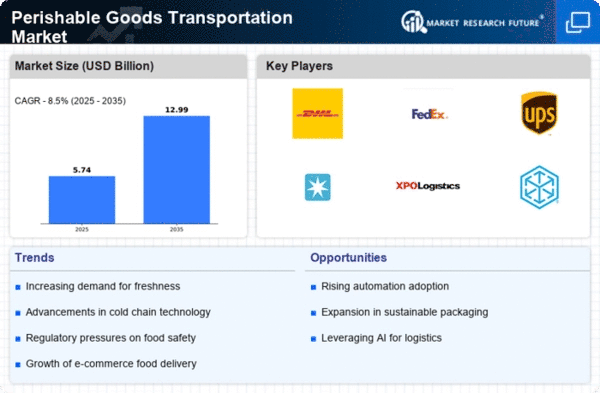
As per MRFR analysis, the Perishable Goods Transportation Market Size was estimated at 5.29 USD Billion in 2024. The Perishable Goods Transportation industry is projected to grow from 5.75 USD Billion in 2025 to 12.99 USD Billion by 2035, exhibiting a compound annual growth rate (CAGR) of 8.5 during the forecast period 2025 - 2035.

Key Market Trends & Highlights

The Perishable Goods Transportation Market is experiencing dynamic growth driven by technological advancements and increasing demand for fresh produce.

  • Sustainability initiatives are becoming a focal point for companies in the North American perishable goods transportation sector.
  • Technological advancements in logistics are enhancing efficiency, particularly in the food transportation segment.
  • E-commerce growth is significantly influencing the demand for rapid delivery of perishable goods in the Asia-Pacific region.
  • Rising demand for fresh produce and the expansion of retail and food service sectors are key drivers propelling market growth.

Market Size & Forecast

2024 Market Size 5.29 (USD Billion)
2035 Market Size 12.99 (USD Billion)
CAGR (2025 - 2035) 8.5%
Largest Regional Market Share in 2024 North America

Major Players

DHL (DE), FedEx (US), UPS (US), Maersk (DK), Kuehne + Nagel (CH), XPO Logistics (US), C.H. Robinson (US), DB Schenker (DE), Nippon Express (JP)

Market Trends

The Perishable Goods Transportation Market is currently experiencing a dynamic evolution, driven by the increasing demand for fresh and high-quality food products. This sector encompasses a variety of transportation methods, including refrigerated trucks, air freight, and maritime shipping, all tailored to maintain the integrity of perishable items during transit. As consumer preferences shift towards organic and locally sourced products, the market is adapting to ensure timely delivery while minimizing spoilage. Furthermore, advancements in technology, such as temperature monitoring systems and automated logistics, are enhancing operational efficiency and transparency in the supply chain. In December 2025, sustainability emerges as a pivotal focus within the Perishable Goods Transportation Market. Stakeholders are increasingly prioritizing eco-friendly practices, such as utilizing alternative fuels and optimizing routes to reduce carbon footprints. This trend aligns with global efforts to combat climate change and meet regulatory requirements. Additionally, the rise of e-commerce has transformed distribution channels, necessitating innovative solutions to cater to the growing consumer base seeking convenience and quality. Overall, the Perishable Goods Transportation Market appears poised for continued growth, driven by evolving consumer demands and technological advancements.

Sustainability Initiatives

The Perishable Goods Transportation Market is witnessing a pronounced shift towards sustainability. Companies are increasingly adopting eco-friendly practices, such as utilizing alternative fuels and optimizing logistics to minimize environmental impact. This trend reflects a broader commitment to reducing carbon emissions and adhering to regulatory standards.

Technological Advancements

Innovations in technology are reshaping the Perishable Goods Transportation Market. Enhanced tracking systems, temperature-controlled containers, and automated logistics solutions are improving efficiency and reducing spoilage. These advancements facilitate better monitoring of perishable items throughout the supply chain.

E-commerce Growth

The rise of e-commerce is significantly influencing the Perishable Goods Transportation Market. As consumers increasingly seek online shopping options for fresh produce and other perishables, companies are adapting their distribution strategies. This trend necessitates rapid delivery solutions and improved supply chain management.

Perishable Goods Transportation Market Market Drivers

Market Growth Projections

The Global Perishable Goods Transportation Market Industry is poised for substantial growth, with projections indicating a rise from 5.29 USD Billion in 2024 to 13.0 USD Billion by 2035. This growth is underpinned by a compound annual growth rate (CAGR) of 8.51% from 2025 to 2035. Factors contributing to this expansion include rising consumer demand for fresh produce, technological advancements in logistics, and the globalization of food supply chains. As stakeholders adapt to these trends, the market is likely to witness increased investment in cold chain logistics and innovative transportation solutions, ensuring that perishable goods are delivered efficiently and safely.

Rising Demand for Fresh Produce

The increasing global demand for fresh produce is a primary driver of the Global Perishable Goods Transportation Market Industry. As consumers become more health-conscious, the preference for fresh fruits and vegetables rises. This trend is particularly evident in urban areas where access to fresh produce is limited. In 2024, the market is valued at 5.29 USD Billion, reflecting the growing need for efficient transportation solutions. Retailers and distributors are investing in advanced logistics systems to ensure that perishable goods reach consumers in optimal condition. This demand is expected to propel the market significantly, with projections indicating a growth to 13.0 USD Billion by 2035.

Globalization of Food Supply Chains

The globalization of food supply chains is a significant factor influencing the Global Perishable Goods Transportation Market Industry. As countries engage in international trade, the movement of perishable goods across borders becomes essential. This trend is facilitated by trade agreements and advancements in transportation infrastructure, allowing for quicker delivery times. Countries are increasingly reliant on imports to meet domestic demand for fresh produce, which further drives the need for efficient logistics solutions. The market's growth trajectory is supported by the anticipated CAGR of 8.51% from 2025 to 2035, as stakeholders adapt to the complexities of global supply chains.

Technological Advancements in Logistics

Technological innovations are transforming the Global Perishable Goods Transportation Market Industry. The adoption of temperature-controlled logistics, real-time tracking systems, and automated warehousing solutions enhances the efficiency of transporting perishable goods. For instance, the implementation of IoT devices allows for continuous monitoring of temperature and humidity levels during transit, ensuring product integrity. As logistics companies embrace these technologies, they can reduce spoilage rates and improve delivery times. This trend is likely to contribute to the market's projected CAGR of 8.51% from 2025 to 2035, as stakeholders seek to optimize their supply chains and meet consumer expectations.

Regulatory Compliance and Food Safety Standards

Regulatory compliance and food safety standards play a crucial role in shaping the Global Perishable Goods Transportation Market Industry. Governments worldwide are implementing stringent regulations to ensure the safety and quality of perishable goods during transportation. Compliance with these regulations necessitates investment in specialized transportation equipment and training for personnel. Companies that prioritize food safety are likely to gain a competitive edge in the market. As the industry adapts to these evolving standards, the focus on maintaining product integrity during transit is expected to drive market growth, aligning with the projected increase in market value from 5.29 USD Billion in 2024 to 13.0 USD Billion by 2035.

Expansion of E-commerce and Online Grocery Shopping

The rapid expansion of e-commerce and online grocery shopping is reshaping the Global Perishable Goods Transportation Market Industry. Consumers increasingly prefer the convenience of ordering fresh food online, necessitating efficient logistics solutions to handle perishable items. Major retailers are investing in cold chain logistics to ensure that products remain fresh during transit. This shift is driving demand for specialized transportation services that can cater to the unique requirements of perishable goods. As a result, the market is expected to experience substantial growth, with a valuation of 5.29 USD Billion in 2024 and a forecasted increase to 13.0 USD Billion by 2035.

Market Segment Insights

By Application: Food Transportation (Largest) vs. Pharmaceutical Transportation (Fastest-Growing)

The Perishable Goods Transportation Market is predominantly driven by Food Transportation, which holds the largest market share among its peers. The demand for safe and efficient food distribution is increasing globally, particularly with the rise of online grocery shopping. Additionally, the segment has benefitted from advancements in cold chain logistics, ensuring that perishable food items reach consumers in optimal conditions. Meanwhile, Pharmaceutical Transportation is emerging as a critical area of growth, attributed to the increasing need for temperature-sensitive drugs and vaccines, especially highlighted by recent global health crises.

Food Transportation: Dominant vs. Pharmaceutical Transportation: Emerging

Food Transportation remains the dominant segment in the Perishable Goods Transportation Market, driven by the consistent demand for fresh produce and packaged food items. It relies heavily on sophisticated logistical networks equipped with temperature-controlled transport systems to maintain quality and safety. Conversely, Pharmaceutical Transportation is gaining prominence as an emerging sector, spurred by the rising importance of biotechnology and pharmaceuticals that require stringent temperature controls. This segment is characterized by its focus on compliance with strict regulations, employing advanced tracking technologies to ensure that drugs and vaccines are transported under precisely controlled conditions, enhancing the reliability and efficiency of supply chains.

By Transportation Mode: Road Transportation (Largest) vs. Air Transportation (Fastest-Growing)

In the Perishable Goods Transportation Market, Road Transportation holds the largest market share, dominating the logistics landscape due to its flexibility and efficiency in last-mile delivery. It is preferred for transporting perishable goods due to its ability to provide direct routes and minimize transit times, which is critical for maintaining the integrity of temperature-sensitive products. In contrast, Air Transportation, while sharing a smaller percentage of the market, has emerged as the fastest-growing segment, driven by increasing consumer demand for rapid shipping methods, especially for high-value perishables such as seafood and premium food products. Growth trends for the Transportation Mode segment are shaped by technological advancements and evolving consumer preferences. The rise of e-commerce and changing retail dynamics are pushing logistics providers to innovate in their service offerings. Road Transportation is benefitting from improved fleet management technologies and urban logistics solutions that enhance delivery efficiency. Meanwhile, Air Transportation is aided by enhancements in cargo aircraft capabilities and expanded air freight networks, making it increasingly viable for businesses looking to expedite their supply chains and respond quickly to market demands.

Road Transportation (Dominant) vs. Rail Transportation (Emerging)

Road Transportation stands out as the dominant player in the Perishable Goods Transportation Market due to its unparalleled flexibility and accessibility, allowing for quick responses to fluctuating demand and regional differences. It excels in short-haul distribution and offers the advantage of direct-to-consumer delivery. Conversely, Rail Transportation is emerging as a significant alternative, particularly for long-distance shipments where efficiency and cost-effectiveness can be maximized. Rail offers substantial environmental benefits and can transport large volumes of goods with reduced carbon footprints, appealing to environmentally-conscious companies. As the market evolves, Rail Transportation's role in budget-sensitive logistics will likely grow, especially as regions seek to balance efficiency and sustainability in their transportation strategies.

By Temperature Control Method: Refrigerated Transport (Largest) vs. Frozen Transport (Fastest-Growing)

In the Perishable Goods Transportation Market, Refrigerated Transport holds the largest market share among temperature control methods, providing essential solutions for transporting products that require consistent cooling during transit. This method is widely adopted due to its effectiveness in preserving the quality and freshness of various perishable goods, including fruits, vegetables, dairy, and meat. Conversely, Frozen Transport is emerging as a significant player, catering to the growing demand for frozen food products and maintaining stringent temperature controls necessary for their safe transportation. Growth trends within this segment highlight a substantial increase in Frozen Transport, driven by the rising consumer preference for convenient, ready-to-eat meals and the expansion of the frozen food sector. The industry's focus on sustainability and efficiency is also contributing to advancements in technology and logistics, facilitating better temperature control solutions for perishable goods. Furthermore, as global trade expands, the need for reliable temperature-controlled transport is becoming more critical, supporting the overall growth of both Refrigerated and Frozen Transport methods.

Refrigerated Transport (Dominant) vs. Frozen Transport (Emerging)

Refrigerated Transport is currently the dominant method in the Perishable Goods Transportation Market, providing effective solutions for transporting temperature-sensitive goods. This method is essential for maintaining the integrity of products requiring cooling, such as fresh seafood and meat, which can spoil rapidly. The infrastructure supporting refrigerated transport is well-established, with a wide array of refrigerated vehicles and containers in use across the supply chain. It ensures optimal temperature maintenance, thereby significantly reducing product spoilage rates and extending shelf life. On the other hand, Frozen Transport is emerging as a key player, driven by increasing consumer trends favoring frozen food products. This segment is gaining traction, particularly in urban areas where convenience is paramount. Innovations in cooling technology, coupled with the rising demand for frozen products, position Frozen Transport as a rapidly growing segment, complementing the established Refrigerated Transport method.

By End Use: Retail Distribution (Largest) vs. Direct-to-Consumer Delivery (Fastest-Growing)

The Perishable Goods Transportation Market showcases distinct segment values, notably Retail Distribution, Wholesale Distribution, and Direct-to-Consumer Delivery. Retail Distribution currently holds the largest share, reflecting strong consumer demand at physical stores and the efficiency of existing supply chains. Meanwhile, Wholesale Distribution maintains a crucial role in supplying retailers and maintaining stock levels but does not exhibit the same growth potential. Direct-to-Consumer Delivery is rapidly gaining ground as consumers increasingly prefer the convenience of home delivery, significantly influencing market trends.

Retail Distribution (Dominant) vs. Direct-to-Consumer Delivery (Emerging)

Retail Distribution stands as the dominant segment in the Perishable Goods Transportation Market, fueled by established infrastructure and consumer behavior favoring in-store shopping. Its robust logistics capabilities allow for efficient inventory management and timely delivery. Conversely, Direct-to-Consumer Delivery represents the emerging segment driven by digital transformation and changes in consumer preferences towards home deliveries. This shift is propelled by the need for convenience and the influence of e-commerce, prompting logistics providers to enhance their cold chain capabilities to ensure product freshness during transit. The ongoing evolution in consumer habits is reshaping the market landscape.

Get more detailed insights about Perishable Goods Transportation Market Research Report - Forecast to 2035

Regional Insights

North America : Market Leader in Transportation

North America is poised to maintain its leadership in the perishable goods transportation market, holding a significant market share of 2.65 in 2024. The region's growth is driven by increasing consumer demand for fresh produce and stringent food safety regulations. Additionally, advancements in cold chain logistics and technology are enhancing efficiency and reliability in transportation, further propelling market growth. The competitive landscape is characterized by major players such as FedEx, UPS, and DHL, which dominate the market with their extensive networks and innovative solutions. The U.S. stands out as a key player, supported by a robust infrastructure and regulatory framework that fosters growth. The presence of these leading companies ensures a dynamic market environment, catering to the rising demand for perishable goods across various sectors.

Europe : Emerging Market with Growth Potential

Europe's perishable goods transportation market is on the rise, with a market size of 1.5 in 2024. The growth is fueled by increasing cross-border trade and a growing preference for fresh food products among consumers. Regulatory support, particularly from the European Food Safety Authority, is enhancing food safety standards, which in turn drives demand for efficient transportation solutions. Leading countries in this region include Germany, France, and the UK, where companies like Maersk and Kuehne + Nagel are prominent. The competitive landscape is evolving, with a focus on sustainability and innovation in logistics. The presence of these key players ensures that the market remains dynamic, addressing the challenges of transporting perishable goods effectively.

Asia-Pacific : Rapidly Growing Market Segment

The Asia-Pacific region is witnessing significant growth in the perishable goods transportation market, with a market size of 0.9 in 2024. This growth is driven by rising disposable incomes and changing consumer preferences towards fresh and organic products. Additionally, government initiatives aimed at improving logistics infrastructure are acting as catalysts for market expansion. Countries like China and Japan are leading the charge, with companies such as Nippon Express and XPO Logistics playing crucial roles in the market. The competitive landscape is becoming increasingly dynamic, with a focus on enhancing cold chain capabilities and adopting advanced technologies to meet the growing demand for perishable goods transportation.

Middle East and Africa : Emerging Market with Challenges

The Middle East and Africa region is gradually developing its perishable goods transportation market, currently valued at 0.24 in 2024. The growth is primarily driven by increasing urbanization and a rising demand for fresh food products. However, challenges such as inadequate infrastructure and regulatory hurdles remain significant barriers to growth in this region. Countries like South Africa and the UAE are at the forefront of this market, with local players striving to enhance their logistics capabilities. The competitive landscape is characterized by a mix of established companies and emerging players, all working to improve cold chain logistics and address the unique challenges of transporting perishable goods in this diverse region.

Key Players and Competitive Insights

The Perishable Goods Transportation Market is characterized by a dynamic competitive landscape, driven by the increasing demand for fresh produce, pharmaceuticals, and other temperature-sensitive products. Key players such as DHL (DE), FedEx (US), and Maersk (DK) are strategically positioning themselves through innovation and digital transformation. DHL (DE) focuses on enhancing its cold chain logistics capabilities, while FedEx (US) emphasizes its network expansion to improve delivery efficiency. Maersk (DK) is investing in sustainable shipping solutions, which reflects a broader trend towards environmentally responsible practices in the industry. Collectively, these strategies contribute to a competitive environment that prioritizes efficiency, sustainability, and customer satisfaction.In terms of business tactics, companies are increasingly localizing their operations and optimizing supply chains to meet the specific needs of regional markets. The market structure appears moderately fragmented, with several key players exerting significant influence. This fragmentation allows for a variety of service offerings, yet the collective strength of major companies like Kuehne + Nagel (CH) and UPS (US) shapes the competitive dynamics, as they leverage their extensive networks and technological advancements to gain market share.

In November Kuehne + Nagel (CH) announced a partnership with a leading biotechnology firm to enhance its temperature-controlled logistics services. This collaboration aims to streamline the transportation of sensitive medical products, indicating a strategic move towards catering to the growing pharmaceutical sector. Such partnerships are likely to bolster Kuehne + Nagel's position in the market, as they align with the increasing demand for specialized logistics solutions.

In October UPS (US) unveiled its new AI-driven route optimization software, designed to improve delivery times for perishable goods. This technological advancement not only enhances operational efficiency but also reduces carbon emissions, aligning with the industry's shift towards sustainability. The implementation of AI in logistics signifies a critical step in maintaining competitive advantage in a rapidly evolving market.

In December FedEx (US) launched a new cold chain service specifically tailored for the e-commerce sector, addressing the rising demand for home delivery of perishable items. This initiative reflects FedEx's commitment to innovation and responsiveness to market trends, potentially positioning the company as a leader in the e-commerce logistics space.

As of December current competitive trends in the Perishable Goods Transportation Market are heavily influenced by digitalization, sustainability, and the integration of AI technologies. Strategic alliances are becoming increasingly vital, as companies seek to enhance their service offerings and operational capabilities. The competitive landscape is shifting from traditional price-based competition to a focus on innovation, technology, and supply chain reliability. This evolution suggests that companies that prioritize these aspects will likely emerge as leaders in the market, adapting to the changing demands of consumers and regulatory environments.

Key Companies in the Perishable Goods Transportation Market include

Industry Developments

June 2023: UPS Supply Chain Solutions and Emergent Cold partnered to provide integrated warehousing and transportation solutions for customers in the life sciences and healthcare industries, including temperature-controlled services for pharmaceuticals and perishable medical supplies.

May 2023: XPO Logistics, Inc. and Burris Logistics formed a strategic alliance to expand their refrigerated transportation network and offer customers a wider range of services in the North American food and beverage industry.

March 2023: Fresh Del Monte Produce Inc. and Mediterranean Shipping Company (MSC) partnered to develop innovative logistics solutions for transporting fresh produce around the world, focusing on sustainability and efficiency.

Future Outlook

Perishable Goods Transportation Market Future Outlook

The Perishable Goods Transportation Market is projected to grow at an 8.5% CAGR from 2025 to 2035, driven by technological advancements, increasing demand for fresh produce, and globalization of supply chains.

New opportunities lie in:

  • Implementation of IoT-enabled temperature monitoring systems
  • Expansion of cold chain logistics networks in emerging markets
  • Development of automated packaging solutions for perishables

By 2035, the market is expected to be robust, driven by innovation and increased efficiency.

Market Segmentation

Perishable Goods Transportation Market End Use Outlook

  • Retail Distribution
  • Wholesale Distribution
  • Direct-to-Consumer Delivery

Perishable Goods Transportation Market Application Outlook

  • Food Transportation
  • Pharmaceutical Transportation
  • Floral Transportation
  • Beverage Transportation

Perishable Goods Transportation Market Transportation Mode Outlook

  • Road Transportation
  • Rail Transportation
  • Air Transportation
  • Sea Transportation

Perishable Goods Transportation Market Temperature Control Method Outlook

  • Refrigerated Transport
  • Frozen Transport
  • Ambient Transport

Report Scope

MARKET SIZE 20245.29(USD Billion)
MARKET SIZE 20255.75(USD Billion)
MARKET SIZE 203512.99(USD Billion)
COMPOUND ANNUAL GROWTH RATE (CAGR)8.5% (2025 - 2035)
REPORT COVERAGERevenue Forecast, Competitive Landscape, Growth Factors, and Trends
BASE YEAR2024
Market Forecast Period2025 - 2035
Historical Data2019 - 2024
Market Forecast UnitsUSD Billion
Key Companies ProfiledDHL (DE), FedEx (US), UPS (US), Maersk (DK), Kuehne + Nagel (CH), XPO Logistics (US), C.H. Robinson (US), DB Schenker (DE), Nippon Express (JP)
Segments CoveredApplication, Transportation Mode, Temperature Control Method, End Use
Key Market OpportunitiesIntegration of advanced tracking technologies enhances efficiency in the Perishable Goods Transportation Market.
Key Market DynamicsRising demand for temperature-controlled logistics drives innovation in perishable goods transportation solutions.
Countries CoveredNorth America, Europe, APAC, South America, MEA

FAQs

How much is the Perishable Goods Transportation market?

The Perishable Goods Transportation market size was valued at USD 5.29 Billion in 2024.

What is the growth rate of the Perishable Goods Transportation market?

Perishable Goods Transportation Market is projected to register a CAGR of 8.5% from 2025-2035

Which region held the biggest market share in the Perishable Goods Transportation market?

North America held the largest share of the market

Who are the prime players in the Perishable Goods Transportation market?

The key players in the market are Africa Express Line Limited, Bay & Bay Transportation, C.H. Robinson Worldwide Inc, CMA CGM Group (MERIT France SAS), DB Schenker, Deutsche Post AG, FST Logistics Inc, Hapag-Lloyd AG, Hellmann Worldwide Logistics SE, K Line Logistics Ltd (Kawasaki Kisen Kaisha Ltd).

Which type led the Perishable Goods Transportation market?

The MPS category dominated the market in 2022.

Which mode of transportation had the largest market share in the Perishable Goods Transportation market?

Road transportation had the largest share of the market.

  1. SECTION I: EXECUTIVE SUMMARY AND KEY HIGHLIGHTS
    1. | 1.1 EXECUTIVE SUMMARY
    2. | 1.1.1 Market Overview
    3. | 1.1.2 Key Findings
    4. | 1.1.3 Market Segmentation
    5. | 1.1.4 Competitive Landscape
    6. | 1.1.5 Challenges and Opportunities
    7. | 1.1.6 Future Outlook
  2. SECTION II: SCOPING, METHODOLOGY AND MARKET STRUCTURE
    1. | 2.1 MARKET INTRODUCTION
    2. | 2.1.1 Definition
    3. | 2.1.2 Scope of the study
    4. |-- 2.1.2.1 Research Objective
    5. |-- 2.1.2.2 Assumption
    6. |-- 2.1.2.3 Limitations
    7. | 2.2 RESEARCH METHODOLOGY
    8. | 2.2.1 Overview
    9. | 2.2.2 Data Mining
    10. | 2.2.3 Secondary Research
    11. | 2.2.4 Primary Research
    12. |-- 2.2.4.1 Primary Interviews and Information Gathering Process
    13. |-- 2.2.4.2 Breakdown of Primary Respondents
    14. | 2.2.5 Forecasting Model
    15. | 2.2.6 Market Size Estimation
    16. |-- 2.2.6.1 Bottom-Up Approach
    17. |-- 2.2.6.2 Top-Down Approach
    18. | 2.2.7 Data Triangulation
    19. | 2.2.8 Validation
  3. SECTION III: QUALITATIVE ANALYSIS
    1. | 3.1 MARKET DYNAMICS
    2. | 3.1.1 Overview
    3. | 3.1.2 Drivers
    4. | 3.1.3 Restraints
    5. | 3.1.4 Opportunities
    6. | 3.2 MARKET FACTOR ANALYSIS
    7. | 3.2.1 Value chain Analysis
    8. | 3.2.2 Porter's Five Forces Analysis
    9. |-- 3.2.2.1 Bargaining Power of Suppliers
    10. |-- 3.2.2.2 Bargaining Power of Buyers
    11. |-- 3.2.2.3 Threat of New Entrants
    12. |-- 3.2.2.4 Threat of Substitutes
    13. |-- 3.2.2.5 Intensity of Rivalry
    14. | 3.2.3 COVID-19 Impact Analysis
    15. |-- 3.2.3.1 Market Impact Analysis
    16. |-- 3.2.3.2 Regional Impact
    17. |-- 3.2.3.3 Opportunity and Threat Analysis
  4. SECTION IV: QUANTITATIVE ANALYSIS
    1. | 4.1 Packaging & Transport, BY Application (USD Billion)
    2. | 4.1.1 Food Transportation
    3. | 4.1.2 Pharmaceutical Transportation
    4. | 4.1.3 Floral Transportation
    5. | 4.1.4 Beverage Transportation
    6. | 4.2 Packaging & Transport, BY Transportation Mode (USD Billion)
    7. | 4.2.1 Road Transportation
    8. | 4.2.2 Rail Transportation
    9. | 4.2.3 Air Transportation
    10. | 4.2.4 Sea Transportation
    11. | 4.3 Packaging & Transport, BY Temperature Control Method (USD Billion)
    12. | 4.3.1 Refrigerated Transport
    13. | 4.3.2 Frozen Transport
    14. | 4.3.3 Ambient Transport
    15. | 4.4 Packaging & Transport, BY End Use (USD Billion)
    16. | 4.4.1 Retail Distribution
    17. | 4.4.2 Wholesale Distribution
    18. | 4.4.3 Direct-to-Consumer Delivery
    19. | 4.5 Packaging & Transport, BY Region (USD Billion)
    20. | 4.5.1 North America
    21. |-- 4.5.1.1 US
    22. |-- 4.5.1.2 Canada
    23. | 4.5.2 Europe
    24. |-- 4.5.2.1 Germany
    25. |-- 4.5.2.2 UK
    26. |-- 4.5.2.3 France
    27. |-- 4.5.2.4 Russia
    28. |-- 4.5.2.5 Italy
    29. |-- 4.5.2.6 Spain
    30. |-- 4.5.2.7 Rest of Europe
    31. | 4.5.3 APAC
    32. |-- 4.5.3.1 China
    33. |-- 4.5.3.2 India
    34. |-- 4.5.3.3 Japan
    35. |-- 4.5.3.4 South Korea
    36. |-- 4.5.3.5 Malaysia
    37. |-- 4.5.3.6 Thailand
    38. |-- 4.5.3.7 Indonesia
    39. |-- 4.5.3.8 Rest of APAC
    40. | 4.5.4 South America
    41. |-- 4.5.4.1 Brazil
    42. |-- 4.5.4.2 Mexico
    43. |-- 4.5.4.3 Argentina
    44. |-- 4.5.4.4 Rest of South America
    45. | 4.5.5 MEA
    46. |-- 4.5.5.1 GCC Countries
    47. |-- 4.5.5.2 South Africa
    48. |-- 4.5.5.3 Rest of MEA
  5. SECTION V: COMPETITIVE ANALYSIS
    1. | 5.1 Competitive Landscape
    2. | 5.1.1 Overview
    3. | 5.1.2 Competitive Analysis
    4. | 5.1.3 Market share Analysis
    5. | 5.1.4 Major Growth Strategy in the Packaging & Transport
    6. | 5.1.5 Competitive Benchmarking
    7. | 5.1.6 Leading Players in Terms of Number of Developments in the Packaging & Transport
    8. | 5.1.7 Key developments and growth strategies
    9. |-- 5.1.7.1 New Product Launch/Service Deployment
    10. |-- 5.1.7.2 Merger & Acquisitions
    11. |-- 5.1.7.3 Joint Ventures
    12. | 5.1.8 Major Players Financial Matrix
    13. |-- 5.1.8.1 Sales and Operating Income
    14. |-- 5.1.8.2 Major Players R&D Expenditure. 2023
    15. | 5.2 Company Profiles
    16. | 5.2.1 DHL (DE)
    17. |-- 5.2.1.1 Financial Overview
    18. |-- 5.2.1.2 Products Offered
    19. |-- 5.2.1.3 Key Developments
    20. |-- 5.2.1.4 SWOT Analysis
    21. |-- 5.2.1.5 Key Strategies
    22. | 5.2.2 FedEx (US)
    23. |-- 5.2.2.1 Financial Overview
    24. |-- 5.2.2.2 Products Offered
    25. |-- 5.2.2.3 Key Developments
    26. |-- 5.2.2.4 SWOT Analysis
    27. |-- 5.2.2.5 Key Strategies
    28. | 5.2.3 UPS (US)
    29. |-- 5.2.3.1 Financial Overview
    30. |-- 5.2.3.2 Products Offered
    31. |-- 5.2.3.3 Key Developments
    32. |-- 5.2.3.4 SWOT Analysis
    33. |-- 5.2.3.5 Key Strategies
    34. | 5.2.4 Maersk (DK)
    35. |-- 5.2.4.1 Financial Overview
    36. |-- 5.2.4.2 Products Offered
    37. |-- 5.2.4.3 Key Developments
    38. |-- 5.2.4.4 SWOT Analysis
    39. |-- 5.2.4.5 Key Strategies
    40. | 5.2.5 Kuehne + Nagel (CH)
    41. |-- 5.2.5.1 Financial Overview
    42. |-- 5.2.5.2 Products Offered
    43. |-- 5.2.5.3 Key Developments
    44. |-- 5.2.5.4 SWOT Analysis
    45. |-- 5.2.5.5 Key Strategies
    46. | 5.2.6 XPO Logistics (US)
    47. |-- 5.2.6.1 Financial Overview
    48. |-- 5.2.6.2 Products Offered
    49. |-- 5.2.6.3 Key Developments
    50. |-- 5.2.6.4 SWOT Analysis
    51. |-- 5.2.6.5 Key Strategies
    52. | 5.2.7 C.H. Robinson (US)
    53. |-- 5.2.7.1 Financial Overview
    54. |-- 5.2.7.2 Products Offered
    55. |-- 5.2.7.3 Key Developments
    56. |-- 5.2.7.4 SWOT Analysis
    57. |-- 5.2.7.5 Key Strategies
    58. | 5.2.8 DB Schenker (DE)
    59. |-- 5.2.8.1 Financial Overview
    60. |-- 5.2.8.2 Products Offered
    61. |-- 5.2.8.3 Key Developments
    62. |-- 5.2.8.4 SWOT Analysis
    63. |-- 5.2.8.5 Key Strategies
    64. | 5.2.9 Nippon Express (JP)
    65. |-- 5.2.9.1 Financial Overview
    66. |-- 5.2.9.2 Products Offered
    67. |-- 5.2.9.3 Key Developments
    68. |-- 5.2.9.4 SWOT Analysis
    69. |-- 5.2.9.5 Key Strategies
    70. | 5.3 Appendix
    71. | 5.3.1 References
    72. | 5.3.2 Related Reports

Packaging & Transport Market Segmentation

Packaging & Transport By Application (USD Billion, 2025-2035)

  • Food Transportation
  • Pharmaceutical Transportation
  • Floral Transportation
  • Beverage Transportation

Packaging & Transport By Transportation Mode (USD Billion, 2025-2035)

  • Road Transportation
  • Rail Transportation
  • Air Transportation
  • Sea Transportation

Packaging & Transport By Temperature Control Method (USD Billion, 2025-2035)

  • Refrigerated Transport
  • Frozen Transport
  • Ambient Transport

Packaging & Transport By End Use (USD Billion, 2025-2035)

  • Retail Distribution
  • Wholesale Distribution
  • Direct-to-Consumer Delivery
Infographic

Free Sample Request

Kindly complete the form below to receive a free sample of this Report

Get Free Sample

Customer Strories

Compare Licence

×
Features License Type
Single User Multiuser License Enterprise User
Price $4,950 $5,950 $7,250
Maximum User Access Limit 1 User Upto 10 Users Unrestricted Access Throughout the Organization
Free Customization
Direct Access to Analyst
Deliverable Format
Platform Access
Discount on Next Purchase 10% 15% 15%
Printable Versions