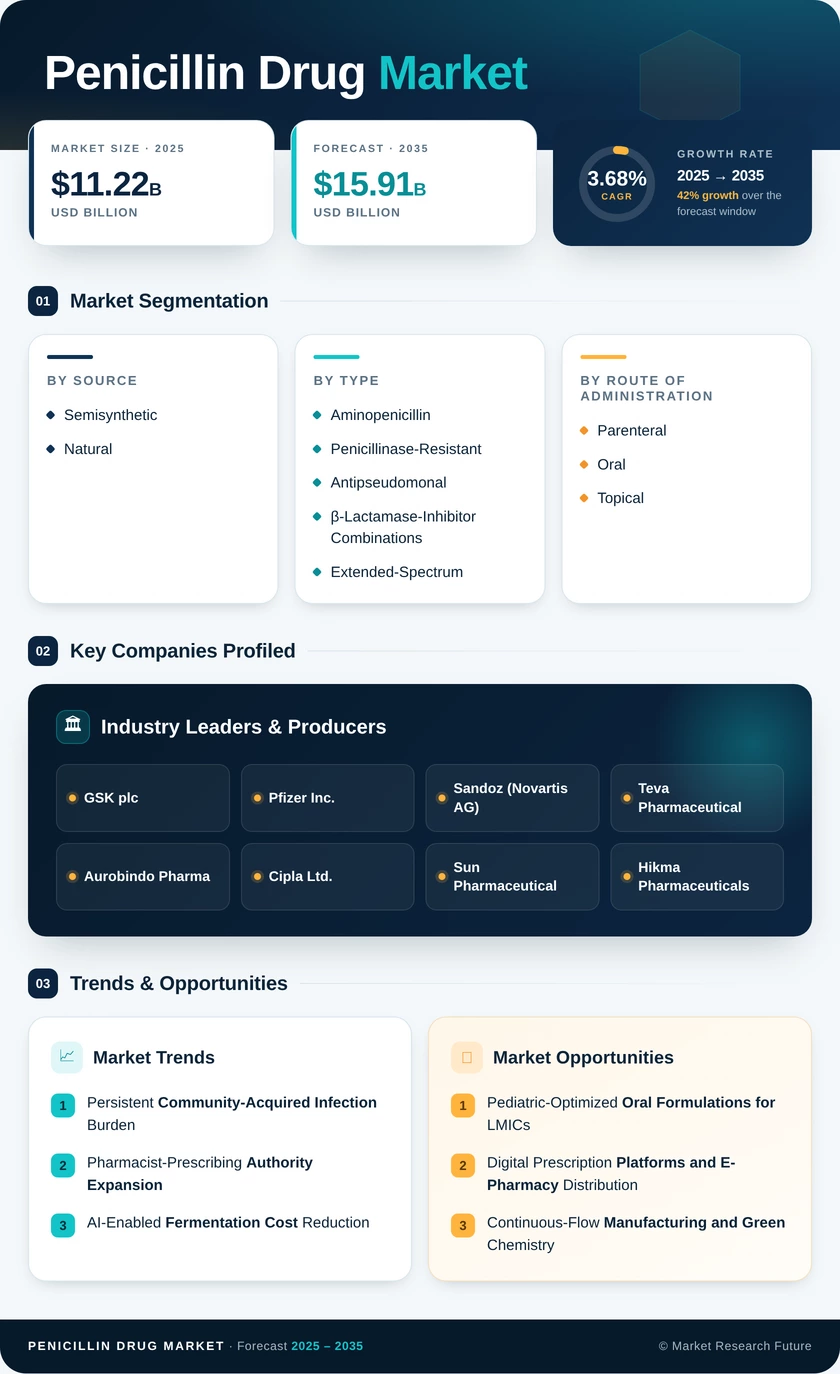
Segmentation Quick Reference
| Dimension | Sub-Segments | Dominant Segment | Fastest Growing Segment |
| Source | Natural, Semisynthetic | Semisynthetic | Semisynthetic |
| Product Type | Aminopenicillin, Penicillinase-Resistant, Antipseudomonal, β-Lactamase-Inhibitor Combinations, Extended-Spectrum | Aminopenicillin | β-Lactamase-Inhibitor Combinations |
| Route of Administration | Oral, Parenteral, Topical | Parenteral | Oral |
| Spectrum of Activity | Narrow-Spectrum, Broad-Spectrum, Extended-Spectrum | Broad-Spectrum | Extended-Spectrum |
| Distribution Channel | Hospital Pharmacies, Retail/Community Pharmacies, Online Pharmacies | Hospital Pharmacies | Retail/Community Pharmacies |
Market Segmentation Overview
By Source
| Sub-Segment | Key Trend |
| Natural | Steady niche demand for injectable Penicillin G in rheumatic fever and syphilis prophylaxis programs |
| Semisynthetic | Volume-driven growth through aminopenicillin prescribing; side-chain innovation enabling new combination products |
Semisynthetic penicillins remain the commercial backbone of the market, encompassing amoxicillin, ampicillin, and their derivative combinations. Natural penicillins retain a clinically essential but volume-limited role in targeted infectious-disease therapy.
By Product Type
| Sub-Segment | Key Trend |
| Aminopenicillin | Highest-volume class globally; first-line for community respiratory and urinary infections |
| Penicillinase-Resistant | Stable hospital demand for MSSA coverage; limited pipeline innovation |
| Antipseudomonal | Growing ICU utilization for gram-negative nosocomial infections |
| β-Lactamase-Inhibitor Combinations | Fastest-growing type; new pairings targeting ESBL and carbapenemase producers |
| Extended-Spectrum | Broadening gram-negative coverage; formulary adoption is increasing in Asia-Pacific hospitals. |
Aminopenicillins and β-lactamase-inhibitor combinations together represent the primary growth engines. Aminopenicillins dominate by volume, while inhibitor combinations lead by growth rate as resistance pressures shift hospital prescribing patterns.
By Route of Administration
| Sub-Segment | Key Trend |
| Oral | Fastest-growing route; pharmacist prescribing and OPAT step-down protocols expanding access |
| Parenteral | Largest route by revenue; anchored by hospital inpatient IV protocols |
| Topical | Smallest segment: niche wound-care and dermatological applications |
The shift from inpatient parenteral therapy to earlier oral step-down is a defining trend, reducing hospital length-of-stay and redirecting revenue toward community-pharmacy channels.
By Spectrum of Activity
| Sub-Segment | Key Trend |
| Narrow-Spectrum | Targeted therapy for streptococcal and treponemal infections; stewardship-favored |
| Broad-Spectrum | Largest segment: empiric prescribing across community and hospital settings |
| Extended-Spectrum | Fastest-growing; addressing ESBL-producing pathogen coverage gaps |
Antimicrobial stewardship programs are gradually shifting prescribing from broad-spectrum empiric therapy toward targeted narrow- and extended-spectrum agents, depending on resistance patterns.
By Distribution Channel
| Sub-Segment | Key Trend |
| Hospital Pharmacies | Dominant channel; parenteral and combination-product distribution hub |
| Retail/Community Pharmacies | Fastest-growing; pharmacist-initiated prescribing unlocking new dispensing volumes |
| Online Pharmacies | Emerging channel in India and ASEAN; digital platforms improving access and demand visibility |
Community and online pharmacies are collectively gaining share as prescribing authority decentralizes and e-commerce platforms penetrate emerging-market healthcare ecosystems.


 Noah Malgeri
Co-Founder

 Peter Groot koerkamp
Account and Business Manager

 Younghwan Choi
Senior Retail Manager

 Mark Irwin
Management Consultant

 Akif Moroglu
Strategy & Business Development Director

 Guilherme Gomes Martins
Product Management Director

 Joseph Aguayo
Sales Operations & Pricing Manager

 La Terria Dodd
Program Support Specialist

 Rob Kooiker
Group Product Manager HVAC & Fire Protection GMA