Request Free Sample ×

Kindly complete the form below to receive a free sample of this Report

* Please use a valid business email

Leading companies partner with us for data-driven Insights

clients tt-cursor
Hero Background
English
Chinese
French
Japanese
Korean
German
Spanish

Pediatric Healthcare Market Analysis

ID: MRFR/Pharma/2061-HCR
72 Pages
Vikita Thakur
April 2026

Middle East and Africa Pediatric Healthcare Market Research Report Information By Type Of Diseases (Short Term Diseases, Chronic Diseases And Others), By Therapeutics (Cardiology, Allergy and Immunology, Gastroenterology, Infectious Disease and Others), By Treatment (Medication, Surgery, and Others) And By Region (Middle East and Africa) –Market Forecast Till 2035

Share:
Download PDF ×

We do not share your information with anyone. However, we may send you emails based on your report interest from time to time. You may contact us at any time to opt-out.

Pediatric Healthcare Market Infographic
Purchase Options

Market Analysis

In-depth Analysis of Pediatric Healthcare Market Industry Landscape

The Pediatric Healthcare Market is a very dynamic and rapidly developing area that has a major role of ensuring the well-being of children globally. A combination of technological advancements, demographic trends, regulatory landscapes and growing awareness about child health shape market dynamics in pediatric healthcare.

Constant improvement in medical technology is one of the main causes of market dynamics in pediatric healthcare. Telemedicine, wearables and diagnostics specifically for kids are some of the innovative things that have changed how healthcare is given to child patients. In addition to improving diagnosis accuracy and efficiency, these technologies contribute to better patient outcomes. Consequently, cutting-edge pediatric healthcare solutions continue being more sought after thereby driving market expansion and making healthcare providers together with tech companies work under a competitive environment.

Demographics also significantly affect pediatric healthcare markets dynamics. An increasing global population of children necessitates more specialized healthcare services. This enlarging number of kids mostly results from increased birth rates as well as high life expectancy which means there are opportunities for makers medical devices as well as pharmaceuticals plus it makes providers extend their offerings or broaden their market presence.

Regulation landscape plays an important role in forming dynamics within the pediatric health care industry. Governments all over the world are increasingly putting regulations and guidelines in place regarding children’s’ health such as stringent rules relating to drugs used by them or those who manufacture medical equipment for this specific group.The regulations aim at meeting particular needs that arise when dealing with children’s’ health care hence promoting research and development within this sector.Consequently ,compliance with regulatory standards has become critical for companies operating in the pediatric healthcare field determining their strategies towards product development.

Additionally, parents and other caregivers have now realized how important it is to consider the growth of this market segment. Parents can access information via websites and social media making them knowledgeable about early prevention measures against diseases among other things. As their level of knowledge increases on prevention just like pros early treatment options will definitely be sought by many of them which eventually lead to an improvement in healthcare utilization. Moreover, the increased awareness has also led to a demand for special pediatric health care services that cater for specific needs and preferences of this consumer segment thereby creating room for market players to address these needs.


Author
Author Profile
Vikita Thakur
Senior Research Analyst

She holds an experience of about 5+ years in market research and business consulting projects for sectors such as life sciences, medical devices, and healthcare IT. She possesses a robust background in data analysis, market estimation, competitive intelligence, pipeline analysis market trend identification, and consumer behavior insights. Her expertise lies in technical Sales support, client interaction and project management, designing and implementing market research studies, conducting competitive analysis, and synthesizing complex data into actionable recommendations that drive business growth.

Leave a Comment

FAQs

What is the current valuation of the Middle East and Africa Pediatric Healthcare Market?

<p>The market valuation was 50.01 USD Billion in 2024.</p>

What is the projected market size for the Middle East and Africa Pediatric Healthcare Market by 2035?

<p>The market is projected to reach 75.71 USD Billion by 2035.</p>

What is the expected CAGR for the Middle East and Africa Pediatric Healthcare Market during the forecast period 2025 - 2035?

<p>The expected CAGR is 3.84% during the forecast period 2025 - 2035.</p>

Which companies are considered key players in the Middle East and Africa Pediatric Healthcare Market?

<p>Key players include Roche, Pfizer, Novartis, Sanofi, GlaxoSmithKline, Merck, AstraZeneca, Bristol-Myers Squibb, and Johnson & Johnson.</p>

What are the primary segments of the Middle East and Africa Pediatric Healthcare Market?

<p>The primary segments include Type of Diseases, Therapeutics, and Treatment.</p>

How much revenue is generated from short-term diseases in the pediatric healthcare market?

Revenue from short-term diseases was between 15.0 and 22.0 USD Billion.

What is the revenue range for chronic diseases in the pediatric healthcare market?

The revenue range for chronic diseases is between 20.0 and 30.0 USD Billion.

Which therapeutic area generates the highest revenue in the pediatric healthcare market?

The 'Others' category in therapeutics generates the highest revenue, ranging from 31.51 to 48.21 USD Billion.

What is the revenue range for surgical treatments in the pediatric healthcare market?

Revenue from surgical treatments is projected to be between 15.0 and 25.0 USD Billion.

How does the pediatric healthcare market in the Middle East and Africa compare to other regions?

While specific comparisons are not provided, the market's growth trajectory suggests a robust development in pediatric healthcare within the region.

Market Summary

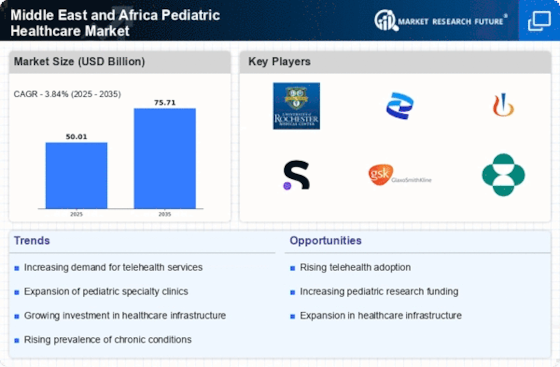
As per Market Research Future analysis, the Middle East and Africa Pediatric Healthcare Market was estimated at 50.01 USD Billion in 2024. The pediatric healthcare industry is projected to grow from 51.93 USD Billion in 2025 to 75.71 USD Billion by 2035, exhibiting a compound annual growth rate (CAGR) of 3.84% during the forecast period 2025 - 2035

Key Market Trends & Highlights

The Middle East and Africa Pediatric Healthcare Market is experiencing transformative growth driven by technological advancements and a focus on preventive care.

  • The rise of telehealth services is reshaping pediatric healthcare delivery across the region. There is an increasing emphasis on preventive care, reflecting a shift towards long-term health management for children. Integration of advanced technologies is becoming prevalent, particularly in the management of chronic diseases, which remains the largest segment. The increasing pediatric population and government initiatives are key drivers propelling market growth, especially in cardiology and infectious disease segments.

Market Size & Forecast

2024 Market Size 50.01 (USD Billion)
2035 Market Size 75.71 (USD Billion)
CAGR (2025 - 2035) 3.84%
Largest Regional Market Share in 2024 MEA

Major Players

<a href="https://medically.roche.com/be/en/oncology/diseases/paediatric-oncology.html">Roche </a>(CH), Pfizer (US), Novartis (CH), Sanofi (FR), GlaxoSmithKline (GB), Merck (US), AstraZeneca (GB), <a href="https://www.bms.com/about-us/responsibility/bristol-myers-squibb-foundation/our-focus-areas/pediatric-cancer-and-blood-disorders.html">Bristol-Myers Squibb</a> (US), Johnson &amp; Johnson (US)

Market Trends

The Middle East and Africa Pediatric Healthcare Market is currently experiencing a transformative phase, characterized by a growing emphasis on specialized pediatric care. This shift is largely driven by an increasing awareness of children's health issues and the necessity for tailored healthcare solutions. Healthcare providers are progressively adopting advanced technologies and innovative practices to enhance the quality of care delivered to younger populations. Furthermore, the integration of telemedicine and digital health solutions appears to be gaining traction, facilitating access to healthcare services in remote areas. This trend is particularly relevant in regions where healthcare infrastructure may be limited, thereby ensuring that pediatric patients receive timely and effective care. In addition, there is a noticeable rise in collaborative efforts among governments, healthcare organizations, and non-profits aimed at improving pediatric health outcomes. These partnerships are likely to focus on preventive care, education, and community outreach initiatives. As a result, the Middle East and Africa Pediatric Healthcare Market is poised for growth, with stakeholders increasingly recognizing the importance of investing in children's health. The future landscape may see enhanced regulatory frameworks and funding opportunities that support pediatric healthcare initiatives, ultimately leading to better health outcomes for children across the region.

Rise of Telehealth Services

The adoption of telehealth services is becoming more prevalent in the Middle East and Africa Pediatric Healthcare Market. This trend is driven by the need for accessible healthcare solutions, particularly in underserved areas. Telehealth enables healthcare providers to reach pediatric patients remotely, offering consultations and follow-up care without the need for physical visits. This approach not only improves access but also enhances the efficiency of healthcare delivery.

Focus on Preventive Care

There is an increasing emphasis on preventive care within the Middle East and Africa Pediatric Healthcare Market. Stakeholders are recognizing the importance of early intervention and health education to mitigate potential health issues. Programs aimed at vaccination, nutrition, and wellness are being prioritized, reflecting a shift towards proactive healthcare strategies that aim to improve long-term health outcomes for children.

Integration of Advanced Technologies

The integration of advanced technologies in pediatric healthcare is gaining momentum. Innovations such as artificial intelligence, wearable health devices, and electronic health records are being utilized to enhance patient care. These technologies facilitate better monitoring of children's health, streamline processes, and support healthcare professionals in making informed decisions, thereby improving overall service delivery.

Pediatric Healthcare Market Market Drivers

Focus on Preventive Healthcare

The emphasis on preventive healthcare is becoming increasingly prominent in the Middle East and Africa Pediatric Healthcare Market. Healthcare providers are recognizing the importance of preventive measures in reducing the incidence of childhood diseases. Initiatives such as vaccination programs, nutritional education, and regular health screenings are being prioritized to promote overall child health. This shift towards preventive care is likely to result in a decrease in hospital admissions and long-term healthcare costs. As parents become more aware of the benefits of preventive healthcare, the demand for such services is expected to rise. Consequently, healthcare providers may invest more in preventive programs, thereby enhancing the overall pediatric healthcare landscape in the region.

Increasing Pediatric Population

The Middle East and Africa Pediatric Healthcare Market is experiencing growth due to the rising pediatric population. According to demographic data, the region has one of the highest birth rates globally, contributing to a substantial increase in the number of children requiring healthcare services. This demographic trend necessitates the expansion of pediatric healthcare facilities and services to cater to the growing needs of this population. As the number of children under the age of 14 is projected to reach over 200 million by 2030, healthcare providers are likely to invest in specialized pediatric care, thereby driving the market forward. The increasing demand for pediatric healthcare services is expected to stimulate innovations in treatment and care delivery, enhancing overall healthcare outcomes for children.

Government Initiatives and Funding

Government initiatives aimed at improving healthcare infrastructure are pivotal in the Middle East and Africa Pediatric Healthcare Market. Various governments in the region are allocating significant budgets to enhance healthcare services, particularly for children. For instance, initiatives to build new hospitals and clinics, along with funding for pediatric research, are becoming more prevalent. The World Health Organization has noted that investments in child health can yield substantial returns, potentially reducing long-term healthcare costs. As a result, the focus on pediatric healthcare is likely to increase, with governments prioritizing child health in their national health agendas. This trend may lead to improved access to healthcare services for children, ultimately benefiting the pediatric population.

Rising Awareness of Child Health Issues

There is a growing awareness of child health issues among parents and caregivers in the Middle East and Africa Pediatric Healthcare Market. Educational campaigns and community outreach programs are increasingly emphasizing the importance of regular health check-ups, vaccinations, and preventive care. This heightened awareness is likely to lead to increased demand for pediatric healthcare services, as parents become more proactive in seeking medical attention for their children. Furthermore, the prevalence of non-communicable diseases among children is prompting healthcare providers to focus on early diagnosis and management. As a result, the market may witness a surge in the development of specialized pediatric services and programs aimed at addressing these health concerns.

Technological Advancements in Healthcare

Technological advancements are playing a crucial role in shaping the Middle East and Africa Pediatric Healthcare Market. The integration of telemedicine, electronic health records, and mobile health applications is transforming how pediatric care is delivered. These technologies facilitate better communication between healthcare providers and families, ensuring timely interventions and follow-ups. Moreover, the adoption of advanced diagnostic tools and treatment modalities is enhancing the quality of care for children. As healthcare providers increasingly leverage technology to improve service delivery, the market is likely to expand, driven by the demand for innovative solutions that cater specifically to pediatric needs. This trend may also lead to improved health outcomes for children across the region.

Market Segment Insights

By Type of Diseases: Chronic Diseases (Largest) vs. Short Term Diseases (Fastest-Growing)

<p>In the Middle East and Africa Pediatric Healthcare Market, the distribution of diseases in pediatric care reveals a landscape where chronic diseases capture the largest market share, reflecting the growing prevalence of long-term health issues among children. Conditions such as asthma, diabetes, and congenital disorders are increasingly recognized, necessitating long-term care management and treatment options. Meanwhile, short-term diseases, which include common infections and seasonal ailments, are rapidly gaining significance, attributed to increased awareness and improved diagnostic measures within the region. The growth trends within this segment are driven by various factors including urbanization, changing lifestyles, and improved healthcare access in many Middle Eastern and African countries. Parents are increasingly aware of the need for proactive healthcare for their children, leading to a surge in demand for vaccines and preventive measures against both chronic and short-term diseases. Furthermore, public health initiatives aimed at educating families about disease prevention contribute to the rapidly evolving landscape of pediatric healthcare, focusing on both proactive and reactive healthcare strategies.</p>

<p>Chronic Diseases (Dominant) vs. Short Term Diseases (Emerging)</p>

<p>Chronic diseases represent a dominant category in the pediatric healthcare sector, characterized by their long-lasting impact and continuous management requirements. Common among this classification are conditions like asthma, type 1 diabetes, and congenital abnormalities. These conditions not only require innovative treatment options but also a structured approach towards ongoing healthcare, fostering a robust market for therapeutic agents and management protocols. On the other hand, short-term diseases are emerging rapidly, primarily due to the prevalence of infectious diseases and the impact of environmental factors. The increasing focus on vaccinations and urgent care for acute conditions marks a significant shift toward addressing immediate health concerns, indicating the need for pediatric healthcare providers to adapt to the changing dynamics of disease prevalence in the region.</p>

By Therapeutics: Cardiology (Largest) vs. Infectious Disease (Fastest-Growing)

<p>In the Middle East and Africa Pediatric Healthcare Market, the therapeutics segment is a critical area of focus, with diverse sub-segments like Cardiology, Allergy and Immunology, Gastroenterology, and Infectious Disease contributing to the overall market distribution. Currently, Cardiology stands out as the largest segment, frequently driven by the prevalence of congenital heart defects in the pediatric population, thereby commanding significant attention from healthcare providers and policymakers. On the other hand, Infectious Disease is observing rapid growth, propelled by increased awareness and rising incidences of communicable diseases in children, necessitating effective therapeutic interventions.</p>

<p>Cardiology (Dominant) vs. Infectious Disease (Emerging)</p>

<p>Cardiology serves as the dominant therapeutic area within the pediatric healthcare landscape of the Middle East and Africa. Reflecting high levels of investment and research, this segment is crucial due to the increasing diagnosis of cardiac conditions among children. The emergence of new therapies and technological advancements in cardiac care is enabling better health outcomes. Conversely, the Infectious Disease segment is considered an emerging area, rapidly gaining traction as public health initiatives address the high burden of infections in pediatric populations. Innovations in treatment protocols and vaccination campaigns are bolstering this segment's growth, indicating a shift towards more collaborative and integrative healthcare approaches. This responsiveness to emerging health challenges underscores the dynamic nature of pediatric healthcare in the region.</p>

By Treatment: Medication (Largest) vs. Surgery (Fastest-Growing)

<p>In the Middle East and Africa Pediatric Healthcare Market, the treatment segment is strategically divided into three primary values: Medication, Surgery, and Others. Among these, Medication holds the largest share, indicating a strong reliance on pharmaceuticals for managing pediatric conditions. Surgery, however, is emerging as the fastest-growing segment, reflecting a shift towards more complex interventions as healthcare infrastructure in the region improves. Others comprise alternative treatment modalities that cater to specialized needs, but they currently hold a smaller market share compared to the other two.</p>

<p>Medication: Dominant vs. Surgery: Emerging</p>

<p>Medication remains the dominant treatment option in the Middle East and Africa Pediatric Healthcare Market, characterized by a wide range of formulations tailored for pediatric patients. This includes liquid formulations, chewables, and age-appropriate dosing, ensuring ease of administration and adherence to treatment regimens. On the other hand, Surgery is the emerging force, driven by advancements in minimally invasive techniques and increased access to surgical care. This growth is propelled by rising investments in pediatric surgery programs and the establishment of specialized pediatric surgical centers, addressing complex health issues that require surgical intervention.</p>

Get more detailed insights about Middle East and Africa Pediatric Healthcare Market-Forecast To 2035

Regional Insights

North America : Healthcare Innovation Leader

The North American pediatric healthcare market is driven by advanced healthcare infrastructure, high R&D investments, and increasing awareness of child health issues. The U.S. holds the largest market share at approximately 70%, followed by Canada at around 15%. Regulatory support from agencies like the FDA enhances market growth, ensuring safety and efficacy in pediatric treatments. Leading countries in this region include the United States and Canada, with a competitive landscape featuring major players like Pfizer, Johnson & Johnson, and Merck. These companies are focusing on innovative therapies and vaccines tailored for children, addressing specific health challenges. The presence of robust healthcare systems and a strong emphasis on pediatric research further solidify North America's position in the global market.

Europe : Diverse Healthcare Landscape

The European pediatric healthcare market is characterized by diverse healthcare systems and increasing investments in child health initiatives. Germany and France are the largest markets, holding approximately 25% and 20% of the market share, respectively. Regulatory frameworks, such as the EU Pediatric Regulation, promote research and development in pediatric medicines, driving market growth. Key players in this region include Roche, Novartis, and Sanofi, which are actively involved in developing innovative treatments for pediatric patients. The competitive landscape is marked by collaborations between pharmaceutical companies and healthcare providers to enhance pediatric care. Additionally, initiatives aimed at improving access to healthcare services for children are gaining momentum across various European nations.

Asia-Pacific : Emerging Pediatric Market

The Asia-Pacific pediatric healthcare market is witnessing rapid growth due to increasing population, rising healthcare expenditure, and improving access to medical services. China and India are the largest markets, accounting for approximately 30% and 20% of the market share, respectively. Government initiatives aimed at enhancing child health and reducing mortality rates are significant growth drivers in this region. Countries like Japan and Australia are also contributing to market expansion, with a focus on advanced healthcare technologies and pediatric research. The competitive landscape features key players such as GlaxoSmithKline and AstraZeneca, which are investing in innovative solutions tailored for children. The region's growing emphasis on preventive care and early diagnosis is further shaping the pediatric healthcare market.

Middle East and Africa : Growing Healthcare Initiatives

The Middle East and Africa pediatric healthcare market is evolving, driven by increasing investments in healthcare infrastructure and government initiatives aimed at improving child health. The largest markets are South Africa and the UAE, holding approximately 25% and 20% of the market share, respectively. Regulatory bodies are focusing on enhancing healthcare access and quality for children, which is crucial for market growth. Countries like Saudi Arabia and Egypt are also making strides in pediatric healthcare, with a growing presence of key players such as Merck and Johnson & Johnson. The competitive landscape is characterized by partnerships between governments and private sectors to enhance healthcare delivery. Additionally, awareness campaigns focused on child health are gaining traction, further supporting market development.

Key Players and Competitive Insights

Leading market players are investing heavily in research and development in order to expand their product lines, which will help the Pediatric Healthcare Market, grow even more. Market participants are also undertaking a variety of strategic activities to expand their Middle East and Africa footprint, with important market developments including new product launches, contractual agreements, mergers and acquisitions, higher investments, and collaboration with other organizations. To expand and survive in a more competitive and rising market climate, Pediatric Healthcare industry must offer cost-effective items.
Manufacturing locally to minimize operational costs is one of the key business tactics used by manufacturers in the Middle East and Africa Pediatric Healthcare industry to benefit clients and increase the market sector. In recent years, the Pediatric Healthcare industry has offered some of the most significant advantages to medicine.
Major players in the Pediatric Healthcare Market, including Novartis AG (Switzerland), AstraZeneca (UK), Janssen  Services, LLC (Belgium), Eli Lilly and Company (US), Bristol-Myers Squibb Company (US), AMMT (Dubai), King Faisal Specialist Hospital and Research Centre (Saudi Arabia), VPS Healthcare (UAE), and others, are attempting to increase market demand by investing in research and development operations.
Novartis AG, headquartered in Switzerland, is a major player in the Middle East and Africa (MEA) pediatric healthcare sector and a major worldwide pharmaceutical firm. Novartis focuses on creating cutting-edge medical treatments for a range of pediatric health issues. Novartis is dedicated to enhancing pediatric healthcare in the MEA region by providing a selection of medication made especially for kids. The business makes research and development investments to create secure and efficient solutions for pediatric illnesses. In order to improve access to pediatric healthcare and promote illness prevention and management, Novartis also works with healthcare providers, governments, and nonprofit organizations.
AstraZeneca, a leading pharmaceutical company headquartered in the UK. The company focuses on creating and offering cutting-edge drugs and therapies for a range of pediatric health issues. Across order to improve pediatric healthcare access and results, AstraZeneca collaborates with healthcare providers, governments, and non-profit organisations across the MEA area. The business makes investments in research and development to address the distinct healthcare requirements of children in the area, creating drugs and therapies that are suitable for pediatric patients and are both secure and efficient. The dedication of AstraZeneca to pediatric healthcare goes beyond drug development.
In order to enhance pediatric health outcomes in the MEA region, the company actively supports collaborations, educational programmers, and campaigns that raise awareness of diseases. AstraZeneca aims to improve disease prevention, early diagnosis, and suitable treatment options for kids across the Middle East and Africa by collaborating closely with healthcare stakeholders.

Key Companies in the Pediatric Healthcare Market include

Industry Developments

May 2018 Gilenya (fingolimod), manufactured by Novartis AG, is the first disease-modifying drug approved for the treatment of children and adolescents with relapsing forms of multiple sclerosis (RMS), according to the US Food and Drug Administration (FDA).

Future Outlook

Pediatric Healthcare Market Future Outlook

The Middle East and Africa Pediatric Healthcare Market is projected to grow at 3.84% CAGR from 2025 to 2035, driven by increasing healthcare access, technological advancements, and rising pediatric health awareness.

New opportunities lie in:

  • Telehealth platforms for remote pediatric consultations
  • Development of specialized pediatric pharmaceuticals
  • Integration of AI-driven diagnostic tools in pediatric care

By 2035, the market is expected to be robust, reflecting enhanced healthcare delivery and innovation.

Market Segmentation

Pediatric Healthcare Market Treatment Outlook

  • Medication
  • Surgery
  • Others

Pediatric Healthcare Market Therapeutics Outlook

  • Cardiology
  • Allergy and Immunology
  • Gastroenterology
  • Infectious Disease
  • Others

Pediatric Healthcare Market Type of Diseases Outlook

  • Short Term Diseases
  • Chronic Diseases
  • Others

Report Scope

MARKET SIZE 2024 50.01(USD Billion)
MARKET SIZE 2025 51.93(USD Billion)
MARKET SIZE 2035 75.71(USD Billion)
COMPOUND ANNUAL GROWTH RATE (CAGR) 3.84% (2025 - 2035)
REPORT COVERAGE Revenue Forecast, Competitive Landscape, Growth Factors, and Trends
BASE YEAR 2024
Market Forecast Period 2025 - 2035
Historical Data 2019 - 2024
Market Forecast Units USD Billion
Key Companies Profiled Roche (CH), Pfizer (US), Novartis (CH), Sanofi (FR), GlaxoSmithKline (GB), Merck (US), AstraZeneca (GB), Bristol-Myers Squibb (US), Johnson & Johnson (US)
Segments Covered Type Of Diseases, Therapeutics, Treatment, Region
Key Market Opportunities Integration of telemedicine and digital health solutions enhances access to pediatric healthcare in the region.
Key Market Dynamics Rising demand for pediatric healthcare services drives innovation and competition among providers in the Middle East and Africa.
Countries Covered North America, Europe, APAC, South America, MEA

FAQs

What is the current valuation of the Middle East and Africa Pediatric Healthcare Market?

<p>The market valuation was 50.01 USD Billion in 2024.</p>

What is the projected market size for the Middle East and Africa Pediatric Healthcare Market by 2035?

<p>The market is projected to reach 75.71 USD Billion by 2035.</p>

What is the expected CAGR for the Middle East and Africa Pediatric Healthcare Market during the forecast period 2025 - 2035?

<p>The expected CAGR is 3.84% during the forecast period 2025 - 2035.</p>

Which companies are considered key players in the Middle East and Africa Pediatric Healthcare Market?

<p>Key players include Roche, Pfizer, Novartis, Sanofi, GlaxoSmithKline, Merck, AstraZeneca, Bristol-Myers Squibb, and Johnson & Johnson.</p>

What are the primary segments of the Middle East and Africa Pediatric Healthcare Market?

<p>The primary segments include Type of Diseases, Therapeutics, and Treatment.</p>

How much revenue is generated from short-term diseases in the pediatric healthcare market?

Revenue from short-term diseases was between 15.0 and 22.0 USD Billion.

What is the revenue range for chronic diseases in the pediatric healthcare market?

The revenue range for chronic diseases is between 20.0 and 30.0 USD Billion.

Which therapeutic area generates the highest revenue in the pediatric healthcare market?

The 'Others' category in therapeutics generates the highest revenue, ranging from 31.51 to 48.21 USD Billion.

What is the revenue range for surgical treatments in the pediatric healthcare market?

Revenue from surgical treatments is projected to be between 15.0 and 25.0 USD Billion.

How does the pediatric healthcare market in the Middle East and Africa compare to other regions?

While specific comparisons are not provided, the market's growth trajectory suggests a robust development in pediatric healthcare within the region.

  1. SECTION I: EXECUTIVE SUMMARY AND KEY HIGHLIGHTS
    1. | 1.1 EXECUTIVE SUMMARY
    2. | | 1.1.1 Market Overview
    3. | | 1.1.2 Key Findings
    4. | | 1.1.3 Market Segmentation
    5. | | 1.1.4 Competitive Landscape
    6. | | 1.1.5 Challenges and Opportunities
    7. | | 1.1.6 Future Outlook
  2. SECTION II: SCOPING, METHODOLOGY AND MARKET STRUCTURE
    1. | 2.1 MARKET INTRODUCTION
    2. | | 2.1.1 Definition
    3. | | 2.1.2 Scope of the study
    4. | | | 2.1.2.1 Research Objective
    5. | | | 2.1.2.2 Assumption
    6. | | | 2.1.2.3 Limitations
    7. | 2.2 RESEARCH METHODOLOGY
    8. | | 2.2.1 Overview
    9. | | 2.2.2 Data Mining
    10. | | 2.2.3 Secondary Research
    11. | | 2.2.4 Primary Research
    12. | | | 2.2.4.1 Primary Interviews and Information Gathering Process
    13. | | | 2.2.4.2 Breakdown of Primary Respondents
    14. | | 2.2.5 Forecasting Model
    15. | | 2.2.6 Market Size Estimation
    16. | | | 2.2.6.1 Bottom-Up Approach
    17. | | | 2.2.6.2 Top-Down Approach
    18. | | 2.2.7 Data Triangulation
    19. | | 2.2.8 Validation
  3. SECTION III: QUALITATIVE ANALYSIS
    1. | 3.1 MARKET DYNAMICS
    2. | | 3.1.1 Overview
    3. | | 3.1.2 Drivers
    4. | | 3.1.3 Restraints
    5. | | 3.1.4 Opportunities
    6. | 3.2 MARKET FACTOR ANALYSIS
    7. | | 3.2.1 Value chain Analysis
    8. | | 3.2.2 Porter's Five Forces Analysis
    9. | | | 3.2.2.1 Bargaining Power of Suppliers
    10. | | | 3.2.2.2 Bargaining Power of Buyers
    11. | | | 3.2.2.3 Threat of New Entrants
    12. | | | 3.2.2.4 Threat of Substitutes
    13. | | | 3.2.2.5 Intensity of Rivalry
    14. | | 3.2.3 COVID-19 Impact Analysis
    15. | | | 3.2.3.1 Market Impact Analysis
    16. | | | 3.2.3.2 Regional Impact
    17. | | | 3.2.3.3 Opportunity and Threat Analysis
  4. SECTION IV: QUANTITATIVE ANALYSIS
    1. | 4.1 Healthcare, BY Type of Diseases (USD Billion)
    2. | | 4.1.1 Short Term Diseases
    3. | | 4.1.2 Chronic Diseases
    4. | | 4.1.3 Others
    5. | 4.2 Healthcare, BY Therapeutics (USD Billion)
    6. | | 4.2.1 Cardiology
    7. | | 4.2.2 Allergy and Immunology
    8. | | 4.2.3 Gastroenterology
    9. | | 4.2.4 Infectious Disease
    10. | | 4.2.5 Others
    11. | 4.3 Healthcare, BY Treatment (USD Billion)
    12. | | 4.3.1 Medication
    13. | | 4.3.2 Surgery
    14. | | 4.3.3 Others
    15. | 4.4 Healthcare, BY Region (USD Billion)
    16. | | 4.4.1 North America
    17. | | | 4.4.1.1 US
    18. | | | 4.4.1.2 Canada
    19. | | 4.4.2 Europe
    20. | | | 4.4.2.1 Germany
    21. | | | 4.4.2.2 UK
    22. | | | 4.4.2.3 France
    23. | | | 4.4.2.4 Russia
    24. | | | 4.4.2.5 Italy
    25. | | | 4.4.2.6 Spain
    26. | | | 4.4.2.7 Rest of Europe
    27. | | 4.4.3 APAC
    28. | | | 4.4.3.1 China
    29. | | | 4.4.3.2 India
    30. | | | 4.4.3.3 Japan
    31. | | | 4.4.3.4 South Korea
    32. | | | 4.4.3.5 Malaysia
    33. | | | 4.4.3.6 Thailand
    34. | | | 4.4.3.7 Indonesia
    35. | | | 4.4.3.8 Rest of APAC
    36. | | 4.4.4 South America
    37. | | | 4.4.4.1 Brazil
    38. | | | 4.4.4.2 Mexico
    39. | | | 4.4.4.3 Argentina
    40. | | | 4.4.4.4 Rest of South America
    41. | | 4.4.5 MEA
    42. | | | 4.4.5.1 GCC Countries
    43. | | | 4.4.5.2 South Africa
    44. | | | 4.4.5.3 Rest of MEA
  5. SECTION V: COMPETITIVE ANALYSIS
    1. | 5.1 Competitive Landscape
    2. | | 5.1.1 Overview
    3. | | 5.1.2 Competitive Analysis
    4. | | 5.1.3 Market share Analysis
    5. | | 5.1.4 Major Growth Strategy in the Healthcare
    6. | | 5.1.5 Competitive Benchmarking
    7. | | 5.1.6 Leading Players in Terms of Number of Developments in the Healthcare
    8. | | 5.1.7 Key developments and growth strategies
    9. | | | 5.1.7.1 New Product Launch/Service Deployment
    10. | | | 5.1.7.2 Merger & Acquisitions
    11. | | | 5.1.7.3 Joint Ventures
    12. | | 5.1.8 Major Players Financial Matrix
    13. | | | 5.1.8.1 Sales and Operating Income
    14. | | | 5.1.8.2 Major Players R&D Expenditure. 2023
    15. | 5.2 Company Profiles
    16. | | 5.2.1 Roche (CH)
    17. | | | 5.2.1.1 Financial Overview
    18. | | | 5.2.1.2 Products Offered
    19. | | | 5.2.1.3 Key Developments
    20. | | | 5.2.1.4 SWOT Analysis
    21. | | | 5.2.1.5 Key Strategies
    22. | | 5.2.2 Pfizer (US)
    23. | | | 5.2.2.1 Financial Overview
    24. | | | 5.2.2.2 Products Offered
    25. | | | 5.2.2.3 Key Developments
    26. | | | 5.2.2.4 SWOT Analysis
    27. | | | 5.2.2.5 Key Strategies
    28. | | 5.2.3 Novartis (CH)
    29. | | | 5.2.3.1 Financial Overview
    30. | | | 5.2.3.2 Products Offered
    31. | | | 5.2.3.3 Key Developments
    32. | | | 5.2.3.4 SWOT Analysis
    33. | | | 5.2.3.5 Key Strategies
    34. | | 5.2.4 Sanofi (FR)
    35. | | | 5.2.4.1 Financial Overview
    36. | | | 5.2.4.2 Products Offered
    37. | | | 5.2.4.3 Key Developments
    38. | | | 5.2.4.4 SWOT Analysis
    39. | | | 5.2.4.5 Key Strategies
    40. | | 5.2.5 GlaxoSmithKline (GB)
    41. | | | 5.2.5.1 Financial Overview
    42. | | | 5.2.5.2 Products Offered
    43. | | | 5.2.5.3 Key Developments
    44. | | | 5.2.5.4 SWOT Analysis
    45. | | | 5.2.5.5 Key Strategies
    46. | | 5.2.6 Merck (US)
    47. | | | 5.2.6.1 Financial Overview
    48. | | | 5.2.6.2 Products Offered
    49. | | | 5.2.6.3 Key Developments
    50. | | | 5.2.6.4 SWOT Analysis
    51. | | | 5.2.6.5 Key Strategies
    52. | | 5.2.7 AstraZeneca (GB)
    53. | | | 5.2.7.1 Financial Overview
    54. | | | 5.2.7.2 Products Offered
    55. | | | 5.2.7.3 Key Developments
    56. | | | 5.2.7.4 SWOT Analysis
    57. | | | 5.2.7.5 Key Strategies
    58. | | 5.2.8 Bristol-Myers Squibb (US)
    59. | | | 5.2.8.1 Financial Overview
    60. | | | 5.2.8.2 Products Offered
    61. | | | 5.2.8.3 Key Developments
    62. | | | 5.2.8.4 SWOT Analysis
    63. | | | 5.2.8.5 Key Strategies
    64. | | 5.2.9 Johnson & Johnson (US)
    65. | | | 5.2.9.1 Financial Overview
    66. | | | 5.2.9.2 Products Offered
    67. | | | 5.2.9.3 Key Developments
    68. | | | 5.2.9.4 SWOT Analysis
    69. | | | 5.2.9.5 Key Strategies
    70. | 5.3 Appendix
    71. | | 5.3.1 References
    72. | | 5.3.2 Related Reports
  6. LIST OF FIGURES
    1. | 6.1 MARKET SYNOPSIS
    2. | 6.2 NORTH AMERICA MARKET ANALYSIS
    3. | 6.3 US MARKET ANALYSIS BY TYPE OF DISEASES
    4. | 6.4 US MARKET ANALYSIS BY THERAPEUTICS
    5. | 6.5 US MARKET ANALYSIS BY TREATMENT
    6. | 6.6 CANADA MARKET ANALYSIS BY TYPE OF DISEASES
    7. | 6.7 CANADA MARKET ANALYSIS BY THERAPEUTICS
    8. | 6.8 CANADA MARKET ANALYSIS BY TREATMENT
    9. | 6.9 EUROPE MARKET ANALYSIS
    10. | 6.10 GERMANY MARKET ANALYSIS BY TYPE OF DISEASES
    11. | 6.11 GERMANY MARKET ANALYSIS BY THERAPEUTICS
    12. | 6.12 GERMANY MARKET ANALYSIS BY TREATMENT
    13. | 6.13 UK MARKET ANALYSIS BY TYPE OF DISEASES
    14. | 6.14 UK MARKET ANALYSIS BY THERAPEUTICS
    15. | 6.15 UK MARKET ANALYSIS BY TREATMENT
    16. | 6.16 FRANCE MARKET ANALYSIS BY TYPE OF DISEASES
    17. | 6.17 FRANCE MARKET ANALYSIS BY THERAPEUTICS
    18. | 6.18 FRANCE MARKET ANALYSIS BY TREATMENT
    19. | 6.19 RUSSIA MARKET ANALYSIS BY TYPE OF DISEASES
    20. | 6.20 RUSSIA MARKET ANALYSIS BY THERAPEUTICS
    21. | 6.21 RUSSIA MARKET ANALYSIS BY TREATMENT
    22. | 6.22 ITALY MARKET ANALYSIS BY TYPE OF DISEASES
    23. | 6.23 ITALY MARKET ANALYSIS BY THERAPEUTICS
    24. | 6.24 ITALY MARKET ANALYSIS BY TREATMENT
    25. | 6.25 SPAIN MARKET ANALYSIS BY TYPE OF DISEASES
    26. | 6.26 SPAIN MARKET ANALYSIS BY THERAPEUTICS
    27. | 6.27 SPAIN MARKET ANALYSIS BY TREATMENT
    28. | 6.28 REST OF EUROPE MARKET ANALYSIS BY TYPE OF DISEASES
    29. | 6.29 REST OF EUROPE MARKET ANALYSIS BY THERAPEUTICS
    30. | 6.30 REST OF EUROPE MARKET ANALYSIS BY TREATMENT
    31. | 6.31 APAC MARKET ANALYSIS
    32. | 6.32 CHINA MARKET ANALYSIS BY TYPE OF DISEASES
    33. | 6.33 CHINA MARKET ANALYSIS BY THERAPEUTICS
    34. | 6.34 CHINA MARKET ANALYSIS BY TREATMENT
    35. | 6.35 INDIA MARKET ANALYSIS BY TYPE OF DISEASES
    36. | 6.36 INDIA MARKET ANALYSIS BY THERAPEUTICS
    37. | 6.37 INDIA MARKET ANALYSIS BY TREATMENT
    38. | 6.38 JAPAN MARKET ANALYSIS BY TYPE OF DISEASES
    39. | 6.39 JAPAN MARKET ANALYSIS BY THERAPEUTICS
    40. | 6.40 JAPAN MARKET ANALYSIS BY TREATMENT
    41. | 6.41 SOUTH KOREA MARKET ANALYSIS BY TYPE OF DISEASES
    42. | 6.42 SOUTH KOREA MARKET ANALYSIS BY THERAPEUTICS
    43. | 6.43 SOUTH KOREA MARKET ANALYSIS BY TREATMENT
    44. | 6.44 MALAYSIA MARKET ANALYSIS BY TYPE OF DISEASES
    45. | 6.45 MALAYSIA MARKET ANALYSIS BY THERAPEUTICS
    46. | 6.46 MALAYSIA MARKET ANALYSIS BY TREATMENT
    47. | 6.47 THAILAND MARKET ANALYSIS BY TYPE OF DISEASES
    48. | 6.48 THAILAND MARKET ANALYSIS BY THERAPEUTICS
    49. | 6.49 THAILAND MARKET ANALYSIS BY TREATMENT
    50. | 6.50 INDONESIA MARKET ANALYSIS BY TYPE OF DISEASES
    51. | 6.51 INDONESIA MARKET ANALYSIS BY THERAPEUTICS
    52. | 6.52 INDONESIA MARKET ANALYSIS BY TREATMENT
    53. | 6.53 REST OF APAC MARKET ANALYSIS BY TYPE OF DISEASES
    54. | 6.54 REST OF APAC MARKET ANALYSIS BY THERAPEUTICS
    55. | 6.55 REST OF APAC MARKET ANALYSIS BY TREATMENT
    56. | 6.56 SOUTH AMERICA MARKET ANALYSIS
    57. | 6.57 BRAZIL MARKET ANALYSIS BY TYPE OF DISEASES
    58. | 6.58 BRAZIL MARKET ANALYSIS BY THERAPEUTICS
    59. | 6.59 BRAZIL MARKET ANALYSIS BY TREATMENT
    60. | 6.60 MEXICO MARKET ANALYSIS BY TYPE OF DISEASES
    61. | 6.61 MEXICO MARKET ANALYSIS BY THERAPEUTICS
    62. | 6.62 MEXICO MARKET ANALYSIS BY TREATMENT
    63. | 6.63 ARGENTINA MARKET ANALYSIS BY TYPE OF DISEASES
    64. | 6.64 ARGENTINA MARKET ANALYSIS BY THERAPEUTICS
    65. | 6.65 ARGENTINA MARKET ANALYSIS BY TREATMENT
    66. | 6.66 REST OF SOUTH AMERICA MARKET ANALYSIS BY TYPE OF DISEASES
    67. | 6.67 REST OF SOUTH AMERICA MARKET ANALYSIS BY THERAPEUTICS
    68. | 6.68 REST OF SOUTH AMERICA MARKET ANALYSIS BY TREATMENT
    69. | 6.69 MEA MARKET ANALYSIS
    70. | 6.70 GCC COUNTRIES MARKET ANALYSIS BY TYPE OF DISEASES
    71. | 6.71 GCC COUNTRIES MARKET ANALYSIS BY THERAPEUTICS
    72. | 6.72 GCC COUNTRIES MARKET ANALYSIS BY TREATMENT
    73. | 6.73 SOUTH AFRICA MARKET ANALYSIS BY TYPE OF DISEASES
    74. | 6.74 SOUTH AFRICA MARKET ANALYSIS BY THERAPEUTICS
    75. | 6.75 SOUTH AFRICA MARKET ANALYSIS BY TREATMENT
    76. | 6.76 REST OF MEA MARKET ANALYSIS BY TYPE OF DISEASES
    77. | 6.77 REST OF MEA MARKET ANALYSIS BY THERAPEUTICS
    78. | 6.78 REST OF MEA MARKET ANALYSIS BY TREATMENT
    79. | 6.79 KEY BUYING CRITERIA OF HEALTHCARE
    80. | 6.80 RESEARCH PROCESS OF MRFR
    81. | 6.81 DRO ANALYSIS OF HEALTHCARE
    82. | 6.82 DRIVERS IMPACT ANALYSIS: HEALTHCARE
    83. | 6.83 RESTRAINTS IMPACT ANALYSIS: HEALTHCARE
    84. | 6.84 SUPPLY / VALUE CHAIN: HEALTHCARE
    85. | 6.85 HEALTHCARE, BY TYPE OF DISEASES, 2024 (% SHARE)
    86. | 6.86 HEALTHCARE, BY TYPE OF DISEASES, 2024 TO 2035 (USD Billion)
    87. | 6.87 HEALTHCARE, BY THERAPEUTICS, 2024 (% SHARE)
    88. | 6.88 HEALTHCARE, BY THERAPEUTICS, 2024 TO 2035 (USD Billion)
    89. | 6.89 HEALTHCARE, BY TREATMENT, 2024 (% SHARE)
    90. | 6.90 HEALTHCARE, BY TREATMENT, 2024 TO 2035 (USD Billion)
    91. | 6.91 BENCHMARKING OF MAJOR COMPETITORS
  7. LIST OF TABLES
    1. | 7.1 LIST OF ASSUMPTIONS
    2. | | 7.1.1
    3. | 7.2 North America MARKET SIZE ESTIMATES; FORECAST
    4. | | 7.2.1 BY TYPE OF DISEASES, 2025-2035 (USD Billion)
    5. | | 7.2.2 BY THERAPEUTICS, 2025-2035 (USD Billion)
    6. | | 7.2.3 BY TREATMENT, 2025-2035 (USD Billion)
    7. | 7.3 US MARKET SIZE ESTIMATES; FORECAST
    8. | | 7.3.1 BY TYPE OF DISEASES, 2025-2035 (USD Billion)
    9. | | 7.3.2 BY THERAPEUTICS, 2025-2035 (USD Billion)
    10. | | 7.3.3 BY TREATMENT, 2025-2035 (USD Billion)
    11. | 7.4 Canada MARKET SIZE ESTIMATES; FORECAST
    12. | | 7.4.1 BY TYPE OF DISEASES, 2025-2035 (USD Billion)
    13. | | 7.4.2 BY THERAPEUTICS, 2025-2035 (USD Billion)
    14. | | 7.4.3 BY TREATMENT, 2025-2035 (USD Billion)
    15. | 7.5 Europe MARKET SIZE ESTIMATES; FORECAST
    16. | | 7.5.1 BY TYPE OF DISEASES, 2025-2035 (USD Billion)
    17. | | 7.5.2 BY THERAPEUTICS, 2025-2035 (USD Billion)
    18. | | 7.5.3 BY TREATMENT, 2025-2035 (USD Billion)
    19. | 7.6 Germany MARKET SIZE ESTIMATES; FORECAST
    20. | | 7.6.1 BY TYPE OF DISEASES, 2025-2035 (USD Billion)
    21. | | 7.6.2 BY THERAPEUTICS, 2025-2035 (USD Billion)
    22. | | 7.6.3 BY TREATMENT, 2025-2035 (USD Billion)
    23. | 7.7 UK MARKET SIZE ESTIMATES; FORECAST
    24. | | 7.7.1 BY TYPE OF DISEASES, 2025-2035 (USD Billion)
    25. | | 7.7.2 BY THERAPEUTICS, 2025-2035 (USD Billion)
    26. | | 7.7.3 BY TREATMENT, 2025-2035 (USD Billion)
    27. | 7.8 France MARKET SIZE ESTIMATES; FORECAST
    28. | | 7.8.1 BY TYPE OF DISEASES, 2025-2035 (USD Billion)
    29. | | 7.8.2 BY THERAPEUTICS, 2025-2035 (USD Billion)
    30. | | 7.8.3 BY TREATMENT, 2025-2035 (USD Billion)
    31. | 7.9 Russia MARKET SIZE ESTIMATES; FORECAST
    32. | | 7.9.1 BY TYPE OF DISEASES, 2025-2035 (USD Billion)
    33. | | 7.9.2 BY THERAPEUTICS, 2025-2035 (USD Billion)
    34. | | 7.9.3 BY TREATMENT, 2025-2035 (USD Billion)
    35. | 7.10 Italy MARKET SIZE ESTIMATES; FORECAST
    36. | | 7.10.1 BY TYPE OF DISEASES, 2025-2035 (USD Billion)
    37. | | 7.10.2 BY THERAPEUTICS, 2025-2035 (USD Billion)
    38. | | 7.10.3 BY TREATMENT, 2025-2035 (USD Billion)
    39. | 7.11 Spain MARKET SIZE ESTIMATES; FORECAST
    40. | | 7.11.1 BY TYPE OF DISEASES, 2025-2035 (USD Billion)
    41. | | 7.11.2 BY THERAPEUTICS, 2025-2035 (USD Billion)
    42. | | 7.11.3 BY TREATMENT, 2025-2035 (USD Billion)
    43. | 7.12 Rest of Europe MARKET SIZE ESTIMATES; FORECAST
    44. | | 7.12.1 BY TYPE OF DISEASES, 2025-2035 (USD Billion)
    45. | | 7.12.2 BY THERAPEUTICS, 2025-2035 (USD Billion)
    46. | | 7.12.3 BY TREATMENT, 2025-2035 (USD Billion)
    47. | 7.13 APAC MARKET SIZE ESTIMATES; FORECAST
    48. | | 7.13.1 BY TYPE OF DISEASES, 2025-2035 (USD Billion)
    49. | | 7.13.2 BY THERAPEUTICS, 2025-2035 (USD Billion)
    50. | | 7.13.3 BY TREATMENT, 2025-2035 (USD Billion)
    51. | 7.14 China MARKET SIZE ESTIMATES; FORECAST
    52. | | 7.14.1 BY TYPE OF DISEASES, 2025-2035 (USD Billion)
    53. | | 7.14.2 BY THERAPEUTICS, 2025-2035 (USD Billion)
    54. | | 7.14.3 BY TREATMENT, 2025-2035 (USD Billion)
    55. | 7.15 India MARKET SIZE ESTIMATES; FORECAST
    56. | | 7.15.1 BY TYPE OF DISEASES, 2025-2035 (USD Billion)
    57. | | 7.15.2 BY THERAPEUTICS, 2025-2035 (USD Billion)
    58. | | 7.15.3 BY TREATMENT, 2025-2035 (USD Billion)
    59. | 7.16 Japan MARKET SIZE ESTIMATES; FORECAST
    60. | | 7.16.1 BY TYPE OF DISEASES, 2025-2035 (USD Billion)
    61. | | 7.16.2 BY THERAPEUTICS, 2025-2035 (USD Billion)
    62. | | 7.16.3 BY TREATMENT, 2025-2035 (USD Billion)
    63. | 7.17 South Korea MARKET SIZE ESTIMATES; FORECAST
    64. | | 7.17.1 BY TYPE OF DISEASES, 2025-2035 (USD Billion)
    65. | | 7.17.2 BY THERAPEUTICS, 2025-2035 (USD Billion)
    66. | | 7.17.3 BY TREATMENT, 2025-2035 (USD Billion)
    67. | 7.18 Malaysia MARKET SIZE ESTIMATES; FORECAST
    68. | | 7.18.1 BY TYPE OF DISEASES, 2025-2035 (USD Billion)
    69. | | 7.18.2 BY THERAPEUTICS, 2025-2035 (USD Billion)
    70. | | 7.18.3 BY TREATMENT, 2025-2035 (USD Billion)
    71. | 7.19 Thailand MARKET SIZE ESTIMATES; FORECAST
    72. | | 7.19.1 BY TYPE OF DISEASES, 2025-2035 (USD Billion)
    73. | | 7.19.2 BY THERAPEUTICS, 2025-2035 (USD Billion)
    74. | | 7.19.3 BY TREATMENT, 2025-2035 (USD Billion)
    75. | 7.20 Indonesia MARKET SIZE ESTIMATES; FORECAST
    76. | | 7.20.1 BY TYPE OF DISEASES, 2025-2035 (USD Billion)
    77. | | 7.20.2 BY THERAPEUTICS, 2025-2035 (USD Billion)
    78. | | 7.20.3 BY TREATMENT, 2025-2035 (USD Billion)
    79. | 7.21 Rest of APAC MARKET SIZE ESTIMATES; FORECAST
    80. | | 7.21.1 BY TYPE OF DISEASES, 2025-2035 (USD Billion)
    81. | | 7.21.2 BY THERAPEUTICS, 2025-2035 (USD Billion)
    82. | | 7.21.3 BY TREATMENT, 2025-2035 (USD Billion)
    83. | 7.22 South America MARKET SIZE ESTIMATES; FORECAST
    84. | | 7.22.1 BY TYPE OF DISEASES, 2025-2035 (USD Billion)
    85. | | 7.22.2 BY THERAPEUTICS, 2025-2035 (USD Billion)
    86. | | 7.22.3 BY TREATMENT, 2025-2035 (USD Billion)
    87. | 7.23 Brazil MARKET SIZE ESTIMATES; FORECAST
    88. | | 7.23.1 BY TYPE OF DISEASES, 2025-2035 (USD Billion)
    89. | | 7.23.2 BY THERAPEUTICS, 2025-2035 (USD Billion)
    90. | | 7.23.3 BY TREATMENT, 2025-2035 (USD Billion)
    91. | 7.24 Mexico MARKET SIZE ESTIMATES; FORECAST
    92. | | 7.24.1 BY TYPE OF DISEASES, 2025-2035 (USD Billion)
    93. | | 7.24.2 BY THERAPEUTICS, 2025-2035 (USD Billion)
    94. | | 7.24.3 BY TREATMENT, 2025-2035 (USD Billion)
    95. | 7.25 Argentina MARKET SIZE ESTIMATES; FORECAST
    96. | | 7.25.1 BY TYPE OF DISEASES, 2025-2035 (USD Billion)
    97. | | 7.25.2 BY THERAPEUTICS, 2025-2035 (USD Billion)
    98. | | 7.25.3 BY TREATMENT, 2025-2035 (USD Billion)
    99. | 7.26 Rest of South America MARKET SIZE ESTIMATES; FORECAST
    100. | | 7.26.1 BY TYPE OF DISEASES, 2025-2035 (USD Billion)
    101. | | 7.26.2 BY THERAPEUTICS, 2025-2035 (USD Billion)
    102. | | 7.26.3 BY TREATMENT, 2025-2035 (USD Billion)
    103. | 7.27 MEA MARKET SIZE ESTIMATES; FORECAST
    104. | | 7.27.1 BY TYPE OF DISEASES, 2025-2035 (USD Billion)
    105. | | 7.27.2 BY THERAPEUTICS, 2025-2035 (USD Billion)
    106. | | 7.27.3 BY TREATMENT, 2025-2035 (USD Billion)
    107. | 7.28 GCC Countries MARKET SIZE ESTIMATES; FORECAST
    108. | | 7.28.1 BY TYPE OF DISEASES, 2025-2035 (USD Billion)
    109. | | 7.28.2 BY THERAPEUTICS, 2025-2035 (USD Billion)
    110. | | 7.28.3 BY TREATMENT, 2025-2035 (USD Billion)
    111. | 7.29 South Africa MARKET SIZE ESTIMATES; FORECAST
    112. | | 7.29.1 BY TYPE OF DISEASES, 2025-2035 (USD Billion)
    113. | | 7.29.2 BY THERAPEUTICS, 2025-2035 (USD Billion)
    114. | | 7.29.3 BY TREATMENT, 2025-2035 (USD Billion)
    115. | 7.30 Rest of MEA MARKET SIZE ESTIMATES; FORECAST
    116. | | 7.30.1 BY TYPE OF DISEASES, 2025-2035 (USD Billion)
    117. | | 7.30.2 BY THERAPEUTICS, 2025-2035 (USD Billion)
    118. | | 7.30.3 BY TREATMENT, 2025-2035 (USD Billion)
    119. | 7.31 PRODUCT LAUNCH/PRODUCT DEVELOPMENT/APPROVAL
    120. | | 7.31.1
    121. | 7.32 ACQUISITION/PARTNERSHIP
    122. | | 7.32.1

Healthcare Market Segmentation

Healthcare By Type of Diseases (USD Billion, 2025-2035)

  • Short Term Diseases
  • Chronic Diseases
  • Others

Healthcare By Therapeutics (USD Billion, 2025-2035)

  • Cardiology
  • Allergy and Immunology
  • Gastroenterology
  • Infectious Disease
  • Others

Healthcare By Treatment (USD Billion, 2025-2035)

  • Medication
  • Surgery
  • Others
Infographic

Free Sample Request

Kindly complete the form below to receive a free sample of this Report

Get Free Sample

Customer Strories

Compare Licence

×
Features License Type
Single User Multiuser License Enterprise User
Price $4,950 $5,950 $7,250
Maximum User Access Limit 1 User Upto 10 Users Unrestricted Access Throughout the Organization
Free Customization
Direct Access to Analyst
Deliverable Format
Platform Access
Discount on Next Purchase 10% 15% 15%
Printable Versions
%>