×
  • Cat-intel
  • MedIntelliX
  • Resources
  • About Us
  • Hero Background
    English
    Chinese
    French
    Japanese
    Korean
    German
    Spanish

    PE Copolymer Market Size

    ID: MRFR/CnM/18554-HCR
    128 Pages
    Sejal Akre
    October 2025

    PE Copolymer Market Research Report Information By Type (Food Grade and Non-Food Grade), By Application (Package, Container, Cable, Medical, and Others), And By Region (North America, Europe, Asia-Pacific, And Rest Of The World) –Market Forecast Till 2035

    Share:
    Download PDF ×

    We do not share your information with anyone. However, we may send you emails based on your report interest from time to time. You may contact us at any time to opt-out.

    PE Copolymer Market Infographic
    Purchase Options

    Pe Copolymer Size

    PE Copolymer Market Growth Projections and Opportunities

    The PE copolymer market is influenced by several key factors that shape its production, demand, and pricing dynamics. One of the primary drivers of this market is the increasing demand for versatile and cost-effective polymer materials across various industries. PE copolymers, which are derived from ethylene and one or more comonomers, offer a wide range of properties such as flexibility, toughness, chemical resistance, and thermal stability. They find applications in sectors such as packaging, automotive, construction, and healthcare, where lightweight and durable materials are required. The growing demand for PE copolymers in flexible packaging, automotive components, pipes, and medical devices drives market growth.

    Another significant factor influencing the PE copolymer market is technological advancements and innovations in polymer synthesis and processing. Manufacturers are continually innovating to improve polymerization techniques, catalyst systems, and blending technologies to tailor the properties of PE copolymers for specific applications. Advanced manufacturing processes such as metallocene catalysis and reactive extrusion enable the production of copolymers with precise control over molecular structure, morphology, and performance characteristics. These technological advancements not only enhance product quality and performance but also drive down production costs, thereby stimulating market growth.

    Furthermore, regulatory standards and industry certifications play a crucial role in shaping the PE copolymer market. Regulatory requirements related to product safety, performance, and environmental impact drive the adoption of quality standards such as ASTM, FDA, and ISO in the manufacturing and use of PE copolymers. Compliance with these standards ensures product reliability, traceability, and suitability for various applications, thereby fostering customer trust and confidence in PE copolymer products. Additionally, adherence to regulatory standards enables manufacturers to access global markets and compete effectively on a global scale.

    Moreover, the demand for PE copolymers is closely tied to the performance and growth of end-user industries. In the packaging sector, PE copolymers are used in the production of films, bags, pouches, and containers for food, beverages, personal care products, and industrial goods. The increasing demand for convenient and sustainable packaging solutions, driven by changing consumer preferences and environmental concerns, fuels the growth of the PE copolymer market in the packaging industry. Similarly, in the automotive sector, PE copolymers find applications in interior trim, bumpers, door panels, and fuel tanks. The growing demand for lightweight materials, improved fuel efficiency, and enhanced safety features in vehicles drives the demand for PE copolymers in the automotive industry.

    Market competition is another significant factor influencing the PE copolymer market dynamics. The presence of numerous manufacturers and suppliers competing for market share can lead to price competition and product differentiation strategies. Factors such as product quality, reliability, technical support, and delivery lead times play crucial roles in gaining a competitive edge within the market. Strategic alliances, partnerships, and mergers & acquisitions are common strategies adopted by market players to strengthen their market position, expand their product portfolios, and enhance their geographic reach.

    Furthermore, global economic conditions and trade policies impact the PE copolymer market on a broader scale. Economic factors such as GDP growth, industrial production, and consumer spending influence the demand for PE copolymer products across different regions. Trade policies, tariffs, and geopolitical tensions can disrupt supply chains and trade flows, thereby affecting market dynamics and prices. Additionally, currency exchange rates and inflation rates can impact the competitiveness of PE copolymer manufacturers operating in global markets.
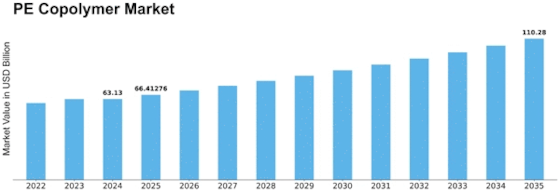

    PE Copolymer Market Size Graph
    Author
    Sejal Akre
    Senior Research Analyst

    She has over 5 years of rich experience, in market research and consulting providing valuable market insights to client. Hands on expertise in management consulting, and extensive knowledge in domain including ICT, Automotive & Transportation and Aerospace & Defense. She is skilled in Go-to market strategy, industry analysis, market sizing, in depth company profiling, competitive intelligence & benchmarking and value chain amongst others.

    Leave a Comment

    FAQs

    How much is the PE Copolymer market?

    PE Copolymer Market was valued at USD 63.13 Billion in 2024

    What is the growth rate of the PE Copolymer market?

    PE Copolymer Market is expected to grow with a CAGR of 5.2% in the period 2025-2035

    Which region held the largest market share in the PE Copolymer market?

    North America had the largest share of the global market

    Who are the key players in the PE Copolymer market?

    The key players in the market are Horda, Unipetrol, Dow, ICO Polymers, Guangzhou Lushan, Ineos, Americhem, ExxonMobil, Ferro, and others.

    Which type led the PE Copolymer market?

    The food grade category dominated the market in 2024.

    Which application had the largest market share in the PE Copolymer market?

    The package had the largest share in the global market.

    Market Summary

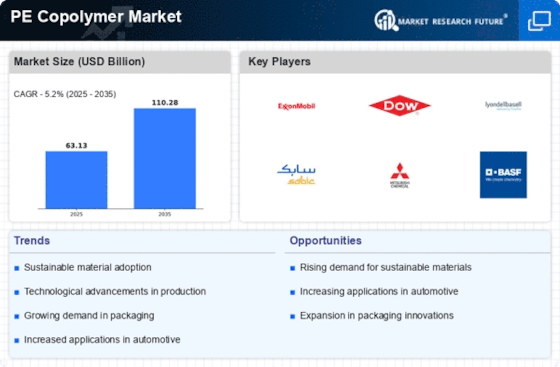
    As per MRFR analysis, the PE Copolymer Market Size was estimated at 63.13 USD Billion in 2024. The PE Copolymer industry is projected to grow from 66.41 USD Billion in 2025 to 110.28 USD Billion by 2035, exhibiting a compound annual growth rate (CAGR) of 5.2 during the forecast period 2025 - 2035.

    Key Market Trends & Highlights

    The PE Copolymer Market is poised for growth driven by sustainability and technological advancements.

    • The North American region remains the largest market for PE copolymers, reflecting a strong demand across various applications.
    • Asia-Pacific is emerging as the fastest-growing region, fueled by increasing industrialization and consumer demand.
    • The food grade segment continues to dominate the market, while the non-food grade segment is experiencing rapid growth due to diverse applications.
    • Rising demand in packaging applications and regulatory support for sustainable materials are key drivers propelling market expansion.

    Market Size & Forecast

    2024 Market Size 63.13 (USD Billion)
    2035 Market Size 110.28 (USD Billion)
    CAGR (2025 - 2035) 5.2%
    Largest Regional Market Share in 2024 North America

    Major Players

    <p>ExxonMobil (US), Dow (US), LyondellBasell (US), SABIC (SA), Mitsubishi Chemical (JP), BASF (DE), Chevron Phillips Chemical (US), TotalEnergies (FR), LG Chem (KR)</p>

    Market Trends

    The PE Copolymer Market is currently experiencing a dynamic phase characterized by evolving consumer preferences and technological advancements. The demand for versatile materials that offer enhanced performance properties is driving innovation within this sector. As industries increasingly seek sustainable solutions, the focus on eco-friendly copolymers is becoming more pronounced. This shift is likely to influence production methods and material sourcing, as manufacturers adapt to meet the expectations of environmentally conscious consumers. Furthermore, the integration of advanced manufacturing techniques, such as additive manufacturing, is reshaping the landscape of the PE Copolymer Market, enabling the creation of customized products that cater to specific applications. In addition to sustainability, the PE Copolymer Market is witnessing a trend towards increased collaboration among stakeholders. Partnerships between manufacturers, suppliers, and research institutions are fostering the development of novel applications and enhancing product offerings. This collaborative approach may lead to the emergence of innovative solutions that address the unique challenges faced by various industries. As the market continues to evolve, it appears that adaptability and responsiveness to market demands will be crucial for success in the PE Copolymer Market. Overall, the current landscape suggests a promising future, driven by innovation, sustainability, and collaboration.

    Sustainability Focus

    The emphasis on sustainable materials is reshaping the PE Copolymer Market. Manufacturers are increasingly prioritizing eco-friendly practices, leading to the development of biodegradable and recyclable copolymers. This trend reflects a broader societal shift towards environmental responsibility.

    Technological Advancements

    Innovations in manufacturing processes are significantly impacting the PE Copolymer Market. Advanced techniques, such as 3D printing and automation, are enabling the production of high-performance materials tailored to specific applications, enhancing efficiency and reducing waste.

    Collaborative Development

    The trend of collaboration among industry players is gaining momentum in the PE Copolymer Market. Partnerships between manufacturers, suppliers, and research institutions are fostering innovation, resulting in the creation of new applications and improved product offerings.

    PE Copolymer Market Market Drivers

    Growth in Automotive Applications

    The automotive sector is increasingly adopting PE copolymers due to their favorable properties, such as impact resistance and flexibility. In 2025, the automotive applications are expected to represent around 25% of the PE Copolymer Market. This growth is fueled by the industry's ongoing efforts to reduce vehicle weight and improve fuel efficiency. Additionally, the versatility of PE copolymers allows for their use in various components, including interior and exterior parts. As automotive manufacturers continue to innovate and prioritize material performance, the demand for PE copolymers is likely to rise, further solidifying their position in the market.

    Expansion in Consumer Goods Sector

    The PE Copolymer Market is witnessing expansion within the consumer goods sector, driven by the increasing use of these materials in household products. Items such as containers, toys, and household appliances are increasingly being manufactured using PE copolymers due to their durability and aesthetic appeal. In 2025, the consumer goods segment is anticipated to contribute approximately 20% to the overall market. This growth is indicative of a broader trend where manufacturers are prioritizing high-performance materials that can withstand daily use while also appealing to consumers' preferences for quality and design. As a result, the industry is likely to see sustained demand in this area.

    Rising Demand in Packaging Applications

    The PE Copolymer Market is experiencing a notable surge in demand, particularly within the packaging sector. This increase is largely attributed to the material's excellent barrier properties, which enhance the shelf life of products. In 2025, the packaging segment is projected to account for approximately 40% of the total market share, driven by the growing need for lightweight and durable materials. Furthermore, the shift towards sustainable packaging solutions is prompting manufacturers to explore PE copolymers as viable alternatives to traditional plastics. This trend indicates a potential for significant growth in the industry, as companies seek to meet consumer preferences for eco-friendly products.

    Technological Innovations in Production

    Technological advancements in the production of PE copolymers are playing a crucial role in shaping the PE Copolymer Market. Innovations such as advanced polymerization techniques and improved processing methods are enhancing the efficiency and quality of PE copolymer production. These developments not only reduce production costs but also enable the creation of specialized copolymers with tailored properties for specific applications. As manufacturers adopt these technologies, the market is expected to benefit from increased output and a broader range of product offerings. This trend suggests a promising future for the industry, as companies strive to meet diverse consumer needs.

    Regulatory Support for Sustainable Materials

    The PE Copolymer Market is benefiting from regulatory support aimed at promoting sustainable materials. Governments are increasingly implementing policies that encourage the use of environmentally friendly products, which is driving demand for PE copolymers. In 2025, it is anticipated that regulatory frameworks will continue to evolve, providing incentives for manufacturers to adopt sustainable practices. This shift not only aligns with global sustainability goals but also positions PE copolymers as a favorable choice for companies looking to enhance their environmental credentials. As regulations become more stringent, the industry is likely to see a rise in the adoption of PE copolymers, further solidifying their market presence.

    Market Segment Insights

    By Type: Food Grade (Largest) vs. Non-Food Grade (Fastest-Growing)

    <p>In the PE Copolymer Market, the Food Grade segment holds the largest share, largely driven by the growing demand for safe and compliant packaging solutions in the food industry. This sector's emphasis on hygiene and safety standards has bolstered its position, making it a preferred choice for manufacturers. Non-Food Grade, while currently smaller, showcases significant potential as consumer awareness around sustainability and product safety rises in other applications, thus expanding its footprint in various industries.</p>

    <p>PE Copolymer Applications: Food Grade (Dominant) vs. Non-Food Grade (Emerging)</p>

    <p>The Food Grade segment of PE Copolymers is characterized by its compliance with stringent food safety regulations and its ability to provide durable and flexible packaging options. This dominance is driven by the need for reliable packaging in food processing and distribution, ensuring product integrity and shelf life. On the other hand, the Non-Food Grade segment is emerging rapidly, capitalizing on trends such as eco-friendly materials and innovative uses in areas like agriculture and healthcare. This segment is expected to witness accelerated growth as manufacturers seek to develop versatile products that cater to diverse applications outside the food industry.</p>

    By Application: Container (Largest) vs. Medical (Fastest-Growing)

    <p>In the PE Copolymer Market, the application segment is diverse, consisting of packages, containers, cables, medical applications, and others. Among these, containers hold the largest market share, reflecting robust demand for various packaging needs across industries. Packaging applications, anchored by containers, significantly influence market dynamics, driven by their essential role in logistics and supply chain operations. Conversely, the medical segment, though smaller currently, is emerging rapidly with innovative uses of PE copolymers in healthcare. As the market evolves, growth trends indicate a noticeable surge in the medical application sector, underpinned by increasing healthcare demands and technological advancements. Medical applications such as drug delivery systems and sterilization products are becoming more prevalent, showcasing the versatility of PE copolymers. The expanding use in medical technologies is expected to accelerate this segment's growth, highlighting its position as the fastest-growing area within the overall market.</p>

    <p>Container (Dominant) vs. Medical (Emerging)</p>

    <p>Containers represent a dominant force within the PE Copolymer Market, owing to their widespread adoption in various sectors such as consumer goods, food and beverage, and industrial applications. These containers benefit from the lightweight, flexible, and durable nature of PE copolymers, making them ideal for packaging that requires both protection and ease of handling. In contrast, the medical application segment is considered emerging but is gaining traction due to a growing need for advanced medical solutions. This includes the use of PE copolymers for creating safe and efficient drug delivery systems, packaging for sensitive medical devices, and applications in biomedical devices. The intersection of innovation in healthcare and the adaptability of PE copolymers is poised to drive significant growth in the medical segment, indicating a clear shift in application focus within the market.</p>

    Get more detailed insights about PE Copolymer Market Research Report — Global Forecast till 2035

    Regional Insights

    North America : Innovation and Demand Surge

    North America is witnessing robust growth in the PE copolymer market, driven by increasing demand in packaging, automotive, and consumer goods sectors. The region holds approximately 40% of the global market share, making it the largest market for PE copolymers. Regulatory support for sustainable materials and innovations in production processes are further catalyzing this growth. The United States is the leading country in this region, with major players like ExxonMobil, Dow, and LyondellBasell dominating the landscape. The competitive environment is characterized by continuous innovation and strategic partnerships aimed at enhancing product offerings. The presence of advanced manufacturing facilities and a strong supply chain network further solidifies North America's position in the global market.

    Europe : Sustainability and Innovation Focus

    Europe is emerging as a significant player in the PE copolymer market, driven by stringent environmental regulations and a strong focus on sustainability. The region accounts for approximately 30% of the global market share, making it the second-largest market. Initiatives like the European Green Deal are pushing for the adoption of eco-friendly materials, which is expected to boost demand for PE copolymers in various applications. Germany, France, and the UK are the leading countries in this market, with key players such as BASF and TotalEnergies actively investing in sustainable technologies. The competitive landscape is marked by collaborations between manufacturers and research institutions to innovate and develop new products. This focus on sustainability is reshaping the market dynamics and driving growth in the region.

    Asia-Pacific : Rapid Industrialization and Growth

    Asia-Pacific is rapidly becoming a powerhouse in the PE copolymer market, fueled by industrialization and increasing consumer demand. The region holds about 25% of the global market share, with countries like China and India leading the charge. The growth is supported by favorable government policies and investments in infrastructure, which are expected to drive demand for PE copolymers in packaging and construction sectors. China is the largest market in the region, with significant contributions from local manufacturers and multinational companies like Mitsubishi Chemical and LG Chem. The competitive landscape is evolving, with a mix of established players and emerging companies focusing on innovation and cost-effective production methods. This dynamic environment is set to enhance the region's market position in the coming years.

    Middle East and Africa : Emerging Markets and Opportunities

    The Middle East and Africa (MEA) region is witnessing emerging opportunities in the PE copolymer market, driven by increasing industrial activities and urbanization. The region holds approximately 5% of the global market share, with significant growth potential in countries like Saudi Arabia and South Africa. Government initiatives aimed at diversifying economies and boosting manufacturing capabilities are expected to enhance market demand. Saudi Arabia is a key player in the region, with major companies like SABIC leading the market. The competitive landscape is characterized by a focus on local production and partnerships with international firms to leverage technology and expertise. As the region continues to develop, the demand for PE copolymers is anticipated to rise, creating new opportunities for growth.

    Key Players and Competitive Insights

    The market for PE copolymers is continuing to grow as a result of major companies investing heavily in R&D to expand their product offerings. Market participants are also taking part in a number of strategic initiatives in an effort to strengthen their global footprint. The industry has seen significant developments with the launch of new goods, agreements, mergers and acquisitions, higher investment, and collaboration with other companies. For the PE Copolymer industry to expand and prosper in a market that is becoming more and more competitive, it must offer reasonably priced goods.

    Manufacturing locally to reduce expenses is one of the main business strategies used by producers in the global PE Copolymer industry to support clients and grow the market sector. Some of the greatest advances in medicine in recent years have come from the PE copolymer industry. Major players in the PE Copolymer market, including Horda, Unipetrol, Dow, ICO Polymers, Guangzhou Lushan, Ineos, Americhem, ExxonMobil, Ferro, and others, are attempting to increase market demand by investing in research and development operations.

    The integrated oil and gas business Exxon Mobil Corp. (ExxonMobil) finds, explores for, develops, and produces natural gas, crude oil, and natural gas liquids. It produces, transports, trades, and sells petroleum products, refines crude oil, and makes lube base stocks and finished lubricants. In addition, ExxonMobil produces and sells a broad range of specialty goods in addition to commodity petrochemicals such as aromatics, olefins, polyethylene, and polypropylene plastics. A network of distribution hubs, industrial facilities, and transit networks runs it.

    In April 2022, ExxonMobil introduced its new ExceedTM S performance polyethylene (PE) resins, which offer the best stiffness and toughness combinations available in the market along with ease of processing. With respect to current market benchmarks, the new PE platform offers chances to improve film performance, conversion efficiency, and packaging durability while simplifying film formulations and designs thanks to the company's most recent advancements in polymer science.

    Americhem is a globally recognized creator and developer of custom color masterbatch, functional additives, tailored chemicals, and performance innovations. Delivering Performance, Solutions, and Trust in close partnership with clients looking to optimize their polymer products is the cornerstone of their business. Complete technical assistance is provided for all of the company's goods, guaranteeing their quality, dependability, and affordability. In November 2023, Americhem had ten manufacturing facilities under operation, as well as global sales offices. The headquarters and primary research and development facilities are situated in Cuyahoga Falls, Ohio.

    Americhem, Inc., a leader in the global market for cutting-edge polymer solutions, is happy to announce the beginning of an agreement with Nexeo Plastics for the distribution of tailored compounds in North America. This agreement covers the full range of tailored compounds from Americhem, such as ColorFast®, ColorRx®, InColor®, InElec®, InLube®, and InStruc®.

    Key Companies in the PE Copolymer Market market include

    Industry Developments

    April 2021: SABIC announced that it would handle the marketing and sales of the greatest number of polymer and petrochemical goods produced by Saudi Aramco. Furthermore, Aramco declared that SABIC would take over management of Pengerang Petrochemical Company (PRefChem), a joint venture between Sadara and S-Oil with operations situated in Malaysia.

    In February 2020: At Md&M West 2020, Sabic will introduce new Lnp Elcres Crx Pc copolymers, which are resistant to stress cracking in systems exposed to strong disinfectants in the healthcare sector.

    Future Outlook

    PE Copolymer Market Future Outlook

    <p>The PE Copolymer Market is projected to grow at a 5.2% CAGR from 2024 to 2035, driven by increasing demand in packaging, automotive, and construction sectors.</p>

    New opportunities lie in:

    • <p>Expansion into biodegradable PE copolymers for sustainable packaging solutions.</p>
    • <p>Development of high-performance PE copolymers for automotive applications.</p>
    • <p>Investment in advanced manufacturing technologies to enhance production efficiency.</p>

    <p>By 2035, the PE Copolymer Market is expected to achieve robust growth and innovation.</p>

    Market Segmentation

    PE Copolymer Type Outlook

    • Food Grade
    • Non-Food Grade

    PE Copolymer Regional Outlook

    North America
    • US
    • Canada

    PE Copolymer Application Outlook

    • Package
    • Container
    • Cable
    • Medical
    • Others

    Report Scope

    MARKET SIZE 202463.13(USD Billion)
    MARKET SIZE 202566.41(USD Billion)
    MARKET SIZE 2035110.28(USD Billion)
    COMPOUND ANNUAL GROWTH RATE (CAGR)5.2% (2024 - 2035)
    REPORT COVERAGERevenue Forecast, Competitive Landscape, Growth Factors, and Trends
    BASE YEAR2024
    Market Forecast Period2025 - 2035
    Historical Data2019 - 2024
    Market Forecast UnitsUSD Billion
    Key Companies ProfiledMarket analysis in progress
    Segments CoveredMarket segmentation analysis in progress
    Key Market OpportunitiesGrowing demand for sustainable packaging solutions drives innovation in the PE Copolymer Market.
    Key Market DynamicsRising demand for lightweight materials drives innovation and competition in the PE Copolymer Market.
    Countries CoveredNorth America, Europe, APAC, South America, MEA

    FAQs

    How much is the PE Copolymer market?

    PE Copolymer Market was valued at USD 63.13 Billion in 2024

    What is the growth rate of the PE Copolymer market?

    PE Copolymer Market is expected to grow with a CAGR of 5.2% in the period 2025-2035

    Which region held the largest market share in the PE Copolymer market?

    North America had the largest share of the global market

    Who are the key players in the PE Copolymer market?

    The key players in the market are Horda, Unipetrol, Dow, ICO Polymers, Guangzhou Lushan, Ineos, Americhem, ExxonMobil, Ferro, and others.

    Which type led the PE Copolymer market?

    The food grade category dominated the market in 2024.

    Which application had the largest market share in the PE Copolymer market?

    The package had the largest share in the global market.

    1. SECTION I: EXECUTIVE SUMMARY AND KEY HIGHLIGHTS
      1. | 1.1 EXECUTIVE SUMMARY
      2. | | 1.1.1 Market Overview
      3. | | 1.1.2 Key Findings
      4. | | 1.1.3 Market Segmentation
      5. | | 1.1.4 Competitive Landscape
      6. | | 1.1.5 Challenges and Opportunities
      7. | | 1.1.6 Future Outlook
    2. SECTION II: SCOPING, METHODOLOGY AND MARKET STRUCTURE
      1. | 2.1 MARKET INTRODUCTION
      2. | | 2.1.1 Definition
      3. | | 2.1.2 Scope of the study
      4. | | | 2.1.2.1 Research Objective
      5. | | | 2.1.2.2 Assumption
      6. | | | 2.1.2.3 Limitations
      7. | 2.2 RESEARCH METHODOLOGY
      8. | | 2.2.1 Overview
      9. | | 2.2.2 Data Mining
      10. | | 2.2.3 Secondary Research
      11. | | 2.2.4 Primary Research
      12. | | | 2.2.4.1 Primary Interviews and Information Gathering Process
      13. | | | 2.2.4.2 Breakdown of Primary Respondents
      14. | | 2.2.5 Forecasting Model
      15. | | 2.2.6 Market Size Estimation
      16. | | | 2.2.6.1 Bottom-Up Approach
      17. | | | 2.2.6.2 Top-Down Approach
      18. | | 2.2.7 Data Triangulation
      19. | | 2.2.8 Validation
    3. SECTION III: QUALITATIVE ANALYSIS
      1. | 3.1 MARKET DYNAMICS
      2. | | 3.1.1 Overview
      3. | | 3.1.2 Drivers
      4. | | 3.1.3 Restraints
      5. | | 3.1.4 Opportunities
      6. | 3.2 MARKET FACTOR ANALYSIS
      7. | | 3.2.1 Value chain Analysis
      8. | | 3.2.2 Porter's Five Forces Analysis
      9. | | | 3.2.2.1 Bargaining Power of Suppliers
      10. | | | 3.2.2.2 Bargaining Power of Buyers
      11. | | | 3.2.2.3 Threat of New Entrants
      12. | | | 3.2.2.4 Threat of Substitutes
      13. | | | 3.2.2.5 Intensity of Rivalry
      14. | | 3.2.3 COVID-19 Impact Analysis
      15. | | | 3.2.3.1 Market Impact Analysis
      16. | | | 3.2.3.2 Regional Impact
      17. | | | 3.2.3.3 Opportunity and Threat Analysis
    4. SECTION IV: QUANTITATIVE ANALYSIS
      1. | 4.1 Chemicals and Materials, BY Type (USD Billion)
      2. | | 4.1.1 Food Grade
      3. | | 4.1.2 Non-Food Grade
      4. | 4.2 Chemicals and Materials, BY Application (USD Billion)
      5. | | 4.2.1 Package
      6. | | 4.2.2 Container
      7. | | 4.2.3 Cable
      8. | | 4.2.4 Medical
      9. | | 4.2.5 Others
      10. | 4.3 Chemicals and Materials, BY Region (USD Billion)
      11. | | 4.3.1 North America
      12. | | | 4.3.1.1 US
      13. | | | 4.3.1.2 Canada
      14. | | 4.3.2 Europe
      15. | | | 4.3.2.1 Germany
      16. | | | 4.3.2.2 UK
      17. | | | 4.3.2.3 France
      18. | | | 4.3.2.4 Russia
      19. | | | 4.3.2.5 Italy
      20. | | | 4.3.2.6 Spain
      21. | | | 4.3.2.7 Rest of Europe
      22. | | 4.3.3 APAC
      23. | | | 4.3.3.1 China
      24. | | | 4.3.3.2 India
      25. | | | 4.3.3.3 Japan
      26. | | | 4.3.3.4 South Korea
      27. | | | 4.3.3.5 Malaysia
      28. | | | 4.3.3.6 Thailand
      29. | | | 4.3.3.7 Indonesia
      30. | | | 4.3.3.8 Rest of APAC
      31. | | 4.3.4 South America
      32. | | | 4.3.4.1 Brazil
      33. | | | 4.3.4.2 Mexico
      34. | | | 4.3.4.3 Argentina
      35. | | | 4.3.4.4 Rest of South America
      36. | | 4.3.5 MEA
      37. | | | 4.3.5.1 GCC Countries
      38. | | | 4.3.5.2 South Africa
      39. | | | 4.3.5.3 Rest of MEA
    5. SECTION V: COMPETITIVE ANALYSIS
      1. | 5.1 Competitive Landscape
      2. | | 5.1.1 Overview
      3. | | 5.1.2 Competitive Analysis
      4. | | 5.1.3 Market share Analysis
      5. | | 5.1.4 Major Growth Strategy in the Chemicals and Materials
      6. | | 5.1.5 Competitive Benchmarking
      7. | | 5.1.6 Leading Players in Terms of Number of Developments in the Chemicals and Materials
      8. | | 5.1.7 Key developments and growth strategies
      9. | | | 5.1.7.1 New Product Launch/Service Deployment
      10. | | | 5.1.7.2 Merger & Acquisitions
      11. | | | 5.1.7.3 Joint Ventures
      12. | | 5.1.8 Major Players Financial Matrix
      13. | | | 5.1.8.1 Sales and Operating Income
      14. | | | 5.1.8.2 Major Players R&D Expenditure. 2023
      15. | 5.2 Company Profiles
      16. | | 5.2.1 ExxonMobil (US)
      17. | | | 5.2.1.1 Financial Overview
      18. | | | 5.2.1.2 Products Offered
      19. | | | 5.2.1.3 Key Developments
      20. | | | 5.2.1.4 SWOT Analysis
      21. | | | 5.2.1.5 Key Strategies
      22. | | 5.2.2 Dow (US)
      23. | | | 5.2.2.1 Financial Overview
      24. | | | 5.2.2.2 Products Offered
      25. | | | 5.2.2.3 Key Developments
      26. | | | 5.2.2.4 SWOT Analysis
      27. | | | 5.2.2.5 Key Strategies
      28. | | 5.2.3 LyondellBasell (US)
      29. | | | 5.2.3.1 Financial Overview
      30. | | | 5.2.3.2 Products Offered
      31. | | | 5.2.3.3 Key Developments
      32. | | | 5.2.3.4 SWOT Analysis
      33. | | | 5.2.3.5 Key Strategies
      34. | | 5.2.4 SABIC (SA)
      35. | | | 5.2.4.1 Financial Overview
      36. | | | 5.2.4.2 Products Offered
      37. | | | 5.2.4.3 Key Developments
      38. | | | 5.2.4.4 SWOT Analysis
      39. | | | 5.2.4.5 Key Strategies
      40. | | 5.2.5 Mitsubishi Chemical (JP)
      41. | | | 5.2.5.1 Financial Overview
      42. | | | 5.2.5.2 Products Offered
      43. | | | 5.2.5.3 Key Developments
      44. | | | 5.2.5.4 SWOT Analysis
      45. | | | 5.2.5.5 Key Strategies
      46. | | 5.2.6 BASF (DE)
      47. | | | 5.2.6.1 Financial Overview
      48. | | | 5.2.6.2 Products Offered
      49. | | | 5.2.6.3 Key Developments
      50. | | | 5.2.6.4 SWOT Analysis
      51. | | | 5.2.6.5 Key Strategies
      52. | | 5.2.7 Chevron Phillips Chemical (US)
      53. | | | 5.2.7.1 Financial Overview
      54. | | | 5.2.7.2 Products Offered
      55. | | | 5.2.7.3 Key Developments
      56. | | | 5.2.7.4 SWOT Analysis
      57. | | | 5.2.7.5 Key Strategies
      58. | | 5.2.8 TotalEnergies (FR)
      59. | | | 5.2.8.1 Financial Overview
      60. | | | 5.2.8.2 Products Offered
      61. | | | 5.2.8.3 Key Developments
      62. | | | 5.2.8.4 SWOT Analysis
      63. | | | 5.2.8.5 Key Strategies
      64. | | 5.2.9 LG Chem (KR)
      65. | | | 5.2.9.1 Financial Overview
      66. | | | 5.2.9.2 Products Offered
      67. | | | 5.2.9.3 Key Developments
      68. | | | 5.2.9.4 SWOT Analysis
      69. | | | 5.2.9.5 Key Strategies
      70. | 5.3 Appendix
      71. | | 5.3.1 References
      72. | | 5.3.2 Related Reports
    6. LIST OF FIGURES
      1. | 6.1 MARKET SYNOPSIS
      2. | 6.2 NORTH AMERICA MARKET ANALYSIS
      3. | 6.3 US MARKET ANALYSIS BY TYPE
      4. | 6.4 US MARKET ANALYSIS BY APPLICATION
      5. | 6.5 CANADA MARKET ANALYSIS BY TYPE
      6. | 6.6 CANADA MARKET ANALYSIS BY APPLICATION
      7. | 6.7 EUROPE MARKET ANALYSIS
      8. | 6.8 GERMANY MARKET ANALYSIS BY TYPE
      9. | 6.9 GERMANY MARKET ANALYSIS BY APPLICATION
      10. | 6.10 UK MARKET ANALYSIS BY TYPE
      11. | 6.11 UK MARKET ANALYSIS BY APPLICATION
      12. | 6.12 FRANCE MARKET ANALYSIS BY TYPE
      13. | 6.13 FRANCE MARKET ANALYSIS BY APPLICATION
      14. | 6.14 RUSSIA MARKET ANALYSIS BY TYPE
      15. | 6.15 RUSSIA MARKET ANALYSIS BY APPLICATION
      16. | 6.16 ITALY MARKET ANALYSIS BY TYPE
      17. | 6.17 ITALY MARKET ANALYSIS BY APPLICATION
      18. | 6.18 SPAIN MARKET ANALYSIS BY TYPE
      19. | 6.19 SPAIN MARKET ANALYSIS BY APPLICATION
      20. | 6.20 REST OF EUROPE MARKET ANALYSIS BY TYPE
      21. | 6.21 REST OF EUROPE MARKET ANALYSIS BY APPLICATION
      22. | 6.22 APAC MARKET ANALYSIS
      23. | 6.23 CHINA MARKET ANALYSIS BY TYPE
      24. | 6.24 CHINA MARKET ANALYSIS BY APPLICATION
      25. | 6.25 INDIA MARKET ANALYSIS BY TYPE
      26. | 6.26 INDIA MARKET ANALYSIS BY APPLICATION
      27. | 6.27 JAPAN MARKET ANALYSIS BY TYPE
      28. | 6.28 JAPAN MARKET ANALYSIS BY APPLICATION
      29. | 6.29 SOUTH KOREA MARKET ANALYSIS BY TYPE
      30. | 6.30 SOUTH KOREA MARKET ANALYSIS BY APPLICATION
      31. | 6.31 MALAYSIA MARKET ANALYSIS BY TYPE
      32. | 6.32 MALAYSIA MARKET ANALYSIS BY APPLICATION
      33. | 6.33 THAILAND MARKET ANALYSIS BY TYPE
      34. | 6.34 THAILAND MARKET ANALYSIS BY APPLICATION
      35. | 6.35 INDONESIA MARKET ANALYSIS BY TYPE
      36. | 6.36 INDONESIA MARKET ANALYSIS BY APPLICATION
      37. | 6.37 REST OF APAC MARKET ANALYSIS BY TYPE
      38. | 6.38 REST OF APAC MARKET ANALYSIS BY APPLICATION
      39. | 6.39 SOUTH AMERICA MARKET ANALYSIS
      40. | 6.40 BRAZIL MARKET ANALYSIS BY TYPE
      41. | 6.41 BRAZIL MARKET ANALYSIS BY APPLICATION
      42. | 6.42 MEXICO MARKET ANALYSIS BY TYPE
      43. | 6.43 MEXICO MARKET ANALYSIS BY APPLICATION
      44. | 6.44 ARGENTINA MARKET ANALYSIS BY TYPE
      45. | 6.45 ARGENTINA MARKET ANALYSIS BY APPLICATION
      46. | 6.46 REST OF SOUTH AMERICA MARKET ANALYSIS BY TYPE
      47. | 6.47 REST OF SOUTH AMERICA MARKET ANALYSIS BY APPLICATION
      48. | 6.48 MEA MARKET ANALYSIS
      49. | 6.49 GCC COUNTRIES MARKET ANALYSIS BY TYPE
      50. | 6.50 GCC COUNTRIES MARKET ANALYSIS BY APPLICATION
      51. | 6.51 SOUTH AFRICA MARKET ANALYSIS BY TYPE
      52. | 6.52 SOUTH AFRICA MARKET ANALYSIS BY APPLICATION
      53. | 6.53 REST OF MEA MARKET ANALYSIS BY TYPE
      54. | 6.54 REST OF MEA MARKET ANALYSIS BY APPLICATION
      55. | 6.55 KEY BUYING CRITERIA OF CHEMICALS AND MATERIALS
      56. | 6.56 RESEARCH PROCESS OF MRFR
      57. | 6.57 DRO ANALYSIS OF CHEMICALS AND MATERIALS
      58. | 6.58 DRIVERS IMPACT ANALYSIS: CHEMICALS AND MATERIALS
      59. | 6.59 RESTRAINTS IMPACT ANALYSIS: CHEMICALS AND MATERIALS
      60. | 6.60 SUPPLY / VALUE CHAIN: CHEMICALS AND MATERIALS
      61. | 6.61 CHEMICALS AND MATERIALS, BY TYPE, 2024 (% SHARE)
      62. | 6.62 CHEMICALS AND MATERIALS, BY TYPE, 2024 TO 2035 (USD Billion)
      63. | 6.63 CHEMICALS AND MATERIALS, BY APPLICATION, 2024 (% SHARE)
      64. | 6.64 CHEMICALS AND MATERIALS, BY APPLICATION, 2024 TO 2035 (USD Billion)
      65. | 6.65 BENCHMARKING OF MAJOR COMPETITORS
    7. LIST OF TABLES
      1. | 7.1 LIST OF ASSUMPTIONS
      2. | | 7.1.1
      3. | 7.2 North America MARKET SIZE ESTIMATES; FORECAST
      4. | | 7.2.1 BY TYPE, 2025-2035 (USD Billion)
      5. | | 7.2.2 BY APPLICATION, 2025-2035 (USD Billion)
      6. | 7.3 US MARKET SIZE ESTIMATES; FORECAST
      7. | | 7.3.1 BY TYPE, 2025-2035 (USD Billion)
      8. | | 7.3.2 BY APPLICATION, 2025-2035 (USD Billion)
      9. | 7.4 Canada MARKET SIZE ESTIMATES; FORECAST
      10. | | 7.4.1 BY TYPE, 2025-2035 (USD Billion)
      11. | | 7.4.2 BY APPLICATION, 2025-2035 (USD Billion)
      12. | 7.5 Europe MARKET SIZE ESTIMATES; FORECAST
      13. | | 7.5.1 BY TYPE, 2025-2035 (USD Billion)
      14. | | 7.5.2 BY APPLICATION, 2025-2035 (USD Billion)
      15. | 7.6 Germany MARKET SIZE ESTIMATES; FORECAST
      16. | | 7.6.1 BY TYPE, 2025-2035 (USD Billion)
      17. | | 7.6.2 BY APPLICATION, 2025-2035 (USD Billion)
      18. | 7.7 UK MARKET SIZE ESTIMATES; FORECAST
      19. | | 7.7.1 BY TYPE, 2025-2035 (USD Billion)
      20. | | 7.7.2 BY APPLICATION, 2025-2035 (USD Billion)
      21. | 7.8 France MARKET SIZE ESTIMATES; FORECAST
      22. | | 7.8.1 BY TYPE, 2025-2035 (USD Billion)
      23. | | 7.8.2 BY APPLICATION, 2025-2035 (USD Billion)
      24. | 7.9 Russia MARKET SIZE ESTIMATES; FORECAST
      25. | | 7.9.1 BY TYPE, 2025-2035 (USD Billion)
      26. | | 7.9.2 BY APPLICATION, 2025-2035 (USD Billion)
      27. | 7.10 Italy MARKET SIZE ESTIMATES; FORECAST
      28. | | 7.10.1 BY TYPE, 2025-2035 (USD Billion)
      29. | | 7.10.2 BY APPLICATION, 2025-2035 (USD Billion)
      30. | 7.11 Spain MARKET SIZE ESTIMATES; FORECAST
      31. | | 7.11.1 BY TYPE, 2025-2035 (USD Billion)
      32. | | 7.11.2 BY APPLICATION, 2025-2035 (USD Billion)
      33. | 7.12 Rest of Europe MARKET SIZE ESTIMATES; FORECAST
      34. | | 7.12.1 BY TYPE, 2025-2035 (USD Billion)
      35. | | 7.12.2 BY APPLICATION, 2025-2035 (USD Billion)
      36. | 7.13 APAC MARKET SIZE ESTIMATES; FORECAST
      37. | | 7.13.1 BY TYPE, 2025-2035 (USD Billion)
      38. | | 7.13.2 BY APPLICATION, 2025-2035 (USD Billion)
      39. | 7.14 China MARKET SIZE ESTIMATES; FORECAST
      40. | | 7.14.1 BY TYPE, 2025-2035 (USD Billion)
      41. | | 7.14.2 BY APPLICATION, 2025-2035 (USD Billion)
      42. | 7.15 India MARKET SIZE ESTIMATES; FORECAST
      43. | | 7.15.1 BY TYPE, 2025-2035 (USD Billion)
      44. | | 7.15.2 BY APPLICATION, 2025-2035 (USD Billion)
      45. | 7.16 Japan MARKET SIZE ESTIMATES; FORECAST
      46. | | 7.16.1 BY TYPE, 2025-2035 (USD Billion)
      47. | | 7.16.2 BY APPLICATION, 2025-2035 (USD Billion)
      48. | 7.17 South Korea MARKET SIZE ESTIMATES; FORECAST
      49. | | 7.17.1 BY TYPE, 2025-2035 (USD Billion)
      50. | | 7.17.2 BY APPLICATION, 2025-2035 (USD Billion)
      51. | 7.18 Malaysia MARKET SIZE ESTIMATES; FORECAST
      52. | | 7.18.1 BY TYPE, 2025-2035 (USD Billion)
      53. | | 7.18.2 BY APPLICATION, 2025-2035 (USD Billion)
      54. | 7.19 Thailand MARKET SIZE ESTIMATES; FORECAST
      55. | | 7.19.1 BY TYPE, 2025-2035 (USD Billion)
      56. | | 7.19.2 BY APPLICATION, 2025-2035 (USD Billion)
      57. | 7.20 Indonesia MARKET SIZE ESTIMATES; FORECAST
      58. | | 7.20.1 BY TYPE, 2025-2035 (USD Billion)
      59. | | 7.20.2 BY APPLICATION, 2025-2035 (USD Billion)
      60. | 7.21 Rest of APAC MARKET SIZE ESTIMATES; FORECAST
      61. | | 7.21.1 BY TYPE, 2025-2035 (USD Billion)
      62. | | 7.21.2 BY APPLICATION, 2025-2035 (USD Billion)
      63. | 7.22 South America MARKET SIZE ESTIMATES; FORECAST
      64. | | 7.22.1 BY TYPE, 2025-2035 (USD Billion)
      65. | | 7.22.2 BY APPLICATION, 2025-2035 (USD Billion)
      66. | 7.23 Brazil MARKET SIZE ESTIMATES; FORECAST
      67. | | 7.23.1 BY TYPE, 2025-2035 (USD Billion)
      68. | | 7.23.2 BY APPLICATION, 2025-2035 (USD Billion)
      69. | 7.24 Mexico MARKET SIZE ESTIMATES; FORECAST
      70. | | 7.24.1 BY TYPE, 2025-2035 (USD Billion)
      71. | | 7.24.2 BY APPLICATION, 2025-2035 (USD Billion)
      72. | 7.25 Argentina MARKET SIZE ESTIMATES; FORECAST
      73. | | 7.25.1 BY TYPE, 2025-2035 (USD Billion)
      74. | | 7.25.2 BY APPLICATION, 2025-2035 (USD Billion)
      75. | 7.26 Rest of South America MARKET SIZE ESTIMATES; FORECAST
      76. | | 7.26.1 BY TYPE, 2025-2035 (USD Billion)
      77. | | 7.26.2 BY APPLICATION, 2025-2035 (USD Billion)
      78. | 7.27 MEA MARKET SIZE ESTIMATES; FORECAST
      79. | | 7.27.1 BY TYPE, 2025-2035 (USD Billion)
      80. | | 7.27.2 BY APPLICATION, 2025-2035 (USD Billion)
      81. | 7.28 GCC Countries MARKET SIZE ESTIMATES; FORECAST
      82. | | 7.28.1 BY TYPE, 2025-2035 (USD Billion)
      83. | | 7.28.2 BY APPLICATION, 2025-2035 (USD Billion)
      84. | 7.29 South Africa MARKET SIZE ESTIMATES; FORECAST
      85. | | 7.29.1 BY TYPE, 2025-2035 (USD Billion)
      86. | | 7.29.2 BY APPLICATION, 2025-2035 (USD Billion)
      87. | 7.30 Rest of MEA MARKET SIZE ESTIMATES; FORECAST
      88. | | 7.30.1 BY TYPE, 2025-2035 (USD Billion)
      89. | | 7.30.2 BY APPLICATION, 2025-2035 (USD Billion)
      90. | 7.31 PRODUCT LAUNCH/PRODUCT DEVELOPMENT/APPROVAL
      91. | | 7.31.1
      92. | 7.32 ACQUISITION/PARTNERSHIP
      93. | | 7.32.1

    PE Copolymer Market Segmentation

    PE Copolymer Type Outlook (USD Billion, 2018-2032)

    • Food Grade
    • Non-Food Grade

    PE Copolymer Application Outlook (USD Billion, 2018-2032)

    • Package
    • Container
    • Cable
    • Medical
    • Others

    PE Copolymer Regional Outlook (USD Billion, 2018-2032)

    • North America Outlook (USD Billion, 2018-2032)
      • North America PE Copolymer by Type
        • Food Grade
        • Non-Food Grade
      • North America PE Copolymer by Application
        • Package
        • Container
        • Cable
        • Medical
        • Others
      • US Outlook (USD Billion, 2018-2032)
      • US PE Copolymer by Type
        • Food Grade
        • Non-Food Grade
      • US PE Copolymer by Application
        • Package
        • Container
        • Cable
        • Medical
        • Others
      • CANADA Outlook (USD Billion, 2018-2032)
      • CANADA PE Copolymer by Type
        • Food Grade
        • Non-Food Grade
      • CANADA PE Copolymer by Application
        • Package
        • Container
        • Cable
        • Medical
        • Others
      • Europe Outlook (USD Billion, 2018-2032)
        • Europe PE Copolymer by Type
          • Food Grade
          • Non-Food Grade
        • Europe PE Copolymer by Application
          • Package
          • Container
          • Cable
          • Medical
          • Others
        • Germany Outlook (USD Billion, 2018-2032)
        • Germany PE Copolymer by Type
          • Food Grade
          • Non-Food Grade
        • Germany PE Copolymer by Application
          • Package
          • Container
          • Cable
          • Medical
          • Others
        • France Outlook (USD Billion, 2018-2032)
        • France PE Copolymer by Type
          • Food Grade
          • Non-Food Grade
        • France PE Copolymer by Application
          • Package
          • Container
          • Cable
          • Medical
          • Others
        • UK Outlook (USD Billion, 2018-2032)
        • UK PE Copolymer by Type
          • Food Grade
          • Non-Food Grade
        • UK PE Copolymer by Application
          • Package
          • Container
          • Cable
          • Medical
          • Others
        • ITALY Outlook (USD Billion, 2018-2032)
        • ITALY PE Copolymer by Type
          • Food Grade
          • Non-Food Grade
        • ITALY PE Copolymer by Application
          • Package
          • Container
          • Cable
          • Medical
          • Others
        • SPAIN Outlook (USD Billion, 2018-2032)
        • Spain PE Copolymer by Type
          • Food Grade
          • Non-Food Grade
        • Spain PE Copolymer by Application
          • Package
          • Container
          • Cable
          • Medical
          • Others
        • Rest Of Europe Outlook (USD Billion, 2018-2032)
        • Rest Of Europe PE Copolymer by Type
          • Food Grade
          • Non-Food Grade
        • REST OF EUROPE PE Copolymer by Application
          • Package
          • Container
          • Cable
          • Medical
          • Others
        • Asia-Pacific Outlook (USD Billion, 2018-2032)
          • Asia-Pacific PE Copolymer by Type
            • Food Grade
            • Non-Food Grade
          • Asia-Pacific PE Copolymer by Application
            • Package
            • Container
            • Cable
            • Medical
            • Others
          • China Outlook (USD Billion, 2018-2032)
          • China PE Copolymer by Type
            • Food Grade
            • Non-Food Grade
          • China PE Copolymer by Application
            • Package
            • Container
            • Cable
            • Medical
            • Others
          • Japan Outlook (USD Billion, 2018-2032)
          • Japan PE Copolymer by Type
            • Food Grade
            • Non-Food Grade
          • Japan PE Copolymer by Application
            • Package
            • Container
            • Cable
            • Medical
            • Others
          • India Outlook (USD Billion, 2018-2032)
          • India PE Copolymer by Type
            • Food Grade
            • Non-Food Grade
          • India PE Copolymer by Application
            • Package
            • Container
            • Cable
            • Medical
            • Others
          • Australia Outlook (USD Billion, 2018-2032)
          • Australia PE Copolymer by Type
            • Food Grade
            • Non-Food Grade
          • Australia PE Copolymer by Application
            • Package
            • Container
            • Cable
            • Medical
            • Others
          • Rest of Asia-Pacific Outlook (USD Billion, 2018-2032)
          • Rest of Asia-Pacific PE Copolymer by Type
            • Food Grade
            • Non-Food Grade
          • Rest of Asia-Pacific PE Copolymer by Application
            • Package
            • Container
            • Cable
            • Medical
            • Others
          • Rest of the World Outlook (USD Billion, 2018-2032)
            • Rest of the World PE Copolymer by Type
              • Food Grade
              • Non-Food Grade
            • Rest of the World PE Copolymer by Application
              • Package
              • Container
              • Cable
              • Medical
              • Others
            • Middle East Outlook (USD Billion, 2018-2032)
            • Middle East PE Copolymer by Type
              • Food Grade
              • Non-Food Grade
            • Middle East PE Copolymer by Application
              • Package
              • Container
              • Cable
              • Medical
              • Others
            • Africa Outlook (USD Billion, 2018-2032)
            • Africa PE Copolymer by Type
              • Food Grade
              • Non-Food Grade
            • Africa PE Copolymer by Application
              • Package
              • Container
              • Cable
              • Medical
              • Others
            • Latin America Outlook (USD Billion, 2018-2032)
            • Latin America PE Copolymer by Type
              • Food Grade
              • Non-Food Grade
            • Latin America PE Copolymer by Application
              • Package
              • Container
              • Cable
              • Medical
              • Others
    Infographic

    Free Sample Request

    Kindly complete the form below to receive a free sample of this Report

    Get Free Sample

    Customer Strories

    “I am very pleased with how market segments have been defined in a relevant way for my purposes (such as "Portable Freezers & refrigerators" and "last-mile"). In general the report is well structured. Thanks very much for your efforts.”

    Victoria Milne

    Founder
    Case Study
    Chemicals and Materials

    Compare Licence

    ×
    Features License Type
    Single User Multiuser License Enterprise User
    Price $4,950 $5,950 $7,250
    Maximum User Access Limit 1 User Upto 10 Users Unrestricted Access Throughout the Organization
    Free Customization
    Direct Access to Analyst
    Deliverable Format
    Platform Access
    Discount on Next Purchase 10% 15% 15%
    Printable Versions