×
  • Cat-intel
  • MedIntelliX
  • Resources
  • About Us
  • Hero Background
    English
    Chinese
    French
    Japanese
    Korean
    German
    Spanish

    PE Copolymer Market Share

    ID: MRFR/CnM/18554-HCR
    128 Pages
    Sejal Akre
    October 2025

    PE Copolymer Market Research Report Information By Type (Food Grade and Non-Food Grade), By Application (Package, Container, Cable, Medical, and Others), And By Region (North America, Europe, Asia-Pacific, And Rest Of The World) –Market Forecast Till 2035

    Share:
    Download PDF ×

    We do not share your information with anyone. However, we may send you emails based on your report interest from time to time. You may contact us at any time to opt-out.

    PE Copolymer Market Infographic
    Purchase Options

    Market Share

    PE Copolymer Market Share Analysis

    In the PE Copolymer market, companies implement various market share positioning strategies to gain a competitive edge and expand their market presence. One of the primary strategies employed is differentiation, where companies emphasize unique features or benefits of their PE copolymer products compared to competitors. This could include aspects such as material properties, such as flexibility, toughness, or resistance to chemicals and environmental factors. By highlighting these distinctive qualities, companies aim to attract customers who value these attributes and are more likely to choose their products over alternatives available in the market.

    Cost leadership is another significant positioning strategy in the PE Copolymer market. Companies often strive to offer their products at competitive prices while ensuring quality standards are maintained. This approach appeals to cost-conscious customers and can help companies capture market share by providing cost-effective solutions compared to competitors. Additionally, companies may invest in efficient manufacturing processes or sourcing strategies to further reduce costs and enhance their competitiveness in terms of pricing.

    Niche targeting is also prevalent in the PE Copolymer market. Instead of targeting the broader market, companies may focus on specific segments or applications where their products can address unique needs or requirements. For example, a company might specialize in providing PE copolymers for use in packaging films, where properties like sealability and barrier protection are critical. By catering to niche markets, companies can often command higher prices and build stronger relationships with customers who value specialized products and expertise.

    Market segmentation plays a crucial role in positioning strategies for the PE Copolymer market. Companies may segment the market based on factors such as industry verticals, geographical regions, or end-user applications to better understand and target their customer base. By tailoring marketing efforts and product offerings to specific segments, companies can more effectively address the diverse needs and preferences of their target audience, thereby increasing their market share within those segments.

    Branding and marketing efforts are essential components of market share positioning strategies in the PE Copolymer market. Strong branding helps companies differentiate their products from competitors and build trust and recognition among customers. Effective marketing campaigns, both online and offline, can further reinforce this positioning by highlighting the unique benefits and value propositions of the company's PE copolymer products. By investing in branding and marketing initiatives, companies can increase awareness, generate demand, and ultimately capture a larger share of the market.

    Partnerships and collaborations are another avenue for market share positioning in the PE Copolymer market. By forming strategic alliances with suppliers, distributors, or industry partners, companies can expand their reach and access new markets or customer segments. Collaborations can also provide opportunities for knowledge sharing, research, and product development, enabling companies to innovate and differentiate their offerings in the market.

    Innovation is a critical driver of market share positioning strategies in the PE Copolymer market. Companies that invest in research and development to develop new formulations, applications, or technologies can gain a competitive edge by offering innovative solutions that address evolving customer needs. Whether it's developing copolymers with enhanced performance, durability, or sustainability, innovation enables companies to stay ahead of the competition and capture market share in this dynamic industry.


    Author
    Sejal Akre
    Senior Research Analyst

    She has over 5 years of rich experience, in market research and consulting providing valuable market insights to client. Hands on expertise in management consulting, and extensive knowledge in domain including ICT, Automotive & Transportation and Aerospace & Defense. She is skilled in Go-to market strategy, industry analysis, market sizing, in depth company profiling, competitive intelligence & benchmarking and value chain amongst others.

    Leave a Comment

    FAQs

    How much is the PE Copolymer market?

    PE Copolymer Market was valued at USD 63.13 Billion in 2024

    What is the growth rate of the PE Copolymer market?

    PE Copolymer Market is expected to grow with a CAGR of 5.2% in the period 2025-2035

    Which region held the largest market share in the PE Copolymer market?

    North America had the largest share of the global market

    Who are the key players in the PE Copolymer market?

    The key players in the market are Horda, Unipetrol, Dow, ICO Polymers, Guangzhou Lushan, Ineos, Americhem, ExxonMobil, Ferro, and others.

    Which type led the PE Copolymer market?

    The food grade category dominated the market in 2024.

    Which application had the largest market share in the PE Copolymer market?

    The package had the largest share in the global market.

    Market Summary

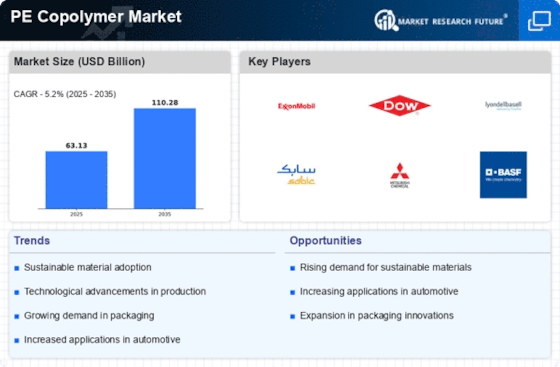
    The Global PE Copolymer Market is projected to grow from 63.13 USD Billion in 2024 to 110.28 USD Billion by 2035.

    Key Market Trends & Highlights

    PE Copolymer Key Trends and Highlights

    • The market is expected to experience a compound annual growth rate (CAGR) of 5.2 percent from 2025 to 2035.
    • By 2035, the market valuation is anticipated to reach 110.2 USD Billion, reflecting robust growth.
    • in 2024, the market is valued at 63.13 USD Billion, indicating a strong foundation for future expansion.
    • Growing adoption of sustainable packaging solutions due to increasing environmental concerns is a major market driver.

    Market Size & Forecast

    2024 Market Size 63.13 (USD Billion)
    2035 Market Size 110.28 (USD Billion)
    CAGR (2025-2035) 5.20%
    Largest Regional Market Share in 2024 latin_america)

    Major Players

    Horda, Unipetrol, Dow, ICO Polymers, Guangzhou Lushan, Ineos, Americhem, ExxonMobil, Ferro

    Market Trends

    Increasing demand for bio-based PE copolymers is driving the market growth

    Consumer preferences are shifting in favor of sustainable and eco-friendly materials as they become more conscious of the effects that plastic products have on the environment. Bio-based PE copolymers support this trend by drawing in eco-aware customers and expanding the market. For instance, according to research by the European Chemical Industry Council, global sales of bio-based products were expected to reach $250 billion in 2020

    Precise control over the molecular structure of PE copolymers is made possible by sophisticated catalyst technologies like metallocene and single-site catalysts. This degree of control enables producers to precisely modify the copolymer's properties, resulting in improved performance qualities. PE copolymers with enhanced mechanical strength, thermal stability, and other desired features can be produced more easily when sophisticated catalysts are used. This leads to copolymers that can more successfully satisfy certain application needs, increasing their usefulness across a range of sectors. The polymerization of PE copolymers is made more efficient by the use of cutting-edge catalyst technology.

    These catalysts frequently enable quicker reaction rates and shorter production durations, improving the efficiency and economy of manufacturing.

    The circular economy benefits from PE copolymers that are made to be recyclable and compatible with closed-loop recycling systems. The creation of copolymers that are effectively recyclable and reusable in new goods advances market expansion and promotes sustainability objectives. More and more products are using LCAs to determine how they will affect the environment. Environmentally concerned consumers and industries are likely to favor PE copolymers with favorable life cycle assessment (LCA) profiles, which show reduced environmental effects throughout the copolymer's life cycle.

    Canada contributes significantly to the global production of automobiles, making it one of the world's top automakers. In 2021, Canada manufactured over 1.12 million vehicles and light trucks, a 19% decrease from 2020. About 2 million vehicles and light trucks are produced in Canada each year, accounting for a significant portion of the world's total automobile manufacturing. But fewer than 0.5% of these cars are electric, which is more than 80% less than the roughly 3% global average. Thus driving the PE Copolymer market revenue.

    PE Copolymer Market Market Drivers

    Rising Demand in Packaging Applications

    The Global PE Copolymer Market Industry is experiencing a surge in demand driven by the packaging sector. As consumer preferences shift towards lightweight and durable packaging solutions, PE copolymers are increasingly favored for their excellent barrier properties and flexibility. In 2024, the market is projected to reach 63.1 USD Billion, reflecting the growing reliance on these materials in food and beverage packaging. The trend towards sustainable packaging further propels this demand, as manufacturers seek materials that not only perform well but also align with environmental goals. This shift indicates a robust growth trajectory for the Global PE Copolymer Market Industry.

    Market Segment Insights

    PE Copolymer Type Insights

    The PE Copolymer Market segmentation, based on type, includes food grade and non-food grade. The food-grade segment dominated the market. Food-grade PE copolymers are widely utilized in films, bags, pouches, and containers, among other packaging applications. These materials are appropriate for safeguarding and preserving food goods because they combine qualities like flexibility, hardness, and barrier performance.

    The non-food grade segment is expected to be the fastest-growing segment of the PE copolymer market during the forecast period. PE copolymers are widely used in non-food packaging applications, including industrial commodities, domestic goods, cleaning products, and personal care items. Because of the material's adaptability, packaging solutions that are customized to meet the needs of various non-food items can be created.

    Figure 1: PE Copolymer Market, by Type, 2022 & 2032 (USD Billion)

    Source: Secondary Research, Primary Research, Market Research Future Database and Analyst Review

    PE Copolymer Application Insights

    The PE Copolymer Market segmentation, based on application, includes package, container, cable, medical, and others. The package category has the largest market share. Due to their moisture resistance, sealability, and printability, PE copolymers are frequently employed in the manufacturing of thin, flexible films. Packaging for food, industrial use, and other applications all employ these films. To improve barrier qualities and the overall performance of packaging, PE copolymers are frequently mixed with other materials to create laminates.

    Throughout the forecast period, the PE copolymer market’s cable segment is anticipated to grow at the quickest rate. Electrical wires are frequently insulated with PE copolymers. Because of their dielectric qualities, they can be used to provide electrical insulation, which stops current from moving between conductors.

    Get more detailed insights about PE Copolymer Market Research Report — Global Forecast till 2035

    Regional Insights

    By region, the study provides market insights into North America, Europe, Asia-Pacific, and the Rest of the World. The North American PE copolymer market area will dominate this market, owing to the manufacturing and industrial foundation of North America, and especially the United States, which is well-established and diverse. PE copolymer demand is strongly correlated with industrial activity, and the robust manufacturing sector in the region plays a major role in the market's expansion.

    North America leads the world in technological innovation, and the market for PE copolymers is poised for growth as 3D printing becomes more widely used across a range of industries. The need for cutting-edge materials like PE copolymers is projected to increase as 3D printing applications spread.

    Further, the major countries studied in the market report are The US, Canada, Germany, France, the UK, Italy, Spain, China, Japan, India, Australia, South Korea, and Brazil.

    Figure 2: PE COPOLYMER MARKET SHARE BY REGION 2022 (USD Billion)

    PE COPOLYMER MARKET SHARE BY REGION 2022

    Source: Secondary Research, Primary Research, Market Research Future Database and Analyst Review

    Europe's PE Copolymer market accounts for the second-largest market share because of its substantial recycling infrastructure investments; Europe has made it simpler to incorporate recycled materials into new goods. Recyclable PE copolymers can profit from the current recycling infrastructure, advancing environmental objectives. Further, the German PE Copolymer market held the largest market share, and the UK PE Copolymer market was the fastest-growing market in the European region.

    The Asia-Pacific PE Copolymer Market is expected to grow at the fastest CAGR from 2023 to 2032. This is due to continuous infrastructure development and urbanization initiatives in countries like China and India. These generate a sizable demand for building supplies, such as PE copolymers used in fittings, pipes, and other building applications. Moreover, China’s PE Copolymer market held the largest market share, and the Indian PE Copolymer market was the fastest-growing market in the Asia-Pacific region.

    Key Players and Competitive Insights

    The market for PE copolymers is continuing to grow as a result of major companies investing heavily in R&D to expand their product offerings. Market participants are also taking part in a number of strategic initiatives in an effort to strengthen their global footprint. The industry has seen significant developments with the launch of new goods, agreements, mergers and acquisitions, higher investment, and collaboration with other companies. For the PE Copolymer industry to expand and prosper in a market that is becoming more and more competitive, it must offer reasonably priced goods.

    Manufacturing locally to reduce expenses is one of the main business strategies used by producers in the global PE Copolymer industry to support clients and grow the market sector. Some of the greatest advances in medicine in recent years have come from the PE copolymer industry. Major players in the PE Copolymer market, including Horda, Unipetrol, Dow, ICO Polymers, Guangzhou Lushan, Ineos, Americhem, ExxonMobil, Ferro, and others, are attempting to increase market demand by investing in research and development operations.

    The integrated oil and gas business Exxon Mobil Corp. (ExxonMobil) finds, explores for, develops, and produces natural gas, crude oil, and natural gas liquids. It produces, transports, trades, and sells petroleum products, refines crude oil, and makes lube base stocks and finished lubricants. In addition, ExxonMobil produces and sells a broad range of specialty goods in addition to commodity petrochemicals such as aromatics, olefins, polyethylene, and polypropylene plastics. A network of distribution hubs, industrial facilities, and transit networks runs it.

    In April 2022, ExxonMobil introduced its new ExceedTM S performance polyethylene (PE) resins, which offer the best stiffness and toughness combinations available in the market along with ease of processing. With respect to current market benchmarks, the new PE platform offers chances to improve film performance, conversion efficiency, and packaging durability while simplifying film formulations and designs thanks to the company's most recent advancements in polymer science.

    Americhem is a globally recognized creator and developer of custom color masterbatch, functional additives, tailored chemicals, and performance innovations. Delivering Performance, Solutions, and Trust in close partnership with clients looking to optimize their polymer products is the cornerstone of their business. Complete technical assistance is provided for all of the company's goods, guaranteeing their quality, dependability, and affordability. In November 2023, Americhem had ten manufacturing facilities under operation, as well as global sales offices. The headquarters and primary research and development facilities are situated in Cuyahoga Falls, Ohio.

    Americhem, Inc., a leader in the global market for cutting-edge polymer solutions, is happy to announce the beginning of an agreement with Nexeo Plastics for the distribution of tailored compounds in North America. This agreement covers the full range of tailored compounds from Americhem, such as ColorFast®, ColorRx®, InColor®, InElec®, InLube®, and InStruc®.

    Key Companies in the PE Copolymer Market market include

    Industry Developments

    April 2021: SABIC announced that it would handle the marketing and sales of the greatest number of polymer and petrochemical goods produced by Saudi Aramco. Furthermore, Aramco declared that SABIC would take over management of Pengerang Petrochemical Company (PRefChem), a joint venture between Sadara and S-Oil with operations situated in Malaysia.

    In February 2020: At Md&M West 2020, Sabic will introduce new Lnp Elcres Crx Pc copolymers, which are resistant to stress cracking in systems exposed to strong disinfectants in the healthcare sector.

    Future Outlook

    PE Copolymer Market Future Outlook

    The PE Copolymer Market is projected to grow at a 5.20% CAGR from 2025 to 2035, driven by rising demand in packaging, automotive, and construction sectors.

    New opportunities lie in:

    • Invest in R&D for bio-based PE copolymers to meet sustainability demands.
    • Expand production capabilities in emerging markets to capture new customer bases.
    • Leverage advanced manufacturing technologies to enhance product performance and reduce costs.

    By 2035, the PE Copolymer Market is expected to achieve robust growth, solidifying its position as a key player in various industries.

    Market Segmentation

    PE Copolymer Type Outlook

    • Food Grade
    • Non-Food Grade

    PE Copolymer Regional Outlook

    North America
    • US
    • Canada

    PE Copolymer Application Outlook

    • Package
    • Container
    • Cable
    • Medical
    • Others

    Report Scope

    Report Attribute/Metric Details
    Market Size 2024 USD 63.13 billion
    Market Size 2035 110.28 (Value (USD Billion))
    Compound Annual Growth Rate (CAGR) 5.20% (2025 - 2035)
    Base Year 2024
    Market Forecast Period 2025 - 2035
    Historical Data 2018- 2022
    Market Forecast Units Value (USD Billion)
    Report Coverage Revenue Forecast, Market Competitive Landscape, Growth Factors, and Trends
    Segments Covered Type, Application, and Region
    Geographies Covered North America, Europe, Asia Pacific, and the Rest of the World
    Countries Covered The US, Canada, Germany, France, UK, Italy, Spain, China, Japan, India, Australia, South Korea, and Brazil
    Key Companies Profiled  Horda, Unipetrol, Dow, ICO Polymers, Guangzhou Lushan, Ineos, Americhem, ExxonMobil, Ferro, and others
    Key Market Opportunities ·       Technological developments in polymerization processes and innovation in advanced medical devices
    Key Market Dynamics ·       Expanding automotive sector and growing demand in the packaging industry
    Market Size 2025 66.41 (Value (USD Billion))

    FAQs

    How much is the PE Copolymer market?

    PE Copolymer Market was valued at USD 63.13 Billion in 2024

    What is the growth rate of the PE Copolymer market?

    PE Copolymer Market is expected to grow with a CAGR of 5.2% in the period 2025-2035

    Which region held the largest market share in the PE Copolymer market?

    North America had the largest share of the global market

    Who are the key players in the PE Copolymer market?

    The key players in the market are Horda, Unipetrol, Dow, ICO Polymers, Guangzhou Lushan, Ineos, Americhem, ExxonMobil, Ferro, and others.

    Which type led the PE Copolymer market?

    The food grade category dominated the market in 2024.

    Which application had the largest market share in the PE Copolymer market?

    The package had the largest share in the global market.

    1. SECTION I: EXECUTIVE SUMMARY AND KEY HIGHLIGHTS
      1. | 1.1 EXECUTIVE SUMMARY
      2. | | 1.1.1 Market Overview
      3. | | 1.1.2 Key Findings
      4. | | 1.1.3 Market Segmentation
      5. | | 1.1.4 Competitive Landscape
      6. | | 1.1.5 Challenges and Opportunities
      7. | | 1.1.6 Future Outlook
    2. SECTION II: SCOPING, METHODOLOGY AND MARKET STRUCTURE
      1. | 2.1 MARKET INTRODUCTION
      2. | | 2.1.1 Definition
      3. | | 2.1.2 Scope of the study
      4. | | | 2.1.2.1 Research Objective
      5. | | | 2.1.2.2 Assumption
      6. | | | 2.1.2.3 Limitations
      7. | 2.2 RESEARCH METHODOLOGY
      8. | | 2.2.1 Overview
      9. | | 2.2.2 Data Mining
      10. | | 2.2.3 Secondary Research
      11. | | 2.2.4 Primary Research
      12. | | | 2.2.4.1 Primary Interviews and Information Gathering Process
      13. | | | 2.2.4.2 Breakdown of Primary Respondents
      14. | | 2.2.5 Forecasting Model
      15. | | 2.2.6 Market Size Estimation
      16. | | | 2.2.6.1 Bottom-Up Approach
      17. | | | 2.2.6.2 Top-Down Approach
      18. | | 2.2.7 Data Triangulation
      19. | | 2.2.8 Validation
    3. SECTION III: QUALITATIVE ANALYSIS
      1. | 3.1 MARKET DYNAMICS
      2. | | 3.1.1 Overview
      3. | | 3.1.2 Drivers
      4. | | 3.1.3 Restraints
      5. | | 3.1.4 Opportunities
      6. | 3.2 MARKET FACTOR ANALYSIS
      7. | | 3.2.1 Value chain Analysis
      8. | | 3.2.2 Porter's Five Forces Analysis
      9. | | | 3.2.2.1 Bargaining Power of Suppliers
      10. | | | 3.2.2.2 Bargaining Power of Buyers
      11. | | | 3.2.2.3 Threat of New Entrants
      12. | | | 3.2.2.4 Threat of Substitutes
      13. | | | 3.2.2.5 Intensity of Rivalry
      14. | | 3.2.3 COVID-19 Impact Analysis
      15. | | | 3.2.3.1 Market Impact Analysis
      16. | | | 3.2.3.2 Regional Impact
      17. | | | 3.2.3.3 Opportunity and Threat Analysis
    4. SECTION IV: QUANTITATIVE ANALYSIS
      1. | 4.1 Chemicals and Materials, BY Type (USD Billion)
      2. | | 4.1.1 Food Grade
      3. | | 4.1.2 Non-Food Grade
      4. | 4.2 Chemicals and Materials, BY Application (USD Billion)
      5. | | 4.2.1 Package
      6. | | 4.2.2 Container
      7. | | 4.2.3 Cable
      8. | | 4.2.4 Medical
      9. | | 4.2.5 Others
      10. | 4.3 Chemicals and Materials, BY Region (USD Billion)
      11. | | 4.3.1 North America
      12. | | | 4.3.1.1 US
      13. | | | 4.3.1.2 Canada
      14. | | 4.3.2 Europe
      15. | | | 4.3.2.1 Germany
      16. | | | 4.3.2.2 UK
      17. | | | 4.3.2.3 France
      18. | | | 4.3.2.4 Russia
      19. | | | 4.3.2.5 Italy
      20. | | | 4.3.2.6 Spain
      21. | | | 4.3.2.7 Rest of Europe
      22. | | 4.3.3 APAC
      23. | | | 4.3.3.1 China
      24. | | | 4.3.3.2 India
      25. | | | 4.3.3.3 Japan
      26. | | | 4.3.3.4 South Korea
      27. | | | 4.3.3.5 Malaysia
      28. | | | 4.3.3.6 Thailand
      29. | | | 4.3.3.7 Indonesia
      30. | | | 4.3.3.8 Rest of APAC
      31. | | 4.3.4 South America
      32. | | | 4.3.4.1 Brazil
      33. | | | 4.3.4.2 Mexico
      34. | | | 4.3.4.3 Argentina
      35. | | | 4.3.4.4 Rest of South America
      36. | | 4.3.5 MEA
      37. | | | 4.3.5.1 GCC Countries
      38. | | | 4.3.5.2 South Africa
      39. | | | 4.3.5.3 Rest of MEA
    5. SECTION V: COMPETITIVE ANALYSIS
      1. | 5.1 Competitive Landscape
      2. | | 5.1.1 Overview
      3. | | 5.1.2 Competitive Analysis
      4. | | 5.1.3 Market share Analysis
      5. | | 5.1.4 Major Growth Strategy in the Chemicals and Materials
      6. | | 5.1.5 Competitive Benchmarking
      7. | | 5.1.6 Leading Players in Terms of Number of Developments in the Chemicals and Materials
      8. | | 5.1.7 Key developments and growth strategies
      9. | | | 5.1.7.1 New Product Launch/Service Deployment
      10. | | | 5.1.7.2 Merger & Acquisitions
      11. | | | 5.1.7.3 Joint Ventures
      12. | | 5.1.8 Major Players Financial Matrix
      13. | | | 5.1.8.1 Sales and Operating Income
      14. | | | 5.1.8.2 Major Players R&D Expenditure. 2023
      15. | 5.2 Company Profiles
      16. | | 5.2.1 ExxonMobil (US)
      17. | | | 5.2.1.1 Financial Overview
      18. | | | 5.2.1.2 Products Offered
      19. | | | 5.2.1.3 Key Developments
      20. | | | 5.2.1.4 SWOT Analysis
      21. | | | 5.2.1.5 Key Strategies
      22. | | 5.2.2 Dow (US)
      23. | | | 5.2.2.1 Financial Overview
      24. | | | 5.2.2.2 Products Offered
      25. | | | 5.2.2.3 Key Developments
      26. | | | 5.2.2.4 SWOT Analysis
      27. | | | 5.2.2.5 Key Strategies
      28. | | 5.2.3 LyondellBasell (US)
      29. | | | 5.2.3.1 Financial Overview
      30. | | | 5.2.3.2 Products Offered
      31. | | | 5.2.3.3 Key Developments
      32. | | | 5.2.3.4 SWOT Analysis
      33. | | | 5.2.3.5 Key Strategies
      34. | | 5.2.4 SABIC (SA)
      35. | | | 5.2.4.1 Financial Overview
      36. | | | 5.2.4.2 Products Offered
      37. | | | 5.2.4.3 Key Developments
      38. | | | 5.2.4.4 SWOT Analysis
      39. | | | 5.2.4.5 Key Strategies
      40. | | 5.2.5 Mitsubishi Chemical (JP)
      41. | | | 5.2.5.1 Financial Overview
      42. | | | 5.2.5.2 Products Offered
      43. | | | 5.2.5.3 Key Developments
      44. | | | 5.2.5.4 SWOT Analysis
      45. | | | 5.2.5.5 Key Strategies
      46. | | 5.2.6 BASF (DE)
      47. | | | 5.2.6.1 Financial Overview
      48. | | | 5.2.6.2 Products Offered
      49. | | | 5.2.6.3 Key Developments
      50. | | | 5.2.6.4 SWOT Analysis
      51. | | | 5.2.6.5 Key Strategies
      52. | | 5.2.7 Chevron Phillips Chemical (US)
      53. | | | 5.2.7.1 Financial Overview
      54. | | | 5.2.7.2 Products Offered
      55. | | | 5.2.7.3 Key Developments
      56. | | | 5.2.7.4 SWOT Analysis
      57. | | | 5.2.7.5 Key Strategies
      58. | | 5.2.8 TotalEnergies (FR)
      59. | | | 5.2.8.1 Financial Overview
      60. | | | 5.2.8.2 Products Offered
      61. | | | 5.2.8.3 Key Developments
      62. | | | 5.2.8.4 SWOT Analysis
      63. | | | 5.2.8.5 Key Strategies
      64. | | 5.2.9 LG Chem (KR)
      65. | | | 5.2.9.1 Financial Overview
      66. | | | 5.2.9.2 Products Offered
      67. | | | 5.2.9.3 Key Developments
      68. | | | 5.2.9.4 SWOT Analysis
      69. | | | 5.2.9.5 Key Strategies
      70. | 5.3 Appendix
      71. | | 5.3.1 References
      72. | | 5.3.2 Related Reports
    6. LIST OF FIGURES
      1. | 6.1 MARKET SYNOPSIS
      2. | 6.2 NORTH AMERICA MARKET ANALYSIS
      3. | 6.3 US MARKET ANALYSIS BY TYPE
      4. | 6.4 US MARKET ANALYSIS BY APPLICATION
      5. | 6.5 CANADA MARKET ANALYSIS BY TYPE
      6. | 6.6 CANADA MARKET ANALYSIS BY APPLICATION
      7. | 6.7 EUROPE MARKET ANALYSIS
      8. | 6.8 GERMANY MARKET ANALYSIS BY TYPE
      9. | 6.9 GERMANY MARKET ANALYSIS BY APPLICATION
      10. | 6.10 UK MARKET ANALYSIS BY TYPE
      11. | 6.11 UK MARKET ANALYSIS BY APPLICATION
      12. | 6.12 FRANCE MARKET ANALYSIS BY TYPE
      13. | 6.13 FRANCE MARKET ANALYSIS BY APPLICATION
      14. | 6.14 RUSSIA MARKET ANALYSIS BY TYPE
      15. | 6.15 RUSSIA MARKET ANALYSIS BY APPLICATION
      16. | 6.16 ITALY MARKET ANALYSIS BY TYPE
      17. | 6.17 ITALY MARKET ANALYSIS BY APPLICATION
      18. | 6.18 SPAIN MARKET ANALYSIS BY TYPE
      19. | 6.19 SPAIN MARKET ANALYSIS BY APPLICATION
      20. | 6.20 REST OF EUROPE MARKET ANALYSIS BY TYPE
      21. | 6.21 REST OF EUROPE MARKET ANALYSIS BY APPLICATION
      22. | 6.22 APAC MARKET ANALYSIS
      23. | 6.23 CHINA MARKET ANALYSIS BY TYPE
      24. | 6.24 CHINA MARKET ANALYSIS BY APPLICATION
      25. | 6.25 INDIA MARKET ANALYSIS BY TYPE
      26. | 6.26 INDIA MARKET ANALYSIS BY APPLICATION
      27. | 6.27 JAPAN MARKET ANALYSIS BY TYPE
      28. | 6.28 JAPAN MARKET ANALYSIS BY APPLICATION
      29. | 6.29 SOUTH KOREA MARKET ANALYSIS BY TYPE
      30. | 6.30 SOUTH KOREA MARKET ANALYSIS BY APPLICATION
      31. | 6.31 MALAYSIA MARKET ANALYSIS BY TYPE
      32. | 6.32 MALAYSIA MARKET ANALYSIS BY APPLICATION
      33. | 6.33 THAILAND MARKET ANALYSIS BY TYPE
      34. | 6.34 THAILAND MARKET ANALYSIS BY APPLICATION
      35. | 6.35 INDONESIA MARKET ANALYSIS BY TYPE
      36. | 6.36 INDONESIA MARKET ANALYSIS BY APPLICATION
      37. | 6.37 REST OF APAC MARKET ANALYSIS BY TYPE
      38. | 6.38 REST OF APAC MARKET ANALYSIS BY APPLICATION
      39. | 6.39 SOUTH AMERICA MARKET ANALYSIS
      40. | 6.40 BRAZIL MARKET ANALYSIS BY TYPE
      41. | 6.41 BRAZIL MARKET ANALYSIS BY APPLICATION
      42. | 6.42 MEXICO MARKET ANALYSIS BY TYPE
      43. | 6.43 MEXICO MARKET ANALYSIS BY APPLICATION
      44. | 6.44 ARGENTINA MARKET ANALYSIS BY TYPE
      45. | 6.45 ARGENTINA MARKET ANALYSIS BY APPLICATION
      46. | 6.46 REST OF SOUTH AMERICA MARKET ANALYSIS BY TYPE
      47. | 6.47 REST OF SOUTH AMERICA MARKET ANALYSIS BY APPLICATION
      48. | 6.48 MEA MARKET ANALYSIS
      49. | 6.49 GCC COUNTRIES MARKET ANALYSIS BY TYPE
      50. | 6.50 GCC COUNTRIES MARKET ANALYSIS BY APPLICATION
      51. | 6.51 SOUTH AFRICA MARKET ANALYSIS BY TYPE
      52. | 6.52 SOUTH AFRICA MARKET ANALYSIS BY APPLICATION
      53. | 6.53 REST OF MEA MARKET ANALYSIS BY TYPE
      54. | 6.54 REST OF MEA MARKET ANALYSIS BY APPLICATION
      55. | 6.55 KEY BUYING CRITERIA OF CHEMICALS AND MATERIALS
      56. | 6.56 RESEARCH PROCESS OF MRFR
      57. | 6.57 DRO ANALYSIS OF CHEMICALS AND MATERIALS
      58. | 6.58 DRIVERS IMPACT ANALYSIS: CHEMICALS AND MATERIALS
      59. | 6.59 RESTRAINTS IMPACT ANALYSIS: CHEMICALS AND MATERIALS
      60. | 6.60 SUPPLY / VALUE CHAIN: CHEMICALS AND MATERIALS
      61. | 6.61 CHEMICALS AND MATERIALS, BY TYPE, 2024 (% SHARE)
      62. | 6.62 CHEMICALS AND MATERIALS, BY TYPE, 2024 TO 2035 (USD Billion)
      63. | 6.63 CHEMICALS AND MATERIALS, BY APPLICATION, 2024 (% SHARE)
      64. | 6.64 CHEMICALS AND MATERIALS, BY APPLICATION, 2024 TO 2035 (USD Billion)
      65. | 6.65 BENCHMARKING OF MAJOR COMPETITORS
    7. LIST OF TABLES
      1. | 7.1 LIST OF ASSUMPTIONS
      2. | | 7.1.1
      3. | 7.2 North America MARKET SIZE ESTIMATES; FORECAST
      4. | | 7.2.1 BY TYPE, 2025-2035 (USD Billion)
      5. | | 7.2.2 BY APPLICATION, 2025-2035 (USD Billion)
      6. | 7.3 US MARKET SIZE ESTIMATES; FORECAST
      7. | | 7.3.1 BY TYPE, 2025-2035 (USD Billion)
      8. | | 7.3.2 BY APPLICATION, 2025-2035 (USD Billion)
      9. | 7.4 Canada MARKET SIZE ESTIMATES; FORECAST
      10. | | 7.4.1 BY TYPE, 2025-2035 (USD Billion)
      11. | | 7.4.2 BY APPLICATION, 2025-2035 (USD Billion)
      12. | 7.5 Europe MARKET SIZE ESTIMATES; FORECAST
      13. | | 7.5.1 BY TYPE, 2025-2035 (USD Billion)
      14. | | 7.5.2 BY APPLICATION, 2025-2035 (USD Billion)
      15. | 7.6 Germany MARKET SIZE ESTIMATES; FORECAST
      16. | | 7.6.1 BY TYPE, 2025-2035 (USD Billion)
      17. | | 7.6.2 BY APPLICATION, 2025-2035 (USD Billion)
      18. | 7.7 UK MARKET SIZE ESTIMATES; FORECAST
      19. | | 7.7.1 BY TYPE, 2025-2035 (USD Billion)
      20. | | 7.7.2 BY APPLICATION, 2025-2035 (USD Billion)
      21. | 7.8 France MARKET SIZE ESTIMATES; FORECAST
      22. | | 7.8.1 BY TYPE, 2025-2035 (USD Billion)
      23. | | 7.8.2 BY APPLICATION, 2025-2035 (USD Billion)
      24. | 7.9 Russia MARKET SIZE ESTIMATES; FORECAST
      25. | | 7.9.1 BY TYPE, 2025-2035 (USD Billion)
      26. | | 7.9.2 BY APPLICATION, 2025-2035 (USD Billion)
      27. | 7.10 Italy MARKET SIZE ESTIMATES; FORECAST
      28. | | 7.10.1 BY TYPE, 2025-2035 (USD Billion)
      29. | | 7.10.2 BY APPLICATION, 2025-2035 (USD Billion)
      30. | 7.11 Spain MARKET SIZE ESTIMATES; FORECAST
      31. | | 7.11.1 BY TYPE, 2025-2035 (USD Billion)
      32. | | 7.11.2 BY APPLICATION, 2025-2035 (USD Billion)
      33. | 7.12 Rest of Europe MARKET SIZE ESTIMATES; FORECAST
      34. | | 7.12.1 BY TYPE, 2025-2035 (USD Billion)
      35. | | 7.12.2 BY APPLICATION, 2025-2035 (USD Billion)
      36. | 7.13 APAC MARKET SIZE ESTIMATES; FORECAST
      37. | | 7.13.1 BY TYPE, 2025-2035 (USD Billion)
      38. | | 7.13.2 BY APPLICATION, 2025-2035 (USD Billion)
      39. | 7.14 China MARKET SIZE ESTIMATES; FORECAST
      40. | | 7.14.1 BY TYPE, 2025-2035 (USD Billion)
      41. | | 7.14.2 BY APPLICATION, 2025-2035 (USD Billion)
      42. | 7.15 India MARKET SIZE ESTIMATES; FORECAST
      43. | | 7.15.1 BY TYPE, 2025-2035 (USD Billion)
      44. | | 7.15.2 BY APPLICATION, 2025-2035 (USD Billion)
      45. | 7.16 Japan MARKET SIZE ESTIMATES; FORECAST
      46. | | 7.16.1 BY TYPE, 2025-2035 (USD Billion)
      47. | | 7.16.2 BY APPLICATION, 2025-2035 (USD Billion)
      48. | 7.17 South Korea MARKET SIZE ESTIMATES; FORECAST
      49. | | 7.17.1 BY TYPE, 2025-2035 (USD Billion)
      50. | | 7.17.2 BY APPLICATION, 2025-2035 (USD Billion)
      51. | 7.18 Malaysia MARKET SIZE ESTIMATES; FORECAST
      52. | | 7.18.1 BY TYPE, 2025-2035 (USD Billion)
      53. | | 7.18.2 BY APPLICATION, 2025-2035 (USD Billion)
      54. | 7.19 Thailand MARKET SIZE ESTIMATES; FORECAST
      55. | | 7.19.1 BY TYPE, 2025-2035 (USD Billion)
      56. | | 7.19.2 BY APPLICATION, 2025-2035 (USD Billion)
      57. | 7.20 Indonesia MARKET SIZE ESTIMATES; FORECAST
      58. | | 7.20.1 BY TYPE, 2025-2035 (USD Billion)
      59. | | 7.20.2 BY APPLICATION, 2025-2035 (USD Billion)
      60. | 7.21 Rest of APAC MARKET SIZE ESTIMATES; FORECAST
      61. | | 7.21.1 BY TYPE, 2025-2035 (USD Billion)
      62. | | 7.21.2 BY APPLICATION, 2025-2035 (USD Billion)
      63. | 7.22 South America MARKET SIZE ESTIMATES; FORECAST
      64. | | 7.22.1 BY TYPE, 2025-2035 (USD Billion)
      65. | | 7.22.2 BY APPLICATION, 2025-2035 (USD Billion)
      66. | 7.23 Brazil MARKET SIZE ESTIMATES; FORECAST
      67. | | 7.23.1 BY TYPE, 2025-2035 (USD Billion)
      68. | | 7.23.2 BY APPLICATION, 2025-2035 (USD Billion)
      69. | 7.24 Mexico MARKET SIZE ESTIMATES; FORECAST
      70. | | 7.24.1 BY TYPE, 2025-2035 (USD Billion)
      71. | | 7.24.2 BY APPLICATION, 2025-2035 (USD Billion)
      72. | 7.25 Argentina MARKET SIZE ESTIMATES; FORECAST
      73. | | 7.25.1 BY TYPE, 2025-2035 (USD Billion)
      74. | | 7.25.2 BY APPLICATION, 2025-2035 (USD Billion)
      75. | 7.26 Rest of South America MARKET SIZE ESTIMATES; FORECAST
      76. | | 7.26.1 BY TYPE, 2025-2035 (USD Billion)
      77. | | 7.26.2 BY APPLICATION, 2025-2035 (USD Billion)
      78. | 7.27 MEA MARKET SIZE ESTIMATES; FORECAST
      79. | | 7.27.1 BY TYPE, 2025-2035 (USD Billion)
      80. | | 7.27.2 BY APPLICATION, 2025-2035 (USD Billion)
      81. | 7.28 GCC Countries MARKET SIZE ESTIMATES; FORECAST
      82. | | 7.28.1 BY TYPE, 2025-2035 (USD Billion)
      83. | | 7.28.2 BY APPLICATION, 2025-2035 (USD Billion)
      84. | 7.29 South Africa MARKET SIZE ESTIMATES; FORECAST
      85. | | 7.29.1 BY TYPE, 2025-2035 (USD Billion)
      86. | | 7.29.2 BY APPLICATION, 2025-2035 (USD Billion)
      87. | 7.30 Rest of MEA MARKET SIZE ESTIMATES; FORECAST
      88. | | 7.30.1 BY TYPE, 2025-2035 (USD Billion)
      89. | | 7.30.2 BY APPLICATION, 2025-2035 (USD Billion)
      90. | 7.31 PRODUCT LAUNCH/PRODUCT DEVELOPMENT/APPROVAL
      91. | | 7.31.1
      92. | 7.32 ACQUISITION/PARTNERSHIP
      93. | | 7.32.1

    PE Copolymer Market Segmentation

    PE Copolymer Type Outlook (USD Billion, 2018-2032)

    • Food Grade
    • Non-Food Grade

    PE Copolymer Application Outlook (USD Billion, 2018-2032)

    • Package
    • Container
    • Cable
    • Medical
    • Others

    PE Copolymer Regional Outlook (USD Billion, 2018-2032)

    • North America Outlook (USD Billion, 2018-2032)
      • North America PE Copolymer by Type
        • Food Grade
        • Non-Food Grade
      • North America PE Copolymer by Application
        • Package
        • Container
        • Cable
        • Medical
        • Others
      • US Outlook (USD Billion, 2018-2032)
      • US PE Copolymer by Type
        • Food Grade
        • Non-Food Grade
      • US PE Copolymer by Application
        • Package
        • Container
        • Cable
        • Medical
        • Others
      • CANADA Outlook (USD Billion, 2018-2032)
      • CANADA PE Copolymer by Type
        • Food Grade
        • Non-Food Grade
      • CANADA PE Copolymer by Application
        • Package
        • Container
        • Cable
        • Medical
        • Others
      • Europe Outlook (USD Billion, 2018-2032)
        • Europe PE Copolymer by Type
          • Food Grade
          • Non-Food Grade
        • Europe PE Copolymer by Application
          • Package
          • Container
          • Cable
          • Medical
          • Others
        • Germany Outlook (USD Billion, 2018-2032)
        • Germany PE Copolymer by Type
          • Food Grade
          • Non-Food Grade
        • Germany PE Copolymer by Application
          • Package
          • Container
          • Cable
          • Medical
          • Others
        • France Outlook (USD Billion, 2018-2032)
        • France PE Copolymer by Type
          • Food Grade
          • Non-Food Grade
        • France PE Copolymer by Application
          • Package
          • Container
          • Cable
          • Medical
          • Others
        • UK Outlook (USD Billion, 2018-2032)
        • UK PE Copolymer by Type
          • Food Grade
          • Non-Food Grade
        • UK PE Copolymer by Application
          • Package
          • Container
          • Cable
          • Medical
          • Others
        • ITALY Outlook (USD Billion, 2018-2032)
        • ITALY PE Copolymer by Type
          • Food Grade
          • Non-Food Grade
        • ITALY PE Copolymer by Application
          • Package
          • Container
          • Cable
          • Medical
          • Others
        • SPAIN Outlook (USD Billion, 2018-2032)
        • Spain PE Copolymer by Type
          • Food Grade
          • Non-Food Grade
        • Spain PE Copolymer by Application
          • Package
          • Container
          • Cable
          • Medical
          • Others
        • Rest Of Europe Outlook (USD Billion, 2018-2032)
        • Rest Of Europe PE Copolymer by Type
          • Food Grade
          • Non-Food Grade
        • REST OF EUROPE PE Copolymer by Application
          • Package
          • Container
          • Cable
          • Medical
          • Others
        • Asia-Pacific Outlook (USD Billion, 2018-2032)
          • Asia-Pacific PE Copolymer by Type
            • Food Grade
            • Non-Food Grade
          • Asia-Pacific PE Copolymer by Application
            • Package
            • Container
            • Cable
            • Medical
            • Others
          • China Outlook (USD Billion, 2018-2032)
          • China PE Copolymer by Type
            • Food Grade
            • Non-Food Grade
          • China PE Copolymer by Application
            • Package
            • Container
            • Cable
            • Medical
            • Others
          • Japan Outlook (USD Billion, 2018-2032)
          • Japan PE Copolymer by Type
            • Food Grade
            • Non-Food Grade
          • Japan PE Copolymer by Application
            • Package
            • Container
            • Cable
            • Medical
            • Others
          • India Outlook (USD Billion, 2018-2032)
          • India PE Copolymer by Type
            • Food Grade
            • Non-Food Grade
          • India PE Copolymer by Application
            • Package
            • Container
            • Cable
            • Medical
            • Others
          • Australia Outlook (USD Billion, 2018-2032)
          • Australia PE Copolymer by Type
            • Food Grade
            • Non-Food Grade
          • Australia PE Copolymer by Application
            • Package
            • Container
            • Cable
            • Medical
            • Others
          • Rest of Asia-Pacific Outlook (USD Billion, 2018-2032)
          • Rest of Asia-Pacific PE Copolymer by Type
            • Food Grade
            • Non-Food Grade
          • Rest of Asia-Pacific PE Copolymer by Application
            • Package
            • Container
            • Cable
            • Medical
            • Others
          • Rest of the World Outlook (USD Billion, 2018-2032)
            • Rest of the World PE Copolymer by Type
              • Food Grade
              • Non-Food Grade
            • Rest of the World PE Copolymer by Application
              • Package
              • Container
              • Cable
              • Medical
              • Others
            • Middle East Outlook (USD Billion, 2018-2032)
            • Middle East PE Copolymer by Type
              • Food Grade
              • Non-Food Grade
            • Middle East PE Copolymer by Application
              • Package
              • Container
              • Cable
              • Medical
              • Others
            • Africa Outlook (USD Billion, 2018-2032)
            • Africa PE Copolymer by Type
              • Food Grade
              • Non-Food Grade
            • Africa PE Copolymer by Application
              • Package
              • Container
              • Cable
              • Medical
              • Others
            • Latin America Outlook (USD Billion, 2018-2032)
            • Latin America PE Copolymer by Type
              • Food Grade
              • Non-Food Grade
            • Latin America PE Copolymer by Application
              • Package
              • Container
              • Cable
              • Medical
              • Others
    Infographic

    Free Sample Request

    Kindly complete the form below to receive a free sample of this Report

    Get Free Sample

    Customer Strories

    “I am very pleased with how market segments have been defined in a relevant way for my purposes (such as "Portable Freezers & refrigerators" and "last-mile"). In general the report is well structured. Thanks very much for your efforts.”

    Victoria Milne

    Founder
    Case Study
    Chemicals and Materials

    Compare Licence

    ×
    Features License Type
    Single User Multiuser License Enterprise User
    Price $4,950 $5,950 $7,250
    Maximum User Access Limit 1 User Upto 10 Users Unrestricted Access Throughout the Organization
    Free Customization
    Direct Access to Analyst
    Deliverable Format
    Platform Access
    Discount on Next Purchase 10% 15% 15%
    Printable Versions