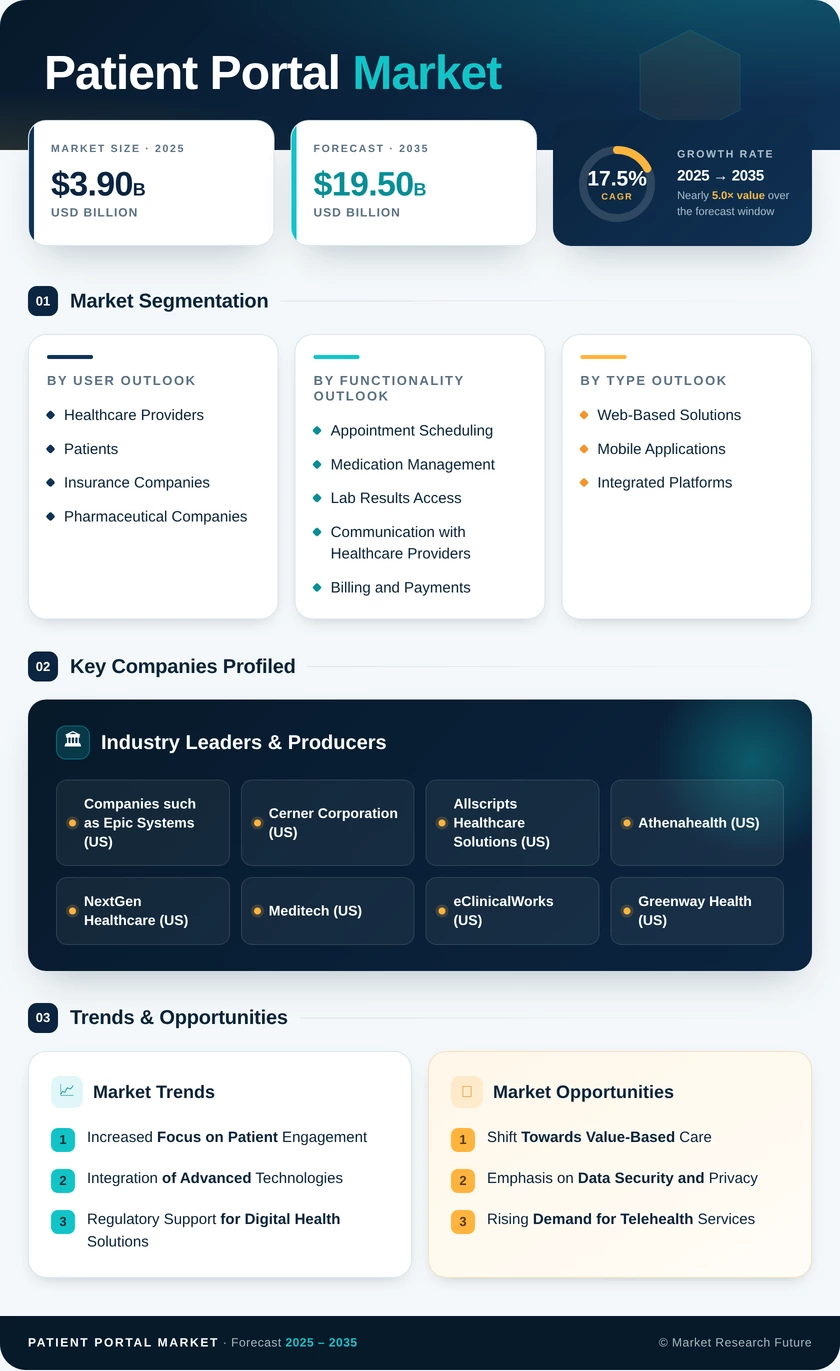
Patient Portal Market (2026 - 2035)

ID: MRFR/HC/9264-HCR 200 Pages Rahul Gotadki Last Updated: September 15, 2026
Patient Portal Market Research Report By Functionality (Appointment Scheduling, Medication Management, Lab Results Access, Communication with Healthcare Providers, Billing and Payments), By Deployment Model (On-Premises, Cloud-Based, Hybrid), By End User (Healthcare Providers, Patients, Insurance Companies, Pharmaceutical Companies), By Software Type (Web-Based Solutions, Mobile Applications, Integrated Platforms) and By Regional (North America, Europe, South America, Asia Pacific, Middle East and Africa) - Growth & Industry Forecast 2026 To 2035
Patient Portal Market
Market Size
Forecast Period2026-2035
CAGR (2026-2035)17.2%
2025 Market SizeUSD 7.02 Billion
2035 Market SizeUSD 34.33 Billion
Key Players
Epic Systems
Oracle Health
athenahealth
Veradigm
NextGen Healthcare
eClinicalWorks
Opportunities
  • AI-Assisted Inbox Triage
  • Payer–Provider Convergence Platforms
  • Emerging-Market National Identity Rails
  1. 1 Market Overview |
    1. 1.1 Study Assumptions & Market Definition |
    2. 1.2 Scope of the Study |
    3. 1.3 Research Methodology
  2. 2 Market Summary & Key Report Takeaways |
    1. 2.1 By Portal Type |
    2. 2.2 By Deployment Mode & End User |
    3. 2.3 By Geography
  3. 3 Market Size & Forecast (2021–2035) |
    1. 3.1 Historical Market Size (2021–2024) |
    2. 3.2 Base Year Assessment (2025) |
    3. 3.3 Forecast Market Size (2026–2035) |
    4. 3.4 Year-over-Year Growth Analysis
  4. 4 Market Dynamics — Driver Impact Analysis |
    1. 4.1 Enforcement Turned Access Into a Compliance Line Item |
    2. 4.2 Payer Mandates Open a Second Buyer Class |
    3. 4.3 Cloud Economics Redraw the Cost Curve |
    4. 4.4 Consumers Now Expect Asynchronous Care
  5. 5 Market Dynamics — Restraints Impact Analysis |
    1. 5.1 Registration Is Not Adoption |
    2. 5.2 Security Liability Scales With Access |
    3. 5.3 Messaging Volume Created a Clinician Problem
  6. 6 Market Opportunity Analysis |
    1. 6.1 AI-Assisted Inbox Triage |
    2. 6.2 Payer–Provider Convergence Platforms |
    3. 6.3 Emerging-Market National Identity Rails |
    4. 6.4 Data Monetization Through Consented Research Recruitment |
    5. 6.5 Embedded Financial Services |
    6. 6.6 Industry Value Chain Analysis |
    7. 6.7 Porter's Five Forces Analysis
  7. 7 Regional Market Share & Country-Level Analysis |
    1. 7.1 North America | |
      1. 7.1.1 US | |
      2. 7.1.2 Canada | |
      3. 7.1.3 Mexico |
    2. 7.2 Europe | |
      1. 7.2.1 Germany | |
      2. 7.2.2 UK | |
      3. 7.2.3 France | |
      4. 7.2.4 Italy | |
      5. 7.2.5 Spain | |
      6. 7.2.6 Nordic Countries | |
      7. 7.2.7 Russia | |
      8. 7.2.8 Rest of Europe |
    3. 7.3 Asia-Pacific | |
      1. 7.3.1 China | |
      2. 7.3.2 India | |
      3. 7.3.3 Japan | |
      4. 7.3.4 South Korea | |
      5. 7.3.5 ASEAN | |
      6. 7.3.6 Rest of Asia-Pacific |
    4. 7.4 South America | |
      1. 7.4.1 Brazil | |
      2. 7.4.2 Argentina | |
      3. 7.4.3 Rest of South America |
    5. 7.5 Middle East & Africa | |
      1. 7.5.1 Saudi Arabia | |
      2. 7.5.2 UAE | |
      3. 7.5.3 South Africa | |
      4. 7.5.4 Egypt | |
      5. 7.5.5 Rest of Middle East & Africa
  8. 8 Future Outlook (2026–2035) |
    1. 8.1 Autonomous Administrative Operations |
    2. 8.2 Platform Economics and Switching Costs |
    3. 8.3 Standards Consolidation |
    4. 8.4 Equity and Accessibility as Purchasing Criteria
  9. 9 Market Segmentation Analysis |
    1. 9.1 By Portal Type | |
      1. 9.1.1 Integrated Portals | |
      2. 9.1.2 Stand-Alone Portals |
    2. 9.2 By Deployment Mode | |
      1. 9.2.1 Web/On-Premise | |
      2. 9.2.2 Cloud-Based |
    3. 9.3 By End User | |
      1. 9.3.1 Providers | |
      2. 9.3.2 Payers | |
      3. 9.3.3 Pharmacies & Retail Health | |
      4. 9.3.4 Other End Users
  10. 10 Competitive Landscape |
    1. 10.1 Market Concentration Analysis (2026) |
    2. 10.2 Competitive Benchmarking Matrix |
    3. 10.3 Company Profiles | |
      1. 10.3.1 Epic Systems | |
      2. 10.3.2 Oracle Health | |
      3. 10.3.3 athenahealth | |
      4. 10.3.4 Veradigm | |
      5. 10.3.5 NextGen Healthcare | |
      6. 10.3.6 eClinicalWorks | |
      7. 10.3.7 MEDITECH | |
      8. 10.3.8 Phreesia | |
      9. 10.3.9 Greenway Health | |
      10. 10.3.10 InteliChart | |
      11. 10.3.11 CureMD
  11. 11 Recent News & Developments (2023–2025)
  12. 12 Report Scope & Methodology |
    1. 12.1 Study Period & Base Year |
    2. 12.2 Valuation Currency & Units |
    3. 12.3 Abbreviations
  13. 13 Detailed Sources & Citations
  14. 14 Frequently Asked Questions
  15. 15 LIST OF TABLES |
  16. TABLE 1 Global Patient Portal Market Size & Forecast, by Revenue (USD Billion), 2021–2035 |
  17. TABLE 2 Global Patient Portal Market — Year-over-Year Growth Analysis, 2021–2035 |
  18. TABLE 3 Driver Impact Analysis Matrix, 2026–2035 |
  19. TABLE 4 Restraint Impact Analysis Matrix, 2026–2035 |
  20. TABLE 5 Global Patient Portal Market Size, by Region, 2021–2035 (USD Billion) |
  21. TABLE 6 North America Patient Portal Market Size, by Country, 2021–2035 (USD Billion) |
  22. TABLE 7 Europe Patient Portal Market Size, by Country, 2021–2035 (USD Billion) |
  23. TABLE 8 Asia-Pacific Patient Portal Market Size, by Country, 2021–2035 (USD Billion) |
  24. TABLE 9 South America Patient Portal Market Size, by Country, 2021–2035 (USD Billion) |
  25. TABLE 10 Middle East & Africa Patient Portal Market Size, by Country, 2021–2035 (USD Billion) |
  26. TABLE 11 Global Patient Portal Market Size, by Portal Type, 2021–2035 (USD Billion) |
  27. TABLE 12 Global Patient Portal Market Size, by Deployment Mode, 2021–2035 (USD Billion) |
  28. TABLE 13 Global Patient Portal Market Size, by End User, 2021–2035 (USD Billion) |
  29. TABLE 14 North America Patient Portal Market Size, by Portal Type, 2021–2035 (USD Billion) |
  30. TABLE 15 North America Patient Portal Market Size, by Deployment Mode, 2021–2035 (USD Billion) |
  31. TABLE 16 North America Patient Portal Market Size, by End User, 2021–2035 (USD Billion) |
  32. TABLE 17 Europe Patient Portal Market Size, by Portal Type, 2021–2035 (USD Billion) |
  33. TABLE 18 Europe Patient Portal Market Size, by Deployment Mode, 2021–2035 (USD Billion) |
  34. TABLE 19 Europe Patient Portal Market Size, by End User, 2021–2035 (USD Billion) |
  35. TABLE 20 Asia-Pacific Patient Portal Market Size, by Portal Type, 2021–2035 (USD Billion) |
  36. TABLE 21 Asia-Pacific Patient Portal Market Size, by Deployment Mode, 2021–2035 (USD Billion) |
  37. TABLE 22 Asia-Pacific Patient Portal Market Size, by End User, 2021–2035 (USD Billion) |
  38. TABLE 23 South America Patient Portal Market Size, by Portal Type, 2021–2035 (USD Billion) |
  39. TABLE 24 South America Patient Portal Market Size, by End User, 2021–2035 (USD Billion) |
  40. TABLE 25 Middle East & Africa Patient Portal Market Size, by Portal Type, 2021–2035 (USD Billion) |
  41. TABLE 26 Middle East & Africa Patient Portal Market Size, by End User, 2021–2035 (USD Billion) |
  42. TABLE 27 US Patient Portal Market Size, by Segment, 2021–2035 (USD Billion) |
  43. TABLE 28 Germany Patient Portal Market Size, by Segment, 2021–2035 (USD Billion) |
  44. TABLE 29 China Patient Portal Market Size, by Segment, 2021–2035 (USD Billion) |
  45. TABLE 30 India Patient Portal Market Size, by Segment, 2021–2035 (USD Billion) |
  46. TABLE 31 Brazil Patient Portal Market Size, by Segment, 2021–2035 (USD Billion) |
  47. TABLE 32 Saudi Arabia Patient Portal Market Size, by Segment, 2021–2035 (USD Billion) |
  48. TABLE 33 Competitive Benchmarking Matrix, 2026 |
  49. TABLE 34 Company Profiles — Key Players |
  50. TABLE 35 Recent Developments & Strategic Announcements, 2023–2025 |
  51. TABLE 36 Report Scope & Methodology Summary |
  52. TABLE 37 Detailed Sources & Citations Index
  53. 16 LIST OF FIGURES |
  54. FIGURE 1 Market Dynamics Overview — Drivers, Restraints, Opportunities |
  55. FIGURE 2 Industry Value Chain Analysis |
  56. FIGURE 3 Porter's Five Forces Analysis |
  57. FIGURE 4 Global Market Size Trend, 2021–2035 (USD Billion) |
  58. FIGURE 5 Year-over-Year Growth Trajectory, 2022–2035 (%) |
  59. FIGURE 6 Market Share by Portal Type, 2025 vs 2035 (%) |
  60. FIGURE 7 Market Share by Deployment Mode, 2025 vs 2035 (%) |
  61. FIGURE 8 Market Share by End User, 2025 vs 2035 (%) |
  62. FIGURE 9 Regional Revenue Share, 2025 (%) |
  63. FIGURE 10 Regional CAGR Comparison, 2026–2035 (%) |
  64. FIGURE 11 North America Country Share Breakdown, 2025 (%) |
  65. FIGURE 12 Europe Country Share Breakdown, 2025 (%) |
  66. FIGURE 13 Asia-Pacific Country Share Breakdown, 2025 (%) |
  67. FIGURE 14 Competitive Landscape — Estimated Revenue Share Bands, 2026 |
  68. FIGURE 15 Vendor Positioning Matrix — Integration Depth vs Deployment Agility |
  69. FIGURE 16 Regulatory Milestone Timeline, 2023–2031

Segmentation Quick Reference

DimensionSub-SegmentsDominant SegmentFastest Growing Segment
By Portal TypeIntegrated Portals; Stand-Alone PortalsIntegrated PortalsStand-Alone Portals
By Deployment ModeWeb/On-Premise; Cloud-BasedWeb/On-PremiseCloud-Based
By End UserProviders; Payers; Pharmacies & Retail Health; Other End UsersProvidersPayers
By GeographyNorth America; Europe; Asia-Pacific; Middle East & Africa; South AmericaNorth AmericaAsia-Pacific


Market Segmentation Overview

By Portal Type

Sub-SegmentKey Trend
Integrated PortalsBundled licensing keeps switching economically irrational for large health systems.
Stand-Alone PortalsModular deployment lets ambulatory and retail clinics add access without system replacement.


Portal type is the dimension where incumbency and agility collide most directly. Integrated suites hold revenue through data-model lock-in, while stand-alone vendors grow faster by selling to organizations that cannot afford or justify a full clinical system overhaul.

By Deployment Mode

Sub-SegmentKey Trend
Web/On-PremiseRetains majority revenue as depreciated infrastructure amortizes across renewal cycles
Cloud-BasedManaged security certification and elastic capacity shift ownership cost onto the vendor.


Deployment preference is converging on cloud everywhere except where data residency law genuinely forbids it — and in-country hyperscale regions are steadily removing even that objection across Europe and the Gulf.

By End User

Sub-SegmentKey Trend
ProvidersCompliance obligations and patient retention drive the largest and most stable spend base.
PayersAPI mandates with fixed 2027 deadlines create a first-time enterprise buying wave
Pharmacies & Retail HealthTransactional workflows — refills, immunizations, results — with lighter integration demands
Other End UsersEmployer health programs and public health agencies buying targeted engagement tooling


End-user mix is diversifying for the first time in a decade. Providers still anchor revenue, but payer procurement growth reshapes vendor roadmaps toward benefits, authorization status, and claims transparency rather than purely clinical record display.




Download PDF ×

We do not share your information with anyone. However, we may send you emails based on your report interest from time to time. You may contact us at any time to opt-out.