×
Request Free Sample ×

Kindly complete the form below to receive a free sample of this Report

* Please use a valid business email

Leading companies partner with us for data-driven Insights

clients tt-cursor
Hero Background
English
Chinese
French
Japanese
Korean
German
Spanish

Passenger Security Market Share

ID: MRFR/AD/8159-HCR
168 Pages
Sejal Akre
October 2025

Passenger Security Market Size, Share, Industry Trend & Analysis Research Report Information by Solution (Baggage Inspection Systems, Video Management Systems, Access Control/Biometric Systems, Cybersecurity Solutions, Hand-Held Scanners, Full-Body Scanners, Explosive Trace Detectors, Walk-Through Metal Detectors, Perimeter Intrusion Detection Systems and Bar-Coded Boarding Systems), Investment Type (New Demand and Replacement Demand), End User (Commercial Airports, Seaports and Railway Stations) and Region - Forecast 2030

Share:
Download PDF ×

We do not share your information with anyone. However, we may send you emails based on your report interest from time to time. You may contact us at any time to opt-out.

Passenger Security Market Infographic
Purchase Options

Market Share

Passenger Security Market Share Analysis

“The Passenger Security market is currently undergoing transformations that are indicators of the changing dynamics of airport security, public transportation safety and passenger experience; a remarkable trend is the increasing integration of sophisticated screening technologies at airports and transportation hubs. The use of advanced body scanners, state-of-the-art x-ray machines, biometric identification technology, help to improve security as well as the efficiency of passenger screening systems. This trend reflects the industry’s commitment to innovative solutions that can reconcile strict security protocols with seamless and speedy passenger flow.

Another key trend is the increased adoption of biometrics for verifying passengers’ identities. Biometric technologies like facial recognition, fingerprint scanning and iris recognition are increasingly being used to enhance security and streamline passenger journeys from check-in to boarding, airports and transport authorities are using biometrics to create an effortless yet secure journey for travelers. It shows that amid concerns about privacy airlines seek to combine more secure measures on their way forward so they will not hinder customer rights with those laws that protect privacy in this new era of digital transformation.

Additionally, the Passenger Security market has witnessed an upsurge in artificial intelligence (AI) and machine learning (ML) adoption in its security systems. AI video analytics, behavior detection algorithms and predictive analytics help identify potential threats faster than ever before by using real-time monitoring capabilities.This leads to proactive approaches by which security issues can be addressed ahead before becoming major ones resulting into safeguarding both passengers' safety as well as the infrastructure.

The market also experiences increased focus on cyber-security within passenger security systems; with aviation and transportation increasingly employing digital technologies, they become prone to cyber threats. This trend includes deploying robust cybersecurity controls that safeguard critical details on passengers, communication networks or even control systems. This cybersecurity emphasis addresses the evolving threat landscape in the digital age protecting sensitive data while securing integrity within passenger security systems.

Besides this there is a push for integrated security solutions covering various aspects of passenger safety; integrating video surveillance with access control, biometrics and cyber security features creates one platform. This integration of security solutions simplifies the security operations, supports real-time monitoring and response as well as enhances overall efficiency of passenger safety measures. It is a way of looking at passengers’ safety holistically by recognizing how various security threats are interconnected within the transport sector.

Also, the Passenger Security market is witnessing trends in passenger screening technologies that give priority to privacy concerns; advanced screening technologies maintaining a balance between effective threat detection and privacy for passengers are on the rise. By addressing concerns about invasive security controls, this trend makes sure that passengers’ rights conform to statutory regulations governing their privacy.Thus, there has been an emphasis on preserving human dignity and privacy during such processes.

Moreover, there is a growing tendency towards touchless or contactless technologies in passenger security procedures; COVID-19 pandemic has underscored this change by accelerating adoption of touchless solutions such as contactless check-in, biometric boarding passes or even no-touching airport security equipment. In addition to addressing health and hygiene considerations, these developments also result into faster more convenient trips for travelers hence consistent with new demands from tourists in a post-pandemic era.”

Author
Sejal Akre
Senior Research Analyst

She has over 5 years of rich experience, in market research and consulting providing valuable market insights to client. Hands on expertise in management consulting, and extensive knowledge in domain including ICT, Automotive & Transportation and Aerospace & Defense. She is skilled in Go-to market strategy, industry analysis, market sizing, in depth company profiling, competitive intelligence & benchmarking and value chain amongst others.

Leave a Comment

FAQs

What is the CAGR for Passenger security market?

Passenger security market can expand at 6.91% CAGR by 2030.

What is the valuation of the Passenger security market?

By 2030, the Passenger security market value can touch to USD 7,770 Mn.

Who are key players of the Passenger security market?

Honeywell International Inc. (US), FLIR Systems, Inc. (US), and E.I.A. SPA (Italy) are some reputed names in the Passenger security market.

What is the Passenger security market driver?

The rapid replacement of conventional security screening solutions can promote the Passenger security market.

What is the Passenger security market restrain?

Complexities with cybersecurity can limit the Passenger security market expansion.

Market Summary

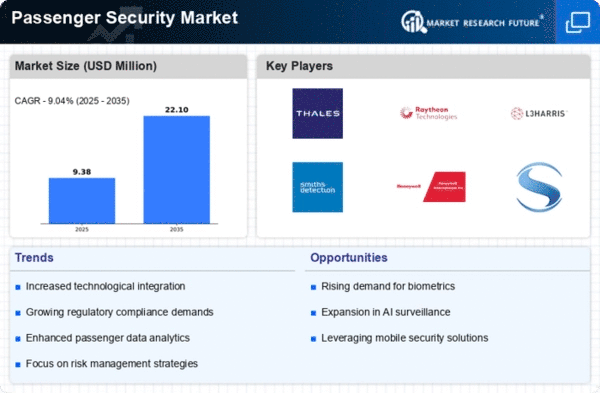
As per MRFR analysis, the Passenger Security Market Size was estimated at 8.6 USD Million in 2024. The Passenger Security industry is projected to grow from 9.3 in 2025 to 22.1 by 2035, exhibiting a compound annual growth rate (CAGR) of 9.04 during the forecast period 2025 - 2035.

Key Market Trends & Highlights

The Passenger Security Market is poised for substantial growth driven by technological advancements and increasing safety concerns.

  • The integration of biometric technologies is transforming security protocols across various sectors.
  • North America remains the largest market for passenger security solutions, while Asia-Pacific is emerging as the fastest-growing region.
  • Surveillance systems dominate the market, yet access control solutions are rapidly gaining traction.
  • Rising terrorism threats and growing awareness of passenger safety are key drivers propelling market expansion.

Market Size & Forecast

2024 Market Size 8.6 (USD Million)
2035 Market Size 22.1 (USD Million)
CAGR (2025 - 2035) 9.04%
Largest Regional Market Share in 2024 North America

Major Players

Thales Group (FR), Raytheon Technologies (US), L3Harris Technologies (US), Smiths Detection (GB), Honeywell International (US), SAFRAN (FR), Aviat Networks (US), SITA (CH), Cognitec Systems (DE)

Market Trends

Passenger Security

Passenger Security Market Market Drivers

Increasing Global Air Travel Demand

The Global passenger security Market Industry is experiencing a notable surge in demand driven by the increasing volume of air travel. In 2024, the market is projected to reach 4.73 USD Billion, reflecting the growing number of passengers traveling internationally. This trend is likely to continue as global tourism rebounds and more individuals opt for air travel. Enhanced security measures are essential to ensure passenger safety, leading to investments in advanced screening technologies and personnel training. As the number of travelers rises, the need for robust security solutions becomes paramount, thereby propelling the growth of the Global Passenger Security Market Industry.

Regulatory Compliance and Standards

The Global Passenger Security Market Industry is heavily shaped by stringent regulatory compliance requirements imposed by governments and international organizations. These regulations mandate enhanced security measures at airports and other transportation hubs to mitigate risks associated with terrorism and other threats. Compliance with these standards necessitates significant investments in security infrastructure and personnel training, thereby driving market growth. As governments worldwide continue to update and enforce these regulations, the demand for advanced security solutions is likely to increase. This dynamic is expected to sustain the Global Passenger Security Market Industry's growth trajectory, particularly as it approaches the anticipated market value of 10.8 USD Billion by 2035.

Rising Security Threats and Terrorism

The Global Passenger Security Market Industry faces increasing pressure due to the rising threats of terrorism and other security risks. High-profile incidents have underscored the necessity for enhanced security measures in public transportation systems. As threats evolve, so too must the strategies employed to counteract them. This has led to a heightened focus on developing comprehensive security frameworks that incorporate advanced technologies and intelligence-sharing among agencies. The urgency to protect passengers and ensure safe travel experiences is driving investments in security solutions, which is likely to contribute to the market's growth, with projections indicating a CAGR of 7.84% from 2025 to 2035.

Growing Public Awareness and Expectations

The Global Passenger Security Market Industry is also influenced by the growing public awareness regarding security issues in transportation. Passengers are increasingly concerned about their safety while traveling, prompting airports and airlines to enhance their security measures. This heightened awareness has led to greater expectations for efficient and effective security processes. As a result, stakeholders in the industry are compelled to adopt innovative security technologies and practices to meet these demands. The focus on passenger experience, alongside security, is likely to drive investments in the Global Passenger Security Market Industry, ensuring that it remains responsive to evolving public expectations.

Technological Advancements in Security Solutions

The Global Passenger Security Market Industry is significantly influenced by rapid technological advancements. Innovations such as biometric screening, artificial intelligence, and machine learning are transforming security protocols at airports and other transit hubs. These technologies enhance the efficiency and accuracy of passenger screening processes, thereby improving overall security. For instance, biometric systems can reduce wait times while ensuring thorough identity verification. As these technologies become more integrated into security frameworks, they are expected to drive market growth, contributing to the projected increase to 10.8 USD Billion by 2035. The ongoing evolution of security technology is a critical driver for the Global Passenger Security Market Industry.

Market Segment Insights

By Application: Surveillance (Largest) vs. Access Control (Fastest-Growing)

In the Passenger Security Market, the application segments show a diverse distribution of market share. Surveillance is currently the largest segment, dominating a significant portion of the market due to its integration of advanced technology and comprehensive monitoring capabilities. Following closely, Access Control is enjoying rapid growth, fueled by increasing demand for secure entry solutions in airports and transport hubs. Other segments, such as Screening, Incident Management, and Emergency Response also play essential roles, but their market shares are smaller compared to the top two segments. Growth trends in the Passenger Security Market are influenced by rising global travel and heightened security concerns. The surveillance segment benefits from continuous advancements in technology, including artificial intelligence and machine learning, which enhance the efficiency of threat detection. Additionally, Access Control systems are adapting to evolving security needs, leading to their emergence as the fastest-growing segment, as organizations enhance their capabilities in managing access while ensuring seamless passenger experiences.

Surveillance (Dominant) vs. Access Control (Emerging)

The Surveillance segment is characterized by its wide-ranging capabilities that include real-time monitoring, data analysis, and threat detection, making it an essential component of passenger security. This segment is dominated by high-definition cameras, intelligent video analytics, and integration with other security systems, ensuring effective management of safety within transportation environments. In contrast, the Access Control segment is regarded as an emerging player, driven by innovations in biometric systems and contactless technologies. This segment is gaining traction as it provides enhanced security and convenience to passengers. Organizations are investing in sophisticated access control solutions to streamline passenger flow while maintaining high security, reflecting the industry's shift towards more integrated and user-friendly systems.

By End Use: Airports (Largest) vs. Event Venues (Fastest-Growing)

In the Passenger Security Market, the segment distribution is heavily skewed towards Airports, which dominate the landscape due to the heightened security protocols necessitated by international travel. Railways and Public Transport follow, albeit at a slower pace, with substantial measures in place to ensure passenger safety. Bus Stations and Event Venues capture a smaller market share, reflecting diverse security needs based on the nature and volume of passenger traffic.

Airports (Dominant) vs. Event Venues (Emerging)

Airports are the cornerstone of the Passenger Security Market, driven by stringent regulations and the high volume of international travelers. They employ multifaceted security measures, including advanced screening technologies and personnel training, shaping a robust infrastructure for passenger safety. Conversely, Event Venues are emerging as a dynamic sector with the rising trend of large-scale public events and gatherings. The demand for sophisticated security solutions is accelerating here, with a focus on crowd control and threat detection technologies, marking a significant shift towards proactive security measures.

By Technology: Biometric Systems (Largest) vs. Video Analytics (Fastest-Growing)

In the Passenger Security Market, the technology segment is dominated by Biometric Systems, which has established itself as the largest contributor to market share due to its advanced ability to ensure secure identification and authentication. Other technologies, such as Metal Detectors and X-ray Screening, follow, but they lack the growth momentum seen in rising technologies. Video Analytics, for instance, is gaining traction for its capability to process vast amounts of data and enhance security through more intelligent surveillance systems.

Technology: Biometric Systems (Dominant) vs. Video Analytics (Emerging)

Biometric Systems have become the dominant technology in the Passenger Security Market due to their reliable and quick identification processes that significantly minimize human error. These systems utilize fingerprints, iris scanning, and facial recognition to enhance security protocols effectively. In contrast, Video Analytics is emerging fast, leveraging AI-driven algorithms to transform traditional surveillance methods. This technology not only improves threat detection but also facilitates data analysis in real time, thus enhancing situational awareness and operational efficiency. As the demand for secure, efficient passenger processing systems increases, Video Analytics stands to become a key player in complementing Biometric Systems.

By Service Type: Consulting Services (Largest) vs. Maintenance Services (Fastest-Growing)

In the Passenger Security Market, the service type segment is dominated by Consulting Services, which holds the largest share of the market. This segment is favored by organizations seeking expert guidance on compliance, technology implementation, and risk management in security operations. Following closely, Maintenance Services has carved out a substantial niche as businesses increasingly recognize the importance of routine inspections and upkeep to ensure optimal functionality of security systems. The growth trends within this segment are driven by several factors, including the rising demand for advanced security solutions due to evolving threats and the growing emphasis on passenger safety. As regulations become more stringent, the need for specialized Consulting Services continues to expand. Concurrently, Maintenance Services is experiencing rapid growth due to the increasing adoption of integrated security technologies that require ongoing support and modernization.

Consulting Services (Dominant) vs. Training Services (Emerging)

Consulting Services hold the dominant position in the Passenger Security Market, providing essential advice and strategies to organizations for enhancing their security frameworks. This service type is characterized by its role in navigating complex security challenges and compliance requirements. On the other hand, Training Services are emerging as a vital component in this market, focusing on equipping staff and security personnel with the necessary skills to handle sophisticated security systems and protocols. As businesses invest in training to mitigate risks and improve operational efficiency, this segment is rapidly gaining traction. The evolution of security threats, coupled with the increasing emphasis on employee preparedness, positions Training Services as a critical element in the overall security strategy.

By Component: Cameras (Largest) vs. Software Solutions (Fastest-Growing)

In the Passenger Security Market, the component segment exhibits a varied distribution of market share among its key players. Cameras are the most prominent component, capturing a significant share due to their importance in monitoring and surveillance, while sensors and alarm systems follow, contributing to overall security measures. Software solutions, although currently a smaller share, have been rapidly gaining traction, bolstered by advancements in technology and increasing reliance on integrated security systems. The growth trends within this segment highlight a robust increase in demand for advanced components such as AI-driven cameras and real-time analytics software. The surge in passenger travel and the necessity for enhanced security protocols are pivotal drivers of growth in this market. Additionally, the rising emphasis on smart technology integration promises to further accelerate the adoption of innovative security solutions, positioning software solutions as the fastest-growing sector within the components category.

Cameras (Dominant) vs. Software Solutions (Emerging)

Cameras, as the dominant player in the passenger security component segment, are essential for effective surveillance and incident detection. Their significance arises from their ability to provide critical visual data that supports real-time decision-making processes. Notably, enhancements in camera technology, such as high-definition imaging and night vision capabilities, further bolster their market presence. In contrast, software solutions represent an emerging category, reflecting a shift towards more sophisticated data management and analytic approaches in security systems. These software solutions enable integration with various hardware components, offering functionalities like real-time monitoring, alerts, and predictive analytics. As organizations seek to enhance their security infrastructure, the adoption of software solutions is on the rise, fostering a convergence between hardware and software in passenger security.

Get more detailed insights about Passenger Security Market Research Report - Global Forecast till 2035

Regional Insights

airport security

Key Players and Competitive Insights

The Passenger Security Market is currently characterized by a dynamic competitive landscape, driven by increasing global travel demand and heightened security concerns. Key players such as Thales Group (FR), Raytheon Technologies (US), and Smiths Detection (GB) are strategically positioned to leverage innovation and technological advancements. Thales Group (FR) focuses on integrating advanced biometric systems and AI-driven analytics to enhance security measures, while Raytheon Technologies (US) emphasizes the development of next-generation surveillance technologies. Smiths Detection (GB) is actively pursuing partnerships to expand its product offerings in the detection and screening domain, thereby shaping a competitive environment that prioritizes technological sophistication and operational efficiency.In terms of business tactics, companies are increasingly localizing manufacturing to reduce costs and enhance supply chain resilience. The market appears moderately fragmented, with a mix of established players and emerging firms vying for market share. The collective influence of these key players fosters a competitive structure that encourages innovation and collaboration, as companies seek to differentiate themselves through unique value propositions.

In November Thales Group (FR) announced a strategic partnership with a leading AI firm to develop cutting-edge facial recognition technology aimed at improving passenger flow management at airports. This collaboration is expected to enhance the efficiency of security processes, thereby reducing wait times and improving overall passenger experience. The strategic importance of this move lies in Thales' commitment to integrating AI into its security solutions, positioning the company as a leader in the digital transformation of passenger security.

In October Raytheon Technologies (US) unveiled a new line of advanced screening equipment designed to detect a wider range of threats with greater accuracy. This launch is indicative of the company's focus on innovation and its response to evolving security challenges. By enhancing the capabilities of its screening technologies, Raytheon aims to solidify its market position and address the growing demand for effective security solutions in high-traffic environments.

In September Smiths Detection (GB) expanded its product portfolio by acquiring a startup specializing in AI-driven threat detection algorithms. This acquisition is expected to bolster Smiths' technological capabilities and enhance its competitive edge in the market. The strategic significance of this move lies in the integration of advanced analytics into Smiths' existing product lines, which could lead to improved detection rates and operational efficiencies.

As of December the Passenger Security Market is witnessing trends such as digitalization, sustainability, and AI integration, which are reshaping competitive dynamics. Strategic alliances are becoming increasingly prevalent, as companies recognize the value of collaboration in driving innovation. Looking ahead, competitive differentiation is likely to evolve from traditional price-based competition to a focus on technological innovation, supply chain reliability, and enhanced customer experiences. This shift underscores the importance of adaptability and forward-thinking strategies in navigating the complexities of the Passenger Security Market.

Key Companies in the Passenger Security Market include

Industry Developments

    • Smiths Detection (UK): Information on recent developments is a little scarce online, but they are a major player known for continuous innovation. You can expect them to be at the forefront of advancements in passenger security.

    • Honeywell International (US): They've been focusing on integrated security solutions. This means creating systems that combine various security technologies for a more holistic approach.

    • Axis Communications (Sweden): In 2019, they launched a new high-resolution, multi-directional camera offering 24/7 operation and 360-degree coverage. This improves situational awareness for security personnel.

Future Outlook

Passenger Security Market Future Outlook

The Passenger Security Market is projected to grow at a 9.04% CAGR from 2025 to 2035, driven by technological advancements, regulatory changes, and increasing passenger volumes.

New opportunities lie in:

  • Integration of AI-driven surveillance systems for enhanced threat detection.
  • Development of biometric authentication solutions for seamless passenger processing.
  • Expansion of mobile security applications for real-time alerts and monitoring.

By 2035, the Passenger Security Market is expected to be robust, reflecting substantial growth and innovation.

Market Segmentation

Passenger Security Market End Use Outlook

  • Airports
  • Railways
  • Bus Stations
  • Public Transport
  • Event Venues

Passenger Security Market Component Outlook

  • Cameras
  • Sensors
  • Alarm Systems
  • Software Solutions

Passenger Security Market Technology Outlook

  • Biometric Systems
  • Video Analytics
  • Artificial Intelligence
  • Metal Detectors
  • X-ray Screening

Passenger Security Market Application Outlook

  • Access Control
  • Surveillance
  • Screening
  • Incident Management
  • Emergency Response

Passenger Security Market Service Type Outlook

  • Consulting Services
  • Installation Services
  • Maintenance Services
  • Training Services

Report Scope

MARKET SIZE 20248.6(USD Million)
MARKET SIZE 20259.3(USD Million)
MARKET SIZE 203522.1(USD Million)
COMPOUND ANNUAL GROWTH RATE (CAGR)9.04% (2025 - 2035)
REPORT COVERAGERevenue Forecast, Competitive Landscape, Growth Factors, and Trends
BASE YEAR2024
Market Forecast Period2025 - 2035
Historical Data2019 - 2024
Market Forecast UnitsUSD Million
Key Companies ProfiledThales Group (FR), Raytheon Technologies (US), L3Harris Technologies (US), Smiths Detection (GB), Honeywell International (US), SAFRAN (FR), Aviat Networks (US), SITA (CH), Cognitec Systems (DE)
Segments CoveredApplication, End Use, Technology, Service Type, Component
Key Market OpportunitiesIntegration of advanced biometric technologies enhances efficiency in the Passenger Security Market.
Key Market DynamicsRising technological advancements and regulatory changes drive innovation in the Passenger Security Market.
Countries CoveredNorth America, Europe, APAC, South America, MEA

FAQs

What is the CAGR for Passenger security market?

Passenger security market can expand at 6.91% CAGR by 2030.

What is the valuation of the Passenger security market?

By 2030, the Passenger security market value can touch to USD 7,770 Mn.

Who are key players of the Passenger security market?

Honeywell International Inc. (US), FLIR Systems, Inc. (US), and E.I.A. SPA (Italy) are some reputed names in the Passenger security market.

What is the Passenger security market driver?

The rapid replacement of conventional security screening solutions can promote the Passenger security market.

What is the Passenger security market restrain?

Complexities with cybersecurity can limit the Passenger security market expansion.

  1. SECTION I: EXECUTIVE SUMMARY AND KEY HIGHLIGHTS
    1. EXECUTIVE SUMMARY
      1. Market Overview
      2. Key Findings
      3. Market Segmentation
      4. Competitive Landscape
      5. Challenges and Opportunities
      6. Future Outlook
  2. SECTION II: SCOPING, METHODOLOGY AND MARKET STRUCTURE
    1. MARKET INTRODUCTION
      1. Definition
      2. Scope of the study
    2. RESEARCH METHODOLOGY
      1. Overview
      2. Data Mining
      3. Secondary Research
      4. Primary Research
      5. Forecasting Model
      6. Market Size Estimation
      7. Data Triangulation
      8. Validation
  3. SECTION III: QUALITATIVE ANALYSIS
    1. MARKET DYNAMICS
      1. Overview
      2. Drivers
      3. Restraints
      4. Opportunities
    2. MARKET FACTOR ANALYSIS
      1. Value chain Analysis
      2. Porter's Five Forces Analysis
      3. COVID-19 Impact Analysis
  4. SECTION IV: QUANTITATIVE ANALYSIS
    1. Aerospace & Defense, BY Application (USD Million)
      1. Access Control
      2. Surveillance
      3. Screening
      4. Incident Management
      5. Emergency Response
    2. Aerospace & Defense, BY End Use (USD Million)
      1. Airports
      2. Railways
      3. Bus Stations
      4. Public Transport
      5. Event Venues
    3. Aerospace & Defense, BY Technology (USD Million)
      1. Biometric Systems
      2. Video Analytics
      3. Artificial Intelligence
      4. Metal Detectors
      5. X-ray Screening
    4. Aerospace & Defense, BY Service Type (USD Million)
      1. Consulting Services
      2. Installation Services
      3. Maintenance Services
      4. Training Services
    5. Aerospace & Defense, BY Component (USD Million)
      1. Cameras
      2. Sensors
      3. Alarm Systems
      4. Software Solutions
    6. Aerospace & Defense, BY Region (USD Million)
      1. North America
      2. Europe
      3. APAC
      4. South America
      5. MEA
  5. SECTION V: COMPETITIVE ANALYSIS
    1. Competitive Landscape
      1. Overview
      2. Competitive Analysis
      3. Market share Analysis
      4. Major Growth Strategy in the Aerospace & Defense
      5. Competitive Benchmarking
      6. Leading Players in Terms of Number of Developments in the Aerospace & Defense
      7. Key developments and growth strategies
      8. Major Players Financial Matrix
    2. Company Profiles
      1. Thales Group (FR)
      2. Raytheon Technologies (US)
      3. L3Harris Technologies (US)
      4. Smiths Detection (GB)
      5. Honeywell International (US)
      6. SAFRAN (FR)
      7. Aviat Networks (US)
      8. SITA (CH)
      9. Cognitec Systems (DE)
    3. Appendix
      1. References
      2. Related Reports

Aerospace & Defense Market Segmentation

Aerospace & Defense By Application (USD Million, 2025-2035)

  • Access Control
  • Surveillance
  • Screening
  • Incident Management
  • Emergency Response

Aerospace & Defense By End Use (USD Million, 2025-2035)

  • Airports
  • Railways
  • Bus Stations
  • Public Transport
  • Event Venues

Aerospace & Defense By Technology (USD Million, 2025-2035)

  • Biometric Systems
  • Video Analytics
  • Artificial Intelligence
  • Metal Detectors
  • X-ray Screening

Aerospace & Defense By Service Type (USD Million, 2025-2035)

  • Consulting Services
  • Installation Services
  • Maintenance Services
  • Training Services

Aerospace & Defense By Component (USD Million, 2025-2035)

  • Cameras
  • Sensors
  • Alarm Systems
  • Software Solutions
Infographic

Free Sample Request

Kindly complete the form below to receive a free sample of this Report

Get Free Sample

Customer Strories

Compare Licence

×
Features License Type
Single User Multiuser License Enterprise User
Price $4,950 $5,950 $7,250
Maximum User Access Limit 1 User Upto 10 Users Unrestricted Access Throughout the Organization
Free Customization
Direct Access to Analyst
Deliverable Format
Platform Access
Discount on Next Purchase 10% 15% 15%
Printable Versions