Request Free Sample ×

Kindly complete the form below to receive a free sample of this Report

* Please use a valid business email

Leading companies partner with us for data-driven Insights

clients tt-cursor
Hero Background
English
Chinese
French
Japanese
Korean
German
Spanish

Paroxysmal Supraventricular Tachycardia Market Size

ID: MRFR/MED/4462-HCR
100 Pages
Rahul Gotadki
Last Updated: April 24, 2026

Paroxysmal Supraventricular Tachycardia (PSVT) Market: by Type (AVNRT, AVRT, PAT, WPW) Diagnosis (EPS, Echocardiogram, Holter Monitor, Event Monitor) Treatment (Physical Maneuvers, medications), End-User (Hospitals & Clinics) - Forecast Till 2035

Share:
Download PDF ×

We do not share your information with anyone. However, we may send you emails based on your report interest from time to time. You may contact us at any time to opt-out.

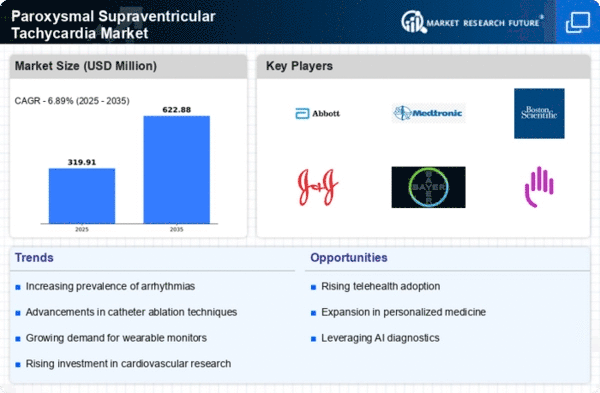
Paroxysmal Supraventricular Tachycardia Market Infographic
Purchase Options

Paroxysmal Supraventricular Tachycardia Size

Paroxysmal Supraventricular Tachycardia Market Growth Projections and Opportunities

The market for paroxysmal supraventricular tachycardia (PSVT) is molded by the meticulousness of this arrhythmia. PSVT includes quick pulses beginning over the heart's ventricles, and its attributes impact the advancement of designated symptomatic and treatment arrangements inside the more extensive arrhythmia market. The market is impacted by progressions in electrophysiological planning and removal procedures well defined for PSVT. Catheter removal techniques, which include designated annihilation of strange tissue causing PSVT, add to the expanding exhibit of treatment choices. Organizations at the cutting edge of refining these methods add to the developing landscape of PSVT management. Drug organizations assume a critical part in the PSVT market by creating hostile to arrhythmic medications to oversee and control episodes. Medications, for example, beta-blockers and calcium channel blockers are commonly recommended. Innovative work endeavors in drug advancement influence market patterns, expecting to upgrade drug adequacy and limit consequences. The connection of telehealth and remote checking arrangements is progressively relevant in the management of PSVT. Remote checking takes into consideration constant following of heart rhythms, empowering healthcare suppliers to quickly intervene. Organizations embracing telehealth add to more accessible and effective healthcare administrations for people with PSVT. Lifestyle factors, like stress, caffeine intake, and absence of physical work, can set off PSVT episodes. The market answers the impact of these variables by stressing way of life alterations as a component of the exhaustive management of PSVT. Organizations elevating all-encompassing methodologies add to a patient-focused market that tends to both intense episodes and long haul prevention. The psychosocial effect of living with PSVT is a huge thought on the lookout. Organizations tending to the close to home and mental parts of the condition, like tension and vulnerability during episodes, add to a more persistent driven approach. Patient help drives upgrade by and large consideration and work on the personal satisfaction for people with PSVT.
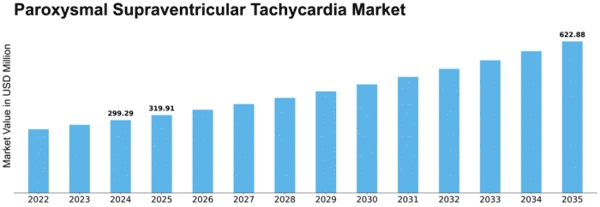
Paroxysmal Supraventricular Tachycardia Market Size Graph
Author
Author Profile
Rahul Gotadki
Research Manager

He holds an experience of about 9+ years in Market Research and Business Consulting, working under the spectrum of Life Sciences and Healthcare domains. Rahul conceptualizes and implements a scalable business strategy and provides strategic leadership to the clients. His expertise lies in market estimation, competitive intelligence, pipeline analysis, customer assessment, etc.

Leave a Comment

FAQs

What is the current market valuation of the Paroxysmal Supraventricular Tachycardia Market?

<p>The market valuation was 299.29 USD Million in 2024.</p>

What is the projected market size for the Paroxysmal Supraventricular Tachycardia Market by 2035?

<p>The projected valuation for 2035 is 622.88 USD Million.</p>

What is the expected CAGR for the Paroxysmal Supraventricular Tachycardia Market during the forecast period?

<p>The expected CAGR during 2025 - 2035 is 6.89%.</p>

Which companies are considered key players in the Paroxysmal Supraventricular Tachycardia Market?

<p>Key players include Abbott Laboratories, Medtronic, Boston Scientific, and Johnson & Johnson.</p>

What are the primary types of Paroxysmal Supraventricular Tachycardia and their market values?

<p>Atrioventricular Nodal Reentrant Tachycardia had a market value range of 75.0 to 150.0 USD Million.</p>

How does the market for Catheter Ablation compare to other treatment approaches?

Catheter Ablation had a market value range of 100.0 to 250.0 USD Million, indicating strong demand.

What demographic factors influence the Paroxysmal Supraventricular Tachycardia Market?

Factors such as age group and comorbid conditions had market values of 75.0 to 150.0 USD Million and 90.0 to 180.0 USD Million, respectively.

What diagnostic methods are utilized in the Paroxysmal Supraventricular Tachycardia Market?

Electrocardiogram was the leading diagnostic method with a market value range of 120.0 to 250.0 USD Million.

What treatment approaches are available for Paroxysmal Supraventricular Tachycardia?

Available treatment approaches include Medication, Catheter Ablation, and Electrical Cardioversion, with respective market values.

How do lifestyle factors impact the Paroxysmal Supraventricular Tachycardia Market?

Lifestyle factors had a market value range of 74.29 to 172.88 USD Million, suggesting their relevance in patient management.

Market Summary

As per MRFR analysis, the Paroxysmal Supraventricular Tachycardia Market Size was estimated at 299.29 USD Million in 2024. The Paroxysmal Supraventricular Tachycardia industry is projected to grow from 319.91 in 2025 to 622.88 by 2035, exhibiting a compound annual growth rate (CAGR) of 6.89% during the forecast period 2025 - 2035.

Key Market Trends & Highlights

The Paroxysmal Supraventricular Tachycardia Market is experiencing notable advancements and growth driven by technological innovations and increasing awareness.

  • North America remains the largest market for Paroxysmal Supraventricular Tachycardia treatments, reflecting a robust healthcare infrastructure. The Asia-Pacific region is emerging as the fastest-growing market, driven by rising healthcare investments and increasing patient populations. Atrioventricular Nodal Reentrant Tachycardia represents the largest segment, while Focal Atrial Tachycardia is witnessing the fastest growth due to evolving treatment options. Key market drivers include the rising incidence of cardiovascular diseases and technological innovations in cardiac monitoring, which are shaping the market landscape.

Market Size & Forecast

2024 Market Size 299.29 (USD Million)
2035 Market Size 622.88 (USD Million)
CAGR (2025 - 2035) 6.89%
Largest Regional Market Share in 2024 North America

Major Players

Abbott Laboratories (US), Medtronic (US), <a href="https://www.bmc.org/patient-care/conditions-we-treat/db/paroxysmal-supraventricular-tachycardia-psvt">Boston Scientific</a> (US), Johnson &amp; Johnson (US), Bayer AG (DE), Bristol-Myers Squibb (US), AstraZeneca (GB), Cardinal Health (US), Stryker Corporation (US)

Market Trends

The Paroxysmal Supraventricular Tachycardia Market is currently experiencing notable developments driven by advancements in medical technology and an increasing understanding of cardiac conditions. As healthcare providers enhance their diagnostic and treatment capabilities, there is a growing emphasis on personalized medicine. This trend appears to be reshaping therapeutic approaches, allowing for tailored interventions that cater to individual patient needs. Furthermore, the integration of telemedicineand remote monitoring solutions is likely to improve patient outcomes by facilitating timely interventions and continuous care. In addition, the rising prevalence of cardiovascular diseases is contributing to heightened awareness and demand for effective treatment options. This situation may lead to increased investments in research and development, fostering innovation in therapeutic modalities. As the market evolves, collaboration between pharmaceutical companies and healthcare institutions seems essential for driving progress and ensuring that patients receive optimal care. Overall, the Paroxysmal Supraventricular Tachycardia Market is poised for growth, with various factors influencing its trajectory and shaping future opportunities.

Advancements in Treatment Modalities

The Paroxysmal Supraventricular Tachycardia Market is witnessing a shift towards innovative treatment options. New pharmacological agents and catheter-based interventions are emerging, enhancing the efficacy of management strategies. This evolution suggests a potential for improved patient outcomes and reduced recurrence rates.

Integration of Telehealth Solutions

The incorporation of telehealth technologies is transforming the Paroxysmal Supraventricular Tachycardia Market. Remote monitoring and virtual consultations are becoming more prevalent, allowing for better patient engagement and timely interventions. This trend indicates a move towards more accessible healthcare.

Growing Focus on Personalized Medicine

There is an increasing emphasis on personalized medicine within the Paroxysmal Supraventricular Tachycardia Market. Tailored treatment plans based on genetic and clinical profiles are gaining traction, potentially leading to more effective management of the condition. This focus may enhance patient satisfaction and adherence.

Paroxysmal Supraventricular Tachycardia Market Market Drivers

Aging Population

The demographic shift towards an aging population is a significant driver of the Global Paroxysmal Supraventricular Tachycardia Market (PSVT) Market Industry. Older adults are more susceptible to cardiovascular conditions, including PSVT, due to age-related physiological changes. As the global population ages, the incidence of PSVT is likely to rise, leading to increased demand for treatment options. This trend is particularly evident in developed countries, where healthcare systems are adapting to cater to the needs of older patients. Consequently, the market is poised for growth as healthcare providers focus on managing PSVT in this demographic.

Rising Incidence of PSVT

The Global Paroxysmal Supraventricular Tachycardia Market (PSVT) Market Industry is witnessing a notable increase in the incidence of PSVT, driven by factors such as lifestyle changes and increased stress levels. As more individuals experience episodes of rapid heart rate, the demand for effective treatment options rises. In 2024, the market is valued at approximately 0.3 USD Billion, reflecting the growing awareness and diagnosis of this condition. This trend is expected to continue, with projections indicating a market value of 0.62 USD Billion by 2035, suggesting a robust growth trajectory fueled by the rising prevalence of PSVT.

Market Growth Projections

The Global Paroxysmal Supraventricular Tachycardia Market (PSVT) Market Industry is projected to experience substantial growth over the next decade. With a market valuation of 0.3 USD Billion in 2024, it is expected to reach 0.62 USD Billion by 2035, reflecting a compound annual growth rate (CAGR) of 6.89% from 2025 to 2035. This growth is indicative of the increasing recognition of PSVT as a significant health issue and the corresponding demand for effective treatment options. The market dynamics suggest a favorable environment for stakeholders, including healthcare providers and pharmaceutical companies, to engage in the development and distribution of PSVT therapies.

Increased Awareness and Diagnosis

There is a growing awareness regarding cardiovascular diseases, including PSVT, which is positively influencing the Global Paroxysmal Supraventricular Tachycardia Market (PSVT) Market Industry. Public health campaigns and educational initiatives are helping to inform both healthcare professionals and patients about the symptoms and risks associated with PSVT. This heightened awareness leads to earlier diagnosis and treatment, which is essential for effective management of the condition. As a result, the market is expected to see substantial growth, with a projected compound annual growth rate (CAGR) of 6.89% from 2025 to 2035, indicating a sustained interest in addressing this health concern.

Advancements in Treatment Modalities

Innovations in medical technology are significantly impacting the Global Paroxysmal Supraventricular Tachycardia Market (PSVT) Market Industry. New treatment modalities, including catheter ablation and advanced antiarrhythmic drugs, are emerging, offering patients more effective and less invasive options. These advancements not only enhance patient outcomes but also contribute to the overall growth of the market. The introduction of novel therapies is likely to attract more patients seeking relief from PSVT symptoms, thereby expanding the market. As the industry evolves, it is anticipated that these innovations will play a crucial role in shaping the future landscape of PSVT treatment.

Regulatory Support for New Therapies

Regulatory bodies are increasingly supportive of the development and approval of new therapies for PSVT, which is fostering growth in the Global Paroxysmal Supraventricular Tachycardia Market (PSVT) Market Industry. Streamlined approval processes and incentives for innovation are encouraging pharmaceutical companies to invest in research and development of novel treatment options. This regulatory environment not only accelerates the availability of new therapies but also enhances competition within the market. As a result, patients benefit from a wider array of treatment choices, which is likely to drive market expansion in the coming years.

Market Segment Insights

By Type of Paroxysmal Supraventricular Tachycardia: Atrioventricular Nodal Reentrant Tachycardia (Largest) vs. Atrial Tachycardia (Fastest-Growing)

<p>The Paroxysmal Supraventricular Tachycardia (PSVT) market showcases a diverse landscape of segment values, with Atrioventricular Nodal Reentrant Tachycardia leading the charge as the largest segment due to its prevalence in the population. This condition accounts for a significant share of PSVT cases, making it a focal point for both clinical attention and market investments. In contrast, Atrial Tachycardia is emerging rapidly, with increased recognition and advancements in treatment options driving its growth in recent years. As healthcare providers refine their approaches to managing PSVT, the dynamics among these segments evolve, reflecting shifts in clinical practice and patient awareness.</p>

<p>Atrioventricular Nodal Reentrant Tachycardia (Dominant) vs. Atrial Tachycardia (Emerging)</p>

<p>Atrioventricular Nodal Reentrant Tachycardia (AVNRT) is recognized as the dominant form of paroxysmal supraventricular tachycardia, characterized by its typical presentation and established treatment pathways, thus commanding a substantial share of market attention. AVNRT is often effectively managed through ablation techniques, which have improved patient outcomes significantly. On the other hand, Atrial Tachycardia is becoming an important emerging segment, gaining traction as awareness increases around different tachycardia types. Atrial Tachycardia is known for its variable characteristics and, while less common than AVNRT, it is witnessing a faster growth rate due to advancements in diagnostic technologies and therapeutic options, positioning it uniquely in the evolving market landscape.</p>

By Treatment Approach: Medication (Largest) vs. Catheter Ablation (Fastest-Growing)

In the Paroxysmal Supraventricular Tachycardia Market, the treatment approach is diverse, with 'Medication' holding the largest share. This category includes various antiarrhythmic drugs that have proven effective in managing symptoms and reducing episodes. In contrast, 'Catheter Ablation' stands out as the fastest-growing segment, driven by advancements in technology and an increasing preference for minimally invasive procedures among patients and healthcare providers. As patients look for more sustainable treatment options, these segments indicate a shifting landscape in treatment preferences. The growth trends in the 'Treatment Approach' segment are influenced by factors such as an aging population, increased awareness of heart rhythm disorders, and technological innovations in catheter ablation techniques. Medication usage remains prevalent due to its ease of administration and established efficacy, while catheter ablation is experiencing rapid adoption due to its potential for long-term cures. As physicians and patients continue to navigate treatment options, the emphasis on personalized approaches is likely to define future developments in this market.

Medication (Dominant) vs. Catheter Ablation (Emerging)

The 'Medication' segment is characterized by a wide range of antiarrhythmic drugs that are integral to managing Paroxysmal Supraventricular Tachycardia. This approach is traditionally viewed as the first line of treatment, offering a non-invasive solution for symptom control. On the other hand, 'Catheter Ablation' is an emerging treatment option that involves mapping and destroying the specific areas of the heart causing the abnormal electrical signals. As technology evolves, catheter ablation is becoming increasingly favored due to its potential for providing a permanent solution to the arrhythmia. Patients looking for effective long-term management find catheter ablation appealing, positioning it as a notable contender against established medication therapies.

By Patient Demographics: Age Group (Largest) vs. Gender (Fastest-Growing)

<p>In the Paroxysmal Supraventricular Tachycardia (PSVT) market, the age group segment holds a substantial share, indicating a higher prevalence of PSVT incidents among older adults. Younger demographics also contribute to the market, but they represent a smaller fraction of the patients diagnosed. The male to female ratio in PSVT cases displays varied distribution, typically leaning towards males, which aligns with observed trends in cardiovascular conditions across different age groups.</p>

<p>Age Group: 60+ (Dominant) vs. Gender: Female (Emerging)</p>

<p>In the patient demographics for PSVT, individuals aged 60 and above are recognized as the dominant age group, primarily due to age-related physiological changes that increase the risk of tachyarrhythmias. Meanwhile, the female patient demographic is emerging as a significant segment, driven by rising awareness and diagnosis rates among women suffering from cardiovascular issues. The inclusion of women patients into clinical studies and marketing strategies highlights a growing understanding of PSVT's impact on diverse populations, emphasizing tailored approaches to treatment and management.</p>

By Diagnosis Method: Electrocardiogram (Largest) vs. Holter Monitor (Fastest-Growing)

<p>The Paroxysmal Supraventricular Tachycardia (PSVT) market is significantly influenced by the various diagnosis methods, with the Electrocardiogram (ECG) leading the segment due to its widespread accessibility and effectiveness in detecting arrhythmias promptly. Holter Monitor follows closely as it provides extended monitoring, offering a significant advantage for diagnosing intermittent conditions like PSVT. The Event Monitor and Electrophysiological Study, while essential, hold a smaller market share but are critical when patients exhibit atypical symptoms leading to further investigation.</p>

<p>Diagnosis Methods: ECG (Dominant) vs. Electrophysiological Study (Emerging)</p>

<p>The Electrocardiogram (ECG) remains the dominant diagnostic method in the PSVT market due to its efficiency and immediate results in identifying tachycardia episodes. Its simplicity and quick turnaround time position it as the first-line diagnostic tool. Conversely, the Electrophysiological Study, though less commonly performed, is emerging as a vital method for patients with complex cases. This invasive procedure allows for in-depth analysis and can guide targeted therapeutic strategies. As technology improves, the Electrophysiological Study is gaining traction, becoming crucial for tailored patient management.</p>

Get more detailed insights about Paroxysmal Supraventricular Tachycardia Market Research Report – Forecast to 2035

Regional Insights

North America : Market Leader in Innovation

North America is poised to maintain its leadership in the Paroxysmal Supraventricular Tachycardia market, holding a significant market share of $149.65M in 2024. The region's growth is driven by increasing prevalence of cardiovascular diseases, advancements in medical technology, and supportive regulatory frameworks. The demand for effective treatment options is further fueled by rising healthcare expenditures and a focus on patient-centric care. The competitive landscape in North America is robust, featuring key players such as Abbott Laboratories, Medtronic, and Boston Scientific. These companies are at the forefront of innovation, developing cutting-edge therapies and devices. The U.S. remains the largest market, supported by a well-established healthcare infrastructure and a high rate of adoption of new technologies. This dynamic environment is expected to foster continued growth in the coming years.

Europe : Emerging Market with Potential

Europe is witnessing a growing market for Paroxysmal Supraventricular Tachycardia, with a market size of €85.0M. The region's growth is driven by an aging population, increasing awareness of cardiovascular health, and advancements in treatment options. Regulatory bodies are actively promoting innovative therapies, which is expected to enhance patient access to effective treatments and improve health outcomes across member states. Leading countries in Europe include Germany, France, and the UK, where significant investments in healthcare infrastructure are being made. The competitive landscape features major players like Bayer AG and Bristol-Myers Squibb, who are focusing on research and development to introduce novel therapies. The European market is characterized by a mix of established companies and emerging startups, creating a vibrant ecosystem for innovation.

Asia-Pacific : Rapidly Growing Healthcare Sector

The Asia-Pacific region is experiencing significant growth in the Paroxysmal Supraventricular Tachycardia market, valued at $50.0M. This growth is attributed to increasing healthcare investments, rising awareness of cardiovascular diseases, and a growing middle-class population seeking advanced medical solutions. Regulatory bodies are also enhancing frameworks to facilitate the introduction of innovative therapies, which is expected to drive market expansion further. Countries like China, Japan, and India are leading the charge in this region, with a focus on improving healthcare access and quality. The competitive landscape is evolving, with both global and local players, including Johnson & Johnson and AstraZeneca, actively participating. The presence of a diverse range of treatment options is expected to cater to the varying needs of patients across different markets in the region.

Middle East and Africa : Emerging Market with Challenges

The Middle East and Africa region is gradually developing its Paroxysmal Supraventricular Tachycardia market, currently valued at $14.64M. Growth is driven by increasing healthcare investments and a rising prevalence of cardiovascular diseases. However, challenges such as regulatory hurdles and limited access to advanced medical technologies can impede market growth. Efforts are being made to improve healthcare infrastructure and regulatory frameworks to enhance patient access to treatments. Leading countries in this region include South Africa and the UAE, where healthcare reforms are being implemented to attract investments. The competitive landscape is characterized by a mix of local and international players, with companies like Cardinal Health and Stryker Corporation making strides in the market. The focus on improving healthcare delivery systems is expected to create new opportunities for growth in the coming years.

Key Players and Competitive Insights

The Paroxysmal Supraventricular Tachycardia Market is characterized by a dynamic competitive landscape, driven by increasing prevalence rates and advancements in treatment modalities. Key players such as Abbott Laboratories (US), Medtronic (US), and Boston Scientific (US) are at the forefront, each adopting distinct strategies to enhance their market positioning. Abbott Laboratories (US) focuses on innovation through the development of advanced cardiac monitoring devices, while Medtronic (US) emphasizes strategic partnerships to expand its product offerings. Boston Scientific (US) is actively pursuing mergers and acquisitions to bolster its portfolio, indicating a trend towards consolidation in the market. Collectively, these strategies contribute to a competitive environment that is increasingly characterized by technological advancements and collaborative efforts.In terms of business tactics, companies are localizing manufacturing and optimizing supply chains to enhance operational efficiency. The market appears moderately fragmented, with several players vying for market share. However, the influence of major companies is substantial, as they leverage their resources to drive innovation and improve patient outcomes. This competitive structure suggests that while there is room for smaller entrants, the dominance of established players is likely to shape market dynamics significantly.
In November Abbott Laboratories (US) announced the launch of a new cardiac monitoring system designed to provide real-time data to healthcare providers. This strategic move is expected to enhance patient management and improve treatment outcomes, reflecting the company's commitment to innovation in cardiac care. The introduction of such technology may also position Abbott as a leader in the digital health space, potentially attracting a broader patient base.
In October Medtronic (US) entered into a partnership with a leading telehealth provider to integrate remote monitoring capabilities into its existing cardiac devices. This collaboration is indicative of a growing trend towards digital health solutions, allowing for more personalized patient care. By enhancing its product offerings through telehealth integration, Medtronic is likely to strengthen its competitive edge in the market.
In September Boston Scientific (US) completed the acquisition of a smaller medical device company specializing in atrial fibrillation treatments. This acquisition not only expands Boston Scientific's product portfolio but also enhances its capabilities in addressing a broader range of cardiac conditions. Such strategic actions suggest a proactive approach to market consolidation, enabling Boston Scientific to leverage synergies and improve its market position.
As of December current competitive trends in the Paroxysmal Supraventricular Tachycardia Market are increasingly defined by digitalization, sustainability, and the integration of artificial intelligence (AI) into healthcare solutions. Strategic alliances are becoming more prevalent, as companies recognize the value of collaboration in driving innovation. The competitive landscape is shifting from traditional price-based competition to a focus on technological advancements and supply chain reliability. This evolution indicates that future differentiation will likely hinge on the ability to deliver innovative solutions that enhance patient care and operational efficiency.

Key Companies in the Paroxysmal Supraventricular Tachycardia Market include

Industry Developments

Future Outlook

Paroxysmal Supraventricular Tachycardia Market Future Outlook

The Paroxysmal Supraventricular Tachycardia Market is projected to grow at a 6.89% CAGR from 2025 to 2035, driven by technological advancements, increasing prevalence, and enhanced treatment options.

New opportunities lie in:

  • <p>Development of wearable cardiac monitoring devices for real-time data collection. Expansion of telehealth services for remote patient management and follow-up. Investment in AI-driven analytics for personalized treatment plans and outcomes.</p>

By 2035, the market is expected to exhibit robust growth, driven by innovation and increased patient engagement.

Market Segmentation

Paroxysmal Supraventricular Tachycardia Market Diagnostic Method Outlook

  • Electrocardiogram
  • Holter Monitor
  • Event Monitor
  • Electrophysiological Study

Paroxysmal Supraventricular Tachycardia Market Treatment Approach Outlook

  • Medication
  • Catheter Ablation
  • Electrical Cardioversion
  • Lifestyle Modification

Paroxysmal Supraventricular Tachycardia Market Patient Demographics Outlook

  • Age Group
  • Gender
  • Comorbid Conditions
  • Lifestyle Factors

Paroxysmal Supraventricular Tachycardia Market Type of Paroxysmal Supraventricular Tachycardia Outlook

  • Atrioventricular Nodal Reentrant Tachycardia
  • Atrioventricular Reentrant Tachycardia
  • Sinus Node Reentrant Tachycardia
  • Focal Atrial Tachycardia

Report Scope

MARKET SIZE 2024 299.29(USD Million)
MARKET SIZE 2025 319.91(USD Million)
MARKET SIZE 2035 622.88(USD Million)
COMPOUND ANNUAL GROWTH RATE (CAGR) 6.89% (2025 - 2035)
REPORT COVERAGE Revenue Forecast, Competitive Landscape, Growth Factors, and Trends
BASE YEAR 2024
Market Forecast Period 2025 - 2035
Historical Data 2019 - 2024
Market Forecast Units USD Million
Key Companies Profiled Abbott Laboratories (US), Medtronic (US), Boston Scientific (US), Johnson & Johnson (US), Bayer AG (DE), Bristol-Myers Squibb (US), AstraZeneca (GB), Cardinal Health (US), Stryker Corporation (US)
Segments Covered Type of Paroxysmal Supraventricular Tachycardia, Treatment Approach, Patient Demographics, Diagnostic Method
Key Market Opportunities Advancements in catheter ablation techniques enhance treatment options in the Paroxysmal Supraventricular Tachycardia Market.
Key Market Dynamics Rising demand for innovative treatment options drives competitive dynamics in the Paroxysmal Supraventricular Tachycardia market.
Countries Covered North America, Europe, APAC, South America, MEA

FAQs

What is the current market valuation of the Paroxysmal Supraventricular Tachycardia Market?

<p>The market valuation was 299.29 USD Million in 2024.</p>

What is the projected market size for the Paroxysmal Supraventricular Tachycardia Market by 2035?

<p>The projected valuation for 2035 is 622.88 USD Million.</p>

What is the expected CAGR for the Paroxysmal Supraventricular Tachycardia Market during the forecast period?

<p>The expected CAGR during 2025 - 2035 is 6.89%.</p>

Which companies are considered key players in the Paroxysmal Supraventricular Tachycardia Market?

<p>Key players include Abbott Laboratories, Medtronic, Boston Scientific, and Johnson & Johnson.</p>

What are the primary types of Paroxysmal Supraventricular Tachycardia and their market values?

<p>Atrioventricular Nodal Reentrant Tachycardia had a market value range of 75.0 to 150.0 USD Million.</p>

How does the market for Catheter Ablation compare to other treatment approaches?

Catheter Ablation had a market value range of 100.0 to 250.0 USD Million, indicating strong demand.

What demographic factors influence the Paroxysmal Supraventricular Tachycardia Market?

Factors such as age group and comorbid conditions had market values of 75.0 to 150.0 USD Million and 90.0 to 180.0 USD Million, respectively.

What diagnostic methods are utilized in the Paroxysmal Supraventricular Tachycardia Market?

Electrocardiogram was the leading diagnostic method with a market value range of 120.0 to 250.0 USD Million.

What treatment approaches are available for Paroxysmal Supraventricular Tachycardia?

Available treatment approaches include Medication, Catheter Ablation, and Electrical Cardioversion, with respective market values.

How do lifestyle factors impact the Paroxysmal Supraventricular Tachycardia Market?

Lifestyle factors had a market value range of 74.29 to 172.88 USD Million, suggesting their relevance in patient management.

  1. SECTION I: EXECUTIVE SUMMARY AND KEY HIGHLIGHTS
    1. | 1.1 EXECUTIVE SUMMARY
    2. | | 1.1.1 Market Overview
    3. | | 1.1.2 Key Findings
    4. | | 1.1.3 Market Segmentation
    5. | | 1.1.4 Competitive Landscape
    6. | | 1.1.5 Challenges and Opportunities
    7. | | 1.1.6 Future Outlook
  2. SECTION II: SCOPING, METHODOLOGY AND MARKET STRUCTURE
    1. | 2.1 MARKET INTRODUCTION
    2. | | 2.1.1 Definition
    3. | | 2.1.2 Scope of the study
    4. | | | 2.1.2.1 Research Objective
    5. | | | 2.1.2.2 Assumption
    6. | | | 2.1.2.3 Limitations
    7. | 2.2 RESEARCH METHODOLOGY
    8. | | 2.2.1 Overview
    9. | | 2.2.2 Data Mining
    10. | | 2.2.3 Secondary Research
    11. | | 2.2.4 Primary Research
    12. | | | 2.2.4.1 Primary Interviews and Information Gathering Process
    13. | | | 2.2.4.2 Breakdown of Primary Respondents
    14. | | 2.2.5 Forecasting Model
    15. | | 2.2.6 Market Size Estimation
    16. | | | 2.2.6.1 Bottom-Up Approach
    17. | | | 2.2.6.2 Top-Down Approach
    18. | | 2.2.7 Data Triangulation
    19. | | 2.2.8 Validation
  3. SECTION III: QUALITATIVE ANALYSIS
    1. | 3.1 MARKET DYNAMICS
    2. | | 3.1.1 Overview
    3. | | 3.1.2 Drivers
    4. | | 3.1.3 Restraints
    5. | | 3.1.4 Opportunities
    6. | 3.2 MARKET FACTOR ANALYSIS
    7. | | 3.2.1 Value chain Analysis
    8. | | 3.2.2 Porter's Five Forces Analysis
    9. | | | 3.2.2.1 Bargaining Power of Suppliers
    10. | | | 3.2.2.2 Bargaining Power of Buyers
    11. | | | 3.2.2.3 Threat of New Entrants
    12. | | | 3.2.2.4 Threat of Substitutes
    13. | | | 3.2.2.5 Intensity of Rivalry
    14. | | 3.2.3 COVID-19 Impact Analysis
    15. | | | 3.2.3.1 Market Impact Analysis
    16. | | | 3.2.3.2 Regional Impact
    17. | | | 3.2.3.3 Opportunity and Threat Analysis
  4. SECTION IV: QUANTITATIVE ANALYSIS
    1. | 4.1 Healthcare, BY Type of Paroxysmal Supraventricular Tachycardia (USD Million)
    2. | | 4.1.1 Atrioventricular Nodal Reentrant Tachycardia
    3. | | 4.1.2 Atrioventricular Reentrant Tachycardia
    4. | | 4.1.3 Atrial Tachycardia
    5. | | 4.1.4 Multifocal Atrial Tachycardia
    6. | 4.2 Healthcare, BY Treatment Approach (USD Million)
    7. | | 4.2.1 Medication
    8. | | 4.2.2 Catheter Ablation
    9. | | 4.2.3 Electrical Cardioversion
    10. | | 4.2.4 Lifestyle Modifications
    11. | 4.3 Healthcare, BY Patient Demographics (USD Million)
    12. | | 4.3.1 Age Group
    13. | | 4.3.2 Gender
    14. | | 4.3.3 Comorbid Conditions
    15. | | 4.3.4 Lifestyle Factors
    16. | 4.4 Healthcare, BY Diagnosis Method (USD Million)
    17. | | 4.4.1 Electrocardiogram
    18. | | 4.4.2 Holter Monitor
    19. | | 4.4.3 Event Monitor
    20. | | 4.4.4 Electrophysiological Study
    21. | 4.5 Healthcare, BY Region (USD Million)
    22. | | 4.5.1 North America
    23. | | | 4.5.1.1 US
    24. | | | 4.5.1.2 Canada
    25. | | 4.5.2 Europe
    26. | | | 4.5.2.1 Germany
    27. | | | 4.5.2.2 UK
    28. | | | 4.5.2.3 France
    29. | | | 4.5.2.4 Russia
    30. | | | 4.5.2.5 Italy
    31. | | | 4.5.2.6 Spain
    32. | | | 4.5.2.7 Rest of Europe
    33. | | 4.5.3 APAC
    34. | | | 4.5.3.1 China
    35. | | | 4.5.3.2 India
    36. | | | 4.5.3.3 Japan
    37. | | | 4.5.3.4 South Korea
    38. | | | 4.5.3.5 Malaysia
    39. | | | 4.5.3.6 Thailand
    40. | | | 4.5.3.7 Indonesia
    41. | | | 4.5.3.8 Rest of APAC
    42. | | 4.5.4 South America
    43. | | | 4.5.4.1 Brazil
    44. | | | 4.5.4.2 Mexico
    45. | | | 4.5.4.3 Argentina
    46. | | | 4.5.4.4 Rest of South America
    47. | | 4.5.5 MEA
    48. | | | 4.5.5.1 GCC Countries
    49. | | | 4.5.5.2 South Africa
    50. | | | 4.5.5.3 Rest of MEA
  5. SECTION V: COMPETITIVE ANALYSIS
    1. | 5.1 Competitive Landscape
    2. | | 5.1.1 Overview
    3. | | 5.1.2 Competitive Analysis
    4. | | 5.1.3 Market share Analysis
    5. | | 5.1.4 Major Growth Strategy in the Healthcare
    6. | | 5.1.5 Competitive Benchmarking
    7. | | 5.1.6 Leading Players in Terms of Number of Developments in the Healthcare
    8. | | 5.1.7 Key developments and growth strategies
    9. | | | 5.1.7.1 New Product Launch/Service Deployment
    10. | | | 5.1.7.2 Merger & Acquisitions
    11. | | | 5.1.7.3 Joint Ventures
    12. | | 5.1.8 Major Players Financial Matrix
    13. | | | 5.1.8.1 Sales and Operating Income
    14. | | | 5.1.8.2 Major Players R&D Expenditure. 2023
    15. | 5.2 Company Profiles
    16. | | 5.2.1 Abbott Laboratories (US)
    17. | | | 5.2.1.1 Financial Overview
    18. | | | 5.2.1.2 Products Offered
    19. | | | 5.2.1.3 Key Developments
    20. | | | 5.2.1.4 SWOT Analysis
    21. | | | 5.2.1.5 Key Strategies
    22. | | 5.2.2 Medtronic (US)
    23. | | | 5.2.2.1 Financial Overview
    24. | | | 5.2.2.2 Products Offered
    25. | | | 5.2.2.3 Key Developments
    26. | | | 5.2.2.4 SWOT Analysis
    27. | | | 5.2.2.5 Key Strategies
    28. | | 5.2.3 Boston Scientific (US)
    29. | | | 5.2.3.1 Financial Overview
    30. | | | 5.2.3.2 Products Offered
    31. | | | 5.2.3.3 Key Developments
    32. | | | 5.2.3.4 SWOT Analysis
    33. | | | 5.2.3.5 Key Strategies
    34. | | 5.2.4 Johnson & Johnson (US)
    35. | | | 5.2.4.1 Financial Overview
    36. | | | 5.2.4.2 Products Offered
    37. | | | 5.2.4.3 Key Developments
    38. | | | 5.2.4.4 SWOT Analysis
    39. | | | 5.2.4.5 Key Strategies
    40. | | 5.2.5 Bayer AG (DE)
    41. | | | 5.2.5.1 Financial Overview
    42. | | | 5.2.5.2 Products Offered
    43. | | | 5.2.5.3 Key Developments
    44. | | | 5.2.5.4 SWOT Analysis
    45. | | | 5.2.5.5 Key Strategies
    46. | | 5.2.6 Bristol-Myers Squibb (US)
    47. | | | 5.2.6.1 Financial Overview
    48. | | | 5.2.6.2 Products Offered
    49. | | | 5.2.6.3 Key Developments
    50. | | | 5.2.6.4 SWOT Analysis
    51. | | | 5.2.6.5 Key Strategies
    52. | | 5.2.7 AstraZeneca (GB)
    53. | | | 5.2.7.1 Financial Overview
    54. | | | 5.2.7.2 Products Offered
    55. | | | 5.2.7.3 Key Developments
    56. | | | 5.2.7.4 SWOT Analysis
    57. | | | 5.2.7.5 Key Strategies
    58. | | 5.2.8 Cardinal Health (US)
    59. | | | 5.2.8.1 Financial Overview
    60. | | | 5.2.8.2 Products Offered
    61. | | | 5.2.8.3 Key Developments
    62. | | | 5.2.8.4 SWOT Analysis
    63. | | | 5.2.8.5 Key Strategies
    64. | | 5.2.9 Stryker Corporation (US)
    65. | | | 5.2.9.1 Financial Overview
    66. | | | 5.2.9.2 Products Offered
    67. | | | 5.2.9.3 Key Developments
    68. | | | 5.2.9.4 SWOT Analysis
    69. | | | 5.2.9.5 Key Strategies
    70. | 5.3 Appendix
    71. | | 5.3.1 References
    72. | | 5.3.2 Related Reports
  6. LIST OF FIGURES
    1. | 6.1 MARKET SYNOPSIS
    2. | 6.2 NORTH AMERICA MARKET ANALYSIS
    3. | 6.3 US MARKET ANALYSIS BY TYPE OF PAROXYSMAL SUPRAVENTRICULAR TACHYCARDIA
    4. | 6.4 US MARKET ANALYSIS BY TREATMENT APPROACH
    5. | 6.5 US MARKET ANALYSIS BY PATIENT DEMOGRAPHICS
    6. | 6.6 US MARKET ANALYSIS BY DIAGNOSIS METHOD
    7. | 6.7 CANADA MARKET ANALYSIS BY TYPE OF PAROXYSMAL SUPRAVENTRICULAR TACHYCARDIA
    8. | 6.8 CANADA MARKET ANALYSIS BY TREATMENT APPROACH
    9. | 6.9 CANADA MARKET ANALYSIS BY PATIENT DEMOGRAPHICS
    10. | 6.10 CANADA MARKET ANALYSIS BY DIAGNOSIS METHOD
    11. | 6.11 EUROPE MARKET ANALYSIS
    12. | 6.12 GERMANY MARKET ANALYSIS BY TYPE OF PAROXYSMAL SUPRAVENTRICULAR TACHYCARDIA
    13. | 6.13 GERMANY MARKET ANALYSIS BY TREATMENT APPROACH
    14. | 6.14 GERMANY MARKET ANALYSIS BY PATIENT DEMOGRAPHICS
    15. | 6.15 GERMANY MARKET ANALYSIS BY DIAGNOSIS METHOD
    16. | 6.16 UK MARKET ANALYSIS BY TYPE OF PAROXYSMAL SUPRAVENTRICULAR TACHYCARDIA
    17. | 6.17 UK MARKET ANALYSIS BY TREATMENT APPROACH
    18. | 6.18 UK MARKET ANALYSIS BY PATIENT DEMOGRAPHICS
    19. | 6.19 UK MARKET ANALYSIS BY DIAGNOSIS METHOD
    20. | 6.20 FRANCE MARKET ANALYSIS BY TYPE OF PAROXYSMAL SUPRAVENTRICULAR TACHYCARDIA
    21. | 6.21 FRANCE MARKET ANALYSIS BY TREATMENT APPROACH
    22. | 6.22 FRANCE MARKET ANALYSIS BY PATIENT DEMOGRAPHICS
    23. | 6.23 FRANCE MARKET ANALYSIS BY DIAGNOSIS METHOD
    24. | 6.24 RUSSIA MARKET ANALYSIS BY TYPE OF PAROXYSMAL SUPRAVENTRICULAR TACHYCARDIA
    25. | 6.25 RUSSIA MARKET ANALYSIS BY TREATMENT APPROACH
    26. | 6.26 RUSSIA MARKET ANALYSIS BY PATIENT DEMOGRAPHICS
    27. | 6.27 RUSSIA MARKET ANALYSIS BY DIAGNOSIS METHOD
    28. | 6.28 ITALY MARKET ANALYSIS BY TYPE OF PAROXYSMAL SUPRAVENTRICULAR TACHYCARDIA
    29. | 6.29 ITALY MARKET ANALYSIS BY TREATMENT APPROACH
    30. | 6.30 ITALY MARKET ANALYSIS BY PATIENT DEMOGRAPHICS
    31. | 6.31 ITALY MARKET ANALYSIS BY DIAGNOSIS METHOD
    32. | 6.32 SPAIN MARKET ANALYSIS BY TYPE OF PAROXYSMAL SUPRAVENTRICULAR TACHYCARDIA
    33. | 6.33 SPAIN MARKET ANALYSIS BY TREATMENT APPROACH
    34. | 6.34 SPAIN MARKET ANALYSIS BY PATIENT DEMOGRAPHICS
    35. | 6.35 SPAIN MARKET ANALYSIS BY DIAGNOSIS METHOD
    36. | 6.36 REST OF EUROPE MARKET ANALYSIS BY TYPE OF PAROXYSMAL SUPRAVENTRICULAR TACHYCARDIA
    37. | 6.37 REST OF EUROPE MARKET ANALYSIS BY TREATMENT APPROACH
    38. | 6.38 REST OF EUROPE MARKET ANALYSIS BY PATIENT DEMOGRAPHICS
    39. | 6.39 REST OF EUROPE MARKET ANALYSIS BY DIAGNOSIS METHOD
    40. | 6.40 APAC MARKET ANALYSIS
    41. | 6.41 CHINA MARKET ANALYSIS BY TYPE OF PAROXYSMAL SUPRAVENTRICULAR TACHYCARDIA
    42. | 6.42 CHINA MARKET ANALYSIS BY TREATMENT APPROACH
    43. | 6.43 CHINA MARKET ANALYSIS BY PATIENT DEMOGRAPHICS
    44. | 6.44 CHINA MARKET ANALYSIS BY DIAGNOSIS METHOD
    45. | 6.45 INDIA MARKET ANALYSIS BY TYPE OF PAROXYSMAL SUPRAVENTRICULAR TACHYCARDIA
    46. | 6.46 INDIA MARKET ANALYSIS BY TREATMENT APPROACH
    47. | 6.47 INDIA MARKET ANALYSIS BY PATIENT DEMOGRAPHICS
    48. | 6.48 INDIA MARKET ANALYSIS BY DIAGNOSIS METHOD
    49. | 6.49 JAPAN MARKET ANALYSIS BY TYPE OF PAROXYSMAL SUPRAVENTRICULAR TACHYCARDIA
    50. | 6.50 JAPAN MARKET ANALYSIS BY TREATMENT APPROACH
    51. | 6.51 JAPAN MARKET ANALYSIS BY PATIENT DEMOGRAPHICS
    52. | 6.52 JAPAN MARKET ANALYSIS BY DIAGNOSIS METHOD
    53. | 6.53 SOUTH KOREA MARKET ANALYSIS BY TYPE OF PAROXYSMAL SUPRAVENTRICULAR TACHYCARDIA
    54. | 6.54 SOUTH KOREA MARKET ANALYSIS BY TREATMENT APPROACH
    55. | 6.55 SOUTH KOREA MARKET ANALYSIS BY PATIENT DEMOGRAPHICS
    56. | 6.56 SOUTH KOREA MARKET ANALYSIS BY DIAGNOSIS METHOD
    57. | 6.57 MALAYSIA MARKET ANALYSIS BY TYPE OF PAROXYSMAL SUPRAVENTRICULAR TACHYCARDIA
    58. | 6.58 MALAYSIA MARKET ANALYSIS BY TREATMENT APPROACH
    59. | 6.59 MALAYSIA MARKET ANALYSIS BY PATIENT DEMOGRAPHICS
    60. | 6.60 MALAYSIA MARKET ANALYSIS BY DIAGNOSIS METHOD
    61. | 6.61 THAILAND MARKET ANALYSIS BY TYPE OF PAROXYSMAL SUPRAVENTRICULAR TACHYCARDIA
    62. | 6.62 THAILAND MARKET ANALYSIS BY TREATMENT APPROACH
    63. | 6.63 THAILAND MARKET ANALYSIS BY PATIENT DEMOGRAPHICS
    64. | 6.64 THAILAND MARKET ANALYSIS BY DIAGNOSIS METHOD
    65. | 6.65 INDONESIA MARKET ANALYSIS BY TYPE OF PAROXYSMAL SUPRAVENTRICULAR TACHYCARDIA
    66. | 6.66 INDONESIA MARKET ANALYSIS BY TREATMENT APPROACH
    67. | 6.67 INDONESIA MARKET ANALYSIS BY PATIENT DEMOGRAPHICS
    68. | 6.68 INDONESIA MARKET ANALYSIS BY DIAGNOSIS METHOD
    69. | 6.69 REST OF APAC MARKET ANALYSIS BY TYPE OF PAROXYSMAL SUPRAVENTRICULAR TACHYCARDIA
    70. | 6.70 REST OF APAC MARKET ANALYSIS BY TREATMENT APPROACH
    71. | 6.71 REST OF APAC MARKET ANALYSIS BY PATIENT DEMOGRAPHICS
    72. | 6.72 REST OF APAC MARKET ANALYSIS BY DIAGNOSIS METHOD
    73. | 6.73 SOUTH AMERICA MARKET ANALYSIS
    74. | 6.74 BRAZIL MARKET ANALYSIS BY TYPE OF PAROXYSMAL SUPRAVENTRICULAR TACHYCARDIA
    75. | 6.75 BRAZIL MARKET ANALYSIS BY TREATMENT APPROACH
    76. | 6.76 BRAZIL MARKET ANALYSIS BY PATIENT DEMOGRAPHICS
    77. | 6.77 BRAZIL MARKET ANALYSIS BY DIAGNOSIS METHOD
    78. | 6.78 MEXICO MARKET ANALYSIS BY TYPE OF PAROXYSMAL SUPRAVENTRICULAR TACHYCARDIA
    79. | 6.79 MEXICO MARKET ANALYSIS BY TREATMENT APPROACH
    80. | 6.80 MEXICO MARKET ANALYSIS BY PATIENT DEMOGRAPHICS
    81. | 6.81 MEXICO MARKET ANALYSIS BY DIAGNOSIS METHOD
    82. | 6.82 ARGENTINA MARKET ANALYSIS BY TYPE OF PAROXYSMAL SUPRAVENTRICULAR TACHYCARDIA
    83. | 6.83 ARGENTINA MARKET ANALYSIS BY TREATMENT APPROACH
    84. | 6.84 ARGENTINA MARKET ANALYSIS BY PATIENT DEMOGRAPHICS
    85. | 6.85 ARGENTINA MARKET ANALYSIS BY DIAGNOSIS METHOD
    86. | 6.86 REST OF SOUTH AMERICA MARKET ANALYSIS BY TYPE OF PAROXYSMAL SUPRAVENTRICULAR TACHYCARDIA
    87. | 6.87 REST OF SOUTH AMERICA MARKET ANALYSIS BY TREATMENT APPROACH
    88. | 6.88 REST OF SOUTH AMERICA MARKET ANALYSIS BY PATIENT DEMOGRAPHICS
    89. | 6.89 REST OF SOUTH AMERICA MARKET ANALYSIS BY DIAGNOSIS METHOD
    90. | 6.90 MEA MARKET ANALYSIS
    91. | 6.91 GCC COUNTRIES MARKET ANALYSIS BY TYPE OF PAROXYSMAL SUPRAVENTRICULAR TACHYCARDIA
    92. | 6.92 GCC COUNTRIES MARKET ANALYSIS BY TREATMENT APPROACH
    93. | 6.93 GCC COUNTRIES MARKET ANALYSIS BY PATIENT DEMOGRAPHICS
    94. | 6.94 GCC COUNTRIES MARKET ANALYSIS BY DIAGNOSIS METHOD
    95. | 6.95 SOUTH AFRICA MARKET ANALYSIS BY TYPE OF PAROXYSMAL SUPRAVENTRICULAR TACHYCARDIA
    96. | 6.96 SOUTH AFRICA MARKET ANALYSIS BY TREATMENT APPROACH
    97. | 6.97 SOUTH AFRICA MARKET ANALYSIS BY PATIENT DEMOGRAPHICS
    98. | 6.98 SOUTH AFRICA MARKET ANALYSIS BY DIAGNOSIS METHOD
    99. | 6.99 REST OF MEA MARKET ANALYSIS BY TYPE OF PAROXYSMAL SUPRAVENTRICULAR TACHYCARDIA
    100. | 6.100 REST OF MEA MARKET ANALYSIS BY TREATMENT APPROACH
    101. | 6.101 REST OF MEA MARKET ANALYSIS BY PATIENT DEMOGRAPHICS
    102. | 6.102 REST OF MEA MARKET ANALYSIS BY DIAGNOSIS METHOD
    103. | 6.103 KEY BUYING CRITERIA OF HEALTHCARE
    104. | 6.104 RESEARCH PROCESS OF MRFR
    105. | 6.105 DRO ANALYSIS OF HEALTHCARE
    106. | 6.106 DRIVERS IMPACT ANALYSIS: HEALTHCARE
    107. | 6.107 RESTRAINTS IMPACT ANALYSIS: HEALTHCARE
    108. | 6.108 SUPPLY / VALUE CHAIN: HEALTHCARE
    109. | 6.109 HEALTHCARE, BY TYPE OF PAROXYSMAL SUPRAVENTRICULAR TACHYCARDIA, 2024 (% SHARE)
    110. | 6.110 HEALTHCARE, BY TYPE OF PAROXYSMAL SUPRAVENTRICULAR TACHYCARDIA, 2024 TO 2035 (USD Million)
    111. | 6.111 HEALTHCARE, BY TREATMENT APPROACH, 2024 (% SHARE)
    112. | 6.112 HEALTHCARE, BY TREATMENT APPROACH, 2024 TO 2035 (USD Million)
    113. | 6.113 HEALTHCARE, BY PATIENT DEMOGRAPHICS, 2024 (% SHARE)
    114. | 6.114 HEALTHCARE, BY PATIENT DEMOGRAPHICS, 2024 TO 2035 (USD Million)
    115. | 6.115 HEALTHCARE, BY DIAGNOSIS METHOD, 2024 (% SHARE)
    116. | 6.116 HEALTHCARE, BY DIAGNOSIS METHOD, 2024 TO 2035 (USD Million)
    117. | 6.117 BENCHMARKING OF MAJOR COMPETITORS
  7. LIST OF TABLES
    1. | 7.1 LIST OF ASSUMPTIONS
    2. | | 7.1.1
    3. | 7.2 North America MARKET SIZE ESTIMATES; FORECAST
    4. | | 7.2.1 BY TYPE OF PAROXYSMAL SUPRAVENTRICULAR TACHYCARDIA, 2025-2035 (USD Million)
    5. | | 7.2.2 BY TREATMENT APPROACH, 2025-2035 (USD Million)
    6. | | 7.2.3 BY PATIENT DEMOGRAPHICS, 2025-2035 (USD Million)
    7. | | 7.2.4 BY DIAGNOSIS METHOD, 2025-2035 (USD Million)
    8. | 7.3 US MARKET SIZE ESTIMATES; FORECAST
    9. | | 7.3.1 BY TYPE OF PAROXYSMAL SUPRAVENTRICULAR TACHYCARDIA, 2025-2035 (USD Million)
    10. | | 7.3.2 BY TREATMENT APPROACH, 2025-2035 (USD Million)
    11. | | 7.3.3 BY PATIENT DEMOGRAPHICS, 2025-2035 (USD Million)
    12. | | 7.3.4 BY DIAGNOSIS METHOD, 2025-2035 (USD Million)
    13. | 7.4 Canada MARKET SIZE ESTIMATES; FORECAST
    14. | | 7.4.1 BY TYPE OF PAROXYSMAL SUPRAVENTRICULAR TACHYCARDIA, 2025-2035 (USD Million)
    15. | | 7.4.2 BY TREATMENT APPROACH, 2025-2035 (USD Million)
    16. | | 7.4.3 BY PATIENT DEMOGRAPHICS, 2025-2035 (USD Million)
    17. | | 7.4.4 BY DIAGNOSIS METHOD, 2025-2035 (USD Million)
    18. | 7.5 Europe MARKET SIZE ESTIMATES; FORECAST
    19. | | 7.5.1 BY TYPE OF PAROXYSMAL SUPRAVENTRICULAR TACHYCARDIA, 2025-2035 (USD Million)
    20. | | 7.5.2 BY TREATMENT APPROACH, 2025-2035 (USD Million)
    21. | | 7.5.3 BY PATIENT DEMOGRAPHICS, 2025-2035 (USD Million)
    22. | | 7.5.4 BY DIAGNOSIS METHOD, 2025-2035 (USD Million)
    23. | 7.6 Germany MARKET SIZE ESTIMATES; FORECAST
    24. | | 7.6.1 BY TYPE OF PAROXYSMAL SUPRAVENTRICULAR TACHYCARDIA, 2025-2035 (USD Million)
    25. | | 7.6.2 BY TREATMENT APPROACH, 2025-2035 (USD Million)
    26. | | 7.6.3 BY PATIENT DEMOGRAPHICS, 2025-2035 (USD Million)
    27. | | 7.6.4 BY DIAGNOSIS METHOD, 2025-2035 (USD Million)
    28. | 7.7 UK MARKET SIZE ESTIMATES; FORECAST
    29. | | 7.7.1 BY TYPE OF PAROXYSMAL SUPRAVENTRICULAR TACHYCARDIA, 2025-2035 (USD Million)
    30. | | 7.7.2 BY TREATMENT APPROACH, 2025-2035 (USD Million)
    31. | | 7.7.3 BY PATIENT DEMOGRAPHICS, 2025-2035 (USD Million)
    32. | | 7.7.4 BY DIAGNOSIS METHOD, 2025-2035 (USD Million)
    33. | 7.8 France MARKET SIZE ESTIMATES; FORECAST
    34. | | 7.8.1 BY TYPE OF PAROXYSMAL SUPRAVENTRICULAR TACHYCARDIA, 2025-2035 (USD Million)
    35. | | 7.8.2 BY TREATMENT APPROACH, 2025-2035 (USD Million)
    36. | | 7.8.3 BY PATIENT DEMOGRAPHICS, 2025-2035 (USD Million)
    37. | | 7.8.4 BY DIAGNOSIS METHOD, 2025-2035 (USD Million)
    38. | 7.9 Russia MARKET SIZE ESTIMATES; FORECAST
    39. | | 7.9.1 BY TYPE OF PAROXYSMAL SUPRAVENTRICULAR TACHYCARDIA, 2025-2035 (USD Million)
    40. | | 7.9.2 BY TREATMENT APPROACH, 2025-2035 (USD Million)
    41. | | 7.9.3 BY PATIENT DEMOGRAPHICS, 2025-2035 (USD Million)
    42. | | 7.9.4 BY DIAGNOSIS METHOD, 2025-2035 (USD Million)
    43. | 7.10 Italy MARKET SIZE ESTIMATES; FORECAST
    44. | | 7.10.1 BY TYPE OF PAROXYSMAL SUPRAVENTRICULAR TACHYCARDIA, 2025-2035 (USD Million)
    45. | | 7.10.2 BY TREATMENT APPROACH, 2025-2035 (USD Million)
    46. | | 7.10.3 BY PATIENT DEMOGRAPHICS, 2025-2035 (USD Million)
    47. | | 7.10.4 BY DIAGNOSIS METHOD, 2025-2035 (USD Million)
    48. | 7.11 Spain MARKET SIZE ESTIMATES; FORECAST
    49. | | 7.11.1 BY TYPE OF PAROXYSMAL SUPRAVENTRICULAR TACHYCARDIA, 2025-2035 (USD Million)
    50. | | 7.11.2 BY TREATMENT APPROACH, 2025-2035 (USD Million)
    51. | | 7.11.3 BY PATIENT DEMOGRAPHICS, 2025-2035 (USD Million)
    52. | | 7.11.4 BY DIAGNOSIS METHOD, 2025-2035 (USD Million)
    53. | 7.12 Rest of Europe MARKET SIZE ESTIMATES; FORECAST
    54. | | 7.12.1 BY TYPE OF PAROXYSMAL SUPRAVENTRICULAR TACHYCARDIA, 2025-2035 (USD Million)
    55. | | 7.12.2 BY TREATMENT APPROACH, 2025-2035 (USD Million)
    56. | | 7.12.3 BY PATIENT DEMOGRAPHICS, 2025-2035 (USD Million)
    57. | | 7.12.4 BY DIAGNOSIS METHOD, 2025-2035 (USD Million)
    58. | 7.13 APAC MARKET SIZE ESTIMATES; FORECAST
    59. | | 7.13.1 BY TYPE OF PAROXYSMAL SUPRAVENTRICULAR TACHYCARDIA, 2025-2035 (USD Million)
    60. | | 7.13.2 BY TREATMENT APPROACH, 2025-2035 (USD Million)
    61. | | 7.13.3 BY PATIENT DEMOGRAPHICS, 2025-2035 (USD Million)
    62. | | 7.13.4 BY DIAGNOSIS METHOD, 2025-2035 (USD Million)
    63. | 7.14 China MARKET SIZE ESTIMATES; FORECAST
    64. | | 7.14.1 BY TYPE OF PAROXYSMAL SUPRAVENTRICULAR TACHYCARDIA, 2025-2035 (USD Million)
    65. | | 7.14.2 BY TREATMENT APPROACH, 2025-2035 (USD Million)
    66. | | 7.14.3 BY PATIENT DEMOGRAPHICS, 2025-2035 (USD Million)
    67. | | 7.14.4 BY DIAGNOSIS METHOD, 2025-2035 (USD Million)
    68. | 7.15 India MARKET SIZE ESTIMATES; FORECAST
    69. | | 7.15.1 BY TYPE OF PAROXYSMAL SUPRAVENTRICULAR TACHYCARDIA, 2025-2035 (USD Million)
    70. | | 7.15.2 BY TREATMENT APPROACH, 2025-2035 (USD Million)
    71. | | 7.15.3 BY PATIENT DEMOGRAPHICS, 2025-2035 (USD Million)
    72. | | 7.15.4 BY DIAGNOSIS METHOD, 2025-2035 (USD Million)
    73. | 7.16 Japan MARKET SIZE ESTIMATES; FORECAST
    74. | | 7.16.1 BY TYPE OF PAROXYSMAL SUPRAVENTRICULAR TACHYCARDIA, 2025-2035 (USD Million)
    75. | | 7.16.2 BY TREATMENT APPROACH, 2025-2035 (USD Million)
    76. | | 7.16.3 BY PATIENT DEMOGRAPHICS, 2025-2035 (USD Million)
    77. | | 7.16.4 BY DIAGNOSIS METHOD, 2025-2035 (USD Million)
    78. | 7.17 South Korea MARKET SIZE ESTIMATES; FORECAST
    79. | | 7.17.1 BY TYPE OF PAROXYSMAL SUPRAVENTRICULAR TACHYCARDIA, 2025-2035 (USD Million)
    80. | | 7.17.2 BY TREATMENT APPROACH, 2025-2035 (USD Million)
    81. | | 7.17.3 BY PATIENT DEMOGRAPHICS, 2025-2035 (USD Million)
    82. | | 7.17.4 BY DIAGNOSIS METHOD, 2025-2035 (USD Million)
    83. | 7.18 Malaysia MARKET SIZE ESTIMATES; FORECAST
    84. | | 7.18.1 BY TYPE OF PAROXYSMAL SUPRAVENTRICULAR TACHYCARDIA, 2025-2035 (USD Million)
    85. | | 7.18.2 BY TREATMENT APPROACH, 2025-2035 (USD Million)
    86. | | 7.18.3 BY PATIENT DEMOGRAPHICS, 2025-2035 (USD Million)
    87. | | 7.18.4 BY DIAGNOSIS METHOD, 2025-2035 (USD Million)
    88. | 7.19 Thailand MARKET SIZE ESTIMATES; FORECAST
    89. | | 7.19.1 BY TYPE OF PAROXYSMAL SUPRAVENTRICULAR TACHYCARDIA, 2025-2035 (USD Million)
    90. | | 7.19.2 BY TREATMENT APPROACH, 2025-2035 (USD Million)
    91. | | 7.19.3 BY PATIENT DEMOGRAPHICS, 2025-2035 (USD Million)
    92. | | 7.19.4 BY DIAGNOSIS METHOD, 2025-2035 (USD Million)
    93. | 7.20 Indonesia MARKET SIZE ESTIMATES; FORECAST
    94. | | 7.20.1 BY TYPE OF PAROXYSMAL SUPRAVENTRICULAR TACHYCARDIA, 2025-2035 (USD Million)
    95. | | 7.20.2 BY TREATMENT APPROACH, 2025-2035 (USD Million)
    96. | | 7.20.3 BY PATIENT DEMOGRAPHICS, 2025-2035 (USD Million)
    97. | | 7.20.4 BY DIAGNOSIS METHOD, 2025-2035 (USD Million)
    98. | 7.21 Rest of APAC MARKET SIZE ESTIMATES; FORECAST
    99. | | 7.21.1 BY TYPE OF PAROXYSMAL SUPRAVENTRICULAR TACHYCARDIA, 2025-2035 (USD Million)
    100. | | 7.21.2 BY TREATMENT APPROACH, 2025-2035 (USD Million)
    101. | | 7.21.3 BY PATIENT DEMOGRAPHICS, 2025-2035 (USD Million)
    102. | | 7.21.4 BY DIAGNOSIS METHOD, 2025-2035 (USD Million)
    103. | 7.22 South America MARKET SIZE ESTIMATES; FORECAST
    104. | | 7.22.1 BY TYPE OF PAROXYSMAL SUPRAVENTRICULAR TACHYCARDIA, 2025-2035 (USD Million)
    105. | | 7.22.2 BY TREATMENT APPROACH, 2025-2035 (USD Million)
    106. | | 7.22.3 BY PATIENT DEMOGRAPHICS, 2025-2035 (USD Million)
    107. | | 7.22.4 BY DIAGNOSIS METHOD, 2025-2035 (USD Million)
    108. | 7.23 Brazil MARKET SIZE ESTIMATES; FORECAST
    109. | | 7.23.1 BY TYPE OF PAROXYSMAL SUPRAVENTRICULAR TACHYCARDIA, 2025-2035 (USD Million)
    110. | | 7.23.2 BY TREATMENT APPROACH, 2025-2035 (USD Million)
    111. | | 7.23.3 BY PATIENT DEMOGRAPHICS, 2025-2035 (USD Million)
    112. | | 7.23.4 BY DIAGNOSIS METHOD, 2025-2035 (USD Million)
    113. | 7.24 Mexico MARKET SIZE ESTIMATES; FORECAST
    114. | | 7.24.1 BY TYPE OF PAROXYSMAL SUPRAVENTRICULAR TACHYCARDIA, 2025-2035 (USD Million)
    115. | | 7.24.2 BY TREATMENT APPROACH, 2025-2035 (USD Million)
    116. | | 7.24.3 BY PATIENT DEMOGRAPHICS, 2025-2035 (USD Million)
    117. | | 7.24.4 BY DIAGNOSIS METHOD, 2025-2035 (USD Million)
    118. | 7.25 Argentina MARKET SIZE ESTIMATES; FORECAST
    119. | | 7.25.1 BY TYPE OF PAROXYSMAL SUPRAVENTRICULAR TACHYCARDIA, 2025-2035 (USD Million)
    120. | | 7.25.2 BY TREATMENT APPROACH, 2025-2035 (USD Million)
    121. | | 7.25.3 BY PATIENT DEMOGRAPHICS, 2025-2035 (USD Million)
    122. | | 7.25.4 BY DIAGNOSIS METHOD, 2025-2035 (USD Million)
    123. | 7.26 Rest of South America MARKET SIZE ESTIMATES; FORECAST
    124. | | 7.26.1 BY TYPE OF PAROXYSMAL SUPRAVENTRICULAR TACHYCARDIA, 2025-2035 (USD Million)
    125. | | 7.26.2 BY TREATMENT APPROACH, 2025-2035 (USD Million)
    126. | | 7.26.3 BY PATIENT DEMOGRAPHICS, 2025-2035 (USD Million)
    127. | | 7.26.4 BY DIAGNOSIS METHOD, 2025-2035 (USD Million)
    128. | 7.27 MEA MARKET SIZE ESTIMATES; FORECAST
    129. | | 7.27.1 BY TYPE OF PAROXYSMAL SUPRAVENTRICULAR TACHYCARDIA, 2025-2035 (USD Million)
    130. | | 7.27.2 BY TREATMENT APPROACH, 2025-2035 (USD Million)
    131. | | 7.27.3 BY PATIENT DEMOGRAPHICS, 2025-2035 (USD Million)
    132. | | 7.27.4 BY DIAGNOSIS METHOD, 2025-2035 (USD Million)
    133. | 7.28 GCC Countries MARKET SIZE ESTIMATES; FORECAST
    134. | | 7.28.1 BY TYPE OF PAROXYSMAL SUPRAVENTRICULAR TACHYCARDIA, 2025-2035 (USD Million)
    135. | | 7.28.2 BY TREATMENT APPROACH, 2025-2035 (USD Million)
    136. | | 7.28.3 BY PATIENT DEMOGRAPHICS, 2025-2035 (USD Million)
    137. | | 7.28.4 BY DIAGNOSIS METHOD, 2025-2035 (USD Million)
    138. | 7.29 South Africa MARKET SIZE ESTIMATES; FORECAST
    139. | | 7.29.1 BY TYPE OF PAROXYSMAL SUPRAVENTRICULAR TACHYCARDIA, 2025-2035 (USD Million)
    140. | | 7.29.2 BY TREATMENT APPROACH, 2025-2035 (USD Million)
    141. | | 7.29.3 BY PATIENT DEMOGRAPHICS, 2025-2035 (USD Million)
    142. | | 7.29.4 BY DIAGNOSIS METHOD, 2025-2035 (USD Million)
    143. | 7.30 Rest of MEA MARKET SIZE ESTIMATES; FORECAST
    144. | | 7.30.1 BY TYPE OF PAROXYSMAL SUPRAVENTRICULAR TACHYCARDIA, 2025-2035 (USD Million)
    145. | | 7.30.2 BY TREATMENT APPROACH, 2025-2035 (USD Million)
    146. | | 7.30.3 BY PATIENT DEMOGRAPHICS, 2025-2035 (USD Million)
    147. | | 7.30.4 BY DIAGNOSIS METHOD, 2025-2035 (USD Million)
    148. | 7.31 PRODUCT LAUNCH/PRODUCT DEVELOPMENT/APPROVAL
    149. | | 7.31.1
    150. | 7.32 ACQUISITION/PARTNERSHIP
    151. | | 7.32.1

Healthcare Market Segmentation

Healthcare By Type of Paroxysmal Supraventricular Tachycardia (USD Million, 2025-2035)

  • Atrioventricular Nodal Reentrant Tachycardia
  • Atrioventricular Reentrant Tachycardia
  • Atrial Tachycardia
  • Multifocal Atrial Tachycardia

Healthcare By Treatment Approach (USD Million, 2025-2035)

  • Medication
  • Catheter Ablation
  • Electrical Cardioversion
  • Lifestyle Modifications

Healthcare By Patient Demographics (USD Million, 2025-2035)

  • Age Group
  • Gender
  • Comorbid Conditions
  • Lifestyle Factors

Healthcare By Diagnosis Method (USD Million, 2025-2035)

  • Electrocardiogram
  • Holter Monitor
  • Event Monitor
  • Electrophysiological Study
Infographic

Free Sample Request

Kindly complete the form below to receive a free sample of this Report

Get Free Sample

Customer Strories

Compare Licence

×
Features License Type
Single User Multiuser License Enterprise User
Price $4,950 $5,950 $7,250
Maximum User Access Limit 1 User Upto 10 Users Unrestricted Access Throughout the Organization
Free Customization
Direct Access to Analyst
Deliverable Format
Platform Access
Discount on Next Purchase 10% 15% 15%
Printable Versions