
×
Request Free Sample ×

Kindly complete the form below to receive a free sample of this Report

* Please use a valid business email

Leading companies partner with us for data-driven Insights

clients tt-cursor
Hero Background
English
Chinese
French
Japanese
Korean
German
Spanish

Paralleling Switchgear Market Share

ID: MRFR/EnP/4552-HCR
100 Pages
Snehal Singh
February 2026

Paralleling Switchgear Market Research Report Information By Voltage (Low Voltage, Medium Voltage), By Application (Prime, Standby, Peak Shave), By End-User (Commercial, Industrial, Utilities And Others) And By Region (North America, Europe, Asia-Pacific, And Rest Of The World) – Global Industry Size, Share, Growth, Trends and Forecast To 2035

Share:
Download PDF ×

We do not share your information with anyone. However, we may send you emails based on your report interest from time to time. You may contact us at any time to opt-out.

Paralleling Switchgear Market Infographic
Purchase Options

Market Share

Paralleling Switchgear Market Share Analysis

The contemporary increase in the efficiency of paralleling switchgear market has been evident in the recent power distribution systems developments, energy management and the rising demand for reliable and resilient electrical infrastructure. One critical trend in this market is the increased adoption of digitalization as well as smart technologies in paralleling switchgear systems. Paralleling switchgear can be remotely operated, real-time monitored and its predictive maintenance can be carried out through the integration of intelligent control systems. This development is consistent with the industry-wide movement toward digital transformation to enhance power distribution networks’ performance such as their reliability, effectiveness and overall productivity.

Another major trend affecting the paralleling switchgear market is an increasing focus on microgrid deployment and grid resiliency. Paralleling switchgear plays a major role in enabling microgrids creation and management by allowing distributed energy resources, backup power sources, grid connected operations to be integrated seamlessly. With every growing demand for resilient power solutions, paralleling switch gear is emerging as one of key components used for developing microgrid infrastructures that offer flexibility and controls on source of energy both in grid-connected mode or islanded mode.

The shift towards renewable energy sources influences the development of paralleling switchgears especially when solar and wind powers are integrated into electricity grids. The smooth interconnection of renewable energies with existing distributed generation system requires appropriate synchronising using parallel switching gears technology. These factors are closely linked to clean energy services that have become popular recently making it necessary to install advanced parallel switches geared at decentralizing production activities.

Energy storage integration has been an emerging trend in paralleling switchgear market. As more players adopt these technologies, they use parallel switches gears to facilitate easy incorporation of stored electrical power into a whole electric grid network for delivery purposes. Herein lies particular importance where such storage serves purposes like peak shaving, grid stabilization or emergency back-up. Parallel switching gear ensures that generators work together with storages thereby optimizing the use of stored energy as needed relative to the grid status and demand too.


Author
Snehal Singh
Assistant Manager - Research

High acumen in analyzing complex macro & micro markets with more than 6 years of work experience in the field of market research. By implementing her analytical skills in forecasting and estimation into market research reports, she has expertise in Packaging, Construction, and Equipment domains. She handles a team size of 20-25 resources and ensures smooth running of the projects, associated marketing activities, and client servicing.

Leave a Comment

FAQs

What is the current valuation of the Paralleling Switchgear Market as of 2024?

<p>The Paralleling Switchgear Market was valued at 1.67 USD Billion in 2024.</p>

What is the projected market valuation for the Paralleling Switchgear Market in 2035?

<p>The market is projected to reach 2.757 USD Billion by 2035.</p>

What is the expected CAGR for the Paralleling Switchgear Market during the forecast period 2025 - 2035?

<p>The expected CAGR for the market during 2025 - 2035 is 4.66%.</p>

Which voltage segments are included in the Paralleling Switchgear Market?

<p>The market includes Low Voltage, valued between 0.67 and 1.1 USD Billion, and Medium Voltage, valued between 1.0 and 1.657 USD Billion.</p>

What applications are driving the Paralleling Switchgear Market?

<p>Key applications include Prime, valued between 0.67 and 1.1 USD Billion, Standby, valued between 0.5 and 0.85 USD Billion, and Peak Shave, valued between 0.5 and 0.77 USD Billion.</p>

Who are the leading players in the Paralleling Switchgear Market?

<p>Key players include Schneider Electric, Eaton, Siemens, General Electric, Mitsubishi Electric, ABB, Emerson Electric, Rockwell Automation, and Crompton Greaves.</p>

What are the end-user segments in the Paralleling Switchgear Market?

End-user segments include Commercial, valued between 0.5 and 0.85 USD Billion, Industrial, valued between 0.6 and 1.0 USD Billion, Utilities, valued between 0.4 and 0.7 USD Billion, and Others, valued between 0.17 and 0.32 USD Billion.

How does the market performance of the Industrial segment compare to others?

The Industrial segment is projected to be valued between 0.6 and 1.0 USD Billion, indicating robust demand relative to other segments.

What factors are influencing the growth of the Paralleling Switchgear Market?

Growth appears to be influenced by increasing demand for reliable power solutions and advancements in switchgear technology.

What trends are expected to shape the Paralleling Switchgear Market in the coming years?

Trends may include enhanced automation, integration of smart technologies, and a focus on energy efficiency.

Market Summary

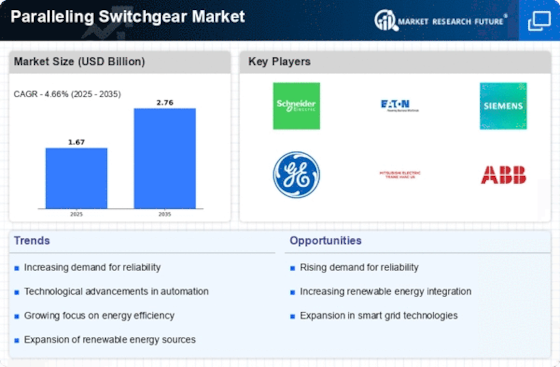
As per Market Research Future analysis, the Paralleling Switchgear Market Size was estimated at 1.67 USD Billion in 2024. The Paralleling Switchgear industry is projected to grow from USD 1.748 Billion in 2025 to USD 2.757 Billion by 2035, exhibiting a compound annual growth rate (CAGR) of 4.66% during the forecast period 2025 - 2035

Key Market Trends & Highlights

The Paralleling Switchgear Market is poised for substantial growth driven by technological advancements and increasing demand for reliable power solutions.

  • North America remains the largest market for paralleling switchgear, driven by robust industrial infrastructure. Asia-Pacific is emerging as the fastest-growing region, fueled by rapid urbanization and industrialization. The low voltage segment dominates the market, while the medium voltage segment is experiencing the fastest growth due to rising energy demands. Key market drivers include the rising demand for reliable power supply and the expansion of data centers, which are critical for modern infrastructure.

Market Size & Forecast

2024 Market Size 1.67 (USD Billion)
2035 Market Size 2.757 (USD Billion)
CAGR (2025 - 2035) 4.66%
Largest Regional Market Share in 2024 Asia Pacific

Major Players

Schneider Electric (FR), <a href="https://www.eaton.com/us/en-us/support/business-resources/consultants-engineers/consultant-resources/design-guides/generator-paralleling-switchgear.html">Eaton </a>(US), Siemens (DE), General Electric (US), Mitsubishi Electric (JP), <a href="https://new.abb.com/medium-voltage/packaging-and-solutions/digital-systems/power-management-and-control-solutions/paralleling-switchgear">ABB</a> (CH), Emerson Electric (US), Rockwell Automation (US), Crompton Greaves (IN)

Market Trends

The Paralleling Switchgear Market is currently experiencing a notable evolution, driven by the increasing demand for reliable power distribution systems across various sectors. This market encompasses equipment that enables multiple power sources to operate in tandem, ensuring uninterrupted power supply and enhanced efficiency. As industries strive for greater energy resilience, the adoption of paralleling switchgear is becoming more prevalent. Furthermore, advancements in technology are facilitating the development of smarter and more efficient switchgear solutions, which are likely to play a pivotal role in shaping the future landscape of this market. In addition to technological innovations, regulatory frameworks are also influencing the Paralleling Switchgear Market. Governments worldwide are implementing stringent standards aimed at improving energy efficiency and reducing carbon footprints. This regulatory push is encouraging manufacturers to innovate and offer products that align with sustainability goals. As a result, the market is poised for growth, with an increasing number of players entering the field to capitalize on emerging opportunities. Overall, the Paralleling Switchgear Market appears to be on a trajectory of expansion, driven by both technological advancements and regulatory influences.

Technological Advancements

The Paralleling Switchgear Market is witnessing a surge in technological innovations, particularly in automation and digitalization. These advancements are enhancing the operational efficiency of switchgear systems, allowing for real-time monitoring and control. As industries increasingly adopt smart grid technologies, the demand for advanced paralleling switchgear solutions is likely to rise.

Sustainability Initiatives

There is a growing emphasis on sustainability within the Paralleling Switchgear Market, as organizations seek to minimize their environmental impact. This trend is prompting manufacturers to develop eco-friendly products that comply with stringent environmental regulations. The focus on reducing carbon emissions and improving energy efficiency is expected to drive market growth.

Increased Demand in Renewable Energy

The shift towards renewable energy sources is significantly influencing the Paralleling Switchgear Market. As more industries integrate solar, wind, and other renewable technologies, the need for reliable switchgear solutions that can manage multiple energy sources is becoming critical. This trend suggests a robust future for the market as it adapts to the evolving energy landscape.

Paralleling Switchgear Market Market Drivers

Expansion of Data Centers

The rapid expansion of data centers is a significant driver for the Paralleling Switchgear Market. With the increasing demand for cloud computing and data storage, data centers require robust power solutions to ensure continuous operation. The market for data centers is projected to grow at a rate of approximately 10% annually, necessitating reliable power management systems. Paralleling switchgear is essential in these facilities, as it allows for the integration of multiple power sources, enhancing redundancy and reliability. Additionally, the growing emphasis on energy efficiency in data centers further propels the demand for advanced paralleling switchgear solutions. As organizations strive to minimize operational costs while maintaining high availability, the role of paralleling switchgear becomes increasingly critical, indicating a promising outlook for the market.

Growth in Industrial Automation

The ongoing trend towards industrial automation is significantly influencing the Paralleling Switchgear Market. As industries adopt automated processes to enhance productivity and efficiency, the demand for sophisticated power management solutions rises. Paralleling switchgear plays a crucial role in managing multiple power sources, ensuring seamless operation of automated systems. The market data suggests that the industrial automation sector is expected to witness a growth rate of around 8% annually, which directly correlates with the increasing adoption of paralleling switchgear. This growth is further fueled by the need for real-time monitoring and control of power systems, which paralleling switchgear can effectively provide. Consequently, the integration of these systems into automated environments is likely to drive market expansion, as businesses seek to optimize their energy consumption and operational reliability.

Emergence of Smart Grid Technologies

The emergence of smart grid technologies is reshaping the Paralleling Switchgear Market. As utilities and industries adopt smart grid solutions, the need for advanced power management systems becomes increasingly apparent. Paralleling switchgear is integral to the operation of smart grids, facilitating the integration of renewable energy sources and enhancing grid reliability. The market for smart grid technologies is anticipated to grow at a compound annual growth rate of approximately 9%, which bodes well for the paralleling switchgear market. These systems enable real-time monitoring and control of power flows, allowing for more efficient energy distribution. As the transition towards smart grids accelerates, the demand for paralleling switchgear is expected to increase, driven by the need for innovative solutions that support modern energy infrastructure.

Increased Focus on Energy Efficiency

The heightened focus on energy efficiency across various sectors is driving the Paralleling Switchgear Market. Organizations are increasingly seeking solutions that not only provide reliable power but also optimize energy consumption. Paralleling switchgear systems are designed to enhance the efficiency of power distribution, allowing for better load management and reduced energy waste. Market analysis indicates that energy-efficient solutions are expected to capture a larger share of the power management market, with a projected growth rate of around 7% over the next few years. This trend is further supported by regulatory initiatives aimed at reducing carbon footprints and promoting sustainable practices. As businesses prioritize energy efficiency, the demand for paralleling switchgear is likely to rise, reflecting a shift towards more sustainable power management solutions.

Rising Demand for Reliable Power Supply

The increasing reliance on uninterrupted power supply across various sectors is a primary driver for the Paralleling Switchgear Market. Industries such as manufacturing, healthcare, and data centers require robust power solutions to prevent downtime and ensure operational efficiency. According to recent data, the demand for reliable power solutions is projected to grow at a compound annual growth rate of approximately 6% over the next five years. This trend indicates a significant opportunity for the paralleling switchgear market, as these systems provide the necessary redundancy and reliability. Furthermore, the integration of advanced monitoring and control technologies enhances the performance of paralleling switchgear, making them indispensable in critical applications. As organizations increasingly prioritize energy resilience, the market for paralleling switchgear is likely to expand, driven by the need for dependable power infrastructure.

Market Segment Insights

By Voltage: Low Voltage (Largest) vs. Medium Voltage (Fastest-Growing)

<p>In the Paralleling Switchgear Market, Low Voltage systems dominate the landscape, capturing the largest share due to their extensive applications in commercial and industrial settings. These systems are preferred for their reliability, safety, and ability to manage power distribution effectively. Conversely, Medium Voltage systems, although smaller in share, are on an upward trajectory, driven by the rising demand for efficient energy solutions and the growing focus on renewable energy integration.</p>

<p>Voltage: Low Voltage (Dominant) vs. Medium Voltage (Emerging)</p>

<p>Low Voltage paralleling switchgear is characterized by its versatility and wide deployment primarily in commercial buildings, hospitals, and data centers, ensuring enhanced continuity of power supply. As the dominant segment, it is favored for its cost-effectiveness and ease of installation. On the other hand, Medium Voltage switchgear is gaining traction as an emerging option, finding applications in industrial settings and utility systems, especially with the increasing shift towards smart grid technologies and the need for higher efficiency in power management. With advancements in technology, Medium Voltage systems are expected to experience significant growth, aligning with the industry's shift towards innovative power solutions.</p>

By Application: Prime (Largest) vs. Peak Shave (Fastest-Growing)

<p>The application segment of the Paralleling Switchgear Market is characterized by three primary categories: Prime, Standby, and Peak Shave. Among these, the Prime application currently holds the largest market share, as it is essential for continuous power supply in various industrial and commercial sectors. Standby applications, while significant, cater to backup scenarios and do not match the expansive demand driven by Prime use cases. Peak Shave, on the other hand, has been gaining traction rapidly as industries strive to optimize energy costs during peak demand periods.</p>

<p>Prime (Dominant) vs. Peak Shave (Emerging)</p>

<p>The Prime application is recognized as the dominant segment in the Paralleling Switchgear Market, primarily due to its vital role in ensuring uninterrupted power supply for critical operations. Industries relying on consistent energy, like manufacturing and healthcare, favor Prime applications for seamless functioning. Conversely, Peak Shave is emerging as a significant contender, driven by increased energy costs and the necessity for businesses to manage energy consumption effectively. This often involves utilizing paralleling switchgear to cut down on peak demand charges. Both segments serve crucial roles, but their strategies and target markets differ, with Prime maintaining stability while Peak Shave capitalizes on evolving energy strategies.</p>

By End-User: Commercial (Largest) vs. Industrial (Fastest-Growing)

<p>The Paralleling Switchgear Market showcases a diverse range of end-user segments, with the Commercial sector holding the largest share. This segment is characterized by a high demand for reliable power solutions, driven by the growth of data centers and commercial buildings. On the other hand, the Industrial segment is witnessing rapid growth due to increasing energy requirements from manufacturing plants and facilities that need uninterrupted power supply for critical operations.</p>

<p>Commercial (Dominant) vs. Industrial (Emerging)</p>

<p>The Commercial end-user segment dominates the Paralleling Switchgear Market, largely due to its expansive infrastructure, including office buildings, retail spaces, and data centers that rely on consistent power supply. This segment prioritizes high-quality performance, durability, and energy efficiency, leading to significant investments in advanced switchgear technology. Conversely, the Industrial segment, marked as an emerging sector, is rapidly expanding as industries automate and modernize their facilities. These industrial players seek robust paralleling switchgear solutions to ensure operational continuity, particularly in sectors like manufacturing, oil and gas, and pharmaceuticals, where power reliability is crucial for productivity.</p>

Get more detailed insights about Paralleling Switchgear Market Research Report – Forecast to 2035

Regional Insights

North America : Innovation and Demand Surge

North America is witnessing significant growth in the paralleling switchgear market, driven by increasing demand for reliable power solutions and stringent regulatory standards. The region holds the largest market share at approximately 40%, with the U.S. leading the charge due to its advanced infrastructure and investment in renewable energy. Canada follows closely, contributing around 15% to the market share, supported by government initiatives promoting energy efficiency. The competitive landscape is dominated by key players such as Eaton, General Electric, and Schneider Electric, who are investing heavily in R&D to innovate their product offerings. The presence of these industry giants fosters a robust market environment, encouraging smaller firms to enhance their capabilities. The focus on smart grid technologies and automation further propels market growth, ensuring a dynamic and competitive atmosphere.

Europe : Regulatory Framework Drives Growth

Europe is emerging as a significant player in the paralleling switchgear market, driven by stringent environmental regulations and a shift towards renewable energy sources. The region holds the second-largest market share at around 30%, with Germany and the UK leading the way. Germany's commitment to energy transition and the UK's focus on smart grid technologies are key factors propelling market growth, supported by EU regulations promoting energy efficiency and sustainability. Leading countries in this region include Germany, the UK, and France, where major players like Siemens and ABB are actively involved in developing innovative solutions. The competitive landscape is characterized by collaborations and partnerships aimed at enhancing product offerings. The presence of a well-established manufacturing base and a focus on technological advancements further solidify Europe's position in the global market.

Asia-Pacific : Emerging Markets and Opportunities

Asia-Pacific is rapidly becoming a powerhouse in the paralleling switchgear market, fueled by industrialization and urbanization. The region holds a market share of approximately 25%, with China and India being the largest contributors. China's focus on infrastructure development and India's push for renewable energy are significant growth drivers, supported by government policies aimed at enhancing energy security and efficiency. The competitive landscape is marked by the presence of key players like Mitsubishi Electric and Crompton Greaves, who are expanding their operations to meet the growing demand. The region's market is characterized by a mix of established companies and emerging players, fostering innovation and competitive pricing. As the demand for reliable power solutions increases, the Asia-Pacific market is poised for substantial growth in the coming years.

Middle East and Africa : Resource-Rich Market Potential

The Middle East and Africa region is witnessing a gradual increase in the paralleling switchgear market, driven by the need for reliable power solutions in resource-rich countries. The market share is estimated at around 5%, with the UAE and South Africa leading the way. The UAE's investments in renewable energy and South Africa's focus on improving energy infrastructure are key factors contributing to market growth, supported by government initiatives aimed at enhancing energy efficiency. Key players in this region include local firms and international companies like ABB and Schneider Electric, who are expanding their presence to tap into emerging opportunities. The competitive landscape is evolving, with a focus on innovation and sustainability. As the region continues to develop its energy sector, the demand for advanced switchgear solutions is expected to rise, presenting significant growth potential.

Key Players and Competitive Insights

Leading market players are investing heavily in research and development in order to expand their product lines, which will help the Paralleling Switchgear Market, grow even more. Market participants are also undertaking a variety of strategic activities to expand their global footprint, with important market developments including new product launches, contractual agreements, mergers and acquisitions, higher investments, and collaboration with other organizations. To expand and survive in a more competitive and rising market climate, Paralleling Switchgear industry must offer cost-effective items.
Manufacturing locally to minimize operational costs is one of the key business tactics used by manufacturers in the global Paralleling Switchgear industry to benefit clients and increase the market sector. In recent years, the Paralleling Switchgear industry has offered some of the most significant advantages to medicine. Major players in the Paralleling Switchgear Market, including Regal Beloit Corporation (U.S.), Schneider Electric SE. (France), Advanced Power Technologies. (U.S.), Enercon Engineering, Inc. (U.S.), Industrial Electric Mfg (U.S.), and Russelectric Inc. (U.S.) and others, are attempting to increase market demand by investing in research and development operations.
Schneider Electric SE is a multinational French corporation specializing in digital automation and energy management. By merging energy technology, real-time automation, software, and services, it addresses homes, buildings, data centres, infrastructure, and industries. Schneider Electric is a Fortune Global 500 corporation, a Euronext Exchange public company, and a component of the Euro Stoxx 50 stock market index. The corporation made €34.2 billion in revenue in fiscal year. In June 2022, Schneider Electric unveiled new research and innovations aimed at preparing IT infrastructure for net zero operations.
ABB Ltd. is a global Swedish-Swiss enterprise headquartered in Zürich, Switzerland.ASEA Brown Boveri was created in 1988 when Sweden's Allmänna Svenska Elektriska Aktiebolaget (ASEA) and Switzerland's Brown, Boveri & Cie amalgamated to form ASEA Brown Boveri, afterwards abbreviated to ABB. Both firms were founded in the late 1800s and were major makers of electrical equipment, a business in which ABB is still involved today. Since then, the company has grown into robotics and automation technology.
In January 2022, ABB collaborated with Samsung Electronics to develop solutions for energy savings, energy management, and smart Internet of Things (IoT) connectivity for residential and commercial buildings.

Key Companies in the Paralleling Switchgear Market include

Industry Developments

April 2021,GE and Hitachi-ABB Power Grids struck a non-exclusive cross-licensing deal that will allow them to extend their high-voltage equipment line by using a game-changing gas alternative to sulphur hexafluoride (SF6). SF6 is a switching and insulating gas that is extensively employed in high-voltage electrical equipment. It is a significant greenhouse gas.

July 2021,the European Commission's life climate action program awarded GE Renewable Energy's Grid Solutions business USD 2.6 million to help fund the development of a sulphur hexafluoride (SF6)-free 245-kilovolt (kV) g3 live tank circuit breaker. The new circuit breaker will employ GE's g3 gas technology to deliver the same high performance and small-dimensional footprint as a standard SF6 circuit breaker.

Future Outlook

Paralleling Switchgear Market Future Outlook

The Paralleling Switchgear Market is projected to grow at a 4.66% CAGR from 2025 to 2035, driven by increasing demand for reliable power solutions and advancements in technology.

New opportunities lie in:

  • Integration of IoT for real-time monitoring and diagnostics
  • Development of modular switchgear systems for flexible installations
  • Expansion into renewable energy sectors with tailored switchgear solutions

By 2035, the market is expected to achieve robust growth, reflecting evolving energy demands.

Market Segmentation

Paralleling Switchgear Market Voltage Outlook

  • Low Voltage
  • Medium Voltage

Paralleling Switchgear Market End-User Outlook

  • Commercial
  • Industrial
  • Utilities
  • Others

Paralleling Switchgear Market Application Outlook

  • Prime
  • Standby
  • Peak Shave

Report Scope

MARKET SIZE 2024 1.67(USD Billion)
MARKET SIZE 2025 1.748(USD Billion)
MARKET SIZE 2035 2.757(USD Billion)
COMPOUND ANNUAL GROWTH RATE (CAGR) 4.66% (2025 - 2035)
REPORT COVERAGE Revenue Forecast, Competitive Landscape, Growth Factors, and Trends
BASE YEAR 2024
Market Forecast Period 2025 - 2035
Historical Data 2019 - 2024
Market Forecast Units USD Billion
Key Companies Profiled Schneider Electric (FR), Eaton (US), Siemens (DE), General Electric (US), Mitsubishi Electric (JP), ABB (CH), Emerson Electric (US), Rockwell Automation (US), Crompton Greaves (IN)
Segments Covered Voltage, Application, End-User, Region
Key Market Opportunities Integration of renewable energy sources drives demand in the Paralleling Switchgear Market.
Key Market Dynamics Rising demand for energy efficiency drives innovation and competition in the paralleling switchgear market.
Countries Covered North America, Europe, APAC, South America, MEA

FAQs

What is the current valuation of the Paralleling Switchgear Market as of 2024?

<p>The Paralleling Switchgear Market was valued at 1.67 USD Billion in 2024.</p>

What is the projected market valuation for the Paralleling Switchgear Market in 2035?

<p>The market is projected to reach 2.757 USD Billion by 2035.</p>

What is the expected CAGR for the Paralleling Switchgear Market during the forecast period 2025 - 2035?

<p>The expected CAGR for the market during 2025 - 2035 is 4.66%.</p>

Which voltage segments are included in the Paralleling Switchgear Market?

<p>The market includes Low Voltage, valued between 0.67 and 1.1 USD Billion, and Medium Voltage, valued between 1.0 and 1.657 USD Billion.</p>

What applications are driving the Paralleling Switchgear Market?

<p>Key applications include Prime, valued between 0.67 and 1.1 USD Billion, Standby, valued between 0.5 and 0.85 USD Billion, and Peak Shave, valued between 0.5 and 0.77 USD Billion.</p>

Who are the leading players in the Paralleling Switchgear Market?

<p>Key players include Schneider Electric, Eaton, Siemens, General Electric, Mitsubishi Electric, ABB, Emerson Electric, Rockwell Automation, and Crompton Greaves.</p>

What are the end-user segments in the Paralleling Switchgear Market?

End-user segments include Commercial, valued between 0.5 and 0.85 USD Billion, Industrial, valued between 0.6 and 1.0 USD Billion, Utilities, valued between 0.4 and 0.7 USD Billion, and Others, valued between 0.17 and 0.32 USD Billion.

How does the market performance of the Industrial segment compare to others?

The Industrial segment is projected to be valued between 0.6 and 1.0 USD Billion, indicating robust demand relative to other segments.

What factors are influencing the growth of the Paralleling Switchgear Market?

Growth appears to be influenced by increasing demand for reliable power solutions and advancements in switchgear technology.

What trends are expected to shape the Paralleling Switchgear Market in the coming years?

Trends may include enhanced automation, integration of smart technologies, and a focus on energy efficiency.

  1. SECTION I: EXECUTIVE SUMMARY AND KEY HIGHLIGHTS
    1. | 1.1 EXECUTIVE SUMMARY
    2. | | 1.1.1 Market Overview
    3. | | 1.1.2 Key Findings
    4. | | 1.1.3 Market Segmentation
    5. | | 1.1.4 Competitive Landscape
    6. | | 1.1.5 Challenges and Opportunities
    7. | | 1.1.6 Future Outlook
  2. SECTION II: SCOPING, METHODOLOGY AND MARKET STRUCTURE
    1. | 2.1 MARKET INTRODUCTION
    2. | | 2.1.1 Definition
    3. | | 2.1.2 Scope of the study
    4. | | | 2.1.2.1 Research Objective
    5. | | | 2.1.2.2 Assumption
    6. | | | 2.1.2.3 Limitations
    7. | 2.2 RESEARCH METHODOLOGY
    8. | | 2.2.1 Overview
    9. | | 2.2.2 Data Mining
    10. | | 2.2.3 Secondary Research
    11. | | 2.2.4 Primary Research
    12. | | | 2.2.4.1 Primary Interviews and Information Gathering Process
    13. | | | 2.2.4.2 Breakdown of Primary Respondents
    14. | | 2.2.5 Forecasting Model
    15. | | 2.2.6 Market Size Estimation
    16. | | | 2.2.6.1 Bottom-Up Approach
    17. | | | 2.2.6.2 Top-Down Approach
    18. | | 2.2.7 Data Triangulation
    19. | | 2.2.8 Validation
  3. SECTION III: QUALITATIVE ANALYSIS
    1. | 3.1 MARKET DYNAMICS
    2. | | 3.1.1 Overview
    3. | | 3.1.2 Drivers
    4. | | 3.1.3 Restraints
    5. | | 3.1.4 Opportunities
    6. | 3.2 MARKET FACTOR ANALYSIS
    7. | | 3.2.1 Value chain Analysis
    8. | | 3.2.2 Porter's Five Forces Analysis
    9. | | | 3.2.2.1 Bargaining Power of Suppliers
    10. | | | 3.2.2.2 Bargaining Power of Buyers
    11. | | | 3.2.2.3 Threat of New Entrants
    12. | | | 3.2.2.4 Threat of Substitutes
    13. | | | 3.2.2.5 Intensity of Rivalry
    14. | | 3.2.3 COVID-19 Impact Analysis
    15. | | | 3.2.3.1 Market Impact Analysis
    16. | | | 3.2.3.2 Regional Impact
    17. | | | 3.2.3.3 Opportunity and Threat Analysis
  4. SECTION IV: QUANTITATIVE ANALYSIS
    1. | 4.1 Energy & Power, BY Voltage (USD Billion)
    2. | | 4.1.1 Low Voltage
    3. | | 4.1.2 Medium Voltage
    4. | 4.2 Energy & Power, BY Application (USD Billion)
    5. | | 4.2.1 Prime
    6. | | 4.2.2 Standby
    7. | | 4.2.3 Peak Shave
    8. | 4.3 Energy & Power, BY End-User (USD Billion)
    9. | | 4.3.1 Commercial
    10. | | 4.3.2 Industrial
    11. | | 4.3.3 Utilities
    12. | | 4.3.4 Others
    13. | 4.4 Energy & Power, BY Region (USD Billion)
    14. | | 4.4.1 North America
    15. | | | 4.4.1.1 US
    16. | | | 4.4.1.2 Canada
    17. | | 4.4.2 Europe
    18. | | | 4.4.2.1 Germany
    19. | | | 4.4.2.2 UK
    20. | | | 4.4.2.3 France
    21. | | | 4.4.2.4 Russia
    22. | | | 4.4.2.5 Italy
    23. | | | 4.4.2.6 Spain
    24. | | | 4.4.2.7 Rest of Europe
    25. | | 4.4.3 APAC
    26. | | | 4.4.3.1 China
    27. | | | 4.4.3.2 India
    28. | | | 4.4.3.3 Japan
    29. | | | 4.4.3.4 South Korea
    30. | | | 4.4.3.5 Malaysia
    31. | | | 4.4.3.6 Thailand
    32. | | | 4.4.3.7 Indonesia
    33. | | | 4.4.3.8 Rest of APAC
    34. | | 4.4.4 South America
    35. | | | 4.4.4.1 Brazil
    36. | | | 4.4.4.2 Mexico
    37. | | | 4.4.4.3 Argentina
    38. | | | 4.4.4.4 Rest of South America
    39. | | 4.4.5 MEA
    40. | | | 4.4.5.1 GCC Countries
    41. | | | 4.4.5.2 South Africa
    42. | | | 4.4.5.3 Rest of MEA
  5. SECTION V: COMPETITIVE ANALYSIS
    1. | 5.1 Competitive Landscape
    2. | | 5.1.1 Overview
    3. | | 5.1.2 Competitive Analysis
    4. | | 5.1.3 Market share Analysis
    5. | | 5.1.4 Major Growth Strategy in the Energy & Power
    6. | | 5.1.5 Competitive Benchmarking
    7. | | 5.1.6 Leading Players in Terms of Number of Developments in the Energy & Power
    8. | | 5.1.7 Key developments and growth strategies
    9. | | | 5.1.7.1 New Product Launch/Service Deployment
    10. | | | 5.1.7.2 Merger & Acquisitions
    11. | | | 5.1.7.3 Joint Ventures
    12. | | 5.1.8 Major Players Financial Matrix
    13. | | | 5.1.8.1 Sales and Operating Income
    14. | | | 5.1.8.2 Major Players R&D Expenditure. 2023
    15. | 5.2 Company Profiles
    16. | | 5.2.1 Schneider Electric (FR)
    17. | | | 5.2.1.1 Financial Overview
    18. | | | 5.2.1.2 Products Offered
    19. | | | 5.2.1.3 Key Developments
    20. | | | 5.2.1.4 SWOT Analysis
    21. | | | 5.2.1.5 Key Strategies
    22. | | 5.2.2 Eaton (US)
    23. | | | 5.2.2.1 Financial Overview
    24. | | | 5.2.2.2 Products Offered
    25. | | | 5.2.2.3 Key Developments
    26. | | | 5.2.2.4 SWOT Analysis
    27. | | | 5.2.2.5 Key Strategies
    28. | | 5.2.3 Siemens (DE)
    29. | | | 5.2.3.1 Financial Overview
    30. | | | 5.2.3.2 Products Offered
    31. | | | 5.2.3.3 Key Developments
    32. | | | 5.2.3.4 SWOT Analysis
    33. | | | 5.2.3.5 Key Strategies
    34. | | 5.2.4 General Electric (US)
    35. | | | 5.2.4.1 Financial Overview
    36. | | | 5.2.4.2 Products Offered
    37. | | | 5.2.4.3 Key Developments
    38. | | | 5.2.4.4 SWOT Analysis
    39. | | | 5.2.4.5 Key Strategies
    40. | | 5.2.5 Mitsubishi Electric (JP)
    41. | | | 5.2.5.1 Financial Overview
    42. | | | 5.2.5.2 Products Offered
    43. | | | 5.2.5.3 Key Developments
    44. | | | 5.2.5.4 SWOT Analysis
    45. | | | 5.2.5.5 Key Strategies
    46. | | 5.2.6 ABB (CH)
    47. | | | 5.2.6.1 Financial Overview
    48. | | | 5.2.6.2 Products Offered
    49. | | | 5.2.6.3 Key Developments
    50. | | | 5.2.6.4 SWOT Analysis
    51. | | | 5.2.6.5 Key Strategies
    52. | | 5.2.7 Emerson Electric (US)
    53. | | | 5.2.7.1 Financial Overview
    54. | | | 5.2.7.2 Products Offered
    55. | | | 5.2.7.3 Key Developments
    56. | | | 5.2.7.4 SWOT Analysis
    57. | | | 5.2.7.5 Key Strategies
    58. | | 5.2.8 Rockwell Automation (US)
    59. | | | 5.2.8.1 Financial Overview
    60. | | | 5.2.8.2 Products Offered
    61. | | | 5.2.8.3 Key Developments
    62. | | | 5.2.8.4 SWOT Analysis
    63. | | | 5.2.8.5 Key Strategies
    64. | | 5.2.9 Crompton Greaves (IN)
    65. | | | 5.2.9.1 Financial Overview
    66. | | | 5.2.9.2 Products Offered
    67. | | | 5.2.9.3 Key Developments
    68. | | | 5.2.9.4 SWOT Analysis
    69. | | | 5.2.9.5 Key Strategies
    70. | 5.3 Appendix
    71. | | 5.3.1 References
    72. | | 5.3.2 Related Reports
  6. LIST OF FIGURES
    1. | 6.1 MARKET SYNOPSIS
    2. | 6.2 NORTH AMERICA MARKET ANALYSIS
    3. | 6.3 US MARKET ANALYSIS BY VOLTAGE
    4. | 6.4 US MARKET ANALYSIS BY APPLICATION
    5. | 6.5 US MARKET ANALYSIS BY END-USER
    6. | 6.6 CANADA MARKET ANALYSIS BY VOLTAGE
    7. | 6.7 CANADA MARKET ANALYSIS BY APPLICATION
    8. | 6.8 CANADA MARKET ANALYSIS BY END-USER
    9. | 6.9 EUROPE MARKET ANALYSIS
    10. | 6.10 GERMANY MARKET ANALYSIS BY VOLTAGE
    11. | 6.11 GERMANY MARKET ANALYSIS BY APPLICATION
    12. | 6.12 GERMANY MARKET ANALYSIS BY END-USER
    13. | 6.13 UK MARKET ANALYSIS BY VOLTAGE
    14. | 6.14 UK MARKET ANALYSIS BY APPLICATION
    15. | 6.15 UK MARKET ANALYSIS BY END-USER
    16. | 6.16 FRANCE MARKET ANALYSIS BY VOLTAGE
    17. | 6.17 FRANCE MARKET ANALYSIS BY APPLICATION
    18. | 6.18 FRANCE MARKET ANALYSIS BY END-USER
    19. | 6.19 RUSSIA MARKET ANALYSIS BY VOLTAGE
    20. | 6.20 RUSSIA MARKET ANALYSIS BY APPLICATION
    21. | 6.21 RUSSIA MARKET ANALYSIS BY END-USER
    22. | 6.22 ITALY MARKET ANALYSIS BY VOLTAGE
    23. | 6.23 ITALY MARKET ANALYSIS BY APPLICATION
    24. | 6.24 ITALY MARKET ANALYSIS BY END-USER
    25. | 6.25 SPAIN MARKET ANALYSIS BY VOLTAGE
    26. | 6.26 SPAIN MARKET ANALYSIS BY APPLICATION
    27. | 6.27 SPAIN MARKET ANALYSIS BY END-USER
    28. | 6.28 REST OF EUROPE MARKET ANALYSIS BY VOLTAGE
    29. | 6.29 REST OF EUROPE MARKET ANALYSIS BY APPLICATION
    30. | 6.30 REST OF EUROPE MARKET ANALYSIS BY END-USER
    31. | 6.31 APAC MARKET ANALYSIS
    32. | 6.32 CHINA MARKET ANALYSIS BY VOLTAGE
    33. | 6.33 CHINA MARKET ANALYSIS BY APPLICATION
    34. | 6.34 CHINA MARKET ANALYSIS BY END-USER
    35. | 6.35 INDIA MARKET ANALYSIS BY VOLTAGE
    36. | 6.36 INDIA MARKET ANALYSIS BY APPLICATION
    37. | 6.37 INDIA MARKET ANALYSIS BY END-USER
    38. | 6.38 JAPAN MARKET ANALYSIS BY VOLTAGE
    39. | 6.39 JAPAN MARKET ANALYSIS BY APPLICATION
    40. | 6.40 JAPAN MARKET ANALYSIS BY END-USER
    41. | 6.41 SOUTH KOREA MARKET ANALYSIS BY VOLTAGE
    42. | 6.42 SOUTH KOREA MARKET ANALYSIS BY APPLICATION
    43. | 6.43 SOUTH KOREA MARKET ANALYSIS BY END-USER
    44. | 6.44 MALAYSIA MARKET ANALYSIS BY VOLTAGE
    45. | 6.45 MALAYSIA MARKET ANALYSIS BY APPLICATION
    46. | 6.46 MALAYSIA MARKET ANALYSIS BY END-USER
    47. | 6.47 THAILAND MARKET ANALYSIS BY VOLTAGE
    48. | 6.48 THAILAND MARKET ANALYSIS BY APPLICATION
    49. | 6.49 THAILAND MARKET ANALYSIS BY END-USER
    50. | 6.50 INDONESIA MARKET ANALYSIS BY VOLTAGE
    51. | 6.51 INDONESIA MARKET ANALYSIS BY APPLICATION
    52. | 6.52 INDONESIA MARKET ANALYSIS BY END-USER
    53. | 6.53 REST OF APAC MARKET ANALYSIS BY VOLTAGE
    54. | 6.54 REST OF APAC MARKET ANALYSIS BY APPLICATION
    55. | 6.55 REST OF APAC MARKET ANALYSIS BY END-USER
    56. | 6.56 SOUTH AMERICA MARKET ANALYSIS
    57. | 6.57 BRAZIL MARKET ANALYSIS BY VOLTAGE
    58. | 6.58 BRAZIL MARKET ANALYSIS BY APPLICATION
    59. | 6.59 BRAZIL MARKET ANALYSIS BY END-USER
    60. | 6.60 MEXICO MARKET ANALYSIS BY VOLTAGE
    61. | 6.61 MEXICO MARKET ANALYSIS BY APPLICATION
    62. | 6.62 MEXICO MARKET ANALYSIS BY END-USER
    63. | 6.63 ARGENTINA MARKET ANALYSIS BY VOLTAGE
    64. | 6.64 ARGENTINA MARKET ANALYSIS BY APPLICATION
    65. | 6.65 ARGENTINA MARKET ANALYSIS BY END-USER
    66. | 6.66 REST OF SOUTH AMERICA MARKET ANALYSIS BY VOLTAGE
    67. | 6.67 REST OF SOUTH AMERICA MARKET ANALYSIS BY APPLICATION
    68. | 6.68 REST OF SOUTH AMERICA MARKET ANALYSIS BY END-USER
    69. | 6.69 MEA MARKET ANALYSIS
    70. | 6.70 GCC COUNTRIES MARKET ANALYSIS BY VOLTAGE
    71. | 6.71 GCC COUNTRIES MARKET ANALYSIS BY APPLICATION
    72. | 6.72 GCC COUNTRIES MARKET ANALYSIS BY END-USER
    73. | 6.73 SOUTH AFRICA MARKET ANALYSIS BY VOLTAGE
    74. | 6.74 SOUTH AFRICA MARKET ANALYSIS BY APPLICATION
    75. | 6.75 SOUTH AFRICA MARKET ANALYSIS BY END-USER
    76. | 6.76 REST OF MEA MARKET ANALYSIS BY VOLTAGE
    77. | 6.77 REST OF MEA MARKET ANALYSIS BY APPLICATION
    78. | 6.78 REST OF MEA MARKET ANALYSIS BY END-USER
    79. | 6.79 KEY BUYING CRITERIA OF ENERGY & POWER
    80. | 6.80 RESEARCH PROCESS OF MRFR
    81. | 6.81 DRO ANALYSIS OF ENERGY & POWER
    82. | 6.82 DRIVERS IMPACT ANALYSIS: ENERGY & POWER
    83. | 6.83 RESTRAINTS IMPACT ANALYSIS: ENERGY & POWER
    84. | 6.84 SUPPLY / VALUE CHAIN: ENERGY & POWER
    85. | 6.85 ENERGY & POWER, BY VOLTAGE, 2024 (% SHARE)
    86. | 6.86 ENERGY & POWER, BY VOLTAGE, 2024 TO 2035 (USD Billion)
    87. | 6.87 ENERGY & POWER, BY APPLICATION, 2024 (% SHARE)
    88. | 6.88 ENERGY & POWER, BY APPLICATION, 2024 TO 2035 (USD Billion)
    89. | 6.89 ENERGY & POWER, BY END-USER, 2024 (% SHARE)
    90. | 6.90 ENERGY & POWER, BY END-USER, 2024 TO 2035 (USD Billion)
    91. | 6.91 BENCHMARKING OF MAJOR COMPETITORS
  7. LIST OF TABLES
    1. | 7.1 LIST OF ASSUMPTIONS
    2. | | 7.1.1
    3. | 7.2 North America MARKET SIZE ESTIMATES; FORECAST
    4. | | 7.2.1 BY VOLTAGE, 2025-2035 (USD Billion)
    5. | | 7.2.2 BY APPLICATION, 2025-2035 (USD Billion)
    6. | | 7.2.3 BY END-USER, 2025-2035 (USD Billion)
    7. | 7.3 US MARKET SIZE ESTIMATES; FORECAST
    8. | | 7.3.1 BY VOLTAGE, 2025-2035 (USD Billion)
    9. | | 7.3.2 BY APPLICATION, 2025-2035 (USD Billion)
    10. | | 7.3.3 BY END-USER, 2025-2035 (USD Billion)
    11. | 7.4 Canada MARKET SIZE ESTIMATES; FORECAST
    12. | | 7.4.1 BY VOLTAGE, 2025-2035 (USD Billion)
    13. | | 7.4.2 BY APPLICATION, 2025-2035 (USD Billion)
    14. | | 7.4.3 BY END-USER, 2025-2035 (USD Billion)
    15. | 7.5 Europe MARKET SIZE ESTIMATES; FORECAST
    16. | | 7.5.1 BY VOLTAGE, 2025-2035 (USD Billion)
    17. | | 7.5.2 BY APPLICATION, 2025-2035 (USD Billion)
    18. | | 7.5.3 BY END-USER, 2025-2035 (USD Billion)
    19. | 7.6 Germany MARKET SIZE ESTIMATES; FORECAST
    20. | | 7.6.1 BY VOLTAGE, 2025-2035 (USD Billion)
    21. | | 7.6.2 BY APPLICATION, 2025-2035 (USD Billion)
    22. | | 7.6.3 BY END-USER, 2025-2035 (USD Billion)
    23. | 7.7 UK MARKET SIZE ESTIMATES; FORECAST
    24. | | 7.7.1 BY VOLTAGE, 2025-2035 (USD Billion)
    25. | | 7.7.2 BY APPLICATION, 2025-2035 (USD Billion)
    26. | | 7.7.3 BY END-USER, 2025-2035 (USD Billion)
    27. | 7.8 France MARKET SIZE ESTIMATES; FORECAST
    28. | | 7.8.1 BY VOLTAGE, 2025-2035 (USD Billion)
    29. | | 7.8.2 BY APPLICATION, 2025-2035 (USD Billion)
    30. | | 7.8.3 BY END-USER, 2025-2035 (USD Billion)
    31. | 7.9 Russia MARKET SIZE ESTIMATES; FORECAST
    32. | | 7.9.1 BY VOLTAGE, 2025-2035 (USD Billion)
    33. | | 7.9.2 BY APPLICATION, 2025-2035 (USD Billion)
    34. | | 7.9.3 BY END-USER, 2025-2035 (USD Billion)
    35. | 7.10 Italy MARKET SIZE ESTIMATES; FORECAST
    36. | | 7.10.1 BY VOLTAGE, 2025-2035 (USD Billion)
    37. | | 7.10.2 BY APPLICATION, 2025-2035 (USD Billion)
    38. | | 7.10.3 BY END-USER, 2025-2035 (USD Billion)
    39. | 7.11 Spain MARKET SIZE ESTIMATES; FORECAST
    40. | | 7.11.1 BY VOLTAGE, 2025-2035 (USD Billion)
    41. | | 7.11.2 BY APPLICATION, 2025-2035 (USD Billion)
    42. | | 7.11.3 BY END-USER, 2025-2035 (USD Billion)
    43. | 7.12 Rest of Europe MARKET SIZE ESTIMATES; FORECAST
    44. | | 7.12.1 BY VOLTAGE, 2025-2035 (USD Billion)
    45. | | 7.12.2 BY APPLICATION, 2025-2035 (USD Billion)
    46. | | 7.12.3 BY END-USER, 2025-2035 (USD Billion)
    47. | 7.13 APAC MARKET SIZE ESTIMATES; FORECAST
    48. | | 7.13.1 BY VOLTAGE, 2025-2035 (USD Billion)
    49. | | 7.13.2 BY APPLICATION, 2025-2035 (USD Billion)
    50. | | 7.13.3 BY END-USER, 2025-2035 (USD Billion)
    51. | 7.14 China MARKET SIZE ESTIMATES; FORECAST
    52. | | 7.14.1 BY VOLTAGE, 2025-2035 (USD Billion)
    53. | | 7.14.2 BY APPLICATION, 2025-2035 (USD Billion)
    54. | | 7.14.3 BY END-USER, 2025-2035 (USD Billion)
    55. | 7.15 India MARKET SIZE ESTIMATES; FORECAST
    56. | | 7.15.1 BY VOLTAGE, 2025-2035 (USD Billion)
    57. | | 7.15.2 BY APPLICATION, 2025-2035 (USD Billion)
    58. | | 7.15.3 BY END-USER, 2025-2035 (USD Billion)
    59. | 7.16 Japan MARKET SIZE ESTIMATES; FORECAST
    60. | | 7.16.1 BY VOLTAGE, 2025-2035 (USD Billion)
    61. | | 7.16.2 BY APPLICATION, 2025-2035 (USD Billion)
    62. | | 7.16.3 BY END-USER, 2025-2035 (USD Billion)
    63. | 7.17 South Korea MARKET SIZE ESTIMATES; FORECAST
    64. | | 7.17.1 BY VOLTAGE, 2025-2035 (USD Billion)
    65. | | 7.17.2 BY APPLICATION, 2025-2035 (USD Billion)
    66. | | 7.17.3 BY END-USER, 2025-2035 (USD Billion)
    67. | 7.18 Malaysia MARKET SIZE ESTIMATES; FORECAST
    68. | | 7.18.1 BY VOLTAGE, 2025-2035 (USD Billion)
    69. | | 7.18.2 BY APPLICATION, 2025-2035 (USD Billion)
    70. | | 7.18.3 BY END-USER, 2025-2035 (USD Billion)
    71. | 7.19 Thailand MARKET SIZE ESTIMATES; FORECAST
    72. | | 7.19.1 BY VOLTAGE, 2025-2035 (USD Billion)
    73. | | 7.19.2 BY APPLICATION, 2025-2035 (USD Billion)
    74. | | 7.19.3 BY END-USER, 2025-2035 (USD Billion)
    75. | 7.20 Indonesia MARKET SIZE ESTIMATES; FORECAST
    76. | | 7.20.1 BY VOLTAGE, 2025-2035 (USD Billion)
    77. | | 7.20.2 BY APPLICATION, 2025-2035 (USD Billion)
    78. | | 7.20.3 BY END-USER, 2025-2035 (USD Billion)
    79. | 7.21 Rest of APAC MARKET SIZE ESTIMATES; FORECAST
    80. | | 7.21.1 BY VOLTAGE, 2025-2035 (USD Billion)
    81. | | 7.21.2 BY APPLICATION, 2025-2035 (USD Billion)
    82. | | 7.21.3 BY END-USER, 2025-2035 (USD Billion)
    83. | 7.22 South America MARKET SIZE ESTIMATES; FORECAST
    84. | | 7.22.1 BY VOLTAGE, 2025-2035 (USD Billion)
    85. | | 7.22.2 BY APPLICATION, 2025-2035 (USD Billion)
    86. | | 7.22.3 BY END-USER, 2025-2035 (USD Billion)
    87. | 7.23 Brazil MARKET SIZE ESTIMATES; FORECAST
    88. | | 7.23.1 BY VOLTAGE, 2025-2035 (USD Billion)
    89. | | 7.23.2 BY APPLICATION, 2025-2035 (USD Billion)
    90. | | 7.23.3 BY END-USER, 2025-2035 (USD Billion)
    91. | 7.24 Mexico MARKET SIZE ESTIMATES; FORECAST
    92. | | 7.24.1 BY VOLTAGE, 2025-2035 (USD Billion)
    93. | | 7.24.2 BY APPLICATION, 2025-2035 (USD Billion)
    94. | | 7.24.3 BY END-USER, 2025-2035 (USD Billion)
    95. | 7.25 Argentina MARKET SIZE ESTIMATES; FORECAST
    96. | | 7.25.1 BY VOLTAGE, 2025-2035 (USD Billion)
    97. | | 7.25.2 BY APPLICATION, 2025-2035 (USD Billion)
    98. | | 7.25.3 BY END-USER, 2025-2035 (USD Billion)
    99. | 7.26 Rest of South America MARKET SIZE ESTIMATES; FORECAST
    100. | | 7.26.1 BY VOLTAGE, 2025-2035 (USD Billion)
    101. | | 7.26.2 BY APPLICATION, 2025-2035 (USD Billion)
    102. | | 7.26.3 BY END-USER, 2025-2035 (USD Billion)
    103. | 7.27 MEA MARKET SIZE ESTIMATES; FORECAST
    104. | | 7.27.1 BY VOLTAGE, 2025-2035 (USD Billion)
    105. | | 7.27.2 BY APPLICATION, 2025-2035 (USD Billion)
    106. | | 7.27.3 BY END-USER, 2025-2035 (USD Billion)
    107. | 7.28 GCC Countries MARKET SIZE ESTIMATES; FORECAST
    108. | | 7.28.1 BY VOLTAGE, 2025-2035 (USD Billion)
    109. | | 7.28.2 BY APPLICATION, 2025-2035 (USD Billion)
    110. | | 7.28.3 BY END-USER, 2025-2035 (USD Billion)
    111. | 7.29 South Africa MARKET SIZE ESTIMATES; FORECAST
    112. | | 7.29.1 BY VOLTAGE, 2025-2035 (USD Billion)
    113. | | 7.29.2 BY APPLICATION, 2025-2035 (USD Billion)
    114. | | 7.29.3 BY END-USER, 2025-2035 (USD Billion)
    115. | 7.30 Rest of MEA MARKET SIZE ESTIMATES; FORECAST
    116. | | 7.30.1 BY VOLTAGE, 2025-2035 (USD Billion)
    117. | | 7.30.2 BY APPLICATION, 2025-2035 (USD Billion)
    118. | | 7.30.3 BY END-USER, 2025-2035 (USD Billion)
    119. | 7.31 PRODUCT LAUNCH/PRODUCT DEVELOPMENT/APPROVAL
    120. | | 7.31.1
    121. | 7.32 ACQUISITION/PARTNERSHIP
    122. | | 7.32.1

Energy & Power Market Segmentation

Energy & Power By Voltage (USD Billion, 2025-2035)

  • Low Voltage
  • Medium Voltage

Energy & Power By Application (USD Billion, 2025-2035)

  • Prime
  • Standby
  • Peak Shave

Energy & Power By End-User (USD Billion, 2025-2035)

  • Commercial
  • Industrial
  • Utilities
  • Others
Infographic

Free Sample Request

Kindly complete the form below to receive a free sample of this Report

Get Free Sample

Customer Strories

Compare Licence

×
Features License Type
Single User Multiuser License Enterprise User
Price $4,950 $5,950 $7,250
Maximum User Access Limit 1 User Upto 10 Users Unrestricted Access Throughout the Organization
Free Customization
Direct Access to Analyst
Deliverable Format
Platform Access
Discount on Next Purchase 10% 15% 15%
Printable Versions