
×
Hero Background
English
Chinese
French
Japanese
Korean
German
Spanish

Palletizers Market Size

ID: MRFR/Equip/10597-CR
146 Pages
Snehal Singh
July 2025

Palletizers Market Research Report Information by Palletizers Type (Conventional, Robotic, Cobot Palletizer), by Automation Level (Fully Automated, Semi-automated, Manual), by Application (Food & Beverages (Bottling & Canning, Packaged Food, Bakery & Confectionery, Others), Pharmaceuticals, Consumer Goods (Electronics Appliances, Household Products, Others), Industrial Goods, Others) and Region (North America, Europe, Asia-Pacific, Middle East & Africa, South America) - Forecast till 2035

Share:
Download PDF ×

We do not share your information with anyone. However, we may send you emails based on your report interest from time to time. You may contact us at any time to opt-out.

Palletizers Market Infographic
Purchase Options

Palletizers Size

Palletizers Market Growth Projections and Opportunities

The palletizers market is shaped by various market factors that play a pivotal role in its growth and evolution. Understanding these factors is essential for businesses and investors seeking to thrive in this dynamic industry. Here are key market factors influencing the palletizers market, presented in a concise pointer format: Automation Trends: The increasing adoption of automation in industries is a significant driver for the palletizers market. As businesses aim to enhance efficiency and reduce labor costs, automated palletizing systems become a preferred choice. This trend is particularly prominent in sectors such as manufacturing, logistics, and food and beverage. E-commerce Boom: The surge in e-commerce activities globally has propelled the demand for palletizing solutions. Efficient palletizing systems play a crucial role in streamlining warehouse operations, meeting the high demand for quick and accurate order fulfillment in the e-commerce sector. Customization and Flexibility: Businesses are seeking palletizing solutions that offer customization and flexibility to adapt to diverse product sizes and packaging formats. Palletizers that can handle a variety of products and packaging configurations provide a competitive edge in meeting the evolving needs of different industries. Labor Shortages: The shortage of skilled labor in certain regions has led industries to invest in palletizing systems to mitigate the impact of workforce limitations. Automated palletizers not only address labor shortages but also contribute to improved workplace safety and efficiency. Integration with Industry 4.0: Palletizers are increasingly being integrated into the broader framework of Industry 4.0, leveraging technologies such as the Internet of Things (IoT) and data analytics. Smart palletizing systems offer real-time monitoring, predictive maintenance, and data-driven insights, enhancing overall operational efficiency. Environmental Sustainability: The growing emphasis on environmental sustainability is influencing the palletizers market. Companies are seeking eco-friendly palletizing solutions that reduce energy consumption, minimize waste, and contribute to their sustainability goals. Palletizers with energy-efficient features are gaining traction in this context. Global Supply Chain Challenges: Disruptions in global supply chains, whether due to natural disasters, geopolitical factors, or pandemics, have underscored the importance of resilient and adaptable palletizing systems. Businesses are prioritizing palletizers that can withstand and quickly recover from supply chain disruptions. Regulatory Compliance: Adherence to safety and regulatory standards is a critical factor in the palletizers market. Manufacturers and users of palletizing systems need to comply with industry-specific regulations to ensure workplace safety, product quality, and overall operational integrity. Cost-Effectiveness: While the initial investment in palletizing systems may seem significant, businesses focus on the long-term cost-effectiveness of these solutions. Palletizers that offer a balance between upfront costs, maintenance expenses, and operational efficiency are well-positioned in the market. Emerging Markets: The palletizers market is witnessing growth in emerging markets, driven by industrialization, infrastructure development, and increased manufacturing activities. Companies are expanding their presence in these regions, capitalizing on the rising demand for advanced palletizing solutions.
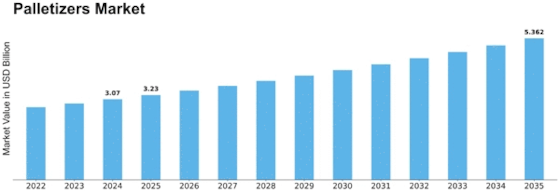

Palletizers Market Size Graph
Author
Snehal Singh
Assistant Manager - Research

High acumen in analyzing complex macro & micro markets with more than 6 years of work experience in the field of market research. By implementing her analytical skills in forecasting and estimation into market research reports, she has expertise in Packaging, Construction, and Equipment domains. She handles a team size of 20-25 resources and ensures smooth running of the projects, associated marketing activities, and client servicing.

Leave a Comment

FAQs

What is the current valuation of the Palletizers Market as of 2024?

The Palletizers Market was valued at 3.07 USD Billion in 2024.

What is the projected market valuation for the Palletizers Market in 2035?

The market is projected to reach 5.362 USD Billion by 2035.

What is the expected CAGR for the Palletizers Market during the forecast period 2025 - 2035?

The expected CAGR for the Palletizers Market during 2025 - 2035 is 5.2%.

Which segments are included in the Palletizers Market by type?

The market segments by type include Conventional, Robotic, and Cobot Palletizers.

What are the projected valuations for Conventional and Robotic palletizers by 2035?

Conventional palletizers are projected to reach 2.5 USD Billion, while Robotic palletizers may reach 2.0 USD Billion by 2035.

Market Summary

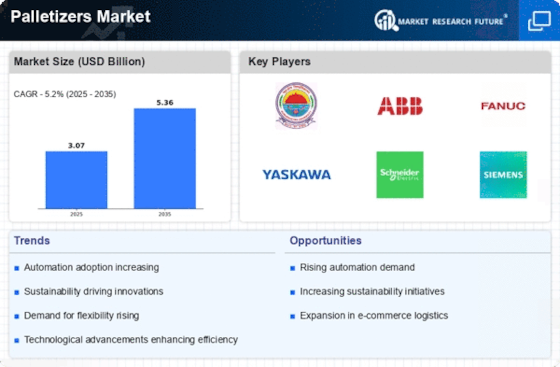
As per MRFR analysis, the Palletizers Market Size was estimated at 3.07 USD Billion in 2024. The Palletizers industry is projected to grow from 3.23 in 2025 to 5.362 by 2035, exhibiting a compound annual growth rate (CAGR) of 5.2 during the forecast period 2025 - 2035.

Key Market Trends & Highlights

The Palletizers Market is currently experiencing a robust shift towards automation and sustainability.

  • The North American region remains the largest market for palletizers, driven by advanced manufacturing capabilities. Asia-Pacific is recognized as the fastest-growing region, reflecting a surge in e-commerce and retail activities. Conventional palletizers dominate the market, while robotic palletizers are emerging as the fastest-growing segment. Rising demand for efficient logistics solutions and technological advancements in automation are key drivers propelling market growth.

Market Size & Forecast

2024 Market Size 3.07 (USD Billion)
2035 Market Size 5.362 (USD Billion)
CAGR (2025 - 2035) 5.2%
Largest Regional Market Share in 2024 Asia Pacific

Major Players

<p>KUKA (DE), ABB (CH), <a href="https://www.fanuc.eu/eu-en/application/palletising">FANUC </a>(JP), Yaskawa (JP), Schneider Electric (FR), Siemens (DE), Mitsubishi Electric (JP), <a href="https://www.rockwellautomation.com/en-in/company/news/case-studies/pallet-packaging-robotic.html">Rockwell Automation</a> (US), Beckhoff Automation (DE)</p>

Market Trends

The Palletizers Market is currently experiencing a transformative phase, driven by advancements in automation and the increasing demand for efficiency in supply chain operations. Companies are increasingly adopting automated palletizing solutions to enhance productivity and reduce labor costs. This shift towards automation is not merely a trend but appears to be a fundamental change in how goods are handled and transported. Furthermore, the integration of smart technologies, such as artificial intelligence and the Internet of Things, is likely to redefine operational capabilities, enabling real-time monitoring and optimization of palletizing processes. In addition to automation, sustainability is emerging as a pivotal factor influencing the Palletizers Market. Organizations are becoming more aware of their environmental impact and are seeking solutions that minimize waste and energy consumption. This growing emphasis on eco-friendly practices may lead to the development of innovative palletizing systems that utilize sustainable materials and energy-efficient technologies. As the market evolves, it seems that the convergence of automation and sustainability will shape the future landscape of palletizing solutions, making them more adaptable and responsive to the needs of various industries.

Automation Adoption

The Palletizers Market is witnessing a notable shift towards automation, as businesses seek to enhance operational efficiency. Automated systems are increasingly favored for their ability to streamline processes, reduce labor costs, and improve accuracy in palletizing operations.

Sustainability Focus

A growing emphasis on sustainability is influencing the Palletizers Market, with companies striving to adopt eco-friendly practices. This trend may lead to the development of palletizing solutions that prioritize energy efficiency and the use of sustainable materials.

Integration of Smart Technologies

The incorporation of smart technologies into palletizing systems is becoming more prevalent. This trend suggests that advancements in artificial intelligence and IoT could enhance real-time monitoring and optimization, thereby improving overall productivity.

Palletizers Market Market Drivers

Growth in E-commerce and Retail Sectors

The Palletizers Market Industry is significantly influenced by the rapid growth in the e-commerce and retail sectors. As online shopping continues to gain traction, the demand for efficient packaging and distribution solutions has escalated. Data indicates that e-commerce sales are expected to reach over 6 trillion dollars by 2024, necessitating the need for automated palletizing systems to handle increased product volumes. Retailers are increasingly adopting palletizers to manage inventory more effectively and ensure timely deliveries. This trend not only enhances operational efficiency but also reduces the risk of errors in order fulfillment. As a result, the Palletizers Market Industry is poised for substantial growth, driven by the evolving needs of the retail landscape and the imperative for automation in handling logistics.

Technological Advancements in Automation

Technological advancements play a pivotal role in shaping the Palletizers Market Industry. Innovations in robotics, artificial intelligence, and machine learning are transforming traditional palletizing processes into highly efficient automated systems. The integration of these technologies allows for greater precision, speed, and flexibility in palletizing operations. Recent studies suggest that the automation market is expected to grow at a rate of 10% annually, indicating a robust interest in automated solutions. Companies are increasingly investing in smart palletizers that can adapt to varying product sizes and shapes, thereby enhancing productivity. This trend not only streamlines operations but also reduces labor costs, making the Palletizers Market Industry a focal point for businesses aiming to modernize their logistics and manufacturing processes.

Rising Demand for Efficient Logistics Solutions

The Palletizers Market Industry is experiencing a notable surge in demand for efficient logistics solutions. As businesses strive to enhance their supply chain operations, the need for automated palletizing systems has become increasingly apparent. According to recent data, the project logistics sector is projected to grow at a compound annual growth rate of approximately 7.5% over the next five years. This growth is driven by the need for faster and more reliable delivery systems, which in turn propels the demand for advanced palletizers. Companies are investing in these technologies to streamline their operations, reduce labor costs, and improve overall productivity. Consequently, the Palletizers Market Industry is likely to witness significant advancements in technology and increased adoption rates as organizations seek to optimize their logistics processes.

Increasing Investment in Manufacturing Automation

The Palletizers Market Industry is benefiting from a marked increase in investment in manufacturing automation. As industries strive to enhance productivity and reduce operational costs, the adoption of automated palletizing systems is becoming more prevalent. Recent reports indicate that the manufacturing automation market is projected to grow by approximately 8% annually, driven by the need for efficiency and precision in production processes. Companies are recognizing the value of integrating automated solutions to streamline their operations, minimize human error, and improve overall output. This trend is particularly evident in sectors such as food and beverage, pharmaceuticals, and consumer goods, where the demand for reliable and efficient palletizing solutions is paramount. As a result, the Palletizers Market Industry is poised for growth, fueled by the ongoing investments in automation technologies.

Focus on Sustainability and Eco-friendly Practices

The Palletizers Market Industry is witnessing a growing emphasis on sustainability and eco-friendly practices. As environmental concerns become more pronounced, companies are seeking ways to reduce their carbon footprint and enhance their sustainability efforts. The adoption of energy-efficient palletizers and recyclable packaging materials is on the rise, reflecting a broader commitment to environmental stewardship. Data suggests that businesses implementing sustainable practices can achieve cost savings of up to 20% in operational expenses. This shift towards sustainability not only aligns with consumer preferences but also positions companies favorably in a competitive market. Consequently, the Palletizers Market Industry is likely to evolve, with an increasing number of manufacturers focusing on developing eco-friendly palletizing solutions that meet both operational and environmental goals.

Market Segment Insights

By Type: Conventional (Largest) vs. Robotic (Fastest-Growing)

<p>In the Palletizers Market, the segmentation by type is prominently led by Conventional palletizers, which maintain the largest market share. This segment is favored for its reliability and cost-effectiveness, making it a preferred choice among a broad spectrum of industries. On the other hand, Robotic palletizers are swiftly gaining traction, capturing significant attention due to their flexibility and efficiency in handling diverse products across various sizes and shapes. The growth trends in this segment reveal a significant shift towards automation and advanced technology integration. The demand for Robotic palletizers is driven by the need for increased efficiency and labor optimization in production lines. Additionally, manufacturers are progressively adopting collaborative robots, or Cobots, to enhance productivity while ensuring worker safety. This paradigm shift indicates a robust transformation in palletizing processes, aligning with industry 4.0 advancements.</p>

<p>Palletizer Type: Conventional (Dominant) vs. Robotic (Emerging)</p>

<p>Conventional palletizers are the stalwart of the palletizing segment, offering robust and proven solutions for high-volume operations. Their capabilities in efficiently sorting, stacking, and securing products make them essential in traditional manufacturing setups. While they may appear less flexible, their mechanical simplicity and low initial investment continue to appeal to various sectors. Conversely, <a href="https://www.marketresearchfuture.com/reports/robotic-palletizer-market-24752">Robotic palletizers</a> are rapidly emerging as a modern alternative, providing unmatched versatility in handling various product shapes and sizes. With the integration of artificial intelligence and machine learning, these systems can adapt to changing production schedules, optimize workflows, and significantly reduce operational costs. This emerging trend signifies a pivotal shift towards automation in the palletizing industry.</p>

By Automation Level: Fully Automated (Largest) vs. Semi-Automated (Fastest-Growing)

<p>The automation level in the palletizers market demonstrates a varied distribution, with fully automated systems holding the largest share. These systems cater to industries seeking high efficiency and reduced labor costs, making them a popular choice among manufacturers. Semi-automated palletizers, meanwhile, are increasingly gaining traction, appealing to businesses looking for a balance between cost-effectiveness and automation, leading to a steady growth in this segment.</p>

<p>Fully Automated (Dominant) vs. Semi-Automated (Emerging)</p>

<p>Fully automated palletizers offer remarkable efficiency and accuracy, making them the dominant choice for large-scale production facilities. They reduce human error and labor costs while increasing throughput, allowing manufacturers to meet high demand. On the other hand, semi-automated palletizers are emerging as a valuable solution for companies that are gradually transitioning towards automation. They provide flexibility and a lower initial investment, attracting medium-sized businesses that require a solution adaptable to fluctuating production needs. Both segments play crucial roles in the market, appealing to different operational strategies.</p>

By Application: Food & Beverages (Largest) vs. Pharmaceuticals (Fastest-Growing)

<p>In the Palletizers Market, the application segment is primarily dominated by the Food &amp; Beverages sector, which holds the largest share due to the rising demand for automated packaging solutions in this industry. This sector's prevalence is driven by the need for efficient handling and packaging processes, particularly as consumer preferences lean towards convenience foods and beverages. Meanwhile, the Pharmaceuticals sector, although smaller in overall market share, is witnessing rapid growth due to the increased demand for automation in drug packaging and distribution, driven by stricter regulations and a growing need for efficiency in pharmaceutical logistics. The growth trends in these segments suggest a continued expansion of automation solutions in the Food &amp; Beverages sector, bolstered by technological advancements and growing consumer demand. Concurrently, the Pharmaceuticals segment is not only growing faster but is also evolving in response to regulatory changes and the push for safer, more reliable packaging technologies. This dual momentum in growth highlights the diverse applications of palletizers across different industries, with adaptations being made to meet specific sectoral needs and compliance requirements.</p>

<p>Food &amp; Beverages (Dominant) vs. Pharmaceuticals (Emerging)</p>

<p>The Food &amp; Beverages sector stands as the dominant force within the Palletizers Market, driven by high-volume demands and an ever-increasing need for efficient packaging solutions. This sector's operations are characterized by requiring rapid processing lines and reliable equipment capable of handling a variety of product shapes and sizes. On the other hand, the Pharmaceuticals sector represents an emerging opportunity in the market. Its focus is on highly specialized equipment that caters to stringent regulatory requirements and ensures <a href="https://www.marketresearchfuture.com/reports/safety-valve-market-7790">safety valve</a> and accuracy in the packaging processes. The growth in this segment is propelled by innovations aimed at enhancing operational efficiency, with manufacturers increasingly investing in automated solutions to meet dual demands of compliance and cost-effectiveness.</p>

Get more detailed insights about Palletizers Market Research Report – Forecast Till 2035

Regional Insights

Based on the Region, the Global Palletizers Market are segmented into North America, Europe, Asia-Pacific, Middle East & Africa and South America. The Asia-Pacific segment dominated the global market in 2024, while the Asia-Pacific is projected to be the fastest–growing segment during the forecast period. Major demand factors driving the Asia-Pacific market are the rapid expansion of e-commerce and warehousing and surge in production volumes in industries such as food and beverage, pharmaceuticals, and consumer goods and the increasing demand for automation in manufacturing, packaging, and logistics. 

The Asia Pacific palletizer market consists of countries including China, Japan, India, South Korea, Malaysia, Thailand, Indonesia, Australia, and Rest of Asia Pacific. The Asia Pacific region is emerging as one of the fastest-growing markets for palletizers, driven by rapid industrial expansion and substantial investments in automation infrastructure. Major economies like China, Japan, South Korea, and India are increasingly adopting both conventional and robotic palletizing systems to optimize production lines and enhance efficiency. The robust growth in the e-commerce sector across APAC is fueling demand for faster, more reliable logistics solutions, prompting manufacturers to modernize their material handling processes.

FIGURE 3: PALLETIZERS MARKET VALUE BY REGION 2024 AND 2035 (USD BILLION)

PALLETIZERS MARKET VALUE BY REGION 2024 AND 2035

Source: Secondary Research, Primary Research, MRFR Database, and Analyst Review

Further, the countries considered in the scope of the Application Tracking System Market are the US, Canada, Mexico, Germany, UK, France, Russia, Italy, Spain, China, India, Japan, South Korea, Malaysia, Thailand, Indonesia, Australia, GCC Countries. South Africa, Brazil, Argentina, Peru, Chile and others.

Key Players and Competitive Insights

Many global, regional, and local vendors characterize the Palletizers Market. The market is highly competitive, with all the players competing to gain market share. Intense competition, rapid advances in technology, frequent changes in government policies, and environmental regulations are key factors that confront market growth. The vendors compete based on cost, product quality, reliability, and government regulations. Vendors must provide cost-efficient, high-quality products to survive and succeed in an intensely competitive market.

The major competitors in the market are ONExia Inc., Columbia/Okura, LLC, Vention, Robotiq, Premier Tech Ltd., ProMach Inc., FlexLink, FORTNA Inc., Pacteon Group, Sidel are among others. The Palletizers Market is a consolidated market due to increasing competition, acquisitions, mergers and other strategic market developments and decisions to improve operational effectiveness.

Key Companies in the Palletizers Market market include

Industry Developments

February 2024: ESS Technologies, Inc., partnered with Phoenix Wrappers to create a compact collaborative robotic pallet cell integrated with a Phoenix stretch wrapper.

October 2024: ProMach announced that it has introduced its Innovation Station, highlighting advancements in packaging technology, including robotic efficiency solutions such as the Brenton RL1000 Palletizer at Pack Expo International. These solutions aim to bring speed and flexibility to packaging end lines.

March 2023: Sidel unveiled RoboAccess Pal S, a compact palletizer combining robotics and cobotics, designed to replace manual palletizing1. It features a lightweight, carbon fiber and 3D-printed clamping head, a patented folding guarding system, and a patented mobile physical curtain for operator safety during pallet changes.

July 2022: Premier Tech announced that it has made an investment for its Systems and Automation business group worth USD 33 million for the construction of a new facility in Montgomery, Alabama. With the help of this major investment, the company strengthening its presence in America, and commitment toward its customers and the American market.

Future Outlook

Palletizers Market Future Outlook

<p>The Palletizers Market is projected to grow at a 5.2% CAGR from 2024 to 2035, driven by automation, e-commerce expansion, and demand for efficiency.</p>

New opportunities lie in:

  • <p>Integration of AI-driven robotics for enhanced operational efficiency.</p><p>Development of customizable palletizing solutions for diverse industries.</p><p>Expansion into emerging markets with tailored product offerings.</p>

<p>By 2035, the Palletizers Market is expected to achieve robust growth, reflecting evolving industry demands.</p>

Market Segmentation

Palletizers Market Type Outlook

  • Conventional
  • Robotic
  • Cobot Palletizer

Palletizers Market Application Outlook

  • Food & Beverages
  • Pharmaceuticals
  • Consumer Goods
  • Industrial Goods

Palletizers Market Automation Level Outlook

  • Fully Automated
  • Semi-automated
  • Manual

Report Scope

MARKET SIZE 20243.07(USD Billion)
MARKET SIZE 20253.23(USD Billion)
MARKET SIZE 20355.362(USD Billion)
COMPOUND ANNUAL GROWTH RATE (CAGR)5.2% (2024 - 2035)
REPORT COVERAGERevenue Forecast, Competitive Landscape, Growth Factors, and Trends
BASE YEAR2024
Market Forecast Period2025 - 2035
Historical Data2019 - 2024
Market Forecast UnitsUSD Billion
Key Companies ProfiledMarket analysis in progress
Segments CoveredMarket segmentation analysis in progress
Key Market OpportunitiesIntegration of advanced automation technologies enhances efficiency in the Palletizers Market.
Key Market DynamicsTechnological advancements and automation drive efficiency in palletizing processes, reshaping competitive dynamics in the market.
Countries CoveredNorth America, Europe, APAC, South America, MEA

FAQs

What is the current valuation of the Palletizers Market as of 2024?

The Palletizers Market was valued at 3.07 USD Billion in 2024.

What is the projected market valuation for the Palletizers Market in 2035?

The market is projected to reach 5.362 USD Billion by 2035.

What is the expected CAGR for the Palletizers Market during the forecast period 2025 - 2035?

The expected CAGR for the Palletizers Market during 2025 - 2035 is 5.2%.

Which segments are included in the Palletizers Market by type?

The market segments by type include Conventional, Robotic, and Cobot Palletizers.

What are the projected valuations for Conventional and Robotic palletizers by 2035?

Conventional palletizers are projected to reach 2.5 USD Billion, while Robotic palletizers may reach 2.0 USD Billion by 2035.

  1. SECTION I: EXECUTIVE SUMMARY AND KEY HIGHLIGHTS
    1. EXECUTIVE SUMMARY
      1. Market Overview
      2. Key Findings
      3. Market Segmentation
      4. Competitive Landscape
      5. Challenges and Opportunities
      6. Future Outlook 2
  2. SECTION II: SCOPING, METHODOLOGY AND MARKET STRUCTURE
    1. MARKET INTRODUCTION
      1. Definition
      2. Scope of the study
    2. RESEARCH METHODOLOGY
      1. Overview
      2. Data Mining
      3. Secondary Research
      4. Primary Research
      5. Forecasting Model
      6. Market Size Estimation
      7. Data Triangulation
      8. Validation 3
  3. SECTION III: QUALITATIVE ANALYSIS
    1. MARKET DYNAMICS
      1. Overview
      2. Drivers
      3. Restraints
      4. Opportunities
    2. MARKET FACTOR ANALYSIS
      1. Value chain Analysis
      2. Porter's Five Forces Analysis
      3. COVID-19 Impact Analysis
  4. SECTION IV: QUANTITATIVE ANALYSIS
    1. Food, Beverages & Nutrition, BY Type (USD Billion)
      1. Conventional
      2. Robotic
      3. Cobot Palletizer
    2. Food, Beverages & Nutrition, BY Automation Level (USD Billion)
      1. Fully Automated
      2. Semi-automated
      3. Manual
    3. Food, Beverages & Nutrition, BY Application (USD Billion)
      1. Food & Beverages
      2. Pharmaceuticals
      3. Consumer Goods
      4. Industrial Goods
    4. Food, Beverages & Nutrition, BY Region (USD Billion)
      1. North America
      2. Europe
      3. APAC
      4. South America
      5. MEA
  5. SECTION V: COMPETITIVE ANALYSIS
    1. Competitive Landscape
      1. Overview
      2. Competitive Analysis
      3. Market share Analysis
      4. Major Growth Strategy in the Food, Beverages & Nutrition
      5. Competitive Benchmarking
      6. Leading Players in Terms of Number of Developments in the Food, Beverages & Nutrition
      7. Key developments and growth strategies
      8. Major Players Financial Matrix
    2. Company Profiles
      1. KUKA (DE)
      2. ABB (CH)
      3. FANUC (JP)
      4. Yaskawa (JP)
      5. Schneider Electric (FR)
      6. Siemens (DE)
      7. Mitsubishi Electric (JP)
      8. Rockwell Automation (US)
      9. Beckhoff Automation (DE)
    3. Appendix
      1. References
      2. Related Reports 6 LIST OF FIGURES
    4. MARKET SYNOPSIS
    5. NORTH AMERICA MARKET ANALYSIS
    6. US MARKET ANALYSIS BY TYPE
    7. US MARKET ANALYSIS BY AUTOMATION LEVEL
    8. US MARKET ANALYSIS BY APPLICATION
    9. CANADA MARKET ANALYSIS BY TYPE
    10. CANADA MARKET ANALYSIS BY AUTOMATION LEVEL
    11. CANADA MARKET ANALYSIS BY APPLICATION
    12. EUROPE MARKET ANALYSIS
    13. GERMANY MARKET ANALYSIS BY TYPE
    14. GERMANY MARKET ANALYSIS BY AUTOMATION LEVEL
    15. GERMANY MARKET ANALYSIS BY APPLICATION
    16. UK MARKET ANALYSIS BY TYPE
    17. UK MARKET ANALYSIS BY AUTOMATION LEVEL
    18. UK MARKET ANALYSIS BY APPLICATION
    19. FRANCE MARKET ANALYSIS BY TYPE
    20. FRANCE MARKET ANALYSIS BY AUTOMATION LEVEL
    21. FRANCE MARKET ANALYSIS BY APPLICATION
    22. RUSSIA MARKET ANALYSIS BY TYPE
    23. RUSSIA MARKET ANALYSIS BY AUTOMATION LEVEL
    24. RUSSIA MARKET ANALYSIS BY APPLICATION
    25. ITALY MARKET ANALYSIS BY TYPE
    26. ITALY MARKET ANALYSIS BY AUTOMATION LEVEL
    27. ITALY MARKET ANALYSIS BY APPLICATION
    28. SPAIN MARKET ANALYSIS BY TYPE
    29. SPAIN MARKET ANALYSIS BY AUTOMATION LEVEL
    30. SPAIN MARKET ANALYSIS BY APPLICATION
    31. REST OF EUROPE MARKET ANALYSIS BY TYPE
    32. REST OF EUROPE MARKET ANALYSIS BY AUTOMATION LEVEL
    33. REST OF EUROPE MARKET ANALYSIS BY APPLICATION
    34. APAC MARKET ANALYSIS
    35. CHINA MARKET ANALYSIS BY TYPE
    36. CHINA MARKET ANALYSIS BY AUTOMATION LEVEL
    37. CHINA MARKET ANALYSIS BY APPLICATION
    38. INDIA MARKET ANALYSIS BY TYPE
    39. INDIA MARKET ANALYSIS BY AUTOMATION LEVEL
    40. INDIA MARKET ANALYSIS BY APPLICATION
    41. JAPAN MARKET ANALYSIS BY TYPE
    42. JAPAN MARKET ANALYSIS BY AUTOMATION LEVEL
    43. JAPAN MARKET ANALYSIS BY APPLICATION
    44. SOUTH KOREA MARKET ANALYSIS BY TYPE
    45. SOUTH KOREA MARKET ANALYSIS BY AUTOMATION LEVEL
    46. SOUTH KOREA MARKET ANALYSIS BY APPLICATION
    47. MALAYSIA MARKET ANALYSIS BY TYPE
    48. MALAYSIA MARKET ANALYSIS BY AUTOMATION LEVEL
    49. MALAYSIA MARKET ANALYSIS BY APPLICATION
    50. THAILAND MARKET ANALYSIS BY TYPE
    51. THAILAND MARKET ANALYSIS BY AUTOMATION LEVEL
    52. THAILAND MARKET ANALYSIS BY APPLICATION
    53. INDONESIA MARKET ANALYSIS BY TYPE
    54. INDONESIA MARKET ANALYSIS BY AUTOMATION LEVEL
    55. INDONESIA MARKET ANALYSIS BY APPLICATION
    56. REST OF APAC MARKET ANALYSIS BY TYPE
    57. REST OF APAC MARKET ANALYSIS BY AUTOMATION LEVEL
    58. REST OF APAC MARKET ANALYSIS BY APPLICATION
    59. SOUTH AMERICA MARKET ANALYSIS
    60. BRAZIL MARKET ANALYSIS BY TYPE
    61. BRAZIL MARKET ANALYSIS BY AUTOMATION LEVEL
    62. BRAZIL MARKET ANALYSIS BY APPLICATION
    63. MEXICO MARKET ANALYSIS BY TYPE
    64. MEXICO MARKET ANALYSIS BY AUTOMATION LEVEL
    65. MEXICO MARKET ANALYSIS BY APPLICATION
    66. ARGENTINA MARKET ANALYSIS BY TYPE
    67. ARGENTINA MARKET ANALYSIS BY AUTOMATION LEVEL
    68. ARGENTINA MARKET ANALYSIS BY APPLICATION
    69. REST OF SOUTH AMERICA MARKET ANALYSIS BY TYPE
    70. REST OF SOUTH AMERICA MARKET ANALYSIS BY AUTOMATION LEVEL
    71. REST OF SOUTH AMERICA MARKET ANALYSIS BY APPLICATION
    72. MEA MARKET ANALYSIS
    73. GCC COUNTRIES MARKET ANALYSIS BY TYPE
    74. GCC COUNTRIES MARKET ANALYSIS BY AUTOMATION LEVEL
    75. GCC COUNTRIES MARKET ANALYSIS BY APPLICATION
    76. SOUTH AFRICA MARKET ANALYSIS BY TYPE
    77. SOUTH AFRICA MARKET ANALYSIS BY AUTOMATION LEVEL
    78. SOUTH AFRICA MARKET ANALYSIS BY APPLICATION
    79. REST OF MEA MARKET ANALYSIS BY TYPE
    80. REST OF MEA MARKET ANALYSIS BY AUTOMATION LEVEL
    81. REST OF MEA MARKET ANALYSIS BY APPLICATION
    82. KEY BUYING CRITERIA OF FOOD, BEVERAGES & NUTRITION
    83. RESEARCH PROCESS OF MRFR
    84. DRO ANALYSIS OF FOOD, BEVERAGES & NUTRITION
    85. DRIVERS IMPACT ANALYSIS: FOOD, BEVERAGES & NUTRITION
    86. RESTRAINTS IMPACT ANALYSIS: FOOD, BEVERAGES & NUTRITION
    87. SUPPLY / VALUE CHAIN: FOOD, BEVERAGES & NUTRITION
    88. FOOD, BEVERAGES & NUTRITION, BY TYPE, 2024 (% SHARE)
    89. FOOD, BEVERAGES & NUTRITION, BY TYPE, 2024 TO 2035 (USD Billion)
    90. FOOD, BEVERAGES & NUTRITION, BY AUTOMATION LEVEL, 2024 (% SHARE)
    91. FOOD, BEVERAGES & NUTRITION, BY AUTOMATION LEVEL, 2024 TO 2035 (USD Billion)
    92. FOOD, BEVERAGES & NUTRITION, BY APPLICATION, 2024 (% SHARE)
    93. FOOD, BEVERAGES & NUTRITION, BY APPLICATION, 2024 TO 2035 (USD Billion)
    94. BENCHMARKING OF MAJOR COMPETITORS 7 LIST OF TABLES
    95. LIST OF ASSUMPTIONS
    96. North America MARKET SIZE ESTIMATES; FORECAST
      1. BY TYPE, 2025-2035 (USD Billion)
      2. BY AUTOMATION LEVEL, 2025-2035 (USD Billion)
      3. BY APPLICATION, 2025-2035 (USD Billion)
    97. US MARKET SIZE ESTIMATES; FORECAST
      1. BY TYPE, 2025-2035 (USD Billion)
      2. BY AUTOMATION LEVEL, 2025-2035 (USD Billion)
      3. BY APPLICATION, 2025-2035 (USD Billion)
    98. Canada MARKET SIZE ESTIMATES; FORECAST
      1. BY TYPE, 2025-2035 (USD Billion)
      2. BY AUTOMATION LEVEL, 2025-2035 (USD Billion)
      3. BY APPLICATION, 2025-2035 (USD Billion)
    99. Europe MARKET SIZE ESTIMATES; FORECAST
      1. BY TYPE, 2025-2035 (USD Billion)
      2. BY AUTOMATION LEVEL, 2025-2035 (USD Billion)
      3. BY APPLICATION, 2025-2035 (USD Billion)
    100. Germany MARKET SIZE ESTIMATES; FORECAST
      1. BY TYPE, 2025-2035 (USD Billion)
      2. BY AUTOMATION LEVEL, 2025-2035 (USD Billion)
      3. BY APPLICATION, 2025-2035 (USD Billion)
    101. UK MARKET SIZE ESTIMATES; FORECAST
      1. BY TYPE, 2025-2035 (USD Billion)
      2. BY AUTOMATION LEVEL, 2025-2035 (USD Billion)
      3. BY APPLICATION, 2025-2035 (USD Billion)
    102. France MARKET SIZE ESTIMATES; FORECAST
      1. BY TYPE, 2025-2035 (USD Billion)
      2. BY AUTOMATION LEVEL, 2025-2035 (USD Billion)
      3. BY APPLICATION, 2025-2035 (USD Billion)
    103. Russia MARKET SIZE ESTIMATES; FORECAST
      1. BY TYPE, 2025-2035 (USD Billion)
      2. BY AUTOMATION LEVEL, 2025-2035 (USD Billion)
      3. BY APPLICATION, 2025-2035 (USD Billion)
    104. Italy MARKET SIZE ESTIMATES; FORECAST
      1. BY TYPE, 2025-2035 (USD Billion)
      2. BY AUTOMATION LEVEL, 2025-2035 (USD Billion)
      3. BY APPLICATION, 2025-2035 (USD Billion)
    105. Spain MARKET SIZE ESTIMATES; FORECAST
      1. BY TYPE, 2025-2035 (USD Billion)
      2. BY AUTOMATION LEVEL, 2025-2035 (USD Billion)
      3. BY APPLICATION, 2025-2035 (USD Billion)
    106. Rest of Europe MARKET SIZE ESTIMATES; FORECAST
      1. BY TYPE, 2025-2035 (USD Billion)
      2. BY AUTOMATION LEVEL, 2025-2035 (USD Billion)
      3. BY APPLICATION, 2025-2035 (USD Billion)
    107. APAC MARKET SIZE ESTIMATES; FORECAST
      1. BY TYPE, 2025-2035 (USD Billion)
      2. BY AUTOMATION LEVEL, 2025-2035 (USD Billion)
      3. BY APPLICATION, 2025-2035 (USD Billion)
    108. China MARKET SIZE ESTIMATES; FORECAST
      1. BY TYPE, 2025-2035 (USD Billion)
      2. BY AUTOMATION LEVEL, 2025-2035 (USD Billion)
      3. BY APPLICATION, 2025-2035 (USD Billion)
    109. India MARKET SIZE ESTIMATES; FORECAST
      1. BY TYPE, 2025-2035 (USD Billion)
      2. BY AUTOMATION LEVEL, 2025-2035 (USD Billion)
      3. BY APPLICATION, 2025-2035 (USD Billion)
    110. Japan MARKET SIZE ESTIMATES; FORECAST
      1. BY TYPE, 2025-2035 (USD Billion)
      2. BY AUTOMATION LEVEL, 2025-2035 (USD Billion)
      3. BY APPLICATION, 2025-2035 (USD Billion)
    111. South Korea MARKET SIZE ESTIMATES; FORECAST
      1. BY TYPE, 2025-2035 (USD Billion)
      2. BY AUTOMATION LEVEL, 2025-2035 (USD Billion)
      3. BY APPLICATION, 2025-2035 (USD Billion)
    112. Malaysia MARKET SIZE ESTIMATES; FORECAST
      1. BY TYPE, 2025-2035 (USD Billion)
      2. BY AUTOMATION LEVEL, 2025-2035 (USD Billion)
      3. BY APPLICATION, 2025-2035 (USD Billion)
    113. Thailand MARKET SIZE ESTIMATES; FORECAST
      1. BY TYPE, 2025-2035 (USD Billion)
      2. BY AUTOMATION LEVEL, 2025-2035 (USD Billion)
      3. BY APPLICATION, 2025-2035 (USD Billion)
    114. Indonesia MARKET SIZE ESTIMATES; FORECAST
      1. BY TYPE, 2025-2035 (USD Billion)
      2. BY AUTOMATION LEVEL, 2025-2035 (USD Billion)
      3. BY APPLICATION, 2025-2035 (USD Billion)
    115. Rest of APAC MARKET SIZE ESTIMATES; FORECAST
      1. BY TYPE, 2025-2035 (USD Billion)
      2. BY AUTOMATION LEVEL, 2025-2035 (USD Billion)
      3. BY APPLICATION, 2025-2035 (USD Billion)
    116. South America MARKET SIZE ESTIMATES; FORECAST
      1. BY TYPE, 2025-2035 (USD Billion)
      2. BY AUTOMATION LEVEL, 2025-2035 (USD Billion)
      3. BY APPLICATION, 2025-2035 (USD Billion)
    117. Brazil MARKET SIZE ESTIMATES; FORECAST
      1. BY TYPE, 2025-2035 (USD Billion)
      2. BY AUTOMATION LEVEL, 2025-2035 (USD Billion)
      3. BY APPLICATION, 2025-2035 (USD Billion)
    118. Mexico MARKET SIZE ESTIMATES; FORECAST
      1. BY TYPE, 2025-2035 (USD Billion)
      2. BY AUTOMATION LEVEL, 2025-2035 (USD Billion)
      3. BY APPLICATION, 2025-2035 (USD Billion)
    119. Argentina MARKET SIZE ESTIMATES; FORECAST
      1. BY TYPE, 2025-2035 (USD Billion)
      2. BY AUTOMATION LEVEL, 2025-2035 (USD Billion)
      3. BY APPLICATION, 2025-2035 (USD Billion)
    120. Rest of South America MARKET SIZE ESTIMATES; FORECAST
      1. BY TYPE, 2025-2035 (USD Billion)
      2. BY AUTOMATION LEVEL, 2025-2035 (USD Billion)
      3. BY APPLICATION, 2025-2035 (USD Billion)
    121. MEA MARKET SIZE ESTIMATES; FORECAST
      1. BY TYPE, 2025-2035 (USD Billion)
      2. BY AUTOMATION LEVEL, 2025-2035 (USD Billion)
      3. BY APPLICATION, 2025-2035 (USD Billion)
    122. GCC Countries MARKET SIZE ESTIMATES; FORECAST
      1. BY TYPE, 2025-2035 (USD Billion)
      2. BY AUTOMATION LEVEL, 2025-2035 (USD Billion)
      3. BY APPLICATION, 2025-2035 (USD Billion)
    123. South Africa MARKET SIZE ESTIMATES; FORECAST
      1. BY TYPE, 2025-2035 (USD Billion)
      2. BY AUTOMATION LEVEL, 2025-2035 (USD Billion)
      3. BY APPLICATION, 2025-2035 (USD Billion)
    124. Rest of MEA MARKET SIZE ESTIMATES; FORECAST
      1. BY TYPE, 2025-2035 (USD Billion)
      2. BY AUTOMATION LEVEL, 2025-2035 (USD Billion)
      3. BY APPLICATION, 2025-2035 (USD Billion)
    125. PRODUCT LAUNCH/PRODUCT DEVELOPMENT/APPROVAL
    126. ACQUISITION/PARTNERSHIP

Global Outlook (USD Billion,2019-2035)

Global Palletizersy, By Palletizer Type (USD Billion,2019-2035)

  • Conventional
  • Robotic
  • Cobot Palletizer

Global Palletizersy, By Automation Level (USD Billion,2019-2035)

  • Fully Automated
  • Semi-automated
  • Manual

Global Palletizersy, By Application (USD Billion,2019-2035)

  • Food & Beverages
    • Bottling & Canning
    • Packaged Food
    • Bakery & Confectionery
    • Others
  • Pharmaceuticals
  • Consumer Goods
    • Electronics Appliances
    • Household Products
    • Others
  • Industrial Goods
  • Others

North America Outlook (USD Billion,2019-2035)

North America Palletizersy, By Palletizer Type (USD Billion,2019-2035)

  • Conventional
  • Robotic
  • Cobot Palletizer

North America Palletizersy, By Automation Level (USD Billion,2019-2035)

  • Fully Automated
  • Semi-automated
  • Manual

North America Palletizersy, By Application (USD Billion,2019-2035)

  • Food & Beverages
    • Bottling & Canning
    • Packaged Food
    • Bakery & Confectionery
    • Others
  • Pharmaceuticals
  • Consumer Goods
    • Electronics Appliances
    • Household Products
    • Others
  • Industrial Goods
  • Others

US Outlook (USD Billion,2019-2035)

US Palletizersy, By Palletizer Type (USD Billion,2019-2035)

  • Conventional
  • Robotic
  • Cobot Palletizer

US Palletizersy, By Automation Level (USD Billion,2019-2035)

  • Fully Automated
  • Semi-automated
  • Manual

US Palletizersy, By Application (USD Billion,2019-2035)

  • Food & Beverages
    • Bottling & Canning
    • Packaged Food
    • Bakery & Confectionery
    • Others
  • Pharmaceuticals
  • Consumer Goods
    • Electronics Appliances
    • Household Products
    • Others
  • Industrial Goods
  • Others

Canada Outlook (USD Billion,2019-2035)

Canada Palletizersy, By Palletizer Type (USD Billion,2019-2035)

  • Conventional
  • Robotic
  • Cobot Palletizer

Canada Palletizersy, By Automation Level (USD Billion,2019-2035)

  • Fully Automated
  • Semi-automated
  • Manual

Canada Palletizersy, By Application (USD Billion,2019-2035)

  • Food & Beverages
    • Bottling & Canning
    • Packaged Food
    • Bakery & Confectionery
    • Others
  • Pharmaceuticals
  • Consumer Goods
    • Electronics Appliances
    • Household Products
    • Others
  • Industrial Goods
  • Others

Mexico Outlook (USD Billion,2019-2035)

Mexico Palletizersy, By Palletizer Type (USD Billion,2019-2035)

  • Conventional
  • Robotic
  • Cobot Palletizer

Mexico Palletizersy, By Automation Level (USD Billion,2019-2035)

  • Fully Automated
  • Semi-automated
  • Manual

Mexico Palletizersy, By Application (USD Billion,2019-2035)

  • Food & Beverages
    • Bottling & Canning
    • Packaged Food
    • Bakery & Confectionery
    • Others
  • Pharmaceuticals
  • Consumer Goods
    • Electronics Appliances
    • Household Products
    • Others
  • Industrial Goods
  • Others

Europe Outlook (USD Billion,2019-2035)

Europe Palletizersy, By Palletizer Type (USD Billion,2019-2035)

  • Conventional
  • Robotic
  • Cobot Palletizer

Europe Palletizersy, By Automation Level (USD Billion,2019-2035)

  • Fully Automated
  • Semi-automated
  • Manual

Europe Palletizersy, By Application (USD Billion,2019-2035)

  • Food & Beverages
    • Bottling & Canning
    • Packaged Food
    • Bakery & Confectionery
    • Others
  • Pharmaceuticals
  • Consumer Goods
    • Electronics Appliances
    • Household Products
    • Others
  • Industrial Goods
  • Others

Germany Outlook (USD Billion,2019-2035)

Germany Palletizersy, By Palletizer Type (USD Billion,2019-2035)

  • Conventional
  • Robotic
  • Cobot Palletizer

Germany Palletizersy, By Automation Level (USD Billion,2019-2035)

  • Fully Automated
  • Semi-automated
  • Manual

Germany Palletizersy, By Application (USD Billion,2019-2035)

  • Food & Beverages
    • Bottling & Canning
    • Packaged Food
    • Bakery & Confectionery
    • Others
  • Pharmaceuticals
  • Consumer Goods
    • Electronics Appliances
    • Household Products
    • Others
  • Industrial Goods
  • Others

UK Outlook (USD Billion,2019-2035)

UK Palletizersy, By Palletizer Type (USD Billion,2019-2035)

  • Conventional
  • Robotic
  • Cobot Palletizer

UK Palletizersy, By Automation Level (USD Billion,2019-2035)

  • Fully Automated
  • Semi-automated
  • Manual

UK Palletizersy, By Application (USD Billion,2019-2035)

  • Food & Beverages
    • Bottling & Canning
    • Packaged Food
    • Bakery & Confectionery
    • Others
  • Pharmaceuticals
  • Consumer Goods
    • Electronics Appliances
    • Household Products
    • Others
  • Industrial Goods
  • Others

France Outlook (USD Billion,2019-2035)

France Palletizersy, By Palletizer Type (USD Billion,2019-2035)

  • Conventional
  • Robotic
  • Cobot Palletizer

France Palletizersy, By Automation Level (USD Billion,2019-2035)

  • Fully Automated
  • Semi-automated
  • Manual

France Palletizersy, By Application (USD Billion,2019-2035)

  • Food & Beverages
    • Bottling & Canning
    • Packaged Food
    • Bakery & Confectionery
    • Others
  • Pharmaceuticals
  • Consumer Goods
    • Electronics Appliances
    • Household Products
    • Others
  • Industrial Goods
  • Others

Russia Outlook (USD Billion,2019-2035)

Russia Palletizersy, By Palletizer Type (USD Billion,2019-2035)

  • Conventional
  • Robotic
  • Cobot Palletizer

Russia Palletizersy, By Automation Level (USD Billion,2019-2035)

  • Fully Automated
  • Semi-automated
  • Manual

Russia Palletizersy, By Application (USD Billion,2019-2035)

  • Food & Beverages
    • Bottling & Canning
    • Packaged Food
    • Bakery & Confectionery
    • Others
  • Pharmaceuticals
  • Consumer Goods
    • Electronics Appliances
    • Household Products
    • Others
  • Industrial Goods
  • Others

Italy Outlook (USD Billion,2019-2035)

Italy Palletizersy, By Palletizer Type (USD Billion,2019-2035)

  • Conventional
  • Robotic
  • Cobot Palletizer

Italy Palletizersy, By Automation Level (USD Billion,2019-2035)

  • Fully Automated
  • Semi-automated
  • Manual

Italy Palletizersy, By Application (USD Billion,2019-2035)

  • Food & Beverages
    • Bottling & Canning
    • Packaged Food
    • Bakery & Confectionery
    • Others
  • Pharmaceuticals
  • Consumer Goods
    • Electronics Appliances
    • Household Products
    • Others
  • Industrial Goods
  • Others

Spain Outlook (USD Billion,2019-2035)

Spain Palletizersy, By Palletizer Type (USD Billion,2019-2035)

  • Conventional
  • Robotic
  • Cobot Palletizer

Spain Palletizersy, By Automation Level (USD Billion,2019-2035)

  • Fully Automated
  • Semi-automated
  • Manual

Spain Palletizersy, By Application (USD Billion,2019-2035)

  • Food & Beverages
    • Bottling & Canning
    • Packaged Food
    • Bakery & Confectionery
    • Others
  • Pharmaceuticals
  • Consumer Goods
    • Electronics Appliances
    • Household Products
    • Others
  • Industrial Goods
  • Others

Rest of Europe Outlook (USD Billion,2019-2035)

Rest of Europe Palletizersy, By Palletizer Type (USD Billion,2019-2035)

  • Conventional
  • Robotic
  • Cobot Palletizer

Rest of Europe Palletizersy, By Automation Level (USD Billion,2019-2035)

  • Fully Automated
  • Semi-automated
  • Manual

Rest of Europe Palletizersy, By Application (USD Billion,2019-2035)

  • Food & Beverages
    • Bottling & Canning
    • Packaged Food
    • Bakery & Confectionery
    • Others
  • Pharmaceuticals
  • Consumer Goods
    • Electronics Appliances
    • Household Products
    • Others
  • Industrial Goods
  • Others

Asia-Pacific Outlook (USD Billion,2019-2035)

Asia-Pacific Palletizersy, By Palletizer Type (USD Billion,2019-2035)

  • Conventional
  • Robotic
  • Cobot Palletizer

Asia-Pacific Palletizersy, By Automation Level (USD Billion,2019-2035)

  • Fully Automated
  • Semi-automated
  • Manual

Asia-Pacific Palletizersy, By Application (USD Billion,2019-2035)

  • Food & Beverages
    • Bottling & Canning
    • Packaged Food
    • Bakery & Confectionery
    • Others
  • Pharmaceuticals
  • Consumer Goods
    • Electronics Appliances
    • Household Products
    • Others
  • Industrial Goods
  • Others

China Outlook (USD Billion,2019-2035)

China Palletizersy, By Palletizer Type (USD Billion,2019-2035)

  • Conventional
  • Robotic
  • Cobot Palletizer

China Palletizersy, By Automation Level (USD Billion,2019-2035)

  • Fully Automated
  • Semi-automated
  • Manual

China Palletizersy, By Application (USD Billion,2019-2035)

  • Food & Beverages
    • Bottling & Canning
    • Packaged Food
    • Bakery & Confectionery
    • Others
  • Pharmaceuticals
  • Consumer Goods
    • Electronics Appliances
    • Household Products
    • Others
  • Industrial Goods
  • Others

India Outlook (USD Billion,2019-2035)

India Palletizersy, By Palletizer Type (USD Billion,2019-2035)

  • Conventional
  • Robotic
  • Cobot Palletizer

India Palletizersy, By Automation Level (USD Billion,2019-2035)

  • Fully Automated
  • Semi-automated
  • Manual

India Palletizersy, By Application (USD Billion,2019-2035)

  • Food & Beverages
    • Bottling & Canning
    • Packaged Food
    • Bakery & Confectionery
    • Others
  • Pharmaceuticals
  • Consumer Goods
    • Electronics Appliances
    • Household Products
    • Others
  • Industrial Goods
  • Others

Japan Outlook (USD Billion,2019-2035)

Japan Palletizersy, By Palletizer Type (USD Billion,2019-2035)

  • Conventional
  • Robotic
  • Cobot Palletizer

Japan Palletizersy, By Automation Level (USD Billion,2019-2035)

  • Fully Automated
  • Semi-automated
  • Manual

Japan Palletizersy, By Application (USD Billion,2019-2035)

  • Food & Beverages
    • Bottling & Canning
    • Packaged Food
    • Bakery & Confectionery
    • Others
  • Pharmaceuticals
  • Consumer Goods
    • Electronics Appliances
    • Household Products
    • Others
  • Industrial Goods
  • Others

South Korea Outlook (USD Billion,2019-2035)

South Korea Palletizersy, By Palletizer Type (USD Billion,2019-2035)

  • Conventional
  • Robotic
  • Cobot Palletizer

South Korea Palletizersy, By Automation Level (USD Billion,2019-2035)

  • Fully Automated
  • Semi-automated
  • Manual

South Korea Palletizersy, By Application (USD Billion,2019-2035)

  • Food & Beverages
    • Bottling & Canning
    • Packaged Food
    • Bakery & Confectionery
    • Others
  • Pharmaceuticals
  • Consumer Goods
    • Electronics Appliances
    • Household Products
    • Others
  • Industrial Goods
  • Others

Malaysia Outlook (USD Billion,2019-2035)

Malaysia Palletizersy, By Palletizer Type (USD Billion,2019-2035)

  • Conventional
  • Robotic
  • Cobot Palletizer

Malaysia Palletizersy, By Automation Level (USD Billion,2019-2035)

  • Fully Automated
  • Semi-automated
  • Manual

Malaysia Palletizersy, By Application (USD Billion,2019-2035)

  • Food & Beverages
    • Bottling & Canning
    • Packaged Food
    • Bakery & Confectionery
    • Others
  • Pharmaceuticals
  • Consumer Goods
    • Electronics Appliances
    • Household Products
    • Others
  • Industrial Goods
  • Others

Thailand Outlook (USD Billion,2019-2035)

Thailand Palletizersy, By Palletizer Type (USD Billion,2019-2035)

  • Conventional
  • Robotic
  • Cobot Palletizer

Thailand Palletizersy, By Automation Level (USD Billion,2019-2035)

  • Fully Automated
  • Semi-automated
  • Manual

Thailand Palletizersy, By Application (USD Billion,2019-2035)

  • Food & Beverages
    • Bottling & Canning
    • Packaged Food
    • Bakery & Confectionery
    • Others
  • Pharmaceuticals
  • Consumer Goods
    • Electronics Appliances
    • Household Products
    • Others
  • Industrial Goods
  • Others

Indonesia Outlook (USD Billion,2019-2035)

Indonesia Palletizersy, By Palletizer Type (USD Billion,2019-2035)

  • Conventional
  • Robotic
  • Cobot Palletizer

Indonesia Palletizersy, By Automation Level (USD Billion,2019-2035)

  • Fully Automated
  • Semi-automated
  • Manual

Indonesia Palletizersy, By Application (USD Billion,2019-2035)

  • Food & Beverages
    • Bottling & Canning
    • Packaged Food
    • Bakery & Confectionery
    • Others
  • Pharmaceuticals
  • Consumer Goods
    • Electronics Appliances
    • Household Products
    • Others
  • Industrial Goods
  • Others

Australia Outlook (USD Billion,2019-2035)

Australia Palletizersy, By Palletizer Type (USD Billion,2019-2035)

  • Conventional
  • Robotic
  • Cobot Palletizer

Australia Palletizersy, By Automation Level (USD Billion,2019-2035)

  • Fully Automated
  • Semi-automated
  • Manual

Australia Palletizersy, By Application (USD Billion,2019-2035)

  • Food & Beverages
    • Bottling & Canning
    • Packaged Food
    • Bakery & Confectionery
    • Others
  • Pharmaceuticals
  • Consumer Goods
    • Electronics Appliances
    • Household Products
    • Others
  • Industrial Goods
  • Others

Rest of Asia-Pacific Outlook (USD Billion,2019-2035)

Rest of Asia-Pacific Palletizersy, By Palletizer Type (USD Billion,2019-2035)

  • Conventional
  • Robotic
  • Cobot Palletizer

Rest of Asia-Pacific Palletizersy, By Automation Level (USD Billion,2019-2035)

  • Fully Automated
  • Semi-automated
  • Manual

Rest of Asia-Pacific Palletizersy, By Application (USD Billion,2019-2035)

  • Food & Beverages
    • Bottling & Canning
    • Packaged Food
    • Bakery & Confectionery
    • Others
  • Pharmaceuticals
  • Consumer Goods
    • Electronics Appliances
    • Household Products
    • Others
  • Industrial Goods
  • Others

Middle East & Africa Outlook (USD Billion,2019-2035)

Middle East & Africa Palletizersy, By Palletizer Type (USD Billion,2019-2035)

  • Conventional
  • Robotic
  • Cobot Palletizer

Middle East & Africa Palletizersy, By Automation Level (USD Billion,2019-2035)

  • Fully Automated
  • Semi-automated
  • Manual

Middle East & Africa Palletizersy, By Application (USD Billion,2019-2035)

  • Food & Beverages
    • Bottling & Canning
    • Packaged Food
    • Bakery & Confectionery
    • Others
  • Pharmaceuticals
  • Consumer Goods
    • Electronics Appliances
    • Household Products
    • Others
  • Industrial Goods
  • Others

GCC Countries Outlook (USD Billion,2019-2035)

GCC Countries Palletizersy, By Palletizer Type (USD Billion,2019-2035)

  • Conventional
  • Robotic
  • Cobot Palletizer

GCC Countries Palletizersy, By Automation Level (USD Billion,2019-2035)

  • Fully Automated
  • Semi-automated
  • Manual

GCC Countries Palletizersy, By Application (USD Billion,2019-2035)

  • Food & Beverages
    • Bottling & Canning
    • Packaged Food
    • Bakery & Confectionery
    • Others
  • Pharmaceuticals
  • Consumer Goods
    • Electronics Appliances
    • Household Products
    • Others
  • Industrial Goods
  • Others

South Africa Outlook (USD Billion,2019-2035)

South Africa Palletizersy, By Palletizer Type (USD Billion,2019-2035)

  • Conventional
  • Robotic
  • Cobot Palletizer

South Africa Palletizersy, By Automation Level (USD Billion,2019-2035)

  • Fully Automated
  • Semi-automated
  • Manual

South Africa Palletizersy, By Application (USD Billion,2019-2035)

  • Food & Beverages
    • Bottling & Canning
    • Packaged Food
    • Bakery & Confectionery
    • Others
  • Pharmaceuticals
  • Consumer Goods
    • Electronics Appliances
    • Household Products
    • Others
  • Industrial Goods
  • Others

Rest of Middle East & Africa Outlook (USD Billion,2019-2035)

Rest of Middle East & Africa Palletizersy, By Palletizer Type (USD Billion,2019-2035)

  • Conventional
  • Robotic
  • Cobot Palletizer

Rest of Middle East & Africa Palletizersy, By Automation Level (USD Billion,2019-2035)

  • Fully Automated
  • Semi-automated
  • Manual

Rest of Middle East & Africa Palletizersy, By Application (USD Billion,2019-2035)

  • Food & Beverages
    • Bottling & Canning
    • Packaged Food
    • Bakery & Confectionery
    • Others
  • Pharmaceuticals
  • Consumer Goods
    • Electronics Appliances
    • Household Products
    • Others
  • Industrial Goods
  • Others

South America Outlook (USD Billion,2019-2035)

South America Palletizersy, By Palletizer Type (USD Billion,2019-2035)

  • Conventional
  • Robotic
  • Cobot Palletizer

South America Palletizersy, By Automation Level (USD Billion,2019-2035)

  • Fully Automated
  • Semi-automated
  • Manual

South America Palletizersy, By Application (USD Billion,2019-2035)

  • Food & Beverages
    • Bottling & Canning
    • Packaged Food
    • Bakery & Confectionery
    • Others
  • Pharmaceuticals
  • Consumer Goods
    • Electronics Appliances
    • Household Products
    • Others
  • Industrial Goods
  • Others

Brazil Outlook (USD Billion,2019-2035)

Brazil Palletizersy, By Palletizer Type (USD Billion,2019-2035)

  • Conventional
  • Robotic
  • Cobot Palletizer

Brazil Palletizersy, By Automation Level (USD Billion,2019-2035)

  • Fully Automated
  • Semi-automated
  • Manual

Brazil Palletizersy, By Application (USD Billion,2019-2035)

  • Food & Beverages
    • Bottling & Canning
    • Packaged Food
    • Bakery & Confectionery
    • Others
  • Pharmaceuticals
  • Consumer Goods
    • Electronics Appliances
    • Household Products
    • Others
  • Industrial Goods
  • Others

Argentina Outlook (USD Billion,2019-2035)

Argentina Palletizersy, By Palletizer Type (USD Billion,2019-2035)

  • Conventional
  • Robotic
  • Cobot Palletizer

Argentina Palletizersy, By Automation Level (USD Billion,2019-2035)

  • Fully Automated
  • Semi-automated
  • Manual

Argentina Palletizersy, By Application (USD Billion,2019-2035)

  • Food & Beverages
    • Bottling & Canning
    • Packaged Food
    • Bakery & Confectionery
    • Others
  • Pharmaceuticals
  • Consumer Goods
    • Electronics Appliances
    • Household Products
    • Others
  • Industrial Goods
  • Others

Peru Outlook (USD Billion,2019-2035)

Peru Palletizersy, By Palletizer Type (USD Billion,2019-2035)

  • Conventional
  • Robotic
  • Cobot Palletizer

Peru Palletizersy, By Automation Level (USD Billion,2019-2035)

  • Fully Automated
  • Semi-automated
  • Manual

Peru Palletizersy, By Application (USD Billion,2019-2035)

  • Food & Beverages
    • Bottling & Canning
    • Packaged Food
    • Bakery & Confectionery
    • Others
  • Pharmaceuticals
  • Consumer Goods
    • Electronics Appliances
    • Household Products
    • Others
  • Industrial Goods
  • Others

Chile Outlook (USD Billion,2019-2035)

Chile Palletizersy, By Palletizer Type (USD Billion,2019-2035)

  • Conventional
  • Robotic
  • Cobot Palletizer

Chile Palletizersy, By Automation Level (USD Billion,2019-2035)

  • Fully Automated
  • Semi-automated
  • Manual

Chile Palletizersy, By Application (USD Billion,2019-2035)

  • Food & Beverages
    • Bottling & Canning
    • Packaged Food
    • Bakery & Confectionery
    • Others
  • Pharmaceuticals
  • Consumer Goods
    • Electronics Appliances
    • Household Products
    • Others
  • Industrial Goods
  • Others

Rest of South America Outlook (USD Billion,2019-2035)

Rest of South America Palletizersy, By Palletizer Type (USD Billion,2019-2035)

  • Conventional
  • Robotic
  • Cobot Palletizer

Rest of South America Palletizersy, By Automation Level (USD Billion,2019-2035)

  • Fully Automated
  • Semi-automated
  • Manual

Rest of South America Palletizersy, By Application (USD Billion,2019-2035)

  • Food & Beverages
    • Bottling & Canning
    • Packaged Food
    • Bakery & Confectionery
    • Others
  • Pharmaceuticals
  • Consumer Goods
    • Electronics Appliances
    • Household Products
    • Others
  • Industrial Goods
  • Others
Infographic

Free Sample Request

Kindly complete the form below to receive a free sample of this Report

Get Free Sample

Customer Strories

Compare Licence

×
Features License Type
Single User Multiuser License Enterprise User
Price $4,950 $5,950 $7,250
Maximum User Access Limit 1 User Upto 10 Users Unrestricted Access Throughout the Organization
Free Customization
Direct Access to Analyst
Deliverable Format
Platform Access
Discount on Next Purchase 10% 15% 15%
Printable Versions