Request Free Sample ×

Kindly complete the form below to receive a free sample of this Report

* Please use a valid business email

Leading companies partner with us for data-driven Insights

clients tt-cursor
Hero Background
English
Chinese
French
Japanese
Korean
German
Spanish

Pain management devices Market Share

ID: MRFR/HC/0975-HCR
200 Pages
Nidhi Mandole
March 2026

Pain Management Devices Market Research Report: Size, Share, Trend Analysis By Device Type (Stimulators, Analgesics Delivery Devices, Cryotherapy Devices, Radiofrequency Ablation Devices), By Therapeutic Area (Chronic Pain, Acute Pain, Postoperative Pain, Cancer Pain), By End Users (Hospitals, Home Care Settings, Ambulatory Surgical Centers, Physical Therapy Clinics), By Technology (Transcutaneous Electrical Nerve Stimulator, Intrathecal Drug Delivery Systems, Cryoablation Technology, Radiofrequency Technology) and By Regional (North America, Europe, South America, Asia Pacific, Middle East and Africa) - Growth Outlook & Industry Forecast Till 2035

Share:
Download PDF ×

We do not share your information with anyone. However, we may send you emails based on your report interest from time to time. You may contact us at any time to opt-out.

Pain management devices Market Infographic
Purchase Options

Market Share

Pain management devices Market Share Analysis

Acquiring Business sector Experiences: Getting a great situation on the lookout for pain management devices requires a broad understanding of market complexities, enveloping administrative commitments, the serious climate, and the consistently changing examples in torment the executives.

Focusing on and Division: It is basic to distinguish specific agony conditions and patient socioeconomics. By redoing pain management devices to take care of explicit sections, one can accomplish a more thoughtful and productive market methodology.

Setting techniques should focus on the exhibit of adequacy relating pain management devices. Gaining exact proof and useful outcomes that exhibit help with discomfort really supports one's validity and accumulates more prominent market adequacy.

Personalization to Address Patient Necessities: Recognizing the heterogeneous idea of agony experiences, adjustable gadgets might act as a strategic part of situating. By accentuating gadgets that can be modified to suit the particular prerequisites of every patient, one can improve their market separation.

Putting accentuation on the harmless qualities of pain management devices can present a significant advantage. Advancing these gadgets as an alternative for obtrusive strategies might speak to patients looking for treatment options that require less interruption.

The consolidation of availability and information observing functionalities into pain management devices can demonstrate profitable in the ongoing period of advanced wellbeing. The essential position of gadgets that are viable with advanced wellbeing stages increases patient commitment while outfitting medical care experts with priceless information.

Patient Schooling Drives: Patient and medical services supplier centered instructive projects are absolutely critical. It is suggested that these drives focus on the scattering of information in regards to the upsides of pain management devices, their fitting use, and the potential improvements they might bring to one's personal satisfaction.

Joint effort with Medical services Suppliers: For market situating, it is fundamental to lay out associations with medical care suppliers. Encouraging cooperative organizations with medical services experts like actual advisors, torment trained professionals, and others might possibly bring about increased gadget supports and solutions.

Effectively Exploring Repayment Deterrents, It is crucial to appreciate repayment systems and actually explore repayment obstructions. A great repayment profile for a gadget can work with its reception and market section.

Global Market Development: considering the overall interest for pain management devices, associations should devise intends to enter worldwide business sectors. Achievement depends on the capacity to conform to shifted administrative conditions and redo gadgets to line up with provincial inclinations.

Propositioning gadgets as imaginative, sans drug choices are reliable with the rising tendency towards non-pharmacological pain management devices. Putting accentuation on the chance of decreasing dependence on pain relieving meds might interest the two patients and medical services experts.

Easy to understand Configuration: Market situating is affected by plans that are instinctive and appropriate for patients. Patient adherence is expanded, and the general client experience is improved by gadgets that are compact, advantageous, and require little upkeep.

Ongoing Agony Observing: A favorable component of these gadgets is their capacity to screen torment progressively. Cultivating the impression of these gadgets as instruments that empower patients to effectively manage their aggravation might engage medical services experts as well as patients.

Altering Gadgets to Target Specific Agony Types: Creating gadgets that explicitly target neuropathic torment or outer muscle torment empowers the execution of designated advertising procedures. By stressing the viability of gadgets in treating specific agony conditions, one can speak to a more unambiguous customer.

The execution of measurements to gauge patient results is absolutely critical. Observing agony lightning, improved usefulness, and by and large quiet satisfaction yields critical information that can be used to prove the adequacy of pain management devices.


Author
Author Profile
Nidhi Mandole
Senior Research Analyst

She is an extremely curious individual currently working in Healthcare and Medical Devices Domain. Nidhi is comfortably versed in data centric research backed by healthcare educational background. She leverages extensive data mining and analytics tools such as Primary and Secondary Research, Statistical Analysis, Machine Learning, Data Modelling. Her key role also involves Technical Sales Support, Client Interaction and Project management within the Healthcare team. Lastly, she showcases extensive affinity towards learning new skills and remain fascinated in implementing them.

Leave a Comment

FAQs

What is the projected market valuation of the Pain Management Devices Market by 2035?

<p>The Pain Management Devices Market is projected to reach a valuation of 12.0 USD Billion by 2035.</p>

What was the market valuation of the Pain Management Devices Market in 2024?

<p>In 2024, the market valuation of Pain Management Devices was 6.57 USD Billion.</p>

What is the expected CAGR for the Pain Management Devices Market during the forecast period 2025 - 2035?

<p>The expected CAGR for the Pain Management Devices Market during the forecast period 2025 - 2035 is 5.63%.</p>

Which companies are considered key players in the Pain Management Devices Market?

<p>Key players in the Pain Management Devices Market include Medtronic, Boston Scientific, Abbott Laboratories, Johnson & Johnson, and Stryker Corporation.</p>

What are the main segments of the Pain Management Devices Market?

<p>The main segments of the Pain Management Devices Market include Device Type, Therapeutic Area, End User, and Technology.</p>

How much is the market for Stimulators expected to grow by 2035?

<p>The market for Stimulators is expected to grow from 2.0 USD Billion in 2024 to 3.5 USD Billion by 2035.</p>

What is the projected growth for Analgesics Delivery Devices by 2035?

<p>Analgesics Delivery Devices are projected to grow from 2.5 USD Billion in 2024 to 4.0 USD Billion by 2035.</p>

What is the expected market size for Cancer Pain management devices by 2035?

<p>The market size for Cancer Pain management devices is expected to increase from 2.07 USD Billion in 2024 to 4.0 USD Billion by 2035.</p>

Which end user segment is anticipated to have the highest growth by 2035?

<p>The Physical Therapy Clinics segment is anticipated to grow from 2.07 USD Billion in 2024 to 4.0 USD Billion by 2035.</p>

What technological advancements are expected to influence the Pain Management Devices Market?

<p>Technological advancements such as Radiofrequency Technology and Intrathecal Drug Delivery Systems are expected to significantly influence the market, with projected growth to 4.0 USD Billion by 2035.</p>

Market Summary

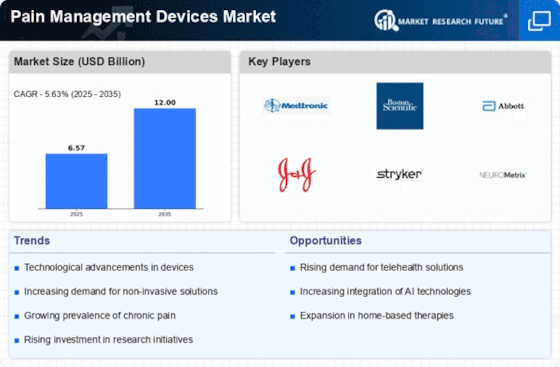
As per Market Research Future analysis, the Pain Management Devices Market was estimated at 6.57 USD Billion in 2024. The Pain Management Devices industry is projected to grow from 6.94 USD Billion in 2025 to 12.0 USD Billion by 2035, exhibiting a compound annual growth rate (CAGR) of 5.63% during the forecast period 2026 - 2035

Key Market Trends & Highlights

The Pain Management Devices Market is experiencing robust growth driven by technological advancements and increasing demand for personalized treatment solutions.

  • Technological advancements are reshaping the Pain Management Devices Market, particularly in North America, which remains the largest market. The integration of digital health solutions is gaining traction, especially in the Asia-Pacific region, recognized as the fastest-growing market. Stimulators dominate the market as the largest segment, while analgesics delivery devices are emerging as the fastest-growing segment. Rising prevalence of chronic pain and increased healthcare expenditure are key drivers propelling market expansion.

Market Size & Forecast

2024 Market Size 6.57 (USD Billion)
2035 Market Size 12.0 (USD Billion)
CAGR (2025 - 2035) 5.63%
Largest Regional Market Share in 2024 North America

Major Players

<a title="Medtronic" href="https://www.medtronic.com/en-us/healthcare-professionals/specialties/pain-management.html" target="_blank" rel="noopener">Medtronic</a> (US), Boston Scientific (US), Abbott Laboratories (US), Johnson &amp; Johnson (US), Stryker Corporation (US), NeuroMetrix (US), Halyard Health (US), Cymedica Orthopedics (US), Bioness (US)

Market Trends

The Pain Management Devices Market is currently experiencing a notable evolution, driven by advancements in technology and an increasing awareness of chronic pain conditions. As healthcare systems worldwide strive to enhance patient outcomes, there is a growing emphasis on non-invasive and drug-free solutions. This shift is likely to foster innovation in device design and functionality, catering to a diverse range of pain management needs. Furthermore, the integration of digital health technologies, such as telemedicine and mobile applications, appears to be reshaping how patients access and utilize pain management devices. In addition, the Pain Management Devices Market is witnessing a surge in demand for personalized treatment options. Patients are increasingly seeking tailored solutions that address their specific pain profiles, which may lead to the development of more sophisticated devices. This trend suggests a potential shift towards a more patient-centric approach in pain management, where devices are not only effective but also adaptable to individual requirements. As the pain management market continues to evolve, stakeholders must remain vigilant to emerging trends and consumer preferences to ensure they meet the changing landscape of pain management effectively.

Technological Advancements

The Pain Management Devices Market is seeing rapid technological progress, with innovations such as wearable devices and smart pain relief solutions. These advancements enhance user experience and improve treatment efficacy, making pain management more accessible.

Personalized Treatment Approaches

There is a growing trend towards personalized pain management solutions, as patients increasingly seek devices tailored to their unique pain experiences. This shift may lead to the development of customizable devices that cater to individual needs.

Integration of Digital Health Solutions

The incorporation of digital health technologies into the Pain Management Devices Market is transforming patient engagement. Telehealth platforms and mobile applications are facilitating remote monitoring and support, enhancing the overall management of pain.

Pain management devices Market Market Drivers

Aging Population

The aging population is another critical factor influencing the Pain Management Devices Market. As individuals age, they often experience an increase in chronic pain conditions, including arthritis and degenerative diseases. The demographic shift towards an older population is expected to drive demand for pain management solutions. By 2030, it is anticipated that the number of individuals aged 65 and older will reach approximately 1.5 billion, creating a substantial market for pain management devices. This demographic trend suggests that healthcare systems will increasingly rely on advanced pain management technologies to address the needs of older patients. Consequently, the Pain Management Devices Market is likely to witness significant growth as manufacturers develop devices tailored to the unique requirements of this demographic.

Rising Healthcare Expenditure

Rising healthcare expenditure is a significant driver for the Pain Management Devices Market. As countries invest more in healthcare infrastructure and services, there is an increasing focus on pain management solutions. This trend is particularly evident in regions where healthcare systems are evolving to prioritize patient-centered care. Increased funding for pain management programs and devices is likely to enhance accessibility and affordability for patients. Furthermore, as healthcare providers recognize the importance of effective pain management in improving patient outcomes, the demand for pain management devices is expected to rise. The Pain Management Devices Market stands to benefit from this trend, as higher healthcare expenditure translates into greater investment in innovative pain management technologies.

Rising Prevalence of Chronic Pain

The increasing prevalence of chronic pain conditions is a primary driver for the Pain Management Devices Market. Conditions such as arthritis, fibromyalgia, and neuropathic pain affect millions of individuals worldwide. According to recent estimates, nearly 20% of adults experience chronic pain, which necessitates effective pain management solutions. This growing patient population is likely to propel demand for innovative pain management devices, as healthcare providers seek to offer effective treatments. The Pain Management Devices Market is expected to expand significantly as a result, with projections indicating a compound annual growth rate of over 8% in the coming years. As more patients seek relief from chronic pain, the market for devices designed to alleviate discomfort is poised for substantial growth.

Technological Innovations in Pain Management Devices

Technological innovations are transforming the Pain Management Devices Market, leading to the development of more effective and user-friendly devices. Advancements in areas such as neuromodulation, wearable technology, and telehealth are enhancing the capabilities of pain management devices. For instance, devices that utilize electrical stimulation or biofeedback mechanisms are becoming increasingly popular due to their non-invasive nature and effectiveness. The integration of smart technology allows for real-time monitoring and personalized treatment plans, which may improve patient outcomes. As these innovations continue to emerge, the Pain Management Devices Market is likely to experience robust growth, driven by the demand for cutting-edge solutions that cater to diverse patient needs.

Increased Awareness and Acceptance of Pain Management Solutions

There is a growing awareness and acceptance of pain management solutions among both healthcare providers and patients, which serves as a significant driver for the Pain Management Devices Market. Educational initiatives and advocacy efforts have contributed to a better understanding of chronic pain and its impact on quality of life. As a result, patients are more likely to seek out effective pain management options, including devices that offer non-invasive or minimally invasive treatments. This shift in perception is likely to enhance the market landscape, with an increasing number of healthcare professionals recommending pain management devices as part of comprehensive treatment plans. The Pain Management Devices Market is expected to benefit from this trend, as more patients embrace innovative solutions to manage their pain.

Market Segment Insights

By Device Type: Stimulators (Largest) vs. Analgesics Delivery Devices (Fastest-Growing)

In the Pain Management Devices Market, stimulators hold the largest share among device types, showcasing their critical role in managing chronic pain through neuromodulation techniques. <a title="Analgesics" href="https://www.marketresearchfuture.com/reports/analgesics-market-19195" target="_blank" rel="noopener">Analgesics</a> delivery devices are also gaining traction due to their effectiveness in delivering medication directly to target areas, thus reducing systemic side effects and enhancing patient compliance.

Stimulators (Dominant) vs. Analgesics Delivery Devices (Emerging)

Stimulators are currently the dominant force in the pain management landscape, known for their ability to provide targeted pain relief through methods such as spinal cord stimulation and transcutaneous electrical nerve stimulation (TENS). Conversely, analgesics delivery devices represent an emerging segment, characterized by innovative solutions such as patient-controlled analgesia and implantable delivery systems. These devices are rapidly evolving in response to the demand for personalized pain management strategies, highlighting their potential to revolutionize patient care by ensuring timely and effective medication delivery.

By Therapeutic Area: Chronic Pain (Largest) vs. Cancer Pain (Fastest-Growing)

In the Pain Management Devices Market, chronic pain holds the largest share, representing a significant portion of current demand. Chronic pain conditions often require ongoing management, leading to a consistent need for advanced therapeutic devices. In contrast, cancer pain, while currently smaller in market share, is experiencing rapid growth as advancements in cancer treatments and rising survival rates increase the need for effective pain management solutions. Market growth trends indicate that the demand for devices addressing chronic pain remains strong, as more individuals seek relief from conditions such as arthritis and back pain. Meanwhile, the emergence of innovative devices specifically designed for cancer pain management is revolutionizing this segment, driven by an aging population and increasing incidences of cancer, highlighting the need for tailored pain management options.

Chronic Pain: Dominant vs. Cancer Pain: Emerging

Chronic pain is characterized by prolonged discomfort, often linked to various conditions, including arthritis, fibromyalgia, and neuropathy. It is the dominant segment in the Pain Management Devices Market due to the extensive patient population requiring continuous relief. Treatments in this segment are well-established, utilizing devices like TENS units and spinal cord stimulators. Conversely, cancer pain is emerging as a critical focus for innovation in pain management. This segment involves complex pain syndromes that necessitate specialized devices to provide targeted relief. The rise of personalized medicine approaches allows for more effective management of cancer pain, enhancing patient quality of life and fostering the development of groundbreaking treatment modalities.

By End User: Hospitals (Largest) vs. Home Care Settings (Fastest-Growing)

The Pain Management Devices Market is primarily characterized by significant contributions from various end users including hospitals, home care settings, ambulatory surgical centers, and physical therapy clinics. Among these, hospitals hold the largest share in the pain management market due to their extensive resources and patient bases, allowing for a wide range of pain management solutions. Home care settings are gaining traction as a valid segment, indicating a shift in consumer preferences towards at-home management of pain, given the convenience and cost-effectiveness associated with personal care environments.

Hospitals (Dominant) vs. Home Care Settings (Emerging)

Hospitals serve as the dominant end user within the Pain Management Devices Market, leveraging state-of-the-art technology alongside comprehensive healthcare services. They are equipped with specialized staff and facilities that cater to complex pain management needs, driving the demand for advanced devices. Conversely, home care settings are emerging as a promising segment, reflecting a paradigm shift towards at-home treatment modalities. This growth is driven by an aging population and increasing chronic pain prevalence, coupled with technological advancements that facilitate effective remote pain management. Together, they embody a dynamic contrast between established practices and modern, home-based solutions.

By Technology: Transcutaneous Electrical Nerve Stimulator (Largest) vs. Intrathecal Drug Delivery Systems (Fastest-Growing)

The Pain Management Devices Market is witnessing a diverse distribution of technologies, with the Transcutaneous Electrical Nerve Stimulator (TENS) leading in market share due to its widespread acceptance and ease of use. In contrast, Intrathecal Drug Delivery Systems are rapidly gaining traction, capturing the attention of healthcare providers and patients alike, as they provide targeted pain relief with fewer systemic side effects compared to traditional methods. The remaining technologies such as Cryoablation and Radiofrequency are also essential but currently represent smaller market portions.

Technology: TENS (Dominant) vs. Intrathecal Drug Delivery Systems (Emerging)

Transcutaneous Electrical Nerve Stimulators (TENS) remain the dominant force in the Pain Management Devices Market, primarily due to their user-friendly application for chronic pain relief, making them highly accessible for patients. Meanwhile, Intrathecal Drug Delivery Systems are emerging as a promising alternative, especially for patients unresponsive to conventional therapies. These systems allow for localized drug delivery directly to the spinal cord, minimizing side effects associated with oral or intravenous medications. As chronic pain management evolves, the intrinsic safety profile and efficacy of these technologies propel them closer to prominence in clinical practices. The competition among these technologies indicates a growing inclination towards patient-centered approaches in pain management.

Get more detailed insights about Pain Management Devices Market-Forecast to 2035

Regional Insights

The Pain Management Devices Market showcases significant regional variations in its dynamics and performance. In 2024, North America dominates the market with a valuation of 2.7 USD Billion, expected to grow to 4.8 USD billion by 2035, primarily due to advanced healthcare infrastructure and increased demand for innovative pain management solutions.

Europe follows closely with a market valuation of 2.1 USD Billion in 2024, projected to reach 3.7 USD billion by 2035, driven by a growing aging population and rising prevalence of chronic pain conditions.South America, while smaller, is also making strides with valuations of 0.5 USD Billion in 2024, forecasting to hit 1.0 USD billion in 2035, indicating a significant growth potential in response to improving healthcare access.

The Asia Pacific region holds a notable position with a valuation of 1.8 USD billion expected to increase to 2.8 USD billion by 2035, reflecting a growing focus on pain management due to increasing incidences of lifestyle-related ailments. Lastly, the Middle East and Africa, valued at 0.47 USD billion in 2024 and expected to reach 0.7 USD billion by 2035, exhibit a developing market with efforts to strengthen healthcare sectors.Overall, the Pain Management Devices Market segmentation reveals varied growth trajectories, where North America leads the majority holding, while other regions present unique opportunities that could shape future market trends.

Key Players and Competitive Insights

The Pain Management Devices Market is characterized by rapid advancements in technology coupled with an increasing prevalence of chronic pain conditions, which significantly drives competition among key players. This market is witnessing a surge in demand for innovative and effective pain management solutions, thereby prompting medical device manufacturers to invest heavily in research and development. The competitive landscape is marked by a diverse range of pain management device companies, each vying to develop cutting-edge devices that cater to the varying needs of patients. As medical device manufacturers strive to differentiate their offerings, market participants are focusing on enhancing product efficacy, improving user experience, and expanding geographical reach.
The overarching trends include the integration of digital technologies in pain management solutions and a growing emphasis on minimally invasive devices. Nuvectra has established itself as a noteworthy player within the Pain Management Devices Market, primarily through its commitment to innovative solutions tailored for chronic pain management. The company is known for developing advanced neuromodulation devices that target specific pain pathways, thereby offering patients personalized and effective treatment options.
Nuvectra's strength lies in its robust research capabilities, which enable it to stay ahead of market trends and develop products that respond to the evolving needs of healthcare practitioners and patients alike. The company's strategic focus on partnerships with healthcare providers and effective clinician training further enhances its market presence, positioning it favorably among competitors in the ever-evolving pain management landscape.Bayer AG holds a significant position in the Pain Management Devices Market, driven by its broad portfolio of healthcare solutions aimed at pain relief.
The company is known for its commitment to providing comprehensive pain management through a combination of pharmaceutical and device-based therapies. Key products include a range of analgesics and innovative medical devices designed to alleviate pain, thereby addressing a critical aspect of patient care. Bayer AG's strengths are further amplified by its extensive research and development investments, which consistently lead to the introduction of novel products that meet high clinical standards. The company's strategic approach includes forming alliances and considering mergers and acquisitions to refine its product offering and expand its global footprint.
This positions Bayer AG as a key contender in the market, catering to the complex needs of patients and healthcare providers in the realm of pain management globally.

Key Companies in the Pain management devices Market include

Industry Developments

Recent changes in the Pain Management Devices Market show that there is more innovation and strategic partnerships to help people deal with chronic pain better. In September 2023, Medtronic added to its neuromodulation line by releasing a wireless spinal cord stimulator. This device is meant to give patients more control and improve treatment outcomes. Also, in August 2023, Stryker Corporation and NeuroMetrix, a company that makes wearable pain therapy devices, signed a deal to work together to make solutions for managing chronic pain.

Boston Scientific bought Relievant Medical Systems in November 2023, which improved its ability to treat vertebrogenic back pain.The market has been steadily growing since 2021, thanks to the rising demand for minimally invasive and non-opioid options for chronic pain. This is especially true for neuromodulation technologies like TENS units, radiofrequency ablation, and peripheral nerve stimulators. Medical device manufacturers like Abbott Laboratories, which is a major player in spinal cord stimulation, and Zynex Medical, which makes FDA-approved electrotherapy devices, are still putting more money into research and development.

The goal of these efforts is to make things more effective, comfortable for patients, and easy to program from a distance. Overall, the Pain Management Devices Market is on a strong upward trend because of new technologies and more people using them in clinical settings.

Future Outlook

Pain management devices Market Future Outlook

The Pain Management Devices Market is projected to grow at a 5.63% CAGR from 2025 to 2035, driven by technological advancements, increasing chronic pain prevalence, and rising healthcare expenditure.

New opportunities lie in:

  • <p>Development of portable pain relief devices for home use. Integration of AI for personalized pain management solutions. Expansion into emerging markets with tailored product offerings.</p>

By 2035, the market is expected to be robust, driven by innovation and strategic expansions.

Market Segmentation

Pain management devices Market End User Outlook

  • Hospitals
  • Home Care Settings
  • Ambulatory Surgical Centers
  • Physical Therapy Clinics

Pain management devices Market Technology Outlook

  • Transcutaneous Electrical Nerve Stimulator
  • Intrathecal Drug Delivery Systems
  • Cryoablation Technology
  • Radiofrequency Technology

Pain management devices Market Device Type Outlook

  • Stimulators
  • Analgesics Delivery Devices
  • Cryotherapy Devices
  • Radiofrequency Ablation Devices

Pain management devices Market Therapeutic Area Outlook

  • Chronic Pain
  • Acute Pain
  • Postoperative Pain
  • Cancer Pain

Report Scope

MARKET SIZE 2024 6.57(USD Billion)
MARKET SIZE 2025 6.94(USD Billion)
MARKET SIZE 2035 12.0(USD Billion)
COMPOUND ANNUAL GROWTH RATE (CAGR) 5.63% (2025 - 2035)
REPORT COVERAGE Revenue Forecast, Competitive Landscape, Growth Factors, and Trends
BASE YEAR 2024
Market Forecast Period 2026 - 2035
Historical Data 2019 - 2024
Market Forecast Units USD Billion
Key Companies Profiled Medtronic (US), Boston Scientific (US), Abbott Laboratories (US), Johnson & Johnson (US), Stryker Corporation (US), NeuroMetrix (US), Halyard Health (US), Cymedica Orthopedics (US), Bioness (US)
Segments Covered Device Type, Therapeutic Area, End Users, Technology, Regional
Key Market Opportunities Integration of wearable technology enhances patient engagement in the Pain Management Devices Market.
Key Market Dynamics Technological advancements and regulatory changes drive innovation and competition in the Pain Management Devices Market.
Countries Covered North America, Europe, APAC, South America, MEA

FAQs

What is the projected market valuation of the Pain Management Devices Market by 2035?

<p>The Pain Management Devices Market is projected to reach a valuation of 12.0 USD Billion by 2035.</p>

What was the market valuation of the Pain Management Devices Market in 2024?

<p>In 2024, the market valuation of Pain Management Devices was 6.57 USD Billion.</p>

What is the expected CAGR for the Pain Management Devices Market during the forecast period 2025 - 2035?

<p>The expected CAGR for the Pain Management Devices Market during the forecast period 2025 - 2035 is 5.63%.</p>

Which companies are considered key players in the Pain Management Devices Market?

<p>Key players in the Pain Management Devices Market include Medtronic, Boston Scientific, Abbott Laboratories, Johnson & Johnson, and Stryker Corporation.</p>

What are the main segments of the Pain Management Devices Market?

<p>The main segments of the Pain Management Devices Market include Device Type, Therapeutic Area, End User, and Technology.</p>

How much is the market for Stimulators expected to grow by 2035?

<p>The market for Stimulators is expected to grow from 2.0 USD Billion in 2024 to 3.5 USD Billion by 2035.</p>

What is the projected growth for Analgesics Delivery Devices by 2035?

<p>Analgesics Delivery Devices are projected to grow from 2.5 USD Billion in 2024 to 4.0 USD Billion by 2035.</p>

What is the expected market size for Cancer Pain management devices by 2035?

<p>The market size for Cancer Pain management devices is expected to increase from 2.07 USD Billion in 2024 to 4.0 USD Billion by 2035.</p>

Which end user segment is anticipated to have the highest growth by 2035?

<p>The Physical Therapy Clinics segment is anticipated to grow from 2.07 USD Billion in 2024 to 4.0 USD Billion by 2035.</p>

What technological advancements are expected to influence the Pain Management Devices Market?

<p>Technological advancements such as Radiofrequency Technology and Intrathecal Drug Delivery Systems are expected to significantly influence the market, with projected growth to 4.0 USD Billion by 2035.</p>

  1. SECTION I: EXECUTIVE SUMMARY AND KEY HIGHLIGHTS
    1. | 1.1 EXECUTIVE SUMMARY
    2. | | 1.1.1 Market Overview
    3. | | 1.1.2 Key Findings
    4. | | 1.1.3 Market Segmentation
    5. | | 1.1.4 Competitive Landscape
    6. | | 1.1.5 Challenges and Opportunities
    7. | | 1.1.6 Future Outlook
  2. SECTION II: SCOPING, METHODOLOGY AND MARKET STRUCTURE
    1. | 2.1 MARKET INTRODUCTION
    2. | | 2.1.1 Definition
    3. | | 2.1.2 Scope of the study
    4. | | | 2.1.2.1 Research Objective
    5. | | | 2.1.2.2 Assumption
    6. | | | 2.1.2.3 Limitations
    7. | 2.2 RESEARCH METHODOLOGY
    8. | | 2.2.1 Overview
    9. | | 2.2.2 Data Mining
    10. | | 2.2.3 Secondary Research
    11. | | 2.2.4 Primary Research
    12. | | | 2.2.4.1 Primary Interviews and Information Gathering Process
    13. | | | 2.2.4.2 Breakdown of Primary Respondents
    14. | | 2.2.5 Forecasting Model
    15. | | 2.2.6 Market Size Estimation
    16. | | | 2.2.6.1 Bottom-Up Approach
    17. | | | 2.2.6.2 Top-Down Approach
    18. | | 2.2.7 Data Triangulation
    19. | | 2.2.8 Validation
  3. SECTION III: QUALITATIVE ANALYSIS
    1. | 3.1 MARKET DYNAMICS
    2. | | 3.1.1 Overview
    3. | | 3.1.2 Drivers
    4. | | 3.1.3 Restraints
    5. | | 3.1.4 Opportunities
    6. | 3.2 MARKET FACTOR ANALYSIS
    7. | | 3.2.1 Value chain Analysis
    8. | | 3.2.2 Porter's Five Forces Analysis
    9. | | | 3.2.2.1 Bargaining Power of Suppliers
    10. | | | 3.2.2.2 Bargaining Power of Buyers
    11. | | | 3.2.2.3 Threat of New Entrants
    12. | | | 3.2.2.4 Threat of Substitutes
    13. | | | 3.2.2.5 Intensity of Rivalry
    14. | | 3.2.3 COVID-19 Impact Analysis
    15. | | | 3.2.3.1 Market Impact Analysis
    16. | | | 3.2.3.2 Regional Impact
    17. | | | 3.2.3.3 Opportunity and Threat Analysis
  4. SECTION IV: QUANTITATIVE ANALYSIS
    1. | 4.1 Healthcare, BY Device Type (USD Billion)
    2. | | 4.1.1 Stimulators
    3. | | 4.1.2 Analgesics Delivery Devices
    4. | | 4.1.3 Cryotherapy Devices
    5. | | 4.1.4 Radiofrequency Ablation Devices
    6. | 4.2 Healthcare, BY Therapeutic Area (USD Billion)
    7. | | 4.2.1 Chronic Pain
    8. | | 4.2.2 Acute Pain
    9. | | 4.2.3 Postoperative Pain
    10. | | 4.2.4 Cancer Pain
    11. | 4.3 Healthcare, BY End User (USD Billion)
    12. | | 4.3.1 Hospitals
    13. | | 4.3.2 Home Care Settings
    14. | | 4.3.3 Ambulatory Surgical Centers
    15. | | 4.3.4 Physical Therapy Clinics
    16. | 4.4 Healthcare, BY Technology (USD Billion)
    17. | | 4.4.1 Transcutaneous Electrical Nerve Stimulator
    18. | | 4.4.2 Intrathecal Drug Delivery Systems
    19. | | 4.4.3 Cryoablation Technology
    20. | | 4.4.4 Radiofrequency Technology
    21. | 4.5 Healthcare, BY Region (USD Billion)
    22. | | 4.5.1 North America
    23. | | | 4.5.1.1 US
    24. | | | 4.5.1.2 Canada
    25. | | 4.5.2 Europe
    26. | | | 4.5.2.1 Germany
    27. | | | 4.5.2.2 UK
    28. | | | 4.5.2.3 France
    29. | | | 4.5.2.4 Russia
    30. | | | 4.5.2.5 Italy
    31. | | | 4.5.2.6 Spain
    32. | | | 4.5.2.7 Rest of Europe
    33. | | 4.5.3 APAC
    34. | | | 4.5.3.1 China
    35. | | | 4.5.3.2 India
    36. | | | 4.5.3.3 Japan
    37. | | | 4.5.3.4 South Korea
    38. | | | 4.5.3.5 Malaysia
    39. | | | 4.5.3.6 Thailand
    40. | | | 4.5.3.7 Indonesia
    41. | | | 4.5.3.8 Rest of APAC
    42. | | 4.5.4 South America
    43. | | | 4.5.4.1 Brazil
    44. | | | 4.5.4.2 Mexico
    45. | | | 4.5.4.3 Argentina
    46. | | | 4.5.4.4 Rest of South America
    47. | | 4.5.5 MEA
    48. | | | 4.5.5.1 GCC Countries
    49. | | | 4.5.5.2 South Africa
    50. | | | 4.5.5.3 Rest of MEA
  5. SECTION V: COMPETITIVE ANALYSIS
    1. | 5.1 Competitive Landscape
    2. | | 5.1.1 Overview
    3. | | 5.1.2 Competitive Analysis
    4. | | 5.1.3 Market share Analysis
    5. | | 5.1.4 Major Growth Strategy in the Healthcare
    6. | | 5.1.5 Competitive Benchmarking
    7. | | 5.1.6 Leading Players in Terms of Number of Developments in the Healthcare
    8. | | 5.1.7 Key developments and growth strategies
    9. | | | 5.1.7.1 New Product Launch/Service Deployment
    10. | | | 5.1.7.2 Merger & Acquisitions
    11. | | | 5.1.7.3 Joint Ventures
    12. | | 5.1.8 Major Players Financial Matrix
    13. | | | 5.1.8.1 Sales and Operating Income
    14. | | | 5.1.8.2 Major Players R&D Expenditure. 2023
    15. | 5.2 Company Profiles
    16. | | 5.2.1 Medtronic (US)
    17. | | | 5.2.1.1 Financial Overview
    18. | | | 5.2.1.2 Products Offered
    19. | | | 5.2.1.3 Key Developments
    20. | | | 5.2.1.4 SWOT Analysis
    21. | | | 5.2.1.5 Key Strategies
    22. | | 5.2.2 Boston Scientific (US)
    23. | | | 5.2.2.1 Financial Overview
    24. | | | 5.2.2.2 Products Offered
    25. | | | 5.2.2.3 Key Developments
    26. | | | 5.2.2.4 SWOT Analysis
    27. | | | 5.2.2.5 Key Strategies
    28. | | 5.2.3 Abbott Laboratories (US)
    29. | | | 5.2.3.1 Financial Overview
    30. | | | 5.2.3.2 Products Offered
    31. | | | 5.2.3.3 Key Developments
    32. | | | 5.2.3.4 SWOT Analysis
    33. | | | 5.2.3.5 Key Strategies
    34. | | 5.2.4 Johnson & Johnson (US)
    35. | | | 5.2.4.1 Financial Overview
    36. | | | 5.2.4.2 Products Offered
    37. | | | 5.2.4.3 Key Developments
    38. | | | 5.2.4.4 SWOT Analysis
    39. | | | 5.2.4.5 Key Strategies
    40. | | 5.2.5 Stryker Corporation (US)
    41. | | | 5.2.5.1 Financial Overview
    42. | | | 5.2.5.2 Products Offered
    43. | | | 5.2.5.3 Key Developments
    44. | | | 5.2.5.4 SWOT Analysis
    45. | | | 5.2.5.5 Key Strategies
    46. | | 5.2.6 NeuroMetrix (US)
    47. | | | 5.2.6.1 Financial Overview
    48. | | | 5.2.6.2 Products Offered
    49. | | | 5.2.6.3 Key Developments
    50. | | | 5.2.6.4 SWOT Analysis
    51. | | | 5.2.6.5 Key Strategies
    52. | | 5.2.7 Halyard Health (US)
    53. | | | 5.2.7.1 Financial Overview
    54. | | | 5.2.7.2 Products Offered
    55. | | | 5.2.7.3 Key Developments
    56. | | | 5.2.7.4 SWOT Analysis
    57. | | | 5.2.7.5 Key Strategies
    58. | | 5.2.8 Cymedica Orthopedics (US)
    59. | | | 5.2.8.1 Financial Overview
    60. | | | 5.2.8.2 Products Offered
    61. | | | 5.2.8.3 Key Developments
    62. | | | 5.2.8.4 SWOT Analysis
    63. | | | 5.2.8.5 Key Strategies
    64. | | 5.2.9 Bioness (US)
    65. | | | 5.2.9.1 Financial Overview
    66. | | | 5.2.9.2 Products Offered
    67. | | | 5.2.9.3 Key Developments
    68. | | | 5.2.9.4 SWOT Analysis
    69. | | | 5.2.9.5 Key Strategies
    70. | 5.3 Appendix
    71. | | 5.3.1 References
    72. | | 5.3.2 Related Reports
  6. LIST OF FIGURES
    1. | 6.1 MARKET SYNOPSIS
    2. | 6.2 NORTH AMERICA MARKET ANALYSIS
    3. | 6.3 US MARKET ANALYSIS BY DEVICE TYPE
    4. | 6.4 US MARKET ANALYSIS BY THERAPEUTIC AREA
    5. | 6.5 US MARKET ANALYSIS BY END USER
    6. | 6.6 US MARKET ANALYSIS BY TECHNOLOGY
    7. | 6.7 CANADA MARKET ANALYSIS BY DEVICE TYPE
    8. | 6.8 CANADA MARKET ANALYSIS BY THERAPEUTIC AREA
    9. | 6.9 CANADA MARKET ANALYSIS BY END USER
    10. | 6.10 CANADA MARKET ANALYSIS BY TECHNOLOGY
    11. | 6.11 EUROPE MARKET ANALYSIS
    12. | 6.12 GERMANY MARKET ANALYSIS BY DEVICE TYPE
    13. | 6.13 GERMANY MARKET ANALYSIS BY THERAPEUTIC AREA
    14. | 6.14 GERMANY MARKET ANALYSIS BY END USER
    15. | 6.15 GERMANY MARKET ANALYSIS BY TECHNOLOGY
    16. | 6.16 UK MARKET ANALYSIS BY DEVICE TYPE
    17. | 6.17 UK MARKET ANALYSIS BY THERAPEUTIC AREA
    18. | 6.18 UK MARKET ANALYSIS BY END USER
    19. | 6.19 UK MARKET ANALYSIS BY TECHNOLOGY
    20. | 6.20 FRANCE MARKET ANALYSIS BY DEVICE TYPE
    21. | 6.21 FRANCE MARKET ANALYSIS BY THERAPEUTIC AREA
    22. | 6.22 FRANCE MARKET ANALYSIS BY END USER
    23. | 6.23 FRANCE MARKET ANALYSIS BY TECHNOLOGY
    24. | 6.24 RUSSIA MARKET ANALYSIS BY DEVICE TYPE
    25. | 6.25 RUSSIA MARKET ANALYSIS BY THERAPEUTIC AREA
    26. | 6.26 RUSSIA MARKET ANALYSIS BY END USER
    27. | 6.27 RUSSIA MARKET ANALYSIS BY TECHNOLOGY
    28. | 6.28 ITALY MARKET ANALYSIS BY DEVICE TYPE
    29. | 6.29 ITALY MARKET ANALYSIS BY THERAPEUTIC AREA
    30. | 6.30 ITALY MARKET ANALYSIS BY END USER
    31. | 6.31 ITALY MARKET ANALYSIS BY TECHNOLOGY
    32. | 6.32 SPAIN MARKET ANALYSIS BY DEVICE TYPE
    33. | 6.33 SPAIN MARKET ANALYSIS BY THERAPEUTIC AREA
    34. | 6.34 SPAIN MARKET ANALYSIS BY END USER
    35. | 6.35 SPAIN MARKET ANALYSIS BY TECHNOLOGY
    36. | 6.36 REST OF EUROPE MARKET ANALYSIS BY DEVICE TYPE
    37. | 6.37 REST OF EUROPE MARKET ANALYSIS BY THERAPEUTIC AREA
    38. | 6.38 REST OF EUROPE MARKET ANALYSIS BY END USER
    39. | 6.39 REST OF EUROPE MARKET ANALYSIS BY TECHNOLOGY
    40. | 6.40 APAC MARKET ANALYSIS
    41. | 6.41 CHINA MARKET ANALYSIS BY DEVICE TYPE
    42. | 6.42 CHINA MARKET ANALYSIS BY THERAPEUTIC AREA
    43. | 6.43 CHINA MARKET ANALYSIS BY END USER
    44. | 6.44 CHINA MARKET ANALYSIS BY TECHNOLOGY
    45. | 6.45 INDIA MARKET ANALYSIS BY DEVICE TYPE
    46. | 6.46 INDIA MARKET ANALYSIS BY THERAPEUTIC AREA
    47. | 6.47 INDIA MARKET ANALYSIS BY END USER
    48. | 6.48 INDIA MARKET ANALYSIS BY TECHNOLOGY
    49. | 6.49 JAPAN MARKET ANALYSIS BY DEVICE TYPE
    50. | 6.50 JAPAN MARKET ANALYSIS BY THERAPEUTIC AREA
    51. | 6.51 JAPAN MARKET ANALYSIS BY END USER
    52. | 6.52 JAPAN MARKET ANALYSIS BY TECHNOLOGY
    53. | 6.53 SOUTH KOREA MARKET ANALYSIS BY DEVICE TYPE
    54. | 6.54 SOUTH KOREA MARKET ANALYSIS BY THERAPEUTIC AREA
    55. | 6.55 SOUTH KOREA MARKET ANALYSIS BY END USER
    56. | 6.56 SOUTH KOREA MARKET ANALYSIS BY TECHNOLOGY
    57. | 6.57 MALAYSIA MARKET ANALYSIS BY DEVICE TYPE
    58. | 6.58 MALAYSIA MARKET ANALYSIS BY THERAPEUTIC AREA
    59. | 6.59 MALAYSIA MARKET ANALYSIS BY END USER
    60. | 6.60 MALAYSIA MARKET ANALYSIS BY TECHNOLOGY
    61. | 6.61 THAILAND MARKET ANALYSIS BY DEVICE TYPE
    62. | 6.62 THAILAND MARKET ANALYSIS BY THERAPEUTIC AREA
    63. | 6.63 THAILAND MARKET ANALYSIS BY END USER
    64. | 6.64 THAILAND MARKET ANALYSIS BY TECHNOLOGY
    65. | 6.65 INDONESIA MARKET ANALYSIS BY DEVICE TYPE
    66. | 6.66 INDONESIA MARKET ANALYSIS BY THERAPEUTIC AREA
    67. | 6.67 INDONESIA MARKET ANALYSIS BY END USER
    68. | 6.68 INDONESIA MARKET ANALYSIS BY TECHNOLOGY
    69. | 6.69 REST OF APAC MARKET ANALYSIS BY DEVICE TYPE
    70. | 6.70 REST OF APAC MARKET ANALYSIS BY THERAPEUTIC AREA
    71. | 6.71 REST OF APAC MARKET ANALYSIS BY END USER
    72. | 6.72 REST OF APAC MARKET ANALYSIS BY TECHNOLOGY
    73. | 6.73 SOUTH AMERICA MARKET ANALYSIS
    74. | 6.74 BRAZIL MARKET ANALYSIS BY DEVICE TYPE
    75. | 6.75 BRAZIL MARKET ANALYSIS BY THERAPEUTIC AREA
    76. | 6.76 BRAZIL MARKET ANALYSIS BY END USER
    77. | 6.77 BRAZIL MARKET ANALYSIS BY TECHNOLOGY
    78. | 6.78 MEXICO MARKET ANALYSIS BY DEVICE TYPE
    79. | 6.79 MEXICO MARKET ANALYSIS BY THERAPEUTIC AREA
    80. | 6.80 MEXICO MARKET ANALYSIS BY END USER
    81. | 6.81 MEXICO MARKET ANALYSIS BY TECHNOLOGY
    82. | 6.82 ARGENTINA MARKET ANALYSIS BY DEVICE TYPE
    83. | 6.83 ARGENTINA MARKET ANALYSIS BY THERAPEUTIC AREA
    84. | 6.84 ARGENTINA MARKET ANALYSIS BY END USER
    85. | 6.85 ARGENTINA MARKET ANALYSIS BY TECHNOLOGY
    86. | 6.86 REST OF SOUTH AMERICA MARKET ANALYSIS BY DEVICE TYPE
    87. | 6.87 REST OF SOUTH AMERICA MARKET ANALYSIS BY THERAPEUTIC AREA
    88. | 6.88 REST OF SOUTH AMERICA MARKET ANALYSIS BY END USER
    89. | 6.89 REST OF SOUTH AMERICA MARKET ANALYSIS BY TECHNOLOGY
    90. | 6.90 MEA MARKET ANALYSIS
    91. | 6.91 GCC COUNTRIES MARKET ANALYSIS BY DEVICE TYPE
    92. | 6.92 GCC COUNTRIES MARKET ANALYSIS BY THERAPEUTIC AREA
    93. | 6.93 GCC COUNTRIES MARKET ANALYSIS BY END USER
    94. | 6.94 GCC COUNTRIES MARKET ANALYSIS BY TECHNOLOGY
    95. | 6.95 SOUTH AFRICA MARKET ANALYSIS BY DEVICE TYPE
    96. | 6.96 SOUTH AFRICA MARKET ANALYSIS BY THERAPEUTIC AREA
    97. | 6.97 SOUTH AFRICA MARKET ANALYSIS BY END USER
    98. | 6.98 SOUTH AFRICA MARKET ANALYSIS BY TECHNOLOGY
    99. | 6.99 REST OF MEA MARKET ANALYSIS BY DEVICE TYPE
    100. | 6.100 REST OF MEA MARKET ANALYSIS BY THERAPEUTIC AREA
    101. | 6.101 REST OF MEA MARKET ANALYSIS BY END USER
    102. | 6.102 REST OF MEA MARKET ANALYSIS BY TECHNOLOGY
    103. | 6.103 KEY BUYING CRITERIA OF HEALTHCARE
    104. | 6.104 RESEARCH PROCESS OF MRFR
    105. | 6.105 DRO ANALYSIS OF HEALTHCARE
    106. | 6.106 DRIVERS IMPACT ANALYSIS: HEALTHCARE
    107. | 6.107 RESTRAINTS IMPACT ANALYSIS: HEALTHCARE
    108. | 6.108 SUPPLY / VALUE CHAIN: HEALTHCARE
    109. | 6.109 HEALTHCARE, BY DEVICE TYPE, 2024 (% SHARE)
    110. | 6.110 HEALTHCARE, BY DEVICE TYPE, 2024 TO 2035 (USD Billion)
    111. | 6.111 HEALTHCARE, BY THERAPEUTIC AREA, 2024 (% SHARE)
    112. | 6.112 HEALTHCARE, BY THERAPEUTIC AREA, 2024 TO 2035 (USD Billion)
    113. | 6.113 HEALTHCARE, BY END USER, 2024 (% SHARE)
    114. | 6.114 HEALTHCARE, BY END USER, 2024 TO 2035 (USD Billion)
    115. | 6.115 HEALTHCARE, BY TECHNOLOGY, 2024 (% SHARE)
    116. | 6.116 HEALTHCARE, BY TECHNOLOGY, 2024 TO 2035 (USD Billion)
    117. | 6.117 BENCHMARKING OF MAJOR COMPETITORS
  7. LIST OF TABLES
    1. | 7.1 LIST OF ASSUMPTIONS
    2. | | 7.1.1
    3. | 7.2 North America MARKET SIZE ESTIMATES; FORECAST
    4. | | 7.2.1 BY DEVICE TYPE, 2025-2035 (USD Billion)
    5. | | 7.2.2 BY THERAPEUTIC AREA, 2025-2035 (USD Billion)
    6. | | 7.2.3 BY END USER, 2025-2035 (USD Billion)
    7. | | 7.2.4 BY TECHNOLOGY, 2025-2035 (USD Billion)
    8. | 7.3 US MARKET SIZE ESTIMATES; FORECAST
    9. | | 7.3.1 BY DEVICE TYPE, 2025-2035 (USD Billion)
    10. | | 7.3.2 BY THERAPEUTIC AREA, 2025-2035 (USD Billion)
    11. | | 7.3.3 BY END USER, 2025-2035 (USD Billion)
    12. | | 7.3.4 BY TECHNOLOGY, 2025-2035 (USD Billion)
    13. | 7.4 Canada MARKET SIZE ESTIMATES; FORECAST
    14. | | 7.4.1 BY DEVICE TYPE, 2025-2035 (USD Billion)
    15. | | 7.4.2 BY THERAPEUTIC AREA, 2025-2035 (USD Billion)
    16. | | 7.4.3 BY END USER, 2025-2035 (USD Billion)
    17. | | 7.4.4 BY TECHNOLOGY, 2025-2035 (USD Billion)
    18. | 7.5 Europe MARKET SIZE ESTIMATES; FORECAST
    19. | | 7.5.1 BY DEVICE TYPE, 2025-2035 (USD Billion)
    20. | | 7.5.2 BY THERAPEUTIC AREA, 2025-2035 (USD Billion)
    21. | | 7.5.3 BY END USER, 2025-2035 (USD Billion)
    22. | | 7.5.4 BY TECHNOLOGY, 2025-2035 (USD Billion)
    23. | 7.6 Germany MARKET SIZE ESTIMATES; FORECAST
    24. | | 7.6.1 BY DEVICE TYPE, 2025-2035 (USD Billion)
    25. | | 7.6.2 BY THERAPEUTIC AREA, 2025-2035 (USD Billion)
    26. | | 7.6.3 BY END USER, 2025-2035 (USD Billion)
    27. | | 7.6.4 BY TECHNOLOGY, 2025-2035 (USD Billion)
    28. | 7.7 UK MARKET SIZE ESTIMATES; FORECAST
    29. | | 7.7.1 BY DEVICE TYPE, 2025-2035 (USD Billion)
    30. | | 7.7.2 BY THERAPEUTIC AREA, 2025-2035 (USD Billion)
    31. | | 7.7.3 BY END USER, 2025-2035 (USD Billion)
    32. | | 7.7.4 BY TECHNOLOGY, 2025-2035 (USD Billion)
    33. | 7.8 France MARKET SIZE ESTIMATES; FORECAST
    34. | | 7.8.1 BY DEVICE TYPE, 2025-2035 (USD Billion)
    35. | | 7.8.2 BY THERAPEUTIC AREA, 2025-2035 (USD Billion)
    36. | | 7.8.3 BY END USER, 2025-2035 (USD Billion)
    37. | | 7.8.4 BY TECHNOLOGY, 2025-2035 (USD Billion)
    38. | 7.9 Russia MARKET SIZE ESTIMATES; FORECAST
    39. | | 7.9.1 BY DEVICE TYPE, 2025-2035 (USD Billion)
    40. | | 7.9.2 BY THERAPEUTIC AREA, 2025-2035 (USD Billion)
    41. | | 7.9.3 BY END USER, 2025-2035 (USD Billion)
    42. | | 7.9.4 BY TECHNOLOGY, 2025-2035 (USD Billion)
    43. | 7.10 Italy MARKET SIZE ESTIMATES; FORECAST
    44. | | 7.10.1 BY DEVICE TYPE, 2025-2035 (USD Billion)
    45. | | 7.10.2 BY THERAPEUTIC AREA, 2025-2035 (USD Billion)
    46. | | 7.10.3 BY END USER, 2025-2035 (USD Billion)
    47. | | 7.10.4 BY TECHNOLOGY, 2025-2035 (USD Billion)
    48. | 7.11 Spain MARKET SIZE ESTIMATES; FORECAST
    49. | | 7.11.1 BY DEVICE TYPE, 2025-2035 (USD Billion)
    50. | | 7.11.2 BY THERAPEUTIC AREA, 2025-2035 (USD Billion)
    51. | | 7.11.3 BY END USER, 2025-2035 (USD Billion)
    52. | | 7.11.4 BY TECHNOLOGY, 2025-2035 (USD Billion)
    53. | 7.12 Rest of Europe MARKET SIZE ESTIMATES; FORECAST
    54. | | 7.12.1 BY DEVICE TYPE, 2025-2035 (USD Billion)
    55. | | 7.12.2 BY THERAPEUTIC AREA, 2025-2035 (USD Billion)
    56. | | 7.12.3 BY END USER, 2025-2035 (USD Billion)
    57. | | 7.12.4 BY TECHNOLOGY, 2025-2035 (USD Billion)
    58. | 7.13 APAC MARKET SIZE ESTIMATES; FORECAST
    59. | | 7.13.1 BY DEVICE TYPE, 2025-2035 (USD Billion)
    60. | | 7.13.2 BY THERAPEUTIC AREA, 2025-2035 (USD Billion)
    61. | | 7.13.3 BY END USER, 2025-2035 (USD Billion)
    62. | | 7.13.4 BY TECHNOLOGY, 2025-2035 (USD Billion)
    63. | 7.14 China MARKET SIZE ESTIMATES; FORECAST
    64. | | 7.14.1 BY DEVICE TYPE, 2025-2035 (USD Billion)
    65. | | 7.14.2 BY THERAPEUTIC AREA, 2025-2035 (USD Billion)
    66. | | 7.14.3 BY END USER, 2025-2035 (USD Billion)
    67. | | 7.14.4 BY TECHNOLOGY, 2025-2035 (USD Billion)
    68. | 7.15 India MARKET SIZE ESTIMATES; FORECAST
    69. | | 7.15.1 BY DEVICE TYPE, 2025-2035 (USD Billion)
    70. | | 7.15.2 BY THERAPEUTIC AREA, 2025-2035 (USD Billion)
    71. | | 7.15.3 BY END USER, 2025-2035 (USD Billion)
    72. | | 7.15.4 BY TECHNOLOGY, 2025-2035 (USD Billion)
    73. | 7.16 Japan MARKET SIZE ESTIMATES; FORECAST
    74. | | 7.16.1 BY DEVICE TYPE, 2025-2035 (USD Billion)
    75. | | 7.16.2 BY THERAPEUTIC AREA, 2025-2035 (USD Billion)
    76. | | 7.16.3 BY END USER, 2025-2035 (USD Billion)
    77. | | 7.16.4 BY TECHNOLOGY, 2025-2035 (USD Billion)
    78. | 7.17 South Korea MARKET SIZE ESTIMATES; FORECAST
    79. | | 7.17.1 BY DEVICE TYPE, 2025-2035 (USD Billion)
    80. | | 7.17.2 BY THERAPEUTIC AREA, 2025-2035 (USD Billion)
    81. | | 7.17.3 BY END USER, 2025-2035 (USD Billion)
    82. | | 7.17.4 BY TECHNOLOGY, 2025-2035 (USD Billion)
    83. | 7.18 Malaysia MARKET SIZE ESTIMATES; FORECAST
    84. | | 7.18.1 BY DEVICE TYPE, 2025-2035 (USD Billion)
    85. | | 7.18.2 BY THERAPEUTIC AREA, 2025-2035 (USD Billion)
    86. | | 7.18.3 BY END USER, 2025-2035 (USD Billion)
    87. | | 7.18.4 BY TECHNOLOGY, 2025-2035 (USD Billion)
    88. | 7.19 Thailand MARKET SIZE ESTIMATES; FORECAST
    89. | | 7.19.1 BY DEVICE TYPE, 2025-2035 (USD Billion)
    90. | | 7.19.2 BY THERAPEUTIC AREA, 2025-2035 (USD Billion)
    91. | | 7.19.3 BY END USER, 2025-2035 (USD Billion)
    92. | | 7.19.4 BY TECHNOLOGY, 2025-2035 (USD Billion)
    93. | 7.20 Indonesia MARKET SIZE ESTIMATES; FORECAST
    94. | | 7.20.1 BY DEVICE TYPE, 2025-2035 (USD Billion)
    95. | | 7.20.2 BY THERAPEUTIC AREA, 2025-2035 (USD Billion)
    96. | | 7.20.3 BY END USER, 2025-2035 (USD Billion)
    97. | | 7.20.4 BY TECHNOLOGY, 2025-2035 (USD Billion)
    98. | 7.21 Rest of APAC MARKET SIZE ESTIMATES; FORECAST
    99. | | 7.21.1 BY DEVICE TYPE, 2025-2035 (USD Billion)
    100. | | 7.21.2 BY THERAPEUTIC AREA, 2025-2035 (USD Billion)
    101. | | 7.21.3 BY END USER, 2025-2035 (USD Billion)
    102. | | 7.21.4 BY TECHNOLOGY, 2025-2035 (USD Billion)
    103. | 7.22 South America MARKET SIZE ESTIMATES; FORECAST
    104. | | 7.22.1 BY DEVICE TYPE, 2025-2035 (USD Billion)
    105. | | 7.22.2 BY THERAPEUTIC AREA, 2025-2035 (USD Billion)
    106. | | 7.22.3 BY END USER, 2025-2035 (USD Billion)
    107. | | 7.22.4 BY TECHNOLOGY, 2025-2035 (USD Billion)
    108. | 7.23 Brazil MARKET SIZE ESTIMATES; FORECAST
    109. | | 7.23.1 BY DEVICE TYPE, 2025-2035 (USD Billion)
    110. | | 7.23.2 BY THERAPEUTIC AREA, 2025-2035 (USD Billion)
    111. | | 7.23.3 BY END USER, 2025-2035 (USD Billion)
    112. | | 7.23.4 BY TECHNOLOGY, 2025-2035 (USD Billion)
    113. | 7.24 Mexico MARKET SIZE ESTIMATES; FORECAST
    114. | | 7.24.1 BY DEVICE TYPE, 2025-2035 (USD Billion)
    115. | | 7.24.2 BY THERAPEUTIC AREA, 2025-2035 (USD Billion)
    116. | | 7.24.3 BY END USER, 2025-2035 (USD Billion)
    117. | | 7.24.4 BY TECHNOLOGY, 2025-2035 (USD Billion)
    118. | 7.25 Argentina MARKET SIZE ESTIMATES; FORECAST
    119. | | 7.25.1 BY DEVICE TYPE, 2025-2035 (USD Billion)
    120. | | 7.25.2 BY THERAPEUTIC AREA, 2025-2035 (USD Billion)
    121. | | 7.25.3 BY END USER, 2025-2035 (USD Billion)
    122. | | 7.25.4 BY TECHNOLOGY, 2025-2035 (USD Billion)
    123. | 7.26 Rest of South America MARKET SIZE ESTIMATES; FORECAST
    124. | | 7.26.1 BY DEVICE TYPE, 2025-2035 (USD Billion)
    125. | | 7.26.2 BY THERAPEUTIC AREA, 2025-2035 (USD Billion)
    126. | | 7.26.3 BY END USER, 2025-2035 (USD Billion)
    127. | | 7.26.4 BY TECHNOLOGY, 2025-2035 (USD Billion)
    128. | 7.27 MEA MARKET SIZE ESTIMATES; FORECAST
    129. | | 7.27.1 BY DEVICE TYPE, 2025-2035 (USD Billion)
    130. | | 7.27.2 BY THERAPEUTIC AREA, 2025-2035 (USD Billion)
    131. | | 7.27.3 BY END USER, 2025-2035 (USD Billion)
    132. | | 7.27.4 BY TECHNOLOGY, 2025-2035 (USD Billion)
    133. | 7.28 GCC Countries MARKET SIZE ESTIMATES; FORECAST
    134. | | 7.28.1 BY DEVICE TYPE, 2025-2035 (USD Billion)
    135. | | 7.28.2 BY THERAPEUTIC AREA, 2025-2035 (USD Billion)
    136. | | 7.28.3 BY END USER, 2025-2035 (USD Billion)
    137. | | 7.28.4 BY TECHNOLOGY, 2025-2035 (USD Billion)
    138. | 7.29 South Africa MARKET SIZE ESTIMATES; FORECAST
    139. | | 7.29.1 BY DEVICE TYPE, 2025-2035 (USD Billion)
    140. | | 7.29.2 BY THERAPEUTIC AREA, 2025-2035 (USD Billion)
    141. | | 7.29.3 BY END USER, 2025-2035 (USD Billion)
    142. | | 7.29.4 BY TECHNOLOGY, 2025-2035 (USD Billion)
    143. | 7.30 Rest of MEA MARKET SIZE ESTIMATES; FORECAST
    144. | | 7.30.1 BY DEVICE TYPE, 2025-2035 (USD Billion)
    145. | | 7.30.2 BY THERAPEUTIC AREA, 2025-2035 (USD Billion)
    146. | | 7.30.3 BY END USER, 2025-2035 (USD Billion)
    147. | | 7.30.4 BY TECHNOLOGY, 2025-2035 (USD Billion)
    148. | 7.31 PRODUCT LAUNCH/PRODUCT DEVELOPMENT/APPROVAL
    149. | | 7.31.1
    150. | 7.32 ACQUISITION/PARTNERSHIP
    151. | | 7.32.1

Healthcare Market Segmentation

Healthcare By Device Type (USD Billion, 2025-2035)

  • Stimulators
  • Analgesics Delivery Devices
  • Cryotherapy Devices
  • Radiofrequency Ablation Devices

Healthcare By Therapeutic Area (USD Billion, 2025-2035)

  • Chronic Pain
  • Acute Pain
  • Postoperative Pain
  • Cancer Pain

Healthcare By End User (USD Billion, 2025-2035)

  • Hospitals
  • Home Care Settings
  • Ambulatory Surgical Centers
  • Physical Therapy Clinics

Healthcare By Technology (USD Billion, 2025-2035)

  • Transcutaneous Electrical Nerve Stimulator
  • Intrathecal Drug Delivery Systems
  • Cryoablation Technology
  • Radiofrequency Technology
Infographic

Free Sample Request

Kindly complete the form below to receive a free sample of this Report

Get Free Sample

Customer Strories

Compare Licence

×
Features License Type
Single User Multiuser License Enterprise User
Price $4,950 $5,950 $7,250
Maximum User Access Limit 1 User Upto 10 Users Unrestricted Access Throughout the Organization
Free Customization
Direct Access to Analyst
Deliverable Format
Platform Access
Discount on Next Purchase 10% 15% 15%
Printable Versions