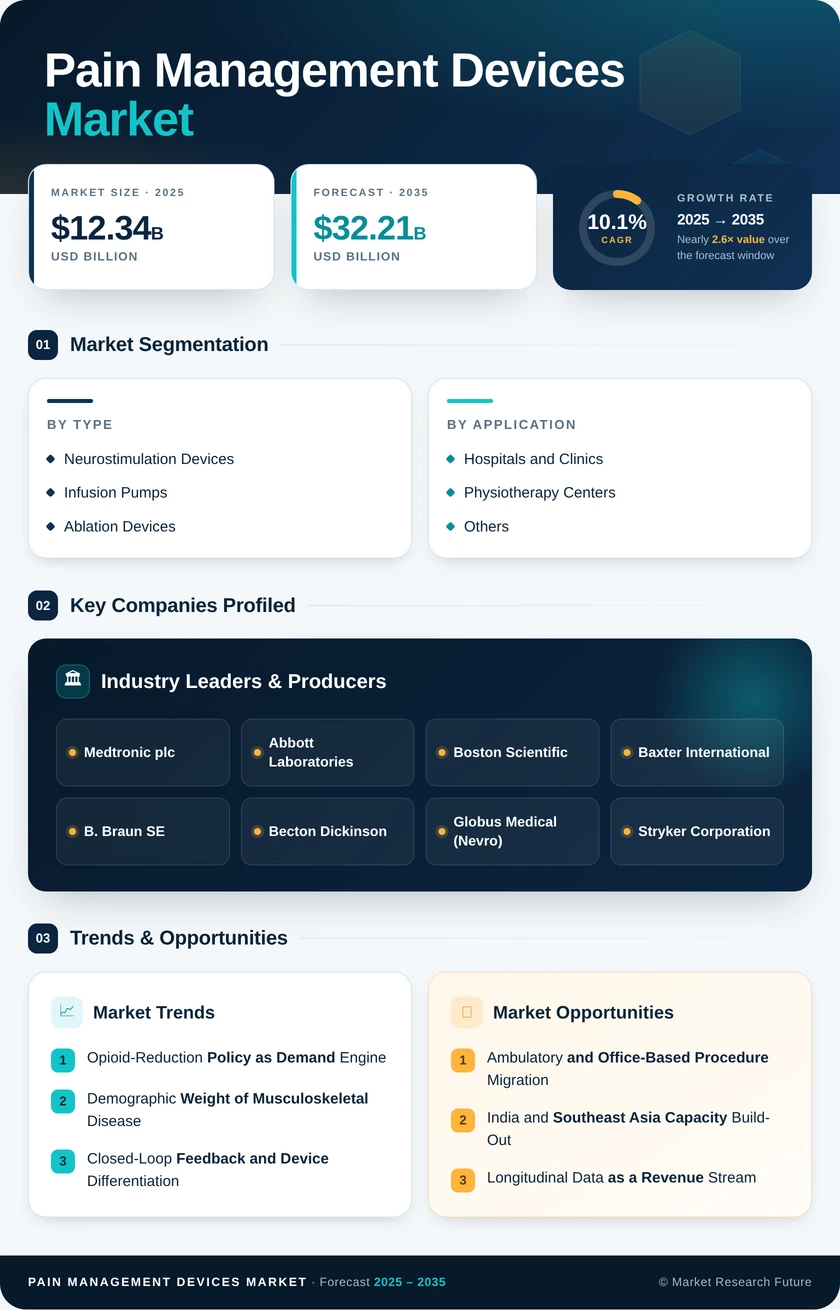
Segmentation Quick Reference
| Dimension | Sub-Segments | Dominant Segment | Fastest Growing Segment |
| By Product Type | Neurostimulation Devices; Infusion Pumps; Ablation Devices | Neurostimulation Devices | Ablation Devices |
| By Application | Musculoskeletal; Neuropathic Pain; Cancer Pain; Facial Pain & Migraine; Others | Musculoskeletal | Neuropathic Pain |
| By End-User | Hospitals and Clinics; Physiotherapy Centers; Others | Hospitals and Clinics | Others (ASC & Home Care) |
| By Geography | North America; Europe; Asia-Pacific; South America; Middle East & Africa | North America | Asia-Pacific |
Market Segmentation Overview
By Product Type
| Sub-Segment | Key Trend |
| Neurostimulation Devices | Migration from fixed-output to feedback-driven closed-loop platforms with continuous neural sensing |
| Infusion Pumps | Fleet-wide replacement toward dose-error-reduction systems with EHR interoperability |
| Ablation Devices | Rapid uptake of basivertebral and cooled radiofrequency procedures in ambulatory settings |
Product mix is shifting on two axes at once: implants are becoming smarter and smaller, while non-implant procedures grow faster than the implant base. Vendors holding both sides of that split — an implant franchise plus a procedural ablation portfolio — enjoy the strongest cross-sell economics through 2035.
By Application
| Sub-Segment | Key Trend |
| Musculoskeletal | Low back pain remains the largest single indication and the primary implant referral source. |
| Neuropathic Pain | Diabetic neuropathy prevalence drives the fastest indication-level expansion. |
| Cancer Pain | Extended survivorship lengthens treatment duration and raises intrathecal pump candidacy. |
| Facial Pain & Migraine | Peripheral and occipital neuromodulation adjuncts are gaining specialist adoption. |
| Others | Post-surgical, visceral and pelvic pain protocols entering routine interventional practice. |
Indication breadth is widening steadily. Devices once reserved for failed back surgery syndrome now carry labeling across multiple chronic conditions, and every label expansion converts a pharmacological population into a procedural one.
By End-User
| Sub-Segment | Key Trend |
| Hospitals and Clinics | Retain permanent implantation volume due to surgical suite and imaging requirements. |
| Physiotherapy Centers | Expanding use of non-invasive and transcutaneous modalities in conservative pathways |
| Others | Ambulatory surgical centers and home care absorbing trials, ablation and follow-up programming |
Site of care is the most consequential structural variable in the forecast. Each percentage point of procedure volume that moves from inpatient to ambulatory settings lowers system cost, raises throughput, and shifts purchasing authority from hospital committees toward physician-owned facilities.
By Geography
| Sub-Segment | Key Trend |
| North America | Reimbursement depth sustains the largest installed implant base globally |
| Europe | MDR recertification reshapes supplier choice while opioid stewardship lifts referrals |
| Asia-Pacific | Capacity build-out and localized manufacturing drive the steepest regional growth. |
| South America | Private supplementary health plans fund the majority of implant volume. |
| Middle East & Africa | Gulf tertiary center investment concentrates demand in a handful of flagship facilities. |
Geographic divergence will widen before it narrows. Mature markets compete on evidence and lifetime cost; emerging markets compete on access and affordability, and the vendors that build genuinely tiered portfolios rather than discounting flagship products will hold the durable position.


 Noah Malgeri
Co-Founder
Noah Malgeri
Co-Founder

 Peter Groot koerkamp
Account and Business Manager
Peter Groot koerkamp
Account and Business Manager

 Younghwan Choi
Senior Retail Manager
Younghwan Choi
Senior Retail Manager

 Mark Irwin
Management Consultant
Mark Irwin
Management Consultant

 Akif Moroglu
Strategy & Business Development Director
Akif Moroglu
Strategy & Business Development Director

 Guilherme Gomes Martins
Product Management Director
Guilherme Gomes Martins
Product Management Director

 Joseph Aguayo
Sales Operations & Pricing Manager
Joseph Aguayo
Sales Operations & Pricing Manager

 La Terria Dodd
Program Support Specialist
La Terria Dodd
Program Support Specialist

 Rob Kooiker
Group Product Manager HVAC & Fire Protection GMA
Rob Kooiker
Group Product Manager HVAC & Fire Protection GMA