×
Request Free Sample ×

Kindly complete the form below to receive a free sample of this Report

* Please use a valid business email

Leading companies partner with us for data-driven Insights

clients tt-cursor
Hero Background
English
Chinese
French
Japanese
Korean
German
Spanish

Packaging Printing Market Trends

ID: MRFR/PCM/1583-HCR
188 Pages
Pradeep Nandi
October 2025

Packaging Printing Market Research Report By Material Type (Plastic, Paper, Metal, Glass), By Printing Technology (Flexographic Printing, Digital Printing, Rotogravure Printing, Offset Printing), By End Use Industry (Food and Beverage, Pharmaceuticals, Cosmetics, Consumer Goods), By Packaging Type (Labels, Flexible Packaging, Rigid Packaging, Corrugated Boxes) and By Regional (North America, Europe, South America, Asia Pacific, Middle East and Africa) - Forecast to 2035

Share:
Download PDF ×

We do not share your information with anyone. However, we may send you emails based on your report interest from time to time. You may contact us at any time to opt-out.

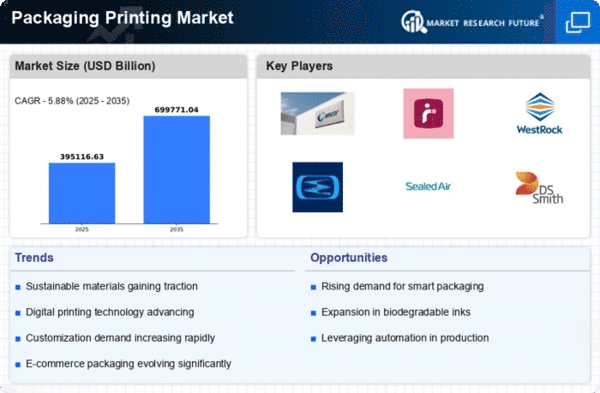
Packaging Printing Market Infographic
Purchase Options

Market Trends

Key Emerging Trends in the Packaging Printing Market

The packaging printing market has experienced significant trends in recent years, reflecting shifts in consumer preferences, advancements in printing technology, and evolving industry regulations. Packaging printing plays a crucial role in enhancing brand visibility, product appeal, and consumer engagement across various sectors such as food and beverage, pharmaceuticals, cosmetics, and consumer goods.

Some regulations followed by the packaging printing industries with the right intention of counterfeit prevention, child resistance, tamper resistance might end up the packaging non-functional. Consumers might find it difficult to open the packaging. Such factors might change the attitude of the consumer and might decrease the value of the product.

One notable trend in the packaging printing market is the increasing demand for sustainable and eco-friendly printing solutions. With growing awareness of environmental issues and regulatory pressures to reduce carbon footprint, there is a rising preference for printing technologies and materials that are environmentally friendly. Manufacturers are responding to this trend by adopting eco-friendly printing processes such as water-based inks, UV-curable inks, and digital printing techniques that minimize volatile organic compound (VOC) emissions and reduce energy consumption. Additionally, there is a growing emphasis on using recycled and biodegradable substrates in packaging printing to promote sustainability and minimize environmental impact.

Moreover, technological advancements have been driving innovation in the packaging printing market, leading to the development of advanced printing technologies and solutions that offer improved print quality, efficiency, and customization. Digital printing technologies, such as inkjet and electrophotography, have gained traction in the packaging industry due to their flexibility, cost-effectiveness, and ability to produce high-quality, variable data prints. These technologies enable manufacturers to create personalized and targeted packaging designs, enhancing brand differentiation and consumer engagement. Furthermore, advancements in color management, image reproduction, and finishing techniques have enabled packaging printers to achieve superior print quality and visual impact, meeting the evolving demands of brand owners and consumers.

Additionally, the global packaging printing market is influenced by shifting consumer preferences and buying behavior, particularly in the food and beverage sector. With consumers seeking convenience, transparency, and sustainability in packaged products, there is a growing demand for packaging designs that reflect these values. Packaging printers are responding to this trend by offering innovative printing solutions that incorporate interactive elements such as QR codes, augmented reality (AR) technology, and variable data printing to provide consumers with product information, recipes, and brand stories. This trend is driving increased adoption of smart and interactive packaging designs that enhance the consumer experience and foster brand loyalty.

Furthermore, market trends in the global packaging printing market are shaped by evolving industry regulations and standards governing packaging and labeling practices. Regulatory bodies such as the Food and Drug Administration (FDA) in the United States and the European Food Safety Authority (EFSA) in Europe establish guidelines and requirements for packaging materials, safety, and labeling in industries such as food, pharmaceuticals, and healthcare. Compliance with these regulations drives the adoption of packaging printing solutions that meet specific criteria for product safety, traceability, and information transparency, ensuring consumer protection and regulatory compliance.

Author
Pradeep Nandi
Senior Research Analyst

I have a bachelor's degree in mechanical engineering and an MBA. I have more than two years of expertise in the retail, food, and beverage, chemical, and material industries, and hence have developed a sound cross-domain expertise. A firm believer in lifelong learning and sharing of knowledge. Having a proclivity for hatching ideas and trying to absorb as much information as possible in a short amount of time. Introducing corporates to the data and insight, which enables them to move from probability to possibility, has been my key areas of interest. 

Leave a Comment

FAQs

What is the expected market size of the Packaging Printing Market in 2024?

The Packaging Printing Market is expected to be valued at 390.5 USD Billion in 2024.

What is the expected CAGR for the Packaging Printing Market from 2025 to 2035?

Packaging Printing Market is expected to grow with a CAGR of 6% in the period 2025-2035

Which region holds the largest market share in the Packaging Printing Market in 2024?

In 2024, North America holds the largest market share with a valuation of 150.0 USD billion.

How much is the Asia Pacific region expected to contribute to the Packaging Printing Market by 2035?

By 2035, the Asia Pacific region is expected to contribute 175.0 USD billion to the Packaging Printing Market.

Who are the key players in the Packaging Printing Market?

Major players in the Packaging Printing Market include R.R. Donnelley, International Paper, WestRock, and Amcor.

What is the market size of plastic packaging printing in 2024?

Plastic packaging printing is valued at 180.0 USD billion in the Packaging Printing Market in 2024.

What are the projected values for paper packaging printing from 2024 to 2035?

Paper packaging printing is expected to grow from 120.0 USD billion in 2024 to 150.0 USD billion by 2035.

How does the metal packaging segment perform in 2024 compared to 2035?

The metal packaging segment is valued at 98.0 USD Billion in 2024 and is expected to reach 130.0 USD billion by 2035.

What challenges does the Packaging Printing Market face in the current scenario?

The Packaging Printing Market faces challenges related to raw material costs and environmental regulations impacting production.

Market Summary

As per MRFR analysis, the Packaging Printing Market Size was estimated at 390.5 USD Billion in 2024. The Packaging Printing industry is projected to grow from 413.93 USD Billion in 2025 to 741.3 USD Billion by 2035, exhibiting a compound annual growth rate (CAGR) of 6% during the forecast period 2025 - 2035.

Key Market Trends & Highlights

The Packaging Printing Market is experiencing a dynamic shift towards sustainability and technological innovation.

  • North America remains the largest market for packaging printing, driven by robust consumer demand and advanced manufacturing capabilities. Asia-Pacific is recognized as the fastest-growing region, propelled by increasing urbanization and rising disposable incomes. Food packaging continues to dominate the market, while beverage packaging is emerging as the fastest-growing segment due to changing consumer preferences. Sustainability initiatives and technological advancements are key drivers, as businesses adapt to regulatory compliance and consumer demands for customization.

Market Size & Forecast

2024 Market Size 390.5 (USD Billion)
2035 Market Size 741.3(USD Billion)
CAGR (2025 - 2035) 6%
Largest Regional Market Share in 2024 North America

Major Players

Amcor, Mondi, Smurfit WestRock, Sealed Air, Xerox Corporation, International Paper, Tetra Pak, HP Inc., Toppan Printing Co., Ltd., Canon Inc.

Market Trends

The Packaging Printing Market is currently experiencing a dynamic evolution, driven by various factors that influence consumer preferences and technological advancements. As sustainability becomes a focal point for many industries, there is a noticeable shift towards eco-friendly materials and processes. This trend is not merely a response to regulatory pressures but also reflects a growing consumer demand for environmentally responsible products. Consequently, manufacturers are increasingly adopting innovative printing techniques that minimize waste and enhance recyclability, thereby aligning with broader sustainability goals. Moreover, the rise of e-commerce has transformed packaging requirements, necessitating more robust and visually appealing designs to attract consumers in a crowded digital marketplace. The Packaging Printing Market appears to be adapting to these changes by integrating advanced technologies such as digital printing and automation, which facilitate quicker turnaround times and customization options. This adaptability suggests a promising future for the market, as it continues to evolve in response to both consumer expectations and technological innovations. In summary, the Packaging Printing Market is poised for growth, driven by sustainability initiatives and the demands of a rapidly changing retail landscape.

Sustainability Initiatives

The Packaging Printing Market is increasingly focusing on sustainable practices, with manufacturers exploring eco-friendly materials and processes. This trend reflects a broader commitment to environmental responsibility, as companies seek to reduce their carbon footprint and appeal to environmentally conscious consumers.

Technological Advancements

Innovations in printing technology are reshaping the Packaging Printing Market. Digital printing and automation are becoming more prevalent, allowing for faster production times and greater customization. These advancements enable businesses to respond swiftly to market demands and enhance product appeal.

E-commerce Influence

The growth of e-commerce is significantly impacting packaging design and functionality. As online shopping continues to rise, the Packaging Printing Market is adapting by creating packaging that is not only visually appealing but also durable enough to withstand shipping and handling.

Packaging Printing Market Market Drivers

Sustainability Initiatives

The Global Packaging Printing Market Industry is increasingly influenced by sustainability initiatives. As consumers become more environmentally conscious, brands are prioritizing eco-friendly packaging solutions. This shift is evident in the rising demand for biodegradable and recyclable materials, which are projected to dominate the market. In 2024, the market is valued at 458 USD Billion, with sustainability playing a crucial role in this growth. Companies that adopt sustainable practices not only enhance their brand image but also comply with stringent regulations aimed at reducing environmental impact. This trend is likely to continue, shaping the future of packaging printing.

Market Segment Insights

By Application: Food Packaging (Largest) vs. Beverage Packaging (Fastest-Growing)

The Packaging Printing Market exhibits a diverse application landscape, with food packaging leading the market share significantly. This segment dominates the overall packaging landscape due to the increasing demand for shelf-life extension and food safety. In contrast, the beverage packaging segment is rapidly gaining traction, thanks to rising consumer preferences for ready-to-drink products and sustainable packaging solutions. This has resulted in noteworthy growth in the beverage packaging domain, positioning it as the fastest-growing area within the broader market.

Food Packaging (Dominant) vs. Pharmaceutical Packaging (Emerging)

Food packaging remains the dominant segment in the Packaging Printing Market, characterized by its reliance on innovative materials to enhance food preservation and visual appeal. It utilizes advanced printing techniques that ensure compliance with safety regulations while attracting consumer attention. On the other hand, pharmaceutical packaging is an emerging segment, driven by increasing health awareness and stringent regulations regarding drug safety and branding requirements. The packaging solutions in this segment must ensure product integrity and traceability, making it crucial for manufacturers to adopt advanced printing technologies to meet these complexities. This positions <a href="https://www.marketresearchfuture.com/reports/pharmaceutical-packaging-market-1291">pharmaceutical packaging</a> as a vital yet evolving part of the packaging printing landscape.

By Printing Technology: Flexographic Printing (Largest) vs. Digital Printing (Fastest-Growing)

The Packaging Printing Market exhibits a diverse landscape characterized by several printing technologies, with <a href="https://www.marketresearchfuture.com/reports/flexographic-printing-market-57483">flexographic printing</a> holding the largest share. This technology is predominantly favored for its efficiency in high-volume runs and compatibility with various substrates, making it a preferred choice in the packaging sector. Following closely is Digital Printing, which is rapidly gaining traction due to its flexibility and ability to accommodate shorter runs. These attributes make digital solutions increasingly appealing to brands looking to customize packaging designs and optimize print processes. As consumer preferences shift towards personalization and sustainability, Digital Printing is poised to experience significant growth, positioning it as the fastest-growing segment in the market. The rise in e-commerce and the demand for quick turnaround times further propel this trend, offering businesses innovative ways to engage with their audience while reducing waste. Flexographic Printing will remain critical in large-scale production, yet the adaptability of Digital Printing is revolutionizing packaging strategies, ensuring it captures a larger market share over the upcoming years.

Flexographic Printing (Dominant) vs. Digital Printing (Emerging)

Flexographic Printing stands as the dominant force within the Packaging Printing Market due to its ability to efficiently cater to large volume production with high-speed output, allowing companies to maintain cost-effectiveness while achieving vibrant prints across various substrates. This method is especially favored in industries requiring continuous patterns and bold graphics, such as food and beverage packaging. In contrast, Digital Printing represents an emerging force within the market, thriving on the demands for customization and shorter production runs. This flexibility caters to the growing trend of personalized packaging and on-demand solutions, allowing brands to quickly adapt to consumer needs and market changes without incurring excessive costs. Both segments showcase their unique advantages, addressing the distinct demands of the packaging landscape.

By Material Type: Plastic (Largest) vs. Paper (Fastest-Growing)

In the Packaging Printing Market, the material type segment showcases a diverse distribution among key players. Plastic currently holds the largest share, driven by its durability and versatility in packaging applications. Meanwhile, paper is emerging as the fastest-growing segment, benefiting from an increasing consumer preference for sustainable and eco-friendly packaging solutions. As market dynamics shift towards sustainability, the demand for biodegradable materials is also gaining traction, set to alter the competitive landscape significantly. Companies are innovating by integrating recycled materials into their products, enhancing the appeal of paper. This shift is reinforced by government regulations aimed at reducing plastic waste, encouraging advancements in biodegradable alternatives to meet consumer expectations.

Plastic (Dominant) vs. Biodegradable Materials (Emerging)

Plastic remains the dominant material in the Packaging Printing Market, appreciated for its lightweight, strong, and moisture-resistant properties. It offers flexibility in design and can accommodate various printing techniques, making it a staple for numerous packaging solutions. Additionally, its cost-effectiveness and availability further solidify its position. Conversely, biodegradable materials are emerging as a viable alternative driven by increasing environmental awareness among consumers and regulatory pressures on single-use plastics. These materials, which can decompose naturally, offer brands a way to align with sustainability goals. Companies are increasingly investing in biodegradable solutions to cater to the eco-conscious market, indicating a potential shift in consumer preferences and regulatory landscapes.

By End Use: Retail (Largest) vs. E-commerce (Fastest-Growing)

The Packaging Printing Market exhibits a diverse distribution among its end-use segments. Retail holds the largest share, driven by the demand for visually appealing packaging that enhances shelf presence and consumer engagement. E-commerce, although smaller currently, is rapidly gaining traction, fueled by the surge in online shopping and the accompanying need for effective branding and protective packaging. Healthcare and Food Service also contribute significantly, underscoring the variety of requirements across different sectors.

Retail (Dominant) vs. E-commerce (Emerging)

In the Packaging Printing Market, Retail packaging is characterized by its focus on aesthetics and brand representation, making it the dominant force. Companies invest in eye-catching designs and sustainable materials to attract consumers in physical stores. On the other hand, E-commerce packaging is emerging rapidly, adapted to logistical needs and customer convenience. Its focus is on protecting products during transit while maintaining brand identity. E-commerce's growth is driven by the increasing reliance on online shopping, requiring innovative packaging solutions to enhance unboxing experiences and promote sustainability.

Get more detailed insights about Packaging Printing Market Research Report - Global Forecast to 2035

Regional Insights

North America : Market Leader in Packaging

North America continues to lead The Packaging Printing, holding a significant share of 186,000.0. The region's growth is driven by increasing consumer demand for sustainable packaging solutions and advancements in printing technologies. Regulatory support for eco-friendly practices further catalyzes market expansion, as companies adapt to stringent environmental standards. The shift towards e-commerce has also amplified the need for innovative packaging solutions, enhancing market dynamics. The competitive landscape in North America is robust, featuring key players such as WestRock, International Paper, and Graphic Packaging Holding Company. These companies are investing heavily in R&D to develop sustainable materials and improve printing efficiency. The U.S. remains the largest market, with Canada and Mexico also contributing to growth. The presence of established firms and a focus on innovation position North America as a formidable player in the packaging printing sector.

Europe : Emerging Sustainability Focus

Europe's packaging printing market is valued at 100,000.0, driven by a strong emphasis on sustainability and regulatory frameworks promoting eco-friendly practices. The European Union's directives on packaging waste and recycling are pivotal in shaping market trends, encouraging companies to adopt sustainable materials and processes. This regulatory environment fosters innovation, as businesses seek to comply with stringent guidelines while meeting consumer demand for greener options. Leading countries in this region include Germany, France, and the UK, where major players like Mondi and Smurfit Kappa are actively enhancing their product offerings. The competitive landscape is characterized by a mix of established firms and emerging startups focused on sustainable solutions. The presence of advanced printing technologies and a skilled workforce further bolster Europe's position in The Packaging Printing.

Asia-Pacific : Rapid Growth and Innovation

The Asia-Pacific packaging printing market, valued at 70,000.0, is experiencing rapid growth driven by urbanization and rising disposable incomes. The demand for packaged goods is surging, particularly in countries like China and India, where a growing middle class is influencing consumption patterns. Regulatory initiatives aimed at reducing plastic waste are also shaping market dynamics, pushing companies to innovate in sustainable packaging solutions. China stands out as a key player in the region, with significant investments in advanced printing technologies. Other notable markets include Japan and India, where local firms are increasingly competing with global giants. The competitive landscape is evolving, with a mix of traditional and digital printing methods being adopted to meet diverse consumer needs. This dynamic environment positions Asia-Pacific as a promising region for future growth in packaging printing.

Middle East and Africa : Emerging Market Opportunities

The Middle East and Africa packaging printing market, valued at 5,000.0, is on the rise, driven by increasing consumer demand and economic development. The region is witnessing a shift towards modern retail and e-commerce, which is boosting the need for innovative packaging solutions. Regulatory frameworks are gradually evolving to support sustainable practices, although challenges remain in terms of infrastructure and technology adoption. Countries like South Africa and the UAE are leading the charge, with local and international players investing in the market. Key companies are focusing on enhancing their product offerings to cater to the growing demand for packaged goods. The competitive landscape is characterized by a mix of established firms and new entrants, creating opportunities for growth and innovation in the packaging printing sector.

Key Players and Competitive Insights

The Packaging Printing Market is currently characterized by a dynamic competitive landscape, driven by factors such as sustainability, technological advancements, and evolving consumer preferences. Major players like Amcor (AU), Mondi (GB), and WestRock (US) are strategically positioning themselves to leverage these trends. Amcor (AU) focuses on innovation in sustainable packaging solutions, while Mondi (GB) emphasizes its commitment to circular economy principles. WestRock (US) is enhancing its operational capabilities through digital transformation initiatives, collectively shaping a competitive environment that prioritizes eco-friendly practices and technological integration.Key business tactics within the market include localizing manufacturing and optimizing supply chains to enhance efficiency and responsiveness. The competitive structure appears moderately fragmented, with a mix of large multinational corporations and regional players. This fragmentation allows for diverse offerings and innovation, as key players collaborate and compete to meet the growing demand for sustainable packaging solutions.
In November Amcor (AU) announced a partnership with a leading technology firm to develop smart packaging solutions that incorporate IoT capabilities. This strategic move is likely to enhance product traceability and consumer engagement, aligning with the increasing demand for transparency in packaging. Such innovations may position Amcor (AU) as a frontrunner in the smart packaging segment, potentially attracting new customers and markets.
In October Mondi (GB) launched a new line of recyclable packaging products aimed at reducing plastic waste. This initiative underscores Mondi's commitment to sustainability and aligns with global trends towards eco-friendly packaging. By expanding its product portfolio, Mondi (GB) not only addresses consumer concerns but also strengthens its market position against competitors who may lag in sustainability efforts.
In September WestRock (US) unveiled a state-of-the-art digital printing facility designed to enhance customization capabilities for its clients. This facility is expected to significantly reduce lead times and improve production efficiency. By investing in advanced printing technologies, WestRock (US) is likely to attract businesses seeking tailored packaging solutions, thereby reinforcing its competitive edge in the market.
As of December current trends in the Packaging Printing Market indicate a strong focus on digitalization, sustainability, and AI integration. Strategic alliances among key players are shaping the landscape, fostering innovation and collaboration. The competitive differentiation is expected to evolve from traditional price-based competition to a focus on innovation, technology, and supply chain reliability. Companies that can effectively integrate these elements into their strategies are likely to thrive in this rapidly changing environment.

Key Companies in the Packaging Printing Market include

Industry Developments

  • Q3 2022: AutajonGroup recently announced the addition of ZappPackaging from California to its Packaging Division Autajon Group acquired ZappPackaging, a California-based packaging company, expanding its Packaging Division and strengthening its presence in the United States, particularly in California.

Future Outlook

Packaging Printing Market Future Outlook

The Packaging Printing Market is projected to grow at a 6% CAGR from 2025 to 2035, driven by sustainability trends, technological advancements, and increasing demand for customized packaging solutions.

New opportunities lie in:

  • <p>Invest in digital printing technologies for faster turnaround times. Develop eco-friendly packaging materials to meet consumer demand. Expand into emerging markets with tailored packaging solutions.</p>

By 2035, the Packaging Printing Market is expected to be robust, driven by innovation and sustainability.

Market Segmentation

Packaging Printing Market End Use Outlook

  • Retail
  • E-commerce
  • Healthcare
  • Food Service
  • Manufacturing

Packaging Printing Market Application Outlook

  • Food Packaging
  • Beverage Packaging
  • Pharmaceutical Packaging
  • Cosmetic Packaging
  • Industrial Packaging

Packaging Printing Market Material Type Outlook

  • Plastic
  • Paper
  • Metal
  • Glass
  • Biodegradable Materials

Packaging Printing Market Printing Technology Outlook

  • Flexographic Printing
  • Digital Printing
  • Gravure Printing
  • Offset Printing
  • Screen Printing

Report Scope

MARKET SIZE 2024 390.5(USD Billion)
MARKET SIZE 2025 413.93(USD Billion)
MARKET SIZE 2035 741.3(USD Billion)
COMPOUND ANNUAL GROWTH RATE (CAGR) 6% (2025 - 2035)
REPORT COVERAGE Revenue Forecast, Competitive Landscape, Growth Factors, and Trends
BASE YEAR 2024
Market Forecast Period 2025 - 2035
Historical Data 2019 - 2024
Market Forecast Units USD Billion
Key Companies Profiled Amcor, Mondi, Smurfit WestRock, Sealed Air, Xerox Corporation, International Paper, Tetra Pak, HP Inc., Toppan Printing Co., Ltd., Canon Inc.
Segments Covered Application, Printing Technology, Material Type, End Use
Key Market Opportunities Adoption of sustainable materials and digital printing technologies drives growth in the Packaging Printing Market.
Key Market Dynamics Technological advancements and sustainability trends drive innovation and competition in the Packaging Printing Market.
Countries Covered North America, Europe, APAC, South America, MEA

FAQs

What is the expected market size of the Packaging Printing Market in 2024?

The Packaging Printing Market is expected to be valued at 390.5 USD Billion in 2024.

What is the expected CAGR for the Packaging Printing Market from 2025 to 2035?

Packaging Printing Market is expected to grow with a CAGR of 6% in the period 2025-2035

Which region holds the largest market share in the Packaging Printing Market in 2024?

In 2024, North America holds the largest market share with a valuation of 150.0 USD billion.

How much is the Asia Pacific region expected to contribute to the Packaging Printing Market by 2035?

By 2035, the Asia Pacific region is expected to contribute 175.0 USD billion to the Packaging Printing Market.

Who are the key players in the Packaging Printing Market?

Major players in the Packaging Printing Market include R.R. Donnelley, International Paper, WestRock, and Amcor.

What is the market size of plastic packaging printing in 2024?

Plastic packaging printing is valued at 180.0 USD billion in the Packaging Printing Market in 2024.

What are the projected values for paper packaging printing from 2024 to 2035?

Paper packaging printing is expected to grow from 120.0 USD billion in 2024 to 150.0 USD billion by 2035.

How does the metal packaging segment perform in 2024 compared to 2035?

The metal packaging segment is valued at 98.0 USD Billion in 2024 and is expected to reach 130.0 USD billion by 2035.

What challenges does the Packaging Printing Market face in the current scenario?

The Packaging Printing Market faces challenges related to raw material costs and environmental regulations impacting production.

  1. SECTION I: EXECUTIVE SUMMARY AND KEY HIGHLIGHTS
    1. EXECUTIVE SUMMARY
      1. Market Overview
      2. Key Findings
      3. Market Segmentation
      4. Competitive Landscape
      5. Challenges and Opportunities
      6. Future Outlook 2 SECTION II: SCOPING, METHODOLOGY AND MARKET STRUCTURE
    2. MARKET INTRODUCTION
      1. Definition
      2. Scope of the study
    3. RESEARCH METHODOLOGY
      1. Overview
      2. Data Mining
      3. Secondary Research
      4. Primary Research
      5. Forecasting Model
      6. Market Size Estimation
      7. Data Triangulation
      8. Validation 3 SECTION III: QUALITATIVE ANALYSIS
    4. MARKET DYNAMICS
      1. Overview
      2. Drivers
      3. Restraints
      4. Opportunities
    5. MARKET FACTOR ANALYSIS
      1. Value chain Analysis
      2. Porter's Five Forces Analysis
      3. COVID-19 Impact Analysis
    6. Packaging & Transport, BY Application (USD Billion)
      1. Food Packaging
      2. Beverage Packaging
      3. Pharmaceutical Packaging
      4. Cosmetic Packaging
      5. Industrial Packaging
    7. Packaging & Transport, BY Printing Technology (USD Billion)
      1. Flexographic Printing
      2. Digital Printing
      3. Gravure Printing
      4. Offset Printing
      5. Screen Printing
    8. Packaging & Transport, BY Material Type (USD Billion)
      1. Plastic
      2. Paper
      3. Metal
      4. Glass
      5. Biodegradable Materials
    9. Packaging & Transport, BY End Use (USD Billion)
      1. Retail
      2. E-commerce
      3. Healthcare
      4. Food Service
      5. Manufacturing
    10. Packaging & Transport, BY Region (USD Billion)
      1. North America
      2. Europe
      3. APAC
      4. South America
      5. MEA
    11. Competitive Landscape
      1. Overview
      2. Competitive Analysis
      3. Market share Analysis
      4. Major Growth Strategy in the Packaging & Transport
      5. Competitive Benchmarking
      6. Leading Players in Terms of Number of Developments in the Packaging & Transport
      7. Key developments and growth strategies
      8. Major Players Financial Matrix
    12. Company Profiles
      1. Amcor (AU)
      2. Mondi (GB)
      3. WestRock (US)
      4. Smurfit Kappa (IE)
      5. Sealed Air (US)
      6. DS Smith (GB)
      7. Graphic Packaging Holding Company (US)
      8. International Paper (US)
      9. Tetra Pak (SE)
    13. Appendix
      1. References
      2. Related Reports

Packaging & Transport Market Segmentation

Packaging & Transport By Application (USD Billion, 2025-2035)

  • Food Packaging
  • Beverage Packaging
  • Pharmaceutical Packaging
  • Cosmetic Packaging
  • Industrial Packaging

Packaging & Transport By Printing Technology (USD Billion, 2025-2035)

  • Flexographic Printing
  • Digital Printing
  • Gravure Printing
  • Offset Printing
  • Screen Printing

Packaging & Transport By Material Type (USD Billion, 2025-2035)

  • Plastic
  • Paper
  • Metal
  • Glass
  • Biodegradable Materials

Packaging & Transport By End Use (USD Billion, 2025-2035)

  • Retail
  • E-commerce
  • Healthcare
  • Food Service
  • Manufacturing
Infographic

Free Sample Request

Kindly complete the form below to receive a free sample of this Report

Get Free Sample

Customer Strories

Compare Licence

×
Features License Type
Single User Multiuser License Enterprise User
Price $4,950 $5,950 $7,250
Maximum User Access Limit 1 User Upto 10 Users Unrestricted Access Throughout the Organization
Free Customization
Direct Access to Analyst
Deliverable Format
Platform Access
Discount on Next Purchase 10% 15% 15%
Printable Versions