
Request Free Sample ×

Kindly complete the form below to receive a free sample of this Report

* Please use a valid business email

Leading companies partner with us for data-driven Insights

clients tt-cursor
Hero Background
English
Chinese
French
Japanese
Korean
German
Spanish

Overhead Cranes Market Size

ID: MRFR/PCM/6793-HCR
111 Pages
Snehal Singh
April 2026

Overhead Cranes Market Size, Share & Industry Analysis Research Report Information By Product (Single Girder Overhead Cranes and Double Girder Overhead Cranes), By End-User (Automotive, Paper, Utility, Aerospace and Others), And By Region (North America, Europe, Asia-Pacific, And Rest Of The World) – Market Forecast Till 2035

Share:
Download PDF ×

We do not share your information with anyone. However, we may send you emails based on your report interest from time to time. You may contact us at any time to opt-out.

Overhead Cranes Market Infographic
Purchase Options

Overhead Cranes Size

Market Size Snapshot

Year Value
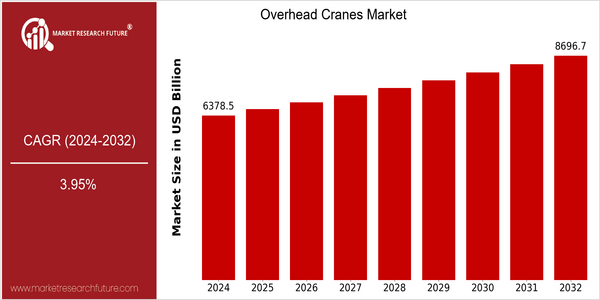
2024 USD 6378.5 Billion
2032 USD 8696.7 Billion
CAGR (2024-2032) 3.95 %

Note – Market size depicts the revenue generated over the financial year

The world's overhead cranes market is expected to grow steadily, with a market size of $ 6,378,560,000 in 2024, expected to reach $ 8,696,600,000 by 2032. This represents a CAGR of 3.95% for the period from 2024 to 2032. The market is expected to grow because of the increasing automation of industrial processes, the growing demand for efficient material handling solutions, and the development of crane technology that improves efficiency and safety. And as the industries continue to develop, the integration of smart technology such as IoT and AI is expected to drive the adoption of overhead cranes and provide real-time monitoring and preventive maintenance. The key players in the overhead cranes market, such as Konecranes, Terex, and Liebherr, are continuously investing in R & D to develop new products. And companies are also forming strategic alliances to increase market share and leverage complementary technology. Recent product launches, for example, with advanced automation and energy-saving designs, show that the industry is committed to meeting the growing demand for manufacturing, construction, and logistics. In general, the global overhead cranes market is expected to benefit from the technological progress and strategic initiatives of these companies and will continue to grow in the future.
home-ubuntu-www-mrf_ne_design-batch-5-cp-overhead-cranes-market size

Regional Market Size

Regional Deep Dive

The global Overhead Cranes market is experiencing substantial growth across regions, owing to increasing industrialization, growing urbanization, and increasing automation in material handling. Each region has a different market character, influenced by local economic and regulatory conditions and technological developments. North America is characterized by a mature market with a focus on innovation and safety standards, whereas Europe focuses on energy efficiency and sustainable development. Asia-Pacific is characterized by rapid growth, mainly in the manufacturing sector, whereas the Middle East and Africa are characterized by slow but steady development of their economies, which is also reflected in the demand for Overhead Cranes. Latin America is a relatively new market, but it is also characterized by continuous investment in the mining and construction industries.

Europe

  • European manufacturers are increasingly focusing on eco-friendly crane solutions, with companies like Demag and Liebherr investing in electric and hybrid models to meet stringent EU environmental regulations.
  • The European market is also witnessing collaborations between manufacturers and technology firms to develop automated overhead crane systems, which are expected to enhance productivity in logistics and warehousing sectors.

Asia Pacific

  • The Asia-Pacific region is experiencing rapid industrial growth, particularly in countries like China and India, where significant investments in infrastructure and manufacturing are driving the demand for overhead cranes.
  • Local companies such as Shanghai Zhenhua Heavy Industries and Konecranes are expanding their production capabilities to cater to the increasing demand, while government initiatives aimed at boosting manufacturing are further propelling market growth.

Latin America

  • Latin America is witnessing a revival in construction activities, particularly in Brazil and Mexico, which is driving the demand for overhead cranes as part of larger infrastructure projects.
  • Local manufacturers are beginning to emerge, and partnerships with international companies are being formed to enhance technology transfer and improve product offerings in the region.

North America

  • In North America, the market is booming for smart cranes that are connected to the Internet of Things, enhancing efficiency and safety. Konecranes and Terex are among the leaders in integrating new technology into their crane systems.
  • Regulatory changes in safety standards, particularly OSHA regulations, are pushing manufacturers to innovate and improve the safety features of overhead cranes, thereby increasing the overall market competitiveness.

Middle East And Africa

  • In the Middle East, large-scale infrastructure projects, such as the NEOM city in Saudi Arabia, are creating substantial demand for overhead cranes, with companies like Al Jaber Group actively involved in these developments.
  • The African market is gradually evolving, with increased investments in mining and construction sectors, leading to a growing need for efficient material handling solutions, including overhead cranes.

Did You Know?

“Did you know that overhead cranes can lift loads weighing up to 1,000 tons, making them essential for heavy industries such as shipbuilding and steel manufacturing?” — International Crane and Rigging Conference

Segmental Market Size

The market for overhead cranes is experiencing steady growth, primarily driven by the increasing demand for efficient material handling solutions across industries. Also driving the market is the growing need for automation in manufacturing processes, and stringent safety regulations that require advanced lifting equipment. The growing number of construction and logistics projects worldwide is also driving the market. This market is currently at a mature stage of development, with key players such as Konecranes and Demag offering advanced solutions. North America and Europe are the most advanced regions, with many companies deploying smart crane systems that optimize productivity. Heavy-duty cranes are mainly used in production plants, warehouses, and shipyards, where precision and safety are critical. The growing trend toward sustainable development and the implementation of Industry 4.0 is also driving the market, as companies seek to integrate smart technology into their operations. The development of the Internet of Things and artificial intelligence is enabling the smart operation of overhead cranes, with predictive maintenance and remote monitoring.

Future Outlook

From 2024 to 2032, the global Overhead Cranes market is expected to grow at a CAGR of 3.95%. It is driven by the growing automation in the manufacturing and logistics industries, where overhead cranes play a key role in enhancing operational efficiency and safety. By 2032, the penetration of smart cranes with IoT capabilities will be higher than the current level of about 15%. It is expected that the use of modern lifting equipment will increase, mainly due to the development of the industry and the construction industry, especially in emerging economies. The trend towards sustainable development is also expected to drive the development of energy-efficient cranes and new materials, which are in line with the trend of reducing the carbon footprint of products. In view of these trends, the Overhead Cranes market will continue to evolve, with a focus on integrating digital solutions and improving the user experience, and will become an important part of the future of industrial operations.

Overhead Cranes Market Size Graph
Author
Author Profile
Snehal Singh
Manager - Research

High acumen in analyzing complex macro & micro markets with more than 6 years of work experience in the field of market research. By implementing her analytical skills in forecasting and estimation into market research reports, she has expertise in Packaging, Construction, and Equipment domains. She handles a team size of 20-25 resources and ensures smooth running of the projects, associated marketing activities, and client servicing.

Leave a Comment

FAQs

What is the projected market valuation of the Overhead Cranes Market by 2035?

<p>The Overhead Cranes Market is projected to reach a valuation of 9769.7 USD Million by 2035.</p>

What was the market valuation of the Overhead Cranes Market in 2024?

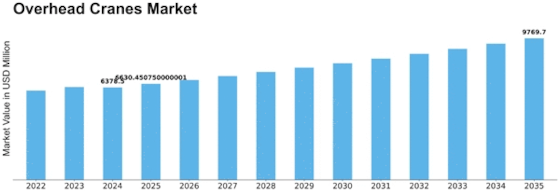
<p>In 2024, the Overhead Cranes Market was valued at 6378.5 USD Million.</p>

What is the expected CAGR for the Overhead Cranes Market during the forecast period 2025 - 2035?

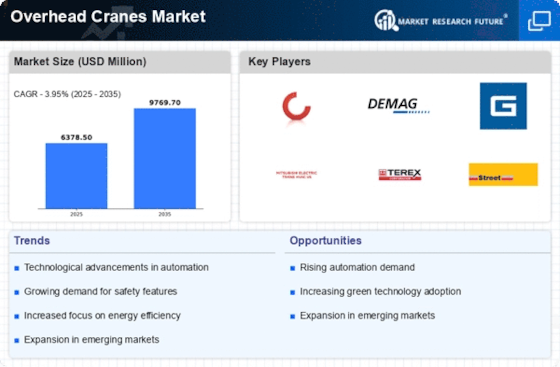
<p>The expected CAGR for the Overhead Cranes Market during the forecast period 2025 - 2035 is 3.95%.</p>

Which product type segment had the highest valuation in 2024?

<p>In 2024, the Double Girder Overhead Cranes segment had a valuation of 3828.5 USD Million.</p>

What is the projected valuation range for Single Girder Overhead Cranes by 2035?

<p>The projected valuation range for Single Girder Overhead Cranes by 2035 is between 2550.0 and 3850.0 USD Million.</p>

Which end-user segment is expected to show the highest growth in the Overhead Cranes Market?

<p>The 'Others' end-user segment, valued at 4158.5 USD Million in 2024, is expected to show substantial growth.</p>

Who are the key players in the Overhead Cranes Market?

Key players in the Overhead Cranes Market include Konecranes, Demag, Gorbel, and Mitsubishi Electric.

What was the valuation of the Utility segment in 2024?

The Utility segment was valued at 1200.0 USD Million in 2024.

How does the projected growth of the Overhead Cranes Market compare to its 2024 valuation?

The Overhead Cranes Market is expected to grow from 6378.5 USD Million in 2024 to 9769.7 USD Million by 2035.

What is the valuation range for the Aerospace end-user segment by 2035?

The valuation range for the Aerospace end-user segment by 2035 is projected to be between 800.0 and 1200.0 USD Million.

Market Summary

As per Market Research Future analysis, the Overhead Cranes Market Size was estimated at 5.46 USD Billion in 2024. The Overhead Cranes industry is projected to grow from USD 5.7 Billion in 2025 to USD 8.9 Billion by 2035, exhibiting a compound annual growth rate (CAGR) of 4.5% during the forecast period 2025 - 2035

Key Market Trends & Highlights

The Overhead Cranes Market is poised for growth driven by technological advancements and increasing demand across various sectors.

  • Technological advancements are enhancing the efficiency and safety of overhead cranes, particularly in North America. Sustainability initiatives are becoming increasingly important, influencing design and operational practices in the Asia-Pacific region. Customization and flexibility in crane solutions are gaining traction, especially in the automotive segment, which remains the largest market. The rising demand in the construction sector and increased automation in manufacturing are key drivers propelling market growth.

Market Size & Forecast

2024 Market Size 5.46 (USD Billion)
2035 Market Size 8.9 (USD Billion )
CAGR (2025 - 2035) 4.5%
Largest Regional Market Share in 2024 Europe

Major Players

Konecranes, Demag, Gorbel, Mitsubishi Electric, Weihua Group Co., Ltd., Street Crane Company, Cargotec , ABUS Kransysteme, Eisenmann, ABUS Kransysteme GmbH

Market Trends

The Overhead Cranes Market is currently experiencing a dynamic evolution, driven by advancements in technology and increasing demand across various sectors. Industries such as manufacturing, construction, and logistics are increasingly relying on these cranes for efficient material handling. The integration of automation and smart technologies appears to enhance operational efficiency, reduce labor costs, and improve safety standards. Furthermore, the growing emphasis on sustainability and energy efficiency is prompting manufacturers to innovate and develop eco-friendly crane solutions. This shift not only aligns with global environmental goals but also meets the expectations of modern consumers who prioritize sustainability in their purchasing decisions. In addition, the Overhead Cranes Market is witnessing a trend towards customization and flexibility. As businesses seek to optimize their operations, the demand for tailored solutions that cater to specific operational needs is on the rise. This trend suggests that manufacturers may need to adopt a more customer-centric approach, focusing on providing versatile products that can adapt to various applications. Overall, the market landscape is characterized by rapid technological advancements and a strong focus on sustainability, indicating a promising future for the Overhead Cranes Market.

Technological Advancements

The Overhead Cranes Market is increasingly influenced by technological innovations. Automation and smart technologies are being integrated into crane systems, enhancing efficiency and safety. These advancements allow for real-time monitoring and control, which can lead to improved operational performance.

Sustainability Initiatives

There is a growing emphasis on sustainability within the Overhead Cranes Market. Manufacturers are focusing on developing eco-friendly solutions that reduce energy consumption and minimize environmental impact. This trend aligns with global efforts to promote sustainable practices across industries.

Customization and Flexibility

The demand for customized solutions is rising in the Overhead Cranes Market. Businesses are seeking cranes that can be tailored to their specific operational requirements. This trend indicates a shift towards more flexible and adaptable products that can meet diverse industry needs.

Overhead Cranes Market Market Drivers

Focus on Safety and Compliance

Safety regulations and compliance standards are becoming more stringent across various industries, which is influencing the Overhead Cranes Market. Companies are increasingly prioritizing safety measures to protect their workforce and minimize liability. In 2025, it is anticipated that investments in safety equipment and training will exceed 50 billion dollars. Overhead cranes equipped with advanced safety features, such as load monitoring systems and emergency stop functions, are gaining traction as organizations strive to adhere to these regulations. This focus on safety not only enhances operational efficiency but also fosters a culture of safety within organizations. As a result, the Overhead Cranes Market is likely to see increased demand for cranes that meet or exceed safety standards.

Growth in E-commerce and Logistics

The rapid expansion of e-commerce and logistics sectors is driving demand for efficient material handling solutions, including overhead cranes. As online shopping continues to gain traction, warehouses and distribution centers are increasingly relying on advanced equipment to manage inventory and fulfill orders swiftly. The logistics market is projected to grow at a rate of 7.5% annually, indicating a robust demand for overhead cranes in these facilities. These cranes facilitate the quick and safe movement of goods, which is essential for meeting consumer expectations in the fast-paced e-commerce environment. This trend suggests that the Overhead Cranes Market will experience sustained growth as logistics providers seek to enhance their operational capabilities.

Rising Demand in Construction Sector

The construction sector is experiencing a notable surge in activity, which appears to be a primary driver for the Overhead Cranes Market. As infrastructure projects expand, the need for efficient material handling solutions becomes increasingly critical. In 2025, the construction industry is projected to grow at a compound annual growth rate of approximately 5.5%, leading to heightened demand for overhead cranes. These cranes facilitate the movement of heavy materials, thereby enhancing productivity on construction sites. Furthermore, the integration of advanced technologies in cranes is likely to improve operational efficiency, making them indispensable in modern construction practices. This trend suggests that the Overhead Cranes Market will continue to thrive as construction projects become more complex and demanding.

Increased Automation in Manufacturing

The manufacturing sector is progressively embracing automation, which significantly influences the Overhead Cranes Market. Automation enhances operational efficiency and reduces labor costs, prompting manufacturers to invest in advanced overhead crane systems. In 2025, it is estimated that the automation market will reach a valuation of over 200 billion dollars, with a substantial portion allocated to material handling equipment. Overhead cranes, equipped with smart technologies, are becoming essential for automating the movement of goods within manufacturing facilities. This shift towards automation not only streamlines processes but also minimizes the risk of workplace accidents, thereby promoting safety. Consequently, the Overhead Cranes Market is likely to benefit from this trend as manufacturers seek to optimize their operations.

Emerging Markets and Infrastructure Development

Emerging markets are witnessing significant infrastructure development, which is likely to propel the Overhead Cranes Market. Countries in Asia and Africa are investing heavily in transportation, energy, and urban development projects. In 2025, infrastructure spending in these regions is projected to reach over 1 trillion dollars, creating a substantial demand for overhead cranes. These cranes are essential for lifting and moving heavy materials in construction and manufacturing processes. As emerging economies continue to develop, the need for efficient material handling solutions will grow, suggesting that the Overhead Cranes Market will benefit from this trend. This development may also lead to increased competition among manufacturers to provide innovative and cost-effective crane solutions.

Market Segment Insights

By Product Type: Single Girder Overhead Cranes (Largest) vs. Double Girder Overhead Cranes (Fastest-Growing)

<p>In the Overhead Cranes Market, Single Girder Overhead Cranes hold a significant market share due to their cost-effectiveness and versatility in light to medium lifting applications. Their design allows for efficient space utilization, making them a preferred choice in various industries such as manufacturing and warehousing. Meanwhile, Double Girder Overhead Cranes, while currently smaller in the market share distribution, are gaining traction due to their superior lifting capabilities and stability, making them ideal for heavy-duty applications and increasingly adopted in sectors like construction and logistics.</p>

<p>Single Girder (Dominant) vs. Double Girder (Emerging)</p>

<p>Single Girder Overhead Cranes are recognized for their lightweight structure, which provides an economical lifting solution for various industrial applications. Their lower initial cost, combined with less maintenance and simpler operations, is driving their popularity among small to medium enterprises. Conversely, Double Girder Overhead Cranes represent the emerging choice in the market, known for their robustness and ability to handle larger loads with higher precision. This segment is experiencing rapid growth as industries demand more reliable and efficient systems for lifting heavy and bulky items. The evolving manufacturing processes and increasing automation are further propelling the adoption of Double Girder Overhead Cranes.</p>

By End User: Automotive (Largest) vs. Aerospace (Fastest-Growing)

The Overhead Cranes Market is witnessing a robust distribution of market share across various end-user segments. The automotive sector holds a significant portion, serving as a backbone for the crane industry due to the high volume of assembly lines and heavy lifting needs. Meanwhile, the aerospace sector is also gaining attention, showing promise as manufacturers look to optimize operations and enhance production flexibility, leading to increased demand for specialized cranes.

Automotive (Dominant) vs. Aerospace (Emerging)

The automotive segment is characterized by its extensive use of overhead cranes for assembly and manufacturing processes, providing essential support in automotive plants where efficiency and speed are crucial. This dominance is propelled by the industry’s heavy reliance on automation and the need for precise handling of heavy components. Conversely, the aerospace segment, while currently emerging, is rapidly evolving as companies prioritize innovative handling solutions to meet stringent regulations and high safety standards. This shift reflects a growing trend towards the integration of advanced technologies and improvements in operational efficiency within aerospace manufacturing.

Get more detailed insights about Overhead Cranes Market Research Report - Global Forecast till 2035

Regional Insights

North America : Industrial Growth Engine

North America is witnessing robust growth in the overhead cranes market, driven by increasing industrial automation and infrastructure development. The region holds approximately 40% of the global market share, with the United States being the largest contributor, followed by Canada at around 15%. Regulatory support for safety standards and modernization initiatives further catalyze market expansion. The competitive landscape is characterized by key players such as Konecranes, Terex Corporation, and Gorbel, which dominate the market with innovative solutions. The presence of advanced manufacturing facilities and a focus on technological advancements in the U.S. and Canada enhances the region's attractiveness for investments in overhead crane systems. Companies are increasingly adopting smart technologies to improve efficiency and safety in operations.

Europe : Innovation and Sustainability Focus

Europe is emerging as a significant player in the overhead cranes market, driven by stringent safety regulations and a strong emphasis on sustainability. The region accounts for approximately 30% of the global market share, with Germany and the UK leading the charge, holding around 12% and 8% respectively. Regulatory frameworks promoting energy efficiency and reduced emissions are key growth catalysts. Leading countries in Europe are investing heavily in modernizing their industrial infrastructure, with key players like Demag and ABUS Kransysteme at the forefront. The competitive landscape is marked by innovation, with companies focusing on smart crane technologies and automation solutions. The European market is characterized by a high demand for customized solutions that meet specific industry needs, enhancing operational efficiency and safety.

Asia-Pacific : Rapid Industrialization Hub

The Asia-Pacific region is experiencing rapid growth in the overhead cranes market, fueled by industrialization and urbanization. This region holds approximately 25% of the global market share, with China being the largest market, contributing around 18%, followed by Japan at about 5%. Government initiatives to boost manufacturing and infrastructure development are significant drivers of this growth. China's aggressive investments in infrastructure and manufacturing sectors have attracted major players like Mitsubishi Electric and Konecranes to expand their operations. The competitive landscape is evolving, with local manufacturers emerging alongside established global brands. The demand for advanced and automated crane systems is on the rise, as industries seek to enhance productivity and safety in their operations.

Middle East and Africa : Emerging Market Potential

The Middle East and Africa region is gradually emerging as a potential market for overhead cranes, driven by infrastructure projects and industrial growth. This region holds about 5% of the global market share, with the UAE and South Africa being the leading countries, contributing approximately 2% and 1.5% respectively. Government investments in construction and energy sectors are pivotal in driving demand for overhead cranes. The competitive landscape is characterized by a mix of local and international players, with companies like Terex Corporation and Cargotec establishing a presence. The region's focus on diversifying its economy and enhancing industrial capabilities is expected to boost the demand for overhead cranes. As infrastructure projects continue to expand, the market is poised for significant growth in the coming years.

Key Players and Competitive Insights

The Overhead Cranes Market is currently characterized by a dynamic competitive landscape, driven by technological advancements and increasing demand across various sectors such as manufacturing, construction, and logistics. Key players like Konecranes (FI), Demag (DE), and Terex Corporation (US) are strategically positioning themselves through innovation and regional expansion. Konecranes, for instance, emphasizes digital transformation, integrating IoT solutions into their products to enhance operational efficiency. Meanwhile, Demag focuses on expanding its footprint in emerging markets, leveraging its strong brand reputation to capture new opportunities. These strategies collectively shape a competitive environment that is increasingly focused on technological differentiation and customer-centric solutions.In terms of business tactics, companies are localizing manufacturing to reduce lead times and optimize supply chains, which is particularly crucial in the current global economic climate. The market appears moderately fragmented, with several players vying for market share, yet the influence of major companies remains substantial. This competitive structure allows for a diverse range of offerings, catering to various customer needs while fostering innovation through competition.
In August Konecranes (FI) announced the launch of its new cloud-based crane management system, which aims to enhance predictive maintenance capabilities for users. This strategic move is significant as it not only positions Konecranes at the forefront of digital innovation but also addresses the growing demand for smart solutions in the overhead crane sector. By leveraging data analytics, the company enhances operational efficiency and reduces downtime for its clients, thereby solidifying its competitive edge.
In September Terex Corporation (US) revealed its plans to invest in a new manufacturing facility in Southeast Asia, aimed at increasing production capacity and meeting the rising demand in the region. This expansion is crucial as it allows Terex to localize its operations, thereby reducing shipping costs and improving delivery times. Such a strategic investment reflects the company's commitment to enhancing its market presence and responsiveness to regional demands, which is likely to yield long-term benefits.
In July Demag (DE) entered into a strategic partnership with a leading automation technology firm to develop advanced automation solutions for overhead cranes. This collaboration is indicative of the growing trend towards automation in the industry, as it enables Demag to offer more sophisticated and efficient solutions to its customers. By integrating automation technologies, the company not only enhances its product offerings but also positions itself as a leader in the evolving landscape of overhead crane solutions.
As of October the competitive trends in the Overhead Cranes Market are increasingly defined by digitalization, sustainability, and the integration of artificial intelligence. Strategic alliances are becoming more prevalent, as companies recognize the need to collaborate to enhance their technological capabilities. Looking ahead, it is likely that competitive differentiation will evolve from traditional price-based competition to a focus on innovation, technology integration, and supply chain reliability. This shift underscores the importance of adaptability and forward-thinking strategies in maintaining a competitive advantage in the market.

Key Companies in the Overhead Cranes Market include

Industry Developments

  • Q2 2024: Konecranes wins major contract to supply overhead cranes for new battery gigafactory in Germany Konecranes announced it secured a significant contract to deliver multiple overhead cranes to a new battery manufacturing facility in Germany, supporting the country's push for electric vehicle production.
  • Q2 2024: Weihua Group opens new smart crane manufacturing facility in Henan, China Weihua Group inaugurated a state-of-the-art manufacturing plant dedicated to smart overhead cranes, aiming to boost production capacity and meet rising global demand for automated material handling solutions.
  • Q3 2024: Demag launches new generation of energy-efficient overhead cranes with advanced IoT integration Demag introduced a new product line of overhead cranes featuring improved energy efficiency and integrated IoT systems for real-time monitoring and predictive maintenance.
  • Q1 2024: Konecranes appoints new CEO, Anders Svensson, to lead next phase of growth Konecranes announced the appointment of Anders Svensson as its new Chief Executive Officer, effective March 2024, to drive innovation and global expansion in the overhead cranes sector.
  • Q2 2024: Cargotec and Konecranes terminate planned merger after regulatory hurdles Cargotec and Konecranes officially called off their proposed merger following regulatory challenges in the EU, impacting consolidation plans in the global cranes and material handling market.
  • Q2 2025: Weihua Group secures contract to supply overhead cranes for major port expansion in Southeast Asia Weihua Group announced a contract win to deliver a fleet of heavy-duty overhead cranes for a large-scale port infrastructure project in Southeast Asia, supporting regional trade growth.
  • Q1 2025: Konecranes unveils AI-powered overhead crane safety system at Hannover Messe 2025 Konecranes launched a new AI-driven safety system for overhead cranes, designed to reduce workplace accidents and improve operational efficiency, showcased at the Hannover Messe industrial fair.
  • Q3 2024: Terex Corporation acquires Italian crane manufacturer for $120 million Terex Corporation completed the acquisition of an Italian overhead crane manufacturer, expanding its European footprint and product portfolio in the industrial lifting sector.
  • Q2 2024: Kito Corporation announces partnership with Siemens for smart crane automation Kito Corporation entered a strategic partnership with Siemens to co-develop smart automation solutions for overhead cranes, integrating advanced controls and digitalization technologies.
  • Q1 2025: Demag secures multi-million euro contract for overhead cranes in French automotive plant Demag announced it won a contract to supply overhead cranes for a new automotive manufacturing facility in France, supporting increased production capacity for electric vehicles.
  • Q2 2025: Konecranes invests €50 million in new R&D center for overhead crane technology in Finland Konecranes revealed plans to invest €50 million in a new research and development center focused on next-generation overhead crane technologies, including automation and sustainability.
  • Q3 2024: Street Crane Company wins contract to supply overhead cranes for UK logistics hub Street Crane Company secured a contract to deliver overhead cranes for a major new logistics hub in the United Kingdom, supporting the country's growing e-commerce and distribution sector.

Future Outlook

Overhead Cranes Market Future Outlook

The Overhead Cranes Market is projected to grow at a 4.5% CAGR from 2025 to 2035, driven by industrial automation, infrastructure development, and increased demand for material handling solutions.

New opportunities lie in:

  • <p>Integration of IoT for predictive maintenance solutions.</p>
  • <p> </p>
  • <p>Development of lightweight, high-capacity crane systems.</p>
  • <p>Expansion into emerging markets with tailored product offerings.</p>

By 2035, the market is expected to achieve robust growth, reflecting evolving industrial needs.

Market Segmentation

Overhead Cranes Market End User Outlook

  • Automotive
  • Paper
  • Utility
  • Aerospace
  • Others

Overhead Cranes Market Product Type Outlook

  • Single Girder Overhead Cranes
  • Double Girder Overhead Cranes

Report Scope

MARKET SIZE 2024 5.46 (USD Billion)
MARKET SIZE 2025 5.7 (USD Billion)
MARKET SIZE 2035 8.9 (USD Billion)
COMPOUND ANNUAL GROWTH RATE (CAGR) 4.5% (2025 - 2035)
REPORT COVERAGE Revenue Forecast, Competitive Landscape, Growth Factors, and Trends
BASE YEAR 2024
Market Forecast Period 2025 - 2035
Historical Data 2019 - 2024
Market Forecast Units USD Million
Key Companies Profiled Konecranes, Demag, Gorbel, Mitsubishi Electric, Weihua Group Co., Ltd., Street Crane Company, Cargotec , ABUS Kransysteme, Eisenmann, ABUS Kransysteme GmbH
Segments Covered Product, End-User, Region
Key Market Opportunities Integration of smart technologies enhances efficiency and safety in the Overhead Cranes Market.
Key Market Dynamics Technological advancements and regulatory changes drive innovation and efficiency in the overhead cranes market.
Countries Covered North America, Europe, APAC, South America, MEA

FAQs

What is the projected market valuation of the Overhead Cranes Market by 2035?

<p>The Overhead Cranes Market is projected to reach a valuation of 9769.7 USD Million by 2035.</p>

What was the market valuation of the Overhead Cranes Market in 2024?

<p>In 2024, the Overhead Cranes Market was valued at 6378.5 USD Million.</p>

What is the expected CAGR for the Overhead Cranes Market during the forecast period 2025 - 2035?

<p>The expected CAGR for the Overhead Cranes Market during the forecast period 2025 - 2035 is 3.95%.</p>

Which product type segment had the highest valuation in 2024?

<p>In 2024, the Double Girder Overhead Cranes segment had a valuation of 3828.5 USD Million.</p>

What is the projected valuation range for Single Girder Overhead Cranes by 2035?

<p>The projected valuation range for Single Girder Overhead Cranes by 2035 is between 2550.0 and 3850.0 USD Million.</p>

Which end-user segment is expected to show the highest growth in the Overhead Cranes Market?

<p>The 'Others' end-user segment, valued at 4158.5 USD Million in 2024, is expected to show substantial growth.</p>

Who are the key players in the Overhead Cranes Market?

Key players in the Overhead Cranes Market include Konecranes, Demag, Gorbel, and Mitsubishi Electric.

What was the valuation of the Utility segment in 2024?

The Utility segment was valued at 1200.0 USD Million in 2024.

How does the projected growth of the Overhead Cranes Market compare to its 2024 valuation?

The Overhead Cranes Market is expected to grow from 6378.5 USD Million in 2024 to 9769.7 USD Million by 2035.

What is the valuation range for the Aerospace end-user segment by 2035?

The valuation range for the Aerospace end-user segment by 2035 is projected to be between 800.0 and 1200.0 USD Million.

  1. SECTION I: EXECUTIVE SUMMARY AND KEY HIGHLIGHTS
    1. | 1.1 EXECUTIVE SUMMARY
    2. | | 1.1.1 Market Overview
    3. | | 1.1.2 Key Findings
    4. | | 1.1.3 Market Segmentation
    5. | | 1.1.4 Competitive Landscape
    6. | | 1.1.5 Challenges and Opportunities
    7. | | 1.1.6 Future Outlook
  2. SECTION II: SCOPING, METHODOLOGY AND MARKET STRUCTURE
    1. | 2.1 MARKET INTRODUCTION
    2. | | 2.1.1 Definition
    3. | | 2.1.2 Scope of the study
    4. | | | 2.1.2.1 Research Objective
    5. | | | 2.1.2.2 Assumption
    6. | | | 2.1.2.3 Limitations
    7. | 2.2 RESEARCH METHODOLOGY
    8. | | 2.2.1 Overview
    9. | | 2.2.2 Data Mining
    10. | | 2.2.3 Secondary Research
    11. | | 2.2.4 Primary Research
    12. | | | 2.2.4.1 Primary Interviews and Information Gathering Process
    13. | | | 2.2.4.2 Breakdown of Primary Respondents
    14. | | 2.2.5 Forecasting Model
    15. | | 2.2.6 Market Size Estimation
    16. | | | 2.2.6.1 Bottom-Up Approach
    17. | | | 2.2.6.2 Top-Down Approach
    18. | | 2.2.7 Data Triangulation
    19. | | 2.2.8 Validation
  3. SECTION III: QUALITATIVE ANALYSIS
    1. | 3.1 MARKET DYNAMICS
    2. | | 3.1.1 Overview
    3. | | 3.1.2 Drivers
    4. | | 3.1.3 Restraints
    5. | | 3.1.4 Opportunities
    6. | 3.2 MARKET FACTOR ANALYSIS
    7. | | 3.2.1 Value chain Analysis
    8. | | 3.2.2 Porter's Five Forces Analysis
    9. | | | 3.2.2.1 Bargaining Power of Suppliers
    10. | | | 3.2.2.2 Bargaining Power of Buyers
    11. | | | 3.2.2.3 Threat of New Entrants
    12. | | | 3.2.2.4 Threat of Substitutes
    13. | | | 3.2.2.5 Intensity of Rivalry
    14. | | 3.2.3 COVID-19 Impact Analysis
    15. | | | 3.2.3.1 Market Impact Analysis
    16. | | | 3.2.3.2 Regional Impact
    17. | | | 3.2.3.3 Opportunity and Threat Analysis
  4. SECTION IV: QUANTITATIVE ANALYSIS
    1. | 4.1 Packaging & Transport, BY Product Type (USD Million)
    2. | | 4.1.1 Single Girder Overhead Cranes
    3. | | 4.1.2 Double Girder Overhead Cranes
    4. | 4.2 Packaging & Transport, BY End User (USD Million)
    5. | | 4.2.1 Automotive
    6. | | 4.2.2 Paper
    7. | | 4.2.3 Utility
    8. | | 4.2.4 Aerospace
    9. | | 4.2.5 Others
    10. | 4.3 Packaging & Transport, BY Region (USD Million)
    11. | | 4.3.1 North America
    12. | | | 4.3.1.1 US
    13. | | | 4.3.1.2 Canada
    14. | | 4.3.2 Europe
    15. | | | 4.3.2.1 Germany
    16. | | | 4.3.2.2 UK
    17. | | | 4.3.2.3 France
    18. | | | 4.3.2.4 Russia
    19. | | | 4.3.2.5 Italy
    20. | | | 4.3.2.6 Spain
    21. | | | 4.3.2.7 Rest of Europe
    22. | | 4.3.3 APAC
    23. | | | 4.3.3.1 China
    24. | | | 4.3.3.2 India
    25. | | | 4.3.3.3 Japan
    26. | | | 4.3.3.4 South Korea
    27. | | | 4.3.3.5 Malaysia
    28. | | | 4.3.3.6 Thailand
    29. | | | 4.3.3.7 Indonesia
    30. | | | 4.3.3.8 Rest of APAC
    31. | | 4.3.4 South America
    32. | | | 4.3.4.1 Brazil
    33. | | | 4.3.4.2 Mexico
    34. | | | 4.3.4.3 Argentina
    35. | | | 4.3.4.4 Rest of South America
    36. | | 4.3.5 MEA
    37. | | | 4.3.5.1 GCC Countries
    38. | | | 4.3.5.2 South Africa
    39. | | | 4.3.5.3 Rest of MEA
  5. SECTION V: COMPETITIVE ANALYSIS
    1. | 5.1 Competitive Landscape
    2. | | 5.1.1 Overview
    3. | | 5.1.2 Competitive Analysis
    4. | | 5.1.3 Market share Analysis
    5. | | 5.1.4 Major Growth Strategy in the Packaging & Transport
    6. | | 5.1.5 Competitive Benchmarking
    7. | | 5.1.6 Leading Players in Terms of Number of Developments in the Packaging & Transport
    8. | | 5.1.7 Key developments and growth strategies
    9. | | | 5.1.7.1 New Product Launch/Service Deployment
    10. | | | 5.1.7.2 Merger & Acquisitions
    11. | | | 5.1.7.3 Joint Ventures
    12. | | 5.1.8 Major Players Financial Matrix
    13. | | | 5.1.8.1 Sales and Operating Income
    14. | | | 5.1.8.2 Major Players R&D Expenditure. 2023
    15. | 5.2 Company Profiles
    16. | | 5.2.1 Konecranes (FI)
    17. | | | 5.2.1.1 Financial Overview
    18. | | | 5.2.1.2 Products Offered
    19. | | | 5.2.1.3 Key Developments
    20. | | | 5.2.1.4 SWOT Analysis
    21. | | | 5.2.1.5 Key Strategies
    22. | | 5.2.2 Demag (DE)
    23. | | | 5.2.2.1 Financial Overview
    24. | | | 5.2.2.2 Products Offered
    25. | | | 5.2.2.3 Key Developments
    26. | | | 5.2.2.4 SWOT Analysis
    27. | | | 5.2.2.5 Key Strategies
    28. | | 5.2.3 Gorbel (US)
    29. | | | 5.2.3.1 Financial Overview
    30. | | | 5.2.3.2 Products Offered
    31. | | | 5.2.3.3 Key Developments
    32. | | | 5.2.3.4 SWOT Analysis
    33. | | | 5.2.3.5 Key Strategies
    34. | | 5.2.4 Mitsubishi Electric (JP)
    35. | | | 5.2.4.1 Financial Overview
    36. | | | 5.2.4.2 Products Offered
    37. | | | 5.2.4.3 Key Developments
    38. | | | 5.2.4.4 SWOT Analysis
    39. | | | 5.2.4.5 Key Strategies
    40. | | 5.2.5 Terex Corporation (US)
    41. | | | 5.2.5.1 Financial Overview
    42. | | | 5.2.5.2 Products Offered
    43. | | | 5.2.5.3 Key Developments
    44. | | | 5.2.5.4 SWOT Analysis
    45. | | | 5.2.5.5 Key Strategies
    46. | | 5.2.6 Street Crane Company (GB)
    47. | | | 5.2.6.1 Financial Overview
    48. | | | 5.2.6.2 Products Offered
    49. | | | 5.2.6.3 Key Developments
    50. | | | 5.2.6.4 SWOT Analysis
    51. | | | 5.2.6.5 Key Strategies
    52. | | 5.2.7 Cargotec (FI)
    53. | | | 5.2.7.1 Financial Overview
    54. | | | 5.2.7.2 Products Offered
    55. | | | 5.2.7.3 Key Developments
    56. | | | 5.2.7.4 SWOT Analysis
    57. | | | 5.2.7.5 Key Strategies
    58. | | 5.2.8 ABUS Kransysteme (DE)
    59. | | | 5.2.8.1 Financial Overview
    60. | | | 5.2.8.2 Products Offered
    61. | | | 5.2.8.3 Key Developments
    62. | | | 5.2.8.4 SWOT Analysis
    63. | | | 5.2.8.5 Key Strategies
    64. | | 5.2.9 Eisenmann (DE)
    65. | | | 5.2.9.1 Financial Overview
    66. | | | 5.2.9.2 Products Offered
    67. | | | 5.2.9.3 Key Developments
    68. | | | 5.2.9.4 SWOT Analysis
    69. | | | 5.2.9.5 Key Strategies
    70. | 5.3 Appendix
    71. | | 5.3.1 References
    72. | | 5.3.2 Related Reports
  6. LIST OF FIGURES
    1. | 6.1 MARKET SYNOPSIS
    2. | 6.2 NORTH AMERICA MARKET ANALYSIS
    3. | 6.3 US MARKET ANALYSIS BY PRODUCT TYPE
    4. | 6.4 US MARKET ANALYSIS BY END USER
    5. | 6.5 CANADA MARKET ANALYSIS BY PRODUCT TYPE
    6. | 6.6 CANADA MARKET ANALYSIS BY END USER
    7. | 6.7 EUROPE MARKET ANALYSIS
    8. | 6.8 GERMANY MARKET ANALYSIS BY PRODUCT TYPE
    9. | 6.9 GERMANY MARKET ANALYSIS BY END USER
    10. | 6.10 UK MARKET ANALYSIS BY PRODUCT TYPE
    11. | 6.11 UK MARKET ANALYSIS BY END USER
    12. | 6.12 FRANCE MARKET ANALYSIS BY PRODUCT TYPE
    13. | 6.13 FRANCE MARKET ANALYSIS BY END USER
    14. | 6.14 RUSSIA MARKET ANALYSIS BY PRODUCT TYPE
    15. | 6.15 RUSSIA MARKET ANALYSIS BY END USER
    16. | 6.16 ITALY MARKET ANALYSIS BY PRODUCT TYPE
    17. | 6.17 ITALY MARKET ANALYSIS BY END USER
    18. | 6.18 SPAIN MARKET ANALYSIS BY PRODUCT TYPE
    19. | 6.19 SPAIN MARKET ANALYSIS BY END USER
    20. | 6.20 REST OF EUROPE MARKET ANALYSIS BY PRODUCT TYPE
    21. | 6.21 REST OF EUROPE MARKET ANALYSIS BY END USER
    22. | 6.22 APAC MARKET ANALYSIS
    23. | 6.23 CHINA MARKET ANALYSIS BY PRODUCT TYPE
    24. | 6.24 CHINA MARKET ANALYSIS BY END USER
    25. | 6.25 INDIA MARKET ANALYSIS BY PRODUCT TYPE
    26. | 6.26 INDIA MARKET ANALYSIS BY END USER
    27. | 6.27 JAPAN MARKET ANALYSIS BY PRODUCT TYPE
    28. | 6.28 JAPAN MARKET ANALYSIS BY END USER
    29. | 6.29 SOUTH KOREA MARKET ANALYSIS BY PRODUCT TYPE
    30. | 6.30 SOUTH KOREA MARKET ANALYSIS BY END USER
    31. | 6.31 MALAYSIA MARKET ANALYSIS BY PRODUCT TYPE
    32. | 6.32 MALAYSIA MARKET ANALYSIS BY END USER
    33. | 6.33 THAILAND MARKET ANALYSIS BY PRODUCT TYPE
    34. | 6.34 THAILAND MARKET ANALYSIS BY END USER
    35. | 6.35 INDONESIA MARKET ANALYSIS BY PRODUCT TYPE
    36. | 6.36 INDONESIA MARKET ANALYSIS BY END USER
    37. | 6.37 REST OF APAC MARKET ANALYSIS BY PRODUCT TYPE
    38. | 6.38 REST OF APAC MARKET ANALYSIS BY END USER
    39. | 6.39 SOUTH AMERICA MARKET ANALYSIS
    40. | 6.40 BRAZIL MARKET ANALYSIS BY PRODUCT TYPE
    41. | 6.41 BRAZIL MARKET ANALYSIS BY END USER
    42. | 6.42 MEXICO MARKET ANALYSIS BY PRODUCT TYPE
    43. | 6.43 MEXICO MARKET ANALYSIS BY END USER
    44. | 6.44 ARGENTINA MARKET ANALYSIS BY PRODUCT TYPE
    45. | 6.45 ARGENTINA MARKET ANALYSIS BY END USER
    46. | 6.46 REST OF SOUTH AMERICA MARKET ANALYSIS BY PRODUCT TYPE
    47. | 6.47 REST OF SOUTH AMERICA MARKET ANALYSIS BY END USER
    48. | 6.48 MEA MARKET ANALYSIS
    49. | 6.49 GCC COUNTRIES MARKET ANALYSIS BY PRODUCT TYPE
    50. | 6.50 GCC COUNTRIES MARKET ANALYSIS BY END USER
    51. | 6.51 SOUTH AFRICA MARKET ANALYSIS BY PRODUCT TYPE
    52. | 6.52 SOUTH AFRICA MARKET ANALYSIS BY END USER
    53. | 6.53 REST OF MEA MARKET ANALYSIS BY PRODUCT TYPE
    54. | 6.54 REST OF MEA MARKET ANALYSIS BY END USER
    55. | 6.55 KEY BUYING CRITERIA OF PACKAGING & TRANSPORT
    56. | 6.56 RESEARCH PROCESS OF MRFR
    57. | 6.57 DRO ANALYSIS OF PACKAGING & TRANSPORT
    58. | 6.58 DRIVERS IMPACT ANALYSIS: PACKAGING & TRANSPORT
    59. | 6.59 RESTRAINTS IMPACT ANALYSIS: PACKAGING & TRANSPORT
    60. | 6.60 SUPPLY / VALUE CHAIN: PACKAGING & TRANSPORT
    61. | 6.61 PACKAGING & TRANSPORT, BY PRODUCT TYPE, 2024 (% SHARE)
    62. | 6.62 PACKAGING & TRANSPORT, BY PRODUCT TYPE, 2024 TO 2035 (USD Million)
    63. | 6.63 PACKAGING & TRANSPORT, BY END USER, 2024 (% SHARE)
    64. | 6.64 PACKAGING & TRANSPORT, BY END USER, 2024 TO 2035 (USD Million)
    65. | 6.65 BENCHMARKING OF MAJOR COMPETITORS
  7. LIST OF TABLES
    1. | 7.1 LIST OF ASSUMPTIONS
    2. | | 7.1.1
    3. | 7.2 North America MARKET SIZE ESTIMATES; FORECAST
    4. | | 7.2.1 BY PRODUCT TYPE, 2025-2035 (USD Million)
    5. | | 7.2.2 BY END USER, 2025-2035 (USD Million)
    6. | 7.3 US MARKET SIZE ESTIMATES; FORECAST
    7. | | 7.3.1 BY PRODUCT TYPE, 2025-2035 (USD Million)
    8. | | 7.3.2 BY END USER, 2025-2035 (USD Million)
    9. | 7.4 Canada MARKET SIZE ESTIMATES; FORECAST
    10. | | 7.4.1 BY PRODUCT TYPE, 2025-2035 (USD Million)
    11. | | 7.4.2 BY END USER, 2025-2035 (USD Million)
    12. | 7.5 Europe MARKET SIZE ESTIMATES; FORECAST
    13. | | 7.5.1 BY PRODUCT TYPE, 2025-2035 (USD Million)
    14. | | 7.5.2 BY END USER, 2025-2035 (USD Million)
    15. | 7.6 Germany MARKET SIZE ESTIMATES; FORECAST
    16. | | 7.6.1 BY PRODUCT TYPE, 2025-2035 (USD Million)
    17. | | 7.6.2 BY END USER, 2025-2035 (USD Million)
    18. | 7.7 UK MARKET SIZE ESTIMATES; FORECAST
    19. | | 7.7.1 BY PRODUCT TYPE, 2025-2035 (USD Million)
    20. | | 7.7.2 BY END USER, 2025-2035 (USD Million)
    21. | 7.8 France MARKET SIZE ESTIMATES; FORECAST
    22. | | 7.8.1 BY PRODUCT TYPE, 2025-2035 (USD Million)
    23. | | 7.8.2 BY END USER, 2025-2035 (USD Million)
    24. | 7.9 Russia MARKET SIZE ESTIMATES; FORECAST
    25. | | 7.9.1 BY PRODUCT TYPE, 2025-2035 (USD Million)
    26. | | 7.9.2 BY END USER, 2025-2035 (USD Million)
    27. | 7.10 Italy MARKET SIZE ESTIMATES; FORECAST
    28. | | 7.10.1 BY PRODUCT TYPE, 2025-2035 (USD Million)
    29. | | 7.10.2 BY END USER, 2025-2035 (USD Million)
    30. | 7.11 Spain MARKET SIZE ESTIMATES; FORECAST
    31. | | 7.11.1 BY PRODUCT TYPE, 2025-2035 (USD Million)
    32. | | 7.11.2 BY END USER, 2025-2035 (USD Million)
    33. | 7.12 Rest of Europe MARKET SIZE ESTIMATES; FORECAST
    34. | | 7.12.1 BY PRODUCT TYPE, 2025-2035 (USD Million)
    35. | | 7.12.2 BY END USER, 2025-2035 (USD Million)
    36. | 7.13 APAC MARKET SIZE ESTIMATES; FORECAST
    37. | | 7.13.1 BY PRODUCT TYPE, 2025-2035 (USD Million)
    38. | | 7.13.2 BY END USER, 2025-2035 (USD Million)
    39. | 7.14 China MARKET SIZE ESTIMATES; FORECAST
    40. | | 7.14.1 BY PRODUCT TYPE, 2025-2035 (USD Million)
    41. | | 7.14.2 BY END USER, 2025-2035 (USD Million)
    42. | 7.15 India MARKET SIZE ESTIMATES; FORECAST
    43. | | 7.15.1 BY PRODUCT TYPE, 2025-2035 (USD Million)
    44. | | 7.15.2 BY END USER, 2025-2035 (USD Million)
    45. | 7.16 Japan MARKET SIZE ESTIMATES; FORECAST
    46. | | 7.16.1 BY PRODUCT TYPE, 2025-2035 (USD Million)
    47. | | 7.16.2 BY END USER, 2025-2035 (USD Million)
    48. | 7.17 South Korea MARKET SIZE ESTIMATES; FORECAST
    49. | | 7.17.1 BY PRODUCT TYPE, 2025-2035 (USD Million)
    50. | | 7.17.2 BY END USER, 2025-2035 (USD Million)
    51. | 7.18 Malaysia MARKET SIZE ESTIMATES; FORECAST
    52. | | 7.18.1 BY PRODUCT TYPE, 2025-2035 (USD Million)
    53. | | 7.18.2 BY END USER, 2025-2035 (USD Million)
    54. | 7.19 Thailand MARKET SIZE ESTIMATES; FORECAST
    55. | | 7.19.1 BY PRODUCT TYPE, 2025-2035 (USD Million)
    56. | | 7.19.2 BY END USER, 2025-2035 (USD Million)
    57. | 7.20 Indonesia MARKET SIZE ESTIMATES; FORECAST
    58. | | 7.20.1 BY PRODUCT TYPE, 2025-2035 (USD Million)
    59. | | 7.20.2 BY END USER, 2025-2035 (USD Million)
    60. | 7.21 Rest of APAC MARKET SIZE ESTIMATES; FORECAST
    61. | | 7.21.1 BY PRODUCT TYPE, 2025-2035 (USD Million)
    62. | | 7.21.2 BY END USER, 2025-2035 (USD Million)
    63. | 7.22 South America MARKET SIZE ESTIMATES; FORECAST
    64. | | 7.22.1 BY PRODUCT TYPE, 2025-2035 (USD Million)
    65. | | 7.22.2 BY END USER, 2025-2035 (USD Million)
    66. | 7.23 Brazil MARKET SIZE ESTIMATES; FORECAST
    67. | | 7.23.1 BY PRODUCT TYPE, 2025-2035 (USD Million)
    68. | | 7.23.2 BY END USER, 2025-2035 (USD Million)
    69. | 7.24 Mexico MARKET SIZE ESTIMATES; FORECAST
    70. | | 7.24.1 BY PRODUCT TYPE, 2025-2035 (USD Million)
    71. | | 7.24.2 BY END USER, 2025-2035 (USD Million)
    72. | 7.25 Argentina MARKET SIZE ESTIMATES; FORECAST
    73. | | 7.25.1 BY PRODUCT TYPE, 2025-2035 (USD Million)
    74. | | 7.25.2 BY END USER, 2025-2035 (USD Million)
    75. | 7.26 Rest of South America MARKET SIZE ESTIMATES; FORECAST
    76. | | 7.26.1 BY PRODUCT TYPE, 2025-2035 (USD Million)
    77. | | 7.26.2 BY END USER, 2025-2035 (USD Million)
    78. | 7.27 MEA MARKET SIZE ESTIMATES; FORECAST
    79. | | 7.27.1 BY PRODUCT TYPE, 2025-2035 (USD Million)
    80. | | 7.27.2 BY END USER, 2025-2035 (USD Million)
    81. | 7.28 GCC Countries MARKET SIZE ESTIMATES; FORECAST
    82. | | 7.28.1 BY PRODUCT TYPE, 2025-2035 (USD Million)
    83. | | 7.28.2 BY END USER, 2025-2035 (USD Million)
    84. | 7.29 South Africa MARKET SIZE ESTIMATES; FORECAST
    85. | | 7.29.1 BY PRODUCT TYPE, 2025-2035 (USD Million)
    86. | | 7.29.2 BY END USER, 2025-2035 (USD Million)
    87. | 7.30 Rest of MEA MARKET SIZE ESTIMATES; FORECAST
    88. | | 7.30.1 BY PRODUCT TYPE, 2025-2035 (USD Million)
    89. | | 7.30.2 BY END USER, 2025-2035 (USD Million)
    90. | 7.31 PRODUCT LAUNCH/PRODUCT DEVELOPMENT/APPROVAL
    91. | | 7.31.1
    92. | 7.32 ACQUISITION/PARTNERSHIP
    93. | | 7.32.1

Packaging & Transport Market Segmentation

Packaging & Transport By Product Type (USD Million, 2025-2035)

  • Single Girder Overhead Cranes
  • Double Girder Overhead Cranes

Packaging & Transport By End User (USD Million, 2025-2035)

  • Automotive
  • Paper
  • Utility
  • Aerospace
  • Others
Infographic

Free Sample Request

Kindly complete the form below to receive a free sample of this Report

Get Free Sample

Customer Strories

Compare Licence

×
Features License Type
Single User Multiuser License Enterprise User
Price $4,950 $5,950 $7,250
Maximum User Access Limit 1 User Upto 10 Users Unrestricted Access Throughout the Organization
Free Customization
Direct Access to Analyst
Deliverable Format
Platform Access
Discount on Next Purchase 10% 15% 15%
Printable Versions