Request Free Sample ×

Kindly complete the form below to receive a free sample of this Report

* Please use a valid business email

Leading companies partner with us for data-driven Insights

clients tt-cursor
Hero Background
English
Chinese
French
Japanese
Korean
German
Spanish

Osteoporosis Drugs Market Trends

ID: MRFR/Pharma/1841-HCR
200 Pages
Satyendra Maurya
April 2026

Osteoporosis Drugs Market Research Report: Size, Share, Trend Analysis By Drug Class (Bisphosphonates, Hormonal Therapy, Monoclonal Antibodies, Calcium and Vitamin D Supplements, Selective Estrogen Receptor Modulators), By Route of Administration (Oral, Intravenous, Subcutaneous, Transdermal), By Distribution Channel (Hospital Pharmacy, Retail Pharmacy, Online Pharmacy), By Patient Population (Postmenopausal Women, Men, Elderly Population) and By Regional (North America, Europe, South America, Asia Pacific, Middle East and Africa) - Growth Outlook & Industry Forecast Till 2035

Share:
Download PDF ×

We do not share your information with anyone. However, we may send you emails based on your report interest from time to time. You may contact us at any time to opt-out.

Osteoporosis Drugs Market Infographic
Purchase Options

Market Trends

Key Emerging Trends in the Osteoporosis Drugs Market

Growing older populations around the world have a big impact on the market for osteoporosis drugs. In the same age group, more and more people are getting osteoporosis. It's even more important to have medicines that can treat and stop bone loss because of this.

Using more than one treatment to help people with osteoporosis is getting a lot of attention. Some drugs, like anabolic agents and drugs that stop or slow down bone loss, work better when mixed. This keeps bones from breaking and makes them stronger.

Anabolic drug treatments for osteoporosis are becoming more popular. Parathyroid hormone analogs are one type of steroid drug that can help bones get bigger. They are becoming an important part of treating serious osteoporosis and provide options to standard treatments that break down bones.

Long-acting versions are becoming more popular in the research and creation of osteoporosis drugs. Drugs that come in extended-release forms or with longer dosing times help patients stick to their treatment plans, require less frequent administration, and lead to better treatment results.

Adding digital health options to the market is changing how it works. Involvement, monitoring, and taking medicines as directed are easier for patients with osteoporosis thanks to mobile apps, smart technology, and video platforms. This improves their overall care.

More programs are making people more aware of osteoporosis, which is growing the world market for drugs that treat it. Educating healthcare workers and the public about osteoporosis risk factors, ways to avoid getting it, and medicines that are available all help the market grow in a variety of areas.

Alternatives to oral bisphosphonates are getting interest. Intravenous versions and improved oral drugs offer choices for patients who may face issues with the long-term use of standard oral bisphosphonates.

Medication delivery in osteoporosis is moving towards patient-centric methods. Efforts to increase the comfort of drug administration, such as easy-to-use syringe devices and user-friendly formulas, add to better patient retention.

Biomarkers for bone health are getting more and more attention in research. Identifying and tracking biomarkers associated with bone turnover and fracture risk helps in tailored treatment plans, allowing healthcare workers to tailor measures based on individual patient needs.

Exploration of non-traditional treatment targets is affecting osteoporosis drug development. To make the next wave of osteoporosis drugs, scientists are looking into new pathways like Wnt signaling, sclerostin inhibition, and cathepsin K inhibition.

Author
Author Profile
Satyendra Maurya
Research Analyst

An accomplished research analyst with high proficiency in market forecasting, data visualization, competitive benchmarking, and others. He holds a pronounced track record in research and consulting projects for sectors such as life sciences, medical devices, and healthcare IT. His capabilities in qualitative and quantitative analysis have resulted in positive client outcomes. Working on niche market trends, opportunities, sales, and forecasted value is part of his skill set.

Leave a Comment

FAQs

What is the current valuation of the Osteoporosis Drugs Market as of 2024?

<p>The Osteoporosis Drugs Market was valued at 12.97 USD Billion in 2024.</p>

What is the projected market valuation for the Osteoporosis Drugs Market in 2035?

The Osteoporosis Drugs Market is projected to reach 22.51 USD Billion by 2035.

What is the expected CAGR for the Osteoporosis Drugs Market during the forecast period 2025 - 2035?

<p>The expected CAGR for the Osteoporosis Drugs Market during 2025 - 2035 is 5.14%.</p>

Which drug class had the highest valuation in 2024, and what is its projected value for 2035?

<p>Bisphosphonates had a valuation of 3.88 USD Billion in 2024, projected to reach 6.88 USD Billion by 2035.</p>

How does the market for Hormonal Therapy compare between 2024 and 2035?

<p>Hormonal Therapy was valued at 2.59 USD Billion in 2024 and is expected to grow to 4.56 USD Billion by 2035.</p>

What are the projected values for the Oral route of administration from 2024 to 2035?

<p>The Oral route of administration was valued at 5.0 USD Billion in 2024 and is projected to increase to 8.5 USD Billion by 2035.</p>

Which distribution channel is expected to show the most growth from 2024 to 2035?

<p>Retail Pharmacy, valued at 5.18 USD Billion in 2024, is projected to grow to 9.12 USD Billion by 2035.</p>

What is the projected market size for the elderly population segment by 2035?

<p>The elderly population segment, valued at 3.9 USD Billion in 2024, is expected to reach 6.63 USD Billion by 2035.</p>

Which key players are leading the Osteoporosis Drugs Market?

<p>Key players in the Osteoporosis Drugs Market include Amgen, Bristol-Myers Squibb, Eli Lilly and Company, Novartis, and Pfizer.</p>

What is the projected value for Monoclonal Antibodies in 2035?

<p>Monoclonal Antibodies, valued at 1.94 USD Billion in 2024, are projected to reach 3.43 USD Billion by 2035.</p>

Market Summary

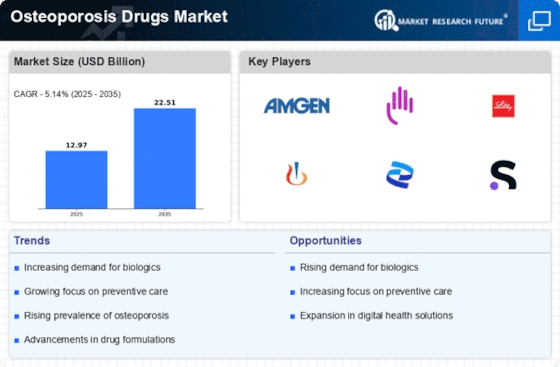
According to MRFR analysis, the Osteoporosis Drugs Market Size was valued at USD 12.97 Billion in 2024. The market is projected to grow from USD 13.64 Billion in 2025 to USD 22.51 Billion by 2035, registering a CAGR of 5.14% during the forecast period (2026–2035). North America led the market with over 44.72% share, generating around USD 5.8 billion in revenue.
 
The Osteoporosis Drugs Market is growing due to the rising prevalence of bone disorders, aging populations, and increasing awareness of bone health. Key trends include development of advanced bisphosphonates and monoclonal antibody therapies, growing adoption of combination treatments, and expanding pharmaceutical R&D focused on improving fracture prevention and patient outcomes globally.

Key Market Trends & Highlights

The Osteoporosis Drugs Market is experiencing a transformative shift towards innovative therapies and preventive care.

  • The rise of biologics and targeted therapies is reshaping treatment paradigms in the market. North America remains the largest market, while Asia-Pacific is emerging as the fastest-growing region for osteoporosis treatments. Bisphosphonates continue to dominate the market, whereas monoclonal antibodies are witnessing rapid growth. The aging population and increased awareness about osteoporosis are driving market expansion and investment in new therapies.

Market Size & Forecast

2024 Market Size 12.97 (USD Billion)
2035 Market Size 22.51 (USD Billion)
CAGR (2025 - 2035) 5.14%
Largest Regional Market Share in 2024 North America

Major Players

Companies such as <a href="https://www.amgen.com/about/therapy-areas/bone-health" target="_blank" rel="noopener">Amgen</a> (US), Bristol-Myers Squibb (US), Eli Lilly and Company (US), Novartis (CH), Pfizer (US), <a href="https://www.news.sanofi.us/press-releases?item=118387" target="_blank" rel="noopener">Sanofi </a>(FR), Teva Pharmaceutical Industries (IL), Horizon Therapeutics (IE), Mylan (US) are some of the major participants in the global market.

Market Trends

The Osteoporosis Drugs Market is currently experiencing a notable transformation, driven by an increasing awareness of bone health and the rising prevalence of osteoporosis among various demographics. This condition, characterized by weakened bones, has prompted a surge in demand for effective therapeutic options. Pharmaceutical companies are actively investing in research and development to introduce innovative treatments that not only address the symptoms but also target the underlying causes of bone density loss. As a result, the market landscape is evolving, with a focus on personalized medicine and biologics that offer tailored solutions for patients. The increasing approval of novel therapies and higher diagnosis rates among aging females are significantly expanding the post-menopausal osteoporosis drug market. Moreover, the regulatory environment surrounding osteoporosis treatments is becoming more stringent, which may influence the speed at which new drugs enter the osteoporosis drug market. However, this also encourages manufacturers to enhance their product offerings, ensuring safety and efficacy.

Strategic shifts in the osteoporosis drug market share are expected as patent expirations for traditional therapies pave the way for advanced biologics and biosimilars to capture a larger portion of the clinical landscape. The integration of technology in drug delivery systems and patient monitoring is also gaining traction, potentially improving adherence to treatment regimens. Overall, the Osteoporosis Drugs Market appears poised for growth, with a combination of innovative therapies and a heightened focus on patient-centric approaches shaping its future.

Rise of Biologics and Targeted Therapies

The market is witnessing a shift towards biologics and targeted therapies, which aim to provide more effective treatment options. These therapies focus on specific biological pathways involved in bone metabolism, potentially leading to improved patient outcomes.

Increased Focus on Preventive Care

There is a growing emphasis on preventive care within the Osteoporosis Drugs Market, as healthcare providers recognize the importance of early intervention. This trend may lead to increased screening and awareness campaigns, ultimately driving demand for preventive medications.

Integration of Digital Health Solutions

The incorporation of digital health solutions is becoming more prevalent in the market. Technologies such as mobile applications and telemedicine are being utilized to enhance patient engagement and adherence to treatment, potentially transforming the management of osteoporosis.

Osteoporosis Drugs Market Market Drivers

Advancements in Drug Development and Research

Innovations in drug development are significantly influencing the Osteoporosis Drugs Market. Recent advancements in biotechnology and pharmacology have led to the emergence of novel therapeutic agents, including biologics and targeted therapies. These new treatments are designed to enhance bone density and reduce fracture risk more effectively than traditional options.
 
For instance, the introduction of monoclonal antibodies has shown promising results in clinical trials, indicating a potential shift in treatment paradigms. The ongoing research into the mechanisms of bone metabolism is likely to yield further breakthroughs, thereby expanding the range of available therapies. As a result, the market is poised for growth, driven by the introduction of more effective and safer treatment options that cater to the diverse needs of patients.

Regulatory Support and Approval of New Therapies

The Osteoporosis Drugs Market is experiencing favorable conditions due to regulatory support for the approval of new therapies. Regulatory agencies are increasingly recognizing the need for innovative treatments to address the growing burden of osteoporosis. Streamlined approval processes and incentives for the development of novel drugs are encouraging pharmaceutical companies to invest in research and development.
 
This regulatory environment is likely to expedite the introduction of new therapies into the market, providing patients with more options for managing osteoporosis. As new drugs receive approval, the market is expected to witness a surge in product offerings, catering to the diverse needs of patients and healthcare providers alike.

Increased Awareness and Education on Osteoporosis

The Osteoporosis Drugs Market is also being propelled by heightened awareness and education regarding osteoporosis. Public health campaigns and educational initiatives are informing individuals about the risks associated with osteoporosis and the importance of early diagnosis and treatment. This increased awareness is leading to more individuals seeking medical consultations and preventive care, which in turn drives demand for osteoporosis drugs.
 
Furthermore, healthcare professionals are becoming more proactive in screening and diagnosing osteoporosis, contributing to a larger patient population requiring treatment. The emphasis on preventive care and early intervention is likely to foster a more informed public, ultimately benefiting the market as more patients are treated effectively and efficiently.

Aging Population and Increased Incidence of Osteoporosis

The Osteoporosis Drugs Market is experiencing a notable surge due to the aging population, which is increasingly susceptible to osteoporosis. As individuals age, bone density diminishes, leading to a higher prevalence of fractures and related complications. According to recent estimates, approximately 200 million people worldwide are affected by osteoporosis, with the majority being postmenopausal women.
 
This demographic shift is likely to drive demand for osteoporosis drugs, as healthcare systems seek effective treatments to manage this condition. Furthermore, the increasing awareness of osteoporosis and its consequences is prompting more individuals to seek medical advice, thereby expanding the market for osteoporosis drugs. The growing incidence of osteoporosis among older adults suggests a sustained need for innovative therapies and preventive measures within the market.

Rising Healthcare Expenditure and Investment in Pharmaceuticals

The Osteoporosis Drugs Market is benefiting from the increasing healthcare expenditure observed in various regions. Governments and private sectors are investing more in healthcare infrastructure, which includes funding for research and development in pharmaceuticals. This trend is particularly evident in countries with aging populations, where the burden of osteoporosis is more pronounced.
 
The World Health Organization has reported that healthcare spending is projected to rise significantly, which could facilitate the development and accessibility of osteoporosis drugs. Additionally, the growing emphasis on improving patient outcomes is likely to drive investments in innovative therapies. As healthcare systems allocate more resources to combat osteoporosis, the market is expected to expand, providing patients with better treatment options and improving overall health outcomes.

Market Segment Insights

By Drug Class: Bisphosphonates (Largest) vs. Monoclonal Antibodies (Fastest-Growing)

Bisphosphonates hold the largest market share due to their established efficacy and widespread use. These drugs, along with Hormonal Therapy and Calcium and <a title="vitamin d supplement" href="https://www.marketresearchfuture.com/reports/vitamin-d-supplement-market-43666" target="_blank" rel="noopener">Vitamin D Supplements</a>, form the backbone of osteoporosis treatment options for patients. Conversely, Monoclonal Antibodies, although currently smaller in market share, are rapidly gaining traction, driven by innovative formulations and targeted treatment methodologies that cater to specific patient needs.

Bisphosphonates (Dominant) vs. Monoclonal Antibodies (Emerging)

Bisphosphonates are the dominant class in the Osteoporosis Drugs Market, known for their proven ability to inhibit bone resorption, which plays a critical role in strengthening bone density. They are frequently prescribed as the first line of defense against osteoporosis, appealing particularly to aging populations at risk. On the other hand, Monoclonal Antibodies are emerging as a promising alternative, characterized by their advanced mechanism of action that directly targets osteoclasts to enhance bone formation. This emerging class is increasingly being embraced for its efficacy in treatment-resistant cases, captivating healthcare providers' attention and contributing to its accelerated market growth.

By Route of Administration: Oral (Largest) vs. Intravenous (Fastest-Growing)

The route of administration plays a crucial role in drug delivery preferences. The oral administration segment holds the largest Osteoporosis Drugs Market share, favored for its convenience and patient compliance. This method is preferred due to its ease of use, leading to a significant percentage of patients opting for oral medications. In contrast, the intravenous segment, although smaller in share, is recognized as the fastest-growing due to its effectiveness and rapid onset of action, making it increasingly popular among healthcare providers seeking immediate results for their patients.

Administration Method: Oral (Dominant) vs. Intravenous (Emerging)

The oral route of administration is dominant in the Osteoporosis Drugs Market, primarily due to its established comfort and convenience for patients. Oral medications are easier to administer, leading to higher patient adherence, which is vital for long-term osteoporosis management. On the other hand, intravenous administration is emerging as a viable alternative, especially in cases where rapid therapeutic effects are required. This method allows for precise dosing and immediate drug action, making it attractive in hospital and severe case settings. As healthcare providers aim for more effective treatment outcomes, intravenous options are gaining traction, indicating a shift in market dynamics towards more intensive treatment methods.

By Distribution Channel: Retail Pharmacy (Largest) vs. Hospital Pharmacy (Fastest-Growing)

The osteoporosis drugs market is primarily segmented into hospital pharmacy, retail pharmacy, and online pharmacy, with retail pharmacies holding the largest market share. Retail pharmacies have established themselves as the go-to source for osteoporosis medications, benefiting from convenience, accessibility, and existing consumer trust. Hospital pharmacies follow closely and have been gaining traction, especially for patients requiring immediate care or specialized treatments. Online pharmacies, while growing, have yet to achieve comparable market presence due to regulatory challenges and consumer preference for direct consultations.

Retail Pharmacy (Dominant) vs. Hospital Pharmacy (Emerging)

Retail pharmacies dominate the osteoporosis drugs distribution channel due to their widespread accessibility and well-established consumer relationships, offering a broad range of osteoporosis medications. They provide significant convenience, enabling patients to pick up prescriptions easily without the delays often associated with hospital pharmacies. However, hospital pharmacies are emerging as vital competitors, driven by the need for specialized care and patient education, particularly in acute medical situations. This trend is also fueled by an increasing number of hospitals enhancing their pharmacy services to support osteoporosis treatment protocols more effectively. Both channels play essential roles in the osteoporosis drugs market, but their operational dynamics cater to different patient needs.

By Patient Population: Postmenopausal Women (Largest) vs. Men (Fastest-Growing)

The patient population segment reveals distinct dynamics. Postmenopausal women represent the largest share, driven primarily by the hormonal changes that increase the risk of osteoporosis. This demographic's greater susceptibility to bone density loss significantly contributes to the high consumption of osteoporosis medications. Meanwhile, men, historically considered a lower-risk group, are experiencing an increasing recognition of their osteoporosis vulnerability, carving out a remarkable Osteoporosis Drugs Market share.

Postmenopausal Women: Dominant vs. Men: Emerging

The Postmenopausal Women segment remains the dominant force in the osteoporosis drugs market, characterized by significant awareness and proactive treatment regimens. This group's need for preventative care and therapy to combat osteoporosis is escalating due to longer life expectancies and increased health education about the risks associated with menopause. On the other hand, the Emerging Men segment is witnessing a rise in market interest as healthcare providers recognize osteoporosis as a significant health concern for aging men. Awareness campaigns and changes in diagnostic practices are contributing to this segment's growth, prompting a demand for tailored medications and treatment protocols that address this previously overlooked demographic.

Get more detailed insights about Osteoporosis Drugs Market Research Report - Forecast to 2035

Regional Insights

The Osteoporosis Drugs Market is poised for substantial growth across various regions. In 2024, North America commands a significant portion, valued at 4.5 USD Billion, and is projected to rise to 8.1 USD Billion in 2035, making it a key player in the Osteoporosis Drugs Market due to its advanced healthcare infrastructure and increasing awareness about osteoporosis management. Specifically, the Canada osteoporosis treatment drugs market is projected to experience steady growth through 2035, fueled by a rising geriatric population and the recent introduction of advanced therapies like teriparatide injectables by domestic pharmaceutical leaders.

Europe follows closely with a valuation of 3.5 USD Billion in 2024, reaching 6.2 USD billion by 2035, reflecting a strong demand driven by an aging population.Meanwhile, Asia Pacific, valued at 3.0 USD Billion in 2024 and expected to grow to 5.4 USD Billion in 2035, indicates rising economic capabilities and a growing focus on healthcare. South America and the Middle East, and Africa represent the smaller segments, valued at 1.2 USD Billion and 0.8 USD Billion in 2024, respectively, but are likely to experience growth opportunities due to improving healthcare systems and increasing disease awareness.

Overall, the Osteoporosis Drugs Market revenue is likely to see diverse growth trajectories across these regions, influenced by factors such as demographic shifts, healthcare advancements, and a growing inclination towards preventive healthcare solutions.

Key Players and Competitive Insights

The Osteoporosis Drugs Market has witnessed significant developments over the years, driven by an increasing awareness of bone health and the rising incidence of osteoporosis, particularly among aging populations. Competition in this sector is intense as various pharmaceutical companies strive to innovate and enhance their product offerings. The landscape is characterized by a mix of established players and emerging biotech firms, each focusing on unique therapeutic mechanisms, formulations, and delivery methods.
 
Companies are keen to optimize their portfolios by exploring new treatment approaches like monoclonal antibodies and anti-resorptive therapies, while also engaging in strategic collaborations and partnerships to expand their market reach.The landscape is continuously evolving, especially with advancements in research and development that are paving the way for novel therapies targeting the pathophysiology of bone disorders.Novartis has established a strong foothold in the Osteoporosis Drugs Market by leveraging its extensive research capabilities and innovative product development strategies.
 
The company excels in formulating effective therapies that cater to various demographics, especially postmenopausal women who are at higher risk of osteoporosis. Novartis’ commitment to continuous improvement and maintenance of high-quality standards is evident in its sustained investment in clinical trials and safety assessments. The company also capitalizes on robust distribution channels and strategic collaborations to enhance its market share and presence across global regions.
 
Furthermore, Novartis has successfully implemented marketing initiatives that spotlight the importance of osteoporosis prevention and management, thus strengthening its position as a leader in the pharmaceutical sector focused on bone health. Regeneron Pharmaceuticals is also active in the Osteoporosis Drugs Market, albeit with a slightly different strategic approach. The company has a reputation for innovation, particularly in the development of biologics and monoclonal antibodies, which are instrumental in treating chronic conditions, including osteoporosis.
 
Key products from Regeneron have been pivotal in addressing the underlying biological mechanisms of bone resorption and formation. Their market presence is reinforced by strong R&D capabilities, allowing them to respond swiftly to evolving healthcare needs. Regeneron has engaged in strategic mergers and acquisitions to bolster its portfolio, enhancing its distribution and reach within the global market. The company's strengths lie in its focus on leveraging cutting-edge biotechnology and its commitment to clinical excellence, establishing itself as a formidable contender in the evolving landscape of osteoporosis therapies.

Key Companies in the Osteoporosis Drugs Market include

Industry Developments

There have been several notable developments in the Osteoporosis Drugs Market recently, particularly involving major pharmaceutical companies. In November 2023, Eli Lilly received FDA approval for a new osteoporosis medication aimed at increasing bone density in postmenopausal women. Meanwhile, Merck has reported an increase in market valuation due to positive clinical trial results for its osteoporosis treatment, echoing similar trends observed in the industry. In terms of mergers and acquisitions, November 2023 saw Regeneron Pharmaceuticals acquire a smaller biotech company that specializes in osteoporosis therapies, bolstering its R&D capabilities in this domain.

Additionally, Novartis announced plans to expand its osteoporosis drug portfolio through strategic partnerships, emphasizing growth in the therapeutic area. Over the past few years, companies like Amgen and Pfizer have also made significant strides in launching innovative treatments, contributing to the projected growth of the market. With rising awareness of osteoporosis as a major health concern among aging populations globally, the demand for effective treatments continues to grow, pushing these companies to enhance their product offerings and collaborate more intensively within the sector.

Future Outlook

Osteoporosis Drugs Market Future Outlook

The Osteoporosis Drugs Market is projected to grow at a 5.14% CAGR from 2025 to 2035, driven by increasing aging populations, rising awareness, and advancements in drug formulations.

New opportunities lie in:

  • <p>Development of personalized osteoporosis treatment plans</p>
  • <p> </p>
  • <p>Expansion into emerging markets with tailored marketing strategies</p>
  • <p>Investment in digital health technologies for patient monitoring</p>

By 2035, the Osteoporosis Drugs Market is expected to achieve substantial growth and innovation.

Market Segmentation

Osteoporosis Drugs Market Drug Class Outlook

  • Bisphosphonates
  • Hormonal Therapy
  • Monoclonal Antibodies
  • Calcium and Vitamin D Supplements
  • Selective Estrogen Receptor Modulators

Osteoporosis Drugs Market Patient Population Outlook

  • Postmenopausal Women
  • Men
  • Elderly Population

Osteoporosis Drugs Market Distribution Channel Outlook

  • Hospital Pharmacy
  • Retail Pharmacy
  • Online Pharmacy

Osteoporosis Drugs Market Route of Administration Outlook

  • Oral
  • Intravenous
  • Subcutaneous
  • Transdermal

Report Scope

MARKET SIZE 2024 12.97(USD Billion)
MARKET SIZE 2025 13.64(USD Billion)
MARKET SIZE 2035 22.51(USD Billion)
COMPOUND ANNUAL GROWTH RATE (CAGR) 5.14% (2026 - 2035)
REPORT COVERAGE Revenue Forecast, Competitive Landscape, Growth Factors, and Trends
BASE YEAR 2024
Market Forecast Period 2025 - 2035
Historical Data 2019 - 2024
Market Forecast Units USD Billion
Key Companies Profiled Amgen (US), Bristol-Myers Squibb (US), Eli Lilly and Company (US), Novartis (CH), Pfizer (US), Sanofi (FR), Teva Pharmaceutical Industries (IL), Horizon Therapeutics (IE), Mylan (US)
Segments Covered Drug Class, Route of Administration, Distribution Channel, Patient Population, Regional
Key Market Opportunities Emerging biologics and personalized medicine are reshaping the market landscape.
Key Market Dynamics Rising demand for innovative osteoporosis therapies drives competitive dynamics and regulatory scrutiny in the pharmaceutical landscape.
Countries Covered North America, Europe, APAC, South America, MEA

FAQs

What is the current valuation of the Osteoporosis Drugs Market as of 2024?

<p>The Osteoporosis Drugs Market was valued at 12.97 USD Billion in 2024.</p>

What is the projected market valuation for the Osteoporosis Drugs Market in 2035?

The Osteoporosis Drugs Market is projected to reach 22.51 USD Billion by 2035.

What is the expected CAGR for the Osteoporosis Drugs Market during the forecast period 2025 - 2035?

<p>The expected CAGR for the Osteoporosis Drugs Market during 2025 - 2035 is 5.14%.</p>

Which drug class had the highest valuation in 2024, and what is its projected value for 2035?

<p>Bisphosphonates had a valuation of 3.88 USD Billion in 2024, projected to reach 6.88 USD Billion by 2035.</p>

How does the market for Hormonal Therapy compare between 2024 and 2035?

<p>Hormonal Therapy was valued at 2.59 USD Billion in 2024 and is expected to grow to 4.56 USD Billion by 2035.</p>

What are the projected values for the Oral route of administration from 2024 to 2035?

<p>The Oral route of administration was valued at 5.0 USD Billion in 2024 and is projected to increase to 8.5 USD Billion by 2035.</p>

Which distribution channel is expected to show the most growth from 2024 to 2035?

<p>Retail Pharmacy, valued at 5.18 USD Billion in 2024, is projected to grow to 9.12 USD Billion by 2035.</p>

What is the projected market size for the elderly population segment by 2035?

<p>The elderly population segment, valued at 3.9 USD Billion in 2024, is expected to reach 6.63 USD Billion by 2035.</p>

Which key players are leading the Osteoporosis Drugs Market?

<p>Key players in the Osteoporosis Drugs Market include Amgen, Bristol-Myers Squibb, Eli Lilly and Company, Novartis, and Pfizer.</p>

What is the projected value for Monoclonal Antibodies in 2035?

<p>Monoclonal Antibodies, valued at 1.94 USD Billion in 2024, are projected to reach 3.43 USD Billion by 2035.</p>

  1. SECTION I: EXECUTIVE SUMMARY AND KEY HIGHLIGHTS |
    1. EXECUTIVE SUMMARY | |
      1. Market Overview | |
      2. Key Findings | |
      3. Market Segmentation | |
      4. Competitive Landscape | |
      5. Challenges and Opportunities | |
      6. Future Outlook 2
  2. SECTION II: SCOPING, METHODOLOGY AND MARKET STRUCTURE |
    1. MARKET INTRODUCTION | |
      1. Definition | |
      2. Scope of the study | | |
    2. RESEARCH METHODOLOGY | |
      1. Overview | |
      2. Data Mining | |
      3. Secondary Research | |
      4. Primary Research | | |
      5. Forecasting Model | |
      6. Market Size Estimation | | |
      7. Data Triangulation | |
      8. Validation 3
  3. SECTION III: QUALITATIVE ANALYSIS |
    1. MARKET DYNAMICS | |
      1. Overview | |
      2. Drivers | |
      3. Restraints | |
      4. Opportunities |
    2. MARKET FACTOR ANALYSIS | |
      1. Value chain Analysis | |
      2. Porter's Five Forces Analysis | | |
      3. COVID-19 Impact Analysis | | |
  4. SECTION IV: QUANTITATIVE ANALYSIS |
    1. Healthcare, BY Drug Class (USD Billion) | |
      1. Bisphosphonates | |
      2. Hormonal Therapy | |
      3. Monoclonal Antibodies | |
      4. Calcium and Vitamin D Supplements | |
      5. Selective Estrogen Receptor Modulators |
    2. Healthcare, BY Route of Administration (USD Billion) | |
      1. Oral | |
      2. Intravenous | |
      3. Subcutaneous | |
      4. Transdermal |
    3. Healthcare, BY Distribution Channel (USD Billion) | |
      1. Hospital Pharmacy | |
      2. Retail Pharmacy | |
      3. Online Pharmacy |
    4. Healthcare, BY Patient Population (USD Billion) | |
      1. Postmenopausal Women | |
      2. Men | |
      3. Elderly Population |
    5. Healthcare, BY Region (USD Billion) | |
      1. North America | | |
      2. Europe | | |
      3. APAC | | |
      4. South America | | |
      5. MEA | | |
  5. SECTION V: COMPETITIVE ANALYSIS |
    1. Competitive Landscape | |
      1. Overview | |
      2. Competitive Analysis | |
      3. Market share Analysis | |
      4. Major Growth Strategy in the Healthcare | |
      5. Competitive Benchmarking | |
      6. Leading Players in Terms of Number of Developments in the Healthcare | |
      7. Key developments and growth strategies | | |
      8. Major Players Financial Matrix | | |
    2. Company Profiles | |
      1. Amgen (US) | | |
      2. Bristol-Myers Squibb (US) | | |
      3. Eli Lilly and Company (US) | | |
      4. Novartis (CH) | | |
      5. Pfizer (US) | | |
      6. Sanofi (FR) | | |
      7. Teva Pharmaceutical Industries (IL) | | |
      8. Horizon Therapeutics (IE) | | |
      9. Mylan (US) | | |
    3. Appendix | |
      1. References | |
      2. Related Reports 6 LIST OF FIGURES |
    4. MARKET SYNOPSIS |
    5. NORTH AMERICA MARKET ANALYSIS |
    6. US MARKET ANALYSIS BY DRUG CLASS |
    7. US MARKET ANALYSIS BY ROUTE OF ADMINISTRATION |
    8. US MARKET ANALYSIS BY DISTRIBUTION CHANNEL |
    9. US MARKET ANALYSIS BY PATIENT POPULATION |
    10. CANADA MARKET ANALYSIS BY DRUG CLASS |
    11. CANADA MARKET ANALYSIS BY ROUTE OF ADMINISTRATION |
    12. CANADA MARKET ANALYSIS BY DISTRIBUTION CHANNEL |
    13. CANADA MARKET ANALYSIS BY PATIENT POPULATION |
    14. EUROPE MARKET ANALYSIS |
    15. GERMANY MARKET ANALYSIS BY DRUG CLASS |
    16. GERMANY MARKET ANALYSIS BY ROUTE OF ADMINISTRATION |
    17. GERMANY MARKET ANALYSIS BY DISTRIBUTION CHANNEL |
    18. GERMANY MARKET ANALYSIS BY PATIENT POPULATION |
    19. UK MARKET ANALYSIS BY DRUG CLASS |
    20. UK MARKET ANALYSIS BY ROUTE OF ADMINISTRATION |
    21. UK MARKET ANALYSIS BY DISTRIBUTION CHANNEL |
    22. UK MARKET ANALYSIS BY PATIENT POPULATION |
    23. FRANCE MARKET ANALYSIS BY DRUG CLASS |
    24. FRANCE MARKET ANALYSIS BY ROUTE OF ADMINISTRATION |
    25. FRANCE MARKET ANALYSIS BY DISTRIBUTION CHANNEL |
    26. FRANCE MARKET ANALYSIS BY PATIENT POPULATION |
    27. RUSSIA MARKET ANALYSIS BY DRUG CLASS |
    28. RUSSIA MARKET ANALYSIS BY ROUTE OF ADMINISTRATION |
    29. RUSSIA MARKET ANALYSIS BY DISTRIBUTION CHANNEL |
    30. RUSSIA MARKET ANALYSIS BY PATIENT POPULATION |
    31. ITALY MARKET ANALYSIS BY DRUG CLASS |
    32. ITALY MARKET ANALYSIS BY ROUTE OF ADMINISTRATION |
    33. ITALY MARKET ANALYSIS BY DISTRIBUTION CHANNEL |
    34. ITALY MARKET ANALYSIS BY PATIENT POPULATION |
    35. SPAIN MARKET ANALYSIS BY DRUG CLASS |
    36. SPAIN MARKET ANALYSIS BY ROUTE OF ADMINISTRATION |
    37. SPAIN MARKET ANALYSIS BY DISTRIBUTION CHANNEL |
    38. SPAIN MARKET ANALYSIS BY PATIENT POPULATION |
    39. REST OF EUROPE MARKET ANALYSIS BY DRUG CLASS |
    40. REST OF EUROPE MARKET ANALYSIS BY ROUTE OF ADMINISTRATION |
    41. REST OF EUROPE MARKET ANALYSIS BY DISTRIBUTION CHANNEL |
    42. REST OF EUROPE MARKET ANALYSIS BY PATIENT POPULATION |
    43. APAC MARKET ANALYSIS |
    44. CHINA MARKET ANALYSIS BY DRUG CLASS |
    45. CHINA MARKET ANALYSIS BY ROUTE OF ADMINISTRATION |
    46. CHINA MARKET ANALYSIS BY DISTRIBUTION CHANNEL |
    47. CHINA MARKET ANALYSIS BY PATIENT POPULATION |
    48. INDIA MARKET ANALYSIS BY DRUG CLASS |
    49. INDIA MARKET ANALYSIS BY ROUTE OF ADMINISTRATION |
    50. INDIA MARKET ANALYSIS BY DISTRIBUTION CHANNEL |
    51. INDIA MARKET ANALYSIS BY PATIENT POPULATION |
    52. JAPAN MARKET ANALYSIS BY DRUG CLASS |
    53. JAPAN MARKET ANALYSIS BY ROUTE OF ADMINISTRATION |
    54. JAPAN MARKET ANALYSIS BY DISTRIBUTION CHANNEL |
    55. JAPAN MARKET ANALYSIS BY PATIENT POPULATION |
    56. SOUTH KOREA MARKET ANALYSIS BY DRUG CLASS |
    57. SOUTH KOREA MARKET ANALYSIS BY ROUTE OF ADMINISTRATION |
    58. SOUTH KOREA MARKET ANALYSIS BY DISTRIBUTION CHANNEL |
    59. SOUTH KOREA MARKET ANALYSIS BY PATIENT POPULATION |
    60. MALAYSIA MARKET ANALYSIS BY DRUG CLASS |
    61. MALAYSIA MARKET ANALYSIS BY ROUTE OF ADMINISTRATION |
    62. MALAYSIA MARKET ANALYSIS BY DISTRIBUTION CHANNEL |
    63. MALAYSIA MARKET ANALYSIS BY PATIENT POPULATION |
    64. THAILAND MARKET ANALYSIS BY DRUG CLASS |
    65. THAILAND MARKET ANALYSIS BY ROUTE OF ADMINISTRATION |
    66. THAILAND MARKET ANALYSIS BY DISTRIBUTION CHANNEL |
    67. THAILAND MARKET ANALYSIS BY PATIENT POPULATION |
    68. INDONESIA MARKET ANALYSIS BY DRUG CLASS |
    69. INDONESIA MARKET ANALYSIS BY ROUTE OF ADMINISTRATION |
    70. INDONESIA MARKET ANALYSIS BY DISTRIBUTION CHANNEL |
    71. INDONESIA MARKET ANALYSIS BY PATIENT POPULATION |
    72. REST OF APAC MARKET ANALYSIS BY DRUG CLASS |
    73. REST OF APAC MARKET ANALYSIS BY ROUTE OF ADMINISTRATION |
    74. REST OF APAC MARKET ANALYSIS BY DISTRIBUTION CHANNEL |
    75. REST OF APAC MARKET ANALYSIS BY PATIENT POPULATION |
    76. SOUTH AMERICA MARKET ANALYSIS |
    77. BRAZIL MARKET ANALYSIS BY DRUG CLASS |
    78. BRAZIL MARKET ANALYSIS BY ROUTE OF ADMINISTRATION |
    79. BRAZIL MARKET ANALYSIS BY DISTRIBUTION CHANNEL |
    80. BRAZIL MARKET ANALYSIS BY PATIENT POPULATION |
    81. MEXICO MARKET ANALYSIS BY DRUG CLASS |
    82. MEXICO MARKET ANALYSIS BY ROUTE OF ADMINISTRATION |
    83. MEXICO MARKET ANALYSIS BY DISTRIBUTION CHANNEL |
    84. MEXICO MARKET ANALYSIS BY PATIENT POPULATION |
    85. ARGENTINA MARKET ANALYSIS BY DRUG CLASS |
    86. ARGENTINA MARKET ANALYSIS BY ROUTE OF ADMINISTRATION |
    87. ARGENTINA MARKET ANALYSIS BY DISTRIBUTION CHANNEL |
    88. ARGENTINA MARKET ANALYSIS BY PATIENT POPULATION |
    89. REST OF SOUTH AMERICA MARKET ANALYSIS BY DRUG CLASS |
    90. REST OF SOUTH AMERICA MARKET ANALYSIS BY ROUTE OF ADMINISTRATION |
    91. REST OF SOUTH AMERICA MARKET ANALYSIS BY DISTRIBUTION CHANNEL |
    92. REST OF SOUTH AMERICA MARKET ANALYSIS BY PATIENT POPULATION |
    93. MEA MARKET ANALYSIS |
    94. GCC COUNTRIES MARKET ANALYSIS BY DRUG CLASS |
    95. GCC COUNTRIES MARKET ANALYSIS BY ROUTE OF ADMINISTRATION |
    96. GCC COUNTRIES MARKET ANALYSIS BY DISTRIBUTION CHANNEL |
    97. GCC COUNTRIES MARKET ANALYSIS BY PATIENT POPULATION |
    98. SOUTH AFRICA MARKET ANALYSIS BY DRUG CLASS |
    99. SOUTH AFRICA MARKET ANALYSIS BY ROUTE OF ADMINISTRATION |
    100. SOUTH AFRICA MARKET ANALYSIS BY DISTRIBUTION CHANNEL |
    101. SOUTH AFRICA MARKET ANALYSIS BY PATIENT POPULATION |
    102. REST OF MEA MARKET ANALYSIS BY DRUG CLASS |
    103. REST OF MEA MARKET ANALYSIS BY ROUTE OF ADMINISTRATION |
    104. REST OF MEA MARKET ANALYSIS BY DISTRIBUTION CHANNEL |
    105. REST OF MEA MARKET ANALYSIS BY PATIENT POPULATION |
    106. KEY BUYING CRITERIA OF HEALTHCARE |
    107. RESEARCH PROCESS OF MRFR |
    108. DRO ANALYSIS OF HEALTHCARE |
    109. DRIVERS IMPACT ANALYSIS: HEALTHCARE |
    110. RESTRAINTS IMPACT ANALYSIS: HEALTHCARE |
    111. SUPPLY / VALUE CHAIN: HEALTHCARE |
    112. HEALTHCARE, BY DRUG CLASS, 2024 (% SHARE) |
    113. HEALTHCARE, BY DRUG CLASS, 2024 TO 2035 (USD Billion) |
    114. HEALTHCARE, BY ROUTE OF ADMINISTRATION, 2024 (% SHARE) |
    115. HEALTHCARE, BY ROUTE OF ADMINISTRATION, 2024 TO 2035 (USD Billion) |
    116. HEALTHCARE, BY DISTRIBUTION CHANNEL, 2024 (% SHARE) |
    117. HEALTHCARE, BY DISTRIBUTION CHANNEL, 2024 TO 2035 (USD Billion) |
    118. HEALTHCARE, BY PATIENT POPULATION, 2024 (% SHARE) |
    119. HEALTHCARE, BY PATIENT POPULATION, 2024 TO 2035 (USD Billion) |
    120. BENCHMARKING OF MAJOR COMPETITORS 7 LIST OF TABLES |
    121. LIST OF ASSUMPTIONS | |
      1. |
    122. North America MARKET SIZE ESTIMATES; FORECAST | |
      1. BY DRUG CLASS, 2025-2035 (USD Billion) | |
      2. BY ROUTE OF ADMINISTRATION, 2025-2035 (USD Billion) | |
      3. BY DISTRIBUTION CHANNEL, 2025-2035 (USD Billion) | |
      4. BY PATIENT POPULATION, 2025-2035 (USD Billion) |
    123. US MARKET SIZE ESTIMATES; FORECAST | |
      1. BY DRUG CLASS, 2025-2035 (USD Billion) | |
      2. BY ROUTE OF ADMINISTRATION, 2025-2035 (USD Billion) | |
      3. BY DISTRIBUTION CHANNEL, 2025-2035 (USD Billion) | |
      4. BY PATIENT POPULATION, 2025-2035 (USD Billion) |
    124. Canada MARKET SIZE ESTIMATES; FORECAST | |
      1. BY DRUG CLASS, 2025-2035 (USD Billion) | |
      2. BY ROUTE OF ADMINISTRATION, 2025-2035 (USD Billion) | |
      3. BY DISTRIBUTION CHANNEL, 2025-2035 (USD Billion) | |
      4. BY PATIENT POPULATION, 2025-2035 (USD Billion) |
    125. Europe MARKET SIZE ESTIMATES; FORECAST | |
      1. BY DRUG CLASS, 2025-2035 (USD Billion) | |
      2. BY ROUTE OF ADMINISTRATION, 2025-2035 (USD Billion) | |
      3. BY DISTRIBUTION CHANNEL, 2025-2035 (USD Billion) | |
      4. BY PATIENT POPULATION, 2025-2035 (USD Billion) |
    126. Germany MARKET SIZE ESTIMATES; FORECAST | |
      1. BY DRUG CLASS, 2025-2035 (USD Billion) | |
      2. BY ROUTE OF ADMINISTRATION, 2025-2035 (USD Billion) | |
      3. BY DISTRIBUTION CHANNEL, 2025-2035 (USD Billion) | |
      4. BY PATIENT POPULATION, 2025-2035 (USD Billion) |
    127. UK MARKET SIZE ESTIMATES; FORECAST | |
      1. BY DRUG CLASS, 2025-2035 (USD Billion) | |
      2. BY ROUTE OF ADMINISTRATION, 2025-2035 (USD Billion) | |
      3. BY DISTRIBUTION CHANNEL, 2025-2035 (USD Billion) | |
      4. BY PATIENT POPULATION, 2025-2035 (USD Billion) |
    128. France MARKET SIZE ESTIMATES; FORECAST | |
      1. BY DRUG CLASS, 2025-2035 (USD Billion) | |
      2. BY ROUTE OF ADMINISTRATION, 2025-2035 (USD Billion) | |
      3. BY DISTRIBUTION CHANNEL, 2025-2035 (USD Billion) | |
      4. BY PATIENT POPULATION, 2025-2035 (USD Billion) |
    129. Russia MARKET SIZE ESTIMATES; FORECAST | |
      1. BY DRUG CLASS, 2025-2035 (USD Billion) | |
      2. BY ROUTE OF ADMINISTRATION, 2025-2035 (USD Billion) | |
      3. BY DISTRIBUTION CHANNEL, 2025-2035 (USD Billion) | |
      4. BY PATIENT POPULATION, 2025-2035 (USD Billion) |
    130. Italy MARKET SIZE ESTIMATES; FORECAST | |
      1. BY DRUG CLASS, 2025-2035 (USD Billion) | |
      2. BY ROUTE OF ADMINISTRATION, 2025-2035 (USD Billion) | |
      3. BY DISTRIBUTION CHANNEL, 2025-2035 (USD Billion) | |
      4. BY PATIENT POPULATION, 2025-2035 (USD Billion) |
    131. Spain MARKET SIZE ESTIMATES; FORECAST | |
      1. BY DRUG CLASS, 2025-2035 (USD Billion) | |
      2. BY ROUTE OF ADMINISTRATION, 2025-2035 (USD Billion) | |
      3. BY DISTRIBUTION CHANNEL, 2025-2035 (USD Billion) | |
      4. BY PATIENT POPULATION, 2025-2035 (USD Billion) |
    132. Rest of Europe MARKET SIZE ESTIMATES; FORECAST | |
      1. BY DRUG CLASS, 2025-2035 (USD Billion) | |
      2. BY ROUTE OF ADMINISTRATION, 2025-2035 (USD Billion) | |
      3. BY DISTRIBUTION CHANNEL, 2025-2035 (USD Billion) | |
      4. BY PATIENT POPULATION, 2025-2035 (USD Billion) |
    133. APAC MARKET SIZE ESTIMATES; FORECAST | |
      1. BY DRUG CLASS, 2025-2035 (USD Billion) | |
      2. BY ROUTE OF ADMINISTRATION, 2025-2035 (USD Billion) | |
      3. BY DISTRIBUTION CHANNEL, 2025-2035 (USD Billion) | |
      4. BY PATIENT POPULATION, 2025-2035 (USD Billion) |
    134. China MARKET SIZE ESTIMATES; FORECAST | |
      1. BY DRUG CLASS, 2025-2035 (USD Billion) | |
      2. BY ROUTE OF ADMINISTRATION, 2025-2035 (USD Billion) | |
      3. BY DISTRIBUTION CHANNEL, 2025-2035 (USD Billion) | |
      4. BY PATIENT POPULATION, 2025-2035 (USD Billion) |
    135. India MARKET SIZE ESTIMATES; FORECAST | |
      1. BY DRUG CLASS, 2025-2035 (USD Billion) | |
      2. BY ROUTE OF ADMINISTRATION, 2025-2035 (USD Billion) | |
      3. BY DISTRIBUTION CHANNEL, 2025-2035 (USD Billion) | |
      4. BY PATIENT POPULATION, 2025-2035 (USD Billion) |
    136. Japan MARKET SIZE ESTIMATES; FORECAST | |
      1. BY DRUG CLASS, 2025-2035 (USD Billion) | |
      2. BY ROUTE OF ADMINISTRATION, 2025-2035 (USD Billion) | |
      3. BY DISTRIBUTION CHANNEL, 2025-2035 (USD Billion) | |
      4. BY PATIENT POPULATION, 2025-2035 (USD Billion) |
    137. South Korea MARKET SIZE ESTIMATES; FORECAST | |
      1. BY DRUG CLASS, 2025-2035 (USD Billion) | |
      2. BY ROUTE OF ADMINISTRATION, 2025-2035 (USD Billion) | |
      3. BY DISTRIBUTION CHANNEL, 2025-2035 (USD Billion) | |
      4. BY PATIENT POPULATION, 2025-2035 (USD Billion) |
    138. Malaysia MARKET SIZE ESTIMATES; FORECAST | |
      1. BY DRUG CLASS, 2025-2035 (USD Billion) | |
      2. BY ROUTE OF ADMINISTRATION, 2025-2035 (USD Billion) | |
      3. BY DISTRIBUTION CHANNEL, 2025-2035 (USD Billion) | |
      4. BY PATIENT POPULATION, 2025-2035 (USD Billion) |
    139. Thailand MARKET SIZE ESTIMATES; FORECAST | |
      1. BY DRUG CLASS, 2025-2035 (USD Billion) | |
      2. BY ROUTE OF ADMINISTRATION, 2025-2035 (USD Billion) | |
      3. BY DISTRIBUTION CHANNEL, 2025-2035 (USD Billion) | |
      4. BY PATIENT POPULATION, 2025-2035 (USD Billion) |
    140. Indonesia MARKET SIZE ESTIMATES; FORECAST | |
      1. BY DRUG CLASS, 2025-2035 (USD Billion) | |
      2. BY ROUTE OF ADMINISTRATION, 2025-2035 (USD Billion) | |
      3. BY DISTRIBUTION CHANNEL, 2025-2035 (USD Billion) | |
      4. BY PATIENT POPULATION, 2025-2035 (USD Billion) |
    141. Rest of APAC MARKET SIZE ESTIMATES; FORECAST | |
      1. BY DRUG CLASS, 2025-2035 (USD Billion) | |
      2. BY ROUTE OF ADMINISTRATION, 2025-2035 (USD Billion) | |
      3. BY DISTRIBUTION CHANNEL, 2025-2035 (USD Billion) | |
      4. BY PATIENT POPULATION, 2025-2035 (USD Billion) |
    142. South America MARKET SIZE ESTIMATES; FORECAST | |
      1. BY DRUG CLASS, 2025-2035 (USD Billion) | |
      2. BY ROUTE OF ADMINISTRATION, 2025-2035 (USD Billion) | |
      3. BY DISTRIBUTION CHANNEL, 2025-2035 (USD Billion) | |
      4. BY PATIENT POPULATION, 2025-2035 (USD Billion) |
    143. Brazil MARKET SIZE ESTIMATES; FORECAST | |
      1. BY DRUG CLASS, 2025-2035 (USD Billion) | |
      2. BY ROUTE OF ADMINISTRATION, 2025-2035 (USD Billion) | |
      3. BY DISTRIBUTION CHANNEL, 2025-2035 (USD Billion) | |
      4. BY PATIENT POPULATION, 2025-2035 (USD Billion) |
    144. Mexico MARKET SIZE ESTIMATES; FORECAST | |
      1. BY DRUG CLASS, 2025-2035 (USD Billion) | |
      2. BY ROUTE OF ADMINISTRATION, 2025-2035 (USD Billion) | |
      3. BY DISTRIBUTION CHANNEL, 2025-2035 (USD Billion) | |
      4. BY PATIENT POPULATION, 2025-2035 (USD Billion) |
    145. Argentina MARKET SIZE ESTIMATES; FORECAST | |
      1. BY DRUG CLASS, 2025-2035 (USD Billion) | |
      2. BY ROUTE OF ADMINISTRATION, 2025-2035 (USD Billion) | |
      3. BY DISTRIBUTION CHANNEL, 2025-2035 (USD Billion) | |
      4. BY PATIENT POPULATION, 2025-2035 (USD Billion) |
    146. Rest of South America MARKET SIZE ESTIMATES; FORECAST | |
      1. BY DRUG CLASS, 2025-2035 (USD Billion) | |
      2. BY ROUTE OF ADMINISTRATION, 2025-2035 (USD Billion) | |
      3. BY DISTRIBUTION CHANNEL, 2025-2035 (USD Billion) | |
      4. BY PATIENT POPULATION, 2025-2035 (USD Billion) |
    147. MEA MARKET SIZE ESTIMATES; FORECAST | |
      1. BY DRUG CLASS, 2025-2035 (USD Billion) | |
      2. BY ROUTE OF ADMINISTRATION, 2025-2035 (USD Billion) | |
      3. BY DISTRIBUTION CHANNEL, 2025-2035 (USD Billion) | |
      4. BY PATIENT POPULATION, 2025-2035 (USD Billion) |
    148. GCC Countries MARKET SIZE ESTIMATES; FORECAST | |
      1. BY DRUG CLASS, 2025-2035 (USD Billion) | |
      2. BY ROUTE OF ADMINISTRATION, 2025-2035 (USD Billion) | |
      3. BY DISTRIBUTION CHANNEL, 2025-2035 (USD Billion) | |
      4. BY PATIENT POPULATION, 2025-2035 (USD Billion) |
    149. South Africa MARKET SIZE ESTIMATES; FORECAST | |
      1. BY DRUG CLASS, 2025-2035 (USD Billion) | |
      2. BY ROUTE OF ADMINISTRATION, 2025-2035 (USD Billion) | |
      3. BY DISTRIBUTION CHANNEL, 2025-2035 (USD Billion) | |
      4. BY PATIENT POPULATION, 2025-2035 (USD Billion) |
    150. Rest of MEA MARKET SIZE ESTIMATES; FORECAST | |
      1. BY DRUG CLASS, 2025-2035 (USD Billion) | |
      2. BY ROUTE OF ADMINISTRATION, 2025-2035 (USD Billion) | |
      3. BY DISTRIBUTION CHANNEL, 2025-2035 (USD Billion) | |
      4. BY PATIENT POPULATION, 2025-2035 (USD Billion) |
    151. PRODUCT LAUNCH/PRODUCT DEVELOPMENT/APPROVAL | |
      1. |
    152. ACQUISITION/PARTNERSHIP | |

Healthcare Market Segmentation

Healthcare By Drug Class (USD Billion, 2025-2035)

  • Bisphosphonates
  • Hormonal Therapy
  • Monoclonal Antibodies
  • Calcium and Vitamin D Supplements
  • Selective Estrogen Receptor Modulators

Healthcare By Route of Administration (USD Billion, 2025-2035)

  • Oral
  • Intravenous
  • Subcutaneous
  • Transdermal

Healthcare By Distribution Channel (USD Billion, 2025-2035)

  • Hospital Pharmacy
  • Retail Pharmacy
  • Online Pharmacy

Healthcare By Patient Population (USD Billion, 2025-2035)

  • Postmenopausal Women
  • Men
  • Elderly Population
Infographic

Free Sample Request

Kindly complete the form below to receive a free sample of this Report

Get Free Sample

Customer Strories

Compare Licence

×
Features License Type
Single User Multiuser License Enterprise User
Price $4,950 $5,950 $7,250
Maximum User Access Limit 1 User Upto 10 Users Unrestricted Access Throughout the Organization
Free Customization
Direct Access to Analyst
Deliverable Format
Platform Access
Discount on Next Purchase 10% 15% 15%
Printable Versions
%>