×
Request Free Sample ×

Kindly complete the form below to receive a free sample of this Report

* Please use a valid business email

Leading companies partner with us for data-driven Insights

clients tt-cursor
Hero Background
English
Chinese
French
Japanese
Korean
German
Spanish

Organic Spices Herbs Market Analysis

ID: MRFR/FnB/2831-CR
142 Pages
Snehal Singh
February 2021

Organic Spices and Herbs Market Size, Share, Industry Trend & Analysis Research Report Information- by Spices Type (Chilies, Garlic, Ginger, Turmeric, Cumin, Pepper, Cinnamon, Cloves, Cardamom), by Herbs Type (Basil, Mint, Marjoram, Parsley, Oregano, Sage, Bay Leaves, Dill, Thyme, Rosemary, Celery, Kaffir lime leaves ), by Form (Whole, Powder, Crushed/Chopped, Essential oil and Others), by Application (Culinary, Meat ;Poultry Products, Sauces dips, Snacks Convenience Foods, SoupsNoodles, Ready to Eat Meals, Beverages, Personal Care ) and Region - Forecast to 2035

Share:
Download PDF ×

We do not share your information with anyone. However, we may send you emails based on your report interest from time to time. You may contact us at any time to opt-out.

Organic Spices Herbs Market Infographic
Purchase Options

Market Analysis

In-depth Analysis of Organic Spices Herbs Market Industry Landscape

Ensuring Safe Food: Regulations and the Rise of Organic Choices

Food safety regulations have come a long way, with a primary goal of safeguarding consumers from potential health risks linked to foods grown using synthetic methods. Governments globally are revamping their laws to make them more contemporary and efficient. They are moving towards outcome-based regulations, emphasizing results and transparency. This shift is significantly increasing the demand for organic foods and spices worldwide.

Growing Desire for Organic Food and Drinks

The desire for foods produced organically is rapidly increasing, particularly in developed regions like Europe, the United States, Japan, and Australia. This surge in demand is also impacting the preference for organic spices. Spices play a crucial role in our meals and beverages, and consumers are opting for organic spices over conventional ones as part of their commitment to healthy eating. Many companies producing convenient foods are incorporating organic spices into their products. This not only enhances the nutritional value but also differentiates their products from others in the market. The rising consumer preference for healthy eating and organic choices is prompting more stores to include organic food in their offerings.

Shifting Regulations Towards Safety and Transparency

Modern food safety regulations are evolving to prioritize consumer well-being, especially regarding foods grown synthetically. Governments globally are revising and modernizing their legislation to enhance food safety. There is a notable shift towards outcome-based regulations that focus on achieving specific results and being transparent about the process. This evolution in regulations is a key driver behind the increasing demand for organic foods and spices globally.

Impact on Organic Spice Market

The surge in demand for organically produced foods in developed countries is directly influencing the demand for organic spices. Spices, known for enhancing flavor in our meals and beverages, are now subject to a growing preference for organic varieties. Consumers, seeking healthier dietary choices, are opting for organic spices, leading to a significant market shift. The incorporation of organic spices by food manufacturing companies reflects the changing consumer preferences and contributes to product differentiation in a competitive market.

Retailers Responding to Consumer Preferences

As consumers increasingly prioritize health and choose organic options, retailers are adjusting their offerings to meet these preferences. The rising demand for organic food and spices is prompting more stores to include organic products in their inventory. This shift in consumer behavior is not only reshaping the food industry but also influencing retailers to align with changing dietary preferences.

   

Author
Snehal Singh
Assistant Manager - Research

High acumen in analyzing complex macro & micro markets with more than 6 years of work experience in the field of market research. By implementing her analytical skills in forecasting and estimation into market research reports, she has expertise in Packaging, Construction, and Equipment domains. She handles a team size of 20-25 resources and ensures smooth running of the projects, associated marketing activities, and client servicing.

Leave a Comment

FAQs

What is the current valuation of the US organic spices and herbs market?

The market valuation was 2.1 USD Million in 2024.

What is the projected market size for the US organic spices and herbs market by 2035?

The projected valuation for 2035 is 3.93 USD Million.

What is the expected CAGR for the US organic spices and herbs market during the forecast period?

The expected CAGR for the market from 2025 to 2035 is 5.86%.

Which companies are the key players in the US organic spices and herbs market?

Key players include McCormick & Company, Frontier Co-op, Simply Organic, and others.

Market Summary

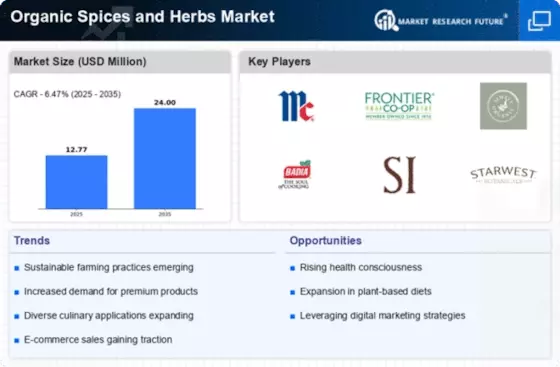
As per analysis, the US organic spices herbs market is projected to grow from USD 2.26 Million in 2025 to USD 3.93 Million by 2035, exhibiting a compound annual growth rate (CAGR) of 5.86% during the forecast period (2025 - 2035).

Key Market Trends & Highlights

The US organic spices and herbs market is experiencing robust growth driven by health consciousness and sustainability.

  • The culinary segment remains the largest, reflecting a strong consumer preference for flavor enhancement and natural ingredients.
  • The medicinal segment is the fastest-growing, as consumers increasingly seek natural remedies and health benefits from herbs.
  • Online retail is the largest distribution channel, capitalizing on the convenience and accessibility of e-commerce for organic products.
  • Health consciousness and sustainability in sourcing are key drivers, propelling demand for organic spices and herbs.

Market Size & Forecast

2024 Market Size 2.1 (USD Million)
2035 Market Size 3.93 (USD Million)
CAGR (2025 - 2035) 5.86%

Major Players

<p>McCormick & Company (US), Frontier Co-op (US), Simply Organic (US), Spice Islands (US), Badia Spices (US), Penzeys Spices (US), The Spice House (US), Organic Spices (US)</p>

Market Trends

The US organic spices herbs market is currently experiencing a notable transformation, driven by a growing consumer preference for natural and organic products. This shift is largely influenced by increasing awareness regarding health benefits associated with organic spices and herbs. Consumers are becoming more discerning, seeking products that not only enhance flavor but also contribute to overall well-being. Retailers are responding to this demand by expanding their organic offerings, which may include a diverse range of spices and herbs sourced from sustainable practices. Furthermore, the rise of e-commerce platforms has facilitated easier access to organic products, allowing consumers to explore a wider variety of options than ever before. In addition to changing consumer preferences, the US organic spices herbs market is also witnessing innovations in packaging and product development. Companies are increasingly focusing on eco-friendly packaging solutions, which align with the values of environmentally conscious consumers. This trend suggests a potential for growth in the market as businesses adapt to meet the expectations of their clientele. Overall, the US organic spices herbs market appears poised for continued expansion, driven by health consciousness, sustainability, and innovation in product offerings.

Health Consciousness Drives Demand

The increasing awareness of health benefits associated with organic spices and herbs is significantly influencing consumer choices. As individuals prioritize wellness, they are more inclined to select organic options that are perceived as healthier alternatives to conventional products.

Sustainability in Sourcing

There is a growing emphasis on sustainable sourcing practices within the US organic spices herbs market. Consumers are increasingly interested in products that are not only organic but also sourced in a manner that supports environmental sustainability and ethical farming practices.

E-commerce Expansion

The rise of e-commerce platforms is reshaping the way consumers access organic spices and herbs. Online shopping provides convenience and a broader selection, enabling consumers to discover and purchase organic products that may not be available in traditional retail settings.

Organic Spices Herbs Market Market Drivers

E-commerce Expansion

The rapid expansion of e-commerce platforms has significantly transformed the landscape of the US organic spices herbs market. With the increasing reliance on online shopping, consumers now have greater access to a diverse range of organic spices and herbs. This shift is particularly evident in the wake of technological advancements and the proliferation of digital payment options, which facilitate seamless online transactions. Data indicates that online sales of organic products, including spices and herbs, have been on the rise, with many consumers preferring the convenience of purchasing from home. Consequently, businesses that invest in robust e-commerce strategies may find themselves well-positioned to capture a larger share of the US organic spices herbs market, as they cater to the evolving preferences of tech-savvy consumers.

Sustainability in Sourcing

Sustainability has emerged as a crucial factor influencing consumer purchasing decisions in the US organic spices herbs market. Many consumers are increasingly concerned about the environmental impact of their food choices, leading to a preference for sustainably sourced organic spices and herbs. This trend is reflected in the growing number of certifications and labels that emphasize sustainable farming practices. For instance, the USDA Organic certification not only assures consumers of organic integrity but also often aligns with sustainable agricultural practices. As a result, brands that prioritize sustainability in their sourcing strategies may gain a competitive edge in the market. The US organic spices herbs market is likely to benefit from this shift, as consumers are willing to pay a premium for products that align with their values regarding environmental stewardship.

Culinary Trends and Global Flavors

The growing interest in culinary exploration and The us organic spices herbs market. As consumers become more adventurous in their cooking, they are increasingly seeking out unique and exotic spices and herbs to enhance their culinary experiences. This trend is reflected in the rising popularity of international cuisines, which often incorporate a variety of organic spices and herbs. Market data suggests that the demand for specialty spices, such as turmeric and saffron, has surged as consumers look to experiment with new flavors. As a result, suppliers and retailers in the US organic spices herbs market may need to adapt their offerings to meet this evolving consumer demand, potentially leading to the introduction of new product lines and flavor combinations.

Health Consciousness Drives Demand

The increasing awareness of health and wellness among consumers appears to be a primary driver for the US organic spices herbs market. As individuals become more health-conscious, they tend to seek out organic options that are perceived as healthier alternatives to conventional spices and herbs. According to recent data, the organic food market in the US has been growing steadily, with organic spices and herbs witnessing a notable surge in demand. This trend is likely influenced by the rising prevalence of dietary restrictions and the desire for natural ingredients free from synthetic additives. Consequently, the US organic spices herbs market is experiencing a shift towards products that promote health benefits, such as anti-inflammatory properties and enhanced flavor profiles, which may further stimulate consumer interest.

Regulatory Support for Organic Farming

Regulatory frameworks supporting organic farming practices are playing a pivotal role in shaping the US organic spices herbs market. The USDA's National Organic Program (NOP) establishes standards for organic production, which not only ensures product integrity but also fosters consumer trust. This regulatory support encourages farmers to transition to organic practices, thereby increasing the supply of organic spices and herbs in the market. As more producers adopt organic farming methods, the US organic spices herbs market is likely to experience enhanced growth, driven by a more robust supply chain. Furthermore, government initiatives aimed at promoting organic agriculture may provide additional incentives for farmers, further bolstering the industry's expansion and sustainability.

Market Segment Insights

By Application: Culinary (Largest) vs. Medicinal (Fastest-Growing)

<p>In the US organic spices and herbs market, the application segment showcases a diverse array of uses. Culinary applications dominate the market, leveraging the growing trend towards organic cooking and the use of fresh herbs and spices in everyday recipes. The culinary segment significantly outpaces others, indicating the increasing consumer preference for natural ingredients in food preparation. Meanwhile, the medicinal application emerges as a rapidly growing segment, driven by the rising awareness of natural remedies and health benefits associated with various organic spices and herbs. The growth trends within the application segment are reinforced by shifting consumer attitudes towards health and wellness. The demand for medicinal applications is propelled by an increasing inclination towards holistic health practices, as consumers seek alternatives to conventional medicine. Additionally, the cosmetic and aromatherapy segments are witnessing gradual adoption rates as people become more aware of the benefits of organic products. This trend is likely to continue, further emphasizing the potential for growth across all these application sectors.</p>

<p>Culinary: Dominant vs. Medicinal: Emerging</p>

<p>The culinary application of organic spices and herbs holds the dominant position in the US market, characterized by a robust consumer base that prioritizes flavorful and healthy cooking options. This segment appeals greatly to home cooks and chefs seeking premium organic products to enhance their dishes, leading to a steady demand. In contrast, the medicinal application is emerging, gaining traction as consumers increasingly recognize the health benefits associated with natural herbs and spices. This segment is marked by a growing trend towards using organic ingredients for wellness, such as turmeric for inflammation and ginger for digestion. The combination of consumer education and the shift towards preventive healthcare is driving the growth of the medicinal segment, setting the stage for a healthy expansion in the organic spices and herbs market.</p>

By Distribution Channel: Online Retail (Largest) vs. Supermarkets (Fastest-Growing)

<p>In the US organic spices and herbs market, Online Retail holds the largest share as consumers increasingly prefer convenience and ease of access to products. This channel benefits from the growth of e-commerce, allowing a wide variety of organic spices and herbs to be accessible from the comfort of home. In comparison, Supermarkets, while traditionally strong, are facing competition as online platforms expand their offerings significantly, particularly during the ongoing shifts in consumer purchasing behavior. The growth trends in this segment are primarily driven by changing consumer preferences towards organic products and the convenience of delivery options. Specialty Stores and Health Food Stores, while experiencing steady demand, are not growing as rapidly as Online Retail and Supermarkets. The online channel's rise reflects broader trends in digital shopping habits, with many consumers favoring the flexibility of online orders, which has accelerated during recent global events shaping retail landscapes.</p>

<p>Online Retail (Dominant) vs. Health Food Stores (Emerging)</p>

<p>Online Retail is dominating the US organic spices and herbs market, driven by convenience, accessibility, and a broad array of product offerings. Consumers are increasingly turning to digital platforms for their grocery needs, seeking a variety of organic spice and herb products at competitive prices. This channel allows consumers to explore brands and products that may not be available locally. Conversely, Health Food Stores are considered an emerging segment, appealing primarily to health-conscious consumers seeking organic and specialty offerings. While they provide personalized shopping experiences and a curated selection, their market presence is limited compared to the extensive reach of Online Retail, and they are adapting to embrace e-commerce to stay relevant.</p>

By Form: Whole Spices (Largest) vs. Ground Spices (Fastest-Growing)

<p>In the US organic spices and herbs market, Whole Spices account for the largest share, driven by consumers' preferences for unprocessed and minimally processed ingredients. Ground Spices follow, gaining traction among consumers looking for convenience and short preparation times. Herbal Teas and Extracts also contribute to the market, appealing to health-conscious consumers seeking natural alternatives. While Whole Spices maintain a strong market presence, the shift towards ready-to-use options is influencing the dynamics of the segment. The growth trends in this segment are influenced by several factors, including an increasing awareness of the health benefits associated with organic spices and herbs. Ground Spices are emerging as the fastest-growing segment due to their convenience and versatility in various culinary applications. Additionally, the rise in demand for herbal teas, associated with wellness trends, reflects changing consumer preferences towards organic and natural products, further enhancing the segment's growth potential.</p>

<p>Whole Spices: Dominant vs. Ground Spices: Emerging</p>

<p>Whole Spices are viewed as a dominant force in the US organic spices and herbs market, largely due to their preference among chefs and home cooks for unground options that retain natural oils and flavors. They provide culinary versatility and allow for customized blending, appealing particularly to organic fans who favor holistic cooking methodologies. Conversely, Ground Spices are rapidly emerging as a favored choice among busy consumers who value ease of use and quick meal preparation. Their popularity is further propelled by the growing trend of ready-to-eat meals and spice blends that require little to no additional preparation, making them a staple in modern kitchens.</p>

By End Use: Household (Largest) vs. Food Service (Fastest-Growing)

<p>In the US organic spices and herbs market, the Household segment holds the largest share, reflecting a strong consumer preference for organic options in home cooking. This segment is driven by a growing awareness of health benefits and an increasing trend towards home-cooked meals among consumers. Food Service, on the other hand, is rapidly gaining traction, as restaurants and food chains integrate organic ingredients into their offerings to meet the rising demand for healthy dining options. The collaboration between suppliers and foodservice operators is also enhancing the availability of organic spices and herbs in this segment.</p>

<p>Household (Dominant) vs. Food Service (Emerging)</p>

<p>The Household segment is characterized by a diverse range of organic spices and herbs being used in everyday cooking, emphasizing flavor and health benefits. It is dominated by retail sales through supermarkets and online platforms, catering to health-conscious consumers who prioritize organic products. Conversely, the Food Service segment, although currently smaller, is emerging rapidly due to the trend of healthy eating and sustainable sourcing. Restaurants and catering services are expanding their menus to include organic options, attracting consumers looking for quality dining experiences. This shifting focus towards organic ingredients presents significant opportunities for growth and innovation within the Food Service segment.</p>

Get more detailed insights about Organic Spices and Herbs Market Research Report- Forecast to 2035

Regional Insights

North America : Market Leader in Organic Spices

North America is poised to maintain its leadership in the organic spices and herbs market, holding a significant market share of 5.99 in 2024. The growth is driven by increasing consumer awareness regarding health benefits, coupled with a rising demand for organic products. Regulatory support, including stringent food safety standards, further catalyzes market expansion, ensuring high-quality offerings for consumers. The United States stands as the primary market within North America, showcasing a competitive landscape with key players like McCormick & Company, Frontier Co-op, and Simply Organic. These companies leverage innovative marketing strategies and product diversification to capture consumer interest. The presence of established distribution channels enhances market accessibility, contributing to the region's robust growth trajectory.

Europe : Emerging Market for Organic Products

Europe is witnessing a burgeoning interest in organic spices and herbs, with a market size of 3.0 in 2025. This growth is fueled by increasing health consciousness among consumers and a shift towards sustainable agricultural practices. Regulatory frameworks, such as the EU Organic Regulation, promote organic farming, ensuring product integrity and safety, which further drives demand. Leading countries like Germany, France, and the UK are at the forefront of this market, with a competitive landscape featuring key players such as Döhler and Olam International. The region's diverse culinary traditions and increasing popularity of organic products create a favorable environment for market expansion. The presence of established retailers and online platforms enhances product availability, catering to the growing consumer base.

Asia-Pacific : Emerging Powerhouse in Spices

Asia-Pacific is emerging as a significant player in the organic spices and herbs market, with a market size of 2.0 in 2025. The region's growth is driven by rising disposable incomes, urbanization, and a growing preference for organic food products. Additionally, government initiatives promoting organic farming practices are enhancing market potential, making organic spices more accessible to consumers. Countries like India and Australia are leading the charge, with a competitive landscape that includes both local and international players. Companies such as Olam International are expanding their footprint in the region, leveraging local sourcing and distribution networks. The increasing awareness of health benefits associated with organic spices is further propelling market growth, positioning Asia-Pacific as a key region for future investments.

Middle East and Africa : Resource-Rich Frontier for Spices

The Middle East and Africa region is gradually emerging in the organic spices and herbs market, with a market size of 1.0 in 2025. The growth is primarily driven by increasing consumer awareness of health benefits and a shift towards organic food consumption. Regulatory frameworks are evolving to support organic farming, which is crucial for market development in this region. Countries like South Africa and the UAE are leading the market, with a competitive landscape that includes both local producers and international brands. The presence of key players such as Badia Spices and Spice Islands is enhancing market visibility. As the region's consumers become more health-conscious, the demand for organic spices is expected to rise, creating opportunities for growth and investment.

Key Players and Competitive Insights

The US organic spices and herbs market is characterized by a dynamic competitive landscape, driven by increasing consumer demand for organic products and a growing awareness of health benefits associated with natural ingredients. Key players such as McCormick & Company (US), Frontier Co-op (US), and Simply Organic (US) are strategically positioned to leverage these trends. McCormick & Company (US) focuses on innovation and product diversification, continually expanding its organic offerings to cater to health-conscious consumers. Frontier Co-op (US) emphasizes sustainability and ethical sourcing, which resonates well with its target demographic. Simply Organic (US) has carved a niche by promoting its commitment to organic farming practices, thereby enhancing its brand loyalty among environmentally conscious consumers. Collectively, these strategies contribute to a competitive environment that prioritizes quality, sustainability, and consumer engagement.

In terms of business tactics, companies are increasingly localizing manufacturing and optimizing supply chains to enhance efficiency and reduce costs. The market structure appears moderately fragmented, with several players competing for market share. However, the influence of key players is substantial, as they set industry standards and drive innovation. This competitive structure allows for a diverse range of products, catering to various consumer preferences and dietary needs.

In December 2025, McCormick & Company (US) announced a partnership with a leading tech firm to integrate AI into its supply chain management. This strategic move is likely to enhance operational efficiency and improve demand forecasting, positioning McCormick to respond more adeptly to market fluctuations. The integration of AI could also facilitate better inventory management, reducing waste and ensuring product availability.

In November 2025, Frontier Co-op (US) launched a new line of sustainably sourced spices, highlighting its commitment to environmental stewardship. This initiative not only strengthens its brand image but also aligns with the growing consumer preference for eco-friendly products. By focusing on sustainability, Frontier Co-op is likely to attract a broader customer base, particularly among younger consumers who prioritize ethical consumption.

In October 2025, Simply Organic (US) expanded its distribution channels by entering into a collaboration with major grocery chains across the US. This strategic action is expected to enhance product accessibility, allowing Simply Organic to reach a wider audience. The expansion into mainstream retail could significantly boost sales and brand visibility, reinforcing its position in the market.

As of January 2026, current competitive trends in the US organic spices and herbs market include a pronounced shift towards digitalization, sustainability, and the integration of advanced technologies such as AI. Strategic alliances are increasingly shaping the landscape, enabling companies to pool resources and expertise. Looking ahead, competitive differentiation is likely to evolve, with a greater emphasis on innovation and technology rather than solely on price. Companies that can effectively leverage these trends will likely secure a competitive edge, ensuring reliability in supply chains and responsiveness to consumer demands.

Key Companies in the Organic Spices Herbs Market include

Industry Developments

    • The Global Organic Spices and Herbs market is estimated to reach USD 510.6 million by 2030 with a growth rate of 7.78%
    • The essential oil form of organic spices and herbs will rise at impressing rate of 4.11% during the forecast period
    • Innovation in farming is the key to success

Report Outlook

    • Market overview highlights the global recognition of the Global Organic Spices and Herbs market
    • Analysis based upon COVID 19
    • Explanation upon the Market Dynamics
    • Market segmentation overview
    • The regional analysis of the Flavored Spirits Market
    • Competitive landscape analysis
    • Recent Developments of Flavored Spirits Market

Future Outlook

Organic Spices Herbs Market Future Outlook

The US organic spices and herbs market is projected to grow at a 5.86% CAGR from 2025 to 2035, driven by increasing health consciousness and demand for natural products.

New opportunities lie in:

  • Expansion of e-commerce platforms for organic spices
  • Development of subscription-based spice delivery services
  • Investment in sustainable farming practices for spice cultivation

By 2035, the market is expected to be robust, reflecting strong consumer demand and innovative business strategies.

Market Segmentation

Organic Spices Herbs Market Form Outlook

  • Whole Spices
  • Ground Spices
  • Herbal Teas
  • Extracts

Organic Spices Herbs Market End Use Outlook

  • Household
  • Food Service
  • Pharmaceuticals
  • Cosmetics

Organic Spices Herbs Market Application Outlook

  • Culinary
  • Medicinal
  • Cosmetic
  • Aromatherapy

Organic Spices Herbs Market Distribution Channel Outlook

  • Online Retail
  • Supermarkets
  • Health Food Stores
  • Specialty Stores

Report Scope

MARKET SIZE 20242.1(USD Million)
MARKET SIZE 20252.26(USD Million)
MARKET SIZE 20353.93(USD Million)
COMPOUND ANNUAL GROWTH RATE (CAGR)5.86% (2024 - 2035)
REPORT COVERAGERevenue Forecast, Competitive Landscape, Growth Factors, and Trends
BASE YEAR2024
Market Forecast Period2025 - 2035
Historical Data2019 - 2024
Market Forecast UnitsUSD Million
Key Companies ProfiledMcCormick & Company (US), Frontier Co-op (US), Simply Organic (US), Spice Islands (US), Badia Spices (US), Penzeys Spices (US), The Spice House (US), Organic Spices (US)
Segments CoveredApplication, Distribution Channel, Form, End Use
Key Market OpportunitiesGrowing consumer demand for organic products drives innovation in the us organic spices herbs market.
Key Market DynamicsRising consumer demand for organic products drives innovation and competition in the US organic spices and herbs market.
Countries CoveredUS

FAQs

What is the current valuation of the US organic spices and herbs market?

The market valuation was 2.1 USD Million in 2024.

What is the projected market size for the US organic spices and herbs market by 2035?

The projected valuation for 2035 is 3.93 USD Million.

What is the expected CAGR for the US organic spices and herbs market during the forecast period?

The expected CAGR for the market from 2025 to 2035 is 5.86%.

Which companies are the key players in the US organic spices and herbs market?

Key players include McCormick & Company, Frontier Co-op, Simply Organic, and others.

  1. SECTION I: EXECUTIVE SUMMARY AND KEY HIGHLIGHTS
    1. EXECUTIVE SUMMARY
      1. Market Overview
      2. Key Findings
      3. Market Segmentation
      4. Competitive Landscape
      5. Challenges and Opportunities
      6. Future Outlook
  2. SECTION II: SCOPING, METHODOLOGY AND MARKET STRUCTURE
    1. MARKET INTRODUCTION
      1. Definition
      2. Scope of the study
    2. RESEARCH METHODOLOGY
      1. Overview
      2. Data Mining
      3. Secondary Research
      4. Primary Research
      5. Forecasting Model
      6. Market Size Estimation
      7. Data Triangulation
      8. Validation
  3. SECTION III: QUALITATIVE ANALYSIS
    1. MARKET DYNAMICS
      1. Overview
      2. Drivers
      3. Restraints
      4. Opportunities
    2. MARKET FACTOR ANALYSIS
      1. Value chain Analysis
      2. Porter's Five Forces Analysis
      3. COVID-19 Impact Analysis
  4. SECTION IV: QUANTITATIVE ANALYSIS
    1. Food, Beverages & Nutrition, BY Application (USD Million)
      1. Culinary
      2. Medicinal
      3. Cosmetic
      4. Aromatic
      5. Preservative
    2. Food, Beverages & Nutrition, BY Form (USD Million)
      1. Whole
      2. Ground
      3. Extract
      4. Powder
      5. Flakes
    3. Food, Beverages & Nutrition, BY Distribution Channel (USD Million)
      1. Online
      2. Supermarket
      3. Specialty Store
      4. Health Food Store
      5. Direct Sales
    4. Food, Beverages & Nutrition, BY End Use (USD Million)
      1. Household
      2. Food Industry
      3. Pharmaceuticals
      4. Cosmetics
      5. Beverage Industry
    5. Food, Beverages & Nutrition, BY Source (USD Million)
      1. Plant-Based
      2. Wildcrafted
      3. Cultivated
      4. Organic
      5. Non-Organic
    6. Food, Beverages & Nutrition, BY Region (USD Million)
      1. North America
      2. Europe
      3. APAC
      4. South America
      5. MEA
  5. SECTION V: COMPETITIVE ANALYSIS
    1. Competitive Landscape
      1. Overview
      2. Competitive Analysis
      3. Market share Analysis
      4. Major Growth Strategy in the Food, Beverages & Nutrition
      5. Competitive Benchmarking
      6. Leading Players in Terms of Number of Developments in the Food, Beverages & Nutrition
      7. Key developments and growth strategies
      8. Major Players Financial Matrix
    2. Company Profiles
      1. McCormick & Company (US)
      2. Olam International (SG)
      3. Döhler (DE)
      4. Frontier Co-op (US)
      5. Spice Islands (US)
      6. Simply Organic (US)
      7. Starwest Botanicals (US)
      8. Badia Spices (US)
      9. Penzeys Spices (US)
    3. Appendix
      1. References
      2. Related Reports

Food, Beverages & Nutrition Market Segmentation

Food, Beverages & Nutrition By Application (USD Million, 2025-2035)

  • Culinary
  • Medicinal
  • Cosmetic
  • Aromatic
  • Preservative

Food, Beverages & Nutrition By Form (USD Million, 2025-2035)

  • Whole
  • Ground
  • Extract
  • Powder
  • Flakes

Food, Beverages & Nutrition By Distribution Channel (USD Million, 2025-2035)

  • Online
  • Supermarket
  • Specialty Store
  • Health Food Store
  • Direct Sales

Food, Beverages & Nutrition By End Use (USD Million, 2025-2035)

  • Household
  • Food Industry
  • Pharmaceuticals
  • Cosmetics
  • Beverage Industry

Food, Beverages & Nutrition By Source (USD Million, 2025-2035)

  • Plant-Based
  • Wildcrafted
  • Cultivated
  • Organic
  • Non-Organic
Infographic

Free Sample Request

Kindly complete the form below to receive a free sample of this Report

Get Free Sample

Customer Strories

Compare Licence

×
Features License Type
Single User Multiuser License Enterprise User
Price $4,950 $5,950 $7,250
Maximum User Access Limit 1 User Upto 10 Users Unrestricted Access Throughout the Organization
Free Customization
Direct Access to Analyst
Deliverable Format
Platform Access
Discount on Next Purchase 10% 15% 15%
Printable Versions