×
Request Free Sample ×

Kindly complete the form below to receive a free sample of this Report

* Please use a valid business email

Leading companies partner with us for data-driven Insights

clients tt-cursor
Hero Background
English
Chinese
French
Japanese
Korean
German
Spanish

Organic Natural Feminine Care Market Trends

ID: MRFR/HC/5972-CR
111 Pages
Kinjoll Dey
February 2019

Organic and Natural Feminine Care Market Research Report Information by Product (Panty Liners & Shields, Sanitary Pads, Tampons), by Distribution Channel (Online Purchase, Retail Pharmacies, Supermarkets & Hypermarkets), and Region - Forecast till 2035

Share:
Download PDF ×

We do not share your information with anyone. However, we may send you emails based on your report interest from time to time. You may contact us at any time to opt-out.

Organic Natural Feminine Care Market Infographic
Purchase Options

Market Trends

Key Emerging Trends in the Organic Natural Feminine Care Market

The menstrual products market is experiencing a notable upswing in demand and consumer interest in organic and natural alternatives, driven by their skin-friendly and environmentally conscious attributes. As awareness grows regarding the potential health and environmental risks associated with conventional menstrual products, consumers are actively seeking alternatives that prioritize both personal well-being and sustainability. Organic and natural menstrual products distinguish themselves by being crafted from non-genetically modified (non-GMO) certified organic cotton. This choice of material eliminates artificial dyes, rayon, and fragrances, addressing concerns related to skin irritation and rashes often associated with conventional products. Beyond skin-related issues, there is a heightened awareness of the potential health risks posed by the use of conventional menstrual products, with concerns ranging from cancer to neurological damage and other chronic or acute diseases. The World Health Organization (WHO) has drawn attention to the significant health risks linked to conventional cotton farming. Shockingly, WHO reports that approximately 20,000 people lose their lives each year in developing countries due to cancer and miscarriages attributed to the chemicals sprayed on conventional cotton. This grim reality underscores the urgent need for alternatives, as conventional menstrual products can be a source of exposure to harmful substances that may have severe health implications. Furthermore, the adverse impact extends to farmers working in conventional cotton farms. Overexposure to hazardous pesticides has led to serious health problems among these farmers, including asthma, neurological damage, and cancer. The toll on the health of those involved in conventional cotton production emphasizes the broader health and environmental consequences of conventional menstrual products. In response to these concerns, the demand for organic and natural menstrual products is on the rise. Consumers are opting for products manufactured with organic cotton that is cultivated without the use of synthetic pesticides and fertilizers. This not only addresses health concerns but also aligns with environmentally sustainable farming practices, reducing the ecological footprint associated with conventional cotton production. The shift toward organic and natural menstrual products signifies a broader trend wherein consumers are increasingly prioritizing sustainability and health consciousness. The market growth in this segment is driven by individuals making informed choices that consider both personal well-being and environmental impact. Brands and manufacturers responding to this demand are well-positioned to capture market share and contribute to reshaping the menstrual product industry into one that is more sustainable and health-focused. As the awareness of the potential risks associated with conventional menstrual products continues to grow, the market for organic and natural alternatives is expected to expand, driven by a consumer base seeking products that offer a safer and more environmentally responsible choice for menstrual hygiene.

Author
Kinjoll Dey
Senior Research Analyst

He is an extremely curious individual currently working in Healthcare and Medical Devices Domain. Kinjoll is comfortably versed in data centric research backed by healthcare educational background. He leverages extensive data mining and analytics tools such as Primary and Secondary Research, Statistical Analysis, Machine Learning, Data Modelling. His key role also involves Technical Sales Support, Client Interaction and Project management within the Healthcare team. Lastly, he showcases extensive affinity towards learning new skills and remain fascinated in implementing them.

Leave a Comment

FAQs

What is the current valuation of the Organic and Natural Feminine Care Market?

<p>The market valuation was 0.7514 USD Billion in 2024.</p>

What is the projected market size for the Organic and Natural Feminine Care Market by 2035?

<p>The market is projected to reach 1.64 USD Billion by 2035.</p>

What is the expected CAGR for the Organic and Natural Feminine Care Market during the forecast period?

<p>The expected CAGR for the market from 2025 to 2035 is 7.35%.</p>

Which product segment holds the highest valuation in the Organic and Natural Feminine Care Market?

<p>Sanitary Pads held a valuation of 0.3 USD Billion in 2024 and is projected to grow significantly.</p>

How do online purchases compare to other distribution channels in the market?

<p>Online purchases were valued at 0.2514 USD Billion in 2024 and are expected to increase to 0.54 USD Billion by 2035.</p>

Who are the key players in the Organic and Natural Feminine Care Market?

Key players include Natracare, Seventh Generation, Organyc, Cora, Lola, Rael, The Honey Pot, and Sustain Natural.

What is the valuation of the Panty Liners & Shields segment in 2024?

The Panty Liners &amp; Shields segment was valued at 0.2 USD Billion in 2024.

What is the projected growth for the Tampons segment by 2035?

The Tampons segment is expected to grow from 0.2514 USD Billion in 2024 to 0.49 USD Billion by 2035.

How does the retail pharmacy distribution channel perform in the market?

Retail Pharmacies had a valuation of 0.2 USD Billion in 2024 and are projected to grow to 0.4 USD Billion by 2035.

What trends are influencing the growth of the Organic and Natural Feminine Care Market?

The increasing consumer preference for organic products and sustainability is likely driving market growth.

Market Summary

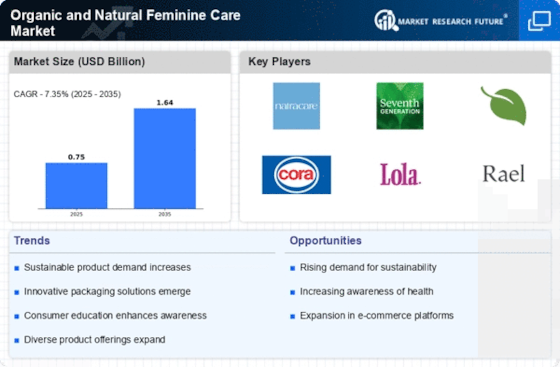
As per Market Research Future analysis, the Organic and Natural Feminine Care Market Size was estimated at 0.7514 USD Billion in 2024. The Organic and Natural Feminine Care industry is projected to grow from USD 0.8067 Billion in 2025 to USD 1.64 Billion by 2035, exhibiting a compound annual growth rate (CAGR) of 7.35% during the forecast period 2025 - 2035

Key Market Trends & Highlights

The Organic and Natural Feminine Care Market is experiencing a robust shift towards sustainability and personalization.

  • The market is increasingly characterized by a strong focus on sustainability and eco-friendly practices, particularly in North America. Ingredient transparency is becoming a critical factor for consumers, driving demand for products that clearly disclose their components. Personalization of feminine care products is gaining traction, especially among younger consumers in the Asia-Pacific region. Rising consumer awareness and regulatory support for natural products are key drivers propelling the growth of sanitary pads and online purchases.

Market Size & Forecast

2024 Market Size 0.7514 (USD Billion)
2035 Market Size 1.64 (USD Billion)
CAGR (2025 - 2035) 7.35%
Largest Regional Market Share in 2024 North America

Major Players

Natracare (GB), Seventh Generation (US), Organyc (IT), Cora (US), Lola (US), Rael (US), The Honey Pot (US), Sustain Natural (US)

Market Trends

The Organic and Natural Feminine Care Market is currently experiencing a notable shift towards products that prioritize health and environmental sustainability. Consumers are increasingly aware of the ingredients in their personal care items, leading to a growing demand for organic and natural alternatives. This trend is driven by a desire for safer, chemical-free options that align with a more holistic approach to health. As awareness of the potential risks associated with synthetic materials rises, brands are responding by reformulating their products to meet these evolving consumer preferences.

Moreover, the market landscape is becoming more competitive as new entrants emerge, offering innovative solutions that cater to the diverse needs of women. This includes a range of products such as organic cotton pads, menstrual cups, and natural intimate washes. The emphasis on transparency in sourcing and production processes is also becoming a focal point for consumers, who are increasingly seeking brands that demonstrate ethical practices. As the Organic and Natural Feminine Care Market continues to evolve, it appears poised for sustained growth, driven by a combination of consumer demand and industry innovation.

Sustainability Focus

There is a growing emphasis on sustainability within the Organic and Natural Feminine Care Market. Brands are increasingly adopting eco-friendly practices, such as using biodegradable materials and sustainable sourcing methods. This trend reflects a broader societal shift towards environmental consciousness, as consumers seek products that minimize their ecological footprint.

Ingredient Transparency

Consumers are demanding greater transparency regarding the ingredients used in feminine care products. This trend indicates a shift towards informed purchasing decisions, with individuals increasingly scrutinizing labels for harmful chemicals. Brands that prioritize clear communication about their formulations are likely to gain consumer trust and loyalty.

Personalization of Products

The Organic and Natural Feminine Care Market is witnessing a trend towards personalized products tailored to individual needs. This includes customizable options that address specific concerns, such as sensitivity or hormonal fluctuations. Such personalization not only enhances user experience but also fosters a deeper connection between consumers and brands.

Organic Natural Feminine Care Market Market Drivers

Rising Consumer Awareness

The Organic and Natural Feminine Care Market is experiencing a notable increase in consumer awareness regarding the health implications of personal care products. As individuals become more informed about the potential risks associated with synthetic chemicals, there is a growing preference for organic and natural alternatives. This shift is reflected in market data, which indicates that the demand for organic feminine hygiene products has surged by approximately 20% over the past year. Consumers are actively seeking products that are free from harmful additives, which is driving innovation and expansion within the Organic and Natural Feminine Care Market.

Increased Focus on Women's Health

There is a growing emphasis on women's health and wellness, which is significantly influencing the Organic and Natural Feminine Care Market. As women become more proactive about their health, they are seeking products that align with their values and health goals. This trend is reflected in the rising sales of organic menstrual products and intimate care items, which have seen a growth rate of 18% in recent years. The focus on holistic health and well-being is prompting brands to develop innovative solutions that cater to the specific needs of women, thereby enhancing the overall appeal of the Organic and Natural Feminine Care Market.

Shift Towards Eco-Friendly Packaging

The Organic and Natural Feminine Care Market is witnessing a significant shift towards eco-friendly packaging solutions. As environmental concerns become more pronounced, consumers are increasingly favoring brands that prioritize sustainability in their packaging choices. This trend is evidenced by a 30% increase in sales for products utilizing biodegradable or recyclable materials. Companies are responding by innovating their packaging strategies, which not only aligns with consumer values but also enhances brand loyalty. The emphasis on sustainable packaging is likely to play a crucial role in shaping the future landscape of the Organic and Natural Feminine Care Market.

Regulatory Support for Natural Products

Regulatory frameworks are increasingly favoring the Organic and Natural Feminine Care Market, as governments worldwide implement stricter guidelines on chemical usage in personal care products. This regulatory support not only encourages manufacturers to adopt organic practices but also enhances consumer trust in these products. For instance, recent legislation has mandated clearer labeling of ingredients, allowing consumers to make informed choices. As a result, the market for organic feminine care products is projected to grow at a compound annual growth rate of 15% over the next five years, indicating a robust future for the Organic and Natural Feminine Care Market.

Influence of Social Media and Influencers

The rise of social media platforms has profoundly impacted the Organic and Natural Feminine Care Market. Influencers and health advocates are leveraging these platforms to promote awareness about the benefits of organic feminine care products. This digital marketing strategy has proven effective, as it reaches a broad audience and fosters community discussions around personal care choices. Market analysis suggests that brands engaging with influencers see a 25% increase in consumer engagement and sales. Consequently, the influence of social media is likely to continue driving growth and shaping consumer perceptions within the Organic and Natural Feminine Care Market.

Market Segment Insights

By Product: Sanitary Pads (Largest) vs. Tampons (Fastest-Growing)

In the Organic and Natural Feminine Care Market, sanitary pads hold the largest share, largely due to their widespread acceptance and availability. The convenience and comfort provided by these products have led to consistent demand among consumers. Moreover, as manufacturers focus on eco-friendly materials, the appeal of organic sanitary pads continues to attract environmentally conscious buyers. In contrast, tampons are emerging as the fastest-growing segment, driven by increased consumer awareness of the benefits of organic materials and a shift towards more sustainable options. With new brands entering the space and promoting organic certifications, tampons are gaining traction rapidly.

Sanitary Pads (Dominant) vs. Tampons (Emerging)

Sanitary pads dominate the Organic and Natural Feminine Care Market primarily due to their user-friendly design and extensive variety. Offering options for different absorbencies and sizes, they cater to a broad spectrum of preferences. Their growth has been further supported by continuous innovation, including the use of organic cotton and other natural materials that enhance safety and comfort. On the other hand, tampons, once overshadowed, are now an emerging force in the market. Their market position is bolstered by consumer shifts toward convenience and sustainability. Brands are increasingly introducing organic tampons, appealing to a demographic that values eco-friendly products. This combination of factors positions both products as vital players in the feminine care landscape.

By Distribution Channel: Supermarkets & Hypermarkets (Largest) vs. Online Purchase (Fastest-Growing)

In the Organic and Natural Feminine Care Market, the distribution of sales among various channels highlights the strong preference for traditional shopping venues. Supermarkets and hypermarkets dominate this segment, serving as the primary point of sale for many consumers who prioritize convenience and accessibility. Their extensive reach and ability to provide a wide selection of feminine care products contribute significantly to their market share position. The strong footfall in these establishments also aids in boosting organic product visibility and availability. Conversely, the online purchase segment is emerging rapidly, catering to a growing demographic of consumers who favor the convenience and discretion of online shopping. This shift is largely driven by technological advancements and changing consumer behaviors, particularly among younger demographics who opt for e-commerce solutions. The increasing focus on organic and natural products is also motivating online retailers to expand their offerings, thereby creating a robust platform for this segment's growth.

Supermarkets &amp; Hypermarkets: Dominant vs. Online Purchase: Emerging

Supermarkets and hypermarkets remain the dominant players in the distribution of organic and natural feminine care products, leveraging their extensive networks and customer bases. They offer an expansive range of products, ensuring that consumers can easily access various organic options under one roof. This segment benefits from established brand loyalty and in-store promotions that encourage purchasing decisions. In contrast, the online purchase segment is rapidly emerging as a preferred channel, especially among tech-savvy consumers. Factors driving this growth include the convenience of home delivery, the ability to compare prices easily, and access to niche brands that may not be available in physical stores. As both segments continue to evolve, the competition between them is likely to intensify, with each channel working to meet consumer demands more effectively.

Get more detailed insights about Organic and Natural Feminine Care Market Research Report – Forecast till 2035

Regional Insights

North America : Sustainable Market Leaders

North America is the largest market for organic and natural feminine care products, holding approximately 45% of the global market share. The growth is driven by increasing consumer awareness regarding health and environmental issues, alongside a shift towards sustainable products. Regulatory support, such as the FDA's guidelines on organic labeling, further catalyzes market expansion. The demand for eco-friendly and chemical-free products is on the rise, reflecting a broader trend towards sustainability. The United States leads the market, followed by Canada, with key players like Seventh Generation, Cora, and Rael dominating the landscape. The competitive environment is characterized by innovation and a focus on product quality. Companies are increasingly investing in marketing strategies that emphasize the benefits of organic ingredients, appealing to health-conscious consumers. The presence of established brands and new entrants fosters a dynamic market atmosphere, enhancing consumer choice.

Europe : Emerging Regulatory Frameworks

Europe is the second-largest market for organic and natural feminine care, accounting for approximately 30% of the global share. The region's growth is propelled by stringent regulations on chemical use in personal care products, alongside a rising consumer preference for organic options. The European Union's REACH regulation plays a crucial role in shaping market dynamics, ensuring safety and sustainability in product formulations. This regulatory framework encourages brands to innovate and meet consumer demands for transparency and eco-friendliness. Leading countries in this market include Germany, France, and the UK, where brands like Organyc and Natracare are well-established. The competitive landscape is marked by a mix of local and international players, all vying for market share through product differentiation and sustainability initiatives. The presence of a robust retail network, including health stores and online platforms, further supports market growth, making organic feminine care products more accessible to consumers.

Asia-Pacific : Rapidly Growing Market

Asia-Pacific is witnessing rapid growth in the organic and natural feminine care market, holding about 15% of the global share. The increasing awareness of health and hygiene, coupled with rising disposable incomes, is driving demand for organic products. Countries like India and China are experiencing significant shifts in consumer preferences, with a growing inclination towards natural alternatives. Regulatory bodies are beginning to implement guidelines that promote organic certifications, further supporting market growth. In this region, India and China are the leading markets, with local brands emerging alongside international players. The competitive landscape is evolving, with companies like Rael and The Honey Pot gaining traction. The market is characterized by a mix of traditional practices and modern retail strategies, as consumers seek products that align with their health-conscious lifestyles. The rise of e-commerce platforms is also facilitating access to organic feminine care products, enhancing market penetration.

Middle East and Africa : Untapped Market Potential

The Middle East and Africa region is an emerging market for organic and natural feminine care, currently holding about 10% of the global share. The growth is driven by increasing awareness of women's health issues and a shift towards natural products. Cultural changes and the influence of social media are encouraging women to seek safer, organic alternatives. Regulatory frameworks are gradually evolving, with governments recognizing the importance of health and safety in personal care products, which is expected to boost market growth. Leading countries in this region include South Africa and the UAE, where there is a growing presence of both local and international brands. The competitive landscape is still developing, with companies exploring innovative marketing strategies to reach consumers. The market is characterized by a blend of traditional values and modern consumerism, as women increasingly prioritize health and sustainability in their purchasing decisions.

Key Players and Competitive Insights

The Organic and Natural Feminine Care Market is currently characterized by a dynamic competitive landscape, driven by increasing consumer awareness regarding health and environmental sustainability. Key players such as Natracare (GB), Seventh Generation (US), and Cora (US) are strategically positioning themselves through innovation and sustainability initiatives. Natracare (GB) emphasizes its commitment to organic materials and eco-friendly production processes, which resonates with a growing demographic seeking natural alternatives. Seventh Generation (US) focuses on transparency and ethical sourcing, appealing to consumers who prioritize corporate responsibility. Cora (US) has carved a niche by integrating subscription models, enhancing customer loyalty while promoting convenience. Collectively, these strategies not only enhance brand visibility but also foster a competitive environment that prioritizes sustainability and consumer engagement.

In terms of business tactics, companies are increasingly localizing manufacturing to reduce carbon footprints and optimize supply chains. This trend appears to be a response to both consumer demand for local products and the need for resilience in supply chains. The market structure is moderately fragmented, with numerous players vying for market share, yet the influence of major companies is palpable. Their collective efforts in sustainability and innovation are likely to shape market dynamics, pushing smaller players to adapt or risk obsolescence.

In August 2025, Natracare (GB) launched a new line of biodegradable panty liners, which underscores its commitment to sustainability and innovation. This strategic move not only enhances its product portfolio but also positions the brand as a leader in eco-friendly feminine care solutions. The introduction of biodegradable products is likely to attract environmentally conscious consumers, thereby expanding Natracare's market reach.

In September 2025, Seventh Generation (US) announced a partnership with a leading tech firm to develop AI-driven supply chain solutions aimed at enhancing operational efficiency. This collaboration suggests a forward-thinking approach to integrating technology into traditional manufacturing processes, potentially reducing costs and improving product availability. Such advancements may provide Seventh Generation with a competitive edge in a market that increasingly values efficiency and sustainability.

In October 2025, Cora (US) expanded its subscription service to include personalized product recommendations based on user preferences and feedback. This strategic enhancement not only improves customer experience but also leverages data analytics to foster deeper consumer relationships. By prioritizing personalization, Cora is likely to strengthen its market position and drive customer loyalty in an increasingly competitive landscape.

As of October 2025, the Organic and Natural Feminine Care Market is witnessing trends that emphasize digitalization, sustainability, and technological integration. Strategic alliances among companies are becoming more prevalent, as they seek to leverage shared resources and expertise to enhance their competitive positioning. The shift from price-based competition to a focus on innovation, technology, and supply chain reliability is evident, suggesting that future differentiation will hinge on a company's ability to adapt to these evolving consumer expectations.

Key Companies in the Organic Natural Feminine Care Market include

Industry Developments

Future Outlook

Organic Natural Feminine Care Market Future Outlook

The Organic and Natural Feminine Care Market is projected to grow at a 7.35% CAGR from 2025 to 2035, driven by increasing consumer awareness and demand for sustainable products.

New opportunities lie in:

  • <p>Expansion of subscription-based delivery services for organic products. Development of biodegradable packaging solutions to enhance sustainability. Investment in educational campaigns promoting the benefits of organic feminine care.</p>

By 2035, the market is expected to solidify its position as a leader in sustainable feminine care solutions.

Market Segmentation

Organic Natural Feminine Care Market Product Outlook

  • Sanitary Pads
  • Panty Liners & Shields
  • Tampons

Organic Natural Feminine Care Market Distribution Channel Outlook

  • Supermarkets & Hypermarkets
  • Retail Pharmacies
  • Online Purchase

Report Scope

MARKET SIZE 2024 0.7514(USD Billion)
MARKET SIZE 2025 0.8067(USD Billion)
MARKET SIZE 2035 1.64(USD Billion)
COMPOUND ANNUAL GROWTH RATE (CAGR) 7.35% (2025 - 2035)
REPORT COVERAGE Revenue Forecast, Competitive Landscape, Growth Factors, and Trends
BASE YEAR 2024
Market Forecast Period 2025 - 2035
Historical Data 2019 - 2024
Market Forecast Units USD Billion
Key Companies Profiled Natracare (GB), Seventh Generation (US), Organyc (IT), Cora (US), Lola (US), Rael (US), The Honey Pot (US), Sustain Natural (US)
Segments Covered Product, Distribution Channel
Key Market Opportunities Growing consumer demand for sustainable and chemical-free products in the Organic and Natural Feminine Care Market.
Key Market Dynamics Rising consumer demand for sustainable products drives innovation and competition in the Organic and Natural Feminine Care Market.
Countries Covered North America, Europe, APAC, South America, MEA

FAQs

What is the current valuation of the Organic and Natural Feminine Care Market?

<p>The market valuation was 0.7514 USD Billion in 2024.</p>

What is the projected market size for the Organic and Natural Feminine Care Market by 2035?

<p>The market is projected to reach 1.64 USD Billion by 2035.</p>

What is the expected CAGR for the Organic and Natural Feminine Care Market during the forecast period?

<p>The expected CAGR for the market from 2025 to 2035 is 7.35%.</p>

Which product segment holds the highest valuation in the Organic and Natural Feminine Care Market?

<p>Sanitary Pads held a valuation of 0.3 USD Billion in 2024 and is projected to grow significantly.</p>

How do online purchases compare to other distribution channels in the market?

<p>Online purchases were valued at 0.2514 USD Billion in 2024 and are expected to increase to 0.54 USD Billion by 2035.</p>

Who are the key players in the Organic and Natural Feminine Care Market?

Key players include Natracare, Seventh Generation, Organyc, Cora, Lola, Rael, The Honey Pot, and Sustain Natural.

What is the valuation of the Panty Liners & Shields segment in 2024?

The Panty Liners &amp; Shields segment was valued at 0.2 USD Billion in 2024.

What is the projected growth for the Tampons segment by 2035?

The Tampons segment is expected to grow from 0.2514 USD Billion in 2024 to 0.49 USD Billion by 2035.

How does the retail pharmacy distribution channel perform in the market?

Retail Pharmacies had a valuation of 0.2 USD Billion in 2024 and are projected to grow to 0.4 USD Billion by 2035.

What trends are influencing the growth of the Organic and Natural Feminine Care Market?

The increasing consumer preference for organic products and sustainability is likely driving market growth.

  1. Report Prologue 2 Executive Summary 3 Market Introduction
    1. Definition 18
    2. Scope of the Study 18
    3. Research Objective 18
    4. Assumptions & Limitations 18
      1. Assumptions 18
      2. Limitations 18
    5. Market Structure 19 4 Research Methodology
    6. Research Process 21
    7. Primary Research 22
    8. Secondary Research 23
    9. Market Size Estimation 24
    10. Forecast Model 24 5 Market Dynamics
    11. Introduction 26
    12. Drivers 27
      1. Rising demand and consumer interest towards organic and natural menstrual products 27
      2. Risk of suffering from menstrual toxic shock syndrome (TSS) 27
      3. Rising awareness and government initiatives about organic and natural feminine care products 27
      4. Rise in product innovations 28
    13. Restraints 29
      1. High cost of products 29
      2. Non-availability of organic and natural feminine care products in supermarkets or retail stores 29
    14. Opportunities 30
      1. Opportunity for big companies to enter in the organic and natural feminine care market as small companies and start-ups dominate the market 30 6 Market Factor Analysis
    15. Porter’s Five Forces Model 32
      1. Bargaining Power of Suppliers 32
      2. Bargaining Power of Buyers 33
      3. Threat of New Entrants 33
      4. Threat of Substitutes 33
      5. Rivalry 33
    16. Supply Chain Analysis 34
      1. R&D and Development 34
      2. Manufacturing 34
      3. Distribution & Sales 34
      4. Organic Natural Feminine Care Market, by Product
    17. Introduction 37
    18. Sanitary Pads 38
    19. Tampons 39
    20. Panty Liners & Organic Natural Feminine Care Market, by Distribution Channel
    21. Introduction 42
    22. Supermarkets & Hypermarkets 43
    23. Retail Pharmacies 44
    24. Organic Natural Feminine Care Market, by Region
    25. Introduction 47
    26. Organic Natural Feminine Care Market, by Organic Natural Feminine Care Market, by Distribution Channel
      1. Organic Natural Feminine Care Market, by Organic Natural Feminine Care Market, by Distribution Channel
      2. Organic Natural Feminine Care Market, by Organic Natural Feminine Care Market, by Distribution Channel
      3. Organic Natural Feminine Care Market, by Organic Natural Feminine Care Market, by Distribution Channel
      4. Organic Natural Feminine Care Market, by Organic Natural Feminine Care Market, by Distribution Channel
      5. Organic Natural Feminine Care Market, by Organic Natural Feminine Care Market, by Distribution Channel
      6. Organic Natural Feminine Care Market, by Organic Natural Feminine Care Market, by Distribution Channel
    27. Organic Natural Feminine Care Market, by Organic Natural Feminine Care Market, by Distribution Channel
      1. Organic Natural Feminine Care Market, by Organic Natural Feminine Care Market, by Distribution Channel
      2. Organic Natural Feminine Care Market, by Organic Natural Feminine Care Market, by Distribution Channel
    28. Organic Natural Feminine Care Market, by Organic Natural Feminine Care Market, by Distribution Channel
      1. Organic Natural Feminine Care Market, by Organic Natural Feminine Care Market, by Distribution Channel
      2. Organic Natural Feminine Care Market, by Organic Natural Feminine Care Market, by Distribution Channel
    29. Middle East & Organic Natural Feminine Care Market, by Organic Natural Feminine Care Market, by Distribution Channel
      1. Organic Natural Feminine Care Market, by Organic Natural Feminine Care Market, by Distribution Channel
      2. Organic Natural Feminine Care Market, by Organic Natural Feminine Care Market, by Distribution Channel 10 Competitive Landscape
    30. Introduction 82
    31. Company Ranking 82 11 Company Profiles
    32. Procter & Gamble 84
      1. Company Overview 84
      2. Financial Overview 84
      3. Products/Services Offered 85
      4. SWOT Analysis 85
      5. Key Development 85
      6. Key Strategies 85
    33. Armada & Lady Anion 86
      1. Company Overview 86
      2. Financial Overview 86
      3. Products/Services Offered 86
      4. SWOT Analysis 86
      5. Key Development 86
      6. Key Strategies 86
    34. Bodywise (UK) Limited 87
      1. Company Overview 87
      2. Financial Overview 87
      3. Products/Services Offered 87
      4. SWOT Analysis 88
      5. Key Developments 88
      6. Key strategy 88
    35. Corman USA Inc. 89
      1. Company Overview 89
      2. Financial Overview 89
      3. Products/Services Offered 89
      4. SWOT Analysis 90
      5. Key Developments 90
      6. Key strategy 90
    36. GladRags 91
      1. Company Overview 91
      2. Financial Overview 91
      3. Products/Services Offered 91
      4. SWOT Analysis 92
      5. Key Developments 92
      6. Key Strategy 92
    37. Heyday Care LLP 93
      1. Company Overview 93
      2. Financial Overview 93
      3. Products/Services Offered 93
      4. SWOT Analysis 93
      5. Key Developments 93
      6. Key Strategy 93
    38. Maxim Hygiene 94
      1. Company Overview 94
      2. Financial Overview 94
      3. Products/Services Offered 94
      4. SWOT Analysis 95
      5. Key Development 95
      6. Key Strategy 95
    39. Apropos 96
      1. Company Overview 96
      2. Financial Overview 96
      3. Products/Services Offered 96
      4. SWOT Analysis 96
      5. Key Development 96
      6. Key Strategy 97
    40. Purganics 98
      1. Company Overview 98
      2. Financial Overview 98
      3. Products/Services Offered 98
      4. SWOT Analysis 98
      5. Key Development 98
      6. Key Strategy 98
    41. Rael 99
      1. Company Overview 99
      2. Financial Overview 99
      3. Products/Services Offered 99
      4. SWOT Analysis 100
      5. Key Development 100
      6. Key Strategy 100
    42. Saathi 101
      1. Company Overview 101
      2. Financial Overview 101
      3. Products/Services Offered 101
      4. SWOT Analysis 101
      5. Key Development 101
      6. Key Strategy 101
    43. The Honest Company Inc. 102
      1. Company Overview 102
      2. Financial Overview 102
      3. Products/Services Offered 102
      4. SWOT Analysis 102
      5. Key Development 102
      6. Key Strategy 103
    44. Tosama 104
      1. Company Overview 104
      2. Financial Overview 104
      3. Products/Services Offered 104
      4. SWOT Analysis 105
      5. Key Development 105
      6. Key Strategy 105
    45. Veeda USA 106
      1. Company Overview 106
      2. Financial Overview 106
      3. Products/Services Offered 106
      4. SWOT Analysis 106
      5. Key Development 106
      6. Key Strategy 106
    46. Other Companies List 107
  2. Appendix
    1. Discussion Blue Print 109   13 Organic Natural Feminine Care Market, BY PRODUCT, 2024–2032 (USD Billion) 38 Organic Natural Feminine Care Market, BY REGION, 2024–2032 (USD Billion) 38 Organic Natural Feminine Care Market, BY REGION, 2024–2032 (USD Billion) 39
  3. GLOBAL ORGANIC AND NATURAL FEMININE CARE MARKET FOR PANTY LINERS & Organic Natural Feminine Care Market, BY REGION, 2024–2032 (USD Billion) 40 Organic Natural Feminine Care Market, BY DISTRIBUTION CHANNEL, 2024–2032 (USD Billion) 43
  4. GLOBAL ORGANIC AND NATURAL FEMININE CARE MARKET FOR SUPERMARKETS & Organic Natural Feminine Care Market, BY REGION, 2024–2032 (USD Billion) 43 Organic Natural Feminine Care Market, BY REGION, 2024–2032 (USD Billion) 44 Organic Natural Feminine Care Market, BY REGION, 2024–2032 (USD Billion) 45 Organic Natural Feminine Care Market, BY REGION, 2024–2032 (USD Billion) 48
  5. ASIA-PACIFIC: Organic Natural Feminine Care Market, BY COUNTRY, 2024–2032 (USD Billion) 49
  6. ASIA-PACIFIC: Organic Natural Feminine Care Market, BY PRODUCT, 2024–2032 (USD Billion) 50
  7. ASIA-PACIFIC: Organic Natural Feminine Care Market, BY DISTRIBUTION CHANNEL, 2024–2032 (USD Billion) 50
  8. CHINA: Organic Natural Feminine Care Market, BY PRODUCT, 2024–2032 (USD Billion) 51
  9. CHINA: Organic Natural Feminine Care Market, BY DISTRIBUTION CHANNEL, 2024–2032 (USD Billion) 51
  10. JAPAN: Organic Natural Feminine Care Market, BY PRODUCT, 2024–2032 (USD Billion) 52
  11. JAPAN: Organic Natural Feminine Care Market, BY DISTRIBUTION CHANNEL, 2024–2032 (USD Billion) 52
  12. INDIA: Organic Natural Feminine Care Market, BY PRODUCT, 2024–2032 (USD Billion) 53
  13. INDIA: Organic Natural Feminine Care Market, BY DISTRIBUTION CHANNEL, 2024–2032 (USD Billion) 53
  14. AUSTRALIA: Organic Natural Feminine Care Market, BY PRODUCT, 2024–2032 (USD Billion) 54
  15. AUSTRALIA: Organic Natural Feminine Care Market, BY DISTRIBUTION CHANNEL, 2024–2032 (USD Billion) 54
  16. SOUTH KOREA: Organic Natural Feminine Care Market, BY PRODUCT, 2024–2032 (USD Billion) 55
  17. SOUTH KOREA: Organic Natural Feminine Care Market, BY DISTRIBUTION CHANNEL, 2024–2032 (USD Billion) 55
  18. REST OF ASIA-PACIFIC: Organic Natural Feminine Care Market, BY PRODUCT, 2024–2032 (USD Billion) 56
  19. REST OF ASIA-PACIFIC: Organic Natural Feminine Care Market, BY DISTRIBUTION CHANNEL, 2024–2032 (USD Billion) 56
  20. AMERICAS: Organic Natural Feminine Care Market, BY REGION, 2024–2032 (USD Billion) 57
  21. AMERICAS: Organic Natural Feminine Care Market, BY PRODUCT, 2024–2032 (USD Billion) 58
  22. AMERICAS: Organic Natural Feminine Care Market, BY DISTRIBUTION CHANNEL, 2024–2032 (USD Billion) 58
  23. NORTH AMERICA: Organic Natural Feminine Care Market, BY COUNTRY, 2024–2032 (USD Billion) 59
  24. NORTH AMERICA: Organic Natural Feminine Care Market, BY PRODUCT, 2024–2032 (USD Billion) 59
  25. NORTH AMERICA: Organic Natural Feminine Care Market, BY DISTRIBUTION CHANNEL, 2024–2032 (USD Billion) 60
  26. US: Organic Natural Feminine Care Market, BY PRODUCT, 2024–2032 (USD Billion) 60
  27. US: Organic Natural Feminine Care Market, BY DISTRIBUTION CHANNEL, 2024–2032 (USD Billion) 61
  28. CANADA: Organic Natural Feminine Care Market, BY PRODUCT, 2024–2032 (USD Billion) 61
  29. CANADA: Organic Natural Feminine Care Market, BY DISTRIBUTION CHANNEL, 2024–2032 (USD Billion) 62
  30. SOUTH AMERICA: Organic Natural Feminine Care Market, BY COUNTRY/REGION, 2024–2032 (USD Billion) 62
  31. SOUTH AMERICA: Organic Natural Feminine Care Market, BY PRODUCT, 2024–2032 (USD Billion) 63
  32. SOUTH AMERICA: Organic Natural Feminine Care Market, BY DISTRIBUTION CHANNEL, 2024–2032 (USD Billion) 63
  33. BRAZIL: Organic Natural Feminine Care Market, BY PRODUCT, 2024–2032 (USD Billion) 64
  34. BRAZIL: Organic Natural Feminine Care Market, BY DISTRIBUTION CHANNEL, 2024–2032 (USD Billion) 64
  35. REST OF SOUTH AMERICA: Organic Natural Feminine Care Market, BY PRODUCT, 2024–2032 (USD Billion) 65
  36. REST OF SOUTH AMERICA: Organic Natural Feminine Care Market, BY DISTRIBUTION CHANNEL, 2024–2032 (USD Billion) 65
  37. EUROPE: Organic Natural Feminine Care Market, BY REGION, 2024–2032 (USD Billion) 66
  38. EUROPE: Organic Natural Feminine Care Market, BY PRODUCT, 2024–2032 (USD Billion) 67
  39. EUROPE: Organic Natural Feminine Care Market, BY DISTRIBUTION CHANNEL, 2024–2032 (USD Billion) 67
  40. WESTERN EUROPE: Organic Natural Feminine Care Market, BY COUNTRY, 2024–2032 (USD Billion) 68
  41. WESTERN EUROPE: Organic Natural Feminine Care Market, BY PRODUCT, 2024–2032 (USD Billion) 69
  42. WESTERN EUROPE: Organic Natural Feminine Care Market, BY DISTRIBUTION CHANNEL, 2024–2032 (USD Billion) 69
  43. GERMANY: Organic Natural Feminine Care Market, BY PRODUCT, 2024–2032 (USD Billion) 70
  44. GERMANY: Organic Natural Feminine Care Market, BY DISTRIBUTION CHANNEL, 2024–2032 (USD Billion) 70
  45. FRANCE: Organic Natural Feminine Care Market, BY PRODUCT, 2024–2032 (USD Billion) 71
  46. FRANCE: Organic Natural Feminine Care Market, BY DISTRIBUTION CHANNEL, 2024–2032 (USD Billion) 71
  47. UK: Organic Natural Feminine Care Market, BY PRODUCT, 2024–2032 (USD Billion) 72
  48. UK: Organic Natural Feminine Care Market, BY DISTRIBUTION CHANNEL, 2024–2032 (USD Billion) 72
  49. ITALY: Organic Natural Feminine Care Market, BY PRODUCT, 2024–2032 (USD Billion) 73
  50. ITALY: Organic Natural Feminine Care Market, BY DISTRIBUTION CHANNEL, 2024–2032 (USD Billion) 73
  51. SPAIN: Organic Natural Feminine Care Market, BY PRODUCT, 2024–2032 (USD Billion) 74
  52. SPAIN: Organic Natural Feminine Care Market, BY DISTRIBUTION CHANNEL, 2024–2032 (USD Billion) 74
  53. REST OF WESTERN EUROPE: Organic Natural Feminine Care Market, BY PRODUCT, 2024–2032 (USD Billion) 75
  54. REST OF WESTERN EUROPE: Organic Natural Feminine Care Market, BY DISTRIBUTION CHANNEL, 2024–2032 (USD Billion) 75
  55. EASTERN EUROPE: Organic Natural Feminine Care Market, BY PRODUCT, 2024–2032 (USD Billion) 76
  56. EASTERN EUROPE: Organic Natural Feminine Care Market, BY DISTRIBUTION CHANNEL, 2024–2032 (USD Billion) 76
  57. MIDDLE EAST & AFRICA: Organic Natural Feminine Care Market, BY REGION, 2024–2032 (USD Billion) 77
  58. MIDDLE EAST & AFRICA: Organic Natural Feminine Care Market, BY PRODUCT, 2024–2032 (USD Billion) 78
  59. MIDDLE EAST & AFRICA: Organic Natural Feminine Care Market, BY DISTRIBUTION CHANNEL, 2024–2032 (USD Billion) 78
  60. MIDDLE EAST: Organic Natural Feminine Care Market, BY PRODUCT, 2024–2032 (USD Billion) 79
  61. MIDDLE EAST: Organic Natural Feminine Care Market, BY DISTRIBUTION CHANNEL, 2024–2032 (USD Billion) 79
  62. AFRICA: Organic Natural Feminine Care Market, BY PRODUCT, 2024–2032 (USD Billion) 80
  63. AFRICA: Organic Natural Feminine Care Market, BY DISTRIBUTION CHANNEL, 2024–2032 (USD Billion) 80   14 List of Figures
  64. GLOBAL ORGANIC AND NATURAL FEMININE CARE MARKET: MARKET STRUCTURE 19
  65. RESEARCH PROCESS 21
  66. TOP-DOWN & BOTTOM-UP APPROACH 24
  67. MARKET DYNAMICS ANALYSIS OF THE GLOBAL ORGANIC AND NATURAL FEMININE CARE MARKET 26
  68. PORTER’S FIVE FORCES ANALYSIS: GLOBAL ORGANIC AND NATURAL FEMININE CARE MARKET 32
  69. SUPPLY CHAIN: Organic Natural Feminine Care Market, BY PRODUCT, 2023(%) 37 Organic Natural Feminine Care Market, BY PRODUCT, 2024 & 2032 (USD Billion) 37 Organic Natural Feminine Care Market, BY DISTRIBUTION CHANNEL, 2023(%) 42 Organic Natural Feminine Care Market, BY DISTRIBUTION CHANNEL, 2024 & 2032 (USD Billion) 42 Organic Natural Feminine Care Market, BY REGION, 2023(%) 47 Organic Natural Feminine Care Market, BY REGION, 2024 & 2032 (USD Billion) 47
  70. ASIA-PACIFIC: Organic Natural Feminine Care Market, BY COUNTRY, 2023 (%) 49
  71. AMERICAS: Organic Natural Feminine Care Market, BY REGION, 2023 (%) 57
  72. NORTH AMERICA: Organic Natural Feminine Care Market, BY COUNTRY, 2023 (%) 59
  73. EUROPE: Organic Natural Feminine Care Market, BY REGION, 2023 (%) 66
  74. WESTERN EUROPE: Organic Natural Feminine Care Market, BY COUNTRY, 2023 (%) 68
  75. MIDDLE EAST & AFRICA: Organic Natural Feminine Care Market, BY REGION, 2023 (%) 77

Organic and Natural Feminine Care Market Segmentation

Market Segmentation Overview

  • Detailed segmentation data will be available in the full report
  • Comprehensive analysis by multiple parameters
  • Regional and country-level breakdowns
  • Market size forecasts by segment
Infographic

Free Sample Request

Kindly complete the form below to receive a free sample of this Report

Get Free Sample

Customer Strories

Compare Licence

×
Features License Type
Single User Multiuser License Enterprise User
Price $4,950 $5,950 $7,250
Maximum User Access Limit 1 User Upto 10 Users Unrestricted Access Throughout the Organization
Free Customization
Direct Access to Analyst
Deliverable Format
Platform Access
Discount on Next Purchase 10% 15% 15%
Printable Versions