Request Free Sample ×

Kindly complete the form below to receive a free sample of this Report

* Please use a valid business email

Leading companies partner with us for data-driven Insights

clients tt-cursor
Hero Background
English
Chinese
French
Japanese
Korean
German
Spanish

Organic Foods Market Analysis

ID: MRFR/FnB/10407-HCR
200 Pages
Snehal Singh
Last Updated: April 19, 2026

Organic Foods Market Size, Share, Industry Trend & Analysis Research Report By Product Type (Fruits and Vegetables, Grains and Cereals, Dairy Products, Meat and Poultry, Packaged Foods), By Distribution Channel (Supermarkets and Hypermarkets, Specialty Stores, Online Stores, Health Food Stores), By End Use (Household, Food Service, Catering), By Certification (USDA Organic, EU Organic, JAS Organic, Other Organic Certifications) and By Regional (North America, Europe, South America, Asia Pacific, Middle East and Africa) - Forecast to 2035

Share:
Download PDF ×

We do not share your information with anyone. However, we may send you emails based on your report interest from time to time. You may contact us at any time to opt-out.

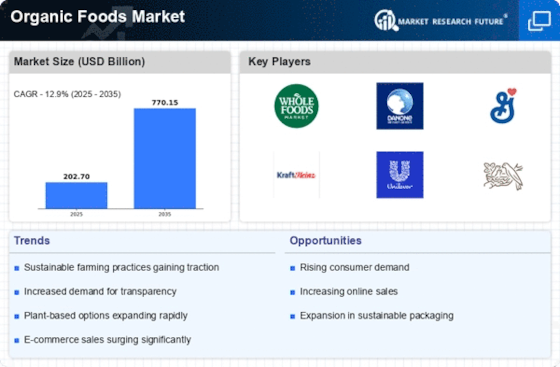
Organic Foods Market Infographic
Purchase Options

Market Analysis

In-depth Analysis of Organic Foods Market Industry Landscape

The organic foods market is witnessing significant trends that reflect a growing consumer preference for healthier, sustainable, and ethically produced food options. One prominent trend is the increasing demand for organic products driven by a heightened awareness of health and wellness. Consumers are seeking foods free from synthetic pesticides, herbicides, and genetically modified organisms, aligning with the perception that organic foods are a more natural and wholesome choice. This health-conscious trend extends to various categories within the organic market, including fruits, vegetables, dairy, meat, and processed foods.

Sustainability is a driving force in shaping market trends within the organic foods sector. Consumers are increasingly concerned about the environmental impact of food production, leading to a preference for products with eco-friendly and sustainable practices. The organic farming methods, which prioritize soil health, crop rotation, and reduced chemical inputs, resonate with environmentally conscious consumers. The emphasis on sustainable packaging is also gaining importance, with consumers preferring products that minimize plastic usage and employ recyclable materials.

The local and artisanal movement is influencing the organic foods market, with consumers expressing a preference for products sourced locally or from small-scale producers. This trend is fueled by a desire to support local economies, reduce carbon footprints associated with transportation, and connect with the producers of their food. Farmers' markets, community-supported agriculture (CSA) programs, and direct-to-consumer sales channels have gained popularity, providing consumers with access to fresh, locally produced organic foods.

E-commerce is playing a pivotal role in the growth of the organic foods market. Online platforms have made it easier for consumers to access a wide range of organic products, including those not readily available in local stores. The convenience of online shopping, coupled with transparent labeling and product information, empowers consumers to make informed choices about the organic foods they purchase. As a result, e-commerce has become a significant distribution channel for organic food producers, enabling them to reach a broader and more diverse consumer base.

Organic foods are expanding beyond traditional grocery store shelves into mainstream retail outlets. The increasing availability of organic options in major supermarkets and discount retailers reflects a shift in consumer behavior and preferences. As organic foods become more accessible and affordable, a broader demographic is incorporating them into their regular shopping habits. This mainstreaming of organic products is contributing to the overall growth of the organic foods market.

Certifications and labeling initiatives are gaining importance as consumers seek assurance regarding the authenticity of organic products. Recognizable organic certifications, such as USDA Organic and EU Organic, serve as trust indicators, providing consumers with confidence in the organic integrity of the products they purchase. Additionally, initiatives that promote transparency and traceability in the supply chain, such as farm-to-table labeling, are gaining traction as consumers prioritize knowing the origin of their food.

The rise of plant-based diets is influencing market trends within the organic foods sector. As consumers increasingly explore plant-centric eating habits for health, environmental, and ethical reasons, the demand for organic plant-based alternatives is on the rise. Organic plant-based products, including plant-based meats, dairy alternatives, and snacks, are gaining popularity among consumers looking for sustainable and cruelty-free options.

Author
Author Profile
Snehal Singh
Manager - Research

High acumen in analyzing complex macro & micro markets with more than 6 years of work experience in the field of market research. By implementing her analytical skills in forecasting and estimation into market research reports, she has expertise in Packaging, Construction, and Equipment domains. She handles a team size of 20-25 resources and ensures smooth running of the projects, associated marketing activities, and client servicing.

Leave a Comment

FAQs

What is the size of the global organic foods market in 2025?

The global organic foods market is valued at USD 228.85 billion in 2025. It is projected to reach USD 770.15 billion by 2035, growing at a CAGR of 12.9% over the forecast period.

What is the projected CAGR of the organic foods market from 2025 to 2035?

The organic foods market is expected to grow at a compound annual growth rate (CAGR) of 12.9% between 2025 and 2035.

Which region dominates the global organic foods market?

North America dominates the organic foods market with approximately 40% market share, valued at USD 91.5 billion in 2025. 

Which region is the fastest-growing in the organic foods market?

Asia-Pacific is the fastest-growing region, expanding at a CAGR of approximately 17.5% through 2035. Rapid urbanization, rising disposable incomes, and growing health awareness across India, China, and Southeast Asia are key growth catalysts.

What is the largest product segment in the organic foods market?

Fruits and vegetables represent the largest segment, holding approximately 38% of the global organic foods market share in 2025. Their dominance is attributed to high nutritional value, strong clean-label consumer preference, and wide retail availability.

Which organic foods segment is growing the fastest?

Packaged organic foods is the fastest-growing segment, expanding at a CAGR of 16.2% through 2035. Growing consumer demand for convenience, combined with continuous product innovation by major brands, is accelerating this segment's expansion across global markets.

What are the key drivers of growth in the organic foods market?

The primary growth drivers include rising health consciousness, government support for sustainable agriculture, and rapid expansion of organic farming across 191 countries. Product innovation, e-commerce channel growth, and urbanization in emerging markets further accelerate overall market expansion.

How big will the organic foods market be by 2035?

The global organic foods market is projected to reach USD 770.15 billion by 2035, up from USD 228.85 billion in 2025. This reflects a near 3.4x increase in market value over the decade-long forecast period.

What is the role of e-commerce in the organic foods market growth?

Online retail is the fastest-growing distribution channel for organic foods, contributing an estimated 1.2% CAGR impact to overall market growth. Post-pandemic shifts in purchasing behavior, broader product selection, and the rise of subscription-based organic delivery services are fueling this channel's rapid expansion.

Which countries are the key markets within the Asia-Pacific organic foods segment?

India, China, and Japan are the leading markets within Asia-Pacific, with China projected to reach USD 22.7 billion and India USD 1.71 billion by 2026. Rising middle-class populations, expanding organic farmland, and increasing product launches by regional and international players are driving growth across these countries.

Market Summary

Global Organic Foods Market, valued at USD 228.85 billion in 2025, is projected to reach USD 770.15 billion by 2035, growing at a CAGR of 12.9% during 2025–2035. North America dominates with ~40% market share, driven by high health consciousness and a mature organic retail ecosystem, while Asia-Pacific grows fastest at ~17.5% CAGR, fueled by rapid urbanization, rising incomes, and expanding organic farming adoption across India and China.

Key Market Facts 2025–2035

Metric 2025 Value 2035 Projection CAGR
Global Market Size USD 228.85B USD 770.15B 12.9%
North America USD 91.5B (40%) USD 289B 12.5% ← DOMINANT
Europe USD 64.1B (28%) USD 215B 12.8%
Asia-Pacific USD 34.3B (15%) USD 175B 17.5% ← FASTEST
South America USD 20.6B (9%) USD 64B 12.0%
Middle East & Africa USD 18.3B (8%) USD 55B 11.6%

Fastest Growing Segments

Segment 2025 Share CAGR Key Driver
Fruits & Vegetables 38% 13.1% Nutritional value & clean-label demand
Packaged Foods 18% 16.2% Convenience & product innovation
Dairy Products 15% 12.5% Health-conscious consumption trends
Grains & Cereals 14% 12.0% Plant-based diet & gut health awareness
Meat & Poultry 10% 11.8% Sustainable protein & welfare-conscious buying

Regional Leadership

  • North America (40%): USA leads — strong USDA Organic certification ecosystem + high consumer spending
  • Asia-Pacific (17.5% CAGR): India & China fastest — urbanization + rising disposable incomes
  • Europe (28%): Germany & France dominate — stringent EU Organic regulations + sustainability focus
  • South America: Brazil & Argentina expanding — government pesticide-free agriculture initiatives
  • Middle East & Africa: UAE leads demand — growing preference for chemical-free natural foods

Primary Growth Drivers

  • Rising health consciousness & clean-label preference (+2.8% CAGR impact)
  • Expansion of organic farming infrastructure across 191 countries (+2.1% CAGR impact)
  • Government support & sustainability regulation (+1.7% CAGR impact)
  • Accelerating product innovation & launch activity (+1.5% CAGR impact)
  • Urbanization & rising incomes in emerging markets (+1.4% CAGR impact)
  • E-commerce channel expansion for organic retail (+1.2% CAGR impact)

Key Market Trends & Highlights

The Organic Foods Market is experiencing robust growth driven by health consciousness and sustainability.

  • Rising health consciousness among consumers is propelling the demand for organic foods, particularly in North America. The Asia-Pacific region is emerging as the fastest-growing market for organic products, reflecting changing consumer preferences. Fruits and vegetables remain the largest segment, while packaged foods are witnessing the fastest growth in the organic category. Key market drivers include the rising demand for organic products and increased focus on sustainability, influencing purchasing decisions.

Market Size & Forecast

2024 Market Size 202.7 (USD Billion)
2035 Market Size 770.15 (USD Billion)
CAGR (2025 - 2035) 12.9%
Largest Regional Market Share in 2024 North America

Major Players

Whole Foods Market (US), Danone (FR), <a href="https://www.generalmills.com/">General Mills (US)</a>, Kraft Heinz (US), Unilever (GB), Nestle (CH), Hain Celestial Group (US), Organic Valley (US), Earthbound Farm (US), Amy's Kitchen (US)

Market Trends

The Organic Foods Market is currently experiencing a notable transformation, driven by a growing consumer awareness regarding health and sustainability. This shift appears to be influencing purchasing behaviors, as individuals increasingly seek products that align with their values. The demand for organic foods is not merely a trend; it seems to reflect a broader societal movement towards healthier lifestyles and environmentally friendly practices. Retailers, including leading brands like whole foods market organic grocery store chains, are responding by expanding their organic offerings, which may indicate a recognition of the potential profitability in this sector.

Furthermore, specialty retail and niche formats such as roots organic food market, 4 seasons organic food market, and concepts like roots natural foods market kitchen organic juice bar leominster are contributing to localized organic retail growth. In addition, evolving consumer preferences toward packaged organic goods such as 365 by whole foods market organic peanut butter, 365 by whole foods market organic ground cinnamon, and 365 whole foods market organic ancient grains bread highlight growing brand-led innovation.

This could involve the introduction of new organic varieties and enhanced packaging solutions that emphasize sustainability. As the market continues to evolve, it may also face challenges related to certification processes and maintaining product integrity. Nevertheless, the overall trajectory suggests a robust future for organic foods, characterized by increased availability and consumer engagement.

Rising Health Consciousness

There is a discernible increase in consumer awareness regarding health and nutrition, which appears to be driving the demand for organic foods. Individuals are increasingly prioritizing products perceived as healthier, leading to a shift in purchasing habits.

Sustainability Focus

A growing emphasis on environmental sustainability is influencing consumer choices. Many individuals are opting for organic foods as a means to support eco-friendly farming practices, which may contribute to a more sustainable food system.

E-commerce Expansion

The rise of online shopping platforms is facilitating greater access to organic products. This trend suggests that consumers are more willing to explore and purchase organic foods through digital channels, enhancing market reach.

Organic Foods Market Market Drivers

Changing Consumer Lifestyles

The Organic Foods Market is significantly influenced by changing consumer lifestyles, particularly among younger demographics. Millennials and Generation Z are increasingly prioritizing health and wellness, leading to a surge in the consumption of organic foods. This demographic shift is reflected in market data, which shows that younger consumers are more likely to seek out organic options when shopping. Additionally, the rise of plant-based diets and the increasing popularity of clean eating are further propelling the demand for organic products. As these lifestyle trends continue to gain traction, the Organic Foods Market is expected to adapt and innovate, offering a wider array of organic options to meet the evolving preferences of health-conscious consumers.

Increased Focus on Sustainability

Sustainability has emerged as a pivotal driver within the Organic Foods Market. Consumers are increasingly concerned about the environmental impact of their food choices, leading to a preference for organic products that are produced using sustainable farming practices. This shift is evidenced by a significant rise in the number of certified organic farms, which has increased by over 30% in recent years. The Organic Foods Market is thus positioned to benefit from this trend, as consumers seek to support brands that align with their values regarding environmental stewardship. Furthermore, the emphasis on sustainability is likely to influence purchasing decisions, with consumers willing to pay a premium for organic products that contribute to ecological preservation.

Rising Demand for Organic Products

The Organic Foods Market experiences a notable increase in demand as consumers become more health-conscious. This trend is driven by a growing awareness of the benefits associated with organic foods, such as reduced exposure to pesticides and enhanced nutritional value. Recent data indicates that the organic food sector has seen a compound annual growth rate of approximately 10% over the past few years. This rising demand is not limited to fruits and vegetables but extends to dairy, meat, and packaged goods, reflecting a broader shift in consumer preferences. As more individuals prioritize their health and well-being, the Organic Foods Market is likely to continue expanding, catering to a diverse range of dietary needs and preferences.

Regulatory Support for Organic Farming

Regulatory frameworks play a crucial role in shaping the Organic Foods Market. Governments worldwide are increasingly implementing policies that support organic farming practices, including subsidies and certification programs. These initiatives not only promote the growth of organic agriculture but also enhance consumer trust in organic products. Recent statistics indicate that countries with robust regulatory support have seen a marked increase in organic food sales, suggesting a direct correlation between policy initiatives and market growth. As regulatory environments continue to evolve, they are likely to provide a favorable landscape for the Organic Foods Market, encouraging more farmers to transition to organic practices and expanding the availability of organic products in the marketplace.

Technological Advancements in Agriculture

Technological innovations are reshaping the Organic Foods Market, enhancing production efficiency and product quality. Advances in agricultural technology, such as precision farming and biotechnology, enable organic farmers to optimize yields while adhering to organic standards. These innovations not only improve the sustainability of organic farming practices but also help in meeting the increasing consumer demand for organic products. For instance, the integration of data analytics in farming operations has shown potential in reducing resource waste and improving crop resilience. As these technologies continue to evolve, they are likely to play a crucial role in the growth of the Organic Foods Market, ensuring that supply can keep pace with rising consumer interest.

Market Segment Insights

By Product Type: Fruits (Largest) vs. Vegetables (Fastest-Growing)

In the organic food market, the distribution of market share among product types reveals that fruits hold the largest share, appealing to health-conscious consumers and representing a staple in organic diets. Vegetables, on the other hand, are witnessing a significant increase in share as consumers are more inclined toward plant-based diets, driving demand for organic options. Despite fruits being predominant, the adoption of organic veggies is on a robust upward trajectory and is gradually reshaping the market landscape. As awareness about health and wellness continues to rise, fruits remain the go-to choice for many organic consumers. However, the fastest growth trajectory is observed in the vegetables segment, fueled by factors such as sustainability trends, nutritional benefits, and an increasing preference for locally-sourced produce. This bodes well for the vegetable segment as it seeks to capture a larger portion of the market share in the forthcoming years.

Fruits (Dominant) vs. Vegetables (Emerging)

Fruits have long been a dominant category in the organic food market due to their natural appeal, variety, and the health benefits they provide. This segment includes organic apples, berries, citrus, and tropical fruits, which are sought after for their nutrient profiles and clean, pesticide-free growing practices. On the other hand, vegetables are emerging as an equally important segment, driven by the growing interest in plant-based diets and organic culinary practices. Leafy greens, root vegetables, and cruciferous types are increasingly favored for their versatility in meals and supporting a healthy lifestyle. The increasing shift towards conscious eating habits is propelling both segments, but fruits still lead in popularity while vegetables are rapidly catching up with innovation and consumer preferences.

By Distribution Channel: Supermarkets (Largest) vs. Online Retail (Fastest-Growing)

In the organic food market, supermarkets hold a dominant position as the largest distribution channel, capturing a significant share due to their extensive reach and established customer base. This channel benefits from consumer preference for the convenience of one-stop shopping, allowing customers to find a wide variety of organic products under one roof. Online retail is rapidly gaining traction, appealing to a tech-savvy consumer base that values convenience and access to diverse organic options, especially during and post-pandemic.

Supermarkets: Dominant vs. Online Retail: Emerging

Supermarkets are the stalwarts of the organic food distribution landscape, leveraging their large footprint and brand trust to offer competitive pricing and variety. They host organic products alongside conventional ones, often attracting health-conscious consumers looking for convenience. On the other hand, online retail is quickly becoming an emerging player in this sector, driven by the rise of e-commerce and changing shopping behaviors. Consumers appreciate the ability to access organic foods directly from farms and specialized sources without geographical constraints. This growth is fueled by advancements in logistics and delivery systems, ensuring freshness and convenience.

By Consumer Demographics: Age (Largest) vs. Income Level (Fastest-Growing)

In the organic food market, the consumer demographic segment displays distinct variations across age groups and income levels, with younger consumers aged 18-34 commanding the largest market share. This demographic actively promotes the demand for organic products due to their health consciousness and willingness to pay a premium for quality. In contrast, the income level segment reveals a growing interest among higher-income households, who are increasingly incorporating organic food into their diets, contributing to a shift in traditional consumer behaviors towards sustainability and wellness. Recent trends indicate a significant growth in demand for organic foods among middle to upper-income brackets, which is fueled by an increased awareness of health and environmental issues. Furthermore, as more consumers prioritize wellness and clean eating, the market for organic foods is expected to broaden its reach. This is particularly evident in urban areas, where access to organic food options continues to expand, reflecting changing consumer preferences across the board.

Age (Dominant) vs. Income Level (Emerging)

The age demographic for the organic food market is dominated by younger consumers, particularly those aged 18-34, who are often labeled as health-conscious and environmentally aware. This group is more likely to experiment with organic products and advocate for sustainable farming practices, thus driving market demand. On the other hand, the income level segment is emerging, showcasing a rapid increase among higher-income consumers who are now adopting organic foods as a lifestyle choice rather than just a health trend. These consumers tend to prioritize quality over price and are significantly influencing the market by pushing retailers to expand their organic offerings. This interplay between age and income demographics is redefining the organic food landscape.

By Certification Type: USDA Organic (Largest) vs. Non-GMO Project Verified (Fastest-Growing)

In the organic food market, certification types play a crucial role in consumer choices and market dynamics. USDA Organic holds the largest share, significantly influencing buying decisions due to its rigorous standards and widespread recognition. Non-GMO Project Verified, while smaller in share, is rapidly catching up as consumers increasingly seek transparency about genetically modified organisms, reflecting a significant shift in consumer awareness and preferences. Other certifications, such as Certified Naturally Grown and Organic Certification Canada, also contribute to the market but operate within more niche segments. The growth in the organic food market is mostly driven by increasing health consciousness among consumers and a rising demand for transparency in food sourcing. USDA Organic continues to be the standard bearer for organic products, while Non-GMO Project Verified is emerging as a strong contender, particularly among younger consumers. The distinct focus on non-GMO practices is propelling the growth of this certification type, indicating a trend toward products that align with specific consumer values and beliefs.

USDA Organic (Dominant) vs. Non-GMO Project Verified (Emerging)

USDA Organic remains the dominant certification type in the organic food market, favored by consumers for its comprehensive standards which include no synthetic fertilizers or pesticides and stringent production methods. This certification assures consumers of quality and environmental sustainability, reinforcing their loyalty. On the other hand, Non-GMO Project Verified is positioned as an emerging certification appealing to a growing consumer base that prioritizes non-GMO ingredients in their food choices. This certification represents a shift toward more conscious consumption, catering to consumers looking for clearer labeling on genetic modifications. This positioning indicates a vibrant and evolving market landscape where both dominant and emerging certifications co-exist to meet diverse consumer needs.

By Packaging Type: Bulk Packaging (Largest) vs. Eco-Friendly Packaging (Fastest-Growing)

In the organic food market, Bulk Packaging is the most dominant segment, primarily used by suppliers for large-scale distribution. It allows manufacturers to provide organic foods at competitive prices while reducing per-unit shipping costs. Eco-Friendly Packaging, emphasizing sustainability, is witnessing rapid growth due to increasing consumer awareness about environmental issues. As consumers lean towards eco-conscious choices, this segment is shrinking the gap with traditional bulk packaging in popularity. The growth of Eco-Friendly Packaging is driven by rising demand for sustainable formulations and recyclable materials. Brands are innovating to provide biodegradable and compostable options. Conversely, Bulk Packaging's steady market share reflects ongoing demand in the wholesale and food service sectors, where cost efficiency remains a key consideration. Both segments reflect distinct consumer preferences in the organic food landscape.

Bulk Packaging: Dominant vs. Eco-Friendly Packaging: Emerging

Bulk Packaging remains the preferred choice in the organic food market for suppliers looking to minimize costs while maximizing distribution efficiency. This type often involves larger quantities that appeal to restaurants and grocery chains. However, as consumer trends pivot towards sustainability, Eco-Friendly Packaging is rapidly emerging. Characterized by biodegradable materials and innovative designs that reduce waste, it is increasingly favored by environmentally conscious consumers. The growing emphasis on packaging that is not only functional but also sustainably sourced positions Eco-Friendly Packaging as a vital segment for future growth, attracting brands looking to enhance their market appeal and align with consumer values.

Get more detailed insights about Organic Foods Market Research Report-Forecast to 2035

Regional Insights

North America : Market Leader in Organic Foods Market

North America is the largest market for organic foods, accounting for approximately 45% of the global market share. Regional developments include expansion of the canada organic food market and increasing cross-border trade in organic products. Additionally, consumer awareness initiatives and retail penetration continue to influence purchasing behaviors. Regulatory support, such as the USDA Organic certification, further catalyzes market expansion. The demand for organic products is expected to continue rising as consumers prioritize sustainability and health. The United States leads the North American market, with significant contributions from Canada. Key players like Whole Foods Market, General Mills, and Kraft Heinz dominate the landscape, offering a wide range of organic products. The competitive environment is characterized by innovation and a focus on quality, with companies investing in sustainable sourcing and production methods to meet consumer expectations.

Europe : Growing Organic Market Presence

Europe is the second-largest market for organic foods, holding around 30% of the global market share. The Europe organic food market continues to expand due to regulatory support, strong sustainability initiatives, and increasing consumer awareness. Regulatory frameworks, such as the EU Organic Regulation, promote organic farming and ensure product integrity, further enhancing market growth. Countries like Germany and France are at the forefront, leading the charge in organic consumption. Germany is the largest market in Europe, followed by France and the UK. The competitive landscape features major players like Danone and Unilever, who are expanding their organic product lines. The presence of local organic brands also contributes to a diverse market. The European market is characterized by a strong emphasis on sustainability and transparency, with consumers increasingly seeking out organic certifications and local sourcing.

Asia-Pacific : Emerging Market Potential

Asia-Pacific is witnessing rapid growth in the organic foods market. Key developments include expansion of the china organic food market as well as increasing demand within the organic food market in India, driven by rising disposable incomes and health-conscious consumers. The region's growth is driven by rising disposable incomes, urbanization, and increasing health awareness among consumers. Countries like China and Japan are leading the charge, with supportive government policies promoting organic agriculture and consumption. The demand for organic products is expected to surge as consumers become more health-conscious and environmentally aware. China is the largest market in the region, followed by Japan and Australia. The competitive landscape is evolving, with both local and international players entering the market. Companies like Hain Celestial Group and Organic Valley are expanding their presence, focusing on product innovation and quality. The region's market is characterized by a growing interest in organic certifications and a shift towards sustainable farming practices.

Middle East and Africa : Untapped Organic Market Potential

The Middle East and Africa represent an emerging market for organic foods, currently holding about 10% of the global market share. The growth is driven by increasing health awareness, urbanization, and a shift towards sustainable agricultural practices. Countries like South Africa and the UAE are leading the market, with growing consumer interest in organic products. Regulatory frameworks are gradually evolving to support organic farming and ensure product quality. South Africa is the largest market in the region, followed by the UAE. The competitive landscape is characterized by a mix of local and international players, with companies focusing on organic certifications and quality assurance. The market is still developing, but there is significant potential for growth as consumers increasingly seek healthier and more sustainable food options.

Key Players and Competitive Insights

The Organic Foods Market is currently characterized by a dynamic competitive landscape, driven by increasing consumer demand for health-conscious and environmentally sustainable products. Key players such as Whole Foods Market (US), Danone (FR), and Unilever (GB) are strategically positioning themselves through innovation and regional expansion. Whole Foods Market (US) continues to enhance its product offerings by focusing on local sourcing and organic certifications, which resonates with its target demographic. Meanwhile, Danone (FR) emphasizes its commitment to sustainability, integrating organic products into its broader portfolio, thereby appealing to eco-conscious consumers. Unilever (GB) is also making strides in this sector, leveraging its extensive distribution network to promote organic lines, which collectively shapes a competitive environment that prioritizes quality and sustainability.The market structure appears moderately fragmented, with numerous players vying for consumer attention. Key tactics such as localizing manufacturing and optimizing supply chains are prevalent among these companies, allowing them to respond swiftly to market demands. This fragmentation fosters a competitive atmosphere where innovation and product differentiation are crucial for maintaining market share. The collective influence of these major players is significant, as they set trends that smaller companies often follow, thereby shaping the overall market dynamics.
In August Whole Foods Market (US) announced a partnership with local farmers to expand its organic produce offerings. This strategic move not only enhances the freshness of its products but also strengthens community ties, which is likely to bolster customer loyalty. By prioritizing local sourcing, Whole Foods Market (US) positions itself as a leader in the organic segment, appealing to consumers who value transparency and sustainability in their food choices.
In September Danone (FR) launched a new line of organic dairy products aimed at the premium segment of the market. This initiative reflects Danone's strategy to cater to health-conscious consumers seeking high-quality organic options. The introduction of this product line is significant as it aligns with the growing trend of premiumization in the organic sector, potentially increasing Danone's market share and reinforcing its brand image as a health-oriented company.
In July Unilever (GB) unveiled its commitment to achieving net-zero emissions across its supply chain by 2030, which includes a focus on expanding its organic product range. This ambitious goal not only addresses consumer concerns regarding climate change but also positions Unilever (GB) as a forward-thinking leader in sustainability. The integration of sustainability into its core business strategy is likely to enhance Unilever's competitive edge in the organic foods market, appealing to environmentally conscious consumers.
As of October the Organic Foods Market is witnessing trends that emphasize digitalization, sustainability, and the integration of artificial intelligence in supply chain management. Strategic alliances among companies are increasingly shaping the competitive landscape, fostering innovation and collaboration. The shift from price-based competition to a focus on technological advancement and supply chain reliability is evident, suggesting that future competitive differentiation will hinge on the ability to innovate and adapt to evolving consumer preferences.

Key Companies in the Organic Foods Market include

Industry Developments

The Organic Foods Market has been experiencing several noteworthy developments in recent months. Retail expansion strategies, including dedicated organic sections within major supermarkets, are shaping purchasing patterns, alongside evolving consumer queries such as do farmers markets sell organic food and does market basket have organic food, reflecting increasing consumer engagement and awareness regarding organic availability. As of October 2023, The Kroger Co. announced its commitment to expanding its organic product line, emphasizing sustainable sourcing, which reflects a broader trend in the market towards environmentally conscious consumer decisions.

In September 2023, Walmart highlighted the growth of its organic offerings as part of a strategy to meet rising consumer demand for healthier options.

Notable mergers include the acquisition of Hain Celestial Group by a private equity firm reported in August 2023, which is likely to reshape its market positioning. Moreover, General Mills has increased its investment in organic product research and development in response to a spike in consumer interest over the past year.

Organic Valley reported a rise in co-op member numbers, indicating increasing participation in organic farming, reflecting stronger supply chains.

Additionally, overall market valuation in the Global Organic Foods Market segment has expanded significantly, driven by consumer shifts towards healthy eating and sustainability, creating a vibrant landscape for both established brands like Unilever and emerging players such as Nature's Path Foods.

This transformation represents an ongoing shift towards a more health-conscious and environmentally sustainable global food system.


Future Outlook

Organic Foods Market Future Outlook

The Organic Foods Market is projected to grow at a 12.9% CAGR from 2025 to 2035, driven by increasing health consciousness, sustainable practices, and consumer demand for organic products.

New opportunities lie in:

  • <p>Expansion of online organic grocery platforms</p>
  • <p> </p>
  • <p>Development of organic meal kit subscription services</p>
  • <p>Investment in vertical farming technologies for organic produce</p>

By 2035, the Organic Foods Market is expected to be robust, reflecting strong consumer preferences and innovative business strategies.

Market Segmentation

Organic Foods Market Type Outlook

  • Fruits and Vegetables
  • Grains and Cereals
  • Dairy Products
  • Meat and Poultry
  • Packaged Foods

Organic Foods Market End Use Outlook

  • Household
  • Food Service
  • Catering

Organic Foods Market Certification Outlook

  • USDA Organic
  • EU Organic
  • JAS Organic
  • Other Organic Certifications

Organic Foods Market Distribution Channel Outlook

  • Supermarkets and Hypermarkets
  • Specialty Stores
  • Online Stores
  • Health Food Stores

Report Scope

MARKET SIZE 2024 202.7(USD Billion)
MARKET SIZE 2025 228.85(USD Billion)
MARKET SIZE 2035 770.15(USD Billion)
COMPOUND ANNUAL GROWTH RATE (CAGR) 12.9% (2025 - 2035)
REPORT COVERAGE Revenue Forecast, Competitive Landscape, Growth Factors, and Trends
BASE YEAR 2024
Market Forecast Period 2025 - 2035
Historical Data 2019 - 2024
Market Forecast Units USD Billion
Key Companies Profiled Whole Foods Market (US), Danone (FR), General Mills (US), Kraft Heinz (US), Unilever (GB), Nestle (CH), Hain Celestial Group (US), Organic Valley (US), Earthbound Farm (US), Amy's Kitchen (US)
Segments Covered Product Type, Distribution Channel, End Use, Certification, Regional
Key Market Opportunities Growing consumer demand for transparency and sustainability in the Organic Foods Market presents significant opportunities.
Key Market Dynamics Rising consumer demand for organic products drives innovation and competition among producers and retailers in the organic foods sector.
Countries Covered North America, Europe, APAC, South America, MEA

FAQs

What is the size of the global organic foods market in 2025?

The global organic foods market is valued at USD 228.85 billion in 2025. It is projected to reach USD 770.15 billion by 2035, growing at a CAGR of 12.9% over the forecast period.

What is the projected CAGR of the organic foods market from 2025 to 2035?

The organic foods market is expected to grow at a compound annual growth rate (CAGR) of 12.9% between 2025 and 2035.

Which region dominates the global organic foods market?

North America dominates the organic foods market with approximately 40% market share, valued at USD 91.5 billion in 2025. 

Which region is the fastest-growing in the organic foods market?

Asia-Pacific is the fastest-growing region, expanding at a CAGR of approximately 17.5% through 2035. Rapid urbanization, rising disposable incomes, and growing health awareness across India, China, and Southeast Asia are key growth catalysts.

What is the largest product segment in the organic foods market?

Fruits and vegetables represent the largest segment, holding approximately 38% of the global organic foods market share in 2025. Their dominance is attributed to high nutritional value, strong clean-label consumer preference, and wide retail availability.

Which organic foods segment is growing the fastest?

Packaged organic foods is the fastest-growing segment, expanding at a CAGR of 16.2% through 2035. Growing consumer demand for convenience, combined with continuous product innovation by major brands, is accelerating this segment's expansion across global markets.

What are the key drivers of growth in the organic foods market?

The primary growth drivers include rising health consciousness, government support for sustainable agriculture, and rapid expansion of organic farming across 191 countries. Product innovation, e-commerce channel growth, and urbanization in emerging markets further accelerate overall market expansion.

How big will the organic foods market be by 2035?

The global organic foods market is projected to reach USD 770.15 billion by 2035, up from USD 228.85 billion in 2025. This reflects a near 3.4x increase in market value over the decade-long forecast period.

What is the role of e-commerce in the organic foods market growth?

Online retail is the fastest-growing distribution channel for organic foods, contributing an estimated 1.2% CAGR impact to overall market growth. Post-pandemic shifts in purchasing behavior, broader product selection, and the rise of subscription-based organic delivery services are fueling this channel's rapid expansion.

Which countries are the key markets within the Asia-Pacific organic foods segment?

India, China, and Japan are the leading markets within Asia-Pacific, with China projected to reach USD 22.7 billion and India USD 1.71 billion by 2026. Rising middle-class populations, expanding organic farmland, and increasing product launches by regional and international players are driving growth across these countries.

  1. SECTION I: EXECUTIVE SUMMARY AND KEY HIGHLIGHTS |
    1. EXECUTIVE SUMMARY | |
      1. Market Overview | |
      2. Key Findings | |
      3. Market Segmentation | |
      4. Competitive Landscape | |
      5. Challenges and Opportunities | |
      6. Future Outlook 2
  2. SECTION II: SCOPING, METHODOLOGY AND MARKET STRUCTURE |
    1. MARKET INTRODUCTION | |
      1. Definition | |
      2. Scope of the study | | |
    2. RESEARCH METHODOLOGY | |
      1. Overview | |
      2. Data Mining | |
      3. Secondary Research | |
      4. Primary Research | | |
      5. Forecasting Model | |
      6. Market Size Estimation | | |
      7. Data Triangulation | |
      8. Validation 3
  3. SECTION III: QUALITATIVE ANALYSIS |
    1. MARKET DYNAMICS | |
      1. Overview | |
      2. Drivers | |
      3. Restraints | |
      4. Opportunities |
    2. MARKET FACTOR ANALYSIS | |
      1. Value chain Analysis | |
      2. Porter's Five Forces Analysis | | |
      3. COVID-19 Impact Analysis | | |
  4. SECTION IV: QUANTITATIVE ANALYSIS |
    1. Food, Beverages & Nutrition, BY Product Type (USD Billion) | |
      1. Fruits | |
      2. Vegetables | |
      3. Dairy | |
      4. Grains | |
      5. Meat |
    2. Food, Beverages & Nutrition, BY Distribution Channel (USD Billion) | |
      1. Supermarkets | |
      2. Online Retail | |
      3. Health Food Stores | |
      4. Farmers Markets | |
      5. Specialty Stores |
    3. Food, Beverages & Nutrition, BY Consumer Demographics (USD Billion) | |
      1. Age | |
      2. Income Level | |
      3. Education Level | |
      4. Family Size | |
      5. Lifestyle |
    4. Food, Beverages & Nutrition, BY Certification Type (USD Billion) | |
      1. USDA Organic | |
      2. Non-GMO Project Verified | |
      3. Certified Naturally Grown | |
      4. Organic Certification Canada | |
      5. European Union Organic |
    5. Food, Beverages & Nutrition, BY Packaging Type (USD Billion) | |
      1. Bulk Packaging | |
      2. Retail Packaging | |
      3. Eco-Friendly Packaging | |
      4. Single-Serve Packaging | |
      5. Reusable Packaging |
    6. Food, Beverages & Nutrition, BY Region (USD Billion) | |
      1. North America | | |
      2. Europe | | |
      3. APAC | | |
      4. South America | | |
      5. MEA | | |
  5. SECTION V: COMPETITIVE ANALYSIS |
    1. Competitive Landscape | |
      1. Overview | |
      2. Competitive Analysis | |
      3. Market share Analysis | |
      4. Major Growth Strategy in the Food, Beverages & Nutrition | |
      5. Competitive Benchmarking | |
      6. Leading Players in Terms of Number of Developments in the Food, Beverages & Nutrition | |
      7. Key developments and growth strategies | | |
      8. Major Players Financial Matrix | | |
    2. Company Profiles | |
      1. Whole Foods Market (US) | | |
      2. Danone (FR) | | |
      3. Nestle (CH) | | |
      4. Unilever (GB) | | |
      5. General Mills (US) | | |
      6. Kraft Heinz (US) | | |
      7. Hain Celestial Group (US) | | |
      8. Organic Valley (US) | | |
      9. Earthbound Farm (US) | | |
      10. Amy's Kitchen (US) | | |
    3. Appendix | |
      1. References | |
      2. Related Reports 6 LIST OF FIGURES |
    4. MARKET SYNOPSIS |
    5. NORTH AMERICA MARKET ANALYSIS |
    6. US MARKET ANALYSIS BY PRODUCT TYPE |
    7. US MARKET ANALYSIS BY DISTRIBUTION CHANNEL |
    8. US MARKET ANALYSIS BY CONSUMER DEMOGRAPHICS |
    9. US MARKET ANALYSIS BY CERTIFICATION TYPE |
    10. US MARKET ANALYSIS BY PACKAGING TYPE |
    11. CANADA MARKET ANALYSIS BY PRODUCT TYPE |
    12. CANADA MARKET ANALYSIS BY DISTRIBUTION CHANNEL |
    13. CANADA MARKET ANALYSIS BY CONSUMER DEMOGRAPHICS |
    14. CANADA MARKET ANALYSIS BY CERTIFICATION TYPE |
    15. CANADA MARKET ANALYSIS BY PACKAGING TYPE |
    16. EUROPE MARKET ANALYSIS |
    17. GERMANY MARKET ANALYSIS BY PRODUCT TYPE |
    18. GERMANY MARKET ANALYSIS BY DISTRIBUTION CHANNEL |
    19. GERMANY MARKET ANALYSIS BY CONSUMER DEMOGRAPHICS |
    20. GERMANY MARKET ANALYSIS BY CERTIFICATION TYPE |
    21. GERMANY MARKET ANALYSIS BY PACKAGING TYPE |
    22. UK MARKET ANALYSIS BY PRODUCT TYPE |
    23. UK MARKET ANALYSIS BY DISTRIBUTION CHANNEL |
    24. UK MARKET ANALYSIS BY CONSUMER DEMOGRAPHICS |
    25. UK MARKET ANALYSIS BY CERTIFICATION TYPE |
    26. UK MARKET ANALYSIS BY PACKAGING TYPE |
    27. FRANCE MARKET ANALYSIS BY PRODUCT TYPE |
    28. FRANCE MARKET ANALYSIS BY DISTRIBUTION CHANNEL |
    29. FRANCE MARKET ANALYSIS BY CONSUMER DEMOGRAPHICS |
    30. FRANCE MARKET ANALYSIS BY CERTIFICATION TYPE |
    31. FRANCE MARKET ANALYSIS BY PACKAGING TYPE |
    32. RUSSIA MARKET ANALYSIS BY PRODUCT TYPE |
    33. RUSSIA MARKET ANALYSIS BY DISTRIBUTION CHANNEL |
    34. RUSSIA MARKET ANALYSIS BY CONSUMER DEMOGRAPHICS |
    35. RUSSIA MARKET ANALYSIS BY CERTIFICATION TYPE |
    36. RUSSIA MARKET ANALYSIS BY PACKAGING TYPE |
    37. ITALY MARKET ANALYSIS BY PRODUCT TYPE |
    38. ITALY MARKET ANALYSIS BY DISTRIBUTION CHANNEL |
    39. ITALY MARKET ANALYSIS BY CONSUMER DEMOGRAPHICS |
    40. ITALY MARKET ANALYSIS BY CERTIFICATION TYPE |
    41. ITALY MARKET ANALYSIS BY PACKAGING TYPE |
    42. SPAIN MARKET ANALYSIS BY PRODUCT TYPE |
    43. SPAIN MARKET ANALYSIS BY DISTRIBUTION CHANNEL |
    44. SPAIN MARKET ANALYSIS BY CONSUMER DEMOGRAPHICS |
    45. SPAIN MARKET ANALYSIS BY CERTIFICATION TYPE |
    46. SPAIN MARKET ANALYSIS BY PACKAGING TYPE |
    47. REST OF EUROPE MARKET ANALYSIS BY PRODUCT TYPE |
    48. REST OF EUROPE MARKET ANALYSIS BY DISTRIBUTION CHANNEL |
    49. REST OF EUROPE MARKET ANALYSIS BY CONSUMER DEMOGRAPHICS |
    50. REST OF EUROPE MARKET ANALYSIS BY CERTIFICATION TYPE |
    51. REST OF EUROPE MARKET ANALYSIS BY PACKAGING TYPE |
    52. APAC MARKET ANALYSIS |
    53. CHINA MARKET ANALYSIS BY PRODUCT TYPE |
    54. CHINA MARKET ANALYSIS BY DISTRIBUTION CHANNEL |
    55. CHINA MARKET ANALYSIS BY CONSUMER DEMOGRAPHICS |
    56. CHINA MARKET ANALYSIS BY CERTIFICATION TYPE |
    57. CHINA MARKET ANALYSIS BY PACKAGING TYPE |
    58. INDIA MARKET ANALYSIS BY PRODUCT TYPE |
    59. INDIA MARKET ANALYSIS BY DISTRIBUTION CHANNEL |
    60. INDIA MARKET ANALYSIS BY CONSUMER DEMOGRAPHICS |
    61. INDIA MARKET ANALYSIS BY CERTIFICATION TYPE |
    62. INDIA MARKET ANALYSIS BY PACKAGING TYPE |
    63. JAPAN MARKET ANALYSIS BY PRODUCT TYPE |
    64. JAPAN MARKET ANALYSIS BY DISTRIBUTION CHANNEL |
    65. JAPAN MARKET ANALYSIS BY CONSUMER DEMOGRAPHICS |
    66. JAPAN MARKET ANALYSIS BY CERTIFICATION TYPE |
    67. JAPAN MARKET ANALYSIS BY PACKAGING TYPE |
    68. SOUTH KOREA MARKET ANALYSIS BY PRODUCT TYPE |
    69. SOUTH KOREA MARKET ANALYSIS BY DISTRIBUTION CHANNEL |
    70. SOUTH KOREA MARKET ANALYSIS BY CONSUMER DEMOGRAPHICS |
    71. SOUTH KOREA MARKET ANALYSIS BY CERTIFICATION TYPE |
    72. SOUTH KOREA MARKET ANALYSIS BY PACKAGING TYPE |
    73. MALAYSIA MARKET ANALYSIS BY PRODUCT TYPE |
    74. MALAYSIA MARKET ANALYSIS BY DISTRIBUTION CHANNEL |
    75. MALAYSIA MARKET ANALYSIS BY CONSUMER DEMOGRAPHICS |
    76. MALAYSIA MARKET ANALYSIS BY CERTIFICATION TYPE |
    77. MALAYSIA MARKET ANALYSIS BY PACKAGING TYPE |
    78. THAILAND MARKET ANALYSIS BY PRODUCT TYPE |
    79. THAILAND MARKET ANALYSIS BY DISTRIBUTION CHANNEL |
    80. THAILAND MARKET ANALYSIS BY CONSUMER DEMOGRAPHICS |
    81. THAILAND MARKET ANALYSIS BY CERTIFICATION TYPE |
    82. THAILAND MARKET ANALYSIS BY PACKAGING TYPE |
    83. INDONESIA MARKET ANALYSIS BY PRODUCT TYPE |
    84. INDONESIA MARKET ANALYSIS BY DISTRIBUTION CHANNEL |
    85. INDONESIA MARKET ANALYSIS BY CONSUMER DEMOGRAPHICS |
    86. INDONESIA MARKET ANALYSIS BY CERTIFICATION TYPE |
    87. INDONESIA MARKET ANALYSIS BY PACKAGING TYPE |
    88. REST OF APAC MARKET ANALYSIS BY PRODUCT TYPE |
    89. REST OF APAC MARKET ANALYSIS BY DISTRIBUTION CHANNEL |
    90. REST OF APAC MARKET ANALYSIS BY CONSUMER DEMOGRAPHICS |
    91. REST OF APAC MARKET ANALYSIS BY CERTIFICATION TYPE |
    92. REST OF APAC MARKET ANALYSIS BY PACKAGING TYPE |
    93. SOUTH AMERICA MARKET ANALYSIS |
    94. BRAZIL MARKET ANALYSIS BY PRODUCT TYPE |
    95. BRAZIL MARKET ANALYSIS BY DISTRIBUTION CHANNEL |
    96. BRAZIL MARKET ANALYSIS BY CONSUMER DEMOGRAPHICS |
    97. BRAZIL MARKET ANALYSIS BY CERTIFICATION TYPE |
    98. BRAZIL MARKET ANALYSIS BY PACKAGING TYPE |
    99. MEXICO MARKET ANALYSIS BY PRODUCT TYPE |
    100. MEXICO MARKET ANALYSIS BY DISTRIBUTION CHANNEL |
    101. MEXICO MARKET ANALYSIS BY CONSUMER DEMOGRAPHICS |
    102. MEXICO MARKET ANALYSIS BY CERTIFICATION TYPE |
    103. MEXICO MARKET ANALYSIS BY PACKAGING TYPE |
    104. ARGENTINA MARKET ANALYSIS BY PRODUCT TYPE |
    105. ARGENTINA MARKET ANALYSIS BY DISTRIBUTION CHANNEL |
    106. ARGENTINA MARKET ANALYSIS BY CONSUMER DEMOGRAPHICS |
    107. ARGENTINA MARKET ANALYSIS BY CERTIFICATION TYPE |
    108. ARGENTINA MARKET ANALYSIS BY PACKAGING TYPE |
    109. REST OF SOUTH AMERICA MARKET ANALYSIS BY PRODUCT TYPE |
    110. REST OF SOUTH AMERICA MARKET ANALYSIS BY DISTRIBUTION CHANNEL |
    111. REST OF SOUTH AMERICA MARKET ANALYSIS BY CONSUMER DEMOGRAPHICS |
    112. REST OF SOUTH AMERICA MARKET ANALYSIS BY CERTIFICATION TYPE |
    113. REST OF SOUTH AMERICA MARKET ANALYSIS BY PACKAGING TYPE |
    114. MEA MARKET ANALYSIS |
    115. GCC COUNTRIES MARKET ANALYSIS BY PRODUCT TYPE |
    116. GCC COUNTRIES MARKET ANALYSIS BY DISTRIBUTION CHANNEL |
    117. GCC COUNTRIES MARKET ANALYSIS BY CONSUMER DEMOGRAPHICS |
    118. GCC COUNTRIES MARKET ANALYSIS BY CERTIFICATION TYPE |
    119. GCC COUNTRIES MARKET ANALYSIS BY PACKAGING TYPE |
    120. SOUTH AFRICA MARKET ANALYSIS BY PRODUCT TYPE |
    121. SOUTH AFRICA MARKET ANALYSIS BY DISTRIBUTION CHANNEL |
    122. SOUTH AFRICA MARKET ANALYSIS BY CONSUMER DEMOGRAPHICS |
    123. SOUTH AFRICA MARKET ANALYSIS BY CERTIFICATION TYPE |
    124. SOUTH AFRICA MARKET ANALYSIS BY PACKAGING TYPE |
    125. REST OF MEA MARKET ANALYSIS BY PRODUCT TYPE |
    126. REST OF MEA MARKET ANALYSIS BY DISTRIBUTION CHANNEL |
    127. REST OF MEA MARKET ANALYSIS BY CONSUMER DEMOGRAPHICS |
    128. REST OF MEA MARKET ANALYSIS BY CERTIFICATION TYPE |
    129. REST OF MEA MARKET ANALYSIS BY PACKAGING TYPE |
    130. KEY BUYING CRITERIA OF FOOD, BEVERAGES & NUTRITION |
    131. RESEARCH PROCESS OF MRFR |
    132. DRO ANALYSIS OF FOOD, BEVERAGES & NUTRITION |
    133. DRIVERS IMPACT ANALYSIS: FOOD, BEVERAGES & NUTRITION |
    134. RESTRAINTS IMPACT ANALYSIS: FOOD, BEVERAGES & NUTRITION |
    135. SUPPLY / VALUE CHAIN: FOOD, BEVERAGES & NUTRITION |
    136. FOOD, BEVERAGES & NUTRITION, BY PRODUCT TYPE, 2024 (% SHARE) |
    137. FOOD, BEVERAGES & NUTRITION, BY PRODUCT TYPE, 2024 TO 2035 (USD Billion) |
    138. FOOD, BEVERAGES & NUTRITION, BY DISTRIBUTION CHANNEL, 2024 (% SHARE) |
    139. FOOD, BEVERAGES & NUTRITION, BY DISTRIBUTION CHANNEL, 2024 TO 2035 (USD Billion) |
    140. FOOD, BEVERAGES & NUTRITION, BY CONSUMER DEMOGRAPHICS, 2024 (% SHARE) |
    141. FOOD, BEVERAGES & NUTRITION, BY CONSUMER DEMOGRAPHICS, 2024 TO 2035 (USD Billion) |
    142. FOOD, BEVERAGES & NUTRITION, BY CERTIFICATION TYPE, 2024 (% SHARE) |
    143. FOOD, BEVERAGES & NUTRITION, BY CERTIFICATION TYPE, 2024 TO 2035 (USD Billion) |
    144. FOOD, BEVERAGES & NUTRITION, BY PACKAGING TYPE, 2024 (% SHARE) |
    145. FOOD, BEVERAGES & NUTRITION, BY PACKAGING TYPE, 2024 TO 2035 (USD Billion) |
    146. BENCHMARKING OF MAJOR COMPETITORS 7 LIST OF TABLES |
    147. LIST OF ASSUMPTIONS | |
      1. |
    148. North America MARKET SIZE ESTIMATES; FORECAST | |
      1. BY PRODUCT TYPE, 2025-2035 (USD Billion) | |
      2. BY DISTRIBUTION CHANNEL, 2025-2035 (USD Billion) | |
      3. BY CONSUMER DEMOGRAPHICS, 2025-2035 (USD Billion) | |
      4. BY CERTIFICATION TYPE, 2025-2035 (USD Billion) | |
      5. BY PACKAGING TYPE, 2025-2035 (USD Billion) |
    149. US MARKET SIZE ESTIMATES; FORECAST | |
      1. BY PRODUCT TYPE, 2025-2035 (USD Billion) | |
      2. BY DISTRIBUTION CHANNEL, 2025-2035 (USD Billion) | |
      3. BY CONSUMER DEMOGRAPHICS, 2025-2035 (USD Billion) | |
      4. BY CERTIFICATION TYPE, 2025-2035 (USD Billion) | |
      5. BY PACKAGING TYPE, 2025-2035 (USD Billion) |
    150. Canada MARKET SIZE ESTIMATES; FORECAST | |
      1. BY PRODUCT TYPE, 2025-2035 (USD Billion) | |
      2. BY DISTRIBUTION CHANNEL, 2025-2035 (USD Billion) | |
      3. BY CONSUMER DEMOGRAPHICS, 2025-2035 (USD Billion) | |
      4. BY CERTIFICATION TYPE, 2025-2035 (USD Billion) | |
      5. BY PACKAGING TYPE, 2025-2035 (USD Billion) |
    151. Europe MARKET SIZE ESTIMATES; FORECAST | |
      1. BY PRODUCT TYPE, 2025-2035 (USD Billion) | |
      2. BY DISTRIBUTION CHANNEL, 2025-2035 (USD Billion) | |
      3. BY CONSUMER DEMOGRAPHICS, 2025-2035 (USD Billion) | |
      4. BY CERTIFICATION TYPE, 2025-2035 (USD Billion) | |
      5. BY PACKAGING TYPE, 2025-2035 (USD Billion) |
    152. Germany MARKET SIZE ESTIMATES; FORECAST | |
      1. BY PRODUCT TYPE, 2025-2035 (USD Billion) | |
      2. BY DISTRIBUTION CHANNEL, 2025-2035 (USD Billion) | |
      3. BY CONSUMER DEMOGRAPHICS, 2025-2035 (USD Billion) | |
      4. BY CERTIFICATION TYPE, 2025-2035 (USD Billion) | |
      5. BY PACKAGING TYPE, 2025-2035 (USD Billion) |
    153. UK MARKET SIZE ESTIMATES; FORECAST | |
      1. BY PRODUCT TYPE, 2025-2035 (USD Billion) | |
      2. BY DISTRIBUTION CHANNEL, 2025-2035 (USD Billion) | |
      3. BY CONSUMER DEMOGRAPHICS, 2025-2035 (USD Billion) | |
      4. BY CERTIFICATION TYPE, 2025-2035 (USD Billion) | |
      5. BY PACKAGING TYPE, 2025-2035 (USD Billion) |
    154. France MARKET SIZE ESTIMATES; FORECAST | |
      1. BY PRODUCT TYPE, 2025-2035 (USD Billion) | |
      2. BY DISTRIBUTION CHANNEL, 2025-2035 (USD Billion) | |
      3. BY CONSUMER DEMOGRAPHICS, 2025-2035 (USD Billion) | |
      4. BY CERTIFICATION TYPE, 2025-2035 (USD Billion) | |
      5. BY PACKAGING TYPE, 2025-2035 (USD Billion) |
    155. Russia MARKET SIZE ESTIMATES; FORECAST | |
      1. BY PRODUCT TYPE, 2025-2035 (USD Billion) | |
      2. BY DISTRIBUTION CHANNEL, 2025-2035 (USD Billion) | |
      3. BY CONSUMER DEMOGRAPHICS, 2025-2035 (USD Billion) | |
      4. BY CERTIFICATION TYPE, 2025-2035 (USD Billion) | |
      5. BY PACKAGING TYPE, 2025-2035 (USD Billion) |
    156. Italy MARKET SIZE ESTIMATES; FORECAST | |
      1. BY PRODUCT TYPE, 2025-2035 (USD Billion) | |
      2. BY DISTRIBUTION CHANNEL, 2025-2035 (USD Billion) | |
      3. BY CONSUMER DEMOGRAPHICS, 2025-2035 (USD Billion) | |
      4. BY CERTIFICATION TYPE, 2025-2035 (USD Billion) | |
      5. BY PACKAGING TYPE, 2025-2035 (USD Billion) |
    157. Spain MARKET SIZE ESTIMATES; FORECAST | |
      1. BY PRODUCT TYPE, 2025-2035 (USD Billion) | |
      2. BY DISTRIBUTION CHANNEL, 2025-2035 (USD Billion) | |
      3. BY CONSUMER DEMOGRAPHICS, 2025-2035 (USD Billion) | |
      4. BY CERTIFICATION TYPE, 2025-2035 (USD Billion) | |
      5. BY PACKAGING TYPE, 2025-2035 (USD Billion) |
    158. Rest of Europe MARKET SIZE ESTIMATES; FORECAST | |
      1. BY PRODUCT TYPE, 2025-2035 (USD Billion) | |
      2. BY DISTRIBUTION CHANNEL, 2025-2035 (USD Billion) | |
      3. BY CONSUMER DEMOGRAPHICS, 2025-2035 (USD Billion) | |
      4. BY CERTIFICATION TYPE, 2025-2035 (USD Billion) | |
      5. BY PACKAGING TYPE, 2025-2035 (USD Billion) |
    159. APAC MARKET SIZE ESTIMATES; FORECAST | |
      1. BY PRODUCT TYPE, 2025-2035 (USD Billion) | |
      2. BY DISTRIBUTION CHANNEL, 2025-2035 (USD Billion) | |
      3. BY CONSUMER DEMOGRAPHICS, 2025-2035 (USD Billion) | |
      4. BY CERTIFICATION TYPE, 2025-2035 (USD Billion) | |
      5. BY PACKAGING TYPE, 2025-2035 (USD Billion) |
    160. China MARKET SIZE ESTIMATES; FORECAST | |
      1. BY PRODUCT TYPE, 2025-2035 (USD Billion) | |
      2. BY DISTRIBUTION CHANNEL, 2025-2035 (USD Billion) | |
      3. BY CONSUMER DEMOGRAPHICS, 2025-2035 (USD Billion) | |
      4. BY CERTIFICATION TYPE, 2025-2035 (USD Billion) | |
      5. BY PACKAGING TYPE, 2025-2035 (USD Billion) |
    161. India MARKET SIZE ESTIMATES; FORECAST | |
      1. BY PRODUCT TYPE, 2025-2035 (USD Billion) | |
      2. BY DISTRIBUTION CHANNEL, 2025-2035 (USD Billion) | |
      3. BY CONSUMER DEMOGRAPHICS, 2025-2035 (USD Billion) | |
      4. BY CERTIFICATION TYPE, 2025-2035 (USD Billion) | |
      5. BY PACKAGING TYPE, 2025-2035 (USD Billion) |
    162. Japan MARKET SIZE ESTIMATES; FORECAST | |
      1. BY PRODUCT TYPE, 2025-2035 (USD Billion) | |
      2. BY DISTRIBUTION CHANNEL, 2025-2035 (USD Billion) | |
      3. BY CONSUMER DEMOGRAPHICS, 2025-2035 (USD Billion) | |
      4. BY CERTIFICATION TYPE, 2025-2035 (USD Billion) | |
      5. BY PACKAGING TYPE, 2025-2035 (USD Billion) |
    163. South Korea MARKET SIZE ESTIMATES; FORECAST | |
      1. BY PRODUCT TYPE, 2025-2035 (USD Billion) | |
      2. BY DISTRIBUTION CHANNEL, 2025-2035 (USD Billion) | |
      3. BY CONSUMER DEMOGRAPHICS, 2025-2035 (USD Billion) | |
      4. BY CERTIFICATION TYPE, 2025-2035 (USD Billion) | |
      5. BY PACKAGING TYPE, 2025-2035 (USD Billion) |
    164. Malaysia MARKET SIZE ESTIMATES; FORECAST | |
      1. BY PRODUCT TYPE, 2025-2035 (USD Billion) | |
      2. BY DISTRIBUTION CHANNEL, 2025-2035 (USD Billion) | |
      3. BY CONSUMER DEMOGRAPHICS, 2025-2035 (USD Billion) | |
      4. BY CERTIFICATION TYPE, 2025-2035 (USD Billion) | |
      5. BY PACKAGING TYPE, 2025-2035 (USD Billion) |
    165. Thailand MARKET SIZE ESTIMATES; FORECAST | |
      1. BY PRODUCT TYPE, 2025-2035 (USD Billion) | |
      2. BY DISTRIBUTION CHANNEL, 2025-2035 (USD Billion) | |
      3. BY CONSUMER DEMOGRAPHICS, 2025-2035 (USD Billion) | |
      4. BY CERTIFICATION TYPE, 2025-2035 (USD Billion) | |
      5. BY PACKAGING TYPE, 2025-2035 (USD Billion) |
    166. Indonesia MARKET SIZE ESTIMATES; FORECAST | |
      1. BY PRODUCT TYPE, 2025-2035 (USD Billion) | |
      2. BY DISTRIBUTION CHANNEL, 2025-2035 (USD Billion) | |
      3. BY CONSUMER DEMOGRAPHICS, 2025-2035 (USD Billion) | |
      4. BY CERTIFICATION TYPE, 2025-2035 (USD Billion) | |
      5. BY PACKAGING TYPE, 2025-2035 (USD Billion) |
    167. Rest of APAC MARKET SIZE ESTIMATES; FORECAST | |
      1. BY PRODUCT TYPE, 2025-2035 (USD Billion) | |
      2. BY DISTRIBUTION CHANNEL, 2025-2035 (USD Billion) | |
      3. BY CONSUMER DEMOGRAPHICS, 2025-2035 (USD Billion) | |
      4. BY CERTIFICATION TYPE, 2025-2035 (USD Billion) | |
      5. BY PACKAGING TYPE, 2025-2035 (USD Billion) |
    168. South America MARKET SIZE ESTIMATES; FORECAST | |
      1. BY PRODUCT TYPE, 2025-2035 (USD Billion) | |
      2. BY DISTRIBUTION CHANNEL, 2025-2035 (USD Billion) | |
      3. BY CONSUMER DEMOGRAPHICS, 2025-2035 (USD Billion) | |
      4. BY CERTIFICATION TYPE, 2025-2035 (USD Billion) | |
      5. BY PACKAGING TYPE, 2025-2035 (USD Billion) |
    169. Brazil MARKET SIZE ESTIMATES; FORECAST | |
      1. BY PRODUCT TYPE, 2025-2035 (USD Billion) | |
      2. BY DISTRIBUTION CHANNEL, 2025-2035 (USD Billion) | |
      3. BY CONSUMER DEMOGRAPHICS, 2025-2035 (USD Billion) | |
      4. BY CERTIFICATION TYPE, 2025-2035 (USD Billion) | |
      5. BY PACKAGING TYPE, 2025-2035 (USD Billion) |
    170. Mexico MARKET SIZE ESTIMATES; FORECAST | |
      1. BY PRODUCT TYPE, 2025-2035 (USD Billion) | |
      2. BY DISTRIBUTION CHANNEL, 2025-2035 (USD Billion) | |
      3. BY CONSUMER DEMOGRAPHICS, 2025-2035 (USD Billion) | |
      4. BY CERTIFICATION TYPE, 2025-2035 (USD Billion) | |
      5. BY PACKAGING TYPE, 2025-2035 (USD Billion) |
    171. Argentina MARKET SIZE ESTIMATES; FORECAST | |
      1. BY PRODUCT TYPE, 2025-2035 (USD Billion) | |
      2. BY DISTRIBUTION CHANNEL, 2025-2035 (USD Billion) | |
      3. BY CONSUMER DEMOGRAPHICS, 2025-2035 (USD Billion) | |
      4. BY CERTIFICATION TYPE, 2025-2035 (USD Billion) | |
      5. BY PACKAGING TYPE, 2025-2035 (USD Billion) |
    172. Rest of South America MARKET SIZE ESTIMATES; FORECAST | |
      1. BY PRODUCT TYPE, 2025-2035 (USD Billion) | |
      2. BY DISTRIBUTION CHANNEL, 2025-2035 (USD Billion) | |
      3. BY CONSUMER DEMOGRAPHICS, 2025-2035 (USD Billion) | |
      4. BY CERTIFICATION TYPE, 2025-2035 (USD Billion) | |
      5. BY PACKAGING TYPE, 2025-2035 (USD Billion) |
    173. MEA MARKET SIZE ESTIMATES; FORECAST | |
      1. BY PRODUCT TYPE, 2025-2035 (USD Billion) | |
      2. BY DISTRIBUTION CHANNEL, 2025-2035 (USD Billion) | |
      3. BY CONSUMER DEMOGRAPHICS, 2025-2035 (USD Billion) | |
      4. BY CERTIFICATION TYPE, 2025-2035 (USD Billion) | |
      5. BY PACKAGING TYPE, 2025-2035 (USD Billion) |
    174. GCC Countries MARKET SIZE ESTIMATES; FORECAST | |
      1. BY PRODUCT TYPE, 2025-2035 (USD Billion) | |
      2. BY DISTRIBUTION CHANNEL, 2025-2035 (USD Billion) | |
      3. BY CONSUMER DEMOGRAPHICS, 2025-2035 (USD Billion) | |
      4. BY CERTIFICATION TYPE, 2025-2035 (USD Billion) | |
      5. BY PACKAGING TYPE, 2025-2035 (USD Billion) |
    175. South Africa MARKET SIZE ESTIMATES; FORECAST | |
      1. BY PRODUCT TYPE, 2025-2035 (USD Billion) | |
      2. BY DISTRIBUTION CHANNEL, 2025-2035 (USD Billion) | |
      3. BY CONSUMER DEMOGRAPHICS, 2025-2035 (USD Billion) | |
      4. BY CERTIFICATION TYPE, 2025-2035 (USD Billion) | |
      5. BY PACKAGING TYPE, 2025-2035 (USD Billion) |
    176. Rest of MEA MARKET SIZE ESTIMATES; FORECAST | |
      1. BY PRODUCT TYPE, 2025-2035 (USD Billion) | |
      2. BY DISTRIBUTION CHANNEL, 2025-2035 (USD Billion) | |
      3. BY CONSUMER DEMOGRAPHICS, 2025-2035 (USD Billion) | |
      4. BY CERTIFICATION TYPE, 2025-2035 (USD Billion) | |
      5. BY PACKAGING TYPE, 2025-2035 (USD Billion) |
    177. PRODUCT LAUNCH/PRODUCT DEVELOPMENT/APPROVAL | |
      1. |
    178. ACQUISITION/PARTNERSHIP | |

Food, Beverages & Nutrition Market Segmentation

Food, Beverages & Nutrition By Product Type (USD Billion, 2025-2035)

  • Fruits
  • Vegetables
  • Dairy
  • Grains
  • Meat

Food, Beverages & Nutrition By Distribution Channel (USD Billion, 2025-2035)

  • Supermarkets
  • Online Retail
  • Health Food Stores
  • Farmers Markets
  • Specialty Stores

Food, Beverages & Nutrition By Consumer Demographics (USD Billion, 2025-2035)

  • Age
  • Income Level
  • Education Level
  • Family Size
  • Lifestyle

Food, Beverages & Nutrition By Certification Type (USD Billion, 2025-2035)

  • USDA Organic
  • Non-GMO Project Verified
  • Certified Naturally Grown
  • Organic Certification Canada
  • European Union Organic

Food, Beverages & Nutrition By Packaging Type (USD Billion, 2025-2035)

  • Bulk Packaging
  • Retail Packaging
  • Eco-Friendly Packaging
  • Single-Serve Packaging
  • Reusable Packaging
Infographic

Free Sample Request

Kindly complete the form below to receive a free sample of this Report

Get Free Sample

Customer Strories

Compare Licence

×
Features License Type
Single User Multiuser License Enterprise User
Price $4,950 $5,950 $7,250
Maximum User Access Limit 1 User Upto 10 Users Unrestricted Access Throughout the Organization
Free Customization
Direct Access to Analyst
Deliverable Format
Platform Access
Discount on Next Purchase 10% 15% 15%
Printable Versions