×
Request Free Sample ×

Kindly complete the form below to receive a free sample of this Report

* Please use a valid business email

Leading companies partner with us for data-driven Insights

clients tt-cursor
Hero Background
English
Chinese
French
Japanese
Korean
German
Spanish

Organic Food Preservatives Market Analysis

ID: MRFR/FnB/2794-HCR
110 Pages
Pradeep Nandi
February 2026

Organic Food Preservatives Market Size, Share, Industry Trend & Analysis Research Report Information by Form (Dry and Liquid), by Type (Salt & Sugar, Honey, Lemon, Vinegar, Edible Oil, Chitosan, and Others) by Application (Bakery & Confectionery, Beverages, Dairy & Frozen Dessert, Sweet & Savoury Snacks, Soups, Sauces, & Dressings, and Others) and Region (North America, Europe, Asia-Pacific, and Rest of the World) — Forecast till 2035

Share:
Download PDF ×

We do not share your information with anyone. However, we may send you emails based on your report interest from time to time. You may contact us at any time to opt-out.

Organic Food Preservatives Market Infographic
Purchase Options

Market Analysis

In-depth Analysis of Organic Food Preservatives Market Industry Landscape

A variety of variables influence the marketplace trends in organic food preservatives market or sector, including public health worries, governmental regulations, plus developments in environmentally friendly preservation methods. The growing customer desire towards clean-label as well as natural goods constitutes one such variables driving the development within organic food preservatives market. While people grow increasingly concerned regarding the chemicals in what they eat, they have a growing need for alternatives that may increase the nutritional value of items with no using artificial chemicals. This change in buyer habits is driving organic food preservatives market or industry upward.

Sustainable development has a significant impact in the business changes regarding organic food preservatives. People are looking for more nutritious options while also emphasizing ecologically friendly as well as sustainable activities. Organic food preservatives, which are frequently produced primarily through organic materials including spices, plants, as well as extracts of plants, appeal to environmentally aware customers. The aforementioned preservatives are often produced using sustainable techniques, which eliminate the consumption regarding synthetic substances while decreasing their ecological impact. As ecology remains a more important factor in customer choice, the concerned organic food preservatives market or industry continues to grow.

International laws and approvals significantly influence market trends. Standards which include USDA Organic reassure customers about the legitimacy and caliber about organic food preservatives. Businesses that follow these guidelines have an edge over their competitors, as customers progressively choose items with verified organic certificates. The regulatory structures additionally oversee the research and distribution regarding organic food preservatives, guaranteeing their products fulfill rigorous quality and safety standards.

Regional characteristics give a new element to the marketplace landscape. Whilst North America along with Europe used to be crucial buyers of organic food preservatives because to their greater number of people who are health-conscious, rising nations throughout Asia-Pacific have observed greater interest. As knowledge of natural, organic goods rises across these locations, competitive conditions evolve, creating possibilities inside local along with foreign firms.

The concerned organic food preservatives market's rivalries are defined by discovery as well as the creation of unique compositions. Businesses make investments in R&D to find novel forms for organic stabilizers and improve the efficacy of current ones. A primary goal is to develop preservatives which not only improve the lifespan yet retain the taste and nutrient content of organic goods. Agreements as well as links with food producers also constitute frequent ways to broaden the market by integrating organic preservatives within a wide range of food items.

Considering favorable patterns, obstacles are affecting the sales structure for organic food preservatives. Certain ecological preservation' restricted availability alongside elevated costs may prevent acceptance, particularly in price conscious industries. Furthermore, teaching customers regarding the effectiveness regarding organic preservatives within contrast with artificial ones continues a problem, since opinions regarding organic ways to preserve might differ.

To summarize, customer preferences, environmental concerns, legal requirements, and geographical differences all have an impact upon organic food preservatives market or dynamics. Since the need towards clean-label & natural food products grows, the concerned organic food preservatives market or industry is poised for expansion. Businesses who handle the complexity of compliance with regulations, solve cost problems, and convey the advantages associated with organic preservatives have a good chance to succeed throughout this continuously shifting marketplace.

Author
Pradeep Nandi
Senior Research Analyst

I have a bachelor's degree in mechanical engineering and an MBA. I have more than two years of expertise in the retail, food, and beverage, chemical, and material industries, and hence have developed a sound cross-domain expertise. A firm believer in lifelong learning and sharing of knowledge. Having a proclivity for hatching ideas and trying to absorb as much information as possible in a short amount of time. Introducing corporates to the data and insight, which enables them to move from probability to possibility, has been my key areas of interest. 

Leave a Comment

FAQs

What is the projected market valuation for the Organic Food Preservatives Market in 2035?

<p>The projected market valuation for the Organic Food Preservatives Market in 2035 is 1.018 USD Billion.</p>

What was the market valuation of the Organic Food Preservatives Market in 2024?

<p>The market valuation of the Organic Food Preservatives Market in 2024 was 0.56 USD Billion.</p>

What is the expected CAGR for the Organic Food Preservatives Market from 2025 to 2035?

<p>The expected CAGR for the Organic Food Preservatives Market during the forecast period 2025 - 2035 is 5.58%.</p>

Which companies are considered key players in the Organic Food Preservatives Market?

<p>Key players in the Organic Food Preservatives Market include BASF SE, Cargill, Incorporated, DuPont de Nemours, Inc., and Kemin Industries, Inc.</p>

What are the main segments of the Organic Food Preservatives Market?

<p>The main segments of the Organic Food Preservatives Market include Form, Type, and Application.</p>

How did the Dry and Liquid segments perform in 2024?

<p>In 2024, the Dry segment was valued at 0.25 USD Billion, while the Liquid segment reached 0.31 USD Billion.</p>

What types of organic food preservatives are included in the market analysis?

Types of organic food preservatives include Salt &amp; Sugar, Honey, Lemon, Vinegar, Edible Oil, and Chitosan.

Which application segment had the highest valuation in 2024?

In 2024, the Bakery &amp; Confectionery application segment had the highest valuation at 0.15 USD Billion.

What is the projected growth trend for the Organic Food Preservatives Market?

The Organic Food Preservatives Market appears to be on a growth trend, with a projected valuation increase to 1.018 USD Billion by 2035.

How do the valuations of different types of organic food preservatives compare?

In 2024, Salt &amp; Sugar was valued at 0.15 USD Billion, while Honey and Lemon were valued at 0.1 USD Billion and 0.08 USD Billion, respectively.

Market Summary

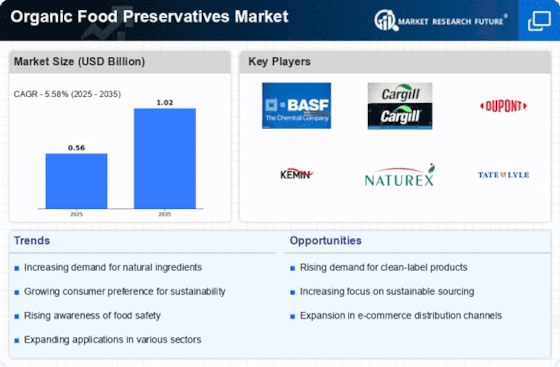
As per Market Research Future analysis, the Organic Food Preservatives Market Size was estimated at 0.56 USD Billion in 2024. The Organic Food Preservatives industry is projected to grow from USD 0.5913 Billion in 2025 to USD 1.018 Billion by 2035, exhibiting a compound annual growth rate (CAGR) of 5.58% during the forecast period 2025 - 2035

Key Market Trends & Highlights

The Organic Food Preservatives Market is experiencing robust growth driven by consumer preferences for natural and clean label products.

  • The demand for clean label products is rising, particularly in North America, which remains the largest market for organic food preservatives.
  • Sustainability and environmental concerns are increasingly influencing purchasing decisions, especially in the Asia-Pacific region, the fastest-growing market.
  • Health and wellness focus is driving innovation in preservation techniques, with liquid preservatives emerging as the fastest-growing segment.
  • Rising consumer awareness and regulatory support for organic products are key drivers propelling the market forward, particularly in the salt and sugar segment.

Market Size & Forecast

2024 Market Size 0.56 (USD Billion)
2035 Market Size 1.018 (USD Billion)
CAGR (2025 - 2035) 5.58%
Largest Regional Market Share in 2024 North America

Major Players

BASF SE (DE), Cargill, Incorporated (US), DuPont de Nemours, Inc. (US), Kemin Industries, Inc. (US), Naturex S.A. (FR), Tate & Lyle PLC (GB), Chr. Hansen Holding A/S (DK), Givaudan SA (CH), Sensient Technologies Corporation (US)

Market Trends

The Organic Food Preservatives Market is currently experiencing a notable shift towards natural and organic solutions as consumers increasingly prioritize health and wellness. This trend appears to be driven by a growing awareness of the potential adverse effects associated with synthetic preservatives. As a result, manufacturers are responding by innovating and expanding their product lines to include organic alternatives that align with consumer preferences. The market landscape is evolving, with a focus on transparency and sustainability, which seems to resonate well with environmentally conscious consumers. Moreover, the demand for organic food preservatives is likely to be influenced by regulatory changes that promote the use of natural ingredients in food products. This regulatory environment may encourage companies to invest in research and development to create effective organic preservatives that meet safety standards while appealing to health-conscious consumers. The Organic Food Preservatives Market appears poised for growth as it adapts to these changing dynamics, potentially leading to a more diverse range of products that cater to various dietary needs and preferences.

Rising Demand for Clean Label Products

Consumers are increasingly seeking products that are free from artificial additives and preservatives. This trend indicates a shift towards clean label products, where transparency in ingredient sourcing and processing is paramount. As a result, manufacturers are likely to reformulate their offerings to include organic preservatives that align with this consumer demand.

Sustainability and Environmental Concerns

There is a growing emphasis on sustainability within the Organic Food Preservatives Market. Consumers are becoming more aware of the environmental impact of food production and are favoring products that utilize sustainable practices. This trend suggests that companies may prioritize sourcing organic ingredients and adopting eco-friendly packaging solutions.

Health and Wellness Focus

The increasing focus on health and wellness is driving the demand for organic food preservatives. Consumers are more inclined to choose products that promote better health outcomes, leading to a preference for natural preservatives over synthetic options. This trend indicates that the market may continue to evolve towards healthier alternatives.

Organic Food Preservatives Market Market Drivers

Rising Consumer Awareness

The Organic Food Preservatives Market is experiencing a notable surge in consumer awareness regarding the benefits of organic products. As individuals become more informed about the potential health risks associated with synthetic preservatives, there is a marked shift towards organic alternatives. This trend is reflected in market data, which indicates that the organic food sector has seen a compound annual growth rate of approximately 10% over the past few years. Consumers are increasingly seeking transparency in food labeling, which further propels the demand for organic preservatives. This heightened awareness not only influences purchasing decisions but also encourages manufacturers to innovate and expand their organic product lines, thereby driving growth in the Organic Food Preservatives Market.

Increased Focus on Food Safety

Food safety remains a paramount concern for consumers and manufacturers alike, driving the Organic Food Preservatives Market. The rising incidence of foodborne illnesses has heightened awareness regarding the importance of safe food preservation methods. Organic preservatives are perceived as safer alternatives to their synthetic counterparts, which may contain harmful chemicals. This perception is supported by data indicating that the organic food market is expected to reach a valuation of over 300 billion dollars by 2025, underscoring the growing emphasis on food safety. As consumers prioritize health and safety in their food choices, the demand for organic preservatives is likely to increase, further propelling the Organic Food Preservatives Market.

Shift Towards Natural Ingredients

There is a discernible shift towards natural ingredients within the food industry, which significantly impacts the Organic Food Preservatives Market. Consumers are increasingly favoring products that contain natural rather than synthetic components, leading to a growing demand for organic preservatives derived from plant sources. Market analysis suggests that the natural preservatives segment is projected to grow at a rate of 8% annually, reflecting the changing preferences of health-conscious consumers. This trend is not only reshaping product formulations but also encouraging manufacturers to explore innovative extraction methods for organic preservatives. Consequently, the Organic Food Preservatives Market is poised for expansion as it aligns with consumer desires for cleaner, more natural food options.

Innovation in Preservation Techniques

Innovation plays a critical role in the evolution of the Organic Food Preservatives Market. Advances in preservation techniques, such as high-pressure processing and natural fermentation, are enabling manufacturers to enhance the shelf life of organic products without compromising their quality. These innovations not only meet consumer demands for longer-lasting products but also align with the growing trend towards sustainability. Market Research Future indicates that the adoption of innovative preservation methods could lead to a 15% reduction in food waste, a significant concern in the food industry. As companies continue to invest in research and development, the Organic Food Preservatives Market is likely to benefit from new technologies that improve product efficacy and consumer appeal.

Regulatory Support for Organic Products

The Organic Food Preservatives Market benefits significantly from supportive regulatory frameworks that promote organic farming and food production. Various governments have implemented policies aimed at encouraging organic agriculture, which includes the use of organic preservatives. For instance, regulations that provide certification for organic products help to build consumer trust and facilitate market entry for organic food manufacturers. This regulatory support is crucial, as it not only legitimizes organic products but also enhances their visibility in the marketplace. As a result, the Organic Food Preservatives Market is likely to witness increased investment and innovation, further solidifying its position in the food sector.

Market Segment Insights

By Form: Dry (Largest) vs. Liquid (Fastest-Growing)

<p>In the Organic Food Preservatives Market, the segment of 'Dry' preservatives holds the largest share, commanding significant attention from both consumers and retailers. Dry organic preservatives are favored for their long shelf life and ease of storage, making them a staple choice among food manufacturers. Conversely, the 'Liquid' segment, while smaller in overall share, is rapidly gaining traction as consumers increasingly seek versatile and easy-to-use alternatives that enhance food safety without compromising on quality.</p>

<p>Preservatives: Dry (Dominant) vs. Liquid (Emerging)</p>

<p>The Dry segment of organic food preservatives is characterized by its stability and concentrated formulation, which allows for effective preservation without the need for synthetic additives. This segment appeals to health-conscious consumers valuing ingredient transparency and product longevity. On the other hand, the Liquid segment, while emerging, captures the interest of food manufacturers due to its convenience and adaptability in various applications. Its growth is driven by rising consumer demand for ready-to-use solutions that blend seamlessly into food products. As health trends shape consumer behavior, these two segments continue to carve out distinct yet essential roles in the organic landscape.</p>

By Type: Salt & Sugar (Largest) vs. Honey (Fastest-Growing)

<p>In the Organic Food Preservatives Market, the distribution of market share is notably diverse, with Salt & Sugar segments holding a significant portion. This longstanding method of preservation is well-established and favored by consumers for its effectiveness and natural appeal. Honey, on the other hand, has been gaining traction rapidly among health-conscious consumers, becoming synonymous with organic and natural food trends, which has boosted its market share significantly in recent years. The growth trends in this segment are driven predominantly by the rising demand for clean label products, as consumers are increasingly opting for organic alternatives to synthetic preservatives. The health benefits associated with natural preservatives like honey, vinegar, and lemon are propelling their popularity. Emerging trends such as the use of Chitosan, derived from crustacean shells, are expected to further invigorate the market, as they align with sustainability goals and the rising vegan movement.</p>

<p>Sugar: Salt & Sugar (Dominant) vs. Honey (Emerging)</p>

<p>The Salt & Sugar segment remains dominant within the Organic Food Preservatives Market due to its traditional usage and established consumer trust. Salt not only acts as an effective preservative but also enhances flavor, making it a staple in food preservation. Sugar, conversely, attracts attention for its ability to preserve fruits and jams while providing sweetness. In contrast, Honey is emerging as a powerful alternative due to its perceived health benefits and versatility. As consumers seek organic and natural options, honey is becoming favored for its antimicrobial properties, attracting both the traditional and health-focused sectors of the market. The evolving consumer trends towards more sustainable, healthy choices are paving the way for Honey's strong emergence in the market.</p>

By Application: Bakery & Confectionery (Largest) vs. Beverages (Fastest-Growing)

<p>The Organic Food Preservatives Market is prominently influenced by the application sectors, with Bakery & Confectionery leading the market share. This sector benefits significantly from the growing consumer demand for organic ingredients, and its established presence in the market makes it a dominant player. In contrast, Beverages are rapidly gaining traction as the fastest-growing segment, fueled by increasing health consciousness and a preference for organic options among consumers. This shift in consumer behavior is redefining the market landscape, emphasizing the pivotal role of organic preservatives in beverage formulations.</p>

<p>Bakery & Confectionery (Dominant) vs. Beverages (Emerging)</p>

<p>The Bakery & Confectionery segment stands out as a dominant force within the Organic Food Preservatives Market, characterized by its reliance on natural ingredients that cater to health-conscious consumers. This segment includes a wide array of products, from bread and cakes to cookies and pastries, which benefit from organic preservatives to extend shelf life while maintaining taste and quality. On the other hand, the Beverages segment is emerging rapidly, reflecting a shift towards organic juices, teas, and functional drinks. Driven by changing consumer preferences, this segment is attracting manufacturers keen on integrating organic standards, thus enhancing product offerings and market appeal. As these segments evolve, the demand for organic preservatives remains crucial to meeting quality and safety standards.</p>

Organic Food Preservatives Market Application Insights

Based on application, the Organic Food Preservatives industry has been segmented into Bakery & <a href="https://www.marketresearchfuture.com/reports/confectionery-market-16095" target="_blank">confectionery</a>, Beverages, <a href="https://www.marketresearchfuture.com/reports/dairy-market-11483" target="_blank">dairy</a> & Frozen Desserts, Sweet & Savoury Snacks, Soups, Sauces, & Dressings, and Others. Bakery & confectionery held the largest segment share in 2022. Manufacturers have been urged to offer natural food preservatives because of the increased demand for organic and natural bakery items. Rising urbanization among consumers has pushed the need for ready-to-eat (RTE) items and foods with prolonged shelf life due to their hectic lifestyles, necessitating natural preservatives to guard against food contamination.

Get more detailed insights about Organic Food Preservatives Market Research Report - Global Forecast till 2035

Regional Insights

North America : Market Leader in Innovation

North America is the largest market for organic food preservatives, holding approximately 40% of the global market share. The region's growth is driven by increasing consumer demand for natural and organic products, coupled with stringent food safety regulations. The U.S. leads this market, followed closely by Canada, as consumers increasingly prefer organic options over synthetic preservatives. Regulatory support for organic labeling further fuels this trend. The competitive landscape in North America is robust, featuring key players such as Cargill, DuPont, and Kemin Industries. These companies are investing in research and development to innovate new organic preservatives that meet consumer preferences. The presence of established food manufacturers and a growing trend towards clean label products are also significant factors contributing to market growth. The region's focus on sustainability and health-conscious choices positions it as a leader in the organic food preservatives market.

Europe : Regulatory Framework Driving Growth

Europe is the second-largest market for organic food preservatives, accounting for approximately 30% of the global market share. The region's growth is propelled by increasing health awareness among consumers and stringent regulations promoting organic farming practices. Countries like Germany and France are at the forefront, with strong consumer bases favoring organic products. The European Union's regulations on food safety and organic labeling significantly influence market dynamics. Leading countries in Europe include Germany, France, and the UK, where the demand for organic food preservatives is surging. The competitive landscape features major players like Naturex and Chr. Hansen, who are focusing on sustainable sourcing and innovative product development. The presence of a well-established retail sector and increasing investments in organic agriculture further enhance market opportunities. The European market is characterized by a strong emphasis on quality and sustainability, aligning with consumer preferences for healthier food options.

Asia-Pacific : Emerging Market Potential

Asia-Pacific is witnessing rapid growth in the organic food preservatives market, holding approximately 20% of the global market share. The region's expansion is driven by rising disposable incomes, urbanization, and a growing awareness of health and wellness. Countries like China and India are leading this growth, as consumers increasingly seek organic alternatives to traditional preservatives. Government initiatives promoting organic farming are also contributing to market development. The competitive landscape in Asia-Pacific is evolving, with both local and international players entering the market. Key companies such as BASF and Givaudan are expanding their presence in the region, focusing on product innovation and partnerships with local manufacturers. The increasing demand for organic food products, coupled with a shift towards healthier lifestyles, positions Asia-Pacific as a significant player in the organic food preservatives market. The region's diverse consumer base presents unique opportunities for growth and innovation.

Middle East and Africa : Untapped Market Opportunities

The Middle East and Africa region is emerging as a potential market for organic food preservatives, currently holding about 10% of the global market share. The growth is driven by increasing health consciousness among consumers and a rising demand for organic food products. Countries like South Africa and the UAE are leading this trend, supported by government initiatives promoting organic agriculture and food safety regulations. The region's diverse culinary traditions also encourage the use of organic preservatives. The competitive landscape in this region is still developing, with a mix of local and international players. Companies are beginning to recognize the potential of the organic food preservatives market, with investments in product development and marketing strategies tailored to local preferences. The presence of key players is gradually increasing, and as consumer awareness grows, the market is expected to expand significantly in the coming years. The region's unique challenges and opportunities present a dynamic environment for growth.

Key Players and Competitive Insights

Leading industry companies are making significant R&D investments to broaden their product offerings, which will spur further expansion of the market for Organic Food Preservatives Market products. Important market developments include new product releases, contractual agreements, mergers and acquisitions, greater investments, and collaboration with other organizations. Market participants also engage in several strategic actions to increase their worldwide presence. The Organic Food Preservatives industry must offer products at reasonable prices to grow and thrive in a more cutthroat and competitive environment.
One of the primary business strategies manufacturers employ in the worldwide Organic Food Preservatives industry to benefit customers and expand the market sector is local manufacturing to reduce operating costs. The Organic Food Preservatives industry has recently provided some of medicine's most important benefits.
Major players in the Organic Food Preservatives Market, including Cargill Incorporated (U.S.), DuPont de Nemours, Inc. (U.S.), Tate & Lyle (U.K.), Univar Inc. (U.S.), Akzo Nobel N.V. (Netherlands), Kemin Industries, Inc. (U.S.), Hawkins Watts Limited (Australia), Danisco A/S (Denmark), Koninklijke DSM N.V. (Netherlands), Brenntag Solutions Group, Inc. (Germany), Hawkins Watts Limited (New Zealand), BASF SE (Germany), Galactic S.A. (Belgium), Archer Daniels Midland Company (U.S.), Kerry Group plc (Ireland), and others, are attempting to increase market demand by investing in research and development operations.
The French American manufacturer and chemist Éleuthère Irénée du Pont de Nemours founded the international chemical corporation DuPont de Nemours, Inc., also known as DuPont, in 1802. The business began as a significant supplier of gunpowder and later played a significant part in establishing Delaware. A well-known firm, IFF, successfully concluded the merger with the nutrition and biosciences division of DuPont in February 2021. The United company will continue to operate under the name IFF.
Irish-based Kerry Group plc is a publicly traded food business. It is traded on the London Stock Exchange and the Dublin ISEQ. Given the company's roots in the cooperative movement, its farmer suppliers still own a sizable stake in the business. Kerry Group plc (Ireland) added the newly renovated plant in Rome, Georgia, to its food production operations in March 2022. The largest food production plant ever built in the U.S. cost USD 141 million.
This plant seeks to offer integrated flavor and nutrition solutions to satisfy rising consumer demand in the chicken, seafood, and alternative protein industries across the U.S. and Canada.

Key Companies in the Organic Food Preservatives Market include

Industry Developments

    • April 2021: Due to the increasing demand for citric acid and citrates, Jungbunzlauer Suisse AG (Switzerland) developed its citric factory in Port Colborne, Canada. These goods are useful bio-based substances for industrial, detergent, and culinary applications. With this development, the business will be able to serve better clients searching for safe, biodegradable produced in environmentally friendly factories.
    • January 2021: To address the rising demand for natural ingredients across several sectors, Corbion boosted its capacity for generating lactic acid in North America by almost 40%. The investment will strengthen the business's position as the world's top supplier of lactic acid and its derivatives.

Future Outlook

Organic Food Preservatives Market Future Outlook

The Organic Food Preservatives Market is projected to grow at a 5.58% CAGR from 2025 to 2035, driven by increasing consumer demand for natural ingredients and sustainable practices.

New opportunities lie in:

  • Development of innovative plant-based preservatives for diverse food applications.
  • Expansion into emerging markets with tailored organic product lines.
  • Investment in R&D for enhancing shelf-life and safety of organic foods.

By 2035, the market is expected to solidify its position as a leader in sustainable food preservation.

Market Segmentation

Organic Food Preservatives Market Form Outlook

  • Dry
  • Liquid

Organic Food Preservatives Market Type Outlook

  • Salt & Sugar
  • Honey
  • Lemon
  • Vinegar
  • Edible Oil
  • Chitosan
  • Others

Organic Food Preservatives Market Application Outlook

  • Bakery & Confectionery
  • Beverages
  • Dairy & Frozen Desserts
  • Sweet & Savoury Snacks
  • Soups, Sauces & Dressings
  • Others

Report Scope

MARKET SIZE 2024 0.56(USD Billion)
MARKET SIZE 2025 0.5913(USD Billion)
MARKET SIZE 2035 1.018(USD Billion)
COMPOUND ANNUAL GROWTH RATE (CAGR) 5.58% (2025 - 2035)
REPORT COVERAGE Revenue Forecast, Competitive Landscape, Growth Factors, and Trends
BASE YEAR 2024
Market Forecast Period 2025 - 2035
Historical Data 2019 - 2024
Market Forecast Units USD Billion
Key Companies Profiled BASF SE (DE), Cargill, Incorporated (US), DuPont de Nemours, Inc. (US), Kemin Industries, Inc. (US), Naturex S.A. (FR), Tate & Lyle PLC (GB), Chr. Hansen Holding A/S (DK), Givaudan SA (CH), Sensient Technologies Corporation (US)
Segments Covered Form, Type, Application
Key Market Opportunities Growing consumer demand for clean-label products drives innovation in the Organic Food Preservatives Market.
Key Market Dynamics Rising consumer demand for clean-label products drives innovation in organic food preservatives and regulatory compliance.
Countries Covered North America, Europe, APAC, South America, MEA

FAQs

What is the projected market valuation for the Organic Food Preservatives Market in 2035?

<p>The projected market valuation for the Organic Food Preservatives Market in 2035 is 1.018 USD Billion.</p>

What was the market valuation of the Organic Food Preservatives Market in 2024?

<p>The market valuation of the Organic Food Preservatives Market in 2024 was 0.56 USD Billion.</p>

What is the expected CAGR for the Organic Food Preservatives Market from 2025 to 2035?

<p>The expected CAGR for the Organic Food Preservatives Market during the forecast period 2025 - 2035 is 5.58%.</p>

Which companies are considered key players in the Organic Food Preservatives Market?

<p>Key players in the Organic Food Preservatives Market include BASF SE, Cargill, Incorporated, DuPont de Nemours, Inc., and Kemin Industries, Inc.</p>

What are the main segments of the Organic Food Preservatives Market?

<p>The main segments of the Organic Food Preservatives Market include Form, Type, and Application.</p>

How did the Dry and Liquid segments perform in 2024?

<p>In 2024, the Dry segment was valued at 0.25 USD Billion, while the Liquid segment reached 0.31 USD Billion.</p>

What types of organic food preservatives are included in the market analysis?

Types of organic food preservatives include Salt &amp; Sugar, Honey, Lemon, Vinegar, Edible Oil, and Chitosan.

Which application segment had the highest valuation in 2024?

In 2024, the Bakery &amp; Confectionery application segment had the highest valuation at 0.15 USD Billion.

What is the projected growth trend for the Organic Food Preservatives Market?

The Organic Food Preservatives Market appears to be on a growth trend, with a projected valuation increase to 1.018 USD Billion by 2035.

How do the valuations of different types of organic food preservatives compare?

In 2024, Salt &amp; Sugar was valued at 0.15 USD Billion, while Honey and Lemon were valued at 0.1 USD Billion and 0.08 USD Billion, respectively.

  1. SECTION I: EXECUTIVE SUMMARY AND KEY HIGHLIGHTS
    1. | 1.1 EXECUTIVE SUMMARY
    2. | | 1.1.1 Market Overview
    3. | | 1.1.2 Key Findings
    4. | | 1.1.3 Market Segmentation
    5. | | 1.1.4 Competitive Landscape
    6. | | 1.1.5 Challenges and Opportunities
    7. | | 1.1.6 Future Outlook
  2. SECTION II: SCOPING, METHODOLOGY AND MARKET STRUCTURE
    1. | 2.1 MARKET INTRODUCTION
    2. | | 2.1.1 Definition
    3. | | 2.1.2 Scope of the study
    4. | | | 2.1.2.1 Research Objective
    5. | | | 2.1.2.2 Assumption
    6. | | | 2.1.2.3 Limitations
    7. | 2.2 RESEARCH METHODOLOGY
    8. | | 2.2.1 Overview
    9. | | 2.2.2 Data Mining
    10. | | 2.2.3 Secondary Research
    11. | | 2.2.4 Primary Research
    12. | | | 2.2.4.1 Primary Interviews and Information Gathering Process
    13. | | | 2.2.4.2 Breakdown of Primary Respondents
    14. | | 2.2.5 Forecasting Model
    15. | | 2.2.6 Market Size Estimation
    16. | | | 2.2.6.1 Bottom-Up Approach
    17. | | | 2.2.6.2 Top-Down Approach
    18. | | 2.2.7 Data Triangulation
    19. | | 2.2.8 Validation
  3. SECTION III: QUALITATIVE ANALYSIS
    1. | 3.1 MARKET DYNAMICS
    2. | | 3.1.1 Overview
    3. | | 3.1.2 Drivers
    4. | | 3.1.3 Restraints
    5. | | 3.1.4 Opportunities
    6. | 3.2 MARKET FACTOR ANALYSIS
    7. | | 3.2.1 Value chain Analysis
    8. | | 3.2.2 Porter's Five Forces Analysis
    9. | | | 3.2.2.1 Bargaining Power of Suppliers
    10. | | | 3.2.2.2 Bargaining Power of Buyers
    11. | | | 3.2.2.3 Threat of New Entrants
    12. | | | 3.2.2.4 Threat of Substitutes
    13. | | | 3.2.2.5 Intensity of Rivalry
    14. | | 3.2.3 COVID-19 Impact Analysis
    15. | | | 3.2.3.1 Market Impact Analysis
    16. | | | 3.2.3.2 Regional Impact
    17. | | | 3.2.3.3 Opportunity and Threat Analysis
  4. SECTION IV: QUANTITATIVE ANALYSIS
    1. | 4.1 Food, Beverages & Nutrition, BY Form (USD Billion)
    2. | | 4.1.1 Dry
    3. | | 4.1.2 Liquid
    4. | 4.2 Food, Beverages & Nutrition, BY Type (USD Billion)
    5. | | 4.2.1 Salt & Sugar
    6. | | 4.2.2 Honey
    7. | | 4.2.3 Lemon
    8. | | 4.2.4 Vinegar
    9. | | 4.2.5 Edible Oil
    10. | | 4.2.6 Chitosan
    11. | | 4.2.7 Others
    12. | 4.3 Food, Beverages & Nutrition, BY Application (USD Billion)
    13. | | 4.3.1 Bakery & Confectionery
    14. | | 4.3.2 Beverages
    15. | | 4.3.3 Dairy & Frozen Desserts
    16. | | 4.3.4 Sweet & Savoury Snacks
    17. | | 4.3.5 Soups, Sauces & Dressings
    18. | | 4.3.6 Others
    19. | 4.4 Food, Beverages & Nutrition, BY Region (USD Billion)
    20. | | 4.4.1 North America
    21. | | | 4.4.1.1 US
    22. | | | 4.4.1.2 Canada
    23. | | 4.4.2 Europe
    24. | | | 4.4.2.1 Germany
    25. | | | 4.4.2.2 UK
    26. | | | 4.4.2.3 France
    27. | | | 4.4.2.4 Russia
    28. | | | 4.4.2.5 Italy
    29. | | | 4.4.2.6 Spain
    30. | | | 4.4.2.7 Rest of Europe
    31. | | 4.4.3 APAC
    32. | | | 4.4.3.1 China
    33. | | | 4.4.3.2 India
    34. | | | 4.4.3.3 Japan
    35. | | | 4.4.3.4 South Korea
    36. | | | 4.4.3.5 Malaysia
    37. | | | 4.4.3.6 Thailand
    38. | | | 4.4.3.7 Indonesia
    39. | | | 4.4.3.8 Rest of APAC
    40. | | 4.4.4 South America
    41. | | | 4.4.4.1 Brazil
    42. | | | 4.4.4.2 Mexico
    43. | | | 4.4.4.3 Argentina
    44. | | | 4.4.4.4 Rest of South America
    45. | | 4.4.5 MEA
    46. | | | 4.4.5.1 GCC Countries
    47. | | | 4.4.5.2 South Africa
    48. | | | 4.4.5.3 Rest of MEA
  5. SECTION V: COMPETITIVE ANALYSIS
    1. | 5.1 Competitive Landscape
    2. | | 5.1.1 Overview
    3. | | 5.1.2 Competitive Analysis
    4. | | 5.1.3 Market share Analysis
    5. | | 5.1.4 Major Growth Strategy in the Food, Beverages & Nutrition
    6. | | 5.1.5 Competitive Benchmarking
    7. | | 5.1.6 Leading Players in Terms of Number of Developments in the Food, Beverages & Nutrition
    8. | | 5.1.7 Key developments and growth strategies
    9. | | | 5.1.7.1 New Product Launch/Service Deployment
    10. | | | 5.1.7.2 Merger & Acquisitions
    11. | | | 5.1.7.3 Joint Ventures
    12. | | 5.1.8 Major Players Financial Matrix
    13. | | | 5.1.8.1 Sales and Operating Income
    14. | | | 5.1.8.2 Major Players R&D Expenditure. 2023
    15. | 5.2 Company Profiles
    16. | | 5.2.1 BASF SE (DE)
    17. | | | 5.2.1.1 Financial Overview
    18. | | | 5.2.1.2 Products Offered
    19. | | | 5.2.1.3 Key Developments
    20. | | | 5.2.1.4 SWOT Analysis
    21. | | | 5.2.1.5 Key Strategies
    22. | | 5.2.2 Cargill, Incorporated (US)
    23. | | | 5.2.2.1 Financial Overview
    24. | | | 5.2.2.2 Products Offered
    25. | | | 5.2.2.3 Key Developments
    26. | | | 5.2.2.4 SWOT Analysis
    27. | | | 5.2.2.5 Key Strategies
    28. | | 5.2.3 DuPont de Nemours, Inc. (US)
    29. | | | 5.2.3.1 Financial Overview
    30. | | | 5.2.3.2 Products Offered
    31. | | | 5.2.3.3 Key Developments
    32. | | | 5.2.3.4 SWOT Analysis
    33. | | | 5.2.3.5 Key Strategies
    34. | | 5.2.4 Kemin Industries, Inc. (US)
    35. | | | 5.2.4.1 Financial Overview
    36. | | | 5.2.4.2 Products Offered
    37. | | | 5.2.4.3 Key Developments
    38. | | | 5.2.4.4 SWOT Analysis
    39. | | | 5.2.4.5 Key Strategies
    40. | | 5.2.5 Naturex S.A. (FR)
    41. | | | 5.2.5.1 Financial Overview
    42. | | | 5.2.5.2 Products Offered
    43. | | | 5.2.5.3 Key Developments
    44. | | | 5.2.5.4 SWOT Analysis
    45. | | | 5.2.5.5 Key Strategies
    46. | | 5.2.6 Tate & Lyle PLC (GB)
    47. | | | 5.2.6.1 Financial Overview
    48. | | | 5.2.6.2 Products Offered
    49. | | | 5.2.6.3 Key Developments
    50. | | | 5.2.6.4 SWOT Analysis
    51. | | | 5.2.6.5 Key Strategies
    52. | | 5.2.7 Chr. Hansen Holding A/S (DK)
    53. | | | 5.2.7.1 Financial Overview
    54. | | | 5.2.7.2 Products Offered
    55. | | | 5.2.7.3 Key Developments
    56. | | | 5.2.7.4 SWOT Analysis
    57. | | | 5.2.7.5 Key Strategies
    58. | | 5.2.8 Givaudan SA (CH)
    59. | | | 5.2.8.1 Financial Overview
    60. | | | 5.2.8.2 Products Offered
    61. | | | 5.2.8.3 Key Developments
    62. | | | 5.2.8.4 SWOT Analysis
    63. | | | 5.2.8.5 Key Strategies
    64. | | 5.2.9 Sensient Technologies Corporation (US)
    65. | | | 5.2.9.1 Financial Overview
    66. | | | 5.2.9.2 Products Offered
    67. | | | 5.2.9.3 Key Developments
    68. | | | 5.2.9.4 SWOT Analysis
    69. | | | 5.2.9.5 Key Strategies
    70. | 5.3 Appendix
    71. | | 5.3.1 References
    72. | | 5.3.2 Related Reports
  6. LIST OF FIGURES
    1. | 6.1 MARKET SYNOPSIS
    2. | 6.2 NORTH AMERICA MARKET ANALYSIS
    3. | 6.3 US MARKET ANALYSIS BY FORM
    4. | 6.4 US MARKET ANALYSIS BY TYPE
    5. | 6.5 US MARKET ANALYSIS BY APPLICATION
    6. | 6.6 CANADA MARKET ANALYSIS BY FORM
    7. | 6.7 CANADA MARKET ANALYSIS BY TYPE
    8. | 6.8 CANADA MARKET ANALYSIS BY APPLICATION
    9. | 6.9 EUROPE MARKET ANALYSIS
    10. | 6.10 GERMANY MARKET ANALYSIS BY FORM
    11. | 6.11 GERMANY MARKET ANALYSIS BY TYPE
    12. | 6.12 GERMANY MARKET ANALYSIS BY APPLICATION
    13. | 6.13 UK MARKET ANALYSIS BY FORM
    14. | 6.14 UK MARKET ANALYSIS BY TYPE
    15. | 6.15 UK MARKET ANALYSIS BY APPLICATION
    16. | 6.16 FRANCE MARKET ANALYSIS BY FORM
    17. | 6.17 FRANCE MARKET ANALYSIS BY TYPE
    18. | 6.18 FRANCE MARKET ANALYSIS BY APPLICATION
    19. | 6.19 RUSSIA MARKET ANALYSIS BY FORM
    20. | 6.20 RUSSIA MARKET ANALYSIS BY TYPE
    21. | 6.21 RUSSIA MARKET ANALYSIS BY APPLICATION
    22. | 6.22 ITALY MARKET ANALYSIS BY FORM
    23. | 6.23 ITALY MARKET ANALYSIS BY TYPE
    24. | 6.24 ITALY MARKET ANALYSIS BY APPLICATION
    25. | 6.25 SPAIN MARKET ANALYSIS BY FORM
    26. | 6.26 SPAIN MARKET ANALYSIS BY TYPE
    27. | 6.27 SPAIN MARKET ANALYSIS BY APPLICATION
    28. | 6.28 REST OF EUROPE MARKET ANALYSIS BY FORM
    29. | 6.29 REST OF EUROPE MARKET ANALYSIS BY TYPE
    30. | 6.30 REST OF EUROPE MARKET ANALYSIS BY APPLICATION
    31. | 6.31 APAC MARKET ANALYSIS
    32. | 6.32 CHINA MARKET ANALYSIS BY FORM
    33. | 6.33 CHINA MARKET ANALYSIS BY TYPE
    34. | 6.34 CHINA MARKET ANALYSIS BY APPLICATION
    35. | 6.35 INDIA MARKET ANALYSIS BY FORM
    36. | 6.36 INDIA MARKET ANALYSIS BY TYPE
    37. | 6.37 INDIA MARKET ANALYSIS BY APPLICATION
    38. | 6.38 JAPAN MARKET ANALYSIS BY FORM
    39. | 6.39 JAPAN MARKET ANALYSIS BY TYPE
    40. | 6.40 JAPAN MARKET ANALYSIS BY APPLICATION
    41. | 6.41 SOUTH KOREA MARKET ANALYSIS BY FORM
    42. | 6.42 SOUTH KOREA MARKET ANALYSIS BY TYPE
    43. | 6.43 SOUTH KOREA MARKET ANALYSIS BY APPLICATION
    44. | 6.44 MALAYSIA MARKET ANALYSIS BY FORM
    45. | 6.45 MALAYSIA MARKET ANALYSIS BY TYPE
    46. | 6.46 MALAYSIA MARKET ANALYSIS BY APPLICATION
    47. | 6.47 THAILAND MARKET ANALYSIS BY FORM
    48. | 6.48 THAILAND MARKET ANALYSIS BY TYPE
    49. | 6.49 THAILAND MARKET ANALYSIS BY APPLICATION
    50. | 6.50 INDONESIA MARKET ANALYSIS BY FORM
    51. | 6.51 INDONESIA MARKET ANALYSIS BY TYPE
    52. | 6.52 INDONESIA MARKET ANALYSIS BY APPLICATION
    53. | 6.53 REST OF APAC MARKET ANALYSIS BY FORM
    54. | 6.54 REST OF APAC MARKET ANALYSIS BY TYPE
    55. | 6.55 REST OF APAC MARKET ANALYSIS BY APPLICATION
    56. | 6.56 SOUTH AMERICA MARKET ANALYSIS
    57. | 6.57 BRAZIL MARKET ANALYSIS BY FORM
    58. | 6.58 BRAZIL MARKET ANALYSIS BY TYPE
    59. | 6.59 BRAZIL MARKET ANALYSIS BY APPLICATION
    60. | 6.60 MEXICO MARKET ANALYSIS BY FORM
    61. | 6.61 MEXICO MARKET ANALYSIS BY TYPE
    62. | 6.62 MEXICO MARKET ANALYSIS BY APPLICATION
    63. | 6.63 ARGENTINA MARKET ANALYSIS BY FORM
    64. | 6.64 ARGENTINA MARKET ANALYSIS BY TYPE
    65. | 6.65 ARGENTINA MARKET ANALYSIS BY APPLICATION
    66. | 6.66 REST OF SOUTH AMERICA MARKET ANALYSIS BY FORM
    67. | 6.67 REST OF SOUTH AMERICA MARKET ANALYSIS BY TYPE
    68. | 6.68 REST OF SOUTH AMERICA MARKET ANALYSIS BY APPLICATION
    69. | 6.69 MEA MARKET ANALYSIS
    70. | 6.70 GCC COUNTRIES MARKET ANALYSIS BY FORM
    71. | 6.71 GCC COUNTRIES MARKET ANALYSIS BY TYPE
    72. | 6.72 GCC COUNTRIES MARKET ANALYSIS BY APPLICATION
    73. | 6.73 SOUTH AFRICA MARKET ANALYSIS BY FORM
    74. | 6.74 SOUTH AFRICA MARKET ANALYSIS BY TYPE
    75. | 6.75 SOUTH AFRICA MARKET ANALYSIS BY APPLICATION
    76. | 6.76 REST OF MEA MARKET ANALYSIS BY FORM
    77. | 6.77 REST OF MEA MARKET ANALYSIS BY TYPE
    78. | 6.78 REST OF MEA MARKET ANALYSIS BY APPLICATION
    79. | 6.79 KEY BUYING CRITERIA OF FOOD, BEVERAGES & NUTRITION
    80. | 6.80 RESEARCH PROCESS OF MRFR
    81. | 6.81 DRO ANALYSIS OF FOOD, BEVERAGES & NUTRITION
    82. | 6.82 DRIVERS IMPACT ANALYSIS: FOOD, BEVERAGES & NUTRITION
    83. | 6.83 RESTRAINTS IMPACT ANALYSIS: FOOD, BEVERAGES & NUTRITION
    84. | 6.84 SUPPLY / VALUE CHAIN: FOOD, BEVERAGES & NUTRITION
    85. | 6.85 FOOD, BEVERAGES & NUTRITION, BY FORM, 2024 (% SHARE)
    86. | 6.86 FOOD, BEVERAGES & NUTRITION, BY FORM, 2024 TO 2035 (USD Billion)
    87. | 6.87 FOOD, BEVERAGES & NUTRITION, BY TYPE, 2024 (% SHARE)
    88. | 6.88 FOOD, BEVERAGES & NUTRITION, BY TYPE, 2024 TO 2035 (USD Billion)
    89. | 6.89 FOOD, BEVERAGES & NUTRITION, BY APPLICATION, 2024 (% SHARE)
    90. | 6.90 FOOD, BEVERAGES & NUTRITION, BY APPLICATION, 2024 TO 2035 (USD Billion)
    91. | 6.91 BENCHMARKING OF MAJOR COMPETITORS
  7. LIST OF TABLES
    1. | 7.1 LIST OF ASSUMPTIONS
    2. | | 7.1.1
    3. | 7.2 North America MARKET SIZE ESTIMATES; FORECAST
    4. | | 7.2.1 BY FORM, 2025-2035 (USD Billion)
    5. | | 7.2.2 BY TYPE, 2025-2035 (USD Billion)
    6. | | 7.2.3 BY APPLICATION, 2025-2035 (USD Billion)
    7. | 7.3 US MARKET SIZE ESTIMATES; FORECAST
    8. | | 7.3.1 BY FORM, 2025-2035 (USD Billion)
    9. | | 7.3.2 BY TYPE, 2025-2035 (USD Billion)
    10. | | 7.3.3 BY APPLICATION, 2025-2035 (USD Billion)
    11. | 7.4 Canada MARKET SIZE ESTIMATES; FORECAST
    12. | | 7.4.1 BY FORM, 2025-2035 (USD Billion)
    13. | | 7.4.2 BY TYPE, 2025-2035 (USD Billion)
    14. | | 7.4.3 BY APPLICATION, 2025-2035 (USD Billion)
    15. | 7.5 Europe MARKET SIZE ESTIMATES; FORECAST
    16. | | 7.5.1 BY FORM, 2025-2035 (USD Billion)
    17. | | 7.5.2 BY TYPE, 2025-2035 (USD Billion)
    18. | | 7.5.3 BY APPLICATION, 2025-2035 (USD Billion)
    19. | 7.6 Germany MARKET SIZE ESTIMATES; FORECAST
    20. | | 7.6.1 BY FORM, 2025-2035 (USD Billion)
    21. | | 7.6.2 BY TYPE, 2025-2035 (USD Billion)
    22. | | 7.6.3 BY APPLICATION, 2025-2035 (USD Billion)
    23. | 7.7 UK MARKET SIZE ESTIMATES; FORECAST
    24. | | 7.7.1 BY FORM, 2025-2035 (USD Billion)
    25. | | 7.7.2 BY TYPE, 2025-2035 (USD Billion)
    26. | | 7.7.3 BY APPLICATION, 2025-2035 (USD Billion)
    27. | 7.8 France MARKET SIZE ESTIMATES; FORECAST
    28. | | 7.8.1 BY FORM, 2025-2035 (USD Billion)
    29. | | 7.8.2 BY TYPE, 2025-2035 (USD Billion)
    30. | | 7.8.3 BY APPLICATION, 2025-2035 (USD Billion)
    31. | 7.9 Russia MARKET SIZE ESTIMATES; FORECAST
    32. | | 7.9.1 BY FORM, 2025-2035 (USD Billion)
    33. | | 7.9.2 BY TYPE, 2025-2035 (USD Billion)
    34. | | 7.9.3 BY APPLICATION, 2025-2035 (USD Billion)
    35. | 7.10 Italy MARKET SIZE ESTIMATES; FORECAST
    36. | | 7.10.1 BY FORM, 2025-2035 (USD Billion)
    37. | | 7.10.2 BY TYPE, 2025-2035 (USD Billion)
    38. | | 7.10.3 BY APPLICATION, 2025-2035 (USD Billion)
    39. | 7.11 Spain MARKET SIZE ESTIMATES; FORECAST
    40. | | 7.11.1 BY FORM, 2025-2035 (USD Billion)
    41. | | 7.11.2 BY TYPE, 2025-2035 (USD Billion)
    42. | | 7.11.3 BY APPLICATION, 2025-2035 (USD Billion)
    43. | 7.12 Rest of Europe MARKET SIZE ESTIMATES; FORECAST
    44. | | 7.12.1 BY FORM, 2025-2035 (USD Billion)
    45. | | 7.12.2 BY TYPE, 2025-2035 (USD Billion)
    46. | | 7.12.3 BY APPLICATION, 2025-2035 (USD Billion)
    47. | 7.13 APAC MARKET SIZE ESTIMATES; FORECAST
    48. | | 7.13.1 BY FORM, 2025-2035 (USD Billion)
    49. | | 7.13.2 BY TYPE, 2025-2035 (USD Billion)
    50. | | 7.13.3 BY APPLICATION, 2025-2035 (USD Billion)
    51. | 7.14 China MARKET SIZE ESTIMATES; FORECAST
    52. | | 7.14.1 BY FORM, 2025-2035 (USD Billion)
    53. | | 7.14.2 BY TYPE, 2025-2035 (USD Billion)
    54. | | 7.14.3 BY APPLICATION, 2025-2035 (USD Billion)
    55. | 7.15 India MARKET SIZE ESTIMATES; FORECAST
    56. | | 7.15.1 BY FORM, 2025-2035 (USD Billion)
    57. | | 7.15.2 BY TYPE, 2025-2035 (USD Billion)
    58. | | 7.15.3 BY APPLICATION, 2025-2035 (USD Billion)
    59. | 7.16 Japan MARKET SIZE ESTIMATES; FORECAST
    60. | | 7.16.1 BY FORM, 2025-2035 (USD Billion)
    61. | | 7.16.2 BY TYPE, 2025-2035 (USD Billion)
    62. | | 7.16.3 BY APPLICATION, 2025-2035 (USD Billion)
    63. | 7.17 South Korea MARKET SIZE ESTIMATES; FORECAST
    64. | | 7.17.1 BY FORM, 2025-2035 (USD Billion)
    65. | | 7.17.2 BY TYPE, 2025-2035 (USD Billion)
    66. | | 7.17.3 BY APPLICATION, 2025-2035 (USD Billion)
    67. | 7.18 Malaysia MARKET SIZE ESTIMATES; FORECAST
    68. | | 7.18.1 BY FORM, 2025-2035 (USD Billion)
    69. | | 7.18.2 BY TYPE, 2025-2035 (USD Billion)
    70. | | 7.18.3 BY APPLICATION, 2025-2035 (USD Billion)
    71. | 7.19 Thailand MARKET SIZE ESTIMATES; FORECAST
    72. | | 7.19.1 BY FORM, 2025-2035 (USD Billion)
    73. | | 7.19.2 BY TYPE, 2025-2035 (USD Billion)
    74. | | 7.19.3 BY APPLICATION, 2025-2035 (USD Billion)
    75. | 7.20 Indonesia MARKET SIZE ESTIMATES; FORECAST
    76. | | 7.20.1 BY FORM, 2025-2035 (USD Billion)
    77. | | 7.20.2 BY TYPE, 2025-2035 (USD Billion)
    78. | | 7.20.3 BY APPLICATION, 2025-2035 (USD Billion)
    79. | 7.21 Rest of APAC MARKET SIZE ESTIMATES; FORECAST
    80. | | 7.21.1 BY FORM, 2025-2035 (USD Billion)
    81. | | 7.21.2 BY TYPE, 2025-2035 (USD Billion)
    82. | | 7.21.3 BY APPLICATION, 2025-2035 (USD Billion)
    83. | 7.22 South America MARKET SIZE ESTIMATES; FORECAST
    84. | | 7.22.1 BY FORM, 2025-2035 (USD Billion)
    85. | | 7.22.2 BY TYPE, 2025-2035 (USD Billion)
    86. | | 7.22.3 BY APPLICATION, 2025-2035 (USD Billion)
    87. | 7.23 Brazil MARKET SIZE ESTIMATES; FORECAST
    88. | | 7.23.1 BY FORM, 2025-2035 (USD Billion)
    89. | | 7.23.2 BY TYPE, 2025-2035 (USD Billion)
    90. | | 7.23.3 BY APPLICATION, 2025-2035 (USD Billion)
    91. | 7.24 Mexico MARKET SIZE ESTIMATES; FORECAST
    92. | | 7.24.1 BY FORM, 2025-2035 (USD Billion)
    93. | | 7.24.2 BY TYPE, 2025-2035 (USD Billion)
    94. | | 7.24.3 BY APPLICATION, 2025-2035 (USD Billion)
    95. | 7.25 Argentina MARKET SIZE ESTIMATES; FORECAST
    96. | | 7.25.1 BY FORM, 2025-2035 (USD Billion)
    97. | | 7.25.2 BY TYPE, 2025-2035 (USD Billion)
    98. | | 7.25.3 BY APPLICATION, 2025-2035 (USD Billion)
    99. | 7.26 Rest of South America MARKET SIZE ESTIMATES; FORECAST
    100. | | 7.26.1 BY FORM, 2025-2035 (USD Billion)
    101. | | 7.26.2 BY TYPE, 2025-2035 (USD Billion)
    102. | | 7.26.3 BY APPLICATION, 2025-2035 (USD Billion)
    103. | 7.27 MEA MARKET SIZE ESTIMATES; FORECAST
    104. | | 7.27.1 BY FORM, 2025-2035 (USD Billion)
    105. | | 7.27.2 BY TYPE, 2025-2035 (USD Billion)
    106. | | 7.27.3 BY APPLICATION, 2025-2035 (USD Billion)
    107. | 7.28 GCC Countries MARKET SIZE ESTIMATES; FORECAST
    108. | | 7.28.1 BY FORM, 2025-2035 (USD Billion)
    109. | | 7.28.2 BY TYPE, 2025-2035 (USD Billion)
    110. | | 7.28.3 BY APPLICATION, 2025-2035 (USD Billion)
    111. | 7.29 South Africa MARKET SIZE ESTIMATES; FORECAST
    112. | | 7.29.1 BY FORM, 2025-2035 (USD Billion)
    113. | | 7.29.2 BY TYPE, 2025-2035 (USD Billion)
    114. | | 7.29.3 BY APPLICATION, 2025-2035 (USD Billion)
    115. | 7.30 Rest of MEA MARKET SIZE ESTIMATES; FORECAST
    116. | | 7.30.1 BY FORM, 2025-2035 (USD Billion)
    117. | | 7.30.2 BY TYPE, 2025-2035 (USD Billion)
    118. | | 7.30.3 BY APPLICATION, 2025-2035 (USD Billion)
    119. | 7.31 PRODUCT LAUNCH/PRODUCT DEVELOPMENT/APPROVAL
    120. | | 7.31.1
    121. | 7.32 ACQUISITION/PARTNERSHIP
    122. | | 7.32.1

Food, Beverages & Nutrition Market Segmentation

Food, Beverages & Nutrition By Form (USD Billion, 2025-2035)

  • Dry
  • Liquid

Food, Beverages & Nutrition By Type (USD Billion, 2025-2035)

  • Salt & Sugar
  • Honey
  • Lemon
  • Vinegar
  • Edible Oil
  • Chitosan
  • Others

Food, Beverages & Nutrition By Application (USD Billion, 2025-2035)

  • Bakery & Confectionery
  • Beverages
  • Dairy & Frozen Desserts
  • Sweet & Savoury Snacks
  • Soups, Sauces & Dressings
  • Others
Infographic

Free Sample Request

Kindly complete the form below to receive a free sample of this Report

Get Free Sample

Customer Strories

Compare Licence

×
Features License Type
Single User Multiuser License Enterprise User
Price $4,950 $5,950 $7,250
Maximum User Access Limit 1 User Upto 10 Users Unrestricted Access Throughout the Organization
Free Customization
Direct Access to Analyst
Deliverable Format
Platform Access
Discount on Next Purchase 10% 15% 15%
Printable Versions