×
Hero Background
English
Chinese
French
Japanese
Korean
German
Spanish

Organic Catalyst Market Size

ID: MRFR/CnM/6809-HCR
140 Pages
Anshula Mandaokar
October 2025

Organic Catalyst Market Research Report Information by Product Type (Enzymes, Amines, Chiral Amides, Iminium, Carbenes and others), Application (Medicines, Fertilizers, Pesticides, Paper & Pulp and others), End-Use Industry (Chemical, Agriculture, Healthcare, Food & Beverages and others) and Region (North America, Europe, Asia-Pacific, Latin America and Middle East & Africa) - Forecast till 2035

Share:
Download PDF ×

We do not share your information with anyone. However, we may send you emails based on your report interest from time to time. You may contact us at any time to opt-out.

Organic Catalyst Market Infographic
Purchase Options

Organic Catalyst Size

Organic Catalyst Market Growth Projections and Opportunities

The global organic catalyst market value was 550 million US dollars in 2018. It is expected to grow by more than 4.8% annually in the next years. Most of this growth is due to more people embracing green scientific concepts, which shows a trend toward greener methods. A catalyst speeds a chemical reaction without being consumed. Organic catalysts are chemicals made of carbon, hydrogen, oxygen, nitrogen, sulfur, and phosphorus. Another term for organic catalysts is organocatalyst. These catalysts are crucial for chemical acceleration. To accelerate a chemical reaction, organocatalysis uses organic catalysts. Organic catalysts are non-toxic, affordable, easy to find, and do not react with air or water. Due to their advantages, organic catalysts are favored in medicine and agriculture over transition metal catalysts. Organic catalysts work with many functional groups and don't require dry conditions. They can cut reaction steps and synthesis costs this way. Organic chemical catalysts for biological catalysis are becoming increasingly popular. Metal-organic catalysts are different because they are metals connected to organic catalysts. This trend is due to concerns about the health risks of therapeutic metal usage. Manufacturers are using organic chemical catalysts increasingly to practice green chemistry. Environmentally friendly and sustainable chemical processes are promoted by "green chemistry" principles. Organic catalysts are employed to support these ideas, expanding the global organic catalyst market. Organic catalysts will become more important in horticulture and health as the need for eco-friendly alternatives rises. Organic catalysts are essential to green chemistry in the chemical industry. This is because they are cheap, versatile, and compatible with other compounds. Asia-Pacific may dominate the worldwide industry in subsequent years. China dominates the chemical, polymer, petroleum, and car industries, which explains this. China has several polymer and chemical companies. China began producing chemical and petroleum products due to rising local demand and lower production costs than the US and EU. Increasing foreign direct investment (FDI) and strong economic prospects in rising countries like India and Vietnam are also driving Asia-Pacific market growth. North America is the second-largest market due to changing low sulfur and car laws. This area values environmental catalysts because to these rules. As more Americans buy fuel, catalysts that convert heavy crude oil into lighter components like kerosene, diesel, and gasoline will be needed. The growth of Mexico's chemical, oil, and fuel industries also boosts North America's market. The oil and gas industries in Saudi Arabia, Oman, Kuwait, and Qatar are very robust so the Middle East and Africa should be ideal locations to make petroleum processing catalysts. Chemical companies in the Middle East are likely to make more plastics and petrochemicals because the building, car, packing, and drug businesses need them more. 
Organic Catalyst Market Size Graph
Author
Anshula Mandaokar
Team Lead - Research

Anshula Mandaokar holds an academic degree in Chemical Engineering and has been contributing to the field for more than 5 years. She has expertise in Market Research and Business Consulting and serves as a Team Lead for a reputed Market Research firm under the Chemicals and Materials domain spectrum. She has worked on multiple projects, generating explicit results in a quick turnaround time. Her understanding of data interpretation justifies her role as a leader.

Leave a Comment

FAQs

Who are the factors aiding the transformation of the organic catalyst market?

The augmented demand level from the pharmaceutical and agricultural sectors is projected to enhance the market.

What is the CAGR development detected in the organic catalyst market?

Organic Catalyst Market is expected to grow with a CAGR of 5.32% in the period 2025-2035

What is the revenue capacity of the organic catalyst market in the forecast period?

A constructive revenue level is estimated to empower the market.

Which regions are regulating the organic catalyst market?

The APAC regional market is estimated to shape the market in the coming period.

Which influences are stimulating the organic catalyst market?

Pon Pure Chemicals (India), Evonik Industries AG (Germany), Nouryon (The Netherlands), Mitushi Biopharma (India)and Gulbrandsen (US) are the notable leaders in the market.

Market Summary

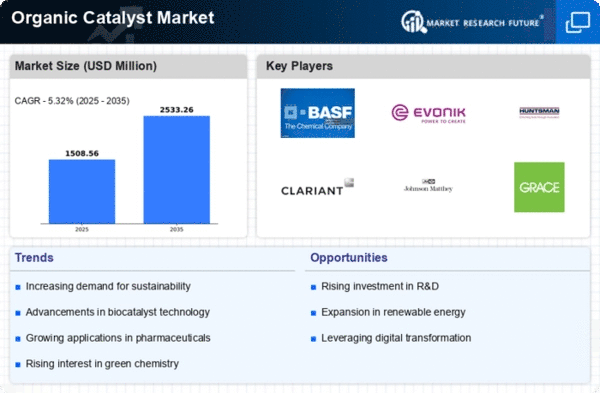
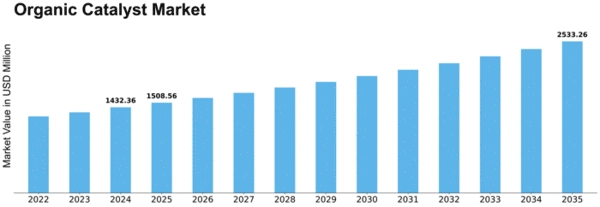
As per MRFR analysis, the Organic Catalyst Market Size was estimated at 1432.36 USD Million in 2024. The Organic Catalyst industry is projected to grow from 1508.56 USD Million in 2025 to 2533.26 USD Million by 2035, exhibiting a compound annual growth rate (CAGR) of 5.32 during the forecast period 2025 - 2035.

Key Market Trends & Highlights

The Organic Catalyst Market is experiencing robust growth driven by sustainability and technological advancements.

  • The market is increasingly oriented towards sustainability, reflecting a broader global trend.
  • North America remains the largest market, while Asia-Pacific is recognized as the fastest-growing region.
  • In the Chemical Synthesis segment, demand continues to dominate, whereas the Pharmaceuticals segment is witnessing rapid growth.
  • Rising demand for eco-friendly solutions and advancements in catalytic technologies are key drivers propelling market expansion.

Market Size & Forecast

2024 Market Size 1432.36 (USD Million)
2035 Market Size 2533.26 (USD Million)
CAGR (2025 - 2035) 5.32%
Largest Regional Market Share in 2024 North America

Major Players

<p>BASF SE (DE), Evonik Industries AG (DE), Huntsman Corporation (US), Clariant AG (CH), Johnson Matthey PLC (GB), W.R. Grace & Co. (US), Solvay SA (BE), Mitsubishi Chemical Corporation (JP), SABIC (SA)</p>

Market Trends

The Organic Catalyst Market is currently experiencing a notable transformation, driven by increasing environmental awareness and the demand for sustainable chemical processes. As industries strive to reduce their carbon footprint, organic catalysts are emerging as a viable alternative to traditional metal-based catalysts. This shift is not merely a trend but appears to be a fundamental change in how chemical reactions are facilitated, emphasizing efficiency and eco-friendliness. Furthermore, advancements in research and development are likely to enhance the performance of organic catalysts, making them more attractive for various applications, including pharmaceuticals, agrochemicals, and biofuels. In addition to environmental considerations, the Organic Catalyst Market is influenced by regulatory frameworks that promote greener technologies. Governments worldwide are implementing policies that encourage the adoption of sustainable practices, which may further propel the market's growth. The versatility of organic catalysts, combined with their potential to improve reaction selectivity and reduce by-products, suggests a promising future. As industries continue to innovate and adapt, the Organic Catalyst Market is poised for significant evolution, potentially reshaping the landscape of chemical manufacturing in the years to come.

Sustainability Focus

The emphasis on sustainability is reshaping the Organic Catalyst Market, as industries seek greener alternatives to traditional catalysts. This trend reflects a broader commitment to environmental responsibility, driving the development and adoption of organic catalysts.

Regulatory Support

Government regulations are increasingly favoring the use of organic catalysts, as policies promote eco-friendly practices. This support may enhance market growth, encouraging industries to transition towards more sustainable chemical processes.

Technological Advancements

Ongoing research and technological innovations are likely to improve the efficiency and effectiveness of organic catalysts. These advancements could lead to broader applications across various sectors, including pharmaceuticals and renewable energy.

Organic Catalyst Market Market Drivers

Market Growth Projections

The Global Organic Catalyst Market Industry is projected to experience substantial growth over the coming years. With a market value expected to reach 1.43 USD Billion in 2024 and 2.54 USD Billion by 2035, the industry is on a promising trajectory. The compound annual growth rate of 5.35% from 2025 to 2035 indicates a robust expansion driven by various factors, including technological advancements, regulatory support, and increasing demand for sustainable solutions. This growth is indicative of the evolving landscape of catalysis, where organic catalysts are becoming increasingly integral to industrial processes across multiple sectors.

Regulatory Support for Green Chemistry

Regulatory frameworks promoting green chemistry are increasingly influencing the Global Organic Catalyst Market Industry. Governments worldwide are implementing policies that encourage the use of organic catalysts in chemical processes, thereby reducing environmental impact. For instance, initiatives aimed at minimizing hazardous waste and emissions are steering industries towards adopting organic catalysts. This regulatory support not only fosters innovation but also enhances market growth. The anticipated compound annual growth rate of 5.35% from 2025 to 2035 underscores the positive impact of these regulations on the market, as companies align their practices with sustainable standards.

Growing Applications in Pharmaceuticals

The pharmaceutical sector is a significant driver of the Global Organic Catalyst Market Industry, as organic catalysts are increasingly utilized in drug synthesis and development. Their ability to facilitate complex reactions with high selectivity and efficiency makes them invaluable in producing active pharmaceutical ingredients. The rising demand for innovative therapies and personalized medicine is further propelling the adoption of organic catalysts in this sector. As pharmaceutical companies seek to enhance production processes and reduce costs, the market for organic catalysts is expected to flourish, contributing to the overall growth of the industry.

Technological Advancements in Catalysis

Technological advancements play a pivotal role in shaping the Global Organic Catalyst Market Industry. Innovations in catalyst design and synthesis are enhancing the efficiency and effectiveness of organic catalysts. For example, the development of new catalytic processes allows for lower energy consumption and improved reaction rates. These advancements not only optimize production but also contribute to cost savings for manufacturers. As a result, the market is expected to grow significantly, with a projected value of 2.54 USD Billion by 2035. This growth is indicative of the ongoing evolution in catalysis technology, which is likely to drive further adoption of organic catalysts across various industries.

Rising Awareness of Environmental Impact

There is a growing awareness of the environmental impact of industrial processes, which is driving the Global Organic Catalyst Market Industry. Stakeholders across various sectors are recognizing the need to adopt greener alternatives to traditional catalysts. This shift is motivated by both consumer preferences for sustainable products and the increasing pressure from regulatory bodies to minimize environmental footprints. As a result, industries are turning to organic catalysts, which offer reduced toxicity and lower emissions. This heightened awareness is likely to sustain market growth, as companies prioritize sustainable practices in their operations.

Increasing Demand for Sustainable Solutions

The Global Organic Catalyst Market Industry experiences a notable surge in demand for sustainable solutions across various sectors. Industries are increasingly adopting organic catalysts due to their environmentally friendly properties, which align with global sustainability goals. For instance, the chemical sector is shifting towards greener processes, utilizing organic catalysts to reduce harmful emissions. This trend is reflected in the projected market value of 1.43 USD Billion in 2024, indicating a robust growth trajectory. As companies strive to meet regulatory standards and consumer preferences for eco-friendly products, the Global Organic Catalyst Market Industry is poised for substantial expansion.

Market Segment Insights

By Application: Chemical Synthesis (Largest) vs. Pharmaceuticals (Fastest-Growing)

<p>The Organic Catalyst Market sees significant distribution in application segments, with Chemical Synthesis commanding the largest share. This segment leverages catalysts to facilitate reactions for creating complex organic compounds, making it indispensable in various chemical processes. Following closely are Pharmaceuticals, which utilize organic catalysts for drug formulation and synthesis, showcasing their growing importance in the health sector. As catalysts play a role in enhancing reaction efficiencies and yields, their contribution to these applications cannot be overstated. With the rising demand for eco-friendly and efficient production methods, growth trends within the Organic Catalyst Market are driven by advancements in chemical processes and sustainable practices. Pharmaceutical applications are witnessing unprecedented growth due to increasing investment in drug development and personalized medicine. On the other hand, the need for innovative catalysts in Chemical Synthesis continues to expand, propelled by a growing emphasis on green chemistry. This dual growth landscape presents ample opportunities for innovation and market expansion in the overall sector.</p>

<p>Chemical Synthesis: Dominant vs. Pharmaceuticals: Emerging</p>

<p>Chemical Synthesis stands out as the dominant application in the Organic Catalyst Market, primarily due to its extensive use in producing a vast array of chemical substances, including intermediates and specialty chemicals. This segment benefits from the ongoing industrial need for efficient and sustainable production methodologies, which enhance yield while minimizing waste. Additionally, established industries continue to invest in upgrading their processes, ensuring that Chemical Synthesis maintains its market leadership. Conversely, the Pharmaceuticals segment is emerging rapidly, primarily attributed to an increasing focus on novel drug development and efficiency improvement in synthesis processes. As biotechnology intersects with organic catalysts, the pharmaceutical sector is evolving to incorporate new chemical pathways that significantly heighten production efficacy and reduce environmental impact, indicating strong growth potential for this segment.</p>

By End Use Industry: Pharmaceutical (Largest) vs. Automotive (Fastest-Growing)

<p>In the Organic Catalyst Market, the 'End Use Industry' segment displays a diverse landscape, with the Pharmaceutical sector claiming the largest market share. This is largely attributed to the growing demand for innovative drug formulations and environmentally friendly processes. Additionally, Agriculture and Food and Beverage sectors follow closely, both contributing significantly to the organic catalyst consumption due to their reliance on sustainable and efficient production methods.</p>

<p>Pharmaceutical (Dominant) vs. Automotive (Emerging)</p>

<p>The Pharmaceutical industry stands as the dominant player in the Organic Catalyst Market, driven by its emphasis on sustainable and efficient synthesis methods. This sector prioritizes the development of green catalysts that minimize environmental impact while enhancing drug performance. In contrast, the Automotive segment is emerging rapidly as it adapts to increasing regulatory pressures and consumer demand for cleaner technologies. Automotive manufacturers are seeking organic catalysts to enhance engine performance, improve fuel efficiency, and reduce emissions, thereby marking it as a key area of growth within the organic catalyst domain.</p>

By Type: Homogeneous Catalyst (Largest) vs. Biocatalyst (Fastest-Growing)

<p>In the organic catalyst market, the share distribution reveals that homogeneous catalysts hold the largest portion, owing to their excellent selectivity and broad application across various chemical reactions. Meanwhile, heterogeneous catalysts, while significant, are positioned as a stable alternative due to their continuous operational capacity and ease of separation from final products. On the other hand, biocatalysts are emerging rapidly, gaining traction due to their eco-friendly and efficient nature, catering to the increasing demand for sustainable processes.</p>

<p>Homogeneous Catalyst (Dominant) vs. Biocatalyst (Emerging)</p>

<p>Homogeneous catalysts are widely acclaimed for their high efficiency and selectivity, predominantly used in fine chemical synthesis and pharmaceuticals. They facilitate complex reactions under mild conditions, leading to fewer by-products. In contrast, biocatalysts are gaining momentum as they utilize biological materials, providing a sustainable alternative to traditional chemical processes. Their growing adoption is influenced by advancements in enzyme technology and increasing regulatory pressures for greener methods. Both segment values highlight the diverse applications and strategic importance of these catalysts in responding to evolving market demands.</p>

By Form: Liquid (Largest) vs. Solid (Fastest-Growing)

<p>In the Organic Catalyst Market, the form segment indicates distinct distributions among liquid, solid, and gas catalysts. Currently, liquid catalysts hold the largest market share, driven by their versatility and effectiveness in various organic reactions. Solid catalysts are gaining traction due to advancements in solid-state chemical processes, showcasing their potential for growth despite having a smaller market share at present. Meanwhile, gas catalysts remain pivotal for specific industrial applications but constitute a limited share compared to liquids and solids.</p>

<p>Liquid (Dominant) vs. Solid (Emerging)</p>

<p>Liquid catalysts dominate the Organic Catalyst Market due to their ability to easily dissolve in reaction mixtures, yielding high surface area and improved reaction rates. Their wide application across pharmaceutical and petrochemical industries contributes significantly to their market position. On the other hand, solid catalysts are emerging rapidly, characterized by their stability and recyclability, making them environmentally attractive options. As the industry trend shifts towards sustainable practices, the solid catalyst segment is poised for robust growth, further enhancing its role as a critical component in organic synthesis.</p>

Get more detailed insights about Organic Catalyst Market Research Report - Global Forecast till 2035

Regional Insights

North America : Market Leader in Innovation

North America is poised to maintain its leadership in the organic catalyst market, holding a significant share of 600.0 million in 2025. The region's growth is driven by robust demand from the automotive and chemical industries, alongside stringent environmental regulations promoting cleaner production methods. The increasing focus on sustainable practices and the adoption of advanced technologies further bolster market expansion. The United States stands as the primary contributor, with key players like BASF SE, Huntsman Corporation, and W.R. Grace & Co. leading the charge. The competitive landscape is characterized by continuous innovation and strategic partnerships aimed at enhancing product offerings. As companies invest in R&D, the market is expected to witness a surge in advanced organic catalysts, catering to diverse industrial applications.

Europe : Sustainable Growth and Innovation

Europe's organic catalyst market is projected to reach 400.0 million by 2025, driven by increasing demand for eco-friendly solutions and regulatory support for sustainable practices. The European Union's stringent regulations on emissions and waste management are pivotal in shaping market dynamics, encouraging industries to adopt organic catalysts for cleaner production processes. This regulatory framework is a key driver of innovation and investment in the sector. Germany and France are leading the charge in this region, with major players like Evonik Industries AG and Clariant AG at the forefront. The competitive landscape is marked by a strong emphasis on research and development, with companies focusing on enhancing catalyst efficiency and sustainability. The presence of established firms and a growing number of startups contribute to a vibrant market environment, fostering collaboration and technological advancements.

Asia-Pacific : Rapid Growth and Development

The Asia-Pacific region is witnessing rapid growth in the organic catalyst market, projected to reach 350.0 million by 2025. This growth is fueled by increasing industrialization, particularly in countries like China and India, where the demand for efficient and sustainable production methods is on the rise. Government initiatives promoting green chemistry and sustainable practices are also significant drivers of market expansion in this region. China is the dominant player in the Asia-Pacific market, with major companies like Mitsubishi Chemical Corporation and SABIC leading the way. The competitive landscape is characterized by a mix of established firms and emerging players, all vying for market share. As the region continues to invest in advanced manufacturing technologies, the demand for organic catalysts is expected to grow, supporting various industries including automotive, pharmaceuticals, and agriculture.

Middle East and Africa : Emerging Market Potential

The Middle East and Africa (MEA) organic catalyst market is projected to reach 82.36 million by 2025, driven by increasing industrial activities and a growing focus on sustainable practices. The region's rich natural resources and strategic initiatives aimed at diversifying economies are key factors contributing to market growth. Additionally, regulatory frameworks promoting environmental sustainability are encouraging the adoption of organic catalysts across various sectors. Countries like Saudi Arabia and South Africa are leading the market, with a growing presence of key players such as SABIC and W.R. Grace & Co. The competitive landscape is evolving, with both local and international companies investing in the region. As industries seek to enhance efficiency and reduce environmental impact, the demand for organic catalysts is expected to rise, creating significant growth opportunities in the MEA market.

Key Players and Competitive Insights

The Organic Catalyst Market is currently characterized by a dynamic competitive landscape, driven by increasing demand for sustainable and efficient chemical processes. Key players are actively engaging in innovation and strategic partnerships to enhance their market positioning. For instance, BASF SE (DE) has been focusing on developing bio-based catalysts, which aligns with the growing trend towards sustainability. Similarly, Evonik Industries AG (DE) is investing in digital transformation initiatives to optimize its production processes, thereby improving efficiency and reducing costs. These strategies collectively contribute to a competitive environment that emphasizes technological advancement and sustainability.

In terms of business tactics, companies are increasingly localizing manufacturing to reduce supply chain vulnerabilities and enhance responsiveness to regional market demands. The market structure appears moderately fragmented, with several key players exerting influence over their respective segments. This fragmentation allows for niche players to thrive, while larger corporations leverage their scale to optimize operations and expand their market reach.

In November 2025, Huntsman Corporation (US) announced a strategic partnership with a leading biotechnology firm to co-develop innovative organic catalysts aimed at reducing carbon emissions in industrial processes. This collaboration is significant as it not only enhances Huntsman's product portfolio but also positions the company as a leader in sustainable chemical solutions, responding to the increasing regulatory pressures for greener technologies.

In October 2025, Clariant AG (CH) launched a new line of organic catalysts designed specifically for the production of biofuels. This initiative underscores Clariant's commitment to sustainability and reflects a broader industry trend towards renewable energy sources. The introduction of these catalysts is expected to capture a growing market segment focused on environmentally friendly fuel alternatives, thereby enhancing Clariant's competitive edge.

In September 2025, Johnson Matthey PLC (GB) expanded its research and development capabilities by opening a new innovation center dedicated to organic catalysts. This facility aims to accelerate the development of next-generation catalysts that meet the evolving needs of the market. The establishment of this center indicates Johnson Matthey's strategic focus on innovation and its intent to maintain a leadership position in the organic catalyst sector.

As of December 2025, the Organic Catalyst Market is witnessing trends that emphasize digitalization, sustainability, and the integration of artificial intelligence in production processes. Strategic alliances are increasingly shaping the competitive landscape, allowing companies to pool resources and expertise. Looking ahead, it is likely that competitive differentiation will evolve from traditional price-based competition to a focus on innovation, technological advancements, and supply chain reliability. This shift suggests that companies prioritizing R&D and sustainable practices will be better positioned to thrive in the future.

Key Companies in the Organic Catalyst Market market include

Industry Developments

Future Outlook

Organic Catalyst Market Future Outlook

<p>The Organic Catalyst Market is projected to grow at a 5.32% CAGR from 2024 to 2035, driven by increasing demand for sustainable processes and innovations in chemical manufacturing.</p>

New opportunities lie in:

  • <p>Development of biodegradable organic catalysts for eco-friendly applications.</p>
  • <p>Expansion into emerging markets with tailored catalyst solutions.</p>
  • <p>Investment in R&D for high-performance catalysts in pharmaceuticals.</p>

<p>By 2035, the Organic Catalyst Market is expected to achieve robust growth, positioning itself as a leader in sustainable chemical solutions.</p>

Market Segmentation

Organic Catalyst Market Form Outlook

  • Liquid
  • Solid
  • Gas

Organic Catalyst Market Type Outlook

  • Homogeneous Catalyst
  • Heterogeneous Catalyst
  • Biocatalyst

Organic Catalyst Market Application Outlook

  • Chemical Synthesis
  • Polymerization
  • Petrochemical Processing
  • Pharmaceuticals

Organic Catalyst Market End Use Industry Outlook

  • Automotive
  • Agriculture
  • Pharmaceutical
  • Food and Beverage

Report Scope

MARKET SIZE 20241432.36(USD Million)
MARKET SIZE 20251508.56(USD Million)
MARKET SIZE 20352533.26(USD Million)
COMPOUND ANNUAL GROWTH RATE (CAGR)5.32% (2024 - 2035)
REPORT COVERAGERevenue Forecast, Competitive Landscape, Growth Factors, and Trends
BASE YEAR2024
Market Forecast Period2025 - 2035
Historical Data2019 - 2024
Market Forecast UnitsUSD Million
Key Companies ProfiledBASF SE (DE), Evonik Industries AG (DE), Huntsman Corporation (US), Clariant AG (CH), Johnson Matthey PLC (GB), W.R. Grace & Co. (US), Solvay SA (BE), Mitsubishi Chemical Corporation (JP), SABIC (SA)
Segments CoveredApplication, End Use Industry, Type, Form
Key Market OpportunitiesGrowing demand for sustainable processes drives innovation in the Organic Catalyst Market.
Key Market DynamicsRising demand for sustainable processes drives innovation in organic catalysts, enhancing efficiency and reducing environmental impact.
Countries CoveredNorth America, Europe, APAC, South America, MEA

FAQs

Who are the factors aiding the transformation of the organic catalyst market?

The augmented demand level from the pharmaceutical and agricultural sectors is projected to enhance the market.

What is the CAGR development detected in the organic catalyst market?

Organic Catalyst Market is expected to grow with a CAGR of 5.32% in the period 2025-2035

What is the revenue capacity of the organic catalyst market in the forecast period?

A constructive revenue level is estimated to empower the market.

Which regions are regulating the organic catalyst market?

The APAC regional market is estimated to shape the market in the coming period.

Which influences are stimulating the organic catalyst market?

Pon Pure Chemicals (India), Evonik Industries AG (Germany), Nouryon (The Netherlands), Mitushi Biopharma (India)and Gulbrandsen (US) are the notable leaders in the market.

  1. Executive Summary
  2. Market
    1. Introduction
    2. Market Definition
    3. Scope of the
    4. Study
    5. List of Assumptions
    6. Markets Structure
    7. Market Research Methodology
    8. Research Process
    9. Primary Research
    10. Secondary Research
    11. Market Size
    12. Estimation
    13. Forecast Model
  3. Market Dynamics of Global
    1. Organic Catalyst Market
    2. Introduction
    3. Drivers
    4. Restraints
    5. Opportunities
    6. Challenges
    7. Trends/Technology
  4. Market Factor Analysis of Global Organic Catalyst
    1. Market
    2. Supply Chain Analysis
      1. Raw Product Type
      2. Manufacturers/Producers
      3. Distributors/Retailers/Wholesalers/E-Commerce
    3. Suppliers
    4. End Users
    5. Porter’s Five Forces Analysis
      1. Bargaining Power of Buyers
      2. Threat of Substitutes
    6. Threat of New Entrants
    7. Bargaining Power of Suppliers
    8. Intensity of Competitive Rivalry
    9. Pricing Analysis
  5. Global Organic Catalyst Market, by Product Type
    1. Introduction
      1. Market Estimates & Forecast, 2025−2034
    2. Enzymes
  6. Market Estimates & Forecast, by Region, 2025−2034
    1. Amines
      1. Market Estimates
    2. Market Estimates & Forecast, 2025−2034
    3. & Forecast, by Region, 2025−2034
    4. Chiral Amides
      1. Market Estimates
    5. Market Estimates & Forecast, 2025−2034
    6. & Forecast, by Region, 2025−2034
    7. Iminium
      1. Market Estimates
    8. Market Estimates & Forecast, 2025−2034
    9. & Forecast, by Region, 2025−2034
    10. Carbenes
      1. Market Estimates
    11. Market Estimates & Forecast, 2025−2034
    12. & Forecast, by Region, 2025−2034
    13. Others
      1. Market Estimates
    14. Market Estimates & Forecast, 2025−2034
    15. & Forecast, by Region, 2025−2034
  7. Global Organic Catalyst
  8. Market, by Application
    1. Introduction
    2. Medicines
      1. Market Estimates
    3. Market Estimates & Forecast, 2025−2034
    4. & Forecast, by Region, 2025−2034
    5. Fertilizers
      1. Market Estimates
    6. Market Estimates & Forecast, 2025−2034
    7. & Forecast, by Region, 2025−2034
    8. Pesticides
      1. Market Estimates
    9. Market Estimates & Forecast, 2025−2034
    10. & Forecast, by Region, 2025−2034
    11. Paper & Pulp
      1. Market Estimates
    12. Market Estimates & Forecast, 2025−2034
    13. & Forecast, by Region, 2025−2034
    14. Others
      1. Market Estimates
    15. Market Estimates & Forecast, 2025−2034
    16. & Forecast, by Region, 2025−2034
  9. Global Organic Catalyst
  10. Market, by End-Use Industry
    1. Introduction
    2. Chemical
      1. Market Estimates
    3. Market Estimates & Forecast, 2025−2034
    4. & Forecast, by Region, 2025−2034
    5. Agriculture
      1. Market Estimates
    6. Market Estimates & Forecast, 2025−2034
    7. & Forecast, by Region, 2025−2034
    8. Healthcare
      1. Market Estimates
    9. Market Estimates & Forecast, 2025−2034
    10. & Forecast, by Region, 2025−2034
    11. Food & Beverages
      1. Market Estimates
    12. Market Estimates & Forecast, 2025−2034
    13. & Forecast, by Region, 2025−2034
    14. Others
      1. Market Estimates
    15. Market Estimates & Forecast, 2025−2034
    16. & Forecast, by Region, 2025−2034
  11. Global Organic Catalyst
  12. Market, by Region
    1. Introduction
    2. North America
      1. Market Estimates
      2. Market Estimates
      3. Market Estimates
      4. US
      5. Canada
    3. Market Estimates & Forecast, 2025−2034
    4. & Forecast, by Product Type, 2025−2034
    5. & Forecast, by Application, 2025−2034
    6. & Forecast, by End-Use Industry, 2025−2034
    7. Market Estimates & Forecast, 2025−2034
    8. & Forecast, by Product Type, 2025−2034
    9. & Forecast, by Application, 2025−2034
    10. & Forecast, by End-Use Industry, 2025−2034
    11. Market Estimates & Forecast, 2025−2034
    12. & Forecast, by Product Type, 2025−2034
    13. & Forecast, by Application, 2025−2034
    14. & Forecast, by End-Use Industry, 2025−2034
    15. Europe
      1. Market Estimates
      2. Market Estimates
      3. Market Estimates
      4. Germany
      5. France
      6. Italy
      7. Spain
      8. UK
      9. Russia
      10. Poland
      11. Rest of
    16. Market Estimates & Forecast, 2025−2034
    17. & Forecast, by Product Type, 2025−2034
    18. & Forecast, by Application, 2025−2034
    19. & Forecast, by End-Use Industry, 2025−2034
    20. Market Estimates & Forecast, 2025−2034
    21. & Forecast, by Product Type, 2025−2034
    22. & Forecast, by Application, 2025−2034
    23. & Forecast, by End-Use Industry, 2025−2034
    24. Market Estimates & Forecast, 2025−2034
    25. & Forecast, by Product Type, 2025−2034
    26. & Forecast, by Application, 2025−2034
    27. & Forecast, by End-Use Industry, 2025−2034
    28. Market Estimates & Forecast, 2025−2034
    29. & Forecast, by Product Type, 2025−2034
    30. & Forecast, by Application, 2025−2034
    31. & Forecast, by End-Use Industry, 2025−2034
    32. Market Estimates & Forecast, 2025−2034
    33. & Forecast, by Product Type, 2025−2034
    34. & Forecast, by Application, 2025−2034
    35. & Forecast, by End-Use Industry, 2025−2034
    36. Market Estimates & Forecast, 2025−2034
    37. & Forecast, by Product Type, 2025−2034
    38. & Forecast, by Application, 2025−2034
    39. & Forecast, by End-Use Industry, 2025−2034
    40. Market Estimates & Forecast, 2025−2034
    41. & Forecast, by Product Type, 2025−2034
    42. & Forecast, by Application, 2025−2034
    43. & Forecast, by End-Use Industry, 2025−2034
    44. Market Estimates & Forecast, 2025−2034
    45. & Forecast, by Product Type, 2025−2034
    46. & Forecast, by Application, 2025−2034
    47. & Forecast, by End-Use Industry, 2025−2034
    48. Europe
  13. Market Estimates & Forecast, by Product Type, 2025−2034
  14. Market Estimates & Forecast, by Application, 2025−2034
  15. Market Estimates & Forecast, by End-Use Industry, 2025−2034
    1. Asia-Pacific
  16. Market Estimates & Forecast, 2025−2034
  17. Market Estimates & Forecast, by Product Type, 2025−2034
  18. Market Estimates & Forecast, by Application, 2025−2034
  19. Market Estimates & Forecast, by End-Use Industry, 2025−2034
    1. China
  20. Market Estimates & Forecast, 2025−2034
  21. Market Estimates & Forecast, by Product Type, 2025−2034
  22. Market Estimates & Forecast, by Application, 2025−2034
  23. Market Estimates & Forecast, by End-Use Industry, 2025−2034
    1. India
  24. Market Estimates & Forecast, 2025−2034
  25. Market Estimates & Forecast, by Product Type, 2025−2034
  26. Market Estimates & Forecast, by Application, 2025−2034
  27. Market Estimates & Forecast, by End-Use Industry, 2025−2034
    1. Japan
  28. Market Estimates & Forecast, 2025−2034
  29. Market Estimates & Forecast, by Product Type, 2025−2034
  30. Market Estimates & Forecast, by Application, 2025−2034
  31. Market Estimates & Forecast, by End-Use Industry, 2025−2034
    1. Australia & New Zealand
    2. Type, 2025−2034
    3. Application, 2025−2034
    4. by End-Use Industry, 2025−2034
    5. Market Estimates & Forecast, 2025−2034
    6. & Forecast, by Product Type, 2025−2034
    7. & Forecast, by Application, 2025−2034
    8. & Forecast, by End-Use Industry, 2025−2034
    9. & Africa
  32. Market Estimates & Forecast,
  33. Market Estimates & Forecast, by Product
  34. Market Estimates & Forecast, by
  35. Market Estimates & Forecast,
  36. Rest of Asia Pacific
  37. Market Estimates
  38. Market Estimates
  39. Market Estimates
    1. Middle East
      1. Market Estimates & Forecast, 2025−2034
  40. Market Estimates & Forecast, by Product Type, 2025−2034
  41. Market Estimates & Forecast, by Application, 2025−2034
  42. Market Estimates & Forecast, by End-Use Industry, 2025−2034
    1. GCC
  43. Market Estimates & Forecast, 2025−2034
  44. Market Estimates & Forecast, by Product Type, 2025−2034
  45. Market Estimates & Forecast, by Application, 2025−2034
  46. Market Estimates & Forecast, by End-Use Industry, 2025−2034
    1. Israel
  47. Market Estimates & Forecast, 2025−2034
  48. Market Estimates & Forecast, by Product Type, 2025−2034
  49. Market Estimates & Forecast, by Application, 2025−2034
  50. Market Estimates & Forecast, by End-Use Industry, 2025−2034
    1. North Africa
  51. Market Estimates & Forecast, 2025−2034
  52. Market Estimates & Forecast, by Product Type, 2025−2034
  53. Market Estimates & Forecast, by Application, 2025−2034
  54. Market Estimates & Forecast, by End-Use Industry, 2025−2034
    1. Turkey
  55. Market Estimates & Forecast, 2025−2034
  56. Market Estimates & Forecast, by Product Type, 2025−2034
  57. Market Estimates & Forecast, by Application, 2025−2034
  58. Market Estimates & Forecast, by End-Use Industry, 2025−2034
    1. Rest of Middle East & Africa
    2. Type, 2025−2034
    3. Application, 2025−2034
    4. by End-Use Industry, 2025−2034
    5. Market Estimates & Forecast, 2025−2034
    6. & Forecast, by Product Type, 2025−2034
    7. & Forecast, by Application, 2025−2034
    8. & Forecast, by End-Use Industry, 2025−2034
    9. Market Estimates & Forecast, 2025−2034
    10. & Forecast, by Product Type, 2025−2034
    11. & Forecast, by Application, 2025−2034
    12. & Forecast, by End-Use Industry, 2025−2034
    13. Market Estimates & Forecast, 2025−2034
    14. & Forecast, by Product Type, 2025−2034
    15. & Forecast, by Application, 2025−2034
    16. & Forecast, by End-Use Industry, 2025−2034
    17. Market Estimates & Forecast, 2025−2034
    18. & Forecast, by Product Type, 2025−2034
    19. & Forecast, by Application, 2025−2034
    20. & Forecast, by End-Use Industry, 2025−2034
    21. Latin America
  59. Market Estimates & Forecast,
  60. Market Estimates & Forecast, by Product
  61. Market Estimates & Forecast, by
  62. Market Estimates & Forecast,
    1. Latin America
      1. Market Estimates
      2. Market Estimates
      3. Market Estimates
      4. Brazil
      5. Mexico
      6. Argentina
      7. Rest of
  63. Market Estimates & Forecast, by Product Type, 2025−2034
  64. Market Estimates & Forecast, by Application, 2025−2034
  65. Market Estimates & Forecast, by End-Use Industry, 2025−2034
    1. Company Landscape
    2. Introduction
    3. Market Strategy
    4. Key Development Analysis (Expansion/Merger & Acquisition/Joint Venture/New Product
    5. Development/Agreement/Investment)
  66. Company Profiles
    1. Bio-Organic Catalyst
    2. Financial Updates
    3. Strategy
    4. Yangzhou Dajiang Chemical Co.,Ltd
    5. Financial Updates
    6. Strategy
    7. newtopchem
    8. Updates
    9. Strategy
    10. BASF SE
    11. Product/Business Segment Overview
    12. Key Developments
    13. Company Overview
    14. Segment Overview
    15. SWOT Analysis
    16. Overview
    17. Segment Overview
    18. SWOT Analysis
    19. Overview
    20. Segment Overview
    21. SWOT Analysis
    22. Financial Updates
    23. Strategy
    24. Mystical Biotech Pvt Ltd
    25. Financial Updates
    26. Strategy
    27. Mitushi Biopharma
    28. Updates
    29. Strategy
    30. Novozymes
    31. Updates
    32. Strategy
    33. AB Enzymes
    34. Updates
    35. Strategy
    36. Aum Enzymes
    37. Updates
    38. Strategy
    39. F. Hoffmann-La Roche Ltd
    40. Financial Updates
    41. Strategy
    42. DSM
    43. Product/Business Segment Overview
    44. Key Developments
  67. Company Overview
  68. Product/Business Segment Overview
  69. Key Developments
  70. SWOT Analysis
  71. Company Overview
  72. Product/Business Segment Overview
  73. Key Developments
  74. SWOT Analysis
  75. Company Overview
  76. Financial
  77. Product/Business Segment Overview
  78. Key Developments
  79. SWOT Analysis
  80. Company Overview
  81. Financial Updates
  82. Strategy
  83. SWOT Analysis
    1. Nouryon
      1. Financial Updates
      2. Product/Business
      3. Strategy
      4. Key Developments
    2. Pon Pure Chemicals
      1. Company
      2. Financial Updates
      3. Product/Business
      4. Strategy
      5. Key Developments
    3. Evonik Industries AG
      1. Company
      2. Financial Updates
      3. Product/Business
      4. Strategy
      5. Key Developments
    4. Gulbrandsen
      1. Company Overview
      2. Product/Business Segment Overview
      3. Key Developments
      4. SWOT Analysis
      5. Company Overview
      6. Product/Business Segment Overview
      7. Key Developments
      8. SWOT Analysis
      9. Company Overview
      10. Financial
      11. Product/Business Segment Overview
      12. Key Developments
      13. SWOT Analysis
      14. Company Overview
      15. Financial
      16. Product/Business Segment Overview
      17. Key Developments
      18. SWOT Analysis
      19. Company Overview
      20. Financial
      21. Product/Business Segment Overview
      22. Key Developments
      23. SWOT Analysis
      24. Company Overview
      25. Financial
      26. Product/Business Segment Overview
      27. Key Developments
      28. SWOT Analysis
      29. Company Overview
      30. Product/Business Segment Overview
      31. Key Developments
      32. SWOT Analysis
      33. Company Overview
      34. Financial Updates
      35. Strategy
      36. SWOT Analysis
  84. Conclusion
    1. LIST
  85. OF TABLES
  86. Global Organic Catalyst Market,
    1. by Region, 2025−2034
  87. North America: Organic Catalyst
  88. Market, by Country, 2025−2034
  89. Europe: Organic Catalyst
  90. Market, by Country, 2025−2034
  91. Asia-Pacific: Organic
  92. Catalyst Market, by Country, 2025−2034
  93. Middle East &
  94. Africa: Organic Catalyst Market, by Country, 2025−2034
    1. Table
  95. Latin America: Organic Catalyst Market, by Country, 2025−2034
    1. Table
  96. Global Organic Catalyst Product Type Market, by Regions, 2025−2034
    1. Table
  97. North America: Organic Catalyst Product Type Market, by Country, 2025−2034
    1. Table
  98. Europe: Organic Catalyst Product Type Market, by Country, 2025−2034
    1. Table10
  99. Asia-Pacific: Organic Catalyst Product Type Market, by Country, 2025−2034
    1. Table11
  100. Middle East & Africa: Organic Catalyst Product Type Market, by Country, 2025−2034
    1. Table12
  101. Latin America: Organic Catalyst Product Type Market, by Country, 2025−2034
    1. Table13
  102. Global Organic Catalyst Application Market, by Regions, 2025−2034
    1. Table14
  103. North America: Organic Catalyst by Application Market, by Country, 2025−2034
    1. Table15
  104. Europe: Organic Catalyst Application Market, by Country, 2025−2034
    1. Table16
  105. Asia-Pacific: Organic Catalyst Application Market, by Country, 2025−2034
    1. Table17
  106. Middle East & Africa: Organic Catalyst Application Market, by Country, 2025−2034
    1. Table18
  107. Latin America: Organic Catalyst Application Market, by Country, 2025−2034
    1. Table19
  108. Global Organic Catalyst End-Use Industry Market, by Regions, 2025−2034
    1. Table20
  109. North America: Organic Catalyst End-Use Industry Market, by Country, 2025−2034
    1. Table21
  110. Europe: Organic Catalyst End-Use Industry Market, by Country, 2025−2034
    1. Table22
  111. Asia-Pacific: Organic Catalyst End-Use Industry Market, by Country, 2025−2034
    1. Table23
  112. Middle East & Africa: Organic Catalyst End-Use Industry Market, by Country,
    1. Table24 Latin America: Organic Catalyst End-Use Industry
  113. Market, by Country, 2025−2034
    1. Table25 Global Product Type Market,
    2. by Region, 2025−2034
  114. Table26 Global Application Market, by Region,
  115. Table27 Global End-Use Industry Market, by Region,
    1. Table28 North America: Organic Catalyst Market, by
    2. Country
  116. Table29 North America: Organic Catalyst Market, by Product
    1. Type
  117. Table30 North America: Organic Catalyst Market, by Application
    1. Table31
  118. North America: Organic Catalyst Market, by End-Use Industry
    1. Table32
  119. Europe: Organic Catalyst Market, by Country
    1. Table33 Europe: Organic
  120. Catalyst Market, by Product Type
    1. Table34 Europe: Organic Catalyst
  121. Market, by Application
    1. Table35 Europe: Organic Catalyst Market, by
    2. End-Use Industry
    3. Table36 Asia-Pacific: Organic Catalyst Market, by
    4. Country
  122. Table37 Asia-Pacific: Organic Catalyst Market, by Product
    1. Type
  123. Table38 Asia-Pacific: Organic Catalyst Market, by Application
    1. Table39
  124. Asia-Pacific: Organic Catalyst Market, by End-Use Industry
    1. Table40
  125. Middle East & Africa: Organic Catalyst Market, by Country
    1. Table41
  126. Middle East & Africa: Organic Catalyst Market, by Product Type
    1. Table42
  127. Middle East & Africa: Organic Catalyst Market, by Application
    1. Table43
  128. Middle East & Africa: Organic Catalyst Market, by End-Use Industry
    1. Table44
  129. Latin America: Organic Catalyst Market, by Country
    1. Table45 Latin America:
  130. Organic Catalyst Market, by Product Type
    1. Table46 Latin America: Organic
  131. Catalyst Market, by Application
    1. Table47 Latin America: Organic Catalyst
  132. Market, by End-Use Industry
  133. LIST OF FIGURES
    1. FIGURE
  134. Global Organic Catalyst Market Segmentation
  135. Forecast Research
    1. Methodology
  136. Five Forces Analysis of Global Organic Catalyst
    1. Market
  137. Value Chain of Global Organic Catalyst Market
    1. FIGURE
  138. Share of Global Organic Catalyst Market in 2020, by Country (%)
    1. FIGURE
  139. Global Organic Catalyst Market, 2025−2034
  140. Global
  141. Organic Catalyst Market Size, by Product Type, 2020
  142. Share
  143. of Global Organic Catalyst Market, by Product Type, 2025−2034
    1. FIGURE
  144. Global Organic Catalyst Market Size, by Application, 2020
    1. FIGURE
  145. Share of Global Organic Catalyst Market, by Application, 2025−2034
    1. FIGURE
  146. Global Organic Catalyst Market Size, by End-Use Industry, 2020
    1. FIGURE
  147. Share of Global Organic Catalyst Market, by End-Use Industry, 2025−2034

Organic Catalyst Market Segmentation

Market Segmentation Overview

  • Detailed segmentation data will be available in the full report
  • Comprehensive analysis by multiple parameters
  • Regional and country-level breakdowns
  • Market size forecasts by segment
Infographic

Free Sample Request

Kindly complete the form below to receive a free sample of this Report

Get Free Sample

Customer Strories

Compare Licence

×
Features License Type
Single User Multiuser License Enterprise User
Price $4,950 $5,950 $7,250
Maximum User Access Limit 1 User Upto 10 Users Unrestricted Access Throughout the Organization
Free Customization
Direct Access to Analyst
Deliverable Format
Platform Access
Discount on Next Purchase 10% 15% 15%
Printable Versions