×
Request Free Sample ×

Kindly complete the form below to receive a free sample of this Report

* Please use a valid business email

Leading companies partner with us for data-driven Insights

clients tt-cursor
Hero Background
English
Chinese
French
Japanese
Korean
German
Spanish

Organic Binders Market Share

ID: MRFR/CnM/5664-HCR
140 Pages
Anshula Mandaokar
October 2025

Organic binders Market Research Report Information by Form (Powder, Granulates, dispersions, Solid Resin), Product (Acrylic, Latex, PVC, PVA, and Others), Application (Paints & Coatings, Construction, Electronics, Automotive, and Others), Region — Global Forecast till 2035

Share:
Download PDF ×

We do not share your information with anyone. However, we may send you emails based on your report interest from time to time. You may contact us at any time to opt-out.

Organic Binders Market Infographic
×
Organic Binders Market Infographic Full View
Purchase Options

Market Share

Organic Binders Market Share Analysis

In the fiercely competitive landscape of the Subsea Organic Binders Market, companies strategically deploy various market share positioning strategies to establish a robust presence and gain a competitive edge. A pivotal strategy involves differentiation, where companies focus on producing high-quality organic binders tailored for subsea applications. These binders may possess unique features such as enhanced adhesion, corrosion resistance, or specific formulations suitable for challenging underwater environments in the oil and gas industry. By investing in research and development, companies can create innovative formulations that cater to the evolving needs of subsea projects, setting themselves apart from competitors and securing a significant market share. Differentiation not only attracts customers seeking specialized solutions but also enhances the overall perceived value of organic binders in the subsea market.

Cost leadership is another critical strategy employed by companies in the Subsea Organic Binders Market. This approach revolves around becoming a low-cost producer through optimized manufacturing processes, economies of scale, and efficient supply chain management. Emphasizing cost efficiency enables companies to offer competitive pricing for their organic binders, making them appealing to cost-conscious subsea project operators and gaining a larger market share. Successful execution of this strategy demands continuous improvement, innovative production methods, and a keen focus on operational excellence to maintain profitability while providing cost-competitive products.

Strategic alliances and partnerships play a vital role in shaping the market share positioning of companies in the Subsea Organic Binders Market. Collaborating with key stakeholders such as oil and gas companies, subsea equipment manufacturers, or research institutions allows companies to access essential resources, cutting-edge technologies, and distribution channels. Through strategic partnerships, companies can expand their market reach, leverage shared expertise, and create synergies that enhance their overall competitive position. This collaborative approach fosters innovation, accelerates market penetration, and contributes to a more robust market presence in the subsea sector.

Geographical expansion is a strategic imperative for companies aiming to increase their market share in the Subsea Organic Binders Market. Identifying and entering new subsea markets or expanding existing operations globally allows companies to tap into regions with growing demand for organic binders in subsea applications. Adapting products to suit the unique requirements of different subsea environments is crucial for success in geographical expansion. This strategy enables companies to diversify their customer base, reduce dependency on specific regions, and strengthen their market share on a global scale.

Furthermore, a customer-centric approach is indispensable for gaining and maintaining market share in the Subsea Organic Binders Market. Understanding the specific requirements of subsea projects, providing technical support, and offering excellent customer service contribute to building strong relationships. Companies that prioritize customer satisfaction often benefit from increased loyalty, positive word-of-mouth marketing, and repeat business, ultimately solidifying their market share. As the subsea industry continues to evolve with increased focus on sustainability and efficiency, aligning organic binders with the unique needs of customers becomes crucial for sustained success.
Author
Anshula Mandaokar
Team Lead - Research

Anshula Mandaokar holds an academic degree in Chemical Engineering and has been contributing to the field for more than 5 years. She has expertise in Market Research and Business Consulting and serves as a Team Lead for a reputed Market Research firm under the Chemicals and Materials domain spectrum. She has worked on multiple projects, generating explicit results in a quick turnaround time. Her understanding of data interpretation justifies her role as a leader.

Leave a Comment

FAQs

What could restrain the organic binders market from achieving strong growth?

The global organic binders market would get dampened by factors like lack of resources, construction standards, and environmental regulations.

Which region would have the maximum organic binders market share?

The Asia Pacific market would fetch the maximum market revenue for the global organic binders market.

Who are the players to have a remarkable impact on the organic binders market?

Major participants like Wacker Chemie AG (Germany), BASF SE (Germany), ENDURA IPNR (India), Oilex International GmbH (Germany), Empower Materials (US), Stover Seed company (US), KYOEISHA CHEMICAL Co. LTD (Japan), Keramicalia (South Africa), and Others would ensure strong growth for the organic binders market.

What strategies would be adopted by players of the global organic binders market?

Players taking care of the organic binders market would have strategies like effective agreement, better expansion plans, investments, product launches, joint ventures, mergers & acquisitions, and R&D.

What factors to dominate the global organic binders market growth?

Growing speed of urbanization, booming automotive sector, increasing electronics sector, various reconstruction activities, better investment schemes, and technological advancements are expected to ensure a better surge in the global organic binders market.

Market Summary

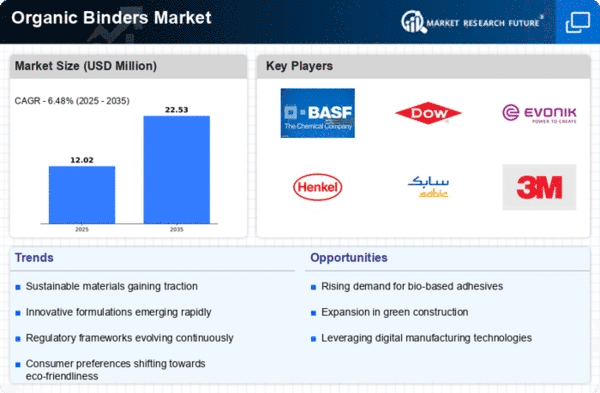
As per MRFR analysis, the Organic Binders Market Size was estimated at 11.29 USD Million in 2024. The Organic Binders industry is projected to grow from 12.02 USD Million in 2025 to 22.53 USD Million by 2035, exhibiting a compound annual growth rate (CAGR) of 6.48 during the forecast period 2025 - 2035.

Key Market Trends & Highlights

The Organic Binders Market is experiencing robust growth driven by sustainability and innovation.

  • The market is increasingly influenced by a strong focus on sustainability, particularly in North America.
  • Technological advancements are propelling the development of innovative organic binders, especially in the Asia-Pacific region.
  • Consumer preferences are shifting towards eco-friendly products, with adhesives being the largest segment in the market.
  • Rising construction activities and regulatory support for sustainable practices are key drivers of market growth.

Market Size & Forecast

2024 Market Size 11.29 (USD Million)
2035 Market Size 22.53 (USD Million)
CAGR (2025 - 2035) 6.48%
Largest Regional Market Share in 2024 North America

Major Players

<p>BASF SE (DE), Dow Inc. (US), Evonik Industries AG (DE), Henkel AG & Co. KGaA (DE), SABIC (SA), 3M Company (US), Ashland Global Holdings Inc. (US), Kraton Corporation (US)</p>

Market Trends

The Organic Binders Market is currently experiencing a notable transformation, driven by increasing environmental awareness and the demand for sustainable materials. As industries seek alternatives to traditional synthetic binders, organic options are gaining traction due to their eco-friendly properties. This shift is evident across various sectors, including construction, automotive, and packaging, where organic binders are being integrated into products to enhance performance while minimizing environmental impact. Furthermore, advancements in technology are facilitating the development of innovative organic binder formulations, which are expected to further propel market growth. In addition to environmental considerations, the Organic Binders Market is influenced by changing consumer preferences that favor natural ingredients. This trend is prompting manufacturers to invest in research and development to create high-performance organic binders that meet the evolving needs of end-users. As a result, the market landscape is becoming increasingly competitive, with companies striving to differentiate their offerings through quality and sustainability. Overall, the Organic Binders Market appears poised for continued expansion as it aligns with global sustainability goals and responds to the growing demand for greener alternatives in various applications.

Sustainability Focus

The emphasis on sustainability is reshaping the Organic Binders Market, as consumers and industries alike prioritize eco-friendly materials. This trend is prompting manufacturers to innovate and develop organic binders that not only perform well but also reduce environmental footprints.

Technological Advancements

Ongoing technological advancements are playing a crucial role in the evolution of the Organic Binders Market. Innovations in formulation and production processes are enabling the creation of high-performance organic binders, which are likely to enhance their adoption across diverse applications.

Consumer Preference Shift

A noticeable shift in consumer preferences towards natural and organic products is influencing the Organic Binders Market. As awareness of health and environmental issues grows, manufacturers are increasingly focusing on developing organic binders that cater to these changing demands.

Organic Binders Market Market Drivers

Regulatory Support

Government regulations promoting the use of eco-friendly materials are significantly influencing the Global Organic Binders Market Industry. Various countries are implementing stringent policies to phase out harmful synthetic binders, thereby creating a favorable environment for organic alternatives. For instance, the European Union has introduced directives that encourage the use of bio-based materials in construction and manufacturing. This regulatory support not only boosts consumer confidence in organic binders but also incentivizes manufacturers to innovate and invest in sustainable practices, further propelling market growth.

Consumer Preferences

Shifting consumer preferences towards natural and organic products are reshaping the Global Organic Binders Market Industry. As consumers become more health-conscious and environmentally aware, there is a growing demand for products that utilize organic binders. This trend is particularly evident in sectors such as food packaging and personal care, where organic binders are favored for their safety and sustainability. Consequently, manufacturers are increasingly reformulating their products to incorporate organic binders, aligning with consumer expectations and driving market growth.

Sustainability Trends

The Global Organic Binders Market Industry is experiencing a notable shift towards sustainability, driven by increasing environmental awareness among consumers and manufacturers. As industries strive to reduce their carbon footprints, organic binders, derived from renewable resources, are gaining traction. This shift is evidenced by the projected market growth from 12.5 USD Billion in 2024 to 25 USD Billion by 2035, reflecting a compound annual growth rate of 6.5% from 2025 to 2035. Companies are increasingly adopting organic binders in applications ranging from construction to packaging, aligning with global sustainability goals and regulations.

Market Growth Projections

The Global Organic Binders Market Industry is poised for substantial growth, with projections indicating an increase from 12.5 USD Billion in 2024 to 25 USD Billion by 2035. This growth trajectory suggests a robust compound annual growth rate of 6.5% from 2025 to 2035. Such projections highlight the increasing adoption of organic binders across various applications, driven by sustainability trends, regulatory support, and evolving consumer preferences. As industries continue to prioritize eco-friendly materials, the market is likely to expand, presenting opportunities for innovation and investment.

Technological Advancements

Innovations in production technologies are enhancing the performance and applicability of organic binders within the Global Organic Binders Market Industry. Advances in bioengineering and material science are enabling the development of high-performance organic binders that meet the stringent requirements of various industries. For example, the introduction of new formulations that improve adhesion and durability is expanding the use of organic binders in sectors such as automotive and aerospace. These technological advancements are likely to attract investments and drive market expansion, as manufacturers seek to leverage improved product offerings.

Growing Demand in Construction

The construction sector is a major driver of the Global Organic Binders Market Industry, as the demand for sustainable building materials continues to rise. Organic binders are increasingly utilized in adhesives, sealants, and coatings, which are essential for environmentally friendly construction practices. The global push for green buildings and sustainable infrastructure is expected to contribute significantly to market growth. As a result, the industry is projected to reach 12.5 USD Billion in 2024, with further expansion anticipated as construction practices evolve to prioritize sustainability.

Market Segment Insights

By Application: Adhesives (Largest) vs. Coatings (Fastest-Growing)

<p>In the Organic Binders Market, the application segment reveals significant insights into how different products capture market shares. Adhesives dominate this space, reflecting a steady percentage of overall demand driven by a variety of industries including construction and packaging. Coatings, while smaller in market share, are experiencing rapid growth, driven by trends towards eco-friendly alternatives and enhanced performance in protective applications. Sealants, composites, and plastics, while integral, show varied growth trajectories, with sealants finding stability due to their niche applications.</p>

<p>Adhesives (Dominant) vs. Coatings (Emerging)</p>

<p>Adhesives represent a dominant force in the Organic Binders Market, driven by their widespread use in various sectors, such as automotive, construction, and woodworking. Their versatility allows them to bond dissimilar materials effectively, catering to an expansive range of applications. On the other hand, coatings are emerging as a vital component in this market, reflecting a surge in demand for sustainable and high-performance solutions. The advent of eco-friendly organic binders in coatings is transforming the landscape, as industries increasingly prioritize durability and environmental impact. This shift not only highlights the versatility of coatings but also positions them as a critical area for innovation in the organic binders space.</p>

By End Use Industry: Construction (Largest) vs. Automotive (Fastest-Growing)

<p>In the Organic Binders Market, the end use industry segment showcases a diverse distribution of market shares among various sectors. Construction is the largest segment, driven by increasing infrastructure development and a growing demand for sustainable building materials. Following construction, the automotive sector emerges, highlighted as the fastest-growing segment, spurred by advancements in electric vehicle technologies and eco-friendly materials in manufacturing processes. As we look forward, growth trends within the Organic Binders Market reveal strong potential for both construction and automotive industries. The construction segment is supported by a surge in green building initiatives and stringent regulations prioritizing sustainable practices. Meanwhile, the automotive industry benefits from rising consumer preferences for sustainable vehicles, leading to increased adoption of organic binders in manufacturing processes, which enhances performance and reduces environmental impact.</p>

<p>Construction (Dominant) vs. Automotive (Emerging)</p>

<p>In the Organic Binders Market, the construction sector is positioned as the dominant player, characterized by a robust demand for binders in various applications such as adhesives, sealants, and coatings. This segment emphasizes environmentally friendly materials, aligning with global sustainability trends and regulations. In contrast, the automotive segment is rapidly emerging, with organic binders being integrated into the production of lightweight and energy-efficient vehicles. As manufacturers pivot towards sustainable practices, the necessity for innovative materials that offer high performance while minimizing environmental impact becomes critical. Both segments show a commitment to reducing carbon footprints, leading to a cohesive movement towards sustainability in the market.</p>

By Type: Natural Binders (Largest) vs. Synthetic Binders (Fastest-Growing)

<p>In the Organic Binders Market, Natural Binders dominate the market share due to their eco-friendly properties and the increasing demand for sustainable materials. Their biodegradable nature aligns with consumer preferences for organic products. In contrast, Synthetic Binders are gaining traction, especially among manufacturers looking for high-performance solutions. The ability of synthetic binders to enhance product durability and functionality is a significant factor in their growing market presence.</p>

<p>Natural Binders: (Dominant) vs. Synthetic Binders (Emerging)</p>

<p>Natural Binders are characterized by their renewable sourcing from plant-based materials, making them increasingly popular among environmentally conscious consumers and manufacturers. They exhibit exceptional biodegradability and provide a lower carbon footprint in comparison to conventional materials. On the other hand, Synthetic Binders, while not as environmentally friendly, offer superior performance features, including resistance to extreme temperatures and enhanced longevity, which makes them a preferred choice in various industrial applications. As sustainability trends continue to evolve, both segments are expected to coexist, catering to distinct market needs.</p>

By Form: Powder (Largest) vs. Liquid (Fastest-Growing)

<p>In the Organic Binders Market, the 'Form' segment showcases significant diversity, with Powder leading as the largest segment, attributed to its versatility in various applications. Following closely is the Liquid segment, which is witnessing rapid growth due to its easy application and efficiency in formulation processes. Categories such as Granular, Paste, and Emulsion hold important positions but are comparatively smaller in terms of market share.</p>

<p>Powder (Dominant) vs. Liquid (Emerging)</p>

<p>The Powder form of organic binders is recognized for its dominance within the market, stemming from its widespread usage in adhesives, coatings, and formulations where solid-state properties are crucial. Its ability to provide high binding strength and stability makes it a preferred choice among manufacturers. Conversely, the Liquid form is emerging rapidly, appealing to industries for its user-friendly application and adaptability in ready-to-use formulations. As sustainability becomes more vital, both forms are being evaluated not just for performance but also for their environmental impact as the market shifts toward greener alternatives.</p>

By Source: Plant-based (Largest) vs. Synthetic (Fastest-Growing)

<p>The organic binders market is primarily dominated by the plant-based segment, which has established itself as the leading choice due to its environmental benefits and growing consumer preference for sustainable materials. Following plant-based binders, animal-based and mineral-based options hold sizable shares, appealing to niche markets. Waste-derived binders are also gaining traction as industries seek innovative recycling solutions, whereas synthetic binders, although traditionally less favored, are increasing in share as technology advances.</p>

<p>Plant-based (Dominant) vs. Synthetic (Emerging)</p>

<p>Plant-based organic binders, derived from materials such as starches and proteins, are leading the market thanks to their renewability and biodegradability. Their widespread use in packaging, construction, and personal care products highlights their versatility. In contrast, synthetic organic binders are emerging as a response to demand for high-performance materials. Although they typically offer superior adhesion and durability, their reliance on petrochemicals poses sustainability challenges. As technological advancements improve their environmental footprint, this segment is expected to grow rapidly, attracting interest from industries seeking balance between performance and sustainability.</p>

Get more detailed insights about Organic Binders Market Research Report – Global Forecast till 2035

Regional Insights

North America : Market Leader in Organic Binders

North America is poised to maintain its leadership in the Organic Binders Market, holding a significant market share of 5.65 in 2024. The region's growth is driven by increasing demand in construction and automotive sectors, alongside stringent environmental regulations promoting sustainable materials. The shift towards eco-friendly products is further catalyzed by government incentives and funding for green technologies. The United States stands as the primary market, with key players like BASF SE, Dow Inc., and 3M Company leading the charge. The competitive landscape is characterized by innovation and strategic partnerships, enhancing product offerings. The presence of established companies ensures a robust supply chain, catering to diverse applications across industries, thereby solidifying North America's market position.

Europe : Emerging Market with Growth Potential

Europe is witnessing a burgeoning Organic Binders Market, with a market size of 3.0. The region's growth is fueled by increasing environmental awareness and regulatory frameworks aimed at reducing carbon footprints. Initiatives from the European Union to promote sustainable construction materials are pivotal in driving demand for organic binders, aligning with the region's green goals. Leading countries such as Germany, France, and the UK are at the forefront of this market, supported by major players like Evonik Industries AG and Henkel AG. The competitive landscape is marked by innovation and a focus on R&D, enabling companies to develop advanced products that meet stringent regulations. The presence of these key players enhances market dynamics, fostering a collaborative environment for growth.

Asia-Pacific : Rapid Growth in Emerging Markets

The Asia-Pacific region is experiencing rapid growth in the Organic Binders Market, with a market size of 2.5. This growth is driven by increasing industrialization and urbanization, particularly in countries like China and India. The demand for eco-friendly materials in construction and automotive sectors is rising, supported by government initiatives aimed at promoting sustainable practices and reducing environmental impact. China and India are the leading countries in this market, with significant contributions from local manufacturers and global players like SABIC and Ashland Global Holdings Inc. The competitive landscape is evolving, with a focus on innovation and cost-effective solutions. The presence of both established and emerging companies fosters a dynamic market environment, enhancing the region's growth potential.

Middle East and Africa : Niche Market with Growth Opportunities

The Middle East and Africa region represents a niche market in the Organic Binders sector, with a market size of 0.14. Despite its smaller size, the region is witnessing gradual growth driven by increasing construction activities and a shift towards sustainable materials. Government initiatives aimed at promoting green building practices are catalyzing demand for organic binders, particularly in urban development projects. Countries like South Africa and the UAE are leading the charge, with a growing interest from international players looking to tap into this emerging market. The competitive landscape is characterized by a mix of local and global companies, fostering innovation and collaboration. As the region continues to develop, the potential for organic binders is expected to expand significantly, attracting more investments and partnerships.

Key Players and Competitive Insights

The Organic Binders Market is currently characterized by a dynamic competitive landscape, driven by increasing demand for sustainable materials and innovations in product formulations. Key players such as BASF SE (DE), Dow Inc. (US), and Evonik Industries AG (DE) are strategically positioning themselves through a combination of technological advancements and regional expansions. For instance, BASF SE (DE) has focused on enhancing its product portfolio with bio-based binders, which aligns with the growing consumer preference for environmentally friendly solutions. Similarly, Dow Inc. (US) has been investing in digital transformation initiatives to optimize its supply chain and improve operational efficiency, thereby enhancing its competitive edge in the market.

The market structure appears moderately fragmented, with several players vying for market share. Key business tactics such as localizing manufacturing and optimizing supply chains are prevalent among leading companies. This fragmentation allows for a diverse range of products and innovations, although it also intensifies competition among established and emerging players. The collective influence of these key players shapes the market dynamics, as they continuously adapt to changing consumer preferences and regulatory requirements.

In November 2025, Evonik Industries AG (DE) announced the launch of a new line of bio-based organic binders aimed at the construction sector. This strategic move is significant as it not only expands Evonik's product offerings but also positions the company as a leader in sustainable construction materials. The introduction of these binders is expected to meet the increasing demand for eco-friendly solutions in the building industry, thereby enhancing Evonik's market presence.

In October 2025, Dow Inc. (US) entered into a strategic partnership with a leading technology firm to develop AI-driven solutions for optimizing binder formulations. This collaboration is likely to enhance Dow's innovation capabilities, allowing for the development of more efficient and effective products. The integration of AI into their operations may lead to significant advancements in product performance and customer satisfaction, further solidifying Dow's position in the market.

In September 2025, BASF SE (DE) completed the acquisition of a regional competitor specializing in organic binders. This acquisition is indicative of BASF's strategy to strengthen its market position and expand its geographical reach. By integrating the acquired company's technologies and expertise, BASF aims to enhance its product offerings and improve its competitive stance in the organic binders sector.

As of December 2025, current competitive trends in the Organic Binders Market are heavily influenced by digitalization, sustainability, and the integration of advanced technologies such as AI. Strategic alliances are becoming increasingly important, as companies seek to leverage each other's strengths to enhance innovation and market reach. The competitive differentiation is likely to evolve from traditional price-based competition to a focus on innovation, technology, and supply chain reliability, reflecting the industry's shift towards more sustainable and efficient practices.

Key Companies in the Organic Binders Market include

Industry Developments

Future Outlook

Organic Binders Market Future Outlook

<p>The Organic Binders Market is projected to grow at a 6.48% CAGR from 2024 to 2035, driven by increasing demand for sustainable materials and innovations in product formulations.</p>

New opportunities lie in:

  • <p>Development of bio-based organic binders for construction applications.</p>
  • <p>Expansion into emerging markets with tailored product offerings.</p>
  • <p>Investment in R&D for high-performance organic binders in automotive sectors.</p>

<p>By 2035, the Organic Binders Market is expected to achieve substantial growth and innovation.</p>

Market Segmentation

Organic Binders Market Form Outlook

  • Powder
  • Liquid
  • Granular
  • Paste
  • Emulsion

Organic Binders Market Type Outlook

  • Natural Binders
  • Synthetic Binders
  • Biobased Binders
  • Thermoplastic Binders
  • Thermosetting Binders

Organic Binders Market Source Outlook

  • Plant-based
  • Animal-based
  • Mineral-based
  • Waste-derived
  • Synthetic

Organic Binders Market Application Outlook

  • Adhesives
  • Coatings
  • Sealants
  • Composites
  • Plastics

Organic Binders Market End Use Industry Outlook

  • Construction
  • Automotive
  • Aerospace
  • Electronics
  • Packaging

Report Scope

MARKET SIZE 202411.29(USD Million)
MARKET SIZE 202512.02(USD Million)
MARKET SIZE 203522.53(USD Million)
COMPOUND ANNUAL GROWTH RATE (CAGR)6.48% (2024 - 2035)
REPORT COVERAGERevenue Forecast, Competitive Landscape, Growth Factors, and Trends
BASE YEAR2024
Market Forecast Period2025 - 2035
Historical Data2019 - 2024
Market Forecast UnitsUSD Million
Key Companies ProfiledBASF SE (DE), Dow Inc. (US), Evonik Industries AG (DE), Henkel AG & Co. KGaA (DE), SABIC (SA), 3M Company (US), Ashland Global Holdings Inc. (US), Kraton Corporation (US)
Segments CoveredApplication, End Use Industry, Type, Form, Source
Key Market OpportunitiesGrowing demand for sustainable materials drives innovation in the Organic Binders Market.
Key Market DynamicsRising demand for sustainable materials drives innovation and competition in the organic binders market.
Countries CoveredNorth America, Europe, APAC, South America, MEA

FAQs

What could restrain the organic binders market from achieving strong growth?

The global organic binders market would get dampened by factors like lack of resources, construction standards, and environmental regulations.

Which region would have the maximum organic binders market share?

The Asia Pacific market would fetch the maximum market revenue for the global organic binders market.

Who are the players to have a remarkable impact on the organic binders market?

Major participants like Wacker Chemie AG (Germany), BASF SE (Germany), ENDURA IPNR (India), Oilex International GmbH (Germany), Empower Materials (US), Stover Seed company (US), KYOEISHA CHEMICAL Co. LTD (Japan), Keramicalia (South Africa), and Others would ensure strong growth for the organic binders market.

What strategies would be adopted by players of the global organic binders market?

Players taking care of the organic binders market would have strategies like effective agreement, better expansion plans, investments, product launches, joint ventures, mergers &amp; acquisitions, and R&amp;D.

What factors to dominate the global organic binders market growth?

Growing speed of urbanization, booming automotive sector, increasing electronics sector, various reconstruction activities, better investment schemes, and technological advancements are expected to ensure a better surge in the global organic binders market.

  1. SECTION I: EXECUTIVE SUMMARY AND KEY HIGHLIGHTS
    1. | 1.1 EXECUTIVE SUMMARY
  2. SECTION II: SCOPING, METHODOLOGY AND MARKET STRUCTURE
    1. | 2.1 MARKET INTRODUCTION
    2. | 2.2 RESEARCH METHODOLOGY
  3. SECTION III: QUALITATIVE ANALYSIS
    1. | 3.1 MARKET DYNAMICS
    2. | 3.2 MARKET FACTOR ANALYSIS
  4. SECTION IV: QUANTITATIVE ANALYSIS
    1. | 4.1 Chemicals and Materials, BY Application (USD Million)
    2. | 4.2 Chemicals and Materials, BY End Use Industry (USD Million)
    3. | 4.3 Chemicals and Materials, BY Type (USD Million)
    4. | 4.4 Chemicals and Materials, BY Form (USD Million)
    5. | 4.5 Chemicals and Materials, BY Source (USD Million)
    6. | 4.6 Chemicals and Materials, BY Region (USD Million)
  5. SECTION V: COMPETITIVE ANALYSIS
    1. | 5.1 Competitive Landscape
    2. | 5.2 Company Profiles
    3. | 5.3 Appendix

Organic Binders Market Segmentation

Market Segmentation Overview

  • Detailed segmentation data will be available in the full report
  • Comprehensive analysis by multiple parameters
  • Regional and country-level breakdowns
  • Market size forecasts by segment
Infographic

Free Sample Request

Kindly complete the form below to receive a free sample of this Report

Get Free Sample

Customer Strories

Compare Licence

×
Features License Type
Single User Multiuser License Enterprise User
Price $4,950 $5,950 $7,250
Maximum User Access Limit 1 User Upto 10 Users Unrestricted Access Throughout the Organization
Free Customization
Direct Access to Analyst
Deliverable Format
Platform Access
Discount on Next Purchase 10% 15% 15%
Printable Versions