Request Free Sample ×

Kindly complete the form below to receive a free sample of this Report

* Please use a valid business email

Leading companies partner with us for data-driven Insights

clients tt-cursor
Hero Background
English
Chinese
French
Japanese
Korean
German
Spanish

Organic and Natural Tampons Market Analysis

ID: MRFR/HC/5765-HCR
100 Pages
Rahul Gotadki
March 2026

Organic and Natural Tampons Market Research Report Information by Type (Cardboard Applicator, Plastic Applicator, Digital Tampon), by Size (Junior Tampons, Regular Tampons, Super, Super-Plus), by Odour (Fragrance Based, Non-Fragrance Based) - Forecast Till 2035

Share:
Download PDF ×

We do not share your information with anyone. However, we may send you emails based on your report interest from time to time. You may contact us at any time to opt-out.

Organic and Natural Tampons Market Infographic
Purchase Options

Market Analysis

In-depth Analysis of Organic and Natural Tampons Market Industry Landscape

The market dynamics of organic and natural tampons reflect a confluence of factors pushed by using changing customer alternatives, environmental attention, and issues of non-public fitness. Increasing cognizance of the capability health dangers related to conventional tampons drives market dynamics. Consumers are seeking options that are free from artificial materials, chemical compounds, and pollutants, leading to a developing demand for organic and natural tampons as a more secure and healthier option. Environmental sustainability is a sizeable motive force of market dynamics. Consumers are increasingly conscious of the environmental impact of disposable merchandise, prompting a shift toward eco-friendly options. Organic and natural tampons, frequently made from biodegradable materials, align with this choice for sustainable and eco-conscious alternatives. The broader trends in lifestyle and well-being play a function in market dynamics. As clients prioritize holistic well-being, the selection of feminine hygiene products turns into a quintessential part of a healthful lifestyle. Organic and natural tampons, perceived as a holistic and conscious preference, have advantage traction in this well-being-driven market. The empowerment of women and accelerated training about female hygiene contribute to market dynamics. Empowered clients are making informed picks regarding their health and schooling campaigns across the capability risks associated with traditional tampons, further raising the demand for natural and natural options. The market dynamics are stimulated through the provision and accessibility of organic and natural tampons. As those merchandise become more widely available in mainstream retail outlets and online structures, purchasers have more access, contributing to multiplied adoption and market boom. Market dynamics are formed by way of the aggressive panorama and ongoing innovations in product offerings. Adherence to regulatory standards and certifications plays an important role in market dynamics. Organic and natural tampons frequently carry certifications, including USDA Organic or GOTS (Global Organic Textile Standard), imparting assurance to customers about the authenticity of the product. Compliance with regulatory necessities is vital for constructing consider in the market. Social media structures have a significant impact on market dynamics. Influencer advertising and social media campaigns play a position in elevating focus and promoting organic and natural tampons as a favored choice. The visible and educational content shared on social media structures contributes to shaping purchaser perceptions. Economic issues have an impact on market dynamics, with pricing being a vital factor. The affordability of organic and natural tampons relative to standard counterparts is important for a wide market reputation.


Author
Author Profile
Rahul Gotadki
Research Manager

He holds an experience of about 9+ years in Market Research and Business Consulting, working under the spectrum of Life Sciences and Healthcare domains. Rahul conceptualizes and implements a scalable business strategy and provides strategic leadership to the clients. His expertise lies in market estimation, competitive intelligence, pipeline analysis, customer assessment, etc.

Leave a Comment

FAQs

What is the current valuation of the Organic and Natural Tampons Market?

<p>The market valuation reached 1394.38 USD Million in 2024.</p>

What is the projected market size for the Organic and Natural Tampons Market by 2035?

<p>The market is expected to grow to 2362.93 USD Million by 2035.</p>

What is the expected CAGR for the Organic and Natural Tampons Market during the forecast period?

<p>The market is projected to experience a CAGR of 4.87% from 2025 to 2035.</p>

Which companies are considered key players in the Organic and Natural Tampons Market?

<p>Key players include Natracare, Organyc, Cora, Seventh Generation, and others.</p>

What are the primary applications of organic and natural tampons?

<p>The main applications include Menstrual Hygiene, Postpartum Care, and Gynecological Health, with valuations ranging from 150.0 to 1000.0 USD Million.</p>

What materials are predominantly used in organic and natural tampons?

<p>The market features materials such as Cotton, Bamboo, Organic Cotton, and Biodegradable Materials, with valuations between 200.0 and 700.0 USD Million.</p>

How are organic and natural tampons distributed in the market?

<p>Distribution channels include Supermarkets, Pharmacies, and Online Retail, with valuations from 150.0 to 800.0 USD Million.</p>

What consumer demographics are influencing the Organic and Natural Tampons Market?

<p>Demographics such as Age Group, Income Level, and Health Consciousness are key, with valuations from 194.38 to 700.0 USD Million.</p>

What types of tampons are available in the organic and natural segment?

Product types include Regular, Super, and Applicator Tampons, with valuations ranging from 200.0 to 600.0 USD Million.

How does environmental awareness impact the Organic and Natural Tampons Market?

Environmental awareness is a significant factor, influencing consumer choices and contributing to market valuations of approximately 194.38 to 312.93 USD Million.

Market Summary

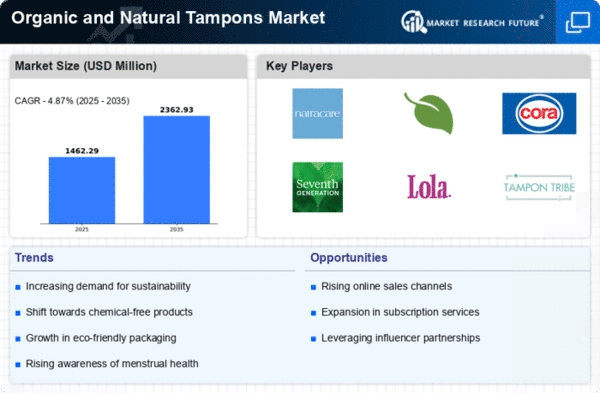
As per MRFR analysis, the Organic and Natural Tampons Market Size was estimated at 1394.38 USD Million in 2024. The Organic and Natural Tampons industry is projected to grow from 1478.26 in 2025 to 2362.93 by 2035, exhibiting a compound annual growth rate (CAGR) of 4.87% during the forecast period 2025 - 2035.

Key Market Trends & Highlights

The Organic and Natural Tampons Market is experiencing a robust shift towards sustainability and health-conscious choices.

  • The North American market remains the largest, driven by increasing consumer demand for organic and natural products.
  • Asia-Pacific is emerging as the fastest-growing region, reflecting a rising awareness of health and sustainability among consumers.
  • The Health and Wellness segment dominates the market, while the Sustainability Awareness segment is rapidly gaining traction.
  • Key market drivers include heightened sustainability awareness and the growing trend towards health and wellness, influencing consumer preferences.

Market Size & Forecast

2024 Market Size 1394.38 (USD Million)
2035 Market Size 2362.93 (USD Million)
CAGR (2025 - 2035) 4.87%
Largest Regional Market Share in 2024 North America

Major Players

Natracare (GB), Organyc (IT), Cora (US), Seventh Generation (US), Lola (US), Tampon Tribe (CA), Rael (US), Period (US)

Market Trends

The Organic and Natural Tampons Market is currently experiencing a notable shift towards sustainability and health-conscious choices among consumers. This trend appears to be driven by an increasing awareness of the potential health risks associated with conventional menstrual products, which often contain synthetic materials and chemicals. As a result, many individuals are gravitating towards organic and natural alternatives that promise fewer additives and a more environmentally friendly profile. This growing preference suggests a broader movement towards holistic wellness and eco-conscious living, which is reshaping purchasing behaviors in the feminine hygiene sector. Moreover, the Organic and Natural Tampons Market is likely to benefit from the rising demand for transparency in product ingredients. Consumers are becoming more discerning, seeking out brands that provide clear information about sourcing, manufacturing processes, and ingredient lists. This trend indicates a shift towards informed consumerism, where individuals prioritize products that align with their values of health and sustainability. As awareness continues to grow, it seems plausible that the market will expand further, with innovative products emerging to meet the evolving needs of consumers seeking safer and more sustainable menstrual care options.

Sustainability Focus

The Organic and Natural Tampons Market is witnessing a heightened emphasis on sustainability. Consumers are increasingly prioritizing products that minimize environmental impact, leading to a surge in demand for biodegradable and eco-friendly options.

Health-Conscious Choices

There is a growing trend towards health-conscious choices within the Organic and Natural Tampons Market. Many consumers are opting for products free from synthetic materials and harmful chemicals, reflecting a broader awareness of personal health.

Transparency in Ingredients

The demand for transparency in product ingredients is becoming more pronounced. Consumers are seeking brands that openly disclose their sourcing and manufacturing practices, fostering trust and loyalty in the Organic and Natural Tampons Market.

Organic and Natural Tampons Market Market Drivers

Rising Health Consciousness

The increasing awareness regarding health and wellness among consumers appears to be a pivotal driver for the Global Organic and Natural Tampons Market Industry. As individuals become more informed about the potential health risks associated with conventional feminine hygiene products, there is a noticeable shift towards organic alternatives. This trend is reflected in the projected market size, which is expected to reach 0.62 USD Billion in 2024. The demand for products free from synthetic chemicals and toxins is likely to continue growing, as consumers prioritize their health and well-being.

Market Segment Insights

By Application: Menstrual Hygiene (Largest) vs. Postpartum Care (Fastest-Growing)

<p>In the Organic and Natural Tampons Market, the application segment is predominantly driven by menstrual hygiene products, which command the largest share. This segment caters to a wide consumer base, driven by the growing awareness regarding menstrual health and sustainability. Following closely, postpartum care is rapidly gaining traction due to increasing acknowledgment of organic solutions in maternal health, which reflects a shift towards wellness-oriented choices during this critical phase.</p>

<p>Menstrual Hygiene (Dominant) vs. Postpartum Care (Emerging)</p>

<p>Menstrual hygiene products represent the dominant portion of the application segment, transcending traditional use to incorporate more environmentally friendly materials and packaging. They resonate with health-conscious consumers seeking safer options free from harmful chemicals. On the other hand, postpartum care is emerging as a pivotal area of growth, fueled by rising preferences for organic products among new mothers. This segment is shaped by innovations focusing on gentleness and comfort postpartum, creating opportunities for brands to develop specialized products that cater specifically to this consumer group.</p>

By Material Type: Cotton (Largest) vs. Bamboo (Fastest-Growing)

<p>In the Organic and Natural Tampons Market, the material type segment showcases a diverse range of options, with cotton holding the largest market share. This is attributable to its durability, absorbency, and consumer trust in traditional materials. Following cotton, bamboo is emerging rapidly, carved by environmentally-conscious consumer choices that favor sustainable and renewable resources. Organic cotton and biodegradable materials trail behind, but they too are gaining traction as consumers look for more eco-friendly alternatives. The synthetic-free category is also influential, capturing a niche audience that prioritizes health and wellness over conventional materials.</p>

<p>Cotton (Dominant) vs. Bamboo (Emerging)</p>

<p>Cotton remains the dominant player in the Organic and Natural Tampons Market, known for its exceptional absorbent properties and consumer familiarity. This traditional material is associated with comfort and safety, leading to high customer loyalty. On the other hand, bamboo is considered an emerging contender, celebrated for its sustainability and lower environmental footprint. Its rapid growth can be attributed to the increasing demand for green products among consumers, as bamboo can be cultivated without harmful pesticides. As awareness about environmental issues grows, the potential for bamboo to capture a more significant share of the market will likely unfold, offering an innovative alternative to conventional materials such as cotton. Both materials, while distinct in their characteristics, reflect the evolving consumer preferences towards sustainability.</p>

By Distribution Channel: Online Retail (Largest) vs. Supermarkets (Fastest-Growing)

<p>In the Organic and Natural Tampons Market, the distribution channels are witnessing a dynamic composition, with online retail dominating the landscape. Its convenience and accessibility have made it the largest segment, appealing to the modern consumer's preference for shopping via digital platforms. Meanwhile, supermarkets are rapidly gaining ground, becoming the fastest-growing distribution channel. Their extensive reach and increased shelf space for organic products are attracting more consumers. The growth trends within these distribution channels are driven by changing consumer behaviors and preferences. The rise of e-commerce has transformed how tampons are purchased, as online platforms offer a variety of brands and products that cater to eco-conscious consumers. Supermarkets, on the other hand, are responding to demand by expanding their organic ranges, enhancing their role as a pivotal point for shoppers looking for natural alternatives.</p>

<p>Online Retail (Dominant) vs. Health Food Stores (Emerging)</p>

<p>Online retail has established itself as the dominant distribution channel in the Organic and Natural Tampons Market, facilitated by an increasing reliance on digital shopping among consumers. Its competitive edge lies in the ability to provide a wider selection, competitive pricing, and the convenience of home delivery. Health Food Stores, although emerging in comparison, are carving out a niche market by offering specialized organic products, often emphasizing their sustainable and health-focused attributes. While they currently represent a smaller share, their growth is fueled by a dedicated consumer base that prioritizes organic and natural product sourcing. Collaborations with wellness brands and an increase in organic certification awareness are pushing Health Food Stores to the forefront of this evolving market.</p>

By Consumer Demographics: Age Group (Largest) vs. Income Level (Fastest-Growing)

<p>The Organic and Natural Tampons Market shows significant variation across different consumer demographics, with age group accounting for the largest share. Younger consumers, particularly those aged 18 to 34, are driving the demand for organic products, prioritizing sustainability and health over traditional options. Conversely, income levels indicate a growing shift, where higher-income consumers are increasingly embracing organic and natural alternatives, reflecting changing attitudes towards personal health and environmental impact. This demographic is more willing to invest in premium products that align with their values. Growth trends indicate a notable rise in health consciousness among consumers, significantly influencing purchasing behavior. The increasing awareness of health benefits associated with organic materials is propelling market growth within the income level segment. Additionally, the trend toward environmental awareness among consumers is encouraging a broader acceptance of organic and natural products, further driving segments aimed at higher-income individuals. This blend of demographics suggests a market ripe for innovation and targeted marketing strategies, capitalizing on the specific values of these consumer groups.</p>

<p>Age Group: 18-34 (Dominant) vs. Income Level: High-Income (Emerging)</p>

<p>The age group of 18-34 is currently the dominant demographic within the Organic and Natural Tampons Market, showcasing a strong preference for sustainable and health-conscious products. This group is not only more likely to engage with brands that promote eco-friendly practices but also values transparency regarding the ingredients used in products. In contrast, high-income consumers represent an emerging segment, increasingly recognizing the benefits of organic options for both personal health and environmental sustainability. This demographic is characterized by higher purchasing power and a willingness to pay a premium for products that align with their values, suggesting a potential for significant growth in tailored marketing strategies targeting both age and income.</p>

By Product Type: Regular Tampons (Largest) vs. Super Tampons (Fastest-Growing)

<p>In the Organic and Natural Tampons Market, the product type segment plays a crucial role in market dynamics. Regular Tampons hold the largest share among product types, appealing to a broad consumer base due to their familiarity and reliability. Super Tampons follow, providing an essential alternative for those requiring greater absorption, while Super Plus Tampons cater to a niche but growing audience, thus securing a stable position within the market. Applicator and Non-Applicator Tampons represent distinct preferences among consumers, impacting overall product distribution.</p>

<p>Regular Tampons (Dominant) vs. Super Tampons (Emerging)</p>

<p>Regular Tampons are identified as the dominant segment in the Organic and Natural Tampons Market, recognized for their comfort and ease of use. They are preferred by many consumers due to their availability and suitability for average flow. In contrast, Super Tampons are emerging as a popular choice among consumers with heavier flow needs. With increasing awareness of sustainable products, both Regular and Super Tampons are benefitting from the shift toward organic materials, further enhancing their appeal in health-conscious markets. This combination of established reliability and growth potential positions these segments as key players going forward.</p>

Get more detailed insights about Organic and Natural Tampons Market Research Report – Forecast till 2035

Regional Insights

North America : Market Leader in Organic Products

North America is the largest market for organic and natural tampons, holding a significant share of 700.0M in 2024. The growth is driven by increasing consumer awareness regarding health and environmental sustainability, alongside a shift towards organic products. Regulatory support for organic certifications and eco-friendly practices further fuels demand, making this region a hub for innovation in menstrual products. The competitive landscape is robust, with key players like Cora, Seventh Generation, and Rael leading the market. The U.S. is the primary contributor, supported by a growing trend of women seeking safer, chemical-free options. The presence of brands like Natracare and Lola highlights the diverse offerings available, catering to a wide range of consumer preferences.

Europe : Emerging Market with Growth Potential

Europe is witnessing a growing demand for organic and natural tampons, with a market size of 400.0M. Factors such as increasing health consciousness and stringent regulations on product safety are driving this trend. The European Union's commitment to sustainability and eco-friendly products is a significant catalyst, encouraging brands to innovate and meet consumer expectations for organic options. Leading countries in this region include Germany, France, and the UK, where brands like Organyc and Natracare are making significant inroads. The competitive landscape is evolving, with new entrants focusing on organic certifications and sustainable practices. This shift is expected to enhance market growth as consumers increasingly prioritize health and environmental impact in their purchasing decisions.

Asia-Pacific : Emerging Powerhouse in Organic Market

Asia-Pacific is emerging as a significant player in the organic and natural tampons market, with a market size of 250.0M. The region is experiencing a shift in consumer behavior, with more women opting for organic products due to rising health awareness and environmental concerns. Government initiatives promoting sustainable practices are also contributing to market growth, making this region a focal point for future expansion. Countries like Australia and Japan are leading the charge, with local brands and international players like Cora and Rael gaining traction. The competitive landscape is becoming increasingly dynamic, with a focus on product innovation and marketing strategies that resonate with health-conscious consumers. This trend is expected to continue as awareness of organic products grows across the region.

Middle East and Africa : Niche Market with Growth Opportunities

The Middle East and Africa region represents a niche market for organic and natural tampons, with a market size of 44.38M. Despite being smaller compared to other regions, there is a growing interest in organic products driven by increasing awareness of health and hygiene. Regulatory frameworks are gradually evolving to support organic certifications, which could enhance market growth in the coming years. Countries like South Africa and the UAE are showing potential for expansion, with local brands beginning to emerge. The competitive landscape is still developing, but there is an opportunity for international players to enter the market. As consumer preferences shift towards organic and sustainable options, this region could see significant growth in the organic tampon segment.

Key Players and Competitive Insights

The Organic and Natural Tampons Market is currently characterized by a dynamic competitive landscape, driven by increasing consumer awareness regarding health and environmental sustainability. Key players such as Natracare (GB), Cora (US), and Rael (US) are strategically positioning themselves through innovation and sustainability initiatives. Natracare (GB) emphasizes its commitment to organic materials and eco-friendly packaging, which resonates with environmentally conscious consumers. Cora (US) focuses on expanding its product line to include a wider range of menstrual health products, thereby enhancing its market presence. Rael (US) has adopted a digital-first approach, leveraging e-commerce platforms to reach a broader audience, which reflects a significant shift in consumer purchasing behavior towards online shopping.In terms of business tactics, companies are increasingly localizing manufacturing to reduce supply chain vulnerabilities and enhance responsiveness to market demands. The market structure appears moderately fragmented, with several players competing for market share. This fragmentation allows for niche brands to thrive, while larger companies leverage their scale to optimize supply chains and reduce costs. The collective influence of these key players shapes a competitive environment that is both innovative and responsive to consumer needs.

In November Cora (US) launched a new subscription service aimed at providing personalized menstrual care solutions. This strategic move is significant as it not only enhances customer loyalty but also positions Cora as a leader in the direct-to-consumer space, catering to the growing demand for convenience and tailored health solutions. The subscription model may also provide a steady revenue stream, which is crucial in a competitive market.

In October Rael (US) announced a partnership with a leading health tech company to integrate AI-driven insights into its product development process. This collaboration is likely to enhance product innovation by utilizing data analytics to better understand consumer preferences and trends. Such a move indicates a forward-thinking approach that could set Rael apart from competitors by aligning product offerings more closely with consumer needs.

In September Natracare (GB) expanded its distribution channels by entering into a partnership with a major retail chain in Europe. This strategic action is indicative of Natracare's intent to increase its market penetration and accessibility, thereby reaching a wider audience. The expansion into retail signifies a shift towards omnichannel strategies, which are becoming increasingly important in the current market landscape.

As of December the Organic and Natural Tampons Market is witnessing trends such as digitalization, sustainability, and the integration of AI technologies. Strategic alliances are playing a crucial role in shaping the competitive landscape, allowing companies to pool resources and expertise. Looking ahead, competitive differentiation is likely to evolve from traditional price-based competition to a focus on innovation, technology, and supply chain reliability. Companies that can effectively leverage these trends will likely secure a stronger foothold in the market.

Key Companies in the Organic and Natural Tampons Market include

Industry Developments

May 2023: Corman S.p.A. (Italy) launched a biodegradable and compostable plastic tampon applicator under the brand Organyc in the Netherlands. Moreover, this product was also launched globally in the third quarter of 2023. Tosama's and Corman's teams of researchers and developers have created this technology. This technology can turn leftover parts of wheat, corn, and sugar cane into a type of plastic that can be shaped easily. This special plastic can be quickly molded into a tampon applicator. Not only is this good for the environment, but it's also beneficial for women.

May 2022: TOM Organic (Australia) has launched period products in New Zealand to make menstruation more susceptible. TOM Organic offers market-leading 100% organic cotton tampons made with organic cotton and biodegradable mater ials.

May 2019: Procter & Gamble (US) launched Tampax PURE, an organic tampon that is free of dyes, fragrances, and chlorine bleaching. This product is 100% organic, has a cotton core, and delivers the protection expected from Tampex every time. Moreover, this Tampax PURE applicator is composed of 90% plant-based material. The addition of this product to the Procter & Gamble product portfol io expanded the company’s reach and assisted in generating company revenue. 

February 2019: Procter & Gamble (US) acquired an organic period care start-up “This is L. Inc. (US)”, manufactures organic pads and tampons. P&G is dedicated to maintaining the product quality that L.'s customers have come to trust, including perio d products made with organic materials.

Intended Audience

    • Organic and Natural Tampons Market products Manufacturers and vendors
    • Contract research organization
    • Various research and consulting firms

Future Outlook

Organic and Natural Tampons Market Future Outlook

The Organic and Natural Tampons Market is projected to grow at a 4.87% CAGR from 2025 to 2035, driven by increasing consumer awareness and demand for sustainable products.

New opportunities lie in:

  • Expansion into emerging markets with tailored product lines.
  • Development of subscription-based delivery services for convenience.
  • Partnerships with eco-friendly retailers to enhance brand visibility.

By 2035, the market is expected to solidify its position as a leader in sustainable feminine hygiene.

Market Segmentation

Organic and Natural Tampons Market Application Outlook

  • Personal Care
  • Health and Wellness
  • Sustainability Awareness
  • Eco-Friendly Practices

Organic and Natural Tampons Market Target Demographic Outlook

  • Young Adults
  • Health-Conscious Consumers
  • Environmentally Conscious Individuals
  • Parents

Organic and Natural Tampons Market Distribution Channel Outlook

  • Online Retail
  • Health Stores
  • Supermarkets
  • Specialty Stores

Organic and Natural Tampons Market Material Composition Outlook

  • Organic Cotton
  • Bamboo Fiber
  • Biodegradable Materials
  • Chemical-Free Components

Report Scope

MARKET SIZE 2024 1394.38(USD Million)
MARKET SIZE 2025 1478.26(USD Million)
MARKET SIZE 2035 2362.93(USD Million)
COMPOUND ANNUAL GROWTH RATE (CAGR) 4.87% (2025 - 2035)
REPORT COVERAGE Revenue Forecast, Competitive Landscape, Growth Factors, and Trends
BASE YEAR 2024
Market Forecast Period 2025 - 2035
Historical Data 2019 - 2024
Market Forecast Units USD Million
Key Companies Profiled Natracare (GB), Organyc (IT), Cora (US), Seventh Generation (US), Lola (US), Tampon Tribe (CA), Rael (US), Period (US)
Segments Covered Application, Material Composition, Target Demographic, Distribution Channel
Key Market Opportunities Growing consumer preference for sustainable products drives demand in the Organic and Natural Tampons Market.
Key Market Dynamics Rising consumer preference for sustainable products drives innovation and competition in the Organic and Natural Tampons Market.
Countries Covered North America, Europe, APAC, South America, MEA

FAQs

What is the current valuation of the Organic and Natural Tampons Market?

<p>The market valuation reached 1394.38 USD Million in 2024.</p>

What is the projected market size for the Organic and Natural Tampons Market by 2035?

<p>The market is expected to grow to 2362.93 USD Million by 2035.</p>

What is the expected CAGR for the Organic and Natural Tampons Market during the forecast period?

<p>The market is projected to experience a CAGR of 4.87% from 2025 to 2035.</p>

Which companies are considered key players in the Organic and Natural Tampons Market?

<p>Key players include Natracare, Organyc, Cora, Seventh Generation, and others.</p>

What are the primary applications of organic and natural tampons?

<p>The main applications include Menstrual Hygiene, Postpartum Care, and Gynecological Health, with valuations ranging from 150.0 to 1000.0 USD Million.</p>

What materials are predominantly used in organic and natural tampons?

<p>The market features materials such as Cotton, Bamboo, Organic Cotton, and Biodegradable Materials, with valuations between 200.0 and 700.0 USD Million.</p>

How are organic and natural tampons distributed in the market?

<p>Distribution channels include Supermarkets, Pharmacies, and Online Retail, with valuations from 150.0 to 800.0 USD Million.</p>

What consumer demographics are influencing the Organic and Natural Tampons Market?

<p>Demographics such as Age Group, Income Level, and Health Consciousness are key, with valuations from 194.38 to 700.0 USD Million.</p>

What types of tampons are available in the organic and natural segment?

Product types include Regular, Super, and Applicator Tampons, with valuations ranging from 200.0 to 600.0 USD Million.

How does environmental awareness impact the Organic and Natural Tampons Market?

Environmental awareness is a significant factor, influencing consumer choices and contributing to market valuations of approximately 194.38 to 312.93 USD Million.

  1. SECTION I: EXECUTIVE SUMMARY AND KEY HIGHLIGHTS
    1. | 1.1 EXECUTIVE SUMMARY
    2. | | 1.1.1 Market Overview
    3. | | 1.1.2 Key Findings
    4. | | 1.1.3 Market Segmentation
    5. | | 1.1.4 Competitive Landscape
    6. | | 1.1.5 Challenges and Opportunities
    7. | | 1.1.6 Future Outlook
  2. SECTION II: SCOPING, METHODOLOGY AND MARKET STRUCTURE
    1. | 2.1 MARKET INTRODUCTION
    2. | | 2.1.1 Definition
    3. | | 2.1.2 Scope of the study
    4. | | | 2.1.2.1 Research Objective
    5. | | | 2.1.2.2 Assumption
    6. | | | 2.1.2.3 Limitations
    7. | 2.2 RESEARCH METHODOLOGY
    8. | | 2.2.1 Overview
    9. | | 2.2.2 Data Mining
    10. | | 2.2.3 Secondary Research
    11. | | 2.2.4 Primary Research
    12. | | | 2.2.4.1 Primary Interviews and Information Gathering Process
    13. | | | 2.2.4.2 Breakdown of Primary Respondents
    14. | | 2.2.5 Forecasting Model
    15. | | 2.2.6 Market Size Estimation
    16. | | | 2.2.6.1 Bottom-Up Approach
    17. | | | 2.2.6.2 Top-Down Approach
    18. | | 2.2.7 Data Triangulation
    19. | | 2.2.8 Validation
  3. SECTION III: QUALITATIVE ANALYSIS
    1. | 3.1 MARKET DYNAMICS
    2. | | 3.1.1 Overview
    3. | | 3.1.2 Drivers
    4. | | 3.1.3 Restraints
    5. | | 3.1.4 Opportunities
    6. | 3.2 MARKET FACTOR ANALYSIS
    7. | | 3.2.1 Value chain Analysis
    8. | | 3.2.2 Porter's Five Forces Analysis
    9. | | | 3.2.2.1 Bargaining Power of Suppliers
    10. | | | 3.2.2.2 Bargaining Power of Buyers
    11. | | | 3.2.2.3 Threat of New Entrants
    12. | | | 3.2.2.4 Threat of Substitutes
    13. | | | 3.2.2.5 Intensity of Rivalry
    14. | | 3.2.3 COVID-19 Impact Analysis
    15. | | | 3.2.3.1 Market Impact Analysis
    16. | | | 3.2.3.2 Regional Impact
    17. | | | 3.2.3.3 Opportunity and Threat Analysis
  4. SECTION IV: QUANTITATIVE ANALYSIS
    1. | 4.1 Healthcare, BY Application (USD Million)
    2. | | 4.1.1 Menstrual Hygiene
    3. | | 4.1.2 Postpartum Care
    4. | | 4.1.3 Gynecological Health
    5. | | 4.1.4 Sports and Fitness
    6. | | 4.1.5 Travel
    7. | 4.2 Healthcare, BY Material Type (USD Million)
    8. | | 4.2.1 Cotton
    9. | | 4.2.2 Bamboo
    10. | | 4.2.3 Organic Cotton
    11. | | 4.2.4 Biodegradable Materials
    12. | | 4.2.5 Synthetic-Free
    13. | 4.3 Healthcare, BY Distribution Channel (USD Million)
    14. | | 4.3.1 Online Retail
    15. | | 4.3.2 Supermarkets
    16. | | 4.3.3 Pharmacies
    17. | | 4.3.4 Health Food Stores
    18. | | 4.3.5 Direct Sales
    19. | 4.4 Healthcare, BY Consumer Demographics (USD Million)
    20. | | 4.4.1 Age Group
    21. | | 4.4.2 Income Level
    22. | | 4.4.3 Lifestyle Choices
    23. | | 4.4.4 Health Consciousness
    24. | | 4.4.5 Environmental Awareness
    25. | 4.5 Healthcare, BY Product Type (USD Million)
    26. | | 4.5.1 Regular Tampons
    27. | | 4.5.2 Super Tampons
    28. | | 4.5.3 Super Plus Tampons
    29. | | 4.5.4 Applicator Tampons
    30. | | 4.5.5 Non-Applicator Tampons
    31. | 4.6 Healthcare, BY Region (USD Million)
    32. | | 4.6.1 North America
    33. | | | 4.6.1.1 US
    34. | | | 4.6.1.2 Canada
    35. | | 4.6.2 Europe
    36. | | | 4.6.2.1 Germany
    37. | | | 4.6.2.2 UK
    38. | | | 4.6.2.3 France
    39. | | | 4.6.2.4 Russia
    40. | | | 4.6.2.5 Italy
    41. | | | 4.6.2.6 Spain
    42. | | | 4.6.2.7 Rest of Europe
    43. | | 4.6.3 APAC
    44. | | | 4.6.3.1 China
    45. | | | 4.6.3.2 India
    46. | | | 4.6.3.3 Japan
    47. | | | 4.6.3.4 South Korea
    48. | | | 4.6.3.5 Malaysia
    49. | | | 4.6.3.6 Thailand
    50. | | | 4.6.3.7 Indonesia
    51. | | | 4.6.3.8 Rest of APAC
    52. | | 4.6.4 South America
    53. | | | 4.6.4.1 Brazil
    54. | | | 4.6.4.2 Mexico
    55. | | | 4.6.4.3 Argentina
    56. | | | 4.6.4.4 Rest of South America
    57. | | 4.6.5 MEA
    58. | | | 4.6.5.1 GCC Countries
    59. | | | 4.6.5.2 South Africa
    60. | | | 4.6.5.3 Rest of MEA
  5. SECTION V: COMPETITIVE ANALYSIS
    1. | 5.1 Competitive Landscape
    2. | | 5.1.1 Overview
    3. | | 5.1.2 Competitive Analysis
    4. | | 5.1.3 Market share Analysis
    5. | | 5.1.4 Major Growth Strategy in the Healthcare
    6. | | 5.1.5 Competitive Benchmarking
    7. | | 5.1.6 Leading Players in Terms of Number of Developments in the Healthcare
    8. | | 5.1.7 Key developments and growth strategies
    9. | | | 5.1.7.1 New Product Launch/Service Deployment
    10. | | | 5.1.7.2 Merger & Acquisitions
    11. | | | 5.1.7.3 Joint Ventures
    12. | | 5.1.8 Major Players Financial Matrix
    13. | | | 5.1.8.1 Sales and Operating Income
    14. | | | 5.1.8.2 Major Players R&D Expenditure. 2023
    15. | 5.2 Company Profiles
    16. | | 5.2.1 Natracare (GB)
    17. | | | 5.2.1.1 Financial Overview
    18. | | | 5.2.1.2 Products Offered
    19. | | | 5.2.1.3 Key Developments
    20. | | | 5.2.1.4 SWOT Analysis
    21. | | | 5.2.1.5 Key Strategies
    22. | | 5.2.2 Organyc (IT)
    23. | | | 5.2.2.1 Financial Overview
    24. | | | 5.2.2.2 Products Offered
    25. | | | 5.2.2.3 Key Developments
    26. | | | 5.2.2.4 SWOT Analysis
    27. | | | 5.2.2.5 Key Strategies
    28. | | 5.2.3 Cora (US)
    29. | | | 5.2.3.1 Financial Overview
    30. | | | 5.2.3.2 Products Offered
    31. | | | 5.2.3.3 Key Developments
    32. | | | 5.2.3.4 SWOT Analysis
    33. | | | 5.2.3.5 Key Strategies
    34. | | 5.2.4 Seventh Generation (US)
    35. | | | 5.2.4.1 Financial Overview
    36. | | | 5.2.4.2 Products Offered
    37. | | | 5.2.4.3 Key Developments
    38. | | | 5.2.4.4 SWOT Analysis
    39. | | | 5.2.4.5 Key Strategies
    40. | | 5.2.5 Lola (US)
    41. | | | 5.2.5.1 Financial Overview
    42. | | | 5.2.5.2 Products Offered
    43. | | | 5.2.5.3 Key Developments
    44. | | | 5.2.5.4 SWOT Analysis
    45. | | | 5.2.5.5 Key Strategies
    46. | | 5.2.6 Tampon Tribe (CA)
    47. | | | 5.2.6.1 Financial Overview
    48. | | | 5.2.6.2 Products Offered
    49. | | | 5.2.6.3 Key Developments
    50. | | | 5.2.6.4 SWOT Analysis
    51. | | | 5.2.6.5 Key Strategies
    52. | | 5.2.7 Rael (US)
    53. | | | 5.2.7.1 Financial Overview
    54. | | | 5.2.7.2 Products Offered
    55. | | | 5.2.7.3 Key Developments
    56. | | | 5.2.7.4 SWOT Analysis
    57. | | | 5.2.7.5 Key Strategies
    58. | | 5.2.8 Period (US)
    59. | | | 5.2.8.1 Financial Overview
    60. | | | 5.2.8.2 Products Offered
    61. | | | 5.2.8.3 Key Developments
    62. | | | 5.2.8.4 SWOT Analysis
    63. | | | 5.2.8.5 Key Strategies
    64. | | 5.2.9 Hello Period (GB)
    65. | | | 5.2.9.1 Financial Overview
    66. | | | 5.2.9.2 Products Offered
    67. | | | 5.2.9.3 Key Developments
    68. | | | 5.2.9.4 SWOT Analysis
    69. | | | 5.2.9.5 Key Strategies
    70. | 5.3 Appendix
    71. | | 5.3.1 References
    72. | | 5.3.2 Related Reports
  6. LIST OF FIGURES
    1. | 6.1 MARKET SYNOPSIS
    2. | 6.2 NORTH AMERICA MARKET ANALYSIS
    3. | 6.3 US MARKET ANALYSIS BY APPLICATION
    4. | 6.4 US MARKET ANALYSIS BY MATERIAL TYPE
    5. | 6.5 US MARKET ANALYSIS BY DISTRIBUTION CHANNEL
    6. | 6.6 US MARKET ANALYSIS BY CONSUMER DEMOGRAPHICS
    7. | 6.7 US MARKET ANALYSIS BY PRODUCT TYPE
    8. | 6.8 CANADA MARKET ANALYSIS BY APPLICATION
    9. | 6.9 CANADA MARKET ANALYSIS BY MATERIAL TYPE
    10. | 6.10 CANADA MARKET ANALYSIS BY DISTRIBUTION CHANNEL
    11. | 6.11 CANADA MARKET ANALYSIS BY CONSUMER DEMOGRAPHICS
    12. | 6.12 CANADA MARKET ANALYSIS BY PRODUCT TYPE
    13. | 6.13 EUROPE MARKET ANALYSIS
    14. | 6.14 GERMANY MARKET ANALYSIS BY APPLICATION
    15. | 6.15 GERMANY MARKET ANALYSIS BY MATERIAL TYPE
    16. | 6.16 GERMANY MARKET ANALYSIS BY DISTRIBUTION CHANNEL
    17. | 6.17 GERMANY MARKET ANALYSIS BY CONSUMER DEMOGRAPHICS
    18. | 6.18 GERMANY MARKET ANALYSIS BY PRODUCT TYPE
    19. | 6.19 UK MARKET ANALYSIS BY APPLICATION
    20. | 6.20 UK MARKET ANALYSIS BY MATERIAL TYPE
    21. | 6.21 UK MARKET ANALYSIS BY DISTRIBUTION CHANNEL
    22. | 6.22 UK MARKET ANALYSIS BY CONSUMER DEMOGRAPHICS
    23. | 6.23 UK MARKET ANALYSIS BY PRODUCT TYPE
    24. | 6.24 FRANCE MARKET ANALYSIS BY APPLICATION
    25. | 6.25 FRANCE MARKET ANALYSIS BY MATERIAL TYPE
    26. | 6.26 FRANCE MARKET ANALYSIS BY DISTRIBUTION CHANNEL
    27. | 6.27 FRANCE MARKET ANALYSIS BY CONSUMER DEMOGRAPHICS
    28. | 6.28 FRANCE MARKET ANALYSIS BY PRODUCT TYPE
    29. | 6.29 RUSSIA MARKET ANALYSIS BY APPLICATION
    30. | 6.30 RUSSIA MARKET ANALYSIS BY MATERIAL TYPE
    31. | 6.31 RUSSIA MARKET ANALYSIS BY DISTRIBUTION CHANNEL
    32. | 6.32 RUSSIA MARKET ANALYSIS BY CONSUMER DEMOGRAPHICS
    33. | 6.33 RUSSIA MARKET ANALYSIS BY PRODUCT TYPE
    34. | 6.34 ITALY MARKET ANALYSIS BY APPLICATION
    35. | 6.35 ITALY MARKET ANALYSIS BY MATERIAL TYPE
    36. | 6.36 ITALY MARKET ANALYSIS BY DISTRIBUTION CHANNEL
    37. | 6.37 ITALY MARKET ANALYSIS BY CONSUMER DEMOGRAPHICS
    38. | 6.38 ITALY MARKET ANALYSIS BY PRODUCT TYPE
    39. | 6.39 SPAIN MARKET ANALYSIS BY APPLICATION
    40. | 6.40 SPAIN MARKET ANALYSIS BY MATERIAL TYPE
    41. | 6.41 SPAIN MARKET ANALYSIS BY DISTRIBUTION CHANNEL
    42. | 6.42 SPAIN MARKET ANALYSIS BY CONSUMER DEMOGRAPHICS
    43. | 6.43 SPAIN MARKET ANALYSIS BY PRODUCT TYPE
    44. | 6.44 REST OF EUROPE MARKET ANALYSIS BY APPLICATION
    45. | 6.45 REST OF EUROPE MARKET ANALYSIS BY MATERIAL TYPE
    46. | 6.46 REST OF EUROPE MARKET ANALYSIS BY DISTRIBUTION CHANNEL
    47. | 6.47 REST OF EUROPE MARKET ANALYSIS BY CONSUMER DEMOGRAPHICS
    48. | 6.48 REST OF EUROPE MARKET ANALYSIS BY PRODUCT TYPE
    49. | 6.49 APAC MARKET ANALYSIS
    50. | 6.50 CHINA MARKET ANALYSIS BY APPLICATION
    51. | 6.51 CHINA MARKET ANALYSIS BY MATERIAL TYPE
    52. | 6.52 CHINA MARKET ANALYSIS BY DISTRIBUTION CHANNEL
    53. | 6.53 CHINA MARKET ANALYSIS BY CONSUMER DEMOGRAPHICS
    54. | 6.54 CHINA MARKET ANALYSIS BY PRODUCT TYPE
    55. | 6.55 INDIA MARKET ANALYSIS BY APPLICATION
    56. | 6.56 INDIA MARKET ANALYSIS BY MATERIAL TYPE
    57. | 6.57 INDIA MARKET ANALYSIS BY DISTRIBUTION CHANNEL
    58. | 6.58 INDIA MARKET ANALYSIS BY CONSUMER DEMOGRAPHICS
    59. | 6.59 INDIA MARKET ANALYSIS BY PRODUCT TYPE
    60. | 6.60 JAPAN MARKET ANALYSIS BY APPLICATION
    61. | 6.61 JAPAN MARKET ANALYSIS BY MATERIAL TYPE
    62. | 6.62 JAPAN MARKET ANALYSIS BY DISTRIBUTION CHANNEL
    63. | 6.63 JAPAN MARKET ANALYSIS BY CONSUMER DEMOGRAPHICS
    64. | 6.64 JAPAN MARKET ANALYSIS BY PRODUCT TYPE
    65. | 6.65 SOUTH KOREA MARKET ANALYSIS BY APPLICATION
    66. | 6.66 SOUTH KOREA MARKET ANALYSIS BY MATERIAL TYPE
    67. | 6.67 SOUTH KOREA MARKET ANALYSIS BY DISTRIBUTION CHANNEL
    68. | 6.68 SOUTH KOREA MARKET ANALYSIS BY CONSUMER DEMOGRAPHICS
    69. | 6.69 SOUTH KOREA MARKET ANALYSIS BY PRODUCT TYPE
    70. | 6.70 MALAYSIA MARKET ANALYSIS BY APPLICATION
    71. | 6.71 MALAYSIA MARKET ANALYSIS BY MATERIAL TYPE
    72. | 6.72 MALAYSIA MARKET ANALYSIS BY DISTRIBUTION CHANNEL
    73. | 6.73 MALAYSIA MARKET ANALYSIS BY CONSUMER DEMOGRAPHICS
    74. | 6.74 MALAYSIA MARKET ANALYSIS BY PRODUCT TYPE
    75. | 6.75 THAILAND MARKET ANALYSIS BY APPLICATION
    76. | 6.76 THAILAND MARKET ANALYSIS BY MATERIAL TYPE
    77. | 6.77 THAILAND MARKET ANALYSIS BY DISTRIBUTION CHANNEL
    78. | 6.78 THAILAND MARKET ANALYSIS BY CONSUMER DEMOGRAPHICS
    79. | 6.79 THAILAND MARKET ANALYSIS BY PRODUCT TYPE
    80. | 6.80 INDONESIA MARKET ANALYSIS BY APPLICATION
    81. | 6.81 INDONESIA MARKET ANALYSIS BY MATERIAL TYPE
    82. | 6.82 INDONESIA MARKET ANALYSIS BY DISTRIBUTION CHANNEL
    83. | 6.83 INDONESIA MARKET ANALYSIS BY CONSUMER DEMOGRAPHICS
    84. | 6.84 INDONESIA MARKET ANALYSIS BY PRODUCT TYPE
    85. | 6.85 REST OF APAC MARKET ANALYSIS BY APPLICATION
    86. | 6.86 REST OF APAC MARKET ANALYSIS BY MATERIAL TYPE
    87. | 6.87 REST OF APAC MARKET ANALYSIS BY DISTRIBUTION CHANNEL
    88. | 6.88 REST OF APAC MARKET ANALYSIS BY CONSUMER DEMOGRAPHICS
    89. | 6.89 REST OF APAC MARKET ANALYSIS BY PRODUCT TYPE
    90. | 6.90 SOUTH AMERICA MARKET ANALYSIS
    91. | 6.91 BRAZIL MARKET ANALYSIS BY APPLICATION
    92. | 6.92 BRAZIL MARKET ANALYSIS BY MATERIAL TYPE
    93. | 6.93 BRAZIL MARKET ANALYSIS BY DISTRIBUTION CHANNEL
    94. | 6.94 BRAZIL MARKET ANALYSIS BY CONSUMER DEMOGRAPHICS
    95. | 6.95 BRAZIL MARKET ANALYSIS BY PRODUCT TYPE
    96. | 6.96 MEXICO MARKET ANALYSIS BY APPLICATION
    97. | 6.97 MEXICO MARKET ANALYSIS BY MATERIAL TYPE
    98. | 6.98 MEXICO MARKET ANALYSIS BY DISTRIBUTION CHANNEL
    99. | 6.99 MEXICO MARKET ANALYSIS BY CONSUMER DEMOGRAPHICS
    100. | 6.100 MEXICO MARKET ANALYSIS BY PRODUCT TYPE
    101. | 6.101 ARGENTINA MARKET ANALYSIS BY APPLICATION
    102. | 6.102 ARGENTINA MARKET ANALYSIS BY MATERIAL TYPE
    103. | 6.103 ARGENTINA MARKET ANALYSIS BY DISTRIBUTION CHANNEL
    104. | 6.104 ARGENTINA MARKET ANALYSIS BY CONSUMER DEMOGRAPHICS
    105. | 6.105 ARGENTINA MARKET ANALYSIS BY PRODUCT TYPE
    106. | 6.106 REST OF SOUTH AMERICA MARKET ANALYSIS BY APPLICATION
    107. | 6.107 REST OF SOUTH AMERICA MARKET ANALYSIS BY MATERIAL TYPE
    108. | 6.108 REST OF SOUTH AMERICA MARKET ANALYSIS BY DISTRIBUTION CHANNEL
    109. | 6.109 REST OF SOUTH AMERICA MARKET ANALYSIS BY CONSUMER DEMOGRAPHICS
    110. | 6.110 REST OF SOUTH AMERICA MARKET ANALYSIS BY PRODUCT TYPE
    111. | 6.111 MEA MARKET ANALYSIS
    112. | 6.112 GCC COUNTRIES MARKET ANALYSIS BY APPLICATION
    113. | 6.113 GCC COUNTRIES MARKET ANALYSIS BY MATERIAL TYPE
    114. | 6.114 GCC COUNTRIES MARKET ANALYSIS BY DISTRIBUTION CHANNEL
    115. | 6.115 GCC COUNTRIES MARKET ANALYSIS BY CONSUMER DEMOGRAPHICS
    116. | 6.116 GCC COUNTRIES MARKET ANALYSIS BY PRODUCT TYPE
    117. | 6.117 SOUTH AFRICA MARKET ANALYSIS BY APPLICATION
    118. | 6.118 SOUTH AFRICA MARKET ANALYSIS BY MATERIAL TYPE
    119. | 6.119 SOUTH AFRICA MARKET ANALYSIS BY DISTRIBUTION CHANNEL
    120. | 6.120 SOUTH AFRICA MARKET ANALYSIS BY CONSUMER DEMOGRAPHICS
    121. | 6.121 SOUTH AFRICA MARKET ANALYSIS BY PRODUCT TYPE
    122. | 6.122 REST OF MEA MARKET ANALYSIS BY APPLICATION
    123. | 6.123 REST OF MEA MARKET ANALYSIS BY MATERIAL TYPE
    124. | 6.124 REST OF MEA MARKET ANALYSIS BY DISTRIBUTION CHANNEL
    125. | 6.125 REST OF MEA MARKET ANALYSIS BY CONSUMER DEMOGRAPHICS
    126. | 6.126 REST OF MEA MARKET ANALYSIS BY PRODUCT TYPE
    127. | 6.127 KEY BUYING CRITERIA OF HEALTHCARE
    128. | 6.128 RESEARCH PROCESS OF MRFR
    129. | 6.129 DRO ANALYSIS OF HEALTHCARE
    130. | 6.130 DRIVERS IMPACT ANALYSIS: HEALTHCARE
    131. | 6.131 RESTRAINTS IMPACT ANALYSIS: HEALTHCARE
    132. | 6.132 SUPPLY / VALUE CHAIN: HEALTHCARE
    133. | 6.133 HEALTHCARE, BY APPLICATION, 2024 (% SHARE)
    134. | 6.134 HEALTHCARE, BY APPLICATION, 2024 TO 2035 (USD Million)
    135. | 6.135 HEALTHCARE, BY MATERIAL TYPE, 2024 (% SHARE)
    136. | 6.136 HEALTHCARE, BY MATERIAL TYPE, 2024 TO 2035 (USD Million)
    137. | 6.137 HEALTHCARE, BY DISTRIBUTION CHANNEL, 2024 (% SHARE)
    138. | 6.138 HEALTHCARE, BY DISTRIBUTION CHANNEL, 2024 TO 2035 (USD Million)
    139. | 6.139 HEALTHCARE, BY CONSUMER DEMOGRAPHICS, 2024 (% SHARE)
    140. | 6.140 HEALTHCARE, BY CONSUMER DEMOGRAPHICS, 2024 TO 2035 (USD Million)
    141. | 6.141 HEALTHCARE, BY PRODUCT TYPE, 2024 (% SHARE)
    142. | 6.142 HEALTHCARE, BY PRODUCT TYPE, 2024 TO 2035 (USD Million)
    143. | 6.143 BENCHMARKING OF MAJOR COMPETITORS
  7. LIST OF TABLES
    1. | 7.1 LIST OF ASSUMPTIONS
    2. | | 7.1.1
    3. | 7.2 North America MARKET SIZE ESTIMATES; FORECAST
    4. | | 7.2.1 BY APPLICATION, 2025-2035 (USD Million)
    5. | | 7.2.2 BY MATERIAL TYPE, 2025-2035 (USD Million)
    6. | | 7.2.3 BY DISTRIBUTION CHANNEL, 2025-2035 (USD Million)
    7. | | 7.2.4 BY CONSUMER DEMOGRAPHICS, 2025-2035 (USD Million)
    8. | | 7.2.5 BY PRODUCT TYPE, 2025-2035 (USD Million)
    9. | 7.3 US MARKET SIZE ESTIMATES; FORECAST
    10. | | 7.3.1 BY APPLICATION, 2025-2035 (USD Million)
    11. | | 7.3.2 BY MATERIAL TYPE, 2025-2035 (USD Million)
    12. | | 7.3.3 BY DISTRIBUTION CHANNEL, 2025-2035 (USD Million)
    13. | | 7.3.4 BY CONSUMER DEMOGRAPHICS, 2025-2035 (USD Million)
    14. | | 7.3.5 BY PRODUCT TYPE, 2025-2035 (USD Million)
    15. | 7.4 Canada MARKET SIZE ESTIMATES; FORECAST
    16. | | 7.4.1 BY APPLICATION, 2025-2035 (USD Million)
    17. | | 7.4.2 BY MATERIAL TYPE, 2025-2035 (USD Million)
    18. | | 7.4.3 BY DISTRIBUTION CHANNEL, 2025-2035 (USD Million)
    19. | | 7.4.4 BY CONSUMER DEMOGRAPHICS, 2025-2035 (USD Million)
    20. | | 7.4.5 BY PRODUCT TYPE, 2025-2035 (USD Million)
    21. | 7.5 Europe MARKET SIZE ESTIMATES; FORECAST
    22. | | 7.5.1 BY APPLICATION, 2025-2035 (USD Million)
    23. | | 7.5.2 BY MATERIAL TYPE, 2025-2035 (USD Million)
    24. | | 7.5.3 BY DISTRIBUTION CHANNEL, 2025-2035 (USD Million)
    25. | | 7.5.4 BY CONSUMER DEMOGRAPHICS, 2025-2035 (USD Million)
    26. | | 7.5.5 BY PRODUCT TYPE, 2025-2035 (USD Million)
    27. | 7.6 Germany MARKET SIZE ESTIMATES; FORECAST
    28. | | 7.6.1 BY APPLICATION, 2025-2035 (USD Million)
    29. | | 7.6.2 BY MATERIAL TYPE, 2025-2035 (USD Million)
    30. | | 7.6.3 BY DISTRIBUTION CHANNEL, 2025-2035 (USD Million)
    31. | | 7.6.4 BY CONSUMER DEMOGRAPHICS, 2025-2035 (USD Million)
    32. | | 7.6.5 BY PRODUCT TYPE, 2025-2035 (USD Million)
    33. | 7.7 UK MARKET SIZE ESTIMATES; FORECAST
    34. | | 7.7.1 BY APPLICATION, 2025-2035 (USD Million)
    35. | | 7.7.2 BY MATERIAL TYPE, 2025-2035 (USD Million)
    36. | | 7.7.3 BY DISTRIBUTION CHANNEL, 2025-2035 (USD Million)
    37. | | 7.7.4 BY CONSUMER DEMOGRAPHICS, 2025-2035 (USD Million)
    38. | | 7.7.5 BY PRODUCT TYPE, 2025-2035 (USD Million)
    39. | 7.8 France MARKET SIZE ESTIMATES; FORECAST
    40. | | 7.8.1 BY APPLICATION, 2025-2035 (USD Million)
    41. | | 7.8.2 BY MATERIAL TYPE, 2025-2035 (USD Million)
    42. | | 7.8.3 BY DISTRIBUTION CHANNEL, 2025-2035 (USD Million)
    43. | | 7.8.4 BY CONSUMER DEMOGRAPHICS, 2025-2035 (USD Million)
    44. | | 7.8.5 BY PRODUCT TYPE, 2025-2035 (USD Million)
    45. | 7.9 Russia MARKET SIZE ESTIMATES; FORECAST
    46. | | 7.9.1 BY APPLICATION, 2025-2035 (USD Million)
    47. | | 7.9.2 BY MATERIAL TYPE, 2025-2035 (USD Million)
    48. | | 7.9.3 BY DISTRIBUTION CHANNEL, 2025-2035 (USD Million)
    49. | | 7.9.4 BY CONSUMER DEMOGRAPHICS, 2025-2035 (USD Million)
    50. | | 7.9.5 BY PRODUCT TYPE, 2025-2035 (USD Million)
    51. | 7.10 Italy MARKET SIZE ESTIMATES; FORECAST
    52. | | 7.10.1 BY APPLICATION, 2025-2035 (USD Million)
    53. | | 7.10.2 BY MATERIAL TYPE, 2025-2035 (USD Million)
    54. | | 7.10.3 BY DISTRIBUTION CHANNEL, 2025-2035 (USD Million)
    55. | | 7.10.4 BY CONSUMER DEMOGRAPHICS, 2025-2035 (USD Million)
    56. | | 7.10.5 BY PRODUCT TYPE, 2025-2035 (USD Million)
    57. | 7.11 Spain MARKET SIZE ESTIMATES; FORECAST
    58. | | 7.11.1 BY APPLICATION, 2025-2035 (USD Million)
    59. | | 7.11.2 BY MATERIAL TYPE, 2025-2035 (USD Million)
    60. | | 7.11.3 BY DISTRIBUTION CHANNEL, 2025-2035 (USD Million)
    61. | | 7.11.4 BY CONSUMER DEMOGRAPHICS, 2025-2035 (USD Million)
    62. | | 7.11.5 BY PRODUCT TYPE, 2025-2035 (USD Million)
    63. | 7.12 Rest of Europe MARKET SIZE ESTIMATES; FORECAST
    64. | | 7.12.1 BY APPLICATION, 2025-2035 (USD Million)
    65. | | 7.12.2 BY MATERIAL TYPE, 2025-2035 (USD Million)
    66. | | 7.12.3 BY DISTRIBUTION CHANNEL, 2025-2035 (USD Million)
    67. | | 7.12.4 BY CONSUMER DEMOGRAPHICS, 2025-2035 (USD Million)
    68. | | 7.12.5 BY PRODUCT TYPE, 2025-2035 (USD Million)
    69. | 7.13 APAC MARKET SIZE ESTIMATES; FORECAST
    70. | | 7.13.1 BY APPLICATION, 2025-2035 (USD Million)
    71. | | 7.13.2 BY MATERIAL TYPE, 2025-2035 (USD Million)
    72. | | 7.13.3 BY DISTRIBUTION CHANNEL, 2025-2035 (USD Million)
    73. | | 7.13.4 BY CONSUMER DEMOGRAPHICS, 2025-2035 (USD Million)
    74. | | 7.13.5 BY PRODUCT TYPE, 2025-2035 (USD Million)
    75. | 7.14 China MARKET SIZE ESTIMATES; FORECAST
    76. | | 7.14.1 BY APPLICATION, 2025-2035 (USD Million)
    77. | | 7.14.2 BY MATERIAL TYPE, 2025-2035 (USD Million)
    78. | | 7.14.3 BY DISTRIBUTION CHANNEL, 2025-2035 (USD Million)
    79. | | 7.14.4 BY CONSUMER DEMOGRAPHICS, 2025-2035 (USD Million)
    80. | | 7.14.5 BY PRODUCT TYPE, 2025-2035 (USD Million)
    81. | 7.15 India MARKET SIZE ESTIMATES; FORECAST
    82. | | 7.15.1 BY APPLICATION, 2025-2035 (USD Million)
    83. | | 7.15.2 BY MATERIAL TYPE, 2025-2035 (USD Million)
    84. | | 7.15.3 BY DISTRIBUTION CHANNEL, 2025-2035 (USD Million)
    85. | | 7.15.4 BY CONSUMER DEMOGRAPHICS, 2025-2035 (USD Million)
    86. | | 7.15.5 BY PRODUCT TYPE, 2025-2035 (USD Million)
    87. | 7.16 Japan MARKET SIZE ESTIMATES; FORECAST
    88. | | 7.16.1 BY APPLICATION, 2025-2035 (USD Million)
    89. | | 7.16.2 BY MATERIAL TYPE, 2025-2035 (USD Million)
    90. | | 7.16.3 BY DISTRIBUTION CHANNEL, 2025-2035 (USD Million)
    91. | | 7.16.4 BY CONSUMER DEMOGRAPHICS, 2025-2035 (USD Million)
    92. | | 7.16.5 BY PRODUCT TYPE, 2025-2035 (USD Million)
    93. | 7.17 South Korea MARKET SIZE ESTIMATES; FORECAST
    94. | | 7.17.1 BY APPLICATION, 2025-2035 (USD Million)
    95. | | 7.17.2 BY MATERIAL TYPE, 2025-2035 (USD Million)
    96. | | 7.17.3 BY DISTRIBUTION CHANNEL, 2025-2035 (USD Million)
    97. | | 7.17.4 BY CONSUMER DEMOGRAPHICS, 2025-2035 (USD Million)
    98. | | 7.17.5 BY PRODUCT TYPE, 2025-2035 (USD Million)
    99. | 7.18 Malaysia MARKET SIZE ESTIMATES; FORECAST
    100. | | 7.18.1 BY APPLICATION, 2025-2035 (USD Million)
    101. | | 7.18.2 BY MATERIAL TYPE, 2025-2035 (USD Million)
    102. | | 7.18.3 BY DISTRIBUTION CHANNEL, 2025-2035 (USD Million)
    103. | | 7.18.4 BY CONSUMER DEMOGRAPHICS, 2025-2035 (USD Million)
    104. | | 7.18.5 BY PRODUCT TYPE, 2025-2035 (USD Million)
    105. | 7.19 Thailand MARKET SIZE ESTIMATES; FORECAST
    106. | | 7.19.1 BY APPLICATION, 2025-2035 (USD Million)
    107. | | 7.19.2 BY MATERIAL TYPE, 2025-2035 (USD Million)
    108. | | 7.19.3 BY DISTRIBUTION CHANNEL, 2025-2035 (USD Million)
    109. | | 7.19.4 BY CONSUMER DEMOGRAPHICS, 2025-2035 (USD Million)
    110. | | 7.19.5 BY PRODUCT TYPE, 2025-2035 (USD Million)
    111. | 7.20 Indonesia MARKET SIZE ESTIMATES; FORECAST
    112. | | 7.20.1 BY APPLICATION, 2025-2035 (USD Million)
    113. | | 7.20.2 BY MATERIAL TYPE, 2025-2035 (USD Million)
    114. | | 7.20.3 BY DISTRIBUTION CHANNEL, 2025-2035 (USD Million)
    115. | | 7.20.4 BY CONSUMER DEMOGRAPHICS, 2025-2035 (USD Million)
    116. | | 7.20.5 BY PRODUCT TYPE, 2025-2035 (USD Million)
    117. | 7.21 Rest of APAC MARKET SIZE ESTIMATES; FORECAST
    118. | | 7.21.1 BY APPLICATION, 2025-2035 (USD Million)
    119. | | 7.21.2 BY MATERIAL TYPE, 2025-2035 (USD Million)
    120. | | 7.21.3 BY DISTRIBUTION CHANNEL, 2025-2035 (USD Million)
    121. | | 7.21.4 BY CONSUMER DEMOGRAPHICS, 2025-2035 (USD Million)
    122. | | 7.21.5 BY PRODUCT TYPE, 2025-2035 (USD Million)
    123. | 7.22 South America MARKET SIZE ESTIMATES; FORECAST
    124. | | 7.22.1 BY APPLICATION, 2025-2035 (USD Million)
    125. | | 7.22.2 BY MATERIAL TYPE, 2025-2035 (USD Million)
    126. | | 7.22.3 BY DISTRIBUTION CHANNEL, 2025-2035 (USD Million)
    127. | | 7.22.4 BY CONSUMER DEMOGRAPHICS, 2025-2035 (USD Million)
    128. | | 7.22.5 BY PRODUCT TYPE, 2025-2035 (USD Million)
    129. | 7.23 Brazil MARKET SIZE ESTIMATES; FORECAST
    130. | | 7.23.1 BY APPLICATION, 2025-2035 (USD Million)
    131. | | 7.23.2 BY MATERIAL TYPE, 2025-2035 (USD Million)
    132. | | 7.23.3 BY DISTRIBUTION CHANNEL, 2025-2035 (USD Million)
    133. | | 7.23.4 BY CONSUMER DEMOGRAPHICS, 2025-2035 (USD Million)
    134. | | 7.23.5 BY PRODUCT TYPE, 2025-2035 (USD Million)
    135. | 7.24 Mexico MARKET SIZE ESTIMATES; FORECAST
    136. | | 7.24.1 BY APPLICATION, 2025-2035 (USD Million)
    137. | | 7.24.2 BY MATERIAL TYPE, 2025-2035 (USD Million)
    138. | | 7.24.3 BY DISTRIBUTION CHANNEL, 2025-2035 (USD Million)
    139. | | 7.24.4 BY CONSUMER DEMOGRAPHICS, 2025-2035 (USD Million)
    140. | | 7.24.5 BY PRODUCT TYPE, 2025-2035 (USD Million)
    141. | 7.25 Argentina MARKET SIZE ESTIMATES; FORECAST
    142. | | 7.25.1 BY APPLICATION, 2025-2035 (USD Million)
    143. | | 7.25.2 BY MATERIAL TYPE, 2025-2035 (USD Million)
    144. | | 7.25.3 BY DISTRIBUTION CHANNEL, 2025-2035 (USD Million)
    145. | | 7.25.4 BY CONSUMER DEMOGRAPHICS, 2025-2035 (USD Million)
    146. | | 7.25.5 BY PRODUCT TYPE, 2025-2035 (USD Million)
    147. | 7.26 Rest of South America MARKET SIZE ESTIMATES; FORECAST
    148. | | 7.26.1 BY APPLICATION, 2025-2035 (USD Million)
    149. | | 7.26.2 BY MATERIAL TYPE, 2025-2035 (USD Million)
    150. | | 7.26.3 BY DISTRIBUTION CHANNEL, 2025-2035 (USD Million)
    151. | | 7.26.4 BY CONSUMER DEMOGRAPHICS, 2025-2035 (USD Million)
    152. | | 7.26.5 BY PRODUCT TYPE, 2025-2035 (USD Million)
    153. | 7.27 MEA MARKET SIZE ESTIMATES; FORECAST
    154. | | 7.27.1 BY APPLICATION, 2025-2035 (USD Million)
    155. | | 7.27.2 BY MATERIAL TYPE, 2025-2035 (USD Million)
    156. | | 7.27.3 BY DISTRIBUTION CHANNEL, 2025-2035 (USD Million)
    157. | | 7.27.4 BY CONSUMER DEMOGRAPHICS, 2025-2035 (USD Million)
    158. | | 7.27.5 BY PRODUCT TYPE, 2025-2035 (USD Million)
    159. | 7.28 GCC Countries MARKET SIZE ESTIMATES; FORECAST
    160. | | 7.28.1 BY APPLICATION, 2025-2035 (USD Million)
    161. | | 7.28.2 BY MATERIAL TYPE, 2025-2035 (USD Million)
    162. | | 7.28.3 BY DISTRIBUTION CHANNEL, 2025-2035 (USD Million)
    163. | | 7.28.4 BY CONSUMER DEMOGRAPHICS, 2025-2035 (USD Million)
    164. | | 7.28.5 BY PRODUCT TYPE, 2025-2035 (USD Million)
    165. | 7.29 South Africa MARKET SIZE ESTIMATES; FORECAST
    166. | | 7.29.1 BY APPLICATION, 2025-2035 (USD Million)
    167. | | 7.29.2 BY MATERIAL TYPE, 2025-2035 (USD Million)
    168. | | 7.29.3 BY DISTRIBUTION CHANNEL, 2025-2035 (USD Million)
    169. | | 7.29.4 BY CONSUMER DEMOGRAPHICS, 2025-2035 (USD Million)
    170. | | 7.29.5 BY PRODUCT TYPE, 2025-2035 (USD Million)
    171. | 7.30 Rest of MEA MARKET SIZE ESTIMATES; FORECAST
    172. | | 7.30.1 BY APPLICATION, 2025-2035 (USD Million)
    173. | | 7.30.2 BY MATERIAL TYPE, 2025-2035 (USD Million)
    174. | | 7.30.3 BY DISTRIBUTION CHANNEL, 2025-2035 (USD Million)
    175. | | 7.30.4 BY CONSUMER DEMOGRAPHICS, 2025-2035 (USD Million)
    176. | | 7.30.5 BY PRODUCT TYPE, 2025-2035 (USD Million)
    177. | 7.31 PRODUCT LAUNCH/PRODUCT DEVELOPMENT/APPROVAL
    178. | | 7.31.1
    179. | 7.32 ACQUISITION/PARTNERSHIP
    180. | | 7.32.1

Healthcare Market Segmentation

Healthcare By Application (USD Million, 2025-2035)

  • Menstrual Hygiene
  • Postpartum Care
  • Gynecological Health
  • Sports and Fitness
  • Travel

Healthcare By Material Type (USD Million, 2025-2035)

  • Cotton
  • Bamboo
  • Organic Cotton
  • Biodegradable Materials
  • Synthetic-Free

Healthcare By Distribution Channel (USD Million, 2025-2035)

  • Online Retail
  • Supermarkets
  • Pharmacies
  • Health Food Stores
  • Direct Sales

Healthcare By Consumer Demographics (USD Million, 2025-2035)

  • Age Group
  • Income Level
  • Lifestyle Choices
  • Health Consciousness
  • Environmental Awareness

Healthcare By Product Type (USD Million, 2025-2035)

  • Regular Tampons
  • Super Tampons
  • Super Plus Tampons
  • Applicator Tampons
  • Non-Applicator Tampons
Infographic

Free Sample Request

Kindly complete the form below to receive a free sample of this Report

Get Free Sample

Customer Strories

Compare Licence

×
Features License Type
Single User Multiuser License Enterprise User
Price $4,950 $5,950 $7,250
Maximum User Access Limit 1 User Upto 10 Users Unrestricted Access Throughout the Organization
Free Customization
Direct Access to Analyst
Deliverable Format
Platform Access
Discount on Next Purchase 10% 15% 15%
Printable Versions