Organ Transplantation Market (2026 - 2035)

ID: MRFR/Pharma/0410-HCR 80 Pages Rahul Gotadki Last Updated: October 12, 2026
Organ Transplantation Market Research Report By Type Of Organ (Heart, Kidney, Others), By Products (Organ Preservation Solutions, Transplant Diagnostics, Tissue Products), By Type Of Transplant (Autograft, Allograft And Others), By Treatment (Analgesic, Immunosuppressant And Other), By End Users (Hospitals, Transplant Centers And Other) - Forecast Till 2035
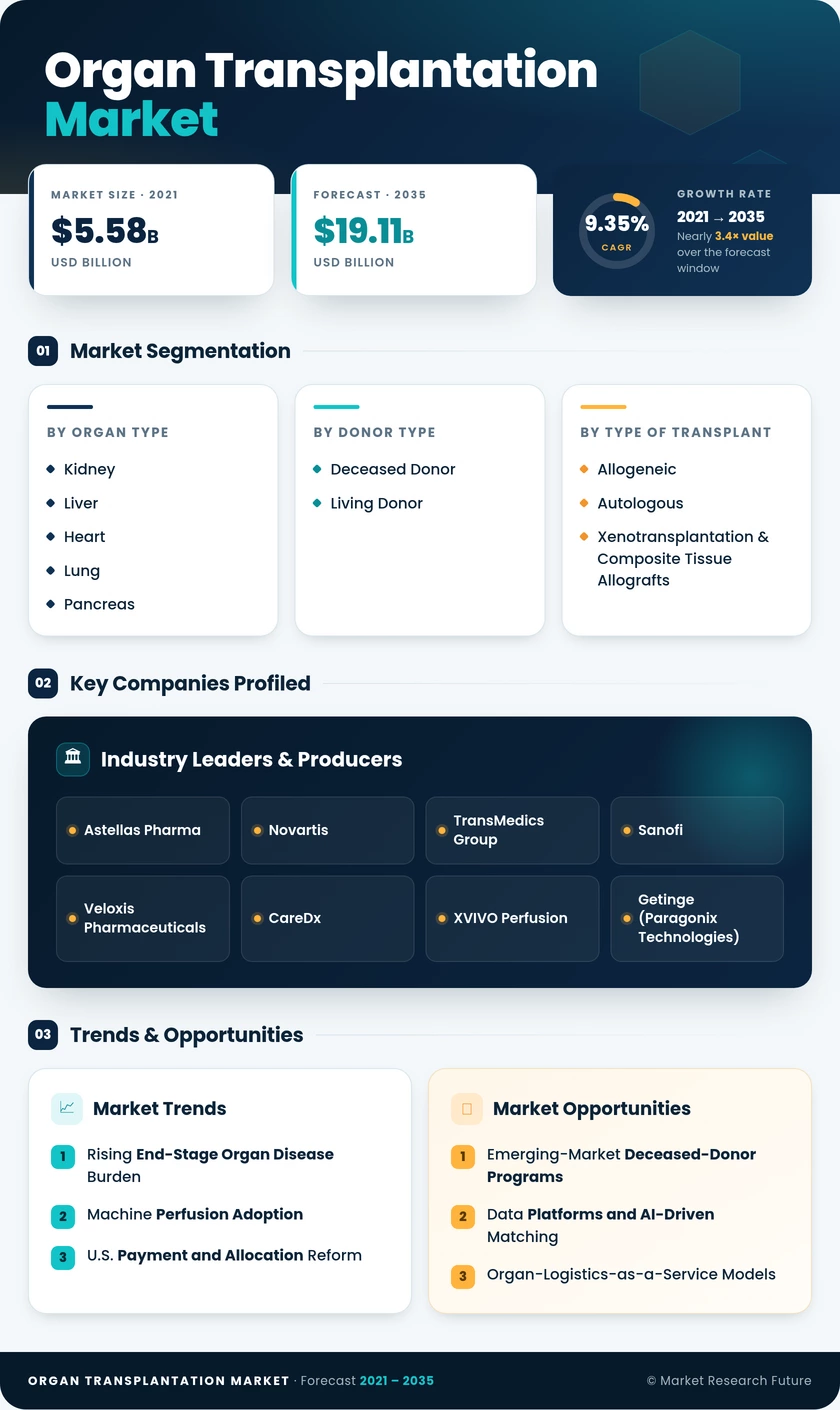
Organ Transplantation Market
Market Size
Forecast Period2026-2035
CAGR (2026-2035)9.35%
2025 Market SizeUSD 7.84 Billion
2035 Market SizeUSD 19.11 Billion
Key Players
Astellas Pharma
Novartis
TransMedics Group
Sanofi
Veloxis Pharmaceuticals
CareDx
Opportunities
  • Emerging-Market Deceased-Donor Programs
  • Data Platforms and AI-Driven Matching
  • Organ-Logistics-as-a-Service Models
  1. 1 Market Summary | |
  2. 2 Key Report Takeaways | |
    1. 2.1 By Organ Type | |
    2. 2.2 By Donor Type | |
    3. 2.3 By Type of Transplant | |
    4. 2.4 By Organ-Preservation Technique | |
    5. 2.5 By Product Type | |
    6. 2.6 By End User | |
    7. 2.7 By Region | |
  3. 3 Market Size and Forecast (2021–2035) | |
  4. 4 Driver Impact Analysis | |
    1. 4.1 Rising End-Stage Organ Disease Burden | |
    2. 4.2 Machine Perfusion Adoption | |
    3. 4.3 U.S. Payment and Allocation Reform | |
    4. 4.4 Opt-Out Consent and DCD Expansion | |
    5. 4.5 Living-Donor Financial Support | |
    6. 4.6 Next-Generation Immunosuppression and Diagnostics | |
  5. 5 Restraints Impact Analysis | |
    1. 5.1 Donor Organ Shortage and Discard | |
    2. 5.2 High Procedure and Lifetime Costs | |
    3. 5.3 Immunosuppression Toxicity and Nonadherence | |
    4. 5.4 Ethical and Regulatory Constraints | |
    5. 5.5 Workforce and Infrastructure Gaps | |
  6. 6 Opportunities | |
    1. 6.1 Emerging-Market Deceased-Donor Programs | |
    2. 6.2 Data Platforms and AI-Driven Matching | |
    3. 6.3 Organ-Logistics-as-a-Service Models | |
    4. 6.4 Xenotransplantation and Bioengineered Organs | |
    5. 6.5 Biosimilar and Precision Immunosuppression | |
  7. 7 Regional Market Share and Country-Level Analysis | |
    1. 7.1 North America | | |
      1. 7.1.1 US | | |
      2. 7.1.2 Canada | | |
      3. 7.1.3 Mexico | |
    2. 7.2 Europe | | |
      1. 7.2.1 Germany | | |
      2. 7.2.2 UK | | |
      3. 7.2.3 France | | |
      4. 7.2.4 Italy | | |
      5. 7.2.5 Spain | | |
      6. 7.2.6 Nordic Countries | | |
      7. 7.2.7 Russia | | |
      8. 7.2.8 Rest of Europe | |
    3. 7.3 Asia-Pacific | | |
      1. 7.3.1 China | | |
      2. 7.3.2 India | | |
      3. 7.3.3 Japan | | |
      4. 7.3.4 South Korea | | |
      5. 7.3.5 ASEAN | | |
      6. 7.3.6 Rest of Asia-Pacific | |
    4. 7.4 South America | | |
      1. 7.4.1 Brazil | | |
      2. 7.4.2 Argentina | | |
      3. 7.4.3 Rest of South America | |
    5. 7.5 Middle East & Africa | | |
      1. 7.5.1 Saudi Arabia | | |
      2. 7.5.2 UAE | | |
      3. 7.5.3 South Africa | | |
      4. 7.5.4 Egypt | | |
      5. 7.5.5 Rest of MEA | |
  8. 8 Future Outlook (2026–2035) | |
    1. 8.1 AI-Assisted Allocation and Acceptance | |
    2. 8.2 Perfusion-Centered Organ Logistics | |
    3. 8.3 Xenotransplant and Regenerative Pipeline | |
    4. 8.4 Value-Based Payment and Outcome Transparency | |
  9. 9 Segmentation Analysis | |
    1. 9.1 By Organ Type | | |
      1. 9.1.1 Kidney | | |
      2. 9.1.2 Liver | | |
      3. 9.1.3 Heart | | |
      4. 9.1.4 Lung | | |
      5. 9.1.5 Pancreas | | |
      6. 9.1.6 Intestine | | |
      7. 9.1.7 Other Organs | |
    2. 9.2 By Donor Type | | |
      1. 9.2.1 Deceased Donor | | |
      2. 9.2.2 Living Donor | |
    3. 9.3 By Type of Transplant | | |
      1. 9.3.1 Allogeneic | | |
      2. 9.3.2 Autologous | | |
      3. 9.3.3 Xenotransplantation & Composite Tissue Allografts | |
    4. 9.4 By Organ-Preservation Technique | | |
      1. 9.4.1 Static Cold Storage | | |
      2. 9.4.2 Hypothermic Machine Perfusion | | |
      3. 9.4.3 Normothermic Machine Perfusion | | |
      4. 9.4.4 Other Novel Methods | |
    5. 9.5 By Product Type | | |
      1. 9.5.1 Immunosuppressants | | |
      2. 9.5.2 Organ Preservation Solutions & Devices | | |
      3. 9.5.3 Tissue Products | | |
      4. 9.5.4 Digital Therapeutics & Tele-transplant Platforms | | |
      5. 9.5.5 Transplant Diagnostics | |
    6. 9.6 By End User | | |
      1. 9.6.1 Hospitals | | |
      2. 9.6.2 Transplant Centers | | |
      3. 9.6.3 Ambulatory Clinics & Same-Day Surgical Centers | | |
      4. 9.6.4 Research & Academic Institutes | |
  10. 10 Competitive Landscape | |
    1. 10.1 Market Concentration Analysis | |
    2. 10.2 Competitive Benchmarking Matrix | |
  11. 11 Recent News & Developments | |
  12. 12 Report Scope and Methodology | |
  13. 13 Detailed Sources and Citations | |
  14. 14 Frequently Asked Questions (FAQs) | | LIST OF TABLES | |
  15. TABLE 1 Global Market Snapshot, 2025–2035 | |
  16. TABLE 2 Global Market Size & Forecast, by Revenue (USD Billion), 2021–2035 | |
  17. TABLE 3 Driver Impact Analysis | |
  18. TABLE 4 Restraints Impact Analysis | |
  19. TABLE 5 Regional Market Summary, 2025 | |
  20. TABLE 6 North America Market, by Country, 2025 | |
  21. TABLE 7 Europe Market, by Country, 2025 | |
  22. TABLE 8 Asia-Pacific Market, by Country, 2025 | |
  23. TABLE 9 South America Market, by Country, 2025 | |
  24. TABLE 10 Middle East & Africa Market, by Country, 2025 | |
  25. TABLE 11 Global Market, by Organ Type, 2025 | |
  26. TABLE 12 Global Market, by Donor Type, 2025 | |
  27. TABLE 13 Global Market, by Type of Transplant, 2025 | |
  28. TABLE 14 Global Market, by Organ-Preservation Technique, 2025 | |
  29. TABLE 15 Global Market, by Product Type, 2025 | |
  30. TABLE 16 Global Market, by End User, 2025 | |
  31. TABLE 17 Competitive Benchmarking Matrix, 2025 | |
  32. TABLE 18 Report Scope and Methodology | |
  33. TABLE 19 Detailed Sources and Citations | | LIST OF FIGURES | |
  34. FIGURE 1 Market Dynamics Overview (Drivers, Restraints, Opportunities) | |
  35. FIGURE 2 Industry Value Chain Analysis | |
  36. FIGURE 3 Porter's Five Forces Analysis | |
  37. FIGURE 4 Global Market Size Trend, 2021–2035 (USD Billion) | |
  38. FIGURE 5 Market Share by Organ Type, 2025 | |
  39. FIGURE 6 Market Share by Donor Type, 2025 | |
  40. FIGURE 7 Market Share by Type of Transplant, 2025 | |
  41. FIGURE 8 Market Share by Organ-Preservation Technique, 2025 | |
  42. FIGURE 9 Market Share by Product Type, 2025 | |
  43. FIGURE 10 Market Share by End User, 2025 | |
  44. FIGURE 11 Regional Market Share, 2025 | |
  45. FIGURE 12 Regional Growth Comparison, 2026–2035 | |
  46. FIGURE 13 Competitive Landscape Positioning Map, 2025

Segmentation Quick Reference

Dimension Sub-Segments Dominant Segment Fastest Growing Segment
By Organ Type Kidney, Liver, Heart, Lung, Pancreas, Other Organs Kidney (58.2% share) Lung (9.72% CAGR)
By Donor Type Deceased Donor, Living Donor Deceased Donor (64.8% share) Living Donor (9.86% CAGR)
By Type of Transplant Allogeneic, Autologous, Xenotransplantation & Composite Tissue Allografts Allogeneic (78.6% share) Xenotransplantation & Composite Tissue Allografts (13.8% CAGR)
By Organ-Preservation Technique Static Cold Storage, Hypothermic Machine Perfusion, Normothermic Machine Perfusion Static Cold Storage (66.9% share) Normothermic Machine Perfusion (12.4% CAGR)
By Product Type Immunosuppressants, Organ Preservation Solutions & Devices, Tissue Products, Digital Therapeutics & Tele-transplant Platforms Immunosuppressants (47.9% share) Digital Therapeutics & Tele-transplant Platforms (19.4% CAGR)
By End User Hospitals, Transplant Centers, Ambulatory Clinics & Same-Day Surgical Centers, Research & Academic Institutes Hospitals (53.4% share) Ambulatory Clinics & Same-Day Surgical Centers (13.1% CAGR)
By Region North America, Europe, Asia-Pacific, South America, Middle East & Africa North America (41.5% share) Asia-Pacific (11.4% CAGR)


Market Segmentation Overview

By Organ Type

Sub-Segment Key Trend
Kidney Living-donor and paired-exchange growth
Liver Perfusion enables use of marginal grafts
Heart DCD heart recovery with portable perfusion
Lung Ex vivo lung perfusion expands donor pool
Pancreas Simultaneous pancreas-kidney procedures
Other Organs Pediatric intestinal transplants


Kidney leads organ volume because end-stage renal disease generates the largest waiting list and living donation is routine for this organ. Lung grows fastest since ex vivo perfusion lets centers assess and recondition lungs once declined for poor oxygenation. Liver remains the clear second, gaining from normothermic perfusion of steatotic grafts.

By Donor Type

Sub-Segment Key Trend
Deceased Donor DCD protocols widen eligibility
Living Donor Lost-wage reimbursement and exchange chains


Deceased Donor grafts dominate because procurement organizations and DCD protocols supply most livers, hearts, and lungs. Living Donor activity grows faster as programs reimburse travel and lost wages, while paired exchange turns incompatible pairs into transplant chains. Asian centers add momentum through living-donor liver surgery for children.

By Type of Transplant

Sub-Segment Key Trend
Allogeneic Machine-learning HLA matching
Autologous Confined to hematopoietic and tissue use
Xenotransplantation & Composite Tissue Allografts Gene-edited pig kidney trials


Allogeneic transplants lead because human donor organs remain the only approved option for solid-organ replacement, and improved HLA matching keeps rejection falling. Xenotransplantation & Composite Tissue Allografts grow fastest from a small base, driven by FDA-cleared pig kidney trials. Autologous procedures stay a niche limited to hematopoietic and tissue applications.

By Organ-Preservation Technique

Sub-Segment Key Trend
Static Cold Storage Low-cost default for standard grafts
Hypothermic Machine Perfusion Randomized evidence for kidneys
Normothermic Machine Perfusion Viability testing during transport


Static Cold Storage still leads because it is inexpensive and works well for standard-criteria organs. Normothermic Machine Perfusion grows fastest by allowing surgeons to test function and repair grafts before implantation, cutting discard. Hypothermic Machine Perfusion holds a solid middle position, particularly for kidneys in Europe and Australia.

By Product Type

Sub-Segment Key Trend
Immunosuppressants Biosimilar entry and extended-release formulations
Organ Preservation Solutions & Devices Perfusion consumables revenue
Tissue Products Tissue banking demand
Digital Therapeutics & Tele-transplant Platforms Adherence apps and remote monitoring


Immunosuppressants lead product revenue because every recipient needs lifelong maintenance therapy, though biosimilars are compressing prices. Digital Therapeutics & Tele-transplant Platforms grow fastest as centers use apps and remote monitoring to curb nonadherence. Organ Preservation Solutions & Devices rise with each perfused case, which carries far higher consumable spend than cold storage.

By End User

Sub-Segment Key Trend
Hospitals Complex surgery and intensive care
Transplant Centers Concentrated high-volume expertise
Ambulatory Clinics & Same-Day Surgical Centers Same-day donor nephrectomy
Research & Academic Institutes Perfusion and xenograft trials


Hospitals lead because recipient surgery requires intensive care, infection control, and multidisciplinary teams. Ambulatory Clinics & Same-Day Surgical Centers grow fastest as laparoscopic donor nephrectomy and enhanced-recovery pathways allow discharge within 24 hours. Transplant Centers retain a large share by concentrating surgical volume and advanced preservation suites.


Download PDF ×

We do not share your information with anyone. However, we may send you emails based on your report interest from time to time. You may contact us at any time to opt-out.