Organ Preservation Market (2026 - 2035)

ID: MRFR/HC/4615-CR 169 Pages Rahul Gotadki Last Updated: October 27, 2026
Organ Preservation Market Research Report By Solution (University of Wisconsin Solution, Custodial HTK, Collins Solution, Celsior Solution, Perfadex, Citrate Solution), By Preservation Techniques (Static Cold Storage, Dynamic Cold Storage) By Organ Type (Kidney, Liver, Heart, Lungs), By End User (Hospitals & Clinics, Organ Banks), and By Region (North America, Europe, Asia-Pacific, And Rest Of The World) - Growth & Industry Forecast 2025 To 2035
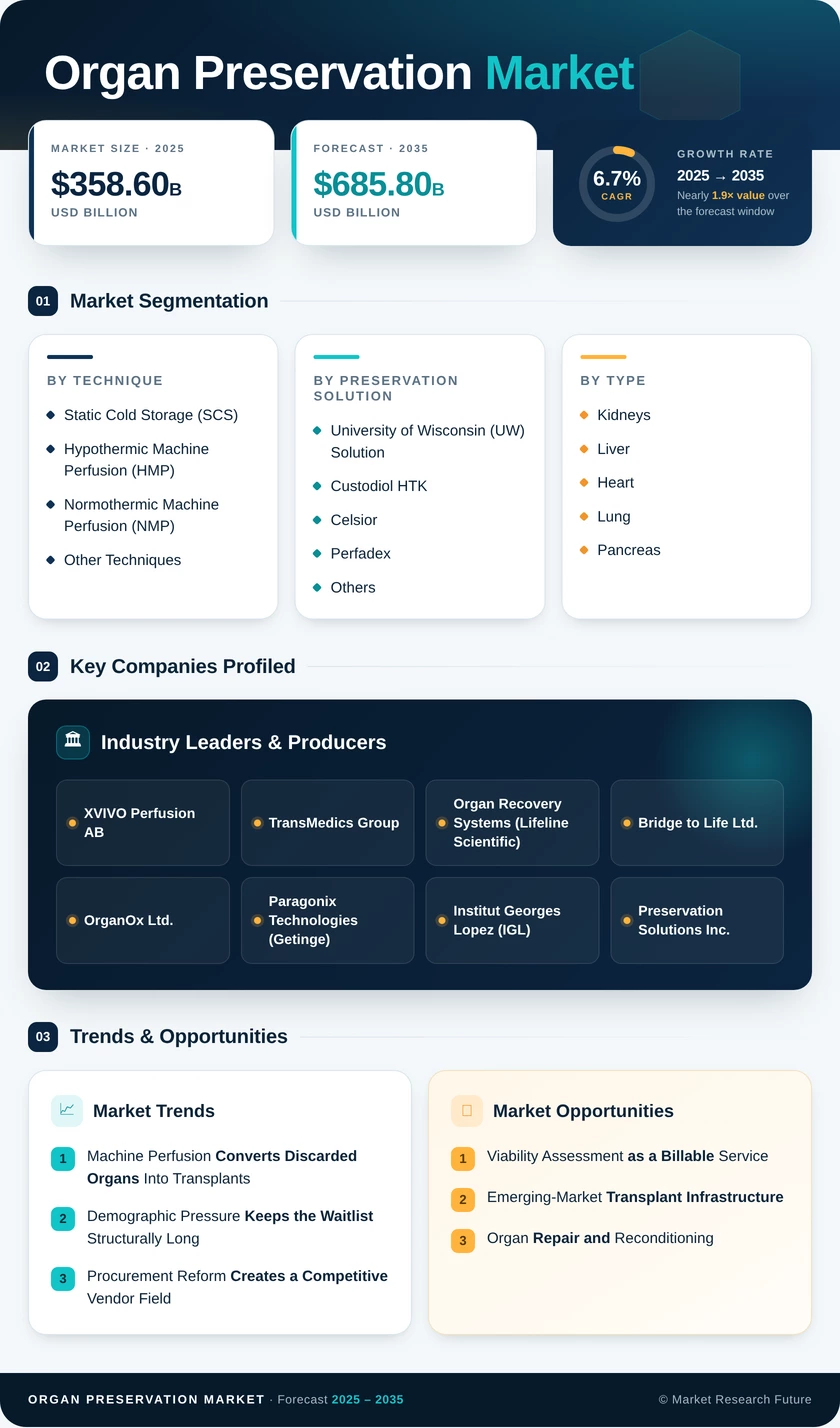
Organ Preservation Market
Market Size
Forecast Period2026-2035
CAGR (2026-2035)6.70%
2025 Market SizeUSD 358.6 Million
2035 Market SizeUSD 685.8 Million
Key Players
XVIVO Perfusion AB
TransMedics Group
Organ Recovery Systems
Bridge to Life Ltd.
OrganOx Ltd.
Paragonix Technologies
Opportunities
  • Viability Assessment as a Billable Service
  • Emerging-Market Transplant Infrastructure
  • Organ Repair and Reconditioning
  1. 1 Market Overview |
    1. 1.1 Study Assumptions & Market Definition |
    2. 1.2 Scope of the Study |
    3. 1.3 Research Methodology
  2. 2 Market Summary & Key Report Takeaways |
    1. 2.1 Key Takeaways by Technique |
    2. 2.2 Key Takeaways by Organ Type & End User |
    3. 2.3 Key Takeaways by Geography
  3. 3 Market Size & Forecast (2021–2035) |
    1. 3.1 Historical Market Size (2021–2024) |
    2. 3.2 Base Year Assessment (2025) |
    3. 3.3 Forecast Market Size (2026–2035) |
    4. 3.4 Year-over-Year Growth Analysis
  4. 4 Market Drivers Analysis |
    1. 4.1 Machine Perfusion Adoption & DCD Donor Expansion |
    2. 4.2 Reimbursement Clarity & Organ Acquisition Cost Pass-Through |
    3. 4.3 Rising End-Stage Organ Failure Prevalence |
    4. 4.4 Procurement Reform & OPO Performance Mandates
  5. 5 Market Restraints Analysis |
    1. 5.1 Capital and Per-Case Cost of Perfusion Platforms |
    2. 5.2 Structural Donor Pool Ceiling |
    3. 5.3 Clinical Inertia & Protocol Transition Timelines
  6. 6 Market Opportunity Analysis |
    1. 6.1 Viability Assessment as a Billable Service |
    2. 6.2 Emerging-Market Transplant Infrastructure |
    3. 6.3 Organ Repair & Reconditioning |
    4. 6.4 Registry Data Monetisation & Outcome-Linked Contracting |
    5. 6.5 Xenotransplantation Preservation Protocols |
    6. 6.6 Industry Value Chain Analysis |
    7. 6.7 Porter's Five Forces Analysis
  7. 7 Regional Analysis |
    1. 7.1 North America | |
      1. 7.1.1 US | |
      2. 7.1.2 Canada | |
      3. 7.1.3 Mexico |
    2. 7.2 Europe | |
      1. 7.2.1 Germany | |
      2. 7.2.2 UK | |
      3. 7.2.3 France | |
      4. 7.2.4 Italy | |
      5. 7.2.5 Spain | |
      6. 7.2.6 Nordic Countries | |
      7. 7.2.7 Russia | |
      8. 7.2.8 Rest of Europe |
    3. 7.3 Asia-Pacific | |
      1. 7.3.1 China | |
      2. 7.3.2 India | |
      3. 7.3.3 Japan | |
      4. 7.3.4 South Korea | |
      5. 7.3.5 ASEAN | |
      6. 7.3.6 Rest of Asia-Pacific |
    4. 7.4 South America | |
      1. 7.4.1 Brazil | |
      2. 7.4.2 Argentina | |
      3. 7.4.3 Rest of South America |
    5. 7.5 Middle East & Africa | |
      1. 7.5.1 Saudi Arabia | |
      2. 7.5.2 UAE | |
      3. 7.5.3 South Africa | |
      4. 7.5.4 Egypt | |
      5. 7.5.5 Rest of Middle East & Africa
  8. 8 Future Outlook (2026–2035) |
    1. 8.1 Algorithmic Organ Acceptance |
    2. 8.2 Service Economics Replace Product Economics |
    3. 8.3 Normothermic Regional Perfusion Standardisation |
    4. 8.4 Supply Chain & Sustainability Scrutiny
  9. 9 Segmentation Analysis |
    1. 9.1 By Technique | |
      1. 9.1.1 Static Cold Storage (SCS) | |
      2. 9.1.2 Hypothermic Machine Perfusion (HMP) | |
      3. 9.1.3 Normothermic Machine Perfusion (NMP) | |
      4. 9.1.4 Other Techniques |
    2. 9.2 By Preservation Solution | |
      1. 9.2.1 University of Wisconsin (UW) Solution | |
      2. 9.2.2 Custodiol HTK | |
      3. 9.2.3 Celsior | |
      4. 9.2.4 Perfadex | |
      5. 9.2.5 Others |
    3. 9.3 By Product Type | |
      1. 9.3.1 Preservation Solutions | |
      2. 9.3.2 Machine Perfusion Systems | |
      3. 9.3.3 Transport and Storage Consumables | |
      4. 9.3.4 Accessories & Monitoring Software |
    4. 9.4 By Organ Type | |
      1. 9.4.1 Kidneys | |
      2. 9.4.2 Liver | |
      3. 9.4.3 Heart | |
      4. 9.4.4 Lung | |
      5. 9.4.5 Pancreas | |
      6. 9.4.6 Others |
    5. 9.5 By End User | |
      1. 9.5.1 Transplant Centers | |
      2. 9.5.2 Hospitals | |
      3. 9.5.3 Organ Procurement Organizations | |
      4. 9.5.4 Research Institutes and Specialty Clinics
  10. 10 Competitive Landscape |
    1. 10.1 Market Concentration Analysis (2026) |
    2. 10.2 Competitive Benchmarking Matrix |
    3. 10.3 Company Profiles | |
      1. 10.3.1 XVIVO Perfusion AB | |
      2. 10.3.2 TransMedics Group | |
      3. 10.3.3 Organ Recovery Systems (Lifeline Scientific) | |
      4. 10.3.4 Bridge to Life Ltd. | |
      5. 10.3.5 OrganOx Ltd. | |
      6. 10.3.6 Paragonix Technologies (Getinge) | |
      7. 10.3.7 Institut Georges Lopez (IGL) | |
      8. 10.3.8 Preservation Solutions Inc. | |
      9. 10.3.9 BioLifeSolutions | |
      10. 10.3.10 Waters Medical Systems | |
      11. 10.3.11 21st Century Medicine
  11. 11 Recent Developments & News
  12. 12 Report Scope & Methodology |
    1. 12.1 Study Period & Base Year |
    2. 12.2 Data Sources & Citations |
    3. 12.3 Abbreviations
  13. 13 Detailed Sources and Citations
  14. 14 Frequently Asked Questions
  15. 15 LIST OF TABLES |
  16. TABLE 1 Global Organ Preservation Market Size & Forecast, by Revenue (USD Million), 2021–2035 |
  17. TABLE 2 Year-over-Year Growth Analysis, 2021–2035 |
  18. TABLE 3 Driver Impact Analysis Matrix, 2026–2035 |
  19. TABLE 4 Restraint Impact Analysis Matrix, 2026–2035 |
  20. TABLE 5 Market Size, by Region, 2021–2035 (USD Million) |
  21. TABLE 6 North America Market Size, by Country, 2021–2035 (USD Million) |
  22. TABLE 7 Europe Market Size, by Country, 2021–2035 (USD Million) |
  23. TABLE 8 Asia-Pacific Market Size, by Country, 2021–2035 (USD Million) |
  24. TABLE 9 South America Market Size, by Country, 2021–2035 (USD Million) |
  25. TABLE 10 Middle East & Africa Market Size, by Country, 2021–2035 (USD Million) |
  26. TABLE 11 Market Size, by Technique, 2021–2035 (USD Million) |
  27. TABLE 12 Market Size, by Preservation Solution, 2021–2035 (USD Million) |
  28. TABLE 13 Market Size, by Product Type, 2021–2035 (USD Million) |
  29. TABLE 14 Market Size, by Organ Type, 2021–2035 (USD Million) |
  30. TABLE 15 Market Size, by End User, 2021–2035 (USD Million) |
  31. TABLE 16 North America Market Size, by Technique and Organ Type, 2021–2035 (USD Million) |
  32. TABLE 17 Europe Market Size, by Technique and Organ Type, 2021–2035 (USD Million) |
  33. TABLE 18 Asia-Pacific Market Size, by Technique and Organ Type, 2021–2035 (USD Million) |
  34. TABLE 19 South America Market Size, by Technique and End User, 2021–2035 (USD Million) |
  35. TABLE 20 Middle East & Africa Market Size, by Technique and End User, 2021–2035 (USD Million) |
  36. TABLE 21 Competitive Benchmarking Matrix — Global Organ Preservation Market, 2026 |
  37. TABLE 22 Company Profiles — Key Players |
  38. TABLE 23 Recent Developments & Strategic Announcements, 2023–2025 |
  39. TABLE 24 Report Scope & Methodology Summary |
  40. TABLE 25 Detailed Sources and Citations Index
  41. 16 LIST OF FIGURES |
  42. FIGURE 1 Market Dynamics — Drivers, Restraints and Opportunities Snapshot |
  43. FIGURE 2 Industry Value Chain Analysis |
  44. FIGURE 3 Porter's Five Forces Analysis |
  45. FIGURE 4 Market Size Trend Line, 2021–2035 (USD Million) |
  46. FIGURE 5 Year-over-Year Growth Curve, 2022–2035 |
  47. FIGURE 6 Market Share by Technique, 2025 vs 2035 |
  48. FIGURE 7 Market Share by Preservation Solution, 2025 |
  49. FIGURE 8 Market Share by Product Type, 2025 vs 2035 |
  50. FIGURE 9 Market Share by Organ Type, 2025 |
  51. FIGURE 10 Market Share by End User, 2025 |
  52. FIGURE 11 Regional Revenue Share Distribution, 2025 vs 2035 |
  53. FIGURE 12 Regional CAGR Comparison, 2026–2035 |
  54. FIGURE 13 Country-Level Revenue Heat Map, 2025 |
  55. FIGURE 14 Competitive Landscape Positioning Matrix, 2026 |
  56. FIGURE 15 Estimated Vendor Revenue Share Ranges, 2025

Segmentation Quick Reference

DimensionSub-SegmentsDominant SegmentFastest Growing Segment
By TechniqueStatic Cold Storage (SCS); Hypothermic Machine Perfusion (HMP); Normothermic Machine Perfusion (NMP); Other TechniquesStatic Cold Storage (SCS)Normothermic Machine Perfusion (NMP)
By Preservation SolutionUniversity of Wisconsin (UW) Solution; Custodiol HTK; Celsior; Perfadex; OthersUniversity of Wisconsin (UW) SolutionOthers
By Product TypePreservation Solutions; Machine Perfusion Systems; Transport and Storage ConsumablesPreservation SolutionsMachine Perfusion Systems
By Organ TypeKidneys; Liver; Heart; Lung; Pancreas; OthersKidneysLiver
By End UserTransplant Centers; Hospitals; Organ Procurement Organizations; Research Institutes and Specialty ClinicsTransplant CentersOrgan Procurement Organizations
By RegionNorth America; Europe; Asia-Pacific; South America; Middle East & AfricaNorth AmericaAsia-Pacific


Market Segmentation Overview

By Technique

Sub-SegmentKey Trend
Static Cold Storage (SCS)Retreating to standard-criteria grafts and short transport radii as perfusion absorbs complex cases
Hypothermic Machine Perfusion (HMP)Established default for DCD kidney recovery; strongest installed-base depth
Normothermic Machine Perfusion (NMP)Enables pre-implant functional testing, driving liver and cardiac adoption
Other TechniquesHypothermic oxygenated and regional perfusion approaches are gaining European traction


Technique choice is increasingly a risk-triage decision rather than an institutional habit. Centres now route grafts by donor profile and transport distance, which means cold storage and perfusion coexist inside the same programme rather than competing for it.

By Preservation Solution

Sub-SegmentKey Trend
University of Wisconsin (UW) SolutionEntrenched abdominal standard facing generic price erosion
Custodiol HTKGaining share in cardiac and paediatric cases on single-flush simplicity
CelsiorSteady thoracic use, concentrated in European centres
PerfadexLung-specific standard tied to reconditioning protocol growth
OthersRegional and institutional formulations expanding in Asia-Pacific tenders


Solution economics are diverging from device economics. Formulations compete on tender price and supply reliability, while differentiation increasingly comes from bundling solutions with the perfusion hardware that consumes them.

By Product Type

Sub-SegmentKey Trend
Preservation SolutionsLargest revenue base, lowest margin, most exposed to procurement pressure
Machine Perfusion SystemsHighest growth via device placement plus recurring disposable attach
Transport and Storage ConsumablesSteady expansion driven by chain-of-custody and tracking requirements


Vendors are shifting portfolio weight toward systems and consumables because those categories carry switching costs. A solution supplier can be replaced at the next tender; a perfusion platform embedded in surgical workflow cannot.

By Organ Type

Sub-SegmentKey Trend
KidneysHighest procedure volume, lowest revenue per case
LiverNormothermic viability assessment driving fastest expansion
HeartDCD cardiac recovery unlocked entirely by perfusion technology
LungEx-vivo reconditioning improving utilisation of marginal grafts.
PancreasNiche volume tied to islet and whole-organ programmes
OthersIntestinal and multi-visceral procedures concentrated in specialist centres


Revenue concentration does not follow procedure counts. Thoracic and hepatic cases carry preservation spend far above renal cases, so a modest rise in heart and liver perfusion volume moves the market more than large kidney volume gains.

By End User

Sub-SegmentKey Trend
Transplant CentersOwn the purchasing decision and the clinical evidence threshold
HospitalsProvide surrounding surgical and recovery infrastructure
Organ Procurement OrganizationsFastest-growing buyer class under performance regulation
Research Institutes and Specialty ClinicsDrive protocol development and xenotransplant preservation work


Buyer power is redistributing. Procurement organisations that once purchased only shipping containers now invest in perfusion hardware because regulators measure their recovery and utilisation performance directly.




Download PDF ×

We do not share your information with anyone. However, we may send you emails based on your report interest from time to time. You may contact us at any time to opt-out.