
Request Free Sample ×

Kindly complete the form below to receive a free sample of this Report

* Please use a valid business email

Leading companies partner with us for data-driven Insights

clients tt-cursor
Hero Background
English
Chinese
French
Japanese
Korean
German
Spanish

Optical position sensor Market Size

ID: MRFR/SEM/5988-HCR
100 Pages
Ankit Gupta
Last Updated: April 06, 2026

Optical position sensor Market Size, Share and Research Report By Type (Linear Position Sensors, Rotary Position Sensors), By Contract Type (Non-Contact Type, Contact Type), By Output (Digital Output, Analog Output), By Application (Machine Tools, Robotics, Motion Systems, Material Handling, Test Equipment, Others {Inspection Systems and Measurement}), By End-user (Manufacturing, Automotive, Aerospace, Packaging, Healthcare, Electronics, Others), And By Region (North America, Europe, Asia-Pacific & Rest Of The World) – Industry Forecast Till 2035

Share:
Download PDF ×

We do not share your information with anyone. However, we may send you emails based on your report interest from time to time. You may contact us at any time to opt-out.

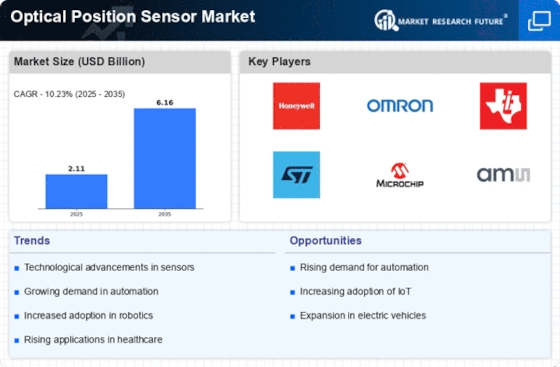
Optical position sensor Market Infographic
Purchase Options

Optical Position Sensor Size

Optical position sensor Market Growth Projections and Opportunities

The Optical Position Sensor Market is influenced by various market factors that play a crucial role in shaping its dynamics. One of the major factors is high demand for quality sensing devices in different sectors. The advances in technology have led to a rise of position optical continuous sensors that provide precise and reliable measurements needed for applications such as robotics, automotive, consumer electronics among others. The market is also considerably influenced by increasing automation in industrial processes as optical position sensors find their extensive use to ensure accurate positional and movement control.

In addition, the market is driven by miniaturization trend in sensor technology. The smaller the electronic devices become, so does also increase demand for compact and light weight optical position sensors. This is more evident in the consumer electronics sector where products with thin and elegant configurations have huge demand. Optical position sensors, which have the ability to deliver top-level performance in a compact size meet this need and drive market growth.

The dynamics of this market are also influenced by the growing trend towards energy efficiency and sustainability along with technological development. The optical position sensors, with their unique non-contact nature of sensing mechanism, have some advantages over traditional contact based ones since these reduce wear and tear; they last longer life time than the former as well as consume low energy. This makes them a popular option for industries seeking to improve their sustainability initiatives while achieving operational optimization.

However, on the other hand, market cannot escape problems. The main barrier for achieving widespread adoption, with particular emphasis on the price-sensitive markets, is cost constraints. Manufacturers are constantly striving to find cheaper alternatives that do not affect the efficiency of optical position sensors. The competitive landscape is also an important factor in shaping the market, where companies try to stand out through new features and quality products at reasonable prices.

Global economic conditions and geopolitical factors also play a role in the dynamics of this market. Industrial capital expenditure is also affected during economic downturns, which affects the overall demand for optical position sensors. Political uncertainties and trade conflicts can change the dynamics of supply chains leading to fluctuations in component prices.

Additionally, regulatory aspects are an integral part of optical position sensor market. Compliance with industry standards and regulations, especially in sectors such as automotive and aerospace, is essential for market players to gain and maintain a competitive edge. Stringent quality and safety standards drive continuous innovation and improvement in optical position sensor technologies.
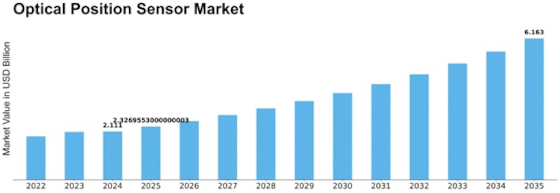
Optical position sensor Market Size Graph
Author
Author Profile
Ankit Gupta
Team Lead - Research

Ankit Gupta is a seasoned market intelligence and strategic research professional with over six plus years of experience in the ICT and Semiconductor industries. With academic roots in Telecom, Marketing, and Electronics, he blends technical insight with business strategy. Ankit has led 200+ projects, including work for Fortune 500 clients like Microsoft and Rio Tinto, covering market sizing, tech forecasting, and go-to-market strategies. Known for bridging engineering and enterprise decision-making, his insights support growth, innovation, and investment planning across diverse technology markets.

Leave a Comment

FAQs

What is the projected market valuation for the Optical Position Sensor Market in 2035?

<p>The Optical Position Sensor Market is projected to reach a valuation of 6.163 USD Billion by 2035.</p>

What was the market valuation for the Optical Position Sensor Market in 2024?

<p>In 2024, the Optical Position Sensor Market was valued at 2.111 USD Billion.</p>

What is the expected CAGR for the Optical Position Sensor Market during the forecast period 2025 - 2035?

<p>The expected CAGR for the Optical Position Sensor Market during the forecast period 2025 - 2035 is 10.23%.</p>

Which companies are considered key players in the Optical Position Sensor Market?

<p>Key players in the Optical Position Sensor Market include Honeywell, Omron, Texas Instruments, and STMicroelectronics.</p>

What are the two main types of position sensors in the market, and how do they compare in valuation?

<p>Linear Position Sensors were valued at 0.845 USD Billion in 2024, while Rotary Position Sensors had a valuation of 1.266 USD Billion.</p>

How do the contact and non-contact types of optical position sensors compare in terms of market valuation?

<p>In 2024, the Non-Contact Type was valued at 1.055 USD Billion, whereas the Contact Type had a valuation of 1.056 USD Billion.</p>

What applications are driving growth in the Optical Position Sensor Market?

Applications such as Machine Tools and Robotics are driving growth, with Machine Tools valued at 0.633 USD Billion in 2024.

What end-user segments are contributing to the Optical Position Sensor Market's growth?

The Manufacturing sector is a major contributor, with a valuation of 0.8 USD Billion in 2024.

What output types are available in the Optical Position Sensor Market, and how do they perform?

Digital Output sensors were valued at 1.055 USD Billion in 2024, while Analog Output sensors had a valuation of 1.056 USD Billion.

What is the expected growth trajectory for the Optical Position Sensor Market in the coming years?

The market is expected to grow significantly, reaching 6.163 USD Billion by 2035, indicating robust demand.

Market Summary

As per Market Research Future analysis, the Optical Position Sensor Market Size was estimated at 2.111 USD Billion in 2024. The Optical Position Sensor industry is projected to grow from 2.326 USD Billion in 2025 to 6.163 USD Billion by 2035, exhibiting a compound annual growth rate (CAGR) of 10.23% during the forecast period 2025 - 2035

Key Market Trends & Highlights

The Optical Position Sensor Market is experiencing robust growth driven by technological advancements and increasing applications across various sectors.

  • The market is witnessing a notable integration of optical position sensors in automation processes, particularly in North America. Miniaturization of components is becoming a prevalent trend, enhancing the functionality of linear position sensors, which remain the largest segment. Energy efficiency is a growing focus, especially in the Asia-Pacific region, where rotary position sensors are rapidly gaining traction. Rising demand in robotics and expansion in automotive applications are key drivers propelling market growth.

Market Size & Forecast

2024 Market Size 2.111 (USD Billion)
2035 Market Size 6.163 (USD Billion)
CAGR (2025 - 2035) 10.23%
Largest Regional Market Share in 2024 North America

Major Players

Honeywell (US), Omron (JP), Texas Instruments (US), STMicroelectronics (CH), Microchip Technology (US), ams AG (AT), Renesas Electronics (JP), Broadcom Inc. (US), Infineon Technologies (DE)

Market Trends

The Optical Position Sensor Market is currently experiencing a notable evolution, driven by advancements in technology and increasing demand across various sectors. The integration of optical position sensors in automation and robotics is particularly prominent, as industries seek to enhance precision and efficiency in their operations. Furthermore, the growing trend towards miniaturization of electronic components is likely to propel the adoption of these sensors in compact devices, thereby expanding their application range. As industries continue to embrace smart technologies, the Optical Position Sensor Market appears poised for substantial growth, with innovations in sensor design and functionality playing a crucial role in shaping its future. In addition, the rising emphasis on energy efficiency and sustainability is influencing the development of optical position sensors. Manufacturers are increasingly focusing on creating sensors that not only meet performance standards but also contribute to reducing energy consumption. This shift towards eco-friendly solutions may lead to the emergence of new market players and technologies, fostering a competitive landscape. Overall, the Optical Position Sensor Market is on a trajectory of transformation, characterized by technological advancements and a growing awareness of environmental considerations, which could redefine its dynamics in the coming years.

Integration in Automation

The Optical Position Sensor Market is witnessing a surge in the integration of sensors within automation systems. This trend is driven by the need for enhanced accuracy and reliability in industrial processes. As industries adopt smart manufacturing practices, the demand for precise position sensing solutions is likely to increase, facilitating improved operational efficiency.

Miniaturization of Components

Another notable trend is the miniaturization of optical position sensors, which allows for their incorporation into smaller devices. This development is particularly relevant in consumer electronics and medical applications, where space constraints are prevalent. The ability to produce compact sensors may lead to broader adoption across various sectors.

Focus on Energy Efficiency

The growing emphasis on energy efficiency is shaping the Optical Position Sensor Market. Manufacturers are increasingly developing sensors that not only perform effectively but also minimize energy consumption. This focus on sustainability may drive innovation and attract new entrants to the market, fostering a more competitive environment.

Optical position sensor Market Market Drivers

Rising Demand in Robotics

The Optical Position Sensor Market is experiencing a notable surge in demand due to the increasing integration of optical sensors in robotics applications. As industries adopt automation, the need for precise positioning and movement tracking becomes paramount. According to recent data, the robotics sector is projected to grow at a compound annual growth rate of over 20% in the coming years. This growth is likely to drive the adoption of optical position sensors, which offer high accuracy and reliability. Furthermore, advancements in sensor technology are enabling the development of more sophisticated robotic systems, which in turn fuels the demand for optical position sensors. The Optical Position Sensor Market is thus positioned to benefit significantly from this trend, as manufacturers seek to enhance the capabilities of their robotic solutions.

Growth in Consumer Electronics

The Optical Position Sensor Market is benefiting from the growth in consumer electronics, where the demand for precise positioning and touchless control is escalating. Devices such as smartphones, tablets, and smart home appliances increasingly incorporate optical position sensors to enhance user experience and functionality. Market analysis suggests that the consumer electronics segment is expected to grow at a rate of around 10% annually, driven by the rising trend of smart devices. This growth indicates a robust opportunity for the Optical Position Sensor Market, as manufacturers strive to integrate advanced sensing technologies into their products to meet consumer expectations for innovation and performance.

Expansion in Automotive Applications

The Optical Position Sensor Market is witnessing substantial growth driven by the expansion of automotive applications. With the automotive sector increasingly focusing on advanced driver-assistance systems (ADAS) and autonomous vehicles, the demand for precise positioning sensors is on the rise. Optical position sensors are integral to various automotive functions, including steering, braking, and throttle control. Market data indicates that the automotive segment is expected to account for a significant share of the optical position sensor market, with a projected growth rate of approximately 15% annually. This trend suggests that as vehicles become more automated and connected, the reliance on optical position sensors will intensify, thereby propelling the Optical Position Sensor Market forward.

Increased Focus on Industrial Automation

The Optical Position Sensor Market is significantly influenced by the increased focus on industrial automation across various sectors. As manufacturers seek to enhance productivity and reduce operational costs, the adoption of automation technologies is becoming more prevalent. Optical position sensors are essential for ensuring accurate positioning in automated systems, which include assembly lines and material handling equipment. Recent statistics indicate that the industrial automation market is projected to grow at a compound annual growth rate of approximately 12%. This trend suggests that the Optical Position Sensor Market will likely experience substantial growth as industries invest in automation solutions that require reliable and precise positioning capabilities.

Technological Advancements in Sensor Design

Technological advancements in sensor design are playing a crucial role in shaping the Optical Position Sensor Market. Innovations such as improved light source technologies and enhanced signal processing algorithms are leading to the development of more efficient and accurate optical position sensors. These advancements not only improve performance but also reduce the size and cost of sensors, making them more accessible to a wider range of applications. As industries seek to optimize their operations, the demand for high-performance optical position sensors is likely to increase. The Optical Position Sensor Market stands to gain from these technological improvements, as they enable manufacturers to offer more competitive products that meet the evolving needs of various sectors.

Market Segment Insights

By Type: Linear Position Sensors (Largest) vs. Rotary Position Sensors (Fastest-Growing)

<p>The Optical Position Sensor Market is characterized by a significant share of Linear Position Sensors, which have been the preferred choice due to their precision and reliability. An increasing number of applications across various industries, including automotive and industrial automation, further enhances their market dominance. Conversely, Rotary Position Sensors are gaining momentum in this market, driven by the rising demand for automation and robotics, leading to a more intensively competitive landscape.</p>

<p>Position Sensors: Linear (Dominant) vs. Rotary (Emerging)</p>

<p>Linear Position Sensors are known for their straightforward design and precise linear measurements, making them essential in applications such as automation and automotive systems. Their dominance is sustained by their efficiency and ability to function in diverse environments. In contrast, Rotary Position Sensors are emerging rapidly, fueled by trends towards sophisticated motion control systems and the increasing utilization of robotics in manufacturing. They offer unique tracking capabilities and flexibility in operation, catering to industries looking to enhance efficiency and precision in dynamic applications.</p>

By Contract Type: Non-Contact Type (Largest) vs. Contact Type (Fastest-Growing)

<p>The Optical Position Sensor Market exhibits a notable division between non-contact and contact type sensors. Currently, non-contact types dominate the market landscape due to their advanced technology and application versatility. This segment's extensive adoption across various applications, from automotive to consumer electronics, secures its leading market share. In contrast, the contact type segment is gaining traction as manufacturers innovate to improve accuracy and performance, finding niche markets where physical interaction is necessary.</p>

<p>Contract Type: Non-Contact (Dominant) vs. Contact (Emerging)</p>

<p>Non-contact position sensors leverage technologies such as optical and magnetic sensing to provide highly accurate positioning data without physical contact. This characteristic enhances their durability and reduces maintenance costs, making them highly preferred in sectors like industrial automation, robotics, and automotive applications. On the other hand, contact type position sensors, while currently smaller in market share, are emerging due to specific applications requiring direct interaction for precision, such as in medical and aerospace industries. Their growth is propelled by increasing demands for high accuracy and reliability, making them a critical segment as technology evolves.</p>

By Output: Digital Output (Largest) vs. Analog Output (Fastest-Growing)

<p>The Optical Position Sensor Market exhibits a distinct distribution between its output segment values. Digital Output currently holds the largest market share, primarily due to its prevalent use in industrial and automation applications, providing enhanced accuracy and reliability. On the other hand, Analog Output is gaining traction, leveraging its linear output characteristics, which appeal to a growing segment of users in applications requiring precise control over variable parameters.</p>

<p>Output Type: Digital Output (Dominant) vs. Analog Output (Emerging)</p>

<p>Digital Output sensors dominate the Optical Position Sensor Market thanks to their ability to deliver precise digital signals, facilitating straightforward integration with digital systems. Their robustness and accuracy make them the preferred choice in various settings, from automotive to industrial applications. Conversely, Analog Output sensors are emerging as an important alternative due to their ability to convey continuous data, which is crucial for sectors like robotics and automation. The adaptation of these sensors in evolving technologies, such as IoT devices, positions them advantageously, capitalizing on the growing demand for precise, real-time measuring tools.</p>

By Application: Machine Tools (Largest) vs. Robotics (Fastest-Growing)

<p>In the Optical Position Sensor Market, the application segments showcase a diverse distribution with significant dominance from Machine Tools, which claim the largest market share. This application is essential for precision and efficiency in manufacturing processes, contributing extensively to the steady demand for optical position sensors. Following closely are Robotics and Motion Systems, which represent vital growth areas, fueled by the rising integration of automation in various industries.</p>

<p>Applications: Machine Tools (Dominant) vs. Robotics (Emerging)</p>

<p>Machine Tools dominate the Optical Position Sensor market due to their critical role in enhancing operational accuracy and productivity in the manufacturing sector. These sensors provide real-time feedback, essential for maintaining precision in machining processes. On the other hand, Robotics, while currently an emerging segment, is experiencing rapid growth. This surge is driven by advancements in technology and the increasing adoption of robotic systems across different industries. Robotics applications are becoming essential as they enhance operational efficiency and flexibility, leading to a significant demand for reliable optical position sensors.</p>

By End-User: Manufacturing (Largest) vs. Automotive (Fastest-Growing)

<p>Within the Optical Position Sensor Market, manufacturing is observed to hold the largest share, as it leverages these sensors for precision manufacturing processes and automation. This sector's embrace of advanced technologies has made optical position sensors indispensable, enhancing productivity and accuracy on production lines. Meanwhile, the automotive industry emerges as a robust contender, making significant inroads into the market due to an increasing demand for advanced driver-assistance systems (ADAS) and autonomous vehicles. The integration of optical sensors in vehicle navigation and collision detection systems is streamlining the consumer experience and boosting safety levels. The growth trends in this segment are primarily driven by the rapid advancements in technology, particularly in the fields of automation and machine learning. As industries strive for greater efficiency and improved safety mechanisms, the demand for precision and reliability in sensors is soaring. Additionally, with global automotive manufacturers actively investing in smart technologies and sustainable practices, the automotive segment is set to witness unprecedented growth. The broader trend towards automation in manufacturing further bolsters the demand for optical position sensors, creating a symbiotic relationship between these sectors and the technology itself.</p>

<p>Manufacturing: Dominant vs. Automotive: Emerging</p>

<p>The manufacturing sector stands as the dominant player in the Optical Position Sensor Market, characterized by its extensive adoption of automation technology and the need for high precision in production processes. Optical position sensors are pivotal for ensuring accuracy in various applications, ranging from assembly lines to quality checks, facilitating a seamless integration into smart manufacturing frameworks. In contrast, the automotive sector, though newer in its reliance on these sensors, is rapidly emerging due to heightened demands for safety features and automation in vehicles. The growth of electric vehicles and advancements in autonomous vehicle technologies are driving this trend, encouraging automotive companies to invest heavily in optical position sensors to enhance functionality and provide consumers with a safer driving experience.</p>

Get more detailed insights about Optical position sensor Market Research Report – Global Forecast till 2035

Regional Insights

North America : Technological Innovation Leader

North America is the largest market for optical position sensors, holding approximately 40% of the global market share. The region's growth is driven by advancements in automation, increasing demand for smart devices, and stringent regulatory standards promoting safety and efficiency. The presence of major technology firms and a robust manufacturing base further catalyze market expansion. The United States leads the market, followed by Canada, with significant contributions from key players like Honeywell, Texas Instruments, and Broadcom. The competitive landscape is characterized by continuous innovation and strategic partnerships, enhancing product offerings and market reach. The focus on IoT and smart manufacturing is expected to drive further growth in the coming years.

Europe : Regulatory Compliance Focus

Europe is the second-largest market for optical position sensors, accounting for around 30% of the global share. The region's growth is fueled by stringent regulations aimed at enhancing safety and efficiency in various industries, including automotive and industrial automation. The European Union's initiatives to promote smart technologies and sustainability are also significant drivers. Leading countries in this region include Germany, France, and the UK, with a strong presence of key players like Infineon Technologies and STMicroelectronics. The competitive landscape is marked by a focus on innovation, with companies investing heavily in R&D to meet regulatory standards and consumer demands. The emphasis on energy-efficient solutions is expected to shape market dynamics in the near future.

Asia-Pacific : Emerging Market Potential

Asia-Pacific is witnessing rapid growth in the optical position sensor market, holding approximately 25% of the global share. The region's expansion is driven by increasing industrial automation, rising consumer electronics demand, and government initiatives to boost manufacturing capabilities. Countries like China and India are at the forefront, with significant investments in technology and infrastructure. China is the largest market in the region, followed by Japan and India, with key players like Omron and Renesas Electronics leading the charge. The competitive landscape is evolving, with local manufacturers emerging alongside established global firms. The focus on smart cities and IoT applications is expected to further accelerate market growth in the coming years.

Middle East and Africa : Resource-Rich Opportunities

The Middle East and Africa region is gradually emerging in the optical position sensor market, holding about 5% of the global share. The growth is primarily driven by increasing investments in infrastructure, smart city projects, and the adoption of automation in various sectors. Countries like the UAE and South Africa are leading the way, with government initiatives aimed at enhancing technological capabilities. The competitive landscape is characterized by a mix of local and international players, with companies exploring opportunities in diverse sectors such as oil and gas, automotive, and consumer electronics. The region's unique challenges and opportunities present a dynamic environment for market growth, with a focus on innovation and sustainability expected to shape future trends.

Key Players and Competitive Insights

Leading market players are investing heavily in research and development in order to expand their product lines, which will help the Optical position sensor Market, grow even more. Market participants are also undertaking a variety of strategic activities to expand their global footprint, with important market developments including new product launches, contractual agreements, mergers and acquisitions, higher investments, and collaboration with other organizations. To expand and survive in a more competitive and rising market climate, Optical position sensor industry must offer cost-effective items.Manufacturing locally to minimize operational costs is one of the key business tactics used by manufacturers in the global Optical position sensor industry to benefit clients and increase the market sector. In recent years, the Optical position sensor industry has offered some of the most significant advantages to medicine. Major players in the Optical position sensor Market, including Honeywell International, Inc. (US), Balluff GmbH (Germany), Sensata Technologies (US), Hamamastu Photonics K.K. (Japan), and Bourns Inc. (US) and others, are attempting to increase market demand by investing in research and development operations.Sony Group Corporation is a Japanese multinational conglomerate headquartered in Minato, Tokyo. As a major technology corporation, it is one of the world's largest makers of consumer and professional electronic equipment, as well as the largest video game console manufacturer and publisher. It is one of the major music firms (largest music publisher and second largest record label) and the third largest film studio through Sony Entertainment, making it one of the most comprehensive media corporations.Osram Opto Semiconductors GmbH, based in Regensburg, Germany, was a wholly owned subsidiary of Osram GmbH, the world's second largest maker of optoelectronic semiconductors after Nichia, with Cree Inc. coming in third. Osram and Infineon Technologies formed the company in 1999 as a joint venture. Osram Opto Semiconductors was acquired by AMS-Osram International GmbH in 2021 and is now part of the AMS Osram Group.

In April Osram Opto Semiconductors has stated that it would participate in a new project that will run through 2021 and will investigate the fundamentals of high-resolution visualization solutions employing LEDs (micro LEDs) and optical sensors. The Bavarian State Ministry for Economic Affairs, Regional Development, and Energy is funding the initiative, which began in November 2018. With an initial demonstrator, the project is planned to be finished in October 2021.  

Key Companies in the Optical position sensor Market include

Industry Developments

June 2019, InGaAs, an area image sensor for hyperspectral cameras capable of detecting short-wavelength infrared light up to 2.55 m, was introduced by Hamamatsu Photonics. It has the world's longest detectable wavelength using this sort of area image sensor.

July 2020, Microsoft has submitted a patent for a'multidimesional'optical heart rate sensor, which could improve accuracy. The heart rate sensor is dubbed multidimensional because it may possibly measure heart rate, pulse wave velocity, blood and tissue oxygenation, and other variables, including blood pressure proxies.

Future Outlook

Optical position sensor Market Future Outlook

The Optical Position Sensor Market is projected to grow at a 10.23% CAGR from 2025 to 2035, driven by advancements in automation, IoT integration, and demand for precision in various industries.

New opportunities lie in:

  • Development of smart manufacturing solutions utilizing optical sensors for real-time monitoring.</p><p>Expansion into automotive applications for enhanced safety and navigation systems.</p><p>Integration of optical position sensors in consumer electronics for improved user interfaces.

By 2035, the market is expected to be robust, driven by innovation and diverse applications.

Market Segmentation

Optical position sensor Market Type Outlook

  • Linear Position Sensors
  • Rotary Position Sensors

Optical position sensor Market Output Outlook

  • Digital Output
  • Analog Output

Optical position sensor Market End-User Outlook

  • Manufacturing
  • Automotive
  • Aerospace
  • Packaging
  • Healthcare
  • Electronics
  • Others

Optical position sensor Market Application Outlook

  • Machine Tools
  • Robotics
  • Motion Systems
  • Material Handling
  • Test Equipment
  • Others

Optical position sensor Market Contract Type Outlook

  • Non-Contact Type
  • Contact Type

Report Scope

MARKET SIZE 2024 2.111(USD Billion)
MARKET SIZE 2025 2.326(USD Billion)
MARKET SIZE 2035 6.163(USD Billion)
COMPOUND ANNUAL GROWTH RATE (CAGR) 10.23% (2025 - 2035)
REPORT COVERAGE Revenue Forecast, Competitive Landscape, Growth Factors, and Trends
BASE YEAR 2024
Market Forecast Period 2025 - 2035
Historical Data 2019 - 2024
Market Forecast Units USD Billion
Key Companies Profiled Honeywell (US), Omron (JP), Texas Instruments (US), STMicroelectronics (CH), Microchip Technology (US), ams AG (AT), Renesas Electronics (JP), Broadcom Inc. (US), Infineon Technologies (DE)
Segments Covered Type, Contract Type, Output, Application, End-user, Region
Key Market Opportunities Integration of advanced automation technologies drives demand in the Optical Position Sensor Market.
Key Market Dynamics Technological advancements drive demand for optical position sensors in automation and robotics applications across various industries.
Countries Covered North America, Europe, APAC, South America, MEA

FAQs

What is the projected market valuation for the Optical Position Sensor Market in 2035?

<p>The Optical Position Sensor Market is projected to reach a valuation of 6.163 USD Billion by 2035.</p>

What was the market valuation for the Optical Position Sensor Market in 2024?

<p>In 2024, the Optical Position Sensor Market was valued at 2.111 USD Billion.</p>

What is the expected CAGR for the Optical Position Sensor Market during the forecast period 2025 - 2035?

<p>The expected CAGR for the Optical Position Sensor Market during the forecast period 2025 - 2035 is 10.23%.</p>

Which companies are considered key players in the Optical Position Sensor Market?

<p>Key players in the Optical Position Sensor Market include Honeywell, Omron, Texas Instruments, and STMicroelectronics.</p>

What are the two main types of position sensors in the market, and how do they compare in valuation?

<p>Linear Position Sensors were valued at 0.845 USD Billion in 2024, while Rotary Position Sensors had a valuation of 1.266 USD Billion.</p>

How do the contact and non-contact types of optical position sensors compare in terms of market valuation?

<p>In 2024, the Non-Contact Type was valued at 1.055 USD Billion, whereas the Contact Type had a valuation of 1.056 USD Billion.</p>

What applications are driving growth in the Optical Position Sensor Market?

Applications such as Machine Tools and Robotics are driving growth, with Machine Tools valued at 0.633 USD Billion in 2024.

What end-user segments are contributing to the Optical Position Sensor Market's growth?

The Manufacturing sector is a major contributor, with a valuation of 0.8 USD Billion in 2024.

What output types are available in the Optical Position Sensor Market, and how do they perform?

Digital Output sensors were valued at 1.055 USD Billion in 2024, while Analog Output sensors had a valuation of 1.056 USD Billion.

What is the expected growth trajectory for the Optical Position Sensor Market in the coming years?

The market is expected to grow significantly, reaching 6.163 USD Billion by 2035, indicating robust demand.

  1. SECTION I: EXECUTIVE SUMMARY AND KEY HIGHLIGHTS
    1. | 1.1 EXECUTIVE SUMMARY
    2. | | 1.1.1 Market Overview
    3. | | 1.1.2 Key Findings
    4. | | 1.1.3 Market Segmentation
    5. | | 1.1.4 Competitive Landscape
    6. | | 1.1.5 Challenges and Opportunities
    7. | | 1.1.6 Future Outlook
  2. SECTION II: SCOPING, METHODOLOGY AND MARKET STRUCTURE
    1. | 2.1 MARKET INTRODUCTION
    2. | | 2.1.1 Definition
    3. | | 2.1.2 Scope of the study
    4. | | | 2.1.2.1 Research Objective
    5. | | | 2.1.2.2 Assumption
    6. | | | 2.1.2.3 Limitations
    7. | 2.2 RESEARCH METHODOLOGY
    8. | | 2.2.1 Overview
    9. | | 2.2.2 Data Mining
    10. | | 2.2.3 Secondary Research
    11. | | 2.2.4 Primary Research
    12. | | | 2.2.4.1 Primary Interviews and Information Gathering Process
    13. | | | 2.2.4.2 Breakdown of Primary Respondents
    14. | | 2.2.5 Forecasting Model
    15. | | 2.2.6 Market Size Estimation
    16. | | | 2.2.6.1 Bottom-Up Approach
    17. | | | 2.2.6.2 Top-Down Approach
    18. | | 2.2.7 Data Triangulation
    19. | | 2.2.8 Validation
  3. SECTION III: QUALITATIVE ANALYSIS
    1. | 3.1 MARKET DYNAMICS
    2. | | 3.1.1 Overview
    3. | | 3.1.2 Drivers
    4. | | 3.1.3 Restraints
    5. | | 3.1.4 Opportunities
    6. | 3.2 MARKET FACTOR ANALYSIS
    7. | | 3.2.1 Value chain Analysis
    8. | | 3.2.2 Porter's Five Forces Analysis
    9. | | | 3.2.2.1 Bargaining Power of Suppliers
    10. | | | 3.2.2.2 Bargaining Power of Buyers
    11. | | | 3.2.2.3 Threat of New Entrants
    12. | | | 3.2.2.4 Threat of Substitutes
    13. | | | 3.2.2.5 Intensity of Rivalry
    14. | | 3.2.3 COVID-19 Impact Analysis
    15. | | | 3.2.3.1 Market Impact Analysis
    16. | | | 3.2.3.2 Regional Impact
    17. | | | 3.2.3.3 Opportunity and Threat Analysis
  4. SECTION IV: QUANTITATIVE ANALYSIS
    1. | 4.1 Semiconductor & Electronics, BY Type (USD Billion)
    2. | | 4.1.1 Linear Position Sensors
    3. | | 4.1.2 Rotary Position Sensors
    4. | 4.2 Semiconductor & Electronics, BY Contract Type (USD Billion)
    5. | | 4.2.1 Non-Contact Type
    6. | | 4.2.2 Contact Type
    7. | 4.3 Semiconductor & Electronics, BY Output (USD Billion)
    8. | | 4.3.1 Digital Output
    9. | | 4.3.2 Analog Output
    10. | 4.4 Semiconductor & Electronics, BY Application (USD Billion)
    11. | | 4.4.1 Machine Tools
    12. | | 4.4.2 Robotics
    13. | | 4.4.3 Motion Systems
    14. | | 4.4.4 Material Handling
    15. | | 4.4.5 Test Equipment
    16. | | 4.4.6 Others
    17. | 4.5 Semiconductor & Electronics, BY End-User (USD Billion)
    18. | | 4.5.1 Manufacturing
    19. | | 4.5.2 Automotive
    20. | | 4.5.3 Aerospace
    21. | | 4.5.4 Packaging
    22. | | 4.5.5 Healthcare
    23. | | 4.5.6 Electronics
    24. | | 4.5.7 Others
    25. | 4.6 Semiconductor & Electronics, BY Region (USD Billion)
    26. | | 4.6.1 North America
    27. | | | 4.6.1.1 US
    28. | | | 4.6.1.2 Canada
    29. | | 4.6.2 Europe
    30. | | | 4.6.2.1 Germany
    31. | | | 4.6.2.2 UK
    32. | | | 4.6.2.3 France
    33. | | | 4.6.2.4 Russia
    34. | | | 4.6.2.5 Italy
    35. | | | 4.6.2.6 Spain
    36. | | | 4.6.2.7 Rest of Europe
    37. | | 4.6.3 APAC
    38. | | | 4.6.3.1 China
    39. | | | 4.6.3.2 India
    40. | | | 4.6.3.3 Japan
    41. | | | 4.6.3.4 South Korea
    42. | | | 4.6.3.5 Malaysia
    43. | | | 4.6.3.6 Thailand
    44. | | | 4.6.3.7 Indonesia
    45. | | | 4.6.3.8 Rest of APAC
    46. | | 4.6.4 South America
    47. | | | 4.6.4.1 Brazil
    48. | | | 4.6.4.2 Mexico
    49. | | | 4.6.4.3 Argentina
    50. | | | 4.6.4.4 Rest of South America
    51. | | 4.6.5 MEA
    52. | | | 4.6.5.1 GCC Countries
    53. | | | 4.6.5.2 South Africa
    54. | | | 4.6.5.3 Rest of MEA
  5. SECTION V: COMPETITIVE ANALYSIS
    1. | 5.1 Competitive Landscape
    2. | | 5.1.1 Overview
    3. | | 5.1.2 Competitive Analysis
    4. | | 5.1.3 Market share Analysis
    5. | | 5.1.4 Major Growth Strategy in the Semiconductor & Electronics
    6. | | 5.1.5 Competitive Benchmarking
    7. | | 5.1.6 Leading Players in Terms of Number of Developments in the Semiconductor & Electronics
    8. | | 5.1.7 Key developments and growth strategies
    9. | | | 5.1.7.1 New Product Launch/Service Deployment
    10. | | | 5.1.7.2 Merger & Acquisitions
    11. | | | 5.1.7.3 Joint Ventures
    12. | | 5.1.8 Major Players Financial Matrix
    13. | | | 5.1.8.1 Sales and Operating Income
    14. | | | 5.1.8.2 Major Players R&D Expenditure. 2023
    15. | 5.2 Company Profiles
    16. | | 5.2.1 Honeywell (US)
    17. | | | 5.2.1.1 Financial Overview
    18. | | | 5.2.1.2 Products Offered
    19. | | | 5.2.1.3 Key Developments
    20. | | | 5.2.1.4 SWOT Analysis
    21. | | | 5.2.1.5 Key Strategies
    22. | | 5.2.2 Omron (JP)
    23. | | | 5.2.2.1 Financial Overview
    24. | | | 5.2.2.2 Products Offered
    25. | | | 5.2.2.3 Key Developments
    26. | | | 5.2.2.4 SWOT Analysis
    27. | | | 5.2.2.5 Key Strategies
    28. | | 5.2.3 Texas Instruments (US)
    29. | | | 5.2.3.1 Financial Overview
    30. | | | 5.2.3.2 Products Offered
    31. | | | 5.2.3.3 Key Developments
    32. | | | 5.2.3.4 SWOT Analysis
    33. | | | 5.2.3.5 Key Strategies
    34. | | 5.2.4 STMicroelectronics (CH)
    35. | | | 5.2.4.1 Financial Overview
    36. | | | 5.2.4.2 Products Offered
    37. | | | 5.2.4.3 Key Developments
    38. | | | 5.2.4.4 SWOT Analysis
    39. | | | 5.2.4.5 Key Strategies
    40. | | 5.2.5 Microchip Technology (US)
    41. | | | 5.2.5.1 Financial Overview
    42. | | | 5.2.5.2 Products Offered
    43. | | | 5.2.5.3 Key Developments
    44. | | | 5.2.5.4 SWOT Analysis
    45. | | | 5.2.5.5 Key Strategies
    46. | | 5.2.6 ams AG (AT)
    47. | | | 5.2.6.1 Financial Overview
    48. | | | 5.2.6.2 Products Offered
    49. | | | 5.2.6.3 Key Developments
    50. | | | 5.2.6.4 SWOT Analysis
    51. | | | 5.2.6.5 Key Strategies
    52. | | 5.2.7 Renesas Electronics (JP)
    53. | | | 5.2.7.1 Financial Overview
    54. | | | 5.2.7.2 Products Offered
    55. | | | 5.2.7.3 Key Developments
    56. | | | 5.2.7.4 SWOT Analysis
    57. | | | 5.2.7.5 Key Strategies
    58. | | 5.2.8 Broadcom Inc. (US)
    59. | | | 5.2.8.1 Financial Overview
    60. | | | 5.2.8.2 Products Offered
    61. | | | 5.2.8.3 Key Developments
    62. | | | 5.2.8.4 SWOT Analysis
    63. | | | 5.2.8.5 Key Strategies
    64. | | 5.2.9 Infineon Technologies (DE)
    65. | | | 5.2.9.1 Financial Overview
    66. | | | 5.2.9.2 Products Offered
    67. | | | 5.2.9.3 Key Developments
    68. | | | 5.2.9.4 SWOT Analysis
    69. | | | 5.2.9.5 Key Strategies
    70. | 5.3 Appendix
    71. | | 5.3.1 References
    72. | | 5.3.2 Related Reports
  6. LIST OF FIGURES
    1. | 6.1 MARKET SYNOPSIS
    2. | 6.2 NORTH AMERICA MARKET ANALYSIS
    3. | 6.3 US MARKET ANALYSIS BY TYPE
    4. | 6.4 US MARKET ANALYSIS BY CONTRACT TYPE
    5. | 6.5 US MARKET ANALYSIS BY OUTPUT
    6. | 6.6 US MARKET ANALYSIS BY APPLICATION
    7. | 6.7 US MARKET ANALYSIS BY END-USER
    8. | 6.8 CANADA MARKET ANALYSIS BY TYPE
    9. | 6.9 CANADA MARKET ANALYSIS BY CONTRACT TYPE
    10. | 6.10 CANADA MARKET ANALYSIS BY OUTPUT
    11. | 6.11 CANADA MARKET ANALYSIS BY APPLICATION
    12. | 6.12 CANADA MARKET ANALYSIS BY END-USER
    13. | 6.13 EUROPE MARKET ANALYSIS
    14. | 6.14 GERMANY MARKET ANALYSIS BY TYPE
    15. | 6.15 GERMANY MARKET ANALYSIS BY CONTRACT TYPE
    16. | 6.16 GERMANY MARKET ANALYSIS BY OUTPUT
    17. | 6.17 GERMANY MARKET ANALYSIS BY APPLICATION
    18. | 6.18 GERMANY MARKET ANALYSIS BY END-USER
    19. | 6.19 UK MARKET ANALYSIS BY TYPE
    20. | 6.20 UK MARKET ANALYSIS BY CONTRACT TYPE
    21. | 6.21 UK MARKET ANALYSIS BY OUTPUT
    22. | 6.22 UK MARKET ANALYSIS BY APPLICATION
    23. | 6.23 UK MARKET ANALYSIS BY END-USER
    24. | 6.24 FRANCE MARKET ANALYSIS BY TYPE
    25. | 6.25 FRANCE MARKET ANALYSIS BY CONTRACT TYPE
    26. | 6.26 FRANCE MARKET ANALYSIS BY OUTPUT
    27. | 6.27 FRANCE MARKET ANALYSIS BY APPLICATION
    28. | 6.28 FRANCE MARKET ANALYSIS BY END-USER
    29. | 6.29 RUSSIA MARKET ANALYSIS BY TYPE
    30. | 6.30 RUSSIA MARKET ANALYSIS BY CONTRACT TYPE
    31. | 6.31 RUSSIA MARKET ANALYSIS BY OUTPUT
    32. | 6.32 RUSSIA MARKET ANALYSIS BY APPLICATION
    33. | 6.33 RUSSIA MARKET ANALYSIS BY END-USER
    34. | 6.34 ITALY MARKET ANALYSIS BY TYPE
    35. | 6.35 ITALY MARKET ANALYSIS BY CONTRACT TYPE
    36. | 6.36 ITALY MARKET ANALYSIS BY OUTPUT
    37. | 6.37 ITALY MARKET ANALYSIS BY APPLICATION
    38. | 6.38 ITALY MARKET ANALYSIS BY END-USER
    39. | 6.39 SPAIN MARKET ANALYSIS BY TYPE
    40. | 6.40 SPAIN MARKET ANALYSIS BY CONTRACT TYPE
    41. | 6.41 SPAIN MARKET ANALYSIS BY OUTPUT
    42. | 6.42 SPAIN MARKET ANALYSIS BY APPLICATION
    43. | 6.43 SPAIN MARKET ANALYSIS BY END-USER
    44. | 6.44 REST OF EUROPE MARKET ANALYSIS BY TYPE
    45. | 6.45 REST OF EUROPE MARKET ANALYSIS BY CONTRACT TYPE
    46. | 6.46 REST OF EUROPE MARKET ANALYSIS BY OUTPUT
    47. | 6.47 REST OF EUROPE MARKET ANALYSIS BY APPLICATION
    48. | 6.48 REST OF EUROPE MARKET ANALYSIS BY END-USER
    49. | 6.49 APAC MARKET ANALYSIS
    50. | 6.50 CHINA MARKET ANALYSIS BY TYPE
    51. | 6.51 CHINA MARKET ANALYSIS BY CONTRACT TYPE
    52. | 6.52 CHINA MARKET ANALYSIS BY OUTPUT
    53. | 6.53 CHINA MARKET ANALYSIS BY APPLICATION
    54. | 6.54 CHINA MARKET ANALYSIS BY END-USER
    55. | 6.55 INDIA MARKET ANALYSIS BY TYPE
    56. | 6.56 INDIA MARKET ANALYSIS BY CONTRACT TYPE
    57. | 6.57 INDIA MARKET ANALYSIS BY OUTPUT
    58. | 6.58 INDIA MARKET ANALYSIS BY APPLICATION
    59. | 6.59 INDIA MARKET ANALYSIS BY END-USER
    60. | 6.60 JAPAN MARKET ANALYSIS BY TYPE
    61. | 6.61 JAPAN MARKET ANALYSIS BY CONTRACT TYPE
    62. | 6.62 JAPAN MARKET ANALYSIS BY OUTPUT
    63. | 6.63 JAPAN MARKET ANALYSIS BY APPLICATION
    64. | 6.64 JAPAN MARKET ANALYSIS BY END-USER
    65. | 6.65 SOUTH KOREA MARKET ANALYSIS BY TYPE
    66. | 6.66 SOUTH KOREA MARKET ANALYSIS BY CONTRACT TYPE
    67. | 6.67 SOUTH KOREA MARKET ANALYSIS BY OUTPUT
    68. | 6.68 SOUTH KOREA MARKET ANALYSIS BY APPLICATION
    69. | 6.69 SOUTH KOREA MARKET ANALYSIS BY END-USER
    70. | 6.70 MALAYSIA MARKET ANALYSIS BY TYPE
    71. | 6.71 MALAYSIA MARKET ANALYSIS BY CONTRACT TYPE
    72. | 6.72 MALAYSIA MARKET ANALYSIS BY OUTPUT
    73. | 6.73 MALAYSIA MARKET ANALYSIS BY APPLICATION
    74. | 6.74 MALAYSIA MARKET ANALYSIS BY END-USER
    75. | 6.75 THAILAND MARKET ANALYSIS BY TYPE
    76. | 6.76 THAILAND MARKET ANALYSIS BY CONTRACT TYPE
    77. | 6.77 THAILAND MARKET ANALYSIS BY OUTPUT
    78. | 6.78 THAILAND MARKET ANALYSIS BY APPLICATION
    79. | 6.79 THAILAND MARKET ANALYSIS BY END-USER
    80. | 6.80 INDONESIA MARKET ANALYSIS BY TYPE
    81. | 6.81 INDONESIA MARKET ANALYSIS BY CONTRACT TYPE
    82. | 6.82 INDONESIA MARKET ANALYSIS BY OUTPUT
    83. | 6.83 INDONESIA MARKET ANALYSIS BY APPLICATION
    84. | 6.84 INDONESIA MARKET ANALYSIS BY END-USER
    85. | 6.85 REST OF APAC MARKET ANALYSIS BY TYPE
    86. | 6.86 REST OF APAC MARKET ANALYSIS BY CONTRACT TYPE
    87. | 6.87 REST OF APAC MARKET ANALYSIS BY OUTPUT
    88. | 6.88 REST OF APAC MARKET ANALYSIS BY APPLICATION
    89. | 6.89 REST OF APAC MARKET ANALYSIS BY END-USER
    90. | 6.90 SOUTH AMERICA MARKET ANALYSIS
    91. | 6.91 BRAZIL MARKET ANALYSIS BY TYPE
    92. | 6.92 BRAZIL MARKET ANALYSIS BY CONTRACT TYPE
    93. | 6.93 BRAZIL MARKET ANALYSIS BY OUTPUT
    94. | 6.94 BRAZIL MARKET ANALYSIS BY APPLICATION
    95. | 6.95 BRAZIL MARKET ANALYSIS BY END-USER
    96. | 6.96 MEXICO MARKET ANALYSIS BY TYPE
    97. | 6.97 MEXICO MARKET ANALYSIS BY CONTRACT TYPE
    98. | 6.98 MEXICO MARKET ANALYSIS BY OUTPUT
    99. | 6.99 MEXICO MARKET ANALYSIS BY APPLICATION
    100. | 6.100 MEXICO MARKET ANALYSIS BY END-USER
    101. | 6.101 ARGENTINA MARKET ANALYSIS BY TYPE
    102. | 6.102 ARGENTINA MARKET ANALYSIS BY CONTRACT TYPE
    103. | 6.103 ARGENTINA MARKET ANALYSIS BY OUTPUT
    104. | 6.104 ARGENTINA MARKET ANALYSIS BY APPLICATION
    105. | 6.105 ARGENTINA MARKET ANALYSIS BY END-USER
    106. | 6.106 REST OF SOUTH AMERICA MARKET ANALYSIS BY TYPE
    107. | 6.107 REST OF SOUTH AMERICA MARKET ANALYSIS BY CONTRACT TYPE
    108. | 6.108 REST OF SOUTH AMERICA MARKET ANALYSIS BY OUTPUT
    109. | 6.109 REST OF SOUTH AMERICA MARKET ANALYSIS BY APPLICATION
    110. | 6.110 REST OF SOUTH AMERICA MARKET ANALYSIS BY END-USER
    111. | 6.111 MEA MARKET ANALYSIS
    112. | 6.112 GCC COUNTRIES MARKET ANALYSIS BY TYPE
    113. | 6.113 GCC COUNTRIES MARKET ANALYSIS BY CONTRACT TYPE
    114. | 6.114 GCC COUNTRIES MARKET ANALYSIS BY OUTPUT
    115. | 6.115 GCC COUNTRIES MARKET ANALYSIS BY APPLICATION
    116. | 6.116 GCC COUNTRIES MARKET ANALYSIS BY END-USER
    117. | 6.117 SOUTH AFRICA MARKET ANALYSIS BY TYPE
    118. | 6.118 SOUTH AFRICA MARKET ANALYSIS BY CONTRACT TYPE
    119. | 6.119 SOUTH AFRICA MARKET ANALYSIS BY OUTPUT
    120. | 6.120 SOUTH AFRICA MARKET ANALYSIS BY APPLICATION
    121. | 6.121 SOUTH AFRICA MARKET ANALYSIS BY END-USER
    122. | 6.122 REST OF MEA MARKET ANALYSIS BY TYPE
    123. | 6.123 REST OF MEA MARKET ANALYSIS BY CONTRACT TYPE
    124. | 6.124 REST OF MEA MARKET ANALYSIS BY OUTPUT
    125. | 6.125 REST OF MEA MARKET ANALYSIS BY APPLICATION
    126. | 6.126 REST OF MEA MARKET ANALYSIS BY END-USER
    127. | 6.127 KEY BUYING CRITERIA OF SEMICONDUCTOR & ELECTRONICS
    128. | 6.128 RESEARCH PROCESS OF MRFR
    129. | 6.129 DRO ANALYSIS OF SEMICONDUCTOR & ELECTRONICS
    130. | 6.130 DRIVERS IMPACT ANALYSIS: SEMICONDUCTOR & ELECTRONICS
    131. | 6.131 RESTRAINTS IMPACT ANALYSIS: SEMICONDUCTOR & ELECTRONICS
    132. | 6.132 SUPPLY / VALUE CHAIN: SEMICONDUCTOR & ELECTRONICS
    133. | 6.133 SEMICONDUCTOR & ELECTRONICS, BY TYPE, 2024 (% SHARE)
    134. | 6.134 SEMICONDUCTOR & ELECTRONICS, BY TYPE, 2024 TO 2035 (USD Billion)
    135. | 6.135 SEMICONDUCTOR & ELECTRONICS, BY CONTRACT TYPE, 2024 (% SHARE)
    136. | 6.136 SEMICONDUCTOR & ELECTRONICS, BY CONTRACT TYPE, 2024 TO 2035 (USD Billion)
    137. | 6.137 SEMICONDUCTOR & ELECTRONICS, BY OUTPUT, 2024 (% SHARE)
    138. | 6.138 SEMICONDUCTOR & ELECTRONICS, BY OUTPUT, 2024 TO 2035 (USD Billion)
    139. | 6.139 SEMICONDUCTOR & ELECTRONICS, BY APPLICATION, 2024 (% SHARE)
    140. | 6.140 SEMICONDUCTOR & ELECTRONICS, BY APPLICATION, 2024 TO 2035 (USD Billion)
    141. | 6.141 SEMICONDUCTOR & ELECTRONICS, BY END-USER, 2024 (% SHARE)
    142. | 6.142 SEMICONDUCTOR & ELECTRONICS, BY END-USER, 2024 TO 2035 (USD Billion)
    143. | 6.143 BENCHMARKING OF MAJOR COMPETITORS
  7. LIST OF TABLES
    1. | 7.1 LIST OF ASSUMPTIONS
    2. | | 7.1.1
    3. | 7.2 North America MARKET SIZE ESTIMATES; FORECAST
    4. | | 7.2.1 BY TYPE, 2025-2035 (USD Billion)
    5. | | 7.2.2 BY CONTRACT TYPE, 2025-2035 (USD Billion)
    6. | | 7.2.3 BY OUTPUT, 2025-2035 (USD Billion)
    7. | | 7.2.4 BY APPLICATION, 2025-2035 (USD Billion)
    8. | | 7.2.5 BY END-USER, 2025-2035 (USD Billion)
    9. | 7.3 US MARKET SIZE ESTIMATES; FORECAST
    10. | | 7.3.1 BY TYPE, 2025-2035 (USD Billion)
    11. | | 7.3.2 BY CONTRACT TYPE, 2025-2035 (USD Billion)
    12. | | 7.3.3 BY OUTPUT, 2025-2035 (USD Billion)
    13. | | 7.3.4 BY APPLICATION, 2025-2035 (USD Billion)
    14. | | 7.3.5 BY END-USER, 2025-2035 (USD Billion)
    15. | 7.4 Canada MARKET SIZE ESTIMATES; FORECAST
    16. | | 7.4.1 BY TYPE, 2025-2035 (USD Billion)
    17. | | 7.4.2 BY CONTRACT TYPE, 2025-2035 (USD Billion)
    18. | | 7.4.3 BY OUTPUT, 2025-2035 (USD Billion)
    19. | | 7.4.4 BY APPLICATION, 2025-2035 (USD Billion)
    20. | | 7.4.5 BY END-USER, 2025-2035 (USD Billion)
    21. | 7.5 Europe MARKET SIZE ESTIMATES; FORECAST
    22. | | 7.5.1 BY TYPE, 2025-2035 (USD Billion)
    23. | | 7.5.2 BY CONTRACT TYPE, 2025-2035 (USD Billion)
    24. | | 7.5.3 BY OUTPUT, 2025-2035 (USD Billion)
    25. | | 7.5.4 BY APPLICATION, 2025-2035 (USD Billion)
    26. | | 7.5.5 BY END-USER, 2025-2035 (USD Billion)
    27. | 7.6 Germany MARKET SIZE ESTIMATES; FORECAST
    28. | | 7.6.1 BY TYPE, 2025-2035 (USD Billion)
    29. | | 7.6.2 BY CONTRACT TYPE, 2025-2035 (USD Billion)
    30. | | 7.6.3 BY OUTPUT, 2025-2035 (USD Billion)
    31. | | 7.6.4 BY APPLICATION, 2025-2035 (USD Billion)
    32. | | 7.6.5 BY END-USER, 2025-2035 (USD Billion)
    33. | 7.7 UK MARKET SIZE ESTIMATES; FORECAST
    34. | | 7.7.1 BY TYPE, 2025-2035 (USD Billion)
    35. | | 7.7.2 BY CONTRACT TYPE, 2025-2035 (USD Billion)
    36. | | 7.7.3 BY OUTPUT, 2025-2035 (USD Billion)
    37. | | 7.7.4 BY APPLICATION, 2025-2035 (USD Billion)
    38. | | 7.7.5 BY END-USER, 2025-2035 (USD Billion)
    39. | 7.8 France MARKET SIZE ESTIMATES; FORECAST
    40. | | 7.8.1 BY TYPE, 2025-2035 (USD Billion)
    41. | | 7.8.2 BY CONTRACT TYPE, 2025-2035 (USD Billion)
    42. | | 7.8.3 BY OUTPUT, 2025-2035 (USD Billion)
    43. | | 7.8.4 BY APPLICATION, 2025-2035 (USD Billion)
    44. | | 7.8.5 BY END-USER, 2025-2035 (USD Billion)
    45. | 7.9 Russia MARKET SIZE ESTIMATES; FORECAST
    46. | | 7.9.1 BY TYPE, 2025-2035 (USD Billion)
    47. | | 7.9.2 BY CONTRACT TYPE, 2025-2035 (USD Billion)
    48. | | 7.9.3 BY OUTPUT, 2025-2035 (USD Billion)
    49. | | 7.9.4 BY APPLICATION, 2025-2035 (USD Billion)
    50. | | 7.9.5 BY END-USER, 2025-2035 (USD Billion)
    51. | 7.10 Italy MARKET SIZE ESTIMATES; FORECAST
    52. | | 7.10.1 BY TYPE, 2025-2035 (USD Billion)
    53. | | 7.10.2 BY CONTRACT TYPE, 2025-2035 (USD Billion)
    54. | | 7.10.3 BY OUTPUT, 2025-2035 (USD Billion)
    55. | | 7.10.4 BY APPLICATION, 2025-2035 (USD Billion)
    56. | | 7.10.5 BY END-USER, 2025-2035 (USD Billion)
    57. | 7.11 Spain MARKET SIZE ESTIMATES; FORECAST
    58. | | 7.11.1 BY TYPE, 2025-2035 (USD Billion)
    59. | | 7.11.2 BY CONTRACT TYPE, 2025-2035 (USD Billion)
    60. | | 7.11.3 BY OUTPUT, 2025-2035 (USD Billion)
    61. | | 7.11.4 BY APPLICATION, 2025-2035 (USD Billion)
    62. | | 7.11.5 BY END-USER, 2025-2035 (USD Billion)
    63. | 7.12 Rest of Europe MARKET SIZE ESTIMATES; FORECAST
    64. | | 7.12.1 BY TYPE, 2025-2035 (USD Billion)
    65. | | 7.12.2 BY CONTRACT TYPE, 2025-2035 (USD Billion)
    66. | | 7.12.3 BY OUTPUT, 2025-2035 (USD Billion)
    67. | | 7.12.4 BY APPLICATION, 2025-2035 (USD Billion)
    68. | | 7.12.5 BY END-USER, 2025-2035 (USD Billion)
    69. | 7.13 APAC MARKET SIZE ESTIMATES; FORECAST
    70. | | 7.13.1 BY TYPE, 2025-2035 (USD Billion)
    71. | | 7.13.2 BY CONTRACT TYPE, 2025-2035 (USD Billion)
    72. | | 7.13.3 BY OUTPUT, 2025-2035 (USD Billion)
    73. | | 7.13.4 BY APPLICATION, 2025-2035 (USD Billion)
    74. | | 7.13.5 BY END-USER, 2025-2035 (USD Billion)
    75. | 7.14 China MARKET SIZE ESTIMATES; FORECAST
    76. | | 7.14.1 BY TYPE, 2025-2035 (USD Billion)
    77. | | 7.14.2 BY CONTRACT TYPE, 2025-2035 (USD Billion)
    78. | | 7.14.3 BY OUTPUT, 2025-2035 (USD Billion)
    79. | | 7.14.4 BY APPLICATION, 2025-2035 (USD Billion)
    80. | | 7.14.5 BY END-USER, 2025-2035 (USD Billion)
    81. | 7.15 India MARKET SIZE ESTIMATES; FORECAST
    82. | | 7.15.1 BY TYPE, 2025-2035 (USD Billion)
    83. | | 7.15.2 BY CONTRACT TYPE, 2025-2035 (USD Billion)
    84. | | 7.15.3 BY OUTPUT, 2025-2035 (USD Billion)
    85. | | 7.15.4 BY APPLICATION, 2025-2035 (USD Billion)
    86. | | 7.15.5 BY END-USER, 2025-2035 (USD Billion)
    87. | 7.16 Japan MARKET SIZE ESTIMATES; FORECAST
    88. | | 7.16.1 BY TYPE, 2025-2035 (USD Billion)
    89. | | 7.16.2 BY CONTRACT TYPE, 2025-2035 (USD Billion)
    90. | | 7.16.3 BY OUTPUT, 2025-2035 (USD Billion)
    91. | | 7.16.4 BY APPLICATION, 2025-2035 (USD Billion)
    92. | | 7.16.5 BY END-USER, 2025-2035 (USD Billion)
    93. | 7.17 South Korea MARKET SIZE ESTIMATES; FORECAST
    94. | | 7.17.1 BY TYPE, 2025-2035 (USD Billion)
    95. | | 7.17.2 BY CONTRACT TYPE, 2025-2035 (USD Billion)
    96. | | 7.17.3 BY OUTPUT, 2025-2035 (USD Billion)
    97. | | 7.17.4 BY APPLICATION, 2025-2035 (USD Billion)
    98. | | 7.17.5 BY END-USER, 2025-2035 (USD Billion)
    99. | 7.18 Malaysia MARKET SIZE ESTIMATES; FORECAST
    100. | | 7.18.1 BY TYPE, 2025-2035 (USD Billion)
    101. | | 7.18.2 BY CONTRACT TYPE, 2025-2035 (USD Billion)
    102. | | 7.18.3 BY OUTPUT, 2025-2035 (USD Billion)
    103. | | 7.18.4 BY APPLICATION, 2025-2035 (USD Billion)
    104. | | 7.18.5 BY END-USER, 2025-2035 (USD Billion)
    105. | 7.19 Thailand MARKET SIZE ESTIMATES; FORECAST
    106. | | 7.19.1 BY TYPE, 2025-2035 (USD Billion)
    107. | | 7.19.2 BY CONTRACT TYPE, 2025-2035 (USD Billion)
    108. | | 7.19.3 BY OUTPUT, 2025-2035 (USD Billion)
    109. | | 7.19.4 BY APPLICATION, 2025-2035 (USD Billion)
    110. | | 7.19.5 BY END-USER, 2025-2035 (USD Billion)
    111. | 7.20 Indonesia MARKET SIZE ESTIMATES; FORECAST
    112. | | 7.20.1 BY TYPE, 2025-2035 (USD Billion)
    113. | | 7.20.2 BY CONTRACT TYPE, 2025-2035 (USD Billion)
    114. | | 7.20.3 BY OUTPUT, 2025-2035 (USD Billion)
    115. | | 7.20.4 BY APPLICATION, 2025-2035 (USD Billion)
    116. | | 7.20.5 BY END-USER, 2025-2035 (USD Billion)
    117. | 7.21 Rest of APAC MARKET SIZE ESTIMATES; FORECAST
    118. | | 7.21.1 BY TYPE, 2025-2035 (USD Billion)
    119. | | 7.21.2 BY CONTRACT TYPE, 2025-2035 (USD Billion)
    120. | | 7.21.3 BY OUTPUT, 2025-2035 (USD Billion)
    121. | | 7.21.4 BY APPLICATION, 2025-2035 (USD Billion)
    122. | | 7.21.5 BY END-USER, 2025-2035 (USD Billion)
    123. | 7.22 South America MARKET SIZE ESTIMATES; FORECAST
    124. | | 7.22.1 BY TYPE, 2025-2035 (USD Billion)
    125. | | 7.22.2 BY CONTRACT TYPE, 2025-2035 (USD Billion)
    126. | | 7.22.3 BY OUTPUT, 2025-2035 (USD Billion)
    127. | | 7.22.4 BY APPLICATION, 2025-2035 (USD Billion)
    128. | | 7.22.5 BY END-USER, 2025-2035 (USD Billion)
    129. | 7.23 Brazil MARKET SIZE ESTIMATES; FORECAST
    130. | | 7.23.1 BY TYPE, 2025-2035 (USD Billion)
    131. | | 7.23.2 BY CONTRACT TYPE, 2025-2035 (USD Billion)
    132. | | 7.23.3 BY OUTPUT, 2025-2035 (USD Billion)
    133. | | 7.23.4 BY APPLICATION, 2025-2035 (USD Billion)
    134. | | 7.23.5 BY END-USER, 2025-2035 (USD Billion)
    135. | 7.24 Mexico MARKET SIZE ESTIMATES; FORECAST
    136. | | 7.24.1 BY TYPE, 2025-2035 (USD Billion)
    137. | | 7.24.2 BY CONTRACT TYPE, 2025-2035 (USD Billion)
    138. | | 7.24.3 BY OUTPUT, 2025-2035 (USD Billion)
    139. | | 7.24.4 BY APPLICATION, 2025-2035 (USD Billion)
    140. | | 7.24.5 BY END-USER, 2025-2035 (USD Billion)
    141. | 7.25 Argentina MARKET SIZE ESTIMATES; FORECAST
    142. | | 7.25.1 BY TYPE, 2025-2035 (USD Billion)
    143. | | 7.25.2 BY CONTRACT TYPE, 2025-2035 (USD Billion)
    144. | | 7.25.3 BY OUTPUT, 2025-2035 (USD Billion)
    145. | | 7.25.4 BY APPLICATION, 2025-2035 (USD Billion)
    146. | | 7.25.5 BY END-USER, 2025-2035 (USD Billion)
    147. | 7.26 Rest of South America MARKET SIZE ESTIMATES; FORECAST
    148. | | 7.26.1 BY TYPE, 2025-2035 (USD Billion)
    149. | | 7.26.2 BY CONTRACT TYPE, 2025-2035 (USD Billion)
    150. | | 7.26.3 BY OUTPUT, 2025-2035 (USD Billion)
    151. | | 7.26.4 BY APPLICATION, 2025-2035 (USD Billion)
    152. | | 7.26.5 BY END-USER, 2025-2035 (USD Billion)
    153. | 7.27 MEA MARKET SIZE ESTIMATES; FORECAST
    154. | | 7.27.1 BY TYPE, 2025-2035 (USD Billion)
    155. | | 7.27.2 BY CONTRACT TYPE, 2025-2035 (USD Billion)
    156. | | 7.27.3 BY OUTPUT, 2025-2035 (USD Billion)
    157. | | 7.27.4 BY APPLICATION, 2025-2035 (USD Billion)
    158. | | 7.27.5 BY END-USER, 2025-2035 (USD Billion)
    159. | 7.28 GCC Countries MARKET SIZE ESTIMATES; FORECAST
    160. | | 7.28.1 BY TYPE, 2025-2035 (USD Billion)
    161. | | 7.28.2 BY CONTRACT TYPE, 2025-2035 (USD Billion)
    162. | | 7.28.3 BY OUTPUT, 2025-2035 (USD Billion)
    163. | | 7.28.4 BY APPLICATION, 2025-2035 (USD Billion)
    164. | | 7.28.5 BY END-USER, 2025-2035 (USD Billion)
    165. | 7.29 South Africa MARKET SIZE ESTIMATES; FORECAST
    166. | | 7.29.1 BY TYPE, 2025-2035 (USD Billion)
    167. | | 7.29.2 BY CONTRACT TYPE, 2025-2035 (USD Billion)
    168. | | 7.29.3 BY OUTPUT, 2025-2035 (USD Billion)
    169. | | 7.29.4 BY APPLICATION, 2025-2035 (USD Billion)
    170. | | 7.29.5 BY END-USER, 2025-2035 (USD Billion)
    171. | 7.30 Rest of MEA MARKET SIZE ESTIMATES; FORECAST
    172. | | 7.30.1 BY TYPE, 2025-2035 (USD Billion)
    173. | | 7.30.2 BY CONTRACT TYPE, 2025-2035 (USD Billion)
    174. | | 7.30.3 BY OUTPUT, 2025-2035 (USD Billion)
    175. | | 7.30.4 BY APPLICATION, 2025-2035 (USD Billion)
    176. | | 7.30.5 BY END-USER, 2025-2035 (USD Billion)
    177. | 7.31 PRODUCT LAUNCH/PRODUCT DEVELOPMENT/APPROVAL
    178. | | 7.31.1
    179. | 7.32 ACQUISITION/PARTNERSHIP
    180. | | 7.32.1

Semiconductor & Electronics Market Segmentation

Semiconductor & Electronics By Type (USD Billion, 2025-2035)

  • Linear Position Sensors
  • Rotary Position Sensors

Semiconductor & Electronics By Contract Type (USD Billion, 2025-2035)

  • Non-Contact Type
  • Contact Type

Semiconductor & Electronics By Output (USD Billion, 2025-2035)

  • Digital Output
  • Analog Output

Semiconductor & Electronics By Application (USD Billion, 2025-2035)

  • Machine Tools
  • Robotics
  • Motion Systems
  • Material Handling
  • Test Equipment
  • Others

Semiconductor & Electronics By End-User (USD Billion, 2025-2035)

  • Manufacturing
  • Automotive
  • Aerospace
  • Packaging
  • Healthcare
  • Electronics
  • Others
Infographic

Free Sample Request

Kindly complete the form below to receive a free sample of this Report

Get Free Sample

Customer Strories

Compare Licence

×
Features License Type
Single User Multiuser License Enterprise User
Price $4,950 $5,950 $7,250
Maximum User Access Limit 1 User Upto 10 Users Unrestricted Access Throughout the Organization
Free Customization
Direct Access to Analyst
Deliverable Format
Platform Access
Discount on Next Purchase 10% 15% 15%
Printable Versions