×
Request Free Sample ×

Kindly complete the form below to receive a free sample of this Report

* Please use a valid business email

Leading companies partner with us for data-driven Insights

clients tt-cursor
Hero Background
English
Chinese
French
Japanese
Korean
German
Spanish

Optical Lenses Market Analysis

ID: MRFR/SEM/3032-HCR
200 Pages
Shubham Munde
October 2025

Optical Lenses Market Size, Share & Industry Analysis: By Type (Converging, Diverging), By Application (Microscopy, Laser Processing, Imaging, Ophthalmic), By Vertical (Healthcare, Life Sciences, Defense, Manufacturing, Consumer Electronics, Others) - Industry Forecast Till 2035

Share:
Download PDF ×

We do not share your information with anyone. However, we may send you emails based on your report interest from time to time. You may contact us at any time to opt-out.

Optical Lenses Market Infographic
Purchase Options

Market Analysis

Optical Lenses Market (Global, 2024)

Introduction

Optical lenses are about to experience considerable change. This will be brought about by technological developments, an increasing demand for quality vision correction, and a growing prevalence of vision-related disorders. As the population ages and digital device use rises, the need for optical products that enhance visual clarity and comfort will become ever more important. In the meantime, the applications of optical lenses are varied: spectacles, contact lenses, and special lenses for professional and leisure activities. The integration of smart and personalised lens solutions is also reshaping consumers’ expectations and bringing about a shift in R&D to meet these changing needs. The market is characterised by a mixture of established players and newcomers that are all striving to gain market share by differentiating their products and forging strategic alliances. As the industry navigates these shifting dynamics, a clear understanding of the trends in consumer demand and technological advancements will be essential for the success of all players.

PESTLE Analysis

Political
The market for spectacle lenses will be influenced by many political factors in 2024, including government legislation relating to health care and eye care. For example, the U.S. government has allotted $ 1.5 billion for the improvement of access to eye care under the Affordable Care Act. This is expected to increase demand for spectacle lenses. In addition, the trade policy and tariffs on imported optical materials have been changed, and the U.S. has imposed a tariff of 25 per cent on certain optical products from certain countries, which will affect the market price and availability.
Economic
The economic framework for the 2024 ophthalmic lenses market is determined by the spending patterns and disposable income of consumers. According to recent data, the average expenditure on health care, including eye care, has risen to $ 4,500 per year, a rise of 10% over the previous year. This shows the growing concern for eye health and the willingness to spend on quality ophthalmic products. The unemployment rate in the United States has stabilized at a low of 3.8%. This has boosted consumer confidence and spending on ophthalmic products.
Social
Among the social phenomena that are affecting the market for optical lenses is the rising trend of digital eye strain, which is caused by long hours in front of a screen. In 2024, a survey was conducted which showed that 70 per cent of adults are experiencing symptoms of digital eye strain. This has resulted in an increased demand for specialized lenses, especially those that block blue light. The aging of the population is also driving the demand for corrective lenses. By 2035, the number of people over the age of 65 is expected to reach 78 million. This will lead to a further increase in the importance of vision care in society.
Technological
The spectacles market is being revolutionized by the technological development of lenses. By 2024 the introduction of 3D printing has brought the cost of lens production down by around 15 per cent and has made it possible to produce lenses in a much greater variety of shapes and colours. The integration of augmented reality features in lenses is gaining ground and this year it is estimated that around five million AR lenses will be sold. These technological developments are making it possible to produce lenses with new functions and new properties, and a new generation of customers is demanding these developments.
Legal
In 2024, the market for eyeglasses will be influenced by legal factors, such as strict regulations on product safety and quality standards. The FDA has introduced new regulations requiring all manufacturers of optical lenses to conform to the ISO 13485 standard for quality management systems for medical devices. The more than 1,200 manufacturers operating in the U.S. market are required to comply with these regulations to ensure that consumers receive safe and effective products. Intellectual property rights are also increasingly important. In the past year, more than 500 patents were filed in the field of optical lenses.
Environmental
The growing importance of the environment in the production of optical lenses, particularly in terms of sustainable manufacturing practices, is a trend that is beginning to be felt in the market. By 2024, approximately thirty per cent of optical lens manufacturers will have used eco-friendly materials, such as biodegradable plastics, in their production processes. In addition, a recent survey has shown that sixty-five per cent of consumers prefer brands that are committed to the environment. Furthermore, waste management regulations are becoming increasingly strict, and the European Union has passed a directive requiring the manufacturers of optical products to take part in the recovery and re-use of these products.

Porter's Five Forces

Threat of New Entrants
The market for spectacles has medium-sized barriers to entry, requiring a large investment in technology and production. The market is characterized by strong brand loyalty and brand recognition, which deters new entrants. The growing importance of e-commerce and the technological development may, however, open up new opportunities for new players to enter the market.
Bargaining Power of Suppliers
The bargaining power of suppliers in the market for optical lenses is relatively low because of the many suppliers and the commodity nature of the raw materials used in lens manufacture. Suppliers can easily be replaced by other suppliers if prices rise, which limits their power. Also, many companies have diversified vertically to reduce their dependence on suppliers.
Bargaining Power of Buyers
The buyers of the optical lenses market have high bargaining power because of the availability of many substitutes and the low switching costs associated with changing brands. Also, the consumers are very informed and sensitive to price, resulting in a price war. Retailers exert significant influence on the suppliers, thereby enhancing buyer power even further.
Threat of Substitutes
The threat of substitutes in the market for optical lenses is moderate. Competition is provided by contact lenses and corrective surgery, but the unique advantages of optical lenses such as prescription and coatings limit the threat of substitutes. Nevertheless, innovation in alternative methods of correcting vision may increase this threat over time.
Competitive Rivalry
The market for lenses is highly competitive. There are many players trying to take a share of the market. Competition is based on factors such as price, quality, innovation and customer service. Brands with a long history and new entrants compete with one another, and this competition leads to aggressive marketing and continuous product development.

SWOT Analysis

Strengths

  • Growing demand for corrective eyewear due to increasing prevalence of vision disorders.
  • Technological advancements leading to improved lens quality and customization options.
  • Strong brand loyalty among consumers for established optical lens manufacturers.

Weaknesses

  • High production costs associated with advanced lens technologies.
  • Limited awareness and accessibility in emerging markets.
  • Dependence on a few key suppliers for raw materials.

Opportunities

  • Expansion into emerging markets with rising disposable incomes.
  • Increasing adoption of online retail channels for optical products.
  • Potential for innovation in smart lenses and augmented reality applications.

Threats

  • Intense competition from low-cost manufacturers and alternative vision correction solutions.
  • Economic downturns affecting consumer spending on non-essential items.
  • Regulatory challenges and changes in healthcare policies impacting the optical industry.

Summary

Optical Lenses Market is characterized by strong demand, which is driven by the growing vision disorders and technological advancements. The market is hampered by the high cost of production and the lack of market penetration. The opportunities for growth lie in the emerging markets and e-commerce. The threats come from competition and economic fluctuations. The focus on innovation and market penetration will be the main strategy for utilizing the strengths and avoiding the risks.


Author
Shubham Munde
Research Analyst Level II

With a technical background in information technology & semiconductors, Shubham has 4.5+ years of experience in market research and analytics with the tasks of data mining, analysis, and project execution. He is the POC for our clients, for their consulting projects running under the ICT/Semiconductor domain. Shubham holds a Bachelor’s in Information and Technology and a Master of Business Administration (MBA). Shubham has executed over 150 research projects for our clients under the brand name Market Research Future in the last 2 years. His core skill is building the research respondent relation for gathering the primary information from industry and market estimation for niche markets. He is having expertise in conducting secondary & primary research, market estimations, market projections, competitive analysis, analysing current market trends and market dynamics, deep-dive analysis on market scenarios, consumer behaviour, technological impact analysis, consulting, analytics, etc. He has worked on fortune 500 companies' syndicate and consulting projects along with several government projects. He has worked on the projects of top tech brands such as IBM, Google, Microsoft, AWS, Meta, Oracle, Cisco Systems, Samsung, Accenture, VMware, Schneider Electric, Dell, HP, Ericsson, and so many others. He has worked on Metaverse, Web 3.0, Zero-Trust security, cyber-security, blockchain, quantum computing, robotics, 5G technology, High-Performance computing, data centers, AI, automation, IT equipment, sensors, semiconductors, consumer electronics and so many tech domain projects.

Leave a Comment

FAQs

How much is the optical lenses market worth?

The valuation of the optical lenses market is expected to be USD 27.4 Billion at a 7.33% CAGR by 2032.

Who are key players of the optical lenses market?

Olympus Corporation Of The Americas, Menicon Co. Ltd., Bausch + Lomb, and Cosina Co., Ltd. are some prominent names in the optical lenses market.

What types of optical lenses are obtainable in the market?

Diverging lenses and converging lenses broad classifications of optical lenses.

What are optical lenses drivers?

The availability of technology that aids in providing customizable optical lenses can impel the growth of the optical lenses market.

Where are optical lenses used?

Devices that offer microscopy, ophthalmic, imaging, and laser processing solutions use optical lenses.

Market Summary

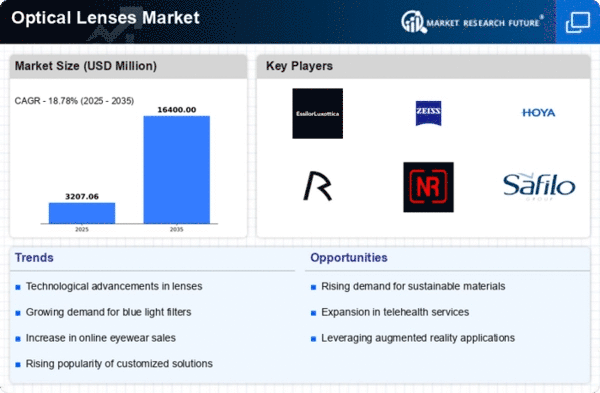
As per MRFR analysis, the Optical Lenses Market Size was estimated at 2700.0 USD Million in 2024. The Optical Lenses industry is projected to grow from 10350.0 in 2025 to 16400.0 by 2035, exhibiting a compound annual growth rate (CAGR) of 18.78 during the forecast period 2025 - 2035.

Key Market Trends & Highlights

The Optical Lenses Market is experiencing robust growth driven by technological advancements and increasing consumer awareness.

  • North America remains the largest market for optical lenses, driven by a high demand for vision correction solutions. The Asia-Pacific region is emerging as the fastest-growing market, fueled by rising disposable incomes and urbanization. The vision correction segment dominates the market, while the contact lenses segment is witnessing rapid growth due to changing consumer preferences. Key market drivers include the rising demand for vision correction and growing awareness of eye health, which are shaping consumer choices.

Market Size & Forecast

2024 Market Size 2700.0 (USD Million)
2035 Market Size 16400.0 (USD Million)
CAGR (2025 - 2035) 18.78%
Largest Regional Market Share in 2024 North America

Major Players

EssilorLuxottica (FR), Zeiss (DE), Hoya (JP), Rodenstock (DE), Nikon (JP), Safilo (IT), Carl Zeiss AG (DE), Bausch + Lomb (US)

Market Trends

The Optical Lenses Market is currently experiencing a dynamic evolution, driven by advancements in technology and changing consumer preferences. The demand for high-quality optical lenses is on the rise, as individuals increasingly seek enhanced visual clarity and comfort. This trend is particularly evident in the growing popularity of progressive lenses and specialized coatings that cater to specific needs, such as blue light filtering and anti-reflective properties. Furthermore, the integration of digital technologies into lens manufacturing processes is likely to improve production efficiency and product customization, thereby attracting a broader customer base. In addition to technological advancements, the Optical Lenses Market is influenced by demographic shifts and lifestyle changes. An aging population is contributing to a heightened need for vision correction solutions, while younger consumers are becoming more aware of eye health and the importance of protective eyewear. This shift in awareness is prompting manufacturers to innovate and diversify their product offerings, ensuring they meet the evolving demands of various consumer segments. As the market continues to expand, it appears poised for sustained growth, with opportunities for new entrants and established players alike to capitalize on emerging trends and consumer preferences.

Technological Advancements

The Optical Lenses Market is witnessing a surge in innovation, particularly with the introduction of smart lenses and advanced coatings. These developments enhance user experience by providing features such as UV protection and glare reduction, appealing to a tech-savvy audience.

Increased Focus on Eye Health

There is a growing awareness among consumers regarding the importance of eye health, leading to a rise in demand for specialized lenses. Products designed to reduce digital eye strain and protect against harmful blue light are becoming increasingly popular.

Customization and Personalization

The trend towards personalized optical solutions is gaining momentum, as consumers seek lenses tailored to their specific needs. This shift encourages manufacturers to offer customizable options, enhancing customer satisfaction and loyalty.

Optical Lenses Market Market Drivers

Market Segment Insights

By Application: Vision Correction (Largest) vs. Contact Lenses (Fastest-Growing)

The Optical Lenses Market is fundamentally divided into several key applications: Vision Correction, Protective Eyewear, Sunglasses, Specialty Lenses, and Contact Lenses. Among these, Vision Correction holds the largest market share, reflecting the persistent demand for corrective eyewear solutions, including prescription glasses and contact lenses. This segment's dominance highlights the ongoing need for vision enhancement as lifestyles continue to evolve, driven by factors such as an increasing geriatric population and the rise in myopia and other refractive errors. In terms of growth trends, Contact Lenses have emerged as the fastest-growing segment within this market. This growth can be attributed to advancements in lens technology, comfort, and convenience offered by modern contact lenses, making them an attractive alternative to traditional eyewear. Additionally, the rise of online retailers has further propelled this segment by increasing accessibility, coupled with heightened consumer awareness regarding the benefits of using contact lenses over glasses for active lifestyles.

Vision Correction (Dominant) vs. Specialty Lenses (Emerging)

Within the Optical Lenses Market, Vision Correction remains the dominant segment due to the enduring necessity for eyewear solutions addressing refractive errors like nearsightedness, farsightedness, and astigmatism. This segment includes traditional glasses and various forms of contact lenses, appealing to a broad demographic. In contrast, Specialty Lenses, which include lenses tailored for specific activities (such as sports or photography) or medical purposes (like orthokeratology), represent an emerging niche. While they currently capture a smaller share of the market, the growing interest in personalized and activity-specific eyewear is driving innovation and attracting consumers. The ongoing development of high-tech materials and designs in the Specialty Lenses segment is likely to enhance their market presence in the coming years.

By Material Type: Plastic (Largest) vs. Polycarbonate (Fastest-Growing)

The Optical Lenses Market is composed of various material types, with Plastic lenses holding the largest market share due to their lightweight, cost-effectiveness, and versatility in various applications. Alongside Plastic, Glass lenses remain popular for their superior optical clarity, although their weight can deter some consumers. Polycarbonate lenses, known for their impact resistance and lightweight nature, are receiving increasing attention, particularly for safety eyewear and children's glasses, marking a significant shift in consumer preferences toward more durable options.

Plastic (Dominant) vs. Polycarbonate (Emerging)

Plastic lenses have established themselves as the dominant choice in the Optical Lenses Market thanks to their affordability, comfort, and lightweight characteristics. These lenses are highly favored among everyday eyewear users for regular usage. In contrast, Polycarbonate lenses, categorized as an emerging segment, are rapidly gaining traction owing to their superior strength and safety features, impacting sectors such as sports eyewear and children's eyewear significantly. This rise can be attributed to increasing awareness among consumers of the advantages of Polycarbonate lenses, including their UV protection and scratch resistance. As such, manufacturers are investing in innovative Polycarbonate options, strengthening their position in the market.

By Lens Type: Single Vision (Largest) vs. Progressive (Fastest-Growing)

In the Optical Lenses Market, Single Vision lenses hold the largest share due to their widespread use in addressing nearsightedness and farsightedness. This segment appeals particularly to consumers seeking straightforward, effective solutions for improved vision clarity. Meanwhile, Progressive lenses are gaining momentum, driven by an increasing aging population and a rising preference for multifocal solutions within a single lens, presenting a substantial opportunity for manufacturers to cater to evolving consumer needs.

Single Vision (Dominant) vs. Progressive (Emerging)

Single Vision lenses dominate the market, providing a simple yet effective solution for correcting vision in one field (either distance or close-up). This has made them a popular choice among a wide demographic, particularly those in need of single-prescription lenses. In contrast, Progressive lenses are emerging as the fastest-growing segment due to the demand for seamless vision correction. These lenses cater to presbyopic individuals who seek a versatile lens that accommodates multiple focal points. As consumers become increasingly aware of the benefits of multifocal lenses, the segment is projected to see significant growth as manufacturers innovate to enhance comfort and visual experience.

By End Use: Healthcare (Largest) vs. Sports (Fastest-Growing)

In the Optical Lenses Market, the end-use segments reveal distinct preferences and applications. The healthcare sector holds a significant share, driven by the demand for corrective lenses, surgical applications, and advancements in vision care technologies. The fashion segment follows, closely influenced by trends in eyewear aesthetics and luxury brand collaborations. Meanwhile, industrial and military segments, though smaller in share, showcase robust needs for specialized lenses in various applications, such as safety gear and tactical equipment, respectively.

Healthcare: Prescription Lenses (Dominant) vs. Sports Sunglasses (Emerging)

Prescription lenses dominate the healthcare segment by addressing the needs of millions requiring vision correction. This category encompasses a wide range of products, including single vision, bifocals, and progressive lenses, catering to diverse consumer requirements. On the other hand, sports sunglasses represent an emerging trend within the optical lenses market, appealing to athletes and outdoor enthusiasts seeking performance-enhancing eyewear. These sunglasses not only offer UV protection but also integrate innovative features like impact resistance, anti-fog coating, and lightweight materials, making them increasingly popular among health-conscious consumers who value both function and style.

By Distribution Channel: Optical Stores (Largest) vs. Online Retail (Fastest-Growing)

In the Optical Lenses Market, the distribution of market share among different channels highlights Optical Stores as the largest contributor, leveraging their extensive reach and established customer trust. Online Retail follows closely, rapidly gaining traction among consumers opting for convenience and broader selections. Other channels such as Supermarkets and Pharmacies serve niche demands, while Direct Sales provide personalized services that cater to specific consumer needs. The growth trends for the Optical Lenses Market distribution channels indicate a significant shift towards Online Retail, driven by the increasing penetration of e-commerce and changing consumer preferences. Technological advancements in online sales platforms are making purchasing lenses more accessible. Meanwhile, Optical Stores are adapting to the changing landscape by enhancing in-store experiences and integrating online services, ensuring they remain a dominant force in this competitive market.

Optical Stores (Dominant) vs. Online Retail (Emerging)

Optical Stores have long been considered the dominant distribution channel in the Optical Lenses Market, benefiting from direct customer interactions and professional consultations. Their established network fosters brand loyalty and allows for personalized services that cater to individual customer requirements. Meanwhile, Online Retail emerges as a competitive alternative, capturing a growing share by appealing to tech-savvy consumers seeking convenience and variety. The digital landscape provides an expansive platform for brands, enabling them to reach wider audiences while often offering competitive pricing. Despite differing operational models, both channels can thrive by embracing innovative technologies; Optical Stores can enhance their services, while Online Retail continues to improve its logistics and customer experience.

Get more detailed insights about Optical Lenses Market Research Report - Global Forecast 2035

Regional Insights

North America : Market Leader in Optical Lenses

North America continues to lead the optical lenses market, holding a significant share of 1080.0 million in 2024. The growth is driven by increasing demand for corrective lenses, advancements in lens technology, and a rising aging population. Regulatory support for vision care and health insurance coverage for optical products further catalyze market expansion. The region's focus on innovation and quality assurance also plays a crucial role in maintaining its market leadership. The competitive landscape in North America is characterized by the presence of major players such as EssilorLuxottica and Bausch + Lomb. These companies are investing heavily in R&D to develop advanced lens solutions, including digital lenses and blue light filtering options. The U.S. market, in particular, is witnessing a surge in demand for personalized lenses, which is reshaping the competitive dynamics. As a result, North America is expected to maintain its dominance in the optical lenses market through 2025.

Europe : Emerging Trends in Vision Care

Europe's optical lenses market is projected to reach 810.0 million by 2025, driven by increasing awareness of eye health and the growing prevalence of vision disorders. The region benefits from stringent regulations that ensure product quality and safety, fostering consumer trust. Additionally, the rise of e-commerce platforms for eyewear is reshaping distribution channels, making optical products more accessible to consumers across Europe. Leading countries such as Germany, France, and Italy are at the forefront of this market, with key players like Zeiss and Hoya driving innovation. The competitive landscape is marked by collaborations and mergers aimed at enhancing product offerings. The European market is also witnessing a shift towards sustainable practices, with companies focusing on eco-friendly materials and production methods. This trend is expected to further boost market growth in the coming years.

Asia-Pacific : Rapid Growth in Emerging Markets

The Asia-Pacific optical lenses market is anticipated to grow significantly, reaching 720.0 million by 2025. This growth is fueled by rising disposable incomes, increasing urbanization, and a growing awareness of eye health. The region's young population is also contributing to the demand for fashionable eyewear, while the aging demographic is driving the need for corrective lenses. Regulatory frameworks are evolving to support the optical industry, enhancing product standards and consumer protection. Countries like Japan, China, and India are leading the market, with key players such as Nikon and Hoya expanding their presence. The competitive landscape is characterized by a mix of local and international brands, with companies focusing on innovative designs and technology integration. The Asia-Pacific region is becoming a hub for optical lens manufacturing, attracting investments and fostering growth in the sector.

Middle East and Africa : Untapped Potential in Vision Care

The Middle East and Africa (MEA) optical lenses market, valued at 90.0 million, presents significant growth opportunities. The region is witnessing an increase in awareness regarding eye health, driven by rising urbanization and lifestyle changes. Government initiatives aimed at improving healthcare access are also contributing to market growth. However, challenges such as economic disparities and limited access to advanced optical products remain. Countries like South Africa and the UAE are leading the market, with a growing number of local and international players entering the space. The competitive landscape is evolving, with companies focusing on affordable and quality optical solutions. As the region continues to develop, the demand for optical lenses is expected to rise, driven by both corrective and fashionable eyewear trends.

Key Players and Competitive Insights

The Optical Lenses Market is characterized by a dynamic competitive landscape, driven by innovation, technological advancements, and strategic partnerships. Key players such as EssilorLuxottica (FR), Zeiss (DE), and Hoya (JP) are at the forefront, each adopting distinct strategies to enhance their market positioning. EssilorLuxottica (FR) focuses on expanding its product portfolio through continuous innovation and strategic acquisitions, while Zeiss (DE) emphasizes precision optics and digital solutions, catering to a growing demand for high-quality lenses. Hoya (JP) is leveraging its expertise in manufacturing to optimize supply chains and enhance operational efficiency, thereby solidifying its competitive edge. Collectively, these strategies contribute to a moderately fragmented market structure, where collaboration and technological integration are pivotal for sustained growth.
In terms of business tactics, companies are increasingly localizing manufacturing to reduce lead times and enhance responsiveness to market demands. This approach, coupled with supply chain optimization, allows for greater flexibility and cost efficiency. The competitive structure of the market remains moderately fragmented, with several players vying for market share. The influence of key players is significant, as their strategic initiatives often set industry standards and drive innovation across the sector.
In November 2025, EssilorLuxottica (FR) announced a partnership with a leading tech firm to develop smart lenses that integrate augmented reality features. This strategic move is poised to revolutionize the consumer experience, aligning with the growing trend towards digitalization in the optical sector. By investing in smart technology, EssilorLuxottica (FR) not only enhances its product offerings but also positions itself as a leader in the emerging market for digital eyewear solutions.
In October 2025, Zeiss (DE) launched a new line of lenses designed specifically for digital device users, addressing the increasing prevalence of screen time among consumers. This initiative reflects Zeiss's commitment to innovation and its responsiveness to changing consumer needs. By focusing on lenses that mitigate digital eye strain, Zeiss (DE) is likely to capture a significant share of the market, appealing to a demographic increasingly concerned about eye health in the digital age.
In September 2025, Hoya (JP) expanded its manufacturing capabilities in Southeast Asia, aiming to enhance production efficiency and meet rising demand in the region. This strategic expansion not only strengthens Hoya's operational footprint but also positions the company to better serve its customer base in a rapidly growing market. The move underscores Hoya's focus on supply chain reliability and responsiveness, which are critical in maintaining competitive advantage.
As of December 2025, the Optical Lenses Market is witnessing trends such as digitalization, sustainability, and the integration of artificial intelligence (AI) into product development. Strategic alliances are increasingly shaping the competitive landscape, enabling companies to pool resources and expertise to drive innovation. The shift from price-based competition to a focus on technological advancement and supply chain reliability is evident, suggesting that future competitive differentiation will hinge on the ability to innovate and adapt to evolving consumer preferences.

Key Companies in the Optical Lenses Market include

Industry Developments

  • Q2 2024: Canon launches new RF-S 3.9mm F3.5 STM Dual Fisheye lens for APS-C EOS R cameras Canon announced the release of its RF-S 3.9mm F3.5 STM Dual Fisheye lens, expanding its VR lens lineup for APS-C EOS R mirrorless cameras. The product launch aims to support immersive content creation for VR applications.
  • Q2 2024: Nikon releases NIKKOR Z 35mm f/1.4 lens for Z-mount mirrorless cameras Nikon introduced the NIKKOR Z 35mm f/1.4, a new fast prime lens for its Z-mount system, targeting both professional and enthusiast photographers seeking high optical performance and versatility.
  • Q2 2024: Fujifilm launches FUJINON GF500mmF5.6 R LM OIS WR lens for GFX Series Fujifilm announced the launch of the FUJINON GF500mmF5.6 R LM OIS WR, a super-telephoto lens for its medium format GFX Series, expanding options for wildlife and sports photographers.
  • Q2 2024: EssilorLuxottica completes acquisition of Israeli smart eyewear startup DeepOptics EssilorLuxottica finalized its acquisition of DeepOptics, an Israeli company specializing in adaptive focus lens technology, to strengthen its position in the smart eyewear segment.
  • Q1 2024: Sony introduces FE 16-25mm F2.8 G wide-angle zoom lens for full-frame cameras Sony launched the FE 16-25mm F2.8 G, a compact wide-angle zoom lens for its E-mount full-frame cameras, designed for landscape, architecture, and event photography.
  • Q1 2024: Largan Precision announces $200 million investment in new optical lens manufacturing facility in Vietnam Largan Precision, a leading supplier of smartphone camera lenses, announced a $200 million investment to build a new manufacturing plant in Vietnam, aiming to expand production capacity and diversify its supply chain.
  • Q2 2024: Canon unveils RF 200-800mm F6.3-9 IS USM super-telephoto zoom lens Canon launched the RF 200-800mm F6.3-9 IS USM, a super-telephoto zoom lens for its RF-mount mirrorless cameras, targeting wildlife and sports photographers.
  • Q1 2024: ZEISS opens new R&D center for optical lens innovation in Germany ZEISS inaugurated a new research and development center focused on advancing optical lens technologies, aiming to accelerate innovation in both consumer and industrial optics.
  • Q2 2024: Sunny Optical Technology secures major supply contract with Apple for iPhone camera lenses Sunny Optical Technology signed a multi-year agreement to supply advanced camera lenses for upcoming Apple iPhone models, reinforcing its role as a key supplier in the global smartphone market.
  • Q1 2024: Nikon announces appointment of Toshikazu Umatate as new CEO Nikon Corporation appointed Toshikazu Umatate as its new Chief Executive Officer, effective April 2024, as part of its leadership succession plan.
  • Q2 2024: Canon launches RF 10-20mm F4 L IS STM ultra-wide zoom lens Canon introduced the RF 10-20mm F4 L IS STM, an ultra-wide zoom lens for its RF-mount system, designed for landscape and architectural photography.
  • Q1 2024: Tamron announces partnership with DJI to develop drone-specific optical lenses Tamron entered into a strategic partnership with DJI to co-develop high-performance optical lenses tailored for aerial photography and videography applications in DJI's next-generation drones.

Future Outlook

Optical Lenses Market Future Outlook

The Optical Lenses Market is projected to grow at an 18.78% CAGR from 2025 to 2035, driven by technological advancements, increasing demand for vision correction, and rising healthcare expenditure.

New opportunities lie in:

  • Expansion into telehealth services for remote eye examinations.
  • Development of smart lenses integrating augmented reality features.
  • Investment in sustainable lens materials to attract eco-conscious consumers.

By 2035, the market is expected to achieve substantial growth, positioning itself as a leader in optical innovations.

Market Segmentation

Optical Lenses Market End Use Outlook

  • Healthcare
  • Sports
  • Fashion
  • Industrial
  • Military

Optical Lenses Market Lens Type Outlook

  • Single Vision
  • Bifocal
  • Progressive
  • Photochromic
  • Polarized

Optical Lenses Market Application Outlook

  • Vision Correction
  • Protective Eyewear
  • Sunglasses
  • Specialty Lenses
  • Contact Lenses

Optical Lenses Market Material Type Outlook

  • Plastic
  • Glass
  • Polycarbonate
  • Trivex
  • High-Index

Optical Lenses Market Distribution Channel Outlook

  • Online Retail
  • Optical Stores
  • Supermarkets
  • Pharmacies
  • Direct Sales

Report Scope

MARKET SIZE 2024 2700.0(USD Million)
MARKET SIZE 2025 10350.0(USD Million)
MARKET SIZE 2035 16400.0(USD Million)
COMPOUND ANNUAL GROWTH RATE (CAGR) 18.78% (2025 - 2035)
REPORT COVERAGE Revenue Forecast, Competitive Landscape, Growth Factors, and Trends
BASE YEAR 2024
Market Forecast Period 2025 - 2035
Historical Data 2019 - 2024
Market Forecast Units USD Million
Key Companies Profiled EssilorLuxottica (FR), Zeiss (DE), Hoya (JP), Rodenstock (DE), Nikon (JP), Safilo (IT), Carl Zeiss AG (DE), Bausch + Lomb (US)
Segments Covered Application, Material Type, Lens Type, End Use, Distribution Channel
Key Market Opportunities Integration of advanced digital technologies enhances customization in the Optical Lenses Market.
Key Market Dynamics Technological advancements and consumer preferences drive innovation and competition in the optical lenses market.
Countries Covered North America, Europe, APAC, South America, MEA

FAQs

How much is the optical lenses market worth?

The valuation of the optical lenses market is expected to be USD 27.4 Billion at a 7.33% CAGR by 2032.

Who are key players of the optical lenses market?

Olympus Corporation Of The Americas, Menicon Co. Ltd., Bausch + Lomb, and Cosina Co., Ltd. are some prominent names in the optical lenses market.

What types of optical lenses are obtainable in the market?

Diverging lenses and converging lenses broad classifications of optical lenses.

What are optical lenses drivers?

The availability of technology that aids in providing customizable optical lenses can impel the growth of the optical lenses market.

Where are optical lenses used?

Devices that offer microscopy, ophthalmic, imaging, and laser processing solutions use optical lenses.

  1. SECTION I: EXECUTIVE SUMMARY AND KEY HIGHLIGHTS
    1. | 1.1 EXECUTIVE SUMMARY
    2. | 1.1.1 Market Overview
    3. | 1.1.2 Key Findings
    4. | 1.1.3 Market Segmentation
    5. | 1.1.4 Competitive Landscape
    6. | 1.1.5 Challenges and Opportunities
    7. | 1.1.6 Future Outlook
  2. SECTION II: SCOPING, METHODOLOGY AND MARKET STRUCTURE
    1. | 2.1 MARKET INTRODUCTION
    2. | 2.1.1 Definition
    3. | 2.1.2 Scope of the study
    4. |-- 2.1.2.1 Research Objective
    5. |-- 2.1.2.2 Assumption
    6. |-- 2.1.2.3 Limitations
    7. | 2.2 RESEARCH METHODOLOGY
    8. | 2.2.1 Overview
    9. | 2.2.2 Data Mining
    10. | 2.2.3 Secondary Research
    11. | 2.2.4 Primary Research
    12. |-- 2.2.4.1 Primary Interviews and Information Gathering Process
    13. |-- 2.2.4.2 Breakdown of Primary Respondents
    14. | 2.2.5 Forecasting Model
    15. | 2.2.6 Market Size Estimation
    16. |-- 2.2.6.1 Bottom-Up Approach
    17. |-- 2.2.6.2 Top-Down Approach
    18. | 2.2.7 Data Triangulation
    19. | 2.2.8 Validation
  3. SECTION III: QUALITATIVE ANALYSIS
    1. | 3.1 MARKET DYNAMICS
    2. | 3.1.1 Overview
    3. | 3.1.2 Drivers
    4. | 3.1.3 Restraints
    5. | 3.1.4 Opportunities
    6. | 3.2 MARKET FACTOR ANALYSIS
    7. | 3.2.1 Value chain Analysis
    8. | 3.2.2 Porter's Five Forces Analysis
    9. |-- 3.2.2.1 Bargaining Power of Suppliers
    10. |-- 3.2.2.2 Bargaining Power of Buyers
    11. |-- 3.2.2.3 Threat of New Entrants
    12. |-- 3.2.2.4 Threat of Substitutes
    13. |-- 3.2.2.5 Intensity of Rivalry
    14. | 3.2.3 COVID-19 Impact Analysis
    15. |-- 3.2.3.1 Market Impact Analysis
    16. |-- 3.2.3.2 Regional Impact
    17. |-- 3.2.3.3 Opportunity and Threat Analysis
  4. SECTION IV: QUANTITATIVE ANALYSIS
    1. | 4.1 Semiconductor & Electronics, BY Application (USD Million)
    2. | 4.1.1 Vision Correction
    3. | 4.1.2 Protective Eyewear
    4. | 4.1.3 Sunglasses
    5. | 4.1.4 Specialty Lenses
    6. | 4.1.5 Contact Lenses
    7. | 4.2 Semiconductor & Electronics, BY Material Type (USD Million)
    8. | 4.2.1 Plastic
    9. | 4.2.2 Glass
    10. | 4.2.3 Polycarbonate
    11. | 4.2.4 Trivex
    12. | 4.2.5 High-Index
    13. | 4.3 Semiconductor & Electronics, BY Lens Type (USD Million)
    14. | 4.3.1 Single Vision
    15. | 4.3.2 Bifocal
    16. | 4.3.3 Progressive
    17. | 4.3.4 Photochromic
    18. | 4.3.5 Polarized
    19. | 4.4 Semiconductor & Electronics, BY End Use (USD Million)
    20. | 4.4.1 Healthcare
    21. | 4.4.2 Sports
    22. | 4.4.3 Fashion
    23. | 4.4.4 Industrial
    24. | 4.4.5 Military
    25. | 4.5 Semiconductor & Electronics, BY Distribution Channel (USD Million)
    26. | 4.5.1 Online Retail
    27. | 4.5.2 Optical Stores
    28. | 4.5.3 Supermarkets
    29. | 4.5.4 Pharmacies
    30. | 4.5.5 Direct Sales
    31. | 4.6 Semiconductor & Electronics, BY Region (USD Million)
    32. | 4.6.1 North America
    33. |-- 4.6.1.1 US
    34. |-- 4.6.1.2 Canada
    35. | 4.6.2 Europe
    36. |-- 4.6.2.1 Germany
    37. |-- 4.6.2.2 UK
    38. |-- 4.6.2.3 France
    39. |-- 4.6.2.4 Russia
    40. |-- 4.6.2.5 Italy
    41. |-- 4.6.2.6 Spain
    42. |-- 4.6.2.7 Rest of Europe
    43. | 4.6.3 APAC
    44. |-- 4.6.3.1 China
    45. |-- 4.6.3.2 India
    46. |-- 4.6.3.3 Japan
    47. |-- 4.6.3.4 South Korea
    48. |-- 4.6.3.5 Malaysia
    49. |-- 4.6.3.6 Thailand
    50. |-- 4.6.3.7 Indonesia
    51. |-- 4.6.3.8 Rest of APAC
    52. | 4.6.4 South America
    53. |-- 4.6.4.1 Brazil
    54. |-- 4.6.4.2 Mexico
    55. |-- 4.6.4.3 Argentina
    56. |-- 4.6.4.4 Rest of South America
    57. | 4.6.5 MEA
    58. |-- 4.6.5.1 GCC Countries
    59. |-- 4.6.5.2 South Africa
    60. |-- 4.6.5.3 Rest of MEA
  5. SECTION V: COMPETITIVE ANALYSIS
    1. | 5.1 Competitive Landscape
    2. | 5.1.1 Overview
    3. | 5.1.2 Competitive Analysis
    4. | 5.1.3 Market share Analysis
    5. | 5.1.4 Major Growth Strategy in the Semiconductor & Electronics
    6. | 5.1.5 Competitive Benchmarking
    7. | 5.1.6 Leading Players in Terms of Number of Developments in the Semiconductor & Electronics
    8. | 5.1.7 Key developments and growth strategies
    9. |-- 5.1.7.1 New Product Launch/Service Deployment
    10. |-- 5.1.7.2 Merger & Acquisitions
    11. |-- 5.1.7.3 Joint Ventures
    12. | 5.1.8 Major Players Financial Matrix
    13. |-- 5.1.8.1 Sales and Operating Income
    14. |-- 5.1.8.2 Major Players R&D Expenditure. 2023
    15. | 5.2 Company Profiles
    16. | 5.2.1 EssilorLuxottica (FR)
    17. |-- 5.2.1.1 Financial Overview
    18. |-- 5.2.1.2 Products Offered
    19. |-- 5.2.1.3 Key Developments
    20. |-- 5.2.1.4 SWOT Analysis
    21. |-- 5.2.1.5 Key Strategies
    22. | 5.2.2 Zeiss (DE)
    23. |-- 5.2.2.1 Financial Overview
    24. |-- 5.2.2.2 Products Offered
    25. |-- 5.2.2.3 Key Developments
    26. |-- 5.2.2.4 SWOT Analysis
    27. |-- 5.2.2.5 Key Strategies
    28. | 5.2.3 Hoya (JP)
    29. |-- 5.2.3.1 Financial Overview
    30. |-- 5.2.3.2 Products Offered
    31. |-- 5.2.3.3 Key Developments
    32. |-- 5.2.3.4 SWOT Analysis
    33. |-- 5.2.3.5 Key Strategies
    34. | 5.2.4 Rodenstock (DE)
    35. |-- 5.2.4.1 Financial Overview
    36. |-- 5.2.4.2 Products Offered
    37. |-- 5.2.4.3 Key Developments
    38. |-- 5.2.4.4 SWOT Analysis
    39. |-- 5.2.4.5 Key Strategies
    40. | 5.2.5 Nikon (JP)
    41. |-- 5.2.5.1 Financial Overview
    42. |-- 5.2.5.2 Products Offered
    43. |-- 5.2.5.3 Key Developments
    44. |-- 5.2.5.4 SWOT Analysis
    45. |-- 5.2.5.5 Key Strategies
    46. | 5.2.6 Safilo (IT)
    47. |-- 5.2.6.1 Financial Overview
    48. |-- 5.2.6.2 Products Offered
    49. |-- 5.2.6.3 Key Developments
    50. |-- 5.2.6.4 SWOT Analysis
    51. |-- 5.2.6.5 Key Strategies
    52. | 5.2.7 Carl Zeiss AG (DE)
    53. |-- 5.2.7.1 Financial Overview
    54. |-- 5.2.7.2 Products Offered
    55. |-- 5.2.7.3 Key Developments
    56. |-- 5.2.7.4 SWOT Analysis
    57. |-- 5.2.7.5 Key Strategies
    58. | 5.2.8 Bausch + Lomb (US)
    59. |-- 5.2.8.1 Financial Overview
    60. |-- 5.2.8.2 Products Offered
    61. |-- 5.2.8.3 Key Developments
    62. |-- 5.2.8.4 SWOT Analysis
    63. |-- 5.2.8.5 Key Strategies
    64. | 5.3 Appendix
    65. | 5.3.1 References
    66. | 5.3.2 Related Reports

Semiconductor & Electronics Market Segmentation

Semiconductor & Electronics By Application (USD Million, 2025-2035)

  • Vision Correction
  • Protective Eyewear
  • Sunglasses
  • Specialty Lenses
  • Contact Lenses

Semiconductor & Electronics By Material Type (USD Million, 2025-2035)

  • Plastic
  • Glass
  • Polycarbonate
  • Trivex
  • High-Index

Semiconductor & Electronics By Lens Type (USD Million, 2025-2035)

  • Single Vision
  • Bifocal
  • Progressive
  • Photochromic
  • Polarized

Semiconductor & Electronics By End Use (USD Million, 2025-2035)

  • Healthcare
  • Sports
  • Fashion
  • Industrial
  • Military

Semiconductor & Electronics By Distribution Channel (USD Million, 2025-2035)

  • Online Retail
  • Optical Stores
  • Supermarkets
  • Pharmacies
  • Direct Sales
Infographic

Free Sample Request

Kindly complete the form below to receive a free sample of this Report

Get Free Sample

Customer Strories

Compare Licence

×
Features License Type
Single User Multiuser License Enterprise User
Price $4,950 $5,950 $7,250
Maximum User Access Limit 1 User Upto 10 Users Unrestricted Access Throughout the Organization
Free Customization
Direct Access to Analyst
Deliverable Format
Platform Access
Discount on Next Purchase 10% 15% 15%
Printable Versions