×
Request Free Sample ×

Kindly complete the form below to receive a free sample of this Report

* Please use a valid business email

Leading companies partner with us for data-driven Insights

clients tt-cursor
Hero Background
English
Chinese
French
Japanese
Korean
German
Spanish

Operating Table Parts Market Share

ID: MRFR/MED/4346-CR
100 Pages
Rahul Gotadki
April 2018

Operating Table Parts Market Research Report, By Product Type (General, Specialty Surgery Table), Procedure (Anesthesia, Orthopedic, Neurology, Urology), Accessory (Standard Accessory), End-Users (Hospital, Clinics) - Global Forecast Till 2035

Share:
Download PDF ×

We do not share your information with anyone. However, we may send you emails based on your report interest from time to time. You may contact us at any time to opt-out.

Operating Table Parts Market Infographic
×
Operating Table Parts Market Infographic Full View
Purchase Options

Market Share

Operating Table Parts Market Share Analysis

The Operating Table Parts Market is an imperative fragment inside the healthcare hardware industry, assuming a vital part in surgical strategies. Market players utilize different vital situating procedures to improve their market offer and satisfy the advancing needs of healthcare suppliers all around the world. A key system includes a steady obligation to item quality and constant development. Organizations put resources into innovative work to present high level and mechanically refined operating table parts. By offering superior grade, imaginative arrangements, they intend to catch the consideration and loyalty of healthcare establishments looking for cutting edge hardware. To take care of the assorted necessities of various clinical claims to fame, organizations decisively differentiate their item portfolios. This includes offering a scope of operating table parts with specific elements custom-made to different surgical prerequisites. Expansion upgrades market reach and positions organizations as comprehensive arrangement suppliers. Venture into new geographic markets is a major methodology for operating table parts producers. Organizations look for open doors in arising economies and team up with neighborhood wholesalers to lay out a vigorous presence. Adjusting to territorial inclinations and guidelines is pivotal for fruitful worldwide extension. Perceiving the necessities of various surgical strengths, organizations center around customization. Fitting operating table parts to oblige the necessities of muscular, neurosurgery, or cardiovascular strategies, for instance, draws in a different client base and lays out the organization as an expert in taking special care of remarkable surgical requests. Offering strong after-deals administrations and support programs is an essential move to guarantee consumer loyalty. Solid help and fast reaction to specialized issues add to long haul client connections. Organizations that focus on post-buy administrations upgrade their market situating and construct a positive standing. Perceiving the financial plan imperatives in specific healthcare markets, organizations might embrace a methodology of offering practical arrangements without settling on quality. This approach penetrates cost sensitive markets and extends the client base.

Author
Rahul Gotadki
Assistant Manager

He holds an experience of about 7+ years in Market Research and Business Consulting, working under the spectrum of Life Sciences and Healthcare domains. Rahul conceptualizes and implements a scalable business strategy and provides strategic leadership to the clients. His expertise lies in market estimation, competitive intelligence, pipeline analysis, customer assessment, etc. In addition to the above, his other responsibility includes strategic tracking of high growth markets & advising clients on the potential areas of focus they could direct their business initiatives

Leave a Comment

FAQs

What is the valuation of the Operating Table Parts Market?

Operating Table Parts Market is expected to reach USD 1.2 Billion by 2032.

What is the CAGR of the Operating Table Parts Market?

Operating Table Parts Market is expected to exhibit a strong 3.2% CAGR over the forecast period till 2030

What is the major driver for the Operating Table Parts Market?

The growing number of surgical procedures is the major driver for the Operating Table Parts Market.

Which is the major regional Operating Table Parts Market?

The Americas dominate the Global Operating Table Parts Market, followed by Europe.

What are the key players in the Operating Table Parts Market?

Leading players in the Operating Table Parts Market include Alvo, Hill-Rom Holdings, and Lojer Group, among others.

Market Summary

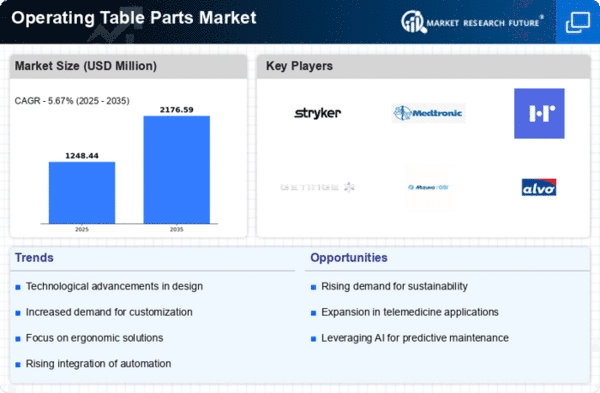
As per MRFR analysis, the Operating Table Parts Market Size was estimated at 1181.45 USD Million in 2024. The Operating Table Parts industry is projected to grow from 1261.98 USD Million in 2025 to 2176.59 USD Million by 2035, exhibiting a compound annual growth rate (CAGR) of 5.67 during the forecast period 2025 - 2035.

Key Market Trends & Highlights

The Operating Table Parts Market is experiencing a dynamic evolution driven by technological advancements and changing healthcare needs.

  • Technological advancements are reshaping the design and functionality of operating table parts, enhancing surgical precision.
  • Customization and modularity are increasingly prioritized, allowing for tailored solutions in diverse surgical environments.
  • The focus on ergonomics is becoming more pronounced, particularly in North America, to improve surgeon comfort and reduce fatigue during procedures.
  • Rising surgical procedures and an aging population are key drivers propelling market growth, especially in hospitals and emergency procedures.

Market Size & Forecast

2024 Market Size 1181.45 (USD Million)
2035 Market Size 2176.59 (USD Million)
CAGR (2025 - 2035) 5.67%
Largest Regional Market Share in 2024 North America

Major Players

<p>Stryker (US), Medtronic (US), Hill-Rom (US), Getinge (SE), Mizuho OSI (US), Alvo (PL), Steris (US), Schmitz (DE), Brandon Medical (GB)</p>

Market Trends

The Operating Table Parts Market is currently experiencing a dynamic evolution, driven by advancements in surgical technology and an increasing emphasis on patient safety. The integration of innovative materials and designs into operating table components appears to enhance functionality and adaptability, catering to a diverse range of surgical procedures. Furthermore, the growing demand for minimally invasive surgeries suggests a shift towards more specialized operating table parts that can accommodate such techniques. This trend may lead to the development of modular systems that allow for greater customization and efficiency in surgical environments. In addition, the Operating Table Parts Market is likely influenced by the rising awareness of ergonomic designs that prioritize both patient comfort and surgeon accessibility. Manufacturers are focusing on creating components that not only meet regulatory standards but also improve the overall surgical experience. As healthcare facilities continue to invest in upgrading their equipment, the market may see a surge in demand for high-quality, durable parts that can withstand the rigors of frequent use. Overall, the Operating Table Parts Market is poised for growth, reflecting the ongoing transformation within the healthcare sector.

Technological Advancements

The Operating Table Parts Market is witnessing a trend towards the incorporation of cutting-edge technology. Enhanced features such as integrated imaging systems and automated adjustments are becoming more prevalent, allowing for improved precision during surgical procedures.

Customization and Modularity

There is a growing inclination towards customizable and modular operating table parts. This trend enables healthcare providers to tailor their equipment to specific surgical needs, thereby enhancing operational efficiency and patient outcomes.

Focus on Ergonomics

An increasing emphasis on ergonomic designs is evident within the Operating Table Parts Market. Manufacturers are prioritizing the development of components that promote comfort for both patients and surgeons, potentially leading to better surgical results.

Operating Table Parts Market Market Drivers

Emerging Markets Growth

The Global Operating Table Parts Market Industry is witnessing substantial growth in emerging markets, where healthcare systems are evolving rapidly. Countries in Asia-Pacific and Latin America are investing heavily in healthcare infrastructure, leading to increased demand for advanced surgical equipment. As these regions expand their healthcare capabilities, the need for reliable operating table parts becomes more pronounced. This trend is likely to contribute to the overall market growth, with expectations of reaching 1.32 USD Billion by 2035, up from 0.48 USD Billion in 2024.

Focus on Patient Safety

The Global Operating Table Parts Market Industry is increasingly influenced by a heightened focus on patient safety and quality of care. Hospitals and surgical centers are prioritizing equipment that minimizes risks during surgical procedures. Enhanced operating table designs that incorporate safety features, such as adjustable height and stability mechanisms, are gaining traction. This shift towards prioritizing patient safety is likely to drive demand for advanced operating table parts, contributing to the market's growth from 0.48 USD Billion in 2024 to an anticipated 1.32 USD Billion by 2035.

Rising Surgical Procedures

An increase in the number of surgical procedures globally is a significant driver for the Global Operating Table Parts Market Industry. Factors such as an aging population and a rise in chronic diseases contribute to this trend. As healthcare systems adapt to meet the growing demand for surgical interventions, the need for reliable and efficient operating table parts becomes paramount. This trend is expected to sustain the market's growth trajectory, with projections indicating a rise from 0.48 USD Billion in 2024 to 1.32 USD Billion by 2035, highlighting the critical role of operating table parts in modern healthcare.

Technological Advancements

The Global Operating Table Parts Market Industry is experiencing a surge in demand due to rapid technological advancements. Innovations such as integrated imaging systems and robotic-assisted surgery tables enhance surgical precision and efficiency. These advancements not only improve patient outcomes but also streamline surgical workflows, thereby increasing the adoption of advanced operating tables. As hospitals and surgical centers invest in modern equipment, the market is projected to grow from 0.48 USD Billion in 2024 to 1.32 USD Billion by 2035, reflecting a compound annual growth rate of 9.62% from 2025 to 2035.

Government Initiatives and Funding

Government initiatives aimed at improving healthcare infrastructure significantly impact the Global Operating Table Parts Market Industry. Many countries are investing in modernizing their healthcare facilities, which includes upgrading surgical equipment. Such initiatives often come with funding programs that encourage hospitals to acquire advanced operating tables and their components. This influx of capital is expected to bolster the market, with projections indicating growth from 0.48 USD Billion in 2024 to 1.32 USD Billion by 2035, driven by supportive government policies and funding.

Market Segment Insights

By Application: Surgical Procedures (Largest) vs. Emergency Procedures (Fastest-Growing)

<p>In the Operating Table Parts Market, the application segment is characterized by various procedures, with Surgical Procedures holding the largest market share. This segment encompasses diverse surgical settings where operating table parts are critical. Following closely are Emergency Procedures, which, although currently smaller, are rapidly increasing due to the escalating demand for quick medical interventions and advancements in emergency care technology. The growing awareness of surgical options contributes to the dominance of surgical applications in this market. The growth trends are notably favorable for Emergency Procedures, driven by factors such as an increasing number of emergency cases and the need for high-quality equipment that can handle urgent scenarios. Moreover, advancements in technology and increasing investments in healthcare infrastructure are paving the way for enhanced operational efficiency in emergency situations, making these procedures a focal point for future growth in the Operating Table Parts Market.</p>

<p>Surgical Procedures (Dominant) vs. Rehabilitation Procedures (Emerging)</p>

<p>Surgical Procedures represent the dominant force in the Operating Table Parts Market, characterized by the essential requirement of high-quality and innovative equipment. These procedures necessitate precision and reliability, leading to ongoing investments in advanced operating table parts that enhance surgical outcomes. In contrast, Rehabilitation Procedures are emerging as a significant segment. They focus on post-operative recovery and require specialized equipment to support patient mobility and recovery. The growth in this segment is being fueled by an aging population and increasing awareness about the importance of rehabilitation in recovering from surgeries. As healthcare providers recognize the crucial role of rehabilitation in successful patient outcomes, the demand for specialized operating table parts tailored for rehabilitation is expected to grow.</p>

By End Use: Hospitals (Largest) vs. Ambulatory Surgical Centers (Fastest-Growing)

<p>In the Operating Table Parts Market, hospitals dominate the end-use segment, commanding the largest share due to their extensive surgical needs and investment in advanced healthcare technology. Ambulatory surgical centers, while smaller in market share, are rapidly gaining traction owing to the shift towards outpatient procedures, which are becoming increasingly popular. Specialty clinics and research institutions also play significant roles, catering to niche markets with specific surgical requirements and research applications.</p>

<p>Hospitals (Dominant) vs. Ambulatory Surgical Centers (Emerging)</p>

<p>Hospitals represent the dominant segment in the Operating Table Parts Market, primarily because they require a wide range of surgical equipment to support various hundreds of procedures. Their robust infrastructure and sustained investments in modern operating tables ensure that they remain a vital component of the healthcare system. On the other hand, ambulatory surgical centers are emerging as a significant force, leveraging advances in minimally invasive surgery and a growing trend towards outpatient care. These centers are innovating to provide cost-effective and efficient surgical solutions, appealing to patients seeking quick recovery and lower healthcare costs. As a result, both segments fulfill essential roles, reflecting different healthcare delivery models.</p>

By Type: Electric Operating Tables (Largest) vs. Hydraulic Operating Tables (Fastest-Growing)

<p>In the Operating Table Parts Market, the distribution of market share reveals that Electric Operating Tables dominate the segment due to their advanced features and user-friendly operation. They have become the preferred choice in surgical settings, as they offer precision and ease of use, thus ensuring better surgical outcomes. Hydraulic Operating Tables, while historically favored for their reliability and cost-effectiveness, are witnessing a significant rise in popularity owing to their enhanced adaptability and performance. The growth trends in this segment are largely driven by technological advancements in electric tables, offering features such as automated positioning and integrated imaging systems. Hydraulic tables are gaining traction as hospitals seek versatile solutions for varying surgical needs. As the demand for minimally invasive procedures rises, both Electric and Hydraulic Operating Tables are expected to play pivotal roles in the evolving healthcare landscape.</p>

<p>Electric Operating Tables (Dominant) vs. Hydraulic Operating Tables (Emerging)</p>

<p>Electric Operating Tables are regarded as the dominant segment in the Operating Table Parts Market due to their superior functionalities, which include automated height adjustments, tilt, and rotation, providing optimal positioning during surgeries. They are heavily utilized in advanced surgical environments, ensuring precision and reducing the effort for surgical teams. Conversely, Hydraulic Operating Tables are emerging as a versatile option, appealing to budget-conscious healthcare facilities with their manual adjustment features, while still offering reliability and ease of maintenance. The increasing trend towards budget optimization in healthcare spending is driving the adoption of hydraulic models, making them a significant player in this dynamic market.</p>

By Material: Stainless Steel (Largest) vs. Plastic (Fastest-Growing)

<p>In the Operating Table Parts Market, the material segment showcases a diverse landscape with Stainless Steel holding the largest market share. This is primarily due to its durability, corrosion resistance, and hygienic properties, making it the material of choice for surgical environments. Aluminum, while notable for being lightweight, occupies a smaller share compared to Stainless Steel and is typically used in specific applications. Plastic and Composite Materials, gaining traction for their versatility and cost-effectiveness, are expected to witness increased utilization in various components.</p>

<p>Material: Stainless Steel (Dominant) vs. Plastic (Emerging)</p>

<p>Stainless Steel remains the dominant material in the Operating Table Parts Market, favored for its robustness and ability to maintain sterile conditions critical to surgical procedures. Its resistance to rust and ease of cleaning contribute significantly to its popularity among healthcare providers. Conversely, Plastic is emerging as a notable player, thanks to advancements in polymer technology that enhance its strength and durability. Its lightweight nature and lower production costs make it an appealing alternative for non-critical components in operating tables. As the demand for infection control and affordability rises, both materials are likely to see their applications evolve in this burgeoning market.</p>

Get more detailed insights about Operating Table Parts Market Research Report - Forecast to 2035

Regional Insights

North America : Market Leader in Innovation

North America is poised to maintain its leadership in the Operating Table Parts Market, holding a significant market share of 590.0M in 2024. The region's growth is driven by advanced healthcare infrastructure, increasing surgical procedures, and a rising demand for innovative medical technologies. Regulatory support and investment in healthcare facilities further catalyze market expansion, ensuring a robust environment for growth. The competitive landscape in North America is characterized by the presence of key players such as Stryker, Medtronic, and Hill-Rom. These companies are at the forefront of technological advancements, offering a range of operating table parts that enhance surgical efficiency. The U.S. remains the leading country, supported by a strong focus on research and development, ensuring that North America continues to set the standard in the global market.

Europe : Emerging Market with Growth Potential

Europe's Operating Table Parts Market is valued at 350.0M, reflecting a growing demand driven by an aging population and increasing surgical interventions. Regulatory frameworks in countries like Germany and France are evolving to support healthcare advancements, fostering innovation in medical equipment. The region is witnessing a shift towards minimally invasive surgeries, further propelling the market's growth. Leading countries in Europe include Germany, France, and the UK, where key players like Getinge and Schmitz are making significant contributions. The competitive landscape is marked by collaborations and partnerships aimed at enhancing product offerings. The European market is expected to see continued growth as healthcare systems adapt to new technologies and patient needs, ensuring a dynamic environment for operating table parts.

Asia-Pacific : Rapidly Growing Healthcare Sector

The Asia-Pacific region, with a market size of 200.0M, is experiencing rapid growth in the Operating Table Parts Market. This surge is attributed to increasing healthcare expenditures, a growing population, and rising awareness of advanced surgical techniques. Countries like China and India are investing heavily in healthcare infrastructure, which is expected to drive demand for operating table parts significantly. China and India are leading the charge in the Asia-Pacific market, with a competitive landscape featuring both local and international players. Companies like Mizuho OSI and Alvo are expanding their presence, catering to the rising demand for surgical equipment. The region's focus on improving healthcare access and quality is likely to sustain growth, making it a key player in the global market for operating table parts.

Middle East and Africa : Emerging Market with Challenges

The Middle East and Africa (MEA) region, with a market size of 41.45M, is gradually emerging in the Operating Table Parts Market. Growth is driven by increasing investments in healthcare infrastructure and a rising number of surgical procedures. However, regulatory challenges and economic disparities across countries pose significant hurdles to market expansion. Governments are working to improve healthcare access, which is expected to enhance market dynamics in the coming years. Leading countries in the MEA region include South Africa and the UAE, where key players like Steris and Brandon Medical are establishing a foothold. The competitive landscape is evolving, with local manufacturers beginning to emerge. As healthcare systems improve and regulations become more favorable, the MEA region is poised for gradual growth in the operating table parts market.

Key Players and Competitive Insights

The Operating Table Parts Market is characterized by a dynamic competitive landscape, driven by technological advancements, increasing surgical procedures, and a growing emphasis on patient safety. Key players such as Stryker (US), Medtronic (US), and Getinge (SE) are at the forefront, each adopting distinct strategies to enhance their market presence. Stryker (US) focuses on innovation, particularly in robotic-assisted surgery, while Medtronic (US) emphasizes digital transformation through integrated surgical solutions. Getinge (SE) is actively pursuing regional expansion, particularly in emerging markets, which collectively shapes a competitive environment that is increasingly reliant on technological differentiation and strategic partnerships.

In terms of business tactics, companies are localizing manufacturing to reduce costs and optimize supply chains, which is crucial in a moderately fragmented market. The collective influence of these key players is significant, as they not only drive innovation but also set benchmarks for quality and service standards across the industry. This competitive structure allows for a diverse range of offerings, catering to various surgical needs and preferences.

In November 2025, Stryker (US) announced the launch of its latest robotic surgical system, which integrates advanced imaging technology to enhance precision in surgical procedures. This strategic move is pivotal as it positions Stryker (US) as a leader in the robotic surgery segment, potentially increasing its market share and reinforcing its commitment to innovation. The introduction of such technology is likely to attract healthcare facilities seeking to improve surgical outcomes and operational efficiency.

In October 2025, Medtronic (US) unveiled a new digital platform designed to streamline surgical workflows and improve data management. This initiative reflects Medtronic's (US) focus on digital transformation, aiming to enhance the overall surgical experience for both healthcare providers and patients. By leveraging data analytics, the company could significantly improve decision-making processes in the operating room, thereby enhancing patient safety and operational efficiency.

In September 2025, Getinge (SE) expanded its manufacturing capabilities in Asia, aiming to meet the rising demand for operating table parts in the region. This strategic expansion is crucial as it not only reduces lead times but also positions Getinge (SE) to better serve a growing market. The move indicates a proactive approach to regional demand fluctuations and highlights the importance of localized production in maintaining competitive advantage.

As of December 2025, current trends in the Operating Table Parts Market include a strong focus on digitalization, sustainability, and the integration of AI technologies. Strategic alliances are increasingly shaping the competitive landscape, allowing companies to pool resources and expertise to drive innovation. The shift from price-based competition to a focus on technological advancement and supply chain reliability is evident, suggesting that future competitive differentiation will hinge on the ability to innovate and adapt to evolving market demands.

Key Companies in the Operating Table Parts Market include

Industry Developments

  • The key market players launched the new version of the operating table in 2021. The hybrid version comes with a smart-hand control feature that enhances production efficiency. The table can be adjusted with ease through the hand control feature. 
  • In 2021 the key market players in the US launched the precision surgical table. The table is suitable for chronic surgeries that require accurate patient body positions. 

Future Outlook

Operating Table Parts Market Future Outlook

<p>The Operating Table Parts Market is projected to grow at a 5.67% CAGR from 2024 to 2035, driven by technological advancements, increasing surgical procedures, and rising healthcare expenditures.</p>

New opportunities lie in:

  • <p>Development of modular operating table components for enhanced customization.</p>
  • <p>Integration of IoT technology for real-time monitoring and maintenance.</p>
  • <p>Expansion into emerging markets with tailored product offerings.</p>

<p>By 2035, the market is expected to achieve robust growth, reflecting evolving healthcare demands.</p>

Market Segmentation

Operating Table Parts Market Type Outlook

  • Electric Operating Tables
  • Hydraulic Operating Tables
  • Manual Operating Tables
  • Modular Operating Tables

Operating Table Parts Market End Use Outlook

  • Hospitals
  • Ambulatory Surgical Centers
  • Specialty Clinics
  • Research Institutions

Operating Table Parts Market Material Outlook

  • Stainless Steel
  • Aluminum
  • Plastic
  • Composite Materials

Operating Table Parts Market Application Outlook

  • Surgical Procedures
  • Diagnostic Procedures
  • Emergency Procedures
  • Rehabilitation Procedures

Report Scope

MARKET SIZE 20241181.45(USD Million)
MARKET SIZE 20251261.98(USD Million)
MARKET SIZE 20352176.59(USD Million)
COMPOUND ANNUAL GROWTH RATE (CAGR)5.67% (2024 - 2035)
REPORT COVERAGERevenue Forecast, Competitive Landscape, Growth Factors, and Trends
BASE YEAR2024
Market Forecast Period2025 - 2035
Historical Data2019 - 2024
Market Forecast UnitsUSD Million
Key Companies ProfiledStryker (US), Medtronic (US), Hill-Rom (US), Getinge (SE), Mizuho OSI (US), Alvo (PL), Steris (US), Schmitz (DE), Brandon Medical (GB)
Segments CoveredApplication, End Use, Type, Material
Key Market OpportunitiesIntegration of advanced robotics and automation in the Operating Table Parts Market enhances surgical precision and efficiency.
Key Market DynamicsTechnological advancements and regulatory changes drive innovation and competition in the Operating Table Parts Market.
Countries CoveredNorth America, Europe, APAC, South America, MEA

FAQs

What is the valuation of the Operating Table Parts Market?

Operating Table Parts Market is expected to reach USD 1.2 Billion by 2032.

What is the CAGR of the Operating Table Parts Market?

Operating Table Parts Market is expected to exhibit a strong 3.2% CAGR over the forecast period till 2030

What is the major driver for the Operating Table Parts Market?

The growing number of surgical procedures is the major driver for the Operating Table Parts Market.

Which is the major regional Operating Table Parts Market?

The Americas dominate the Global Operating Table Parts Market, followed by Europe.

What are the key players in the Operating Table Parts Market?

Leading players in the Operating Table Parts Market include Alvo, Hill-Rom Holdings, and Lojer Group, among others.

  1. SECTION I: EXECUTIVE SUMMARY AND KEY HIGHLIGHTS
    1. | 1.1 EXECUTIVE SUMMARY
  2. SECTION II: SCOPING, METHODOLOGY AND MARKET STRUCTURE
    1. | 2.1 MARKET INTRODUCTION
    2. | 2.2 RESEARCH METHODOLOGY
  3. SECTION III: QUALITATIVE ANALYSIS
    1. | 3.1 MARKET DYNAMICS
    2. | 3.2 MARKET FACTOR ANALYSIS
  4. SECTION IV: QUANTITATIVE ANALYSIS
    1. | 4.1 Healthcare, BY Application (USD Million)
    2. | 4.2 Healthcare, BY End Use (USD Million)
    3. | 4.3 Healthcare, BY Type (USD Million)
    4. | 4.4 Healthcare, BY Material (USD Million)
    5. | 4.5 Healthcare, BY Region (USD Million)
  5. SECTION V: COMPETITIVE ANALYSIS
    1. | 5.1 Competitive Landscape
    2. | 5.2 Company Profiles
    3. | 5.3 Appendix

Operating Table Parts Market Segmentation

Market Segmentation Overview

  • Detailed segmentation data will be available in the full report
  • Comprehensive analysis by multiple parameters
  • Regional and country-level breakdowns
  • Market size forecasts by segment
Infographic

Free Sample Request

Kindly complete the form below to receive a free sample of this Report

Get Free Sample

Customer Strories

Compare Licence

×
Features License Type
Single User Multiuser License Enterprise User
Price $4,950 $5,950 $7,250
Maximum User Access Limit 1 User Upto 10 Users Unrestricted Access Throughout the Organization
Free Customization
Direct Access to Analyst
Deliverable Format
Platform Access
Discount on Next Purchase 10% 15% 15%
Printable Versions