Online Gambling Market

ID: MRFR/ICT/7169-HCR
200 Pages
Apoorva Priyadarshi
Last Updated: June 22, 2026
Online Gambling Market Size, Share and Research Report By Game Type (Casino, Sports Betting, Lottery, Bingo), By Platform (Mobile / Tablet, Desktop), By Age Group (18–24 Years, 25–34 Years, 35–44 Years, 45–54 Years, 55+ Years), By Betting Type (Pre-Match / Fixed-Odds, Live / In-Play) and By Regional (North America, Europe, South America, Asia Pacific, Middle East and Africa) - Industry Forecast to 2035
Download PDF ×

We do not share your information with anyone. However, we may send you emails based on your report interest from time to time. You may contact us at any time to opt-out.

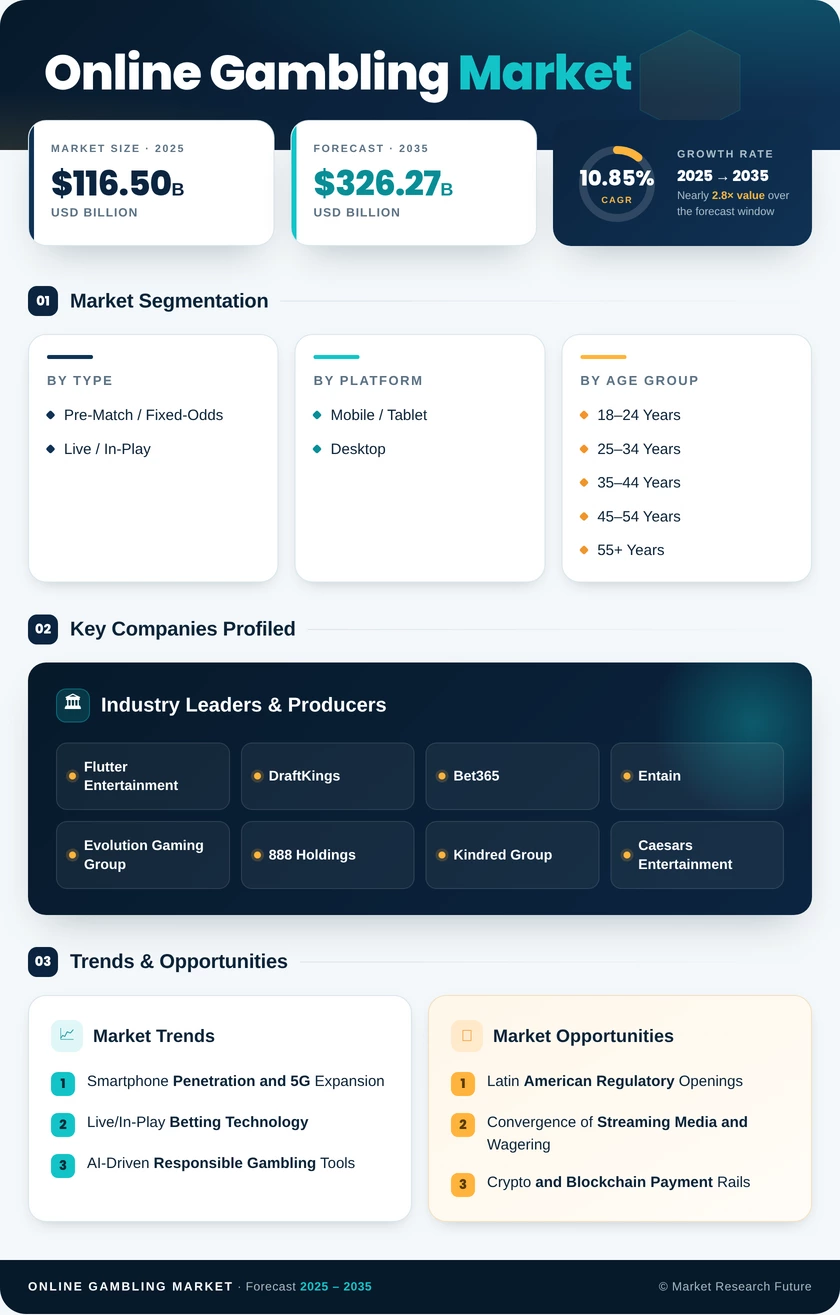
Online Gambling Market

Market Size

Forecast Period2026-2035
CAGR (2026-2035)10.85%
2025 Market SizeUSD 116.50 Billion
2035 Market SizeUSD 326.27 Billion

Key Players

Flutter Entertainment
DraftKings
Bet365
Entain
Evolution Gaming Group
888 Holdings
Opportunities
  • Latin American Regulatory Openings
  • Convergence of Streaming Media and Wagering
  • Crypto and Blockchain Payment Rails
  1. 1 Market Overview |
    1. 1.1 Study Assumptions & Market Definition |
    2. 1.2 Scope of the Study |
    3. 1.3 Research Methodology
  2. 2 Market Summary & Key Takeaways
  3. 3 Market Dynamics |
    1. 3.1 Market Drivers Analysis | |
      1. 3.1.1 Smartphone Penetration & 5G Expansion | |
      2. 3.1.2 U.S. State-by-State Legalization | |
      3. 3.1.3 Live/In-Play Betting Technology | |
      4. 3.1.4 AI-Driven Responsible Gambling Tools | |
      5. 3.1.5 Crypto & Blockchain Payment Integration | |
      6. 3.1.6 Emerging Market Legalization (LatAm, Asia) | |
      7. 3.1.7 Convergence of Media Streaming & Betting |
    2. 3.2 Market Restraints Analysis | |
      1. 3.2.1 Fragmented & Inconsistent Regulations | |
      2. 3.2.2 Problem Gambling & Social Backlash | |
      3. 3.2.3 High Taxation Regimes | |
      4. 3.2.4 Cybersecurity & Fraud Risks | |
      5. 3.2.5 Advertising Restrictions |
    3. 3.3 Market Opportunity Analysis | |
      1. 3.3.1 Latin American Regulatory Openings | |
      2. 3.3.2 Convergence of Streaming Media & Wagering | |
      3. 3.3.3 Crypto & Blockchain Payment Rails | |
      4. 3.3.4 Data Monetization & Personalization Engines | |
      5. 3.3.5 Expansion into Esports & Virtual Sports Betting |
    4. 3.4 Industry Value Chain Analysis |
    5. 3.5 Porter's Five Forces Analysis
  4. 4 Global Online Gambling Market Size & Forecast (2021–2035) |
    1. 4.1 Historical Market Size (2021–2025) |
    2. 4.2 Current & Forecast Market Size (2026–2035) |
    3. 4.3 Market Size by Revenue (USD Billion) |
    4. 4.4 Year-over-Year Growth Analysis
  5. 5 Segmentation Analysis |
    1. 5.1 By Game Type | |
      1. 5.1.1 Casino | |
      2. 5.1.2 Sports Betting | |
      3. 5.1.3 Lottery | |
      4. 5.1.4 Bingo |
    2. 5.2 By Platform | |
      1. 5.2.1 Mobile / Tablet | |
      2. 5.2.2 Desktop |
    3. 5.3 By Age Group | |
      1. 5.3.1 18–24 Years | |
      2. 5.3.2 25–34 Years | |
      3. 5.3.3 35–44 Years | |
      4. 5.3.4 45–54 Years | |
      5. 5.3.5 55+ Years |
    4. 5.4 By Betting Type | |
      1. 5.4.1 Pre-Match / Fixed-Odds | |
      2. 5.4.2 Live / In-Play
  6. 6 Regional Analysis |
    1. 6.1 North America | |
      1. 6.1.1 United States | |
      2. 6.1.2 Canada | |
      3. 6.1.3 Mexico |
    2. 6.2 Europe | |
      1. 6.2.1 Germany | |
      2. 6.2.2 United Kingdom | |
      3. 6.2.3 France | |
      4. 6.2.4 Italy | |
      5. 6.2.5 Spain | |
      6. 6.2.6 Nordic Countries | |
      7. 6.2.7 Russia | |
      8. 6.2.8 Rest of Europe |
    3. 6.3 Asia-Pacific | |
      1. 6.3.1 China | |
      2. 6.3.2 India | |
      3. 6.3.3 Japan | |
      4. 6.3.4 South Korea | |
      5. 6.3.5 ASEAN | |
      6. 6.3.6 Rest of Asia-Pacific |
    4. 6.4 South America | |
      1. 6.4.1 Brazil | |
      2. 6.4.2 Argentina | |
      3. 6.4.3 Rest of South America |
    5. 6.5 Middle East & Africa | |
      1. 6.5.1 South Africa | |
      2. 6.5.2 UAE | |
      3. 6.5.3 Saudi Arabia | |
      4. 6.5.4 Egypt | |
      5. 6.5.5 Rest of MEA
  7. 7 Competitive Landscape |
    1. 7.1 Market Share Analysis (2025) |
    2. 7.2 Competitive Benchmarking Matrix |
    3. 7.3 Company Profiles | |
      1. 7.3.1 Flutter Entertainment | |
      2. 7.3.2 DraftKings | |
      3. 7.3.3 Bet365 | |
      4. 7.3.4 Entain | |
      5. 7.3.5 Evolution Gaming Group | |
      6. 7.3.6 888 Holdings | |
      7. 7.3.7 Kindred Group | |
      8. 7.3.8 Caesars Entertainment | |
      9. 7.3.9 MGM Resorts International | |
      10. 7.3.10 Betsson AB
  8. 8 Future Outlook & Strategic Recommendations (2026–2035) |
    1. 8.1 AI-Powered Operations and Personalization (2026–2028) |
    2. 8.2 Platform Consolidation and M&A Supercycle (2028–2031) |
    3. 8.3 Regulatory Convergence and Global Standards (2029–2033) |
    4. 8.4 Web3, Metaverse Casinos, and Immersive Betting (2032–2035)
  9. 9 Recent Developments & News
  10. 10 Frequently Asked Questions (FAQs)
  11. 11 Report Scope & Methodology |
    1. 11.1 Study Period & Base Year |
    2. 11.2 Data Sources & Citations |
    3. 11.3 Abbreviations
  12. 12 LIST OF TABLES |
  13. TABLE 1 Global Online Gambling Market Size & Forecast, by Revenue (USD Billion), 2021–2035 |
  14. TABLE 2 Global Online Gambling Market — Year-over-Year Growth Analysis, 2021–2035 |
  15. TABLE 3 Global Online Gambling Market — Driver Impact Analysis |
  16. TABLE 4 Global Online Gambling Market — Restraint Impact Analysis |
  17. TABLE 5 Global Online Gambling Market Size, by Game Type, 2021–2035 (USD Billion) |
  18. TABLE 6 Global Online Gambling Market Size, by Platform, 2021–2035 (USD Billion) |
  19. TABLE 7 Global Online Gambling Market Size, by Age Group, 2021–2035 (USD Billion) |
  20. TABLE 8 Global Online Gambling Market Size, by Betting Type, 2021–2035 (USD Billion) |
  21. TABLE 9 Global Online Gambling Market Size, by Region, 2021–2035 (USD Billion) |
  22. TABLE 10 North America Online Gambling Market Size, by Country, 2021–2035 (USD Billion) |
  23. TABLE 11 Europe Online Gambling Market Size, by Country, 2021–2035 (USD Billion) |
  24. TABLE 12 Asia-Pacific Online Gambling Market Size, by Country, 2021–2035 (USD Billion) |
  25. TABLE 13 South America Online Gambling Market Size, by Country, 2021–2035 (USD Billion) |
  26. TABLE 14 Middle East & Africa Online Gambling Market Size, by Country, 2021–2035 (USD Billion) |
  27. TABLE 15 Competitive Benchmarking Matrix — Global Online Gambling Market, 2025 |
  28. TABLE 16 Company Profiles — Key Players, Global Online Gambling Market |
  29. TABLE 17 Recent Developments & Strategic Announcements, 2023–2025 |
  30. TABLE 18 Report Scope & Methodology Summary
  31. 13 LIST OF FIGURES |
  32. FIGURE 1 Online Gambling Market Dynamics — Drivers, Restraints, and Opportunities |
  33. FIGURE 2 Industry Value Chain Analysis — Online Gambling Market |
  34. FIGURE 3 Porter's Five Forces Analysis — Online Gambling Market |
  35. FIGURE 4 Global Online Gambling Market Size Trend (USD Billion), 2021–2035 |
  36. FIGURE 5 Online Gambling Market Share, by Game Type (%), 2025 |
  37. FIGURE 6 Online Gambling Market Share, by Platform (%), 2025 |
  38. FIGURE 7 Online Gambling Market Share, by Age Group (%), 2025 |
  39. FIGURE 8 Online Gambling Market Share, by Betting Type (%), 2025 |
  40. FIGURE 9 Online Gambling Market Share, by Region (%), 2025 |
  41. FIGURE 10 North America Online Gambling Market Share, by Country (%), 2025 |
  42. FIGURE 11 Europe Online Gambling Market Share, by Country (%), 2025 |
  43. FIGURE 12 Asia-Pacific Online Gambling Market Share, by Country (%), 2025 |
  44. FIGURE 13 South America Online Gambling Market Share, by Country (%), 2025 |
  45. FIGURE 14 Middle East & Africa Online Gambling Market Share, by Country (%), 2025 |
  46. FIGURE 15 Competitive Landscape — Market Share of Top 10 Players (%), 2025

Segmentation Quick Reference

DimensionSub-SegmentsDominant SegmentFastest Growing Segment
Game TypeCasino, Sports Betting, Lottery, BingoCasinoSports Betting
PlatformMobile / Tablet, DesktopMobile / TabletMobile / Tablet
Age Group18–24, 25–34, 35–44, 45–54, 55+35–44 Years25–34 Years
Betting TypePre-Match / Fixed-Odds, Live / In-PlayPre-Match / Fixed-OddsLive / In-Play
GeographyNorth America, Europe, Asia-Pacific, South America, MEAEuropeNorth America


Market Segmentation Overview

By Game Type

Sub-SegmentKey Trend
CasinoLive-dealer streaming surpassing RNG-only formats; branded game-show titles driving engagement
Sports BettingSame-game parlays and micro-market proliferation via real-time data feeds
LotteryGovernment-backed digital ticket sales and subscription models are expanding their reach
BingoSocial-gaming features and community chat rooms are attracting casual demographics


Casino gaming remains the revenue cornerstone, but sports betting is eroding its relative share as younger users gravitate toward event-driven wagering enhanced by live streaming and personalized bet-builder tools.

By Platform

Sub-SegmentKey Trend
Mobile / TabletApp-first design, biometric login, push-notification promotions
DesktopMulti-table online poker, high-roller casino sessions, data-heavy sports analysis


Mobile dominance continues to widen as 5G rollouts reduce buffering in live-dealer sessions and app-store distribution simplifies user acquisition.

By Age Group

Sub-SegmentKey Trend
18–24 YearsEsports betting, social-media-driven acquisition funnels
25–34 YearsHighest growth rate; mobile-native, promotion-responsive, crypto-curious
35–44 YearsLargest spend per capita, VIP loyalty, and retention programs
45–54 YearsBrand-loyal; preference for established operators and traditional sports
55+ YearsLottery and bingo-centric; growing digital literacy, expanding online participation


The 25–34 cohort is reshaping product roadmaps, while the 35–44 bracket remains the most valuable on a per-user-revenue basis.

By Betting Type

Sub-SegmentKey Trend
Pre-Match / Fixed-OddsAccumulator bets, weekly fixture-driven volume
Live / In-PlaySub-second odds updates, micro-market expansion, and higher average ticket size


Live/in-play wagering is projected to surpass pre-match by share before 2032, driven by real-time data infrastructure improvements and consumer appetite for interactive experiences.