×
Request Free Sample ×

Kindly complete the form below to receive a free sample of this Report

* Please use a valid business email

Leading companies partner with us for data-driven Insights

clients tt-cursor
Hero Background
English
Chinese
French
Japanese
Korean
German
Spanish

On the Go Breakfast Products Market Analysis

ID: MRFR/FnB/5258-HCR
128 Pages
Snehal Singh
October 2025

On-the-Go Breakfast Products Market Size, Share, Industry Trend & Analysis by Product Type (Cereal Meals, Breakfast Bars, Sandwiches & Burgers, Bakery Products, Beverages, Egg Meals and others), Packaging Type (Cans, Bottles & Jars, Boxes, Trays and others), Distribution Channel (Store-Based and Non-Store-Based) and Region (North America, Europe, Asia Pacific, South America, Middle East and Africa) - Forecast to 2035

Share:
Download PDF ×

We do not share your information with anyone. However, we may send you emails based on your report interest from time to time. You may contact us at any time to opt-out.

On the Go Breakfast Products Market Infographic
×
On the Go Breakfast Products Market Infographic Full View
Purchase Options

Market Analysis

In-depth Analysis of On the Go Breakfast Products Market Industry Landscape

The on-the-go breakfast products market has experienced significant transformations in recent years, driven by the changing lifestyles and hectic routines of consumers seeking convenient and portable breakfast options. With an increasing number of people leading busy lives, there has been a growing demand for quick, nutritious, and easily consumable breakfast solutions. The market dynamics are shaped by factors such as shifting consumer preferences, the emphasis on health and wellness, and innovations in packaging and product formats.

One of the primary drivers of the on-the-go breakfast products market is the shift in consumer preferences towards convenient and time-saving options. As individuals face time constraints in the mornings, the traditional sit-down breakfast is becoming less feasible, leading to a rise in demand for breakfast items that can be consumed on the move. This trend is particularly prevalent among urban populations and busy professionals who prioritize efficiency and functionality in their daily routines.

The emphasis on health and wellness is another key factor influencing the dynamics of the on-the-go breakfast products market. Consumers are increasingly seeking breakfast options that not only offer convenience but also align with their health goals. This has led to the development of on-the-go products that emphasize nutritional value, incorporating ingredients like whole grains, fruits, and protein sources. Health-conscious consumers are driving the market towards healthier alternatives, prompting manufacturers to focus on clean labels and transparent ingredient sourcing.

Innovations in packaging and product formats play a crucial role in shaping the market dynamics of on-the-go breakfast products. Single-serving packs, resealable pouches, and portable containers have become popular choices, offering convenience and portion control. The market has seen the emergence of diverse product formats, including breakfast bars, yogurt cups, smoothie pouches, and pre-packaged breakfast sandwiches, providing consumers with a wide range of choices to fit their preferences and dietary requirements.

The on-the-go breakfast products market is also influenced by the increasing prevalence of snacking behavior throughout the day. As consumers move away from traditional three-meal structures, there is a growing acceptance of breakfast items as snacks or mini-meals consumed at different times. This shift in eating patterns has expanded the market beyond traditional breakfast hours, creating opportunities for product innovation and marketing strategies that position on-the-go breakfast items as versatile snacks suitable for any time of day.

Challenges in the market include addressing concerns related to the nutritional content and sugar levels in some on-the-go breakfast products. As consumers become more discerning about their food choices, manufacturers are responding by reformulating products to reduce added sugars and enhance nutritional profiles. Additionally, competition among brands to stand out in a crowded market poses a challenge, driving companies to invest in marketing strategies, unique product offerings, and collaborations to maintain a competitive edge.


Author
Snehal Singh
Assistant Manager - Research

High acumen in analyzing complex macro & micro markets with more than 6 years of work experience in the field of market research. By implementing her analytical skills in forecasting and estimation into market research reports, she has expertise in Packaging, Construction, and Equipment domains. She handles a team size of 20-25 resources and ensures smooth running of the projects, associated marketing activities, and client servicing.

Leave a Comment

FAQs

How On-the-Go Breakfast Products market Growing during the forecast period?

The On-the-Go Breakfast Products market is expected to grow at a CAGR of 6.4% during the forecast period.

Which region is primarily driven by the On-the-Go Breakfast Products market during the global forecast period in 2032?

The Asia-Pacific (APAC) region is primarily driven by the On-the-Go Breakfast Products market during the global forecast period in 2032.

Who are the major key players of the On-the-Go Breakfast Products market covered in the report?

The major key players of the On-the-Go Breakfast Products market covered in the report are Kellogg Co., General Mills Inc., Raisio PLC, Bagrry’s India Ltd., Sanitarium, Quaker Oats Company, Weetabix Ltd., Nestle S.A., Uncle Toby’s, Amy’s Kitchen, Alara Wholefoods Ltd., Weetabix Limited, Riviana Foods Inc., Moma Foods, United Biscuits Limited, and ITC Limited.

How much is the global on-the-go breakfast products market worth in the future?

On-the-go breakfast products is estimated to reach a valuation of approx. USD 3.9 billion by the end of 2032.

Market Summary

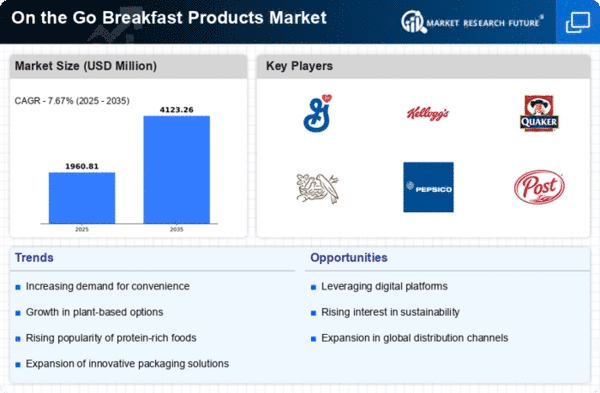
As per MRFR analysis, the On the Go Breakfast Products Market Size was estimated at 1821.13 USD Million in 2024. The On the Go Breakfast Products industry is projected to grow from 1981.68 in 2025 to 4123.26 by 2035, exhibiting a compound annual growth rate (CAGR) of 7.67 during the forecast period 2025 - 2035.

Key Market Trends & Highlights

The On the Go Breakfast Products Market is experiencing a dynamic shift towards health-conscious and convenient options.

  • The North American market remains the largest, driven by a strong demand for health and wellness-focused products.
  • In the Asia-Pacific region, the market is rapidly expanding, fueled by increasing urbanization and changing consumer lifestyles.
  • Granola bars dominate the market as the largest segment, while breakfast smoothies are emerging as the fastest-growing category.
  • Convenience and time efficiency are major drivers, alongside the rising health consciousness among consumers.

Market Size & Forecast

2024 Market Size 1821.13 (USD Million)
2035 Market Size 4123.26 (USD Million)
CAGR (2025 - 2035) 7.67%
Largest Regional Market Share in 2024 North America

Major Players

General Mills (US), Kellogg Company (US), Quaker Oats Company (US), Nestle (CH), PepsiCo (US), Post Holdings (US), Mondelez International (US), Danone (FR), Unilever (GB)

Market Trends

The On the Go Breakfast Products Market is currently experiencing a notable transformation, driven by evolving consumer preferences and lifestyle changes. As individuals increasingly seek convenience in their daily routines, the demand for portable breakfast options has surged. This shift is influenced by a growing awareness of health and nutrition, prompting manufacturers to innovate and offer products that align with these values. The market appears to be diversifying, with a range of offerings that cater to various dietary needs, including gluten-free, vegan, and high-protein options. Furthermore, the integration of technology in product development and marketing strategies is becoming more prevalent, enhancing consumer engagement and accessibility. In addition to health-conscious choices, the On the Go Breakfast Products Market is witnessing a rise in sustainability initiatives. Brands are increasingly focusing on eco-friendly packaging and sourcing ingredients responsibly, reflecting a broader societal trend towards environmental stewardship. This commitment to sustainability not only appeals to environmentally aware consumers but also positions companies favorably in a competitive landscape. Overall, the On the Go Breakfast Products Market is poised for continued growth, as it adapts to the dynamic needs of modern consumers while embracing innovation and sustainability.

Health and Wellness Focus

The On the Go Breakfast Products Market is increasingly emphasizing health and wellness. Consumers are gravitating towards products that offer nutritional benefits, such as high protein content, low sugar levels, and natural ingredients. This trend reflects a broader societal shift towards healthier eating habits, as individuals prioritize their well-being.

Sustainability and Eco-Friendly Practices

Sustainability is becoming a central theme within the On the Go Breakfast Products Market. Brands are adopting eco-friendly packaging solutions and sourcing ingredients responsibly. This trend resonates with environmentally conscious consumers, who are more likely to support products that align with their values.

Technological Integration

The integration of technology in the On the Go Breakfast Products Market is gaining traction. Companies are leveraging digital platforms for marketing and consumer engagement, enhancing the overall shopping experience. This trend indicates a shift towards more interactive and personalized approaches in product promotion.

On the Go Breakfast Products Market Market Drivers

Increasing Demand for Convenience

The Global On-the-Go Breakfast Products Industry is experiencing a notable surge in demand for convenience-driven food options. As lifestyles become increasingly hectic, consumers are seeking quick and easy breakfast solutions that fit their busy schedules. This trend is particularly evident among working professionals and students who prioritize efficiency without compromising nutrition. The market is projected to reach 3.9 USD Billion in 2024, reflecting a growing preference for ready-to-eat and portable breakfast items. This shift towards convenience is likely to drive innovation in product offerings, catering to the needs of on-the-go consumers.

Market Segment Insights

By Product Type: Granola Bars (Largest) vs. Breakfast Smoothies (Fastest-Growing)

In the On the Go Breakfast Products Market, granola bars maintain their position as the largest segment, appealing to consumers looking for convenience and portability. They capture a significant share of the market due to their versatility, offering various flavors and nutritional profiles that cater to different consumer preferences. On the other hand, breakfast smoothies are rapidly gaining traction among health-conscious individuals seeking nutritious options that are easy to consume on the move, contributing to their status as the fastest-growing segment.

Granola Bars (Dominant) vs. Breakfast Smoothies (Emerging)

Granola bars are a dominant force in the On the Go Breakfast Products Market, widely appreciated for their convenience, long shelf life, and nutritional value. They often contain a mix of whole grains, nuts, and fruits, catering to diverse dietary needs and offering an attractive option for busy lifestyles. Conversely, breakfast smoothies represent an emerging segment, appealing particularly to younger consumers and fitness enthusiasts. With their focus on fresh ingredients and health benefits, they are often perceived as a quick yet nutritious meal replacement. As convenience and health continue to drive consumer choices, both segments are evolving, with granola bars solidifying their market presence while smoothies are expanding rapidly.

By Distribution Channel: Supermarkets (Largest) vs. Online Retail (Fastest-Growing)

The distribution of On the Go Breakfast Products among various channels shows a strong preference for Supermarkets, which command a significant portion of market share. These outlets are favored by consumers due to their extensive product offerings and convenient locations. Following closely are Convenience Stores, which also play a crucial role in serving ready-to-eat breakfast options, especially during peak commuting hours. Meanwhile, Online Retail, while currently smaller in share, is rapidly gaining traction as consumers embrace digital shopping platforms for convenience and variety.

Supermarkets (Dominant) vs. Online Retail (Emerging)

Supermarkets have established themselves as the dominant distribution channel for On the Go Breakfast Products, leveraging their wide reach and ability to stock diverse brands and product lines. Consumers appreciate the convenience of finding their favorite breakfast options alongside their regular grocery shopping. On the other hand, Online Retail is emerging as a vital channel, driven by the pandemic-induced shift towards e-commerce and the growing demand for quick, home-delivered grocery solutions. This segment attracts tech-savvy consumers looking for quick and seamless shopping experiences, and its expansion is further supported by innovations in delivery logistics and subscription services.

By Consumer Demographics: Working Professionals (Largest) vs. Students (Fastest-Growing)

In the On the Go Breakfast Products Market, the demographic segments exhibit distinct preferences and consumption patterns. Working professionals represent the largest segment, showcasing a preference for convenient, nutritious options that align with their fast-paced lifestyles. Students, increasingly conscious of their health amidst busy schedules, are witnessing rapid growth as they seek portable breakfast solutions to fit their on-the-go habits. The growth trends in this segment are primarily driven by the rising demand for quick, nutritious meals due to the hectic routines and lifestyles of consumers. Health-conscious individuals are also influencing market dynamics, opting for products that combine convenience with healthy ingredients. Additionally, the increasing trend toward fitness and wellness among parents and fitness enthusiasts further fuels innovation and product development in this competitive market.

Working Professionals (Dominant) vs. Students (Emerging)

Working professionals dominate the On the Go Breakfast Products Market, valuing products that offer both convenience and health benefits, such as protein bars and shakes. They tend to prioritize meal options that fit seamlessly into their morning routines, often opting for items that require no preparation. In contrast, students are emerging as a significant demographic, driven by their desire for affordable yet nutritious quick meals. This group is becoming more health-conscious and favors products that are easy to consume between classes or during commutes. Both demographics significantly influence product offerings, encouraging brands to innovate and cater to their specific needs.

By Packaging Type: Single-Serve Packs (Largest) vs. Eco-Friendly Packaging (Fastest-Growing)

The On the Go Breakfast Products Market shows a diverse distribution of packaging preferences among its consumers. Single-Serve Packs are leading the segment with a considerable market share, appealing to the convenience-driven mindset of busy individuals looking for quick meal solutions. Multi-Packs and Bulk Packaging also maintain a significant presence, catering to families or those who prefer purchasing in larger quantities. Meanwhile, packaging types like Resealable Pouches provide an extra layer of convenience, especially for those who often consume breakfast on the go, further diversifying consumer options.

Single-Serve Packs (Dominant) vs. Eco-Friendly Packaging (Emerging)

Single-Serve Packs are the dominant packaging type in the On the Go Breakfast Products Market, largely due to their convenience and portability, making them a favorite among consumers with hectic lifestyles. This packaging format supports a variety of products, allowing brands to offer tailored solutions for breakfast needs while maintaining freshness. On the other hand, Eco-Friendly Packaging is emerging rapidly as consumer preferences shift toward sustainability. This segment attracts environmentally-conscious buyers who prioritize minimizing their ecological footprint, thus driving innovations in materials and designs that support sustainable practices. Overall, both packaging types possess distinct advantages that cater to different consumer needs.

Get more detailed insights about On-the-Go Breakfast Products Market Research Report - Forecast to 2035

Regional Insights

North America : Market Leader in Breakfast Products

North America leads the On the Go Breakfast Products Market with a substantial share of $910.56M in 2024. The growth is driven by increasing consumer demand for convenient meal options, particularly among busy professionals and families. Regulatory support for health-focused products and innovations in packaging are also key catalysts, enhancing market accessibility and appeal. The competitive landscape is robust, featuring major players like General Mills, Kellogg Company, and Quaker Oats. The U.S. is the primary market, with Canada also showing significant growth. Companies are focusing on product diversification and health-oriented offerings to capture a larger share of the market, ensuring they meet evolving consumer preferences.

Europe : Emerging Market with Growth Potential

Europe's On the Go Breakfast Products Market is valued at $550.0M, reflecting a growing trend towards convenience and health. Factors such as busy lifestyles and increasing awareness of nutrition are driving demand. Regulatory frameworks promoting healthier food options are also influencing market dynamics, encouraging innovation in product offerings. Leading countries include the UK, Germany, and France, where brands like Nestle and Unilever are prominent. The competitive landscape is characterized by a mix of established players and emerging brands, all vying for market share. The focus is on creating diverse, health-conscious products that cater to the evolving tastes of European consumers.

Asia-Pacific : Rapid Growth in Breakfast Consumption

The Asia-Pacific region, with a market size of $300.0M, is witnessing rapid growth in the On the Go Breakfast Products sector. Urbanization and changing lifestyles are key drivers, as consumers increasingly seek convenient meal solutions. Additionally, government initiatives promoting healthy eating habits are fostering a favorable environment for market expansion. Countries like China, Japan, and India are leading the charge, with local and international brands competing for market share. Key players such as PepsiCo and Mondelez International are investing in product innovation to cater to diverse consumer preferences, ensuring a competitive edge in this dynamic market.

Middle East and Africa : Niche Market with Growth Opportunities

The Middle East & Africa region, valued at $60.57M, presents a niche market for On the Go Breakfast Products. The growth is driven by increasing urbanization and a shift towards convenient food options among busy consumers. Regulatory support for healthier food products is also emerging, encouraging brands to innovate and expand their offerings. Countries like South Africa and the UAE are at the forefront, with local and international brands exploring opportunities. The competitive landscape is evolving, with companies focusing on product localization and health benefits to attract consumers. This region holds significant potential for growth as demand for convenient breakfast solutions rises.

Key Players and Competitive Insights

The On the Go Breakfast Products Market is currently characterized by a dynamic competitive landscape, driven by evolving consumer preferences for convenience and health. Major players such as General Mills (US), Kellogg Company (US), and Quaker Oats Company (US) are strategically positioned to capitalize on these trends. General Mills (US) has focused on innovation, particularly in the realm of plant-based options, which aligns with the growing demand for healthier breakfast alternatives. Meanwhile, Kellogg Company (US) has emphasized digital transformation, enhancing its e-commerce capabilities to reach consumers more effectively. Quaker Oats Company (US) has pursued regional expansion, particularly in emerging markets, to tap into new consumer bases. Collectively, these strategies contribute to a competitive environment that is increasingly centered on product differentiation and consumer engagement.In terms of business tactics, companies are localizing manufacturing and optimizing supply chains to enhance efficiency and responsiveness to market demands. The market structure appears moderately fragmented, with several key players exerting influence while also allowing for niche brands to thrive. This fragmentation fosters innovation, as companies strive to differentiate their offerings in a crowded marketplace.

In November General Mills (US) launched a new line of ready-to-eat oatmeal cups, targeting busy consumers seeking nutritious breakfast options. This strategic move not only reinforces their commitment to health-focused products but also positions them to capture a larger share of the on-the-go segment. The introduction of these oatmeal cups is likely to resonate with health-conscious consumers, thereby enhancing brand loyalty and market presence.

In October Kellogg Company (US) announced a partnership with a leading meal delivery service to offer breakfast kits that cater to the on-the-go consumer. This collaboration signifies a shift towards convenience and personalization, allowing Kellogg to leverage the growing trend of meal kits while expanding its reach into new distribution channels. Such partnerships may enhance customer engagement and drive sales growth in a competitive landscape.

In September Quaker Oats Company (US) unveiled a sustainability initiative aimed at reducing packaging waste by 50% by 2030. This commitment to sustainability not only aligns with consumer expectations but also positions Quaker as a leader in environmentally responsible practices within the breakfast segment. The initiative is likely to attract environmentally conscious consumers, thereby enhancing brand reputation and loyalty.

As of December current competitive trends indicate a strong emphasis on digitalization, sustainability, and the integration of AI technologies in product development and marketing strategies. Strategic alliances are increasingly shaping the landscape, enabling companies to leverage complementary strengths and enhance their market positions. Looking ahead, competitive differentiation is expected to evolve, with a notable shift from price-based competition to a focus on innovation, technology, and supply chain reliability. This evolution suggests that companies that prioritize these areas will likely emerge as leaders in the On the Go Breakfast Products Market.

Key Companies in the On the Go Breakfast Products Market include

Industry Developments

Nestle Cereals has announced the debut of its new Breakfast To Go collection, which is the UK's first packed cereal and milk solution. The cereals are available in two varieties: Shreddies or Shredded Wheat Honey & Nut. The range is designed to be a simple and quick way for consumers to enjoy some of their favorite cereals at work and includes a pot of cereal, milk, and a spoon.

Riviana Foods Inc., a subsidiary of Ebro Foods in Madrid, Spain, had introduced Success Garden & Grains Blends, the first boil-in-bag product that combined rice with simple ingredients. White rice, black beans, maize, and bell peppers, as well as white rice, peas, carrot, and red bell peppers, are available in Success Garden & Grains Blends.

Report Outlook

The report's major goal is to highlight the current and future aspects that are shaping the On-the-Go Breakfast Products Market, as well as to lay out the factors that will affect the market's future growth. The market structure is thoroughly defined while stating the report's assumptions and limits, allowing for a better understanding of the market's performance. The addition of market landscape and supply chain research allows for the identification of new trends that could lead to extremely profitable growth possibilities. The market estimates shed more light on the market's long-term growth trends and prospects.

The study on the market for on-the-go breakfast products focuses on key market elements such as historical market trends, market forces, forecasts, and market value by region. Included are country-level analyses for each market segment, as well as market share analyses, segmentation, and market factor studies for the major players.

Future Outlook

On the Go Breakfast Products Market Future Outlook

The On the Go Breakfast Products Market is projected to grow at a 7.67% CAGR from 2025 to 2035, driven by increasing consumer demand for convenience and health-focused options.

New opportunities lie in:

  • Expansion of plant-based breakfast product lines
  • Development of subscription-based delivery services
  • Integration of smart packaging for freshness tracking

By 2035, the market is expected to be robust, reflecting evolving consumer preferences and innovative product offerings.

Market Segmentation

On the Go Breakfast Products Market Product Type Outlook

  • Granola Bars
  • Breakfast Smoothies
  • Instant Oatmeal
  • Protein Shakes
  • Breakfast Sandwiches

On the Go Breakfast Products Market Packaging Type Outlook

  • Single-Serve Packs
  • Multi-Packs
  • Bulk Packaging
  • Eco-Friendly Packaging
  • Resealable Pouches

On the Go Breakfast Products Market Distribution Channel Outlook

  • Supermarkets
  • Convenience Stores
  • Online Retail
  • Health Food Stores
  • Specialty Stores

On the Go Breakfast Products Market Consumer Demographics Outlook

  • Working Professionals
  • Students
  • Health-Conscious Individuals
  • Parents
  • Fitness Enthusiasts

Report Scope

MARKET SIZE 20241821.13(USD Million)
MARKET SIZE 20251981.68(USD Million)
MARKET SIZE 20354123.26(USD Million)
COMPOUND ANNUAL GROWTH RATE (CAGR)7.67% (2025 - 2035)
REPORT COVERAGERevenue Forecast, Competitive Landscape, Growth Factors, and Trends
BASE YEAR2024
Market Forecast Period2025 - 2035
Historical Data2019 - 2024
Market Forecast UnitsUSD Million
Key Companies ProfiledGeneral Mills (US), Kellogg Company (US), Quaker Oats Company (US), Nestle (CH), PepsiCo (US), Post Holdings (US), Mondelez International (US), Danone (FR), Unilever (GB)
Segments CoveredProduct Type, Distribution Channel, Consumer Demographics, Packaging Type
Key Market OpportunitiesGrowing demand for convenient, nutritious options drives innovation in the On the Go Breakfast Products Market.
Key Market DynamicsRising consumer demand for convenience drives innovation in on-the-go breakfast product offerings and packaging solutions.
Countries CoveredNorth America, Europe, APAC, South America, MEA

FAQs

How On-the-Go Breakfast Products market Growing during the forecast period?

The On-the-Go Breakfast Products market is expected to grow at a CAGR of 6.4% during the forecast period.

Which region is primarily driven by the On-the-Go Breakfast Products market during the global forecast period in 2032?

The Asia-Pacific (APAC) region is primarily driven by the On-the-Go Breakfast Products market during the global forecast period in 2032.

Who are the major key players of the On-the-Go Breakfast Products market covered in the report?

The major key players of the On-the-Go Breakfast Products market covered in the report are Kellogg Co., General Mills Inc., Raisio PLC, Bagrry’s India Ltd., Sanitarium, Quaker Oats Company, Weetabix Ltd., Nestle S.A., Uncle Toby’s, Amy’s Kitchen, Alara Wholefoods Ltd., Weetabix Limited, Riviana Foods Inc., Moma Foods, United Biscuits Limited, and ITC Limited.

How much is the global on-the-go breakfast products market worth in the future?

On-the-go breakfast products is estimated to reach a valuation of approx. USD 3.9 billion by the end of 2032.

  1. SECTION I: EXECUTIVE SUMMARY AND KEY HIGHLIGHTS
    1. | 1.1 EXECUTIVE SUMMARY
    2. | 1.1.1 Market Overview
    3. | 1.1.2 Key Findings
    4. | 1.1.3 Market Segmentation
    5. | 1.1.4 Competitive Landscape
    6. | 1.1.5 Challenges and Opportunities
    7. | 1.1.6 Future Outlook
  2. SECTION II: SCOPING, METHODOLOGY AND MARKET STRUCTURE
    1. | 2.1 MARKET INTRODUCTION
    2. | 2.1.1 Definition
    3. | 2.1.2 Scope of the study
    4. |-- 2.1.2.1 Research Objective
    5. |-- 2.1.2.2 Assumption
    6. |-- 2.1.2.3 Limitations
    7. | 2.2 RESEARCH METHODOLOGY
    8. | 2.2.1 Overview
    9. | 2.2.2 Data Mining
    10. | 2.2.3 Secondary Research
    11. | 2.2.4 Primary Research
    12. |-- 2.2.4.1 Primary Interviews and Information Gathering Process
    13. |-- 2.2.4.2 Breakdown of Primary Respondents
    14. | 2.2.5 Forecasting Model
    15. | 2.2.6 Market Size Estimation
    16. |-- 2.2.6.1 Bottom-Up Approach
    17. |-- 2.2.6.2 Top-Down Approach
    18. | 2.2.7 Data Triangulation
    19. | 2.2.8 Validation
  3. SECTION III: QUALITATIVE ANALYSIS
    1. | 3.1 MARKET DYNAMICS
    2. | 3.1.1 Overview
    3. | 3.1.2 Drivers
    4. | 3.1.3 Restraints
    5. | 3.1.4 Opportunities
    6. | 3.2 MARKET FACTOR ANALYSIS
    7. | 3.2.1 Value chain Analysis
    8. | 3.2.2 Porter's Five Forces Analysis
    9. |-- 3.2.2.1 Bargaining Power of Suppliers
    10. |-- 3.2.2.2 Bargaining Power of Buyers
    11. |-- 3.2.2.3 Threat of New Entrants
    12. |-- 3.2.2.4 Threat of Substitutes
    13. |-- 3.2.2.5 Intensity of Rivalry
    14. | 3.2.3 COVID-19 Impact Analysis
    15. |-- 3.2.3.1 Market Impact Analysis
    16. |-- 3.2.3.2 Regional Impact
    17. |-- 3.2.3.3 Opportunity and Threat Analysis
  4. SECTION IV: QUANTITATIVE ANALYSIS
    1. | 4.1 Food, Beverages & Nutrition, BY Product Type (USD Million)
    2. | 4.1.1 Granola Bars
    3. | 4.1.2 Breakfast Smoothies
    4. | 4.1.3 Instant Oatmeal
    5. | 4.1.4 Protein Shakes
    6. | 4.1.5 Breakfast Sandwiches
    7. | 4.2 Food, Beverages & Nutrition, BY Distribution Channel (USD Million)
    8. | 4.2.1 Supermarkets
    9. | 4.2.2 Convenience Stores
    10. | 4.2.3 Online Retail
    11. | 4.2.4 Health Food Stores
    12. | 4.2.5 Specialty Stores
    13. | 4.3 Food, Beverages & Nutrition, BY Consumer Demographics (USD Million)
    14. | 4.3.1 Working Professionals
    15. | 4.3.2 Students
    16. | 4.3.3 Health-Conscious Individuals
    17. | 4.3.4 Parents
    18. | 4.3.5 Fitness Enthusiasts
    19. | 4.4 Food, Beverages & Nutrition, BY Packaging Type (USD Million)
    20. | 4.4.1 Single-Serve Packs
    21. | 4.4.2 Multi-Packs
    22. | 4.4.3 Bulk Packaging
    23. | 4.4.4 Eco-Friendly Packaging
    24. | 4.4.5 Resealable Pouches
    25. | 4.5 Food, Beverages & Nutrition, BY Region (USD Million)
    26. | 4.5.1 North America
    27. |-- 4.5.1.1 US
    28. |-- 4.5.1.2 Canada
    29. | 4.5.2 Europe
    30. |-- 4.5.2.1 Germany
    31. |-- 4.5.2.2 UK
    32. |-- 4.5.2.3 France
    33. |-- 4.5.2.4 Russia
    34. |-- 4.5.2.5 Italy
    35. |-- 4.5.2.6 Spain
    36. |-- 4.5.2.7 Rest of Europe
    37. | 4.5.3 APAC
    38. |-- 4.5.3.1 China
    39. |-- 4.5.3.2 India
    40. |-- 4.5.3.3 Japan
    41. |-- 4.5.3.4 South Korea
    42. |-- 4.5.3.5 Malaysia
    43. |-- 4.5.3.6 Thailand
    44. |-- 4.5.3.7 Indonesia
    45. |-- 4.5.3.8 Rest of APAC
    46. | 4.5.4 South America
    47. |-- 4.5.4.1 Brazil
    48. |-- 4.5.4.2 Mexico
    49. |-- 4.5.4.3 Argentina
    50. |-- 4.5.4.4 Rest of South America
    51. | 4.5.5 MEA
    52. |-- 4.5.5.1 GCC Countries
    53. |-- 4.5.5.2 South Africa
    54. |-- 4.5.5.3 Rest of MEA
  5. SECTION V: COMPETITIVE ANALYSIS
    1. | 5.1 Competitive Landscape
    2. | 5.1.1 Overview
    3. | 5.1.2 Competitive Analysis
    4. | 5.1.3 Market share Analysis
    5. | 5.1.4 Major Growth Strategy in the Food, Beverages & Nutrition
    6. | 5.1.5 Competitive Benchmarking
    7. | 5.1.6 Leading Players in Terms of Number of Developments in the Food, Beverages & Nutrition
    8. | 5.1.7 Key developments and growth strategies
    9. |-- 5.1.7.1 New Product Launch/Service Deployment
    10. |-- 5.1.7.2 Merger & Acquisitions
    11. |-- 5.1.7.3 Joint Ventures
    12. | 5.1.8 Major Players Financial Matrix
    13. |-- 5.1.8.1 Sales and Operating Income
    14. |-- 5.1.8.2 Major Players R&D Expenditure. 2023
    15. | 5.2 Company Profiles
    16. | 5.2.1 General Mills (US)
    17. |-- 5.2.1.1 Financial Overview
    18. |-- 5.2.1.2 Products Offered
    19. |-- 5.2.1.3 Key Developments
    20. |-- 5.2.1.4 SWOT Analysis
    21. |-- 5.2.1.5 Key Strategies
    22. | 5.2.2 Kellogg Company (US)
    23. |-- 5.2.2.1 Financial Overview
    24. |-- 5.2.2.2 Products Offered
    25. |-- 5.2.2.3 Key Developments
    26. |-- 5.2.2.4 SWOT Analysis
    27. |-- 5.2.2.5 Key Strategies
    28. | 5.2.3 Quaker Oats Company (US)
    29. |-- 5.2.3.1 Financial Overview
    30. |-- 5.2.3.2 Products Offered
    31. |-- 5.2.3.3 Key Developments
    32. |-- 5.2.3.4 SWOT Analysis
    33. |-- 5.2.3.5 Key Strategies
    34. | 5.2.4 Nestle (CH)
    35. |-- 5.2.4.1 Financial Overview
    36. |-- 5.2.4.2 Products Offered
    37. |-- 5.2.4.3 Key Developments
    38. |-- 5.2.4.4 SWOT Analysis
    39. |-- 5.2.4.5 Key Strategies
    40. | 5.2.5 PepsiCo (US)
    41. |-- 5.2.5.1 Financial Overview
    42. |-- 5.2.5.2 Products Offered
    43. |-- 5.2.5.3 Key Developments
    44. |-- 5.2.5.4 SWOT Analysis
    45. |-- 5.2.5.5 Key Strategies
    46. | 5.2.6 Post Holdings (US)
    47. |-- 5.2.6.1 Financial Overview
    48. |-- 5.2.6.2 Products Offered
    49. |-- 5.2.6.3 Key Developments
    50. |-- 5.2.6.4 SWOT Analysis
    51. |-- 5.2.6.5 Key Strategies
    52. | 5.2.7 Mondelez International (US)
    53. |-- 5.2.7.1 Financial Overview
    54. |-- 5.2.7.2 Products Offered
    55. |-- 5.2.7.3 Key Developments
    56. |-- 5.2.7.4 SWOT Analysis
    57. |-- 5.2.7.5 Key Strategies
    58. | 5.2.8 Danone (FR)
    59. |-- 5.2.8.1 Financial Overview
    60. |-- 5.2.8.2 Products Offered
    61. |-- 5.2.8.3 Key Developments
    62. |-- 5.2.8.4 SWOT Analysis
    63. |-- 5.2.8.5 Key Strategies
    64. | 5.2.9 Unilever (GB)
    65. |-- 5.2.9.1 Financial Overview
    66. |-- 5.2.9.2 Products Offered
    67. |-- 5.2.9.3 Key Developments
    68. |-- 5.2.9.4 SWOT Analysis
    69. |-- 5.2.9.5 Key Strategies
    70. | 5.3 Appendix
    71. | 5.3.1 References
    72. | 5.3.2 Related Reports

Food, Beverages & Nutrition Market Segmentation

Food, Beverages & Nutrition By Product Type (USD Million, 2025-2035)

  • Granola Bars
  • Breakfast Smoothies
  • Instant Oatmeal
  • Protein Shakes
  • Breakfast Sandwiches

Food, Beverages & Nutrition By Distribution Channel (USD Million, 2025-2035)

  • Supermarkets
  • Convenience Stores
  • Online Retail
  • Health Food Stores
  • Specialty Stores

Food, Beverages & Nutrition By Consumer Demographics (USD Million, 2025-2035)

  • Working Professionals
  • Students
  • Health-Conscious Individuals
  • Parents
  • Fitness Enthusiasts

Food, Beverages & Nutrition By Packaging Type (USD Million, 2025-2035)

  • Single-Serve Packs
  • Multi-Packs
  • Bulk Packaging
  • Eco-Friendly Packaging
  • Resealable Pouches
Infographic

Free Sample Request

Kindly complete the form below to receive a free sample of this Report

Get Free Sample

Customer Strories

Compare Licence

×
Features License Type
Single User Multiuser License Enterprise User
Price $4,950 $5,950 $7,250
Maximum User Access Limit 1 User Upto 10 Users Unrestricted Access Throughout the Organization
Free Customization
Direct Access to Analyst
Deliverable Format
Platform Access
Discount on Next Purchase 10% 15% 15%
Printable Versions